EP0179751B1 - Ionophore polyéther, son procédé de préparation et son utilisation - Google Patents
Ionophore polyéther, son procédé de préparation et son utilisation Download PDFInfo
- Publication number
- EP0179751B1 EP0179751B1 EP85870125A EP85870125A EP0179751B1 EP 0179751 B1 EP0179751 B1 EP 0179751B1 EP 85870125 A EP85870125 A EP 85870125A EP 85870125 A EP85870125 A EP 85870125A EP 0179751 B1 EP0179751 B1 EP 0179751B1
- Authority
- EP
- European Patent Office
- Prior art keywords
- abierixin
- diluent
- streptomyces
- excipient
- association
- Prior art date
- Legal status (The legal status is an assumption and is not a legal conclusion. Google has not performed a legal analysis and makes no representation as to the accuracy of the status listed.)
- Expired
Links
Images

Classifications
-
- C—CHEMISTRY; METALLURGY
- C12—BIOCHEMISTRY; BEER; SPIRITS; WINE; VINEGAR; MICROBIOLOGY; ENZYMOLOGY; MUTATION OR GENETIC ENGINEERING
- C12N—MICROORGANISMS OR ENZYMES; COMPOSITIONS THEREOF; PROPAGATING, PRESERVING, OR MAINTAINING MICROORGANISMS; MUTATION OR GENETIC ENGINEERING; CULTURE MEDIA
- C12N1/00—Microorganisms; Compositions thereof; Processes of propagating, maintaining or preserving microorganisms or compositions thereof; Processes of preparing or isolating a composition containing a microorganism; Culture media therefor
- C12N1/20—Bacteria; Culture media therefor
-
- C—CHEMISTRY; METALLURGY
- C07—ORGANIC CHEMISTRY
- C07H—SUGARS; DERIVATIVES THEREOF; NUCLEOSIDES; NUCLEOTIDES; NUCLEIC ACIDS
- C07H19/00—Compounds containing a hetero ring sharing one ring hetero atom with a saccharide radical; Nucleosides; Mononucleotides; Anhydro-derivatives thereof
- C07H19/01—Compounds containing a hetero ring sharing one ring hetero atom with a saccharide radical; Nucleosides; Mononucleotides; Anhydro-derivatives thereof sharing oxygen
-
- A—HUMAN NECESSITIES
- A61—MEDICAL OR VETERINARY SCIENCE; HYGIENE
- A61P—SPECIFIC THERAPEUTIC ACTIVITY OF CHEMICAL COMPOUNDS OR MEDICINAL PREPARATIONS
- A61P3/00—Drugs for disorders of the metabolism
-
- A—HUMAN NECESSITIES
- A61—MEDICAL OR VETERINARY SCIENCE; HYGIENE
- A61P—SPECIFIC THERAPEUTIC ACTIVITY OF CHEMICAL COMPOUNDS OR MEDICINAL PREPARATIONS
- A61P33/00—Antiparasitic agents
- A61P33/02—Antiprotozoals, e.g. for leishmaniasis, trichomoniasis, toxoplasmosis
-
- A—HUMAN NECESSITIES
- A61—MEDICAL OR VETERINARY SCIENCE; HYGIENE
- A61P—SPECIFIC THERAPEUTIC ACTIVITY OF CHEMICAL COMPOUNDS OR MEDICINAL PREPARATIONS
- A61P37/00—Drugs for immunological or allergic disorders
-
- C—CHEMISTRY; METALLURGY
- C12—BIOCHEMISTRY; BEER; SPIRITS; WINE; VINEGAR; MICROBIOLOGY; ENZYMOLOGY; MUTATION OR GENETIC ENGINEERING
- C12N—MICROORGANISMS OR ENZYMES; COMPOSITIONS THEREOF; PROPAGATING, PRESERVING, OR MAINTAINING MICROORGANISMS; MUTATION OR GENETIC ENGINEERING; CULTURE MEDIA
- C12N1/00—Microorganisms; Compositions thereof; Processes of propagating, maintaining or preserving microorganisms or compositions thereof; Processes of preparing or isolating a composition containing a microorganism; Culture media therefor
- C12N1/20—Bacteria; Culture media therefor
- C12N1/205—Bacterial isolates
-
- C—CHEMISTRY; METALLURGY
- C12—BIOCHEMISTRY; BEER; SPIRITS; WINE; VINEGAR; MICROBIOLOGY; ENZYMOLOGY; MUTATION OR GENETIC ENGINEERING
- C12P—FERMENTATION OR ENZYME-USING PROCESSES TO SYNTHESISE A DESIRED CHEMICAL COMPOUND OR COMPOSITION OR TO SEPARATE OPTICAL ISOMERS FROM A RACEMIC MIXTURE
- C12P17/00—Preparation of heterocyclic carbon compounds with only O, N, S, Se or Te as ring hetero atoms
- C12P17/18—Preparation of heterocyclic carbon compounds with only O, N, S, Se or Te as ring hetero atoms containing at least two hetero rings condensed among themselves or condensed with a common carbocyclic ring system, e.g. rifamycin
- C12P17/181—Heterocyclic compounds containing oxygen atoms as the only ring heteroatoms in the condensed system, e.g. Salinomycin, Septamycin
-
- C—CHEMISTRY; METALLURGY
- C12—BIOCHEMISTRY; BEER; SPIRITS; WINE; VINEGAR; MICROBIOLOGY; ENZYMOLOGY; MUTATION OR GENETIC ENGINEERING
- C12P—FERMENTATION OR ENZYME-USING PROCESSES TO SYNTHESISE A DESIRED CHEMICAL COMPOUND OR COMPOSITION OR TO SEPARATE OPTICAL ISOMERS FROM A RACEMIC MIXTURE
- C12P19/00—Preparation of compounds containing saccharide radicals
- C12P19/44—Preparation of O-glycosides, e.g. glucosides
-
- C—CHEMISTRY; METALLURGY
- C12—BIOCHEMISTRY; BEER; SPIRITS; WINE; VINEGAR; MICROBIOLOGY; ENZYMOLOGY; MUTATION OR GENETIC ENGINEERING
- C12R—INDEXING SCHEME ASSOCIATED WITH SUBCLASSES C12C - C12Q, RELATING TO MICROORGANISMS
- C12R2001/00—Microorganisms ; Processes using microorganisms
- C12R2001/01—Bacteria or Actinomycetales ; using bacteria or Actinomycetales
- C12R2001/465—Streptomyces
- C12R2001/47—Streptomyces albus
Definitions
- the present invention relates, in general, to a new polyether ionophore as well as to its process of preparation.
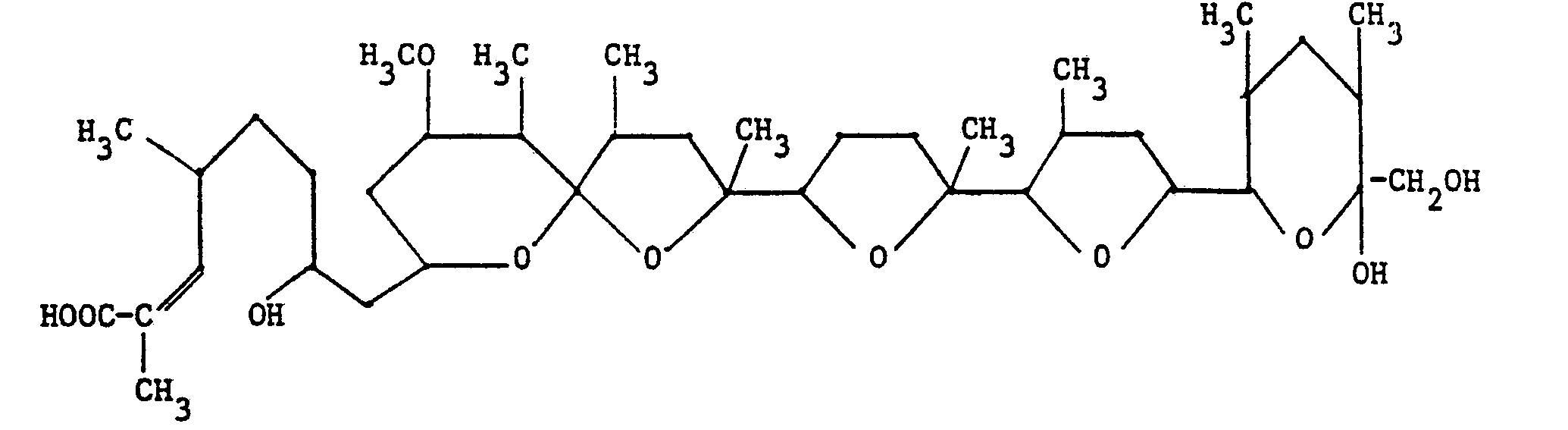
- the invention relates to the polyether ionophore in acid form called "abierixin", corresponding to the formula: Likewise, the invention relates to abierixin in hydrated form or in the form of non-toxic salts.
- non-toxic salts is meant more particularly the alkali metal salts, such as lithium, sodium or potassium, the alkaline earth metal salts, such as calcium or magnesium, or the ammonium salts, such as those obtained from ammonia or an amine, such as methylamine, ethylamine, dimethylamine, diethylamine, triethylamine, ethanolamine, diethanolamine, tromethamol.
- alkali metal salts such as lithium, sodium or potassium
- the alkaline earth metal salts such as calcium or magnesium
- ammonium salts such as those obtained from ammonia or an amine, such as methylamine, ethylamine, dimethylamine, diethylamine, triethylamine, ethanolamine, diethanolamine, tromethamol.
- the compounds of the invention have been found useful as a growth factor in ruminants.
- the compounds of the invention are capable of enhancing the cytotoxic activity of immunotoxins.
- compositions in particular a pharmaceutical composition or a food or therapeutic veterinary composition containing, as essential active principle, at least one compound of the invention in association with a vehicle, diluent or suitable excipient.
- the minimum inhibitory concentration of abierixin against Bacillus cereus determined according to the dilution method is 25 ⁇ g / ml but 0.05 ⁇ g / ml, 0.05 ug / ml and 3.12 gg / ml in the case of monensin, nigericin and grisorixin respectively.
- abierixin will therefore have an indisputable advantage over known polyether antibiotics because this compound will be less likely to cause destruction of the rumen flora.
- abierixin is prepared by culture of a strain of Actinomycetales and this, in a nutritive medium containing an assimilable source of carbon, nitrogen and mineral salts.
- the strain used is of the Streptomyces species, in particular of the hygroscopicus class.
- a particularly useful strain for the production of abierixin is the Streptomyces strain deposited with the INSTITUT PASTEUR (Paris) in the National Collection of Cultures of Microorganisms (C.N.C.M.) under No. 1-321. (Filing date July 31, 1954).
- the spores form spiral chains in compact spirals. Their surface is smooth.
- Streptomyces albua NRRL B 1685 does not produce nigericin or abierixin under the same conditions as those used previously.
- a vegetative inoculum of Streptomyces is first prepared, for example Streptomyces C.N.C.M. - 1-321 by inoculating a small amount of the culture broth with a suspension of frozen spores of the microorganism.
- This microorganism is then grown under aerobic conditions, at a temperature between 25 ° C and 30 ° C, preferably at 27 ° C and on different nutrient media containing elements usually used for this purpose.
- abierixin takes place in 3 to 10 days after inoculation of the culture medium under aerobic conditions and sufficient agitation.
- glucose, dextrins, starch, molasses can be used as the carbon source.
- the nitrogen sources can be yeast extracts, meat extracts, soy flour hydrolysates, casein hydrolysates, meat peptones, "corn-steep” etc ...
- the pH of the culture medium Before inoculation by the microorganism, it is desirable to adjust the pH of the culture medium between approximately 6.5 and 7.5 preferably to 7.2 and this, using an alkali metal hydroxide , such as sodium or potassium hydroxide.
- an alkali metal hydroxide such as sodium or potassium hydroxide.
- the abierixin fraction produced during fermentation is contained in the mycelium. The best yield is obtained from a mycelium isolated using a centrifuge and wrung out.
- the abierixin produced is then extracted, for example by means of ethanol, for approximately 2 hours. It has been noted that this duration makes it possible to obtain 98% of the weight of active compounds produced during fermentation, constituted in particular of abierixin and nigericin.
- the mixture of polycyclic polyethers thus obtained is purified by means of three successive chromatographies, first by column chromatography, so as to remove the fatty acids and most of the nigericin, then by flash chromatography (J. Org. Chem. 1978, 14, 2923) so as to remove all of the elaiophyline and part of the nigericin and finally by high pressure liquid chromatography (HPLC).
- abierixin is isolated in the form of an alkali metal salt.
- Abierixin itself can be obtained in monohydrate form by acidification of its alkali metal salt present in the enriched fractions obtained after purification by column chromatography as described above.
- the monohydrate thus obtained can be moderately heated to recover the abierixin.
- non-toxic salts of abierixin these can be produced in a known manner by reaction of abierixin or its hydrate with an appropriate organic or inorganic base, such as an alkali metal hydroxide, an alkali metal oxide - earthy, ammonia or an amine.
- an appropriate organic or inorganic base such as an alkali metal hydroxide, an alkali metal oxide - earthy, ammonia or an amine.
- Solid Mp 83-85 ° C
- Solubility dissolves in common organic solvents, such as lower alcohols, for example methanol, ethanol, lower esters, for example ethyl acetate or in ethyl ether and chloroform. In water, the solubility is approximately 44%.
- ⁇ j 25: + 45 ° (c 0.03 n, methanol)
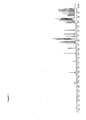
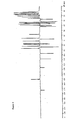
- Figure 3 shows at 200 MHz the nuclear magnetic resonance spectrum of the abierixin proton (reference substance: tetramethylsilane) and Figures 4 let 5 show the nuclear magnetic resonance spectrum of 13 C of this compound at 50.3 MHz (reference substance: tetramethylsilane).
- Appearance solid white foam.
- Mp 120-123 ° C Solubility dissolves in the usual organic solvents, such as lower alcohols, for example methanol, ethanol, lower esters, for example ethyl acetate, or in ethyl ether and chloroform. However, it is insoluble in water.
- Such mutants can be obtained by known techniques, for example by subjecting the abierixin-producing microorganism to X-ray or ultraviolet irradiation or to the action of chemical agents.
- Coccidiosis is a common and widespread disease in poultry, pigs, rabbits, cats, dogs, certain ruminants, etc., a disease caused by one or more parasitic species of the protozoan type Eimeria strain such as E. tenella, E. necatrix, E. acervulina, E. maxima, E. brunetti, E. mivati, E. adenoides and E. mateagrimitis.
- E. tenella and E. acervulina are the agents responsible for a significant and often fatal infection in chickens, an infection manifested by severe and severe bleeding, an accumulation of blood in the cecum and the passage of blood through the faeces.
- E. necatrix attacks the small intestine of chicken causing intestinal coccidiosis while E. maleagrimitis and E. adenoides are responsible for coccidiosis in turkeys.
- abierixin and its non-toxic salts have very interesting anticoccidial properties which can be used for the destruction of parasites in birds and certain ruminants (sheep).
- abierixin and its non-toxic salts can be useful as a growth factor in particular in ruminants and as such can be used in breeding as a food additive.
- abierixin is of particular interest by the fact that it allows rumen flora to use nitrogen from animal food rations in a different way than that of nigericin or monensin, two known ionophoric antibiotics.
- abierixin significantly reduces the fermentability of the protein sources studied (sweet lupine seed, peanut cake, soybean meal) just like monensin or nigericin.
- abierixin could therefore limit the breakdown of proteins in the rumen and thus increase the supply of amino acids of food origin in the small intestine of the ruminant.
- abierixin does not significantly reduce the amount of ammoniacal nitrogen fixed by the bacteria. This compound therefore does not have the inhibitory effect of monensin or nigericin on microbial synthesis, an effect which has been described with different ionophores or antibiotics.
- the efficiency of microbial synthesis measured in the absence of protein nitrogen in order to know with precision the quantity of nitrogen fixed by the bacteria only decreased by 10% in the presence of abierixin, but of more than 30% with monensin or nigericin, which confirms the difference in behavior of the compound of the invention and the known compounds.
- Abierixin as growth promoter for ruminants, therefore presents undeniable advantages over nigericin or monensin since the compound of the invention improves the use of nitrogen in ruminant rations by limiting degradation proteins in the rumen without reducing activity fermentation of microbes.
- abierixin is capable, in combination with certain antibiotics, in particular aminoglycoside antibiotics, of potentiating the action of these compounds.
- abierixin and its non-toxic salts in combination with certain antibiotics, could be used in human medicine.
- abierixin and its pharmaceutically acceptable salts are also capable of increasing the cytotoxicity of immunotoxins, that is to say conjugates obtained from an antibody, for example a monoclonal antibody, or one of its fragments and a toxin, for example the A chain of ricin, or a fragment thereof.
- immunotoxins associated with abierixin or a pharmaceutically acceptable salt thereof may be used for clinical applications, in particular for removing metastatic tumor cells from bone marrow samples from patients undergoing autologous transplantation and consequently avoiding , renewal of the transplant.
- the acute LD 50 toxicity of abierixin in the oral mouse is between 600 and 1000 mg / kg while, under the same conditions, the toxicity of other polycyclic polyethers is found to be very larger, of the order of 50 mg / kg (LD 50 lonomycin: 50 mg / kg, monensin complex: 43.8 mg / kg, salinomycin: 50 mg / kg).
- satinomycin * and nigericin-, intraperitoneally in mice have an LD 50 of 18 mg / kg and 10 to 15 mg / kg respectively.
- Abierixin and its non-toxic salts can therefore be administered as a medicinal active principle in the form of unit compositions suitable for administration in human or veterinary therapy or as a food additive for veterinary use.
- compositions in question are prepared by combining the active principle according to the invention, with a suitable vehicle, diluent or excipient.
- an anticoccidial therapeutic composition can be obtained by adding abierixin or one of its non-toxic salts to the basic food ration in an amount of the order of 0.02% by weight of the final mixture. .
- this may take the form, for example, of a tablet, a dragee, a capsule, a capsule, a powder, a suspension or a syrup for oral administration, a suppository for rectal administration, a sterile solution or suspension for parenteral administration.
- the administration unit can also take the form of a premix containing the active principle dispersed on the vehicle or diluent or else the form of a food supplement containing the active principle mixed with the vehicle or diluent. .
- such a vehicle is preferably a food component for animals, for example oats, soybeans, alfalfa, wheat, fermentation residues, crushed oyster shells, molasses, edible vegetable substances, soy flour, kaolin, talc, crushed limestone, etc ...
- compositions of the invention intended to combat coccidiosis can contain from 10 to 80% by weight of abierixin or of a non-toxic salt thereof and from 90 to 20% of vehicle or diluent by weight of the composition.
- These premixes can be diluted with an animal feed supplement or can be added directly to an animal feed ration to provide a therapeutic feed that can be ingested by poultry.
- abierixin and its non-toxic salts can be administered in the form of a solution or suspension containing a therapeutically effective amount of this active ingredient in poultry drinking water.
- Such a therapeutically active amount can vary from 0.005 to 0.04% by weight of the amount of daily food in chicken.
- a 500 ml Erlenmeyer flask is sterilized for 20 min. at 118 ° C. There are then placed 100 ml of medium l (30 g of soy flour, 20 g of glucose, 2.5 g of corn-steep, 1.0 g of K 2 HP0 4 , 1000 ml of water, the pH being adjusted to 7.2 with 10N NaOH).
- a tube of frozen spores of Streptomyces CNCM-1-321 is then introduced and the whole is stirred in a shaker with a rotary movement for 3 days at 27 ° C. (speed: 200 rpm).
- the 1st preculture is transferred to a 20-liter fermenter containing 1 l of medium I then stirred for 24 hours.
- a 20 I fermenter containing 15 l of medium II is sterilized (yeast extract: 1 g, meat extract: 1 g, "casaminoacids" (casein hydrolyzed by an acid) 4 g, glucose: 15 g, methyl oleate: 20 g, water: 1000 ml, the pH being adjusted to 7.2 with 10N NaOH) for 45 min. at 188 ° C.
- the second preculture is then transferred to it and the medium thus formed is kept in culture for 7 days at a temperature of 27 ° C. with stirring (speed 650 rpm) and under aeration of 0.75 air / min / 1 of middle.
- the mycelium is separated from the fermentation juice by centrifugation at 40,000 g.
- the collected mycelium is placed in 500 ml of ethanol in the centrifuge cylinder and it is very finely ground in order to allow better action of the extraction solvent.
- 4 l of ethanol 300 ml of ethanol / l of centrifuged medium
- the mycelium is then separated on a sintered glass filter and the ethanolic extract is concentrated using a cyclone evaporator. The concentration is then continued by means of a rotary evaporator until a dark red oil is obtained.
- This first column eliminates fatty acids and much of the nigericin.
- fractions enriched in abierixin are then treated by flash chromatography which uses characters specific to pressure chromatography. It is a fast and economical technique allowing in 10 to 15 min. the separation of samples whose weights are between 0.04 and 2.5 g.
- a solvent which migrates the desired element to an Rf of 0.35 by thin layer chromatography.
- a column of appropriate diameter is filled up to a height of 15 cm with silica gel (0.040-0.063 mm), the eluent is added and the pressure is adjusted to have a flow rate of ⁇ 3 cm 3 / min. (n: radius of the column in cm).
- HPLC chromatography is carried out using two columns of silica gel connected in series. Columns 40 cm long and 6 cm in diameter are used for this purpose and detection is carried out using a differential refractometer integrated into the chromatograph.
- the sodium salt of abierixin is obtained in the form of a solid white foam.
- Abierixin monohydrate can be obtained from its sodium salt by modifying the eluents in flash chromatography (paragraph 2) by adding 0.5% acetic acid to them, namely:
- An animal feed premix was prepared by thoroughly mixing the following ingredients:
Landscapes
- Chemical & Material Sciences (AREA)
- Health & Medical Sciences (AREA)
- Organic Chemistry (AREA)
- Life Sciences & Earth Sciences (AREA)
- Engineering & Computer Science (AREA)
- Bioinformatics & Cheminformatics (AREA)
- Zoology (AREA)
- Wood Science & Technology (AREA)
- General Health & Medical Sciences (AREA)
- Genetics & Genomics (AREA)
- Biotechnology (AREA)
- Biochemistry (AREA)
- Medicinal Chemistry (AREA)
- General Chemical & Material Sciences (AREA)
- Chemical Kinetics & Catalysis (AREA)
- Microbiology (AREA)
- General Engineering & Computer Science (AREA)
- Veterinary Medicine (AREA)
- Tropical Medicine & Parasitology (AREA)
- Pharmacology & Pharmacy (AREA)
- Public Health (AREA)
- Animal Behavior & Ethology (AREA)
- Nuclear Medicine, Radiotherapy & Molecular Imaging (AREA)
- Virology (AREA)
- Biomedical Technology (AREA)
- Obesity (AREA)
- Molecular Biology (AREA)
- Hematology (AREA)
- Diabetes (AREA)
- Immunology (AREA)
- Heterocyclic Carbon Compounds Containing A Hetero Ring Having Oxygen Or Sulfur (AREA)
- Organic Low-Molecular-Weight Compounds And Preparation Thereof (AREA)
- Polyethers (AREA)
- Pharmaceuticals Containing Other Organic And Inorganic Compounds (AREA)
- Acyclic And Carbocyclic Compounds In Medicinal Compositions (AREA)
- Preparation Of Compounds By Using Micro-Organisms (AREA)
- Compositions Of Macromolecular Compounds (AREA)
- Materials For Medical Uses (AREA)
- Solid-Sorbent Or Filter-Aiding Compositions (AREA)
- Fodder In General (AREA)
Description
- La présente invention se rapporte, d'une manière générale, à un nouvel ionophore polyéther ainsi qu'à son procédé de préparation.
- En particulier, l'invention concerne l'ionophore polyéther sous forme acide appelé "abiérixine", répondant à la formule :
- Par sels non toxiques, on entend plus particulièrement les sels de métaux alcalins, tels que lithium, sodium ou potassium, les sels de métaux alcalino-terreux, tels que calcium ou magnésium, ou les sels d'ammonium, tels que ceux obtenus à partir de l'ammoniac ou d'une amine, telle que méthylamine, éthylamine, diméthylamine, diéthylamine, triéthylamine, éthanolamine, diéthanolamine, trométhamol.
- On a trouvé que l'abiérixine et ses sels non toxiques sont doués de propriétés anticoccidiennes notamment vis-à-vis d'Eimeria tennella.
- De même, les composés de l'invention se sont révélés utiles comme facteur de croissance chez les ruminants.
- En outre, on a trouvé que les composés de l'invention sont capables d'exalter l'activité cytotoxique d'immunotoxines.
- Un autre objet de l'invention concerne, par conséquent, une composition, en particulier une composition pharmaceutique ou une composition vétérinaire alimentaire ou thérapeutique contenant, comme principe actif essentiel, au moins un composé de l'invention en association avec un véhicule, diluant ou excipient approprié.
- On connait déjà de nombreux antibiotiques du groupe des polyéthers par exemple la monensine, la nigéricine, la grisorixine, la salinomycine etc... ces composés étant actifs contre les bactéries Gram-positives, les champignons et les protozoaires. Ces antibiotiques montrent en outre des propriétés anticoccidiennes.
- Par exemple, on a décrit dans les brevets de l'Allemagne de l'Est Nos. 208 172 et 237 725 des complexes d'antibiotiques produits à partir de souches de Streptomyces hygroscopicus. Ces composés polyéthers sont caractérisés par une activité antibiotique importante et comparativement plus importante que celle présentée par la monensine ou la salinomycine. Par contre, l'abiérixine est douée d'activité antibiotique très faible par rapport à celle présentée par la plupart des ionophores polyéthers connus comme la monensine, la nigéricine ou la grisorixine. Par exemple, la concentration minimale inhibitrice de l'abiérixine vis-à-vis de Bacillus cereus déterminée selon la méthode de dilution est de 25 µg/ml mais de 0,05 µg/ml, 0,05 ug/ml et 3,12 gg/ml dans le cas respectivement de la monensine, de la nigéricine et de la grisorixine.
- En tant que facteur de croissance chez les ruminants, l'abiérixine présentera par conséquent, un avantage incontestable par rapport aux antibiotiques polyéthers connus car ce composé sera moins susceptible de provoquer une destruction de la flore du rumen.
- Selon l'invention, on prépare l'abiérixine par culture d'une souche d'Actinomycetales et ce, en milieu nutritif contenant une source assimilable de carbone, d'azote et de sels minéraux.
- Généralement, la souche utilisée est de l'espèce Streptomyces en particulier de la classe des hygroscopicus. A titre d'exemple, on peut citer, comme souches productrices d'abiérixine, Streptomyces hygroscopicus NRRL B 1865 et Streptomyces hygroscopicus NRRL 3602.
- Une souche particulièrement utile pour la production d'abiérixine est la souche de Streptomyces déposée auprès de l'INSTITUT PASTEUR (Paris) dans la Collection Nationale de Cultures de Microorganismes (C.N.C.M.) sous le No. 1-321. (Date de dépôt 31 juillet 1954).
- Cette souche présente les caractéristiques suivantes :
- En utilisant les milieux définis ci-après :
- A : milieu extrait de malt et de levure (ISP 2)
- B : milieu farine d'avoine (ISP 3)
- C : milieu de BENNET (S.A. WAKSMANN "The actinomycetes" vol. 2 p. 33)
- D : milieu d'EMERSON id. p. 331
- E : milieu CZAPEK - saccharose id. p. 328
- F. milieu CZAPEK-glycerol id.p.328
- G: milieu tyrosine de GORDON et MMITH [Jr. Bact.69, 147-150 (1955)] on a relevé les caractéristiques culturelles ci-après:
- Sur tous les milieux, le mycélium devient pratiquement noir et humide mais seulement au bout de cinq ou six semaines.
- Les spores forment des chaînes spiralées en spirales compactes. Leur surface est lisse.
-

- Les sucres mentionnés ci-dessus sont utilisés dans la classification de NONOMURA, J. Ferment. Technol. 52, 78-92 (1974).
- D'autres caractéristiques des souches productrices d'abiérixine peuvent être relevées à partir du Tableau suivant :
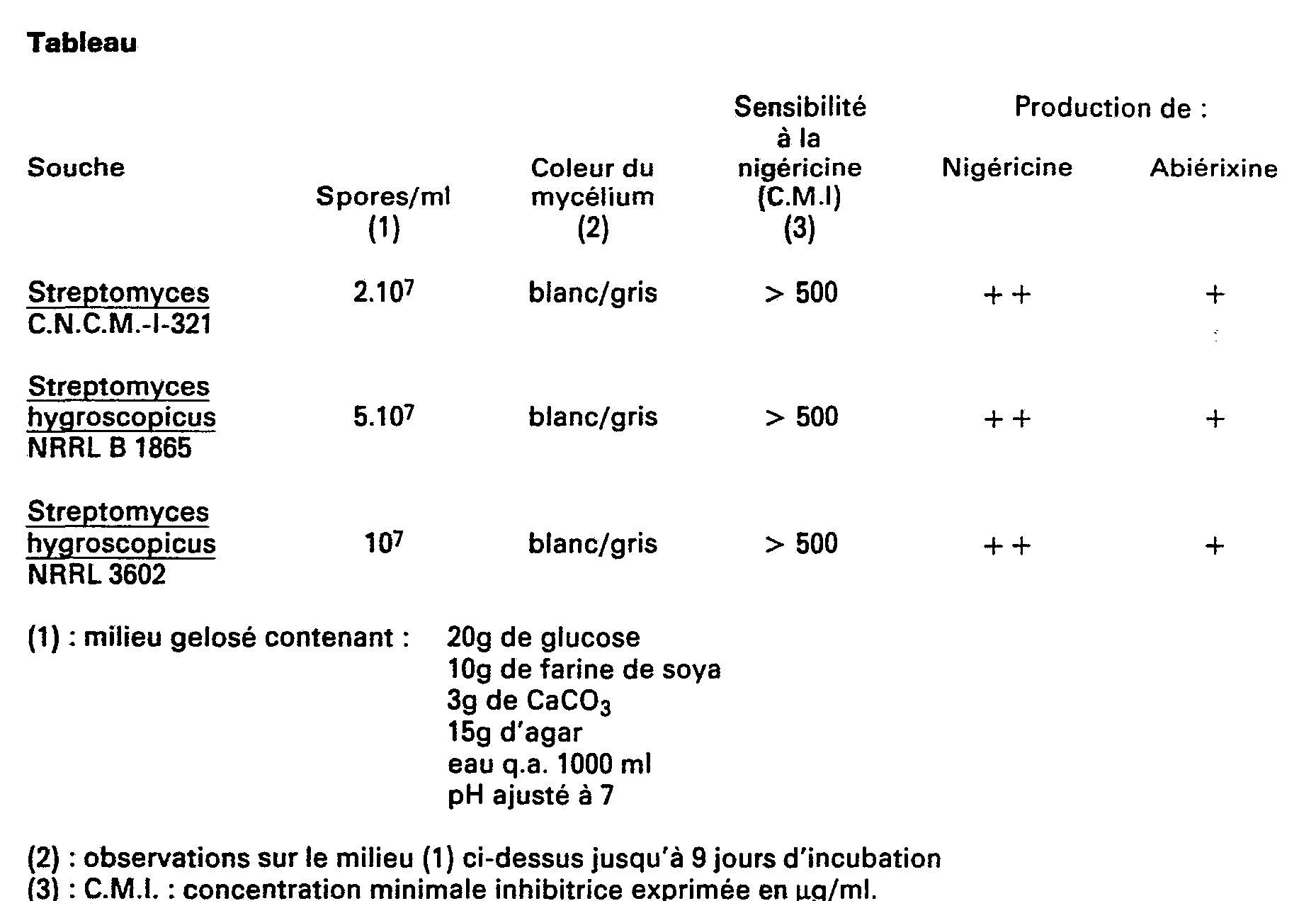
- Par contre le Streptomyces albua NRRL B 1685 ne produit ni nigéricine ni abiérixine dans les mêmes conditions que celles utilisés précédemment.
- Ces réaultats laissent supposer qu'une souche productrice de nigéricine serait également productrice d'abiérixine.
- Suivant un mode de réalisation pour l'obtention de l'abiérixine, on prépare d'abord un inoculum végétatif de Streptomyces par exemple Streptomyces C.N.C.M. - 1-321 en ensemençant une petite quantité du bouillon de culture avec une suspension de spores congelés du micro-organisme.
- On cultive ensuite ce micro-organisme sous conditions d'aérobiose, à une température comprise entre 25°C et 30° C, de préférence à 27° C et sur différents milieux nutritifs contenant des éléments habituellement utilisés à cet effet.
- En général, la production maximale d'abiérixine a lieu en 3 à 10 jours après l'inoculation du milieu de culture sous conditions d'aérobiose et d'agitation suffisantes.
- Comme source de carbone, on peut utiliser le glucose, les dextrines, l'amidon, les mélasses.
- Les sources d'azote peuvent être des extraits de levure, des extraits de viande, des hydrolysats de farine de soya, des hydrolysats de caséine, des peptones de viande, du "corn-steep" etc...
- Avant l'inoculation par le micro-organisme, il est souhaitable d'ajuster le pH du milieu de culture entre environ 6,5 et 7,5 de préférence à 7,2 et, ce, au moyen d'un hydroxyde de métal alcalin, tel que l'hydroxyde de sodium ou de potassium. La fraction abiérixine produite lors de la fermentation est contenue dans le mycélium. Le meilleur rendement est obtenu à partir d'un mycélium isolé à l'aide d'une centrifugeuse et essoré.
- On extrait alors l'abiérixine produite, par exemple au moyen d'éthanol, pendant 2 heures environ. On a remarqué que cette durée permet d'obtenir 98 % du poids de composés actifs produits lors de la fermentation constitués notamment d'abiérixine et de nigéricine. On purifie le mélange de polyéthers polycycliques ainsi obtenu, au moyen de trois chromatographies successives, d'abord par chromatographie sur colonne, de manière à éliminer les acides gras et la majeure partie de la nigéricine, ensuite par chromatographie-éclair (J. Org. Chem. 1978, 14, 2923) de manière à éliminer la totalité de l'élaiophyline et une partie de la nigéricine et finalement par chromatographie liquide haute pression (CLHP).
- A ce stade, on isole l'abiérixine sous forme de sel de métal alcalin.
- L'abiérixine elle-même peut être obtenue sous forme monohydratée par acidification de son sel de métal alcalin présent dans les fractions enrichies obtenues après purification par chromatographie sur colonne comme décrit précédemment.
- Ces fractions enrichies, lorsqu'elles sont éluées en chromatographie-éclair au moyen de solvants contenant un acide, par exemple l'acide acétique fournissent l'abiérixine monohydratée.
- Toutefois, on a remarqué que le traitement par l'acide chlorhydrique N/10 d'une solution éthérée du sel de sodium de l'abiérixine ne conduit pas à l'acidification totale de l'abiérixine.
- Le monohydrate ainsi obtenu peut être chauffé modérément pour recouvrer l'abiérixine.
- Quant aux sels non toxiques d'abiérixine, ceux-ci peuvent être produits de manière connue par réaction de l'abiérixine ou de son hydrate avec une base organique ou inorganique appropriée, telle qu'un hydroxyde de métal alcalin, un oxyde de métal alcalino-terreux, l'ammoniac ou une amine.
- On a déterminé certaines propriétés physico-chimiques des composés de l'invention, à savoir :
- Aspect: solide
P.F. : 83-85° C
Solubilité : se dissout dans les solvants organiques usuels, tels que les alcools inférieurs par exemple méthanol, éthanol, les esters inférieurs, par exemple l'acétate d'éthyle ou encore dans l'éther éthylique et le chloroforme.
Dans l'eau, la solubilité est de 44 % environ.
αj25 : +45° (c = 0,03 n, méthanol) - Masse moléculaire : 742 déterminée par la méthode FAB (Fast Atom Bombardment) [Org. Mass Spectrum, 16,256 (1981)].
- L'ion (M-H)m/z : 723 apparaît dans le spectre FAB négatif et confirme la masse moléculaire m/z = 724 de l'abiérixine.
- Formule brute : C40H68O11·H2O
- Analyse élémentaire :

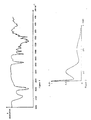
- En infrarouge, le spectre de l'abiérixine, représenté à la figure 1, présente les bandes caractéristiques suivantes* :
- 3360(F), 2980(F), 2940(F), 2880(F), 2640(t.f.), 1730(f), 1640(f), 1460(m), 1370(m), 1360(e), 1355(e), 1310(e), 1300(e), 1290(f), 1260(t.f.), 1240(t.f.), 1205(t.f), 1185(t.f.), 1115(m), 1080(F), 1070(F), 1040(F), 1030(F), 1020(F), 990(f), 980(f), 960(m), 930(t.f.), 910(t.f.), 880(t.f.), 870(t.f.), 845(t.f.), 810(t.f.), 730(t.f.), 715(t.f.), 690(t.f.), 640(t.f.), 620(t.f.), 610(t.f.), 590(t.f.), 535(t.f.), 500(t.f.), 460(t.f.), 455(t.f.), 415(t.f.), 395(t.f.)cm-1.
- *: e = épaulement, t.f. = très faible, f = faible, m = moyen, F = forte.
- De ces données, on peut tirer les informations suivantes :
- - entre 3700 et 3150 cm-1, une bande intense qui se prolonge jusqu'a 2500 cm-1 implique la présence d'un ou plusieurs groupements hydroxylés dont un pourrait être un OH d'acide.
- - trois bandes très intenses avec des maxima à 2970, 2940 et 2880 cm-1 correspondent aux vibrations d'élongation des liaisons CH de la molécule.
- - une bande intense à 1715 - 1690 cm-1 que l'on peut attribuer aux vibrations de valence d'une liaison C=0 d'acide conjugué du type C=C-C02H
- - une bande intense a 1460 cm-1 attribuable aux vibrations des déformations des liaisons C-H
- - enfin, une bande large représentant plusieurs maxima entre 1115 et 1020 cm-1 qui se rapporte a des vibrations de valence C-O-C.
- En ultraviolet, le spectre de l'abiérixine, représenté à la figure 2 présente une bande intense (λ max = 217 nm, ε = 10400), caractéristique d'un groupement acide α,β-insaturé, et une bande faible (λ, max , 275 nm, c = 2800).
- La figure 3 représente à 200 MHz le spectre de résonance magnétique nucléaire du proton de l'abiérixine (substance de référence : tétraméthylsilane) et les figures 4 let 5 représentent à 50,3 MHz le spectre de résonance magnétique nucléaire du 13C de ce composé (substance de référence : tétraméthylsilane).
- Aspect : mousse blanche solide.
P.F. 120-123° C
Solubilité : se dissout dans les solvants organiques usuels, tels que les alcools inférieurs par exemple méthanol, éthanol, les esters inférieurs par exemple l'acétate d'éthyle ou encore dans l'éther éthylique et le chloroforme.
Par contre, il est insoluble dans l'eau. - Le spectre infrarouge du sel de sodium de l'abiérixine se distingue de celui de l'abiérixine même par le fait que la bande intense à 1715 - 1690 cm1 due à la liaison C=0 de l'acide est remplacée par une bande intense à 1540 cm-1 due à l'ion carboxylate.
- On a décrit ci-dessus la préparation, selon l'invention, de l'abiérixine à partir de souches de Streptomyces.
- Il est entendu que l'invention ne se limite pas à la production d'abiérixine à partir de ces souches mais englobe également des modes de réalisation équivalents à partir notammént des souches en question en particulier à partir de la souche Streptomyces C.N.C.M.-I-321 sans pour autant sortir du cadre de l'invention.
- De tels mutants peuvent être obtenus par des techniques connues, par exemple en soumettant le micro- organisme producteur d'abiérixine à une irradation aux rayons X ou ultraviolets ou à l'action d'agents chimiques.
- La coccidiose est une maladie commune et répandue chez la volaille, le porc, le lapin, le chat, le chien, chez certains ruminants etc..., maladie causée par une ou plusieurs espèces parasites du type protozoaire de souche Eimeria tels que E. tenella, E. necatrix, E. acervulina, E. maxima, E. brunetti, E. mivati, E. adenoides et E. mateagrimitis.
- E. tenella et E. acervulina sont les agents responsables d'une infection importante et souvent fatale des poulets, infection qui se manifeste par une hémorragie sévère et importante, une accumulation de sang dans le caecum et par passage de sang dans les matières fécales.
- E. necatrix attaque l'intestin grêle du poulet causant une coccidiose intestinale tandis que E. maleagrimitis et E. adenoides sont responsables de la coccidiose chez le dindon.
- Laissées sans traitement, les infections graves dues à la coccidiose conduisent à un gain de poids inférieur à la normale, à une efficacité réduite de la nourriture et à une mortalité élevée chez les oiseaux.
- Par conséquent, la morbidité et la mortalité occasionnées par les infections de coccidiose créent une perte économique importante lorsque les infections sont laissées sans traitement ou sans surveillance.
- L'élimination ou le contrôle de cette maladie est, par conséquent, de première importance, notamment pour l'élevage de la volaille.
- On a trouvé, dans le cadre de la présente invention, que l'abiérixine ainsi que ses sels non toxiques présentent de très intéressantes propriétés anticoccidiennes susceptibles d'être utilisées pour la destruction de parasites chez les oiseaux et certains ruminants (ovins).
- Des tests ont été effectués de manière à montrer l'efficacité de l'abiérixine comme agent anticoccidien dans lesquels on a relevé les résultats zootechniques (poids, indice de consommation) et les symptômes chimiques de coccidiose (morbidité, mortalité, aspect des matières fécales, excrétion ookystale, lésions).
- On a utilisé à cet effet le protocole expérimental suivant :
- Animaux
- - Coquelets de souche génétique Warren Sex Sal Link
- - Age le jour de l'inoculation (J O) : 17 jours
- - Age le jour de l'abattage (J +8) : 25 jours
- Inoculum
Dose : 300 000 oocystes sporulés d'Eimeria tenella - Alimentation
- - Aliment utilisé : aliment type poulet de chair, 1er âge
- - Anticoccidien utilisé : l'abiérixine à la dose de 40 ou 50 ppm/jour depuis J-2 jusqu'à J +8
- Lots
- - Nombre d'animaux par lot : 4
- - Répartition des lots :
- NCNT : animaux non contaminés, non traités
- CTNT : animaux contaminés, non traités
- CTT, : animaux contaminés, traités avec 40 ppm d'abiérixine
- CTT2 : animaux contaminés, traités avec 50 ppm d'abiérixine
- Les critères
- - Les gains de poids (GP) de J-2 à J +8
- - L'excrétion ookystale (EO) journalière de J+4 à J+8
- - La morbidité (M) notée de 0 à 4
- - L'aspect des fécès noté de 0 : fécès normales à 4 : fécès diarrhéiques ou hémorragiques (MF)
- - La mortalité (M %) exprimée en pourcentage
- - Les lésions (L) notées selon la notation de RFID (W. Malcolm REID, "A diagnostic chart of nine species of fowl coccidia - Georgia Agricultural Experiment Stations - Dec. 1964, Technical Bulletin N. S. 39)
- - Les indices de consommation (IC)
- Les résultats montrent qu'à la dose de 40 ppm/jour l'abiérixine augmente la croissance pondérale de coquelets âgés de 14 jours et contaminés par E. tenella quand ce produit est distribué pendant 10 jours.
- On a également trouvé, dans le cadre de l'invention, que l'abiérixine et ses sels non toxiques peuvent être utiles comme facteur de croissance en particulier chez les ruminants et à ce titre peuvent être employés en élevage comme additif alimentaire.
- Dans ce contexte, on a remarqué que "in vitro" l'abiérixine présente un intérêt tout particulier par le fait qu'elle permet, à la flore ruménale, d'utiliser l'azote des rations alimentaires animales de manière différente de celle de la nigéricine ou de la monensine, deux antibiotiques ionophores connus.
- L'addition d'abiérixine au milieu fermentaire diminue notablement la fermentescibilité des sources protéiques étudiées (graine de lupin doux, tourteau d'arachide, tourteau de soya) tout comme la monensine ou la nigéricine.
- L'emploi "in vivo" d'abiérixine pourrait donc limiter la dégradation des protéines dans le rumen et ainsi accroître l'apport d'acides aminés d'origine alimentaire dans l'intestin grêle du ruminant.
- Par contre, la présence d'abiérixine ne diminue pas significativement la quantité d'azote ammoniacal fixée par les bactéries. Ce composé n'a donc pas l'effet inhibiteur de la monensine ou de la nigéricine sur la synthèse microbienne, effet qui a été décrit avec différents ionophores ou antibiotiques.
- En outre, l'efficacité de la synthèse microbienne mesurée en l'absence d'azote protéique, afin de connaître avec exactitude la quantité d'azote fixée par les bactéries n'a diminué que de 10 % en présence d'abiérixine, mais de plus de 30 % avec la monensine ou la nigéricine, ce qui confirme la différence de comportement du composé de l'invention et des composés connus.
- L'addition des effets à la fois sur la fourniture d'acides aminés provenant de protéines alimentaires et sur la quantité de protéines microbiennes synthétisées dans le rumen ne pourrait qu'avoir des répercutions positives sur la nutrition azotée du ruminant.
- Il s'est avéré également possible d'envisager l'emploi d'abiérixine dans des rations alimentaires contenant de l'azote non protéique utilisable par les bactéries alors qu'une utilisation des antibiotiques ou ionophores connus à ce jour n'est pas très recommandable dens de telle conditions.
- L'absence d'effets négatifs de l'abiérixine sur l'activité microbienne ou sur la production de gaz à partir d'azote protéique a également pu être mise en évidence alors que de tels effets négatifs ont été enregistrés en particulier avec la nigéricine.
- L'abiérixine, en tant que tacteur de croissance pour ruminants, présente, par conséquent, des avantages indéniables sur la nigéricine ou la monensine puisque le composé de l'invention améliore l'utilisation de l'azote des rations du ruminant en limitant la dégradation des protéines dans le rumen sans réduire l'activité fermentaire des microbes.
- En outre, on mentionnera que l'abiérixine est capable, en association avec certains antibiotiques en particulier les antibiotiques aminoglycosides, de potentialiser l'action de ces composés.
- A ce titre, l'abiérixine et ses sels non toxiques, en association avec certains antibiotiques, pourraient être utilisés en médecine humaine.
- Comme indiqué précédemment, l'abiérixine et ses sels pharmaceutiquement acceptables sont également capables d'augmenter la cytotoxicité d'immunotoxines c'est-à-dire de conjugués obtenus à partir d'un anticorps, par exemple un anticorps monoclonal, ou un de ses fragments et une toxine, par exemple la chaîne A de la ricine, ou un de ses fragments.
- En conséquence, des immunotoxines associées à l'abiérixine ou à un de ses sels pharmaceutiquement acceptables pourront être utilisées pour des applications cliniques notamment pour éliminer les cellules tumorales metastatiques d'échantillons de moëlle osseuse provenant de patients subissant une transplantation autologue et éviter, en conséquence, le renouvellement de la greffe.
- Finalement, l'abiérixine et ses sels pharmaceutiquement acceptables ont montré une toxicité faible.
- On a trouvé, par exemple, que la toxicité aiguë DL50 de l'abiérixine chez la souris par voie orale est comprise entre 600 et 1000 mg/kg alors que, dans les mêmes conditions, la toxicité d'autres polyéthers polycycliques se révèle beaucoup plus importante, de l'ordre de 50 mg/kg (DL50 lonomycine : 50 mg/kg, complexe de monensine- : 43,8 mg/kg, salinomycine- : 50 mg/kg).
- A titre indicatif, la satinomycine* et la nigéricine-, par voie intrapéritonéale chez la souris, présentent une DL50 respectivement de 18 mg/kg et de 10 à 15 mg/kg.
- * : The Merck Index, 10ème édition (1983).
- L'abiérixine et ses sels non toxiques peuvent donc être administrés en tant que principe actif médicamenteux sous forme de compositions unitaires convenant à l'administration en thérapie humaine ou vétérinaire ou en tant qu'additif alimentaire à usage vétérinaire.
- Sous son aspect le plus général et en tenant compte de l'utilisation finale choisie, les compositions pharmaceutiques ou vétérinaires en question sont préparées en associant le principe actif selon l'invention, avec un véhicule, diluant ou excipient approprié.
- A titre d'exemple, une composition thérapeutique anticoccidienne peut être obtenue par addition d'abiérixine ou d'un de ses sels non toxiques, à la ration alimentaire de base en quantité de l'ordre de 0,02 % en poids du mélange final.
- Pour ce qui concerne l'unité d'administration celle-ci peut prendre la forme, par exemple, d'un comprimé, d'une dragée, d'une capsule, d'une gélule, d'une poudre, d'une suspension ou d'un sirop pour l'administration orale, d'un suppositoire pour l'administration rectale, d'une solution stérile ou suspension pour l'administration parentérale.
- A usage vétérinaire, l'unité d'administration peut en outre, prendre la forme d'un prémélange contenant le principe actif dispersé sur le véhicule ou diluant ou encore la forme d'un supplément de nourriture contenant le principe actif mélangé au véhicule ou diluant.
- Dans ces deux derniers cas, un tel véhicule est de préférence un composant alimentaire pour animaux, par exemple avoine, graine de soya, luzerne, froment, résidus de fermentation, coquilles d'huîtres broyées, mélasses, substances végétales comestibles, farine de soya, kaolin, talc, calcaire broyé, etc...
- Sous forme de prémélange, des compositions de l'invention destinées à lutter contre la coccidiose peuvent contenir de 10 à 80 % en poids d'abiérixine ou d'un de ses sels non toxiques et de 90 à 20 % de véhicule ou diluant en poids de la composition. Ces prémélanges peuvent être dilués avec un supplément alimentaire pour animaux ou peuvent être ajoutés directement à une ration alimentaire animale de manière à fournir une alimentation thérapeutique qui peut être ingérée par la volaille.
- Alternativement, l'abiérixine et ses sels non toxiques peuvent être administrés sous forme d'une solution ou suspension contenant une quantité thérapeutiquement efficace de ce principe actif dans l'eau de boisson de la volaille.
- Une telle quantité thérapeutiquement active peut varier de 0,005 à 0,04 % en poids de la quantité de nourriture journalière chez le poulet.
- Les exemples, non limitatifs suivants, illustrent l'invention :
- On stérilise un erlenmeyer de 500 ml pendant 20 min. à 118°C. On y place alors 100 ml de milieu l (30 g de farine de soya, 20 g de glucose, 2,5 g de corn-steep, 1,0 g de K2HP04, 1000 ml d'eau, le pH étant ajusté à 7,2 avec NaOH 10N). On introduit alors un tube de spores congelés de Streptomyces C.N.C.M.-1-321 et on agite l'ensemble dans une secoueuse animée d'un mouvement rotatif pendant 3 jours à 27° C (vitesse : 200 tr/min.).
- Sous conditions stériles, on transfère la 1ère préculture dans un fermenteur de 20 1 contenant 1 l de milieu I puis on agite pendant 24h.
- On stérilise un fermenteur de 20 I contenant 15 l de milieu Il (extrait de levure : 1 g, extrait de viande : 1 g, "casaminoacids" (caséine hydrolysée par un acide) 4 g, glucose : 15 g, oléate de méthyle : 20 g, eau : 1000 ml, le pH étant ajusté à 7,2 avec NaOH 10N) pendant 45 min. à 188°C. On y transfère alors la 2ème préculture et on maintient le milieu ainsi formé en culture durant 7 jours à la température de 27° C sous agitation (vitesse 650 tr/min) et sous aération de 0,75 d'air /min/1 de milieu.
- En fin de culture en fermenteur, on sépare le mycélium du jus de fermentation par centrifugation à 40 000 g. On place, dans 500 ml d'éthanol, le mycélium récolté dans le cylindre de la centrifugeuse et on le broie très finement afin de permettre une meilleure action du solvant d'extraction. Après broyage, on ajoute 4 1 d'éthanol (300 ml d'éthanol/l de milieu centrifugé) et on laisse agir le solvant pendant 2 h. On sépare alors le mycélium sur filtre en verre fritté et on concentre l'extrait éthanolique à l'aide d'un évaporateur cyclone. On poursuit ensuite la concentration au moyen d'un évaporateur rotatif jusqu'à obtention d'une huile rouge foncé. On ajoute ensuite 500 ml d'acide chlorhydrique 0,1 N, ce qui permet une meilleure extraction à l'éther éthylique (3 à 4 fois, 250 ml d'éther). On sèche sur sulfate de sodium anhydre et on concentre à l'évaporateur rotatif. On analyse alors l'extrait éthéré par chromatographie sur couche mince de gel de silice, ce qui permet de différencier l'abiérixine d'autres polyéthers polycycliques formés au cours de la fermentation (nigéricine).
-

- On réalise 3 chromatographies successives de l'extrait éthéré à savoir :
- L'on utilise à cet effet deux éluants :
- - cyclohexane/acétate d'éthyle 7/3 puis on fait varier régulièrement le pourcentage d'acétate d'éthyle jusqu'à 100 %.
- - chloroforme/méthanol 9/1 puis on fait varier le pourcentage de méthanol jusqu'à 100 %.
- Cette première colonne permet d'éliminer les acides gras et une grande partie de la nigéricine.
- On traite alors les fractions enrichies en abiérixine par chromatographie éclair qui utilise des caractères propres à la chromatographie sous pression. Il s'agit d'une technique rapide et économique permettant en 10 à 15 min. la séparation d'échantillons dont les poids sont compris entre 0,04 et 2,5 g.
- On choisit à cet effet un solvant qui fasse migrer l'élément désiré à un Rf de 0,35 en chromatographie sur couche mince. On remplit une colonne de diamètre approprié jusqu'à une hauteur de 15 cm avec du gel de silice (0,040-0,063 mm),on ajoute l'éluant et on règle la pression pour avoir un debit de π3 cm3/min. (n : rayon de la colonne en cm).
- En fonction du diamètre de la colonne et du volume d'éluant on a donné dans le tableau ci-dessous les quantités d'abiérixine et de nigéricine dans les fractions collectées ainsi que les Rf respectifs.


- Les volumes d'éluants donnés ci-dessus permettent d'éliminer la totalité de l'élaiophyline et une partie de la nigéricine formées au cours de la fermentation.
- On effectue la dernière chromatographie en CLHP en utilisant deux colonnes de gel de silice branchées en série. On emploie à cet effet des colonnes de 40 cm de longueur et 6 cm de diamètre et on effectue la détection à l'aide d'un réfractomètre différentiel intégré au chromatographe.
- On utilise deux éluants et deux valeurs de débit :
- 1er éluant : 31 de chloroforme/méthanol 95/5 (v/v). Le débit est de 50 ml/min. jusqu'à l'élution des pics antérieurs à l'abiérixine.
- 2ème éluant : 4 à 51 de chloroforme/méthanol 90/10. On règle le débit à 100 ml/min. et on recycle une fois la fraction contenant le composé désiré.
- On collecte des fractions de 100 ml puis on évapore le solvant.
- De cette manière, on obtient le sel sodique de l'abiérixine sous forme d'une mousse blanche solide.
- P.F. : 120-123° C.
- On peut obtenir l'abiérixine monohydratée à partir de son sel de sodium en modifiant les éluants au niveau de la chromatoqraphie éclair (paraqraphe 2) en leur ajoutant 0,5 % d'acide acétique, à savoir :

- De cette manière, on obtient l'abiérixine monohydratée.
- P.F. : 83-85° C
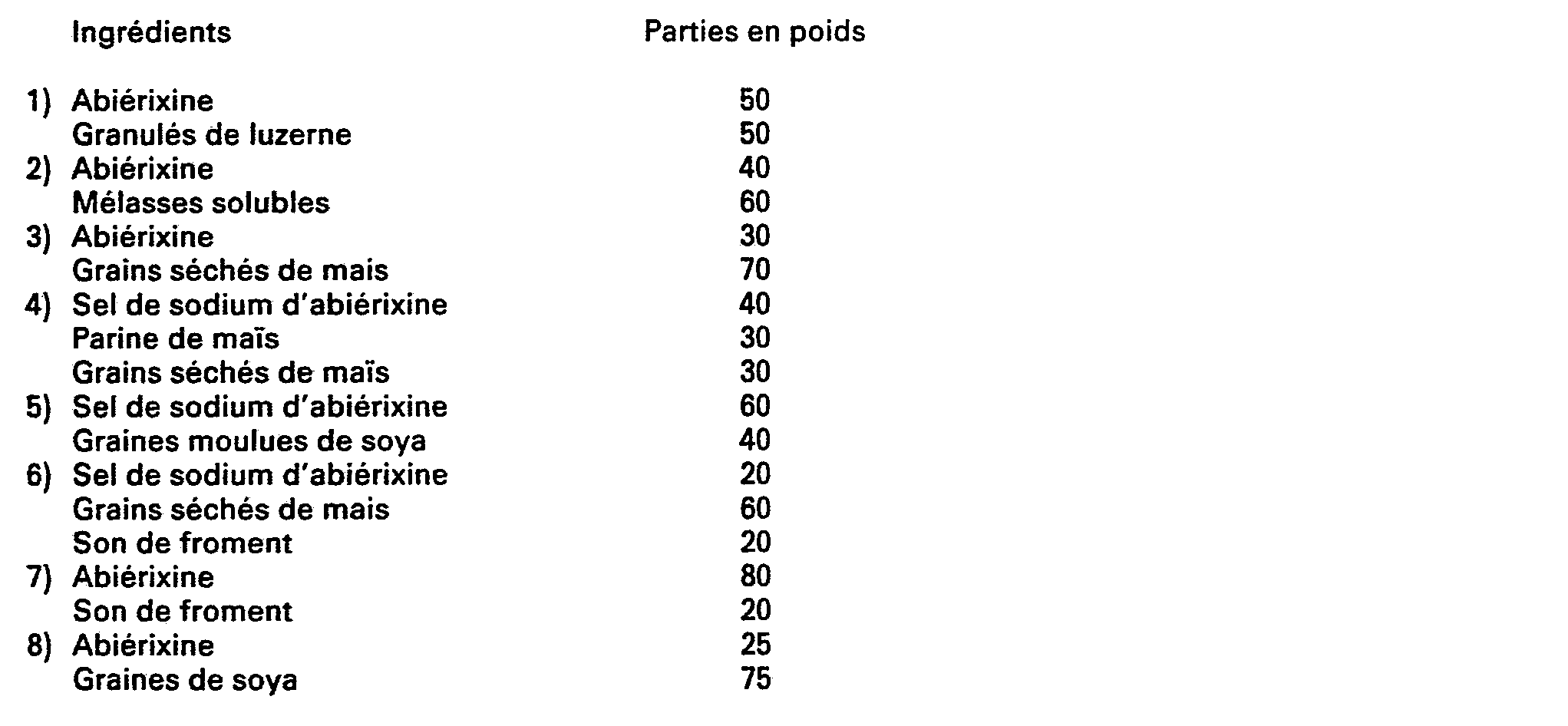
- On a préparé un prémélange alimentaire pour animaux en mélangeant intimement les ingrédients suivants :


Claims (9)

Priority Applications (1)
| Application Number | Priority Date | Filing Date | Title |
|---|---|---|---|
| AT85870125T ATE33391T1 (de) | 1984-09-19 | 1985-09-17 | Ionophor-polyether, deren verfahren zur herstellung und deren anwendung. |
Applications Claiming Priority (2)
| Application Number | Priority Date | Filing Date | Title |
|---|---|---|---|
| FR8414375 | 1984-09-19 | ||
| FR8414375A FR2570378B1 (fr) | 1984-09-19 | 1984-09-19 | Nouvel ionophore polyether, procede d'obtention et compositions veterinaires alimentaires ou therapeutiques le contenant |
Publications (2)
| Publication Number | Publication Date |
|---|---|
| EP0179751A1 EP0179751A1 (fr) | 1986-04-30 |
| EP0179751B1 true EP0179751B1 (fr) | 1988-04-06 |
Family
ID=9307866
Family Applications (1)
| Application Number | Title | Priority Date | Filing Date |
|---|---|---|---|
| EP85870125A Expired EP0179751B1 (fr) | 1984-09-19 | 1985-09-17 | Ionophore polyéther, son procédé de préparation et son utilisation |
Country Status (15)
| Country | Link |
|---|---|
| EP (1) | EP0179751B1 (fr) |
| JP (1) | JPS61137888A (fr) |
| KR (1) | KR860002566A (fr) |
| AT (1) | ATE33391T1 (fr) |
| AU (1) | AU572691B2 (fr) |
| CA (1) | CA1308681C (fr) |
| DE (1) | DE3562092D1 (fr) |
| DK (1) | DK159321C (fr) |
| ES (1) | ES8607292A1 (fr) |
| FR (1) | FR2570378B1 (fr) |
| GR (1) | GR852259B (fr) |
| IL (1) | IL76458A0 (fr) |
| NZ (1) | NZ213521A (fr) |
| PT (1) | PT81134B (fr) |
| ZA (1) | ZA857050B (fr) |
Family Cites Families (6)
| Publication number | Priority date | Publication date | Assignee | Title |
|---|---|---|---|---|
| FR2097053A2 (en) * | 1970-07-30 | 1972-03-03 | Agronomique Inst Nat Rech | Grisorixin - insecticidal and acaricidal antibiotic |
| AU531276B2 (en) * | 1978-11-29 | 1983-08-18 | F. Hoffmann-La Roche & Co. | Antibacterial urethane derivatives |
| BG32647A1 (en) * | 1981-03-11 | 1982-09-15 | Zakharieva | Polyether antibiotic complex and method for its obtaining |
| BG32648A1 (en) * | 1981-03-11 | 1982-09-15 | Gesheva | Polyether antibiotic complex and method for its obtaining |
| US4361649A (en) * | 1981-07-20 | 1982-11-30 | Pfizer Inc. | Polycyclic ether antibiotic |
| US4542027A (en) * | 1984-02-23 | 1985-09-17 | Syntex (U.S.A.) Inc. | Laidlomycin phenylcarbamate |
-
1984
- 1984-09-19 FR FR8414375A patent/FR2570378B1/fr not_active Expired
-
1985
- 1985-09-13 AU AU47443/85A patent/AU572691B2/en not_active Ceased
- 1985-09-13 ZA ZA857050A patent/ZA857050B/xx unknown
- 1985-09-16 PT PT81134A patent/PT81134B/pt not_active IP Right Cessation
- 1985-09-17 DK DK421385A patent/DK159321C/da not_active IP Right Cessation
- 1985-09-17 DE DE8585870125T patent/DE3562092D1/de not_active Expired
- 1985-09-17 GR GR852259A patent/GR852259B/el unknown
- 1985-09-17 AT AT85870125T patent/ATE33391T1/de active
- 1985-09-17 EP EP85870125A patent/EP0179751B1/fr not_active Expired
- 1985-09-18 NZ NZ213521A patent/NZ213521A/xx unknown
- 1985-09-18 ES ES547079A patent/ES8607292A1/es not_active Expired
- 1985-09-19 KR KR1019850006844A patent/KR860002566A/ko not_active Ceased
- 1985-09-19 JP JP60208577A patent/JPS61137888A/ja active Pending
- 1985-09-19 IL IL76458A patent/IL76458A0/xx not_active IP Right Cessation
- 1985-09-19 CA CA000491120A patent/CA1308681C/fr not_active Expired - Lifetime
Also Published As
| Publication number | Publication date |
|---|---|
| DK159321C (da) | 1991-03-11 |
| FR2570378B1 (fr) | 1987-05-22 |
| DK421385A (da) | 1986-03-20 |
| GR852259B (fr) | 1986-01-17 |
| PT81134B (pt) | 1988-01-22 |
| ES8607292A1 (es) | 1986-05-16 |
| DK421385D0 (da) | 1985-09-17 |
| EP0179751A1 (fr) | 1986-04-30 |
| AU4744385A (en) | 1986-03-27 |
| PT81134A (en) | 1985-10-01 |
| FR2570378A1 (fr) | 1986-03-21 |
| AU572691B2 (en) | 1988-05-12 |
| CA1308681C (fr) | 1992-10-13 |
| DK159321B (da) | 1990-10-01 |
| ES547079A0 (es) | 1986-05-16 |
| IL76458A0 (en) | 1986-01-31 |
| ATE33391T1 (de) | 1988-04-15 |
| DE3562092D1 (en) | 1988-05-11 |
| JPS61137888A (ja) | 1986-06-25 |
| KR860002566A (ko) | 1986-04-26 |
| NZ213521A (en) | 1988-06-30 |
| ZA857050B (en) | 1987-05-27 |
Similar Documents
| Publication | Publication Date | Title |
|---|---|---|
| MC1364A1 (fr) | Composes polyethers et procede pour leur preparation | |
| FR2555586A1 (fr) | Complexe antibiotique bbm-2478 | |
| FR2478096A1 (fr) | Lactones physiologiquement actives presentant des proprietes immunopotentialisatrices et anti-inflammatoires, leur procede de production et les compositions pharmaceutiques les renfermant | |
| JPS6244553B2 (fr) | ||
| KR890004135B1 (ko) | 폴리사이클릭 에테르 항생물질 | |
| EP0246975A1 (fr) | Nouvelles substances immuno-suppressives, leur préparation par culture de streptomyces sp. (CBS 162.86) et les compositions pharmaceutiques qui les contiennent | |
| FR2465742A1 (fr) | Nouvel antibiotique utile comme agent d'inhibition de l'activite enzymatique de la glucosidase, procede pour sa production et utilisations | |
| CA1051800A (fr) | Homologues de l'antibiotique lasalocide a produit par les streptomyces | |
| US4226879A (en) | Antibiotic composition | |
| EP0071970B1 (fr) | Antibiotique 76-11, procédé pour sa préparation, agent anticoccidiosique et agent accélérateur de croissance d'animaux domestiques contenant celui-ci comme ingrédient actif | |
| MC1615A1 (fr) | Antibiotiques | |
| EP0179751A1 (fr) | Ionophore polyéther, son procédé de préparation et son utilisation | |
| JPH0215085A (ja) | ポリエーテル坑生物質 | |
| FR2490223A1 (fr) | Nouveau peptide, son procede de preparation et culture du microorganisme utilise dans ce procede | |
| JP2540292B2 (ja) | 新規な微生物 | |
| KR100487703B1 (ko) | 생리활성물질tkr1785류,제조방법및미생물 | |
| US4065356A (en) | Production of antibiotic FR-02A (efrotomycin) by streptomyces lactamdurans | |
| CA2005159A1 (fr) | Tan-1120 et ses derives, production et utilisation | |
| JPS60172985A (ja) | 抗生物質a39079因子s−1およびその製造方法 | |
| JPH0613520B2 (ja) | 抗生物質LL―D42067αおよびLL―D42067β | |
| US4022885A (en) | Polycyclic ether antibiotic | |
| JPS5836957B2 (ja) | コウセイブツシツ a−28086 ノセイゾウホウ | |
| BE830043A (fr) | Antibiotique a-28086 et procede de production | |
| JPS6358542B2 (fr) | ||
| JPS625989A (ja) | 新規抗生物質プラノチオシンbおよびその製造法 |
Legal Events
| Date | Code | Title | Description |
|---|---|---|---|
| PUAI | Public reference made under article 153(3) epc to a published international application that has entered the european phase |
Free format text: ORIGINAL CODE: 0009012 |
|
| 17P | Request for examination filed |
Effective date: 19860219 |
|
| AK | Designated contracting states |
Kind code of ref document: A1 Designated state(s): AT BE CH DE FR GB IT LI LU NL SE |
|
| 17Q | First examination report despatched |
Effective date: 19870416 |
|
| GRAA | (expected) grant |
Free format text: ORIGINAL CODE: 0009210 |
|
| AK | Designated contracting states |
Kind code of ref document: B1 Designated state(s): AT BE CH DE FR GB IT LI LU NL SE |
|
| REF | Corresponds to: |
Ref document number: 33391 Country of ref document: AT Date of ref document: 19880415 Kind code of ref document: T |
|
| REF | Corresponds to: |
Ref document number: 3562092 Country of ref document: DE Date of ref document: 19880511 |
|
| ITF | It: translation for a ep patent filed | ||
| GBT | Gb: translation of ep patent filed (gb section 77(6)(a)/1977) | ||
| PLBE | No opposition filed within time limit |
Free format text: ORIGINAL CODE: 0009261 |
|
| STAA | Information on the status of an ep patent application or granted ep patent |
Free format text: STATUS: NO OPPOSITION FILED WITHIN TIME LIMIT |
|
| 26N | No opposition filed | ||
| ITPR | It: changes in ownership of a european patent |
Owner name: CESSIONE;CENTRE NATIONAL DE LA RECHERCHE SCIENTIFI |
|
| REG | Reference to a national code |
Ref country code: CH Ref legal event code: PUE Owner name: CENTRE NATIONAL DE LA RECHERCHE SCIENTIFIQUE (CNRS |
|
| REG | Reference to a national code |
Ref country code: GB Ref legal event code: 732 |
|
| NLS | Nl: assignments of ep-patents |
Owner name: CENTRE NATIONAL DE LA RECHERCHE SCIENTIFIQUE (CNRS |
|
| REG | Reference to a national code |
Ref country code: FR Ref legal event code: TP |
|
| PGFP | Annual fee paid to national office [announced via postgrant information from national office to epo] |
Ref country code: CH Payment date: 19920813 Year of fee payment: 8 |
|
| PGFP | Annual fee paid to national office [announced via postgrant information from national office to epo] |
Ref country code: DE Payment date: 19920819 Year of fee payment: 8 |
|
| PGFP | Annual fee paid to national office [announced via postgrant information from national office to epo] |
Ref country code: GB Payment date: 19920917 Year of fee payment: 8 |
|
| PGFP | Annual fee paid to national office [announced via postgrant information from national office to epo] |
Ref country code: SE Payment date: 19920918 Year of fee payment: 8 |
|
| PGFP | Annual fee paid to national office [announced via postgrant information from national office to epo] |
Ref country code: AT Payment date: 19920925 Year of fee payment: 8 |
|
| PGFP | Annual fee paid to national office [announced via postgrant information from national office to epo] |
Ref country code: FR Payment date: 19920929 Year of fee payment: 8 |
|
| ITTA | It: last paid annual fee | ||
| PGFP | Annual fee paid to national office [announced via postgrant information from national office to epo] |
Ref country code: NL Payment date: 19920930 Year of fee payment: 8 |
|
| PGFP | Annual fee paid to national office [announced via postgrant information from national office to epo] |
Ref country code: LU Payment date: 19921006 Year of fee payment: 8 |
|
| PGFP | Annual fee paid to national office [announced via postgrant information from national office to epo] |
Ref country code: BE Payment date: 19921116 Year of fee payment: 8 |
|
| EPTA | Lu: last paid annual fee | ||
| PG25 | Lapsed in a contracting state [announced via postgrant information from national office to epo] |
Ref country code: LU Free format text: LAPSE BECAUSE OF NON-PAYMENT OF DUE FEES Effective date: 19930917 Ref country code: GB Effective date: 19930917 Ref country code: AT Effective date: 19930917 |
|
| PG25 | Lapsed in a contracting state [announced via postgrant information from national office to epo] |
Ref country code: SE Effective date: 19930918 |
|
| PG25 | Lapsed in a contracting state [announced via postgrant information from national office to epo] |
Ref country code: LI Effective date: 19930930 Ref country code: CH Effective date: 19930930 Ref country code: BE Effective date: 19930930 |
|
| BERE | Be: lapsed |
Owner name: CENTRE NATIONAL DE LA RECHERCHE SCIENTIFIQUE CNRS Effective date: 19930930 |
|
| PG25 | Lapsed in a contracting state [announced via postgrant information from national office to epo] |
Ref country code: NL Effective date: 19940401 |
|
| GBPC | Gb: european patent ceased through non-payment of renewal fee |
Effective date: 19930917 |
|
| NLV4 | Nl: lapsed or anulled due to non-payment of the annual fee | ||
| PG25 | Lapsed in a contracting state [announced via postgrant information from national office to epo] |
Ref country code: FR Free format text: LAPSE BECAUSE OF NON-PAYMENT OF DUE FEES Effective date: 19940531 |
|
| REG | Reference to a national code |
Ref country code: CH Ref legal event code: PL |
|
| PG25 | Lapsed in a contracting state [announced via postgrant information from national office to epo] |
Ref country code: DE Effective date: 19940601 |
|
| REG | Reference to a national code |
Ref country code: FR Ref legal event code: ST |
|
| EUG | Se: european patent has lapsed |
Ref document number: 85870125.3 Effective date: 19940410 |