EP0180159A2 - Méthode de traitement antirouille à la cire - Google Patents
Méthode de traitement antirouille à la cire Download PDFInfo
- Publication number
- EP0180159A2 EP0180159A2 EP85113595A EP85113595A EP0180159A2 EP 0180159 A2 EP0180159 A2 EP 0180159A2 EP 85113595 A EP85113595 A EP 85113595A EP 85113595 A EP85113595 A EP 85113595A EP 0180159 A2 EP0180159 A2 EP 0180159A2
- Authority
- EP
- European Patent Office
- Prior art keywords
- wax
- article
- viscosity
- temperature
- heated
- Prior art date
- Legal status (The legal status is an assumption and is not a legal conclusion. Google has not performed a legal analysis and makes no representation as to the accuracy of the status listed.)
- Granted
Links
Images
Classifications
-
- B—PERFORMING OPERATIONS; TRANSPORTING
- B05—SPRAYING OR ATOMISING IN GENERAL; APPLYING FLUENT MATERIALS TO SURFACES, IN GENERAL
- B05D—PROCESSES FOR APPLYING FLUENT MATERIALS TO SURFACES, IN GENERAL
- B05D7/00—Processes, other than flocking, specially adapted for applying liquids or other fluent materials to particular surfaces or for applying particular liquids or other fluent materials
- B05D7/14—Processes, other than flocking, specially adapted for applying liquids or other fluent materials to particular surfaces or for applying particular liquids or other fluent materials to metal, e.g. car bodies
-
- B—PERFORMING OPERATIONS; TRANSPORTING
- B05—SPRAYING OR ATOMISING IN GENERAL; APPLYING FLUENT MATERIALS TO SURFACES, IN GENERAL
- B05D—PROCESSES FOR APPLYING FLUENT MATERIALS TO SURFACES, IN GENERAL
- B05D2501/00—Varnish or unspecified clear coat
- B05D2501/10—Wax
-
- B—PERFORMING OPERATIONS; TRANSPORTING
- B05—SPRAYING OR ATOMISING IN GENERAL; APPLYING FLUENT MATERIALS TO SURFACES, IN GENERAL
- B05D—PROCESSES FOR APPLYING FLUENT MATERIALS TO SURFACES, IN GENERAL
- B05D3/00—Pretreatment of surfaces to which liquids or other fluent materials are to be applied; After-treatment of applied coatings, e.g. intermediate treating of an applied coating preparatory to subsequent applications of liquids or other fluent materials
- B05D3/02—Pretreatment of surfaces to which liquids or other fluent materials are to be applied; After-treatment of applied coatings, e.g. intermediate treating of an applied coating preparatory to subsequent applications of liquids or other fluent materials by baking
- B05D3/0218—Pretreatment, e.g. heating the substrate
-
- Y—GENERAL TAGGING OF NEW TECHNOLOGICAL DEVELOPMENTS; GENERAL TAGGING OF CROSS-SECTIONAL TECHNOLOGIES SPANNING OVER SEVERAL SECTIONS OF THE IPC; TECHNICAL SUBJECTS COVERED BY FORMER USPC CROSS-REFERENCE ART COLLECTIONS [XRACs] AND DIGESTS
- Y10—TECHNICAL SUBJECTS COVERED BY FORMER USPC
- Y10T—TECHNICAL SUBJECTS COVERED BY FORMER US CLASSIFICATION
- Y10T428/00—Stock material or miscellaneous articles
- Y10T428/31504—Composite [nonstructural laminate]
- Y10T428/31801—Of wax or waxy material
Definitions
- This invention relates to a method of giving a rust preventing wax treatment to an article, such as an automobile body for example.
- a rust preventing wax treatment is given to many kinds of industrially produced articles.
- a rust preventing wax treatment method comprises the steps of (a) heating either of, or both of, the wax and an article to be treated with the wax, (b) keeping the wax under action of a mechanical force and, after the step (a), applying the wax to desired surfaces of the article, and (c) after the step (b) cooling the article near to room temperature at least in the aforementioned surfaces.
- the wax used in this invention is a composition comprising a microcrystalline wax and at least one kind of rust preventing additive as essential ingredients.
- the wax composition is either a solution in an organic solvent or a dispersion in water.
- a practically convenient manner of applying a mechanical force to the wax is pressurizing the wax to force it flow through a pipe connected to a spray gun.
- the wax exhibits a very low viscosity and therefore can penetrate into narrow spaces when applied to the object of wax treatment even though the content of the solvent or water in the wax composition is relatively small, and the applied wax solidifies in a short time as the waxed article is cooled near to room temperature. Accordingly a wax coating film of a desired thickness can surely and easily be formed without suffering from dripping of the applied wax.
- the wax treatment method according to the invention uses a wax that possesses thixotropy, and in this method a mechanical force is externally applied to the wax to keep the wax in motion before applying the wax to the surfaces to be treated.
- a mechanical force is externally applied to the wax to keep the wax in motion before applying the wax to the surfaces to be treated.
- it is usual to pressurize the wax and force it to flow through a pipe which extends to a spray gun at a sufficiently high speed. Due to its thixotropy the wax flowing in the pipe undergoes considerable lowering of viscosity and is sprayed on the intended surfaces in the viscosity reduced state. Therefore, the wax can penetrate into narrow gaps which may possibly be present along or in front of some areas of the surfaces.
- a wax which exhibits a high degree of thixotropy at temperatures around room temperature and becomes low in thixotropy at elevated temperatures.
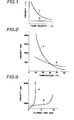
- Fig. 1 illustrates the thixotropic properties of such a wax.
- the curve L when the wax is kept at or around room temperature and is flowing under pressure in a pipe the viscosity of the wax is considerably high while the velocity of the flow is low and becomes lower and lower as the velocity becomes higher.
- elevated temperatures e.g. at a temperature above 50°C, the viscosity of the flowing wax is almost independent of the flow velocity, as represented by the curve H, and remains at a very low level.
- the viscosity of a wax used in this invention is affected by temperature too.
- the curve A represents an example of waxes useful in this invention.
- the curve B in Fig. 2 represents a
- the wax treatment method of the invention includes the step of heating the wax upon or before contact of the wax with a surface to be treated and also the step of cooling the applied wax to room temperature or near thereto.
- the wax applied to the intended surfaces solidifies in a short time, as represented by the curve A in Fig. 3, by the joint effects of the thixotropy and the dependence of viscosity on temperature.
- the curve B in Fig. 3 represents a conventional wax used in a conventional method.
- a wax used in this invention is a composition which always comprises a microcrystalline wax and sometimes comprises a modified wax such as oxidized wax too.
- the wax composition contains usual additives for rust preventing and other purposes, and the wax composition is in the form of either a solution in an organic solvent or an aqueous dispersion. Some examples of preferred wax compositions are shown below. The amounts of the materials are given by parts by weight.
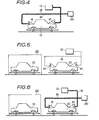
- FIGs. 4, 5 and 6 Practical manners of heating a wax in the wax treatment method of the invention are illustrated in Figs. 4, 5 and 6, wherein an automobile body 10 is the object of wax treatment.
- the automobile body 10 is already provided with a finish coat of paint.
- Fig. 4 illustrates a first case where a wax in heated state is applied to the automobile body 10 which is left at room temperature.
- Numeral 12 indicates a tank containing the wax.
- the wax is pressurized and is supplied to spray guns 14 through pipes 16.
- a heater 18 is coiled around the pipe 16 connecting each spray gun 14 to the wax tank 12.
- the heaters 18 are electrically connected to a controllable power supply 20.
- Fig. 5 illustrates a second case where the automobile body 10 is heated in advance of wax treatment in an oven 22 which is located shortly precedent to the wax treatment station.
- the pipes 16 extending from the wax tank 12 to the spray guns 14 are not provided with any heating means. Soon after heating the automobile body 10 is transferred to the wax treatment station, where the wax under pressure is sprayed on the heated automobile body 10. As a natural consequence the wax is heated upon deposition on the automobile body 10.
- Fig. 6 illustrates a third case where both the wax and the automobile body 10 are heated before applying the wax to the automobile body 10.
- the pipes 16 extending from the wax tank 12 to the spray guns 14 are provided with the heating means 18 and 20 in the same manner as in the case of Fig. 4, and the automobile body 10 is heated in the oven 22 just before wax treatment in the same manner as in the case of Fig. 5.
- the waxed article After application of the wax by spraying, the waxed article is left standing at room temperature to allow the wax coating film to cool down. If necessary the waxed article may be transferred into a cooled zone. As the temperature lowers the viscosity of the applied wax increases to a level sufficient for retention of a desired thickness of the wax coating film even on a vertical surface, so that dripping of the applied wax is suppressed.
Landscapes
- Life Sciences & Earth Sciences (AREA)
- Engineering & Computer Science (AREA)
- Wood Science & Technology (AREA)
- Application Of Or Painting With Fluid Materials (AREA)
Applications Claiming Priority (2)
| Application Number | Priority Date | Filing Date | Title |
|---|---|---|---|
| JP224043/84 | 1984-10-26 | ||
| JP59224043A JPS61103581A (ja) | 1984-10-26 | 1984-10-26 | ワツクスによる防錆処理方法 |
Publications (3)
| Publication Number | Publication Date |
|---|---|
| EP0180159A2 true EP0180159A2 (fr) | 1986-05-07 |
| EP0180159A3 EP0180159A3 (en) | 1987-05-27 |
| EP0180159B1 EP0180159B1 (fr) | 1990-02-07 |
Family
ID=16807698
Family Applications (1)
| Application Number | Title | Priority Date | Filing Date |
|---|---|---|---|
| EP85113595A Expired - Lifetime EP0180159B1 (fr) | 1984-10-26 | 1985-10-25 | Méthode de traitement antirouille à la cire |
Country Status (4)
| Country | Link |
|---|---|
| US (1) | US4606945A (fr) |
| EP (1) | EP0180159B1 (fr) |
| JP (1) | JPS61103581A (fr) |
| DE (1) | DE3575878D1 (fr) |
Cited By (3)
| Publication number | Priority date | Publication date | Assignee | Title |
|---|---|---|---|---|
| WO1991000152A1 (fr) * | 1989-06-26 | 1991-01-10 | Geveko Industri Ab | Agent de protection anticorrosion et son procede d'application |
| DE4217770A1 (de) * | 1992-05-29 | 1993-12-02 | Audi Ag | Verfahren zum Behandeln von Federn |
| FR2771693A1 (fr) * | 1997-11-28 | 1999-06-04 | Valeo Systemes Dessuyage | Essuie-glace de vehicule automobile comportant des articulations |
Families Citing this family (10)
| Publication number | Priority date | Publication date | Assignee | Title |
|---|---|---|---|---|
| JPH0194984A (ja) * | 1987-10-06 | 1989-04-13 | Honda Motor Co Ltd | 自動車車体の防錆処理方法 |
| US5294251A (en) * | 1992-05-08 | 1994-03-15 | Myriad Utile, Inc. | Microcrystalline wax coating composition |
| JPH06285428A (ja) * | 1993-03-31 | 1994-10-11 | Hiroyuki Hattori | ワックス塗布方法 |
| US5700525A (en) * | 1995-03-29 | 1997-12-23 | Betzdearborn Inc. | Passivation method and composition for galvanized metal surfaces |
| US5837078A (en) * | 1997-05-30 | 1998-11-17 | Molecular Architects | VOC-free protective coating |
| GB2334224A (en) * | 1998-02-12 | 1999-08-18 | Rover Group | Motor vehicle body treatment |
| JP2009208015A (ja) * | 2008-03-05 | 2009-09-17 | Honda Motor Co Ltd | 自動車車体の防錆処理方法 |
| EP2371909A1 (fr) * | 2010-03-31 | 2011-10-05 | Nissan Motor Co., Ltd. | Composition de cire de protection contre la corrosion contenant de la polyaniline sous forme dopée et une paraffine liquide |
| US8999234B2 (en) * | 2012-03-21 | 2015-04-07 | David Walden | Moisture and ultraviolet light barrier composition |
| US9580119B2 (en) * | 2014-02-13 | 2017-02-28 | Wabash National, L.P. | Galvanized upper coupler assembly |
Family Cites Families (5)
| Publication number | Priority date | Publication date | Assignee | Title |
|---|---|---|---|---|
| LU39276A1 (fr) * | 1959-10-14 | 1961-04-12 | ||
| US3393078A (en) * | 1966-04-21 | 1968-07-16 | Du Pont | Method of making an emulsion polish and the resulting product |
| GB1307313A (en) * | 1970-04-06 | 1973-02-21 | Ragosine Oil Co Ltd | Wax emulsion |
| SE428179B (sv) * | 1978-06-13 | 1983-06-13 | Atlas Copco Ab | Metod for ybeleggning av ett foremal med ett vetskeformigt material med tixotropa egenskaper |
| US4479981A (en) * | 1982-05-03 | 1984-10-30 | Ashland Oil, Inc. | Water-borne hard coating compositions and processes therefor |
-
1984
- 1984-10-26 JP JP59224043A patent/JPS61103581A/ja active Pending
-
1985
- 1985-09-30 US US06/781,648 patent/US4606945A/en not_active Expired - Fee Related
- 1985-10-25 EP EP85113595A patent/EP0180159B1/fr not_active Expired - Lifetime
- 1985-10-25 DE DE8585113595T patent/DE3575878D1/de not_active Expired - Fee Related
Cited By (3)
| Publication number | Priority date | Publication date | Assignee | Title |
|---|---|---|---|---|
| WO1991000152A1 (fr) * | 1989-06-26 | 1991-01-10 | Geveko Industri Ab | Agent de protection anticorrosion et son procede d'application |
| DE4217770A1 (de) * | 1992-05-29 | 1993-12-02 | Audi Ag | Verfahren zum Behandeln von Federn |
| FR2771693A1 (fr) * | 1997-11-28 | 1999-06-04 | Valeo Systemes Dessuyage | Essuie-glace de vehicule automobile comportant des articulations |
Also Published As
| Publication number | Publication date |
|---|---|
| US4606945A (en) | 1986-08-19 |
| EP0180159A3 (en) | 1987-05-27 |
| JPS61103581A (ja) | 1986-05-22 |
| DE3575878D1 (de) | 1990-03-15 |
| EP0180159B1 (fr) | 1990-02-07 |
Similar Documents
| Publication | Publication Date | Title |
|---|---|---|
| EP0180159B1 (fr) | Méthode de traitement antirouille à la cire | |
| US3795546A (en) | Rinsing coated metallic surfaces | |
| KR960704985A (ko) | 점착이 잘되고 부식을 방지하는 래커층을 만드는 간단한 방법 및 그 기초 부분품(simplified process for producing an anticorrosive paint with a good adhesiveness and workpieces thus obtained) | |
| GR3008295T3 (fr) | ||
| IE45228L (en) | Spraying coating compositions. | |
| IN179443B (fr) | ||
| US3073721A (en) | Method of hot coating | |
| US3438799A (en) | Method for the surface treatment of metal articles | |
| US3970482A (en) | Simplified metal treating compositions formed from precursor components | |
| US4999241A (en) | Coiled steel strip with solid lubricant coating | |
| DE4336857A1 (de) | Verfahren zum Trocknen von Automobillacken | |
| US4177303A (en) | Method of galvanizing a portion only of a ferrous metal article | |
| CA2151031A1 (fr) | Composition de revetement filmogene thermodurcissable et utilisation | |
| US4325745A (en) | Paint repellent composition and method | |
| US3669705A (en) | Corrosion resistant articles having a zinc surface and process for preparing the same | |
| US1926766A (en) | Rust proofing composition and method of producing the same | |
| DE19625789B4 (de) | Verfahren zum Beschichten einer Karosserie | |
| US4226646A (en) | Process of coating a ferrous metal substrate with an aqueous fluoropolymer coating | |
| JPS62197185A (ja) | 防錆剤の塗布方法 | |
| JPS6320394A (ja) | 防錆用ワツクスの製造方法 | |
| JPS6142377A (ja) | 金属薄板構造物の塗装方法 | |
| CN1057786C (zh) | 多功能超薄膜光亮剂的生产方法 | |
| Nelson | High-temperature application of nitrocellulose lacquers | |
| DE705350C (de) | Tauchbad zum serienmaessigen Lackieren von Karosserien mit Lacken beliebiger Zusammensetzung | |
| JPH0431752B2 (fr) |
Legal Events
| Date | Code | Title | Description |
|---|---|---|---|
| PUAI | Public reference made under article 153(3) epc to a published international application that has entered the european phase |
Free format text: ORIGINAL CODE: 0009012 |
|
| 17P | Request for examination filed |
Effective date: 19851025 |
|
| AK | Designated contracting states |
Kind code of ref document: A2 Designated state(s): DE FR GB SE |
|
| PUAL | Search report despatched |
Free format text: ORIGINAL CODE: 0009013 |
|
| AK | Designated contracting states |
Kind code of ref document: A3 Designated state(s): DE FR GB SE |
|
| 17Q | First examination report despatched |
Effective date: 19871230 |
|
| GRAA | (expected) grant |
Free format text: ORIGINAL CODE: 0009210 |
|
| AK | Designated contracting states |
Kind code of ref document: B1 Designated state(s): DE FR GB SE |
|
| PG25 | Lapsed in a contracting state [announced via postgrant information from national office to epo] |
Ref country code: FR Effective date: 19900207 |
|
| REF | Corresponds to: |
Ref document number: 3575878 Country of ref document: DE Date of ref document: 19900315 |
|
| EN | Fr: translation not filed | ||
| PGFP | Annual fee paid to national office [announced via postgrant information from national office to epo] |
Ref country code: GB Payment date: 19900905 Year of fee payment: 6 |
|
| PG25 | Lapsed in a contracting state [announced via postgrant information from national office to epo] |
Ref country code: SE Effective date: 19901026 |
|
| PLBI | Opposition filed |
Free format text: ORIGINAL CODE: 0009260 |
|
| 26 | Opposition filed |
Opponent name: DINOL AKTIEBOLAG Effective date: 19901103 Opponent name: BAYERISCHE MOTOREN WERKE AG, PATENTABTEILUNG AJ-3, Effective date: 19901105 |
|
| PG25 | Lapsed in a contracting state [announced via postgrant information from national office to epo] |
Ref country code: DE Effective date: 19910702 |
|
| RDAG | Patent revoked |
Free format text: ORIGINAL CODE: 0009271 |
|
| STAA | Information on the status of an ep patent application or granted ep patent |
Free format text: STATUS: PATENT REVOKED |
|
| 27W | Patent revoked |
Effective date: 19910726 |
|
| GBPR | Gb: patent revoked under art. 102 of the ep convention designating the uk as contracting state | ||
| EUG | Se: european patent has lapsed |
Ref document number: 85113595.4 Effective date: 19910603 |