EP0181551A2 - Procédé à jointer les enveloppes tubulaires pour aliments - Google Patents
Procédé à jointer les enveloppes tubulaires pour aliments Download PDFInfo
- Publication number
- EP0181551A2 EP0181551A2 EP85113642A EP85113642A EP0181551A2 EP 0181551 A2 EP0181551 A2 EP 0181551A2 EP 85113642 A EP85113642 A EP 85113642A EP 85113642 A EP85113642 A EP 85113642A EP 0181551 A2 EP0181551 A2 EP 0181551A2
- Authority
- EP
- European Patent Office
- Prior art keywords
- casings
- saran
- spliced
- casing
- splicing
- Prior art date
- Legal status (The legal status is an assumption and is not a legal conclusion. Google has not performed a legal analysis and makes no representation as to the accuracy of the status listed.)
- Ceased
Links
Images


Classifications
-
- A—HUMAN NECESSITIES
- A22—BUTCHERING; MEAT TREATMENT; PROCESSING POULTRY OR FISH
- A22C—PROCESSING MEAT, POULTRY, OR FISH
- A22C13/00—Sausage casings
-
- A—HUMAN NECESSITIES
- A22—BUTCHERING; MEAT TREATMENT; PROCESSING POULTRY OR FISH
- A22C—PROCESSING MEAT, POULTRY, OR FISH
- A22C13/00—Sausage casings
- A22C13/0013—Chemical composition of synthetic sausage casings
-
- B—PERFORMING OPERATIONS; TRANSPORTING
- B29—WORKING OF PLASTICS; WORKING OF SUBSTANCES IN A PLASTIC STATE IN GENERAL
- B29C—SHAPING OR JOINING OF PLASTICS; SHAPING OF MATERIAL IN A PLASTIC STATE, NOT OTHERWISE PROVIDED FOR; AFTER-TREATMENT OF THE SHAPED PRODUCTS, e.g. REPAIRING
- B29C65/00—Joining or sealing of preformed parts, e.g. welding of plastics materials; Apparatus therefor
- B29C65/02—Joining or sealing of preformed parts, e.g. welding of plastics materials; Apparatus therefor by heating, with or without pressure
- B29C65/18—Joining or sealing of preformed parts, e.g. welding of plastics materials; Apparatus therefor by heating, with or without pressure using heated tools
-
- B—PERFORMING OPERATIONS; TRANSPORTING
- B29—WORKING OF PLASTICS; WORKING OF SUBSTANCES IN A PLASTIC STATE IN GENERAL
- B29C—SHAPING OR JOINING OF PLASTICS; SHAPING OF MATERIAL IN A PLASTIC STATE, NOT OTHERWISE PROVIDED FOR; AFTER-TREATMENT OF THE SHAPED PRODUCTS, e.g. REPAIRING
- B29C65/00—Joining or sealing of preformed parts, e.g. welding of plastics materials; Apparatus therefor
- B29C65/48—Joining or sealing of preformed parts, e.g. welding of plastics materials; Apparatus therefor using adhesives, i.e. using supplementary joining material; solvent bonding
- B29C65/50—Joining or sealing of preformed parts, e.g. welding of plastics materials; Apparatus therefor using adhesives, i.e. using supplementary joining material; solvent bonding using adhesive tape, e.g. thermoplastic tape; using threads or the like
- B29C65/5007—Joining or sealing of preformed parts, e.g. welding of plastics materials; Apparatus therefor using adhesives, i.e. using supplementary joining material; solvent bonding using adhesive tape, e.g. thermoplastic tape; using threads or the like characterised by the structure of said adhesive tape, threads or the like
- B29C65/5021—Joining or sealing of preformed parts, e.g. welding of plastics materials; Apparatus therefor using adhesives, i.e. using supplementary joining material; solvent bonding using adhesive tape, e.g. thermoplastic tape; using threads or the like characterised by the structure of said adhesive tape, threads or the like being multi-layered
-
- B—PERFORMING OPERATIONS; TRANSPORTING
- B29—WORKING OF PLASTICS; WORKING OF SUBSTANCES IN A PLASTIC STATE IN GENERAL
- B29C—SHAPING OR JOINING OF PLASTICS; SHAPING OF MATERIAL IN A PLASTIC STATE, NOT OTHERWISE PROVIDED FOR; AFTER-TREATMENT OF THE SHAPED PRODUCTS, e.g. REPAIRING
- B29C65/00—Joining or sealing of preformed parts, e.g. welding of plastics materials; Apparatus therefor
- B29C65/48—Joining or sealing of preformed parts, e.g. welding of plastics materials; Apparatus therefor using adhesives, i.e. using supplementary joining material; solvent bonding
- B29C65/50—Joining or sealing of preformed parts, e.g. welding of plastics materials; Apparatus therefor using adhesives, i.e. using supplementary joining material; solvent bonding using adhesive tape, e.g. thermoplastic tape; using threads or the like
- B29C65/5042—Joining or sealing of preformed parts, e.g. welding of plastics materials; Apparatus therefor using adhesives, i.e. using supplementary joining material; solvent bonding using adhesive tape, e.g. thermoplastic tape; using threads or the like covering both elements to be joined
-
- B—PERFORMING OPERATIONS; TRANSPORTING
- B29—WORKING OF PLASTICS; WORKING OF SUBSTANCES IN A PLASTIC STATE IN GENERAL
- B29C—SHAPING OR JOINING OF PLASTICS; SHAPING OF MATERIAL IN A PLASTIC STATE, NOT OTHERWISE PROVIDED FOR; AFTER-TREATMENT OF THE SHAPED PRODUCTS, e.g. REPAIRING
- B29C66/00—General aspects of processes or apparatus for joining preformed parts
- B29C66/01—General aspects dealing with the joint area or with the area to be joined
- B29C66/05—Particular design of joint configurations
- B29C66/10—Particular design of joint configurations particular design of the joint cross-sections
- B29C66/11—Joint cross-sections comprising a single joint-segment, i.e. one of the parts to be joined comprising a single joint-segment in the joint cross-section
- B29C66/112—Single lapped joints
- B29C66/1122—Single lap to lap joints, i.e. overlap joints
-
- B—PERFORMING OPERATIONS; TRANSPORTING
- B29—WORKING OF PLASTICS; WORKING OF SUBSTANCES IN A PLASTIC STATE IN GENERAL
- B29C—SHAPING OR JOINING OF PLASTICS; SHAPING OF MATERIAL IN A PLASTIC STATE, NOT OTHERWISE PROVIDED FOR; AFTER-TREATMENT OF THE SHAPED PRODUCTS, e.g. REPAIRING
- B29C66/00—General aspects of processes or apparatus for joining preformed parts
- B29C66/01—General aspects dealing with the joint area or with the area to be joined
- B29C66/05—Particular design of joint configurations
- B29C66/10—Particular design of joint configurations particular design of the joint cross-sections
- B29C66/11—Joint cross-sections comprising a single joint-segment, i.e. one of the parts to be joined comprising a single joint-segment in the joint cross-section
- B29C66/114—Single butt joints
- B29C66/1142—Single butt to butt joints
-
- B—PERFORMING OPERATIONS; TRANSPORTING
- B29—WORKING OF PLASTICS; WORKING OF SUBSTANCES IN A PLASTIC STATE IN GENERAL
- B29C—SHAPING OR JOINING OF PLASTICS; SHAPING OF MATERIAL IN A PLASTIC STATE, NOT OTHERWISE PROVIDED FOR; AFTER-TREATMENT OF THE SHAPED PRODUCTS, e.g. REPAIRING
- B29C66/00—General aspects of processes or apparatus for joining preformed parts
- B29C66/50—General aspects of joining tubular articles; General aspects of joining long products, i.e. bars or profiled elements; General aspects of joining single elements to tubular articles, hollow articles or bars; General aspects of joining several hollow-preforms to form hollow or tubular articles
- B29C66/51—Joining tubular articles, profiled elements or bars; Joining single elements to tubular articles, hollow articles or bars; Joining several hollow-preforms to form hollow or tubular articles
- B29C66/52—Joining tubular articles, bars or profiled elements
- B29C66/522—Joining tubular articles
- B29C66/5221—Joining tubular articles for forming coaxial connections, i.e. the tubular articles to be joined forming a zero angle relative to each other
-
- B—PERFORMING OPERATIONS; TRANSPORTING
- B29—WORKING OF PLASTICS; WORKING OF SUBSTANCES IN A PLASTIC STATE IN GENERAL
- B29C—SHAPING OR JOINING OF PLASTICS; SHAPING OF MATERIAL IN A PLASTIC STATE, NOT OTHERWISE PROVIDED FOR; AFTER-TREATMENT OF THE SHAPED PRODUCTS, e.g. REPAIRING
- B29C66/00—General aspects of processes or apparatus for joining preformed parts
- B29C66/70—General aspects of processes or apparatus for joining preformed parts characterised by the composition, physical properties or the structure of the material of the parts to be joined; Joining with non-plastics material
- B29C66/71—General aspects of processes or apparatus for joining preformed parts characterised by the composition, physical properties or the structure of the material of the parts to be joined; Joining with non-plastics material characterised by the composition of the plastics material of the parts to be joined
-
- B—PERFORMING OPERATIONS; TRANSPORTING
- B29—WORKING OF PLASTICS; WORKING OF SUBSTANCES IN A PLASTIC STATE IN GENERAL
- B29C—SHAPING OR JOINING OF PLASTICS; SHAPING OF MATERIAL IN A PLASTIC STATE, NOT OTHERWISE PROVIDED FOR; AFTER-TREATMENT OF THE SHAPED PRODUCTS, e.g. REPAIRING
- B29C66/00—General aspects of processes or apparatus for joining preformed parts
- B29C66/70—General aspects of processes or apparatus for joining preformed parts characterised by the composition, physical properties or the structure of the material of the parts to be joined; Joining with non-plastics material
- B29C66/72—General aspects of processes or apparatus for joining preformed parts characterised by the composition, physical properties or the structure of the material of the parts to be joined; Joining with non-plastics material characterised by the structure of the material of the parts to be joined
- B29C66/723—General aspects of processes or apparatus for joining preformed parts characterised by the composition, physical properties or the structure of the material of the parts to be joined; Joining with non-plastics material characterised by the structure of the material of the parts to be joined being multi-layered
- B29C66/7234—General aspects of processes or apparatus for joining preformed parts characterised by the composition, physical properties or the structure of the material of the parts to be joined; Joining with non-plastics material characterised by the structure of the material of the parts to be joined being multi-layered comprising a barrier layer
-
- B—PERFORMING OPERATIONS; TRANSPORTING
- B29—WORKING OF PLASTICS; WORKING OF SUBSTANCES IN A PLASTIC STATE IN GENERAL
- B29C—SHAPING OR JOINING OF PLASTICS; SHAPING OF MATERIAL IN A PLASTIC STATE, NOT OTHERWISE PROVIDED FOR; AFTER-TREATMENT OF THE SHAPED PRODUCTS, e.g. REPAIRING
- B29C66/00—General aspects of processes or apparatus for joining preformed parts
- B29C66/80—General aspects of machine operations or constructions and parts thereof
- B29C66/83—General aspects of machine operations or constructions and parts thereof characterised by the movement of the joining or pressing tools
- B29C66/832—Reciprocating joining or pressing tools
- B29C66/8322—Joining or pressing tools reciprocating along one axis
- B29C66/83221—Joining or pressing tools reciprocating along one axis cooperating reciprocating tools, each tool reciprocating along one axis
-
- B—PERFORMING OPERATIONS; TRANSPORTING
- B29—WORKING OF PLASTICS; WORKING OF SUBSTANCES IN A PLASTIC STATE IN GENERAL
- B29C—SHAPING OR JOINING OF PLASTICS; SHAPING OF MATERIAL IN A PLASTIC STATE, NOT OTHERWISE PROVIDED FOR; AFTER-TREATMENT OF THE SHAPED PRODUCTS, e.g. REPAIRING
- B29C66/00—General aspects of processes or apparatus for joining preformed parts
- B29C66/90—Measuring or controlling the joining process
- B29C66/91—Measuring or controlling the joining process by measuring or controlling the temperature, the heat or the thermal flux
- B29C66/914—Measuring or controlling the joining process by measuring or controlling the temperature, the heat or the thermal flux by controlling or regulating the temperature, the heat or the thermal flux
- B29C66/9141—Measuring or controlling the joining process by measuring or controlling the temperature, the heat or the thermal flux by controlling or regulating the temperature, the heat or the thermal flux by controlling or regulating the temperature
- B29C66/91421—Measuring or controlling the joining process by measuring or controlling the temperature, the heat or the thermal flux by controlling or regulating the temperature, the heat or the thermal flux by controlling or regulating the temperature of the joining tools
-
- B—PERFORMING OPERATIONS; TRANSPORTING
- B29—WORKING OF PLASTICS; WORKING OF SUBSTANCES IN A PLASTIC STATE IN GENERAL
- B29L—INDEXING SCHEME ASSOCIATED WITH SUBCLASS B29C, RELATING TO PARTICULAR ARTICLES
- B29L2023/00—Tubular articles
- B29L2023/001—Tubular films, sleeves
- B29L2023/002—Sausage casings
-
- Y—GENERAL TAGGING OF NEW TECHNOLOGICAL DEVELOPMENTS; GENERAL TAGGING OF CROSS-SECTIONAL TECHNOLOGIES SPANNING OVER SEVERAL SECTIONS OF THE IPC; TECHNICAL SUBJECTS COVERED BY FORMER USPC CROSS-REFERENCE ART COLLECTIONS [XRACs] AND DIGESTS
- Y10—TECHNICAL SUBJECTS COVERED BY FORMER USPC
- Y10T—TECHNICAL SUBJECTS COVERED BY FORMER US CLASSIFICATION
- Y10T428/00—Stock material or miscellaneous articles
- Y10T428/13—Hollow or container type article [e.g., tube, vase, etc.]
- Y10T428/1324—Flexible food casing [e.g., sausage type, etc.]
Definitions
- the present invention relates to methods and materials for joining sections of flexible tubing together to form continuous lengths for various applications, especially, for example, casings for packaging food products like sausages, meats, cheeses and the like.
- Tubular food casings and more particularly, sausage casings like those made of regenerated cellulose and collagen have been widely used in processing frankfurters', bolognas, salamis, hams, etc.
- Tubular casings of various lengths are manufactured, for instance, by extruding viscose into a fibrous web which is then regenerated in a coagulating bath. The regenerated tubular material is washed to remove by-products, further treated and rolled flat onto large reels.
- the casing is dried and shirred into tubular strands, or alternatively, left unshirred with sufficient water, placticizer, etc., such that further soaking need not be performed prior to stuffing by food processors.
- a casing reel may contain several lengths of flat reelstock totaling several hundred feet.
- the optimum length of continuous casing will vary depending on the particular apparatus; e.g. shirring, filling, employed. In general however, short lengths of casing will be inefficient, necessitating frequent stoppages of automated equipment to allow time to thread a new section of casing through the apparatus. For this reason, it has been found highly desirable to join or splice the end of one tubular casing to the beginning of a new section of tubular casing hefore the end of the first section begins its passage through the apparatus. The end portion of first section will then serve to pull the first section of the newly spliced section through the apparatus. In this manner, the need for frequent rethreading of the apparatus and restoring the cycle after each short length of casing material is run through can be avoided.
- US Patent 4,032,176 discloses several methods for assembling lengths of tubular casings end-to-end using pressure sensitive adhesive strips. It has been found, however, that unless splices are bonded with strips which are sealed with appropriate heat and pressure the frequency of joint separation can increase significantly, especially with casings having high moisture levels. Pressure sensitive adhesives do not form fully cured bonds, but instead, remain tacky. Consequently, such joints are not completely reliable, particularly since they must be machinable, remain intact when wet and be able to withstand the forces generated by stuffing equipment.
- US Patent 2,631,509 discloses a method of making tubular articles from a continuous sheet Which is drawn through a tube forming guide. As the tube is formed a lapped edge is made and a bead of thermoplastic material simultaneously deposited therebetween. The edge is sealed under heat and pressure.
- US Patents 3,560,223 and 3,669,692 disclose the fabrication of tubular articles from flat reelstock. The latter patents, however, relate specifically to casings for liver sausage, and therefore, have surfaces coated with saran polymer. In each of the immediate foregoing patents, the edges of the tubes are sealed without splicing tape. That is, the heat sealed joints of the prior art casings are bonded with an adhesive only which is non-supportive.
- Splicing according to the present invention is carried out by the steps of assembling the trailing end of a first casing and the leading end of a second casing to form a joint.
- the joint is then contacted with the splicing tape and bonded by compressing and heating to a temperature sufficient to soften or melt the saran polymer without causing it to degrade.
- the pressure forces the softened polymer into intimate contact with the surfaces of the casings being spliced.
- the saran polymer coated cellulosic splicing tape provides low bulk, high shear and high shock strength splices for food casings.
- the splices When fully bonded, the splices exhibit superior peel strength and can be used to splice virtually all casings, including dried casings. However, because the bonds are also water impervious the splicing tape and methods of use are especially well suited for splicing wet or premoisturized, ready-to-stuff type casings. The splices are shirrable and stuffable, and because they are low bulk are also machinable.
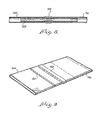
- a strip of splicing tape 14 having an outer saran polymer coating 16 on at least one surface thereof.
- the tape is comprised of a backing 18 formed of a cellulose film, which would include, for example, regenerated cellulose, cellophane, rayon and other such manufactured. polymers.
- Regenerated cellulose is intended to include both clear, regenerated cellulose films and films of fibrous reinforced regenerated cellulose.
- the principal, criteria in selecting a specific cellulose backing material is.that it have a higher melting or scorching temperature than the melting point of the outer saran polymer coating.
- the cellulose backing may be prepared by any of the well known methods in the art, including the viscose process, cuprammonium process, by denitration of cellulose nitrate, and the like.
- clear regenerated cellulose films can be prepared by extruding viscose into a coagulating bath containing ammonium sulfate, sodium sulfate and sulfuric acid. The regenerated cellulose is removed from the coagulating bath and washed to remove reactants and by-products.
- the manufacturing process is modified to insert a web preferably, for example, a long fiber hemp paper into the film.
- a fibrous web is passed through a coating die where viscose is extruded into the web followed by treatment in a coagulating bath where the cellulose is regenerated to produce a paper-reinforced film typically containing from about 35 to about 40% paper and from about 60 to about 65% regenerated cellulose and plasticizing ingredients e.g. glycerin and water.
- a thin preferably continuous coating of a saran polymer is aplied to at least one surface of the backing matezial.
- the expxessions--saran polymer end saran adhesive--as used herein are intended to include a family of known thermoplastic resins, viz vinylidene chloride homopolymer and copolymers of vinylidene chloride with at least one other monomer, such as vinyl chloride, acrylonitrile, acrylaces, methacrylates and their lower alkyl esters e.g... methyl, ethyl; vinyl acetate, etc.
- Copolymers of vinylidene chloride with other monomers are generally described in terms of the weight ratio of the monomer units in the copolymer. Saran, preferably has at least about 50 percent vinylidene chloride. However, copolymers containing as little as 10 percent vinylidene chloride are also included within this term in accordance with the present invention.
- Splicing tape as used herein requires a saran coating having sufficient vinylidene chloride to permit the formation of a strong bond with the cellulose backing.
- the saran adhesive coating may be applied by conventional methods known in the art. The objective in each instance is to prepare a. flexible splicing tape with a thin, continuous, adherant coating of the adhesive onto the cellulose backing for optimum peel and shock strength properties, especially when the spliced segments of casing are moistened or wet.
- saran polymers can be applied directly onto tape backing by the methodology described in US Patent 2,961,323.
- a saran polymer either in an aqueous or non-aqueous system is applied to uncoated cellulose by various techniques, including dipping or by means of a doctor blade, spraying or by extrusion. Good adhesion of the saran is achieved by drying followed by heating at temperatures sufficient to sinter the coating, but at temperatures below those which will adversely affect the cellulose base.
- the saran polymer may be applied by means of a self-priming coating composition, such as described in US Patent 3,794,515 where a saran resin, a plasticizer, a polymeric polyisocyanate and an activator are applied from a solvent system. There, tubular cellulose is coated with one-coat lacquer and then cured by heating. As a further alternative, the cellulose substrate may be primed as a seperate step before applying the saran adhesive.
- a self-priming coating composition such as described in US Patent 3,794,515 where a saran resin, a plasticizer, a polymeric polyisocyanate and an activator are applied from a solvent system.
- tubular cellulose is coated with one-coat lacquer and then cured by heating.
- the cellulose substrate may be primed as a seperate step before applying the saran adhesive.
- primer is an epoxy-substituted resin consisting of a water-soluable thermosetting reaction product of a polysecondary amine. More specifically, they are polymers of epichlorohydrin having a purality of -NH- groups and having an epoxide equivalent weight of at least about 100; and preferrably less than 2000, as determined by reaction with mercapto-ethanol in the procedure described in Bates TAPPI, 52, No. 6, 1969, page 1163.
- the epoxy-substituted primers especially preferred for use in coating the tape backing are available under the name Kymene, a registrated trademark of Hercules Powder Company, Wilmington Delaware.
- the concentration of the primer resin employed is at least 0.5 %, and ranges up to 5% or more.
- the primer resin is cured by heat drying.
- the saran coating can then be applied to the primed casing, for instance, according to methods disclosed in US Patents. 3,794,515; 2,961,323, etc.
- the present invention also comtemplates laminated splicing tapes prepared by laminating saran films onto cellulose backings consisting of 1 to 4 inch wide flat, continuous webs of regenerated cellulose.
- the tapes are fabricated from food casing materials having saran polymer coatings where in normal use the casing material provides the needed barrier properties. against water loss and oxygen induced discoloration of iron rich meat products, such as liverwurst, hamburger, etc., encased therein. Liverwurst and braunschweiger are commonly packaged in saran coated fibrous casings having controlled moist-vapor permeability.
- Splicing tapes can be prepared by severing tubular casings transversely to their longitudinal axes or by slitting the casings longitudinally on one or both edges of flattened reelstock. By slitting a segment of the flattened saran coated tubular material on one edge a suitable splicing tape can be prepared by laying open the material and cutting to suitable lengths depending of the size of the casings being spliced.
- the splicing tape may have plurality of perforations 20 (FIG. 1). Multiple perforations may be formed by various means, such as described in US Patent 2,608,488. Presticking the splicing tape with multiple pinsize holes before using is particularly desirable when the splicing tape is employed in splicing moistened, wet or premoisturized, ready-to-stuff type casings which have sufficient moisture that they need not be soaked further prior to stuffing by meat processors. Such casings usually have at least about 20% by weight water based on total casing weight. The perforations allow steam generated from the water in the casing segments to vent when the assembled joint and tape are bonded with heat and pressure.
- the tapes described herein when used for splicing wet or premoisturized, ready-to-stuff type casings preferably have multiple perforations.
- the trailing end of one casing is brought, for example, into juxtaposition with the leading edge of the next casing and assembled into an appropriate joint.
- a three inch wide strip of saran coated splicing tape is wrapped around the assembled joint with the saran coating in contact with the casings being spliced.
- the splicing tape is brought entirely around the joint and the ecids lapped.
- the wrapped joint is then subjected to "programmed" heat and pressure over a period of time whereby the saran polymer .at least softens, but more preferably softens and melts into intimate contact with the surfaces of the casings being spliced.
- the splice cools and the saran adhesive hardens an extremely strong, water impervious bond results.
- the surfaces of the casings in contact with the splicing tape may be treated with an adhesion promoter in the form of a primer coating.
- adhesion promoter in the form of a primer coating.
- Such coatings are frequently used on the exterior surface of cellulose casings to improve, for example, the adhesion of printing inks.
- they are often used on the interior surfaces of tubular casings used for liverwurst, braunschweiger, etc., to enhance the adhesion of the meat to the casing, avoiding unappetizing fatty deposits from forming between the interior wall of the casing and the outer surface of the meat product.
- Such coatings include, for instance, Kymene resins, e.g. ...Kymene 557 previously described.
- primers would include food grade polymeric polyisocyanates, such as described in US Patent 3,912, 839.
- food grade polymeric polyisocyanates such as described in US Patent 3,912, 839.
- FIGS. 2 and 3 disclose the trailing end of casing segment 22. and the leading end of casing segment 24 with their respective terminal transverse edges in abutting relation 26.
- the outer surfaces of segments 22 and 24 have a primer coating 28, for example, Kymene resin applied before splicing for stronger bonds after sealing.
- the splicing tape 14 having a width generally in the range of about 1 to about 4 inches, is first wrapped on the backside of the segments, folded over and then lapped, as best shown in FIG. 4.
- FIGS. 5 and 6 disclose an alternative method of splicing tubular casings where the leading edge of casing segment 32 is telescoped inside the trailing edge of casing segment 30 to form joint 34.
- Splicing tape 36 of appropriate width and length prepared according to the methods described hereinabove is wrapped around the joint and sealed by the application of heat and pressure.
- Bonding the tape to the assembled joint is best accomplished by applying sufficient heat and pressure over a period of time sufficient to soften, and more preferably, melt the saran polymer in the tape without causing it to degrade. It was discovered that if the heating cycle is too long and the saran is exposed to temperatures and pressures sufficient to degrade the polymer hydrochloric acid is liberated. Under such circumstances, the acid rapidly attacks and weakens the splice and spliced material rendering the tubular casing useless for all practical purposes as food wrapping. As the material ages during storage it can be slowly dissolved by the acid.
- heating sealing cycles can be shortened by utilizing elevated heat sealer temperatures and pressures without necessarily scorching or degrading the splicing tape.
- cycles can be lengthened provided more moderate temperatures and pressures are utilized. Higher temperatures can be advantageously employed when the casings being spliced are wet or in a moistened. ready-to-stuff condition.
- the object in each instance is to achieve "good peel strengths" which for purposes of the present invention are intended to mean delamination of the casing rather than the splicing tape when the tape.and casing are pulled at a 90° angle.
- FIG. 7 illustrates diagramatically upper heat sealer jaw 38 and lower heat sealer jaw 40 of an electrical heat sealer apparatus 39 of known design applied under pressure, simultaneously to the upper and lover surfaces of joint 34.
- the temperature of the sealing jaws is regulated by control rheostat 42.
- Such units are commercially available through ordinary channels of commerce, and include those available from the Vertrod Corporation, Brooklyn, New York.
- the present invention also. contemplates embodiments. where the casings being spliced have an outer or inner surface coated with a saran polymer.
- Tubular food casings having an outer saran coating for controlled moisture-vapor permeability used in packaging liverwurst and braunschweiger, for instance, can be spliced together, for example, by telescoping the end of one segment inside the end of another segment, as illustrated by FIGS. 5 and 6.
- the outer saran polymer coating and the inner adhesion primer of such casings even permit splicing the casing segments together without splicing tape.
- the present invention provides for the use of splicing tape previously described with baclomg for reinforcement and maximum peel strength, especially when wet.
- FIGS. 8 and 9 illustrate a further embodiment whereby food casing 46 having an inner saran coating is telescoped into casing 44, also having an inner saran coating, to form a joint 48 after a sleeve of splicing tape 50 is inserted into one end.
- the saran polymer of the splicing tape faces the inside wall of the casing so when heat sealed blockage at the joint will not occur.
- the splicing tape 50 need not have a saran coating when heat sealing such casomgs, but may be fabricated from only a cellulose backing material.
Landscapes
- Engineering & Computer Science (AREA)
- Mechanical Engineering (AREA)
- Life Sciences & Earth Sciences (AREA)
- Wood Science & Technology (AREA)
- Zoology (AREA)
- Food Science & Technology (AREA)
- Physics & Mathematics (AREA)
- Thermal Sciences (AREA)
- Processing Of Meat And Fish (AREA)
- Packages (AREA)
- Dairy Products (AREA)
Applications Claiming Priority (2)
| Application Number | Priority Date | Filing Date | Title |
|---|---|---|---|
| US672566 | 1984-11-15 | ||
| US06/672,566 US4610742A (en) | 1984-11-15 | 1984-11-15 | Methods and materials for splicing tubular food casings |
Publications (2)
| Publication Number | Publication Date |
|---|---|
| EP0181551A2 true EP0181551A2 (fr) | 1986-05-21 |
| EP0181551A3 EP0181551A3 (fr) | 1986-08-20 |
Family
ID=24699097
Family Applications (1)
| Application Number | Title | Priority Date | Filing Date |
|---|---|---|---|
| EP85113642A Ceased EP0181551A3 (fr) | 1984-11-15 | 1985-10-26 | Procédé à jointer les enveloppes tubulaires pour aliments |
Country Status (9)
| Country | Link |
|---|---|
| US (1) | US4610742A (fr) |
| EP (1) | EP0181551A3 (fr) |
| JP (1) | JPS61142154A (fr) |
| AU (1) | AU562981B2 (fr) |
| CA (1) | CA1261722A (fr) |
| DK (1) | DK525085A (fr) |
| FI (1) | FI79446C (fr) |
| YU (1) | YU178285A (fr) |
| ZA (1) | ZA858084B (fr) |
Cited By (5)
| Publication number | Priority date | Publication date | Assignee | Title |
|---|---|---|---|---|
| BE1000627A3 (fr) * | 1986-12-24 | 1989-02-21 | Viskase Corp | Joint d'enveloppe pour aliments et procede pour sa fabrication. |
| WO1992022211A1 (fr) * | 1991-06-12 | 1992-12-23 | Beckman John H | Conteneurs renforces avec extremites plates pour la preparation de produits alimentaires industriels de dimensions uniformes |
| US5273482A (en) * | 1991-06-12 | 1993-12-28 | John H. Beckman | Reinforced casings for preparing dimensionally uniform processed food products with flat ends |
| EP0608481A1 (fr) * | 1993-01-25 | 1994-08-03 | Teepak, Inc. | Procédé et matériaux à jointer les enveloppes tubulaires pour aliments |
| ES2097704A1 (es) * | 1995-04-12 | 1997-04-01 | Viscofan Ind | Envuelta celulosica para embuticion de productos carnicos. |
Families Citing this family (16)
| Publication number | Priority date | Publication date | Assignee | Title |
|---|---|---|---|---|
| DE3713479A1 (de) * | 1987-04-22 | 1988-11-10 | Hoechst Ag | Schlauch, insbesondere kuenstliche wursthuelle, aus miteinander verbundenen abschnitten |
| US4842022A (en) * | 1988-03-31 | 1989-06-27 | Viskase Corporation | Spliced stuffable cellulosic food casing |
| US5431598A (en) * | 1991-06-12 | 1995-07-11 | Beckman Development Company | Large encased meat product with flat ends method and apparatus |
| US5328733A (en) * | 1992-03-30 | 1994-07-12 | Viskase Corporation | Shirred fibrous casing article and method |
| CA2130222A1 (fr) * | 1994-06-17 | 1995-12-18 | Mark Lee Fox | Enveloppe pour produits alimentaires portant un code a barres aux fins de positionnement dans une machine de mise a dimension automatique |
| DE19518273C2 (de) * | 1995-05-18 | 1997-03-20 | Eichel Packomat Gmbh | Vorrichtung und Verfahren zum luftdichten Verkleben von Folienschläuchen |
| US5690769A (en) | 1995-08-21 | 1997-11-25 | T-Systems International | Method for splicing drip irrigation hoses using splicing means internal to the hoses |
| US5916644A (en) * | 1996-08-20 | 1999-06-29 | Teepak Investments, Inc. | Tubular casing with glued splice and method for its manufacture |
| US6183584B1 (en) * | 1998-04-03 | 2001-02-06 | T-Systems International, Inc. | Method for splicing drip irrigation hoses using two member splicing coupling |
| US6090233A (en) | 1998-05-01 | 2000-07-18 | Drip Tape Manufacturers & Engineers, Inc. | Irrigation hose splice and method of making same |
| DE10017172A1 (de) * | 2000-04-07 | 2001-10-11 | Hartmut Brettschneider | Verfahren zum Herstellen einer Hülle mit größerer Länge für Lebensmittel |
| NL1016442C2 (nl) * | 2000-10-19 | 2002-04-22 | Fuji Seal Europe Bv | Werkwijze en inrichting voor het met elkaar verbinden van het einde van een platgedrukte slang uit kunststoffolie met het begin van een volgende slang. |
| PL363032A1 (en) * | 2001-05-19 | 2004-11-15 | Cds-Crailsheimer Darmsortierbetrieb Gmbh | Method and device for producing a casing of a larger length for foodstuffs, particularly for sausages |
| DE10151144A1 (de) * | 2001-10-17 | 2003-04-30 | Windmoeller & Hoelscher | Verfahren zum Verbinden zweier Enden von flachliegenden und mit Seitenfalten versehenen Schlauchfolienbahnen |
| USD715744S1 (en) * | 2011-03-11 | 2014-10-21 | Roxtec Ab | Cable and pipe penetration seal |
| NL2008499C2 (en) * | 2012-03-16 | 2013-09-18 | Fuji Seal Europe Bv | Device and method for providing a continuous tubular foil. |
Family Cites Families (14)
| Publication number | Priority date | Publication date | Assignee | Title |
|---|---|---|---|---|
| US2631509A (en) * | 1944-07-18 | 1953-03-17 | American Viscose Corp | Method for forming tubular articles |
| US2608488A (en) * | 1949-06-08 | 1952-08-26 | Jr Herbert Rumsey | Tubular casing |
| NL211256A (fr) * | 1955-10-12 | |||
| US3794515A (en) * | 1968-04-03 | 1974-02-26 | Tee Pak Inc | Saran coating of cellulosic casing |
| US3560223A (en) * | 1969-06-16 | 1971-02-02 | Tee Pak Inc | Liver sausage with casing and method of preparing same |
| US3669692A (en) * | 1969-06-30 | 1972-06-13 | Tee Pak Inc | Water and oxygen impermeable comminuted meat product casing |
| US3597791A (en) * | 1969-10-22 | 1971-08-10 | Union Carbide Corp | Method for producing shirred food casings |
| FR2322732A1 (fr) * | 1975-09-05 | 1977-04-01 | Viscora Sa | Procede d'aboutage de troncons tubulaires pour former des enveloppes tubulaires a communication longitudinale continue, et articles obtenus par ce procede |
| DE3013320A1 (de) * | 1980-04-05 | 1981-10-15 | Hoechst Ag, 6000 Frankfurt | Fuer lebensmittel, insbesondere wurstwaren geeignete schlauchhuelle mit einer klebenaht und verfahren zu ihrer herstellung |
| JPS5732654A (en) * | 1980-08-07 | 1982-02-22 | Nec Corp | Semiconductor integrated circuit device |
| DE3030036A1 (de) * | 1980-08-08 | 1982-05-06 | Hoechst Ag, 6000 Frankfurt | Schlauchfoermige verpackungshuelle aus cellulosehydrat mit wasserdampfungurchlaesigem filmueberzug aus synthetischem polymerisat auf der aussen- und haftvermittelnder, fuer wasser durchlaessiger schicht aus synthetischem, waermegehaertetem chemischem kondensationsprodukt auf der innenseite |
| DE3105718A1 (de) * | 1981-02-17 | 1982-09-02 | Hoechst Ag, 6000 Frankfurt | Fuer lebensmittel, insbesondere wurstwaren, geeignete rauchdurchlaessige schlauchhuelle mit einer klebenaht und verfahren zu ihrer herstellung |
| DE3108795A1 (de) * | 1981-03-07 | 1982-09-16 | Hoechst Ag, 6000 Frankfurt | Fuer lebensmittel, insbesondere wurstwaren, geeignete faserverstaerkte schlauchhuelle und verfahren zu ihrer herstellung |
| DE3139481A1 (de) * | 1981-10-03 | 1983-05-05 | Hoechst Ag, 6230 Frankfurt | Fuer zu raeuchernde lebensmittel, insbesondere fuer zu raeuchernde wurstwaren geeignete schlauchhuelle, verfahren zu ihrer herstellung und ihre verwendung |
-
1984
- 1984-11-15 US US06/672,566 patent/US4610742A/en not_active Expired - Fee Related
-
1985
- 1985-10-03 CA CA000492129A patent/CA1261722A/fr not_active Expired
- 1985-10-21 ZA ZA858084A patent/ZA858084B/xx unknown
- 1985-10-26 EP EP85113642A patent/EP0181551A3/fr not_active Ceased
- 1985-10-29 FI FI854236A patent/FI79446C/fi not_active IP Right Cessation
- 1985-10-31 JP JP60245247A patent/JPS61142154A/ja active Pending
- 1985-10-31 AU AU49267/85A patent/AU562981B2/en not_active Ceased
- 1985-11-13 YU YU01782/85A patent/YU178285A/xx unknown
- 1985-11-14 DK DK525085A patent/DK525085A/da not_active Application Discontinuation
Cited By (6)
| Publication number | Priority date | Publication date | Assignee | Title |
|---|---|---|---|---|
| BE1000627A3 (fr) * | 1986-12-24 | 1989-02-21 | Viskase Corp | Joint d'enveloppe pour aliments et procede pour sa fabrication. |
| WO1992022211A1 (fr) * | 1991-06-12 | 1992-12-23 | Beckman John H | Conteneurs renforces avec extremites plates pour la preparation de produits alimentaires industriels de dimensions uniformes |
| US5273482A (en) * | 1991-06-12 | 1993-12-28 | John H. Beckman | Reinforced casings for preparing dimensionally uniform processed food products with flat ends |
| EP0608481A1 (fr) * | 1993-01-25 | 1994-08-03 | Teepak, Inc. | Procédé et matériaux à jointer les enveloppes tubulaires pour aliments |
| US5750217A (en) * | 1993-01-25 | 1998-05-12 | Devro-Teepak, Inc. | Methods and materials for splicing tubular food casings |
| ES2097704A1 (es) * | 1995-04-12 | 1997-04-01 | Viscofan Ind | Envuelta celulosica para embuticion de productos carnicos. |
Also Published As
| Publication number | Publication date |
|---|---|
| US4610742A (en) | 1986-09-09 |
| FI79446C (fi) | 1990-01-10 |
| YU178285A (en) | 1988-04-30 |
| AU4926785A (en) | 1986-05-22 |
| ZA858084B (en) | 1987-09-30 |
| DK525085D0 (da) | 1985-11-14 |
| JPS61142154A (ja) | 1986-06-30 |
| FI79446B (fi) | 1989-09-29 |
| FI854236L (fi) | 1986-05-16 |
| FI854236A0 (fi) | 1985-10-29 |
| DK525085A (da) | 1986-05-16 |
| EP0181551A3 (fr) | 1986-08-20 |
| AU562981B2 (en) | 1987-06-25 |
| CA1261722A (fr) | 1989-09-26 |
Similar Documents
| Publication | Publication Date | Title |
|---|---|---|
| US4610742A (en) | Methods and materials for splicing tubular food casings | |
| CA1182330A (fr) | Enveloppe tubulaire permeable a la fumee, et methode de fabrication connexe | |
| US4410011A (en) | Tubular casing with glued seam and its manufacture and use for curved or ring-shaped sausages | |
| US4563231A (en) | Tubular casing, process for its manufacture, and its use as a sausage casing | |
| CA1166891A (fr) | Enveloppe tubulaire a joint longitudinal colle, et methode de production connexe | |
| US5364674A (en) | Plastic film with fiber reinforcement and tubular casings produced therefrom | |
| US5273482A (en) | Reinforced casings for preparing dimensionally uniform processed food products with flat ends | |
| US4528225A (en) | Easily peelable sausage casing having a glued seam, process for its manufacture, and its use | |
| US4546023A (en) | Smoke-permeable film of fiber-reinforced regenerated cellulose for producing tubular casings, in particular sausage casings | |
| US4623566A (en) | Film of fiber-reinforced regenerated cellulose provided with a gas-impermeable layer, for the production of tubular casings | |
| US4397337A (en) | Tubular casing suitable for foodstuffs and process for its manufacture | |
| US4741938A (en) | Web-shaped or tubular packaging film, in particular a sausage casing, with a barrier layer | |
| FI89447B (fi) | Skarv foer livsmedelshoeljen samt hopfogningsfoerfarande | |
| US5750217A (en) | Methods and materials for splicing tubular food casings | |
| EP0563184B1 (fr) | Produit alimentaire sous forme de saucisse | |
| CA2143908A1 (fr) | Emballage pour produits alimentaires fait a partir d'un hydrate de cellulose et a pelabilite amelioree | |
| JPH08253737A (ja) | 有機金属溶剤を用いた継ぎ合せセルロース系材料 | |
| US4842022A (en) | Spliced stuffable cellulosic food casing | |
| US4624873A (en) | End-dressing for tubular casings | |
| US3247037A (en) | Puncture seal | |
| WO1992022211A1 (fr) | Conteneurs renforces avec extremites plates pour la preparation de produits alimentaires industriels de dimensions uniformes | |
| JPS6111363A (ja) | 食品用ケ−シング | |
| CN1224579A (zh) | 双轴向拉伸的密封食品肠衣 |
Legal Events
| Date | Code | Title | Description |
|---|---|---|---|
| PUAI | Public reference made under article 153(3) epc to a published international application that has entered the european phase |
Free format text: ORIGINAL CODE: 0009012 |
|
| AK | Designated contracting states |
Kind code of ref document: A2 Designated state(s): AT BE CH DE FR GB IT LI LU NL SE |
|
| PUAL | Search report despatched |
Free format text: ORIGINAL CODE: 0009013 |
|
| AK | Designated contracting states |
Kind code of ref document: A3 Designated state(s): AT BE CH DE FR GB IT LI LU NL SE |
|
| 17P | Request for examination filed |
Effective date: 19860920 |
|
| 17Q | First examination report despatched |
Effective date: 19880309 |
|
| STAA | Information on the status of an ep patent application or granted ep patent |
Free format text: STATUS: THE APPLICATION HAS BEEN REFUSED |
|
| 18R | Application refused |
Effective date: 19910225 |
|
| RIN1 | Information on inventor provided before grant (corrected) |
Inventor name: VERBOEKEND, JACOBUS H. A. Inventor name: ROP, JAAP |