EP0181737A2 - Procédé pour la fabrication de circuits intégrés incluant des étapes pour indiquer la présence de sites getter - Google Patents
Procédé pour la fabrication de circuits intégrés incluant des étapes pour indiquer la présence de sites getter Download PDFInfo
- Publication number
- EP0181737A2 EP0181737A2 EP85307851A EP85307851A EP0181737A2 EP 0181737 A2 EP0181737 A2 EP 0181737A2 EP 85307851 A EP85307851 A EP 85307851A EP 85307851 A EP85307851 A EP 85307851A EP 0181737 A2 EP0181737 A2 EP 0181737A2
- Authority
- EP
- European Patent Office
- Prior art keywords
- semiconductor substrate
- substrate
- intensity
- fabricating
- defect
- Prior art date
- Legal status (The legal status is an assumption and is not a legal conclusion. Google has not performed a legal analysis and makes no representation as to the accuracy of the status listed.)
- Granted
Links
Images



Classifications
-
- G—PHYSICS
- G01—MEASURING; TESTING
- G01N—INVESTIGATING OR ANALYSING MATERIALS BY DETERMINING THEIR CHEMICAL OR PHYSICAL PROPERTIES
- G01N23/00—Investigating or analysing materials by the use of wave or particle radiation, e.g. X-rays or neutrons, not covered by groups G01N3/00 – G01N17/00, G01N21/00 or G01N22/00
- G01N23/20—Investigating or analysing materials by the use of wave or particle radiation, e.g. X-rays or neutrons, not covered by groups G01N3/00 – G01N17/00, G01N21/00 or G01N22/00 by using diffraction of the radiation by the materials, e.g. for investigating crystal structure; by using scattering of the radiation by the materials, e.g. for investigating non-crystalline materials; by using reflection of the radiation by the materials
- G01N23/207—Diffractometry using detectors, e.g. using a probe in a central position and one or more displaceable detectors in circumferential positions
-
- H—ELECTRICITY
- H10—SEMICONDUCTOR DEVICES; ELECTRIC SOLID-STATE DEVICES NOT OTHERWISE PROVIDED FOR
- H10P—GENERIC PROCESSES OR APPARATUS FOR THE MANUFACTURE OR TREATMENT OF DEVICES COVERED BY CLASS H10
- H10P36/00—Gettering within semiconductor bodies
- H10P36/03—Gettering within semiconductor bodies within silicon bodies
Definitions
- This invention relates to methods of fabricating integrated circuits; and more particularly, it relates to the steps in such method that determine whether or not the substrate on which the integrated circuits are being fabricated contains gettering sites for mobile impurities.
- the semiconductor substrate on which an integrated circuit is fabricated is made of pure silicon except for a very small amount of P type or N type dopant atoms such as boron or phosphorus.
- P type or N type dopant atoms such as boron or phosphorus.
- various other elements are also present in trace quantities as undesirable impurities. For example, traces of copper and iron are typicallly present.
- impurities if not dealt with cause the integrated circuit to malfunction.
- the impurities ionize and are mobile; and thus they produce undesired currents within the circuit during its operation.
- gettering sites are introduced into the backside of the substrate; and the integrated circuit is then fabricated on the opposite or frontside of the substrate.
- a common way to introduce gettering sites into the substrate is to sandpaper the backside surface. This produces a mechanical stress or defects in the substrate's crystal lattice. In turn, this has the effect of creating new allowable energy levels between the conduction band and valance band of the crystal; and these new energy levels act as traps for the mobile impurity ions in the substrate.
- a mobile impurity ion migrates in the substrate to a position near the gettering sites, it gets trapped in the new energy levels and thus stops migrating. Consequently, the undesired currents in the circuit stop.
- Surface texture of the backside surface of a substrate is not a measure of the degree of gettering sites present.
- a substrate having a rough backside surface can have none or many gettering sites; and the same is true for a substrate having a smooth backside surface.
- a primary object of the invention is to provide a method of fabricating integrated circuits which incorporates novel steps for detecting the presence or absence of gettering sites in a substrate.
- steps of directing, measuring, and continuing may be performed prior to the formation of any transistors on the semiconductor substrate; or they may be performed after the formation of transistors on the semiconductor substrate has begun.
- the angular offset at which the radiation is directed is ten to forty minutes; and the electromagnetic radiation has a wavelength of 0.5A to 4A.
- the fabrication of circuitry is continued only if the measured intensity is at least 25% larger than that which would reflect from the defect-free crystal.
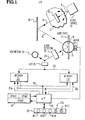
- This apparatus includes an x-ray source 10 from which x-rays 11 are emitted.
- source 10 is a model XRG 3500 as sold by Philips Electronic Instruments Corporation.
- an x-ray collimator 12 having a broad slit 13 through which a portion of the x-rays 11 pass.
- collimator 12 is made of lead; and slit 13 is 1 millimeter by 5 millimeters.
- That portion of the x-rays that pass through slit 13 form a beam 14. It is directed against a monochromatic crystal 15 at the Bragg angle B of the crystal. Angle 8 B is defined by the mathematical equation n ⁇ 2dSIN ⁇ B .
- ⁇ is the wavelength of the x-rays in beam 14 which is reflected from crystal 15 with the largest intensity; and d is the lattice spacing of the atoms in crystal 15.
- crystal 15 operates as a filter which reflects only a certain wavelength in beam 14 as another beam 16.
- Beam 16 is directed against another substrate 17.
- This substrate during one step of the invention is a semiconductor wafer which is being tested to determine whether or not it contains gettering sites for mobile ions.
- substrate 17 is a defect-free crystal of the semiconductor that is being tested.
- Substrate 17 is attached by clamps 18 to a gear 19. This gear 19 along with substrate 17 are rotated clockwise by an electric motor 20. Gear 19 and motor 20 are selected such that substrate 17 rotates at a fixed rate of about one to thirty degrees per hour.
- the angle between beam 16 and substrate 17 is manually set to the Bragg angle B minus a small angular deviation (e.g., 0.1 to 2.0 degrees). Thereafter, substrate 17 is rotated clockwise by gear 19 and motor 20 until the angle which beam 16 makes with substrate 17 increases to the Bragg angle plus a few degrees.
- a small angular deviation e.g., 0.1 to 2.0 degrees.
- detector 22 is a scintillation detector model #85010100 as sold by Philips Corporation. Such a detector senses x-rays over an angular range of several degrees; and thus it is held stationary as substrate 17 rotates.
- Detector 22 generates a signal on an output lead 23 whose magnitude is proportional to the intensity of beam 21. That signal is sent to a voltmeter 24 which provides a visual indication of the magnitude of beam 21. It is used by the operator of the Figure 1 apparatus to manually set the initial angle which substrate 17 makes with beam 16. Specifically, the operator rotates substrate 17 to the position where voltmeter 24 indicates a maximum signal; and from that position he rotates substrate 17 by the small angular deviation counterclockwise to reach the intial position.
- Lead 23 also is coupled to an analog-to-digital converter 25. It has output leads 26 on which digital signals are generated that represent the magnitude of the intensity of beam 21. Signals on the leads 26 are sent to the input terminals of a pair of memories 27 and 28, both of which are addressed by a microprocessor 29 via address lines 30.
- Data from the memories 27 and 28 is read by processor 29 over output lines 31. Signals on a set of control lines 27a from processor 29 selectively enable memory 27 to read and write; and signals on another set of control lines 28a from processor 29 selectively enable memory 28 to read and write.
- Panel 32 has three pushbutton switches labeled #1, #2a, and #2b.
- button #1 When button #1 is pushed, processor 29 executes a control program CP#1 in a memory 33; when button #2a is pushed, processor 29 executes another control program CP#2a; and when button #2b is pushed, processor 29 executes another control program CP#2b.
- processor 29 Prior to pushing button #1, an operator must place the crystal in the clamps 18 and position it at an angle that is a small amount less than the Bragg angle by utilizing voltmeter 24 as described above. Thereafter, when button #1 is pushed, processor 29 sends a signal to motor 20 which starts the motor and thereby causes substrate 17 to rotate clockwise at a fixed rate. As this rotation occurs, processor 29 periodically sends control signals on the leads 27a which cause memory 27 to store the intensity signals on the leads 26 at consecutive memory locations.
- At least six hundred samples are stored in memory 27 for each degree of rotation of substrate 17. These samples continue to be taken until the angle between beam 16 and substrate 17 increases to several degrees beyond the Bragg angle. Then processor 29 sends another signal to motor 20 which turns it off.
- control program CP#2a For this program to operate, the semiconductor wafer that is to be tested for gettering sites must be held by the clamps 18 and positioned at the Bragg angle minus a small deviation. Thereafter, when button #2a is pressed, processor 29 starts motor 20 which causes substrate 17 to rotate clockwise at a fixed rate.
- processor 29 periodically sends control signals on the leads 28a which cause memory 28 to store the intensity signals on the leads 26 at consecutive memory locations.
- these intensity signals are stored at the same rate in memory 28 that they were stored by control program CP#1 in memory 27. Then, after substrate 17 has rotated about one degree past the Bragg angle, processor 29 sends a signal to motor 20 which causes it to turn off.
- processor 29 scans the intensity signals in memory 27 to find the peak intensity. This is achieved via processor 29 by sending consecutive memory addresses on the leads 30 along with read commands on the control leads 27a, and reading and comparing the intensity signals from memory 27 on the leads 31 until the maximum intensity is found.
- processor 29 takes the address in memory 27 at which the peak intensity occurs and adds an increment to it to thereby generate the address in memory 27 of the intensity that was stored when the angle between beam 16 and wafer 17 was ten to thirty minutes from the Bragg angle. For example, if wafer 17 is rotated at a rate of ten degrees per hour and six hundred samples are taken per hour, then an increment of ten to thirty is added to the address of the peak intensity. That intensity in memory 27 at the incremented address is then stored in processor 29 in a register Rl.
- processor 29 Similar steps are performed by processor 29 on the intensity samples that are stored in memory 28. That is, processor 29 first scans the intensities in memory 28 to determine the address of the peak that is there stored; then it increments the address of the peak intensity to obtain the address of the intensity that is ten to thirty minutes from the peak; and then it stores the intensity at the incremented address in a register R2.
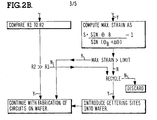
- processor 29 compares the two intensities in registers Rl and R2. If the intensity in register R2 is substantially larger than the intensity in register Rl, then processor 29 sends a signal to control panel 32 which illuminates a lamp GSE which indicates that gettering sites exist. Preferably, the intensity in register R2 is at least 25% larger than the intensity in register Rl for this to occur. In response, the processor of fabricating integrated circuits on substrate 17 is continued.
- processor 29 sends a signal to control panel 32 which illuminates a lamp NGSE which indicates no gettering sites exist.
- wafer 17 is either discarded, or wafer 17 is cycled through another process which introduces gettering sites into the wafer. Then this modified wafer is used in the process in which the integrated circuits are fabricated.
- the angle between beam 16 and substrate 17 is plotted on the horizontal axis as an angular deviation from the Bragg angle ⁇ B ; and the intensity signal on line 23 is plotted on the vertical axis. If substrate 17 is a defect-free crystal, then as curve 23a shows, its intensity is very high at the Bragg angle and it drops off rapidly with only a very small angular deviation from the Bragg angle (e.g., an angular deviation of less than ten seconds).
- intensity 23b is at least 25% larger than intensity 23a.
- control program CP#2b the semiconductor wafer that is to be tested for gettering sites must also be held by the clamps 18 and positioned at the Bragg angle minus a small deviation. Thereafter, when button #2b is pressed, processor 29 starts motor 20 which causes substrate 17 to rotate clockwise.
- processor 29 periodically sends control signals on the leads 28a which cause memory 28 to store the intensity signals on the leads 26 at consecutive memory locations. Thereafter, when substrate 17 has rotated several degrees past the Bragg angle, processor 29 sends a signal to motor 20 which causes it to turn off.
- processor 29 reads and compares the intensity signals in memory 27 to find the peak intensity. Then it stores the address in memory 27 of the peak intensity in a register Rl. Processor 29 then reads and compares the intensity signals in memory 28 to find the peak intensity that is there stored. Then it stores the memory 28 address of the peak intensity in two registers R2 and R3.
- processor 29 decrements the address in registers Rl and R2 by a predetermined amount to obtain the addresses of the peak intensities minus about ten minutes. At those addresses, the stored intensities are certain to be unequal if the substrate which is under test contains gettering sites.
- processor 29 decrements by one the addresses in registers R1 and R2, and compares the intensities that are stored in memories 27 and 28 at those addresses. This decrement and compare operation continues until the intensities at the R1 and R2 addresses are equal.
- equal is herein meant that any difference between the two intensities is within some predetermined minimum value.
- ⁇ B is the Bragg angle
- ⁇ is the smallest angular offset from ⁇ B at which the intensities in memories 27 and 28 are equal.
- Offset ⁇ is computed by subtracting the addresses in registers R2 and R3, and multiplying the difference by the angular movement of substrate 17 which occurs between each intensity sample that is stored in memory 28.
- Processor 29 compares the computed maximum strain S to a predetermined limit, (e.g., 0.010 or 1%). If that limit is exceeded, then processor 29 sends a signal to control panel 32 which illuminates lamp GSE; and in response thereto, the fabrication of circuitry on the substrate 17 that is being tested continues. Conversely, if the maximum strain S is less than the limit, then processor 29 sends a signal to control panel 32 which illuminates lamp NGSE; and in response, the substrate that is being tested is either discarded, or gettering sites are introduced into it and then the fabrication of circuitry on it continues.
- a predetermined limit e.g., 0.010 or 1%
- Equation 1 gives a definition of strain.
- d is the lattice spacing of the atoms of an unstrained crystal
- d' is the lattice spacing of the atoms of a strained crystal.
- Equation 2 is the Bragg equation as it applies to both a strained and an unstrained crystal.
- the term -&B is the Bragg angle for an unstrained crystal lattice
- the term ⁇ B' is the Bragg angle for a strained crystal lattice.
- equation 2 By utilizing equation 2, the term d' can be written in terms of d, ⁇ B and ⁇ B' . This is given as equation 3. Then, by substituting equation 3 into equation 1, a new equation 4 is obtained which expresses strain in terms of d, ⁇ B , and ⁇ B' .
- ⁇ B can also be expressed, as by equation 5, in terms of ⁇ B and the angular deviation ⁇ from ⁇ B at which the curves 23a and 23b in Figure 2 converge. Then, substituting equation 5 into equation 4 yields equation 6 which is the equation for maximum strain.
- Figure 2 steps can be carried out at any stage of an integrated circuit fabrication process. This is because the x-ray beam 16 is non-destructive to any circuitry which is fabricated or partially fabricated on the substrate 17.
- Figures 4a-4f show some specific stages in an exemplary IC fabrication process at which the steps of the present invention may be performed. These figures are taken from U.S. Patent 4,345,307 which is assigned to Burroughs Corporation and which describes a method of mass producing miniature field effect transistors in high density LSI/VLSI chips.
- Figure 4a illustrates a step in which argon atoms are implanted into a backside surface of a substrate in order to there produce gettering sites; but as explained in the background of this disclosure, sandpapering the surface may also be used to produce gettering sites.
- gettering sites are introduced by a vendor of the substrate, and the remaining steps 4b-4f are performed by a purchaser of the substrate, it is very important that the purchaser be able to determine whether or not the gettering sites do in fact exist. This determination is made in accordance with the invention by the above described process steps of Figure 2.
- gettering sites tend to dissipate; and any such dissipation can be detected by subsequently performing the steps of Figure 2.
- the steps of Figure 2 may be performed after the steps of Figures 4a-4c during which the substrate is heated to temperatures of 1,000°C.
- the steps of the present invention may be carried out after the fabrication of the entire integrated circuit is complete (e.g., after the step of Figure 4f). Checking for the presence of gettering sites even at this late stage in the process via the steps of Figure 2 will not adversely affect the circuitry on the substrate.
Landscapes
- Chemical & Material Sciences (AREA)
- General Physics & Mathematics (AREA)
- Crystallography & Structural Chemistry (AREA)
- Health & Medical Sciences (AREA)
- Life Sciences & Earth Sciences (AREA)
- Analytical Chemistry (AREA)
- Biochemistry (AREA)
- Physics & Mathematics (AREA)
- Immunology (AREA)
- General Health & Medical Sciences (AREA)
- Pathology (AREA)
- Testing Or Measuring Of Semiconductors Or The Like (AREA)
- Analysing Materials By The Use Of Radiation (AREA)
- Recrystallisation Techniques (AREA)
- Manufacture Of Electron Tubes, Discharge Lamp Vessels, Lead-In Wires, And The Like (AREA)
- Bipolar Transistors (AREA)
Priority Applications (1)
| Application Number | Priority Date | Filing Date | Title |
|---|---|---|---|
| AT85307851T ATE52636T1 (de) | 1984-11-05 | 1985-10-30 | Verfahren zur herstellung integrierter schaltungen unter einbeziehung von schritten zum nachweis von getterstellen. |
Applications Claiming Priority (2)
| Application Number | Priority Date | Filing Date | Title |
|---|---|---|---|
| US668512 | 1984-11-05 | ||
| US06/668,512 US4575922A (en) | 1984-11-05 | 1984-11-05 | Method of fabricating integrated circuits incorporating steps to detect presence of gettering sites |
Publications (3)
| Publication Number | Publication Date |
|---|---|
| EP0181737A2 true EP0181737A2 (fr) | 1986-05-21 |
| EP0181737A3 EP0181737A3 (en) | 1987-05-20 |
| EP0181737B1 EP0181737B1 (fr) | 1990-05-09 |
Family
ID=24682599
Family Applications (1)
| Application Number | Title | Priority Date | Filing Date |
|---|---|---|---|
| EP85307851A Expired - Lifetime EP0181737B1 (fr) | 1984-11-05 | 1985-10-30 | Procédé pour la fabrication de circuits intégrés incluant des étapes pour indiquer la présence de sites getter |
Country Status (5)
| Country | Link |
|---|---|
| US (1) | US4575922A (fr) |
| EP (1) | EP0181737B1 (fr) |
| JP (1) | JPS61174728A (fr) |
| AT (1) | ATE52636T1 (fr) |
| DE (1) | DE3577622D1 (fr) |
Families Citing this family (8)
| Publication number | Priority date | Publication date | Assignee | Title |
|---|---|---|---|---|
| JP2597976B2 (ja) * | 1985-03-27 | 1997-04-09 | 株式会社東芝 | 半導体装置及びその製造方法 |
| US4777146A (en) * | 1987-02-24 | 1988-10-11 | American Telephone And Telegraph Company, At&T Bell Laboratories | Fabrication process involving semi-insulating material |
| US4873555A (en) * | 1987-06-08 | 1989-10-10 | University Of Pittsburgh Of The Commonwealth System Of Higher Education | Intraband quantum well photodetector and associated method |
| US5233191A (en) * | 1990-04-02 | 1993-08-03 | Hitachi, Ltd. | Method and apparatus of inspecting foreign matters during mass production start-up and mass production line in semiconductor production process |
| US5463459A (en) | 1991-04-02 | 1995-10-31 | Hitachi, Ltd. | Method and apparatus for analyzing the state of generation of foreign particles in semiconductor fabrication process |
| US5306345A (en) * | 1992-08-25 | 1994-04-26 | Particle Solutions | Deposition chamber for deposition of particles on semiconductor wafers |
| JP2003532862A (ja) | 1999-03-16 | 2003-11-05 | キネテイツク・リミテツド | 材料組成を分析するための方法及び装置 |
| US7079975B1 (en) * | 2001-04-30 | 2006-07-18 | Advanced Micro Devices, Inc. | Scatterometry and acoustic based active control of thin film deposition process |
Family Cites Families (6)
| Publication number | Priority date | Publication date | Assignee | Title |
|---|---|---|---|---|
| US4021675A (en) * | 1973-02-20 | 1977-05-03 | Hughes Aircraft Company | System for controlling ion implantation dosage in electronic materials |
| US4033787A (en) * | 1975-10-06 | 1977-07-05 | Honeywell Inc. | Fabrication of semiconductor devices utilizing ion implantation |
| US3984680A (en) * | 1975-10-14 | 1976-10-05 | Massachusetts Institute Of Technology | Soft X-ray mask alignment system |
| US4110625A (en) * | 1976-12-20 | 1978-08-29 | International Business Machines Corporation | Method and apparatus for monitoring the dose of ion implanted into a target by counting emitted X-rays |
| US4332833A (en) * | 1980-02-29 | 1982-06-01 | Bell Telephone Laboratories, Incorporated | Method for optical monitoring in materials fabrication |
| US4392893A (en) * | 1980-11-17 | 1983-07-12 | Texas Instruments Incorporated | Method for controlling characteristics of a semiconductor integrated by circuit X-ray bombardment |
-
1984
- 1984-11-05 US US06/668,512 patent/US4575922A/en not_active Expired - Fee Related
-
1985
- 1985-10-30 AT AT85307851T patent/ATE52636T1/de not_active IP Right Cessation
- 1985-10-30 DE DE8585307851T patent/DE3577622D1/de not_active Expired - Lifetime
- 1985-10-30 EP EP85307851A patent/EP0181737B1/fr not_active Expired - Lifetime
- 1985-11-01 JP JP60246128A patent/JPS61174728A/ja active Granted
Non-Patent Citations (2)
| Title |
|---|
| JOURNAL OF APPLIED CRYSTALLOGRAPHY, vol. 8, part I, 1975, pages 42-44, Chester, GB; M. HART et al.: "Measurement of strain and lattice parameter in epitaxic layers" * |
| JOURNAL OF APPLIED PHYSICS, vol. 51, no. 12, December 1980, pages 6224-6230, New York, US; A. SEGM]LLER et al.: "Automatic x-ray diffraction measurement of the lattice curvature of substrate wafers for the determination o linear strain patterns" * |
Also Published As
| Publication number | Publication date |
|---|---|
| JPH0428140B2 (fr) | 1992-05-13 |
| US4575922A (en) | 1986-03-18 |
| EP0181737A3 (en) | 1987-05-20 |
| ATE52636T1 (de) | 1990-05-15 |
| DE3577622D1 (de) | 1990-06-13 |
| EP0181737B1 (fr) | 1990-05-09 |
| JPS61174728A (ja) | 1986-08-06 |
Similar Documents
| Publication | Publication Date | Title |
|---|---|---|
| De Wolf et al. | Stress measurements in silicon devices through Raman spectroscopy: Bridging the gap between theory and experiment | |
| Rozgonyi et al. | X‐Ray Determination of Stresses in Thin Films and Substrates by Automatic Bragg Angle Control | |
| EP0181737B1 (fr) | Procédé pour la fabrication de circuits intégrés incluant des étapes pour indiquer la présence de sites getter | |
| Caligiuri et al. | Inflationary tensor perturbations after BICEP2 | |
| EP3845893B1 (fr) | Système et procédé applicables pour mesurer l'épaisseur d'un film ultra mince sur un substrat | |
| Roberto et al. | Anharmonicity and the temperature dependence of the forbidden (222) reflection in silicon | |
| Shaw et al. | Measuring nondipolar asymmetries of photoelectron angular distributions | |
| Chateigner | Reliability criteria in quantitative texture analysis with experimental and simulated orientation distributions | |
| US3723873A (en) | Radiation method for determining semiconductor stability and reliability | |
| HUT60543A (en) | Method for detecting precipitated extraneous phases in monocrystal material | |
| Rowe | Anisotropic photoemission and chemisorption-bond geometry on Ge (111) and Si (111) surfaces | |
| US5598452A (en) | Method of evaluating a silicon single crystal | |
| JP2630249B2 (ja) | 全反射蛍光x線分析装置 | |
| Einspruch et al. | Materials and process characterization | |
| USH589H (en) | Measurement of film thickness of integrated circuits | |
| JP3127875B2 (ja) | 全反射螢光x線分析方法及び装置 | |
| Engelbrecht | A Technique for Obtaining the Infrared Reflectivity of Back Side‐Damaged Silicon Samples | |
| Turner | Wafer level reliability: Process control for reliability | |
| Sander | Room temperature annealing of silicon transistor parameters degraded by a burst of neutrons | |
| Gmuca et al. | Low energy accelerator calibration using EBS resonances | |
| Nikulin et al. | X-ray phase-amplitude contrast mapping of single-crystal alloys near the absorption edge of the alloy impurity | |
| Funahashi et al. | Enhanced analysis of particles and vapor phase decomposition droplets by total-reflection X-ray fluorescence | |
| Petrashen et al. | Experimental study of the X‐ray diffraction in a bent crystal with a large strain gradient | |
| JPH0344544A (ja) | 結晶基板の内部歪み測定方法 | |
| Newbury et al. | The role of standards in secondary ion mass spectrometry |
Legal Events
| Date | Code | Title | Description |
|---|---|---|---|
| PUAI | Public reference made under article 153(3) epc to a published international application that has entered the european phase |
Free format text: ORIGINAL CODE: 0009012 |
|
| 17P | Request for examination filed |
Effective date: 19851102 |
|
| AK | Designated contracting states |
Kind code of ref document: A2 Designated state(s): AT BE DE FR GB IT NL SE |
|
| PUAL | Search report despatched |
Free format text: ORIGINAL CODE: 0009013 |
|
| AK | Designated contracting states |
Kind code of ref document: A3 Designated state(s): AT BE DE FR GB IT NL SE |
|
| RAP1 | Party data changed (applicant data changed or rights of an application transferred) |
Owner name: UNISYS CORPORATION |
|
| 17Q | First examination report despatched |
Effective date: 19890420 |
|
| GRAA | (expected) grant |
Free format text: ORIGINAL CODE: 0009210 |
|
| AK | Designated contracting states |
Kind code of ref document: B1 Designated state(s): AT BE DE FR GB IT NL SE |
|
| PG25 | Lapsed in a contracting state [announced via postgrant information from national office to epo] |
Ref country code: AT Effective date: 19900509 |
|
| REF | Corresponds to: |
Ref document number: 52636 Country of ref document: AT Date of ref document: 19900515 Kind code of ref document: T |
|
| REF | Corresponds to: |
Ref document number: 3577622 Country of ref document: DE Date of ref document: 19900613 |
|
| ET | Fr: translation filed | ||
| ITF | It: translation for a ep patent filed | ||
| PLBE | No opposition filed within time limit |
Free format text: ORIGINAL CODE: 0009261 |
|
| STAA | Information on the status of an ep patent application or granted ep patent |
Free format text: STATUS: NO OPPOSITION FILED WITHIN TIME LIMIT |
|
| 26N | No opposition filed | ||
| ITTA | It: last paid annual fee | ||
| PGFP | Annual fee paid to national office [announced via postgrant information from national office to epo] |
Ref country code: BE Payment date: 19931012 Year of fee payment: 9 |
|
| PGFP | Annual fee paid to national office [announced via postgrant information from national office to epo] |
Ref country code: SE Payment date: 19940916 Year of fee payment: 10 |
|
| PG25 | Lapsed in a contracting state [announced via postgrant information from national office to epo] |
Ref country code: BE Effective date: 19941031 |
|
| PGFP | Annual fee paid to national office [announced via postgrant information from national office to epo] |
Ref country code: NL Payment date: 19941031 Year of fee payment: 10 |
|
| EAL | Se: european patent in force in sweden |
Ref document number: 85307851.7 |
|
| BERE | Be: lapsed |
Owner name: UNISYS CORP. Effective date: 19941031 |
|
| PG25 | Lapsed in a contracting state [announced via postgrant information from national office to epo] |
Ref country code: SE Effective date: 19951031 |
|
| PG25 | Lapsed in a contracting state [announced via postgrant information from national office to epo] |
Ref country code: NL Effective date: 19960501 |
|
| EUG | Se: european patent has lapsed |
Ref document number: 85307851.7 |
|
| NLV4 | Nl: lapsed or anulled due to non-payment of the annual fee |
Effective date: 19960501 |
|
| PGFP | Annual fee paid to national office [announced via postgrant information from national office to epo] |
Ref country code: GB Payment date: 19960916 Year of fee payment: 12 |
|
| PGFP | Annual fee paid to national office [announced via postgrant information from national office to epo] |
Ref country code: FR Payment date: 19961011 Year of fee payment: 12 |
|
| PGFP | Annual fee paid to national office [announced via postgrant information from national office to epo] |
Ref country code: DE Payment date: 19961030 Year of fee payment: 12 |
|
| PG25 | Lapsed in a contracting state [announced via postgrant information from national office to epo] |
Ref country code: GB Free format text: LAPSE BECAUSE OF NON-PAYMENT OF DUE FEES Effective date: 19971030 |
|
| PG25 | Lapsed in a contracting state [announced via postgrant information from national office to epo] |
Ref country code: FR Free format text: THE PATENT HAS BEEN ANNULLED BY A DECISION OF A NATIONAL AUTHORITY Effective date: 19971031 |
|
| GBPC | Gb: european patent ceased through non-payment of renewal fee |
Effective date: 19971030 |
|
| PG25 | Lapsed in a contracting state [announced via postgrant information from national office to epo] |
Ref country code: DE Free format text: LAPSE BECAUSE OF NON-PAYMENT OF DUE FEES Effective date: 19980701 |
|
| REG | Reference to a national code |
Ref country code: FR Ref legal event code: ST |