EP0182083A2 - Ruban enduit pour entoilage - Google Patents
Ruban enduit pour entoilage Download PDFInfo
- Publication number
- EP0182083A2 EP0182083A2 EP85112982A EP85112982A EP0182083A2 EP 0182083 A2 EP0182083 A2 EP 0182083A2 EP 85112982 A EP85112982 A EP 85112982A EP 85112982 A EP85112982 A EP 85112982A EP 0182083 A2 EP0182083 A2 EP 0182083A2
- Authority
- EP
- European Patent Office
- Prior art keywords
- interlining
- strip
- melt adhesive
- strip according
- areas
- Prior art date
- Legal status (The legal status is an assumption and is not a legal conclusion. Google has not performed a legal analysis and makes no representation as to the accuracy of the status listed.)
- Withdrawn
Links
Images


Classifications
-
- A—HUMAN NECESSITIES
- A41—WEARING APPAREL
- A41D—OUTERWEAR; PROTECTIVE GARMENTS; ACCESSORIES
- A41D27/00—Details of garments or of their making
- A41D27/02—Linings
- A41D27/06—Stiffening-pieces
Definitions
- the invention relates to a coated interlining which is discontinuously coated on one or both sides with thermoplastic material and is therefore heat-sealable: the hot-melt adhesive softens when heated and becomes adhesive.
- the insert is connected to a textile fabric by hot pressing at 100 to 170 ° C.
- the hot melt adhesive is discontinuously coated using a nickel pressure cylinder; the consistency of the thermoplastic is to be adjusted in such a way that there is only a small flow between the affected points and the product therefore has a number of points or larger, discrete areas of thermoplastic material. These spots or areas may fuse to some extent during the heat treatment, but the coated substrate initially does not contain any continuous lines that cause a stiffening effect.
- the object of the present invention is to avoid these negative characteristics of known interlinings.
- a heat-sealable interlining strip is therefore proposed with the characterizing features of claim 1.
- Such an insert is unslit. It expediently consists of nonwoven.
- the thermoplastic material can be a conventional hot melt adhesive.
- the interlining strip according to the invention advantageously has a length of at least 2 m and has a repeating hot melt adhesive pattern. All that is required to coat it is a printing operation, either screen printing or roller printing.
- the product can be stored in rolls. It is possible to further cut the strip lengthwise or crosswise into a number of smaller units, as well as to cut individual pieces between, for example, 50 mm and 1 m in length from the roll and to use them accordingly in items of clothing.
- the interlining strip according to the invention has a continuous hot-melt adhesive tape, e.g. B. a line or another two-dimensional surface, as a coating.
- At least one dimension of the hot-melt adhesive surface (s) is preferably not shorter than the width of the fabric or nonwoven strip, although it does not have to extend over its entire width.
- the coated surface can be a continuous line from one strip edge to the other.
- the continuous hot melt adhesive lines or tapes can also run diagonally or lengthways, but in any case their length: width ratio must be at least 3: 1.
- the hot-melt adhesive surface areas contain relatively thin, diagonal lines which run in both directions along and across the insert strip. These should only be 1 to 2 mm thick, whereby parallel lines must be at least 5 to 10 mm apart. They delimit parallelogram-like, i.e. rhombic or square surfaces, the total content of which is large in relation to those on the hot-melt adhesive surfaces.
- parallelogram-like, i.e. rhombic or square surfaces the total content of which is large in relation to those on the hot-melt adhesive surfaces.
- Such a heat sealable interlining nonwoven z. B. creates a significant quilting effect on the surface of a garment.
- the interlining material according to the invention is used to produce a garment which has an irregular crease effect.
- the fixing insert has lines of hot-melt adhesive running across its entire length. These lines can also be curved and / or intersect.
- the coated area should be considerably smaller than the entire area free of hot melt adhesive.
- a further version of the present invention is characterized in that the hot melt adhesive areas as a whole are larger than the free areas.
- examples of such an arrangement are products in which the free surfaces are in the form of cutouts or grooves or slots.
- the second surface (s) is a relatively compliant line that can be used to fold a collar, a waist band , a pocket flap or other similar areas of a garment.
- the insert strip according to the invention has one, two or three longitudinally oriented, uncoated lines. Since, according to the present invention, the fixing insert remains intact during folding, i.e. does not need to be cut at the folding line, the grooves can be significantly longer in any direction, i.e. at least 40 mm long, and also continuous. Thus, the difference between the stored areas and the pure fabric areas without an insert on the finished garment is not as blatant as with the previously used laminates.
- the insert according to the invention is also very suitable for stiffening the collar.
- the notch in the collar fabric is in this case tapering, and a corresponding zone free of hot melt adhesive in the interlining nonwoven fabric is also tapered or of essentially the same thickness over its entire length, e.g. 3 to 7 mm.
- a nonwoven strip according to the invention is produced in that the hot melt adhesive is printed on a roller, for which purpose opposing printing screens are particularly suitable.
- a conventional anilox roller made of nickel is often sufficient.
- the hot-melt adhesive areas are expediently applied by a normal screen printing roller, the recessed areas being left out by masking the corresponding fields on the printing screen. This means that the interlining areas are completely free of hot melt adhesive.
- a repetitive hot melt adhesive pattern is naturally created. This can consist of a continuous hatching with two rows of parallel lines of hot-melt adhesive, which run lengthways and crossways to the nonwoven strip and cross each other.
- the longitudinal lines of weakness can be generated in an analogous manner.
- the interlining material according to the invention is used for parts of clothing to be folded or structured by depositing according to the conventional heat sealing method.
- the length: width ratio of the hot melt adhesive area on the insert strip is at least 3: 1, advantageously 5: 1 or even more than 10: 1.
- the length is at least 3 mm, but usually at least 50 mm.
- the weakening lines primarily facilitate the folding of the interlining fabric or the interlining fabric / fabric; however, they also make it easier to trim along these lines if necessary.
- FIGS. 1 to 7 contain schematic views of the interlining fabric according to the invention and FIG. 8 shows a possible use in a perspective view.
- FIG. 1 shows a collar insert which was cut out of a longer strip of nonwoven fabric which is almost completely coated with hot-melt adhesive 1 and which contains an uncoated area 2.
- the area 2 allows folding along the dashed line.
- FIGS. 2 to 5 show cut-off nonwoven strips, which in turn contain hot-melt adhesive surface areas 1.
- FIGS. 2, 3 and 4 show one, two and three line-shaped, uncoated areas 2 which serve as lines of weakness.
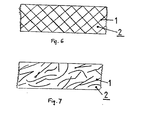
- FIGS. 6 and 7 contain exemplary embodiments in which the coated surface areas 1 as a whole are very small compared to the uncoated surface areas 2.
- the hot-melt adhesive areas 1 are essentially linear. Interlining nonwovens designed in this way are suitable for simulating quilting or creased goods.
- a roll 3 contains the nonwoven interlining strip according to the invention with thermoplastic-coated surface areas 1 and linear, uncoated zones 2 A and 2 B.
- This interlining 4 is suitable for waistbands with defined folding lines. It is connected to a fabric strip 5, which is supported on a roll 6. The interlining 4 and the fabric 5 are pulled off their corresponding rollers 3 and 6 in the direction of the arrow, over the rod 7, then over the tape guide 8 and finally to the hot melt adhesive press (not shown).
- the drawn insert strip 4 contains only two parallel lines 2 A free of thermoplastic (FIGS. 2 to 5).
- the strip edge 9 (FIG. 8) is created by tearing off the strip along the line 2 B, which need not be continuous.
- another roll 3 can be used in an analogous manner; therefore no additional longitudinal section of the interlining on roll 3 is necessary.
Landscapes
- Engineering & Computer Science (AREA)
- Textile Engineering (AREA)
- Details Of Garments (AREA)
- Adhesives Or Adhesive Processes (AREA)
- Adhesive Tapes (AREA)
Applications Claiming Priority (2)
| Application Number | Priority Date | Filing Date | Title |
|---|---|---|---|
| GB848428989A GB8428989D0 (en) | 1984-11-16 | 1984-11-16 | Coated fabrics |
| GB8428989 | 1984-11-16 |
Publications (2)
| Publication Number | Publication Date |
|---|---|
| EP0182083A2 true EP0182083A2 (fr) | 1986-05-28 |
| EP0182083A3 EP0182083A3 (fr) | 1988-03-09 |
Family
ID=10569833
Family Applications (1)
| Application Number | Title | Priority Date | Filing Date |
|---|---|---|---|
| EP85112982A Withdrawn EP0182083A3 (fr) | 1984-11-16 | 1985-10-12 | Ruban enduit pour entoilage |
Country Status (3)
| Country | Link |
|---|---|
| EP (1) | EP0182083A3 (fr) |
| GB (1) | GB8428989D0 (fr) |
| ZA (1) | ZA858091B (fr) |
Cited By (1)
| Publication number | Priority date | Publication date | Assignee | Title |
|---|---|---|---|---|
| CN107048509A (zh) * | 2017-01-09 | 2017-08-18 | 北京信诚威进出口有限公司 | 粘合分格羽绒服 |
Family Cites Families (5)
| Publication number | Priority date | Publication date | Assignee | Title |
|---|---|---|---|---|
| DE2214236C3 (de) * | 1972-03-23 | 1983-11-10 | Kufner Textilwerke KG, 8000 München | Rasterförmige Beschichtung aus Heißsiegelklebern auf Flächengebilden |
| DE2750842A1 (de) * | 1977-11-14 | 1979-05-17 | Nino Ag | Gewebebahn zur herstellung von zuschnitten der frontpartie-einlagen von oberbekleidungsstuecken |
| US4333980A (en) * | 1978-03-20 | 1982-06-08 | Facemate Corporation | Multi-ply fabric structure including interliner |
| AU551851B2 (en) * | 1981-01-14 | 1986-05-15 | Hiraoka & Co. Ltd. | Thermoplastic bonding tape |
| JPS58136803A (ja) * | 1982-02-03 | 1983-08-15 | 日本バイリーン株式会社 | テ−プ状融着芯地 |
-
1984
- 1984-11-16 GB GB848428989A patent/GB8428989D0/en active Pending
-
1985
- 1985-10-12 EP EP85112982A patent/EP0182083A3/fr not_active Withdrawn
- 1985-10-21 ZA ZA858091A patent/ZA858091B/xx unknown
Cited By (1)
| Publication number | Priority date | Publication date | Assignee | Title |
|---|---|---|---|---|
| CN107048509A (zh) * | 2017-01-09 | 2017-08-18 | 北京信诚威进出口有限公司 | 粘合分格羽绒服 |
Also Published As
| Publication number | Publication date |
|---|---|
| GB8428989D0 (en) | 1984-12-27 |
| EP0182083A3 (fr) | 1988-03-09 |
| ZA858091B (en) | 1986-06-25 |
Similar Documents
| Publication | Publication Date | Title |
|---|---|---|
| DE2237583C3 (de) | Bindestreifen zum Klebebinden von Blattstapeln in Buchform | |
| DE2605552C2 (fr) | ||
| DE3308015C2 (fr) | ||
| DE69814892T2 (de) | Verschlusssystem für absorbierende wegwerfartikel | |
| DE69505387T2 (de) | Verpackungsmaterial, verpackungskörper und vorrichtung zur herstellung eines verpackungsmaterials | |
| DE69531000T2 (de) | Verfahren und vorrichtung zum herstellen einer kontinuierlichen stoffbahn | |
| EP0405575A1 (fr) | Procédé de fabrication de slips à jeter | |
| DE2605551A1 (de) | Saugfaehige vorlage | |
| EP0175719A1 (fr) | Procede de fabrication de feuilles ou feuillets avec etiquette autocollante detachable. | |
| DE69518906T2 (de) | Material zum Herstellen von Monatsbinden und absorbierende Gegenstände, die mit diesem Material hergestellt sind | |
| DE69920000T2 (de) | Einlagestoff, verfahren zu dessen herstellung und verwendung | |
| DE69029179T2 (de) | Verfahren und Vorrichtung zum Schweissen thermoplastischer Kunststoffolien | |
| DE69908697T2 (de) | Wellpappenmaschine mit einem mit polymeren Harzmaterial beschichtetem Gurt | |
| DE2301586A1 (de) | Anordnung zur herstellung mehrschichtiger abreissbloecke | |
| DE60016175T2 (de) | Vorrichtung und Verfahren zum Prägen von Papier oder Vliesstoff, sowie das hergestellte Produkt | |
| DE69507619T2 (de) | Verfahren zum Herstellen eines Briefumschlags mit gefalteter Einlage | |
| EP0182083A2 (fr) | Ruban enduit pour entoilage | |
| DE2650196C2 (de) | Windelverschluß | |
| EP0353413A1 (fr) | Soufflet à plis | |
| DE60111883T2 (de) | Verfahren zum Herstellen eines elastischen zusammengesetzten Blattes | |
| EP0848668A1 (fr) | Feuille de transfert pour impression sur des objets et objet ainsi imprime | |
| DE4424888C2 (de) | Anordnung zum Befestigen eines Anfanges einer Papierbahn einer Vorratspapierbahnrolle | |
| CH673078A5 (en) | Adhesive material to replace sewn seams - made of specified adhesives by spot application and calendering | |
| DE4424902C2 (de) | Klebemittelanordnung | |
| DE3818658A1 (de) | Beklebemaschine in einer wellpappenanlage |
Legal Events
| Date | Code | Title | Description |
|---|---|---|---|
| PUAI | Public reference made under article 153(3) epc to a published international application that has entered the european phase |
Free format text: ORIGINAL CODE: 0009012 |
|
| AK | Designated contracting states |
Kind code of ref document: A2 Designated state(s): AT CH DE FR IT LI NL SE |
|
| 17P | Request for examination filed |
Effective date: 19860619 |
|
| PUAL | Search report despatched |
Free format text: ORIGINAL CODE: 0009013 |
|
| AK | Designated contracting states |
Kind code of ref document: A3 Designated state(s): AT CH DE FR IT LI NL SE |
|
| STAA | Information on the status of an ep patent application or granted ep patent |
Free format text: STATUS: THE APPLICATION HAS BEEN WITHDRAWN |
|
| 18W | Application withdrawn |
Withdrawal date: 19880518 |
|
| RIN1 | Information on inventor provided before grant (corrected) |
Inventor name: SCHOFIELD, NEIL |