EP0182665A2 - Verfahren zum Projizieren eines photoelektrischen Bildes - Google Patents
Verfahren zum Projizieren eines photoelektrischen Bildes Download PDFInfo
- Publication number
- EP0182665A2 EP0182665A2 EP85308461A EP85308461A EP0182665A2 EP 0182665 A2 EP0182665 A2 EP 0182665A2 EP 85308461 A EP85308461 A EP 85308461A EP 85308461 A EP85308461 A EP 85308461A EP 0182665 A2 EP0182665 A2 EP 0182665A2
- Authority
- EP
- European Patent Office
- Prior art keywords
- mask substrate
- metal layer
- layer
- photoelectron
- light
- Prior art date
- Legal status (The legal status is an assumption and is not a legal conclusion. Google has not performed a legal analysis and makes no representation as to the accuracy of the status listed.)
- Granted
Links
Images




Classifications
-
- H—ELECTRICITY
- H01—ELECTRIC ELEMENTS
- H01J—ELECTRIC DISCHARGE TUBES OR DISCHARGE LAMPS
- H01J37/00—Discharge tubes with provision for introducing objects or material to be exposed to the discharge, e.g. for the purpose of examination or processing thereof
- H01J37/30—Electron-beam or ion-beam tubes for localised treatment of objects
- H01J37/317—Electron-beam or ion-beam tubes for localised treatment of objects for changing properties of the objects or for applying thin layers thereon, e.g. for ion implantation
- H01J37/3174—Particle-beam lithography, e.g. electron beam lithography
- H01J37/3175—Projection methods, i.e. transfer substantially complete pattern to substrate
-
- B—PERFORMING OPERATIONS; TRANSPORTING
- B82—NANOTECHNOLOGY
- B82Y—SPECIFIC USES OR APPLICATIONS OF NANOSTRUCTURES; MEASUREMENT OR ANALYSIS OF NANOSTRUCTURES; MANUFACTURE OR TREATMENT OF NANOSTRUCTURES
- B82Y10/00—Nanotechnology for information processing, storage or transmission, e.g. quantum computing or single electron logic
-
- B—PERFORMING OPERATIONS; TRANSPORTING
- B82—NANOTECHNOLOGY
- B82Y—SPECIFIC USES OR APPLICATIONS OF NANOSTRUCTURES; MEASUREMENT OR ANALYSIS OF NANOSTRUCTURES; MANUFACTURE OR TREATMENT OF NANOSTRUCTURES
- B82Y40/00—Manufacture or treatment of nanostructures
-
- G—PHYSICS
- G03—PHOTOGRAPHY; CINEMATOGRAPHY; ANALOGOUS TECHNIQUES USING WAVES OTHER THAN OPTICAL WAVES; ELECTROGRAPHY; HOLOGRAPHY
- G03F—PHOTOMECHANICAL PRODUCTION OF TEXTURED OR PATTERNED SURFACES, e.g. FOR PRINTING, FOR PROCESSING OF SEMICONDUCTOR DEVICES; MATERIALS THEREFOR; ORIGINALS THEREFOR; APPARATUS SPECIALLY ADAPTED THEREFOR
- G03F7/00—Photomechanical, e.g. photolithographic, production of textured or patterned surfaces, e.g. printing surfaces; Materials therefor, e.g. comprising photoresists; Apparatus specially adapted therefor
- G03F7/20—Exposure; Apparatus therefor
- G03F7/2037—Exposure with X-ray radiation or corpuscular radiation, through a mask with a pattern opaque to that radiation
-
- H—ELECTRICITY
- H01—ELECTRIC ELEMENTS
- H01J—ELECTRIC DISCHARGE TUBES OR DISCHARGE LAMPS
- H01J2237/00—Discharge tubes exposing object to beam, e.g. for analysis treatment, etching, imaging
- H01J2237/30—Electron or ion beam tubes for processing objects
- H01J2237/317—Processing objects on a microscale
- H01J2237/3175—Lithography
- H01J2237/31777—Lithography by projection
- H01J2237/31779—Lithography by projection from patterned photocathode
Definitions
- Photolithography is an important technique in the production of, for example, a VLSI.
- the photolithography techniques there are techniques of projecting fine patterning on to wafers or the like.
- One of these is the "Direct-Stepping-on Wafer” (DSW) process, wherein a scaled down, e.g. 5:1 or 10:1, projection exposure process using light (having a 0 wavelength of about 4000 A 0.4 ⁇ m) is carried out using a reticle as an original print.
- the DSW process has a resolution limit of about 1 ⁇ m.
- an electron beam exposure process or X-ray exposure process can be used.
- the electron beam is scanned with a point or a rectangular shape, thereby increasing the exposure time.
- the electron beam exposure process therefore has a small throughput.
- the X-ray exposure process uses an X-ray source having a wavelength of 1 to 10 A (0.1 to 1 nm) and a large-scale light source of, for example, 10 to 50 kW whereby proximity exposure is carried out.
- the X-ray exposure process requires a highly accurate aligner to support and align the mask and wafer.
- the X-ray exposure is similar to conventional optical exposure.
- One light source used for generating X-rays is a synchrotron emission light which is undesirably large in scale and high in cost.
- ion beam exposure has the same problems as electron beam exposure.
- a mask image is projected on to a portion to be projected.
- the mask is produced by a process comprising the steps of providing a pattern to be projected made of an ultraviolet absorber, such as Cr, on, for example, crystal glass and covering the same with photoelectric material, such as CsI, from which electrons are emitted by irradiation with ultraviolet light.
- an ultraviolet absorber such as Cr
- photoelectric material such as CsI
- the resist for the electron beam on the wafer is sometimes sensitized by the ultraviolet light passed through the mask, particularly when it has a large energy, as well as by the emitted electrons. This prevents accurate projection of the pattern of the mask, resulting in blurring of the image.
- Further electrons of CsI are emitted ultraviolet light using low pressure (5 mW) Hg lamp.
- the exposure period 20 mm 0 by the ultraviolet light is low, for example 30 sec.
- a method for projecting a photoelectron image comprising the steps of: providing a mask substrate; selectively contacting a layer which lowers the work function of the mask substrate thereto, and emitting photoelectrons from the contacted portion.
- ther is provided a method for projecting a photoelectron image comprising the steps of: providing a mask substrate; forming a patterned metal layer on the mask substrate in vaccum; irradiating the exposed mask substrate and the metal layer with light in vacuum while applying an electric field and a magnetic field; and projecting the photoelectron image formed by photoelectrons emitted from the light irradiated portion.
- Figure 1 is a schematic view explaining a conventional method for projecting a photoelectron image.
- a semiconductor wafer 1 has formed thereon an electron-sensitive resist layer 2.
- a transparent mask substrate 3, such as quartz, has formed thereon a patterned Cr layer 4.
- a layer 5 from which photoelectrons are emitted for example a Pd layer (having a thickness of about 0 0 40 A (4 nm)) or CsI layer (having a thickness of about 500 A (50nm)) is formed.
- a uniform magnetic field H is applied and a bias is applied by an electric source 8, so that the mask side is minus and the wafer side is plus.
- the mask substrate 3 is irradiated with ultraviolet light 6 so as to provide back illumination of the layer 5 from which the photoelectrons are emitted (hereinafter referred to as the photoelectron layer).
- the photoelectron layer Cr absorbs the ultraviolet light preventing it from reaching the layer 5.
- the ultraviolet light reaches the photoelectron layer 5 and photoelectrons 7 are emitted therefrom having a kinetic energy obtained by subtracting the work function o of the photoelectron emitting substance from the light energy hy.
- the thus emitted photoelectrons are focused on the surface of the wafer 1 by the magnetic field H and the bias obtained from the electric source 8.
- the ultraviolet light passes through the mask layer, i.e. the Cr layer 4, and reaches the wafer 1, whereby the electron-sensitive resist 2 reacts to the ultraviolet light and a correct or accurate projecting process is not possible.
- CsI used as the photoelectron layer 5
- 1849 A 184. 9nm
- 6.7 eV ultraviolet region in vacuum
- Figure 2 is a schematic view explaining the principle of the present invention.
- a uniform electric field is applied between an N pole 13 and an S pole 14 of a magnet.
- a wafer 11 and a mask 12 are oppositely disposed therebetween.
- the wafer 11 is provided on a stage 15.
- reflectors 16 and 17 are disposed between the wafer 11 and mask 12.
- Ultraviolet or visible light 18 is reflected by the reflectors to irradiate a photoelectron layer surface of the mask 12.
- Photoelectrons 19 emitted from the photoelectron layer surface are focused at the surface of the wafer 11.
- the wafer can be exposed by the step-and- repeat system, for example 10 to 300 mm ⁇ .
- Figure 3 is a schematic view explaining an embodiment of the present invention.
- a Pt layer 33 (having a thickness of 500 A (50 ⁇ m) is formed on a GaAs mask substrate 12 by a vacuum evaporation process, then the Pt layer 33 is patterned.
- the obtained mask substrate is provided in a vacuum chamber 30 which acts as a subchamber.
- the exposed Pt layer 33 and GaAs substrate 12 are irradiated with an alkali metal beam, e.g. a Cs ion beam 36 generated from a Cs source 35 in a well-known ion beam generator, so that a Cs photoelectron-active layer is formed thereon.
- an alkali metal beam e.g. a Cs ion beam 36 generated from a Cs source 35 in a well-known ion beam generator, so that a Cs photoelectron-active layer is formed thereon.
- reference numerals 37 and 38 denote a leading electrode and an electrostatic polarization electrode.
- the thus obtained mask substrate is moved to a second vacuum chamber 31 which acts as a main chamber.
- a wafer 11 is provided so that it faces the Cs layer 33 of the mask substrate.
- Light 18 is generated by a light source 25, e.g. a halogen lamp, and reflected by a mirror so that the surface of the mask substrate is irradiated with the light 18, whereby the image formed by photoelectrons 19 emitted from the Cs layer is projected on to the wafer 11.
- a bias of about -80 KV is applied on the mask substrate side to emit the photoelectrons 19.
- a uniform magnetic field is applied so that the mask substrate side is the N pole 13 and the wafer side is the S pole 14.
- a third vacuum chamber 32 is provided near the second vacuum chamber 31.
- the third vacuum chamber 32 is separated into a chamber 40 for the mask substrate and a chamber 41 for the wafer.
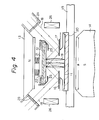
- Figure 4 is a view explaining the second vacuum chamber of Fig. 3 in detail.
- S pole 14 a uniform magnetic field is formed.
- the mask 12 and wafer 11 are disposed so that the mask 12 faces the wafer 11.
- the wafer 11 is fixed by a wafer holder 20 with a chuck the water heoder 20 i. rotatable on a stage 15 which can be moved in horizontal X-and Y- directions. Visible light 18,passed through windows 24 and 25, is reflected by reflectors 16 and 17, and the photoelectron layer surface of the mask 12 is irradiated with the light 18.
- the emitted electrons 19 are focused on to the surface of the wafer 11.
- the mask 12 is held by a mask holder 22, which is insulatedly supported by a ceramic material 21.
- a magnetic field for focusing the electrons is obtained by the poles 13 and 14 (having a cross section of about 40 mm ⁇ ). Within the ends of the poles 13 and 14, a uniform magnetic field can be formed.
- a uniform electrical field is required.
- a bias of -80 KV is applied on the mask 12 and a bias of OV is applied on the wafer 11.
- a bias of a valve is applied on an electrode plate 23 and a reflector 17 so that a potential P is linearly changed, the electric field can be unified.
- a compensator may be used, as shown in Fig. 6.
- Figures 7 and 8 show embodiments of masks according to the present invention.
- a GaAs mask substrate 61 has formed on it a patterned metal 62 such as Pt.
- a photoelectron layer 63 of alkali metal such as Cs is formed. Electrons start being emitted from the Cs layer by light having an energy of about 1.5 eV. The quantum efficiency becomes well enhanced with an energy of 2 to 3 eV.
- Cs may be oxidised several times to form several Cs-O layers.
- a patterned Cs layer 73 is formed on a GaAs mask substrate 71.
- photoelectrons are also emitted from the patterned Cs layer 73.
- Figure 9 is a graph of the relationship between quantum efficiency and irradiating light energy.
- (a) and (b) are the relationships in the cases where GaAs and Pt are respectively used as base mask layers. As shown in Fig. 9, the quantum efficiency is higher in the case of (a) than in the case of (b).
- Figure 10 is an energy diagram of GaAs-Cs.
- E G , E a and ⁇ are a band gap, electron affinity, and the work function, respectively.
- a transparent mask has patterned on it a substrate material which absorbs light. Then, a photoelectron layer is formed on the entire surface as explained above.
- a mask substrate has formed on it two kinds of areas having different quantum efficiencies, whereby the quantity of photoelectrons emitted from the areas are different.
- Cs deposition or 2 Cs treatment process is carried out to form the areas as explained above.
- almost all photoelectron materials can be used but Cs and Cs treated -Sb, -Te, -Ag 2 0, etc a preferable as photoelectron layers.
- the Cs treated -Sb layer is produced by forming an Sb layer on, for example, a sapphire substrate and forming a Cs layer on the Sb layer.
- areas wherein photoelectrons are not emitted are made of metal, for example Pt, Cr, W, Mo, Ta, Au, and Ag.
- metal for example Pt, Cr, W, Mo, Ta, Au, and Ag.
- a mark 91 for alignment is provided around a mask pattern 92. At least two marks 91 are needed so as to match rotation.
- light is shut off with shutters (in Fig. 4, windows 24 and 25 are closed), and another strong light 93 illuminates only the portions of the marks 91. Then,using electrons emitted from the marks 91, the marks 91 are superposed on the marks of the wafer to align the mask with the wafer.
- Figures 12 and 13 show views. of constructions of stages used in the present invention.
- a stage 15 for alignment can be moved in the X- and Y-directions.
- a wafer holder 20 with a chuck (not shown) is rotatably moved.
- a moving mechanism 50 of a stage is provided at one side.
- a (mark detection) scanner (MD) may be used for the alignment.
- a magnetic pole of the present invention will be explained with reference to Fig. 14.
- Fig. 14 instead of the N and S poles 13 and 14, use is made of an electro magnet composed of a coil 60 in which current is passed.
Landscapes
- Engineering & Computer Science (AREA)
- Chemical & Material Sciences (AREA)
- Nanotechnology (AREA)
- Physics & Mathematics (AREA)
- General Physics & Mathematics (AREA)
- Crystallography & Structural Chemistry (AREA)
- Analytical Chemistry (AREA)
- Condensed Matter Physics & Semiconductors (AREA)
- Manufacturing & Machinery (AREA)
- Mathematical Physics (AREA)
- Theoretical Computer Science (AREA)
- Electron Beam Exposure (AREA)
Applications Claiming Priority (6)
| Application Number | Priority Date | Filing Date | Title |
|---|---|---|---|
| JP243342/84 | 1984-11-20 | ||
| JP243343/84 | 1984-11-20 | ||
| JP59243343A JPS61123135A (ja) | 1984-11-20 | 1984-11-20 | 光電子像転写方法 |
| JP59243342A JPS61123134A (ja) | 1984-11-20 | 1984-11-20 | 光電子像転写方法 |
| JP252151/84 | 1984-11-29 | ||
| JP59252151A JPS61129826A (ja) | 1984-11-29 | 1984-11-29 | 光電子像の転写方法 |
Publications (3)
| Publication Number | Publication Date |
|---|---|
| EP0182665A2 true EP0182665A2 (de) | 1986-05-28 |
| EP0182665A3 EP0182665A3 (en) | 1987-04-22 |
| EP0182665B1 EP0182665B1 (de) | 1991-09-18 |
Family
ID=27333131
Family Applications (1)
| Application Number | Title | Priority Date | Filing Date |
|---|---|---|---|
| EP85308461A Expired EP0182665B1 (de) | 1984-11-20 | 1985-11-20 | Verfahren zum Projizieren eines photoelektrischen Bildes |
Country Status (4)
| Country | Link |
|---|---|
| US (1) | US4789786A (de) |
| EP (1) | EP0182665B1 (de) |
| KR (1) | KR910000756B1 (de) |
| DE (1) | DE3584141D1 (de) |
Cited By (3)
| Publication number | Priority date | Publication date | Assignee | Title |
|---|---|---|---|---|
| EP0257528A1 (de) * | 1986-08-18 | 1988-03-02 | Fujitsu Limited | Photokathoden für Elektronenbildprojektion |
| EP0321147A3 (en) * | 1987-12-15 | 1990-03-14 | Fujitsu Limited | Photoelectron mask and photo cathode image projection method using the same |
| WO2007032671A1 (en) * | 2005-09-16 | 2007-03-22 | Mapper Lithography Ip B.V. | Lithography system and projection method |
Families Citing this family (7)
| Publication number | Priority date | Publication date | Assignee | Title |
|---|---|---|---|---|
| DE68922929T2 (de) * | 1988-03-23 | 1996-02-22 | Fujitsu Ltd., Kawasaki, Kanagawa | Photokathoden-Bildprojektionsapparat für die Mustergestaltung auf einer Halbleitervorrichtung. |
| US4928018A (en) * | 1989-06-29 | 1990-05-22 | Texas Instruments, Incorporated | Thermo-enhanced electron image projector |
| US5156942A (en) * | 1989-07-11 | 1992-10-20 | Texas Instruments Incorporated | Extended source E-beam mask imaging system and method |
| JP3689516B2 (ja) * | 1997-01-29 | 2005-08-31 | キヤノン株式会社 | 電子ビーム露光装置 |
| EP0969325B1 (de) * | 1998-07-01 | 2003-01-15 | ASML Netherlands B.V. | Projektionsbelichtungsgerät |
| US9673023B2 (en) * | 2015-05-12 | 2017-06-06 | Applied Materials Israel Ltd. | System for discharging an area that is scanned by an electron beam |
| US10168614B1 (en) | 2017-06-14 | 2019-01-01 | Applied Materials Israel Ltd. | On-axis illumination and alignment for charge control during charged particle beam inspection |
Family Cites Families (13)
| Publication number | Priority date | Publication date | Assignee | Title |
|---|---|---|---|---|
| US3679497A (en) * | 1969-10-24 | 1972-07-25 | Westinghouse Electric Corp | Electron beam fabrication system and process for use thereof |
| US3710101A (en) * | 1970-10-06 | 1973-01-09 | Westinghouse Electric Corp | Apparatus and method for alignment of members to electron beams |
| FR2146106B1 (de) * | 1971-07-16 | 1977-08-05 | Thomson Csf | |
| US3832560A (en) * | 1973-06-13 | 1974-08-27 | Westinghouse Electric Corp | Method and apparatus for electron beam alignment with a member by detecting cathodoluminescence from oxide layers |
| FI760019A7 (de) * | 1976-01-07 | 1977-07-08 | Rauma Repola Oy | |
| GB1557064A (en) * | 1976-09-09 | 1979-12-05 | Mullard Ltd | Masks suitable for use in electron image projectors |
| JPS57194531A (en) * | 1981-05-26 | 1982-11-30 | Toshiba Corp | Electron beam transfer device |
| FR2507232A1 (fr) * | 1981-06-09 | 1982-12-10 | Freyssinet Int Stup | Dispositif de mise en tension de barres de precontrainte et de determination de cette tension |
| JPS5877229A (ja) * | 1981-10-31 | 1983-05-10 | Toshiba Corp | パタ−ン転写用マスクおよびその製造方法 |
| GB2111299B (en) * | 1981-11-30 | 1986-07-09 | Thermo Electron Corp | High current density photoelectron generators |
| US4572956A (en) * | 1982-08-31 | 1986-02-25 | Tokyo Shibaura Denki Kabushiki Kaisha | Electron beam pattern transfer system having an autofocusing mechanism |
| GB2142158A (en) * | 1983-05-25 | 1985-01-09 | Philips Electronic Associated | Electron lithography masks |
| JPS6066816A (ja) * | 1983-09-22 | 1985-04-17 | Fujitsu Ltd | 電子ビ−ム露光装置 |
-
1985
- 1985-11-20 KR KR8508677A patent/KR910000756B1/ko not_active Expired
- 1985-11-20 EP EP85308461A patent/EP0182665B1/de not_active Expired
- 1985-11-20 DE DE8585308461T patent/DE3584141D1/de not_active Expired - Lifetime
-
1988
- 1988-01-15 US US07/144,275 patent/US4789786A/en not_active Expired - Fee Related
Cited By (5)
| Publication number | Priority date | Publication date | Assignee | Title |
|---|---|---|---|---|
| EP0257528A1 (de) * | 1986-08-18 | 1988-03-02 | Fujitsu Limited | Photokathoden für Elektronenbildprojektion |
| EP0321147A3 (en) * | 1987-12-15 | 1990-03-14 | Fujitsu Limited | Photoelectron mask and photo cathode image projection method using the same |
| US4954717A (en) * | 1987-12-15 | 1990-09-04 | Fujitsu Limited | Photoelectron mask and photo cathode image projection method using the same |
| WO2007032671A1 (en) * | 2005-09-16 | 2007-03-22 | Mapper Lithography Ip B.V. | Lithography system and projection method |
| KR101367499B1 (ko) * | 2005-09-16 | 2014-02-25 | 마퍼 리쏘그라피 아이피 비.브이. | 리소그라피 시스템 및 투영 방법 |
Also Published As
| Publication number | Publication date |
|---|---|
| DE3584141D1 (de) | 1991-10-24 |
| EP0182665B1 (de) | 1991-09-18 |
| KR910000756B1 (en) | 1991-02-06 |
| EP0182665A3 (en) | 1987-04-22 |
| US4789786A (en) | 1988-12-06 |
Similar Documents
| Publication | Publication Date | Title |
|---|---|---|
| EP0605964B1 (de) | Elektronenstrahl-lithographie unter Verwendung von einer Photokathode | |
| JPS60502120A (ja) | 光学的に構成されたフィルタおよびその製造方法 | |
| KR920005634B1 (ko) | 광전자 마스크 및 그것을 사용한 광전자 전사노광방법 | |
| US4789786A (en) | Method of projecting photoelectron image | |
| US4652762A (en) | Electron lithography mask manufacture | |
| KR20020026532A (ko) | 전자 빔 소스용의 패터닝된 열전도 포토캐소드 | |
| EP0257528B1 (de) | Photokathoden für Elektronenbildprojektion | |
| JPH01159955A (ja) | 電子イメージプロジェクタ | |
| JPH07254539A (ja) | 電子ビーム露光装置 | |
| US7463336B2 (en) | Device manufacturing method and apparatus with applied electric field | |
| Gordon et al. | Pathways in device lithography | |
| US6515292B1 (en) | High resolution electron projection | |
| CS209199B1 (cs) | Zařízení k výrobě polovodičových struktur | |
| JPS622535A (ja) | 電子ビ−ム露光装置 | |
| JPS61129826A (ja) | 光電子像の転写方法 | |
| Lawes | Sub-micron lithography techniques | |
| JPS5915380B2 (ja) | 微細パタ−ンの転写装置 | |
| Lepselter et al. | Resolution Limitations for Submicron Lithography | |
| Poppeller et al. | Hot Electron Emission Lithography: a method for efficient large area e-beam projection | |
| JPS61123134A (ja) | 光電子像転写方法 | |
| JPS61123135A (ja) | 光電子像転写方法 | |
| JPS60152026A (ja) | 曲面レチクルの製造方法 | |
| JPS63100729A (ja) | 光電子転写用マスクとその製造方法 | |
| JPS58158925A (ja) | X線露光方法 | |
| JPH01289246A (ja) | 光電子転写装置 |
Legal Events
| Date | Code | Title | Description |
|---|---|---|---|
| PUAI | Public reference made under article 153(3) epc to a published international application that has entered the european phase |
Free format text: ORIGINAL CODE: 0009012 |
|
| AK | Designated contracting states |
Kind code of ref document: A2 Designated state(s): DE FR GB |
|
| PUAL | Search report despatched |
Free format text: ORIGINAL CODE: 0009013 |
|
| AK | Designated contracting states |
Kind code of ref document: A3 Designated state(s): DE FR GB |
|
| 17P | Request for examination filed |
Effective date: 19870924 |
|
| 17Q | First examination report despatched |
Effective date: 19890127 |
|
| GRAA | (expected) grant |
Free format text: ORIGINAL CODE: 0009210 |
|
| AK | Designated contracting states |
Kind code of ref document: B1 Designated state(s): DE FR GB |
|
| REF | Corresponds to: |
Ref document number: 3584141 Country of ref document: DE Date of ref document: 19911024 |
|
| ET | Fr: translation filed | ||
| PLBE | No opposition filed within time limit |
Free format text: ORIGINAL CODE: 0009261 |
|
| STAA | Information on the status of an ep patent application or granted ep patent |
Free format text: STATUS: NO OPPOSITION FILED WITHIN TIME LIMIT |
|
| PGFP | Annual fee paid to national office [announced via postgrant information from national office to epo] |
Ref country code: GB Payment date: 19920908 Year of fee payment: 8 |
|
| 26N | No opposition filed | ||
| PGFP | Annual fee paid to national office [announced via postgrant information from national office to epo] |
Ref country code: FR Payment date: 19921127 Year of fee payment: 8 |
|
| PGFP | Annual fee paid to national office [announced via postgrant information from national office to epo] |
Ref country code: DE Payment date: 19930129 Year of fee payment: 8 |
|
| PG25 | Lapsed in a contracting state [announced via postgrant information from national office to epo] |
Ref country code: GB Effective date: 19931120 |
|
| GBPC | Gb: european patent ceased through non-payment of renewal fee |
Effective date: 19931120 |
|
| PG25 | Lapsed in a contracting state [announced via postgrant information from national office to epo] |
Ref country code: FR Effective date: 19940729 |
|
| PG25 | Lapsed in a contracting state [announced via postgrant information from national office to epo] |
Ref country code: DE Effective date: 19940802 |
|
| REG | Reference to a national code |
Ref country code: FR Ref legal event code: ST |