EP0182948B1 - Silikonenthaltende Leiterpolymere und ein Verfahren zu deren Herstellung - Google Patents
Silikonenthaltende Leiterpolymere und ein Verfahren zu deren Herstellung Download PDFInfo
- Publication number
- EP0182948B1 EP0182948B1 EP19840308306 EP84308306A EP0182948B1 EP 0182948 B1 EP0182948 B1 EP 0182948B1 EP 19840308306 EP19840308306 EP 19840308306 EP 84308306 A EP84308306 A EP 84308306A EP 0182948 B1 EP0182948 B1 EP 0182948B1
- Authority
- EP
- European Patent Office
- Prior art keywords
- group
- carbon atoms
- polymer
- prepolymer
- alkyl
- Prior art date
- Legal status (The legal status is an assumption and is not a legal conclusion. Google has not performed a legal analysis and makes no representation as to the accuracy of the status listed.)
- Expired
Links
- 229920000642 polymer Polymers 0.000 title claims description 102
- 238000000034 method Methods 0.000 title claims description 34
- 229910052710 silicon Inorganic materials 0.000 title claims description 21
- XUIMIQQOPSSXEZ-UHFFFAOYSA-N Silicon Chemical compound [Si] XUIMIQQOPSSXEZ-UHFFFAOYSA-N 0.000 title claims description 20
- 239000010703 silicon Substances 0.000 title claims description 20
- 238000006243 chemical reaction Methods 0.000 claims description 47
- 125000004432 carbon atom Chemical group C* 0.000 claims description 41
- XLYOFNOQVPJJNP-UHFFFAOYSA-N water Substances O XLYOFNOQVPJJNP-UHFFFAOYSA-N 0.000 claims description 23
- 125000000217 alkyl group Chemical group 0.000 claims description 20
- 229920002554 vinyl polymer Polymers 0.000 claims description 19
- 150000002430 hydrocarbons Chemical group 0.000 claims description 17
- 230000003301 hydrolyzing effect Effects 0.000 claims description 15
- 238000010521 absorption reaction Methods 0.000 claims description 14
- 238000009833 condensation Methods 0.000 claims description 14
- 230000005494 condensation Effects 0.000 claims description 14
- 238000000862 absorption spectrum Methods 0.000 claims description 13
- 239000003795 chemical substances by application Substances 0.000 claims description 13
- 125000003545 alkoxy group Chemical group 0.000 claims description 12
- 239000001257 hydrogen Substances 0.000 claims description 12
- 229910052739 hydrogen Inorganic materials 0.000 claims description 12
- 125000001997 phenyl group Chemical group [H]C1=C([H])C([H])=C(*)C([H])=C1[H] 0.000 claims description 12
- 239000002904 solvent Substances 0.000 claims description 11
- 238000005227 gel permeation chromatography Methods 0.000 claims description 10
- 125000000391 vinyl group Chemical group [H]C([*])=C([H])[H] 0.000 claims description 10
- 125000004663 dialkyl amino group Chemical group 0.000 claims description 8
- 239000002253 acid Substances 0.000 claims description 7
- 239000003505 polymerization initiator Substances 0.000 claims description 7
- UFHFLCQGNIYNRP-UHFFFAOYSA-N Hydrogen Chemical compound [H][H] UFHFLCQGNIYNRP-UHFFFAOYSA-N 0.000 claims description 6
- 150000008065 acid anhydrides Chemical class 0.000 claims description 6
- 150000004945 aromatic hydrocarbons Chemical class 0.000 claims description 6
- 125000004435 hydrogen atom Chemical group [H]* 0.000 claims description 6
- 230000007062 hydrolysis Effects 0.000 claims description 6
- 238000006460 hydrolysis reaction Methods 0.000 claims description 6
- 125000004001 thioalkyl group Chemical group 0.000 claims description 6
- 229910052736 halogen Inorganic materials 0.000 claims description 5
- 150000002367 halogens Chemical class 0.000 claims description 5
- 239000004215 Carbon black (E152) Substances 0.000 claims description 4
- 229910052801 chlorine Inorganic materials 0.000 claims description 4
- 239000000460 chlorine Substances 0.000 claims description 4
- 229930195733 hydrocarbon Natural products 0.000 claims description 4
- WKBOTKDWSSQWDR-UHFFFAOYSA-N Bromine atom Chemical group [Br] WKBOTKDWSSQWDR-UHFFFAOYSA-N 0.000 claims description 3
- ZAMOUSCENKQFHK-UHFFFAOYSA-N Chlorine atom Chemical compound [Cl] ZAMOUSCENKQFHK-UHFFFAOYSA-N 0.000 claims description 3
- GDTBXPJZTBHREO-UHFFFAOYSA-N bromine Chemical group BrBr GDTBXPJZTBHREO-UHFFFAOYSA-N 0.000 claims description 3
- 229910052794 bromium Inorganic materials 0.000 claims description 3
- 150000007524 organic acids Chemical class 0.000 claims description 3
- 125000005389 trialkylsiloxy group Chemical group 0.000 claims description 3
- 125000004665 trialkylsilyl group Chemical group 0.000 claims description 3
- 125000001183 hydrocarbyl group Chemical group 0.000 claims 8
- 125000002496 methyl group Chemical group [H]C([H])([H])* 0.000 claims 4
- 230000009102 absorption Effects 0.000 claims 3
- ZCYVEMRRCGMTRW-UHFFFAOYSA-N 7553-56-2 Chemical compound [I] ZCYVEMRRCGMTRW-UHFFFAOYSA-N 0.000 claims 2
- 229910052740 iodine Inorganic materials 0.000 claims 2
- 239000011630 iodine Substances 0.000 claims 2
- 125000000725 trifluoropropyl group Chemical group [H]C([H])(*)C([H])([H])C(F)(F)F 0.000 claims 2
- PXGOKWXKJXAPGV-UHFFFAOYSA-N Fluorine Chemical compound FF PXGOKWXKJXAPGV-UHFFFAOYSA-N 0.000 claims 1
- 150000008064 anhydrides Chemical class 0.000 claims 1
- 125000001309 chloro group Chemical group Cl* 0.000 claims 1
- 125000001301 ethoxy group Chemical group [H]C([H])([H])C([H])([H])O* 0.000 claims 1
- 229910052731 fluorine Inorganic materials 0.000 claims 1
- 239000011737 fluorine Substances 0.000 claims 1
- 125000000026 trimethylsilyl group Chemical group [H]C([H])([H])[Si]([*])(C([H])([H])[H])C([H])([H])[H] 0.000 claims 1
- YXFVVABEGXRONW-UHFFFAOYSA-N Toluene Chemical compound CC1=CC=CC=C1 YXFVVABEGXRONW-UHFFFAOYSA-N 0.000 description 60
- 238000006116 polymerization reaction Methods 0.000 description 21
- UHOVQNZJYSORNB-UHFFFAOYSA-N Benzene Chemical compound C1=CC=CC=C1 UHOVQNZJYSORNB-UHFFFAOYSA-N 0.000 description 15
- 230000015572 biosynthetic process Effects 0.000 description 14
- 238000003786 synthesis reaction Methods 0.000 description 13
- VLKZOEOYAKHREP-UHFFFAOYSA-N n-Hexane Chemical compound CCCCCC VLKZOEOYAKHREP-UHFFFAOYSA-N 0.000 description 12
- QTBSBXVTEAMEQO-UHFFFAOYSA-N Acetic acid Chemical compound CC(O)=O QTBSBXVTEAMEQO-UHFFFAOYSA-N 0.000 description 10
- BWHMMNNQKKPAPP-UHFFFAOYSA-L potassium carbonate Chemical compound [K+].[K+].[O-]C([O-])=O BWHMMNNQKKPAPP-UHFFFAOYSA-L 0.000 description 10
- 125000005372 silanol group Chemical group 0.000 description 10
- 238000004458 analytical method Methods 0.000 description 8
- IJGRMHOSHXDMSA-UHFFFAOYSA-N nitrogen Substances N#N IJGRMHOSHXDMSA-UHFFFAOYSA-N 0.000 description 8
- 238000003756 stirring Methods 0.000 description 8
- 239000003054 catalyst Substances 0.000 description 7
- 238000005259 measurement Methods 0.000 description 7
- XEKOWRVHYACXOJ-UHFFFAOYSA-N Ethyl acetate Chemical compound CCOC(C)=O XEKOWRVHYACXOJ-UHFFFAOYSA-N 0.000 description 6
- OKKJLVBELUTLKV-UHFFFAOYSA-N Methanol Chemical compound OC OKKJLVBELUTLKV-UHFFFAOYSA-N 0.000 description 6
- MZRVEZGGRBJDDB-UHFFFAOYSA-N N-Butyllithium Chemical compound [Li]CCCC MZRVEZGGRBJDDB-UHFFFAOYSA-N 0.000 description 6
- IMNFDUFMRHMDMM-UHFFFAOYSA-N N-Heptane Chemical compound CCCCCCC IMNFDUFMRHMDMM-UHFFFAOYSA-N 0.000 description 6
- 125000005309 thioalkoxy group Chemical group 0.000 description 6
- 238000005406 washing Methods 0.000 description 6
- RTZKZFJDLAIYFH-UHFFFAOYSA-N Diethyl ether Chemical compound CCOCC RTZKZFJDLAIYFH-UHFFFAOYSA-N 0.000 description 5
- CTQNGGLPUBDAKN-UHFFFAOYSA-N O-Xylene Chemical compound CC1=CC=CC=C1C CTQNGGLPUBDAKN-UHFFFAOYSA-N 0.000 description 5
- 125000000524 functional group Chemical group 0.000 description 5
- -1 polysiloxane Polymers 0.000 description 5
- 229910000027 potassium carbonate Inorganic materials 0.000 description 5
- 238000010526 radical polymerization reaction Methods 0.000 description 5
- 239000008096 xylene Substances 0.000 description 5
- OZAIFHULBGXAKX-UHFFFAOYSA-N 2-(2-cyanopropan-2-yldiazenyl)-2-methylpropanenitrile Chemical compound N#CC(C)(C)N=NC(C)(C)C#N OZAIFHULBGXAKX-UHFFFAOYSA-N 0.000 description 4
- VEXZGXHMUGYJMC-UHFFFAOYSA-N Hydrochloric acid Chemical compound Cl VEXZGXHMUGYJMC-UHFFFAOYSA-N 0.000 description 4
- VYPSYNLAJGMNEJ-UHFFFAOYSA-N Silicium dioxide Chemical compound O=[Si]=O VYPSYNLAJGMNEJ-UHFFFAOYSA-N 0.000 description 4
- 229960000583 acetic acid Drugs 0.000 description 4
- 239000011248 coating agent Substances 0.000 description 4
- 238000000576 coating method Methods 0.000 description 4
- 238000009826 distribution Methods 0.000 description 4
- 239000000463 material Substances 0.000 description 4
- 229910052757 nitrogen Inorganic materials 0.000 description 4
- 239000012044 organic layer Substances 0.000 description 4
- UKRDPEFKFJNXQM-UHFFFAOYSA-N vinylsilane Chemical class [SiH3]C=C UKRDPEFKFJNXQM-UHFFFAOYSA-N 0.000 description 4
- 238000004566 IR spectroscopy Methods 0.000 description 3
- HEMHJVSKTPXQMS-UHFFFAOYSA-M Sodium hydroxide Chemical compound [OH-].[Na+] HEMHJVSKTPXQMS-UHFFFAOYSA-M 0.000 description 3
- 125000004423 acyloxy group Chemical group 0.000 description 3
- 238000005229 chemical vapour deposition Methods 0.000 description 3
- 230000000052 comparative effect Effects 0.000 description 3
- 239000012141 concentrate Substances 0.000 description 3
- 229910001873 dinitrogen Inorganic materials 0.000 description 3
- FFUAGWLWBBFQJT-UHFFFAOYSA-N hexamethyldisilazane Chemical compound C[Si](C)(C)N[Si](C)(C)C FFUAGWLWBBFQJT-UHFFFAOYSA-N 0.000 description 3
- 239000010410 layer Substances 0.000 description 3
- QJGQUHMNIGDVPM-UHFFFAOYSA-N nitrogen group Chemical group [N] QJGQUHMNIGDVPM-UHFFFAOYSA-N 0.000 description 3
- 239000003921 oil Substances 0.000 description 3
- 238000000926 separation method Methods 0.000 description 3
- 229920005573 silicon-containing polymer Polymers 0.000 description 3
- 229910008051 Si-OH Inorganic materials 0.000 description 2
- 229910020175 SiOH Inorganic materials 0.000 description 2
- BLRPTPMANUNPDV-UHFFFAOYSA-N Silane Chemical compound [SiH4] BLRPTPMANUNPDV-UHFFFAOYSA-N 0.000 description 2
- 229910006358 Si—OH Inorganic materials 0.000 description 2
- RQVFGTYFBUVGOP-UHFFFAOYSA-N [acetyloxy(dimethyl)silyl] acetate Chemical compound CC(=O)O[Si](C)(C)OC(C)=O RQVFGTYFBUVGOP-UHFFFAOYSA-N 0.000 description 2
- 150000001338 aliphatic hydrocarbons Chemical class 0.000 description 2
- 238000010539 anionic addition polymerization reaction Methods 0.000 description 2
- 125000002029 aromatic hydrocarbon group Chemical group 0.000 description 2
- 238000005336 cracking Methods 0.000 description 2
- 238000004132 cross linking Methods 0.000 description 2
- 230000003247 decreasing effect Effects 0.000 description 2
- 238000001035 drying Methods 0.000 description 2
- 150000002148 esters Chemical class 0.000 description 2
- MBGQQKKTDDNCSG-UHFFFAOYSA-N ethenyl-diethoxy-methylsilane Chemical compound CCO[Si](C)(C=C)OCC MBGQQKKTDDNCSG-UHFFFAOYSA-N 0.000 description 2
- 239000012362 glacial acetic acid Substances 0.000 description 2
- 239000011810 insulating material Substances 0.000 description 2
- PNDPGZBMCMUPRI-UHFFFAOYSA-N iodine Chemical compound II PNDPGZBMCMUPRI-UHFFFAOYSA-N 0.000 description 2
- 239000004973 liquid crystal related substance Substances 0.000 description 2
- 239000000178 monomer Substances 0.000 description 2
- FIRXZHKWFHIBOF-UHFFFAOYSA-N n-(dimethylamino-ethenyl-methylsilyl)-n-methylmethanamine Chemical compound CN(C)[Si](C)(C=C)N(C)C FIRXZHKWFHIBOF-UHFFFAOYSA-N 0.000 description 2
- TVMXDCGIABBOFY-UHFFFAOYSA-N octane Chemical compound CCCCCCCC TVMXDCGIABBOFY-UHFFFAOYSA-N 0.000 description 2
- 229920001721 polyimide Polymers 0.000 description 2
- 239000002685 polymerization catalyst Substances 0.000 description 2
- 229920001296 polysiloxane Polymers 0.000 description 2
- 229910000077 silane Inorganic materials 0.000 description 2
- 239000000377 silicon dioxide Substances 0.000 description 2
- AWFOOUAPWFZKQK-UHFFFAOYSA-N (acetyloxy-methyl-phenylsilyl) acetate Chemical compound CC(=O)O[Si](C)(OC(C)=O)C1=CC=CC=C1 AWFOOUAPWFZKQK-UHFFFAOYSA-N 0.000 description 1
- YCIGYTFKOXGYTA-UHFFFAOYSA-N 4-(3-cyanopropyldiazenyl)butanenitrile Chemical compound N#CCCCN=NCCCC#N YCIGYTFKOXGYTA-UHFFFAOYSA-N 0.000 description 1
- 241000478345 Afer Species 0.000 description 1
- 239000004342 Benzoyl peroxide Substances 0.000 description 1
- OMPJBNCRMGITSC-UHFFFAOYSA-N Benzoylperoxide Chemical compound C=1C=CC=CC=1C(=O)OOC(=O)C1=CC=CC=C1 OMPJBNCRMGITSC-UHFFFAOYSA-N 0.000 description 1
- YIVJZNGAASQVEM-UHFFFAOYSA-N Lauroyl peroxide Chemical compound CCCCCCCCCCCC(=O)OOC(=O)CCCCCCCCCCC YIVJZNGAASQVEM-UHFFFAOYSA-N 0.000 description 1
- 239000004642 Polyimide Substances 0.000 description 1
- QAOWNCQODCNURD-UHFFFAOYSA-N Sulfuric acid Chemical compound OS(O)(=O)=O QAOWNCQODCNURD-UHFFFAOYSA-N 0.000 description 1
- JQNJIBYLKBOSCM-UHFFFAOYSA-N [acetyloxy(diethyl)silyl] acetate Chemical compound CC(=O)O[Si](CC)(CC)OC(C)=O JQNJIBYLKBOSCM-UHFFFAOYSA-N 0.000 description 1
- 125000002252 acyl group Chemical group 0.000 description 1
- 125000005234 alkyl aluminium group Chemical group 0.000 description 1
- 125000003282 alkyl amino group Chemical group 0.000 description 1
- 150000001412 amines Chemical class 0.000 description 1
- 125000003118 aryl group Chemical group 0.000 description 1
- 235000019400 benzoyl peroxide Nutrition 0.000 description 1
- 150000001875 compounds Chemical class 0.000 description 1
- 238000000354 decomposition reaction Methods 0.000 description 1
- 230000007547 defect Effects 0.000 description 1
- ZFTFAPZRGNKQPU-UHFFFAOYSA-N dicarbonic acid Chemical compound OC(=O)OC(O)=O ZFTFAPZRGNKQPU-UHFFFAOYSA-N 0.000 description 1
- GAURFLBIDLSLQU-UHFFFAOYSA-N diethoxy(methyl)silicon Chemical compound CCO[Si](C)OCC GAURFLBIDLSLQU-UHFFFAOYSA-N 0.000 description 1
- YNLAOSYQHBDIKW-UHFFFAOYSA-M diethylaluminium chloride Chemical compound CC[Al](Cl)CC YNLAOSYQHBDIKW-UHFFFAOYSA-M 0.000 description 1
- YYLGKUPAFFKGRQ-UHFFFAOYSA-N dimethyldiethoxysilane Chemical compound CCO[Si](C)(C)OCC YYLGKUPAFFKGRQ-UHFFFAOYSA-N 0.000 description 1
- KPUWHANPEXNPJT-UHFFFAOYSA-N disiloxane Chemical class [SiH3]O[SiH3] KPUWHANPEXNPJT-UHFFFAOYSA-N 0.000 description 1
- 238000004821 distillation Methods 0.000 description 1
- 239000012153 distilled water Substances 0.000 description 1
- 230000000694 effects Effects 0.000 description 1
- 239000012776 electronic material Substances 0.000 description 1
- 238000001914 filtration Methods 0.000 description 1
- 238000010574 gas phase reaction Methods 0.000 description 1
- 238000001879 gelation Methods 0.000 description 1
- 238000013007 heat curing Methods 0.000 description 1
- 238000010438 heat treatment Methods 0.000 description 1
- 150000004678 hydrides Chemical class 0.000 description 1
- 125000002887 hydroxy group Chemical group [H]O* 0.000 description 1
- 238000009413 insulation Methods 0.000 description 1
- 238000012690 ionic polymerization Methods 0.000 description 1
- 229910052744 lithium Inorganic materials 0.000 description 1
- 230000008018 melting Effects 0.000 description 1
- 238000002844 melting Methods 0.000 description 1
- 239000012528 membrane Substances 0.000 description 1
- 229910052751 metal Inorganic materials 0.000 description 1
- 239000002184 metal Substances 0.000 description 1
- 150000007522 mineralic acids Chemical class 0.000 description 1
- ZSJNJJNXISKYCY-UHFFFAOYSA-N n-(dimethylamino-ethenyl-phenylsilyl)-n-methylmethanamine Chemical compound CN(C)[Si](C=C)(N(C)C)C1=CC=CC=C1 ZSJNJJNXISKYCY-UHFFFAOYSA-N 0.000 description 1
- YKYONYBAUNKHLG-UHFFFAOYSA-N n-Propyl acetate Natural products CCCOC(C)=O YKYONYBAUNKHLG-UHFFFAOYSA-N 0.000 description 1
- KLLIGZGIMYOKHT-UHFFFAOYSA-N n-[dimethylamino-ethenyl-(3,3,3-trifluoropropyl)silyl]-n-methylmethanamine Chemical compound CN(C)[Si](N(C)C)(C=C)CCC(F)(F)F KLLIGZGIMYOKHT-UHFFFAOYSA-N 0.000 description 1
- 239000012299 nitrogen atmosphere Substances 0.000 description 1
- 150000002978 peroxides Chemical class 0.000 description 1
- 239000009719 polyimide resin Substances 0.000 description 1
- 230000000379 polymerizing effect Effects 0.000 description 1
- 125000002924 primary amino group Chemical group [H]N([H])* 0.000 description 1
- 230000001737 promoting effect Effects 0.000 description 1
- 229940090181 propyl acetate Drugs 0.000 description 1
- 239000007870 radical polymerization initiator Substances 0.000 description 1
- 239000011541 reaction mixture Substances 0.000 description 1
- SCPYDCQAZCOKTP-UHFFFAOYSA-N silanol Chemical compound [SiH3]O SCPYDCQAZCOKTP-UHFFFAOYSA-N 0.000 description 1
- 150000003377 silicon compounds Chemical class 0.000 description 1
- 229910052814 silicon oxide Inorganic materials 0.000 description 1
- 238000006884 silylation reaction Methods 0.000 description 1
- 239000007787 solid Substances 0.000 description 1
- 238000001228 spectrum Methods 0.000 description 1
- 230000000087 stabilizing effect Effects 0.000 description 1
- 239000000126 substance Substances 0.000 description 1
- 125000001424 substituent group Chemical group 0.000 description 1
- 125000005415 substituted alkoxy group Chemical group 0.000 description 1
- 239000001117 sulphuric acid Substances 0.000 description 1
- 235000011149 sulphuric acid Nutrition 0.000 description 1
- QHUNJMXHQHHWQP-UHFFFAOYSA-N trimethylsilyl acetate Chemical compound CC(=O)O[Si](C)(C)C QHUNJMXHQHHWQP-UHFFFAOYSA-N 0.000 description 1
- NQPDZGIKBAWPEJ-UHFFFAOYSA-N valeric acid Chemical compound CCCCC(O)=O NQPDZGIKBAWPEJ-UHFFFAOYSA-N 0.000 description 1
- 239000002966 varnish Substances 0.000 description 1
- 239000003643 water by type Substances 0.000 description 1
- 239000013585 weight reducing agent Substances 0.000 description 1
Images

Classifications
-
- C—CHEMISTRY; METALLURGY
- C08—ORGANIC MACROMOLECULAR COMPOUNDS; THEIR PREPARATION OR CHEMICAL WORKING-UP; COMPOSITIONS BASED THEREON
- C08F—MACROMOLECULAR COMPOUNDS OBTAINED BY REACTIONS ONLY INVOLVING CARBON-TO-CARBON UNSATURATED BONDS
- C08F8/00—Chemical modification by after-treatment
- C08F8/48—Isomerisation; Cyclisation
-
- C—CHEMISTRY; METALLURGY
- C08—ORGANIC MACROMOLECULAR COMPOUNDS; THEIR PREPARATION OR CHEMICAL WORKING-UP; COMPOSITIONS BASED THEREON
- C08F—MACROMOLECULAR COMPOUNDS OBTAINED BY REACTIONS ONLY INVOLVING CARBON-TO-CARBON UNSATURATED BONDS
- C08F8/00—Chemical modification by after-treatment
- C08F8/42—Introducing metal atoms or metal-containing groups
-
- C—CHEMISTRY; METALLURGY
- C08—ORGANIC MACROMOLECULAR COMPOUNDS; THEIR PREPARATION OR CHEMICAL WORKING-UP; COMPOSITIONS BASED THEREON
- C08G—MACROMOLECULAR COMPOUNDS OBTAINED OTHERWISE THAN BY REACTIONS ONLY INVOLVING UNSATURATED CARBON-TO-CARBON BONDS
- C08G77/00—Macromolecular compounds obtained by reactions forming a linkage containing silicon with or without sulfur, nitrogen, oxygen or carbon in the main chain of the macromolecule
- C08G77/48—Macromolecular compounds obtained by reactions forming a linkage containing silicon with or without sulfur, nitrogen, oxygen or carbon in the main chain of the macromolecule in which at least two but not all the silicon atoms are connected by linkages other than oxygen atoms
- C08G77/50—Macromolecular compounds obtained by reactions forming a linkage containing silicon with or without sulfur, nitrogen, oxygen or carbon in the main chain of the macromolecule in which at least two but not all the silicon atoms are connected by linkages other than oxygen atoms by carbon linkages
Definitions
- This invention concerns a novel silicon-containing polymer. More specifically, it relates to a silicon-containing polymer useful in electronic products and having excellent performance characteristics such as high heat resistance, good film-forming properties and high transparency.
- Silica, polyimide and like materials have been employed as heat-resistant insulating materials in electronic products, but they are not always satisfactory with regard to workability and performance.
- the present inventors have noted heat-resistant insulation oils mainly composed of polysiloxane and siloxane bond-containing polymers.
- the oils have a heat-resistant insulating performance of the kind found in silica (SiO z ).
- SiO z silica
- the former is an oily or low melting material and can not easily be used as a solid heat-resistant insulating material.
- CVD chemical vapor deposition
- Ladder polymers containing siloxane bonds have been proposed in order to solve the foregoing problems.
- a ladder polymer is one of the means for improving the solubility and heat-resistance of polymers.
- a siloxane bond-containing ladder polymer having the general formula: has been reported (Japanese Patent Laid-Open No. 49540/1981), but since the polymer is difficult to synthesize and the coating film resulting therefrom tends to crack, it has not yet been put to practical use.
- a siloxane-containing ladder polymer having the general formula: has also been reported (U.S. Patent No. 3485857), but it has a problem of a low molecular weight and thus readily cracks in the coated film.
- the object of this invention is to overcome the foregoing defects in the silicon-containing ladder polymers in the prior art and to provide a novel silicon-containing polymer having solvent solubility and good heat-resistant insulating and film-forming properties.
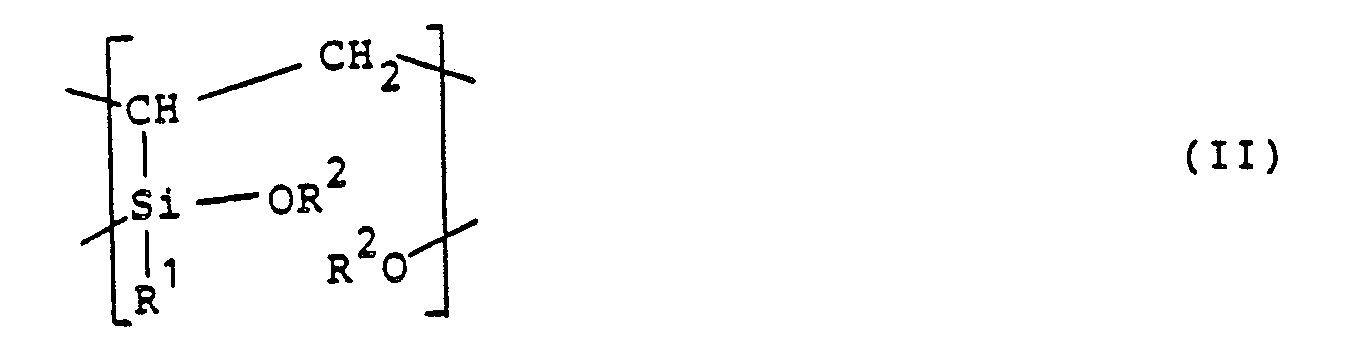
- This invention provides a silicon-containing step ladder polymer comprising units represented by the general formula (I): units represented by the general formula (II): and at least one unit represented by the general formula (III): (where R' represents a hydrocarbon group or a fluorine-substituted hydrocarbon group, R 2 represents hydrogen or a trialkylsiloxy group, and R 3 and R 4 are identical or different and each represents a hydrocarbon group or a fluorine-substituted hydrocarbon group).
- the molar ratio of the units (I) to the units (II) is from 5:1 to 100:1 and the molar ratio of the units (III) to the total amount of the units (I) + (II) is from 1:5 to 1:100.
- R' preferably has 1 to 10 carbon atoms. More preferably, R' is an alkyl or fluorine-substituted alkyl group having 1 to 4 carbon atoms, or a phenyl group. As the number of carbon atoms in non-aromatic R' increases, the heat-resistance of the silicon-containing step ladder polymer is reduced and undesirable steric hindrance may occur in the synthesis of the polymer. In the case of aromatic hydrocarbon groups such as a phenyl group, however, the effect of reducing the heat resistance is not so remarkable.
- R 2 is a trialkyl silyl group
- the alkyl moiety preferably has 1 to 10 and, more preferably 1 to 4 carbon atoms.
- the reaction rate for the trialkyl silylation of the silanol group (SI-OH) in the synthesis of the silicon-containing step ladder polymer of this invention is decreased and the heat-resistant property of the polymer is also reduced.
- R 3 and R 4 preferably have 1 to 10 carbon atoms. More preferably, R 3 and R 4 are alkyl or fluorine-substituted alkyl groups having 1 to 4 carbon atoms or are phenyl groups. As the number of alkyl carbon atoms in R 3 and R 4 increases, the heat resistance of the silicon-containing step ladder polymer of this invention is reduced and undesirable steric hindrance may occur in the synthesis of the polymer. In the case of an aromatic hydrocarbon group such as a phenyl group, however, the tendency of reducing the heat resistance is not so remarkable.
- the ratio of unit I: unit II is less than 5:1, the heat resistance of the silicon-containing step ladder polymer of this invention is undesirably lowered. On the other hand, if the ratio exceeds 100: 1, the bonding function of the step ladder polymer of this invention is reduced.
- the heat resistance of the silicon-containing step ladder polymer of this invention is reduced. While on the other hand, if the ratio is in excess of 100:1, it becomes difficult to synthesize the step ladder polymer.
- the ladder structure typically includes a chain composed of the units selected from the units I and II which preferably comprises 5 to 100 of the units I and II. If it comprises less than 5 such units, the heat resistance of the silicon-containing step ladder polymer of this invention is often reduced, while on the other hand, if it exceeds 100, it may be difficult to synthesize the chain.
- the step ladder polymer of this invention comprises the chain of units I and II, as described above, bonded through a unit III or a chain composed of 5 or less units III, giving a higher molecule.
- the molecular weight of the step ladder polymer according to this invention assessed as a weight average molecular weight measured by GPC (gel permeation chromatography) is preferably between 3.0 x 10 3 to 6.5 x 10 5 . If the molecular weight is less than 3.0 x 10 3 , films of the step ladder polymer of this invention sometimes undergo cracking, while on the other hand, if it exceeds 6.5 x 10 5 , the film-forming property is occasionally reduced and the workability is occasionally worsened. It is preferred that the molecular weight distribution (weight average molecular weight/number average molecular weight) of the step ladder polymer of this invention is more than 2.5:1. If it is less than 2.5: 1, the film forming property of the step ladder polymer of this invention may be poor and readily induce cracking.
- the typical silicon-containing step ladder polymer according to this invention shows an infrared absorption spectrum inherent to the 1,5-disilpyran ring chain at a wave number of about 960 cm-'.
- the typical polymer also exhibits the infrared absorption spectrum inherent to the siloxane bond in the unit (III) at a wave number region from 1020 to 1090 cm -1 .
- the absorption ratio between the wave number 960 cm-' and the wave number 1080 cm-' (A1080/A960) is preferably between 0.05:1 to 0.3:1.
- the absorption ratio is less than 0.05:, the degree of polymerization due to the unit (III) is sometimes insufficient, while on the other hand, if it is in excess of 0.3:1, the component of the ladder structure is decreased and may undesirably reduce the heat-resistance of the step ladder polymer of this invention.
- the structure of the polymer of this invention is usually such that:
- A' has the following structure: where R 1 , R 2 , R 5 , R 6 , r, t and s have the same meanings as above;
- R 1 , R 2 , R 5 , R 6 , r, t and s have the same meanings as above;
- Z has the following structure: where R 3 and R 4 have the same meanings as above, p is an integer from 1 to 5; and
- the structure B may substitute, in some instance the structure Z particularly if B is a short chain with a degree of polymerization of 6 or less. Further, there may be a case where two successive structures B are connected by way of the structure Z to another structure B.
- step ladder polymer for the present invention is derived from the above structure for the typical polymer, where the unit chain A, A' and B mainly composed of the ladder structure formed by the repeating units (I) are connected by way of ⁇ O ⁇ SiR 3 R 4 ⁇ O ⁇ or -0- as the steps.
- the present invention also provides a process for producing a silicon-containing step ladder polymer which comprises reacting a prepolymer represented by the formula (where R' is a hydrocarbon group or a fluorine-substituted hydrocarbon group; X represents a dialkylamino group with each alkyl group having 1 to 4 carbon atoms, a halogen, an alkoxy group having 1 to 7 carbon atoms or a thioalkyl group having 1 to 7 carbon atoms; R 5 and R 6 are the same or different and each represents hydrogen or a hydrocarbon residue of a vinyl polymerization initiator and m is an integer from 5 to 100) with a prepolymer represented by the formula (where R' is a hydrocarbon group or a fluorine-substituted hydrocarbon group; X represents a dialkylamino group with each alkyl group having 1 to 4 carbon atoms, a halogen, an alkoxy group having 1 to 7 carbon atoms or a thioalkyl
- radical polymerization or ionic polymerization is selected depending on the type of the substituent X.
- X is a dialkylamino group
- anionic polymerization using an organic metal such as an alkyl lithium or alkyl aluminium as the catalyst is possible and, in the case where X is an alkoxy group, halogen or thioalkoxy group, radical polymerization is possible using a radical polymerization catalyst, for example, an azonitrile such as azobisbutyronitrile, a peroxide such as benzoyl peroxide or lauroyl peroxide and like other dicarbonate catalysts.
- a radical polymerization catalyst for example, an azonitrile such as azobisbutyronitrile, a peroxide such as benzoyl peroxide or lauroyl peroxide and like other dicarbonate catalysts.
- the anionic polymerization for the vinyl silane derivative in which X is a dialkylamino group is suitably carried out in an aliphatic hydrocarbon such as n-hexane, n-heptane and n-octane or an aromatic hydrocarbon such as benzene, toluene and xylene by adding a catalyst such as n-butyl lithium in n-hexane solution or diethyl aluminium chloride in n-hexane solution in a required amount at a relatively low temperature.
- the polymerization temperature employed is usually from -10 to +90°C and, preferably, from -5 to +50°C.
- the radical polymerization for the vinylsilane derivatives, in which X is halogen, alkoxy or thioalkoxy group, can be carried out in a hydrocarbon solvent such as toluene or xylene, or with no such solvent, by the use of the above mentioned radical polymerization catalyst and at a temperature usually between 50 to 200°C and preferably between 80 to 150°C.
- the vinyl polymer (prepolymer) is then formed into a step ladder polymer.
- X in the vinyl polymer (IV) is an alkylamino group, chlorine, bromine or iodine
- the functional group X is previously replaced with an acyloxy group represented by R 7 COO ⁇ (R' represents any alkyl having 4 or less carbon atoms) and then preferably a stoichiometrical amount of water (relative to Si) is used to perform intramolecular hydrolytic condensation of the prepolymer and hydrolytic condensation between the prepolymer and stepping agent represented by the general formula R 3 R 4 Si(OCOR 7 ) 2 (where R 3 , R 4 and R 7 have the same meanings as above).
- the acyloxylation for the prepolymer (IV) can be carried out by reacting the polymer with an organic acid represented by the general formula R 7COOH (where R 7 has the same meanings as above), preferably in an inert aromatic hydrocarbon solvent such as benzene, toluene or xylene.
- R 7COOH an organic acid represented by the general formula R 7COOH (where R 7 has the same meanings as above)
- R 7COOH preferably in an inert aromatic hydrocarbon solvent such as benzene, toluene or xylene.
- the usual temperature for the reaction is from -5 to +70°C and preferably 10 to 50°C.
- the normal amount of the acid in the reaction is between 3 to 5 mol and preferably 4 to 4.5 mol based on Si in the prepolymer.
- the acyloxylation can be carried out by adding an acid hydride represented by the general formula (R'CO)20 (where R 7 has the same meanings as above) to the polymer in an inert aromatic hydrocarbon solvent such as benzene, toluene or xylene while distilling of the resulting organic acid halogenoid.
- R'CO acid hydride represented by the general formula (R'CO)20 (where R 7 has the same meanings as above)
- R 7 has the same meanings as above
- the temperature preferred for the reaction is between 20 to 150°C and, more preferably, 40 to 120°C.
- the amount of the acid anhydride employed in the reaction is usually between 1.5 to 2.5 mol and, preferably, 2 to 2.3 mol based on Si of the prepolymer.
- Hydrolytic condensation of the acyloxylated propolymer is suitably carried out in an inert aromatic hydrocarbon solvent such as benzene, toluene or xylene at a relatively low polymer concentration, for example, between 1 to 30% by weight and, preferably, 3 to 15% by weight with an object of preferentially forming the desired ladder structure (repeating structure of the unit (I)).
- an inert aromatic hydrocarbon solvent such as benzene, toluene or xylene
- the hydrolytic condensation is preferably carried out either by the process of (1) subjecting the acyloxylated prepolymer to the hydrolytic condensation under the coexistence of the stepping agent R'R'Si(OCOR 7 ) or (2) applying intra-molecular hydrolytic condensation to the prepolymer and, thereafter, adding the stepping agent R 3 R 4 Si(OCOR 7 ).
- the hydrolytic condensation can be carried out by adding equimolar to 100 molar amount of water to Si relevant to the reaction.
- the amount of water to be added is preferably between an equimolar to 10 molar and, more preferably, equimolar to 3 molar amount based on Si, in order that the reaction proceeds moderately and preferentially forms the desired ladder structure. It is desired that the water is gradually added as drops for reaction with or without the presence of an appropriate catalyst.
- the catalyst employed can include, for instance an inorganic acid such as hydrochloric acid and sulphuric acid, an organic acid such as acetic acid or a base such as sodium hydroxide or an amine.
- the hydrolytic condensation is best carried out at a relatively moderate condition, for example, at a temperature from -5 to +80°C and preferably, 20 to 60°C.
- the vinyl polymer can be brought into reaction with an acid anhydride represented by the general formula (R7CO)20 under the presence of a compound as the stepping agent represented by the formula R 3 R 4 SiY 2 (where R 3 and R 4 have the same meanings as above and Y represents an acyloxy group with 2 to 5 carbon atoms, an alkoxy group with 1 to 4 carbon atoms or a thioalkoxy group with 1 to 4 carbon atoms).
- the reaction temperature can be between 30 to 170°C and, preferably, 50 to 130°C and, more preferably, 50 to 90°C under a reduced pressure of 50 to 200 mmHg.
- the amount of the acid anhydride is 1 to 3 molar amount and, preferably, 1.2 to 2 molar amount based on Si of the vinyl polymer and the stepping agent (where Y represents an alkoxy group or a thioalkoxy group).
- the functional group X of the vinyl polymer is partially substituted with the acyloxy group which is then brought into de-esterifying reaction with the non-substituted alkoxy group or the like to form in this stage at least a considerable portion of the aimed ladder structure.
- the hydrolysis or hydrolysis and hydrolytic condensation may be carried out by adding water after the above-mentioned reaction.
- the ensuing auxilliary reaction serves to stabilize the polymer by removing the residual acyl group in the resultant polymer or to complete the desired ladder structure and stabilize the polymer.
- the hydrolysis or hydrolytic condensation can be carried out under relatively moderate conditions, for example, between -5 to +80°C, and preferably, 20 to 60°C.
- the amount of water to be added is preferably less than an equimolar amount based on Si of the vinyl polymer. If the amount of water is excessive, it may cause undesirable crosslinking in the polymer.
- the hydrolytic condensation employed therein may be carried out at a relatively low temperature as described above, but the resultant reaction solution may be heated to a temperature from 50 to 150°C and, preferably, 70 to 120°C and aged for 0.5 to 5 hours with an aim of promoting the reaction and increasing the degree of polymerization.
- the silicon-containing step ladder polymer thus synthesized contains a small amount of silanol groups (Si-OH) derived from a steric structure of the polymer and the reaction conditions. Consequently, crosslinking may sometimes occur between the polymer chains to cause gelation in the case where the polymer solution is concentrated or stored for a long period of time.
- Si-OH silanol groups
- a silylating agent such as a hexa-alkylsilazane represented by the general formula: (R 8 ) 3 Si-NH-Si(R 8 ) 3 or a trialkyl acyloxysilane represented by the general formula: (R I ) 3- SI-OCOR I (where R 8 represents an alkyl group with 1 to 10 carbon atoms and R 9 represents an alkyl group with 1 to 4 carbon atoms) can be added.
- R 8 represents an alkyl group with 1 to 10 carbon atoms
- R 9 represents an alkyl group with 1 to 4 carbon atoms
- One of the applications of the silicon-containing step ladder polymers according to this invention includes insulating varnishes for use in electronic materials. Since bonding performance is required therefor, the presence of some silanol group (SiOH) is desired. In this case, it is preferred to control the conditions for the stabilizing reaction depending on purposes so that the silanol content in the resultant polymer is adjusted to between 0.0005:1 and 0.25:1 expressed as the molar ratio of (OH):(Si).
- the polymer according to this invention is soluble in various solvents including aliphatic hydrocarbons such as n-hexane and n-heptane, aromatic hydrocarbons such as benzene and toluene, and esters such as propyl acetate and ethyl acetate.
- solvent can be therefore be selected depending on the purpose of application.
- the typical polymer is easily soluble in a solvent and has desirable film-forming properties as described above.
- the heat-curing temperature for the coated film may be between 150 to 200°C and cracks do not develop in the coating film.
- the polymer also exhibits a satisfactory heat resistance: the starting point for the heat decomposition is usually about 300°C and the weight reduction when heated to 490°C is normally less than 15%.
- the polymer is colourless.
- the above-mentioned properties of the polymer show that it has a superiority to the polyimide resins which are typical examples of the heat-resistant insulating polymers employed generally. in view of the workability and the performance. Due to the above-mentioned superiority, the polymers according to this invention can be used broadly as chemical materials for electrical and electronic components such as liquid crystal orientation membranes in liquid crystal display cells, insulating protection films for colour filters, and coating materials for electric wires.
- the infrared absorption spectroscopy was carried out by coating the solution on a KBr plate and after drying it at 70°C.
- the characteristic absorption spectrum of the siloxane bond constituting the ladder structure (the repeating structure of unit (I)) was indicated at 960 cm-' and that of the siloxane bond constituting the step bond [unit (III)) was indicated at 1020 cm-' and 1080 -'.
- the absorption ratio of the spectrums, i.e., A1080/A960 was 0.1.
- the weight average molecular weight was 1.7 x 10 4 and a step ladder polymer comprising 15 sagment of the prepolymer hydrolytic condensates was formed.
- the presence of the silanol group (Si-OH) was observed as the result of the infrared absorption spectroscopy, the amount of the silanol group as expressed in the (OH)/(Si) ratio was 0.1 by the analysis according to G. E. Kellum, et al. (Anal. Chem. 39, 1623 (1967)).
- Polymerization was carried out in the same procedures as in Example 1 excepting that the amount of the n-butyl lithium catalyst used was changed to 10 mmol and 23 mmol respectively to obtain two kinds of polymer having different polymerization degrees.
- the average polymerization degrees for the polymers were 13.9 and 6.6 respectively based on the GPC measurements.
- a ladder polymer was synthesized in the same procedures as in Example 1 excepting for using 15 g of the prepolymer with polymerization degree 13.9 and 5 g of the polymer with the polymerization degree 6.6 obtained in the step (1) above and changing the amount of diethyl diacetoxysilane used therein to 2.0 g.
- the weight average molecular weight was 2.5 x 10 4 and the absorption ratio in the infrared absorption spectrums (A1080/A960) was 0.12.
- the synthetic reaction was carried out using the same apparatus and under the same conditions as those in Example 1 by dissolving 15 g of the prepolymer obtained in the step (1) above into 230 ml of toluene. 22 ml of glacial acetic acid were added dropwise and reacted for one hour, followed by dropping to react 1.7 ml of water. After dropping was completed, the reaction was continued under stirring for one hour. Water washing, drying and concentration were carried out in the same procedures as Example 1. From the result of the analysis, it was found that the weight average molecular weight was 1.4 x 10 3 and the absorption ratio in the infrared absorption spectrums (A1080/A960) was 0.08. The (OH)/(Si) ratio was 0.28.
- a step ladder polymer was synthesized under the same conditions as in Example 1.
- the resultant polymer had a weight average molecular weight of 1.6 x 10 4 and the (OH)/(Si) ratio of 0.12.
- the polymer solution was concentrated by distilling off toluene into a 8 w% solution.
- To 100 ml of the solution were added 0.8 g of hexamethyl disilazane (hereinafter referred to simply as HMDS) and reacted at 90°C under stirring for one hour. After the reaction was over, toluene was distilled off at 80°C under a reduced pressure to 12 w% by concentration.
- the resulted step ladder polymer had the weight average molecular weight of 2.9 x 10 4 and the (OH)/(Si) ratio of 0.002 as the result of the analysis.
- the molecular weight of the resulted polymer was 4300 as the result of the GPC measurement.
- the dried organic layer was transferred to the distillator and toluene was distilled off at a temperature of 70°C under a reduced pressure till the polymer solution was concentrated to 7%.
- the thus obtained polymer When measured by the GPC method, the thus obtained polymer had a weight average molecular weight of 3.5 x 10 4 and a molecular weight distribution was 5.7. Based on the infrared absorption spectrum of the polymer, absorption at 960 cm-' indicating the ladder structure was confirmed.
- toluene solution containing 10 w% step ladder polymer prepared in the same manner as in Example 1 were added 3.0 g of trimethyl monoacetoxy silane and, after reaction at 50°C for one hour, transferred to a separation funnel and subjected to water washing and separation for three times. After dewatering to dry the toluene layer with anhydrous potassium carbonate, toluene was distilled off at 70°C under a reduced pressure to concentrate the solution and obtain 14 w% polymer solution.
- the amount of the silanol residue was 0.008 as expressed in the (OH)/(Si) ratio.
- the silicon-containing step ladder polymer according to this invention had desirable properties as the heat resistant insulating film.
- Example 2 The same reaction as in Example 1 was carried out excepting for replacing methyl vinyl bis(dimethyl- . amino)silane with 70 g of phenyl vinyl bis(dimethylamino)silane.
- Example 2 The same reaction as in Example 1 was carried out except for replacing methyl vinyl bis(dimethyl- amino)silane with 65 g of trifluoropropyl vinyl bis(dimethylamino)silane.
- Example 2 The same reaction as in Example 1 was carried out except for replacing dimethyl diacetoxysilane used in the step ladder reaction in Example 1 with 1.7 g of methyl phenyl diacetoxysilane.
Landscapes
- Chemical & Material Sciences (AREA)
- Health & Medical Sciences (AREA)
- Chemical Kinetics & Catalysis (AREA)
- Medicinal Chemistry (AREA)
- Polymers & Plastics (AREA)
- Organic Chemistry (AREA)
- General Chemical & Material Sciences (AREA)
- Silicon Polymers (AREA)
Claims (20)



Priority Applications (2)
| Application Number | Priority Date | Filing Date | Title |
|---|---|---|---|
| EP19840308306 EP0182948B1 (de) | 1984-11-29 | 1984-11-29 | Silikonenthaltende Leiterpolymere und ein Verfahren zu deren Herstellung |
| DE8484308306T DE3478026D1 (en) | 1984-11-29 | 1984-11-29 | Silicon-containing step ladder polymer and a process for producing the same |
Applications Claiming Priority (1)
| Application Number | Priority Date | Filing Date | Title |
|---|---|---|---|
| EP19840308306 EP0182948B1 (de) | 1984-11-29 | 1984-11-29 | Silikonenthaltende Leiterpolymere und ein Verfahren zu deren Herstellung |
Publications (2)
| Publication Number | Publication Date |
|---|---|
| EP0182948A1 EP0182948A1 (de) | 1986-06-04 |
| EP0182948B1 true EP0182948B1 (de) | 1989-05-03 |
Family
ID=8192827
Family Applications (1)
| Application Number | Title | Priority Date | Filing Date |
|---|---|---|---|
| EP19840308306 Expired EP0182948B1 (de) | 1984-11-29 | 1984-11-29 | Silikonenthaltende Leiterpolymere und ein Verfahren zu deren Herstellung |
Country Status (2)
| Country | Link |
|---|---|
| EP (1) | EP0182948B1 (de) |
| DE (1) | DE3478026D1 (de) |
Families Citing this family (1)
| Publication number | Priority date | Publication date | Assignee | Title |
|---|---|---|---|---|
| FR2818651B1 (fr) * | 2000-12-26 | 2003-10-24 | Hoechst Marion Roussel Inc | Synthese de nouvelles molecules heterocycliques oxygenees par reaction de metathese sur support solide utilisant de nouveaux linkers silyles |
Family Cites Families (1)
| Publication number | Priority date | Publication date | Assignee | Title |
|---|---|---|---|---|
| GB1216852A (en) * | 1967-03-21 | 1970-12-23 | Midland Silicones Ltd | Organosilicon compounds |
-
1984
- 1984-11-29 EP EP19840308306 patent/EP0182948B1/de not_active Expired
- 1984-11-29 DE DE8484308306T patent/DE3478026D1/de not_active Expired
Also Published As
| Publication number | Publication date |
|---|---|
| DE3478026D1 (en) | 1989-06-08 |
| EP0182948A1 (de) | 1986-06-04 |
Similar Documents
| Publication | Publication Date | Title |
|---|---|---|
| US5412053A (en) | Polymers containing alternating silsesquioxane and bridging group segments and process for their preparation | |
| US5939576A (en) | Method of functionalizing polycyclic silicones and the compounds so formed | |
| CA2144639C (en) | Single component inorganic/organic network materials and precursors thereof | |
| US5942638A (en) | Method of functionalizing polycyclic silicones and the resulting compounds | |
| US5034490A (en) | Curable norbornenyl functional silicone formulations | |
| US5210168A (en) | Process for forming siloxane bonds | |
| US6815554B2 (en) | Process for preparing unsaturated organosilicon compounds | |
| JP2000510522A (ja) | シロキサン樹脂の合成 | |
| US5266670A (en) | Selective monohydrosilation of vinyl and ethynyl functional norbornenes and curable products produced thereby | |
| JPH07149904A (ja) | オルガノポリシロキサンおよびその製造方法 | |
| US20100210808A1 (en) | Method for preparing polysilazane solution with reducing ammonia substitution of si-h bond | |
| JPH0791386B2 (ja) | 非水系によるシリコーンオリゴマー調製法 | |
| US5175328A (en) | Method for the preparation of organopolysiloxane | |
| JPH0134995B2 (de) | ||
| US5270424A (en) | Hydrosilylation process | |
| EP0182948B1 (de) | Silikonenthaltende Leiterpolymere und ein Verfahren zu deren Herstellung | |
| US5416233A (en) | Preparation of vinylsilane-benzocyclobutenes | |
| JPH0324093A (ja) | トリアルキルシリルメチル基含有シラン化合物 | |
| US4585834A (en) | Silicon-containing step ladder polymer and a process for producing the same | |
| JPH0521140B2 (de) | ||
| US4602065A (en) | Silicon-containing step ladder polymer and a process for producing the same | |
| US5693734A (en) | Organosilicon compounds containing furanyl groups | |
| JP3839498B2 (ja) | 白金−オルガノシロキサン錯体の調製方法 | |
| US5171816A (en) | Curable norbornenyl functional silicone formulations | |
| US6147243A (en) | Method for preparing organosilicon compounds |
Legal Events
| Date | Code | Title | Description |
|---|---|---|---|
| PUAI | Public reference made under article 153(3) epc to a published international application that has entered the european phase |
Free format text: ORIGINAL CODE: 0009012 |
|
| 17P | Request for examination filed |
Effective date: 19841213 |
|
| AK | Designated contracting states |
Kind code of ref document: A1 Designated state(s): CH DE FR GB LI |
|
| 17Q | First examination report despatched |
Effective date: 19880413 |
|
| GRAA | (expected) grant |
Free format text: ORIGINAL CODE: 0009210 |
|
| AK | Designated contracting states |
Kind code of ref document: B1 Designated state(s): CH DE FR GB LI |
|
| REF | Corresponds to: |
Ref document number: 3478026 Country of ref document: DE Date of ref document: 19890608 |
|
| ET | Fr: translation filed | ||
| PGFP | Annual fee paid to national office [announced via postgrant information from national office to epo] |
Ref country code: FR Payment date: 19891107 Year of fee payment: 6 |
|
| PGFP | Annual fee paid to national office [announced via postgrant information from national office to epo] |
Ref country code: GB Payment date: 19891130 Year of fee payment: 6 |
|
| PGFP | Annual fee paid to national office [announced via postgrant information from national office to epo] |
Ref country code: CH Payment date: 19891218 Year of fee payment: 6 |
|
| PGFP | Annual fee paid to national office [announced via postgrant information from national office to epo] |
Ref country code: DE Payment date: 19891229 Year of fee payment: 6 |
|
| PLBE | No opposition filed within time limit |
Free format text: ORIGINAL CODE: 0009261 |
|
| STAA | Information on the status of an ep patent application or granted ep patent |
Free format text: STATUS: NO OPPOSITION FILED WITHIN TIME LIMIT |
|
| 26N | No opposition filed | ||
| PG25 | Lapsed in a contracting state [announced via postgrant information from national office to epo] |
Ref country code: GB Effective date: 19901129 |
|
| PG25 | Lapsed in a contracting state [announced via postgrant information from national office to epo] |
Ref country code: LI Effective date: 19901130 Ref country code: CH Effective date: 19901130 |
|
| GBPC | Gb: european patent ceased through non-payment of renewal fee | ||
| PG25 | Lapsed in a contracting state [announced via postgrant information from national office to epo] |
Ref country code: FR Effective date: 19910731 |
|
| REG | Reference to a national code |
Ref country code: CH Ref legal event code: PL |
|
| PG25 | Lapsed in a contracting state [announced via postgrant information from national office to epo] |
Ref country code: DE Effective date: 19910801 |
|
| REG | Reference to a national code |
Ref country code: FR Ref legal event code: ST |