EP0183042B1 - Verfahren zur Herstellung von Hydrochinonderivaten - Google Patents
Verfahren zur Herstellung von Hydrochinonderivaten Download PDFInfo
- Publication number
- EP0183042B1 EP0183042B1 EP85113322A EP85113322A EP0183042B1 EP 0183042 B1 EP0183042 B1 EP 0183042B1 EP 85113322 A EP85113322 A EP 85113322A EP 85113322 A EP85113322 A EP 85113322A EP 0183042 B1 EP0183042 B1 EP 0183042B1
- Authority
- EP
- European Patent Office
- Prior art keywords
- compound
- formula
- palladium
- signifies
- general formula
- Prior art date
- Legal status (The legal status is an assumption and is not a legal conclusion. Google has not performed a legal analysis and makes no representation as to the accuracy of the status listed.)
- Expired
Links
- XDTMQSROBMDMFD-UHFFFAOYSA-N C1CCCCC1 Chemical compound C1CCCCC1 XDTMQSROBMDMFD-UHFFFAOYSA-N 0.000 description 1
Classifications
-
- C—CHEMISTRY; METALLURGY
- C07—ORGANIC CHEMISTRY
- C07C—ACYCLIC OR CARBOCYCLIC COMPOUNDS
- C07C43/00—Ethers; Compounds having groups, groups or groups
- C07C43/02—Ethers
- C07C43/20—Ethers having an ether-oxygen atom bound to a carbon atom of a six-membered aromatic ring
- C07C43/23—Ethers having an ether-oxygen atom bound to a carbon atom of a six-membered aromatic ring containing hydroxy or O-metal groups
-
- C—CHEMISTRY; METALLURGY
- C07—ORGANIC CHEMISTRY
- C07C—ACYCLIC OR CARBOCYCLIC COMPOUNDS
- C07C41/00—Preparation of ethers; Preparation of compounds having groups, groups or groups
- C07C41/01—Preparation of ethers
- C07C41/02—Preparation of ethers from oxiranes
- C07C41/03—Preparation of ethers from oxiranes by reaction of oxirane rings with hydroxy groups
-
- C—CHEMISTRY; METALLURGY
- C07—ORGANIC CHEMISTRY
- C07C—ACYCLIC OR CARBOCYCLIC COMPOUNDS
- C07C41/00—Preparation of ethers; Preparation of compounds having groups, groups or groups
- C07C41/01—Preparation of ethers
- C07C41/16—Preparation of ethers by reaction of esters of mineral or organic acids with hydroxy or O-metal groups
-
- C—CHEMISTRY; METALLURGY
- C07—ORGANIC CHEMISTRY
- C07C—ACYCLIC OR CARBOCYCLIC COMPOUNDS
- C07C41/00—Preparation of ethers; Preparation of compounds having groups, groups or groups
- C07C41/01—Preparation of ethers
- C07C41/18—Preparation of ethers by reactions not forming ether-oxygen bonds
- C07C41/26—Preparation of ethers by reactions not forming ether-oxygen bonds by introduction of hydroxy or O-metal groups
-
- C—CHEMISTRY; METALLURGY
- C07—ORGANIC CHEMISTRY
- C07C—ACYCLIC OR CARBOCYCLIC COMPOUNDS
- C07C41/00—Preparation of ethers; Preparation of compounds having groups, groups or groups
- C07C41/01—Preparation of ethers
- C07C41/34—Separation; Purification; Stabilisation; Use of additives
- C07C41/36—Separation; Purification; Stabilisation; Use of additives by solid-liquid treatment; by chemisorption
-
- C—CHEMISTRY; METALLURGY
- C07—ORGANIC CHEMISTRY
- C07C—ACYCLIC OR CARBOCYCLIC COMPOUNDS
- C07C41/00—Preparation of ethers; Preparation of compounds having groups, groups or groups
- C07C41/01—Preparation of ethers
- C07C41/34—Separation; Purification; Stabilisation; Use of additives
- C07C41/40—Separation; Purification; Stabilisation; Use of additives by change of physical state, e.g. by crystallisation
-
- C—CHEMISTRY; METALLURGY
- C07—ORGANIC CHEMISTRY
- C07D—HETEROCYCLIC COMPOUNDS
- C07D311/00—Heterocyclic compounds containing six-membered rings having one oxygen atom as the only hetero atom, condensed with other rings
- C07D311/02—Heterocyclic compounds containing six-membered rings having one oxygen atom as the only hetero atom, condensed with other rings ortho- or peri-condensed with carbocyclic rings or ring systems
- C07D311/04—Benzo[b]pyrans, not hydrogenated in the carbocyclic ring
- C07D311/58—Benzo[b]pyrans, not hydrogenated in the carbocyclic ring other than with oxygen or sulphur atoms in position 2 or 4
- C07D311/70—Benzo[b]pyrans, not hydrogenated in the carbocyclic ring other than with oxygen or sulphur atoms in position 2 or 4 with two hydrocarbon radicals attached in position 2 and elements other than carbon and hydrogen in position 6
- C07D311/72—3,4-Dihydro derivatives having in position 2 at least one methyl radical and in position 6 one oxygen atom, e.g. tocopherols
Definitions
- the present invention relates to a new process for the preparation of hydroquinone derivatives which are suitable as intermediates for the preparation of (R, R, R) -a-tocopherol (natural vitamin E) and of racemic a-tocopherol.
- the invention further relates to the new products of this method.
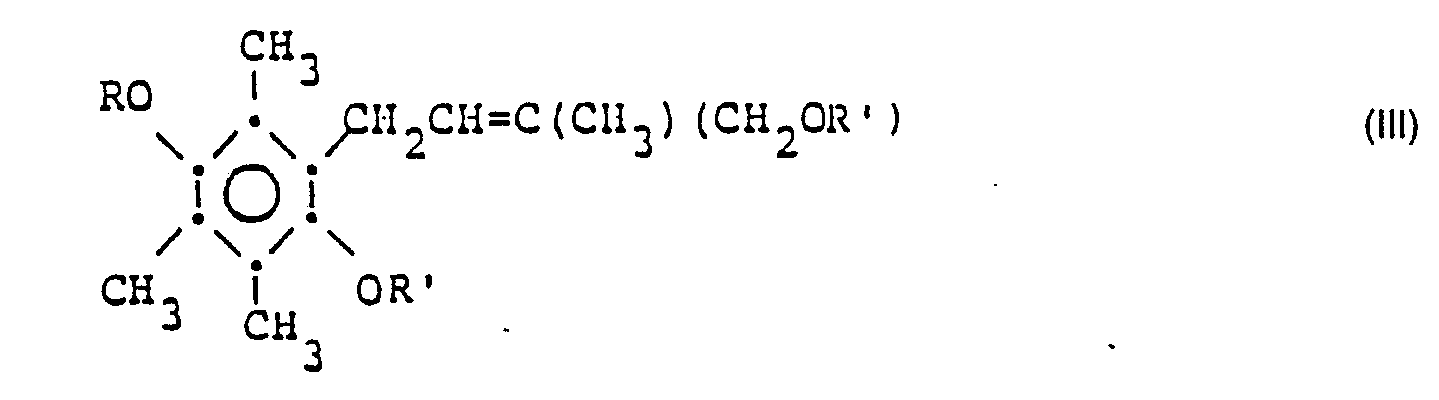
- the process according to the invention is characterized in that a compound of the general formula wherein R represents a hydroxyl protecting group, with 3,4-epoxy-3-methyl-1-butene in the presence of ad 1 ° transition metal catalyst and, if desired, a compound of the general formula thus obtained wherein R has the meaning given above, a Claisen rearrangement, wherein a compound of the general formula wherein R has the meaning given above and R 'is hydrogen or an acyl group is obtained.
- hydroxyl protective group means a group which can be split off, namely both a group which can be split off by hydrolysis, such as the silyl group, an alkoxymethyl group, e.g. B. methoxymethyl, the tetrahydropyranyl group or an acyl group, e.g. B. acetyl, as well as an oxidatively removable group, such as a C 1-6 alkyl group, for. B. methyl.
- the preferred hydroxyl protecting group R is acetyl.
- acyl group means conventional acyl residues of aliphatic and aromatic carboxylic acids, preferably those with up to 10 carbon atoms, such as acetyl, propionyl, benzoyl and the like.
- Formula III is intended to include the cis isomer (Z form), the trans isomer (E form) and mixtures of the cis and trans forms.
- a palladium (O) catalyst this can be generated, for example, from a palladium (II) salt in the reaction mixture by reduction in situ, e.g. B. from palladium (II) acetate in the presence of a reducing agent such as formic acid, hydrazine hydrate, a tertiary amine, for. B. triethylamine, or one, aliphatic or cyclic ether, for. B. tetrahydrofuran, and a compound with palladium (O) ligand, e.g. B. triphenylphosphine.
- a reducing agent such as formic acid, hydrazine hydrate, a tertiary amine, for. B. triethylamine, or one, aliphatic or cyclic ether, for. B. tetrahydrofuran
- a compound with palladium (O) ligand e.g. B. triphenylphosphin
- the palladium (O) -containing complexes are the preferred d 10 transition metal catalysts.
- the reaction of the compound of formula I with 3,4-epoxy-3-methyl-1-butene is conveniently carried out in an inert diluent, in particular an organic solvent, such as an aliphatic or cyclic ether, e.g. B. diethyl ether, diisopropyl ether or tetrahydrofuran; an aromatic hydrocarbon, e.g. B. benzene, toluene or a xylene; or a halogenated aliphatic hydrocarbon, e.g. B. methylene chloride or chloroform.
- organic solvent such as an aliphatic or cyclic ether, e.g. B. diethyl ether, diisopropyl ether or tetrahydrofuran; an aromatic hydrocarbon, e.g. B. benzene, toluene or a xylene; or a halogenated aliphatic hydrocarbon, e.g. B. m
- This reaction is generally carried out at temperatures between 0 ° and 30 ° C., preferably at room temperature.
- the amount of d 10 transition metal catalyst or palladium (II) salt present is generally at least 0.01, in particular 0.05 to 100 mol percent, based on the amount of compound of formula 1, preferably about 0.3 mol percent .
- the optional conversion of the compound of the formula II into the compound of the formula III can in general be carried out under the conditions known per se from Claisen rearrangements.
- the rearrangement according to the invention is advantageously carried out in an inert diluent, in particular an organic solvent, such as an aliphatic or aromatic hydrocarbon, e.g. B. n-heptane, benzene, toluene or a xylene; a heteroaromatic, e.g. B. pyridine; a halogenated aliphatic or aromatic hydrocarbon, e.g. B. methylene chloride, chloroform or chlorobenzene; an aliphatic or cyclic ether, e.g. B.
- an organic solvent such as an aliphatic or aromatic hydrocarbon, e.g. B. n-heptane, benzene, toluene or a xylene; a heteroaromatic, e.g. B.
- reaction temperatures can be varied within a wide range, such as -10 ° C to 140 ° C.
- Temperatures, d. H. in the temperature range -10 ° to + 30 ° C expediently either in the presence of a protonic acid such as acetic acid, hydrochloric acid, trifluoroacetic acid, phosphoric acid or sulfuric acid, in the presence of a carboxylic acid anhydride or halide, e.g. B. acetic anhydride or acetyl chloride, or in the presence of a Lewis acid such as ferric chloride or boron trifluoride or a complex of such an acid, e.g. B. their etherates, is working, or at elevated temperatures, d. H. in the temperature range 80 ° C to 140 ° C, especially at about 100 ° C, if desired in the presence of a base such as pyridine, piperidine or dimethylaminopyridine.
- a protonic acid such as acetic acid, hydrochloric acid, trifluoroacetic acid, phosphoric acid or sulfuric acid
- the product of the rearrangement described above is in the form of a mixture of the isomeric compounds of the general formulas before, exclusively in the form of one or the other isomer.
- the ratio E-form (IIIa): Z-form (IIIb) is in particular from 50:50 to almost 100: 0.
- the compounds of the formulas II and III thus prepared can be isolated and purified by methods known per se.
- the pure E form and the pure Z form of the compound of formula 111, i.e. H. the pure compound of the formula purple and the pure compound of the formula IIIb can be obtained by methods known per se, e.g. B. column chromatography, isolable.
- R and R ' are preferably acetyl.
- the compounds of the general formulas III, lilac and Illb can be converted into (R, R, R) - ⁇ -tocopherol (natural vitamin E), for example according to the reaction scheme 1 below. It is from the E form (compound of the formula lilac), but the reaction stages are also the starting material in the case of the isomer mixture (compounds of the formulas IIIa and IIIb) or the Z form (compound of the formula IIIb). In any case, the process leads to the desired isomer, i. H. to (R, R, R) - ⁇ -tocopherol.
- the solid wedge-shaped sign means that the corresponding residue is above the molecular level
- the dashed line means that the corresponding residue is below the molecular level.
- the conversion of the compound of the formula IIlaa into the compound of the formula IV can be carried out, depending on the nature of the protective group R, under the relevant reaction conditions. If the protective group R can be removed by hydrolysis, this can be done in a simple manner, for example by treatment with an acid (R means, for example, silyl, alkoxymethyl or tetrahydropyranyl) or with a base (R means for example acyl) . If the protective group R can be split off oxidatively, the transfer is also carried out in a simple manner, for. B. by treatment with cerium ammonium nitrate [(Ce (NH 4 ) 2 (NO 3 ) 6 ] and subsequent reductive cyclization of the quinone obtained.
- the selective O-methylation of the compound of formula IV to the compound of formula V can also be carried out under reaction conditions known per se, e.g. B. under phase transfer conditions using dimethyl sulfate as a methylating agent, methylene chloride / water as a solvent, a base such as sodium or potassium hydroxide, and a phase transfer catalyst such as tetrabutylammonium bromide.
- reaction conditions known per se e.g. B. under phase transfer conditions using dimethyl sulfate as a methylating agent, methylene chloride / water as a solvent, a base such as sodium or potassium hydroxide, and a phase transfer catalyst such as tetrabutylammonium bromide.
- the subsequent Sharpless epoxidation of the compound of formula V to the compound of formula VI is a reaction known per se and can be carried out under the usual conditions, e.g. B. using tert-butyl hydroperoxide as an oxidizing agent in the presence of titanium tetraisopropoxide and dibutyl-D-tartrate in methylene chloride in the temperature range from - 20 ° C to room temperature.
- the reduction of the compound of formula VI to the compound of formula VII can be carried out using hydrogen in the presence of Raney nickel or with lithium aluminum hydride.
- the first-mentioned method is expediently carried out in an aqueous organic solvent, a water-miscible organic solvent being suitable as the organic part of the solvent.
- Preferred organic solvents are lower alkanols, such as methanol, ethanol and propanol; aliphatic or cyclic ethers, such as diethyl ether, tetrahydrofuran and dioxane; or ketones, such as acetone.
- the reduction is also conveniently carried out in a neutral to weakly alkaline pH range, in particular in the pH range from about 7-10, and at temperatures of about 70 ° C to about 100 ° C, preferably at the reflux temperature of the reaction mixture.
- a solvent mixture whose boiling point is as close as possible to 100 ° C. is particularly preferred.
- the reduction with lithium aluminum hydride is advantageously carried out in an aliphatic or cyclic ether, such as diethyl ether, tetrahydrofuran or dioxane, and at room temperature.
- the conversion of the compound of formula VII into the epoxide of formula VIII can in itself be carried out in a known manner.
- the primary hydroxyl group is first converted into a leaving group, for. B. in a halide (here halogen is chlorine, bromine or iodine in question) or in a sulfonic acid ester (z. B. tosylate or mesylate) and the like.
- a halide here halogen is chlorine, bromine or iodine in question
- a sulfonic acid ester z. B. tosylate or mesylate
- the compound thus obtained is then treated with a base, in a manner known per se.
- Both inorganic and organic bases are suitable as bases, but preferably inorganic bases, such as in particular sodium hydroxide, potassium hydroxide and the like.
- reaction of an epoxide of the formula VIII with a Grignard compound of the formula IX can also be carried out in a manner known per se.
- a copper (I or 11) catalyst in particular copper (I) -n-propylacetylide or a copper (I) halide-dimethyl sulfide complex, is preferred.
- Suitable solvents for this reaction are all solvents which are customarily suitable for Grignard reactions.
- the compound of formula X is known and can be converted in a known manner into (R, R, R) - ⁇ -tocopherol (XI). This can be done for example in a simple manner by treatment with z.
- the compounds of the formula III, in which R 'is an acyl group, can be reacted further in a manner analogous to the compound of the formula V after selective removal of the acyl group in the side chain.
- the acyl group can be split off by methods known per se, for example in the presence of boron trifluoride, titanium (IV) salts, triethylamine or sodium hydroxide.
- the compound of general formula III can also be converted into racemic ⁇ -tocopherol, for example according to reaction scheme 2 below.
- the conversion of the compound of the formula IIlc into the compound of the formula XII can, depending on the type of the leaving group Y, be carried out under the reaction conditions known per se, for. B. by treating the compound of formula III with methane or p-toluenesulfonic acid chloride in pyridine.
- the last reaction stage leading to the racemic ⁇ -tocopherol is expediently carried out in an organic diluent, preferably toluene, acetic acid, 1,2-dichloroethane or n-heptane, and in the presence of an aqueous mineral acid, such as hydrochloric acid or hydrobromic acid, and / or in the presence of a Lewis acid such as aluminum trichloride or boron trifluoride.
- organic diluent preferably toluene, acetic acid, 1,2-dichloroethane or n-heptane
- an aqueous mineral acid such as hydrochloric acid or hydrobromic acid
- a Lewis acid such as aluminum trichloride or boron trifluoride.
Landscapes
- Chemical & Material Sciences (AREA)
- Organic Chemistry (AREA)
- Chemical Kinetics & Catalysis (AREA)
- Crystallography & Structural Chemistry (AREA)
- Organic Low-Molecular-Weight Compounds And Preparation Thereof (AREA)
- Low-Molecular Organic Synthesis Reactions Using Catalysts (AREA)
- Catalysts (AREA)
Description
- Die vorliegende Erfindung betrifft ein neues Verfahren zur Herstellung von Hydrochinonderivaten, welche als Zwischenprodukte für die Herstellung von (R,R,R)-a-Tocopherol (natürlichem Vitamin E) sowie von racemischem a-Tocopherol geeignet sind. Ferner betrifft die Erfindung die neuen Produkte dieses Verfahrens.
- Es sind bereits einige Verfahren zur Herstellung von natürlichem Vitamin E bekannt, welche jedoch technisch nur von begrenztem Interesse sind, so dass natürliches Vitamin E bis heute nahezu ausschliesslich aus natürlichen Quellen extrahiert wird. Es bestand somit ein Bedürfnis nach einem technisch realisierbaren Zugang, gemäss welchem natürliches Vitamin E in guter Ausbeute und mit hoher optischer Reinheit erhalten werden kann.
- Das erfindungsgemässe Verfahren ist dadurch gekennzeichnet, dass man eine Verbindung der allgemeinen Formel


- Der Ausdruck « Hydroxylschutzgruppe » bedeutet im Rahmen der vorliegenden Erfindung eine abspaltbare Gruppe, und zwar sowohl eine durch Hydrolyse abspaltbare Gruppe, wie die Silylgruppe, eine Alkoxymethylgruppe, z. B. Methoxymethyl, die Tetrahydropyranylgruppe oder eine Acylgruppe, z. B. Acetyl, als auch eine oxidativ abspaltbare Gruppe, wie eine C1-6-Alkylgruppe, z. B. Methyl. Die bevorzugte Hydroxylschutzgruppe R ist Acetyl.
- Der Ausdruck « Acylgruppe bedeutet übliche Acylreste von aliphatischen und aromatischen Carbonsäuren, vorzugsweise solche mit bis zu 10 Kohlenstoffatomen, wie Acetyl, Propionyl, Benzoyl und dergleichen.
- Die Formel III soll das cis-Isomere (Z-Form), das trans-Isomere (E-Form) als auch Gemische der cis-und der trans-Form umfassen.
- Schliesslich bedeutet der Ausdruck « d10-Uebergangsmetall-Katalysator » einen Uebergangsmetallkomplex, dessen zentrales Metallatom die d10-Konfiguration aufweist und wobei die Liganden je nach Oxidationsgrad des Metallatoms ungeladen und/oder negativ geladen sind. Der ganze Komplex ist also ungeladen. Die in Frage kommenden Zentralatome sind Nickel(O), Kupfer(1), Palladium(O), Silber(1), Platin(O) und Gold(I) (siehe J.P. Collman und L.S. Hegedus, « Principles and Applications of Organotransition Metal Chemistry », University Science Books, Mill Valley, California, 1980, Seite 13ff). Beispiele geeigneter Liganden sind Triorganophosphin, wie Triphenylphosphin oder Trimethylphosphin ; Kohlenmonoxid ; ein aromatischer Ligand, wie Benzol ; Halogenid, wie Chlorid ; und Sulfonat, wie Trifluormethansulfonat. Als Beispiele geeigneter Katalysatoren seien genannt :
- Bis-(triphenylphosphin)-nickel(O)-dicarbonyl (siehe Merck Index 9, 1327),
- Der Kupfer(I)-trifluormethansulfonat-Benzol-Komplex [siehe Tetrahedron Letters No. 27, 2529-2532 (1973)],
- Tetrakis-(triphenylphosphin)-palladium(O) und die Verbindung der Formel Pd° (diop)2, worin « diop » ein optisch aktiver Phosphinligand ist, und zwar (2S,3S)-2,3-Isopropyliden-2,3-dihydroxy-1,4-bis-(diphenylphosphino)-butan [(+)-diop] bzw. (2R,3R)-2,3-O-isopropyliden-2,3-dihydroxy-1,4-bis-(diphenyl- phosphino)-butan [(-)-diop] [siehe z. B. Tetrahedron 33, 2615-2649 (1977) und Topics in Stereochemistry 10, 175-285 (1978)],
- (Trimethylphosphin)-silber(I)-chlorid [siehe z. B. Chem. Ber. 105, 3382-3388 (1972)],
- Tetrakis-(triphenylphosphin)-platin(O) [siehe z. B. Inorganic Synthesis 11, 105-108 (1968)] und
- (Triphenylphosphin)-gold(I)-chlorid [siehe z. B. Chemistry and Industry 1959, 1628].
- Im Falle eines Palladium(O)-Katalysators kann dieser beispielsweise aus einem Palladium(II)-Salz im Reaktionsgemisch in situ durch Reduktion erzeugt werden, z. B. aus Palladium(II)-acetat in Gegenwart eines Reduktionsmittels, wie Ameisensäure, Hydrazinhydrat, eines tertiären Amins, z. B. Triäthylamin, oder eines, aliphatischen oder cyclischen Aethers, z. B. Tetrahydrofuran, und einer mit Palladium(O) Ligand-bildenden Verbindung, z. B. Triphenylphosphin.
- Die Palladium(O)-enthaltenden Komplexe sind die bevorzugten d10-Uebergangsmetall-Katalysatoren.
- Die Umsetzung der Verbindung der Formel I mit 3,4-Epoxy-3-methyl-1-buten erfolgt zweckmässigerweise in einem inerten Verdünnungsmittel, insbesondere einem organischen Lösungsmittel, wie einem aliphatischen oder cyclischen Aether, z. B. Diäthyläther, Diisopropyläther oder Tetrahydrofuran ; einem aromatischen Kohlenwasserstoff, z. B. Benzol, Toluol oder einem Xylol ; oder einem halogenierten aliphatischen Kohlenwasserstoff, z. B. Methylenchlorid oder Chloroform. Im Falle von Aethem wirken diese oft auch als Reduktionsmittel zur Ueberführung von eingesetztem Palladium(II) in Palladium (O). So haben sich beispielsweise Diäthyläther und Tetrahydrofuran sowohl als geeignete Lösungsmittel als auch als geeignete Reduktionsmittel in jenen erfindungsgemässen Verfahren gezeigt, in denen Palladium(II)-Salze eingesetzt wurden.
- Diese Umsetzung wird im allgemeinen bei Temperaturen zwischen 0° und 30 °C, vorzugsweise bei Raumtemperatur, durchgeführt.
- Die Menge des vorhandenen d10-Uebergangsmetall-Katalysators bzw. Palladium(II)-Salzes beträgt im allgemeinen mindestens 0,01, insbesondere 0,05 bis 100 Molprozent, bezogen auf die Menge Verbindung der Formel 1, vorzugsweise ca. 0,3 Molprozent.
- . Die fakultative Ueberführung der Verbindung der Formel II in die Verbindung der Formel III kann in allgemeinen unter den an sich bekannten Bedingungen von Claisen-Umlagerungen durchgeführt werden. So erfolgt die erfindungsgemässe Umlagerung zweckmässigerweise in einem inerten Verdünnungsmittel, insbesondere einem organischen Lösungsmittel, wie einem aliphatischen oder aromatischen Kohlenwasserstoff, z. B. n-Heptan, Benzol, Toluol oder einem Xylol ; einem Heteroaromaten, z. B. Pyridin ; einem halogenierten aliphatischen oder aromatischen Kohlenwasserstoff, z. B. Methylenchlorid, Chloroform oder Chlorbenzol ; einem aliphatischen oder cyclischen Aether, z. B. Diäthyläther, Tetrahydrofuran oder Dioxan ; einem Ester, z. B. Essigsäureäthylester ; einem nitrierten Lösungsmittel, z. B. Nitromethan ; oder einem Formamid, z. B. Dimethylformamid. Die Reaktionstemperaturen können in einem grossen Bereich, wie -10 °C bis 140 °C, variiert werden.
- Temperaturen, d. h. im Temperaturbereich -10° bis + 30 °C, wobei zweckmässigerweise entweder in Gegenwart einer Protonensäure, wie Essigsäure, Salzsäure, Trifluoressigsäure, Phosphorsäure oder Schwefelsäure, in Gegenwart eines Carbonsäureanhydrids oder -halogenids, z. B. Acetanhydrid oder Acetylchlorid, oder aber in Gegenwart einer Lewissäure, wie Eisen(III)-chlorid oder Bortrifluorid oder eines Komplexes einer solchen Säure, z. B. deren Aetherate, gearbeitet wird, oder bei erhöhten Temperaturen, d. h. im Temperaturbereich 80 °C bis 140 °C, insbesondere bei ca. 100°C, wobei gewünschtenfalls in Gegenwart einer Base, wie Pyridin, Piperidin oder Dimethylaminopyridin, gearbeitet wird.
- Die Claisen-Umlagerung in Gegenwart eines Carbonsäureanhydrids oder eines Carbonsäurehalogenids führt zu einer Verbindung der Formel III, worin R' eine Acylgruppe bedeutet. In den übrigen Fällen wird eine Verbindung der Formel III erhalten, worin R' Wasserstoff bedeutet.
- In der Regel liegt das Produkt der oben beschriebenen Umlagerung eher in Form eines Gemisches der isomeren Verbindungen der allgemeinen Formeln

- Die Isolierung und die Reinigung der so hergestellten Verbindungen der Formeln II und 111 können nach an sich bekannten Methoden erfolgen. Die reine E-Form und die reine Z-Form der Verbindung der Formel 111, d. h. die reine Verbindung der Formel lila und die reine Verbindung der Formel lllb, sind durch an sich bekannte Methoden, z. B. Säulenchromatographie, isolierbar.
- Die Verbindungen der allgemeinen Formeln II, III, IIIa und IIIb sind neu und, wie oben gesagt, ebenfalls Gegenstand der vorliegenden Erfindung. In diesen Formeln sind R und R' vorzugsweise Acetyl.
- Die Verbindungen der allgemeinen Formeln III, lila und Illb können in (R,R,R)-α-Tocopherol (natürliches Vitamin E) übergeführt werden, beispielsweise gemäss dem nachfolgenden Reaktionsschema 1. Es wird dabei von der E-Form (Verbindung der Formel lila) ausgegangen, jedoch gelten die Reaktionsstufen auch im Falle des Isomerengemisches (Verbindungen der Formeln IIIa und IIIb) oder der Z-Form (Verbindung der Formel IIIb) als Ausgangsmaterial. Das Verfahren führt in jedem Fall zum gewünschten Isomeren, d. h. zum (R,R,R)-α-Tocopherol. In diesem Reaktionsschema bedeutet das ausgefüllte keilförmige Zeichen, dass sich der entsprechende Rest. oberhalb der Molekülebene befindet, während die gestrichelte Linie bedeutet, dass sich der entsprechende Rest unterhalb der Molekülebene befindet.
- Die Ueberführung der Verbindung der Formel Illaa in die Verbindung der Formel IV (Abspaltung der Hydroxyschutzgruppe R) kann je nach Art der Schutzgruppe R unter den diesbezüglichen Reaktionsbedingungen durchgeführt werden. Falls die Schutzgruppe R durch Hydrolyse abspaltbar ist, kann dies in einfacher Weise, beispielsweise durch Behandlung mit einer Säure (R bedeutet z. B. Silyl, Alkoxymethyl oder Tetrahydropyranyl) bzw. mit einer Base (R bedeutet z. B. Acyl), erfolgen. Fals die Schutzgruppe R oxidativ abspaltbar ist, erfolgt die Ueberführung auch in einfacher Weise, z. B. durch Behandlung mit Cerammoniumnitrat [(Ce(NH4)2(NO3)6] und anschliessende reduktive Cyclisierung des erhaltene Chinons.
- Auch die selektive O-Methylierung der Verbindung der Formel IV zur Verbindung der Formel V kann unter an sich bekannten Reaktionsbedingungen durchgeführt werden, z. B. unter Phasentransferbedingungen unter Verwendung von Dimethylsulfat als Methylierungsmittel, von Methylenchlorid/Wasser als Lösungsmittel, einer Base, wie Natrium- oder Kaliumhydroxid, und eines Phasentransferkatalysators, wie Tetrabutylammoniumbromid.
- Die anschliessende Sharpless-Epoxidierung der Verbindung der Formel V zur Verbindung der Formel VI ist eine an sich bekannte Reaktion und kann unter den üblichen Bedingungen durchgeführt werden, z. B. unter Verwendung von tert.-Butylhydroperoxid als Oxidationsmittel in Gegenwart von Titantetraisopropoxid und Dibutyl-D-tartrat in Methylenchlorid im Temperaturbereich von ― 20°C bis zur Raumtemperatur.
- Die Reduktion der Verbindung der Formel VI zur Verbindung der Formel VII kann unter Verwendung von Wasserstoff in Gegenwart von Raney-Nickel oder mit Lithiumaluminiumhydrid durchgeführt werden. Die erstgenannte Methode erfolgt zweckmässigerweise in einem wässrigen organischen Lösungsmittel, wobei geeigneterweise als organischer Teil des Lösungsmittels ein mit Wasser mischbares organisches Lösungsmittel in Frage kommt. Bevorzugte organische Lösungsmittel sind niedere Alkanole, wie Methanol, Aethanol und Propanol ; aliphatische oder cyclische Aether, wie Diäthyläther, Tetrahydrofuran und Dioxan ; oder Ketone, wie Aceton. Die Reduktion erfolgt weiterhin zweckmässig in neutralem bis schwach alkalischem pH-Bereich, insbesondere im pH-Bereich von etwa 7-10, und bei Temperaturen von


- Die Ueberführung der Verbindung der Formel VII in das Epoxid der Formel VIII kann in an sich bekannter Weise durchgeführt werden. Zu diesem Zweck wird in eine Verbindung der Formel VII zunächst die primäre Hydroxygruppe in eine Abgangsgruppe übergeführt, z. B. in ein Halogenid (als Halogen kommt hier Chlor, Brom oder Jod in Frage) oder in einen Sulfonsäureester (z. B. Tosylat oder Mesylat) und dergleichen. Dies kann in an sich bekannter weise erfolgen. Anschliessend wird die so erhaltene Verbindung mit einer Base behandelt, und zwar auch in an sich bekannter Weise. Als Basen eignen sich sowohl anorganische als auch organische Basen, vorzugsweise jedoch anorganische Basen, wie insbesondere Natriumhydroxid, Kaliumhydroxid und dergleichen.
- Auch die Umsetzung eines Epoxids der Formel VIII mit einer Grignard-Verbindung der Formel IX kann in an sich bekannter Weise durchgeführt werden. Bevorzugt ist jedoch die Umsetzung in Gegenwart eines Kupfer (I oder 11)-Katalysators, insbesondere Kupfer(I)-n-Propylacetylid oder eines Kupfer(I)-halogenid- dimethylsulfid-Komplexes. Als Lösungsmittel eignen sich für diese Umsetzung alle bei Grignard-Reaktionen üblicherweise in Frage kommenden Lösungsmittel.
- Die Verbindung der Formel X ist bekannt und kann in bekannter Weise in (R,R,R)-α-Tocopherol (XI) übergeführt werden. Dies kann beispielsweise in einfacher Weise durch Behandlung mit z. B. Cerammoniumnitrat [(Ce(NH4)2-(NO3)6] und anschliessende reduktive Cyclisierung des erhaltene Chinons erfolgen.
- Die Verbindungen der Formel III, worin R' eine Acylgruppe bedeutet, können nach selektiver Abspaltung der Acylgruppe in der Seitenkette in analoger Weise zur Verbindung der Formel V weiter umgesetzt werden. Die Abspaltung der Acylgruppe kann nach an sich bekannten Methoden erfolgen, beispielsweise in Gegenwart von Bortrifluorid, Titan-(lV)-salzen, Triäthylamin oder Natriumhydroxid.
- Die Verbindung der allgemeinen Formel III kann aber auch in racemisches α-Tocopherol übergeführt werden, beispielsweise gemäss dem nachfolgenden Reaktionsschema 2.
- Die Ueberführung der Verbindung der Formel IIlc in die Verbindung der Formel XII (Einführung einer Abgangsgruppe Y) kann je nach Art der Abgangsgruppe Y unter den diesbezüglichen an sich bekannten Reaktionsbedingungen durchgeführt werden, z. B. durch Behandlung der Verbindung der Formel III mit Methan- bzw. p-Toluolsulfonsäurechlorid in Pyridin. Auch die anschliessende Umsetzung der Verbindung der Formel XII mit der Verbindung der Formel IX' kann unter an sich bekannten Reaktionsbedingungen erfolgen. Die zum racemischen α-Tocopherol führende letzte Reaktionsstufe erfolgt zweckmässigerweise in einem organischen Verdünnungsmittel, vorzugsweise Toluol, Essigsäure, 1,2-Dichloräthan oder n-Heptan, und in Gegenwart einer wässrigen Mineralsäure, wie Salzsäure oder Bromwasserstoffsäure, und/oder in Gegenwart einer Lewissäure, wie Aluminiumtrichlorid oder Bortrifluorid.
- Die Isolierung und die Reinigung sämtlicher in den obigen Reaktionsschemata 1 und 2 dargestellten Reaktionsprodukte können nach an sich bekannten Methoden durchgeführt werden.
- Das erfindungsgemässe Verfahren wird durch die nachstehenden Beispiele 1, 2 und 10 illustriert, während die stufenweise Ueberführung des Produktes der Formel III in (R,R,R)-α-Tocopherol durch die Beispiele 3-9 und 11 illustriert wird.
-
- a) Zu einer Lösung von 10 g 2,3,6-Trimethylhydrochinon-1-monoacetat (Formel I, R = CH3CO) in 40 ml Methylenchlorid werden bei Raumtemperatur 120 mg Tetrakis-(triphenylphosphin)-palladium(O), anschliessend 5,0 g 3,4-Epoxy-3-methyl-1-buten, gegeben. Nach Rühren während 30 Minuten bei Raumtemperatur wird das Reaktionsgemisch mit wässriger Natriumbicarbonatlösung gewaschen und dann die organische Phase über wasserfreiem Natriumsulfat getrocknet und eingedampft. Aus dem Rückstand werden mittels Säulenchromatographie (Kieselgel, Diäthyläther/n-Hexan) 12 g reines Produkt, 2,3,6-Trimethyl-4-(1'-hydroxymethyl-1'-methyl-allyloxy)-phenylacetat, in Form eines farblosen Oels gewonnen.
- b) Die Methode von a) wird wiederholt, jedoch mit den Unterschieden, dass als Lösungsmittel Diäthyläther verwendet wird, und dass anstelle von Tetrakis-(triphenylphosphin)-palladium(O) Palladium (II)-acetat (116 mg) und Triphenylphosphin (540 mg) eingesetzt werden. In diesem Fall wird also der Palladium(O)-Katalysator in situ erzeugt. Man erhält das gleiche Produkt wir dasjenige der Methode a)
- c) Die Methode von a) wird wiederholt, jedoch mit dem Unterschied, dass anstelle von Tetrakis-(triphenylphosphin)-palladium(O) Palladium(II)-acetat (116 mg), Triphenylphosphin (680 mg) und Ameisensäure (50 mg, Reduktionsmittel) eingesetzt werden. Auch in diesem Fall wird also der Palladium(O)-Katalysator in situ erzeugt. Man erhält das gleiche Produkt wir dasjenige der Methode a).
- d) Die Methode von a) wird wiederholt, jedoch mit den Unterschieden, dass als Katalysator der Kupfer(I)-trifluormethansulfonat-Benzol-Komplex (40 mg) verwendet und 4 Stunden gerührt wird. Man erhält das gleiche Produkt wie in a).

- e) Die Methode von a) wird wiederholt, jedoch mit den Unterschieden, dass als Katalysator Bis-(triphenylphosphin)-nickel(O)-dicarbonyl (980 mg) verwendet und ca. 16 Stunden bei Rückflusstemperatur erhitzt wird. Man erhält das gleiche Produkt wie in a).
- f) Die Methode von a) wird wiederholt, jedoch mit dem Unterschied, dass als Katalysator Tetrakis-(triphenylphosphin)-platin(O) (180 mg) verwendet wird. Man erhält das gleiche Produkt wie in a).
-
- a) In eine Lösung von 5g 2,3,6-Trimethyl-4-(1'-hydroxymethyl-1'-methyl-allyloxy)-phenylacetat in 80 ml Methylenchlorid wird bei 0 °C ein schwacher Chlorwasserstoff-Strom geleitet. Nach Rühren während 30 Minuten bei 0 °C wird die resultierende Suspension auf wässrige Natriumbicarbonatlösung gegossen. Die organische Phase wird über wasserfreiem Natriumsulfat getrocknet und eingedampft, und aus dem Rückstant (4,9 g) werden mittels Säulenchromatographie (Kieselgel, Diäthyläther/n-Hexan) 4,3 g 4-Hydroxy-5-(4'-hydroxy-3'-methyl-2'-butenyl)-2,3,6-trimethyl-phenylacetat in der E-Form, Smp. 144-146 °C, gewonnen.
- b) Eine Lösung von 6,3 g 2,3,6-Trimethyl-4'-(1'-hydroxymethyl-1'-methyl-allyloxy)-phenylacetat in 150 ml Toluol wird während 6 Stunden bei Rückflusstemperatur erhitzt. Danach wird das Reaktionsgemisch eingedampft und der resultierende Rückstand chromatographiert (Kieselgel, Diäthyläther/n-Hexan/Methanol). Es Werden 4,7 g 4-Hydroxy-5-(4'-hydroxy-3'-methyl-2'-butenyl)-2,3,6-trimethyl-phenylacetat in der E-Form, Smp. 144-146 °C, und 0,7 g des entsprechenden Produktes in der Z-Form, Smp. 138-139 °C, isoliert.
- 5,0g 2,3,6-Trimethyl-4-(1'-hydroxymethyl-1'-methyl-allyloxy)-phenylacetat (hergestellt nach Beispiel 1) werden in 50 ml Acetanhydrid gelöst und mit 0,1g Dimethylaminopyridin versetzt. Nach 5 Stunden Rühren bei Raumtemperatur wird das Gemisch während 7 Stunden bei 100°C gehalten, dann auf Raumtemperatur abgekühlt und auf wässrige Natriumbicarbonatlösung gegossen. Das wässrige Gemisch wird mit Diäthyläther extrahiert, und die Aetherphase wird der Reihe nach mit Natriumbicarbonatlösung und Kochsalzlösung gewaschen, über wasserfreiem Natriumsulfat getrocknet und zur Trockene eingedampft. Es resultieren 5,4g eines Kristallisates von 4-(2',5'-Diacetoxy-3',4',6'-trimethylphenyl)-2-methyl-2-butenylacetat, welches zu ca. 70 % aus dem E- und zu ca. 30 % aus dem Z-isomeren Produkt besteht. Durch Umkristallisation aux Diisopropyläther kann das reine E-Isomere (Smp. 128-130 °C) gewonnen werden.
Claims (10)




Priority Applications (1)
| Application Number | Priority Date | Filing Date | Title |
|---|---|---|---|
| AT85113322T ATE47133T1 (de) | 1984-11-21 | 1985-10-21 | Verfahren zur herstellung von hydrochinonderivaten. |
Applications Claiming Priority (4)
| Application Number | Priority Date | Filing Date | Title |
|---|---|---|---|
| CH555884 | 1984-11-21 | ||
| CH5558/84 | 1984-11-21 | ||
| CH392785 | 1985-09-11 | ||
| CH3927/85 | 1985-09-11 |
Publications (3)
| Publication Number | Publication Date |
|---|---|
| EP0183042A2 EP0183042A2 (de) | 1986-06-04 |
| EP0183042A3 EP0183042A3 (en) | 1987-08-26 |
| EP0183042B1 true EP0183042B1 (de) | 1989-10-11 |
Family
ID=25694195
Family Applications (1)
| Application Number | Title | Priority Date | Filing Date |
|---|---|---|---|
| EP85113322A Expired EP0183042B1 (de) | 1984-11-21 | 1985-10-21 | Verfahren zur Herstellung von Hydrochinonderivaten |
Country Status (6)
| Country | Link |
|---|---|
| US (1) | US4689427A (de) |
| EP (1) | EP0183042B1 (de) |
| JP (1) | JPH075500B2 (de) |
| CN (1) | CN1006063B (de) |
| DE (1) | DE3573598D1 (de) |
| DK (1) | DK167352B1 (de) |
Families Citing this family (10)
| Publication number | Priority date | Publication date | Assignee | Title |
|---|---|---|---|---|
| JP2774122B2 (ja) * | 1987-09-28 | 1998-07-09 | イーストマン ケミカル カンパニー | 1,4‐二置換 2‐ブテン類の製造方法 |
| US5189199A (en) * | 1987-09-28 | 1993-02-23 | Eastman Kodak Company | Process for the preparation of 1,4-disubstituted 2-butenes |
| US5484736A (en) * | 1994-09-19 | 1996-01-16 | Midwest Research Institute | Process for producing large grain cadmium telluride |
| WO1998008837A1 (en) * | 1996-08-28 | 1998-03-05 | Farmacon, Inc. | Phenylbutanol derivatives, methods for their preparation and pharmaceutical compositions thereof |
| JP5096653B2 (ja) * | 2001-09-28 | 2012-12-12 | 株式会社ペンタプラストア | 2,3−ジメトキシ−5−メチル−1,4−ジヒドロキシベンゼン誘導体およびその製造方法 |
| WO2004046126A1 (en) * | 2002-11-21 | 2004-06-03 | Dsm Ip Assets B.V. | Manufacture of tocopheryl acetate |
| EP1663937A2 (de) | 2003-09-15 | 2006-06-07 | DSM IP Assets B.V. | Synthese von alpha-tocopherylalkanoaten und vorstufen davon |
| EP1664067A2 (de) * | 2003-09-15 | 2006-06-07 | DSM IP Assets B.V. | NEUE ROUTE ZU alpha-TOCOPHEROL, alpha-TOCOPHERYLALKANOATEN UND VORSTUFEN DAVON |
| US8048981B2 (en) * | 2005-09-20 | 2011-11-01 | General Electric Company | Thermally curable compositions and method |
| CN110975940B (zh) * | 2019-12-12 | 2022-09-20 | 万华化学集团股份有限公司 | 一种复合金属光催化体系及其制备方法和应用 |
Family Cites Families (5)
| Publication number | Priority date | Publication date | Assignee | Title |
|---|---|---|---|---|
| ES147912A1 (es) * | 1939-02-16 | 1941-10-01 | Hoffmann La Roche | PROCEDIMIENTO PARA LA PREPARACIoN DE UN PRODUCTO DE CONDENSACIoN |
| GB1426769A (en) * | 1972-12-04 | 1976-03-03 | Eisai Co Ltd | Process for the production of hydroquinone derivatives |
| DE2909601A1 (de) * | 1979-03-12 | 1980-09-25 | Basf Ag | Verfahren zur herstellung von chromanderivaten |
| DE3010504A1 (de) * | 1980-03-19 | 1981-10-01 | Basf Ag, 6700 Ludwigshafen | Verfahren zur herstellung von 2-hydroxyalkylchromanen |
| CA1175058A (en) * | 1980-04-07 | 1984-09-25 | James E. Lyons | Selective production of phenylene diacetate |
-
1985
- 1985-10-21 EP EP85113322A patent/EP0183042B1/de not_active Expired
- 1985-10-21 DE DE8585113322T patent/DE3573598D1/de not_active Expired
- 1985-11-15 DK DK531085A patent/DK167352B1/da not_active IP Right Cessation
- 1985-11-15 US US06/798,510 patent/US4689427A/en not_active Expired - Fee Related
- 1985-11-20 CN CN85108407.9A patent/CN1006063B/zh not_active Expired
- 1985-11-20 JP JP60258797A patent/JPH075500B2/ja not_active Expired - Lifetime
Also Published As
| Publication number | Publication date |
|---|---|
| DK167352B1 (da) | 1993-10-18 |
| EP0183042A3 (en) | 1987-08-26 |
| CN1006063B (zh) | 1989-12-13 |
| EP0183042A2 (de) | 1986-06-04 |
| CN85108407A (zh) | 1986-05-10 |
| DE3573598D1 (en) | 1989-11-16 |
| JPH075500B2 (ja) | 1995-01-25 |
| US4689427A (en) | 1987-08-25 |
| JPS61129145A (ja) | 1986-06-17 |
| DK531085D0 (da) | 1985-11-15 |
| DK531085A (da) | 1986-05-22 |
Similar Documents
| Publication | Publication Date | Title |
|---|---|---|
| DE69008851T2 (de) | VERFAHREN ZUR HERSTELLUNG VON 5,6,7, -TRINOR- 4,8,-INTER-m-PHENYLEN PGI,2 Abkömmlingen. | |
| EP0183042A2 (de) | Verfahren zur Herstellung von Hydrochinonderivaten | |
| DE2416035C3 (de) | Synthese von Chinonderivaten mit biologischer Aktivität | |
| EP0107806B1 (de) | Verfahren zur Herstellung von optisch aktiven Hydrochinonderivaten sowie von d-alpha-Tocopherol | |
| EP0129252B1 (de) | Verfahren zur Herstellung von optisch aktiven Hydrochinonderivaten sowie von d-alpha-Tocopherol | |
| EP0036160B1 (de) | Verfahren zur Herstellung von 2-Hydroxyalkylchromanen | |
| DE3214828A1 (de) | Phosphorverbindungen | |
| EP0064605B1 (de) | Verfahren zur Herstellung von Resorcinderivaten sowie Verwendung bestimmter Resorcinderivate als Riechstoffe | |
| DE2726393C2 (de) | Verfahren zur Herstellung von 5-(quartär-Alkyl)resorcinen | |
| EP0000907A1 (de) | Verfahren zur Herstellung von Furanonen und Zwischenprodukte in diesem Verfahren | |
| DE2852975C2 (de) | 5-Cyano-1-alkylpyrrol-2-essigsäure-Derivate, Verfahren zu ihrer Herstellung und ihre Verwendung | |
| DE2812403A1 (de) | Derivate von alpha-(6-carboxyhexyl)- furfurylalkohol und verfahren zu ihrer herstellung | |
| EP0347693B1 (de) | Neue Benzonitrile, Benzaldehyde und Benzylalkohole sowie Verfahren zu ihrer Herstellung | |
| CH618445A5 (de) | ||
| EP0131130B1 (de) | Verfahren zur Herstellung von Cycloalkenylalkinen | |
| DE3877648T2 (de) | Verfahren zur herstellung von naproxen. | |
| EP0110202B1 (de) | Verfahren zur Herstellung von Phenylethanolaminen | |
| EP0015562B1 (de) | Verfahren zur Herstellung von Chromanderivaten | |
| EP0085030B1 (de) | Verfahren zur Herstellung von substituierten Divinylpyridinen und neue substituierte Divinylpyridine | |
| DE69009698T2 (de) | Verfahren zur Herstellung von Halogenacetalen aus Enaminen. | |
| EP0235510B1 (de) | 3,4-Dihydro-2,5,7,8-tetramethyl-2H-1-benzopyranderivate und Verfahren zu ihrer Herstellung | |
| DE2717737C2 (de) | ||
| EP0035635B1 (de) | Verfahren zur Herstellung von Trimethylbenzochinon | |
| DE2738588A1 (de) | Verfahren zur herstellung von desoxy-alpha-saeuren | |
| DE3210707A1 (de) | 2-alkyl-2,4-diacyloxy-3-butenale sowie ihre herstellung |
Legal Events
| Date | Code | Title | Description |
|---|---|---|---|
| PUAI | Public reference made under article 153(3) epc to a published international application that has entered the european phase |
Free format text: ORIGINAL CODE: 0009012 |
|
| 17P | Request for examination filed |
Effective date: 19851021 |
|
| AK | Designated contracting states |
Kind code of ref document: A2 Designated state(s): AT BE CH DE FR GB IT LI NL |
|
| PUAL | Search report despatched |
Free format text: ORIGINAL CODE: 0009013 |
|
| AK | Designated contracting states |
Kind code of ref document: A3 Designated state(s): AT BE CH DE FR GB IT LI NL |
|
| 17Q | First examination report despatched |
Effective date: 19880824 |
|
| GRAA | (expected) grant |
Free format text: ORIGINAL CODE: 0009210 |
|
| RAP1 | Party data changed (applicant data changed or rights of an application transferred) |
Owner name: F. HOFFMANN-LA ROCHE AG |
|
| AK | Designated contracting states |
Kind code of ref document: B1 Designated state(s): AT BE CH DE FR GB IT LI NL |
|
| REF | Corresponds to: |
Ref document number: 47133 Country of ref document: AT Date of ref document: 19891015 Kind code of ref document: T |
|
| REF | Corresponds to: |
Ref document number: 3573598 Country of ref document: DE Date of ref document: 19891116 |
|
| ITF | It: translation for a ep patent filed | ||
| ET | Fr: translation filed | ||
| GBT | Gb: translation of ep patent filed (gb section 77(6)(a)/1977) | ||
| PLBE | No opposition filed within time limit |
Free format text: ORIGINAL CODE: 0009261 |
|
| STAA | Information on the status of an ep patent application or granted ep patent |
Free format text: STATUS: NO OPPOSITION FILED WITHIN TIME LIMIT |
|
| 26N | No opposition filed | ||
| ITTA | It: last paid annual fee | ||
| PGFP | Annual fee paid to national office [announced via postgrant information from national office to epo] |
Ref country code: BE Payment date: 19940909 Year of fee payment: 10 |
|
| PGFP | Annual fee paid to national office [announced via postgrant information from national office to epo] |
Ref country code: GB Payment date: 19940921 Year of fee payment: 10 |
|
| PGFP | Annual fee paid to national office [announced via postgrant information from national office to epo] |
Ref country code: FR Payment date: 19940923 Year of fee payment: 10 |
|
| PGFP | Annual fee paid to national office [announced via postgrant information from national office to epo] |
Ref country code: CH Payment date: 19941017 Year of fee payment: 10 |
|
| PGFP | Annual fee paid to national office [announced via postgrant information from national office to epo] |
Ref country code: DE Payment date: 19941020 Year of fee payment: 10 |
|
| PGFP | Annual fee paid to national office [announced via postgrant information from national office to epo] |
Ref country code: AT Payment date: 19941028 Year of fee payment: 10 |
|
| PGFP | Annual fee paid to national office [announced via postgrant information from national office to epo] |
Ref country code: NL Payment date: 19941031 Year of fee payment: 10 |
|
| PG25 | Lapsed in a contracting state [announced via postgrant information from national office to epo] |
Ref country code: GB Effective date: 19951021 Ref country code: AT Effective date: 19951021 |
|
| PG25 | Lapsed in a contracting state [announced via postgrant information from national office to epo] |
Ref country code: LI Effective date: 19951031 Ref country code: CH Effective date: 19951031 Ref country code: BE Effective date: 19951031 |
|
| BERE | Be: lapsed |
Owner name: F. HOFFMANN-LA ROCHE A.G. Effective date: 19951031 |
|
| PG25 | Lapsed in a contracting state [announced via postgrant information from national office to epo] |
Ref country code: NL Effective date: 19960501 |
|
| REG | Reference to a national code |
Ref country code: CH Ref legal event code: PL |
|
| GBPC | Gb: european patent ceased through non-payment of renewal fee |
Effective date: 19951021 |
|
| PG25 | Lapsed in a contracting state [announced via postgrant information from national office to epo] |
Ref country code: FR Effective date: 19960628 |
|
| NLV4 | Nl: lapsed or anulled due to non-payment of the annual fee |
Effective date: 19960501 |
|
| PG25 | Lapsed in a contracting state [announced via postgrant information from national office to epo] |
Ref country code: DE Effective date: 19960801 |
|
| REG | Reference to a national code |
Ref country code: FR Ref legal event code: ST |