EP0183068B1 - Haltevorrichtung zum Ausbau und Austausch eines Endstücks eines wiederherstellbaren Brennstoffelements - Google Patents
Haltevorrichtung zum Ausbau und Austausch eines Endstücks eines wiederherstellbaren Brennstoffelements Download PDFInfo
- Publication number
- EP0183068B1 EP0183068B1 EP85113716A EP85113716A EP0183068B1 EP 0183068 B1 EP0183068 B1 EP 0183068B1 EP 85113716 A EP85113716 A EP 85113716A EP 85113716 A EP85113716 A EP 85113716A EP 0183068 B1 EP0183068 B1 EP 0183068B1
- Authority
- EP
- European Patent Office
- Prior art keywords
- base
- work station
- nozzle
- fixture
- fuel assembly
- Prior art date
- Legal status (The legal status is an assumption and is not a legal conclusion. Google has not performed a legal analysis and makes no representation as to the accuracy of the status listed.)
- Expired
Links
Images


Classifications
-
- G—PHYSICS
- G21—NUCLEAR PHYSICS; NUCLEAR ENGINEERING
- G21C—NUCLEAR REACTORS
- G21C19/00—Arrangements for treating, for handling, or for facilitating the handling of, fuel or other materials which are used within the reactor, e.g. within its pressure vessel
- G21C19/20—Arrangements for introducing objects into the pressure vessel; Arrangements for handling objects within the pressure vessel; Arrangements for removing objects from the pressure vessel
-
- G—PHYSICS
- G21—NUCLEAR PHYSICS; NUCLEAR ENGINEERING
- G21C—NUCLEAR REACTORS
- G21C3/00—Reactor fuel elements and their assemblies; Selection of substances for use as reactor fuel elements
- G21C3/30—Assemblies of a number of fuel elements in the form of a rigid unit
- G21C3/32—Bundles of parallel pin-, rod-, or tube-shaped fuel elements
- G21C3/334—Assembling, maintenance or repair of the bundles
-
- Y—GENERAL TAGGING OF NEW TECHNOLOGICAL DEVELOPMENTS; GENERAL TAGGING OF CROSS-SECTIONAL TECHNOLOGIES SPANNING OVER SEVERAL SECTIONS OF THE IPC; TECHNICAL SUBJECTS COVERED BY FORMER USPC CROSS-REFERENCE ART COLLECTIONS [XRACs] AND DIGESTS
- Y02—TECHNOLOGIES OR APPLICATIONS FOR MITIGATION OR ADAPTATION AGAINST CLIMATE CHANGE
- Y02E—REDUCTION OF GREENHOUSE GAS [GHG] EMISSIONS, RELATED TO ENERGY GENERATION, TRANSMISSION OR DISTRIBUTION
- Y02E30/00—Energy generation of nuclear origin
- Y02E30/30—Nuclear fission reactors
-
- Y—GENERAL TAGGING OF NEW TECHNOLOGICAL DEVELOPMENTS; GENERAL TAGGING OF CROSS-SECTIONAL TECHNOLOGIES SPANNING OVER SEVERAL SECTIONS OF THE IPC; TECHNICAL SUBJECTS COVERED BY FORMER USPC CROSS-REFERENCE ART COLLECTIONS [XRACs] AND DIGESTS
- Y10—TECHNICAL SUBJECTS COVERED BY FORMER USPC
- Y10T—TECHNICAL SUBJECTS COVERED BY FORMER US CLASSIFICATION
- Y10T29/00—Metal working
- Y10T29/53—Means to assemble or disassemble
- Y10T29/531—Nuclear device
Definitions
- the present invention relates generally to fuel assemblies for nuclear reactors and, more particularly, to a fixture for removing a top nozzle from, and replacing it on, the ends of a plurality of guide thimbles of a reconstitutable fuel assembly.
- the reactor core comprises a large number of elongate fuel assemblies.
- Conventional designs of these fuel assemblies include a plurality of fuel rods and control rod guid thimbles held in an organized array by means of grid spaced along the fuel assembly and attached to the control rod guide thimbles.
- Top and bottom nozzles on opoposite ends of the fuel assembly are secured to the guide thimbles which extend slightly above and below the ends of the fuel rods.
- the guide thimbles are attached in passageways provided in the adapter plate of the top nozzle.
- the guide thimbles may each include an upper sleeve for attachment to the top nozzle.
- the general approach to making a fuel assembly reconstitutable is by use of an attaching structure by means of which the top nozzle is removably mounted on the upper ends of the control rod guide thimbles.
- Such attachng structure may comprise a plurality of outer sockets defined in an adapter plate of the top nozzle, a plurality of inner sockets with each formed on the upper end of one of the guide thimbles, and a plurality of removable locking tubes inserted in the inner sockets to maintain them in locking engagement with the outer sockets.
- Each outer socket is in the form of a passageway through the adapter plate which has an annular groove.
- Each inner socket is in the form of a hollow upper end portion of the guide thimble having an annular bulge which seats in the annular groove when the guide thimble end portion is inserted in the adapter plate passageway.
- a plurality of elongated axial slots are provided in the guide thimble upper end portion to permit inward elastic collapse of the slotted portion so as to allow the larger bulge diameter to be inserted within and removed from the annular circumferential groove in the passageway of the adapter plate. In such manner, the inner socket of the guide thimble is inserted into and withdrawn from locking engagement with the outer socket.
- the locking tube is inserted from above the top nozzle into a locking position in the hollow upper end portibn of the guide thimble forming the inner socket.
- the locking tube retains the bulge of the inner socket in its expanded locking engagement with the annular groove and prevents the inner socket from being moved to a compressed releasing position in which it could be withdrawn from the outer socket.
- the locking tubes maintain the inner sockets in locking engagement with the outer sockets, and thereby the attachment of the top nozzle on the upper ends of the guide thimbles.
- suitable means such as a pair of bulges, are formed in the upper portion of each locking tube after insertion in its locking position which bulges fit into the circumferential bulge in the upper end portion of the guide thimble.
- the invention accordingly resides in an end nozzle removal and replacing fixture for use with a reconstitutable nuclear fuel assembly held in a fixed position within a work station and including an end nozzle with an adapter plate having at least one passageway in which a guide-thimble end portion is retained and from which the latter is releasable through the application of force applied to the end nozzle in an axial direction with respect to said passageway and the guide-thimble end portion therein, characterized by the combination as defined in claim 1.
- this fixture When in use, this fixture will be part of a system of remotely operated, submersible equipment enabling end nozzles of nuclear fuel assemblies to be removed, fuel rods then to be inspected, removed and replaced, transferred from one assembly to another, or rearranged to attain better uranium utilization in the reactor core, and the end nozzles finally to be remounted on and attached to the guide thimbles of the fuel assemblies, all in a safe, positively controlled, and facile manner.
- the end nozzle removal and replacing fixture embodying the invention includes a gear-driven mechanism capable, when operated, of generating sufficient force to cause collapse of the slotted end portions of the guide thimbles and thereby release them from the passageways of the end-nozzle adapter plate.
- the fixture further includes reference means assuring that the remounted nozzle will be in precisely the same axial position on the fuel assembly as it was prior to its removal. This is a highly desirable feature insofar as it removes the potential for fuel assembly damage otherwise occurring if an end nozzle, upon being remounted, is driven down on the end portions of the guide thimbles too far.
- the fuel assembly 10 being of conventional construction, includes an array of fuel rods 16 held in spaced relationship to one another by a number of grids 18 (only one being shown) spaced along the fuel assembly length.
- Each fuel rod 16 includes nuclear fuel pellets (not shown) and is sealed at its opposite ends.
- the fuel pellets composed of fissible material are responsible for creating the reactive power of the nuclear reactor core in which the assembly 10 is placed.
- a liquid moderator/coolant such as water, or water containing boron, is pumped upwardly through the fuel assemblies of the core in order to extract heat generated therein for the production of useful work.
- the reconstitutable fuel assembly 10 also includes a number of longitudinally extendng guide tubes or thimbles 20 along which the grids 18 are spaced and to which they are attached.
- the opposite ends of the guide thimbles 20 extend a short distance past the opposite ends of the fuel rods 16 and are attached respectively to a bottom nozzle (not shown) and the top nozzle 14.
- a number of control rods are reciprocally movable in the guide thimbles 20 located at predetermined positions in the fuel assembly 10.
- the top nozzle 14 includes a rod cluster control mechanism (not shown) interconnected to the control rods and operable to move the control rods vertically in the guide thimbles 20 to thereby control the fission process in the fuel assembly 10, all in a well-known manner.
- the top nozzle 14 comprises a housing 22 having a lower adapter plate 24 surrounded by four interconnected, upstanding side walls 26 with raised sets of pads 28, 30 (only one pad in each set being shown) located respectively at pairs of diagonal corners 32, 34 formed by the side walls 26.
- the control rod guide thimbles 20 have their uppermost end portions 36 coaxially positioned within control rod passageways 38 formed through the adapter plate 24 of the top nozzle 14.
- the adapter plate 24 of the top nozzle 14 is removably connected to the upper end portions 36 of the guide thimbles 20 by an attaching structure, generally designated 40.
- the attaching structure 40 forms no part of the present invention per se and, therefore, will be described but briefly.
- the attaching structure 40 of the reconstitutable fuel assembly 10 includes a plurality of outer sockets 42 defined in the top nozzle adapter plate 24 by the plurality of passageways 38 which each contain an annular circumferential groove 44, a plurality of inner sockets 46 defined on the upper end portions 36 of the guide thimbles 20, and a plurality of removable locking tubes (not shown) inserted in the inner sockets 46 to maintain them in locking engagement with the outer sockets 42.
- Each inner socket 46 is defined by an annular circumferential bulge 48 on the hollow upper end portion 36 of one guide thimble 20.
- a plurality of elongated axial slots 50 are formed in the upper end portion 36 of each guide thimble 20 to permit inward elastic collapse of the slotted end portion to a compressed position so as to allow the circumferential bulge 48 theron to be inserted within and removed from the annular groove 44 via the adapter plate passageway 38.
- the annular bulge 48 seats in the annular groove 44 when the guide thimble end portion 36 is inserted in the adapter plate passageway 38 and has assumed an expanded position. In such manner, the inner socket 46 of each guide thimble 20 is inserted into and withdrawn from locking engagement with one of the outer sockets 42 of the adapter plate 24.
- the locking tubes (not shown) of the attaching structure 40 are inserted from above the top nozzle 14 into their respective locking positions in the hollow upper end portions 36 of the guide thimbles 20 forming the inner sockets 46.
- each locking tube When each locking tube is inserted in its locking position, it retains the bulge 48 of the inner socket 46 in the latter's expanded locking engagement with the annular groove 44 and prevents the inner socket 46 from being moved to its compressed releasing position in which it could be withdrawn from the outer socket 42. In such manner, the locking tubes maintain the inner sockets 46 in locking engagement with the outer sockets 42, and thereby the attchment of the top nozzle 14 on the upper end portions 36 of the guide thimbles 20.
- the irradiated assembly is removed from the reactor core and lowered into a work station 52 by means of a conventional fuel assembly handling tool (not shown).
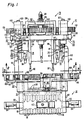
- Figs. 1 and 3 there are illustrated various features in the work station 52 which are used in conjunction with the fixture 12 to guide the top nozzle 14 and the fixture 12 for proper removal and replacement of the top nozzle. These features include a pair of elongated, bullet-nose guide members 54 affixed to, and projecting upwardly from, a pair of diagonal corner 56 of a top flange 58 of the work station 52. Likewise included in the work station 52 are four movable pads 60 that are mounted on, and project through, the side walls 62 of the work station at the elevation of the uppermost grid 18 of the fuel assembly 10.
- the pads 60 are advanced inwardly by cylnders 64, also mounted on the side walls 62, to bear against each side of the grid 18 and take up the clearance between the station 52 and the assembly 10, and thus maintain it in a fixed relation to the work station.
- cylnders 64 also mounted on the side walls 62, to bear against each side of the grid 18 and take up the clearance between the station 52 and the assembly 10, and thus maintain it in a fixed relation to the work station.
- the work station 52 includes four pneumatic-operated moon-shaped brackets 66 mounted on the top flange 58 which are used in conjunction with the fixture 12 during remounting or replacement of the top nozzle 14.
- the fuel assembly 10 is submerged in coolant and thus maintenance operations are performed by manipulation of remotely controlled submersible equipment, one component of which may be a tool (not shown) for removing the locking tubes from the respective guide thimble extensions or end portions. Removal of the locking tubes represents the first step in removing the top nozzle 14 from the reconstitutable fuel assembly 10.
- Another component of such equipment is the fixture 12 embodying the present invention which, after the locking tubes have been removed, is used for removing and subsequently replacing the top nozzle 14 from and on the guide thimbles 20 of the reconstitutable fuel assembly 10.
- a base 68 of the fixture 12 which used in conjunction with the workstation 52, are useful in both removing and replacing the top nozzle 14 from and back onto the guide thimbles 20 of the fuel assembly 10.
- these features on the base 68 of the fixture 12 include guiding means 70, aligning means 72, locking means 74, moving means 76 and reference establishing means 78.
- the guiding means 70 preferably takes the form of a pair of holes 80 formed through one pair of diagonal corners 82 of the fixture base 68.
- the holes 80 are sized to receive the guide members 54 of the work station 52 which project upwardly from the top flange 58 of the station.
- the aligning means 72 of the fixture 12 which preferably takes the form of two elongated rods 88 positioned along a diagonal of the base 68 on either side of the central stud 86 and having lower conically tapered heads 90, insert through two of the passageways 38 in the top nozzle adapter plate 24 and into the upper end portions 36 of two guide thimbles 20.
- Downward movement of the fixture 12 continues until the base 68 and aligning rods 88 reach the position shown in Fig. 8 (only one rod 88 being illustrated for purposes of clarity).
- the fixture 12 also becomes aligned with the top nozzle 14 of the fuel assembly 10 as well as with the top flange 58 of the work station 52 as the fixture base 68 is movably mounted on the work station.
- the fixture base 68 Once the fixture base 68 has lowered to the position shown in Fig. 8, it is properly positioned on the top nozzle 14 for top nozzle removal. Each lowering places the locking means 74 on the fixture base 68 into mateable relation with complementary means on the top nozzle 14.
- the locking means 74 preferably takes the form of a pair of releasable expansion members.
- each expansion member 74 includes a hollow expandable split sleeve 92 and a wedge pin 94 inserted into the sleeve 92 from the lower end.
- the sleeve 92 is attached at an upper end to the fixture base 68 in diagonal alignment with the alignment rods 88 but radially outward therefrom with respect to the central stud 86 of the fixture 12.
- the lower end portion of the sleeve 92 contains several axially extending slots 96 which are expandable circumferentially outward (as seen in broken line form in Fig.
- Expansion of the sleeve 92 creates a tight friction fit between its outer surface 104 and the internal surface 106 of a bore 107 defined in one diagonal corner pad of pair 28 at each diagonal corner of pair 32 of the top nozzle housing side walls 26.
- the tight friction fit attaches the fixture 12 to the top nozzle 20.
- loosening the nut 100 moves the wedge pin 94 in an opposite direction, allowing the sleeve 92 to contact and release the frictional engagement with the internal surface 106 of the bore 107 and thus frees the base 68 from the top nozzle 14.
- the reference establishing means 78 is provided on the fixture base 68 for this purpose. It takes the form of a pair of stop devices 110 mounted on the fixture base 68 adjacent the other pair of diagonal corners 112 of the base.
- each stop device 110 includes a spring-loaded, vertically oriented stop pin 114 and a stop pin lock assembly 116.
- the stop pin 114 projects through an opening 117 on the base 68 and is loaded or biased downwardly by coil spring 118.
- the spring 118 encircles the pin 114 below the base 68 and is positioned in a state of compression between the base and a lower washer 120 attached to the pin.
- the stop in assembly 116 takes the form of a threaded rod 122 and an actuating arm 124 attached to one end of the rod.
- the rod 122 is movable through an elongated hole 126 horizontally tapped into the base 68 from its peripheral edge 128 adjacent each diagonal corner 112 so as to intersect the vertically extending opening 117 in the base through which the stop pin 114 is inserted.
- the threaded rod 122 is rotated within the threaded hole 126 which causes the rod to move through the hole, clockwise rotation to advance the rod toward the pin 114 and counterclockwise rotation to retract the rod away from the pin.
- the inner terminal end 130 of the rod 122 extends into a vertical groove 132 formed in a side of the stop pin 114 which faces the hole 126.
- Left- and right-hand limit lugs 134, 136 extend radially outward from the peripheral edge 128 of the base 68 on either side of the location of attachment of the actuating arm 124 to the outer end of the rod 122 for defining the extremes of the rotational stroke of the arm 124.
- the stop devices 110 Prior to placing the fixture 12 on the top nozzle 14 in preparation for nozzle removal, the stop devices 110 must be preset so as to function to establish a reference representing the displacement between the fixture base 68 and the top flange 58 of the work station 52 so that the top nozzle 14 can be replaced later at the same axial position on the fuel assembly as it was prior to removal.
- a ring 138 on the end of each actuating arm 124 is engaged with a long-handled "hood end" tool (not shown) and, with a lifting motion, the actuating arm is pivoted in a counterclockwise direction against the left-hand limit lug 134, as seen in Fig. 1. This action causes the threaded rod 122 to rotate in the tapped hole 126 and to move away from the groove 132 in the stop pin 114 to an unlocked position.
- each spring-loaded stop pin 114 maintains contact with the top flange 58 of the work station 52.
- the extent of each pin 114 establishes a reference representing the vertical dimension from the work station flange 58 to the fixture base 68.
- the stop pins 114 are immobilized by again using the aforementioned long-handled hook-end tool.
- the ring 138 on each actuating arm 124 is engaged, lifted and pivoted against the right-hand limit lug 136 (from the solid line position to the broken line position in Fig. 8) which rotates the stop pin lock rod 122 in a clockwise direction and advances it to a locked position onto contact with the side of the pin 114 within the groove 132.
- the pressure of the inner terminal end 130 of the threaded rod 122 against the stop pin 114 prevents vertical movement of the stop pin during subsequent top nozzle removal and remounting operations, thus preserving the reference dimension between the work station top flange 58 and the fixture base 68.
- the location of the right-hand limit lug 136 allows adequate rod pressure to hold the stop pin 14, while preventing an excessive degree of rotation that could damage the stop devices 110.
- the stop device 110 remain in the locked positions. This ensures that the remounted top nozzle 14 is axially in an identical position to that prior to removal as established by the reference dimension from the work station top flange 58 to the fixture base 68.
- the moving means 76 is operated to remove the top nozzle 14 locked to the fixture base 68 from the fuel assembly. Specifically, the moving means 76 on the base 68 engages the top flange 58 of the work station 52 and lifts the base 68 and top nozzles 14 locked thereto away from the top flange. Such action causes release of the attaching structures 40 mating the top nozzle adapter plate 24 to the upper end portions 36 of the guide thimbles 20.
- the moving means 76 includes a plurality of elongated reaction pins 140 and drive means 142 for moving the pins.
- the reaction pins 140 extend from the base 68 downwardly toward the top flange 58 when the base is movably mounted on the work station.
- Each of the reaction pins 140 is threadably coupled through an internally threaded hub 144 fixed to the underside of the base 68 such that upon rotation the pins also move vertically relative to the base.
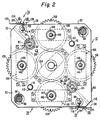
- the drive means 142 includes a centrally located drive gear 146 keyed to a central shaft 148 which is mounted for rotation about a vertical axis by bushings 150, 152 respectively supported on the base 68 and on an inverted U-shaped bracket 154 which, in turn, is mounted on the base 68.
- a nut 156 which, in turn, is mounted on the base 68.
- a nut 156 providing a tool surface for turning the shaft 148 is integrally connected with the upper end of the shaft as is the earlier-mentioned central stud 86 used for lifting the fixture 12.
- the drive means 142 also includes a plurality of driven gears 158, preferably four in number corresponding to the four reaction pins 140 which are used .on the fixture 12.
- Each driven gear 158 is mounted in intermeshed relationship with the drive gear 146 and at a position circumferentially displaced about the drive gear approximately ninety degrees from one another, as most clearly seen in Figs. 2 and 4. Furthermore, each driven gear 158 is affixed to a shaft 160 which is mounted for rotation about a vertical axis by bushings 162, 164 respectively supported on the base 68 and on an inverted U-shaped bracket 166 which, in turn, is mounted on the base.
- the reaction pins 140 are each integrally connected at its upper end to the lower end of one of the driven gear shafts 160 so as to rotate therewith.
- the arrangement of the drive means 142 with the reaction pins 140 must provide for translation of rotational motion of the drive gear 146 into movement of the reaction pins 140 along linear paths due to the threaded mounting of the pins in the hubs 144.
- the teeth of the respective driven gears 158 intermesh with the teeth of drive gear 146 so as to allow the driven gears to slidably move vertically in linear fashion with respect to the drive gear concurrently as the driven gears are rotated by the drive gear.
- Such vertically sliding capability of the driven gears 158 relative to the drive gear 146 can be seen by comparing Fig. 8 to Fig. 9 and Fig. 10 to Fig. 11.
- a long-handled socket end tool (not shown) is engaged with the hex nut 156 on the upper end of the central shaft 148 and is turned in counterclockwise direction. This action turns the drive gear 146 and simultaneously rotates the driven gears 158 and drives the reaction pins 140 rotatably and linearly downward against the top flange 58 of the work station 52.
- the fixture 12 with the attached top nozzle 14 is then carefully removed from the work station 52 and transferred to temporary storage by means of the earlier-mentioned, long-handled, threaded- end tool engaged with the upper threaded end 84 of the central stud 86.
- Remounting of the top nozzle 14 is substantially the reverse of the removal procedure and uses the same features.
- one additional component is needed - some means to hold the lower ends of the reaction pins 140 so that the adapter plate 24 of the top nozzle 14 can be driven down upon the upper end portions 36 of the guide thimbles 20.
- such means is provided in the form of a plurality of actuators 168, preferably four in number corresponding to the number of reaction pins 140 and being pneumatic cylinders, having moon-shaped brackets 66 attached to their piston rod extensions and movable between the solid line and dashed line positions.
- operation of the actuators 168 advances the brackets 66 against reduced diameter sections 172 on the respective reaction pins 140.
- the brackets 66 take the reaction transmitted through the pins 140 as the top nozzle adapter plate 24 is forced over the upper end portions 36 of the guide thimbles 20 by turning the drive gear 146 in a clockwise direction.
- the top nozzle 14 has been lowered to its final assembly elevation when the lower ends of the stop pins 114 contact the top flange 58 of the work station 52. At such elevation the annular bulges 48 on the guide thimbles 20 are seated in the annular grooves 44 in the adapter plate passageways 38. Once such seating relationship has been reached, the actuators 168 are operated to retract the brackets 66. The fixture 12 is then unlocked from the top nozzle 14, and the fixture 12 is lifted off the nozzle and transferred to temporary storage.
Landscapes
- Physics & Mathematics (AREA)
- Engineering & Computer Science (AREA)
- Plasma & Fusion (AREA)
- General Engineering & Computer Science (AREA)
- High Energy & Nuclear Physics (AREA)
- Monitoring And Testing Of Nuclear Reactors (AREA)
- Shovels (AREA)
- Crushing And Grinding (AREA)
- Automatic Assembly (AREA)
Claims (6)
Applications Claiming Priority (2)
| Application Number | Priority Date | Filing Date | Title |
|---|---|---|---|
| US670729 | 1984-11-13 | ||
| US06/670,729 US4664875A (en) | 1984-11-13 | 1984-11-13 | Top nozzle removal and replacement fixture and method in a reconstitutable fuel assembly |
Publications (2)
| Publication Number | Publication Date |
|---|---|
| EP0183068A1 EP0183068A1 (de) | 1986-06-04 |
| EP0183068B1 true EP0183068B1 (de) | 1989-12-27 |
Family
ID=24691620
Family Applications (1)
| Application Number | Title | Priority Date | Filing Date |
|---|---|---|---|
| EP85113716A Expired EP0183068B1 (de) | 1984-11-13 | 1985-10-29 | Haltevorrichtung zum Ausbau und Austausch eines Endstücks eines wiederherstellbaren Brennstoffelements |
Country Status (6)
| Country | Link |
|---|---|
| US (1) | US4664875A (de) |
| EP (1) | EP0183068B1 (de) |
| JP (1) | JPH0664178B2 (de) |
| KR (1) | KR940004832B1 (de) |
| DE (1) | DE3575041D1 (de) |
| ES (1) | ES8703670A1 (de) |
Families Citing this family (8)
| Publication number | Priority date | Publication date | Assignee | Title |
|---|---|---|---|---|
| US4917854A (en) * | 1988-08-26 | 1990-04-17 | Westinghouse Electric Corp. | Method and arrangement for consolidating and storing nozzles removed from nuclear fuel assemblies |
| US5084230A (en) * | 1990-12-12 | 1992-01-28 | Westinghouse Electric Corp. | Hand held tool for removing and replacing a removable top nozzle |
| AU1339992A (en) * | 1991-02-01 | 1992-09-07 | Frederic C. Ambrose | Keyboard positioning system |
| US5207980A (en) * | 1991-10-27 | 1993-05-04 | Westinghouse Electric Corp. | Top nozzle-mounted replacement guide pin assemblies |
| US5405204A (en) * | 1992-02-03 | 1995-04-11 | Ambrose; Frederic C. | Keyboard positioning system |
| EP3182416B1 (de) * | 2015-12-18 | 2018-09-26 | Westinghouse Electric Sweden AB | Kernbrennstoffanordnung mit ausgleichplatte |
| KR102059466B1 (ko) * | 2017-11-09 | 2019-12-27 | 한전원자력연료 주식회사 | 핵연료집합체 상단고정체의 분리·결합 시스템 |
| KR102059464B1 (ko) * | 2017-11-09 | 2019-12-27 | 한전원자력연료 주식회사 | 핵연료집합체 상단고정체 락 인서트와 이를 포함하는 핵연료집합체 상단고정체의 분리·결합 시스템 |
Family Cites Families (15)
| Publication number | Priority date | Publication date | Assignee | Title |
|---|---|---|---|---|
| US3828868A (en) * | 1969-11-26 | 1974-08-13 | Babcock & Wilcox Co | Fuel assembly for a nuclear reactor |
| US3770583A (en) * | 1971-05-20 | 1973-11-06 | Combustion Eng | Fuel assembly hold-down device |
| US3801453A (en) * | 1972-02-11 | 1974-04-02 | Transfer Systems | Fuel assembly for power generating nuclear reactor |
| US3887980A (en) * | 1973-03-29 | 1975-06-10 | Exxon Nuclear Co Inc | Nuclear fuel bundle disassembly and assembly tool |
| US4175000A (en) * | 1973-10-23 | 1979-11-20 | The Babcock & Wilcox Company | Method for inspecting nuclear reactor fuel elements |
| US4219386A (en) * | 1977-06-10 | 1980-08-26 | Exxon Nuclear Company, Inc. | PWR Integral tie plate and locking mechanism |
| US4358421A (en) * | 1977-10-26 | 1982-11-09 | The Babcock & Wilcox Company | Industrial technique |
| US4208248A (en) * | 1977-10-26 | 1980-06-17 | The Babcock & Wilcox Company | Fuel assembly with a removable end fitting |
| JPS5821593A (ja) * | 1981-07-31 | 1983-02-08 | 三菱原子力工業株式会社 | 上部ノズル着脱型燃料集合体の上部ノズル装着装置 |
| DE3173790D1 (en) * | 1981-12-29 | 1986-03-27 | Acec | Recovery envelope for a failed nuclear fuel element |
| US4522780A (en) * | 1982-02-16 | 1985-06-11 | Westinghouse Electric Corp. | Removal and replacement of fuel rods in nuclear fuel assembly |
| US4551299A (en) * | 1982-09-15 | 1985-11-05 | Westinghouse Electric Corp. | Multiple fuel rod gripper |
| FR2536201B1 (fr) * | 1982-11-16 | 1985-07-19 | Fragema Framatome & Cogema | Installation de reparation d'assemblages de combustible nucleaire |
| US4575930A (en) * | 1983-12-21 | 1986-03-18 | Westinghouse Electric Corp. | Nuclear reactor fuel assembly peripheral rod lifting device |
| US4572816A (en) * | 1983-12-21 | 1986-02-25 | Westinghouse Electric Corp. | Reconstituting a nuclear reactor fuel assembly |
-
1984
- 1984-11-13 US US06/670,729 patent/US4664875A/en not_active Expired - Lifetime
-
1985
- 1985-10-29 DE DE8585113716T patent/DE3575041D1/de not_active Expired - Lifetime
- 1985-10-29 EP EP85113716A patent/EP0183068B1/de not_active Expired
- 1985-11-07 ES ES548634A patent/ES8703670A1/es not_active Expired
- 1985-11-11 JP JP60251005A patent/JPH0664178B2/ja not_active Expired - Lifetime
- 1985-11-13 KR KR1019850008487A patent/KR940004832B1/ko not_active Expired - Fee Related
Also Published As
| Publication number | Publication date |
|---|---|
| EP0183068A1 (de) | 1986-06-04 |
| ES548634A0 (es) | 1987-02-16 |
| JPH0664178B2 (ja) | 1994-08-22 |
| JPS61120080A (ja) | 1986-06-07 |
| DE3575041D1 (de) | 1990-02-01 |
| KR940004832B1 (ko) | 1994-06-01 |
| KR860004431A (ko) | 1986-06-23 |
| ES8703670A1 (es) | 1987-02-16 |
| US4664875A (en) | 1987-05-12 |
Similar Documents
| Publication | Publication Date | Title |
|---|---|---|
| US4639998A (en) | Locking tube removal and replacement tool and method in a reconstitutable fuel assembly | |
| CA2870195C (en) | Lower end fitting locknut for nuclear fuel assembly | |
| EP4238717A1 (de) | Universelle halterung, roboter und entriegelungssystem | |
| US4134789A (en) | Method for refuelling a nuclear reactor and device for carrying out said method | |
| US4724607A (en) | Apparatus for rebuilding nuclear fuel assemblies | |
| US4667547A (en) | Apparatus and method for removing a top nozzle in reconstituting a fuel assembly | |
| EP0183068A1 (de) | Haltevorrichtung zum Ausbau und Austausch eines Endstücks eines wiederherstellbaren Brennstoffelements | |
| US4664874A (en) | Reusable locking tube insertion and removal fixture and method in a reconstitutable fuel assembly | |
| US4684498A (en) | Guide thimble captured locking tube in a reconstitutable fuel assembly | |
| EP0206586B1 (de) | Doppelsperrverbindung zur Befestigung des Kopfstückes mit den Führungsrohren eines Kernbrennstabbündels | |
| US4638543A (en) | Locking tube removal fixture and method in a reconstitutable fuel assembly | |
| US4638556A (en) | Locking tube insertion fixture and method in a reconstitutable fuel assembly | |
| US4684500A (en) | Guide thimble captured locking tube in a reconstitutable fuel assembly | |
| JPS63265192A (ja) | 原子炉の炉心及び炉心に装荷するための方法 | |
| JPS62261989A (ja) | 上部ノズルの一体的ロツク装置 | |
| JP4965070B2 (ja) | 燃料集合体ノズル交換用の工具と方法 | |
| JPH02115794A (ja) | 原子炉の燃料集合体の取り外し自在のコネクタ内にガイドチューブのブロッキングスリーブを嵌着する装置及び方法 | |
| JP3742698B2 (ja) | 荷重支持にチャネルまたは冷却材棒を選択的に用いる燃料集合体構造および方法 | |
| US5084230A (en) | Hand held tool for removing and replacing a removable top nozzle |
Legal Events
| Date | Code | Title | Description |
|---|---|---|---|
| PUAI | Public reference made under article 153(3) epc to a published international application that has entered the european phase |
Free format text: ORIGINAL CODE: 0009012 |
|
| AK | Designated contracting states |
Kind code of ref document: A1 Designated state(s): BE DE FR GB IT SE |
|
| 17P | Request for examination filed |
Effective date: 19861117 |
|
| 17Q | First examination report despatched |
Effective date: 19880226 |
|
| ITF | It: translation for a ep patent filed | ||
| GRAA | (expected) grant |
Free format text: ORIGINAL CODE: 0009210 |
|
| AK | Designated contracting states |
Kind code of ref document: B1 Designated state(s): BE DE FR GB IT SE |
|
| ET | Fr: translation filed | ||
| REF | Corresponds to: |
Ref document number: 3575041 Country of ref document: DE Date of ref document: 19900201 |
|
| PLBE | No opposition filed within time limit |
Free format text: ORIGINAL CODE: 0009261 |
|
| STAA | Information on the status of an ep patent application or granted ep patent |
Free format text: STATUS: NO OPPOSITION FILED WITHIN TIME LIMIT |
|
| 26N | No opposition filed | ||
| ITTA | It: last paid annual fee | ||
| EAL | Se: european patent in force in sweden |
Ref document number: 85113716.6 |
|
| PGFP | Annual fee paid to national office [announced via postgrant information from national office to epo] |
Ref country code: SE Payment date: 19960919 Year of fee payment: 12 |
|
| PGFP | Annual fee paid to national office [announced via postgrant information from national office to epo] |
Ref country code: FR Payment date: 19961011 Year of fee payment: 12 |
|
| PGFP | Annual fee paid to national office [announced via postgrant information from national office to epo] |
Ref country code: DE Payment date: 19961030 Year of fee payment: 12 |
|
| PGFP | Annual fee paid to national office [announced via postgrant information from national office to epo] |
Ref country code: BE Payment date: 19961031 Year of fee payment: 12 |
|
| PG25 | Lapsed in a contracting state [announced via postgrant information from national office to epo] |
Ref country code: SE Free format text: LAPSE BECAUSE OF NON-PAYMENT OF DUE FEES Effective date: 19971030 |
|
| PG25 | Lapsed in a contracting state [announced via postgrant information from national office to epo] |
Ref country code: FR Free format text: THE PATENT HAS BEEN ANNULLED BY A DECISION OF A NATIONAL AUTHORITY Effective date: 19971031 Ref country code: BE Free format text: LAPSE BECAUSE OF NON-PAYMENT OF DUE FEES Effective date: 19971031 |
|
| BERE | Be: lapsed |
Owner name: WESTINGHOUSE ELECTRIC CORP. Effective date: 19971031 |
|
| PG25 | Lapsed in a contracting state [announced via postgrant information from national office to epo] |
Ref country code: DE Free format text: LAPSE BECAUSE OF NON-PAYMENT OF DUE FEES Effective date: 19980701 |
|
| EUG | Se: european patent has lapsed |
Ref document number: 85113716.6 |
|
| REG | Reference to a national code |
Ref country code: FR Ref legal event code: ST |
|
| REG | Reference to a national code |
Ref country code: GB Ref legal event code: IF02 |
|
| PGFP | Annual fee paid to national office [announced via postgrant information from national office to epo] |
Ref country code: GB Payment date: 20041004 Year of fee payment: 20 |
|
| PG25 | Lapsed in a contracting state [announced via postgrant information from national office to epo] |
Ref country code: GB Free format text: LAPSE BECAUSE OF EXPIRATION OF PROTECTION Effective date: 20051028 |
|
| REG | Reference to a national code |
Ref country code: GB Ref legal event code: PE20 |