EP0183926A2 - Procédé pour la transmission d'informations numériques dans un réseau radiotéléphone - Google Patents
Procédé pour la transmission d'informations numériques dans un réseau radiotéléphone Download PDFInfo
- Publication number
- EP0183926A2 EP0183926A2 EP85111581A EP85111581A EP0183926A2 EP 0183926 A2 EP0183926 A2 EP 0183926A2 EP 85111581 A EP85111581 A EP 85111581A EP 85111581 A EP85111581 A EP 85111581A EP 0183926 A2 EP0183926 A2 EP 0183926A2
- Authority
- EP
- European Patent Office
- Prior art keywords
- subsections
- subsection
- stations
- station
- telegrams
- Prior art date
- Legal status (The legal status is an assumption and is not a legal conclusion. Google has not performed a legal analysis and makes no representation as to the accuracy of the status listed.)
- Granted
Links
- 230000005540 biological transmission Effects 0.000 title claims abstract description 20
- 238000000034 method Methods 0.000 title claims abstract description 17
- 230000001360 synchronised effect Effects 0.000 claims abstract description 5
- 238000013475 authorization Methods 0.000 claims description 2
- 230000015572 biosynthetic process Effects 0.000 claims 1
- 238000010586 diagram Methods 0.000 description 3
- IUVCFHHAEHNCFT-INIZCTEOSA-N 2-[(1s)-1-[4-amino-3-(3-fluoro-4-propan-2-yloxyphenyl)pyrazolo[3,4-d]pyrimidin-1-yl]ethyl]-6-fluoro-3-(3-fluorophenyl)chromen-4-one Chemical compound C1=C(F)C(OC(C)C)=CC=C1C(C1=C(N)N=CN=C11)=NN1[C@@H](C)C1=C(C=2C=C(F)C=CC=2)C(=O)C2=CC(F)=CC=C2O1 IUVCFHHAEHNCFT-INIZCTEOSA-N 0.000 description 1
- 230000001413 cellular effect Effects 0.000 description 1
- 238000013461 design Methods 0.000 description 1
- 238000011161 development Methods 0.000 description 1
- 230000018109 developmental process Effects 0.000 description 1
- 230000000694 effects Effects 0.000 description 1
- VJYFKVYYMZPMAB-UHFFFAOYSA-N ethoprophos Chemical compound CCCSP(=O)(OCC)SCCC VJYFKVYYMZPMAB-UHFFFAOYSA-N 0.000 description 1
- 230000011664 signaling Effects 0.000 description 1
- 230000002269 spontaneous effect Effects 0.000 description 1
- 230000001960 triggered effect Effects 0.000 description 1
Images


Classifications
-
- H—ELECTRICITY
- H04—ELECTRIC COMMUNICATION TECHNIQUE
- H04W—WIRELESS COMMUNICATION NETWORKS
- H04W88/00—Devices specially adapted for wireless communication networks, e.g. terminals, base stations or access point devices
- H04W88/08—Access point devices
Definitions
- the invention is based on a method according to the preamble of claim 1.
- a radio telephone network is known (Global Communications, 1984, number 1, pages 46 to 50), which is called NORDIC MOBILE TELEPHONE (NMT).
- NMT NORDIC MOBILE TELEPHONE
- the method according to the invention with the characterizing features of claim 1 has the advantage that by using a synchronous method with fixed time slot assignments and by an asymmetrical design of the telegram transmission from a fixed station - to a mobile station and vice versa, the establishment of connections can be accelerated without that operational safety is reduced.
- a method according to the invention is particularly advantageous in which the information telegrams of each time segment are assigned to a group of mobile stations and the reserve telegrams are assigned to all groups of mobile stations. This type of division can increase the transmission capacity.
- a radio telephone network is divided into radio cells FZ1, FZ2 ..., each of which has a fixed radio transmitting and receiving station, hereinafter referred to as fixed station BS1, BS2 ....
- Mobile radio transmission and reception stations hereinafter referred to as mobile stations MS11 ... MS1N, MS21 ... MS2M ..., operate within the radio network, which exchange data telegrams with the stationary stations and can connect to one another via the stationary stations.
- the stationary stations BS1, BS2 are preferably connected via lines L10, L20 to a radio switching center FV which controls the entire information transmission and is equipped with a computer R for this purpose.
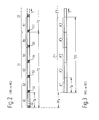
- the subsections U11 and U17 adjoining the first subsection U10 preferably have identical lengths of, for example, 27 ms.
- the subsections U11 and U17 are intended for reserve telegrams R1, R2 and the subsections U12 ... U16 for information telegrams 11 ... 15.
- the synchronous telegrams S1, S2 ... (Barker words) are constructed in such a way that the mobile stations MS11, MS21 ... can recognize at any time which part of a cycle Z1, Z2 ... is currently running.
- the information telegrams 11, I2 ... are standard telegrams which are used for the normal transmission of information from the fixed station, for example BS1, to a mobile station, for example MS11, which are, for example, calls, instructions and information for the mobile stations included.
- the reserve telegrams, for example R1, of each time segment, for example A1 also take calls, that are selective calls to call certain mobile stations, instructions, that are commands for switching the channels originating from the radio switching center FV, as well as general information, the entire information can be distributed to both subsections U11 and U17.
- the second reserve telegram R2 does not require a selective call number because it is already in subsection U11 for the first reserve telegram R1, attention is drawn to the following telegram R2 and because this can only appear in subsection U17. All subsections U10, U11 ... adjoin one another without gaps.
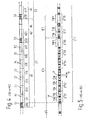
- Each cycle, for example Z'1 is also in five periods, for example A'1 ... A'5, and each period, for example A'5 (Fig. 5), in six subsections, for example U'51 ... U'56.
- Each subsection, for example U'51 contains two preferably equally long subsections T1A, T1B, which are separated by a pause section P of the duration tp.
- the last subsection, for example U'56, of each period, for example A'5, is not divided into two sections; however, it is separated from the previous and subsequent subsections U'55 and U'11 by a pause.
- the pause time tp is used to compensate for the transit time of the mobile stations, for example MS11, which are at different distances from the fixed station, for example BS1, in a radio cell, for example FZ1.
- the first subsection for transmitting a message telegram M1, M2 ... and the second subsection for transmitting an acknowledgment telegram Q1 , Q2 ... provided; see. Fig. 5.
- tp 3 ms
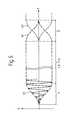
- FIG. 7A shows a time diagram of an organizational channel KO, the upper time axis for the radio traffic from the fixed station BS, for example BS1, to the mobile station MS, for example MS11, and the lower time axis for the radio traffic from the mobile station, for example MS11, is assigned to the fixed station, for example BS1.
- a mobile station, for example MS11 presumably uses a registration telegram TA - if necessary repeatedly - to register its call request with the fixed station, for example BS1. The latter then sends a request telegram TU to the calling mobile station to request a choice.
- the mobile station then sends the call number of the desired radio or wire subscriber, for example the mobile station MS12, to the stationary station BS1 by means of a dialing telegram TW. From this a call telegram TR is sent to the desired subscriber, which is confirmed by the latter by means of a first acknowledgment telegram TQ1. The same calling telegram also goes to the calling subscriber as soon as the wire-side connection is established; he also confirms it with a first acknowledgment telegram TQ1. The handset is then removed in the called mobile station and a lifting telegram TH is thereby triggered; see. Figure 7A. The same thing happens in the calling mobile station. The fixed station then assigns a voice channel by means of an assignment telegram TK; see.
- the calling and called parties then acknowledge in this voice channel KS (FIG. 7B) mobile station uses a second acknowledgment telegram TQ2 to assign the channel.
- the conversation then begins, during which the stationary station can use a telegram TL to request the mobile station to increase its transmission power if, for example, the reception conditions in the stationary station change.
- the latter can send a third acknowledgment telegram TQ 3.
- the respective mobile station sends a call end telegram TE to the fixed station, which uses a TEA to switch the mobile station from the voice channel KS to the organizational channel KO (see arrow P2) and to clear the call connection initiates.
- the mobile station sends a fourth acknowledgment telegram TQ4 to the stationary station and thus indicates its readiness to receive further telegrams from the stationary station.
- the other mobile station also receives a switchover telegram TEA, whereupon it likewise switches back to the organizational channel KO and reports back by means of an acknowledgment telegram TQ4.
- TEA switchover telegram
- Analogous considerations apply to the setup from a mobile to a stationary station and vice versa, only that some of the signaling options described are omitted on the wire side.
- the sections T1A ... are intended for the spontaneous reporting access of the mobile stations.
- Mobile subscribers for example, only use the last two digits of the subscriber numbers to assign them to a subsection.
- Permissions for access to the subsections are preferably granted in the form that, for example, the end numbers "01", “26", “51” and “76", the subsections T1A and the end numbers "02", "27", "52” and “77” are assigned to sections T2A, etc.
- the message access then occurs spontaneously at the next assigned time slot. If it is not acknowledged in the next assigned subsection by a request from the stationary station for further activities, a randomly controlled repetition sequence takes place within the assigned subsections in the mobile station until an acknowledgment arrives.
- the authorizations can be provided, for example, for emergency calls, but also for certain participants in a hierarchy.
Landscapes
- Engineering & Computer Science (AREA)
- Computer Networks & Wireless Communication (AREA)
- Signal Processing (AREA)
- Mobile Radio Communication Systems (AREA)
- Financial Or Insurance-Related Operations Such As Payment And Settlement (AREA)
- Communication Control (AREA)
- Two-Way Televisions, Distribution Of Moving Picture Or The Like (AREA)
- Telephone Function (AREA)
- Circuits Of Receivers In General (AREA)
- Telephonic Communication Services (AREA)
Priority Applications (1)
| Application Number | Priority Date | Filing Date | Title |
|---|---|---|---|
| AT85111581T ATE66560T1 (de) | 1984-12-01 | 1985-09-13 | Verfahren zum uebertragen von digitalen informationen in einem funktelefonnetz. |
Applications Claiming Priority (2)
| Application Number | Priority Date | Filing Date | Title |
|---|---|---|---|
| DE3443974 | 1984-12-01 | ||
| DE19843443974 DE3443974A1 (de) | 1984-12-01 | 1984-12-01 | Verfahren zum uebertragen von digitalen informationen in einem funktelefonnetz |
Publications (3)
| Publication Number | Publication Date |
|---|---|
| EP0183926A2 true EP0183926A2 (fr) | 1986-06-11 |
| EP0183926A3 EP0183926A3 (en) | 1988-08-17 |
| EP0183926B1 EP0183926B1 (fr) | 1991-08-21 |
Family
ID=6251727
Family Applications (1)
| Application Number | Title | Priority Date | Filing Date |
|---|---|---|---|
| EP19850111581 Expired - Lifetime EP0183926B1 (fr) | 1984-12-01 | 1985-09-13 | Procédé pour la transmission d'informations numériques dans un réseau radiotéléphone |
Country Status (7)
| Country | Link |
|---|---|
| EP (1) | EP0183926B1 (fr) |
| AT (1) | ATE66560T1 (fr) |
| DE (2) | DE3443974A1 (fr) |
| DK (1) | DK164346C (fr) |
| ES (1) | ES8702097A1 (fr) |
| FI (1) | FI82338C (fr) |
| NO (1) | NO172718C (fr) |
Cited By (1)
| Publication number | Priority date | Publication date | Assignee | Title |
|---|---|---|---|---|
| GB2329553B (en) * | 1997-08-22 | 2002-08-28 | Olivetti Telemedia Spa | Radio communication system |
Families Citing this family (5)
| Publication number | Priority date | Publication date | Assignee | Title |
|---|---|---|---|---|
| US4675863A (en) | 1985-03-20 | 1987-06-23 | International Mobile Machines Corp. | Subscriber RF telephone system for providing multiple speech and/or data signals simultaneously over either a single or a plurality of RF channels |
| US4825448A (en) * | 1986-08-07 | 1989-04-25 | International Mobile Machines Corporation | Subscriber unit for wireless digital telephone system |
| US4777633A (en) * | 1987-08-14 | 1988-10-11 | International Mobile Machines Corp. | Base station for wireless digital telephone system |
| US5546383A (en) | 1993-09-30 | 1996-08-13 | Cooley; David M. | Modularly clustered radiotelephone system |
| DE19626132A1 (de) * | 1996-06-28 | 1998-01-08 | Sel Alcatel Ag | System und Verfahren zur digitalen Datenübertragung |
Family Cites Families (3)
| Publication number | Priority date | Publication date | Assignee | Title |
|---|---|---|---|---|
| DE2812009C2 (de) * | 1978-03-18 | 1984-08-02 | Standard Elektrik Lorenz Ag, 7000 Stuttgart | Nachrichtenübertragungssystem |
| DE3009309C2 (de) * | 1980-03-11 | 1982-06-24 | Siemens AG, 1000 Berlin und 8000 München | Mobiles Funknetz |
| US4414661A (en) * | 1981-07-02 | 1983-11-08 | Trancom Ab | Apparatus for communicating with a fleet of vehicles |
-
1984
- 1984-12-01 DE DE19843443974 patent/DE3443974A1/de active Granted
-
1985
- 1985-09-13 EP EP19850111581 patent/EP0183926B1/fr not_active Expired - Lifetime
- 1985-09-13 AT AT85111581T patent/ATE66560T1/de not_active IP Right Cessation
- 1985-09-13 DE DE8585111581T patent/DE3583856D1/de not_active Expired - Lifetime
- 1985-10-18 NO NO854152A patent/NO172718C/no unknown
- 1985-10-28 FI FI854212A patent/FI82338C/fi not_active IP Right Cessation
- 1985-11-29 ES ES549431A patent/ES8702097A1/es not_active Expired
- 1985-11-29 DK DK555685A patent/DK164346C/da not_active IP Right Cessation
Cited By (1)
| Publication number | Priority date | Publication date | Assignee | Title |
|---|---|---|---|---|
| GB2329553B (en) * | 1997-08-22 | 2002-08-28 | Olivetti Telemedia Spa | Radio communication system |
Also Published As
| Publication number | Publication date |
|---|---|
| EP0183926A3 (en) | 1988-08-17 |
| FI82338B (fi) | 1990-10-31 |
| FI82338C (fi) | 1991-02-11 |
| ATE66560T1 (de) | 1991-09-15 |
| FI854212A0 (fi) | 1985-10-28 |
| ES8702097A1 (es) | 1986-12-01 |
| NO854152L (no) | 1986-06-02 |
| EP0183926B1 (fr) | 1991-08-21 |
| DE3443974A1 (de) | 1986-06-05 |
| DE3443974C2 (fr) | 1992-11-26 |
| NO172718B (no) | 1993-05-18 |
| ES549431A0 (es) | 1986-12-01 |
| DK555685D0 (da) | 1985-11-29 |
| DK555685A (da) | 1986-06-02 |
| NO172718C (no) | 1993-08-25 |
| DE3583856D1 (de) | 1991-09-26 |
| DK164346C (da) | 1992-11-02 |
| FI854212L (fi) | 1986-06-02 |
| DK164346B (da) | 1992-06-09 |
Similar Documents
| Publication | Publication Date | Title |
|---|---|---|
| DE3855136T2 (de) | Verteilungsfunksystem mit nationaler zugangsfähigkeit | |
| DE69600082T3 (de) | Zeitschlitzanordnung in mobilem kommunikationssystem | |
| DE69030851T2 (de) | Kommunikationssystem | |
| DE69126511T2 (de) | Verbessertes Weiterreichen von Gesprächen zwischen Zellen in Funkkommunkationssystemen mit dynamischer Kanalzuteilung | |
| DE69008312T2 (de) | Verfahren zur Wahl einer Basisstation, eines Radiokanals und eines Zeitschlitzes in einer Mobilstation. | |
| DE4402903A1 (de) | Verfahren zur paketweisen Datenübertragung in einem Mobilfunknetz | |
| EP1163818B1 (fr) | Procede et station de base permettant d'attribuer un canal a une transmission radio | |
| DE2558932B2 (de) | Über Satelliten verbindendes Vermittlungsnetz | |
| EP0611006A1 (fr) | Système radio mobile à communication duplex intégral et semi-duplex | |
| EP0111971A1 (fr) | Procédé et dispositif de commande pour la répartition du volume de trafic sur plusieurs canaux de service d'un système de radiocommunications | |
| EP0073014A2 (fr) | Procédé pour accéder aux canaux de transmission d'un système de télécommunication | |
| DE1791135C3 (de) | Nachrichtenübertragungssystem unter Anwendung eines Zeit- oder Frequenzmultiplex-Verfahrens | |
| EP0036146B1 (fr) | Réseau radio mobile | |
| EP0771125A2 (fr) | Méthode et dispositif pour la transmission de données entre un réseau mobile cellulaire et une station d'abonné | |
| DE69015094T2 (de) | Umschaltungsverfahren zwischen zwei Vermittlungsanlagen für mobile Dienste von einer aktiven Verbindung zu einem mobilen Endgerät. | |
| DE3012484A1 (de) | Mobiles funknetz | |
| DE60022017T2 (de) | Verfahren und vorrichtung, die einer fernübertragungsstation erlauben mehrere kommunikationsstationen zu bedienen | |
| DE1491977B2 (de) | Satelliten-nachrichtenuebertragungssystem mit beliebigem zugriff | |
| EP0210396B1 (fr) | Procédé pour la détermination de la position de stations mobiles | |
| DE69124724T2 (de) | Verteiltes Vermittlungssystem für Zellular-Kommunikation | |
| EP0182027A2 (fr) | Réseau de radio-téléphonie | |
| EP0233963A1 (fr) | Système radio-mobile numérique | |
| EP0183926B1 (fr) | Procédé pour la transmission d'informations numériques dans un réseau radiotéléphone | |
| DE1537011B2 (de) | Schaltungsanordnung zur uebertragung von signalabtast werten in fernmelde insbesondere fernsprechanlagen | |
| DE3402941A1 (de) | Digitales zellenfunksystem mit zeitmultiplex |
Legal Events
| Date | Code | Title | Description |
|---|---|---|---|
| PUAI | Public reference made under article 153(3) epc to a published international application that has entered the european phase |
Free format text: ORIGINAL CODE: 0009012 |
|
| AK | Designated contracting states |
Kind code of ref document: A2 Designated state(s): AT BE CH DE FR GB IT LI NL SE |
|
| PUAL | Search report despatched |
Free format text: ORIGINAL CODE: 0009013 |
|
| AK | Designated contracting states |
Kind code of ref document: A3 Designated state(s): AT BE CH DE FR GB IT LI NL SE |
|
| 17P | Request for examination filed |
Effective date: 19890120 |
|
| 17Q | First examination report despatched |
Effective date: 19910131 |
|
| GRAA | (expected) grant |
Free format text: ORIGINAL CODE: 0009210 |
|
| AK | Designated contracting states |
Kind code of ref document: B1 Designated state(s): AT BE CH DE FR GB IT LI NL SE |
|
| REF | Corresponds to: |
Ref document number: 66560 Country of ref document: AT Date of ref document: 19910915 Kind code of ref document: T |
|
| REF | Corresponds to: |
Ref document number: 3583856 Country of ref document: DE Date of ref document: 19910926 |
|
| ET | Fr: translation filed | ||
| ITF | It: translation for a ep patent filed | ||
| GBT | Gb: translation of ep patent filed (gb section 77(6)(a)/1977) | ||
| RAP4 | Party data changed (patent owner data changed or rights of a patent transferred) |
Owner name: ROBERT BOSCH GMBH |
|
| PLBE | No opposition filed within time limit |
Free format text: ORIGINAL CODE: 0009261 |
|
| STAA | Information on the status of an ep patent application or granted ep patent |
Free format text: STATUS: NO OPPOSITION FILED WITHIN TIME LIMIT |
|
| 26N | No opposition filed | ||
| EAL | Se: european patent in force in sweden |
Ref document number: 85111581.6 |
|
| PGFP | Annual fee paid to national office [announced via postgrant information from national office to epo] |
Ref country code: BE Payment date: 19950925 Year of fee payment: 11 |
|
| PGFP | Annual fee paid to national office [announced via postgrant information from national office to epo] |
Ref country code: AT Payment date: 19950928 Year of fee payment: 11 |
|
| PG25 | Lapsed in a contracting state [announced via postgrant information from national office to epo] |
Ref country code: AT Effective date: 19960913 |
|
| PG25 | Lapsed in a contracting state [announced via postgrant information from national office to epo] |
Ref country code: BE Effective date: 19960930 |
|
| BERE | Be: lapsed |
Owner name: ROBERT BOSCH G.M.B.H. Effective date: 19960930 |
|
| PGFP | Annual fee paid to national office [announced via postgrant information from national office to epo] |
Ref country code: NL Payment date: 19990810 Year of fee payment: 15 Ref country code: GB Payment date: 19990810 Year of fee payment: 15 |
|
| PGFP | Annual fee paid to national office [announced via postgrant information from national office to epo] |
Ref country code: SE Payment date: 19990811 Year of fee payment: 15 |
|
| PGFP | Annual fee paid to national office [announced via postgrant information from national office to epo] |
Ref country code: FR Payment date: 19990830 Year of fee payment: 15 |
|
| PGFP | Annual fee paid to national office [announced via postgrant information from national office to epo] |
Ref country code: DE Payment date: 19991117 Year of fee payment: 15 |
|
| PGFP | Annual fee paid to national office [announced via postgrant information from national office to epo] |
Ref country code: CH Payment date: 19991129 Year of fee payment: 15 |
|
| PG25 | Lapsed in a contracting state [announced via postgrant information from national office to epo] |
Ref country code: GB Free format text: LAPSE BECAUSE OF NON-PAYMENT OF DUE FEES Effective date: 20000913 |
|
| PG25 | Lapsed in a contracting state [announced via postgrant information from national office to epo] |
Ref country code: SE Free format text: THE PATENT HAS BEEN ANNULLED BY A DECISION OF A NATIONAL AUTHORITY Effective date: 20000929 |
|
| PG25 | Lapsed in a contracting state [announced via postgrant information from national office to epo] |
Ref country code: LI Free format text: LAPSE BECAUSE OF NON-PAYMENT OF DUE FEES Effective date: 20000930 Ref country code: CH Free format text: LAPSE BECAUSE OF NON-PAYMENT OF DUE FEES Effective date: 20000930 |
|
| PG25 | Lapsed in a contracting state [announced via postgrant information from national office to epo] |
Ref country code: NL Free format text: LAPSE BECAUSE OF NON-PAYMENT OF DUE FEES Effective date: 20010401 |
|
| GBPC | Gb: european patent ceased through non-payment of renewal fee |
Effective date: 20000913 |
|
| REG | Reference to a national code |
Ref country code: CH Ref legal event code: PL |
|
| EUG | Se: european patent has lapsed |
Ref document number: 85111581.6 |
|
| PG25 | Lapsed in a contracting state [announced via postgrant information from national office to epo] |
Ref country code: FR Free format text: LAPSE BECAUSE OF NON-PAYMENT OF DUE FEES Effective date: 20010531 |
|
| NLV4 | Nl: lapsed or anulled due to non-payment of the annual fee |
Effective date: 20010401 |
|
| PG25 | Lapsed in a contracting state [announced via postgrant information from national office to epo] |
Ref country code: DE Free format text: LAPSE BECAUSE OF NON-PAYMENT OF DUE FEES Effective date: 20010601 |
|
| REG | Reference to a national code |
Ref country code: FR Ref legal event code: ST |