EP0183959A1 - Cyclohexenonderivate, Verfahren zu ihrer Herstellung sowie ihre Verwendung zur Bekämpfung unerwünschten Pflanzenwuchses - Google Patents
Cyclohexenonderivate, Verfahren zu ihrer Herstellung sowie ihre Verwendung zur Bekämpfung unerwünschten Pflanzenwuchses Download PDFInfo
- Publication number
- EP0183959A1 EP0183959A1 EP85113421A EP85113421A EP0183959A1 EP 0183959 A1 EP0183959 A1 EP 0183959A1 EP 85113421 A EP85113421 A EP 85113421A EP 85113421 A EP85113421 A EP 85113421A EP 0183959 A1 EP0183959 A1 EP 0183959A1
- Authority
- EP
- European Patent Office
- Prior art keywords
- formula
- alkoxycarbonyl
- hydrogen
- alkyl
- cyano
- Prior art date
- Legal status (The legal status is an assumption and is not a legal conclusion. Google has not performed a legal analysis and makes no representation as to the accuracy of the status listed.)
- Granted
Links
- FWFSEYBSWVRWGL-UHFFFAOYSA-N cyclohex-2-enone Chemical class O=C1CCCC=C1 FWFSEYBSWVRWGL-UHFFFAOYSA-N 0.000 title claims abstract description 20
- 238000000034 method Methods 0.000 title claims abstract description 11
- 238000002360 preparation method Methods 0.000 title claims abstract description 7
- 230000008635 plant growth Effects 0.000 title claims abstract description 5
- 150000001875 compounds Chemical class 0.000 claims abstract description 26
- UFHFLCQGNIYNRP-UHFFFAOYSA-N Hydrogen Chemical compound [H][H] UFHFLCQGNIYNRP-UHFFFAOYSA-N 0.000 claims abstract description 14
- 229910052739 hydrogen Inorganic materials 0.000 claims abstract description 12
- 239000001257 hydrogen Substances 0.000 claims abstract description 12
- 125000002496 methyl group Chemical group [H]C([H])([H])* 0.000 claims abstract description 11
- 150000003839 salts Chemical class 0.000 claims abstract description 11
- 125000004093 cyano group Chemical group *C#N 0.000 claims abstract description 10
- 125000003178 carboxy group Chemical group [H]OC(*)=O 0.000 claims abstract description 7
- 125000002023 trifluoromethyl group Chemical group FC(F)(F)* 0.000 claims abstract description 7
- 125000004453 alkoxycarbonyl group Chemical group 0.000 claims abstract description 6
- 125000004435 hydrogen atom Chemical group [H]* 0.000 claims abstract description 5
- 230000002363 herbicidal effect Effects 0.000 claims description 10
- 150000001728 carbonyl compounds Chemical class 0.000 claims description 9
- 239000002904 solvent Substances 0.000 claims description 8
- 239000007864 aqueous solution Substances 0.000 claims description 5
- 125000004432 carbon atom Chemical group C* 0.000 claims description 5
- 239000004009 herbicide Substances 0.000 claims description 5
- AVXURJPOCDRRFD-UHFFFAOYSA-N Hydroxylamine Chemical compound ON AVXURJPOCDRRFD-UHFFFAOYSA-N 0.000 claims description 4
- 150000001450 anions Chemical class 0.000 claims description 4
- 150000003868 ammonium compounds Chemical class 0.000 claims description 3
- 239000003701 inert diluent Substances 0.000 claims description 3
- 229910052727 yttrium Inorganic materials 0.000 claims description 3
- 239000002168 alkylating agent Substances 0.000 claims description 2
- 229940100198 alkylating agent Drugs 0.000 claims description 2
- 150000002923 oximes Chemical class 0.000 claims description 2
- 239000000654 additive Substances 0.000 claims 1
- 239000003085 diluting agent Substances 0.000 claims 1
- 125000000217 alkyl group Chemical group 0.000 abstract 2
- 125000000304 alkynyl group Chemical group 0.000 abstract 1
- 125000005017 substituted alkenyl group Chemical group 0.000 abstract 1
- -1 cyclic alkylene radical Chemical class 0.000 description 26
- 239000004480 active ingredient Substances 0.000 description 21
- XLYOFNOQVPJJNP-UHFFFAOYSA-N water Substances O XLYOFNOQVPJJNP-UHFFFAOYSA-N 0.000 description 17
- YMWUJEATGCHHMB-UHFFFAOYSA-N Dichloromethane Chemical compound ClCCl YMWUJEATGCHHMB-UHFFFAOYSA-N 0.000 description 15
- 241000196324 Embryophyta Species 0.000 description 15
- OKKJLVBELUTLKV-UHFFFAOYSA-N Methanol Chemical compound OC OKKJLVBELUTLKV-UHFFFAOYSA-N 0.000 description 15
- 239000000203 mixture Substances 0.000 description 14
- 239000006185 dispersion Substances 0.000 description 13
- LFQSCWFLJHTTHZ-UHFFFAOYSA-N Ethanol Chemical compound CCO LFQSCWFLJHTTHZ-UHFFFAOYSA-N 0.000 description 12
- IAYPIBMASNFSPL-UHFFFAOYSA-N Ethylene oxide Chemical compound C1CO1 IAYPIBMASNFSPL-UHFFFAOYSA-N 0.000 description 10
- 241000209504 Poaceae Species 0.000 description 10
- 239000000243 solution Substances 0.000 description 10
- RTZKZFJDLAIYFH-UHFFFAOYSA-N Diethyl ether Chemical compound CCOCC RTZKZFJDLAIYFH-UHFFFAOYSA-N 0.000 description 9
- VYPSYNLAJGMNEJ-UHFFFAOYSA-N Silicium dioxide Chemical compound O=[Si]=O VYPSYNLAJGMNEJ-UHFFFAOYSA-N 0.000 description 9
- 238000006243 chemical reaction Methods 0.000 description 9
- 239000003921 oil Substances 0.000 description 9
- UHOVQNZJYSORNB-UHFFFAOYSA-N Benzene Chemical compound C1=CC=CC=C1 UHOVQNZJYSORNB-UHFFFAOYSA-N 0.000 description 6
- IAZDPXIOMUYVGZ-UHFFFAOYSA-N Dimethylsulphoxide Chemical compound CS(C)=O IAZDPXIOMUYVGZ-UHFFFAOYSA-N 0.000 description 6
- XEKOWRVHYACXOJ-UHFFFAOYSA-N Ethyl acetate Chemical compound CCOC(C)=O XEKOWRVHYACXOJ-UHFFFAOYSA-N 0.000 description 6
- ZMXDDKWLCZADIW-UHFFFAOYSA-N N,N-Dimethylformamide Chemical compound CN(C)C=O ZMXDDKWLCZADIW-UHFFFAOYSA-N 0.000 description 6
- WYURNTSHIVDZCO-UHFFFAOYSA-N Tetrahydrofuran Chemical compound C1CCOC1 WYURNTSHIVDZCO-UHFFFAOYSA-N 0.000 description 6
- YXFVVABEGXRONW-UHFFFAOYSA-N Toluene Chemical compound CC1=CC=CC=C1 YXFVVABEGXRONW-UHFFFAOYSA-N 0.000 description 6
- 125000001160 methoxycarbonyl group Chemical group [H]C([H])([H])OC(*)=O 0.000 description 6
- VLKZOEOYAKHREP-UHFFFAOYSA-N n-Hexane Chemical compound CCCCCC VLKZOEOYAKHREP-UHFFFAOYSA-N 0.000 description 6
- 229910052784 alkaline earth metal Inorganic materials 0.000 description 5
- 239000002585 base Substances 0.000 description 5
- JHIVVAPYMSGYDF-UHFFFAOYSA-N cyclohexanone Chemical compound O=C1CCCCC1 JHIVVAPYMSGYDF-UHFFFAOYSA-N 0.000 description 5
- 239000000843 powder Substances 0.000 description 5
- 159000000000 sodium salts Chemical class 0.000 description 5
- 125000004178 (C1-C4) alkyl group Chemical group 0.000 description 4
- OYPRJOBELJOOCE-UHFFFAOYSA-N Calcium Chemical compound [Ca] OYPRJOBELJOOCE-UHFFFAOYSA-N 0.000 description 4
- HEDRZPFGACZZDS-UHFFFAOYSA-N Chloroform Chemical compound ClC(Cl)Cl HEDRZPFGACZZDS-UHFFFAOYSA-N 0.000 description 4
- 235000010469 Glycine max Nutrition 0.000 description 4
- DGAQECJNVWCQMB-PUAWFVPOSA-M Ilexoside XXIX Chemical compound C[C@@H]1CC[C@@]2(CC[C@@]3(C(=CC[C@H]4[C@]3(CC[C@@H]5[C@@]4(CC[C@@H](C5(C)C)OS(=O)(=O)[O-])C)C)[C@@H]2[C@]1(C)O)C)C(=O)O[C@H]6[C@@H]([C@H]([C@@H]([C@H](O6)CO)O)O)O.[Na+] DGAQECJNVWCQMB-PUAWFVPOSA-M 0.000 description 4
- KFZMGEQAYNKOFK-UHFFFAOYSA-N Isopropanol Chemical compound CC(C)O KFZMGEQAYNKOFK-UHFFFAOYSA-N 0.000 description 4
- ISWSIDIOOBJBQZ-UHFFFAOYSA-N Phenol Chemical compound OC1=CC=CC=C1 ISWSIDIOOBJBQZ-UHFFFAOYSA-N 0.000 description 4
- KWYUFKZDYYNOTN-UHFFFAOYSA-M Potassium hydroxide Chemical compound [OH-].[K+] KWYUFKZDYYNOTN-UHFFFAOYSA-M 0.000 description 4
- 239000003513 alkali Substances 0.000 description 4
- 229910052783 alkali metal Inorganic materials 0.000 description 4
- 238000009835 boiling Methods 0.000 description 4
- 239000011575 calcium Substances 0.000 description 4
- 239000004359 castor oil Substances 0.000 description 4
- 235000019438 castor oil Nutrition 0.000 description 4
- 239000003795 chemical substances by application Substances 0.000 description 4
- 244000038559 crop plants Species 0.000 description 4
- HPXRVTGHNJAIIH-UHFFFAOYSA-N cyclohexanol Chemical compound OC1CCCCC1 HPXRVTGHNJAIIH-UHFFFAOYSA-N 0.000 description 4
- 239000000839 emulsion Substances 0.000 description 4
- 125000003754 ethoxycarbonyl group Chemical group C(=O)(OCC)* 0.000 description 4
- 125000001495 ethyl group Chemical group [H]C([H])([H])C([H])([H])* 0.000 description 4
- ZEMPKEQAKRGZGQ-XOQCFJPHSA-N glycerol triricinoleate Natural products CCCCCC[C@@H](O)CC=CCCCCCCCC(=O)OC[C@@H](COC(=O)CCCCCCCC=CC[C@@H](O)CCCCCC)OC(=O)CCCCCCCC=CC[C@H](O)CCCCCC ZEMPKEQAKRGZGQ-XOQCFJPHSA-N 0.000 description 4
- 230000012010 growth Effects 0.000 description 4
- ZXEKIIBDNHEJCQ-UHFFFAOYSA-N isobutanol Chemical compound CC(C)CO ZXEKIIBDNHEJCQ-UHFFFAOYSA-N 0.000 description 4
- 125000004108 n-butyl group Chemical group [H]C([H])([H])C([H])([H])C([H])([H])C([H])([H])* 0.000 description 4
- 125000004123 n-propyl group Chemical group [H]C([H])([H])C([H])([H])C([H])([H])* 0.000 description 4
- 239000000741 silica gel Substances 0.000 description 4
- 229910002027 silica gel Inorganic materials 0.000 description 4
- 239000007787 solid Substances 0.000 description 4
- NFAOATPOYUWEHM-UHFFFAOYSA-N 2-(6-methylheptyl)phenol Chemical compound CC(C)CCCCCC1=CC=CC=C1O NFAOATPOYUWEHM-UHFFFAOYSA-N 0.000 description 3
- CSCPPACGZOOCGX-UHFFFAOYSA-N Acetone Chemical compound CC(C)=O CSCPPACGZOOCGX-UHFFFAOYSA-N 0.000 description 3
- WEVYAHXRMPXWCK-UHFFFAOYSA-N Acetonitrile Chemical compound CC#N WEVYAHXRMPXWCK-UHFFFAOYSA-N 0.000 description 3
- 239000005995 Aluminium silicate Substances 0.000 description 3
- QGZKDVFQNNGYKY-UHFFFAOYSA-O Ammonium Chemical compound [NH4+] QGZKDVFQNNGYKY-UHFFFAOYSA-O 0.000 description 3
- ZAMOUSCENKQFHK-UHFFFAOYSA-N Chlorine atom Chemical compound [Cl] ZAMOUSCENKQFHK-UHFFFAOYSA-N 0.000 description 3
- FYYHWMGAXLPEAU-UHFFFAOYSA-N Magnesium Chemical compound [Mg] FYYHWMGAXLPEAU-UHFFFAOYSA-N 0.000 description 3
- CTQNGGLPUBDAKN-UHFFFAOYSA-N O-Xylene Chemical compound CC1=CC=CC=C1C CTQNGGLPUBDAKN-UHFFFAOYSA-N 0.000 description 3
- ZLMJMSJWJFRBEC-UHFFFAOYSA-N Potassium Chemical compound [K] ZLMJMSJWJFRBEC-UHFFFAOYSA-N 0.000 description 3
- 239000002253 acid Substances 0.000 description 3
- 239000013543 active substance Substances 0.000 description 3
- 150000001298 alcohols Chemical class 0.000 description 3
- 235000012211 aluminium silicate Nutrition 0.000 description 3
- 230000015572 biosynthetic process Effects 0.000 description 3
- 229910052791 calcium Inorganic materials 0.000 description 3
- 239000000969 carrier Substances 0.000 description 3
- 239000012141 concentrate Substances 0.000 description 3
- 125000000113 cyclohexyl group Chemical group [H]C1([H])C([H])([H])C([H])([H])C([H])(*)C([H])([H])C1([H])[H] 0.000 description 3
- 230000006378 damage Effects 0.000 description 3
- 230000000694 effects Effects 0.000 description 3
- 239000008187 granular material Substances 0.000 description 3
- RAXXELZNTBOGNW-UHFFFAOYSA-N imidazole Natural products C1=CNC=N1 RAXXELZNTBOGNW-UHFFFAOYSA-N 0.000 description 3
- 239000000543 intermediate Substances 0.000 description 3
- NLYAJNPCOHFWQQ-UHFFFAOYSA-N kaolin Chemical compound O.O.O=[Al]O[Si](=O)O[Si](=O)O[Al]=O NLYAJNPCOHFWQQ-UHFFFAOYSA-N 0.000 description 3
- 229910052749 magnesium Inorganic materials 0.000 description 3
- 239000011777 magnesium Substances 0.000 description 3
- 239000002480 mineral oil Substances 0.000 description 3
- 235000010446 mineral oil Nutrition 0.000 description 3
- 229920003023 plastic Polymers 0.000 description 3
- 229920000151 polyglycol Polymers 0.000 description 3
- 239000010695 polyglycol Substances 0.000 description 3
- 239000011591 potassium Substances 0.000 description 3
- 229910052700 potassium Inorganic materials 0.000 description 3
- 239000011541 reaction mixture Substances 0.000 description 3
- 229910052708 sodium Inorganic materials 0.000 description 3
- 241000894007 species Species 0.000 description 3
- RWSOTUBLDIXVET-UHFFFAOYSA-O sulfonium Chemical compound [SH3+] RWSOTUBLDIXVET-UHFFFAOYSA-O 0.000 description 3
- YLQBMQCUIZJEEH-UHFFFAOYSA-N tetrahydrofuran Natural products C=1C=COC=1 YLQBMQCUIZJEEH-UHFFFAOYSA-N 0.000 description 3
- SCYULBFZEHDVBN-UHFFFAOYSA-N 1,1-Dichloroethane Chemical compound CC(Cl)Cl SCYULBFZEHDVBN-UHFFFAOYSA-N 0.000 description 2
- RYHBNJHYFVUHQT-UHFFFAOYSA-N 1,4-Dioxane Chemical compound C1COCCO1 RYHBNJHYFVUHQT-UHFFFAOYSA-N 0.000 description 2
- WBIQQQGBSDOWNP-UHFFFAOYSA-N 2-dodecylbenzenesulfonic acid Chemical compound CCCCCCCCCCCCC1=CC=CC=C1S(O)(=O)=O WBIQQQGBSDOWNP-UHFFFAOYSA-N 0.000 description 2
- 125000003903 2-propenyl group Chemical group [H]C([*])([H])C([H])=C([H])[H] 0.000 description 2
- 125000001494 2-propynyl group Chemical group [H]C#CC([H])([H])* 0.000 description 2
- CPELXLSAUQHCOX-UHFFFAOYSA-M Bromide Chemical compound [Br-] CPELXLSAUQHCOX-UHFFFAOYSA-M 0.000 description 2
- VEXZGXHMUGYJMC-UHFFFAOYSA-M Chloride anion Chemical compound [Cl-] VEXZGXHMUGYJMC-UHFFFAOYSA-M 0.000 description 2
- RYGMFSIKBFXOCR-UHFFFAOYSA-N Copper Chemical compound [Cu] RYGMFSIKBFXOCR-UHFFFAOYSA-N 0.000 description 2
- XDTMQSROBMDMFD-UHFFFAOYSA-N Cyclohexane Chemical compound C1CCCCC1 XDTMQSROBMDMFD-UHFFFAOYSA-N 0.000 description 2
- 244000068988 Glycine max Species 0.000 description 2
- VEXZGXHMUGYJMC-UHFFFAOYSA-N Hydrochloric acid Chemical compound Cl VEXZGXHMUGYJMC-UHFFFAOYSA-N 0.000 description 2
- XEEYBQQBJWHFJM-UHFFFAOYSA-N Iron Chemical compound [Fe] XEEYBQQBJWHFJM-UHFFFAOYSA-N 0.000 description 2
- CSNNHWWHGAXBCP-UHFFFAOYSA-L Magnesium sulfate Chemical compound [Mg+2].[O-][S+2]([O-])([O-])[O-] CSNNHWWHGAXBCP-UHFFFAOYSA-L 0.000 description 2
- LRHPLDYGYMQRHN-UHFFFAOYSA-N N-Butanol Chemical compound CCCCO LRHPLDYGYMQRHN-UHFFFAOYSA-N 0.000 description 2
- JUJWROOIHBZHMG-UHFFFAOYSA-N Pyridine Chemical compound C1=CC=NC=C1 JUJWROOIHBZHMG-UHFFFAOYSA-N 0.000 description 2
- UIIMBOGNXHQVGW-UHFFFAOYSA-M Sodium bicarbonate Chemical compound [Na+].OC([O-])=O UIIMBOGNXHQVGW-UHFFFAOYSA-M 0.000 description 2
- FAPWRFPIFSIZLT-UHFFFAOYSA-M Sodium chloride Chemical compound [Na+].[Cl-] FAPWRFPIFSIZLT-UHFFFAOYSA-M 0.000 description 2
- QAOWNCQODCNURD-UHFFFAOYSA-L Sulfate Chemical compound [O-]S([O-])(=O)=O QAOWNCQODCNURD-UHFFFAOYSA-L 0.000 description 2
- 241000209140 Triticum Species 0.000 description 2
- 235000021307 Triticum Nutrition 0.000 description 2
- 240000008042 Zea mays Species 0.000 description 2
- 235000005824 Zea mays ssp. parviglumis Nutrition 0.000 description 2
- 235000002017 Zea mays subsp mays Nutrition 0.000 description 2
- HCHKCACWOHOZIP-UHFFFAOYSA-N Zinc Chemical compound [Zn] HCHKCACWOHOZIP-UHFFFAOYSA-N 0.000 description 2
- DHKHKXVYLBGOIT-UHFFFAOYSA-N acetaldehyde Diethyl Acetal Natural products CCOC(C)OCC DHKHKXVYLBGOIT-UHFFFAOYSA-N 0.000 description 2
- 239000000853 adhesive Substances 0.000 description 2
- 230000001070 adhesive effect Effects 0.000 description 2
- 159000000009 barium salts Chemical class 0.000 description 2
- 159000000007 calcium salts Chemical class 0.000 description 2
- 235000013877 carbamide Nutrition 0.000 description 2
- 150000008280 chlorinated hydrocarbons Chemical class 0.000 description 2
- 239000000460 chlorine Substances 0.000 description 2
- 229910052801 chlorine Inorganic materials 0.000 description 2
- MVPPADPHJFYWMZ-UHFFFAOYSA-N chlorobenzene Chemical compound ClC1=CC=CC=C1 MVPPADPHJFYWMZ-UHFFFAOYSA-N 0.000 description 2
- 229910052802 copper Inorganic materials 0.000 description 2
- 239000010949 copper Substances 0.000 description 2
- 235000005822 corn Nutrition 0.000 description 2
- 150000004292 cyclic ethers Chemical class 0.000 description 2
- HJSLFCCWAKVHIW-UHFFFAOYSA-N cyclohexane-1,3-dione Chemical compound O=C1CCCC(=O)C1 HJSLFCCWAKVHIW-UHFFFAOYSA-N 0.000 description 2
- 239000002270 dispersing agent Substances 0.000 description 2
- 238000010410 dusting Methods 0.000 description 2
- 239000003995 emulsifying agent Substances 0.000 description 2
- 150000002148 esters Chemical class 0.000 description 2
- 238000002474 experimental method Methods 0.000 description 2
- 150000002191 fatty alcohols Chemical class 0.000 description 2
- 235000013312 flour Nutrition 0.000 description 2
- 238000009472 formulation Methods 0.000 description 2
- 229910052736 halogen Inorganic materials 0.000 description 2
- 150000002367 halogens Chemical class 0.000 description 2
- 239000003864 humus Substances 0.000 description 2
- 150000004679 hydroxides Chemical class 0.000 description 2
- 150000002443 hydroxylamines Chemical class 0.000 description 2
- 229910052500 inorganic mineral Inorganic materials 0.000 description 2
- HJOVHMDZYOCNQW-UHFFFAOYSA-N isophorone Chemical compound CC1=CC(=O)CC(C)(C)C1 HJOVHMDZYOCNQW-UHFFFAOYSA-N 0.000 description 2
- WPBNNNQJVZRUHP-UHFFFAOYSA-L manganese(2+);methyl n-[[2-(methoxycarbonylcarbamothioylamino)phenyl]carbamothioyl]carbamate;n-[2-(sulfidocarbothioylamino)ethyl]carbamodithioate Chemical compound [Mn+2].[S-]C(=S)NCCNC([S-])=S.COC(=O)NC(=S)NC1=CC=CC=C1NC(=S)NC(=O)OC WPBNNNQJVZRUHP-UHFFFAOYSA-L 0.000 description 2
- 235000010755 mineral Nutrition 0.000 description 2
- 239000011707 mineral Substances 0.000 description 2
- 238000002156 mixing Methods 0.000 description 2
- 150000002790 naphthalenes Chemical class 0.000 description 2
- 239000006072 paste Substances 0.000 description 2
- 150000004714 phosphonium salts Chemical class 0.000 description 2
- 239000004033 plastic Substances 0.000 description 2
- SCVFZCLFOSHCOH-UHFFFAOYSA-M potassium acetate Chemical compound [K+].CC([O-])=O SCVFZCLFOSHCOH-UHFFFAOYSA-M 0.000 description 2
- 239000000047 product Substances 0.000 description 2
- 239000004576 sand Substances 0.000 description 2
- 125000002914 sec-butyl group Chemical group [H]C([H])([H])C([H])([H])C([H])(*)C([H])([H])[H] 0.000 description 2
- 239000011734 sodium Substances 0.000 description 2
- HEMHJVSKTPXQMS-UHFFFAOYSA-M sodium hydroxide Inorganic materials [OH-].[Na+] HEMHJVSKTPXQMS-UHFFFAOYSA-M 0.000 description 2
- 238000001228 spectrum Methods 0.000 description 2
- 239000000126 substance Substances 0.000 description 2
- 125000001424 substituent group Chemical group 0.000 description 2
- 239000000725 suspension Substances 0.000 description 2
- 238000003786 synthesis reaction Methods 0.000 description 2
- VZGDMQKNWNREIO-UHFFFAOYSA-N tetrachloromethane Chemical compound ClC(Cl)(Cl)Cl VZGDMQKNWNREIO-UHFFFAOYSA-N 0.000 description 2
- 150000003672 ureas Chemical class 0.000 description 2
- 235000013311 vegetables Nutrition 0.000 description 2
- 239000000080 wetting agent Substances 0.000 description 2
- 239000008096 xylene Substances 0.000 description 2
- 239000011701 zinc Substances 0.000 description 2
- 229910052725 zinc Inorganic materials 0.000 description 2
- WHOZNOZYMBRCBL-OUKQBFOZSA-N (2E)-2-Tetradecenal Chemical compound CCCCCCCCCCC\C=C\C=O WHOZNOZYMBRCBL-OUKQBFOZSA-N 0.000 description 1
- 0 *C(B(CC([C@@]1C(*)=NO*)=O)C(*)=C)C1=O Chemical compound *C(B(CC([C@@]1C(*)=NO*)=O)C(*)=C)C1=O 0.000 description 1
- 125000004955 1,4-cyclohexylene group Chemical group [H]C1([H])C([H])([H])C([H])([*:1])C([H])([H])C([H])([H])C1([H])[*:2] 0.000 description 1
- QHDHNVFIKWGRJR-UHFFFAOYSA-N 1-cyclohexenol Chemical class OC1=CCCCC1 QHDHNVFIKWGRJR-UHFFFAOYSA-N 0.000 description 1
- FKKAGFLIPSSCHT-UHFFFAOYSA-N 1-dodecoxydodecane;sulfuric acid Chemical compound OS(O)(=O)=O.CCCCCCCCCCCCOCCCCCCCCCCCC FKKAGFLIPSSCHT-UHFFFAOYSA-N 0.000 description 1
- XUJLWPFSUCHPQL-UHFFFAOYSA-N 11-methyldodecan-1-ol Chemical compound CC(C)CCCCCCCCCCO XUJLWPFSUCHPQL-UHFFFAOYSA-N 0.000 description 1
- 238000005160 1H NMR spectroscopy Methods 0.000 description 1
- QFUSCYRJMXLNRB-UHFFFAOYSA-N 2,6-dinitroaniline Chemical class NC1=C([N+]([O-])=O)C=CC=C1[N+]([O-])=O QFUSCYRJMXLNRB-UHFFFAOYSA-N 0.000 description 1
- PAWQVTBBRAZDMG-UHFFFAOYSA-N 2-(3-bromo-2-fluorophenyl)acetic acid Chemical compound OC(=O)CC1=CC=CC(Br)=C1F PAWQVTBBRAZDMG-UHFFFAOYSA-N 0.000 description 1
- SWWPOKFGOMYMID-UHFFFAOYSA-N 2-[1-(ethoxyamino)butylidene]-5-[4-(trifluoromethyl)cyclohexyl]cyclohexane-1,3-dione Chemical compound C1C(=O)C(=C(NOCC)CCC)C(=O)CC1C1CCC(C(F)(F)F)CC1 SWWPOKFGOMYMID-UHFFFAOYSA-N 0.000 description 1
- JEBKRYJETXHFRC-UHFFFAOYSA-N 2-butanoyl-5-[4-(trifluoromethyl)cyclohexyl]cyclohexane-1,3-dione Chemical compound C1C(=O)C(C(=O)CCC)C(=O)CC1C1CCC(C(F)(F)F)CC1 JEBKRYJETXHFRC-UHFFFAOYSA-N 0.000 description 1
- REEXLQXWNOSJKO-UHFFFAOYSA-N 2h-1$l^{4},2,3-benzothiadiazine 1-oxide Chemical class C1=CC=C2S(=O)NN=CC2=C1 REEXLQXWNOSJKO-UHFFFAOYSA-N 0.000 description 1
- FOGYNLXERPKEGN-UHFFFAOYSA-N 3-(2-hydroxy-3-methoxyphenyl)-2-[2-methoxy-4-(3-sulfopropyl)phenoxy]propane-1-sulfonic acid Chemical compound COC1=CC=CC(CC(CS(O)(=O)=O)OC=2C(=CC(CCCS(O)(=O)=O)=CC=2)OC)=C1O FOGYNLXERPKEGN-UHFFFAOYSA-N 0.000 description 1
- AOJJSUZBOXZQNB-VTZDEGQISA-N 4'-epidoxorubicin Chemical group O([C@H]1C[C@@](O)(CC=2C(O)=C3C(=O)C=4C=CC=C(C=4C(=O)C3=C(O)C=21)OC)C(=O)CO)[C@H]1C[C@H](N)[C@@H](O)[C@H](C)O1 AOJJSUZBOXZQNB-VTZDEGQISA-N 0.000 description 1
- ZCYVEMRRCGMTRW-UHFFFAOYSA-N 7553-56-2 Chemical compound [I] ZCYVEMRRCGMTRW-UHFFFAOYSA-N 0.000 description 1
- QTBSBXVTEAMEQO-UHFFFAOYSA-M Acetate Chemical compound CC([O-])=O QTBSBXVTEAMEQO-UHFFFAOYSA-M 0.000 description 1
- 241001621841 Alopecurus myosuroides Species 0.000 description 1
- 239000004254 Ammonium phosphate Substances 0.000 description 1
- 235000007320 Avena fatua Nutrition 0.000 description 1
- 241000209764 Avena fatua Species 0.000 description 1
- 241000894006 Bacteria Species 0.000 description 1
- 235000006463 Brassica alba Nutrition 0.000 description 1
- 244000140786 Brassica hirta Species 0.000 description 1
- WKBOTKDWSSQWDR-UHFFFAOYSA-N Bromine atom Chemical compound [Br] WKBOTKDWSSQWDR-UHFFFAOYSA-N 0.000 description 1
- 244000025254 Cannabis sativa Species 0.000 description 1
- 235000008733 Citrus aurantifolia Nutrition 0.000 description 1
- FBPFZTCFMRRESA-FSIIMWSLSA-N D-Glucitol Natural products OC[C@H](O)[C@H](O)[C@@H](O)[C@H](O)CO FBPFZTCFMRRESA-FSIIMWSLSA-N 0.000 description 1
- FBPFZTCFMRRESA-JGWLITMVSA-N D-glucitol Chemical compound OC[C@H](O)[C@@H](O)[C@H](O)[C@H](O)CO FBPFZTCFMRRESA-JGWLITMVSA-N 0.000 description 1
- 241000233866 Fungi Species 0.000 description 1
- 239000005909 Kieselgur Substances 0.000 description 1
- 235000019738 Limestone Nutrition 0.000 description 1
- 240000006240 Linum usitatissimum Species 0.000 description 1
- 208000002720 Malnutrition Diseases 0.000 description 1
- 241001465754 Metazoa Species 0.000 description 1
- SECXISVLQFMRJM-UHFFFAOYSA-N N-Methylpyrrolidone Chemical compound CN1CCCC1=O SECXISVLQFMRJM-UHFFFAOYSA-N 0.000 description 1
- 238000005481 NMR spectroscopy Methods 0.000 description 1
- IGFHQQFPSIBGKE-UHFFFAOYSA-N Nonylphenol Natural products CCCCCCCCCC1=CC=C(O)C=C1 IGFHQQFPSIBGKE-UHFFFAOYSA-N 0.000 description 1
- 240000007594 Oryza sativa Species 0.000 description 1
- 235000007164 Oryza sativa Nutrition 0.000 description 1
- 239000005662 Paraffin oil Substances 0.000 description 1
- 229920003171 Poly (ethylene oxide) Polymers 0.000 description 1
- 239000004721 Polyphenylene oxide Substances 0.000 description 1
- 240000005498 Setaria italica Species 0.000 description 1
- 235000007226 Setaria italica Nutrition 0.000 description 1
- PMZURENOXWZQFD-UHFFFAOYSA-L Sodium Sulfate Chemical compound [Na+].[Na+].[O-]S([O-])(=O)=O PMZURENOXWZQFD-UHFFFAOYSA-L 0.000 description 1
- 244000062793 Sorghum vulgare Species 0.000 description 1
- LSNNMFCWUKXFEE-UHFFFAOYSA-N Sulfurous acid Chemical compound OS(O)=O LSNNMFCWUKXFEE-UHFFFAOYSA-N 0.000 description 1
- 235000011941 Tilia x europaea Nutrition 0.000 description 1
- 206010044278 Trace element deficiency Diseases 0.000 description 1
- 229920001807 Urea-formaldehyde Polymers 0.000 description 1
- 241000607479 Yersinia pestis Species 0.000 description 1
- 150000001241 acetals Chemical class 0.000 description 1
- 150000001242 acetic acid derivatives Chemical class 0.000 description 1
- 230000002378 acidificating effect Effects 0.000 description 1
- 125000001931 aliphatic group Chemical group 0.000 description 1
- 150000001342 alkaline earth metals Chemical class 0.000 description 1
- 125000002877 alkyl aryl group Chemical group 0.000 description 1
- 150000008055 alkyl aryl sulfonates Chemical class 0.000 description 1
- 150000005215 alkyl ethers Chemical class 0.000 description 1
- 150000008051 alkyl sulfates Chemical class 0.000 description 1
- 229940045714 alkyl sulfonate alkylating agent Drugs 0.000 description 1
- 150000008052 alkyl sulfonates Chemical class 0.000 description 1
- 150000001408 amides Chemical class 0.000 description 1
- 229910000148 ammonium phosphate Inorganic materials 0.000 description 1
- 235000019289 ammonium phosphates Nutrition 0.000 description 1
- 150000003863 ammonium salts Chemical class 0.000 description 1
- BFNBIHQBYMNNAN-UHFFFAOYSA-N ammonium sulfate Chemical compound N.N.OS(O)(=O)=O BFNBIHQBYMNNAN-UHFFFAOYSA-N 0.000 description 1
- 229910052921 ammonium sulfate Inorganic materials 0.000 description 1
- 235000011130 ammonium sulphate Nutrition 0.000 description 1
- 239000008346 aqueous phase Substances 0.000 description 1
- 150000004945 aromatic hydrocarbons Chemical class 0.000 description 1
- GDTBXPJZTBHREO-UHFFFAOYSA-N bromine Substances BrBr GDTBXPJZTBHREO-UHFFFAOYSA-N 0.000 description 1
- 229910052794 bromium Inorganic materials 0.000 description 1
- OSGAYBCDTDRGGQ-UHFFFAOYSA-L calcium sulfate Inorganic materials [Ca+2].[O-]S([O-])(=O)=O OSGAYBCDTDRGGQ-UHFFFAOYSA-L 0.000 description 1
- BVKZGUZCCUSVTD-UHFFFAOYSA-N carbonic acid Chemical class OC(O)=O BVKZGUZCCUSVTD-UHFFFAOYSA-N 0.000 description 1
- 150000004649 carbonic acid derivatives Chemical class 0.000 description 1
- 239000007795 chemical reaction product Substances 0.000 description 1
- 150000001805 chlorine compounds Chemical class 0.000 description 1
- 239000004927 clay Substances 0.000 description 1
- 239000007859 condensation product Substances 0.000 description 1
- 150000001907 coumarones Chemical class 0.000 description 1
- 125000004122 cyclic group Chemical group 0.000 description 1
- OILAIQUEIWYQPH-UHFFFAOYSA-N cyclohexane-1,2-dione Chemical class O=C1CCCCC1=O OILAIQUEIWYQPH-UHFFFAOYSA-N 0.000 description 1
- 238000006114 decarboxylation reaction Methods 0.000 description 1
- MNNHAPBLZZVQHP-UHFFFAOYSA-N diammonium hydrogen phosphate Chemical compound [NH4+].[NH4+].OP([O-])([O-])=O MNNHAPBLZZVQHP-UHFFFAOYSA-N 0.000 description 1
- 150000004891 diazines Chemical class 0.000 description 1
- 239000002283 diesel fuel Substances 0.000 description 1
- 235000014113 dietary fatty acids Nutrition 0.000 description 1
- MTHSVFCYNBDYFN-UHFFFAOYSA-N diethylene glycol Chemical compound OCCOCCO MTHSVFCYNBDYFN-UHFFFAOYSA-N 0.000 description 1
- 238000010790 dilution Methods 0.000 description 1
- 239000012895 dilution Substances 0.000 description 1
- USIUVYZYUHIAEV-UHFFFAOYSA-N diphenyl ether Chemical class C=1C=CC=CC=1OC1=CC=CC=C1 USIUVYZYUHIAEV-UHFFFAOYSA-N 0.000 description 1
- LQZZUXJYWNFBMV-UHFFFAOYSA-N dodecan-1-ol Chemical compound CCCCCCCCCCCCO LQZZUXJYWNFBMV-UHFFFAOYSA-N 0.000 description 1
- 229940060296 dodecylbenzenesulfonic acid Drugs 0.000 description 1
- 239000010459 dolomite Substances 0.000 description 1
- 229910000514 dolomite Inorganic materials 0.000 description 1
- 239000000428 dust Substances 0.000 description 1
- 230000002500 effect on skin Effects 0.000 description 1
- 125000004185 ester group Chemical group 0.000 description 1
- 241001233957 eudicotyledons Species 0.000 description 1
- 238000000605 extraction Methods 0.000 description 1
- 239000000194 fatty acid Substances 0.000 description 1
- 229930195729 fatty acid Natural products 0.000 description 1
- 150000004665 fatty acids Chemical class 0.000 description 1
- 239000003337 fertilizer Substances 0.000 description 1
- VZCYOOQTPOCHFL-OWOJBTEDSA-L fumarate(2-) Chemical compound [O-]C(=O)\C=C\C([O-])=O VZCYOOQTPOCHFL-OWOJBTEDSA-L 0.000 description 1
- 239000000499 gel Substances 0.000 description 1
- 230000035784 germination Effects 0.000 description 1
- 238000000227 grinding Methods 0.000 description 1
- 150000003977 halocarboxylic acids Chemical class 0.000 description 1
- GOQYKNQRPGWPLP-UHFFFAOYSA-N heptadecan-1-ol Chemical class CCCCCCCCCCCCCCCCCO GOQYKNQRPGWPLP-UHFFFAOYSA-N 0.000 description 1
- BXWNKGSJHAJOGX-UHFFFAOYSA-N hexadecan-1-ol Chemical class CCCCCCCCCCCCCCCCO BXWNKGSJHAJOGX-UHFFFAOYSA-N 0.000 description 1
- 239000012442 inert solvent Substances 0.000 description 1
- 229910052740 iodine Inorganic materials 0.000 description 1
- 239000011630 iodine Substances 0.000 description 1
- 229910052742 iron Inorganic materials 0.000 description 1
- 159000000014 iron salts Chemical class 0.000 description 1
- 239000003350 kerosene Substances 0.000 description 1
- 239000004571 lime Substances 0.000 description 1
- 239000006028 limestone Substances 0.000 description 1
- 239000000395 magnesium oxide Substances 0.000 description 1
- CPLXHLVBOLITMK-UHFFFAOYSA-N magnesium oxide Inorganic materials [Mg]=O CPLXHLVBOLITMK-UHFFFAOYSA-N 0.000 description 1
- 229910052943 magnesium sulfate Inorganic materials 0.000 description 1
- 235000019341 magnesium sulphate Nutrition 0.000 description 1
- AXZKOIWUVFPNLO-UHFFFAOYSA-N magnesium;oxygen(2-) Chemical compound [O-2].[Mg+2] AXZKOIWUVFPNLO-UHFFFAOYSA-N 0.000 description 1
- 239000000463 material Substances 0.000 description 1
- 229910052751 metal Inorganic materials 0.000 description 1
- 239000002184 metal Substances 0.000 description 1
- 229910001510 metal chloride Inorganic materials 0.000 description 1
- 125000001570 methylene group Chemical group [H]C([H])([*:1])[*:2] 0.000 description 1
- 235000019713 millet Nutrition 0.000 description 1
- PSZYNBSKGUBXEH-UHFFFAOYSA-N naphthalene-1-sulfonic acid Chemical compound C1=CC=C2C(S(=O)(=O)O)=CC=CC2=C1 PSZYNBSKGUBXEH-UHFFFAOYSA-N 0.000 description 1
- 230000007935 neutral effect Effects 0.000 description 1
- 150000002825 nitriles Chemical class 0.000 description 1
- 239000012454 non-polar solvent Substances 0.000 description 1
- 231100001184 nonphytotoxic Toxicity 0.000 description 1
- SNQQPOLDUKLAAF-UHFFFAOYSA-N nonylphenol Chemical compound CCCCCCCCCC1=CC=CC=C1O SNQQPOLDUKLAAF-UHFFFAOYSA-N 0.000 description 1
- 235000016709 nutrition Nutrition 0.000 description 1
- NUXCOKIYARRTDC-UHFFFAOYSA-N o-ethylhydroxylamine;hydron;chloride Chemical compound Cl.CCON NUXCOKIYARRTDC-UHFFFAOYSA-N 0.000 description 1
- ZQPPMHVWECSIRJ-KTKRTIGZSA-N oleic acid group Chemical group C(CCCCCCC\C=C/CCCCCCCC)(=O)O ZQPPMHVWECSIRJ-KTKRTIGZSA-N 0.000 description 1
- 150000007530 organic bases Chemical class 0.000 description 1
- 239000012074 organic phase Substances 0.000 description 1
- 239000003960 organic solvent Substances 0.000 description 1
- 239000012188 paraffin wax Substances 0.000 description 1
- 239000003415 peat Substances 0.000 description 1
- 239000003208 petroleum Substances 0.000 description 1
- 239000012071 phase Substances 0.000 description 1
- 229940044654 phenolsulfonic acid Drugs 0.000 description 1
- 230000003032 phytopathogenic effect Effects 0.000 description 1
- 239000002798 polar solvent Substances 0.000 description 1
- 229920000570 polyether Polymers 0.000 description 1
- 229920001522 polyglycol ester Polymers 0.000 description 1
- 235000011056 potassium acetate Nutrition 0.000 description 1
- BDERNNFJNOPAEC-UHFFFAOYSA-N propan-1-ol Chemical compound CCCO BDERNNFJNOPAEC-UHFFFAOYSA-N 0.000 description 1
- 239000011814 protection agent Substances 0.000 description 1
- UMJSCPRVCHMLSP-UHFFFAOYSA-N pyridine Natural products COC1=CC=CN=C1 UMJSCPRVCHMLSP-UHFFFAOYSA-N 0.000 description 1
- 150000003222 pyridines Chemical class 0.000 description 1
- LOAUVZALPPNFOQ-UHFFFAOYSA-N quinaldic acid Chemical class C1=CC=CC2=NC(C(=O)O)=CC=C21 LOAUVZALPPNFOQ-UHFFFAOYSA-N 0.000 description 1
- 238000001953 recrystallisation Methods 0.000 description 1
- 235000009566 rice Nutrition 0.000 description 1
- 239000012266 salt solution Substances 0.000 description 1
- 238000007127 saponification reaction Methods 0.000 description 1
- 150000004760 silicates Chemical class 0.000 description 1
- 239000000377 silicon dioxide Substances 0.000 description 1
- 239000001632 sodium acetate Substances 0.000 description 1
- 235000017281 sodium acetate Nutrition 0.000 description 1
- 235000017557 sodium bicarbonate Nutrition 0.000 description 1
- 229910000030 sodium bicarbonate Inorganic materials 0.000 description 1
- 239000011780 sodium chloride Substances 0.000 description 1
- 229910052938 sodium sulfate Inorganic materials 0.000 description 1
- 235000011152 sodium sulphate Nutrition 0.000 description 1
- 239000002689 soil Substances 0.000 description 1
- 239000000600 sorbitol Substances 0.000 description 1
- 239000007921 spray Substances 0.000 description 1
- 238000005507 spraying Methods 0.000 description 1
- 239000000758 substrate Substances 0.000 description 1
- BDHFUVZGWQCTTF-UHFFFAOYSA-M sulfonate Chemical compound [O-]S(=O)=O BDHFUVZGWQCTTF-UHFFFAOYSA-M 0.000 description 1
- 230000002195 synergetic effect Effects 0.000 description 1
- 239000000454 talc Substances 0.000 description 1
- 235000012222 talc Nutrition 0.000 description 1
- 229910052623 talc Inorganic materials 0.000 description 1
- 150000003512 tertiary amines Chemical class 0.000 description 1
- CXWXQJXEFPUFDZ-UHFFFAOYSA-N tetralin Chemical compound C1=CC=C2CCCCC2=C1 CXWXQJXEFPUFDZ-UHFFFAOYSA-N 0.000 description 1
- VZCYOOQTPOCHFL-UHFFFAOYSA-N trans-butenedioic acid Natural products OC(=O)C=CC(O)=O VZCYOOQTPOCHFL-UHFFFAOYSA-N 0.000 description 1
- 150000003918 triazines Chemical class 0.000 description 1
- 239000002699 waste material Substances 0.000 description 1
- 239000002023 wood Substances 0.000 description 1
Classifications
-
- C—CHEMISTRY; METALLURGY
- C07—ORGANIC CHEMISTRY
- C07C—ACYCLIC OR CARBOCYCLIC COMPOUNDS
- C07C255/00—Carboxylic acid nitriles
-
- A—HUMAN NECESSITIES
- A01—AGRICULTURE; FORESTRY; ANIMAL HUSBANDRY; HUNTING; TRAPPING; FISHING
- A01N—PRESERVATION OF BODIES OF HUMANS OR ANIMALS OR PLANTS OR PARTS THEREOF; BIOCIDES, e.g. AS DISINFECTANTS, AS PESTICIDES OR AS HERBICIDES; PEST REPELLANTS OR ATTRACTANTS; PLANT GROWTH REGULATORS
- A01N35/00—Biocides, pest repellants or attractants, or plant growth regulators containing organic compounds containing a carbon atom having two bonds to hetero atoms with at the most one bond to halogen, e.g. aldehyde radical
- A01N35/08—Biocides, pest repellants or attractants, or plant growth regulators containing organic compounds containing a carbon atom having two bonds to hetero atoms with at the most one bond to halogen, e.g. aldehyde radical at least one of the bonds to hetero atoms is to nitrogen
- A01N35/10—Biocides, pest repellants or attractants, or plant growth regulators containing organic compounds containing a carbon atom having two bonds to hetero atoms with at the most one bond to halogen, e.g. aldehyde radical at least one of the bonds to hetero atoms is to nitrogen containing a carbon-to-nitrogen double bond
-
- A—HUMAN NECESSITIES
- A01—AGRICULTURE; FORESTRY; ANIMAL HUSBANDRY; HUNTING; TRAPPING; FISHING
- A01N—PRESERVATION OF BODIES OF HUMANS OR ANIMALS OR PLANTS OR PARTS THEREOF; BIOCIDES, e.g. AS DISINFECTANTS, AS PESTICIDES OR AS HERBICIDES; PEST REPELLANTS OR ATTRACTANTS; PLANT GROWTH REGULATORS
- A01N37/00—Biocides, pest repellants or attractants, or plant growth regulators containing organic compounds containing a carbon atom having three bonds to hetero atoms with at the most two bonds to halogen, e.g. carboxylic acids
- A01N37/44—Biocides, pest repellants or attractants, or plant growth regulators containing organic compounds containing a carbon atom having three bonds to hetero atoms with at the most two bonds to halogen, e.g. carboxylic acids containing at least one carboxylic group or a thio analogue, or a derivative thereof, and a nitrogen atom attached to the same carbon skeleton by a single or double bond, this nitrogen atom not being a member of a derivative or of a thio analogue of a carboxylic group, e.g. amino-carboxylic acids
- A01N37/50—Biocides, pest repellants or attractants, or plant growth regulators containing organic compounds containing a carbon atom having three bonds to hetero atoms with at the most two bonds to halogen, e.g. carboxylic acids containing at least one carboxylic group or a thio analogue, or a derivative thereof, and a nitrogen atom attached to the same carbon skeleton by a single or double bond, this nitrogen atom not being a member of a derivative or of a thio analogue of a carboxylic group, e.g. amino-carboxylic acids the nitrogen atom being doubly bound to the carbon skeleton
-
- A—HUMAN NECESSITIES
- A01—AGRICULTURE; FORESTRY; ANIMAL HUSBANDRY; HUNTING; TRAPPING; FISHING
- A01N—PRESERVATION OF BODIES OF HUMANS OR ANIMALS OR PLANTS OR PARTS THEREOF; BIOCIDES, e.g. AS DISINFECTANTS, AS PESTICIDES OR AS HERBICIDES; PEST REPELLANTS OR ATTRACTANTS; PLANT GROWTH REGULATORS
- A01N49/00—Biocides, pest repellants or attractants, or plant growth regulators, containing compounds containing the group, wherein m+n>=1, both X together may also mean —Y— or a direct carbon-to-carbon bond, and the carbon atoms marked with an asterisk are not part of any ring system other than that which may be formed by the atoms X, the carbon atoms in square brackets being part of any acyclic or cyclic structure, or the group, wherein A means a carbon atom or Y, n>=0, and not more than one of these carbon atoms being a member of the same ring system, e.g. juvenile insect hormones or mimics thereof
-
- A—HUMAN NECESSITIES
- A01—AGRICULTURE; FORESTRY; ANIMAL HUSBANDRY; HUNTING; TRAPPING; FISHING
- A01N—PRESERVATION OF BODIES OF HUMANS OR ANIMALS OR PLANTS OR PARTS THEREOF; BIOCIDES, e.g. AS DISINFECTANTS, AS PESTICIDES OR AS HERBICIDES; PEST REPELLANTS OR ATTRACTANTS; PLANT GROWTH REGULATORS
- A01N53/00—Biocides, pest repellants or attractants, or plant growth regulators containing cyclopropane carboxylic acids or derivatives thereof
-
- C—CHEMISTRY; METALLURGY
- C07—ORGANIC CHEMISTRY
- C07C—ACYCLIC OR CARBOCYCLIC COMPOUNDS
- C07C49/00—Ketones; Ketenes; Dimeric ketenes; Ketonic chelates
- C07C49/587—Unsaturated compounds containing a keto groups being part of a ring
- C07C49/703—Unsaturated compounds containing a keto groups being part of a ring containing hydroxy groups
- C07C49/723—Unsaturated compounds containing a keto groups being part of a ring containing hydroxy groups polycyclic
-
- C—CHEMISTRY; METALLURGY
- C07—ORGANIC CHEMISTRY
- C07C—ACYCLIC OR CARBOCYCLIC COMPOUNDS
- C07C49/00—Ketones; Ketenes; Dimeric ketenes; Ketonic chelates
- C07C49/76—Ketones containing a keto group bound to a six-membered aromatic ring
- C07C49/82—Ketones containing a keto group bound to a six-membered aromatic ring containing hydroxy groups
- C07C49/825—Ketones containing a keto group bound to a six-membered aromatic ring containing hydroxy groups all hydroxy groups bound to the ring
-
- C—CHEMISTRY; METALLURGY
- C07—ORGANIC CHEMISTRY
- C07C—ACYCLIC OR CARBOCYCLIC COMPOUNDS
- C07C59/00—Compounds having carboxyl groups bound to acyclic carbon atoms and containing any of the groups OH, O—metal, —CHO, keto, ether, groups, groups, or groups
- C07C59/40—Unsaturated compounds
- C07C59/76—Unsaturated compounds containing keto groups
- C07C59/90—Unsaturated compounds containing keto groups containing singly bound oxygen-containing groups
-
- C—CHEMISTRY; METALLURGY
- C07—ORGANIC CHEMISTRY
- C07C—ACYCLIC OR CARBOCYCLIC COMPOUNDS
- C07C62/00—Compounds having carboxyl groups bound to carbon atoms of rings other than six—membered aromatic rings and containing any of the groups OH, O—metal, —CHO, keto, ether, groups, groups, or groups
- C07C62/30—Unsaturated compounds
- C07C62/38—Unsaturated compounds containing keto groups
Definitions
- the invention relates to cyclohexenone derivatives, processes for their preparation, herbicides which contain these compounds as active compounds and a process for controlling unwanted vegetation.
- n is not 0 when A is alkoxycarbonyl or cyano
- salts of these compounds have a good herbicidal activity, preferably against species from the grass family (Gramineae). They are compatible and therefore selective in broadleaved crops and in monocotyledonous plants which are not Gramineae, or selective in Gramineae crops such as wheat and rice, and at the same time herbicidal for undesirable grasses.
- Suitable salts of the compounds of the formula I are agriculturally useful salts, for example the alkali metal salts, in particular those Potassium or sodium salts, alkaline earth metal salts, in particular calcium, magnesium or barium salts, manganese, copper, zinc or iron salts and ammonium, sulfonium and phosphonium salts.
- alkali metal salts in particular those Potassium or sodium salts
- alkaline earth metal salts in particular calcium, magnesium or barium salts, manganese, copper, zinc or iron salts and ammonium, sulfonium and phosphonium salts.
- the new cyclohexenone derivatives of the formula I are obtained by reacting the likewise new carbonyl compounds of the formula II in which R 1 , A, B, Z, X and n each have the meaning given above, with hydroxylamine derivatives of the formula R20NH3Y, in which R 2 has the meaning given above and Y is an anion, for example chloride, bromide or sulfate.
- the reaction is expediently carried out in a heterogeneous phase in an inert diluent at a temperature in the range between 0 and approximately 80 ° C. or between 0 ° C. and the boiling point of the reaction mixture in the presence of a base.
- bases are, for example, carbonates, hydrogen carbonates, acetates, alcoholates, hydroxides or oxides of alkali or alkaline earth metals, in particular of sodium, potassium, magnesium or calcium.
- Organic bases such as pyridine or tertiary amines can also be used.
- the reaction proceeds well in a pH range from 2 to 9, preferably 4 to 6, in particular 4.5 to 5.5.
- the pH range is expediently adjusted by adding acetate, for example alkali metal acetate, in particular sodium or potassium acetate, or a mixture of the two salts.
- Alkali metal acetate is added, for example, in amounts of 0.5 to 2 mol, based on 1 mol of ammonium compound of the formula R 2 0NH 3 y .
- solvents are dimethyl sulfoxide; Alcohols such as methanol, ethanol or isopropanol; Benzene; optionally chlorinated hydrocarbons, such as chloroform, dichloroethane, hexane or cyclohexane; Esters such as ethyl acetate or cyclic ethers such as dioxane or tetrahydrofuran are suitable.
- reaction product can then be isolated by concentrating the reaction mixture, adding water and extraction with a non-polar solvent such as methylene chloride and distilling off the solvent under reduced pressure.
- a non-polar solvent such as methylene chloride
- the compounds of the formula I can also be obtained by reacting the carbonyl compounds of the formula II with hydroxylamines of the formula R 2 0NH 2 , in which R 2 has the meaning given above, in inert diluents at a temperature in the range between 0 ° C. and the boiling point of the reaction mixture will. Appropriately heated to a temperature of about 15 to 70 ° C. If appropriate, the hydroxylamine can also be used as an aqueous solution.
- Suitable solvents for this reaction are, for example, alcohols, such as methanol, ethanol, isopropanol or cyclohexanol; optionally chlorinated hydrocarbons, such as hexane, cyclohexane, methylene chloride, toluene or dichloroethane; Esters such as ethyl acetate; Nitriles such as acetonitrile; or cyclic ethers such as tetrahydrofuran.
- alcohols such as methanol, ethanol, isopropanol or cyclohexanol
- optionally chlorinated hydrocarbons such as hexane, cyclohexane, methylene chloride, toluene or dichloroethane
- Esters such as ethyl acetate
- Nitriles such as acetonitrile
- cyclic ethers such as tetrahydrofuran.
- the carbonyl compounds of the formula II can also be reacted with an unsubstituted hydroxylammonium salt of the formula HONH 3 Y, in which Y is an anion (for example chloride, bromide or sulfate), in the presence of a solvent and a base, the reaction conditions being analogous to those of the abovementioned Reaction with the ammonium compound of the formula R 2 0NH 3 Y are.
- an alkylating agent of the formula R 2y % in which R 2 has the meaning given above and Yi is a leaving group (for example chlorine, bromine, iodine or R 2 0S0 3 ) at a temperature of 0 to 100 ° C in an inert solvent, such as dioxane, tetrahydrofuran or N, N-dimethylformamide, optionally in the presence of a base (cf. the above-mentioned bases) converted into the target compound of formula I.
- R 2 has the meaning given above and Yi is a leaving group (for example chlorine, bromine, iodine or R 2 0S0 3 ) at a temperature of 0 to 100 ° C in an inert solvent, such as dioxane, tetrahydrofuran or N, N-dimethylformamide, optionally in the presence of a base (cf. the above-mentioned bases) converted into the target compound of formula I.
- the alkali metal salts of the cyclohexenone derivatives of the formula I can be obtained by treating these compounds with sodium or potassium hydroxide in aqueous solution or in an organic solvent such as methanol, ethanol or acetone.
- Sodium and potassium alcoholates can also be used for salt formation.
- the other metal salts for example the manganese, copper, zinc, iron, calcium, magnesium and barium salts, can be prepared from the sodium salts by reaction with the corresponding metal chlorides in aqueous solution.
- Ammonium, sulfonium and phosphonium salts can by Reaction of compounds of formula 1 with ammonium, sulfonium or phoaphonium hydroxides optionally in aqueous solution.
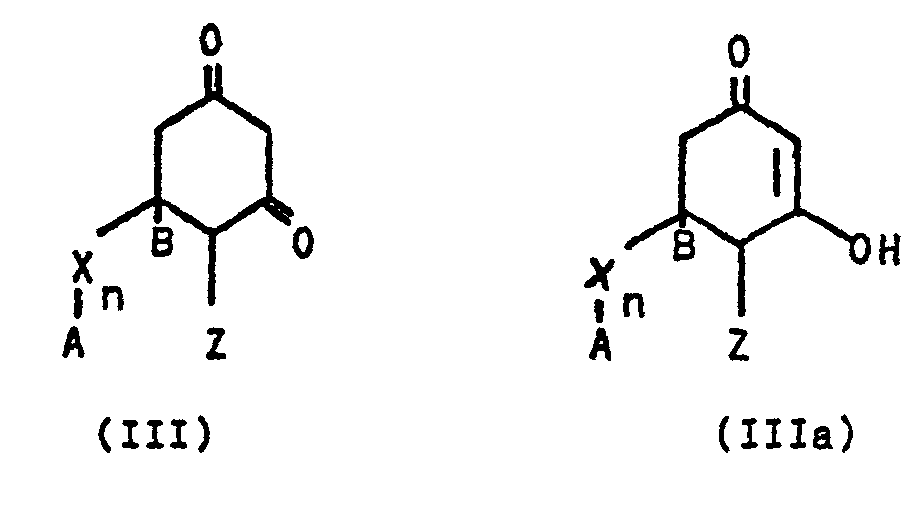
- the carbonyl compounds of the formula II according to the invention can be obtained from cyclohexanediones of the formula III, which may also be in the tautomeric form IIIa, according to methods known from the literature (Tetrahedron Letters 29, 2491 (1975)).
- the carbonyl compounds of the formula II according to the invention are valuable intermediates for the synthesis of the herbicidally active cyclohexenone derivatives of the formula I.
- the following examples illustrate the preparation of the cyclohexenone derivatives of the formula I according to the invention:
- the substance can be purified by recrystallization from petroleum ether (mp: 64 ° C).
- the cyclohexenone derivatives of the formula I can be, for example, in the form of directly sprayable solutions, powders, suspensions, including high-strength aqueous, oily or other suspensions or dispersions, emulsions, oil dispersions, pastes, dusting agents, scattering agents or granules by spraying, atomizing, dusting, scattering or pouring be applied.
- the application forms depend entirely on the purposes; in any case, they should ensure the finest possible distribution of the active compounds according to the invention.
- Mineral oil fractions of medium to high boiling point such as kerosene or diesel oil, oils of vegetable or animal origin, aliphatic, cyclic and aromatic hydrocarbons, such as benzene, toluene, xylene, paraffin, tetrahydronaphthalene, alkylated are used to produce directly sprayable solutions, emulsions, pastes or oil dispersions Naphthalenes or their derivatives, methanol, ethanol, propanol, butanol, chloroform, carbon tetrachloride, cyclohexanol, cyclohexanone, chlorobenzene, isophorone or strongly polar solvents such as N, N-dimethylformamide, dimethyl sulfoxide, N-methylpyrrolidone or water.
- Aqueous use forms can be prepared from emulsion concentrates, pastes or wettable powders (wettable powders, oil dispersions) by adding water.
- emulsions, pastes or oil dispersions the substances as such or dissolved in an oil or solvent can be homogenized in water by means of wetting agents, adhesives, dispersants or emulsifiers.
- concentrates composed of an active substance, wetting agents, adhesives, dispersants or emulsifiers and possibly solvents or oil, which are suitable for dilution with water.
- Alkali, alkaline earth, ammonium salts of ligninsulfonic acid, naphthalenesulfonic acid, phenolsulfonic acid, alkylarylsulfonates, alkyl sulfates, alkyl sulfonates, alkali and alkaline earth salts come as surface-active substances the dibutylnaphthalenesulfonic acid, lauryl ether sulfate, fatty alcohol sulfates, fatty acid alkali and alkaline earth metal salts, salts of sulfated hexadecanols, heptadecanols, octadecanols, salts of sulfated fatty alcohol glycol ether, condensation products of sulfonated naphthalene and daphthalenedehyde phenol, dermal products with fumarate and phenol ethyleneththalene, methylene sulfonate with methylene sulf
- Powders, materials for broadcasting and dusts can be prepared by mixing or grinding the active substances together with a solid carrier.
- Granules e.g. Coated, impregnated and homogeneous granules can be produced by binding the active ingredients to solid carriers.
- Solid carriers are mineral soils such as silica gel, silicas, silica gels, silicates, talc, kaolin, limestone, lime, chalk bolus, loess, clay, dolomite, diatomaceous earth, calcium and magnesium sulfate or magnesium oxide, ground plastics, fertilizers such as e.g. Ammonium sulfate, ammonium phosphate or ammonium nitrate, ureas and vegetable products such as corn flour, tree bark, wood and nutshell flour, cellulose powder and other solid carriers.
- mineral soils such as silica gel, silicas, silica gels, silicates, talc, kaolin, limestone, lime, chalk bolus, loess, clay, dolomite, diatomaceous earth, calcium and magnesium sulfate or magnesium oxide,
- the formulations contain between 0.1 and 95% by weight, preferably between 0.5 and 90% by weight, of active ingredient.
- the application can be done pre-emergence or post-emergence. If the active ingredients are less compatible for certain crop plants, application techniques can also be used in which the herbicidal compositions are sprayed with the aid of sprayers in such a way that the leaves of the sensitive crop plants are not hit as far as possible, while the active ingredients are more undesirable on the leaves below them Plants or the uncovered floor area (post-directed, lay-by).
- the active compound application rates are 0.025 to 3 kg / ha, preferably 0.06 to 0.5 kg / ha.
- the vessels are lightly sprinkled to get germination and growth going. Then cover the containers with transparent plastic covers until the plants have grown. This cover causes the test plants to germinate evenly, unless this is affected by the active ingredients.
- test plants are first grown to a height of 3 to 15 cm and then treated.
- the soy plants are grown in a substrate enriched with peat.
- post-emergence treatment either plants that have been sown directly and grown in the same containers are selected, or they are first grown separately as seedlings and transplanted into the test containers a few days before the treatment.
- the application rate for post-emergence treatment is 0.06 to 0.5 active ingredient / ha. There is no cover during post-emergence treatment.
- test vessels are set up in the greenhouse, warmer areas (20 to 35 ° C.) for heat-loving species and 10 to 25 ° C. for those with moderate climates are preferred.
- the trial period spans 2 to 4 weeks.
- the plants are fed and their response to each treatment is evaluated. It is rated on a scale from 0 to 100. 100 means no emergence of the plants or complete destruction of at least the aerial parts.
- the plants used in the greenhouse experiments consist of the following types:
- the compounds No. 1, 2, 12, 13, 14, 17, 19 and 25 selected by way of example prove to be herbicidally active against plants from the grass family, while Sinapis alba, as a representative of dicotyledon plants, remains completely undamaged.
- compounds Nos. 12 and 14 with 0.25 kg of active ingredient / ha in post-emergence treatment, show strong herbicidal activity against grasses, while soybeans as a dicotyledonous crop do not suffer any damage.
- soybeans With 0.5 kg of active ingredient / ha of active ingredients no. 1 and 2, soybeans can be used to selectively control corn and Setaria italica as an example plant for millet.
- the cyclohexenone derivatives of the formula I can also be used as grass herbicides in a Graminea crop, such as wheat.
- Compound No. 25 is suitable e.g. to control important grasses at a rate of 0.125 kg of active ingredient.
- compounds Nos. 12 and 14 show a strong herbicidal action against widespread harmful grasses, such as Alopecurus myosuroides and Avena fatua, at low application rates.
- Compound No. 32 selected as an example is well suited for combating a wide range of grasses in broadleaved crops. At Soy is shown by way of example that the crop does not suffer any damage.
- the cyclohexenonderates of the formula I can be used in a large number of crop plants.
- the following crops can be considered:
- the cyclohexenone derivatives of the formula I can be mixed with one another and also with representatives of other herbicidal or growth-regulating active compound groups and applied together.
- diazines, 4 H-3,1-benzoazine derivatives, benzothiadiazinones, 2,6-dinitroanilines, N-phenyl carbamates, thiol carbamates, halocarboxylic acids, triazines, amides, ureas, diphenyl ethers, triazinones, uracils, benzofuran derivatives, quinoline carboxylic acids and others come as mixing partners into consideration.
- cyclohexenone derivatives of the formula I or herbicidal compositions containing them may also be useful to apply the cyclohexenone derivatives of the formula I or herbicidal compositions containing them, alone or in combination with other herbicides, mixed with other crop protection agents, for example with agents for controlling pests or phytopathogenic fungi or bacteria.
- other crop protection agents for example with agents for controlling pests or phytopathogenic fungi or bacteria.
- mineral salt solutions which are used to remedy nutritional and trace element deficiencies.
- Non-phytotoxic oils and oil concentrates can also be added.
Landscapes
- Chemical & Material Sciences (AREA)
- Organic Chemistry (AREA)
- Life Sciences & Earth Sciences (AREA)
- Environmental Sciences (AREA)
- Plant Pathology (AREA)
- Health & Medical Sciences (AREA)
- Engineering & Computer Science (AREA)
- Dentistry (AREA)
- General Health & Medical Sciences (AREA)
- Wood Science & Technology (AREA)
- Zoology (AREA)
- Agronomy & Crop Science (AREA)
- Pest Control & Pesticides (AREA)
- Insects & Arthropods (AREA)
- Agricultural Chemicals And Associated Chemicals (AREA)
- Organic Low-Molecular-Weight Compounds And Preparation Thereof (AREA)
Abstract
Description
- Die Erfindung betrifft Cyclohexenonderivate, Verfahren zu ihrer Herstellung, Herbizide, die diese Verbindungen als Wirkstoffe enthalten sowie ein Verfahren zur Bekämpfung von unerwünschtem Pflanzenwuchs.
- Es ist bekannt, daß Cyclohexenonderivate herbizid wirksam sind (DE-A-2 439 104, JP-A-19 945/1979).
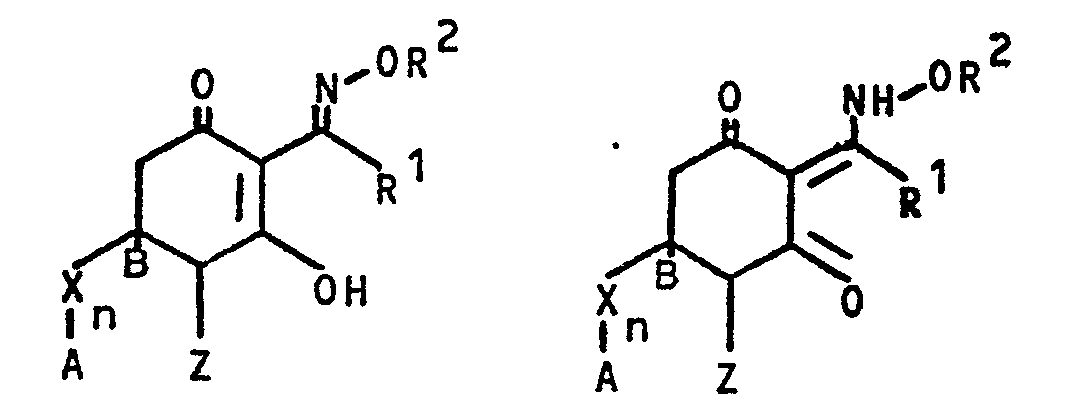
- Es wurde gefunden, daß Cyclohexenonderivate der Formel I

- R1 C1-C4-Alkyl,
- R2 C1-C4-Alkyl, gegebenenfalls halogensubstituiertes C3- bis C5-Alkenyl
- oder C3-C5-Alkinyl,
- A C2-CS-Alkoxycarbonyl, Carboxyl, Cyano oder Trifluormethyl,
- B Wasserstoff oder Methyl,
- X einen unverzweigten, verzweigten oder cyclischen Alkylenrest mit bis zu
- 7 C-Atomen,
- Z Wasserstoff oder C2-C5-Alkoxycarbonyl und
- n 0 oder 1 bedeuten,
- mit der Maßgabe, daß n nicht 0 bedeutet, wenn A für Alkoxycarbonyl oder Cyano steht, sowie Salze dieser Verbindungen eine gute herbizide Wirkung vorzugsweise gegen Arten aus der Familie der Gräser (Gramineen) besitzen. Sie sind verträglich und somit selektiv in breitblättrigen Kulturen sowie in monokotylen Gewächsen, welche nicht zu den Gramineen zählen, bzw. selektiv in Gramineenkulturen, wie Weizen und Reis, und gleichzeitig herbizid für unerwünschte Gräser.
- Die Cyclohexenonderivate der Formel I können in tautomeren Formen auftreten, die alle vom Patentanspruch umfaßt werden:

- Die Substitutenten in Formel I können folgende Bedeutungen haben:
- R1 steht für unverzweigtes oder verzweigtes C1-C4-Alkyl, vorzugsweise C2- und C3-Alkyl, beispielsweise Methyl, Ethyl, n-Propyl, s-Butyl oder n-Butyl.
- R2 bedeutet unverzweigtes oder verzweigtes C1-C4-Alkyl, C3-C5-Alkenyl, das durch Halogen, insbesondere Chlor, substituiert sein kann, oder C3-C5-Alkinyl, beispielsweise Methyl, Ethyl, n-Propyl, n-Butyl, Allyl, Propargyl, 2-Chlorallyl oder 3-Chlorallyl (cis oder trans),
- A steht für C2-C5-Alkoxycarbonyl, beispielsweise Methoxycarbonyl oder Ethoxycarbonyl, sowie für Carboxyl, Cyano oder Trifluormethyl.
- B bedeutet Wasserstoff oder Methyl, wobei Wasserstoff bevorzugt ist.
- X bedeutet einen unverzweigten oder verzweigten Alkylenrest mit bis zu 7 C-Atomen oder einen cyclischen Alkylenreste mit 3 bis 7 C-Atomen, beispielsweise Methylen, Ethylen, Trimethylen, Tetramethylen, Methylmethylen, Methylethylen, 2,5-Dimethyl-pentamethylen, 1,4-Cyclohexylen, 1,3-Cyclohexylen, 1,2-Cyclohexylen oder 1,2-Cyclopropylen.
- Z steht schließlich für Wasserstoff oder C2-C5-AlkoxyCarbonyl, wie Methoxycarbonyl oder Ethoxycarbonyl, wobei Methoxycarbonyl und insbesondere Wasserstoff bevorzugt sind.
- Als Salze der Verbindungen der Formel I kommen landwirtschaftlich brauchbare Salze, beispielsweise die Alkalimetallsalze, insbesondere die Kalium- oder Natriumsalze, Erdalkalimetallsalze, insbesondere Calcium-, Magnesium- oder Bariumsalze, Mangan-, Kupfer-, Zink- oder Eisensalze sowie Ammonium-, Sulfonium- und Phosphoniumsalze in Betracht.
- Man erhält die neuen Cyclohexenonderivate der Formel I durch Umsetzung der ebenfalls neuen Carbonylverbindungen der Formel II

- Man führt die Umsetzung zweckmäßigerweise in heterogener Phase in einem inerten Verdünnungsmittel bei einer Temperatur im Bereich zwischen 0 und ungefährt 80°C oder zwischen 0°C und dem Siedepunkt des Reaktionsgemisches in Gegenwart einer Base durch. Geeignete Basen sind beispielsweise Carbonate, Hydrogencarbonate, Acetate, Alkoholate, Hydroxide oder Oxide von Alkali- oder Erdalkalimetallen, insbesondere von Natrium, Kalium, Magnesium oder Calcium. Außerdem können auch organische Basen, wie Pyridin oder tertiäre Amine, Verwendung finden.
- Die Umsetzung verläuft gut in einem pH-Bereich von 2 bis 9, vorzugsweise 4 bis 6, insbesondere 4,5 bis 5,5. Die Einstellung des pH-Bereichs erfolgt zweckmäßig durch Zusatz von Acetat, beispielsweise Alkalimetallacetat, insbesondere von Natrium- oder Kaliumacetat oder einer Mischung aus beiden Salzen. Alkalimetallacetat wird beispielsweise in Megen von 0,5 bis 2 Mol, bezogen auf 1 Mol Ammoniumverbindung der Formel R20NH3 y, zugesetzt.
- Als Lösungsmittel sind beispielsweise Dimethylsulfoxid; Alkohole, wie Methanol, Ethanol oder Isopropanol; Benzol; gegebenenfalls chlorierte Kohlenwasserstoffe, wie Chloroform, Dichlorethan, Hexan oder Cyclohexan; Ester, wie Essigsäureethylester;oder cyclische Ether, wie Dioxan oder Tetrahydrofuran, geeignet.
- Die Umsetzung ist nach wenigen Stunden beendet, das Reaktionsprodukt kann dann durch Einengen des Reaktionsgemisches, Zugabe von Wasser und Extraktion mit einem unpolaren Lösungsmittel, wie Methylenchlorid und Abdestillieren des Lösungsmittels unter vermindertem Druck isoliert werden.
- Die Verbindungen der Formel I können außerdem durch Umsetzung der Carbonylverbindungen der Formel II mit Hydroxylaminen der Formel R20NH2, in der R2 die obengenannte Bedeutung hat, in inerten Verdünnungsmitteln bei einer Temperatur im Bereich zwischen 0°C und dem Siedepunkt des Reaktionsgemisches erhalten werden. Zweckmäßig erhitzt man auf eine Temperatur von ca. 15 bis 70°C. Gegebenenfalls kann das Hydroxylamin auch als wäßrige Lösung eingesetzt werden.
- Geeignete Lösungsmittel für diese Umsetzung sind beispielsweise Alkohole, wie Methanol, Ethanol, Isopropanol oder Cyclohexanol; gegebenenfalls chlorierte Kohlenwasserstoffe, wie Hexan, Cyclohexan, Methylenchlorid, Toluol oder Dichlorethan; Ester, wie Essigsäureethylester; Nitrile, wie Acetonitril; oder cyclische Ether, wie Tetrahydrofuran.
- Schließlich können die Carbonylverbindungen der Formel II auch mit einem unsubstituierten Hydroxylammoniumsalz der Formel HONH3Y, in der Y ein Anion bedeutet (z.B. Chlorid, Bromid oder Sulfat), in Gegenwart eines Lösungsmittels und einer Base umgesetzt werden, wobei die Reaktionsbedingungen analog denen der obengenannten Reaktion mit der Ammoniumverbindung der Formel R20NH3Y sind. Anschließend wird dann das so erhaltene Oxim mit einem Alkylierungsmittel der Formel R2y%, in der R2 die obengenannte Bedeutung besitzt und Yi eine Abgangsgruppe (z.B. Chlor, Brom, Jod oder R20S03) bedeutet, bei einer Temperatur von 0 bis 100°C in einem inerten Lösungsmittel, wie Dioxan, Tetrahydrofuran oder N,N-Dimethylformamid, gegebenenfalls in Gegenwart einer Base (vgl. die obengenannten Basen) in die Zielverbindung der Formel I übergeführt.
- Die Alkalimetallsalze der Cyclohexenonderivate der Formel I können durch Behandeln dieser Verbindungen mit Natrium- oder Kaliumhydroxid in wäßriger Lösung oder in einem organischen Lösungsmittel, wie Methanol, Ethanol oder Aceton, erhalten werden. Auch Natrium- und Kaliumalkoholate können zur Salzbildung verwendet werden.
- Die anderen Metallsalze, z.B. die Mangan-, Kupfer-, Zink-, Eisen-, Calcium-, Magnesium- und Bariumsalze, können aus den Natriumsalzen durch Reaktion mit den entsprechenden Metallchloriden in wäßriger Lösung hergestellt werden. Ammonium-, Sulfonium- und Phosphoniumsalze können durch Umsetzung von Verbindungen der Formel 1 mit Ammonium-, Sulfonium- oder Phoaphoniumhydroxiden gegebenenfalls in wäßriger Lösung hergestellt werden.
- Die erfindungsgemäßen Carbonylverbindungen der Formel II können aus Cyclohexandionen der Formel III, die auch in der tautomeren Form IIIa vorliegen können,
- Es ist auch möglich, die Carbonylverbindungen der Formel II über die Zwischenstufe der Enolester IV, die bei der Umsetzung der Derivate III mit Säurechloriden anfallen und in Gegenwart von Imidazol- oder Pyridinderivaten umgelagert werden, herzustellen (JP-A-63 052/1979)

- Wie sich aus dem Voranstehenden ergibt, stellen die erfindungsgemäßen Carbonylverbindungen der Formel II wertvolle Zwischenprodukte für die Synthese der herbizid wirksamen Cyclohexenonderivate der Formel I dar. Die folgenden Beispiele erläutern die Herstellung der erfindungsgemäßen Cyclohexenonderivate der Formel I:
- 9,21 g 2-Butyryl-5-(4-trifluormethylcyclohexyl)-cyclohexan-1,3-dion wurden in 100 ml Methanol aufgenommen und mit 2,94 g Ethoxyammoniumchlorid sowie 2,52 g Natriumyhdrogencarbonat versetzt und 20 Stunden lan bei Raumtemperatur gerührt. Anschließend gab man in Wasser, extrahierte mit Methylenchlorid und engte ein. Man erhielt 7,9 g 2-(1-Ethoxyamino--butyliden)-5-(4-trifluormethylcyclohexyl)-cyclohexan-1,3-dion (Verbindung Nr. 1).
- 1H-NMR (in CDCl3/TMS) δ = 4,08 (q) [2 Protonen] 1,90 (m) [Cyclohexylprotonen] 0,92 (t) [3 Protonen]
- Die folgenden Cyclohexenonderivate der Formel I

- lassen sich auf analogem Wege herstellen.
- Bei den in der folgenden Tabelle 1 aufgeführten Substituenten X soll jeweils deren linke Bindung an den Cyclohexanring gebunden sein.


- 48,2 g 2-Butyryl-4-methoxycarbonyl-5-(tetramethylenmethoxycarbonyl)-cyclohexan-1,3-dion und 305 ml 10 gew.%ige wäßrige Kaliumhydroxidlösung wurden 48 Stunden bei Raumtemperatur gerührt. Man extrahierte mit Dichlormethan und säuerte die wäßrige Phase mit Salzsäure auf pH 1 an. Dann wurde auf 80°C erhitzt und bei dieser Temperatur 1 Stunde nachgerührt. Man ließ abkühlen, extrahierte zweimal mit Dichlormethan, trocknete die organische Phase über Natriumsulfat und destillierte das Lösungsmittel ab. Man erhielt 36 g 2-Butyryl-5-(tetramethylencarboxy)-cyclohexan--1,3-dion.
- Die Substanz kann durch Umkristallisieren aus Petrolether gereinigt werden (Fp.: 64°C).
- Die in der folgenden Tabelle 2 aufgeführten Carbonylverbindungen der Formel II

- Auch in dieser Tabelle soll bei den Substituenten X jeweils deren linke Bindung an den Cyclohexanring gebunden sein.


- Die Cyclohexenonderivate der Formel I können beispielsweise in Form von direkt versprühbaren Lösungen, Pulvern, Suspensionen, auch hochprozentigen wäßrigen, öligen oder sonstigen Suspensionen oder Dispersionen, Emulsionen, Üldispersionen, Pasten, Stäubermitteln, Streumitteln oder Granulaten durch Versprühen, Vernebeln, Verstäuben, Verstreuen oder Gießen angewendet werden. Die Anwendungsformen richten sich ganz nach den Verwendungszwecken; sie sollten in jedem Fall möglichst die feinste Verteilung der erfindungsgemäßen Wirkstoffe gewährleisten.
- Zur Herstellung von direkt versprühbaren Lösungen, Emulsionen, Pasten oder öldispersionen kommen Mineralölfraktionen von mittlerem bis hohem Siedepunkt, wie Kerosin oder Dieselöl, öle pflanzlichen oder tierischen Ursprungs, aliphatische, cyclische und aromatische Kohlenwasserstoffe, wie Benzol, Toluol, Xylol, Paraffin, Tetrahydronaphthalin, alkylierte Naphthaline oder deren Derivate, Methanol, Ethanol, Propanol, Butanol, Chloroform, Tetrachlorkohlenstoff, Cyclohexanol, Cyclohexanon, Chlorbenzol, Isophoron oder stark polare Lösungsmittel, wie N,N-Dimethylformamid, Diemthylsulfoxid, N-Methylpyrrolidon oder Wasser in Betracht.
- Wäßrige Anwendungsformen können aus Emulsionskonzentraten, Pasten oder netzbaren Pulvern (Spritzpulvern, öldispersionen) durch Zusatz von Wasser bereitet werden. Zur Herstellung von Emulsionen, Pasten oder öldispersionen können die Substanzen als solche oder in einem Öl oder Lösungsmittel gelöst, mittels Netz-, Haft-, Dispergier- oder Emulgiermittel in Wasser homogenisiert werden. Es können aber auch aus wirksamer Substanz Netz-, Haft-, Dispergier- oder Emulgiermittel und eventuell Lösungsmittel oder Öl bestehende Konzentrate hergestellt werden, die zur Verdünnung mit Wasser geeignet sind.
- Als oberflächenaktive Stoffe kommen Alkali-, Erdalkali-, Ammoniumsalze von Ligninsulfonsäure, Naphthalinsulfonsäure, Phenolsulfonsäure, Alkylarylsulfonate, Alkylsulfate, Alkylsulfonate, Alkali- und Erdalkalisalze der Dibutylnaphthalinsulfonsäure, Laurylethersulfat, Fettalkoholsulfate, fettsaure Alkali- und Erdalkalisalze, Salze sulfatierter Hexadecanole, Heptadecanole, Octadecanole, Salze von sulfatiertem Fettalkoholglykolether, Kondensationsprodukte von sulfoniertem Naphthalin und Naphthalindervaten mit Fcrmaldehyd, Kondensationsprodukte des Naphthalins bzw. der Naphthalinsulfonsäuren mit Phenol und Formaldehyd, Polyoxyethylenoctylphenolether, ethoxyliertes Isooctylphenol, Octylphenol, Nonylphenol, Alkylphenolpolyglykolether, Tributylphenylpolyglykolether, Alkylarylpolyetheralkohole, Isotridecylalkohol, Fettalkohlethylenoxid-Kondensate, ethoxyliertes Rizinusöl, Polyoxyethylenalkylether, ethoxyliertes Polyoxypropylen, Laurylalkoholpolyglykoletheracetal, Sorbitester, Lignin, Sulfitablaugen und Methylcellulose in Betracht.
- Pulver-, Streu- und Stäubemittel können durch Mischen oder gemeinsames Vermahlen der wirksamen Substanzen mit einem festen Trägerstoff hergestellt werden.
- Granulate, z.B. Umhüllungs-, Imprägnierungs- und Homogengranulate können durch Bindung der Wirkstoffe an festen Trägerstoffen hergestellt werden. Feste Trägerstoffe sind Mineralerden wie Silicagel, Kieselsäuren, Kieselgele, Silikate, Talkum, Kaolin, Kalkstein, Kalk, Kreide Bolus, Löß, Ton, Dolomit, Diatomenenerde, Calcium- und Magnesiumsulfat oder Magnesiumoxid, gemahlene Kunststoffe, Düngemittel, wie z.B. Ammoniumsulfat, Ammoniumphosphat oder Ammoniumnitrat, Harnstoffe und pflanzliche Produkte, wie Getreidemehl, Baumrinden-, Holz- und Nußschalemehl, Cellulosepulver und andere feste Trägerstoffe.
- Die Formulierungen enthalten zwischen 0,1 und 95 Gew.-%, vorzugsweise zwischen 0,5 and 90 Gew.-%, Wirkstoff.
- Beispiele für Formulierungen sind:
- I. Man vermischt 90 Gew.-Teile der Verbindung Nr. 12 mit 10 Gew.--Teilen N-Methyl-alpha-pyrrlidon und erhält eine Lösung, die zur Anwendung in Form kleinster Tropfen geeignet ist.
- II. 20 Gew.-Teile der Verbindung Nr. 1 werden in einer Mischung gelöst, die aus 80 Gew.-Teilen Xylol, 10 Gew.-Teilen des Anlagerungsproduktes von 8 bis 10 Mol Ethylenoxid an 1 Mol Ölsäure-N-mono- sthanolamid, 5 Gew.-Teile Calciumsalz der Dodecylbenzolsulfonsäure und 5 Gew.-Teile des Anlagerungsproduktes von 40 Mol Ethylenoxid an 1 Mol Ricinusöl besteht. Durch Ausgießen und feines Verteilen der Lösung in 100 000 Gew.-Teilen Wasser erhält man eine wäßrige Dispersion, die 0,02 Gew.-% des Wirkstoffs enthält.
- III. 20 Gew.-Teile der Verbindung Nr. 2 werden in einer Mischung gelöst, die aus 40 Gew.-Teilen Cyclohexanon, 30 Gew.-Teilen Isobutanol, 20 Gew.-Teile des Anlagerungsproduktes von 7 Mol Ethylenoxid an 1 Mol Isooctylphenol und 10 Gew.-Teile des Anlagerungsproduktes von 40 Mol Ethylenoxid an 1 Mol Ricinusöl besteht. Durch Eingießen und feines Verteilen der Lösung in 100 000 Gew.-Teilen Wasser erhält man eine wäßrige Dispersion, die 0,02 Gew.-% des Wirkstoffs enthält.
- IV. 20 Gew.-Teile des Wirkstoffs Nr. 25 werden in einer Mischung gelöst, die aus 25 Gew.-Teilen Cyclohexanol, 65 Gew.-Teile einer Mineralölfraktion vom Siedepunkt 210 bis 2800C und 10 Gew.-Teilen des Anlagerungsproduktes von 40 Mol Ethylenoxid an 1 Mol Ricinus- öls besteht. Durch Eingießen und feines Verteilen der Lösung in 100 000 Gew.-Teilen Wasser erhält man eine wäßrige Dispersion, die 0,02 Gew.-% des Wirkstoffs enthält.
- V. 20 Gew.-Teile des Wirkstoffs Nr 13 werden mit 3 Gew.-Teilen des Natriumsalzes der Diisobuylnaphthalin-alpha-sulfonsäure, 17 Gew.--Teilen des Natriumsalzes einer Ligninsulfonsäure aus einer Sulfit--Ablauge und 60 Gew.-Teilen pulverförmigem Kieselsäuregel gut vermischt und in einer Hammermühle vermahlen. Durch feines Verteilen der Mischung in 20 000 Gew.-Teilen Wasser erhält man eine Spritzbrühe, die 0,1 Gew.-% des Wirkstoffs enthält.
- VI. 3 Gew.-Teile des Wirkstoffs Nr. 17 werden mit 97 Gew.-Teilen feinteiligem Kaolin vermischt. Man erhält auf diese Weise ein Stäubemittel, das 3 Gew.-% des Wirkstoffs enthält.
- VII. 30 Gew.-Teil des Wirkstoffs Nr. 19 werden mit einer Mischung aus 92 Gew.-Teilen pulverförmigem Kieselsäuregel und 8 Gew.-Teilen Paraffinöl, das auf die Oberfläche dieses Kieselsäuregels gesprüht wurde, innig vrmischt. man erhält auf diese Weise eine Aufbereitung des Wirkstoffs mit guter Haftfähigkeit.
- VIII. 20 Teile des Wirkstoffs Nr. 1 werden mit 2 Teilen Calciumsalz der Dodeclybenzolsulfonsäure, 8 Teilen Fettalkohol-poylglykolether, 2 Teilen Natriumsalz eines Phenol-Harnstoff-Forr.ialdehyd-Kondensates und 68 Teile eines paraffinischen Mineralöls innig vermischt. Man erhält eine stabile ölige Dispersion.
- Die Applikation kann im Vorauflaufverfahren oder im Nachauflaufverfahren erfolgen. Sind die Wirkstoffe für gewisse Kulturpflanzen weniger verträglich, so können auch Ausbringungstechniken angewandt werden, bei welchen die herbiziden Mittel mit Hilfe der Spritzgeräte so gespritz werden, daß die Blätter der empfindlichen Kulturpflanzen nach Möglichkeit nicht getroffen werden, während die Wirkstoffe auf die Blätter darunter wachsender unerwünschter Pflanzen oder die unbedeckte Bodenfläche gelangen (post-directed, lay-by).
- Der Aufwandmengen an Wirkstoff betragen je nach Jahreszeit, Zielpflanzen und Wachstumsstadium 0,025 bis 3 kg/ha, vorzugsweise 0,06 bis 0,5 kg/ha.
- Die Wirkung der Cyclohexenolderivate der Formel I auf das Pflanzenwachstum läßt sich durch Gewächshausversuche zeigen:
- Als Kulturgefäße dienen Plastikblumentöpfe mit 300 cm3 Inhalt und lehmigem Sand mit etwa 3,0 % Humus als Substrat. Die Samen der Testpflanzen werden nach Arten getrennt flach eingesät. Bei Vorauflaufbehandlung werden die Wirkstoffe unmittelbar danach auf die Erdoberfläche aufgebracht. Sie werden hierbei in Wasser als Verteilungsmittel suspendiert oder emulgiert und mittels fein verteilender Düsen gespritzt. Die Aufwandmengen betragen 3,0 kg/ha.
- Nach dem Aufbringen der Mittel werden die Gefäße leicht beregnet, um Keimung und Wachstum in Gang zu bringen. Danach deckt man die Gefäße mit durchsichtigen Plastikhauben ab, bis die Pflanzen angewachsen sind. Diese Abdeckung bewirkt ein gleichmäßiges Keimen der Testpflanzen, sofern dies nicht durch die Wirkstoffe beeinträchtigt wird.
- Zum Zweck der Nachauflaufbehandlung zieht man die Testpflanzen je nach Wuchsform erst bis zu einer Wuchshöhe von 3 bis 15 cm an und behandelte sie danach. Die Sojapflanzen werden in einem mit Torfmull (peat) angereicherten Substrat angezogen. Zur Nachauflaufbehandlung werden entweder direkt gesäte und in den gleichen Gefäßen aufgewachsene Pflanzen ausgewählt, oder sie werden erst als Keimpflanzen getrennt angezogen und einige Tage vor der Behandlung in die Versuchsgefäße verpflanzt. Die Aufwandmenge für die Nachauflaufbehandlung betragen 0,06 bis 0,5 Wirkstoff/ha. Eine Abdeckung unterbleibt bei der Nachauflaufbehandlung.
- Die Versuchsgefäße werden im Gewächshaus aufgestellt, wobei für wärmeliebende Arten wärmere Bereiche (20 bis 35°C) und für solche gemäßigter Klimate 10 bis 25°C bevorzugt werden. Die Versuchsperiode erstreckt sich über 2 bis 4 Wochen. Während dieser Zeit werden die Pflanzen verpflegt und ihre Reaktion auf die einzelnen Behandlungen wird ausgewertet. Bewertet wird nach einer Skala von 0 bis 100. Dabei bedeutet 100 kein Aufgang der Pflanzen bzw. völlig Zerstörung zumindest der oberirdischen Teile.
- Die in den Gewächshausversuchen verwendeten Pflanzen setzen sich aus folgenden Arten zusammen:

- Bei Vorauflaufanwendung erweisen sich die beispielhaft ausgewählten Verbindungen Nr. 1, 2, 12, 13, 14, 17, 19 und 25 als herbizid wirksam gegen Pflanzen aus der Familie der Gräser, während Sinapis alba als Vertreter dikotyler Pflanzen völlig ungeschädigt bleibt.
- Weiterhin zeigen beispielsweise die Verbindungen Nr. 12 und 14 mit 0,25 kg Wirkstoff/ha bei Nachauflaufbehandlung starke herbizide Aktivität gegen Gräser, während Sojabohnen als dikotyle Kulturpflanze keinen Schaden erleiden. Mit 0,5 kg Wirkstoff/ha der Wirkstoffe Nr. 1 und 2 lassen sich in Sojabohnen Ausfallsmais und Setaria italica als Beispielspflanze für Hirsen selektiv bekämpfen. Auch in einer Gramineenkultur, wie beispielsweise Weizen können die Cyclohexenonderivate der Formel I als Gräserherbizide eingesetzt werden. Verbindung Nr. 25 eignet sich z.B. zur Bekämpfung wichtiger Ungräser bei einer Aufwandmenge von 0,125 kg Wirkstoff.
- Ebenfalls im Nachauflaufverfahren zeigen die Verbindungen Nr. 12 und 14 bei geringen Aufwandmengen eine starke herbizide Wirkung gegen weitverbreitete Schadgräser, wie Alopecurus myosuroides und Avena fatua.
- Die beispielhaft ausgewählte Verbindung Nr. 32 eignet sich gut zur Bekämpfung eines breiten Gräserspektrums in breitblättrigen Kulturen. An Soja wird dabei beispielhaft gezeigt, daß die Kulturpflanze keinen Schaden erleidet.
- In Anbetracht des erfaßbaren Wirkungsspektrums zur Unkrautbehämpfung, der Verträglichkeit für Kulturpflanzen oder der unerwünschten Beeinflussung des Wachstums derselben sowie angesichts der Vielfalt der Applikationsmethoden können die Cyclohexenonderiate der Formel I in einer großen Zahl von Kulturpflanzen eingesetzt werden. In Betracht kommen beispielsweise folgende Kulturen:


- Zur Verbreiterung des Wirkungsspektrums und zur Erzielung synergistischer Effekte können die Cyclohexenonderivate der Formel I sowohl untereinander als auch mit Vertretern anderer herbizider oder wachstumsregulierender Wirkstoffgruppen gemischt und gemeinsam ausgebracht werden. Beispielsweise kommen als Mischungspartner Diazine, 4 H-3,1-Benzoazinderivate, Benzothiadiazinone, 2,6-Dinitroaniline, N-Phenylcarbamate, Thiolcarbamate, Halogencarbonsäuren, Triazine, Amide, Harnstoffe, Diphenylether, Triazinone, Uracile, Benzofuranderivate, Chinolin-carbonsäuren und andere in Betracht.
- Außerdem kann es von Nutzen sein, die Cyclohexenonderivate der Formel I bzw. sie enthaltende herbizide Mittel allein oder in Kombination mit anderen Herbiziden auch noch mit weiteren Pflanzenschutzmitteln gemischt gemeinsam auszubringen, beispielsweise mit Mitteln zur Bekämpfung von Schädlingen oder phytopathogenen Pilzen bzw. Bakterien. Von Interesse ist ferner die Mischbarkeit mit Mineralsalzlösungen, welche zur Behebung von Ernährungs- und Spurenelementmängeln eingesetzt werden. Es können auch nichtphytotoxische öle und Ülkonzentrate zugesetzt werden.
Claims (6)

mit der Maßgabe, daß n nicht 0 bedeutet, wenn A für Alkoxycarbonyl oder Cyano steht, und Salze dieser Verbindungen.
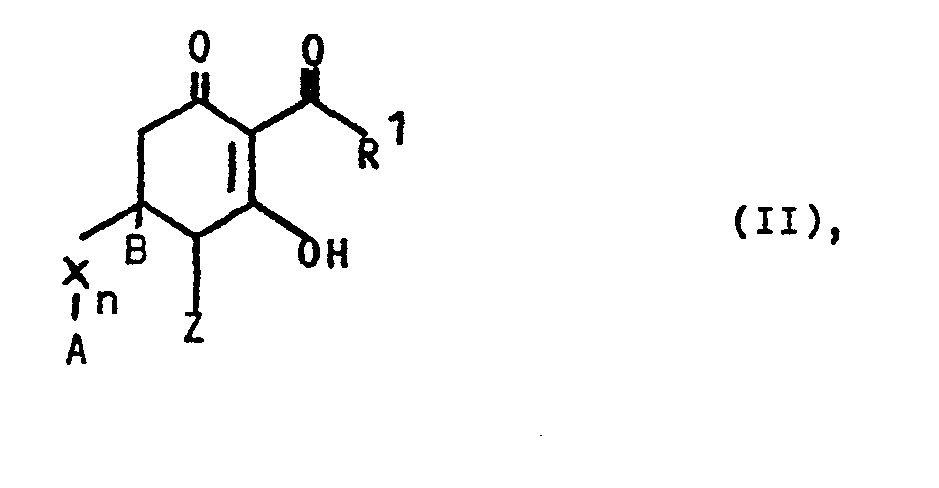

mit der Maßgabe, daß n nicht 0 bedeutet, wenn A für Alkoxycarbonyl oder Cyano steht.
Applications Claiming Priority (2)
| Application Number | Priority Date | Filing Date | Title |
|---|---|---|---|
| DE19843440410 DE3440410A1 (de) | 1984-11-06 | 1984-11-06 | Cyclohexenonderivate, verfahren zu ihrer herstellung sowie ihre verwendung zur bekaempfung unerwuenschten pflanzenwuchses |
| DE3440410 | 1984-11-06 |
Publications (2)
| Publication Number | Publication Date |
|---|---|
| EP0183959A1 true EP0183959A1 (de) | 1986-06-11 |
| EP0183959B1 EP0183959B1 (de) | 1989-02-15 |
Family
ID=6249550
Family Applications (1)
| Application Number | Title | Priority Date | Filing Date |
|---|---|---|---|
| EP85113421A Expired EP0183959B1 (de) | 1984-11-06 | 1985-10-23 | Cyclohexenonderivate, Verfahren zu ihrer Herstellung sowie ihre Verwendung zur Bekämpfung unerwünschten Pflanzenwuchses |
Country Status (5)
| Country | Link |
|---|---|
| US (1) | US4780129A (de) |
| EP (1) | EP0183959B1 (de) |
| JP (1) | JPH064577B2 (de) |
| CA (1) | CA1281033C (de) |
| DE (2) | DE3440410A1 (de) |
Families Citing this family (3)
| Publication number | Priority date | Publication date | Assignee | Title |
|---|---|---|---|---|
| DE3523862A1 (de) * | 1985-07-04 | 1987-01-08 | Basf Ag | Mittel zur regulierung des pflanzenwachstums |
| DE3934204A1 (de) * | 1989-10-13 | 1991-04-18 | Basf Ag | Cyclohexenonverbindungen, verfahren zu ihrer herstellung sowie ihre verwendung als herbizide oder das pflanzenwachstum regulierende mittel |
| AU660918B2 (en) * | 1990-10-17 | 1995-07-13 | Arysta Lifescience Corporation | Method and composition for enhancing uptake and transport of bioactive agents in plants |
Citations (4)
| Publication number | Priority date | Publication date | Assignee | Title |
|---|---|---|---|---|
| JPS51131856A (en) * | 1974-07-25 | 1976-11-16 | Nippon Soda Co Ltd | Cyclohexane derivatives and herbicides |
| GB2077732A (en) * | 1980-06-12 | 1981-12-23 | Nippon Soda Co | Herbicidal cyclohexanedione derivatives |
| EP0086588A2 (de) * | 1982-02-12 | 1983-08-24 | Ici Australia Limited | Cyclohexanderivate, ihre Verwendung als Herbizide, diese enthaltende herbizide Zusammensetzungen und Verfahren zu deren Herstellung |
| EP0095099A1 (de) * | 1982-05-22 | 1983-11-30 | BASF Aktiengesellschaft | Cyclohexan-1,3-dion-Derivate |
Family Cites Families (9)
| Publication number | Priority date | Publication date | Assignee | Title |
|---|---|---|---|---|
| US3950420A (en) * | 1973-08-15 | 1976-04-13 | Nippon Soda Company, Ltd. | Cyclohexane derivatives |
| JPS6045633B2 (ja) * | 1977-07-15 | 1985-10-11 | 日本曹達株式会社 | シクロヘキサン誘導体、製造方法及び除草剤 |
| JPS5840939B2 (ja) * | 1977-10-27 | 1983-09-08 | 日本曹達株式会社 | シクロヘキサンジオン誘導体の製造方法 |
| DE3032973A1 (de) * | 1980-09-02 | 1982-04-22 | Basf Ag, 6700 Ludwigshafen | Cyclohexan-1,3-dion-derivate |
| JPS5838419B2 (ja) * | 1981-04-25 | 1983-08-23 | 日本曹達株式会社 | シクロヘキサン誘導体の製造方法 |
| DE3128960A1 (de) * | 1981-07-22 | 1983-02-17 | Basf Ag, 6700 Ludwigshafen | Cyclohexan-1,3-dion-derivate, herbizide, die diese verbindungen enthalten, und verfahren zu ihrer herstellung |
| US4440566A (en) * | 1982-08-05 | 1984-04-03 | Chevron Research Company | Herbicidal substituted 2-(1-(oxyamino)-alkylidene)-cyclohexane-1,3-diones |
| DE3227332A1 (de) * | 1982-07-22 | 1984-01-26 | Basf Ag, 6700 Ludwigshafen | Cyclohexan-1,3-dionderivate, verfahren zu ihrer herstellung und ihre verwendung zur bekaempfung unerwuenschten pflanzenwuchses |
| ATE40106T1 (de) * | 1983-05-18 | 1989-02-15 | Ciba Geigy Ag | Cyclohexandion-carbonsaeurederivate mit herbizider und das pflanzenwachstum regulierender wirkung. |
-
1984
- 1984-11-06 DE DE19843440410 patent/DE3440410A1/de not_active Withdrawn
-
1985
- 1985-10-23 DE DE8585113421T patent/DE3568274D1/de not_active Expired
- 1985-10-23 EP EP85113421A patent/EP0183959B1/de not_active Expired
- 1985-11-05 JP JP60246467A patent/JPH064577B2/ja not_active Expired - Lifetime
- 1985-11-05 CA CA000494598A patent/CA1281033C/en not_active Expired - Lifetime
-
1987
- 1987-02-13 US US07/014,146 patent/US4780129A/en not_active Expired - Lifetime
Patent Citations (4)
| Publication number | Priority date | Publication date | Assignee | Title |
|---|---|---|---|---|
| JPS51131856A (en) * | 1974-07-25 | 1976-11-16 | Nippon Soda Co Ltd | Cyclohexane derivatives and herbicides |
| GB2077732A (en) * | 1980-06-12 | 1981-12-23 | Nippon Soda Co | Herbicidal cyclohexanedione derivatives |
| EP0086588A2 (de) * | 1982-02-12 | 1983-08-24 | Ici Australia Limited | Cyclohexanderivate, ihre Verwendung als Herbizide, diese enthaltende herbizide Zusammensetzungen und Verfahren zu deren Herstellung |
| EP0095099A1 (de) * | 1982-05-22 | 1983-11-30 | BASF Aktiengesellschaft | Cyclohexan-1,3-dion-Derivate |
Non-Patent Citations (1)
| Title |
|---|
| CHEMICAL ABSTRACTS, vol. 86, no. 25, 20 June 1977, Columbus, Ohio, US; abstract no. 189318Z, page 558; column 1; * |
Also Published As
| Publication number | Publication date |
|---|---|
| DE3568274D1 (en) | 1989-03-23 |
| DE3440410A1 (de) | 1986-05-07 |
| JPS61115045A (ja) | 1986-06-02 |
| JPH064577B2 (ja) | 1994-01-19 |
| EP0183959B1 (de) | 1989-02-15 |
| CA1281033C (en) | 1991-03-05 |
| US4780129A (en) | 1988-10-25 |
Similar Documents
| Publication | Publication Date | Title |
|---|---|---|
| EP0071707B1 (de) | Cyclohexandionderivate, Verfahren zu ihrer Herstellung und diese enthaltende Herbizide | |
| EP0136702B1 (de) | Cyclohexenol-Derivate, Verfahren zu ihrer Herstellung und ihre Verwendung zur Bekämpfung unerwünschten Pflanzenwuchses | |
| EP0177913B1 (de) | Cyclohexenonderivate, Verfahren zu ihrer Herstellung und ihre Verwendung zur Bekämpfung unerwünschten Pflanzenwuchses | |
| EP0066195B1 (de) | Cyclohexan-1,3-dionderivate, Verfahren zu ihrer Herstellung und ihre Verwendung zur Bekämpfung von unerwünschtem Pflanzenwuchs | |
| EP0136647B1 (de) | Cyclohexenonderivate, Verfahren zu ihrer Herstellung sowie ihre Verwendung zur Bekämpfung unerwünschten Pflanzenwuchses | |
| EP0142741B1 (de) | Cyclohexan-1,3-dionderivate, Verfahren zu ihrer Herstellung und ihre Verwendung zur Bekämpfung unerwünschten Pflanzenwuchses | |
| EP0099535B1 (de) | Cyclohexan-1,3-dionderivate, Verfahren zu ihrer Herstellung und ihre Verwendung zur Bekämpfung unerwünschten Pflanzenwuchses | |
| EP0103143B1 (de) | Cyclohexan-1,3-dion-derivate, Verfahren zu ihrer Herstellung und ihre Verwendung zur Bekämpfung unerwünschten Pflanzenwuchses | |
| EP0107156B1 (de) | Cyclohexan-1,3-dionderivate, Verfahren zu ihrer Herstellung und ihre Verwendung zur Bekämpfung unerwünschten Pflanzenwuchses | |
| EP0218233B1 (de) | Cyclohexenonderivate, Verfahren zu ihrer Herstellung und ihre Verwendung zur Bekämpfung unerwünschten Pflanzenwuchses | |
| EP0230235A1 (de) | Cyclohexenonderivate, Verfahren zur ihrer Herstellung und ihre Verwendung als herbizide Mittel | |
| EP0137174B1 (de) | Cyclohexan-1,3-dionderivate, Verfahren zu ihrer Herstellung und ihre Verwendung zur Bekämpfung unerwünschten Pflanzenwuchses | |
| EP0088299B1 (de) | Cyclohexan-1,3-dionderivate, Verfahren zu ihrer Herstellung und ihre Verwendung zur Bekämpfung unerwünschten Pfanzenwuchses | |
| EP0131875B1 (de) | Cyclohexan-1,3-dionderivate, Verfahren zu ihrer Herstellung und ihre Verwendung zur Bekämpfung unerwünschten Pflanzenwuches | |
| EP0157184B1 (de) | Cyclohexenone, Verfahren zu ihrer Herstellung sowie ihre Verwendung zur Bekämpfung unerwünschten Pflanzenwuchses | |
| EP0120448A1 (de) | Cyclohexan-1,3-dion-derivate, Verfahren zu ihrer Herstellung und ihre Verwendung zur Bekämpfung unerwünschten Pflanzenwuchses | |
| EP0169521B1 (de) | Cyclohexenonderivate, Verfahren zur ihrer Herstellung und ihre Verwendung zur Bekämpfung unerwünschten Pflanzenwuchses | |
| EP0183959B1 (de) | Cyclohexenonderivate, Verfahren zu ihrer Herstellung sowie ihre Verwendung zur Bekämpfung unerwünschten Pflanzenwuchses | |
| EP0228598B1 (de) | Cyclohexenonderivate, Verfahren zu ihrer Herstellung und ihre Verwendung als herbizide und das Pflanzenwachstum regulierende Mittel | |
| EP0146837B1 (de) | Cyclohexenonderivate, Verfahren zu ihrer Herstellung und ihre Verwendung zur Bekämpfung unerwünschten Pflanzenwuchses | |
| EP0095099B1 (de) | Cyclohexan-1,3-dion-Derivate | |
| EP0162224B1 (de) | Cyclohexenonderivate und ihre Verwendung zur Bekämpfung unerwünschten Pflanzenwuchses | |
| EP0070495B1 (de) | Cyclohexan-1,3-dion-derivate, Verfahren zu ihrer Herstellung und ihre Verwendung zur Bekämpfung unerwünschten Pflanzenwuchses | |
| EP0325085B1 (de) | Herbizide Tetrahydropyran-2,4-dionderivate | |
| EP0054682B1 (de) | 5-Aryl-cyclohexan-1,3-dion-Derivate, Herbizide, die diese Verbindungen enthalten, und Verfahren zu ihrer Herstellung |
Legal Events
| Date | Code | Title | Description |
|---|---|---|---|
| PUAI | Public reference made under article 153(3) epc to a published international application that has entered the european phase |
Free format text: ORIGINAL CODE: 0009012 |
|
| AK | Designated contracting states |
Kind code of ref document: A1 Designated state(s): BE CH DE FR GB IT LI NL |
|
| 17P | Request for examination filed |
Effective date: 19860503 |
|
| 17Q | First examination report despatched |
Effective date: 19870602 |
|
| GRAA | (expected) grant |
Free format text: ORIGINAL CODE: 0009210 |
|
| AK | Designated contracting states |
Kind code of ref document: B1 Designated state(s): BE CH DE FR GB IT LI NL |
|
| ITF | It: translation for a ep patent filed | ||
| REF | Corresponds to: |
Ref document number: 3568274 Country of ref document: DE Date of ref document: 19890323 |
|
| GBT | Gb: translation of ep patent filed (gb section 77(6)(a)/1977) | ||
| ET | Fr: translation filed | ||
| PLBE | No opposition filed within time limit |
Free format text: ORIGINAL CODE: 0009261 |
|
| STAA | Information on the status of an ep patent application or granted ep patent |
Free format text: STATUS: NO OPPOSITION FILED WITHIN TIME LIMIT |
|
| 26N | No opposition filed | ||
| ITTA | It: last paid annual fee | ||
| PGFP | Annual fee paid to national office [announced via postgrant information from national office to epo] |
Ref country code: BE Payment date: 19931025 Year of fee payment: 9 |
|
| PGFP | Annual fee paid to national office [announced via postgrant information from national office to epo] |
Ref country code: NL Payment date: 19931031 Year of fee payment: 9 |
|
| PG25 | Lapsed in a contracting state [announced via postgrant information from national office to epo] |
Ref country code: BE Effective date: 19941031 |
|
| BERE | Be: lapsed |
Owner name: BASF A.G. Effective date: 19941031 |
|
| PG25 | Lapsed in a contracting state [announced via postgrant information from national office to epo] |
Ref country code: NL Effective date: 19950501 |
|
| NLV4 | Nl: lapsed or anulled due to non-payment of the annual fee | ||
| PGFP | Annual fee paid to national office [announced via postgrant information from national office to epo] |
Ref country code: FR Payment date: 19990924 Year of fee payment: 15 |
|
| PGFP | Annual fee paid to national office [announced via postgrant information from national office to epo] |
Ref country code: CH Payment date: 19991005 Year of fee payment: 15 |
|
| PGFP | Annual fee paid to national office [announced via postgrant information from national office to epo] |
Ref country code: GB Payment date: 19991015 Year of fee payment: 15 |
|
| PGFP | Annual fee paid to national office [announced via postgrant information from national office to epo] |
Ref country code: DE Payment date: 19991026 Year of fee payment: 15 |
|
| PG25 | Lapsed in a contracting state [announced via postgrant information from national office to epo] |
Ref country code: DE Free format text: LAPSE BECAUSE OF THE APPLICANT RENOUNCES Effective date: 20001014 |
|
| PG25 | Lapsed in a contracting state [announced via postgrant information from national office to epo] |
Ref country code: GB Free format text: LAPSE BECAUSE OF NON-PAYMENT OF DUE FEES Effective date: 20001023 |
|
| PG25 | Lapsed in a contracting state [announced via postgrant information from national office to epo] |
Ref country code: LI Free format text: LAPSE BECAUSE OF NON-PAYMENT OF DUE FEES Effective date: 20001031 Ref country code: CH Free format text: LAPSE BECAUSE OF NON-PAYMENT OF DUE FEES Effective date: 20001031 |
|
| GBPC | Gb: european patent ceased through non-payment of renewal fee |
Effective date: 20001023 |
|
| REG | Reference to a national code |
Ref country code: CH Ref legal event code: PL |
|
| PG25 | Lapsed in a contracting state [announced via postgrant information from national office to epo] |
Ref country code: FR Free format text: LAPSE BECAUSE OF NON-PAYMENT OF DUE FEES Effective date: 20010629 |
|
| REG | Reference to a national code |
Ref country code: FR Ref legal event code: ST |