EP0184722A1 - Poudres consistant en alliage de terres rares et leur procédé de préparation - Google Patents
Poudres consistant en alliage de terres rares et leur procédé de préparation Download PDFInfo
- Publication number
- EP0184722A1 EP0184722A1 EP85115067A EP85115067A EP0184722A1 EP 0184722 A1 EP0184722 A1 EP 0184722A1 EP 85115067 A EP85115067 A EP 85115067A EP 85115067 A EP85115067 A EP 85115067A EP 0184722 A1 EP0184722 A1 EP 0184722A1
- Authority
- EP
- European Patent Office
- Prior art keywords
- rare earth
- powder
- alloy
- ppm
- group
- Prior art date
- Legal status (The legal status is an assumption and is not a legal conclusion. Google has not performed a legal analysis and makes no representation as to the accuracy of the status listed.)
- Granted
Links
Images
Classifications
-
- B—PERFORMING OPERATIONS; TRANSPORTING
- B22—CASTING; POWDER METALLURGY
- B22F—WORKING METALLIC POWDER; MANUFACTURE OF ARTICLES FROM METALLIC POWDER; MAKING METALLIC POWDER; APPARATUS OR DEVICES SPECIALLY ADAPTED FOR METALLIC POWDER
- B22F9/00—Making metallic powder or suspensions thereof
- B22F9/16—Making metallic powder or suspensions thereof using chemical processes
- B22F9/18—Making metallic powder or suspensions thereof using chemical processes with reduction of metal compounds
- B22F9/20—Making metallic powder or suspensions thereof using chemical processes with reduction of metal compounds starting from solid metal compounds
-
- C—CHEMISTRY; METALLURGY
- C22—METALLURGY; FERROUS OR NON-FERROUS ALLOYS; TREATMENT OF ALLOYS OR NON-FERROUS METALS
- C22B—PRODUCTION AND REFINING OF METALS; PRETREATMENT OF RAW MATERIALS
- C22B5/00—General methods of reducing to metals
- C22B5/02—Dry methods smelting of sulfides or formation of mattes
- C22B5/04—Dry methods smelting of sulfides or formation of mattes by aluminium, other metals or silicon
-
- C—CHEMISTRY; METALLURGY
- C22—METALLURGY; FERROUS OR NON-FERROUS ALLOYS; TREATMENT OF ALLOYS OR NON-FERROUS METALS
- C22B—PRODUCTION AND REFINING OF METALS; PRETREATMENT OF RAW MATERIALS
- C22B59/00—Obtaining rare earth metals
-
- C—CHEMISTRY; METALLURGY
- C22—METALLURGY; FERROUS OR NON-FERROUS ALLOYS; TREATMENT OF ALLOYS OR NON-FERROUS METALS
- C22C—ALLOYS
- C22C38/00—Ferrous alloys, e.g. steel alloys
-
- H—ELECTRICITY
- H01—ELECTRIC ELEMENTS
- H01F—MAGNETS; INDUCTANCES; TRANSFORMERS; SELECTION OF MATERIALS FOR THEIR MAGNETIC PROPERTIES
- H01F1/00—Magnets or magnetic bodies characterised by the magnetic materials therefor; Selection of materials for their magnetic properties
- H01F1/01—Magnets or magnetic bodies characterised by the magnetic materials therefor; Selection of materials for their magnetic properties of inorganic materials
- H01F1/03—Magnets or magnetic bodies characterised by the magnetic materials therefor; Selection of materials for their magnetic properties of inorganic materials characterised by their coercivity
- H01F1/032—Magnets or magnetic bodies characterised by the magnetic materials therefor; Selection of materials for their magnetic properties of inorganic materials characterised by their coercivity of hard-magnetic materials
- H01F1/04—Magnets or magnetic bodies characterised by the magnetic materials therefor; Selection of materials for their magnetic properties of inorganic materials characterised by their coercivity of hard-magnetic materials metals or alloys
- H01F1/047—Alloys characterised by their composition
- H01F1/053—Alloys characterised by their composition containing rare earth metals
- H01F1/055—Alloys characterised by their composition containing rare earth metals and magnetic transition metals, e.g. SmCo5
- H01F1/057—Alloys characterised by their composition containing rare earth metals and magnetic transition metals, e.g. SmCo5 and IIIa elements, e.g. Nd2Fe14B
- H01F1/0571—Alloys characterised by their composition containing rare earth metals and magnetic transition metals, e.g. SmCo5 and IIIa elements, e.g. Nd2Fe14B in the form of particles, e.g. rapid quenched powders or ribbon flakes
-
- H—ELECTRICITY
- H01—ELECTRIC ELEMENTS
- H01F—MAGNETS; INDUCTANCES; TRANSFORMERS; SELECTION OF MATERIALS FOR THEIR MAGNETIC PROPERTIES
- H01F1/00—Magnets or magnetic bodies characterised by the magnetic materials therefor; Selection of materials for their magnetic properties
- H01F1/01—Magnets or magnetic bodies characterised by the magnetic materials therefor; Selection of materials for their magnetic properties of inorganic materials
- H01F1/03—Magnets or magnetic bodies characterised by the magnetic materials therefor; Selection of materials for their magnetic properties of inorganic materials characterised by their coercivity
- H01F1/032—Magnets or magnetic bodies characterised by the magnetic materials therefor; Selection of materials for their magnetic properties of inorganic materials characterised by their coercivity of hard-magnetic materials
- H01F1/04—Magnets or magnetic bodies characterised by the magnetic materials therefor; Selection of materials for their magnetic properties of inorganic materials characterised by their coercivity of hard-magnetic materials metals or alloys
- H01F1/047—Alloys characterised by their composition
- H01F1/053—Alloys characterised by their composition containing rare earth metals
- H01F1/055—Alloys characterised by their composition containing rare earth metals and magnetic transition metals, e.g. SmCo5
- H01F1/057—Alloys characterised by their composition containing rare earth metals and magnetic transition metals, e.g. SmCo5 and IIIa elements, e.g. Nd2Fe14B
- H01F1/0571—Alloys characterised by their composition containing rare earth metals and magnetic transition metals, e.g. SmCo5 and IIIa elements, e.g. Nd2Fe14B in the form of particles, e.g. rapid quenched powders or ribbon flakes
- H01F1/0573—Alloys characterised by their composition containing rare earth metals and magnetic transition metals, e.g. SmCo5 and IIIa elements, e.g. Nd2Fe14B in the form of particles, e.g. rapid quenched powders or ribbon flakes obtained by reduction or by hydrogen decrepitation or embrittlement
Definitions
- the present invention relates to rare earth alloy powders suitable to be used for the production of FeBR base high-performance rare earth magnets, and processes for producing such powders.
- R represents lanthanides and Y
- rare earth or “rare earth element(s)" represent the same.
- the FeBR base magnets as novel high-performance permanent magnets using rare earth elements (R) represented by Nd, Pr and the like.
- R rare earth elements
- the FeBR base magnets have properties comparable to those of the prior art high-performance magnets SmCo, and are advantageous in that scarce and expensive Sm is not necessarily used as the essential ingredient.
- Nd since Nd has been considered to be a substantially useless component, it is very advantageous that Nd can be used as the main component.
- R 1 is at least one heavy rare earth element selected from the group consisting of Gd, Tb, Dy, Ho, Er, Tm and Yb, and at least 80 at % of R 2 consists of Nd and/or Pr, while the balance being at least one element from the group consisting of rare earth elements including Y and except for R 1 by substituting at least one heavy rare earth element selected from the group consisting of Gd, Tb, Dy, Ho, Er, Tm and Yb of 5 at % or lower (relative to the entire alloy) for light rare earth elements such as Nd and/or Pr, said magnets having a high maximum energy product (BH)max.
- BH maximum energy product
- the starting materials used for the production of these R 1 -R 2 -Fe-B and R 1 -R 2 -Fe-Co-B base rare earth magnets are expensive bulk or lump metals containing small amounts of impurities such as, for instance, rare earth metals of at least 99.5 % purity which are prepared by the electrolysis or thermal reduction technique, electrolytic iron or boron of at least 99.9 % purity.
- These raw materials are all high-quality materials which are previously obtained from ores by purification and contain reduced amounts of impurities, and so the magnet products made thereof become expensive.
- the price of rare earth metal materials is very high, since the production thereof needs highly developed separation and purification techniques, and is only carried out with unsatisfactory efficiency.
- the R l -R 2 -Fe-B and R 1 -R 2 -Fe-Co-B base permanent magnets will be brought to market at considerably high prices, although they possess high-performance, as indicated by their iHc, and are very useful as practical permanent magnet materials.
- An object of the present invention is to solve or eliminate the aforesaid problems and to provide rare earth-containing R(R l -R 2 )-Fe-B and R(R l -R 2 )-Fe-Co-B base alloy powders for magnet materials which can be produced on an industrial mass-production scale and which are inexpensive and have an improved quality, and methods for producing same.
- This object is solved by the rare earth-iron-boron and rare earth-iron-cobalt-boron alloy powders according to claims 1 and 3.
- Advantageous features of these rare earth alloy powders are evident from the subclaims.
- the methods for producing these rare earth alloy powders are evident from claims 9 and 11. Further advantageous features of these processes are evident from the subclaims.
- R1 stands for at least one element selected from the group consisting of Gd, Tb, Dy, Ho, Er, Tm and Yb, and at least 80 at % of R 2 consists of Nd and/or Pr, while the balance of R 2 being at least one element selected from the group consisting of rare earth elements including Y and except for R 1 .
- a rare earth-containing alloy powder consisting essentially of:
- a process for the production of rare.earth-containing alloy powders having a composition to be described just above, an oxygen content not exceeding 10000 ppm, a carbon content not exceeding 1000 ppm and a calcium content not exceeding 2000 rpn characterized by comprising the steps of:
- a rare earth-containing alloy powder consisting essentially of:
- a process for the production of rare earth-containing alloy powders having a composition to be described just above, an oxygen content not exceeding 10000 ppm, a carbon content not exceeding 1000 ppm and a calcium content not exceeding 2000 ppm characterized by comprising the steps of:
- the amount of the rare earth oxides is defined by considering the yield at the reducing reaction based on the amount of the rare earth metal in the resultant alloys, e.g., the former is about 1.1 times of the latter.
- the reducing temperature is preferably 950 to 1100°C.
- an oxygen amount not exceeding 6000 ppm in the resultant alloy powder is preferred.
- R 1 -R 2 -Fe-B and R 1 -R 2 -Fe-Co-B base alloy powders of the present invention it is possible to provide at low costs R 1 -R 2 -Fe-B and R 1 -R 2 -Fe-Co-B base rare earth magnets which can be used at temperatures of not lower than room temperature in a sufficiently stable state, while they maintain magnet properties represented in terms of BH(max) of at least 16-10 4 T.A/m (20 MGOe) and iHc of at least 80.10 4A (10 kOe).
- BH(max) of at least 16-10 4 T.A/m (20 MGOe)
- iHc of at least 80.10 4A (10 kOe).
- the alloy powders of the present invention are produced by the step of using metallic calcium as the reducing agent and calcium chloride (CaCl 2 ) so as to faciliate disintegration of the reduction reaction product.
- the alloy powders for R l -R 2 -Fe-B and R 1 -R 2 -Fe-Co-B magnets which are of high quality and which can be produced at a lower cost, as compared with the use of various bulk or lump metals.
- Other additional elements M may be added to the alloy powders of the present invention.
- metal powders, oxides (including mixed oxides with the componental elements), alloy powders (including alloys with the componental elements) or tne compounds capable of being reduced by Ca are formulated and mixed with the material formulation forming the aforesaid R l -R 2 -Fe-B and R l -R 2 -Fe-Co-B as the materials to be added.
- the alloys with the componental elements may include borides of V, Ti, Zr, Hf, Ta, Nb, Al, W, etc.
- alloy powders of the present invention is very effective from the economical standpoint, since it is possible to simplify the steps for producing magnets and, hence, to provide the R 1 -R 2 -Fe-B or R l -R 2 -Fe-Co-B base rare earth magnets at lower costs.
- the starting materials e.g., the mixed powders of the rare earth oxides with the Fe powder (or further the Co powder), or metal powders such as the Fe-B powder are subjected to reduction and diffusion reactions by using of metallic Ca
- the rare earth oxides are reduced by Ca to rare earth metals, now in a molten state, at a temperature at which the reduction reaction takes place.
- the molten rare earth metals are so easily and homogeneously alloyed with the Fe, Co or F e-B powders, whereby the R 1 -R 2 -Fe-B or R l -R 2 -Fe-Co-B base alloy powders are recovered from the rare earth oxides in a high yield. It is thus possible to make effective use of the R 1 and R 2 rare earth oxide materials.
- the reduction technique hereinabove mentioned is referred to as "direct reduction".
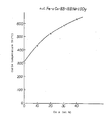
- FIGURE 1 is a graphical view showing the relationship between the amount of Co added and the Curie temperature Tc in the R 1 -R 2 -Fe-Co-B base permanent magnet of the present invention.
- the rare earth-containing alloy powders according to the present invention are produced by the following steps.
- At least one light rare earth (R 2 ) oxide such as Nd oxide (Nd 2 0 3 ) or Pr oxide (Pr 6 O 11 ).
- the mixed raw powders are obtained. Furthermore, the raw powders are added with metallic Ca which acts as a reducing agent for the rare earth oxides and a CaCl 2 powder which serves to promote disintegration of the reaction product after reduction.
- metallic Ca acts as a reducing agent for the rare earth oxides
- CaCl 2 powder which serves to promote disintegration of the reaction product after reduction.
- the required amount of Ca is 1.2 to 3.5 times (by atomic ratio) of the stoichiometric amount necessitated for the reduction of oxygen contained in the mixed raw powders, and the amount of CaCl 2 is 1 to 15 % (by weight) of the raw rare earth oxides.
- the foregoing mixed powders comprising the rare earth oxide powder, Fe powder and ferroboron powder and, optionally, Co powder as well as the reducing agent Ca are subjected to reduction and diffusion treatments at a temperature ranging from 950 to 1200°C (preferably 950 to 1100°C) for approximately 1 to 5 hours in an inert gas atmosphere such as an argon gas atmosphere, and are cooled down to room temperature to obtain a reduction reaction product.
- an inert gas atmosphere such as an argon gas atmosphere
- the reaction product is crushed to a particle size of, e.g., 8 mesh (2.4 mm) or less, and is put into water, in which calcium oxide (CaO), CaO-2CaCl 2 and excessive calcium contained in the reaction product are converted into calcium hydroxide (Ca(OH) 2 ) and the like, so that the reaction product disintegrates, yielding a slurry mixed with water.
- the obtained slurry is sufficiently treated with water for the removal of excessive Ca to obtain the rare earth-containing alloy powders having a particle size of about 10 to about 500 ⁇ m. At a particle size below 10 ⁇ m the oxygen amount in the resultant alloy increases leading to deterioration in the magnetic properties.
- the alloy powders of the present invention have a cyrstal grain size of 20 to 300 ⁇ m in view of workability in the step of the subsequent step of preparing magnets, and magnet properties.
- Water used in the present invention is preferably ion-exchanged water or distilled water in view of the yield of magnets in the magnet-making step to be described later and the magnet properties thereof, since there is then a decrease in the amount of oxygen contained in the alloy powders.
- the rare earth-containing alloy powders obtained in this manner have a major phase (i.e., at least 80 vol % of the entire alloy phase) of the Fe-B-R (or Fe-Co-B-R) tetragonal structure, an oxygen content not exceeding 10000 ppm, a carbon content not exceeding 1000 ppm and a calcium content not exceeding 2000 ppm.
- the alloy powders of the present invention can be finely pulverized as such, and be immediately made into permanent magnets by means of the powder metallurgical technique involving compacting - sintering (normal sintering or press-sintering) - aging.
- the finely pulverizing can be effected by using an Atriter, ball mill, jet mill or the like preferably to a particle size of 1-20 pm, more preferably 2-10 pm. It is to be noted that, in order to produce anisotropic magnets, the particles can be oriented and formed in a magnetic field.
- the rare earth alloy powders of the present invention are used, it is possible to omit some steps of alloy melting - casting - coarse pulverization from the entire steps for preparing permanent magnets using as the raw bulk or lump materials of rare earth metal, iron and boron. There is also an advantage that the price of magnet products can be cut down due to the fact that cheap rare earth oxides can be used as the starting material. In addition, the present invention is economically advantageous in view of the fact that practical permanent magnet materials can easily be obtained on a mass-production scale.
- the oxygen contained in the alloy powders of the present invention combines with the rare earth elements, which are most apt to oxidation, to form rare earth oxides. For that reason, an oxygen content exceeding 10000 pm is not preferred, since the oxygen then remains in the permanent magnets in the form of oxides of R and Fe, so that the magnet properties drop, in particular the coercive force drops below 80 ⁇ 10 4 A (10 kOe) and Br drops, too.
- Oxygen is preferably 6000 m ppm or less, more preferably 4000 ppm or less.
- the carbon In an amount of carbon exceeding 1000 ppm, the carbon remains in the permanent magnets in the form of carbides (R 3 C, R 2 C 3 , RC 2 . etc.), resulting in a considerable lowering of the coercive force below 80 ⁇ 10 4 A (10 kOe), and m accompanied by a deterioration in the loop squareness of the demagnetization curve. Not exceeding 6000 ppm carbon is preferred.
- Ca the reducing agent should not exceed 3.5 times of the stoichiometric amount.
- the amount of Ca is below 1.2 times of the stoichiometric amount, the reduction and difusion reactions are so incomplete that a large amount of unreduced matters remains resulting in that the rare earth alloy powders of the present invention cannot be obtained, or a bad yield will result.
- the Ca amount of 1.5-2.5 times is preferred, and most preferred is 1.6-2.0 times of the stoichiometric amount.
- the amount of CaC12 exceeds 15 % by weight of the rare earth oxides, the amount of C1 (chlorine ions) increases considerably in water with which the reduction and diffusion reaction product is treated, and reacts with the resulting rare earth alloy powders.
- the resultant powders contain 10000 ppm or higher of oxygen, and so cannot be used as the starting material for R 1 -R 2 -Fe-B or R l -R 2 -Fe-Co-B magnets.
- the amount of CaCl 2 is in a range of preferably 2 to 10 % by weight, more preferably 3 to 6 % by weight.
- the range of components rare earth elements (R) and boron (B) of the rare earth alloy powders according to the present invention is:
- R (standing for at least one element selected from the group consisting of rare earth elements including Y) is an essential element for the novel R 1 -R 2 -Fe-B and R 1 -R 2 -Fe-Co-B base permanent magnets, which in an amount below 12.5 at %, causes precipitation of Fe from the present base alloy, gives rise to a sharp drop of the coercive force and, in an amount exceeding 20 at %, allows the coercive force to assume a value of 80 ⁇ 10 4 A (10 kOe) or higher, m but causes the residual magnetic flux density (Br) to decrease to a value which is smaller than that required to obtain (BH)max of at least 16 - 10 4 T ⁇ A (20 MGOe).
- m residual magnetic flux density
- the amount of R 1 (standing for at least one heavy rare earth element selected from the group consisting of Gd, Tb, Dy, Ho, Er, Tm and Yb) constitutes a part of the aforesaid R.
- R 1 to be substituted serves to increase Hc and improves the loop rectangularity of demagnetization curves, leading to an incerease in (BH)max. Therefore, the lower limit of R 1 is 0.05 at %, taking into account the effects upon increases in both iHc and (BH)max.
- R 1 higher iHc i.e., a larger amount of R 1 is more advantageous in applications wherein stability is particularly demanded.
- the elements constituting R 1 are only slightly found in rare earth ores, and are relatively expensive. Hence, the upper limit of R 1 is 5 at %. Particularly preferred R 1 is Dy and Tb, while Tm and Yb would be difficult in procurement.
- the R 2 element constituting the balance in the entire R is a main constitutional one for the permanent magnets according to the present invention, and 80 to 100 % of R 2 consists of Nd and/or Pr, the balance (20 to 0 %) in R 2 being at least one element selected from the group consisting of rare earth elements including Y except for R l .
- the substitution of Co for a part of Fe has an effect upon increase in the Curie temperature Tc of the FeBR base permanent magnets (FIGURE 1).
- Tc Curie temperature
- the presense at least 0.1 at % Co is preferred. It is to be noted, however, that any difficulty is not experienced in the production of the alloy powders, even when the amount of Co is below that lower limit.
- the amount of Co exceeds 35 at %, the saturated magnetization and coercive force of the permanent magnets decrease.
- Co in an amount of 5 at % or more assures that the coefficient of temperature dependence of Br (25-100°C) is 0.1 %/°C or smaller. Furthermore, 25 at % or lower of Co contributes to an increase in the Curie temperature without causing any substantial deterioration of other properties, and about 20 at % (17-23 at %) of Co serves to increase iHc at the same time. A Co amount of about 5 to about 6 at % is most preferred.
- Fe is an element inevitable for the novel R l -R 2 -Fe-B base permanent magnets, which, in an amount of below 60 at %, causes a lowering of residual magnetic flux density (Br) and, in an amount exceeding 83.5 at %. does not give any high coercive force. Hence, the amount of Fe is limited to 60 at % - 83.5 at % in the 1st and 2nd aspects of the present invention.
- Fe shows a similar function in the R l -R 2 -Fe-Co-B base permanent magnets.
- the amount of Fe is limited to 45 - 82 at % (preferably up to 80 at %) and 40 - 82 at % (preferably 45 at % or more) in the 3rd and 4th aspects of the present invention, respectively.
- 60 at % or more of the sum of Fe and Co is preferred, and 60 at% or more Fe is most preferred.
- the incorporation of at least one element selected from the group consisting of the following additional elements M in place of a part of Fe of the aforesaid FeBR permanent magnet alloys makes it possible to increase the coercive force thereof.
- the additional elements M are in amounts not exceeding the values specified below:
- These additional elements M may be added to the starting mixed powders in the form of metal powders, oxides, alloy powders or mixed oxides with the alloy-forming elements, or compounds capable of being reduced by Ca.
- the aforesaid additional elements M have an effect upon the increase in iHc and improvement in the loop rectangularity of demagnetization curves.
- Br decreases.
- (BH)max of 16.10 4 T A m (20 MGOe) or higher Br should be at least 0,9 T (9 kG).
- the upper limit of embodiment M is fixed at the aforesaid value except for the case with Bi, Ni and Mn.
- Bi is limited based on its high vapor pressure, and Ni and Mn are limited in view of iHc drop.
- the upper limit of the sum of M is not more than the maximum atomic percentage among those values specified above of said elements M actually added.
- the upper limit of the sum thereof does not exceed 9 % of Nb.
- the amount of the additional elements to be included is preferably smaller, and is effectively 3 at % or lower, in general.
- the crystal phase of the rare earth-containing alloy powder according to the present invention its major phase (i.e., at least 80 vol %, or 90 vol %, 95 vol % or higher of the entire alloy) of the tetragonal structure is essential to obtain fine and uniform alloy Powders which can exhibit high magnetic properties as magnets.
- This magnetic phase is constituted by an FeBR or FeCoBR tetragonal type crystal with the grain boundaries being surrounded by a nonmagnetic phase.
- the nonmagnetic phase is mainly constituted by an R-rich phase (R metal). In the case where the amount of B is relatively large, there is also partly present a B-rich phase.
- the presence of the nonmagnetic grain boundary region is considered to contribute to high properties, particularly to provide a high performance nucleation type magnet by sintering, and presents one important structural feature of the alloy according to the present invention.
- the nonmagnetic phase is effective even in only a slight amount, and, for instance, at least 1 vol % is sufficient.
- the lattice parameters of the tetragonal crystal the a axis is about 0,88 nm (8.8 A), while the c axis is about 1,22 nm (12.2 A), and the central composition is considered to be R 2 Fe 14 B or R 2 (Fe, Co) 14 B.
- the inventive alloy powders have generally the crystalline nature, i.e., typically with a crystal grain size of the crystals constituting the powder particle amounting to at least about 1 ⁇ m as far as the powder particle is larger than this size.
- the amount of the tetragonal structure phase can be measured by means of the intensity of the X-ray diffractometric chart or an X-ray microanalyser.
- the sintered permanent magnet produced by using the inventive alloy powder is crystalline, wherein the tetragonal RFeB or R(Fe,Co)B crystal has preferably an average crystal grain size of 1-40 ⁇ m (more preferably 3-20 ⁇ m for providing excellent permanent magnet characteristics.
- the alloy powders having a similar composition for producing the R 1 -R 2 -Fe-B or R 1 -R 2 -Fe-Co-B base magnets can be obtained at low costs, using as the starting materials rare earth oxides (and further boron oxide etc.).
- the R 1 -R 2 -Fe-B or R 1 -R 2 -Fe-Co-B base permanent magnets having excellent properties and to omit the steps of preparing alloy powders of the specific composition, which comprises isolation and purification of rare earth metals - alloy making by melting - cooling (usually, casting) - pulverization, from the process for producing magnets, whereby that process can be simplified.
- Such simplification of the magnet production process is very useful in that any contamination of unpreferred components or impurities (oxygen, etc.) into the products is avoided.
- the prevention of oxygen, etc. from entering the products in the steps from melting through pulverization requires complicated process control and is carried out with difficulty, and offers one cause for a rise in the production cost.
- rare earth oxides it is not necessarily required to separate the rare earth oxides to be used into the individual oxides of rare earth.
- the starting material a mixture of rare earth oxides, which has a composition approximate or corresponding to the target composition, or to which an additional amount of rare earth oxides is added to make up for a deficiency, it is possible to simplify the step per se for the separation of rare earth oxides and cut down the cost thereof.
- the alloys of the present invention is very effective in that they are directly obtained as the alloys having a major phase of a RFeB or R(Fe,Co)B tetragonal magnetic phase inevitable for magnetic properties by the direct reduction technique, and are very advantageous in that they are obtained directly in the powdery form.
- the alloy powders according to the present invention may contain, in addition to R, B, and Fe or (Fe + Co), impurities which are inevitably entrained from the industrial process of production.
- the alloy powders containing a total of 2 at % or lower of P, 2 at % or lower of S and 2 at % or lower of Cu still exhibit practical magnetic properties, which, however should be limited to the amounts corresponding to a Br of at least 0,9 T (9 kG) since these impurities decrease Br, and should be as little as possible (e.g., less than 0.5 at % or less than 0.1 at %).
- a total of 182.2 grams of the aforesaid starting powders were mixed together in a V-type mixer aiming at a resultant alloy having a target composition of 30.5 % Nd - 3.6 % D y - 64.75 % Fe - 1.15 % B (wt %) (14.1 % Nd -1.5 % Dy - 77.3 % Fe - 7.1 % B (at %)).
- the resulting mixture was then compacted or press-formed, and was charged in a vessel made of stainless steel. After the vessel had been placed in a muffle furnace, the temperature within the vessel through which an argon gas stream was fed was increased.
- the furnace was kept constant at 1150°C for 3 hours, and was then cooled off to room temperature.
- the thus obtained reduction reaction product was coarsely pulverized to 8 mesh-through, and was thereafter poured in 10 liter ion-exchanged water, in which calcium oxide (CaO), CaO-2CaCl 2 and unreacted calcium residue contained in the reaction product were in turn converted into calcium hydroxide (Ca(OH) 2 ) to disintegrate (or collapse) the reaction product and put it into a slurried state.
- CaO calcium oxide
- CaO-2CaCl 2 unreacted calcium residue contained in the reaction product were in turn converted into calcium hydroxide (Ca(OH) 2 ) to disintegrate (or collapse) the reaction product and put it into a slurried state.
- the slurry was allowed to stand for 30 minutes in a stationary manner, then the formed calcium hydroxide suspension was discharged followed by re-pouring of water.
- the obtained alloy powder was found to have a desired composition of :
- the powder was finely pulverized to a mean particle size of 2.70 ⁇ m and was compacted at a pressure of 1.5 t
- the obtained powder was found to have a desired composition of:
- the obtained powder was found to have a desired composition of :
- the obtained powder was found to have a desired composition of:
- the obtained alloy powder was found to have a desired composition of :
- a total of 184.2 grams of the aforesaid starting powders were mixed together in a V-type mixer with a view to obtaining an alloy having a target composition of 30.0 % Nd - 3.6 % Dy - 47.7 % Fe - 17.5 % Co - 1.12 % B (by weight %)-(14.0 % Nd - 1.5 % Dy - 57.5 % Fe - 20 % Co - 7.0 % B (by atomic %)).
- the resulting mixture was then compacted, and was charged in a vessel made of stainless steel. After the vessle had been placed in a muffle furnace, the temperature within the vessel through which an argon gas flow was fed increased.
- the furnace was kept constant at 1150°C for 3 hours, and was then cooled off to room temperature.
- the thus obtained reduction reaction product was coarsely pulverized to 8 mesh-through, and was thereafter charged in 10 liter of ion-exchanged water, in which calcium oxide (CaO), CaO-2CaC1 2 and unreacted calcium residue contained in the reaction product were in turn converted into calcium hydroxide (Ca(OH) 2 ) to disintegrate the reaction product and put it into a slurried state. After one hour-stirring, the slurry was allowed to stand for 30 minutes in a stationary manner to discharge the formed calcium hydroxide suspension, followed by re-pouring of water.
- the obtained alloy powder was found to have a desired composition of:
- the powder was finely pulverized to a mean particle size of 2.50 microns, and was compacted at a pressure of 1.5 t/cm 2 in a magnetic field of 80 ⁇ 10 4 A m (10 kOe). Thereafter, the carpact m was sintered at 1120°C for 2 hours in an Ar flow, and was aged at 600°C for 1 hour to prepare a permanent magnet sample.
- the obtained alloy powder was found to have a desired composition of:
- the obtained alloy powder was found to have a desired composition of:
- the powder was finely pulverized to a mean particle size of 3.5 ⁇ m and was compacted at a pressure of 1.5 t
- the obtained alloy powder was found to have a desired composition of:
- the obtained alloy powder was found to have a desired composition of :
Landscapes
- Chemical & Material Sciences (AREA)
- Engineering & Computer Science (AREA)
- Mechanical Engineering (AREA)
- Organic Chemistry (AREA)
- Metallurgy (AREA)
- Materials Engineering (AREA)
- Manufacturing & Machinery (AREA)
- Crystallography & Structural Chemistry (AREA)
- Inorganic Chemistry (AREA)
- Power Engineering (AREA)
- General Chemical & Material Sciences (AREA)
- Chemical Kinetics & Catalysis (AREA)
- Life Sciences & Earth Sciences (AREA)
- Environmental & Geological Engineering (AREA)
- General Life Sciences & Earth Sciences (AREA)
- Geology (AREA)
- Hard Magnetic Materials (AREA)
- Manufacture Of Metal Powder And Suspensions Thereof (AREA)
Applications Claiming Priority (8)
| Application Number | Priority Date | Filing Date | Title |
|---|---|---|---|
| JP24879784 | 1984-11-27 | ||
| JP248798/84 | 1984-11-27 | ||
| JP248797/84 | 1984-11-27 | ||
| JP24879884 | 1984-11-27 | ||
| JP26048084 | 1984-12-10 | ||
| JP260479/84 | 1984-12-10 | ||
| JP260480/84 | 1984-12-10 | ||
| JP26047984 | 1984-12-10 |
Publications (2)
| Publication Number | Publication Date |
|---|---|
| EP0184722A1 true EP0184722A1 (fr) | 1986-06-18 |
| EP0184722B1 EP0184722B1 (fr) | 1991-06-26 |
Family
ID=27478139
Family Applications (1)
| Application Number | Title | Priority Date | Filing Date |
|---|---|---|---|
| EP85115067A Expired EP0184722B1 (fr) | 1984-11-27 | 1985-11-27 | Poudres consistant en alliage de terres rares et leur procédé de préparation |
Country Status (5)
| Country | Link |
|---|---|
| US (2) | US4767450A (fr) |
| EP (1) | EP0184722B1 (fr) |
| CN (1) | CN1015295B (fr) |
| CA (1) | CA1280014C (fr) |
| DE (1) | DE3583327D1 (fr) |
Cited By (19)
| Publication number | Priority date | Publication date | Assignee | Title |
|---|---|---|---|---|
| FR2589763A1 (fr) * | 1985-06-24 | 1987-05-15 | Sumitomo Metal Mining Co | Procede de production d'une poudre d'alliage contenant des metaux de terres rares. |
| EP0237416A1 (fr) * | 1986-03-06 | 1987-09-16 | Shin-Etsu Chemical Co., Ltd. | Aimant permanent à base de terres rares |
| EP0237587A1 (fr) * | 1986-03-06 | 1987-09-23 | Sumitomo Special Metals Co., Ltd. | Procédé de préparation d'un alliage de terres rares et alliage de terres rares |
| EP0251871A3 (en) * | 1986-06-26 | 1988-03-09 | Shin-Etsu Chemical Co., Ltd. | A rare earth-based permanent magnet |
| FR2607520A1 (fr) * | 1986-11-27 | 1988-06-03 | Comurhex | Procede d'elaboration par metallothermie d'alliages purs a base de terres rares et de metaux de transition |
| EP0265413A3 (en) * | 1986-08-19 | 1989-03-29 | Treibacher Chemische Werke Aktiengesellschaft | Process for the manufacture of rare-earth metals and of alloys containing rare-earth metals |
| US4837109A (en) * | 1986-07-21 | 1989-06-06 | Hitachi Metals, Ltd. | Method of producing neodymium-iron-boron permanent magnet |
| US4898625A (en) * | 1986-09-16 | 1990-02-06 | Tokin Corporation | Method for producing a rare earth metal-iron-boron permanent magnet by use of a rapidly-quenched alloy powder |
| EP0364089A1 (fr) * | 1988-10-11 | 1990-04-18 | General Motors Corporation | Procédé de décalcification de métaux des terres-rares formés par un procédé de réduction-diffusion |
| EP0299590A3 (fr) * | 1987-07-15 | 1990-07-25 | Crucible Materials Corporation | Méthode de production de poudre en alliages dysprosium-fer-bore |
| US4944801A (en) * | 1988-07-07 | 1990-07-31 | Sumitomo Metal Mining Co. Ltd. | Process for preparing powder of an alloy of a rare earth element, iron and boron for a resin bonded magnet |
| FR2655355A1 (fr) * | 1989-12-01 | 1991-06-07 | Aimants Ugimag Sa | Alliage pour aimant permanent type fe nd b, aimant permanent fritte et procede d'obtention. |
| US5041172A (en) * | 1986-01-16 | 1991-08-20 | Hitachi Metals, Ltd. | Permanent magnet having good thermal stability and method for manufacturing same |
| US5076861A (en) * | 1987-04-30 | 1991-12-31 | Seiko Epson Corporation | Permanent magnet and method of production |
| US5186761A (en) * | 1987-04-30 | 1993-02-16 | Seiko Epson Corporation | Magnetic alloy and method of production |
| EP0561650A3 (en) * | 1992-03-19 | 1993-12-01 | Sumitomo Spec Metals | Alloy powder material for r-fe-b permanent magnets |
| US5460662A (en) * | 1987-04-30 | 1995-10-24 | Seiko Epson Corporation | Permanent magnet and method of production |
| US5538565A (en) * | 1985-08-13 | 1996-07-23 | Seiko Epson Corporation | Rare earth cast alloy permanent magnets and methods of preparation |
| RU2212075C1 (ru) * | 2001-12-26 | 2003-09-10 | Федеральное государственное унитарное предприятие "Всероссийский научно-исследовательский институт авиационных материалов" | Магнитный материал и изделие, выполненное из него |
Families Citing this family (52)
| Publication number | Priority date | Publication date | Assignee | Title |
|---|---|---|---|---|
| CA1316375C (fr) * | 1982-08-21 | 1993-04-20 | Masato Sagawa | Materiaux magnetiques et aimants permanents |
| US4597938A (en) * | 1983-05-21 | 1986-07-01 | Sumitomo Special Metals Co., Ltd. | Process for producing permanent magnet materials |
| US4933009A (en) * | 1985-06-14 | 1990-06-12 | Union Oil Company Of California | Composition for preparing rare earth-iron-boron-permanent magnets |
| US4952252A (en) * | 1985-06-14 | 1990-08-28 | Union Oil Company Of California | Rare earth-iron-boron-permanent magnets |
| US5223047A (en) * | 1986-07-23 | 1993-06-29 | Hitachi Metals, Ltd. | Permanent magnet with good thermal stability |
| US5167914A (en) * | 1986-08-04 | 1992-12-01 | Sumitomo Special Metals Co., Ltd. | Rare earth magnet having excellent corrosion resistance |
| EP0304054B1 (fr) * | 1987-08-19 | 1994-06-08 | Mitsubishi Materials Corporation | Poudre magnétique terre rare-fer-bore et son procédé de fabrication |
| US4824481A (en) * | 1988-01-11 | 1989-04-25 | Eaastman Kodak Company | Sputtering targets for magneto-optic films and a method for making |
| WO1989012113A1 (fr) * | 1988-06-03 | 1989-12-14 | Mitsubishi Metal Corporation | AIMANT FRITTE A BASE D'UN ALLIAGE DE B-Fe-ELEMENTS DE TERRES RARES ET PROCEDE DE PRODUCTION |
| JP2787580B2 (ja) * | 1988-10-06 | 1998-08-20 | 眞人 佐川 | 熱処理性がすぐれたNd−Fe−B系焼結磁石 |
| JPH0784656B2 (ja) * | 1988-10-15 | 1995-09-13 | 住友金属鉱山株式会社 | 光磁気記録用合金ターゲット |
| US4911882A (en) * | 1989-02-08 | 1990-03-27 | Sps Technologies, Inc. | Process for producing permanent magnets |
| US5266128A (en) * | 1989-06-13 | 1993-11-30 | Sps Technologies, Inc. | Magnetic materials and process for producing the same |
| US5122203A (en) * | 1989-06-13 | 1992-06-16 | Sps Technologies, Inc. | Magnetic materials |
| US5244510A (en) * | 1989-06-13 | 1993-09-14 | Yakov Bogatin | Magnetic materials and process for producing the same |
| US5114502A (en) * | 1989-06-13 | 1992-05-19 | Sps Technologies, Inc. | Magnetic materials and process for producing the same |
| US5073337A (en) * | 1990-07-17 | 1991-12-17 | Iowa State University Research Foundation, Inc. | Rare earth/iron fluoride and methods for making and using same |
| US5129945A (en) * | 1990-10-24 | 1992-07-14 | The United States Of America As Represented By The Secretary Of The Interior | Scrap treatment method for rare earth transition metal alloys |
| US5064465A (en) * | 1990-11-29 | 1991-11-12 | Industrial Technology Research Institute | Process for preparing rare earth-iron-boron alloy powders |
| US5183494A (en) * | 1991-04-23 | 1993-02-02 | Industrial Technology Research Instiute | Process for manufacturing rare earth-iron-boron permanent magnet alloy powders |
| JPH04337604A (ja) * | 1991-05-14 | 1992-11-25 | Seiko Instr Inc | 希土類鉄系永久磁石 |
| US5354354A (en) * | 1991-10-22 | 1994-10-11 | Th. Goldschmidt Ag | Method for producing single-phase, incongruently melting intermetallic phases |
| CN1035700C (zh) * | 1992-07-07 | 1997-08-20 | 上海跃龙有色金属有限公司 | 稀土磁性合金粉末制造方法及其产品 |
| US5454998A (en) * | 1994-02-04 | 1995-10-03 | Ybm Technologies, Inc. | Method for producing permanent magnet |
| US5480471A (en) * | 1994-04-29 | 1996-01-02 | Crucible Materials Corporation | Re-Fe-B magnets and manufacturing method for the same |
| JP3304726B2 (ja) * | 1995-11-28 | 2002-07-22 | 住友金属鉱山株式会社 | 希土類−鉄−窒素系磁石合金 |
| US5716461A (en) * | 1996-09-30 | 1998-02-10 | Eastman Kodak Company | Functionally gradient permanent magnet actuators |
| JP3779404B2 (ja) * | 1996-12-05 | 2006-05-31 | 株式会社東芝 | 永久磁石材料、ボンド磁石およびモータ |
| EP0959478B1 (fr) * | 1997-02-06 | 2004-03-31 | Sumitomo Special Metals Company Limited | Procede de fabrication d'un aimant a plaque mince possedant une structure microcristalline |
| JP4121039B2 (ja) * | 1997-02-14 | 2008-07-16 | 日立金属株式会社 | 微細結晶組織を有する薄板磁石 |
| US6332933B1 (en) | 1997-10-22 | 2001-12-25 | Santoku Corporation | Iron-rare earth-boron-refractory metal magnetic nanocomposites |
| US6159308A (en) * | 1997-12-12 | 2000-12-12 | Hitachi Metals, Ltd. | Rare earth permanent magnet and production method thereof |
| TW493185B (en) | 1998-07-13 | 2002-07-01 | Santoku Inc | High performance iron-rare earth-boron-refractory-cobalt nanocomposites |
| US6319335B1 (en) * | 1999-02-15 | 2001-11-20 | Shin-Etsu Chemical Co., Ltd. | Quenched thin ribbon of rare earth/iron/boron-based magnet alloy |
| EP1059645B1 (fr) | 1999-06-08 | 2006-06-14 | Shin-Etsu Chemical Co., Ltd. | Ruban mince d'un alliage de terre rare pour aimant permanent |
| US6582651B1 (en) | 1999-06-11 | 2003-06-24 | Geogia Tech Research Corporation | Metallic articles formed by reduction of nonmetallic articles and method of producing metallic articles |
| US20050062572A1 (en) * | 2003-09-22 | 2005-03-24 | General Electric Company | Permanent magnet alloy for medical imaging system and method of making |
| US20070221296A1 (en) * | 2004-06-25 | 2007-09-27 | Tdk Corporation | Rare Earth Sintered Magnet, Raw Material Alloy Powder For Rare Earth Sintered Magnet, And Process For Producing Rare Earth Sintered Magnet |
| MY142131A (en) * | 2005-03-23 | 2010-09-30 | Shinetsu Chemical Co | Functionally graded rare earth permanent magnet |
| US20070089806A1 (en) * | 2005-10-21 | 2007-04-26 | Rolf Blank | Powders for rare earth magnets, rare earth magnets and methods for manufacturing the same |
| JP5153643B2 (ja) * | 2007-06-29 | 2013-02-27 | Tdk株式会社 | 希土類磁石 |
| CN101582317B (zh) * | 2008-05-15 | 2012-09-19 | 三环瓦克华(北京)磁性器件有限公司 | 新型烧结钕铁硼稀土永磁材料及其制造方法 |
| CN101872668B (zh) * | 2009-04-23 | 2014-06-25 | 北京中科三环高技术股份有限公司 | 具有优良磁化特性的烧结钕铁硼稀土永磁体及其制造方法 |
| US8821650B2 (en) * | 2009-08-04 | 2014-09-02 | The Boeing Company | Mechanical improvement of rare earth permanent magnets |
| CN101923909B (zh) * | 2010-08-20 | 2012-08-29 | 安徽欣意电缆有限公司 | 电缆用铝铁钴稀土合金导体材料及其制造方法 |
| CN103361578A (zh) * | 2013-06-21 | 2013-10-23 | 马鞍山市恒毅机械制造有限公司 | 一种合金含铬粉末冶金钢及其制备方法 |
| CN107620008B (zh) * | 2017-08-23 | 2019-06-21 | 华麟津磁(天津)科技有限公司 | Sm2Fe14B型软磁合金粉末以及还原扩散反应制备该粉末的方法 |
| KR102093491B1 (ko) * | 2017-11-28 | 2020-03-25 | 주식회사 엘지화학 | 소결 자석의 제조 방법 및 소결 자석 |
| CN108515171A (zh) * | 2018-04-03 | 2018-09-11 | 张庆 | 一种稀土粉末冶金材料及其制备方法 |
| CN108933010B (zh) * | 2018-06-28 | 2020-06-30 | 宁波招宝磁业有限公司 | 一种高矫顽力钕铁硼磁体的制备方法 |
| KR102412473B1 (ko) | 2018-08-24 | 2022-06-22 | 주식회사 엘지화학 | 자석 분말의 제조 방법 및 자석 분말 |
| CN111041332A (zh) * | 2019-12-23 | 2020-04-21 | 包头稀土研究院 | 稀土铌钛铁合金及其生产方法和使用方法 |
Citations (6)
| Publication number | Priority date | Publication date | Assignee | Title |
|---|---|---|---|---|
| DE2039972A1 (de) * | 1969-08-13 | 1971-02-25 | Gen Electric | Verfahren zur Herstellung intermetallischer Verbindungen mit Seltenen Erden |
| DE2303697B1 (de) * | 1973-01-26 | 1973-12-06 | Th. Goldschmidt Ag, 4300 Essen | Verfahren zur herstellung von legierungspulvern aus seltenen erden und kobalt |
| EP0106948A2 (fr) * | 1982-09-27 | 1984-05-02 | Sumitomo Special Metals Co., Ltd. | alliages magnétisables permanentement, matériaux magnétiques et aimant permanent contenant FeBR ou (Fe,Co)BR (R=terre rare) |
| EP0134305A1 (fr) * | 1983-08-02 | 1985-03-20 | Sumitomo Special Metals Co., Ltd. | Aimant permanent |
| EP0134304A1 (fr) * | 1983-08-04 | 1985-03-20 | Sumitomo Special Metals Co., Ltd. | Aimants permanents |
| EP0101552B1 (fr) * | 1982-08-21 | 1989-08-09 | Sumitomo Special Metals Co., Ltd. | Matériaux magnétiques, aimants permanents et procédés pour leur production |
Family Cites Families (12)
| Publication number | Priority date | Publication date | Assignee | Title |
|---|---|---|---|---|
| US3826696A (en) * | 1971-08-16 | 1974-07-30 | Gen Electric | Rare earth intermetallic compounds containing calcium |
| US3748193A (en) * | 1971-08-16 | 1973-07-24 | Gen Electric | Rare earth intermetallic compounds by a calcium hydride reduction diffusion process |
| US3883346A (en) * | 1973-03-28 | 1975-05-13 | Gen Electric | Nickel-lanthanum alloy produced by a reduction-diffusion process |
| US3878000A (en) * | 1974-06-03 | 1975-04-15 | Gen Electric | Recovery of cobalt-rare earth alloy particles by hydration-disintegration in a magnetic field |
| US3877999A (en) * | 1974-06-03 | 1975-04-15 | Gen Electric | Hydration-disintegration of cobalt-rare earth alloy containing material |
| JPS59177346A (ja) * | 1983-03-25 | 1984-10-08 | Sumitomo Special Metals Co Ltd | 希土類磁石素材用配合合金 |
| JPS59179703A (ja) * | 1983-03-30 | 1984-10-12 | Tdk Corp | 2相分離型保磁力発生機構をもつ希土類コバルト合金紛末の製造方法 |
| US4684406A (en) * | 1983-05-21 | 1987-08-04 | Sumitomo Special Metals Co., Ltd. | Permanent magnet materials |
| US4597938A (en) * | 1983-05-21 | 1986-07-01 | Sumitomo Special Metals Co., Ltd. | Process for producing permanent magnet materials |
| US4601875A (en) * | 1983-05-25 | 1986-07-22 | Sumitomo Special Metals Co., Ltd. | Process for producing magnetic materials |
| FR2566758B1 (fr) * | 1984-06-29 | 1990-01-12 | Centre Nat Rech Scient | Nouveaux hydrures de terre rare/fer/bore et terre rare/cobalt/bore magnetiques, leur procede de fabrication et de fabrication des produits deshydrures pulverulents correspondants, leurs applications |
| JPS6137341A (ja) * | 1984-07-30 | 1986-02-22 | Toyota Motor Corp | 異形断面形状を有する閉塞鍛造用荒地素材の製造装置 |
-
1985
- 1985-11-25 US US06/801,321 patent/US4767450A/en not_active Expired - Lifetime
- 1985-11-26 CA CA000496253A patent/CA1280014C/fr not_active Expired - Lifetime
- 1985-11-26 CN CN85109738.3A patent/CN1015295B/zh not_active Expired
- 1985-11-27 EP EP85115067A patent/EP0184722B1/fr not_active Expired
- 1985-11-27 DE DE8585115067T patent/DE3583327D1/de not_active Expired - Lifetime
-
1988
- 1988-01-20 US US07/145,981 patent/US4770702A/en not_active Expired - Lifetime
Patent Citations (6)
| Publication number | Priority date | Publication date | Assignee | Title |
|---|---|---|---|---|
| DE2039972A1 (de) * | 1969-08-13 | 1971-02-25 | Gen Electric | Verfahren zur Herstellung intermetallischer Verbindungen mit Seltenen Erden |
| DE2303697B1 (de) * | 1973-01-26 | 1973-12-06 | Th. Goldschmidt Ag, 4300 Essen | Verfahren zur herstellung von legierungspulvern aus seltenen erden und kobalt |
| EP0101552B1 (fr) * | 1982-08-21 | 1989-08-09 | Sumitomo Special Metals Co., Ltd. | Matériaux magnétiques, aimants permanents et procédés pour leur production |
| EP0106948A2 (fr) * | 1982-09-27 | 1984-05-02 | Sumitomo Special Metals Co., Ltd. | alliages magnétisables permanentement, matériaux magnétiques et aimant permanent contenant FeBR ou (Fe,Co)BR (R=terre rare) |
| EP0134305A1 (fr) * | 1983-08-02 | 1985-03-20 | Sumitomo Special Metals Co., Ltd. | Aimant permanent |
| EP0134304A1 (fr) * | 1983-08-04 | 1985-03-20 | Sumitomo Special Metals Co., Ltd. | Aimants permanents |
Cited By (26)
| Publication number | Priority date | Publication date | Assignee | Title |
|---|---|---|---|---|
| FR2589763A1 (fr) * | 1985-06-24 | 1987-05-15 | Sumitomo Metal Mining Co | Procede de production d'une poudre d'alliage contenant des metaux de terres rares. |
| US5597425A (en) * | 1985-08-13 | 1997-01-28 | Seiko Epson Corporation | Rare earth cast alloy permanent magnets and methods of preparation |
| US5538565A (en) * | 1985-08-13 | 1996-07-23 | Seiko Epson Corporation | Rare earth cast alloy permanent magnets and methods of preparation |
| US5560784A (en) * | 1985-08-13 | 1996-10-01 | Seiko Epson Corporation | Rare earth cast alloy permanent magnets and methods of preparation |
| US5565043A (en) * | 1985-08-13 | 1996-10-15 | Seiko Epson Corporation | Rare earth cast alloy permanent magnets and methods of preparation |
| US5041172A (en) * | 1986-01-16 | 1991-08-20 | Hitachi Metals, Ltd. | Permanent magnet having good thermal stability and method for manufacturing same |
| EP0237416A1 (fr) * | 1986-03-06 | 1987-09-16 | Shin-Etsu Chemical Co., Ltd. | Aimant permanent à base de terres rares |
| EP0237587A1 (fr) * | 1986-03-06 | 1987-09-23 | Sumitomo Special Metals Co., Ltd. | Procédé de préparation d'un alliage de terres rares et alliage de terres rares |
| US4769063A (en) * | 1986-03-06 | 1988-09-06 | Sumitomo Special Metals Co., Ltd. | Method for producing rare earth alloy |
| EP0251871A3 (en) * | 1986-06-26 | 1988-03-09 | Shin-Etsu Chemical Co., Ltd. | A rare earth-based permanent magnet |
| US4837109A (en) * | 1986-07-21 | 1989-06-06 | Hitachi Metals, Ltd. | Method of producing neodymium-iron-boron permanent magnet |
| EP0265413A3 (en) * | 1986-08-19 | 1989-03-29 | Treibacher Chemische Werke Aktiengesellschaft | Process for the manufacture of rare-earth metals and of alloys containing rare-earth metals |
| US4898625A (en) * | 1986-09-16 | 1990-02-06 | Tokin Corporation | Method for producing a rare earth metal-iron-boron permanent magnet by use of a rapidly-quenched alloy powder |
| US5011552A (en) * | 1986-09-16 | 1991-04-30 | Tokin Corporation | Method for producing a rare earth metal-iron-boron permanent magnet by use of a rapidly-quenched alloy powder |
| EP0273835A1 (fr) * | 1986-11-27 | 1988-07-06 | COMURHEX Société pour la Conversion de l'Uranium en Métal et Hexafluorure | Procédé d'élaboration par métallothermie d'alliages purs à base de terres rares et de métaux de transition |
| FR2607520A1 (fr) * | 1986-11-27 | 1988-06-03 | Comurhex | Procede d'elaboration par metallothermie d'alliages purs a base de terres rares et de metaux de transition |
| US5186761A (en) * | 1987-04-30 | 1993-02-16 | Seiko Epson Corporation | Magnetic alloy and method of production |
| US5076861A (en) * | 1987-04-30 | 1991-12-31 | Seiko Epson Corporation | Permanent magnet and method of production |
| US5460662A (en) * | 1987-04-30 | 1995-10-24 | Seiko Epson Corporation | Permanent magnet and method of production |
| EP0299590A3 (fr) * | 1987-07-15 | 1990-07-25 | Crucible Materials Corporation | Méthode de production de poudre en alliages dysprosium-fer-bore |
| US4944801A (en) * | 1988-07-07 | 1990-07-31 | Sumitomo Metal Mining Co. Ltd. | Process for preparing powder of an alloy of a rare earth element, iron and boron for a resin bonded magnet |
| EP0364089A1 (fr) * | 1988-10-11 | 1990-04-18 | General Motors Corporation | Procédé de décalcification de métaux des terres-rares formés par un procédé de réduction-diffusion |
| EP0432060A1 (fr) * | 1989-12-01 | 1991-06-12 | Ugimag S.A. | Alliage pour aimant permanent type Fe Nd B, aimant permanent fritté et procédé d'obtention |
| FR2655355A1 (fr) * | 1989-12-01 | 1991-06-07 | Aimants Ugimag Sa | Alliage pour aimant permanent type fe nd b, aimant permanent fritte et procede d'obtention. |
| EP0561650A3 (en) * | 1992-03-19 | 1993-12-01 | Sumitomo Spec Metals | Alloy powder material for r-fe-b permanent magnets |
| RU2212075C1 (ru) * | 2001-12-26 | 2003-09-10 | Федеральное государственное унитарное предприятие "Всероссийский научно-исследовательский институт авиационных материалов" | Магнитный материал и изделие, выполненное из него |
Also Published As
| Publication number | Publication date |
|---|---|
| US4767450A (en) | 1988-08-30 |
| US4770702A (en) | 1988-09-13 |
| CN85109738A (zh) | 1986-08-20 |
| CN1015295B (zh) | 1992-01-15 |
| CA1280014C (fr) | 1991-02-12 |
| DE3583327D1 (de) | 1991-08-01 |
| EP0184722B1 (fr) | 1991-06-26 |
Similar Documents
| Publication | Publication Date | Title |
|---|---|---|
| EP0184722B1 (fr) | Poudres consistant en alliage de terres rares et leur procédé de préparation | |
| EP0126802B1 (fr) | Procédé de fabrication d'un aimant permanant | |
| EP0237587B1 (fr) | Procédé de préparation d'un alliage de terres rares et alliage de terres rares | |
| JP2746818B2 (ja) | 希土類焼結永久磁石の製造方法 | |
| JPH0582442B2 (fr) | ||
| JP3151265B2 (ja) | 希土類永久磁石の製造方法 | |
| JP3126199B2 (ja) | 希土類永久磁石の製造方法 | |
| JP2898463B2 (ja) | R−Fe−B系永久磁石用原料粉末の製造方法 | |
| JP3157661B2 (ja) | R−Fe−B系永久磁石材料の製造方法 | |
| JPH0524975B2 (fr) | ||
| JP2571403B2 (ja) | 希土類磁石材料の製造方法 | |
| JPH0467324B2 (fr) | ||
| JP2789269B2 (ja) | R−Fe−B系永久磁石用原料粉末 | |
| JP2886384B2 (ja) | R−Fe−B系永久磁石用原料粉末の製造方法 | |
| JPH066727B2 (ja) | 永久磁石材料用原料粉末の製造方法 | |
| JP3143182B2 (ja) | 希土類永久磁石の製造方法 | |
| JPH07211570A (ja) | 希土類永久磁石の製造方法 | |
| JPH0582443B2 (fr) | ||
| JPH0791564B2 (ja) | 希土類含有合金粉末 | |
| JPH0526858B2 (fr) | ||
| JPH0745413A (ja) | R−Fe−B系永久磁石用原料粉末の製造方法及び原料粉末調整用合金粉末 | |
| JPH06275415A (ja) | Nd−Fe−B系永久磁石 | |
| JPH06922B2 (ja) | 希土類磁石用合金粉末の製造方法 | |
| JPH0791563B2 (ja) | 希土類含有合金粉末 | |
| JP2886378B2 (ja) | R−Fe−B系永久磁石用原料粉末の製造方法 |
Legal Events
| Date | Code | Title | Description |
|---|---|---|---|
| PUAI | Public reference made under article 153(3) epc to a published international application that has entered the european phase |
Free format text: ORIGINAL CODE: 0009012 |
|
| AK | Designated contracting states |
Kind code of ref document: A1 Designated state(s): BE CH DE FR GB IT LI NL SE |
|
| 17P | Request for examination filed |
Effective date: 19861104 |
|
| 17Q | First examination report despatched |
Effective date: 19871028 |
|
| RAP1 | Party data changed (applicant data changed or rights of an application transferred) |
Owner name: SUMITOMO SPECIAL METALS CO., LTD. |
|
| GRAA | (expected) grant |
Free format text: ORIGINAL CODE: 0009210 |
|
| ITF | It: translation for a ep patent filed | ||
| AK | Designated contracting states |
Kind code of ref document: B1 Designated state(s): BE CH DE FR GB IT LI NL SE |
|
| REF | Corresponds to: |
Ref document number: 3583327 Country of ref document: DE Date of ref document: 19910801 |
|
| ET | Fr: translation filed | ||
| PLBE | No opposition filed within time limit |
Free format text: ORIGINAL CODE: 0009261 |
|
| STAA | Information on the status of an ep patent application or granted ep patent |
Free format text: STATUS: NO OPPOSITION FILED WITHIN TIME LIMIT |
|
| 26N | No opposition filed | ||
| EAL | Se: european patent in force in sweden |
Ref document number: 85115067.2 |
|
| REG | Reference to a national code |
Ref country code: GB Ref legal event code: IF02 |
|
| PGFP | Annual fee paid to national office [announced via postgrant information from national office to epo] |
Ref country code: BE Payment date: 20041015 Year of fee payment: 20 |
|
| PGFP | Annual fee paid to national office [announced via postgrant information from national office to epo] |
Ref country code: FR Payment date: 20041025 Year of fee payment: 20 |
|
| PGFP | Annual fee paid to national office [announced via postgrant information from national office to epo] |
Ref country code: GB Payment date: 20041122 Year of fee payment: 20 |
|
| PGFP | Annual fee paid to national office [announced via postgrant information from national office to epo] |
Ref country code: DE Payment date: 20041125 Year of fee payment: 20 |
|
| PGFP | Annual fee paid to national office [announced via postgrant information from national office to epo] |
Ref country code: SE Payment date: 20041126 Year of fee payment: 20 Ref country code: NL Payment date: 20041126 Year of fee payment: 20 |
|
| PGFP | Annual fee paid to national office [announced via postgrant information from national office to epo] |
Ref country code: CH Payment date: 20041213 Year of fee payment: 20 |
|
| PG25 | Lapsed in a contracting state [announced via postgrant information from national office to epo] |
Ref country code: GB Free format text: LAPSE BECAUSE OF EXPIRATION OF PROTECTION Effective date: 20051126 |
|
| PG25 | Lapsed in a contracting state [announced via postgrant information from national office to epo] |
Ref country code: NL Free format text: LAPSE BECAUSE OF EXPIRATION OF PROTECTION Effective date: 20051127 |
|
| BE20 | Be: patent expired |
Owner name: *SUMITOMO SPECIAL METALS CO. LTD Effective date: 20051127 |
|
| REG | Reference to a national code |
Ref country code: GB Ref legal event code: PE20 |
|
| REG | Reference to a national code |
Ref country code: CH Ref legal event code: PL |
|
| EUG | Se: european patent has lapsed | ||
| NLV7 | Nl: ceased due to reaching the maximum lifetime of a patent |
Effective date: 20051127 |
|
| BE20 | Be: patent expired |
Owner name: *SUMITOMO SPECIAL METALS CO. LTD Effective date: 20051127 |