EP0185300A1 - Verfahren zum Enteiweissen von Milch und/oder Molke - Google Patents
Verfahren zum Enteiweissen von Milch und/oder Molke Download PDFInfo
- Publication number
- EP0185300A1 EP0185300A1 EP19850115733 EP85115733A EP0185300A1 EP 0185300 A1 EP0185300 A1 EP 0185300A1 EP 19850115733 EP19850115733 EP 19850115733 EP 85115733 A EP85115733 A EP 85115733A EP 0185300 A1 EP0185300 A1 EP 0185300A1
- Authority
- EP
- European Patent Office
- Prior art keywords
- whey
- milk
- protein
- partial
- demineralization
- Prior art date
- Legal status (The legal status is an assumption and is not a legal conclusion. Google has not performed a legal analysis and makes no representation as to the accuracy of the status listed.)
- Granted
Links
Classifications
-
- A—HUMAN NECESSITIES
- A23—FOODS OR FOODSTUFFS; TREATMENT THEREOF, NOT COVERED BY OTHER CLASSES
- A23J—PROTEIN COMPOSITIONS FOR FOODSTUFFS; WORKING-UP PROTEINS FOR FOODSTUFFS; PHOSPHATIDE COMPOSITIONS FOR FOODSTUFFS
- A23J1/00—Obtaining protein compositions for foodstuffs; Bulk opening of eggs and separation of yolks from whites
- A23J1/20—Obtaining protein compositions for foodstuffs; Bulk opening of eggs and separation of yolks from whites from milk, e.g. casein; from whey
- A23J1/205—Obtaining protein compositions for foodstuffs; Bulk opening of eggs and separation of yolks from whites from milk, e.g. casein; from whey from whey, e.g. lactalbumine
-
- A—HUMAN NECESSITIES
- A23—FOODS OR FOODSTUFFS; TREATMENT THEREOF, NOT COVERED BY OTHER CLASSES
- A23C—DAIRY PRODUCTS, e.g. MILK, BUTTER OR CHEESE; MILK OR CHEESE SUBSTITUTES; PREPARATION THEREOF
- A23C19/00—Cheese; Cheese preparations; Making thereof
- A23C19/02—Making cheese curd
- A23C19/05—Treating milk before coagulation; Separating whey from curd
-
- A—HUMAN NECESSITIES
- A23—FOODS OR FOODSTUFFS; TREATMENT THEREOF, NOT COVERED BY OTHER CLASSES
- A23C—DAIRY PRODUCTS, e.g. MILK, BUTTER OR CHEESE; MILK OR CHEESE SUBSTITUTES; PREPARATION THEREOF
- A23C9/00—Milk preparations; Milk powder or milk powder preparations
- A23C9/14—Milk preparations; Milk powder or milk powder preparations in which the chemical composition of the milk is modified by non-chemical treatment
- A23C9/142—Milk preparations; Milk powder or milk powder preparations in which the chemical composition of the milk is modified by non-chemical treatment by dialysis, reverse osmosis or ultrafiltration
-
- A—HUMAN NECESSITIES
- A23—FOODS OR FOODSTUFFS; TREATMENT THEREOF, NOT COVERED BY OTHER CLASSES
- A23C—DAIRY PRODUCTS, e.g. MILK, BUTTER OR CHEESE; MILK OR CHEESE SUBSTITUTES; PREPARATION THEREOF
- A23C9/00—Milk preparations; Milk powder or milk powder preparations
- A23C9/14—Milk preparations; Milk powder or milk powder preparations in which the chemical composition of the milk is modified by non-chemical treatment
- A23C9/144—Milk preparations; Milk powder or milk powder preparations in which the chemical composition of the milk is modified by non-chemical treatment by electrical means, e.g. electrodialysis
-
- A—HUMAN NECESSITIES
- A23—FOODS OR FOODSTUFFS; TREATMENT THEREOF, NOT COVERED BY OTHER CLASSES
- A23J—PROTEIN COMPOSITIONS FOR FOODSTUFFS; WORKING-UP PROTEINS FOR FOODSTUFFS; PHOSPHATIDE COMPOSITIONS FOR FOODSTUFFS
- A23J1/00—Obtaining protein compositions for foodstuffs; Bulk opening of eggs and separation of yolks from whites
- A23J1/20—Obtaining protein compositions for foodstuffs; Bulk opening of eggs and separation of yolks from whites from milk, e.g. casein; from whey
-
- A—HUMAN NECESSITIES
- A23—FOODS OR FOODSTUFFS; TREATMENT THEREOF, NOT COVERED BY OTHER CLASSES
- A23V—INDEXING SCHEME RELATING TO FOODS, FOODSTUFFS OR NON-ALCOHOLIC BEVERAGES AND LACTIC OR PROPIONIC ACID BACTERIA USED IN FOODSTUFFS OR FOOD PREPARATION
- A23V2002/00—Food compositions, function of food ingredients or processes for food or foodstuffs
Definitions
- the invention relates to a method for precipitating protein in milk and / or whey, in which the Hilch and / or whey is acidified, heated and the precipitated protein is separated off.
- the whey from cheese production has a protein content of around 0.8%.
- Processes for de-proteinizing whey have recently been developed. With the ultrafiltration of whey, it is possible to reduce the protein content of the whey to values of 0.18 - 0.26%, whereby in contrast to other processes, with ultrafiltration, native protein is obtained, which is partly for further processing by thermal treatment must be denatured.
- whey is partially or fully desalinated in the production of desalinated whey powder, electrodialysis or the ion exchanger being used for this.
- the object on which the invention is based is to improve the yield of precipitated protein during heat-acid precipitation.
- This method according to the invention is based on the desalination of milk and / or whey, whereby almost 100% of the serum proteins can be denatured and precipitated by heating.
- the serum proteins native or denatured, are more interesting than the caseins.
- the serum proteins have a higher nutritional value.
- the technological importance of serum proteins is known to the effect that they denature from 70 oC. And form co-precipitates with the caseins during thermal treatment.
- the minerals that are present in milk as quantity and trace elements are of further importance.
- the salt ions compete with the proteins for water molecules in high salt concentrations, which reduces the solubility of the proteins. Proteins can be precipitated by appropriate salt additions, that in the analytical sector is used for the de-proteinization of milk samples.
- the samples were de-proteinized with an ultracentrifuge, filtered or the whey was drawn off from the thick milk.
- a sour whey with a protein content of 1% was heated at 95 oC for 10 min, separated at 40-50 oC in an ultracentrifuge, resulting in a protein content in the whey of 0.43%.
- the sour whey treated in this way was desalted and, with constant heating and separation using the ultracentrifuge, the following protein values in the whey resulted, depending on the degree of desalination:
- Electrodialysed whey was mixed with 20% skim milk.
- the pH of the mixture was 5.7, the protein content 1.165%.
- the mixture was heated, adjusted to pH 4.5 while hot and separated.
- This whey / milk can also be treated in such a way that the milk is added before the whey is desalted and the whey is desalinated with the milk.
- electrodialysed whey was adjusted to a pH value of 4.1 with citric acid, heated and separated, the pH value adjustment also being able to be carried out before desalting in such a way that the same pH value is achieved after desalting.
- Electrodialysed whey with a pH of 4.82 and a protein content of 0.67 was heated and separated.
- Another possibility for the desalination of milk is the sole extraction of protein, whereby this protein can be marketed as a co-precipitate.
- Milk is desalted by a suitable process, microbiologically acidified to a pH of 4.0-5.2 or adjusted to this pH with an acid, heated to a temperature above 80 oC for denaturing the serum proteins, cooled and the precipitated protein is separated off by a suitable process.
- the coprecipitate formed during the heating the milk or whey is almost completely de-proteinized to values of around 0.2% depending on the degree of demineralization in the subsequent separation process.
- the milk and / or whey can be de-proteinized by partial or full demineralization with a pH adjustment and heating, the heating taking place in the isoelectric range of the proteins.
- the separated protein was added to quark. In comparison to a UF quark made from sweet full concentrate, there was no bitter taste component during storage.
- Milk is partially or fully desalinated, heated to a temperature of 9o to 95oC, microbiologically acidified or thickened via the acidification and the precipitated protein is separated off using a suitable method.
- the resulting whey has a protein content of up to 0.2%, with the mineral content being reduced at the same time. It may also be useful to increase the dry matter in the milk and / or whey in such a way that no or only a reduced amount of whey is obtained.
- a demineralized whey that has been de-proteinated according to these processes is one of the following: also for the production of lactose.
- drying with other components can be carried out without difficulty, since the lack of a buffer system makes setting the pH much easier compared to sour whey.
- a skim milk or a sweet whey can be acidified in a significantly shorter time due to the lack of a buffer system.
- the acidification is only about 40% of the usual time.
- Skim milk was demineralized and the usual amount of acidification cultures was added at 23 oC. Acidification up to a pH of 4.6 only took 8 hours instead of 20 hours. Here too, as with de-proteinization, it was found that the level of demineralization is decisive for shortening the acidification time, with a direct relationship between the degree of demineralization and the acidification time.
- the taste component can be improved by demineralization.
- the proportion of lactic acid formed for the pH reduction is e.g. for quark and sour milk products significantly reduced, the bacterial count reduced due to the partially switched off buffer system in the product, which means that a lower pH value can be set in the product.
- This has a positive effect on an extension of the shelf life of the product without the product having a more acidic taste component.
- the sugar content of the fruit preparations can be reduced in order to achieve the same sugar-acid ratio for the flavor component.
- Demineralization of the above Process steps or in the manufacture of these products are carried out by electrodialysis, the ion exchanger, chemical desalination or by other processes.
Landscapes
- Life Sciences & Earth Sciences (AREA)
- Chemical & Material Sciences (AREA)
- Engineering & Computer Science (AREA)
- Food Science & Technology (AREA)
- Polymers & Plastics (AREA)
- Biochemistry (AREA)
- Water Supply & Treatment (AREA)
- Dairy Products (AREA)
Abstract
Description
- Die Erfindung betrifft ein Verfahren zum Ausfallen von Eiweiß bei Milch und / oder Molke, bei dem die Hilch und / oder Molke angesäuert, erhitzt und das ausgefallene Eiweiß abgetrennt wird.
- Die bei der Käseherstellung anfallende Molke weist einen Eiweißgehalt in der Größenordnung von 0,8 % auf. In der letzten Zeit sind Verfahren zur Enteiweißung von Molke entwickelt worden. über die Ultrafiltation von Molke ist es möglich, den Eiweißanteil der Molke auf Werte von 0,18 - 0,26 % zu reduzieren, wobei mit der Ultrafiltration im Gegensatz zu anderen Verfahren natives Eiweiß gewonnen wird, das teilweise für eine Weiterverarbeitung durch eine thermische Behandlung denaturiert werden muß.
- Mit den bisher bekannten Verfahren über die Hitzedenaturierung der Serumproteine ( Centri - Whey - Verfahren und Thermoquarkverfahren ) und Separierung dieser Proteine ist es möglich, Eiweißwerte in der Molke von 0,45 - 0,50 % zu erreichen, da nur etwa 50 % der Serumproteine über diesen Weg ausgefällt und über ein Abtrennverfahren gewonnen werden können. Zu berücksichtigen ist hierbei, daß bei der Molke ein Anteil von etwa 0,2 % Eiweiß als Reststickstoff vorhanden ist, der für eine Eiweißgewinnung nicht zur Verfügung steht.
- Weiterhin ist aus der Literatur bekannt, daß die Molke bei der Herstellung von entsalztem Molkenpulver teil- oder vollentsalzt wird, wobei hierfür die Elektrodialyse oder der Ionenaustauscher eingesetzt werden.
- Die der Erfindung zugrunde liegende Aufgabe besteht darin, die Ausbeute an ausgefälltem Eiweiß bei der Hitze - Säure - Fällung zu verbessern.
- Die Aufgabe wird gelöst, durch die in den Ansprüchen 1 - 5 angegebenen Verfahrensschritten.
- Die Entwicklung dieses erfindungsgemäßen Verfahrens basiert auf der Entsalzung von Milch und / oder Molke, wobei über die Erhitzung nahezu 100 % der Serumproteine denaturiert und ausgefällt werden können.
- Bei dem dieser Erfindung zugrunde liegendem Verfahren zur Reduzierung des Eiweißanteils in der Molke auf Werte um 0,2 % ist es notwendig, die Struktur der Inhaltsstoffe in der Milch und Molke näher zu betrachten.
- Von der ernährungsphysiologischen Seite ist bekannt, daß die Serumproteine, nativ oder denaturiert, interessanter sind als die Kaseine. Im Vergleich hierzu haben die Serumproteine eine höhere ernährungsphysiologische Wertigkeit. Die technologische Bedeutung der Serumproteine ist dahingehend bekannt, daß Sie bereits ab 70 oC denaturieren.und mit den Kaseinen bei der thermischen Behandlung Kopräzipitate bilden.
- Eine weitere Bedeutung haben die Mineralstoffe, die in der Milch als Mengen- und Spurenelemente vorkommen.
- Erhöht man den Salzanteil in der Milch oder in der Molke, konkurieren in hohen Salzkonzentrationen die Salzionen mit den Proteinen um Wassermoleküle, wodurch sich die Löslichkeit der Proteine verringert. Hierdurch können durch entsprechende Salzzugaben Proteine ausgefällt werden, das auf dem analytischen Sektor bei der Enteiweißung von Milchproben genutzt wird.
- Bei meinen Versuchen hat sich gezeigt, daß bei der Entsalzung der Milch und / oder Molke die Proteine andere Verhaltensformen zeigen, wobei der Salzgehalt zur Stabilisierung der Proteine eine weitaus größere Bedeutung aufweist als bisher angenommen.
- Die durchgeführten Versuche weisen darauf hin, daß das entmineralisierte Produkt bezüglich der Stabilisierung der Proteine, in diesem Fall der Serumproteine, anscheinend einer Hitzebehandlung nicht mehr gewachsen ist.
- Ferner ist eine weitergehende Kopräzipitatbildung ( Komplexbildung von Kaseinen und Serumproteinen bei der Erhitzung ) durch den fehlenden Mineralstoffgehalt vorhanden und somit eine nahezu loo %ige Enteiweißung möglich.
- Bei dem der Erfindung zugrunde liegenden Verfahren kann nach folgendem Verfahrensweg gearbeitet werden :
- Sauermolke, Süßmolke und / oder Milch
- Entsalzung - Elektrodialyse oder Ionenaustauscher
- pH - Wert Einstellung
- Erhitzung mit Heißhaltung
- Kühlung
- Abtrennen der ausgefallenen Proteine
- ----Eiweiß und enteiweißte Molke und / oder Milch
- Bei den Versuchen wurden die Proben mit einer Ultrazentrifuge enteiweißt, filtriert bzw. aus der dickgelegten Milch die Molke abgezogen. Die Versuche mit einem Separator der Fa. Westfalia, in dem das Eiweiß im Schlammraum der Trommel aufgefangen wurde, ergaben annähernd die gleichen Ergebnisse, wobei der Eiweißgehalt in der Molke geringfügig höher lag.
- Eine Sauermolke mit einem Eiweißgehalt von 1 % wurde bei 95 oC 10 min erhitzt, bei 40 - 50 oC in einer Ultrazentrifunge separiert, wobei sich ein Eiweißgehalt in der Molke von 0,43 % ergab. Die derart behandelte Sauermolke wurde entsalzt und bei gleichbleibender Erhitzung und-Separierung mit der Ultrazentrifuge ergaben sich in Abhängigkeit vom Entsalzungsgrad folgende Eiweißwerte in der Molke :
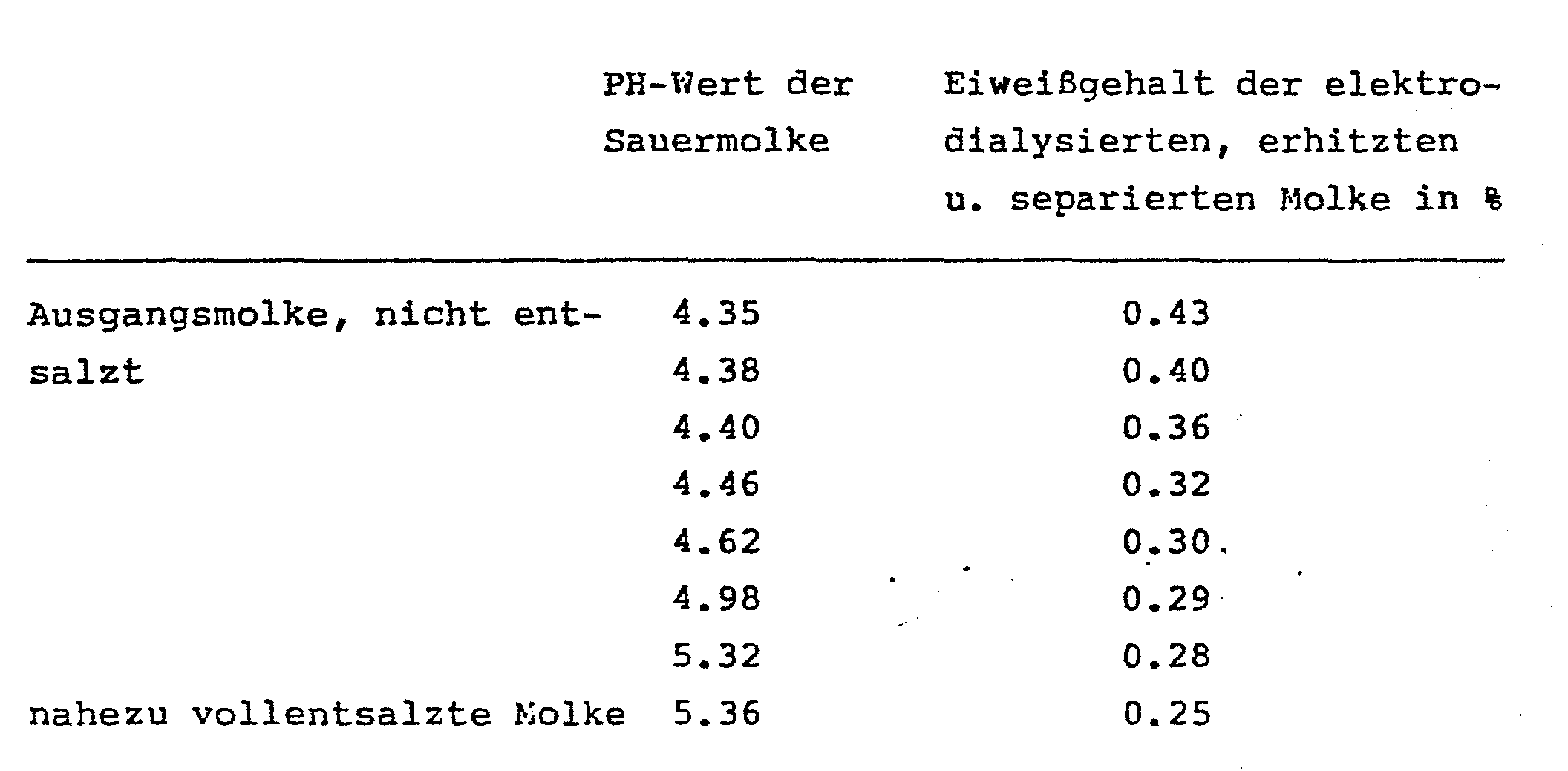
- Aus dieser Tabelle ist ersichtlich, daß'eine Korrelation zwischen dem Entmineralisierungsgrad und dem Resteiweißgehalt der erhitzten, separierten Molke vorhanden ist. Je weniger Mineralstoffe sich in der Molke befinden, desto geringer ist der Eiweißgehalt in der behandelten Molke. Weiterhin ist aus der Tabelle ersichtlich, daß die Entsalzung einen Einfluß auf den pH - Wert hat. Im Verlauf der Entsalzung hat sich der pH - Wert von 4,35 ( Ausgangssalzgehalt der Molke) auf pH 5,36 ( Entsalzungsgrad etwa 80% ) erhöht.
- Andere Versuchsreihen zeigten folgende Resultate :
- Elektrodialysierte Milch, pH 4,82, Eiweiß 0,60 % wurde mit 38 % Magermilch versetzt. Das Gemisch hatte einen pH - Wert von 6,50 und einen Eiweißgehalt von 1,73 %. Dieses wurde erhitzt und mit Zitronensäure auf einen pH - Wert von 4,5 bei der angeführten Erhitzungstemperatur eingestellt.

- Elektrodialysierte Molke wurde mit 20 % Magermilch versetzt. Der pH - Wert der Mischung betrug 5,7, der Eiweißgehalt 1,165 %. Die Mischung wurde erhitzt, in heißem Zustand auf einen pH - Wert von 4,5 eingestellt und separiert.

- Die Behandlung dieser Molke / Milch kann auch derart erfolgen, daß die Milch vor der Entsalzung der Molke zugegeben wird und die Molke mit der Milch entsalzt wird.
- Elektrodialysierte Molke wurde vor der Erhitzung auf einen pH - Wert von 4,1 mit Zitronensäure eingestellt, erhitzt und separiert, wobei die pH - Wert Einstellung auch vor der Entsalzung derart durchgeführt werden kann, daß nach der Entsalzung der gleiche pH - Wert erzielt wird.

- Elektrodialysierte Molke mit einem pH - Wert von 4,82 und einem Eiweißgehalt von 0,67 wurde erhitzt und separiert.

- Bei diesen Versuchen zeigt sich ,daß der Entmineralisierungsgrad, der eingestellte pH. - Wert, die Erhitzungstemperatur und die Erhitzungszeit einen Einfluß auf die Enteiweißung der Milch und / oder Molke haben.
- Eine weitere Möglichkeit bei der Entsalzung von Milch besteht in der alleinigen Eiweißgewinnung, wobei dieses Eiweiß als Kopräzipitat vermarktet werden kann.
- Milch wird durch ein geeignetes Verfahren entsalzt, auf einen pH - Wert von 4,0 - 5,2 mikrobiologisch gesäuert bzw. auf diesen pH - Wert mit einer Säure eingestellt, auf eine Temperatur über 80 oC zur Denaturierung der Serumproteine erhitzt, gekühlt und durch ein geeignetes Verfahren das ausgefallene Eiweiß abgetrennt. Durch die bei der Erhitzung entstehende Kopräzipitatbildung erfolgt bei dem sich anschließenden Abtrennverfahren eine nahezu vollständige Enteiweißung der Milch, bzw. der Molke auf Werte um 0,2 % in Abhängigkeit von dem Entmineralisierungsgrad.
- Nach diesen aufgeführten Beispielen kann die Enteiweißung der Milch und / oder Molke durch eine Teil- oder Vollentsalzung mit einer pH - Werteinstellung und einer Erhitzung erfolgen, wobei die Erhitzung im isoelektrischen Bereich der Proteine erfolgt.
- Das abgetrennte Eiweiß wurde Speisequark zugefügt. Im Vergleich zu einem UF - Quark, hergestellt aus süßem Vollkonzentrat, trat hierbei während der Lagerung keine bittere Geschmackskomponente auf.
- Bei der Käseherstellung ergeben sich noch zusätzlche Möglichkeiten. Milch wird teil- oder vollentsalzt, auf eine Temperatur von 9o bis 95 oC erhitzt, mikrobiologisch gesäuert bzw. über die Säuerung dickgelegt und über ein geeignetes Vefahren das ausgefallene Eiweiß abgetrennt. Die dabei anfallende Molke weist dabei in Abhängigkeit von dem Entsalzungsgrad einen Eiweißgehalt bis zu 0,2 % auf, wobei gleichzeitig der Mineralstoffgehalt reduziert ist. Weiterhin kann es sinnvoll sein, die Trockensubstanz in der Milch und / oder Molke derart zu erhöhen, daß keine oder nur eine reduzierte Menge an Molke anfällt.
- Eine nach diesen Verfahren enteiweißte, entmineralisierte Molke bietet sich u.a. auch für die Lactosegewinnung an. Weiterhin kann eine Trocknung mit anderen Komponenten ohne Schwierigkeiten durchgeführt werden, da die Einstellung des pH - Wertes durch das Fehlen des Puffersystems im Vergleich zu einer Sauermolke wesentlich erleichtert wird.
- Weitere Vorteile bestehen darin, daß eine Magermilch bzw. eine Süßmolke in einer wesentlich kürzeren Zeit durch das Fehlen eines Puffersystems gesäuert werden kann. Bei einer Entmineralsierung auf 80 % des ursprünglichen Aschegehaltes beträgt die Säuerungszeit nur noch etwa 40 % der üblichen Zeit.
- Magermilch wurde entmineralisiert und bei 23 oC mit der üblichen Menge an Säuerungskulturen versetzt. Für die Säuerung bis zu einem pH - Wert von 4,6 wurden nur 8 Stunden an Stelle von 20 Stunden benötigt. Auch hier zeigte sich wie bei der Enteiweißung, daß die Höhe der Entmineralisierung für eine Verkürzung der Säuerungszeit ausschlaggebend ist, wobei eine direkte Beziehung, Entmineralisierungsgrad - Säuerungszeit, vorhanden ist.
- Ferner hat sich gezeigt, daß die geschmackliche Komponente durch die Entmineralisierung verbessert werden kann. Der Anteil der gebildeten Milchsäure für die pH - Wert Reduzierung ist z.B. bei den Produkten Quark und Sauermilcherzeugnisse wesentlich verringert, die Keimzahl durch das teilweise ausgeschaltete Puffersystem im Produkt reduziert, wodurch im Produkt ein niedriger pH - Wert eingestellt werden kann. Dieser macht sich positiv bei einer Haltbarkeitsverlängerung des Produktes bemerkbar, ohne daß das Produkt eine saurere Geschmackskomponente aufweist. Beispielsweise kann daher bei Sauermilcherzeugnissen und Quark der Zuckeranteil der Fruchtzubereitungen reduziert werden, um für die geschmackliche Komponente das gleiche Zucker - Säureverhältnis zu erreichen.
- Die Entmineralisierung bei den o.g. Verfahrensschritten bzw. bei der Herstellung dieser Produkte erfolgt durch die Elektrodialyse, dem Ionenaustauscher, einer chemischen Entsalzung oder durch andere Verfahren.
Claims (15)
Applications Claiming Priority (2)
| Application Number | Priority Date | Filing Date | Title |
|---|---|---|---|
| DE3445223 | 1984-12-12 | ||
| DE19843445223 DE3445223A1 (de) | 1983-12-16 | 1984-12-12 | Verfahren zum ausfaellen von eiweiss bei milch und/oder molke |
Publications (2)
| Publication Number | Publication Date |
|---|---|
| EP0185300A1 true EP0185300A1 (de) | 1986-06-25 |
| EP0185300B1 EP0185300B1 (de) | 1991-04-03 |
Family
ID=6252520
Family Applications (1)
| Application Number | Title | Priority Date | Filing Date |
|---|---|---|---|
| EP85115733A Expired - Lifetime EP0185300B1 (de) | 1984-12-12 | 1985-12-10 | Verfahren zum Enteiweissen von Milch und/oder Molke |
Country Status (3)
| Country | Link |
|---|---|
| US (1) | US4844923A (de) |
| EP (1) | EP0185300B1 (de) |
| DE (1) | DE3582410D1 (de) |
Cited By (1)
| Publication number | Priority date | Publication date | Assignee | Title |
|---|---|---|---|---|
| AU581522B2 (en) * | 1985-06-17 | 1989-02-23 | Laiteries Emile Bridel | Process for selectively separating the alpha-lactalbumin from the proteins of whey |
Families Citing this family (13)
| Publication number | Priority date | Publication date | Assignee | Title |
|---|---|---|---|---|
| JPH0710875B2 (ja) * | 1989-03-10 | 1995-02-08 | 雪印乳業株式会社 | シアル酸類含有脱塩乳糖の製造方法 |
| FR2657233B1 (fr) * | 1990-01-19 | 1993-07-16 | Ingenierie Ste Vidaubanaise | Procede de traitement du lait ecreme. |
| NL9001692A (nl) * | 1990-04-26 | 1991-11-18 | Cooeperatieve Melkproductenbed | Werkwijze voor de bereiding van een olie-in-water emulsie. |
| US5427813A (en) * | 1991-01-22 | 1995-06-27 | Meiji Milk Products Company Limited | Desalted whey containing non-protein nitrogen and process for producing the same |
| US5436014A (en) * | 1993-11-02 | 1995-07-25 | Damodaran; Srinivasan | Removing lipids from cheese whey using chitosan |
| US5811289A (en) * | 1996-02-06 | 1998-09-22 | Lewandowski; Raymond | Process and apparatus for effecting a biological aerobic pretreatment of dairy industry effluent |
| US6288222B1 (en) * | 2000-02-16 | 2001-09-11 | Neose Technologies, Inc. | Method of filtration of a dairy stream |
| RU2166084C1 (ru) * | 2000-07-14 | 2001-04-27 | Уфимский государственный нефтяной технический университет | Устройство для определения углов искривления скважины |
| RU2184845C1 (ru) * | 2001-04-06 | 2002-07-10 | Уфимский государственный нефтяной технический университет | Устройство для определения углов искривления скважины и положения отклонителя при бурении |
| RU2204017C2 (ru) * | 2001-07-16 | 2003-05-10 | Закрытое акционерное общество "Удмуртнефть-Бурение" | Способ измерения ориентации ствола скважины в процессе бурения и устройство для осуществления способа |
| NZ551500A (en) * | 2006-11-23 | 2010-04-30 | Ganugapati Vijaya Bhaskar | Yoghurt product and process using divalent cation depleted milk |
| CZ306221B6 (cs) * | 2007-02-21 | 2016-10-12 | Mega A. S. | Mléčný výrobek a způsob jeho výroby |
| FR3079112B1 (fr) * | 2018-03-21 | 2022-05-06 | Synutra France Int | Procede de demineralisation de lactoserum |
Citations (2)
| Publication number | Priority date | Publication date | Assignee | Title |
|---|---|---|---|---|
| FR2345939A1 (fr) * | 1976-03-31 | 1977-10-28 | Lacto Serum France | Procede de deproteination du serum du lait |
| AT376549B (de) * | 1982-05-17 | 1984-11-26 | Molkereigenossenschaft St Joha | Verfahren zur herstellung eines eiweisshaltigen nahrungs- oder futtermittels |
Family Cites Families (3)
| Publication number | Priority date | Publication date | Assignee | Title |
|---|---|---|---|---|
| DE1492803A1 (de) * | 1965-02-22 | 1969-05-22 | Molkerei J A Meggle | Verfahren zur Gewinnung der Kaseinfraktion aus Milch unter gleichzeitigem Anfall einer zur Herstellung von Milchzucker und Nahrungs- und Futtermitteln geeigneten Molke |
| FR2142812A1 (en) * | 1971-06-25 | 1973-02-02 | Lespagnol Jacques | Demineralization of wheys - from cheese making by ion exchangers |
| FR2391653A1 (fr) * | 1977-05-23 | 1978-12-22 | Nestle Sa Soc Ass Tech Prod | Procede de traitement du lactoserum |
-
1985
- 1985-12-10 EP EP85115733A patent/EP0185300B1/de not_active Expired - Lifetime
- 1985-12-10 DE DE8585115733T patent/DE3582410D1/de not_active Expired - Lifetime
-
1987
- 1987-12-15 US US07/133,019 patent/US4844923A/en not_active Expired - Fee Related
Patent Citations (2)
| Publication number | Priority date | Publication date | Assignee | Title |
|---|---|---|---|---|
| FR2345939A1 (fr) * | 1976-03-31 | 1977-10-28 | Lacto Serum France | Procede de deproteination du serum du lait |
| AT376549B (de) * | 1982-05-17 | 1984-11-26 | Molkereigenossenschaft St Joha | Verfahren zur herstellung eines eiweisshaltigen nahrungs- oder futtermittels |
Non-Patent Citations (3)
| Title |
|---|
| CHEMICAL ABSTRACTS, Band 85, 1976, Seite 422, Nr. 76484m, Columbus, Ohio, US; K.R. MARSHALL et al.: "The use of cation exchange in the production of traditional lactalbumin from cheddar cheese whey", & N. Z. J. DAIRY SCI. TECHNOL. 1976, 11(1), 69-70 * |
| CHEMICAL ABSTRACTS, Band 87, 1977, Seite 553, Nr. 199337q, Columbus, Ohio, US; M.T. SHULKAMY et al.: "Effect of hydrogen ion concentration and heat treatment on the yield of precipitated whey proteins", & AGRIC. RES. REV. 1976, 54(6), 79-86 * |
| CHEMICAL ABSTRACTS, Band 87, 1977, Seite 553, Nr. 199338r, Columbus, Ohio, US; A.F. MONIB et al.: "A simple method for precipitating whey proteins", & AGRIC. RES. REV. 1976, 54(6), 87-90 * |
Cited By (1)
| Publication number | Priority date | Publication date | Assignee | Title |
|---|---|---|---|---|
| AU581522B2 (en) * | 1985-06-17 | 1989-02-23 | Laiteries Emile Bridel | Process for selectively separating the alpha-lactalbumin from the proteins of whey |
Also Published As
| Publication number | Publication date |
|---|---|
| DE3582410D1 (de) | 1991-05-08 |
| EP0185300B1 (de) | 1991-04-03 |
| US4844923A (en) | 1989-07-04 |
Similar Documents
| Publication | Publication Date | Title |
|---|---|---|
| DE69919019T2 (de) | Verfahren zur Herstellung einer Proteinzusammensetzung und einer diese enthaltenden Säuglingsnahrung | |
| DE69220374T2 (de) | Verfahren zur Gewinnung von Alpha-Lactalbumin und Beta-Lactoglobulin aus einem Molkeproteinprodukt | |
| EP0644720B1 (de) | Teildenaturiertes molkenproteinprodukt | |
| DE3885459T2 (de) | Molkeproteinfraktionen. | |
| DE3043691C2 (de) | Verfahren zur Herstellung löslicher, denaturierter Molkeproteinzusammensetzungen | |
| DE2914301C2 (de) | Verfahren zur Gewinnung von Proteinen aus Milchserum | |
| EP0185300B1 (de) | Verfahren zum Enteiweissen von Milch und/oder Molke | |
| DE2822000A1 (de) | Verfahren zur entmineralisierung von milchserum | |
| DE2155696B2 (de) | Verfahren zur Ultrafiltration von Molke | |
| EP0661927A1 (de) | Verfahren zur herstellung von produkten mit hohem beta-kaseingehalt | |
| DE602004006979T2 (de) | Verfahren zur herstellung eines beta-laktoglobulin-angereichertes molkenproteinkonzentrates und darauf basierender texturverstärker zur verwendung in milchprodukten | |
| DE69507613T2 (de) | Verfahren zur fraktionierung von molkebestandteilen | |
| DE3445223C2 (de) | ||
| DE2850494A1 (de) | Verfahren zur herstellung einer kalorienarmen margarine, die ein aus magermilch gewonnenes proteinkonzentrat enthaelt | |
| DE60112465T2 (de) | Transglutaminasehemmer in lebensmittelqualität und seine verwendung | |
| DE69632561T2 (de) | Verfahren zur Herstellung von fraktionierten Sojaproteinen und Verwendung derselben in Nahrungsmitteln | |
| CH626783A5 (de) | ||
| DE69110151T2 (de) | Formulierte Milch für Kleinkinder analog der Muttermilch. | |
| DE2137376A1 (de) | Verfahren zur Verarbeitung von Molke und vermittels des Verfahrens erhaltenes Erzeugnis | |
| DE19950240A1 (de) | Herstellung eines Molkenproteinkonzentrates mit erhöhtem Gehalt an alpha-Lactalbumin | |
| DE1692319A1 (de) | Verfahren zur Steigerung der Ergiebigkeit bei der Herstellung von Kaese | |
| EP0056658A2 (de) | Verfahren zur Vereinheitlichung der Struktur der EiweiBstoffe von Milch | |
| DE2162865C3 (de) | Verfahren zum Herstellen eines Protein und Fruchtbestandteile enthaltenden Getränkes | |
| DE2850495A1 (de) | Verfahren zur herstellung eines proteinkonzertrats | |
| DE2319457C3 (de) | Verfahren zur Herstellung eines Kulturkonzentrats für saure Lebensmittel |
Legal Events
| Date | Code | Title | Description |
|---|---|---|---|
| PUAI | Public reference made under article 153(3) epc to a published international application that has entered the european phase |
Free format text: ORIGINAL CODE: 0009012 |
|
| AK | Designated contracting states |
Kind code of ref document: A1 Designated state(s): DE FR GB NL |
|
| 17P | Request for examination filed |
Effective date: 19861204 |
|
| 17Q | First examination report despatched |
Effective date: 19871027 |
|
| GRAA | (expected) grant |
Free format text: ORIGINAL CODE: 0009210 |
|
| AK | Designated contracting states |
Kind code of ref document: B1 Designated state(s): DE FR GB NL |
|
| PG25 | Lapsed in a contracting state [announced via postgrant information from national office to epo] |
Ref country code: GB Effective date: 19910403 |
|
| ET | Fr: translation filed | ||
| REF | Corresponds to: |
Ref document number: 3582410 Country of ref document: DE Date of ref document: 19910508 |
|
| GBV | Gb: ep patent (uk) treated as always having been void in accordance with gb section 77(7)/1977 [no translation filed] | ||
| PGFP | Annual fee paid to national office [announced via postgrant information from national office to epo] |
Ref country code: FR Payment date: 19911219 Year of fee payment: 7 |
|
| PGFP | Annual fee paid to national office [announced via postgrant information from national office to epo] |
Ref country code: NL Payment date: 19911231 Year of fee payment: 7 |
|
| PLBI | Opposition filed |
Free format text: ORIGINAL CODE: 0009260 |
|
| PLBI | Opposition filed |
Free format text: ORIGINAL CODE: 0009260 |
|
| 26 | Opposition filed |
Opponent name: SOLVAY DEUTSCHLAND GMBH Effective date: 19911220 |
|
| 26 | Opposition filed |
Opponent name: KRAYER, WARNER DIRK Effective date: 19920103 Opponent name: SOLVAY DEUTSCHLAND GMBH Effective date: 19911220 |
|
| NLR1 | Nl: opposition has been filed with the epo |
Opponent name: SOLVAY DEUTSCHLAND GMBH |
|
| NLR1 | Nl: opposition has been filed with the epo |
Opponent name: KRAYER, WARNER DIRK C/O KONINKLIJKE NEDERL. ZUIVEL |
|
| PGFP | Annual fee paid to national office [announced via postgrant information from national office to epo] |
Ref country code: DE Payment date: 19921217 Year of fee payment: 8 |
|
| PG25 | Lapsed in a contracting state [announced via postgrant information from national office to epo] |
Ref country code: NL Effective date: 19930701 |
|
| NLV4 | Nl: lapsed or anulled due to non-payment of the annual fee | ||
| PG25 | Lapsed in a contracting state [announced via postgrant information from national office to epo] |
Ref country code: FR Effective date: 19930831 |
|
| REG | Reference to a national code |
Ref country code: FR Ref legal event code: ST |
|
| PG25 | Lapsed in a contracting state [announced via postgrant information from national office to epo] |
Ref country code: DE Effective date: 19940901 |
|
| RDAG | Patent revoked |
Free format text: ORIGINAL CODE: 0009271 |
|
| STAA | Information on the status of an ep patent application or granted ep patent |
Free format text: STATUS: PATENT REVOKED |
|
| 27W | Patent revoked |
Effective date: 19940919 |