EP0185499A2 - Zusammensetzung für thermoelektrische Legierung - Google Patents
Zusammensetzung für thermoelektrische Legierung Download PDFInfo
- Publication number
- EP0185499A2 EP0185499A2 EP85308940A EP85308940A EP0185499A2 EP 0185499 A2 EP0185499 A2 EP 0185499A2 EP 85308940 A EP85308940 A EP 85308940A EP 85308940 A EP85308940 A EP 85308940A EP 0185499 A2 EP0185499 A2 EP 0185499A2
- Authority
- EP
- European Patent Office
- Prior art keywords
- thermoelectric
- electrical
- alloy
- type
- lead
- Prior art date
- Legal status (The legal status is an assumption and is not a legal conclusion. Google has not performed a legal analysis and makes no representation as to the accuracy of the status listed.)
- Ceased
Links
Images




Classifications
-
- C—CHEMISTRY; METALLURGY
- C22—METALLURGY; FERROUS OR NON-FERROUS ALLOYS; TREATMENT OF ALLOYS OR NON-FERROUS METALS
- C22C—ALLOYS
- C22C28/00—Alloys based on a metal not provided for in groups C22C5/00 - C22C27/00
-
- H—ELECTRICITY
- H10—SEMICONDUCTOR DEVICES; ELECTRIC SOLID-STATE DEVICES NOT OTHERWISE PROVIDED FOR
- H10N—ELECTRIC SOLID-STATE DEVICES NOT OTHERWISE PROVIDED FOR
- H10N10/00—Thermoelectric devices comprising a junction of dissimilar materials, i.e. devices exhibiting Seebeck or Peltier effects
- H10N10/80—Constructional details
- H10N10/85—Thermoelectric active materials
- H10N10/851—Thermoelectric active materials comprising inorganic compositions
- H10N10/8556—Thermoelectric active materials comprising inorganic compositions comprising compounds containing germanium or silicon
Definitions
- the present invention relates to alloy compositions and particularly, but not exclusively, to thermoelectric alloy compositions.
- thermoelectric alloys are known to have thermoelectric properties which enables them to be used on order to generate or absorb heat when subjected to a suitable applied voltage or to generate electricity when heated. Satisfactory thermoelectric alloy compositions should have a high power output and low thermal conductivity. An alloy should therefore have a high Seebeck coefficient which is a measure of its voltage change with temperature, and a high electrical conductivity because the combination of these paramaters defines power. The alloy composition should have minimal heat loss and therefore is selected to have low thermal conductivity. The alloy composition should also use readily available materials to minimise costs for widespread application. Furthermore the efficiency of a thermoelectric element, which is defined as the ratio of power output to heat loss (thermal conductivity) should be as high as possible to minimise running costs of a thermoelectric device.
- alloys are however, very expensive. This makes them uneconomic for many application. They also have relatively low maximum operating temperature limits which limits the efficiency of electricity generation therewith. Thus alloys such as bismuth-telluride may be damaged above 200°C and involve capital costs of the order of 100 pounds sterling per watt?of generating capacity.
- thermoelectic alloy comprising from 5% to 95% of Silicon, from 95% to 5% of Germanium, from 0.01% to 0.2% of Lead and from 0 to 0.2% of Tin, all percentages being atomic percentages.
- Preferred alloys of the present invention include those having the following compositions:
- the alloys of the invention are substantially pure and contain not more than 1 in 10 4 parts, most desirably not more than 1 in 10 6 parts, by weight of undersired impurity, prior to any doping that may be desired as described below.
- the above alloys may be doped with a suitable doping material to provide thermoelectric semi-conductor materials.
- a suitable doping material to provide thermoelectric semi-conductor materials.
- the present invention also extends to a semi-conductor material comprising an alloy of the invention which contains an effective amount of a suitable doping material.
- thermoelectric semi-conductor material comprsing an alloy of 5% to 95% of Silicon, from 95% to 5% Germanium, from 0.01% to 0.2% Lead and from 0% to 0.2% of Tin, all percentages being atomic percentages, and a dopant material having a concentration in the region of 10 18 to 10 20 atoms of said dopant material per cubic centimetre of said alloy.
- Suitable doping materials include elements belonging to Group III of the Periodic Table, for example Boron and Gallium, and Group V of the Periodic Table, for example ' Phosphorous or Arsenic. Suitable concentrations of the doping materials are generally in the range from 10 18 to 10 20 atoms of doping element per cubic centimetre of the doped alloy.
- thermoelectric efficiency generally have improved thermoelectric efficiency and/or are more economical to produce and to run than previously known thermoelectric alloys.
- thermoelectric materials of the present invention may be used in various conventional thermoelectric devices including, for example, electricity generators with various heat inputs such as for example catalytic or non- catalytic fuel gas burners, and heat pumps including both devices for heat generation and heat absorption.
- thermoelectric solar tiles and heat sinks using semi-conductor materials of the present invention.
- alloys and semi-conductor materials have a number of different advantages to a greater or lesser degree depending on their precise composition, over previously known such materials.
- those alloys and materials which contain little or no german- i um are generally cheaper than the known materials.
- Those alloys and materials which contain lead have appreciably reduced thermal conductivities by a factor of 2 to 3 over optional value of Silicon-Germanium without degrading electrical characteristics resulting in significantly reduced heat losses due to thermal conduction in devices using these alloys and materials.
- those alloys and materials comprising essentially silicon and germanium with tin and/or lead generally have significantly higher operating temperatures than Bismuth-Telluride, e.g.
- thermoelectric cells for electricity generation which cells use n and D semi-condutor materials of the invention, as well as thermoelectric devices for heat absorption or generation application of a suitable external voltage, again using semi-conductor materials of the invention.
- thermoelectric device comprising at least one p-type semi-conductor portion and at least one n-type semi-conductor material portion according to the invention, said p-type having a first end electrically coupled to a first end of said n-type portion to form a p-n coupling, said p-n Coupling having first electrical conductor means coupled thereto, said p and n-type portions having respective other ends for receiving respective, electrical contacts, and being connectable to an electrical load, the arrangement being such that, in use, in response to thermal energy applied to said p-n coupling electrical power can be obtained by connecting said electrical load between said electrical contacts.
- each p and n-type portion being electrically connected in series, and physically arranged in parallel, and electrical power being taken between any pair of p and n end portions.
- thermoelectric energy conversion device for generating electrical energy from thermal energy, said device comprising a thermal energy source, and a thermoelectric device according to the invention, the arrangement being such that in use, thermal energy from said thermal energy source is applied to said thermoelectric device to provide electrical power from between said electrical contacts.
- thermoelectric device in a further aspect of the invention there is provided a method of converting thermal energy to electrical energy using a thermoelectric device according to the invention, said method comprising the steps of heating said p-n couplings to a predetermined temperature, and coupling the electrical contacts of said device across an electrical load.
- the thermal energy applied is at a temperature up to 1000 C.
- Fig. 1 shows a thermoelectric cell 10 having a hot end 12 to which heat is supplied via a thermal source 14 for example a flame of burning fuel gas, such as propose propane.
- the cell 1 0 also has a cold end 16 with electrical output connections 18,20 to which can be coupled an electrical load 22.
- the cell 10 comprises n- and p -doped material elements 24,28 and 26,30 electrically connects in series but physically disposed generally parallel to each other and spaced apart.
- Hot ends 34 and 36 respectively of element 24,26 and 28,30 are coupled together by heat resistant and generally inert low electrical resistance conducts 38 which may be copper or a suitable low resistance material which can be used at high temperatures, for example nickel.
- the p and n elements 24,30 have cold ends 40 the two outer most ends of which 42,44 connected to the electrical output connections 18,20.
- the hot end 12 of the cell was heated to about 600°C whilst the cold end 16 was maintained at ambient or slightly above ambient temperature, about 27°C, resulting in an electrical power output of 3 watts at 0.3 volts per pair of p-n elements being obtained.
- Fig. 2 of the drawings illustrating a plurality of p and n-type semi-conductor couplings 39 as shown in Fig. 1 arranged to form a commercial type thermoelectric cell, in which like numerals refer to like parts of Fig. 1.
- the p and n elements can, of course be stacked or laminated to form a physically compact and lightweight structure.
- the heat source 14 heats all conductors 38 and electrical power can be taken from electrical output connections 18,20 as shown or at any of the suitable positions along copper conductors 46.
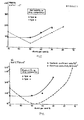
- Fig. 3 of the drawings depicts a graph of thermal conductivity against lead atomic concentration for a Silicon-Germanium alloy of 50:50. Two curves are drawn, curve A for lead only and curve B in which the alloy includes 0.03% tin by atomic percentage. It will be seen from curve A that increasing lead concentration reduces thermal conductivity until a concentration of about 0.057% lead is obtained whereupon the thermal conductivity slightly increases for further increases of lead. Curve B is best fit curve and shows a minimum thermal conductivity at about 0.04% lead and a comparison of curves A,B indciates that thermal conductivity is lower with a lead-tin combination than with lead alone.
- Fig. 4 depicts a graph of thermal conductivity against alloy compositions for the lead value of 0.057% lead obtained in Fig. 1.
- curve A is obtained using an alloy composition grown parallel to the ⁇ 111> crystallographic direction
- curve B is obtained using an alloy composition grown perpendicular to the ⁇ 111> direction
- curve C is a theorectical curve. It will be seen for all curves that thermal conductivity is considerably lower for high Si proportions. However, increasing the lead concentration with a Silicon concentration less than 30% also reduces the thermal conductivity.
- Fig. 5 depicts a graph of Hall mobility versus alloy compositions and for p and n type compositions. It shows that there is some differences due to the difference in mobility between electrons (n-type) and holes (p-type) and that mobility generally increases for both p and n for decreasing proportions of Silicon and increases for n-type for higher proportions of Silicon. This is significant because electrical conductivity is directly related to Hall mobility as follows.
- the composition can be selected for high conductivity to give high Seebeck coefficient. Also from equations (1) and (2) it will be evident mobility electrons and holes decreases with increasing electron and hole concentrations.
- Fig. 6 of the drawings illustrates a graph of electrical power againt atomic percentage Silicon for p and n-type Electrical Power is determined from S 2 ⁇ where S is the Seebeck coefficient for the material and ⁇ is the conductivity.
- Fig. 7 of the drawings a graph of electrical power output, as represented the S 2 /f versus resistivity is shown for a p-type Silicon-Germanium alloy at 50:50 composition.
- the power decreases with resistivity and it is desirable that resistivity of no more than 2-2.5 milliohm cm be used to maximise electrical power output from the thermoelectric material.
- Fig. 8 of the drawings shows the percentage change in resistance with temperature for a p-type alloy of Si:Ge in a 50:50 proportion and having a resistivity of 2x10 -3 ohm cm. It will be seen that the electrical resistance increases with temperature in a linear manner which adversely effects electrical conductivity, however for higher temperatures the thermal conductivity also reduces which cancels the effect of increasing electrical resistance and results in a slight increase in the Seebeck coefficient.
- Fig. 9 illustrates a graph of Figure of merit (Z) against atomic percent silicon for a p and n-type Silicon-Germanium alloy composition having a 0.057 atomic percent lead concentration.
- the figure of merit (Z) is defined as the ratio of electrical power (S 2 ⁇ ) to heat loss (thermal conductivity) and is a measure of efficiency of the thermoelectric composition. It is therefore desirable to have E as high as possible.
- the Fig. 9 shows that the efficiency of p-type is almost independent of the percentage of Silicon whereas the efficiency of the n-type rises rapidly for increasing percentages of Silicon above 50%.
- this graph indicates that for a high Z an n-type allov is preferable and this is consistent with Fig. 4 which shows that thermal conductivity is reduced for higher Silicon percentages.
- thermoelectric device having thermoelectric characteristics designed to suit a particular application.
- the alloy composition can be manufactured as a polycrystalline material using a variety of techniques such as a Bridgaman Stockbarger Crystal growth method for growing crystals in which a flat bottomed or tapered crucible is used to grow the crystal from a point of nucleation near the bottom of the crystal and the crystal is lowered at the same rate as growth to minimise thermal shock.
- the solidified crystal can be cut into pieces of a predetermined size and shape using a diamond saw.
- Silicon (20 g.), Germanium (22 g.), lead (1.2g) and Boron '(7 mg) were placed together in a graphite crucible and heated to slightly above the melting point of the mixture (1500 0 C) this temperature then being maintained for a further 2 hours. The resulting melt was then allowed to cool at a controlled rate of approximately 2° C min -1 .
- the resulting solid ingot was then machined in conventional manner to produce individual elements for use in the above described cell.
- the nominal atomic weight percent of the above amount of lead is 0.58% for the liquid phase.
- the segregation coefficient is the ratio of lead atoms entering the solid phase from the liquid phase. This has not been measured for lead but is believed to be in the region of 0.05 in comparison to the segregation coefficient of tin which is known to be 0.02. The remaining lead imparting atoms remain in the liquid phase until the last part of the polycrystalline ingot is formed and which is then removed.
- the actual weight percent can be measured from samples of the solid phase alloy composition and the amount of lead with a segregation coefficient of about 0.05 will produce an actual lead atomic weight percent of 0.03% in the solid phase.
- the nominal weight percent of lead is 0.87%, however using the segregation coefficient the actual weight percent becomes 0.044%.
- the doped alloy ingot obtained was then machined in conventional manner to produce n- doped elements for the above-described cell.
- the semi-conductor material obtained was found to have the following properties:
- Germanium (75g), Silicon (6g) and Pb (2.5g) were added together as described in example II. At the same time Boron (6mg) was added and the procedure as for example II followed.
- the semi-conductor material obtained was found to have the following properties:
Landscapes
- Chemical & Material Sciences (AREA)
- Inorganic Chemistry (AREA)
- Engineering & Computer Science (AREA)
- Materials Engineering (AREA)
- Mechanical Engineering (AREA)
- Metallurgy (AREA)
- Organic Chemistry (AREA)
- Powder Metallurgy (AREA)
- Silicon Compounds (AREA)
- Crystals, And After-Treatments Of Crystals (AREA)
Applications Claiming Priority (2)
| Application Number | Priority Date | Filing Date | Title |
|---|---|---|---|
| GB8431071 | 1984-12-08 | ||
| GB848431071A GB8431071D0 (en) | 1984-12-08 | 1984-12-08 | Alloys |
Publications (2)
| Publication Number | Publication Date |
|---|---|
| EP0185499A2 true EP0185499A2 (de) | 1986-06-25 |
| EP0185499A3 EP0185499A3 (de) | 1988-02-24 |
Family
ID=10570921
Family Applications (1)
| Application Number | Title | Priority Date | Filing Date |
|---|---|---|---|
| EP85308940A Ceased EP0185499A3 (de) | 1984-12-08 | 1985-12-09 | Zusammensetzung für thermoelektrische Legierung |
Country Status (8)
| Country | Link |
|---|---|
| US (1) | US4711971A (de) |
| EP (1) | EP0185499A3 (de) |
| JP (1) | JPS61149453A (de) |
| AU (1) | AU578398B2 (de) |
| CA (1) | CA1266770A (de) |
| FI (1) | FI854852L (de) |
| GB (1) | GB8431071D0 (de) |
| NO (1) | NO854931L (de) |
Cited By (3)
| Publication number | Priority date | Publication date | Assignee | Title |
|---|---|---|---|---|
| US4857270A (en) * | 1987-05-19 | 1989-08-15 | Komatsu Electronic Metals Co., Ltd. | Process for manufacturing silicon-germanium alloys |
| US5449602A (en) * | 1988-01-13 | 1995-09-12 | Amoco Corporation | Template-directed photoligation |
| WO2001096238A1 (en) * | 2000-06-01 | 2001-12-20 | Shin-Etsu Handotai Co., Ltd. | SiGe CRYSTAL AND METHOD FOR PRODUCING THE SAME |
Families Citing this family (13)
| Publication number | Priority date | Publication date | Assignee | Title |
|---|---|---|---|---|
| DE3784705T2 (de) * | 1986-10-24 | 1993-06-17 | Anritsu Corp | Mit einem duennschichtleiter versehener elektrischer widerstand und kraftsensor. |
| US5981417A (en) * | 1998-03-18 | 1999-11-09 | Phillips Petroleum Company | Method of making an improved catalyst containing an acid-treated zeolite, a boron component, and a zinc component, a product from such method, and the use thereof in the conversion of hydrocarbons |
| CN1130308C (zh) * | 1998-11-26 | 2003-12-10 | 信越半导体株式会社 | 硅锗晶体 |
| US6166317A (en) * | 1999-02-18 | 2000-12-26 | Volk, Jr.; Joseph A. | Cryogenic thermoelectric generator |
| WO2000054343A1 (fr) * | 1999-03-10 | 2000-09-14 | Sumitomo Special Metals Co., Ltd. | Materiau de conversion thermoelectrique et procede de production associe |
| EP1083610A4 (de) * | 1999-03-10 | 2007-02-21 | Neomax Co Ltd | Thermoelektrisches umwandlungsmaterial und herstellungsverfahren dafür |
| US6271459B1 (en) * | 2000-04-26 | 2001-08-07 | Wafermasters, Inc. | Heat management in wafer processing equipment using thermoelectric device |
| US7880079B2 (en) * | 2005-07-29 | 2011-02-01 | The Boeing Company | Dual gap thermo-tunneling apparatus and methods |
| KR20110102693A (ko) * | 2010-03-11 | 2011-09-19 | 삼성전자주식회사 | 빈 격자 클러스터가 형성된 열전체를 포함하는 열전 소자 |
| DE102012017556A1 (de) * | 2011-09-08 | 2013-03-14 | Hitachi Chemical Co., Ltd. | Thermoelektrisches konvertermodul und herstellungsverfahren dafür |
| US9624786B2 (en) | 2013-03-15 | 2017-04-18 | Rolls-Royce Corporation | Braze materials and method for joining of ceramic matrix composites |
| US20140360546A1 (en) * | 2013-06-08 | 2014-12-11 | Alphabet Energy, Inc. | Silicon-based thermoelectric materials including isoelectronic impurities, thermoelectric devices based on such materials, and methods of making and using same |
| US10947162B2 (en) | 2017-04-13 | 2021-03-16 | Rolls-Royce Corporation | Braze alloys for joining or repairing ceramic matrix composite (CMC) components |
Family Cites Families (7)
| Publication number | Priority date | Publication date | Assignee | Title |
|---|---|---|---|---|
| US3007988A (en) * | 1960-03-29 | 1961-11-07 | Gen Electric | Thermocouple system |
| US3081361A (en) * | 1961-06-09 | 1963-03-12 | Monsanto Chemicals | Thermoelectricity |
| US3298777A (en) * | 1961-12-12 | 1967-01-17 | Du Pont | Thermoelectric compositions of nbxta1-xsiyge2-y |
| DE1194937B (de) * | 1962-08-22 | 1965-06-16 | Bosch Gmbh Robert | Halbleitermischkristall zur Verwendung als Schenkel thermoelektrisch wirkender Elemente |
| US3164892A (en) * | 1962-11-27 | 1965-01-12 | Gen Instrument Corp | Thermoelectric body and method of making same |
| US3208947A (en) * | 1963-09-13 | 1965-09-28 | Du Pont | Thermoelectric compositions and methods of preparing same |
| US3782927A (en) * | 1971-08-24 | 1974-01-01 | M Nicolaou | Material for direct thermoelectric energy conversion with a high figure of merit |
-
1984
- 1984-12-08 GB GB848431071A patent/GB8431071D0/en active Pending
-
1985
- 1985-12-05 US US06/805,507 patent/US4711971A/en not_active Expired - Fee Related
- 1985-12-06 AU AU50882/85A patent/AU578398B2/en not_active Ceased
- 1985-12-06 NO NO854931A patent/NO854931L/no unknown
- 1985-12-06 CA CA000497017A patent/CA1266770A/en not_active Expired - Lifetime
- 1985-12-09 FI FI854852A patent/FI854852L/fi not_active IP Right Cessation
- 1985-12-09 JP JP60276672A patent/JPS61149453A/ja active Pending
- 1985-12-09 EP EP85308940A patent/EP0185499A3/de not_active Ceased
Cited By (3)
| Publication number | Priority date | Publication date | Assignee | Title |
|---|---|---|---|---|
| US4857270A (en) * | 1987-05-19 | 1989-08-15 | Komatsu Electronic Metals Co., Ltd. | Process for manufacturing silicon-germanium alloys |
| US5449602A (en) * | 1988-01-13 | 1995-09-12 | Amoco Corporation | Template-directed photoligation |
| WO2001096238A1 (en) * | 2000-06-01 | 2001-12-20 | Shin-Etsu Handotai Co., Ltd. | SiGe CRYSTAL AND METHOD FOR PRODUCING THE SAME |
Also Published As
| Publication number | Publication date |
|---|---|
| NO854931L (no) | 1986-06-09 |
| US4711971A (en) | 1987-12-08 |
| FI854852A0 (fi) | 1985-12-09 |
| JPS61149453A (ja) | 1986-07-08 |
| AU578398B2 (en) | 1988-10-20 |
| EP0185499A3 (de) | 1988-02-24 |
| GB8431071D0 (en) | 1985-01-16 |
| AU5088285A (en) | 1986-06-12 |
| FI854852A7 (fi) | 1986-06-09 |
| FI854852L (fi) | 1986-06-09 |
| CA1266770A (en) | 1990-03-20 |
Similar Documents
| Publication | Publication Date | Title |
|---|---|---|
| US4711971A (en) | Thermoelectric Si-Ge alloy composition | |
| US6942728B2 (en) | High performance p-type thermoelectric materials and methods of preparation | |
| Aoyama et al. | Doping effects on thermoelectric properties of higher manganese silicides (HMSs, MnSi1. 74) and characterization of thermoelectric generating module using p-type (Al, Ge and Mo)-doped HMSs and n-type Mg2Si0. 4Sn0. 6 legs | |
| Slack et al. | The maximum possible conversion efficiency of silicon‐germanium thermoelectric generators | |
| Rosi et al. | Materials for thermoelectric refrigeration | |
| Rosi et al. | Semiconductor materials for thermoelectric power generation up to 700 C | |
| EP0712537B1 (de) | Thermoelektrische materialien mit höherer leistung und herstellungsverfahren | |
| US7326851B2 (en) | Pb-Ge-Te-compounds for thermoelectric generators or Peltier arrangements | |
| Noda et al. | Preparation and thermoelectric properties of Mg2Si1− xGex (x= 0.0∼ 0.4) solid solution semiconductors | |
| US3279954A (en) | Thermoelectric device having silicongermanium alloy thermoelement | |
| JP5468554B2 (ja) | 熱電応用のためのドープテルル化スズを含む半導体材料 | |
| EP2552830B1 (de) | Thermoelektrisches modul und thermoelektrische vorrichtung, die das thermoelektrische modul enthält | |
| GB2113914A (en) | Multiphase thermoelectric alloys | |
| JP2013016685A (ja) | 熱電変換材料、熱電変換素子およびその作製方法 | |
| US20070227577A1 (en) | Pb-Te-compounds doped with tin-antimony-tellurides for thermoelectric generators or peltier arrangements | |
| Hyun et al. | Electrical and thermoelectric properties of 90% Bi2Te3-5% Sb2Te3-5% Sb2Se3 single crystals doped with SbI3 | |
| Korzhuev | Thermoelectric nanostructures: pros and cons | |
| US3285019A (en) | Two-phase thermoelectric body comprising a lead-tellurium matrix | |
| JPH0856020A (ja) | 熱電材料および熱電素子 | |
| Goldsmid | Timeliness in the development of thermoelectric cooling | |
| US3460996A (en) | Thermoelectric lead telluride base compositions and devices utilizing them | |
| WO2000030975A1 (fr) | CRISTAL SiGe | |
| Kurosaki et al. | Thermoelectric Materials and Applications: a Brief Review | |
| Kutasov et al. | Thermoelectric properties of multicomponent solid solutions based on bismuth and antimony chalcogenides with n-type conduction in the region of impurity and mixed conduction | |
| Wood | Refractory semiconductors for high temperature thermoelectric energy conversion |
Legal Events
| Date | Code | Title | Description |
|---|---|---|---|
| PUAI | Public reference made under article 153(3) epc to a published international application that has entered the european phase |
Free format text: ORIGINAL CODE: 0009012 |
|
| AK | Designated contracting states |
Kind code of ref document: A2 Designated state(s): AT BE CH DE FR GB IT LI LU NL SE |
|
| PUAL | Search report despatched |
Free format text: ORIGINAL CODE: 0009013 |
|
| AK | Designated contracting states |
Kind code of ref document: A3 Designated state(s): AT BE CH DE FR GB IT LI LU NL SE |
|
| 17P | Request for examination filed |
Effective date: 19880329 |
|
| 17Q | First examination report despatched |
Effective date: 19900713 |
|
| STAA | Information on the status of an ep patent application or granted ep patent |
Free format text: STATUS: THE APPLICATION HAS BEEN REFUSED |
|
| 18R | Application refused |
Effective date: 19911027 |
|
| RIN1 | Information on inventor provided before grant (corrected) |
Inventor name: DUNCAN, WILLIAM Inventor name: BARLOW, ARTHUR JOHN |