EP0185854A2 - Diode laser à semi-conducteur à hétérostructure enterrée - Google Patents
Diode laser à semi-conducteur à hétérostructure enterrée Download PDFInfo
- Publication number
- EP0185854A2 EP0185854A2 EP85111869A EP85111869A EP0185854A2 EP 0185854 A2 EP0185854 A2 EP 0185854A2 EP 85111869 A EP85111869 A EP 85111869A EP 85111869 A EP85111869 A EP 85111869A EP 0185854 A2 EP0185854 A2 EP 0185854A2
- Authority
- EP
- European Patent Office
- Prior art keywords
- layer structure
- layer
- double hetero
- strip
- melt
- Prior art date
- Legal status (The legal status is an assumption and is not a legal conclusion. Google has not performed a legal analysis and makes no representation as to the accuracy of the status listed.)
- Withdrawn
Links
- 239000004065 semiconductor Substances 0.000 title claims description 28
- 238000004519 manufacturing process Methods 0.000 claims abstract description 9
- 239000000463 material Substances 0.000 claims description 25
- 239000000758 substrate Substances 0.000 claims description 23
- 238000009792 diffusion process Methods 0.000 claims description 22
- 238000000034 method Methods 0.000 claims description 15
- 239000000155 melt Substances 0.000 claims description 12
- GPXJNWSHGFTCBW-UHFFFAOYSA-N Indium phosphide Chemical compound [In]#P GPXJNWSHGFTCBW-UHFFFAOYSA-N 0.000 claims description 9
- 239000002019 doping agent Substances 0.000 claims description 8
- 238000000151 deposition Methods 0.000 claims description 6
- 230000000903 blocking effect Effects 0.000 claims description 5
- 230000008021 deposition Effects 0.000 claims description 5
- 229910000530 Gallium indium arsenide Inorganic materials 0.000 claims description 2
- KXNLCSXBJCPWGL-UHFFFAOYSA-N [Ga].[As].[In] Chemical compound [Ga].[As].[In] KXNLCSXBJCPWGL-UHFFFAOYSA-N 0.000 claims description 2
- 150000002471 indium Chemical class 0.000 claims description 2
- 238000002679 ablation Methods 0.000 claims 1
- 125000005842 heteroatom Chemical group 0.000 claims 1
- 238000005530 etching Methods 0.000 description 5
- VYPSYNLAJGMNEJ-UHFFFAOYSA-N Silicium dioxide Chemical compound O=[Si]=O VYPSYNLAJGMNEJ-UHFFFAOYSA-N 0.000 description 2
- 230000004888 barrier function Effects 0.000 description 2
- 239000011248 coating agent Substances 0.000 description 2
- 238000000576 coating method Methods 0.000 description 2
- 238000000407 epitaxy Methods 0.000 description 2
- 230000005855 radiation Effects 0.000 description 2
- FYYHWMGAXLPEAU-UHFFFAOYSA-N Magnesium Chemical compound [Mg] FYYHWMGAXLPEAU-UHFFFAOYSA-N 0.000 description 1
- HCHKCACWOHOZIP-UHFFFAOYSA-N Zinc Chemical compound [Zn] HCHKCACWOHOZIP-UHFFFAOYSA-N 0.000 description 1
- 229910052793 cadmium Inorganic materials 0.000 description 1
- BDOSMKKIYDKNTQ-UHFFFAOYSA-N cadmium atom Chemical compound [Cd] BDOSMKKIYDKNTQ-UHFFFAOYSA-N 0.000 description 1
- 238000011161 development Methods 0.000 description 1
- 230000018109 developmental process Effects 0.000 description 1
- 238000004090 dissolution Methods 0.000 description 1
- 239000007791 liquid phase Substances 0.000 description 1
- 229910052749 magnesium Inorganic materials 0.000 description 1
- 239000011777 magnesium Substances 0.000 description 1
- 229910052751 metal Inorganic materials 0.000 description 1
- 239000002184 metal Substances 0.000 description 1
- 235000012239 silicon dioxide Nutrition 0.000 description 1
- 239000000377 silicon dioxide Substances 0.000 description 1
- 239000007787 solid Substances 0.000 description 1
- 230000007704 transition Effects 0.000 description 1
- 229910052725 zinc Inorganic materials 0.000 description 1
- 239000011701 zinc Substances 0.000 description 1
Images
Classifications
-
- H—ELECTRICITY
- H01—ELECTRIC ELEMENTS
- H01S—DEVICES USING THE PROCESS OF LIGHT AMPLIFICATION BY STIMULATED EMISSION OF RADIATION [LASER] TO AMPLIFY OR GENERATE LIGHT; DEVICES USING STIMULATED EMISSION OF ELECTROMAGNETIC RADIATION IN WAVE RANGES OTHER THAN OPTICAL
- H01S5/00—Semiconductor lasers
- H01S5/20—Structure or shape of the semiconductor body to guide the optical wave ; Confining structures perpendicular to the optical axis, e.g. index or gain guiding, stripe geometry, broad area lasers, gain tailoring, transverse or lateral reflectors, special cladding structures, MQW barrier reflection layers
-
- H—ELECTRICITY
- H01—ELECTRIC ELEMENTS
- H01S—DEVICES USING THE PROCESS OF LIGHT AMPLIFICATION BY STIMULATED EMISSION OF RADIATION [LASER] TO AMPLIFY OR GENERATE LIGHT; DEVICES USING STIMULATED EMISSION OF ELECTROMAGNETIC RADIATION IN WAVE RANGES OTHER THAN OPTICAL
- H01S5/00—Semiconductor lasers
- H01S5/20—Structure or shape of the semiconductor body to guide the optical wave ; Confining structures perpendicular to the optical axis, e.g. index or gain guiding, stripe geometry, broad area lasers, gain tailoring, transverse or lateral reflectors, special cladding structures, MQW barrier reflection layers
- H01S5/22—Structure or shape of the semiconductor body to guide the optical wave ; Confining structures perpendicular to the optical axis, e.g. index or gain guiding, stripe geometry, broad area lasers, gain tailoring, transverse or lateral reflectors, special cladding structures, MQW barrier reflection layers having a ridge or stripe structure
- H01S5/227—Buried mesa structure ; Striped active layer
-
- H—ELECTRICITY
- H01—ELECTRIC ELEMENTS
- H01S—DEVICES USING THE PROCESS OF LIGHT AMPLIFICATION BY STIMULATED EMISSION OF RADIATION [LASER] TO AMPLIFY OR GENERATE LIGHT; DEVICES USING STIMULATED EMISSION OF ELECTROMAGNETIC RADIATION IN WAVE RANGES OTHER THAN OPTICAL
- H01S5/00—Semiconductor lasers
- H01S5/20—Structure or shape of the semiconductor body to guide the optical wave ; Confining structures perpendicular to the optical axis, e.g. index or gain guiding, stripe geometry, broad area lasers, gain tailoring, transverse or lateral reflectors, special cladding structures, MQW barrier reflection layers
- H01S5/2054—Methods of obtaining the confinement
- H01S5/2059—Methods of obtaining the confinement by means of particular conductivity zones, e.g. obtained by particle bombardment or diffusion
-
- H—ELECTRICITY
- H01—ELECTRIC ELEMENTS
- H01S—DEVICES USING THE PROCESS OF LIGHT AMPLIFICATION BY STIMULATED EMISSION OF RADIATION [LASER] TO AMPLIFY OR GENERATE LIGHT; DEVICES USING STIMULATED EMISSION OF ELECTROMAGNETIC RADIATION IN WAVE RANGES OTHER THAN OPTICAL
- H01S5/00—Semiconductor lasers
- H01S5/20—Structure or shape of the semiconductor body to guide the optical wave ; Confining structures perpendicular to the optical axis, e.g. index or gain guiding, stripe geometry, broad area lasers, gain tailoring, transverse or lateral reflectors, special cladding structures, MQW barrier reflection layers
- H01S5/22—Structure or shape of the semiconductor body to guide the optical wave ; Confining structures perpendicular to the optical axis, e.g. index or gain guiding, stripe geometry, broad area lasers, gain tailoring, transverse or lateral reflectors, special cladding structures, MQW barrier reflection layers having a ridge or stripe structure
- H01S5/227—Buried mesa structure ; Striped active layer
- H01S5/2275—Buried mesa structure ; Striped active layer mesa created by etching
Definitions
- the present invention relates to a method for producing a semiconductor laser diode with a buried heterostructure and to such a laser diode as specified in the preamble of patent claim 1.
- BH lasers buried hetero-laser
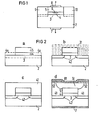
- Fig.l shows such a structure.
- This layer sequence 3, 4, 5 is a sequence B / A / B which forms the double heterolayer structure.
- the strip-shaped laser zone generating the laser radiation lies in this layer sequence.
- 7 and 8 denote contact electrodes for supplying the electric current feeding the laser diode.
- a BH laser with one or more barrier layers in the side regions 9, 10 is usually produced in two epitaxial processes.
- the double heterolayer structure 3, 4, 5 is produced over the entire surface of the substrate 2.
- This structure then becomes the laser strip, i.e. etched out a narrow web, namely the structure of which Fig.l shows the front view with the layers 3, 4, 5 and the contact electrode 8 located thereon.
- the side regions 9 and 10 which extend to the side of the web of the double heterostructure 3, 4, 5 and above the side portions of the substrate 2, are filled with semiconductor material.
- npn or pnp
- this 3-layer sequence is e.g. including the material of the substrate body 2.
- a BH laser or such a production method with such epitaxial deposits, with which the pn junctions in the side regions 9, 10 are also produced is known from US Pat. No. 4,426,700. A diffusion also described there relates only to the known production of an electrically conductive external contact.
- a laser diode of another structure namely an RIDS laser
- this RIDS laser has diffusion-doped layers over the entire surface. This full-surface diffusion in one layer is based on a corresponding full-surface diffusion of the dopant in question from one over it lying layer already present as a solid. Apart from the layer doped by this diffusion, the layer of this diffusion source also remains a permanent component of the finished laser diode.
- the RIDS laser In the case of the RIDS laser or in its production method, it is important to dope through and through a middle stripe in the layer to be doped by diffusion, but viewed in the direction of the thickness, while this is not done for the diffusion doping in the side regions.
- the original substrate body of this known diode has been provided with a web, even before the application of any epitaxial layers, which only corresponds in geometrical dimensions to a web present in a BH laser.
- the function of this ridge of the RIDS laser only serves to achieve different layer thicknesses of this first layer for at least the first layer deposited on the substrate body over the deposition surface.
- Layers to the side of the laser-active zone of RIDS laser, which block the flow of electrical current, are epitaxially produced from already doped material.
- the material of the second epitaxial process works properly on the lateral surfaces of the layer sequence 3, 4, 5, i.e. the double heterolayer structure grows, namely grows so reliably that no leakage current paths can occur between this double heterolayer structure and the respective blocking pn junction structure of the regions 9 and 10.
- the object of the invention is to provide such a manufacturing method, which leads to a semiconductor laser diode with a buried heterostructure, in which such leakage current paths are prevented and nevertheless the manufacture of this diode is not difficult.
- FIGS. 2a show the process step sequence of an exemplary embodiment of the invention.
- the substrate body 2 denotes a substrate body on which there is a double heterolayer structure 3, 4, 5, the one layer 3 (as in the example in FIG. 1) being a portion of the substrate body 2.
- the substrate body 2 and thus the layer 3 consist of indium phosphide, the layer 4 of indium gallium arsenide phosphide and the layer 5 again of indium phosphide.
- the material of the substrate body 2 and the layer 3 are n-doped and the two layers 4 and 5 are p-doped.
- the layer sequence is preferably produced by epitaxy and the geometry of the web of the strip by etching.
- the etching is carried out in such a way that this web extends exactly to below layer 4, i.e. is etched laterally to below the active zone 6 and that the material which is then laterally exposed is n-conductive. 2a shows this state reached after the etching.
- a large number of structures arranged next to one another are produced simultaneously on or in a larger semiconductor substrate wafer, as shown in FIG. 2a.
- a semiconductor substrate wafer with a large number of such structures shown for the individual component of a laser diode is subsequently brought into contact in a liquid-phase epitaxial system with a semiconductor material melt 32 containing p-dopant (for example zinc, cadmium, magnesium).
- p-dopant for example zinc, cadmium, magnesium
- This melt is selected according to the invention so that it is related to the Indiumphos phid of the substrate body 2 or the semiconductor substrate wafer containing a large number of such substrate bodies is in solution equilibrium.
- a phosphorus-saturated indium melt is used.
- the layer 3 on its surfaces 9 and 10 facing the side of the strip is exclusively p-conductive, the thickness of the diffused layer remaining limited to a few tenths of a micron. This can be controlled by choosing the duration of diffusion and the temperatures used.
- the entire diffusion process is ended by pushing off the material of the melt 31, wherein during this diffusion process at least essentially neither a growth nor a removal of semiconductor material onto or from the structure of the layer sequence 3, 4, 5 according to FIG.
- semiconductor material can subsequently be brought to epitaxial growth by pushing on a further semiconductor melt.
- n-doped indium phosphide is allowed to grow. This can either be done selectively only in the side areas 9 and 10 or (as FIG. 2c shows) over the entire area. This creates a blocking pn junction with a locally defined position in the plane of the underside of layer 4 (shown in the figures) in which the laser-active zone is located.
- n-type semiconductor material is formed above the uppermost layer 5 of the double heterolayer structure, through which a barrier-free connection from contact 8 to the double heterolayer structure would be lost. Accordingly, as can be seen from FIG. 2d, p-diffusion is carried out through a stripe mask, so that a p-type region 51 is formed in the previously applied n-indium phosphide 41.
- the stripe mask used for the diffusion of the area 51 is preferably a surface coating of, for example, silicon dioxide, which is denoted by 52 in FIG. 2D and which can remain on the structure.
- the contact electrode is designated, which e.g. is a flat metal coating.
- a variation of the above method consists in actually providing a lightly doped layer 3 on the highly doped substrate 2, as is taken into account in dashed lines in FIG. 2a.
- This layer 3 and the substrate 2 have doping of the same conductivity type, they are, for example, n-type.
- the layer 3 is preferably redoped over the entire thickness in the side regions 9 and 10 located to the side of the web ( 4 , 5) by means of the melt 31.
- the substrate 2 remains practically unchanged.
- Another variation is to first leave the entire layer 4 (together with the portions 4a) during the etching and to dissolve these portions 4a by means of the melt 31, with which the material of this layer 4, which is very thin anyway, is not in solution equilibrium.
- This variation has the advantage that this dissolution stops exactly at the boundary between layers 3 and 4, which corresponds to the above-mentioned etching exactly up to the boundary between layers 4 and 3.
- zones 42 e.g. in contrast to US Pat. No. 4,426,700, geometrically just as this is layer 3 or the portion of substrate 2 corresponding to layer 3.
- the advantageous under-diffusion under the edges of layer 4 already mentioned is also based on this measure.
- the direction of the diffusion can be detected from the diffusion profile generated.
Landscapes
- Physics & Mathematics (AREA)
- Geometry (AREA)
- Condensed Matter Physics & Semiconductors (AREA)
- General Physics & Mathematics (AREA)
- Electromagnetism (AREA)
- Optics & Photonics (AREA)
- Semiconductor Lasers (AREA)
- Liquid Deposition Of Substances Of Which Semiconductor Devices Are Composed (AREA)
Applications Claiming Priority (2)
| Application Number | Priority Date | Filing Date | Title |
|---|---|---|---|
| DE3435307 | 1984-09-26 | ||
| DE3435307 | 1984-09-26 |
Publications (2)
| Publication Number | Publication Date |
|---|---|
| EP0185854A2 true EP0185854A2 (fr) | 1986-07-02 |
| EP0185854A3 EP0185854A3 (fr) | 1987-09-23 |
Family
ID=6246403
Family Applications (1)
| Application Number | Title | Priority Date | Filing Date |
|---|---|---|---|
| EP85111869A Withdrawn EP0185854A3 (fr) | 1984-09-26 | 1985-09-19 | Diode laser à semi-conducteur à hétérostructure enterrée |
Country Status (3)
| Country | Link |
|---|---|
| US (1) | US4683574A (fr) |
| EP (1) | EP0185854A3 (fr) |
| JP (1) | JPS6180889A (fr) |
Cited By (1)
| Publication number | Priority date | Publication date | Assignee | Title |
|---|---|---|---|---|
| DE3708666A1 (de) * | 1987-03-17 | 1988-09-29 | Siemens Ag | Laseranordnung mit getrennt ansteuerbaren gekoppelten halbleiterlasern |
Families Citing this family (4)
| Publication number | Priority date | Publication date | Assignee | Title |
|---|---|---|---|---|
| EP1014455B1 (fr) | 1997-07-25 | 2006-07-12 | Nichia Corporation | Dispositif a semi-conducteur en nitrure |
| JP3770014B2 (ja) | 1999-02-09 | 2006-04-26 | 日亜化学工業株式会社 | 窒化物半導体素子 |
| WO2000052796A1 (fr) | 1999-03-04 | 2000-09-08 | Nichia Corporation | Element de laser semiconducteur au nitrure |
| TWI362769B (en) | 2008-05-09 | 2012-04-21 | Univ Nat Chiao Tung | Light emitting device and fabrication method therefor |
Family Cites Families (6)
| Publication number | Priority date | Publication date | Assignee | Title |
|---|---|---|---|---|
| JPS56157082A (en) * | 1980-05-09 | 1981-12-04 | Hitachi Ltd | Semiconductor laser device and manufacture |
| JPS56169384A (en) * | 1980-05-30 | 1981-12-26 | Nec Corp | Manufacture of semiconductor laser |
| JPS5763882A (en) * | 1980-10-06 | 1982-04-17 | Nec Corp | Manufacture of semiconductor laser |
| JPS57207388A (en) * | 1981-06-16 | 1982-12-20 | Nec Corp | Manufacture of semiconductor laser |
| JPS5943839B2 (ja) * | 1981-09-09 | 1984-10-24 | 株式会社日立製作所 | 半導体レ−ザ |
| US4597638A (en) * | 1983-02-28 | 1986-07-01 | At&T Bell Laboratories | Nonlinear optical apparatus |
-
1985
- 1985-09-12 US US06/775,399 patent/US4683574A/en not_active Expired - Fee Related
- 1985-09-19 EP EP85111869A patent/EP0185854A3/fr not_active Withdrawn
- 1985-09-20 JP JP60208566A patent/JPS6180889A/ja active Granted
Cited By (1)
| Publication number | Priority date | Publication date | Assignee | Title |
|---|---|---|---|---|
| DE3708666A1 (de) * | 1987-03-17 | 1988-09-29 | Siemens Ag | Laseranordnung mit getrennt ansteuerbaren gekoppelten halbleiterlasern |
Also Published As
| Publication number | Publication date |
|---|---|
| JPH0213469B2 (fr) | 1990-04-04 |
| EP0185854A3 (fr) | 1987-09-23 |
| US4683574A (en) | 1987-07-28 |
| JPS6180889A (ja) | 1986-04-24 |
Similar Documents
| Publication | Publication Date | Title |
|---|---|---|
| DE3919462C2 (fr) | ||
| DE2903336C2 (de) | Leuchtdioden-Anzeigeeinrichtung | |
| DE19854269A1 (de) | Dünnschichtsolarzellenanordnung sowie Verfahren zur Herstellung derselben | |
| DE102012109902A1 (de) | Leistungshalbleiterdiode, IGBT, und Verfahren für ihre Herstellung | |
| DE10207522A1 (de) | Halbleiterbauelement und Verfahren zu dessen Herstellung | |
| DE2608562C2 (fr) | ||
| DE2749607C3 (de) | Halbleiteranordnung und Verfahren zu deren Herstellung | |
| DE2600195A1 (de) | Injektionslaser und verfahren zu seiner herstellung | |
| DE2713298A1 (de) | Halbleiterlaser | |
| DE69707390T2 (de) | Strahlungsemittierende halbleiterdiode und deren herstellungsverfahren | |
| DE2509585A1 (de) | Halbleiterelement und verfahren zu dessen herstellung | |
| EP0176028B1 (fr) | Procédé de fabrication d'une diode laser à couche active enterrée et à limitation latérale de courant par jonction p-n auto-ajustée | |
| DE3887567T2 (de) | Halbleiterlaservorrichtung und Verfahren zu ihrer Herstellung. | |
| DE3805088C2 (fr) | ||
| DE2320563B2 (de) | Vierschichttriode | |
| EP0058231B1 (fr) | Réalisation de diodes électroluminescentes ou de diodes laser ayant une surface d'emission limitée | |
| EP0185854A2 (fr) | Diode laser à semi-conducteur à hétérostructure enterrée | |
| EP0002658B1 (fr) | Procédé pour la fabrication d'un dispositif semiconducteur | |
| DE1274243B (de) | Verfahren zur herstellung einer tunneldiode | |
| EP0289012A2 (fr) | Procédé pour la fabrication d'une diode laser avec couche active enterrée | |
| DE3905480A1 (de) | Halbleiterlaser und verfahren zu seiner herstellung | |
| DE68925784T2 (de) | Halbleiterlaser mit geteilter Elektrode | |
| DE2408402A1 (de) | Verfahren zur herstellung integrierter schaltungen bzw. nach einem solchen verfahren hergestellte integrierte halbleiterschaltungseinheit | |
| DE3687052T2 (de) | Halbleiterlaser. | |
| DE19938209B4 (de) | Halbleiteranordnung und Verfahren zur Herstellung |
Legal Events
| Date | Code | Title | Description |
|---|---|---|---|
| PUAI | Public reference made under article 153(3) epc to a published international application that has entered the european phase |
Free format text: ORIGINAL CODE: 0009012 |
|
| 17P | Request for examination filed |
Effective date: 19850925 |
|
| AK | Designated contracting states |
Kind code of ref document: A2 Designated state(s): DE FR GB |
|
| PUAL | Search report despatched |
Free format text: ORIGINAL CODE: 0009013 |
|
| AK | Designated contracting states |
Kind code of ref document: A3 Designated state(s): DE FR GB |
|
| STAA | Information on the status of an ep patent application or granted ep patent |
Free format text: STATUS: THE APPLICATION HAS BEEN WITHDRAWN |
|
| 18W | Application withdrawn |
Withdrawal date: 19871009 |
|
| RIN1 | Information on inventor provided before grant (corrected) |
Inventor name: HEINEN, JOCHEN DR. |