EP0186037A2 - Unabhängige Analyse von Anionen und Kationen mittels indirekter photometrischer Chromatographie - Google Patents
Unabhängige Analyse von Anionen und Kationen mittels indirekter photometrischer Chromatographie Download PDFInfo
- Publication number
- EP0186037A2 EP0186037A2 EP85115718A EP85115718A EP0186037A2 EP 0186037 A2 EP0186037 A2 EP 0186037A2 EP 85115718 A EP85115718 A EP 85115718A EP 85115718 A EP85115718 A EP 85115718A EP 0186037 A2 EP0186037 A2 EP 0186037A2
- Authority
- EP
- European Patent Office
- Prior art keywords
- eluent
- sample
- anions
- cations
- anion
- Prior art date
- Legal status (The legal status is an assumption and is not a legal conclusion. Google has not performed a legal analysis and makes no representation as to the accuracy of the status listed.)
- Withdrawn
Links
- 150000001450 anions Chemical class 0.000 title claims abstract description 137
- 150000001768 cations Chemical class 0.000 title claims abstract description 126
- 238000004587 chromatography analysis Methods 0.000 title claims description 13
- 238000004458 analytical method Methods 0.000 title description 8
- 238000002835 absorbance Methods 0.000 claims abstract description 94
- 150000002500 ions Chemical class 0.000 claims abstract description 66
- 238000000034 method Methods 0.000 claims abstract description 31
- 238000005342 ion exchange Methods 0.000 claims abstract description 22
- 239000003480 eluent Substances 0.000 claims description 155
- 230000005526 G1 to G0 transition Effects 0.000 claims description 27
- 238000005349 anion exchange Methods 0.000 claims description 12
- 238000005341 cation exchange Methods 0.000 claims description 11
- XLYOFNOQVPJJNP-UHFFFAOYSA-N water Substances O XLYOFNOQVPJJNP-UHFFFAOYSA-N 0.000 claims description 9
- AYMSUIZASXNJRV-UHFFFAOYSA-L copper;2-sulfobenzoate Chemical compound [Cu+2].OS(=O)(=O)C1=CC=CC=C1C([O-])=O.OS(=O)(=O)C1=CC=CC=C1C([O-])=O AYMSUIZASXNJRV-UHFFFAOYSA-L 0.000 claims description 7
- 230000000694 effects Effects 0.000 claims description 7
- 239000012266 salt solution Substances 0.000 claims description 4
- 239000007788 liquid Substances 0.000 claims description 3
- ZSAWQMSQHFHNIZ-UHFFFAOYSA-N benzyl(trimethyl)azanium;nitrate Chemical compound [O-][N+]([O-])=O.C[N+](C)(C)CC1=CC=CC=C1 ZSAWQMSQHFHNIZ-UHFFFAOYSA-N 0.000 claims description 2
- 239000000243 solution Substances 0.000 claims description 2
- 239000002904 solvent Substances 0.000 claims 2
- 238000012544 monitoring process Methods 0.000 abstract description 4
- 238000005259 measurement Methods 0.000 abstract description 2
- 238000001514 detection method Methods 0.000 description 23
- NHNBFGGVMKEFGY-UHFFFAOYSA-N Nitrate Chemical compound [O-][N+]([O-])=O NHNBFGGVMKEFGY-UHFFFAOYSA-N 0.000 description 14
- 229910002651 NO3 Inorganic materials 0.000 description 13
- 241000894007 species Species 0.000 description 13
- 150000003839 salts Chemical class 0.000 description 10
- VYPSYNLAJGMNEJ-UHFFFAOYSA-N Silicium dioxide Chemical compound O=[Si]=O VYPSYNLAJGMNEJ-UHFFFAOYSA-N 0.000 description 9
- -1 Ca2+ cations Chemical class 0.000 description 5
- 239000010949 copper Substances 0.000 description 5
- JJLJMEJHUUYSSY-UHFFFAOYSA-L copper(II) hydroxide Inorganic materials [OH-].[OH-].[Cu+2] JJLJMEJHUUYSSY-UHFFFAOYSA-L 0.000 description 5
- 238000000926 separation method Methods 0.000 description 5
- 238000000862 absorption spectrum Methods 0.000 description 4
- 239000003153 chemical reaction reagent Substances 0.000 description 4
- 230000009977 dual effect Effects 0.000 description 4
- 238000004255 ion exchange chromatography Methods 0.000 description 4
- 238000004811 liquid chromatography Methods 0.000 description 4
- 230000014759 maintenance of location Effects 0.000 description 4
- KCXVZYZYPLLWCC-UHFFFAOYSA-N EDTA Chemical compound OC(=O)CN(CC(O)=O)CCN(CC(O)=O)CC(O)=O KCXVZYZYPLLWCC-UHFFFAOYSA-N 0.000 description 3
- IOVCWXUNBOPUCH-UHFFFAOYSA-M Nitrite anion Chemical compound [O-]N=O IOVCWXUNBOPUCH-UHFFFAOYSA-M 0.000 description 3
- 239000000203 mixture Substances 0.000 description 3
- 125000003118 aryl group Chemical group 0.000 description 2
- 239000013522 chelant Substances 0.000 description 2
- AEJIMXVJZFYIHN-UHFFFAOYSA-N copper;dihydrate Chemical compound O.O.[Cu] AEJIMXVJZFYIHN-UHFFFAOYSA-N 0.000 description 2
- 238000011161 development Methods 0.000 description 2
- 230000018109 developmental process Effects 0.000 description 2
- 238000010586 diagram Methods 0.000 description 2
- 238000004128 high performance liquid chromatography Methods 0.000 description 2
- 238000002347 injection Methods 0.000 description 2
- 239000007924 injection Substances 0.000 description 2
- 239000012500 ion exchange media Substances 0.000 description 2
- 229910052751 metal Inorganic materials 0.000 description 2
- 239000002184 metal Substances 0.000 description 2
- 230000003287 optical effect Effects 0.000 description 2
- 230000035945 sensitivity Effects 0.000 description 2
- 239000000377 silicon dioxide Substances 0.000 description 2
- 230000003595 spectral effect Effects 0.000 description 2
- NWUYHJFMYQTDRP-UHFFFAOYSA-N 1,2-bis(ethenyl)benzene;1-ethenyl-2-ethylbenzene;styrene Chemical compound C=CC1=CC=CC=C1.CCC1=CC=CC=C1C=C.C=CC1=CC=CC=C1C=C NWUYHJFMYQTDRP-UHFFFAOYSA-N 0.000 description 1
- NLXLAEXVIDQMFP-UHFFFAOYSA-N Ammonia chloride Chemical compound [NH4+].[Cl-] NLXLAEXVIDQMFP-UHFFFAOYSA-N 0.000 description 1
- RYGMFSIKBFXOCR-UHFFFAOYSA-N Copper Chemical compound [Cu] RYGMFSIKBFXOCR-UHFFFAOYSA-N 0.000 description 1
- 239000005750 Copper hydroxide Substances 0.000 description 1
- 241000047703 Nonion Species 0.000 description 1
- NPYPAHLBTDXSSS-UHFFFAOYSA-N Potassium ion Chemical compound [K+] NPYPAHLBTDXSSS-UHFFFAOYSA-N 0.000 description 1
- QPGJEXWQNJCCSN-UHFFFAOYSA-K [Cu+3].[O-]C(=O)C1=CC(C([O-])=O)=CC(C([O-])=O)=C1 Chemical compound [Cu+3].[O-]C(=O)C1=CC(C([O-])=O)=CC(C([O-])=O)=C1 QPGJEXWQNJCCSN-UHFFFAOYSA-K 0.000 description 1
- 238000003916 acid precipitation Methods 0.000 description 1
- 150000001449 anionic compounds Chemical class 0.000 description 1
- 238000013459 approach Methods 0.000 description 1
- YOUGRGFIHBUKRS-UHFFFAOYSA-N benzyl(trimethyl)azanium Chemical compound C[N+](C)(C)CC1=CC=CC=C1 YOUGRGFIHBUKRS-UHFFFAOYSA-N 0.000 description 1
- LRRJQNMXIDXNIM-UHFFFAOYSA-M benzyl(trimethyl)azanium;iodide Chemical compound [I-].C[N+](C)(C)CC1=CC=CC=C1 LRRJQNMXIDXNIM-UHFFFAOYSA-M 0.000 description 1
- 239000003729 cation exchange resin Substances 0.000 description 1
- 229940023913 cation exchange resins Drugs 0.000 description 1
- 238000006243 chemical reaction Methods 0.000 description 1
- 239000012501 chromatography medium Substances 0.000 description 1
- 238000004891 communication Methods 0.000 description 1
- 150000001875 compounds Chemical class 0.000 description 1
- 229910052802 copper Inorganic materials 0.000 description 1
- 229910001956 copper hydroxide Inorganic materials 0.000 description 1
- XTVVROIMIGLXTD-UHFFFAOYSA-N copper(II) nitrate Chemical group [Cu+2].[O-][N+]([O-])=O.[O-][N+]([O-])=O XTVVROIMIGLXTD-UHFFFAOYSA-N 0.000 description 1
- GBRBMTNGQBKBQE-UHFFFAOYSA-L copper;diiodide Chemical compound I[Cu]I GBRBMTNGQBKBQE-UHFFFAOYSA-L 0.000 description 1
- GSCLWPQCXDSGBU-UHFFFAOYSA-L copper;phthalate Chemical compound [Cu+2].[O-]C(=O)C1=CC=CC=C1C([O-])=O GSCLWPQCXDSGBU-UHFFFAOYSA-L 0.000 description 1
- 239000008367 deionised water Substances 0.000 description 1
- 229910021641 deionized water Inorganic materials 0.000 description 1
- 238000013461 design Methods 0.000 description 1
- 229960001484 edetic acid Drugs 0.000 description 1
- 238000010828 elution Methods 0.000 description 1
- 229910052739 hydrogen Inorganic materials 0.000 description 1
- 239000001257 hydrogen Substances 0.000 description 1
- XLYOFNOQVPJJNP-UHFFFAOYSA-M hydroxide Chemical compound [OH-] XLYOFNOQVPJJNP-UHFFFAOYSA-M 0.000 description 1
- 229910001412 inorganic anion Inorganic materials 0.000 description 1
- 229910001411 inorganic cation Inorganic materials 0.000 description 1
- 239000003456 ion exchange resin Substances 0.000 description 1
- 229920003303 ion-exchange polymer Polymers 0.000 description 1
- 239000004816 latex Substances 0.000 description 1
- 229920000126 latex Polymers 0.000 description 1
- 230000031700 light absorption Effects 0.000 description 1
- 230000000873 masking effect Effects 0.000 description 1
- 239000002609 medium Substances 0.000 description 1
- 238000012856 packing Methods 0.000 description 1
- 239000002245 particle Substances 0.000 description 1
- 229910052700 potassium Inorganic materials 0.000 description 1
- OTYBMLCTZGSZBG-UHFFFAOYSA-L potassium sulfate Chemical compound [K+].[K+].[O-]S([O-])(=O)=O OTYBMLCTZGSZBG-UHFFFAOYSA-L 0.000 description 1
- 229910052939 potassium sulfate Inorganic materials 0.000 description 1
- 239000002244 precipitate Substances 0.000 description 1
- JUJWROOIHBZHMG-UHFFFAOYSA-O pyridinium Chemical compound C1=CC=[NH+]C=C1 JUJWROOIHBZHMG-UHFFFAOYSA-O 0.000 description 1
- 239000011347 resin Substances 0.000 description 1
- 229920005989 resin Polymers 0.000 description 1
- 230000000717 retained effect Effects 0.000 description 1
- 238000011896 sensitive detection Methods 0.000 description 1
- 239000000126 substance Substances 0.000 description 1
- 239000000758 substrate Substances 0.000 description 1
- 238000000825 ultraviolet detection Methods 0.000 description 1
- 239000011800 void material Substances 0.000 description 1
- 239000002699 waste material Substances 0.000 description 1
Images


Classifications
-
- G—PHYSICS
- G01—MEASURING; TESTING
- G01N—INVESTIGATING OR ANALYSING MATERIALS BY DETERMINING THEIR CHEMICAL OR PHYSICAL PROPERTIES
- G01N30/00—Investigating or analysing materials by separation into components using adsorption, absorption or similar phenomena or using ion-exchange, e.g. chromatography or field flow fractionation
- G01N30/96—Investigating or analysing materials by separation into components using adsorption, absorption or similar phenomena or using ion-exchange, e.g. chromatography or field flow fractionation using ion-exchange
-
- G—PHYSICS
- G01—MEASURING; TESTING
- G01N—INVESTIGATING OR ANALYSING MATERIALS BY DETERMINING THEIR CHEMICAL OR PHYSICAL PROPERTIES
- G01N30/00—Investigating or analysing materials by separation into components using adsorption, absorption or similar phenomena or using ion-exchange, e.g. chromatography or field flow fractionation
- G01N30/02—Column chromatography
Definitions
- This invention is in the field of ion exchange chromatography and, more particularly resides in a method and apparatus for the independent analysis of coeluting sample anions and cations in a liquid effluent using Indirect Photometric Chromatographic (IPC) techniques.
- IPC Indirect Photometric Chromatographic
- Liquid chromatography is used to separate the components of a sample substance by passing an eluent containing the sample through a column.
- the components of the sample in the eluent stream have different retention times within the column, and therefore exit the column in a particular sequence depending on the nature of the components of the sample and the nature of the column.
- the sequence of components is detected, for example, photometrically by measuring the intensity of light absorbed by the eluent stream.
- Ion exchange liquid chromatography is often complicated by limitations in the capability to detect the eluted sample ions in the column effluent.
- many inorganic and organic ions are non light-absorbing and difficult to detect using conventional photometric detectors.
- the separation of such "transparent" ions may be conveniently effected using ion exchange resin columns, the detection and measurement of these transparent ions by conventional photometric means is ineffective since they are optically indistinguishable from the transparent eluents commonly prescribed by the art.
- practices using photometers to detect ions in effluent have been effective only when the ions to be analyzed either contain chromophores or can generate chromophores through post-column reactions with appropriate reagents.
- IPC Indirect Photometric Chromatography
- Yamamoto et al noted that, "The retention times observed for Ca 2+ and Mg 2+ , injected as metal cations, and those injected as EDTA chelate anions were not significantly different.” To overcome this problem, Yamamoto et al converted the Mg2+ and Ca2+ cations to chelate anions using the EDTA eluent, separated the anion species for detection, and detected the anions using conventional chromatographic methods. Yamamoto et al specifically noted that Mg 2+ and Ca2+ could not be found except as corresponding anion peaks in the chromatogram.
- the present invention has as its object to provide a method and apparatus using indirect photometric chromatography techniques to detect independently anion and cation species of a sample within a single chromatograph even when the species have identical or nearly identical retention times.
- the technique of the present invention displaces sample anions and cations with photometrically monitorable eluent anion and cation species.
- the present invention teaches the use of an eluent containing a salt with chromophoric anion and cation species each having a known characteristic ratio of absorbance at predetermined wavelengths, and the use of certain mathematical equations to develop, independently two chromatograms, one for anions, and one for cations.
- the invention relates to a method and apparatus for detecting independently photometrically indetectable sample anions and cations using an anion exchange stationary phase and a cation exchange stationary phase, an Indirect Photometric Chromatography method of detection, a particular kind of anion and cation displacing eluent, a multiple analysis wavelength detector, circuitry for mathematically manipulating data, and a recording means.
- the invention resides in a method comprising the steps of:
- the present invention provides a method and apparatus for independently detecting photometrically indetectable anions and cations of a sample, regardless of the concentration of the sample, by chromatographically displacing the anions and cations of the sample using indirect photometric chromatography techniques.
- concentration of the sample refers to concentrations of sample within normal chromatographic limitations.
- Eluent anions and cations once photometrically detected, reveal the anion and cation of the sample by detection of the decrements caused in effluent absorbance of the eluent anions and cations when subjected to photometric monitoring at two preselected wavelengths, ⁇ 1 and ⁇ 2 .
- This method and apparatus invention is predicated on the existence of characteristic absorption spectra for the components of a selected eluent. More specifically, this invention is based on the fact that for a set of wavelengths, an eluent containing a single salt will exhibit constant absorptivity ratios, each distinctive for the anion and cation of the eluent salt. Each constant ratio is referred to hereafter as the "inherent relative absorbance ratio.”
- a d , A ⁇ , and A are absorbance signals
- R 1 2 is the inherent relative absorbance ratio for either an eluent anion or an eluent cation depending on the ion being measured. More specifically, if sample cations are to be measured then R is computed using the general formula: where A - ⁇ 1 , represents the absorbance value of the anion species of the eluent at a first wavelength and A - ⁇ 2 represents the absorbance value of the anion species at a second wavelength. If sample anions are to be measured, then R is computed using the general formula:
- R is about 0.45, i.e., and for sample cation.detection R is about 0.74, i.e.,
- R values are determined simply by ratioing cation peaks using detected absorbance at 240 and 270 nm and anion peaks using detected absorbance at these wavelengths.
- a basic feature of the invention is in the use of eluent having light absorbing anion and cation species capable of chromatographically displacing anions and cations of the sample of interest.
- the eluent must contain light-absorbing anions and cations which:
- the eluent which performs these two functions contains anions and cations which displace the transparent sample anions and cations from the column and enable the anions and cations of the sample to be detected in the column effluent as dips or troughs in the baseline absorbance of the anions and cations of the eluent.
- the eluent must contain light-absorbing anions and cations which have UV or light absorption coefficients such that the anion will not completely mask the cation, nor vice versa. Also, the eluent must contain anions and cations of appropriate displacing power to elute the sample ions from the column in a reasonable amount of time, i.e., allowing resolution of peaks without excessive peak broadening.
- An ideal eluent should contain anions and cations which exhibit absorbances of at least 0.1 AU at 10 -3 molar with a path length of 1 cm at 220 nm or above.
- the eluent should contain a "monitor/displacing" salt which is soluble in water and preferably either aromatic, organic, inorganic, polyvalent or monovalent, or a combination of these characteristics. Even more importantly, the eluent should not contain a second salt which may form spurious peaks upon photometric detection.
- the eluent should have a pH which does not affect chromatographic column packing nor destroy the ionic nature of the chromatographic column. More specifically, the eluent must not have a low pH, such as pH 1, wherein eluent hydrogen ions would begin to function as the displacing ions in place of the intended eluent ions. Similarly, the eluent must not have a. high pH, e.g., pH 12, such that the eluent precipitates metal in the eluent or alternatively causes the hydroxide to act as a displacing ion. A pH of less than 7 is preferred for most silica-based ion exchange columns. Eluents with a pH in the range of pH 4 to pH 5 are effective and useful within the teachings and principles of the invention.
- the apparatus of the invention involves a system for independently measuring anions and cations of a sample using indirect photometric chromatography, an eluent comprising a soluble salt solution having chromophoric anions and cations and having an inherent relative absorbance ratio for the anions of an eluent at selected first and second wavelengths and for the cations of the same eluent at the same first and second wavelengths.
- the invention further involves an anion exchange stationary phase, a cation exchange stationary phase and a detector connected in series.
- the invention includes means for forming a stream of eluent flowing through the anion exchange stationary phase and the cation exchange stationary phase to the detector.
- the invention involves means for introducing a sample of interest into the stream of eluent and flowing the sample and eluent through the anion exchange and cation exchange stationary phase means to produce an effluent.
- the detector is preferably a multiple wavelength detector with means for receiving the effluent from the ion exchange stationary phases and measuring the total absorbance of the anions and cations in the effluent at a first wavelength and a second wavelength.
- the apparatus invention also includes circuitry responsive to the detector with means for using the inherent relative absorbance ratios distinctive for the eluent anions and cations and the detected total absorbance values for the effluent at first and second wavelengths to determine separately sample anion and sample cation concentrations.
- the apparatus invention can further involve recording means for recording the individual responses corresponding to the anions and cations of the sample.
- the particular circuitry of the instant invention consists of means for using the inherent relative absorbance ratio for each eluent ion to scale the detected total absorbance value of the effluent ions at a first wavelength to produce a scaled value and subtracting the detected total absorbance value of the effluent at a second wavelength from the scaled detected total absorbance value at the first wavelength to produce individual absorbance values for the eluent anion and cation, eliminating the effect of fluctuations in eluent anion and cation concentrations and subsequently revealing fluctuations in sample anion and cation concentrations.
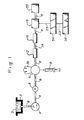
- FIG. 1 there is shown a typical diagram of an ion exchange chromatography system or apparatus which is desirably used in practicing the invention.
- the apparatus includes separating means such as two liquid chromatography columns 12 and 16 which are packed with media capable of performing ion exchange separations.
- Most chromatographic ion exchange media are in the pellicular or micro-particular form.
- the invention may employ a non-ion exchange chromatographic medium which is or can be rendered ion exchange-performing under the influence of the specified eluent.
- a C 18 reverse phase LC column could be used as one of the preferred separating means; such as the work reported by Skelly, N. E. Anal. Chem., 54, No. 4, 1982, pp. 712-715.
- Detector 19 is a flow-through UV photometer with micro-volume cell design for high performance liquid chromatography (HPLC) applications. Detector 19 is connected with waste vessel 38 for receiving the analyzed effluent.
- Sample may be placed into the eluent stream flowing into column 12 using any suitable device but preferably using a syringe 9 to load an injection valve 6 having a sample loop 35.
- the injected sample is swept through column 12 and then column 16 with eluent 3 containing monitor/displacing light-absorbing anions and cations.
- Eluent 3 is drawn through tubing 8 from eluent reservoir 2 preferably using a chromatographic pump 4.
- the pressure of the eluent stream is preferably monitored by a pressure gauge 5.
- a first ion exchange occurs in column 12.
- Effluent from column 12 is passed through tubing 14 to column 16 wherein a second ion exchange appears.
- Effluent from column 16, containing resolved anions and cations is flowed to the photometric detector 19 through tubing 8.
- Tubing 8 preferably is conventional tubing with a 0.5 mm I.D.
- Tubing 14 is preferably a short length of 1.5 mm HPLC tubing.
- Photometric detector 19 is in electronic communication with circuitry 34 and recording means 36.
- pump 4 of this embodiment is a standard liquid chromatographic pump capable of operation with non-pulsing flow rates in the appropriate range.
- pump 4 could utilize a flow rate in the range of greater than 0.5 cc/min and less than 5 cc/min.
- the pump 4 is capable of providing pressure on the system within the range of from 685 to 41350 kPa.
- the columns of this embodiment are preferably anion exchange and cation exchange columns connected in series as columns 12 and 16.
- the particular columns useful in this method and apparatus are columns with a total capacity in milliequivalents (meq) preferably in the range of 10- 3 to 10 meq.
- Silica columns are particularly useful in this invention.
- Other columns which can be used within the principles and teachings of this invention include surface sulfonated cation exchange resins and surface agglomerated latex anion exchangers with resin substrates.
- separating columns useful in this invention are preferably commercially available anion and cation exchange columns with low anion and cation exchange capacities.
- the separating columns are strong anion and cation exchangers.
- a ZIPAX® SAX or SCX duPont column, with prepacked dimensions of 2.1 mm x 500 mm is useful within the principles and teachings of this invention.
- Detector 19 is preferably an ultraviolet light detector; however, another detector can be used within the scope of the invention provided the detector offers a variable parameter to selectively enhance the detectability of eluent components.
- the absorbance of the light-absorbing eluent anions and cations is measured both at a first wavelength ⁇ 1 and at a second wavelength ⁇ 2 . These measured absorbance values are then converted into signals which are passed by means 25 to circuitry 34 for mathematical manipulation.
- the circuitry 34 determines the absorbance difference values for cations and anions individually using the general formula: for measuring ions in the sample, wherein
- a computer may be used as the circuitry 34 to reveal the individual chromatograms or alternatively store and process the chromatographic patterns into sample ion data without recording the actual chromatograms. Similary, the circuitry 34 can be used for sample cation chromatograms.
- Recording means 36 can consist of any form of storage device, such as a computer memory, chart paper or digital readouts.
- concentrations of sample anion and cation can be determined independently and simultaneously using the above described apparatus.
- the method and apparatus of the present invention require a specified eluent to achieve the objects of the invention.
- the preferred characteristics of the eluent are described in the subsequent paragraphs.
- An ideal eluent is one which can exhibit UV absorbance spectra with a maximum absorbance wavelength for anion absorbance and a minimum absorbance wavelength for cation absorbance.
- an ideal eluent is one which can exhibit UV absorbance spectra with a minimum absorbance wavelength for anion absorbance and a maximum absorbance wavelength for cation absorbance.
- the eluent should have an absorbance within a range of 0.1 to 3.0 AU at the selected wavelengths. In the preferred embodiment, the eluent should exhibit an absorbance within the range of 0.5 to 1.5 AU at suitable wavelengths.
- the eluent should also have UV absorbing qualities capable of revealing low concentrations of transparent anions and cations during Indirect Photometric Chromatography (IPC).
- An ideal eluent should contain less than about 5 x 10 -2 molar of displacing anions and cations for the purpose of sensitive detection using the IPC method of analysis.
- a preferred molarity for the eluent is within the range of 5 x 10 to 5 x 10- 2 molar, ideally between 5 x 10 -5 to 5 x 10 -3 .
- An ideal eluent has an eluting power such that it produces a sample ion k' within the range of 0.5 to 50 at eluent concentrations ranging from 10 -5 to 10 -1 molar.
- a preferred eluent develops k' within the range of 1 to 20 at concentrations ranging from 10 -5 to 10 molar. (k' refers to the expression: where V E equals sample ion elution volume and V is the void volume).
- the eluent of the instant invention should be capable of being easily prepared from analytical grade reagents and capable of being prepared so that no secondary salt is present.
- One such preferred eluent which exhibits two different absorption spectra for its anion and cation, is easily prepared from analytical reagent grade ortho-sulfobenzoic acid cyclic anhydride (o-SBA) and copper (II) hydroxide.
- This preferred eluent comprises copper ortho-sulfobenzoate having the structural formula:
- a particularly effective eluent salt is one which is multivalent, aromatic, and with a high molecular weight.
- Effective eluents are prepared by dissolving weighed amounts of the salts in deionized LC quality water.
- copper ortho-sulfobenzoate can be prepared by dissolving known weights of o-SBA cyclic anhydride and C U (OH) 2 in deionized water to give the required equi-normal concentrations.
- eluents which meet these criteria . include benzyl-trimethylammonium nitrate. Benzyl- trimethylammonium eluent cation, (BTA ), exhibits an inherent.relative absorbance ratio of about 5.13 for sample anion detection, i.e.,
- nitrate eluent anion (NO - 3 ) exhibits an inherent relative absorbance ratio of about 0.025, i.e.,
- Cu +2 (NO 3 - ) 2 Another eluent is copper nitrate (Cu +2 (NO 3 - ) 2 ).
- Cu +2 exhibits an inherent relative absorbance ratio of 0.248 for sample anion detection, i.e.,
- nitrate the eluent anion
- the equi-normal nitrate is very weak as a displacing ion relative to divalent copper and the sample anions are highly retained relative to sample cations.
- Additional eluents that have been considered include copper phthalate, copper trimesate, copper iodide, and pyridinium (aromatic cation) salts.
- spectral data shows that one ion of the pair would exhibit an extreme degree of optical absorbance relative to the other, masking the counterion's absorbance at every wavelength.
- Benzyltrimethyl ammonium iodide (BTA I ) would be expected to be suitable using 250 and 270 nm detection wavelengths but monovalency would again be expected to limit sensitivity relative to divalent Cu o-SB.
- the apparatus includes an eluent reservoir, a Laboratory Data Control (LDC) Constametric I pump, a Rheodyne Model 7010 injection valve, a duPont ZIPAX® SAX column, and a duPont ZIPAX® SCX column both prepacked and having a dimension of 2.1 mm x 500 mm, a Micromeritics Model 788 dual variable wavelength detector and a Linear Model 585 dual channel recorder.
- LDC Laboratory Data Control
- the preferred eluent is prepared from analytical reagent grade ortho-sulfobenzoic acid cyclic anhydride (o-SBA), and copper hydroxide to form a 5 x 10 -4 molar mobile phase copper ortho-sulfobenzoate eluent. More particularly, the 5 x 10 -4 molar copper ortho-sulfobenzoate eluent is prepared by dissolving 92.1 milligrams of ortho-sulfobenzoic acid cyclic anhydride (FW 184.17) and 48.8 milligrams of copper (II) hydroxide (FW 97.54) into each liter of water (LC quality water). The solution is stirred until all particles are dissolved and the pH of the eluent is measured to be in the range of pH 4 to pH 6.
- Eluent is placed in the reservoir and the LDC Constametric pump draws eluent from the reservoir and pumps it to a duPont ZIPAX® SAX column at a flow rate of about 1.0 milliliter per minute with an inlet pressure of 15160 kPa psi for this first of the two columns in series.
- a 20 microliter sample aliquot containing 10-3 molar of NH 4 Cl and 10 -3 molar K 2 SO 4 is injected into the stream of eluent between the pump and the first column using the Rheodyne Model 7010 sample injector valve. Anion exchange occurs in the first column and effluent from the first column then proceeds into a second ZIPAX® SCX column.
- the inlet pressure for the second column is approximately 7580 kPa and approaches 0 between the inlet and outlet of this ZIPAX @ SCX column.
- Effluent from the SCX column is flowed into a Micromeritics Model 788 dual variable wavelength detector.
- the effluent from the second column enters a cell having windows disposed at opposite ends.
- Light is passed from a light source through the first set of windows, the effluent, and a second set of windows to a variable angle concave grating which separates the light waves into at least two distinct wavelengths.
- the light beams at these wavelengths are then detected.
- UV detection is performed at two wavelengths, 270 and 240 nm.
- the instrument then passes the detected effluent absorbance values to circuitry or alternatively other means for mathematically manipulating the data relative to the general formula
- a d RA ⁇ - A ⁇ . 1 2
- the manipulated data is subsequently communicated to a Linear Model 585 multichannel recorder.
- sample anions and cations exhibit two different but constant ratios of peak heights or areas at 270 nm relative to 240 nm.
- These known inherent relative absorbance ratios are values equivalent to the ratios of the inherent molar absorptivities of Cu ++ and o-SB at the two wavelengths, 270 nm and 240 nm, in accordance with the principles of IPC. This feature allows immediate identification of peaks as anion or cation.
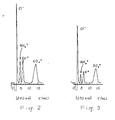
- FIGS. 1-5 are the chromatograms resulting from using Cu o-SB in accordance with the parameters of Example 1.
- Figure 2 is the chromatogram measured at 240 nm.
- Figure 3 is the chromatogram measured at 270 nm.
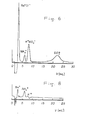
- the independent analysis of anions and cations results in the chromatograms of Figures 7 and 8, respectively.
- Figure 8 shows the interference of a negative peak with the K + peak.
- This interference is due to the absorbance of NO 3 - ion at 240 nm which results in an interference with the detection mode of IPC resulting in a peak height ratio different from 0.74.
- This kind of chromatographic result will occur for those few sample ions that absorb at either 270 nm or 240 nm wavelengths of detection.
- This peak interference difficulty is easily overcome if the sample ion is transparent at one of the detection wavelengths, as is the case with nitrite (NO - 2 ) and nitrate (NO - 3 ).
- This example shows the applicability of the present invention to the chromatographic analysis of anions and cations in complex mixtures including nitrite and nitrate.
- a 20 ⁇ l 10 -3 M sample containing Na , NH + 4 , K + , Cl - , NO - 2 , Br - , and NO3 is injected into the system using a mobile phase of 2.5 x 10 -4 M copper ortho-sulfobenzoate.
- Figure 9 shows the combined chromatogram observed at 270 nm, where both nitrite and nitrate are transparent.
- Figure 10 illustrates the anion chromatogram developed using the method of the invention.
- the potassium (K + ) peak, coeluting with nitrate, is quantified from the difference in peak magnitudes between the combined peak ( Figure 9) and the nitrate peak alone ( Figure 10).
Landscapes
- Physics & Mathematics (AREA)
- Health & Medical Sciences (AREA)
- Life Sciences & Earth Sciences (AREA)
- Chemical & Material Sciences (AREA)
- Analytical Chemistry (AREA)
- Biochemistry (AREA)
- General Health & Medical Sciences (AREA)
- General Physics & Mathematics (AREA)
- Immunology (AREA)
- Pathology (AREA)
- Investigating Or Analysing Materials By The Use Of Chemical Reactions (AREA)
- Investigating Or Analysing Materials By Optical Means (AREA)
Applications Claiming Priority (2)
| Application Number | Priority Date | Filing Date | Title |
|---|---|---|---|
| US06/682,032 US4567753A (en) | 1984-12-12 | 1984-12-12 | Independent analysis of anions and cations using indirect photometric chromatography |
| US682032 | 1984-12-12 |
Publications (2)
| Publication Number | Publication Date |
|---|---|
| EP0186037A2 true EP0186037A2 (de) | 1986-07-02 |
| EP0186037A3 EP0186037A3 (de) | 1989-03-22 |
Family
ID=24737910
Family Applications (1)
| Application Number | Title | Priority Date | Filing Date |
|---|---|---|---|
| EP85115718A Withdrawn EP0186037A3 (de) | 1984-12-12 | 1985-12-10 | Unabhängige Analyse von Anionen und Kationen mittels indirekter photometrischer Chromatographie |
Country Status (5)
| Country | Link |
|---|---|
| US (1) | US4567753A (de) |
| EP (1) | EP0186037A3 (de) |
| JP (1) | JPS61144567A (de) |
| AU (1) | AU563434B2 (de) |
| CA (1) | CA1232323A (de) |
Cited By (1)
| Publication number | Priority date | Publication date | Assignee | Title |
|---|---|---|---|---|
| EP0359322A3 (de) * | 1988-09-16 | 1991-09-11 | Koninklijke Philips Electronics N.V. | Flüssigchromatographie |
Families Citing this family (9)
| Publication number | Priority date | Publication date | Assignee | Title |
|---|---|---|---|---|
| DE3633842A1 (de) * | 1986-10-04 | 1988-04-14 | Kernforschungsanlage Juelich | Verfahren zur analyse von wasser sowie vorrichtung zur durchfuehrung dieses verfahrens |
| US4865746A (en) * | 1987-01-23 | 1989-09-12 | Exxon Research And Engineering Company | Chromatographic analysis of hydrocarbons |
| US4908676A (en) * | 1987-12-18 | 1990-03-13 | Bio-Recovery Systems, Inc. | Sensors for dissolved substances in fluids |
| US4988446A (en) * | 1988-05-14 | 1991-01-29 | Exxon Research And Engineering Company | Method for spectroscopic analysis of hydrocarbons |
| US5076909A (en) * | 1988-05-14 | 1991-12-31 | Exxon Research And Engineering Company | Method for refining or upgrading hydrocarbons with analysis |
| US5958227A (en) * | 1997-07-15 | 1999-09-28 | Tosoh Corporation | Liquid chromatograph apparatus with a switching valve |
| US9694301B2 (en) * | 2012-05-10 | 2017-07-04 | Agilent Technologies, Inc. | Two-dimensional fluid separation with controlled pressure |
| CN104937453B (zh) | 2013-02-19 | 2017-07-14 | 富士胶片株式会社 | 近红外线吸收性组合物及其应用、照相机模块及其制造方法、磺酸铜络合物及其混合物 |
| CN117309795A (zh) * | 2023-09-22 | 2023-12-29 | 浙江大学 | 一种结合电渗析的总氮紫外光度检测法及电渗析装置 |
Family Cites Families (9)
| Publication number | Priority date | Publication date | Assignee | Title |
|---|---|---|---|---|
| US4017262A (en) * | 1973-08-06 | 1977-04-12 | The Dow Chemical Company | Chromatographic apparatus for analysis of ionic species |
| US3920397A (en) * | 1973-08-06 | 1975-11-18 | Dow Chemical Co | Apparatus and method for quantitative analysis of ionic species by liquid column chromatography |
| US3918906A (en) * | 1973-08-06 | 1975-11-11 | Dow Chemical Co | Determining total ionic content |
| US4265634A (en) * | 1980-03-10 | 1981-05-05 | Dionex Corporation | Chromatographic separation and quantitative analysis of ionic species |
| US4414842A (en) * | 1980-05-27 | 1983-11-15 | The Dow Chemical Company | Ion exchange chromatography with indirect photometric detection |
| CA1168705A (en) * | 1980-05-27 | 1984-06-05 | Hamish Small | Ion exchange chromatography with indirect photometric detection |
| US4367041A (en) * | 1980-08-25 | 1983-01-04 | Micromeritics Instrument Corporation | Chromatograph detection system |
| US4383047A (en) * | 1981-02-17 | 1983-05-10 | The Dow Chemical Company | High performance anion-exchange chromatographic packing composition |
| US4629705A (en) * | 1984-05-31 | 1986-12-16 | The Dow Chemical Company | Indirect-photometric chromatography done in and with a variable capacity weakly basic or acidic ion exchange column |
-
1984
- 1984-12-12 US US06/682,032 patent/US4567753A/en not_active Expired - Fee Related
-
1985
- 1985-11-18 AU AU49993/85A patent/AU563434B2/en not_active Ceased
- 1985-11-18 CA CA000495519A patent/CA1232323A/en not_active Expired
- 1985-12-10 EP EP85115718A patent/EP0186037A3/de not_active Withdrawn
- 1985-12-12 JP JP60280183A patent/JPS61144567A/ja active Pending
Cited By (1)
| Publication number | Priority date | Publication date | Assignee | Title |
|---|---|---|---|---|
| EP0359322A3 (de) * | 1988-09-16 | 1991-09-11 | Koninklijke Philips Electronics N.V. | Flüssigchromatographie |
Also Published As
| Publication number | Publication date |
|---|---|
| JPS61144567A (ja) | 1986-07-02 |
| CA1232323A (en) | 1988-02-02 |
| AU563434B2 (en) | 1987-07-09 |
| AU4999385A (en) | 1986-06-19 |
| US4567753A (en) | 1986-02-04 |
| EP0186037A3 (de) | 1989-03-22 |
Similar Documents
| Publication | Publication Date | Title |
|---|---|---|
| CA1042988A (en) | Dual ion chromatograph using parellel columns | |
| Reuhs et al. | High-performance liquid chromatography | |
| Barth et al. | Column liquid chromatography | |
| Sah | Nitrate‐nitrogen determination—a critical review | |
| Iskandarani et al. | Simultaneous independent analysis of anions and cations using indirect photometric chromatography | |
| JPS62223668A (ja) | イオンクロマトグラフイ方法および装置 | |
| Barber et al. | Ultraviolet visualization of inorganic ions by reversed-phase ion-interaction chromatography | |
| US4567753A (en) | Independent analysis of anions and cations using indirect photometric chromatography | |
| Ghanjaoui et al. | High performance liquid chromatography quality control | |
| Wojasińska et al. | Ion chromatographic speciation of chromium with diphenylcarbazide-based spectrophotometric detection | |
| Smith et al. | Determination of metal ions by liquid chromatography incorporating dithiocarbamates in the eluent | |
| Jenke | Modeling of analyte behavior in indirect photometric chromatography | |
| US4414842A (en) | Ion exchange chromatography with indirect photometric detection | |
| CA1168705A (en) | Ion exchange chromatography with indirect photometric detection | |
| US4679428A (en) | Independent analysis of anions and cations using indirect photometric chromatography | |
| Tabatabai et al. | Liquid chromatography | |
| Zerbinati et al. | Determination of aromatic sulphonates in surface waters by high-performance liquid chromatography with coupled fluorescence and UV detection | |
| d'Angelo et al. | Fluoride, chloride, nitrate, and sulfate in aqueous solution by chemically suppressed ion chromatography | |
| US5132018A (en) | Isoconductive gradient ion chromatography | |
| Chauret et al. | Characterization of indirect photometry for the determination of inorganic anions in natural water by ion chromatography | |
| Golombek et al. | 2, 4-Dihydroxybenzoic acid as a novel eluent in single column anion chromatography | |
| Vleugels | Weathering of bare and treated limestone under field exposure conditions in Belgium: Study of the runoff water from micro-catchment units | |
| Kosobucki et al. | Isotachophoresis | |
| Pomeranz et al. | High-performance liquid chromatography and ion chromatography | |
| JPH102892A (ja) | 液相クロマトグラフィーによって、溶液中に存在するPu(IV)、Pu(VI)、ウラン及び硝酸塩から選択される少なくとも1種の元素を測定する方法 |
Legal Events
| Date | Code | Title | Description |
|---|---|---|---|
| PUAI | Public reference made under article 153(3) epc to a published international application that has entered the european phase |
Free format text: ORIGINAL CODE: 0009012 |
|
| 17P | Request for examination filed |
Effective date: 19851210 |
|
| AK | Designated contracting states |
Kind code of ref document: A2 Designated state(s): DE FR GB IT NL |
|
| PUAL | Search report despatched |
Free format text: ORIGINAL CODE: 0009013 |
|
| AK | Designated contracting states |
Kind code of ref document: A3 Designated state(s): DE FR GB IT NL |
|
| 17Q | First examination report despatched |
Effective date: 19910111 |
|
| STAA | Information on the status of an ep patent application or granted ep patent |
Free format text: STATUS: THE APPLICATION IS DEEMED TO BE WITHDRAWN |
|
| 18D | Application deemed to be withdrawn |
Effective date: 19930701 |
|
| RIN1 | Information on inventor provided before grant (corrected) |
Inventor name: ISKANDARANI, ZIAD Inventor name: MILLER, THEODORE EDWARD, JR. |