EP0186080A2 - Procédé de fabrication d'un élément adhésif à propriétés thermoplastiques et son procédé d'utilisation - Google Patents
Procédé de fabrication d'un élément adhésif à propriétés thermoplastiques et son procédé d'utilisation Download PDFInfo
- Publication number
- EP0186080A2 EP0186080A2 EP85115976A EP85115976A EP0186080A2 EP 0186080 A2 EP0186080 A2 EP 0186080A2 EP 85115976 A EP85115976 A EP 85115976A EP 85115976 A EP85115976 A EP 85115976A EP 0186080 A2 EP0186080 A2 EP 0186080A2
- Authority
- EP
- European Patent Office
- Prior art keywords
- adhesive
- melt adhesive
- layer support
- hot melt
- sheet stack
- Prior art date
- Legal status (The legal status is an assumption and is not a legal conclusion. Google has not performed a legal analysis and makes no representation as to the accuracy of the status listed.)
- Granted
Links
- 230000001070 adhesive effect Effects 0.000 title claims abstract description 67
- 239000000853 adhesive Substances 0.000 title claims abstract description 65
- 238000000034 method Methods 0.000 title claims abstract description 19
- 229920001169 thermoplastic Polymers 0.000 title claims abstract description 8
- 239000004416 thermosoftening plastic Substances 0.000 title claims abstract description 8
- 238000004519 manufacturing process Methods 0.000 title abstract description 5
- 230000000694 effects Effects 0.000 title description 8
- 239000000463 material Substances 0.000 claims abstract description 9
- 239000007788 liquid Substances 0.000 claims abstract description 8
- 238000005452 bending Methods 0.000 claims abstract description 5
- 239000004831 Hot glue Substances 0.000 claims description 38
- 239000010410 layer Substances 0.000 claims description 38
- 238000000576 coating method Methods 0.000 claims description 27
- 239000011248 coating agent Substances 0.000 claims description 23
- 238000010438 heat treatment Methods 0.000 claims description 13
- 238000003825 pressing Methods 0.000 claims description 9
- 238000004026 adhesive bonding Methods 0.000 claims description 7
- 239000004744 fabric Substances 0.000 description 4
- 239000000835 fiber Substances 0.000 description 4
- 239000003292 glue Substances 0.000 description 4
- 239000000758 substrate Substances 0.000 description 4
- 239000012790 adhesive layer Substances 0.000 description 3
- 238000001816 cooling Methods 0.000 description 3
- 238000005516 engineering process Methods 0.000 description 3
- 239000004952 Polyamide Substances 0.000 description 2
- 229920002678 cellulose Polymers 0.000 description 2
- 239000001913 cellulose Substances 0.000 description 2
- 238000005520 cutting process Methods 0.000 description 2
- 239000006185 dispersion Substances 0.000 description 2
- 239000000428 dust Substances 0.000 description 2
- 239000011491 glass wool Substances 0.000 description 2
- 238000003801 milling Methods 0.000 description 2
- 239000004033 plastic Substances 0.000 description 2
- 229920002647 polyamide Polymers 0.000 description 2
- 229920000728 polyester Polymers 0.000 description 2
- 239000011148 porous material Substances 0.000 description 2
- 238000007788 roughening Methods 0.000 description 2
- 240000003538 Chamaemelum nobile Species 0.000 description 1
- 235000007866 Chamaemelum nobile Nutrition 0.000 description 1
- 235000007232 Matricaria chamomilla Nutrition 0.000 description 1
- 239000003779 heat-resistant material Substances 0.000 description 1
- 239000012943 hotmelt Substances 0.000 description 1
- 230000001771 impaired effect Effects 0.000 description 1
- 238000002372 labelling Methods 0.000 description 1
- 239000007791 liquid phase Substances 0.000 description 1
- 239000000155 melt Substances 0.000 description 1
- 238000004806 packaging method and process Methods 0.000 description 1
- 235000011837 pasties Nutrition 0.000 description 1
- 238000005096 rolling process Methods 0.000 description 1
- 230000035939 shock Effects 0.000 description 1
Images
Classifications
-
- C—CHEMISTRY; METALLURGY
- C09—DYES; PAINTS; POLISHES; NATURAL RESINS; ADHESIVES; COMPOSITIONS NOT OTHERWISE PROVIDED FOR; APPLICATIONS OF MATERIALS NOT OTHERWISE PROVIDED FOR
- C09J—ADHESIVES; NON-MECHANICAL ASPECTS OF ADHESIVE PROCESSES IN GENERAL; ADHESIVE PROCESSES NOT PROVIDED FOR ELSEWHERE; USE OF MATERIALS AS ADHESIVES
- C09J5/00—Adhesive processes in general; Adhesive processes not provided for elsewhere, e.g. relating to primers
- C09J5/06—Adhesive processes in general; Adhesive processes not provided for elsewhere, e.g. relating to primers involving heating of the applied adhesive
-
- C—CHEMISTRY; METALLURGY
- C09—DYES; PAINTS; POLISHES; NATURAL RESINS; ADHESIVES; COMPOSITIONS NOT OTHERWISE PROVIDED FOR; APPLICATIONS OF MATERIALS NOT OTHERWISE PROVIDED FOR
- C09J—ADHESIVES; NON-MECHANICAL ASPECTS OF ADHESIVE PROCESSES IN GENERAL; ADHESIVE PROCESSES NOT PROVIDED FOR ELSEWHERE; USE OF MATERIALS AS ADHESIVES
- C09J7/00—Adhesives in the form of films or foils
- C09J7/30—Adhesives in the form of films or foils characterised by the adhesive composition
- C09J7/35—Heat-activated
Definitions
- the invention relates to a method for producing a thermoplastic adhesive element according to the preamble of the main claim.
- Adhesive elements of this type are predominantly used in bookbinding technology in order to glue the sheet edges of loose-leaf stacks to one another and to connect folds or envelopes to the back of the sheet stack.
- thermoplastic adhesive melts. In this liquid phase, the adhesive should not only lie along the sheet edges, but also, if possible, in a slight width between these sheet edges. If the adhesive dries after cooling, all the sheets in the sheet stack are firmly connected to one another.
- an adhesive strip is formed exclusively from a hot melt adhesive, which is hard set in its film property. If such an adhesive strip is placed between an envelope and the back of the sheet stack and the envelope is pressed against the sheet stack under the action of heat, the edges of the sheet are not only adhesively bonded to one another, but also to the envelope.
- the known adhesive elements are also used for other adhesive purposes, for example for labeling or for connecting materials that are difficult to glue.
- the aim is to use hot-melt adhesive with a hard setting in the film property, because these have the advantage that a cooled coating is absolutely non-adhesive.
- the adhesive property only arises with heating at certain temperatures.
- the invention is based on the object of increasing the effectiveness of such adhesive elements provided with hot-melt adhesive layers in different directions, on the one hand by significantly improving machine adhesive processes and on the necessary equipment being constructively simplified and therefore cheaper, and on the other hand by opening up the possibilities, previously difficult or to be able to glue together materials that cannot be glued at all.
- this object is achieved by the characterizing features of the main claim, according to which novel adhesive elements can be produced in which the layer support consists of a heat-resistant material which is permeable to hot-melt adhesive in liquid form and only on one side a coating of a hot-melt adhesive which is not hard-set in the film property with reduced bending stiffness.
- Permeable layer supports can be formed in a wide variety of ways, for example by providing a non-permeable material with a large number of openings, slots or other openings. Woven and knitted fabrics can also be used. Layer supports made from a nonwoven have proven to be particularly suitable, with “nonwoven” being understood to mean a fiber layer in sheet or strip form which has sufficient strength to be able to handle it. It has proven to be advantageous to use fibers made of cellulose, polyamide, polyester, glass wool and the like.
- the required heat resistance of the layer support is based on the fact that it is coated with a heated hot melt adhesive and therefore must remain dimensionally stable at temperatures of approximately 160 to 200 ° C.
- the adhesive to be provided for the coating is primarily required to have no or only an insignificant clinging effect in the hardened state.
- the hot melt adhesive according to the invention is consequently not stiff, but rather is lobed, supple or the like, which also manifests itself in the fact that the hot melt adhesive layer has a reduced bending stiffness.
- the coating can also be adhesive, with the result that the coatings must not be allowed to lie against one another.
- CH-PS 533 514 an adhesive element in the form of a film which carries a lattice fabric on one side which is connected to it via a hot melt adhesive which is intended to penetrate through the pores of the lattice fabric.
- the method for producing these adhesive elements is based on pressing the heated hotmelt adhesive through the pores of the mesh fabric onto the film using a roller.
- the hot melt adhesive coating has a greater thickness, e.g. 200 p to 500 p than would be required for one-sided gluing of the layer support. It may even be expedient to dimension the thickness of the hot melt adhesive layer to be greater than the thickness of the layer support.
- the paradox is resolved, which apparently consists in coating a permeable layer support on one side with a certain hot-melt adhesive without the adhesive getting to the other side and, on the other hand, expecting this adhesive element to allow that in the real case of adhesion that the coating penetrates the layer support.
- the invention further relates to a method for gluing objects using the adhesive element according to the invention, in which the coated side of the adhesive element is first fixed to an object using moderate heat, whereupon both objects are brought together and increased with one another in the required for the gluing Temperature to be pressed. Tacking the adhesive element under moderate heat should only make the surface of the coating sticky to pasty, but not to put it in a liquid state. The coating only becomes liquid and penetrates the substrate of the adhesive element when heat is applied at an elevated temperature.
- the adhesive process according to the invention is carried out in such a way that the adhesive element is adhered to a sheet stack back, the sheets of which have to be trimmed smooth and do not need to be roughened, then an uncoated envelope is brought up to the sheet stack back and pressed under the action of heat, the sheet stack being pressed with the pressed envelope is guided along a heating section.
- a suitable device for performing this method is specified in claim 12.
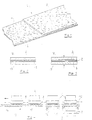
- the layer support 2 is permeable. In the illustration in FIG. 1, it consists of a fleece formed by fibers 4, in particular of cellulose and polyamide. Polyester, glass wool and the like. However, an inherently impermeable material, for example paper, plastic and the like, can also be used, which has been made permeable by making holes, recesses, perforations and the like.
- the layer support 2 can be sheet-like, strip-like, label-like and the like.
- the coating 3 consists of a hot-melt adhesive with a setting that is not hard in the film property, but rather rather lappy or supple.
- hot melt adhesives have been marketed by the applicant for example under the designations HM 109 KF or Opimelt 828 (WZ).
- the coating 3 is only provided on one side of the layer support 2. This means that such adhesive elements, whose coating surface has slightly adhesive properties, can be handled, e.g. when stacking or rolling on each other, the surfaces of the coatings 3 never come to rest
- Such coatings 3 of hot-melt adhesives which are not set hard are applied in a special way to layer support 2, namely by ensuring that the material in the order cannot penetrate through the permeable layer support 2. This is achieved, for example, by cooling the layer support during the coating process, so that the still hot melt adhesive experiences a cold shock immediately after application and cures spontaneously. The same effect can be achieved by moving the substrate along the coating device at a correspondingly high speed.
- the hot melt adhesive can be applied in a certain viscosity, for example using the Rakef process. This also ensures that the hot-melt adhesive solidifies before it can penetrate the layer support 2.
- a layer support 2 constructed in this way is now brought between two objects 16, 17 to be connected. It can be seen that the coating. abuts object 17 and the uncoated side of layer support 2 abuts object 16. If one heats this arrangement according to FIG. 2 and presses it together in the sense of FIG. 3, the coating 3 becomes liquid and migrates through the layer support 2. The coating 3, which has lost its thickness, can now be seen on both sides of the layer support 2. This is the reason why the adhesive element 1 according to FIG. 1 is covered with a relatively thick coating 3, for example in the order of 200 p to 500 p.
- the sheet stacks 6 to be glued need only be cut on the back. It is not necessary to roughen or mill the sheet edges.
- the stack of sheets 6 are clamped between the jaws 5 and moved along a conveyor 7.
- the adhesive elements 1 are provided in the form of an adhesive element roll 8, from each of which an adhesive element 1 is separated by means of a cutting device 9.
- the adhesive element 1 prepared in this way in accordance with the block format is pressed against the back of the sheet stack with the aid of the pressing device 10 and is slightly heated in the process. In this way, it should only be achieved that the adhesive element 1 adheres to the back of the sheet stack
- the individual envelope 11 is pressed against the adhesive element 1 and the sheet stack back from below with the aid of the pressing device 12, intensive heating being used to liquefy the hot melt adhesive.
- the contact pressure of the envelope 11 on the adhesive element 1 and on the sheet stack 6 is maintained along the heating section 13 with the aid of the pressure rollers 14.
- the heating section 13 is formed, for example, by a heating frame 15
- the hot-melt adhesive has sufficient time on the one hand to bind the sheets and on the other hand to bring the envelope 11 to the back of the sheet stack.
- the cooling, curing of the adhesive and removal of the finished book blocks is then carried out in the usual way.
- a sheet stack bound in this way and suspended in an envelope no longer has any appreciable clinging effect on the adhesive layer. Rather, the sheet edges are embedded in a smooth or lobed adhesive layer that has a reduced bending stiffness.
- books, brochures and the like produced according to the invention can be opened fully in the same way as is customary for such objects bonded with dispersion adhesive.
- the sheet edges are not subject to leverage when opened due to the lobber-acting adhesive layer and consequently do not break out. It has proven to be expedient to set the hot melt adhesive the softer the harder the material of the sheets to be bound.
Landscapes
- Chemical & Material Sciences (AREA)
- Organic Chemistry (AREA)
- Adhesives Or Adhesive Processes (AREA)
- Adhesive Tapes (AREA)
- Laminated Bodies (AREA)
- Materials For Medical Uses (AREA)
- Addition Polymer Or Copolymer, Post-Treatments, Or Chemical Modifications (AREA)
Priority Applications (1)
| Application Number | Priority Date | Filing Date | Title |
|---|---|---|---|
| AT85115976T ATE51010T1 (de) | 1984-12-28 | 1985-12-14 | Verfahren zur herstellung eines thermoplastisch wirkenden klebeelementes und verfahren zu seiner verwendung. |
Applications Claiming Priority (2)
| Application Number | Priority Date | Filing Date | Title |
|---|---|---|---|
| DE19843447702 DE3447702A1 (de) | 1984-12-28 | 1984-12-28 | Thermoplastisch wirkendes klebeelement und verfahren zu seiner herstellung und verwendung |
| DE3447702 | 1984-12-28 |
Publications (3)
| Publication Number | Publication Date |
|---|---|
| EP0186080A2 true EP0186080A2 (fr) | 1986-07-02 |
| EP0186080A3 EP0186080A3 (en) | 1987-06-03 |
| EP0186080B1 EP0186080B1 (fr) | 1990-03-14 |
Family
ID=6254054
Family Applications (1)
| Application Number | Title | Priority Date | Filing Date |
|---|---|---|---|
| EP85115976A Expired - Lifetime EP0186080B1 (fr) | 1984-12-28 | 1985-12-14 | Procédé de fabrication d'un élément adhésif à propriétés thermoplastiques et son procédé d'utilisation |
Country Status (4)
| Country | Link |
|---|---|
| EP (1) | EP0186080B1 (fr) |
| AT (1) | ATE51010T1 (fr) |
| DD (1) | DD251726A5 (fr) |
| DE (2) | DE3447702A1 (fr) |
Cited By (3)
| Publication number | Priority date | Publication date | Assignee | Title |
|---|---|---|---|---|
| US5441374A (en) * | 1992-11-24 | 1995-08-15 | Eastman Kodak Company | Apparatus for feeding strips coated with a fusion adhesive on one of their surfaces to an advancing transport unit |
| US6006807A (en) * | 1992-11-24 | 1999-12-28 | Eastman Kodak Company | Apparatus for feeding strips coated with a fusion adhesive on one of their surfaces to a sheet-stack binding apparatus |
| KR101254939B1 (ko) * | 2008-08-05 | 2013-04-23 | 알카텔-루센트 유에스에이 인코포레이티드 | 교호 편광 dpsk 시스템을 위한 pmdc 피드백 신호 |
Families Citing this family (1)
| Publication number | Priority date | Publication date | Assignee | Title |
|---|---|---|---|---|
| DE3906120A1 (de) * | 1989-02-28 | 1990-08-30 | Beiersdorf Ag | Doppelseitig klebende klebebaender |
Family Cites Families (18)
| Publication number | Priority date | Publication date | Assignee | Title |
|---|---|---|---|---|
| US2474619A (en) * | 1944-01-22 | 1949-06-28 | Marathon Paper Mills Co | Heat-sealable sheet material |
| US2446414A (en) * | 1944-09-30 | 1948-08-03 | Marathon Corp | Method of applying heat-sealable labels |
| US3437506A (en) * | 1964-12-28 | 1969-04-08 | Joanna Western Mills Co | Bookbinding tape |
| GB1154751A (en) * | 1965-07-15 | 1969-06-11 | Wm E Wright & Sons Co | Iron-On Trim and Finding Textile Product and a method for manufacturing same |
| DE1769473A1 (de) * | 1968-05-28 | 1971-08-12 | Gustav Sachsenroeder Sen | Klebefolie |
| DE1933556A1 (de) * | 1969-07-02 | 1971-02-25 | Waldhof Zellstoff Fab | Verfahren zur Herstellung von mit Heisssiegelfolien beschichtetem duennem Material |
| CH533514A (de) * | 1972-04-11 | 1973-02-15 | Gamper Ernst | Mehrschichtige Folie und Verfahren zu ihrer Herstellung |
| CH564078A5 (en) * | 1973-05-11 | 1975-07-15 | Haener Ag | Adhesive element - for protecting material against wear or joining two materials e.g. fabric |
| JPS5048042A (fr) * | 1973-05-25 | 1975-04-28 | ||
| CH634705GA3 (en) * | 1977-12-22 | 1983-02-28 | Method for producing an auxiliary support, flocked with flock fibres which can be removed again, for flock pile transfer, auxiliary support produced by the method and use thereof | |
| FI64078C (fi) * | 1979-03-29 | 1983-10-10 | Lohjan Paperi Oy | Foerfarande foer framstaellning av en haeftplastprodukt |
| US4345349A (en) * | 1981-07-30 | 1982-08-24 | National Starch And Chemical Corporation | Adhesive for perfect bound books and method of using same |
| FR2542201B1 (fr) * | 1983-03-11 | 1985-07-26 | Lhd Lab Hygiene Dietetique | Nouveau support chirurgical comprenant un film de polyurethane et un non-tisse, utilisation notamment dans le domaine des pansements, et procede de preparation |
| DE8406759U1 (de) * | 1983-03-11 | 1984-06-07 | Laboratoires d'Hygiène et de Diététique (L.H.D.), Paris | Medizinisches Verbandmaterial mit einer Schicht aus Polyurethan mit einer Vliesstofflage |
| FR2542191B1 (fr) * | 1983-03-11 | 1985-08-16 | Lhd Lab Hygiene Dietetique | Nouveau support chirurgical comprenant une mousse de polyurethane, un non-tisse et une masse adhesive, son utilisation notamment dans le domaine des pansements et son procede de preparation |
| DE8406758U1 (de) * | 1983-03-11 | 1984-06-07 | Laboratoires d'Hygiène et de Diététique (L.H.D.), Paris | Medizinisches Verbandmaterial |
| DE8408505U1 (de) * | 1984-03-20 | 1984-07-05 | Röhm GmbH, 6100 Darmstadt | Selbstklebende elastische kunststoffolie |
| DE8419347U1 (de) * | 1984-06-28 | 1984-12-06 | Hans Neschen GmbH & Co KG, 3062 Bückeburg | Mattierte selbstklebefolie in blatt- oder bahnform |
-
1984
- 1984-12-28 DE DE19843447702 patent/DE3447702A1/de not_active Withdrawn
-
1985
- 1985-12-14 EP EP85115976A patent/EP0186080B1/fr not_active Expired - Lifetime
- 1985-12-14 AT AT85115976T patent/ATE51010T1/de not_active IP Right Cessation
- 1985-12-14 DE DE8585115976T patent/DE3576515D1/de not_active Expired - Fee Related
- 1985-12-27 DD DD85285565A patent/DD251726A5/de unknown
Cited By (5)
| Publication number | Priority date | Publication date | Assignee | Title |
|---|---|---|---|---|
| US5441374A (en) * | 1992-11-24 | 1995-08-15 | Eastman Kodak Company | Apparatus for feeding strips coated with a fusion adhesive on one of their surfaces to an advancing transport unit |
| US6006807A (en) * | 1992-11-24 | 1999-12-28 | Eastman Kodak Company | Apparatus for feeding strips coated with a fusion adhesive on one of their surfaces to a sheet-stack binding apparatus |
| DE4239388B4 (de) * | 1992-11-24 | 2004-07-29 | Heidelberger Druckmaschinen Ag | Verfahren und Vorrichtung zum Zuführen von einseitig mit Schmelzkleber beschichteten Bändern zu einer weiterführenden Transportvorrichtung |
| DE4239387B4 (de) * | 1992-11-24 | 2004-08-12 | Heidelberger Druckmaschinen Ag | Vorrichtung zum Zuführen von einseitig mit Schmelzkleber beschichteten Bändern zu einer Blattstapel-Bindeeinrichtung |
| KR101254939B1 (ko) * | 2008-08-05 | 2013-04-23 | 알카텔-루센트 유에스에이 인코포레이티드 | 교호 편광 dpsk 시스템을 위한 pmdc 피드백 신호 |
Also Published As
| Publication number | Publication date |
|---|---|
| EP0186080B1 (fr) | 1990-03-14 |
| EP0186080A3 (en) | 1987-06-03 |
| ATE51010T1 (de) | 1990-03-15 |
| DE3576515D1 (de) | 1990-04-19 |
| DD251726A5 (de) | 1987-11-25 |
| DE3447702A1 (de) | 1986-07-10 |
Similar Documents
| Publication | Publication Date | Title |
|---|---|---|
| EP0245325B1 (fr) | Procede d'application d'adhesifs | |
| DE68920224T2 (de) | Wasserdichtes, hitzeaktivierbares Band für das Buchbinden. | |
| DE2237583A1 (de) | Bindeglied und verfahren zum binden von seiten in buchform | |
| DE69402688T2 (de) | Luftfilter und verfahren zu seiner herstellung | |
| EP0919369B1 (fr) | Procédé pour fabriquer une pochette de protection, et pochette de protection | |
| DE10118362B4 (de) | Verfahren zur Verbindung eines Bahnanfanges einer Materialrolle | |
| DE2258369A1 (de) | Verfahren zur kontinuierlichen oberflaechenbeschichtung einer basisschicht | |
| EP0186080B1 (fr) | Procédé de fabrication d'un élément adhésif à propriétés thermoplastiques et son procédé d'utilisation | |
| DE3118343C2 (de) | Verbundstoff | |
| DE19851104A1 (de) | Verfahren zum Herstellen eines mehrschichtigen Verbundes und so hergestellter Verbund | |
| DE69207372T2 (de) | Formung von Werkstücken und Formvorrichtung dafür | |
| DE10128924A1 (de) | Verfahren zum Umsetzen eines im wesentlichen scheibenförmigen Werkstücks sowie Vorrichtung zum Durchführen dieses Verfahrens | |
| DE69510805T2 (de) | Verfahren zum herstellen einer platte beschichtet mit einer verblendungsfläche, insbesondere textil | |
| DE2611361B2 (fr) | ||
| DE2147344C2 (de) | Binden einer Anzahl von Blättern zu einem Buchabschnitt | |
| CH656095A5 (de) | Broschiertes buch mit steifer decke und verfahren zu dessen herstellung. | |
| DE19942972A1 (de) | Schichtstoff, Verfahren zu seiner Herstellung und seine Verwendung | |
| EP1342563A1 (fr) | Procédé de fabrication d'une feuille composite élastique à surface textile | |
| EP3077469A1 (fr) | Matériau composite précurseur, matériau composite, procédé de fabrication d'un matériau composite précurseur, procédé de fabrication d'un matériau composite, et utilisation d'un matériau composite précurseur et d'un matériau composite | |
| CH673078A5 (en) | Adhesive material to replace sewn seams - made of specified adhesives by spot application and calendering | |
| EP1045015A2 (fr) | Feuille adhésive ayant une couche adhésive segmentée et son procédé de fabrication | |
| DE2438113A1 (de) | Verfahren und vorrichtung zum fuegen von furnier | |
| DE102008004544B3 (de) | Höckerverbundplatte und Verfahren zu deren Herstellung | |
| DE4424888A1 (de) | Anordnung zum Befestigen eines Anfanges einer Papierbahn einer Vorratspapierbahnrolle | |
| DE3419247C2 (fr) |
Legal Events
| Date | Code | Title | Description |
|---|---|---|---|
| PUAI | Public reference made under article 153(3) epc to a published international application that has entered the european phase |
Free format text: ORIGINAL CODE: 0009012 |
|
| AK | Designated contracting states |
Kind code of ref document: A2 Designated state(s): AT BE CH DE FR GB IT LI NL SE |
|
| PUAL | Search report despatched |
Free format text: ORIGINAL CODE: 0009013 |
|
| AK | Designated contracting states |
Kind code of ref document: A3 Designated state(s): AT BE CH DE FR GB IT LI NL SE |
|
| 17P | Request for examination filed |
Effective date: 19870529 |
|
| 17Q | First examination report despatched |
Effective date: 19880818 |
|
| GRAA | (expected) grant |
Free format text: ORIGINAL CODE: 0009210 |
|
| AK | Designated contracting states |
Kind code of ref document: B1 Designated state(s): AT BE CH DE FR GB IT LI NL SE |
|
| REF | Corresponds to: |
Ref document number: 51010 Country of ref document: AT Date of ref document: 19900315 Kind code of ref document: T |
|
| GBT | Gb: translation of ep patent filed (gb section 77(6)(a)/1977) | ||
| REF | Corresponds to: |
Ref document number: 3576515 Country of ref document: DE Date of ref document: 19900419 |
|
| ET | Fr: translation filed | ||
| ITF | It: translation for a ep patent filed | ||
| PGFP | Annual fee paid to national office [announced via postgrant information from national office to epo] |
Ref country code: FR Payment date: 19901211 Year of fee payment: 6 |
|
| PGFP | Annual fee paid to national office [announced via postgrant information from national office to epo] |
Ref country code: GB Payment date: 19901212 Year of fee payment: 6 |
|
| PGFP | Annual fee paid to national office [announced via postgrant information from national office to epo] |
Ref country code: CH Payment date: 19901213 Year of fee payment: 6 |
|
| PGFP | Annual fee paid to national office [announced via postgrant information from national office to epo] |
Ref country code: SE Payment date: 19901220 Year of fee payment: 6 |
|
| PGFP | Annual fee paid to national office [announced via postgrant information from national office to epo] |
Ref country code: AT Payment date: 19901228 Year of fee payment: 6 |
|
| ITTA | It: last paid annual fee | ||
| PGFP | Annual fee paid to national office [announced via postgrant information from national office to epo] |
Ref country code: NL Payment date: 19901231 Year of fee payment: 6 |
|
| PLBE | No opposition filed within time limit |
Free format text: ORIGINAL CODE: 0009261 |
|
| STAA | Information on the status of an ep patent application or granted ep patent |
Free format text: STATUS: NO OPPOSITION FILED WITHIN TIME LIMIT |
|
| PGFP | Annual fee paid to national office [announced via postgrant information from national office to epo] |
Ref country code: BE Payment date: 19910114 Year of fee payment: 6 |
|
| 26N | No opposition filed | ||
| PG25 | Lapsed in a contracting state [announced via postgrant information from national office to epo] |
Ref country code: GB Effective date: 19911214 Ref country code: AT Effective date: 19911214 |
|
| PG25 | Lapsed in a contracting state [announced via postgrant information from national office to epo] |
Ref country code: SE Effective date: 19911215 |
|
| PG25 | Lapsed in a contracting state [announced via postgrant information from national office to epo] |
Ref country code: LI Effective date: 19911231 Ref country code: CH Effective date: 19911231 Ref country code: BE Effective date: 19911231 |
|
| BERE | Be: lapsed |
Owner name: PLANATOLWERK WILLY HESSELMANN CHEMISCHE UND MASCH Effective date: 19911231 |
|
| PG25 | Lapsed in a contracting state [announced via postgrant information from national office to epo] |
Ref country code: NL Effective date: 19920701 |
|
| GBPC | Gb: european patent ceased through non-payment of renewal fee | ||
| NLV4 | Nl: lapsed or anulled due to non-payment of the annual fee | ||
| PG25 | Lapsed in a contracting state [announced via postgrant information from national office to epo] |
Ref country code: FR Effective date: 19920831 |
|
| REG | Reference to a national code |
Ref country code: CH Ref legal event code: PL |
|
| REG | Reference to a national code |
Ref country code: FR Ref legal event code: ST |
|
| EUG | Se: european patent has lapsed |
Ref document number: 85115976.4 Effective date: 19920704 |
|
| PGFP | Annual fee paid to national office [announced via postgrant information from national office to epo] |
Ref country code: DE Payment date: 19950623 Year of fee payment: 10 |
|
| PG25 | Lapsed in a contracting state [announced via postgrant information from national office to epo] |
Ref country code: DE Effective date: 19960903 |