EP0186334A1 - Système de protection cathodique pour barres dans du béton armé, méthode pour la mise en oeuvre d'une telle protection et anode pour l'utilisation de la méthode et du système - Google Patents
Système de protection cathodique pour barres dans du béton armé, méthode pour la mise en oeuvre d'une telle protection et anode pour l'utilisation de la méthode et du système Download PDFInfo
- Publication number
- EP0186334A1 EP0186334A1 EP85308692A EP85308692A EP0186334A1 EP 0186334 A1 EP0186334 A1 EP 0186334A1 EP 85308692 A EP85308692 A EP 85308692A EP 85308692 A EP85308692 A EP 85308692A EP 0186334 A1 EP0186334 A1 EP 0186334A1
- Authority
- EP
- European Patent Office
- Prior art keywords
- concrete
- cathodic protection
- protection system
- anode
- anodes
- Prior art date
- Legal status (The legal status is an assumption and is not a legal conclusion. Google has not performed a legal analysis and makes no representation as to the accuracy of the status listed.)
- Granted
Links
Images


Classifications
-
- C—CHEMISTRY; METALLURGY
- C23—COATING METALLIC MATERIAL; COATING MATERIAL WITH METALLIC MATERIAL; CHEMICAL SURFACE TREATMENT; DIFFUSION TREATMENT OF METALLIC MATERIAL; COATING BY VACUUM EVAPORATION, BY SPUTTERING, BY ION IMPLANTATION OR BY CHEMICAL VAPOUR DEPOSITION, IN GENERAL; INHIBITING CORROSION OF METALLIC MATERIAL OR INCRUSTATION IN GENERAL
- C23F—NON-MECHANICAL REMOVAL OF METALLIC MATERIAL FROM SURFACE; INHIBITING CORROSION OF METALLIC MATERIAL OR INCRUSTATION IN GENERAL; MULTI-STEP PROCESSES FOR SURFACE TREATMENT OF METALLIC MATERIAL INVOLVING AT LEAST ONE PROCESS PROVIDED FOR IN CLASS C23 AND AT LEAST ONE PROCESS COVERED BY SUBCLASS C21D OR C22F OR CLASS C25
- C23F13/00—Inhibiting corrosion of metals by anodic or cathodic protection
- C23F13/02—Inhibiting corrosion of metals by anodic or cathodic protection cathodic; Selection of conditions, parameters or procedures for cathodic protection, e.g. of electrical conditions
-
- C—CHEMISTRY; METALLURGY
- C23—COATING METALLIC MATERIAL; COATING MATERIAL WITH METALLIC MATERIAL; CHEMICAL SURFACE TREATMENT; DIFFUSION TREATMENT OF METALLIC MATERIAL; COATING BY VACUUM EVAPORATION, BY SPUTTERING, BY ION IMPLANTATION OR BY CHEMICAL VAPOUR DEPOSITION, IN GENERAL; INHIBITING CORROSION OF METALLIC MATERIAL OR INCRUSTATION IN GENERAL
- C23F—NON-MECHANICAL REMOVAL OF METALLIC MATERIAL FROM SURFACE; INHIBITING CORROSION OF METALLIC MATERIAL OR INCRUSTATION IN GENERAL; MULTI-STEP PROCESSES FOR SURFACE TREATMENT OF METALLIC MATERIAL INVOLVING AT LEAST ONE PROCESS PROVIDED FOR IN CLASS C23 AND AT LEAST ONE PROCESS COVERED BY SUBCLASS C21D OR C22F OR CLASS C25
- C23F2201/00—Type of materials to be protected by cathodic protection
- C23F2201/02—Concrete, e.g. reinforced
Definitions
- This invention relates to cathodic protection systems and has particular reference to cathodic protection systems used to protect iron or steel reinforcement bars in concrete structures.
- Impressed current cathodic protection systems are well known in use to protect structures immersed in water, particularly sea water.
- the object to be protected is made a cathode whilst the counter electrode is made an anode.
- Negatively charged ion species are attracted towards the anode where they tend to concentrate, unless sufficient diffusion of ions occurs in the region of the anode to disperse them.
- free sea water the movement of the negatively charged ions occurs freely and readily, such that there is a minimal build-up of ions around the anode.
- Reinforced concrete essentially comprises a series of steel reinforcing bars (commonly referred to as rebars) surrounded by a concrete mixture.
- chloride contaminated concrete In the case of chloride contaminated concrete, a risk exists that chloride ions will enhance the corrosion of the steel.
- the resultant corrosion product formed by the enhanced reaction occupies a greater volume than the space occupied by components prior to chemical reaction, eventually creating intense local pressure that brings about cracking of the concrete and eventual spalling of the concrete cover to expose rebars directly to the atmosphere.
- Electrode potential mapping of the outside surface of concrete rebars is used as a means of assessing the state of corrosion of embedded rebars and by inference the depth of penetration and concentration of salt
- the variation in electrode potential may be 0.5 volts or more. It might be logical to expect that salt contamination from the bridge roadway would leak onto the top surface of the cross beams and hence lead to more rapid penetration to rebars lying near the top surface than on the bottom surface, and this is exactly what is found.
- cathodic protection is meant the application of an electrolytic system whereby the electrode potential of the steel is depressed to a cathodic (negative) potential to stop or significantly decrease corrosion.
- cathodic protection of steel in concrete represents an especially challenging problem for application of cathodic protection for a variety of reasons.
- An obvious difference between cathodic protection in concrete and seawater is the difference in ionic mobility of species within the electrolyte.
- the level of diffusion between anode and cathode is many orders of magnitude lower than in the seawater case, and the distance between the anode and the cathode to be protected cannot usually exceed 15 to 30cms.
- the problem of cathodic protection of rebars in concrete is not the ability to arrest the corrosion of steel by depressing the electrode potential, but the problem of acidity surrounding anodes.
- the longevity of cathodic protection systems applied to concrete may well not be related to the durability of the electrode materials involved, but be related to the acid attack on concrete surrounding anodes.
- the cathodic protection of rebars in concrete is very different to cathodic protection of steel in seawater.
- a cathodic protection system for the protection of iron or steel reinforcement bars in concrete which includes a source of electrical current connected to the reinforcement bars and to an anode, so that, in use, the reinforcement bars are connected as a cathode, wherein the anode is a hydraulically porous material bonded to the concrete so as to make electrical contact therewith and being exposed to the environment over part of its surface area.
- the present invention also provides a cathodic protection system for the protection of iron or steel reinforcement bars in concrete which includes a source of direct current connected to the reinforcement bars and to an anode, wherein the anode is a hydraulically porous material bonded to the concrete so as to make electrical contact therewith.
- the material may be a ceramic material.
- the hydraulically porous material may be directly bonded to the concrete by cement. Aftematively the porous material may be embedded in a conducting backfill.
- a preferred material for the anode is porous TiO x where "x" is in the range 1.67 to 1.95. Preferably "x" is in the range of 1.75 to 1.8.
- the porous TiO x material is preferably in the form of a tile grouted to the exterior of the concrete. A liquid mortar may be used as the grout
- the porous TiO x material may have a thickness in the range 2-3 mm. The density of the material may be in the range 2.3 to 3.5.
- the porous TiO x material may be in the form of a tube passing into a hole in the concrete structure.
- the porous material may be graphite or porous magnetite, porous high silicon iron or porous sintered zinc, aluminium or magnesium sheet
- the porous material may be in the form of a tile bonded to the concrete, the tile having a projecting ear to which electrical contact can be made.
- the ear may be provided with a hole or slot
- the ear may be connected to a power supply cable having an electrically conducting core and a lead metal exterior in electrical contact with the core, the lead being deformed by the action of being pushed into the slot to make electrical contact therewith.
- the present invention further provides a cathodic protection system for the cathodic protection of steel reinforcement bars embedded in concrete, the system comprising a plurality of anodes embedded in spaced location in the concrete, the anodes being formed of hydraulically porous TiO x where x is in the range 1.67 to 1.95, the anodes being electrically interconnected by titanium conductors, the anodes being anodically polarised relative- to the steel reinforcement bars by the titanium conductors.
- the titanium conductors may be in the form of strips.
- the titanium may be anodically passivated and may be coloured.
- the anodically passivated layer may be removed where the titanium is in contact with the TiO x material anodes.
- the titanium may be in the form of strips having sections cut and bent out of the plane of the strips to form tabs to which the anodes are connected.
- the anodes may be connected to the titanium strips by nuts and bolts of titanium or by a titanium rivet
- the strips may mechanically locate the anodes on the concrete.
- the strips may be provided with slots.
- hydraulically porous Ti.O material was used to divide the volume of a glass beaker into two approximately equal volumes.
- sodium chloride solution and a titanium metal strip cathode.
- the other (representing the atmosphere side in the bridge deck) was put distilled water.
- acidity developed with time in the initially distilled water compartment Such acidity develops in spite of the good diffusivity of H + ions in the sodium chloride side, ie H + ions diffused in the "wrong" direction away from the cathode.
- FIG. 1 many road bridges are based on a series of upstanding pillars 1, 2 supporting a cross member 3.
- Members 1, 2 and 3 are formed of reinforced concrete.
- the cross members 3 carry plurality of substantially rectangular section steel girders 4 , 5 which carry the actual road bed 6.
- FIG. 2 and 3 there is provided a mechanism for cathodically protecting the rebars in the structure 3.
- the rebars 7 (more clearly shown in Figure 3) are connected to a source of eletrical current 8 as cathodes.
- a series of hydraulically porous TiO x tiles 9, 10 are grouted to the exterior of the concrete structure 3 and an electrical connection is made to the ties in a suitable manner.
- the preferred value for x is 1.75, but tiles where x is predominantly in the range 1.75 to 1.8 are acceptable. Electrodes of this material are described in US Patent 4 4 22917, the description of which patent is incorporated herein by way of reference.
- the TiO x material will conduct electricity as an anode it may be used to pass an electrical current through the moisture in the concrete into the rebars 7.
- anions such as Cr are attracted to the anodes and by using porous TiO x material the anions can diffuse through the TiO x to be oxidised by the air in the atmosphere or to be washed away by the irrigation of the anodes which will occur from rain water washing over the surface of the support structures, or by applied water irrigation.
- tubular anodes can be used. If necessary water could be directed through the anodes from gulleys on the road deck.
- FIG. 4 One method of connecting the anodes to the electrical conductor line is shown with reference to Figure 4.
- the anode plate 11 is provided with an upstanding ear 1 2 integral with the plate. A hole 13 exposed through the ear 12. Electrical contact is made by bolting or clamping a suitable wire through the aperture 13.
- FIG. 5 An alternative method of making a connection is illustrated in Figure 5.
- a tile 14 of circular or eliptical shape is provided in the centre with three up-standing ears 15, 16 and 17.
- the ears are provided with slots 18, 19 and 20. It will be seen with the slots 18 and 20 face in the opposite direction the the slot 19.
- a lead coated wire having a copper core is threaded around the ears 15, 16 and 17 and the slots are so positioned that tightening of the lead covered wire causes the wire to bite into the slots 18, 19 and 20 to make an electrical contact
- An alternative mode of operation may be used containing TiO x as the electrical conducting constituent formed by packing powder into grooves in the concrete back-filled into grooves in the concrete.
- the current density which needs to be applied to the anodes is very low. Typically a current density of the order of 20 milliamps/m 2 will protect the steel rebars. Thus for concrete structure 1 1 2 m 2 by 14m long, a total current number across being 1-2t amps would be sufficient Operating 15cm x 15 ⁇ m tiles at 5. amps/m 2 would permit each tile to pass 0.1 amp so that 15-20 tiles per cross-beam would be sufficient
- each anode would be electrically connected to the power source used for the impressed current cathodic protection system.
- the hydraulically porous TiO x material particularly material having a density in the range 2.3 to 3.5g/cc is readily bonded by cement to concrete and has the distinctly advantageous property of not being effected by water freezing within the pores of the material.
- material is hydraulically porous water as a liquid (rather than merely as a vapour) can pass through it; for example material of 3mm thickness with a head of water of 30cm will pass one litre of water per 5cm 2 of exposed surface area per day.
- titanium strips may be used instead of using lead coated wires as connectors.
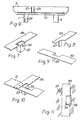
- the titanium strips may themselves have a coating to restrict corrosion of the strips in which case an oxide film formed by anodising is preferred. This arrangement is shown more clearly in Figures 6 to 13.
- this shows the concrete cross beam 3 supported on the pillars 1, 2.
- the beam is a conventional steel rebar reinforced concrete structure.
- the pillars 1 and 2 are also conventional concrete with steel rebars.
- Extending along the length of the beam 3 is a titanium strip 21 and extending vertically from the strip is a plurality of strips, two of which are shown at 22, 23. The entire length of the concrete beam 1 will be covered by strips 22, 23.
- the strips 5, 6 are spot welded, riveted, bolted or otherwise connected to the strip 21 and a vertical strip 24 is connected to the strip 21.
- Strip 24 is connected to a suitable source of electrical current as an anode and a suitable connection is made to the steel reinforcement within the beam 3 as a cathode.
- the tabs can be formed as connectors for adjacent strips 31, 32 and also to connect in an anode 33.
- the anodes are secured by means of titanium nuts and bolts 34.
- the anodes may be embedded into holes drilled into the concrete and are grouted into position as shown in Figure 11 .
- the anode 3 4 is surrounded by grout 36 located in the concrete structure 37.
- the anode is bolted to titanium strip 38.
- the permanently connected anodes can be distributed over the surface of the beam 3 and of course, if required, over the surface of the upright pillars 1, 2. Any other structure can simultaneously be protected.
- the concrete grout securing the anodes may well become weak during operation, even if it is one chosen for its acid resistance such as a high alumina cement, it is probably desirable to use mechanical means to hold the anodes in situ in addition to the grout
- the titanium strips can carry out both functions of supplying current to the anodes and holding the anodes in situ.
- slotted strips 39 Figures 12 and 13 can be used. To install such a system, initially the position of the shear (longitudinal) rebars in the material is located, marked out with chalk, and thus enabling the location of the hydraulically porous tile anodes to be marked in approximate position.
- the hydraulically porous tile used measured 50mm x 50mm and have a hole drilled in one location to take a titanium metal nut 40 and bolt 41.
- the connector strip 39 of slotted titanium had a width of 20mm and was 0.5mm thickness.
- the strip is located at its upper end, leaving slot locations for the anode and defining positions for the self tapping holding screws 42. Because of large aggregate in the concrete cover, it is difficult to drill holes exactly in the concrete, thus the use of the slots facilitated installation.
- the anode tiles are grouted at locations down the strip and the titanium nuts 40 screwed loosely in position and the self tapping screws 42 screwed into position while the acid resisting cement is still soft. This sequence is progressed along the side of the beam.
- the horizontal connector will also be attached to the concrete structure, but only after all other positioning had been completed.
- the system can then be used to protect the rebars.
- cathodic protection system could be used to protect rebars in concrete in any situation, for example car parks, foundations, marine structures etc.
- the system can be installed on the underside of the bridge deck itself to protect the bridge deck. This installation can be done without interfering with the traffic flow.
Landscapes
- Chemical & Material Sciences (AREA)
- Engineering & Computer Science (AREA)
- Materials Engineering (AREA)
- Mechanical Engineering (AREA)
- Metallurgy (AREA)
- Organic Chemistry (AREA)
- Prevention Of Electric Corrosion (AREA)
- Particle Accelerators (AREA)
- Cable Accessories (AREA)
- Laying Of Electric Cables Or Lines Outside (AREA)
Priority Applications (1)
| Application Number | Priority Date | Filing Date | Title |
|---|---|---|---|
| AT85308692T ATE50291T1 (de) | 1984-12-15 | 1985-11-29 | Kathodisches schutzsystem fuer stangen in stahlbeton, verfahren zur durchfuehrung dieses schutzes und eine anode zur verwendung in dem verfahren und system. |
Applications Claiming Priority (2)
| Application Number | Priority Date | Filing Date | Title |
|---|---|---|---|
| GB8431714 | 1984-12-15 | ||
| GB848431714A GB8431714D0 (en) | 1984-12-15 | 1984-12-15 | Cathodic protection system |
Publications (2)
| Publication Number | Publication Date |
|---|---|
| EP0186334A1 true EP0186334A1 (fr) | 1986-07-02 |
| EP0186334B1 EP0186334B1 (fr) | 1990-02-07 |
Family
ID=10571253
Family Applications (1)
| Application Number | Title | Priority Date | Filing Date |
|---|---|---|---|
| EP85308692A Expired - Lifetime EP0186334B1 (fr) | 1984-12-15 | 1985-11-29 | Système de protection cathodique pour barres dans du béton armé, méthode pour la mise en oeuvre d'une telle protection et anode pour l'utilisation de la méthode et du système |
Country Status (6)
| Country | Link |
|---|---|
| EP (1) | EP0186334B1 (fr) |
| JP (1) | JPS61186487A (fr) |
| AT (1) | ATE50291T1 (fr) |
| CA (1) | CA1279606C (fr) |
| DE (1) | DE3575953D1 (fr) |
| GB (1) | GB8431714D0 (fr) |
Cited By (11)
| Publication number | Priority date | Publication date | Assignee | Title |
|---|---|---|---|---|
| US4865702A (en) * | 1986-05-02 | 1989-09-12 | Norsk Averflate Teknikk A/S (Not) | Process of electrochemically re-alkalizing reinforced concrete |
| EP0438839A1 (fr) * | 1988-08-16 | 1991-07-31 | Atraverda Limited | Conducteurs de l'électricité constitués de sous-oxyde de titane |
| WO1997029220A1 (fr) * | 1996-02-09 | 1997-08-14 | Atraverda Limited | Procede electrochimique et electrode |
| WO1999041427A1 (fr) * | 1998-02-10 | 1999-08-19 | Atraverda Limited | Traitement electrochimique du beton arme |
| EP1470266A4 (fr) * | 1999-11-30 | 2007-10-10 | Jack E Bennett | Amelioration portant sur un systeme de protection cathodique |
| EP1994206A2 (fr) * | 2006-03-07 | 2008-11-26 | Gareth Glass | Connexion electrique a une anode courant a appliquer dans une structure en beton |
| US7909982B2 (en) | 2005-03-16 | 2011-03-22 | Gareth Glass | Treatment process for concrete |
| US8211289B2 (en) | 2005-03-16 | 2012-07-03 | Gareth Kevin Glass | Sacrificial anode and treatment of concrete |
| US8999137B2 (en) | 2004-10-20 | 2015-04-07 | Gareth Kevin Glass | Sacrificial anode and treatment of concrete |
| EP2918568A1 (fr) | 2014-03-14 | 2015-09-16 | Sociedad Anónima Minera Catalano-Aragonesa | Compositions céramiques et procédé de fabrication d'électrodes en céramique comprenant lesdites compositions |
| DE102024125743A1 (de) | 2024-09-09 | 2026-03-12 | Protector KKS GmbH | Verfahren zur Instandsetzung von dünnwandigen Betondecken und Betondecke |
Families Citing this family (3)
| Publication number | Priority date | Publication date | Assignee | Title |
|---|---|---|---|---|
| JP4978861B2 (ja) * | 2008-02-01 | 2012-07-18 | 株式会社ピーエス三菱 | 既設pc桁端部の電気防食方法 |
| JP5461093B2 (ja) * | 2009-07-27 | 2014-04-02 | 国立大学法人九州大学 | 犠牲陽極パネル、及び犠牲陽極パネルを利用した防食方法 |
| CN103205755B (zh) * | 2013-04-16 | 2015-11-18 | 深圳大学 | 采用cfrp嵌入阳极的钢筋混凝土阴极保护方法及装置 |
Citations (3)
| Publication number | Priority date | Publication date | Assignee | Title |
|---|---|---|---|---|
| US4255241A (en) * | 1979-05-10 | 1981-03-10 | Kroon David H | Cathodic protection apparatus and method for steel reinforced concrete structures |
| EP0085582A1 (fr) * | 1982-02-05 | 1983-08-10 | Harco Corporation | Protection cathodique utilisant un béton polymère conducteur |
| US4422917A (en) * | 1980-09-10 | 1983-12-27 | Imi Marston Limited | Electrode material, electrode and electrochemical cell |
-
1984
- 1984-12-15 GB GB848431714A patent/GB8431714D0/en active Pending
-
1985
- 1985-11-29 DE DE8585308692T patent/DE3575953D1/de not_active Expired - Lifetime
- 1985-11-29 AT AT85308692T patent/ATE50291T1/de active
- 1985-11-29 EP EP85308692A patent/EP0186334B1/fr not_active Expired - Lifetime
- 1985-12-06 CA CA000497082A patent/CA1279606C/fr not_active Expired - Lifetime
- 1985-12-16 JP JP60282706A patent/JPS61186487A/ja active Pending
Patent Citations (3)
| Publication number | Priority date | Publication date | Assignee | Title |
|---|---|---|---|---|
| US4255241A (en) * | 1979-05-10 | 1981-03-10 | Kroon David H | Cathodic protection apparatus and method for steel reinforced concrete structures |
| US4422917A (en) * | 1980-09-10 | 1983-12-27 | Imi Marston Limited | Electrode material, electrode and electrochemical cell |
| EP0085582A1 (fr) * | 1982-02-05 | 1983-08-10 | Harco Corporation | Protection cathodique utilisant un béton polymère conducteur |
Non-Patent Citations (1)
| Title |
|---|
| PATENT ABSTRACTS OF JAPAN, UNEXAMINED APPLICATIONS, C FIELD, VOL. 5, NO. 35, March 5, 1981 THE PATENT OFFICE JAPANESE GOVERNMENT page 101 C 46 *KOKAI-NO 55_161 076 ( SHINNIPPON SEITETSU K.K.)* * |
Cited By (17)
| Publication number | Priority date | Publication date | Assignee | Title |
|---|---|---|---|---|
| US4865702A (en) * | 1986-05-02 | 1989-09-12 | Norsk Averflate Teknikk A/S (Not) | Process of electrochemically re-alkalizing reinforced concrete |
| EP0438839A1 (fr) * | 1988-08-16 | 1991-07-31 | Atraverda Limited | Conducteurs de l'électricité constitués de sous-oxyde de titane |
| WO1997029220A1 (fr) * | 1996-02-09 | 1997-08-14 | Atraverda Limited | Procede electrochimique et electrode |
| AU709444B2 (en) * | 1996-02-09 | 1999-08-26 | Atraverda Limited | Electrochemical method and electrode |
| US6120675A (en) * | 1996-02-09 | 2000-09-19 | Atraverda Limited | Electrochemical method and electrode |
| WO1999041427A1 (fr) * | 1998-02-10 | 1999-08-19 | Atraverda Limited | Traitement electrochimique du beton arme |
| US6332971B1 (en) | 1998-02-10 | 2001-12-25 | Atraverde Limited | Electrochemical treatment of reinforced concrete |
| AU747707B2 (en) * | 1998-02-10 | 2002-05-23 | Atraverda Limited | Electrochemical treatment of reinforced concrete |
| EP1470266A4 (fr) * | 1999-11-30 | 2007-10-10 | Jack E Bennett | Amelioration portant sur un systeme de protection cathodique |
| US8999137B2 (en) | 2004-10-20 | 2015-04-07 | Gareth Kevin Glass | Sacrificial anode and treatment of concrete |
| US7909982B2 (en) | 2005-03-16 | 2011-03-22 | Gareth Glass | Treatment process for concrete |
| US8211289B2 (en) | 2005-03-16 | 2012-07-03 | Gareth Kevin Glass | Sacrificial anode and treatment of concrete |
| US8349166B2 (en) | 2005-03-16 | 2013-01-08 | Gareth Glass | Treatment process for concrete |
| US9598778B2 (en) | 2005-03-16 | 2017-03-21 | Gareth Glass | Treatment process for concrete |
| EP1994206A2 (fr) * | 2006-03-07 | 2008-11-26 | Gareth Glass | Connexion electrique a une anode courant a appliquer dans une structure en beton |
| EP2918568A1 (fr) | 2014-03-14 | 2015-09-16 | Sociedad Anónima Minera Catalano-Aragonesa | Compositions céramiques et procédé de fabrication d'électrodes en céramique comprenant lesdites compositions |
| DE102024125743A1 (de) | 2024-09-09 | 2026-03-12 | Protector KKS GmbH | Verfahren zur Instandsetzung von dünnwandigen Betondecken und Betondecke |
Also Published As
| Publication number | Publication date |
|---|---|
| CA1279606C (fr) | 1991-01-29 |
| DE3575953D1 (de) | 1990-03-15 |
| ATE50291T1 (de) | 1990-02-15 |
| EP0186334B1 (fr) | 1990-02-07 |
| GB8431714D0 (en) | 1985-01-30 |
| JPS61186487A (ja) | 1986-08-20 |
Similar Documents
| Publication | Publication Date | Title |
|---|---|---|
| US11519077B2 (en) | Galvanic anode and method of corrosion protection | |
| CA1279606C (fr) | Systemes de protection cathodique | |
| CA2880235C (fr) | Anode galvanique et procede de protection contre la corrosion | |
| US5639358A (en) | Cathodic protection system for a steel-reinforced concrete structure | |
| CA2426289C (fr) | Protection cathodique en acier dans du beton arme par traitement electro-osmotique | |
| US20020134690A1 (en) | Doubly-protected reinforcing members in concrete | |
| EP0222829B2 (fr) | Systeme de protection cathodique pour une structure en beton arme et procede d'installation | |
| JPS62263986A (ja) | 導電性液体と接触する強化コンクリ−トの陰極防食 | |
| EP1055017B1 (fr) | Traitement electrochimique du beton arme | |
| GB2271123A (en) | Electrochemical stabilisation of mineral masses such as concrete,and electrode arrangements therefor | |
| US7338591B2 (en) | Method for the cathodic prevention of reinforcement corrosion on damp and wet marine structures | |
| CA1314518C (fr) | Systeme de protection cathodique pour beton arme, a anode en treillis metallique | |
| US5098543A (en) | Cathodic protection system for a steel-reinforced concrete structure | |
| US5423961A (en) | Cathodic protection system for a steel-reinforced concrete structure | |
| Bennett | Corrosion of reinforcing steel in concrete and its prevention by cathodic protection | |
| Mudd et al. | Cathodic protection of steel in concrete with mixed metal oxide activated titanium anode net | |
| HK86390A (en) | Cathodic protection system for a steel-reinforced concrete structure and method of installation |
Legal Events
| Date | Code | Title | Description |
|---|---|---|---|
| PUAI | Public reference made under article 153(3) epc to a published international application that has entered the european phase |
Free format text: ORIGINAL CODE: 0009012 |
|
| AK | Designated contracting states |
Kind code of ref document: A1 Designated state(s): AT BE CH DE FR GB IT LI LU NL SE |
|
| 17P | Request for examination filed |
Effective date: 19860905 |
|
| 17Q | First examination report despatched |
Effective date: 19870911 |
|
| RAP1 | Party data changed (applicant data changed or rights of an application transferred) |
Owner name: EBONEX TECHNOLOGIES, INC. |
|
| GRAA | (expected) grant |
Free format text: ORIGINAL CODE: 0009210 |
|
| AK | Designated contracting states |
Kind code of ref document: B1 Designated state(s): AT BE CH DE FR GB IT LI LU NL SE |
|
| ITF | It: translation for a ep patent filed | ||
| REF | Corresponds to: |
Ref document number: 50291 Country of ref document: AT Date of ref document: 19900215 Kind code of ref document: T |
|
| ET | Fr: translation filed | ||
| REF | Corresponds to: |
Ref document number: 3575953 Country of ref document: DE Date of ref document: 19900315 |
|
| PGFP | Annual fee paid to national office [announced via postgrant information from national office to epo] |
Ref country code: FR Payment date: 19901030 Year of fee payment: 6 |
|
| PGFP | Annual fee paid to national office [announced via postgrant information from national office to epo] |
Ref country code: LU Payment date: 19901107 Year of fee payment: 6 |
|
| PGFP | Annual fee paid to national office [announced via postgrant information from national office to epo] |
Ref country code: GB Payment date: 19901119 Year of fee payment: 6 |
|
| PLBE | No opposition filed within time limit |
Free format text: ORIGINAL CODE: 0009261 |
|
| STAA | Information on the status of an ep patent application or granted ep patent |
Free format text: STATUS: NO OPPOSITION FILED WITHIN TIME LIMIT |
|
| ITTA | It: last paid annual fee | ||
| PG25 | Lapsed in a contracting state [announced via postgrant information from national office to epo] |
Ref country code: LU Free format text: LAPSE BECAUSE OF NON-PAYMENT OF DUE FEES Effective date: 19901130 |
|
| PGFP | Annual fee paid to national office [announced via postgrant information from national office to epo] |
Ref country code: NL Payment date: 19901130 Year of fee payment: 6 Ref country code: AT Payment date: 19901130 Year of fee payment: 6 |
|
| PGFP | Annual fee paid to national office [announced via postgrant information from national office to epo] |
Ref country code: BE Payment date: 19910114 Year of fee payment: 6 |
|
| 26N | No opposition filed | ||
| PGFP | Annual fee paid to national office [announced via postgrant information from national office to epo] |
Ref country code: CH Payment date: 19910207 Year of fee payment: 6 |
|
| EPTA | Lu: last paid annual fee | ||
| PG25 | Lapsed in a contracting state [announced via postgrant information from national office to epo] |
Ref country code: GB Effective date: 19911129 Ref country code: AT Effective date: 19911129 |
|
| PG25 | Lapsed in a contracting state [announced via postgrant information from national office to epo] |
Ref country code: LI Effective date: 19911130 Ref country code: CH Effective date: 19911130 Ref country code: BE Effective date: 19911130 |
|
| BERE | Be: lapsed |
Owner name: EBONEX TECHNOLOGIES INC. Effective date: 19911130 |
|
| PG25 | Lapsed in a contracting state [announced via postgrant information from national office to epo] |
Ref country code: NL Effective date: 19920601 |
|
| NLV4 | Nl: lapsed or anulled due to non-payment of the annual fee | ||
| GBPC | Gb: european patent ceased through non-payment of renewal fee | ||
| PG25 | Lapsed in a contracting state [announced via postgrant information from national office to epo] |
Ref country code: FR Effective date: 19920731 |
|
| REG | Reference to a national code |
Ref country code: CH Ref legal event code: PL |
|
| REG | Reference to a national code |
Ref country code: FR Ref legal event code: ST |
|
| PGFP | Annual fee paid to national office [announced via postgrant information from national office to epo] |
Ref country code: SE Payment date: 19921116 Year of fee payment: 8 |
|
| PGFP | Annual fee paid to national office [announced via postgrant information from national office to epo] |
Ref country code: DE Payment date: 19921212 Year of fee payment: 8 |
|
| PG25 | Lapsed in a contracting state [announced via postgrant information from national office to epo] |
Ref country code: SE Effective date: 19931130 |
|
| PG25 | Lapsed in a contracting state [announced via postgrant information from national office to epo] |
Ref country code: DE Effective date: 19940802 |
|
| EUG | Se: european patent has lapsed |
Ref document number: 85308692.4 Effective date: 19940610 |