EP0186542B1 - Procédé de solubilisation, au moment de l'emploi, d'un principe actif lipophile dans une solution aqueuse, en vue de son administration par voie intraveineuse - Google Patents
Procédé de solubilisation, au moment de l'emploi, d'un principe actif lipophile dans une solution aqueuse, en vue de son administration par voie intraveineuse Download PDFInfo
- Publication number
- EP0186542B1 EP0186542B1 EP85402254A EP85402254A EP0186542B1 EP 0186542 B1 EP0186542 B1 EP 0186542B1 EP 85402254 A EP85402254 A EP 85402254A EP 85402254 A EP85402254 A EP 85402254A EP 0186542 B1 EP0186542 B1 EP 0186542B1
- Authority
- EP
- European Patent Office
- Prior art keywords
- aqueous solution
- time
- intravenous administration
- principle
- solubilisation
- Prior art date
- Legal status (The legal status is an assumption and is not a legal conclusion. Google has not performed a legal analysis and makes no representation as to the accuracy of the status listed.)
- Expired - Lifetime
Links
- 238000000034 method Methods 0.000 title claims description 13
- 238000001990 intravenous administration Methods 0.000 title claims description 7
- 239000007864 aqueous solution Substances 0.000 title description 4
- FAPWRFPIFSIZLT-UHFFFAOYSA-M Sodium chloride Chemical compound [Na+].[Cl-] FAPWRFPIFSIZLT-UHFFFAOYSA-M 0.000 claims description 9
- 239000000243 solution Substances 0.000 claims description 8
- IIZPXYDJLKNOIY-JXPKJXOSSA-N 1-palmitoyl-2-arachidonoyl-sn-glycero-3-phosphocholine Chemical compound CCCCCCCCCCCCCCCC(=O)OC[C@H](COP([O-])(=O)OCC[N+](C)(C)C)OC(=O)CCC\C=C/C\C=C/C\C=C/C\C=C/CCCCC IIZPXYDJLKNOIY-JXPKJXOSSA-N 0.000 claims description 7
- 239000000787 lecithin Substances 0.000 claims description 7
- 229940067606 lecithin Drugs 0.000 claims description 7
- 235000010445 lecithin Nutrition 0.000 claims description 7
- 239000004480 active ingredient Substances 0.000 claims description 5
- XLYOFNOQVPJJNP-UHFFFAOYSA-N water Substances O XLYOFNOQVPJJNP-UHFFFAOYSA-N 0.000 claims description 5
- 239000000203 mixture Substances 0.000 claims description 4
- 239000003960 organic solvent Substances 0.000 claims description 3
- 150000003904 phospholipids Chemical class 0.000 claims description 3
- 150000001875 compounds Chemical class 0.000 claims description 2
- 231100000252 nontoxic Toxicity 0.000 claims description 2
- 230000003000 nontoxic effect Effects 0.000 claims description 2
- 239000002904 solvent Substances 0.000 claims description 2
- 230000007704 transition Effects 0.000 claims description 2
- 239000012071 phase Substances 0.000 claims 2
- 230000003381 solubilizing effect Effects 0.000 claims 2
- 239000008346 aqueous phase Substances 0.000 claims 1
- 230000010412 perfusion Effects 0.000 claims 1
- 239000002504 physiological saline solution Substances 0.000 claims 1
- 230000000063 preceeding effect Effects 0.000 claims 1
- 210000002966 serum Anatomy 0.000 claims 1
- 239000003381 stabilizer Substances 0.000 claims 1
- 239000000725 suspension Substances 0.000 claims 1
- 239000011780 sodium chloride Substances 0.000 description 4
- 230000007928 solubilization Effects 0.000 description 4
- 238000005063 solubilization Methods 0.000 description 4
- LFQSCWFLJHTTHZ-UHFFFAOYSA-N Ethanol Chemical compound CCO LFQSCWFLJHTTHZ-UHFFFAOYSA-N 0.000 description 3
- RJKFOVLPORLFTN-LEKSSAKUSA-N Progesterone Chemical compound C1CC2=CC(=O)CC[C@]2(C)[C@@H]2[C@@H]1[C@@H]1CC[C@H](C(=O)C)[C@@]1(C)CC2 RJKFOVLPORLFTN-LEKSSAKUSA-N 0.000 description 3
- 238000010586 diagram Methods 0.000 description 3
- 238000001802 infusion Methods 0.000 description 3
- 239000007924 injection Substances 0.000 description 3
- 238000002347 injection Methods 0.000 description 3
- 239000002502 liposome Substances 0.000 description 3
- 229960003473 androstanolone Drugs 0.000 description 2
- 230000015572 biosynthetic process Effects 0.000 description 2
- 239000003795 chemical substances by application Substances 0.000 description 2
- 238000010790 dilution Methods 0.000 description 2
- 239000012895 dilution Substances 0.000 description 2
- IPCSVZSSVZVIGE-UHFFFAOYSA-M hexadecanoate Chemical compound CCCCCCCCCCCCCCCC([O-])=O IPCSVZSSVZVIGE-UHFFFAOYSA-M 0.000 description 2
- WTJKGGKOPKCXLL-RRHRGVEJSA-N phosphatidylcholine Chemical compound CCCCCCCCCCCCCCCC(=O)OC[C@H](COP([O-])(=O)OCC[N+](C)(C)C)OC(=O)CCCCCCCC=CCCCCCCCC WTJKGGKOPKCXLL-RRHRGVEJSA-N 0.000 description 2
- 230000036470 plasma concentration Effects 0.000 description 2
- 229960003387 progesterone Drugs 0.000 description 2
- 239000000186 progesterone Substances 0.000 description 2
- 231100000419 toxicity Toxicity 0.000 description 2
- 230000001988 toxicity Effects 0.000 description 2
- NVKAWKQGWWIWPM-ABEVXSGRSA-N 17-β-hydroxy-5-α-Androstan-3-one Chemical compound C1C(=O)CC[C@]2(C)[C@H]3CC[C@](C)([C@H](CC4)O)[C@@H]4[C@@H]3CC[C@H]21 NVKAWKQGWWIWPM-ABEVXSGRSA-N 0.000 description 1
- WQZGKKKJIJFFOK-GASJEMHNSA-N Glucose Natural products OC[C@H]1OC(O)[C@H](O)[C@@H](O)[C@@H]1O WQZGKKKJIJFFOK-GASJEMHNSA-N 0.000 description 1
- 102000007562 Serum Albumin Human genes 0.000 description 1
- 108010071390 Serum Albumin Proteins 0.000 description 1
- 240000003834 Triticum spelta Species 0.000 description 1
- 239000013543 active substance Substances 0.000 description 1
- 230000001476 alcoholic effect Effects 0.000 description 1
- 239000012736 aqueous medium Substances 0.000 description 1
- WQZGKKKJIJFFOK-VFUOTHLCSA-N beta-D-glucose Chemical compound OC[C@H]1O[C@@H](O)[C@H](O)[C@@H](O)[C@@H]1O WQZGKKKJIJFFOK-VFUOTHLCSA-N 0.000 description 1
- 230000005540 biological transmission Effects 0.000 description 1
- 238000000502 dialysis Methods 0.000 description 1
- 239000008103 glucose Substances 0.000 description 1
- 238000010438 heat treatment Methods 0.000 description 1
- 230000003165 hydrotropic effect Effects 0.000 description 1
- 239000003978 infusion fluid Substances 0.000 description 1
- -1 lecithin for example Chemical class 0.000 description 1
- 238000010339 medical test Methods 0.000 description 1
- 239000000693 micelle Substances 0.000 description 1
- 230000010494 opalescence Effects 0.000 description 1
- 239000008363 phosphate buffer Substances 0.000 description 1
- 238000002360 preparation method Methods 0.000 description 1
- 239000003755 preservative agent Substances 0.000 description 1
- 230000002335 preservative effect Effects 0.000 description 1
- 238000001953 recrystallisation Methods 0.000 description 1
- WXMKPNITSTVMEF-UHFFFAOYSA-M sodium benzoate Chemical compound [Na+].[O-]C(=O)C1=CC=CC=C1 WXMKPNITSTVMEF-UHFFFAOYSA-M 0.000 description 1
- 235000010234 sodium benzoate Nutrition 0.000 description 1
- 239000004299 sodium benzoate Substances 0.000 description 1
- 238000000527 sonication Methods 0.000 description 1
- 230000001225 therapeutic effect Effects 0.000 description 1
Images
Classifications
-
- A—HUMAN NECESSITIES
- A61—MEDICAL OR VETERINARY SCIENCE; HYGIENE
- A61K—PREPARATIONS FOR MEDICAL, DENTAL OR TOILETRY PURPOSES
- A61K9/00—Medicinal preparations characterised by special physical form
- A61K9/10—Dispersions; Emulsions
- A61K9/127—Synthetic bilayered vehicles, e.g. liposomes or liposomes with cholesterol as the only non-phosphatidyl surfactant
- A61K9/1277—Preparation processes; Proliposomes
-
- A—HUMAN NECESSITIES
- A61—MEDICAL OR VETERINARY SCIENCE; HYGIENE
- A61K—PREPARATIONS FOR MEDICAL, DENTAL OR TOILETRY PURPOSES
- A61K47/00—Medicinal preparations characterised by the non-active ingredients used, e.g. carriers or inert additives; Targeting or modifying agents chemically bound to the active ingredient
- A61K47/06—Organic compounds, e.g. natural or synthetic hydrocarbons, polyolefins, mineral oil, petrolatum or ozokerite
- A61K47/24—Organic compounds, e.g. natural or synthetic hydrocarbons, polyolefins, mineral oil, petrolatum or ozokerite containing atoms other than carbon, hydrogen, oxygen, halogen, nitrogen or sulfur, e.g. cyclomethicone or phospholipids
-
- A—HUMAN NECESSITIES
- A61—MEDICAL OR VETERINARY SCIENCE; HYGIENE
- A61K—PREPARATIONS FOR MEDICAL, DENTAL OR TOILETRY PURPOSES
- A61K9/00—Medicinal preparations characterised by special physical form
- A61K9/0012—Galenical forms characterised by the site of application
- A61K9/0019—Injectable compositions; Intramuscular, intravenous, arterial, subcutaneous administration; Compositions to be administered through the skin in an invasive manner
Definitions
- the present invention relates to a method of solubilization, at the time of use, of a lipophilic active principle in an aqueous solution, with a view to its administration by the intravenous route.
- a lipophilic active ingredient has already been resolved in different ways.
- One of the known methods consists in using a mixture of solvents miscible with water, but this method involves a risk of recrystallization if the aqueous volume becomes too large, for example after dilution in an infusion of NaCl at 9 o / oo.
- Hydrotropic agents such as sodium benzoate have also been used, these agents being however usable only for certain types of molecules.
- the formation of aggregates has also been used, for example in the case of the solubilization of progesterone by serum albumin, but at doses such that toxicity problems are encountered.
- Another known method consists of an injection into plasma previously taken from the subject to be treated, as described by EVERETT RB et al. Am.J. obstetric. Gynecol. (1978) 131 , 352.
- the present invention aims to remedy the drawbacks of the aforementioned methods known previously.
- this method of solubilization, at the time of use, of a lipophilic active principle in an aqueous solution, with a view to its administration by the intravenous route is characterized in that a solution containing at least one is prepared.
- the solution thus prepared can be introduced into an infusion of sodium chloride or glucose without the active substance being released for at least 48 hours, provided that the quantity of lecithin is sufficient.
- the process according to the invention offers several advantages. Firstly, it makes it possible to use a phospholipid, such as lecithin for example, devoid of toxicity by the intravenous route. Furthermore, the amount of organic solvent used is very low. Finally, stability problems are limited compared to an initial aqueous solution of lecithin.
- Example 1 Dihydrotestosterone 2.5 mg - Egg phosphatidylcholine (ovothin-lecithos) 100 mg - Ascorbyle palmitate 0.4 mg - Phosphate buffer pH 7.2 0.375 ml - Absolute alcohol qs 2.5 ml
- Example 2 Progesterone 10 mg - Soy phosphatidylcholine (Epikuron 200-lecithos) 175 mg - Ascorbyle palmitate 0.6 mg - Absolute alcohol qs 2.5 ml
- D.H.T. dihydrotestosterone
- Example 1 a solution of dihydrotestosterone (D.H.T.), obtained according to Example 1, was injected intravenously, after dilution in an infusion solution of sodium chloride.
- a first patient received 88.2 micrograms per hour of D.H.T. for 4 hours, then 176.4 micrograms per hour of D.H.T. the last 4 hours remaining.
- a second patient received, during these same periods of time, first 176.4 micrograms per hour then 264.6 micrograms per hour.
Landscapes
- Health & Medical Sciences (AREA)
- Chemical & Material Sciences (AREA)
- Life Sciences & Earth Sciences (AREA)
- Veterinary Medicine (AREA)
- Pharmacology & Pharmacy (AREA)
- Epidemiology (AREA)
- Medicinal Chemistry (AREA)
- Animal Behavior & Ethology (AREA)
- General Health & Medical Sciences (AREA)
- Public Health (AREA)
- Molecular Biology (AREA)
- Biophysics (AREA)
- Dispersion Chemistry (AREA)
- Engineering & Computer Science (AREA)
- Chemical Kinetics & Catalysis (AREA)
- General Chemical & Material Sciences (AREA)
- Oil, Petroleum & Natural Gas (AREA)
- Dermatology (AREA)
- Medicinal Preparation (AREA)
- Pharmaceuticals Containing Other Organic And Inorganic Compounds (AREA)
Description
- La présente invention concerne un procédé de solubilisation, AU moment de l'emploi, d'un principe actif lipophile dans une solution aqueuse, en vue de son administration par voie intraveineuse.
- L'administration, par voie intraveineuse, d'un principe actif lipophile a déjà été résolue de différentes façons. L'un des procédés connus consiste à utiliser un mélange de solvants miscibles à l'eau mais ce procédé entraîne un risque de recristallisation si le volume aqueux devient trop important, par exemple après dilution dans une perfusion de NaCl à 9o/oo. On a également utilisé des agents hydrotropes comme le benzoate de sodium, ces agents n'étant toutefois utilisables que pour certains types de molécules. On a également employé la formation d'agrégats, par exemple dans le cas de la solubilisation de la progestérone par de la sérum albumine, mais à des doses telles que l'on rencontre des problèmes de toxicité.
- Un autre procédé connu consiste en une injection dans du plasma préalablement prélevé chez le sujet à traiter, ainsi qu'il est décrit par EVERETT RB et coll. Am.J. obstet. Gynecol. (1978) 131, 352.
- Un a également envisagé d'utiliser une solubilisation en milieu aqueux à l'aide de lécithine et d'un formateur de micelles, ainsi qu'il est décrit dans le brevet belge 856 675 et dans le brevet européen 0 011 745.
- La présente invention vise à remédier aux inconvénients des procédés précités connus antérieurement.
- A cet effet ce procédé de solubilisation, au moment de l'emploi, d'un principe actif lipophile dans une solution aqueuse, en vue de son administration par voie intraveineuse, est caractérisé en ce que l'on prépare une solution contenant au moins un principe actif lipophile, de la lécithine ou un autre phospholipide dont la température de transition de phase est inférieure à la température ambiante, au moins un agent conservateur et au moins un solvant organique (ou un mélange solvant-eau) atoxique par voie intraveineuse, miscible à l'eau, dans lequel les autres composés sont solubles.
- La solution ainsi préparée peut être introduite dans une perfusion de chlorure de sodium ou de glucose sans qu'il y ait relargage du principe actif pendant au moins 48 heures, à condition que la quantité de lécithine soit suffisante.
- Le procédé suivant l'invention offre plusieurs avantages. En premier lieu il permet d'utiliser un phospholipide, tel que la lécithine par exemple, dénué de toxicité par voie intraveineuse. Par ailleurs la quantité de solvant organique utilisée est très faible. Enfin les problèmes de stabilité sont limités par rapport à une solution initiale aqueuse de lécithine.
- La technique qui consiste à injecter une solution alcoolique de lécithine dans de l'eau a été décrite par S. BATZRI et E.D. KORN "Single bilayer liposomes prepared without sonication", Biochem. Biophys. Act. (1973), 293, 1015-1019, pour obtenir des liposomes pouvant véhiculer un principe actif, cette injection étant suivie d'un chauffage ou d'une dialyse pour éliminer l'alcool.
- On donnera ci-dessous, à titre illustratif, des exemples de préparation de solutions par le procédé suivant l'invention:
Exemple 1 - Dihydrotestostérone 2,5 mg - Phosphatidylcholine d'oeuf (ovothin-lécithos) 100 mg - Palmitate d'ascorbyle 0,4 mg - Tampon phosphate pH 7,2 0,375 ml - Alcool absolu qsp 2,5 ml Exemple 2 - Progestérone 10 mg - Phosphatidylcholine de soja (Epikuron 200-lécithos) 175 mg - Palmitate d'ascorbyle 0,6 mg - Alcool absolu qsp 2,5 ml - L'injection des solutions suivant les exemples 1 et 2 dans un flacon de perfusion de chlorure de sodium isotonique donne une légère opalescence due à la présence de vésicules dont la taille moyenne est d'une centaine de nanomètres. Par ailleurs l'observation au microscope électronique à transmission montre la formation de structures lamellaires closes ressemblant à des liposomes.
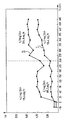
- Au cours de tests médicaux on a injecté une solution de dihydrotestostérone (D.H.T.), obtenue suivant l'exemple 1, par voie intraveineuse, après dilution dans un soluté de perfusion de chlorure de sodium. Un premier patient a reçu 88,2 microgrammes par heure de D.H.T. pendant 4 heures, puis 176,4 microgrammes par heure de D.H.T. les 4 dernières heures restantes. Un second patient a reçu, durant ces mêmes périodes de temps, d'abord 176,4 microgrammes par heure puis 264,6 microgrammes par heure.
- Les résultats des taux plasmatiques obtenus sont indiqués dans le diagramme annexé, les courbes 1 et 2 correspondant respectivement aux premier et second patients précités. Sur ce diagramme le temps t est indiqué en abcisses, en minutes, tandis que le taux plasmatique TP est porté en ordonnées.
- On voit d'après ce diagramme que quelle que soit la dose injectée, la montée en plateau est obtenue rapidement et paraît stable. Il est possible d'atteindre des taux plasmatiques compatibles avec une utilisation thérapeutique. Par ailleurs les soltions sont très bien tolérées par les patients et n'entraînent aucun trouble d'intolérance.
Claims (3)
- Procédé de solubilisation au moment de l'emploi d'un principe actif lipophile dans du sérum physiologique pour administration intraveineuse caractérisé par le fait- que l'on introduit au moins un principe actif lipophile, de la lécithine ou des phospholipides à température de transition de phase inférieure à la température ambiante dans au moins un solvant organique ou un mélange solvant organique/eau, atoxique par voie intraveineuse, les quantités des composants étant suffisantes pour solubiliser ledit principe actif,- et que l'on mélange au moment de l'emploi la phase ainsi obtenue dans une quantité supérieure de phase aqueuse constituée par du sérum pour perfusion.
- Procédé selon la revendication 1 caractérisé en ce que la solution contient un agent stabilisant.
- Procédé selon l'une quelconque des revendications 1 ou 2 caractérisé en ce que le mélange obtenu à administrer par voie intraveineuse se présente sous forme d'une suspension liposomale.
Applications Claiming Priority (2)
| Application Number | Priority Date | Filing Date | Title |
|---|---|---|---|
| FR8417792A FR2573308B1 (fr) | 1984-11-22 | 1984-11-22 | Procede de solubilisation, au moment de l'emploi, d'un principe actif lipophile dans une solution aqueuse, en vue de son administration par voie intraveineuse |
| FR8417792 | 1984-11-22 |
Publications (2)
| Publication Number | Publication Date |
|---|---|
| EP0186542A1 EP0186542A1 (fr) | 1986-07-02 |
| EP0186542B1 true EP0186542B1 (fr) | 1992-08-05 |
Family
ID=9309838
Family Applications (1)
| Application Number | Title | Priority Date | Filing Date |
|---|---|---|---|
| EP85402254A Expired - Lifetime EP0186542B1 (fr) | 1984-11-22 | 1985-11-20 | Procédé de solubilisation, au moment de l'emploi, d'un principe actif lipophile dans une solution aqueuse, en vue de son administration par voie intraveineuse |
Country Status (6)
| Country | Link |
|---|---|
| EP (1) | EP0186542B1 (fr) |
| JP (1) | JPS61129116A (fr) |
| CA (1) | CA1275247C (fr) |
| DE (1) | DE3586457T2 (fr) |
| ES (1) | ES8701490A1 (fr) |
| FR (1) | FR2573308B1 (fr) |
Families Citing this family (6)
| Publication number | Priority date | Publication date | Assignee | Title |
|---|---|---|---|---|
| US5154930A (en) * | 1987-03-05 | 1992-10-13 | The Liposome Company, Inc. | Pharmacological agent-lipid solution preparation |
| CA1340241C (fr) * | 1988-06-08 | 1998-12-15 | Fountain Pharmaceuticals, Inc. | Methode pour l'obtention de microvehicules, avec dilution dans un solvant |
| US5269979A (en) * | 1988-06-08 | 1993-12-14 | Fountain Pharmaceuticals, Inc. | Method for making solvent dilution microcarriers |
| DE4336434A1 (de) * | 1993-10-26 | 1995-04-27 | Hoechst Ag | Pharmazeutische Zubereitung für die parenterale, enterale und dermale Verabreichung von praktisch unlöslichen Arzneistoffen und Verfahren zu ihrer Herstellung |
| DE4412464A1 (de) * | 1994-04-08 | 1995-10-26 | Schering Ag | Arzneimittel, die Fettsäureester der Ascorbinsäure als Antioxydanz und einen steroidalen Wirkstoff enthalten und deren Verwendung |
| US5744463A (en) * | 1996-06-03 | 1998-04-28 | Bair; Glenn O. | Treatment of side effects of progestins and progesterone analogues used for birth control |
Citations (3)
| Publication number | Priority date | Publication date | Assignee | Title |
|---|---|---|---|---|
| EP0100459A2 (fr) * | 1982-07-07 | 1984-02-15 | Eisai Co., Ltd. | Liquide aqueux contenant une substance liposoluble |
| EP0132821A2 (fr) * | 1983-07-25 | 1985-02-13 | Eisai Co., Ltd. | Solution aqueuse renfermant une substance pharmaceutique liposoluble et procédé de sa préparation |
| EP0133258A2 (fr) * | 1983-07-22 | 1985-02-20 | F. HOFFMANN-LA ROCHE & CO. Aktiengesellschaft | Solutions injectables de vitamine E |
-
1984
- 1984-11-22 FR FR8417792A patent/FR2573308B1/fr not_active Expired
-
1985
- 1985-11-15 CA CA000495437A patent/CA1275247C/fr not_active Expired - Fee Related
- 1985-11-18 ES ES548988A patent/ES8701490A1/es not_active Expired
- 1985-11-20 DE DE19853586457 patent/DE3586457T2/de not_active Expired - Fee Related
- 1985-11-20 EP EP85402254A patent/EP0186542B1/fr not_active Expired - Lifetime
- 1985-11-21 JP JP25991585A patent/JPS61129116A/ja active Pending
Patent Citations (3)
| Publication number | Priority date | Publication date | Assignee | Title |
|---|---|---|---|---|
| EP0100459A2 (fr) * | 1982-07-07 | 1984-02-15 | Eisai Co., Ltd. | Liquide aqueux contenant une substance liposoluble |
| EP0133258A2 (fr) * | 1983-07-22 | 1985-02-20 | F. HOFFMANN-LA ROCHE & CO. Aktiengesellschaft | Solutions injectables de vitamine E |
| EP0132821A2 (fr) * | 1983-07-25 | 1985-02-13 | Eisai Co., Ltd. | Solution aqueuse renfermant une substance pharmaceutique liposoluble et procédé de sa préparation |
Also Published As
| Publication number | Publication date |
|---|---|
| FR2573308B1 (fr) | 1987-01-09 |
| ES8701490A1 (es) | 1987-01-01 |
| DE3586457D1 (de) | 1992-09-10 |
| FR2573308A1 (fr) | 1986-05-23 |
| CA1275247C (fr) | 1990-10-16 |
| ES548988A0 (es) | 1987-01-01 |
| DE3586457T2 (de) | 1993-04-08 |
| EP0186542A1 (fr) | 1986-07-02 |
| JPS61129116A (ja) | 1986-06-17 |
Similar Documents
| Publication | Publication Date | Title |
|---|---|---|
| KR100410937B1 (ko) | 프로포폴을 함유하는 혈관주사용 마취제 조성물 | |
| EP0280492B1 (fr) | Composition pour liposome et sa préparation | |
| BE1001760A5 (fr) | Supports de médicaments. | |
| EP0233100B1 (fr) | Composition pharmaceutique,contenant un anesthésique local et/ou un analgésique central encapsulé dans des multilamellaires liposomes | |
| US4425334A (en) | Functional oxygen transport system | |
| DE68905374T2 (de) | Mittel zur vorbeugung und abhilfe gegen ischaemische verletzungen. | |
| KR860001503B1 (ko) | 이버멕틴의 수용화 방법 | |
| EP0094692B1 (fr) | Liposomes enrobées contenant de l'ubidecarénone | |
| EP0354855A2 (fr) | Liposomes dont l'adsorption de protéines sur des surfaces est empêchée | |
| US4614796A (en) | Liposome and method of manufacture therefor | |
| EP0231091A1 (fr) | Emulsions stables de composés organiques hautement fluorés | |
| DE69018460T2 (de) | Markierung mit liposomen von ischämischen geweben. | |
| KR960009181B1 (ko) | 수불용성 유효 성분의 인지질 전달 매체 | |
| EP0186542B1 (fr) | Procédé de solubilisation, au moment de l'emploi, d'un principe actif lipophile dans une solution aqueuse, en vue de son administration par voie intraveineuse | |
| SK80998A3 (en) | Pge-1 containing lyophilized liposomes for use in the treatment of erectile dysfunction | |
| EP1037652B1 (fr) | Compositions pharmaceutiques a base de dalfopristine et de quinupristine et leur preparation | |
| DE4010536C2 (fr) | ||
| US5880123A (en) | Hemolysis prevention by non-ionic surfactants | |
| US4612370A (en) | Lipid-saccharide reaction products | |
| RU2141313C1 (ru) | Фармацевтическая эмульсия, содержащая биологически активные стероиды, и способ получения эмульсии | |
| NL7900459A (nl) | Farmaceutisch preparaat en werkwijze ter bereiding daarvan. | |
| JP2611307B2 (ja) | リポソーム製剤およびその製造法 | |
| WO1997024125A2 (fr) | Composition pharmaceutique injectable contenant l'acide ursodesoxycholique ou l'acide tauroursodesoxycholique, une base forte et du trometamol | |
| JPH0651109B2 (ja) | 脂質膜構造体 | |
| JPWO1991007964A1 (ja) | 脂肪乳剤 |
Legal Events
| Date | Code | Title | Description |
|---|---|---|---|
| PUAI | Public reference made under article 153(3) epc to a published international application that has entered the european phase |
Free format text: ORIGINAL CODE: 0009012 |
|
| AK | Designated contracting states |
Kind code of ref document: A1 Designated state(s): CH DE GB IT LI |
|
| 17P | Request for examination filed |
Effective date: 19861212 |
|
| 17Q | First examination report despatched |
Effective date: 19880915 |
|
| GRAA | (expected) grant |
Free format text: ORIGINAL CODE: 0009210 |
|
| AK | Designated contracting states |
Kind code of ref document: B1 Designated state(s): CH DE GB IT LI |
|
| REF | Corresponds to: |
Ref document number: 3586457 Country of ref document: DE Date of ref document: 19920910 |
|
| ITF | It: translation for a ep patent filed | ||
| PG25 | Lapsed in a contracting state [announced via postgrant information from national office to epo] |
Ref country code: GB Effective date: 19921120 |
|
| ITTA | It: last paid annual fee | ||
| PG25 | Lapsed in a contracting state [announced via postgrant information from national office to epo] |
Ref country code: LI Effective date: 19921130 Ref country code: CH Effective date: 19921130 |
|
| GBT | Gb: translation of ep patent filed (gb section 77(6)(a)/1977) | ||
| PGFP | Annual fee paid to national office [announced via postgrant information from national office to epo] |
Ref country code: DE Payment date: 19930129 Year of fee payment: 8 |
|
| PLBE | No opposition filed within time limit |
Free format text: ORIGINAL CODE: 0009261 |
|
| STAA | Information on the status of an ep patent application or granted ep patent |
Free format text: STATUS: NO OPPOSITION FILED WITHIN TIME LIMIT |
|
| GBPC | Gb: european patent ceased through non-payment of renewal fee |
Effective date: 19921120 |
|
| 26N | No opposition filed | ||
| REG | Reference to a national code |
Ref country code: CH Ref legal event code: PL |
|
| PG25 | Lapsed in a contracting state [announced via postgrant information from national office to epo] |
Ref country code: DE Effective date: 19940802 |