EP0187076B1 - Fluoreszierende Verbindungen, (Amino-4)-naphthalimidderivate, deren Verwendung in immunologischen Bestimmungen bei der Fluoreszenzpolarisation - Google Patents
Fluoreszierende Verbindungen, (Amino-4)-naphthalimidderivate, deren Verwendung in immunologischen Bestimmungen bei der Fluoreszenzpolarisation Download PDFInfo
- Publication number
- EP0187076B1 EP0187076B1 EP85402360A EP85402360A EP0187076B1 EP 0187076 B1 EP0187076 B1 EP 0187076B1 EP 85402360 A EP85402360 A EP 85402360A EP 85402360 A EP85402360 A EP 85402360A EP 0187076 B1 EP0187076 B1 EP 0187076B1
- Authority
- EP
- European Patent Office
- Prior art keywords
- antigen
- hapten
- compound
- formula
- assayed
- Prior art date
- Legal status (The legal status is an assumption and is not a legal conclusion. Google has not performed a legal analysis and makes no representation as to the accuracy of the status listed.)
- Expired - Lifetime
Links
- 150000001875 compounds Chemical class 0.000 title claims description 56
- 238000002875 fluorescence polarization Methods 0.000 title claims description 12
- 230000001900 immune effect Effects 0.000 title claims description 4
- XJHABGPPCLHLLV-UHFFFAOYSA-N benzo[de]isoquinoline-1,3-dione Chemical class C1=CC(C(=O)NC2=O)=C3C2=CC=CC3=C1 XJHABGPPCLHLLV-UHFFFAOYSA-N 0.000 title description 4
- 239000007850 fluorescent dye Substances 0.000 claims description 70
- 239000000427 antigen Substances 0.000 claims description 53
- 108091007433 antigens Proteins 0.000 claims description 53
- 102000036639 antigens Human genes 0.000 claims description 53
- 238000000034 method Methods 0.000 claims description 34
- 102000008394 Immunoglobulin Fragments Human genes 0.000 claims description 19
- 108010021625 Immunoglobulin Fragments Proteins 0.000 claims description 19
- 238000003556 assay Methods 0.000 claims description 19
- 239000003153 chemical reaction reagent Substances 0.000 claims description 16
- LMBFAGIMSUYTBN-MPZNNTNKSA-N teixobactin Chemical compound C([C@H](C(=O)N[C@@H]([C@@H](C)CC)C(=O)N[C@@H](CO)C(=O)N[C@H](CCC(N)=O)C(=O)N[C@H]([C@@H](C)CC)C(=O)N[C@@H]([C@@H](C)CC)C(=O)N[C@@H](CO)C(=O)N[C@H]1C(N[C@@H](C)C(=O)N[C@@H](C[C@@H]2NC(=N)NC2)C(=O)N[C@H](C(=O)O[C@H]1C)[C@@H](C)CC)=O)NC)C1=CC=CC=C1 LMBFAGIMSUYTBN-MPZNNTNKSA-N 0.000 claims description 13
- 239000000203 mixture Substances 0.000 claims description 10
- 229910052757 nitrogen Inorganic materials 0.000 claims description 10
- IJGRMHOSHXDMSA-UHFFFAOYSA-N Atomic nitrogen Chemical compound N#N IJGRMHOSHXDMSA-UHFFFAOYSA-N 0.000 claims description 9
- 150000008064 anhydrides Chemical class 0.000 claims description 9
- 238000006243 chemical reaction Methods 0.000 claims description 9
- 239000012634 fragment Substances 0.000 claims description 8
- 150000003949 imides Chemical class 0.000 claims description 7
- -1 aliphatic diamines Chemical class 0.000 claims description 6
- 230000001588 bifunctional effect Effects 0.000 claims description 6
- BTCSSZJGUNDROE-UHFFFAOYSA-N gamma-aminobutyric acid Chemical compound NCCCC(O)=O BTCSSZJGUNDROE-UHFFFAOYSA-N 0.000 claims description 6
- QGZKDVFQNNGYKY-UHFFFAOYSA-O Ammonium Chemical compound [NH4+] QGZKDVFQNNGYKY-UHFFFAOYSA-O 0.000 claims description 5
- 125000002915 carbonyl group Chemical group [*:2]C([*:1])=O 0.000 claims description 5
- UFULAYFCSOUIOV-UHFFFAOYSA-N cysteamine Chemical compound NCCS UFULAYFCSOUIOV-UHFFFAOYSA-N 0.000 claims description 5
- 229960003151 mercaptamine Drugs 0.000 claims description 5
- 125000004433 nitrogen atom Chemical group N* 0.000 claims description 5
- 125000004435 hydrogen atom Chemical group [H]* 0.000 claims description 4
- OGNSCSPNOLGXSM-UHFFFAOYSA-N (+/-)-DABA Natural products NCCC(N)C(O)=O OGNSCSPNOLGXSM-UHFFFAOYSA-N 0.000 claims description 3
- 229960003692 gamma aminobutyric acid Drugs 0.000 claims description 3
- 238000003018 immunoassay Methods 0.000 claims description 3
- 238000012986 modification Methods 0.000 claims description 3
- 230000004048 modification Effects 0.000 claims description 3
- 150000003141 primary amines Chemical group 0.000 claims description 3
- 150000003431 steroids Chemical class 0.000 claims description 3
- 230000009471 action Effects 0.000 claims description 2
- 125000002887 hydroxy group Chemical group [H]O* 0.000 claims description 2
- 229910052783 alkali metal Inorganic materials 0.000 claims 3
- 150000001340 alkali metals Chemical class 0.000 claims 3
- SSMIFVHARFVINF-UHFFFAOYSA-N 4-amino-1,8-naphthalimide Chemical class O=C1NC(=O)C2=CC=CC3=C2C1=CC=C3N SSMIFVHARFVINF-UHFFFAOYSA-N 0.000 claims 2
- 238000011534 incubation Methods 0.000 claims 1
- 239000000243 solution Substances 0.000 description 58
- MUMGGOZAMZWBJJ-DYKIIFRCSA-N Testostosterone Chemical compound O=C1CC[C@]2(C)[C@H]3CC[C@](C)([C@H](CC4)O)[C@@H]4[C@@H]3CCC2=C1 MUMGGOZAMZWBJJ-DYKIIFRCSA-N 0.000 description 16
- 239000002609 medium Substances 0.000 description 16
- OKKJLVBELUTLKV-UHFFFAOYSA-N Methanol Chemical compound OC OKKJLVBELUTLKV-UHFFFAOYSA-N 0.000 description 15
- 239000000047 product Substances 0.000 description 14
- 238000003756 stirring Methods 0.000 description 13
- 239000008363 phosphate buffer Substances 0.000 description 12
- HTSGKJQDMSTCGS-UHFFFAOYSA-N 1,4-bis(4-chlorophenyl)-2-(4-methylphenyl)sulfonylbutane-1,4-dione Chemical compound C1=CC(C)=CC=C1S(=O)(=O)C(C(=O)C=1C=CC(Cl)=CC=1)CC(=O)C1=CC=C(Cl)C=C1 HTSGKJQDMSTCGS-UHFFFAOYSA-N 0.000 description 11
- 102000001706 Immunoglobulin Fab Fragments Human genes 0.000 description 11
- 108010054477 Immunoglobulin Fab Fragments Proteins 0.000 description 11
- 230000010287 polarization Effects 0.000 description 11
- UIIMBOGNXHQVGW-UHFFFAOYSA-M Sodium bicarbonate Chemical compound [Na+].OC([O-])=O UIIMBOGNXHQVGW-UHFFFAOYSA-M 0.000 description 10
- 150000001412 amines Chemical group 0.000 description 10
- 230000008878 coupling Effects 0.000 description 10
- 238000010168 coupling process Methods 0.000 description 10
- 238000005859 coupling reaction Methods 0.000 description 10
- 230000005284 excitation Effects 0.000 description 10
- 238000002360 preparation method Methods 0.000 description 10
- RYHBNJHYFVUHQT-UHFFFAOYSA-N 1,4-Dioxane Chemical compound C1COCCO1 RYHBNJHYFVUHQT-UHFFFAOYSA-N 0.000 description 9
- QTBSBXVTEAMEQO-UHFFFAOYSA-N Acetic acid Chemical compound CC(O)=O QTBSBXVTEAMEQO-UHFFFAOYSA-N 0.000 description 9
- 230000008569 process Effects 0.000 description 9
- 229960003604 testosterone Drugs 0.000 description 9
- XLYOFNOQVPJJNP-UHFFFAOYSA-N water Substances O XLYOFNOQVPJJNP-UHFFFAOYSA-N 0.000 description 8
- 239000007864 aqueous solution Substances 0.000 description 7
- 239000000872 buffer Substances 0.000 description 7
- 238000006073 displacement reaction Methods 0.000 description 7
- 239000011545 carbonate/bicarbonate buffer Substances 0.000 description 6
- 239000007788 liquid Substances 0.000 description 6
- QZAYGJVTTNCVMB-UHFFFAOYSA-N serotonin Chemical compound C1=C(O)C=C2C(CCN)=CNC2=C1 QZAYGJVTTNCVMB-UHFFFAOYSA-N 0.000 description 6
- 108060003951 Immunoglobulin Proteins 0.000 description 5
- 238000010521 absorption reaction Methods 0.000 description 5
- 229940088597 hormone Drugs 0.000 description 5
- 239000005556 hormone Substances 0.000 description 5
- 102000018358 immunoglobulin Human genes 0.000 description 5
- NOESYZHRGYRDHS-UHFFFAOYSA-N insulin Chemical compound N1C(=O)C(NC(=O)C(CCC(N)=O)NC(=O)C(CCC(O)=O)NC(=O)C(C(C)C)NC(=O)C(NC(=O)CN)C(C)CC)CSSCC(C(NC(CO)C(=O)NC(CC(C)C)C(=O)NC(CC=2C=CC(O)=CC=2)C(=O)NC(CCC(N)=O)C(=O)NC(CC(C)C)C(=O)NC(CCC(O)=O)C(=O)NC(CC(N)=O)C(=O)NC(CC=2C=CC(O)=CC=2)C(=O)NC(CSSCC(NC(=O)C(C(C)C)NC(=O)C(CC(C)C)NC(=O)C(CC=2C=CC(O)=CC=2)NC(=O)C(CC(C)C)NC(=O)C(C)NC(=O)C(CCC(O)=O)NC(=O)C(C(C)C)NC(=O)C(CC(C)C)NC(=O)C(CC=2NC=NC=2)NC(=O)C(CO)NC(=O)CNC2=O)C(=O)NCC(=O)NC(CCC(O)=O)C(=O)NC(CCCNC(N)=N)C(=O)NCC(=O)NC(CC=3C=CC=CC=3)C(=O)NC(CC=3C=CC=CC=3)C(=O)NC(CC=3C=CC(O)=CC=3)C(=O)NC(C(C)O)C(=O)N3C(CCC3)C(=O)NC(CCCCN)C(=O)NC(C)C(O)=O)C(=O)NC(CC(N)=O)C(O)=O)=O)NC(=O)C(C(C)CC)NC(=O)C(CO)NC(=O)C(C(C)O)NC(=O)C1CSSCC2NC(=O)C(CC(C)C)NC(=O)C(NC(=O)C(CCC(N)=O)NC(=O)C(CC(N)=O)NC(=O)C(NC(=O)C(N)CC=1C=CC=CC=1)C(C)C)CC1=CN=CN1 NOESYZHRGYRDHS-UHFFFAOYSA-N 0.000 description 5
- 229910000030 sodium bicarbonate Inorganic materials 0.000 description 5
- 235000017557 sodium bicarbonate Nutrition 0.000 description 5
- YOETUEMZNOLGDB-UHFFFAOYSA-N 2-methylpropyl carbonochloridate Chemical compound CC(C)COC(Cl)=O YOETUEMZNOLGDB-UHFFFAOYSA-N 0.000 description 4
- 125000003178 carboxy group Chemical group [H]OC(*)=O 0.000 description 4
- 229940125782 compound 2 Drugs 0.000 description 4
- 239000012467 final product Substances 0.000 description 4
- 238000002372 labelling Methods 0.000 description 4
- 230000005855 radiation Effects 0.000 description 4
- 230000035945 sensitivity Effects 0.000 description 4
- VDYLVWGBLQNNAW-UVTKPVMCSA-N testosterone (E)-3-(O-carboxymethyl)oxime Chemical compound OC(=O)CO/N=C/1CC[C@]2(C)[C@H]3CC[C@](C)([C@H](CC4)O)[C@@H]4[C@@H]3CCC2=C\1 VDYLVWGBLQNNAW-UVTKPVMCSA-N 0.000 description 4
- BVKZGUZCCUSVTD-UHFFFAOYSA-L Carbonate Chemical compound [O-]C([O-])=O BVKZGUZCCUSVTD-UHFFFAOYSA-L 0.000 description 3
- YMWUJEATGCHHMB-UHFFFAOYSA-N Dichloromethane Chemical compound ClCCl YMWUJEATGCHHMB-UHFFFAOYSA-N 0.000 description 3
- LFQSCWFLJHTTHZ-UHFFFAOYSA-N Ethanol Chemical group CCO LFQSCWFLJHTTHZ-UHFFFAOYSA-N 0.000 description 3
- ZMXDDKWLCZADIW-UHFFFAOYSA-N N,N-Dimethylformamide Chemical compound CN(C)C=O ZMXDDKWLCZADIW-UHFFFAOYSA-N 0.000 description 3
- HEMHJVSKTPXQMS-UHFFFAOYSA-M Sodium hydroxide Chemical compound [OH-].[Na+] HEMHJVSKTPXQMS-UHFFFAOYSA-M 0.000 description 3
- 230000000890 antigenic effect Effects 0.000 description 3
- 239000012736 aqueous medium Substances 0.000 description 3
- 230000015572 biosynthetic process Effects 0.000 description 3
- 238000011088 calibration curve Methods 0.000 description 3
- 239000003814 drug Substances 0.000 description 3
- 239000000975 dye Substances 0.000 description 3
- 230000002163 immunogen Effects 0.000 description 3
- 229940072221 immunoglobulins Drugs 0.000 description 3
- 238000005259 measurement Methods 0.000 description 3
- 102000004169 proteins and genes Human genes 0.000 description 3
- 108090000623 proteins and genes Proteins 0.000 description 3
- 229940076279 serotonin Drugs 0.000 description 3
- 239000002904 solvent Substances 0.000 description 3
- 150000003573 thiols Chemical group 0.000 description 3
- IMFACGCPASFAPR-UHFFFAOYSA-N tributylamine Chemical compound CCCCN(CCCC)CCCC IMFACGCPASFAPR-UHFFFAOYSA-N 0.000 description 3
- BVKZGUZCCUSVTD-UHFFFAOYSA-M Bicarbonate Chemical compound OC([O-])=O BVKZGUZCCUSVTD-UHFFFAOYSA-M 0.000 description 2
- HEDRZPFGACZZDS-UHFFFAOYSA-N Chloroform Chemical compound ClC(Cl)Cl HEDRZPFGACZZDS-UHFFFAOYSA-N 0.000 description 2
- 102100021809 Chorionic somatomammotropin hormone 1 Human genes 0.000 description 2
- RTZKZFJDLAIYFH-UHFFFAOYSA-N Diethyl ether Chemical compound CCOCC RTZKZFJDLAIYFH-UHFFFAOYSA-N 0.000 description 2
- 101710123026 High molecular weight antigen Proteins 0.000 description 2
- 102000004877 Insulin Human genes 0.000 description 2
- 108090001061 Insulin Proteins 0.000 description 2
- IMNFDUFMRHMDMM-UHFFFAOYSA-N N-Heptane Chemical compound CCCCCCC IMNFDUFMRHMDMM-UHFFFAOYSA-N 0.000 description 2
- OFBQJSOFQDEBGM-UHFFFAOYSA-N Pentane Chemical compound CCCCC OFBQJSOFQDEBGM-UHFFFAOYSA-N 0.000 description 2
- VYPSYNLAJGMNEJ-UHFFFAOYSA-N Silicium dioxide Chemical compound O=[Si]=O VYPSYNLAJGMNEJ-UHFFFAOYSA-N 0.000 description 2
- 150000001298 alcohols Chemical class 0.000 description 2
- 239000013060 biological fluid Substances 0.000 description 2
- 210000004369 blood Anatomy 0.000 description 2
- 239000008280 blood Substances 0.000 description 2
- 229940098773 bovine serum albumin Drugs 0.000 description 2
- HFNQLYDPNAZRCH-UHFFFAOYSA-N carbonic acid Chemical compound OC(O)=O.OC(O)=O HFNQLYDPNAZRCH-UHFFFAOYSA-N 0.000 description 2
- 238000004587 chromatography analysis Methods 0.000 description 2
- 230000002860 competitive effect Effects 0.000 description 2
- 150000004985 diamines Chemical class 0.000 description 2
- ZBCBWPMODOFKDW-UHFFFAOYSA-N diethanolamine Chemical compound OCCNCCO ZBCBWPMODOFKDW-UHFFFAOYSA-N 0.000 description 2
- 238000009792 diffusion process Methods 0.000 description 2
- 239000012153 distilled water Substances 0.000 description 2
- 229940079593 drug Drugs 0.000 description 2
- 238000010828 elution Methods 0.000 description 2
- 238000002474 experimental method Methods 0.000 description 2
- 238000002523 gelfiltration Methods 0.000 description 2
- IZKZIDXHCDIZKY-UHFFFAOYSA-N heptane-1,1-diamine Chemical compound CCCCCCC(N)N IZKZIDXHCDIZKY-UHFFFAOYSA-N 0.000 description 2
- 238000004128 high performance liquid chromatography Methods 0.000 description 2
- 230000003308 immunostimulating effect Effects 0.000 description 2
- 238000001727 in vivo Methods 0.000 description 2
- 229940125396 insulin Drugs 0.000 description 2
- 150000002576 ketones Chemical group 0.000 description 2
- 235000019799 monosodium phosphate Nutrition 0.000 description 2
- 239000002281 placental hormone Substances 0.000 description 2
- 239000002244 precipitate Substances 0.000 description 2
- AJPJDKMHJJGVTQ-UHFFFAOYSA-M sodium dihydrogen phosphate Chemical compound [Na+].OP(O)([O-])=O AJPJDKMHJJGVTQ-UHFFFAOYSA-M 0.000 description 2
- 229910000162 sodium phosphate Inorganic materials 0.000 description 2
- 125000006850 spacer group Chemical group 0.000 description 2
- 239000000126 substance Substances 0.000 description 2
- 150000003515 testosterones Chemical class 0.000 description 2
- 238000004809 thin layer chromatography Methods 0.000 description 2
- 238000000954 titration curve Methods 0.000 description 2
- 210000002700 urine Anatomy 0.000 description 2
- PROQIPRRNZUXQM-UHFFFAOYSA-N (16alpha,17betaOH)-Estra-1,3,5(10)-triene-3,16,17-triol Natural products OC1=CC=C2C3CCC(C)(C(C(O)C4)O)C4C3CCC2=C1 PROQIPRRNZUXQM-UHFFFAOYSA-N 0.000 description 1
- KJPRLNWUNMBNBZ-QPJJXVBHSA-N (E)-cinnamaldehyde Chemical compound O=C\C=C\C1=CC=CC=C1 KJPRLNWUNMBNBZ-QPJJXVBHSA-N 0.000 description 1
- NQRKYASMKDDGHT-UHFFFAOYSA-N (aminooxy)acetic acid Chemical compound NOCC(O)=O NQRKYASMKDDGHT-UHFFFAOYSA-N 0.000 description 1
- 108010088751 Albumins Proteins 0.000 description 1
- 102000009027 Albumins Human genes 0.000 description 1
- 102100023635 Alpha-fetoprotein Human genes 0.000 description 1
- 241000894006 Bacteria Species 0.000 description 1
- 231100000699 Bacterial toxin Toxicity 0.000 description 1
- 108091003079 Bovine Serum Albumin Proteins 0.000 description 1
- 108010022366 Carcinoembryonic Antigen Proteins 0.000 description 1
- 102100025475 Carcinoembryonic antigen-related cell adhesion molecule 5 Human genes 0.000 description 1
- 108090000790 Enzymes Proteins 0.000 description 1
- 102000004190 Enzymes Human genes 0.000 description 1
- 239000004593 Epoxy Substances 0.000 description 1
- 101000895818 Homo sapiens Chorionic somatomammotropin hormone 1 Proteins 0.000 description 1
- 101000956228 Homo sapiens Chorionic somatomammotropin hormone 2 Proteins 0.000 description 1
- WHXSMMKQMYFTQS-UHFFFAOYSA-N Lithium Chemical compound [Li] WHXSMMKQMYFTQS-UHFFFAOYSA-N 0.000 description 1
- SOWBFZRMHSNYGE-UHFFFAOYSA-N Monoamide-Oxalic acid Natural products NC(=O)C(O)=O SOWBFZRMHSNYGE-UHFFFAOYSA-N 0.000 description 1
- YSHVNFNOVASFRU-UHFFFAOYSA-M NN(C(=O)NN)[Li] Chemical compound NN(C(=O)NN)[Li] YSHVNFNOVASFRU-UHFFFAOYSA-M 0.000 description 1
- 241000283973 Oryctolagus cuniculus Species 0.000 description 1
- 229910019142 PO4 Inorganic materials 0.000 description 1
- 108090000526 Papain Proteins 0.000 description 1
- 102000015731 Peptide Hormones Human genes 0.000 description 1
- 108010038988 Peptide Hormones Proteins 0.000 description 1
- 108010003044 Placental Lactogen Proteins 0.000 description 1
- 108010005991 Pork Regular Insulin Proteins 0.000 description 1
- 239000004365 Protease Substances 0.000 description 1
- 229920002684 Sepharose Polymers 0.000 description 1
- YZCKVEUIGOORGS-NJFSPNSNSA-N Tritium Chemical compound [3H] YZCKVEUIGOORGS-NJFSPNSNSA-N 0.000 description 1
- AXMVYSVVTMKQSL-UHFFFAOYSA-N UNPD142122 Natural products OC1=CC=C(C=CC=O)C=C1O AXMVYSVVTMKQSL-UHFFFAOYSA-N 0.000 description 1
- 241000700605 Viruses Species 0.000 description 1
- 238000000862 absorption spectrum Methods 0.000 description 1
- 238000005377 adsorption chromatography Methods 0.000 description 1
- 238000001042 affinity chromatography Methods 0.000 description 1
- 239000002170 aldosterone antagonist Substances 0.000 description 1
- 239000003513 alkali Substances 0.000 description 1
- 239000013566 allergen Substances 0.000 description 1
- 229960004784 allergens Drugs 0.000 description 1
- 108010026331 alpha-Fetoproteins Proteins 0.000 description 1
- 150000001413 amino acids Chemical class 0.000 description 1
- 210000004381 amniotic fluid Anatomy 0.000 description 1
- 239000003242 anti bacterial agent Substances 0.000 description 1
- 229940088710 antibiotic agent Drugs 0.000 description 1
- 150000004982 aromatic amines Chemical class 0.000 description 1
- 125000004429 atom Chemical class 0.000 description 1
- 239000000688 bacterial toxin Substances 0.000 description 1
- 239000007853 buffer solution Substances 0.000 description 1
- 229910052799 carbon Inorganic materials 0.000 description 1
- 125000002843 carboxylic acid group Chemical group 0.000 description 1
- 238000004113 cell culture Methods 0.000 description 1
- 238000005119 centrifugation Methods 0.000 description 1
- 210000001175 cerebrospinal fluid Anatomy 0.000 description 1
- 229940117916 cinnamic aldehyde Drugs 0.000 description 1
- KJPRLNWUNMBNBZ-UHFFFAOYSA-N cinnamic aldehyde Natural products O=CC=CC1=CC=CC=C1 KJPRLNWUNMBNBZ-UHFFFAOYSA-N 0.000 description 1
- 238000004440 column chromatography Methods 0.000 description 1
- 230000000052 comparative effect Effects 0.000 description 1
- 229940125904 compound 1 Drugs 0.000 description 1
- 238000007796 conventional method Methods 0.000 description 1
- 230000029087 digestion Effects 0.000 description 1
- IJKVHSBPTUYDLN-UHFFFAOYSA-N dihydroxy(oxo)silane Chemical compound O[Si](O)=O IJKVHSBPTUYDLN-UHFFFAOYSA-N 0.000 description 1
- AFOSIXZFDONLBT-UHFFFAOYSA-N divinyl sulfone Chemical compound C=CS(=O)(=O)C=C AFOSIXZFDONLBT-UHFFFAOYSA-N 0.000 description 1
- 230000008030 elimination Effects 0.000 description 1
- 238000003379 elimination reaction Methods 0.000 description 1
- 238000000295 emission spectrum Methods 0.000 description 1
- 229940088598 enzyme Drugs 0.000 description 1
- PROQIPRRNZUXQM-ZXXIGWHRSA-N estriol Chemical compound OC1=CC=C2[C@H]3CC[C@](C)([C@H]([C@H](O)C4)O)[C@@H]4[C@@H]3CCC2=C1 PROQIPRRNZUXQM-ZXXIGWHRSA-N 0.000 description 1
- 229960001348 estriol Drugs 0.000 description 1
- NLFBCYMMUAKCPC-KQQUZDAGSA-N ethyl (e)-3-[3-amino-2-cyano-1-[(e)-3-ethoxy-3-oxoprop-1-enyl]sulfanyl-3-oxoprop-1-enyl]sulfanylprop-2-enoate Chemical compound CCOC(=O)\C=C\SC(=C(C#N)C(N)=O)S\C=C\C(=O)OCC NLFBCYMMUAKCPC-KQQUZDAGSA-N 0.000 description 1
- 230000007717 exclusion Effects 0.000 description 1
- 239000000499 gel Substances 0.000 description 1
- 229910052736 halogen Inorganic materials 0.000 description 1
- 150000002367 halogens Chemical class 0.000 description 1
- PWSKHLMYTZNYKO-UHFFFAOYSA-N heptane-1,7-diamine Chemical compound NCCCCCCCN PWSKHLMYTZNYKO-UHFFFAOYSA-N 0.000 description 1
- 150000002475 indoles Chemical class 0.000 description 1
- 230000002427 irreversible effect Effects 0.000 description 1
- 238000002955 isolation Methods 0.000 description 1
- 230000001983 lactogenic effect Effects 0.000 description 1
- 229910052744 lithium Inorganic materials 0.000 description 1
- 239000003550 marker Substances 0.000 description 1
- 230000004060 metabolic process Effects 0.000 description 1
- 239000002207 metabolite Substances 0.000 description 1
- 150000001457 metallic cations Chemical class 0.000 description 1
- 125000000325 methylidene group Chemical group [H]C([H])=* 0.000 description 1
- 239000008267 milk Substances 0.000 description 1
- 210000004080 milk Anatomy 0.000 description 1
- 235000013336 milk Nutrition 0.000 description 1
- 239000003607 modifier Substances 0.000 description 1
- 238000012544 monitoring process Methods 0.000 description 1
- 229940126619 mouse monoclonal antibody Drugs 0.000 description 1
- QJGQUHMNIGDVPM-UHFFFAOYSA-N nitrogen group Chemical group [N] QJGQUHMNIGDVPM-UHFFFAOYSA-N 0.000 description 1
- 230000003287 optical effect Effects 0.000 description 1
- 229940094443 oxytocics prostaglandins Drugs 0.000 description 1
- 229940055729 papain Drugs 0.000 description 1
- 235000019834 papain Nutrition 0.000 description 1
- GPCKFIWBUTWTDH-UHFFFAOYSA-N pentane-3,3-diamine Chemical compound CCC(N)(N)CC GPCKFIWBUTWTDH-UHFFFAOYSA-N 0.000 description 1
- 239000000813 peptide hormone Substances 0.000 description 1
- NBIIXXVUZAFLBC-UHFFFAOYSA-K phosphate Chemical compound [O-]P([O-])([O-])=O NBIIXXVUZAFLBC-UHFFFAOYSA-K 0.000 description 1
- 239000010452 phosphate Substances 0.000 description 1
- 229910052698 phosphorus Inorganic materials 0.000 description 1
- 210000002381 plasma Anatomy 0.000 description 1
- 239000003880 polar aprotic solvent Substances 0.000 description 1
- 238000012746 preparative thin layer chromatography Methods 0.000 description 1
- BDERNNFJNOPAEC-UHFFFAOYSA-N propan-1-ol Chemical compound CCCO BDERNNFJNOPAEC-UHFFFAOYSA-N 0.000 description 1
- 150000003180 prostaglandins Chemical class 0.000 description 1
- 238000006862 quantum yield reaction Methods 0.000 description 1
- 239000000376 reactant Substances 0.000 description 1
- 239000012429 reaction media Substances 0.000 description 1
- 210000003296 saliva Anatomy 0.000 description 1
- 229920006395 saturated elastomer Polymers 0.000 description 1
- 150000003335 secondary amines Chemical class 0.000 description 1
- 150000007659 semicarbazones Chemical class 0.000 description 1
- 238000000926 separation method Methods 0.000 description 1
- 210000002966 serum Anatomy 0.000 description 1
- 239000000741 silica gel Substances 0.000 description 1
- 229910002027 silica gel Inorganic materials 0.000 description 1
- 239000000377 silicon dioxide Substances 0.000 description 1
- 239000006228 supernatant Substances 0.000 description 1
- 239000000979 synthetic dye Substances 0.000 description 1
- 229910052722 tritium Inorganic materials 0.000 description 1
- 238000009834 vaporization Methods 0.000 description 1
- 230000008016 vaporization Effects 0.000 description 1
Images

Classifications
-
- C—CHEMISTRY; METALLURGY
- C07—ORGANIC CHEMISTRY
- C07D—HETEROCYCLIC COMPOUNDS
- C07D221/00—Heterocyclic compounds containing six-membered rings having one nitrogen atom as the only ring hetero atom, not provided for by groups C07D211/00 - C07D219/00
- C07D221/02—Heterocyclic compounds containing six-membered rings having one nitrogen atom as the only ring hetero atom, not provided for by groups C07D211/00 - C07D219/00 condensed with carbocyclic rings or ring systems
- C07D221/04—Ortho- or peri-condensed ring systems
- C07D221/06—Ring systems of three rings
- C07D221/14—Aza-phenalenes, e.g. 1,8-naphthalimide
-
- G—PHYSICS
- G01—MEASURING; TESTING
- G01N—INVESTIGATING OR ANALYSING MATERIALS BY DETERMINING THEIR CHEMICAL OR PHYSICAL PROPERTIES
- G01N33/00—Investigating or analysing materials by specific methods not covered by groups G01N1/00 - G01N31/00
- G01N33/48—Biological material, e.g. blood, urine; Haemocytometers
- G01N33/50—Chemical analysis of biological material, e.g. blood, urine; Testing involving biospecific ligand binding methods; Immunological testing
- G01N33/53—Immunoassay; Biospecific binding assay; Materials therefor
- G01N33/531—Production of immunochemical test materials
- G01N33/532—Production of labelled immunochemicals
- G01N33/533—Production of labelled immunochemicals with fluorescent label
Definitions
- the present invention relates to new fluorescent reagents, derivatives of (4-amino) naphthalimide, and the application of these reagents to the assay of compounds capable of coupling with antibodies, using a fluorescence polarization measurement.
- a fluorescent compound of small molecular mass which results from the fixing by an irreversible bond, on a dicarboxyfluorescein of a hapten or antigen to be assayed, which must contain an amine function to form a -CONH bond. - with one of the carboxyls of the fluorescent marker.
- the free fluorescent compound has a low rate of P fluorescence polarization
- the complex: fluorescent compound / antibody has a high P
- the assay method described in FR-A-2,500,165 consists in measuring the difference in the polarization rates of the media containing the Ag to be assayed and the corresponding fluorescent compound in the absence and in the presence of Ac, and to deduce therefrom, using calibration curves, the concentration of Ag initially present in the medium.
- Patent application FR-A-2,58,096 filed as the previous one by Abbott Laboratories relates to an assay process based on the same principle and using as markers derivatives of aminofluorescein.
- the second method is based on the use of one or more molecules of a fluorescent compound covalently attached to the amine, alcohol, thiol or carboxylic functions of the purified Fab fragments of monoclonal immunoglobulins directed against a high molecular weight antigen.
- a fluorescent compound covalently attached to the amine, alcohol, thiol or carboxylic functions of the purified Fab fragments of monoclonal immunoglobulins directed against a high molecular weight antigen.
- the assay method therefore consists in measuring the increase in the P-fluorescence polarization rate of FabF in the presence of the Ag to be assayed, this increase being a function of the proportion of FabF complex with Ag and therefore a function of the concentration of Ag at dose in the middle.
- dicarboxyfluorescein for carrying out the first previously described dosing method, has various drawbacks; above all, Ag must have an amine function. Then, the resulting fluorescent compounds are sensitive to the pH of the medium; not only are they soluble only within a limited pH range, when the carboxylic groups are salified, but above all the intensity of the fluorescence emission varies with the pH , which may require adjusting the meter for each sample.
- the excitation wavelength of these fluorescent compounds is fairly close to that of the emitted radiation, so that it is difficult to optically separate, that is to say by filters, the emitted light to measure, incident light, partially polarized by diffusion; this results in a relatively high minimum detectable concentration of Ag, and a decrease in the sensitivity of the method.
- the present invention does not have these drawbacks and therefore provides a unique solution to various problems the origin of which the user does not necessarily detect.
- the invention relates to assay methods using as assay reagents fluorescent compounds soluble in aqueous medium comprising in their molecule a fluorescent group which is a (4-amino) naphthalimide substituted on the nitrogen of the imide function; the compounds according to the invention correspond to formula I: in which A1 and A2, identical or different, represent the hydrogen atom or an SO group ⁇ 3 M ⁇ , M ⁇ is a metallic cation, preferably alkaline, such as lithium, or an ammonium, such as that derived from diethanolamine, and R represents, with the nitrogen atom to which it is linked, a hapten, antigen or Fab antibody fragment.
- the antigenic determinants were not modified by the chemical reaction.
- the site of recognition of the antigen was not modified by the chemical reaction.
- the hapten, the antigen with a molecular mass of less than 20,000 or the Fab antibody fragment is not directly attached to the nitrogen of the imide but to a Z group substituting this atom, the structure depends on the nature of the reactive functions of the compound to be grafted.
- Group Z is chosen in such a way so that the imide is stable even in aqueous solution and whatever the pH, and that the optical properties of the compound of formula I (quantum yield, emission and excitation wavelengths %) allow its use in the dosing of small quantities of products, which can be found in various media, in particular in biological liquids.
- the excitation wavelength of the molecule is clearly different from that of the fluorescent light emitted, that these wavelengths are distant from those of the radiation absorbed by the biological media, and also that the quantum fluorescence yield is high, that is to say greater than about 0.2.
- Some of the Ags to be grafted may not contain any of the functions capable of reacting on Z under conditions which do not alter the structure of the region of the molecule causing the fluorescence of the compound of formula II:
- the invention it is possible, according to the invention, to fix beforehand, on the hapten, the antigen or the group Z, a reactive group comprising a suitable reactive function; thus, when Ag carries a carboxylic acid group or a derivative reactive group, an aliphatic diamine such as diamino-1,5 pentane or diamino-1,7 heptane will advantageously be used as coupling reagent for groups Z2 and Ag; when Ag carries mobile halogens or epoxy or carboxylic groups, cysteamine may be used as coupling reagent.
- the invention more specifically relates to such reagents.
- the compound according to the invention can result from the action of Ag on the anhydride of formula III: in which A1 and A2 have the same meanings as above, in which case the nitrogen atom of the fluorescent imide of formula I comes from the hapten or the antigen.
- a group carrying an amine function such as diaminoheptane, diaminopentane or cysteamine can be grafted onto Ag, ensuring that the antigenic determinants of Ag are not modified, and preparing , by reacting this new compound with anhydride III, a compound I, useful for assaying Ag.
- gamma-aminobutyric acid is used as a spacer.
- the invention also relates to such compounds.
- Haptens, antigens used to prepare the fluorescent compounds of formula I are compounds capable of giving rise to monoclonal or polyclonal antibodies, alone or after coupling with an immunostimulatory molecule. Their molecular weights are generally between 100 and 20,000 so that the compounds of formula I are soluble in aqueous medium, and that the proper movements of these molecules in solution are sufficient for a linearly polarized light to give rise to a Little polarized fluorescence light. All the haptens or antigens carrying a chemically active function and meeting the conditions mentioned above can be used to prepare fluorescent compounds according to the invention, which makes it possible to assay numerous molecules.
- the method of the invention is particularly suitable for dosing products present in low concentration in biological media, such as blood, urine, cerebrospinal fluid, or in liquids obtained after a physico-chemical treatment of these media and for which the methods simple, precise and inexpensive dosing devices are rare, while the clinical importance of the products is obvious.
- biological media such as blood, urine, cerebrospinal fluid
- the invention also relates to such compounds.
- the fluorescent compound of formula I be prepared with the hapten group thus modified, that is to say carrier of the group used for coupling to the immunostimulatory compound, and in addition that the binding of this modified hapten on the fluorescent nucleus is done via this reactive modifier group. It has indeed been found that the antibodies recognize better the haptens coupled to the fluorescent compounds by a homologous function, than by a heterologous function.
- a reactive group such as an amino acid on a ketone function will be grafted onto the hapten, before preparation. a hapten.
- the compound to be assayed has a molecular mass greater than approximately 60,000, it is not will not fix on the starting fluorescent compound the compound to be assayed itself but a purified fragment of a monoclonal antibody directed against this compound and recognizing an epitope of the antigen to be assayed.
- Fab fragments all these fragments contain primary amine functions and can be attached to the starting fluorescent compound by the means described above.
- the antibody fragment must come from a monoclonal antibody having sufficient affinity for the antigen to be assayed, to allow an assay whose sensitivity is adapted to the concentration of antigens in biological fluids.
- the fluorescent compounds of formula I are prepared by methods known per se; the two products can be reacted: hapten (or one of its derivatives), antigen or fragment of antibody and compound of formula II or of formula III, in stoichiometric quantities, but it is preferred to facilitate the isolation of the final product, put an excess of the least expensive and / or easiest reagent to detect.
- the fluorescent reagent I is purified by solid-liquid adsorption chromatography, in a thin layer, in a column, with high performance or not.
- the reactions take place in solution, in solvents such as alcohols, ketones, polar aprotic solvents (such as dimethylformamide) or water at a temperature between 10 ° C and 50 ° C approximately, in a few hours; operating conditions, including pH of the reaction medium, are obviously a function of the reactants present.
- solvents such as alcohols, ketones, polar aprotic solvents (such as dimethylformamide) or water at a temperature between 10 ° C and 50 ° C approximately, in a few hours; operating conditions, including pH of the reaction medium, are obviously a function of the reactants present.
- Another subject of the invention is the fluorescent compound applicable to immunoassays under fluorescence polarization, which is a derivative of (4-amino) naphthalimide of formula I: in which : -A1 to A2, identical or different, represent the hydrogen atom or a SO3 ⁇ group M+ in which M+ represents an alkali or ammonium cation, and -R represents with the nitrogen atom to which it is bonded, a group derived from a hapten, an antigen with a molecular mass of less than 20,000 or an antibody fragment and may result from the reaction of the hapten, the antigen or the antibody fraction, with a compound of formula II: in which A1 and A2 have the meanings given by the compound of formula I and Z is a group capable of reacting with the hapten, the antigen or the antibody fragment without modification of the immunological properties of said hapten, antigen or fragment of antibody, said reagent being such that the antigen or the antibody fraction is fixed on the nitrogen of the imide or on
- the invention also describes the fluorescence immunopolarization assay method which uses a fluorescent compound of formula I.
- the measurement of P is carried out with any suitable commercial device.
- the wavelength of the incident light is approximately 425 nm, while that of the fluorescent light emitted is approximately 540 nm.
- the measurable concentration of haptens or antigens in the medium during the assay, medium previously diluted if necessary, depends on the polarization measuring device which is used but is generally between 0.2 ⁇ g / l and 10 ⁇ g / l.
- Ag can be measured in natural media such as serum, plasma, saliva, amniotic fluid, milk, urine, without prior treatment thereof, which is particularly advantageous or in any other liquid such as , for example, solutions obtained after physicochemical separation of certain drugs from their blood metabolites taken in vivo or from cell cultures.
- the dosage by competition was studied by plotting the saturation and displacement curves with various haptens and fluorescent compounds studied, while the direct determination of Ag of high molecular mass was studied by plotting the saturation curves with the antigen to be assayed.
- the saturation curve represents the evolution of the P polarization of a solution of a fluorescent compound in aqueous phosphate buffer, to which known quantities of antibodies directed against the hapten, or the antigen, designated by Ag, having served for the preparation of the fluorescent compound.
- This substantially sigmoidal curve reflects the existence of the immunogenic bond between the fluorescent compound and the antibody; the difference between P read between the absence of Ac and P max in the presence of Ac must be at least 0.05 units so that the fluorescent compound studied and the corresponding antibody can be used in an immunopolarization assay method fluorescence.
- the displacement curve represents the evolution of the P of a solution of a mixture of a fluorescent compound of formula I with a given quantity of corresponding antibodies Ac, when known quantities of the corresponding Ag are added.
- the amount of Ac is preferably chosen so that P of the solution of compound I + Ac is approximately 2/3 of P max determined on the saturation curve; the amount of Ag added is preferably between 0.1 and 10 times approximately, in moles, the amount of fluorescent compound.
- Such a curve shows that there is competition between Ag and the corresponding fluorescent compound for attachment to their antibody; it reflects the sensitivity of the assay process using these 3 reagents; it is also the standard curve which is used when assaying the Ag in any liquid medium, to deduce the concentration of Ag present in the sample to be studied, from the value of the polarization measured.
- the saturation curve represents the evolution of P for a solution containing a given quantity of fluorescent compound I, comprising an antibody fragment, to which known quantities of the antigen, recognized by the antibody fragment.
- This curve reflects the existence of an immunogenic bond between the fluorescent compound and the antigen.
- the difference in P between two solutions, one of which does not contain Ag and the other is saturated with Ag, must be at least 0.01 units for the fluorescent compound to be usable in a method of determination by fluorescence immunopolarization taking into account the sensitivity of known devices.
- hapten is testosterone.
- HPLC high performance liquid chromotography
- the samples studied have a volume of approximately 1 ml.
- the volumes of antibody solution added are chosen so that the final concentrations of Ac are between 3 and 30 ⁇ g / ml.
- the curve obtained is the object of FIG. 1.
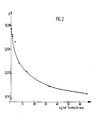
- a constant quantity of fluorescent compound is introduced into tubes containing concentrations of testosterones, between 0.67 and 33.3 ng / ml prepared according to a) and 17.5 ⁇ g of IgG per tube, so that the final volume of solution in the tubes is 1 ml and the final concentration of fluorescent compound 10 ⁇ 8M. Incubate for 10 minutes at 4 ° C before measuring P.
- the decrease curve of P as a function of the amount of hapten is shown in fig. 2.
- This grafting allows the coupling of the hormone to a protein and the preparation of an antitestosterone antibody according to a usual technique, described in particular by ERLANGER et al. in J. Bio Chem. 228 p 713 (1957).
- the hapten to be measured is testosterone;
- the fluorescent compound is prepared with testosterone-3 CMP which is also used to prepare antibodies after coupling with bovine serum albumin according to a known method, and with the compound of formula II in which Z is Z2, these two products being coupled by reaction of a bifunctional molecule 1,7-diamino heptane.
- the hapten to be assayed is estriol. It is used to prepare the fluorescent compound in the form of its estriol-6 CMO derivative, which is also used for the preparation of the antibody, according to known methods.
- the fluorescent compound is isolated (Rf 0.65) on a thin layer chromatography plate (Merck silica gel 60), eluting with dichloromethane / methanol (50/50).
- the hapten to be assayed is serotonin; we will use the competitive process.
- the serotonin linked to compound II is demonstrated by vaporization of an ethanolic solution of cinnamic aldehyde, a reagent specific for the indole nucleus.
- the antigen to be assayed is insulin, by the competitive process.
- the mixture is left for one hour at room temperature with gentle stirring, 12 hours at 4 ° C and one hour at room temperature.
- the fluorescent compound is isolated by column chromatography on BIO-GEL P2 (BIO-RAD®), eluting with phosphate buffer pH 7 (0.05 M). The fluorescent compound passes into the exclusion volume.
- the molecule to be measured is human choriomammotropin (hCS) or placental hormone lactogen (hPL).
- the lactogenic placental hormone from ICN Pharmaceuticals (CLEVELAND, OHIO) is dissolved in a carbonate-bicarbonate buffer (0.1 M) pH 9.0 at a concentration of 10 mg / ml: 11 mg hPL ( 0.509 ⁇ mole) in 1.1 ml of buffer.
- the two preparations (coupling 1 and 2) are subjected to gel filtration by passage on a 1.5 x 12 cm column of Biogel P2 (BIO RAD Lab. RICHMONDS, CA).
- the elution is carried out with a phosphate buffer, 0.05 M, pH 7.0 at a flow rate of 20 ml / hour.
- the starting fluorescent compound is excluded and leaves between the 9th and the 16th ml, the dye is eluted between the 167-224th ml.
- the degree of labeling is determined for each of the two fluorescent compounds obtained (quantity of dye per molecule to be assayed); the amount of protein being assayed by the method of Lowry, OH, Rosebrough, NJ, Farr, AL and Randal, RJ, "J. biol. Chem .” 193 (1951) 265 and that of dye being determined by measuring the absorption of the compound obtained at 428 nm.
- Compounds 1 and 2 have labeling rates of 1.53 and 3.20 respectively.
- the polarization P of a solution of compound 2 is measured such that the concentration of hPL is 2.3 10 ⁇ 8 M while that of the starting fluorescent compound is 7.40 10 ⁇ 8 M, in a phosphate buffer, 0, 02 M, pH 7.0.
- Tubes each containing a given quantity of hPL are introduced, the concentrations being between 0.05 and 10 ⁇ g / ml, a constant quantity of fluorescent compound 2 prepared according to a) and 45 ⁇ g / ml of anti-hPL IgG of such that the final volume is 2 ml and the final concentration of the fluorescent compound is 7.4 10 ⁇ 8 M (measured by fluorescence). Incubate for 2 to 10 hours at 5 ° C ⁇ 2 ° C before measuring P.
- the antigen to be assayed is the aldosterone-bovine serum albumin conjugate; we will use the direct process.
- the fluorescent compound can be prepared as follows:
- Fab fragments of an anti-aldosterone mouse monoclonal antibody are prepared by digestion with papain, as described by Mage, MG in "Methods in Enzymology” Tome 70, eds. H. van Vunakis and JJ Langome, Academic Press, New York, 1980, p. 142.
- the Fab fragments are purified by gel filtration and by affinity chromatography on Protein-A-Sepharose.
- the antigen to be assayed is human IgM; we will use the direct process.
- the fluorescent compound can be prepared as follows: Fab fragments of a mouse anti-human IgM monoclonal antibody are prepared and purified as in Example 8.
- the human IgM titration curve gives the following results:
Landscapes
- Health & Medical Sciences (AREA)
- Chemical & Material Sciences (AREA)
- Immunology (AREA)
- Life Sciences & Earth Sciences (AREA)
- Organic Chemistry (AREA)
- Engineering & Computer Science (AREA)
- Biomedical Technology (AREA)
- Urology & Nephrology (AREA)
- Molecular Biology (AREA)
- Hematology (AREA)
- Microbiology (AREA)
- Cell Biology (AREA)
- Biotechnology (AREA)
- Food Science & Technology (AREA)
- Medicinal Chemistry (AREA)
- Physics & Mathematics (AREA)
- Analytical Chemistry (AREA)
- Biochemistry (AREA)
- General Health & Medical Sciences (AREA)
- General Physics & Mathematics (AREA)
- Pathology (AREA)
- Medicines Containing Antibodies Or Antigens For Use As Internal Diagnostic Agents (AREA)
- Peptides Or Proteins (AREA)
Claims (11)
- Immunologisches Bestimmungsverfahren bei der Fluoreszenzpolarisation, dadurch gekennzeichnet, daß das verwendete Bestimmungsreagens ein 4-Aminonaphtalimid-Derivat der Formel I ist:
 - A₁ und A₂, die identisch oder verschieden sein können, ein Wasserstoff-Atom oder eine Gruppe SO
 - R mit dem daran gebundenen Stickstoff-Atom für eine Gruppe steht, die abgeleitet ist von einem Hapten, einem Antigen mit einem Molekulargewicht von unter 20 000, oder einem Antikörper-Fragment.
 - Verfahren nach Anspruch 1, dadurch gekennzeichnet, daß A₁ und A₂ in Formel I gleichzeitig für SO

- Verfahren nach Anspruch 1, dadurch gekennzeichnet, daß R in Formel I durch Reaktion eines Haptens, eines Antigens oder eines Antikörper-Fragments mit einer Verbindung der Formel II entsteht:

- Verfahren nach Anspruch 3, dadurch gekennzeichnet, daß Z in Formel II ausgewählt ist aus

- Verfahren nach einem der Ansprüche 1 bis 4, wobei das Hapten, das Antigen oder das Antikörper-Fragment über den Imid-Stickstoff gebunden ist oder indirekt über Z, d.h., über eine bifunktionelle Zwischengruppe.
- Verfahren nach Anspruch 1, dadurch gekennzeichnet, daß das verwendete Reagens entsteht durch Einwirkung eines Haptens, eines Antigens oder eines Antikörper-Fragments mit primärer Aminofunktion, oder eines ihrer Derivate mit primärer Aminofunktion auf das Anhydrid der Formel III:

- Fluoreszierende Verbindung, verwendbar zur immunologischen Bestimmung bei der Fluoreszenzpolarisation, nach irgendeinem der Ansprüche 1 bis 6, die ein 4-Aminonaphtalimid-Derivat der Formel I ist ;
 - A₁ und A₂, die identisch oder verschieden sein können, ein Wasserstoff-Atom oder eine Gruppe SO
 - R mit dem daran gebundenen Stickstoff-Atom für eine Gruppe steht, die abgeleitet ist von einem Hapten, einem Antigen mit einem Molekulargewicht von unter 20 000, oder einem Antikörper-Fragment, und durch Reaktion eines Haptens, eines Antigens oder eines Antikörper-Fragments mit einer Verbindung der Formel II entstehen kann:
- Verbindung nach Anspruch 7, worin ein Derivat des Haptens oder das zu bestimmende Antigen an die fluoreszierende Ausgangsverbindung gebunden ist.
- Verbindung nach Anspruch 8, worin das Hapten-Derivat ein Steroid ist, worin ein Carbonyl zu der Funktion -C=N-O-CH₂COOH umgesetzt wurde, oder worin ein Hydroxyl zu der Funktion OCO(CH₂)₂COOH umgesetzt wurde.
- Verfahren zur Bestimmung von Haptenen oder Antigenen mit geringem Molekulargewicht durch Fluoreszenz-Immunpolarisation nach irgendeinem der Ansprüche 1 bis 6, dadurch gekennzeichnet, daß1) in das zu untersuchende Medium eine bekannte Menge eines Reagens der Formel I eingebracht wird, das vom zu bestimmenden Produkt abgeleitet ist und vom gleichen Antikörper wie das zu bestimmende Produkt erkannt wird;2) eine gegebene Menge an Antikörpern eingebracht wird, die gegen das zu bestimmende Produkt und die vorher zugesetzte Verbindung gerichtet sind ;3) nach der Inkubation die Höhe der Fluoreszenzpolarisation der so behandelten Probe gemessen wird;4) die Konzentration des zu bestimmenden Produkts im Medium durch Vergleich mit Eichproben bestimmt wird.
- Verfahren zur Bestimmung von Antigenen mit hohem Molekulargewicht durch Fluoreszenz-Immunpolarisation nach irgendeinem der Ansprüche 1 bis 6, dadurch gekennzeichnet, daß1) in das zu untersuchende Medium eine bekannte Menge einer fluoreszierenden Verbindung der Formel I eingebracht wird, die ein Fragment eines monoklonalen Antikörpers trägt, der gegen das zu bestimmende Antigen gerichtet ist, wobei dieses Fragment das Antigen erkennt;2) die Mischung inkubiert wird;3) die Höhe P der Fluoreszenzpolarisation des so erhaltenen Mediums gemessen wird;4) die Konzentration des zu bestimmenden Antigens durch Vergleich mit Eichproben ermittelt wird.
Applications Claiming Priority (2)
| Application Number | Priority Date | Filing Date | Title |
|---|---|---|---|
| FR8418311 | 1984-11-30 | ||
| FR8418311A FR2574184B1 (fr) | 1984-11-30 | 1984-11-30 | Composes fluorescents, derives d'(amino-4 disulfonato-3,6) naphtalimide, leur application aux dosages immunologiques en polarisation de fluorescence |
Publications (2)
| Publication Number | Publication Date |
|---|---|
| EP0187076A1 EP0187076A1 (de) | 1986-07-09 |
| EP0187076B1 true EP0187076B1 (de) | 1991-09-18 |
Family
ID=9310121
Family Applications (1)
| Application Number | Title | Priority Date | Filing Date |
|---|---|---|---|
| EP85402360A Expired - Lifetime EP0187076B1 (de) | 1984-11-30 | 1985-11-29 | Fluoreszierende Verbindungen, (Amino-4)-naphthalimidderivate, deren Verwendung in immunologischen Bestimmungen bei der Fluoreszenzpolarisation |
Country Status (3)
| Country | Link |
|---|---|
| EP (1) | EP0187076B1 (de) |
| DE (1) | DE3584153D1 (de) |
| FR (1) | FR2574184B1 (de) |
Cited By (1)
| Publication number | Priority date | Publication date | Assignee | Title |
|---|---|---|---|---|
| ES2325293A1 (es) * | 2008-02-28 | 2009-08-31 | Universidad De Granada | Agentes de etiquetado simple basados en vinilsulfona. |
Families Citing this family (4)
| Publication number | Priority date | Publication date | Assignee | Title |
|---|---|---|---|---|
| US5177083A (en) * | 1986-07-03 | 1993-01-05 | The Scripps Clinic And Research Foundation | Drugs effective against retroviruses |
| CA2586320A1 (en) | 2003-11-05 | 2005-05-19 | Photobiomed Corporation | Bonding tissues and cross-linking proteins with naphthalimide compounds |
| CN111825787B (zh) * | 2020-07-17 | 2022-04-05 | 苏州大学 | 分析h2o/dmf混合溶液的溶剂组成的荧光化过氯乙烯 |
| CN114181148B (zh) * | 2021-12-09 | 2022-08-05 | 东北农业大学 | “on-off”型荧光探针、其制备方法及其应用 |
Family Cites Families (2)
| Publication number | Priority date | Publication date | Assignee | Title |
|---|---|---|---|---|
| US4473693A (en) * | 1978-08-04 | 1984-09-25 | Stewart Walter W | Aminonaphthalimide dyes for intracellular labelling |
| CA1248086A (en) * | 1981-12-11 | 1989-01-03 | Stephen D. Stroupe | Fluorescence polarization immunoassay |
-
1984
- 1984-11-30 FR FR8418311A patent/FR2574184B1/fr not_active Expired
-
1985
- 1985-11-29 DE DE8585402360T patent/DE3584153D1/de not_active Expired - Lifetime
- 1985-11-29 EP EP85402360A patent/EP0187076B1/de not_active Expired - Lifetime
Non-Patent Citations (1)
| Title |
|---|
| NATURE, vol.292, no.5818, 02 juillet 1981, MacMillan Journals Ltd., Chesham, Bucks (GB); W.W.STEWART, pp.17-21 * |
Cited By (3)
| Publication number | Priority date | Publication date | Assignee | Title |
|---|---|---|---|---|
| ES2325293A1 (es) * | 2008-02-28 | 2009-08-31 | Universidad De Granada | Agentes de etiquetado simple basados en vinilsulfona. |
| WO2009106664A1 (es) * | 2008-02-28 | 2009-09-03 | Universidad De Granada | Agentes de etiquetado simple basados en vinilsulfona |
| ES2325293B1 (es) * | 2008-02-28 | 2010-06-04 | Universidad De Granada | Agentes de etiquetado simple basados en vinilsulfona. |
Also Published As
| Publication number | Publication date |
|---|---|
| FR2574184B1 (fr) | 1988-04-22 |
| FR2574184A1 (fr) | 1986-06-06 |
| EP0187076A1 (de) | 1986-07-09 |
| DE3584153D1 (de) | 1991-10-24 |
Similar Documents
| Publication | Publication Date | Title |
|---|---|---|
| US5279943A (en) | Homogeneous process for the detection and/or determination by luminescence of an analyte in a medium in which it may be present | |
| FR2462709A1 (fr) | Procede de dosage immunologique utilisant des enzymes, par effet de charges et composition pour sa mise en oeuvre | |
| EP0668504A1 (de) | Quaternäre ammonium immunogenische Konjugate und Immuntest-Reagenz | |
| EP0022005B1 (de) | Verfahren zum Trennen einer eiweissartigen Substanz mittels Affinitätsfiltrierung einer diese Substanz enthaltenden Lösung und Verwendung dieses Verfahrens für enzymatische Bestimmungen | |
| JPH06100601B2 (ja) | 免疫分析用試薬及びそれを用いた分析方法 | |
| CN109824599B (zh) | 一种阿苯达唑半抗原及其制备方法和应用 | |
| CN101066998B (zh) | 甲羟孕酮醋酸酯特异性抗体的制备及该抗体用于同源或异源酶联免疫分析的方法 | |
| EP0187076B1 (de) | Fluoreszierende Verbindungen, (Amino-4)-naphthalimidderivate, deren Verwendung in immunologischen Bestimmungen bei der Fluoreszenzpolarisation | |
| JP3260379B2 (ja) | 西洋ワサビペルオキシダーゼを用いて生体分子を標識する方法 | |
| JPH079428B2 (ja) | 免疫分析方法 | |
| EP0063064A1 (de) | Reagens zur radio-oder enzymimmunologischen Bestimmung der IgE | |
| FR2623193A1 (fr) | Anticorps immobilises, fixes par liaison covalente a un polymere-matrice, et leur procede de preparation | |
| CA1279260C (en) | Homogeneous process for the detection and/or determination by luminescence of an analyte in a medium in which it may be present | |
| CH629894A5 (en) | Process for separating the free fractions from the bound fractions in an immunoassay procedure | |
| JPH0346074B2 (de) | ||
| EP1247096A1 (de) | Verfahren zur immobilisierung von affinen reagentien an hydrophoben festphasen | |
| EP0192565B1 (de) | Verfahren zur immunologischen Bestimmung von Aminen, monoklonale Antikörper und Testsatz zur Durchführung des Verfahrens | |
| JPS60159652A (ja) | 免疫分析用試薬 | |
| JPH07113639B2 (ja) | 免疫分析用試薬 | |
| JP2509636B2 (ja) | 生理活性物質固定化組成物 | |
| JPS62214357A (ja) | 免疫分析用試薬の製造方法 | |
| FR2627588A1 (fr) | Procede de dosage immunologique d'une substance de structure haptenique | |
| CN119528754A (zh) | 一种n-(1,3-二甲基丁基)-n'-苯基对苯二胺-醌半抗原及其制备方法和应用 | |
| JPS63117253A (ja) | 免疫センサ− | |
| CN120172851A (zh) | 一种水杨酸辛酯半抗原及其制备方法和应用 |
Legal Events
| Date | Code | Title | Description |
|---|---|---|---|
| PUAI | Public reference made under article 153(3) epc to a published international application that has entered the european phase |
Free format text: ORIGINAL CODE: 0009012 |
|
| AK | Designated contracting states |
Kind code of ref document: A1 Designated state(s): DE FR GB NL |
|
| 17P | Request for examination filed |
Effective date: 19860728 |
|
| RAP1 | Party data changed (applicant data changed or rights of an application transferred) |
Owner name: ETABLISSEMENT PUBLIC DIT: CENTRE NATIONAL DE LA R |
|
| 17Q | First examination report despatched |
Effective date: 19880721 |
|
| GRAA | (expected) grant |
Free format text: ORIGINAL CODE: 0009210 |
|
| AK | Designated contracting states |
Kind code of ref document: B1 Designated state(s): DE FR GB NL |
|
| PG25 | Lapsed in a contracting state [announced via postgrant information from national office to epo] |
Ref country code: NL Effective date: 19910918 Ref country code: GB Effective date: 19910918 |
|
| REF | Corresponds to: |
Ref document number: 3584153 Country of ref document: DE Date of ref document: 19911024 |
|
| NLV1 | Nl: lapsed or annulled due to failure to fulfill the requirements of art. 29p and 29m of the patents act | ||
| GBV | Gb: ep patent (uk) treated as always having been void in accordance with gb section 77(7)/1977 [no translation filed] | ||
| PLBE | No opposition filed within time limit |
Free format text: ORIGINAL CODE: 0009261 |
|
| STAA | Information on the status of an ep patent application or granted ep patent |
Free format text: STATUS: NO OPPOSITION FILED WITHIN TIME LIMIT |
|
| PG25 | Lapsed in a contracting state [announced via postgrant information from national office to epo] |
Ref country code: FR Effective date: 19920731 |
|
| PG25 | Lapsed in a contracting state [announced via postgrant information from national office to epo] |
Ref country code: DE Effective date: 19920801 |
|
| 26N | No opposition filed | ||
| REG | Reference to a national code |
Ref country code: FR Ref legal event code: ST |