EP0187367B1 - Dünnfilmtransistor - Google Patents
Dünnfilmtransistor Download PDFInfo
- Publication number
- EP0187367B1 EP0187367B1 EP85116460A EP85116460A EP0187367B1 EP 0187367 B1 EP0187367 B1 EP 0187367B1 EP 85116460 A EP85116460 A EP 85116460A EP 85116460 A EP85116460 A EP 85116460A EP 0187367 B1 EP0187367 B1 EP 0187367B1
- Authority
- EP
- European Patent Office
- Prior art keywords
- semiconductor layer
- thin film
- film transistor
- amorphous silicon
- impurity
- Prior art date
- Legal status (The legal status is an assumption and is not a legal conclusion. Google has not performed a legal analysis and makes no representation as to the accuracy of the status listed.)
- Expired - Lifetime
Links
- 239000010409 thin film Substances 0.000 title claims abstract description 30
- 239000004065 semiconductor Substances 0.000 claims abstract description 45
- 239000000758 substrate Substances 0.000 claims abstract description 21
- 229910021417 amorphous silicon Inorganic materials 0.000 claims description 30
- 239000004973 liquid crystal related substance Substances 0.000 claims description 20
- 239000012535 impurity Substances 0.000 claims description 10
- 239000011159 matrix material Substances 0.000 claims description 7
- OAICVXFJPJFONN-UHFFFAOYSA-N Phosphorus Chemical group [P] OAICVXFJPJFONN-UHFFFAOYSA-N 0.000 claims description 5
- 229910052698 phosphorus Inorganic materials 0.000 claims description 5
- 239000011574 phosphorus Substances 0.000 claims description 5
- PCHJSUWPFVWCPO-UHFFFAOYSA-N gold Chemical compound [Au] PCHJSUWPFVWCPO-UHFFFAOYSA-N 0.000 claims description 3
- 239000010931 gold Substances 0.000 claims description 3
- 229910052737 gold Inorganic materials 0.000 claims description 3
- 239000010408 film Substances 0.000 description 7
- XKRFYHLGVUSROY-UHFFFAOYSA-N Argon Chemical compound [Ar] XKRFYHLGVUSROY-UHFFFAOYSA-N 0.000 description 6
- 238000004519 manufacturing process Methods 0.000 description 6
- 210000004027 cell Anatomy 0.000 description 5
- 210000002858 crystal cell Anatomy 0.000 description 5
- XUIMIQQOPSSXEZ-UHFFFAOYSA-N Silicon Chemical compound [Si] XUIMIQQOPSSXEZ-UHFFFAOYSA-N 0.000 description 4
- 229910052710 silicon Inorganic materials 0.000 description 4
- 239000010703 silicon Substances 0.000 description 4
- 229910001218 Gallium arsenide Inorganic materials 0.000 description 3
- KDLHZDBZIXYQEI-UHFFFAOYSA-N Palladium Chemical compound [Pd] KDLHZDBZIXYQEI-UHFFFAOYSA-N 0.000 description 3
- 229910052786 argon Inorganic materials 0.000 description 3
- 230000005669 field effect Effects 0.000 description 3
- 238000000034 method Methods 0.000 description 3
- BLRPTPMANUNPDV-UHFFFAOYSA-N Silane Chemical compound [SiH4] BLRPTPMANUNPDV-UHFFFAOYSA-N 0.000 description 2
- 229910052782 aluminium Inorganic materials 0.000 description 2
- XAGFODPZIPBFFR-UHFFFAOYSA-N aluminium Chemical compound [Al] XAGFODPZIPBFFR-UHFFFAOYSA-N 0.000 description 2
- 150000001875 compounds Chemical class 0.000 description 2
- 230000010354 integration Effects 0.000 description 2
- 229910052751 metal Inorganic materials 0.000 description 2
- 239000002184 metal Substances 0.000 description 2
- 239000010936 titanium Substances 0.000 description 2
- 238000007738 vacuum evaporation Methods 0.000 description 2
- ZOKXTWBITQBERF-UHFFFAOYSA-N Molybdenum Chemical compound [Mo] ZOKXTWBITQBERF-UHFFFAOYSA-N 0.000 description 1
- 229910000577 Silicon-germanium Inorganic materials 0.000 description 1
- 229910000681 Silicon-tin Inorganic materials 0.000 description 1
- RTAQQCXQSZGOHL-UHFFFAOYSA-N Titanium Chemical compound [Ti] RTAQQCXQSZGOHL-UHFFFAOYSA-N 0.000 description 1
- LEVVHYCKPQWKOP-UHFFFAOYSA-N [Si].[Ge] Chemical compound [Si].[Ge] LEVVHYCKPQWKOP-UHFFFAOYSA-N 0.000 description 1
- 230000004888 barrier function Effects 0.000 description 1
- 238000005229 chemical vapour deposition Methods 0.000 description 1
- 238000010276 construction Methods 0.000 description 1
- 239000013078 crystal Substances 0.000 description 1
- 230000000694 effects Effects 0.000 description 1
- 238000005530 etching Methods 0.000 description 1
- 238000002474 experimental method Methods 0.000 description 1
- 239000007789 gas Substances 0.000 description 1
- 239000011521 glass Substances 0.000 description 1
- BHEPBYXIRTUNPN-UHFFFAOYSA-N hydridophosphorus(.) (triplet) Chemical compound [PH] BHEPBYXIRTUNPN-UHFFFAOYSA-N 0.000 description 1
- 238000009413 insulation Methods 0.000 description 1
- 150000002500 ions Chemical class 0.000 description 1
- LQJIDIOGYJAQMF-UHFFFAOYSA-N lambda2-silanylidenetin Chemical compound [Si].[Sn] LQJIDIOGYJAQMF-UHFFFAOYSA-N 0.000 description 1
- 239000000463 material Substances 0.000 description 1
- 239000000203 mixture Substances 0.000 description 1
- 238000012986 modification Methods 0.000 description 1
- 230000004048 modification Effects 0.000 description 1
- 229910052750 molybdenum Inorganic materials 0.000 description 1
- 239000011733 molybdenum Substances 0.000 description 1
- 229910052763 palladium Inorganic materials 0.000 description 1
- 238000000206 photolithography Methods 0.000 description 1
- 238000005268 plasma chemical vapour deposition Methods 0.000 description 1
- 230000000717 retained effect Effects 0.000 description 1
- 229910052701 rubidium Inorganic materials 0.000 description 1
- IGLNJRXAVVLDKE-UHFFFAOYSA-N rubidium atom Chemical compound [Rb] IGLNJRXAVVLDKE-UHFFFAOYSA-N 0.000 description 1
- 229910052719 titanium Inorganic materials 0.000 description 1
- WFKWXMTUELFFGS-UHFFFAOYSA-N tungsten Chemical compound [W] WFKWXMTUELFFGS-UHFFFAOYSA-N 0.000 description 1
- 229910052721 tungsten Inorganic materials 0.000 description 1
- 239000010937 tungsten Substances 0.000 description 1
Images
Classifications
-
- H—ELECTRICITY
- H10—SEMICONDUCTOR DEVICES; ELECTRIC SOLID-STATE DEVICES NOT OTHERWISE PROVIDED FOR
- H10D—INORGANIC ELECTRIC SEMICONDUCTOR DEVICES
- H10D86/00—Integrated devices formed in or on insulating or conducting substrates, e.g. formed in silicon-on-insulator [SOI] substrates or on stainless steel or glass substrates
- H10D86/40—Integrated devices formed in or on insulating or conducting substrates, e.g. formed in silicon-on-insulator [SOI] substrates or on stainless steel or glass substrates characterised by multiple TFTs
-
- H—ELECTRICITY
- H10—SEMICONDUCTOR DEVICES; ELECTRIC SOLID-STATE DEVICES NOT OTHERWISE PROVIDED FOR
- H10D—INORGANIC ELECTRIC SEMICONDUCTOR DEVICES
- H10D30/00—Field-effect transistors [FET]
- H10D30/80—FETs having rectifying junction gate electrodes
- H10D30/87—FETs having Schottky gate electrodes, e.g. metal-semiconductor FETs [MESFET]
- H10D30/875—FETs having Schottky gate electrodes, e.g. metal-semiconductor FETs [MESFET] having thin-film semiconductor bodies
-
- H—ELECTRICITY
- H10—SEMICONDUCTOR DEVICES; ELECTRIC SOLID-STATE DEVICES NOT OTHERWISE PROVIDED FOR
- H10D—INORGANIC ELECTRIC SEMICONDUCTOR DEVICES
- H10D86/00—Integrated devices formed in or on insulating or conducting substrates, e.g. formed in silicon-on-insulator [SOI] substrates or on stainless steel or glass substrates
- H10D86/40—Integrated devices formed in or on insulating or conducting substrates, e.g. formed in silicon-on-insulator [SOI] substrates or on stainless steel or glass substrates characterised by multiple TFTs
- H10D86/60—Integrated devices formed in or on insulating or conducting substrates, e.g. formed in silicon-on-insulator [SOI] substrates or on stainless steel or glass substrates characterised by multiple TFTs wherein the TFTs are in active matrices
Definitions
- the present invention relates to a thin film transistor which is suitable for use, for instance, as an active element of a drive circuit for a liquid crystal display cell.
- an active matrix liquid crystal display of the type that has display electrodes arranged in a matrix form and selectively applies thereto voltage to reproduce and display television signals as images.
- thin film transistors are employed for the selective voltage application to the display electrodes of the liquid crystal display cell and drive circuits for driving gate buses and source buses connected to gates and sources of the thin film transistors, respectively, are provided on one of transparent substrates of the liquid crystal display cell.
- Such an arrangement is proposed in U. S. Patent Application Serial No. 510,481 "Dot-Matrix Liquid Crystal Display” filed on July 1, 1983 corresponding to Japanese patent Application No. 120,808/82 (Pat. Pub. Disc. No. 10,988/84), "Liquid Crystal Color Display", for reducing the number of external leads (terminals) and for facilitating the connection of the liquid crystal display cell with an external device.
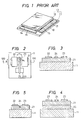
- liquid crystal is sealed in the space defined by transparent substrates 11 and 12 to form a liquid crystal cell 13.
- a number of display electrodes and thin film transistors connected thereto via drain electrodes, though not shown, are disposed, for example, in a matrix form on the transparent substrate 11.
- For each row of the thin film transistors their gate electrodes are connected to a gate bus 14 and for each column their source electrodes are connected to a source bus 15.
- the gate buses 14 and the source buses 15 are led out of the liquid crystal cell 13.
- the transparent substrate 11 has formed thereon a gate bus drive circuit 16 for selectively driving the gate buses 14 and a latch circuit (a source bus drive circuit) 17 which is connected to a shift register 18.
- Picture signals to be displayed are applied serially to the shift register 18 and latched in the latch circuit 17 in parallel. Parallel outputs of the latch circuit 17 are respectively provided on the corresponding source buses 15.
- the provision of the gate drive circuit 16 and the latch circuit (the source drive circuit) 17 on the transparent substrate 11, for driving the thin film transistors in the liquid crystal cell 13, permits the reduction of the number of terminals for external connection, and hence is very convenient.
- the gate drive circuit 16, the latch circuit (the source drive circuit) 17 and the shift register 18 are each formed using an MOSFET, i.e. an FET which has its gate electrode formed on a semiconductor layer between the source and drain through a gate insulating film.
- MOSFET i.e. an FET which has its gate electrode formed on a semiconductor layer between the source and drain through a gate insulating film.
- the MOSFET is low in the operating speed as a switching element, calls for a relatively large drive current and is somewhat complex in structure, resulting in low production yield. Consequently, it is not suitable for fabrication with high integration density.
- the voltage to be applied is relatively high, that is, since the gate voltage is applied via the gate insulation film to the semiconductor layer, the voltage is divided by the gate insulating film and the voltage applied to the semiconductor layer becomes low, so that an appreciably high gate voltage is needed.
- a metal-epitaxial-semiconductor thin film transistor of the type that has a GaAs epitaxial growth layer formed on the epitaxial layer in Schottky contact therewith and controls source-to-drain current by controlling a depletion layer is proposed, for instance, in Proc. IEEE, 54, 307, 1966, C.A. Mead, "Schottky Barrier Gate Field-Effect Transistor” and Proc. IEEE, 55, 1237, 1967, W.W. Heuper et al., "An Epitaxial GaAs Field-Effect Transistor". Since the MESFET employs the epitaxial growth layer, it is difficult to use for a circuit which needs a large area, and this FET is expensive because it uses GaAs.
- a thin film transistor comprising: a substrate; an impurity-doped hydrogenated amorphous silicon semiconductor layer formed on the substrate; an impurity-undoped amorphous silicon semiconductor layer interposed between the impurity-doped amorphous silicon semiconductor layer and the substrate; a source and drain electrode formed in mutually spaced relationship on the amorphous silicon semiconductor layer and in ohmic contact therewith; and a gate electrode formed on the amorphous silicon semiconductor layer in Schottky contact therewith between the source and drain electrodes, wherein the portion of said amorphous silicon semiconductor layer underlying the gate electrode is in the range 0.1 to 1.0 ⁇ m thick.
- Figs. 2 and 3 illustrate an example of a thin film transistor in which an n-type hydrogenated amorphous silicon layer (hereinafter sometimes simply referred to as amorphous silicon layer) 21 doped with phosphorous (P) is formed as an amorphous semiconductor layer on a transparent substrate 11 as of glass.
- the n-type amorphous silicon layer 21 can be formed, for example, by a plasma CVD (Chemical Vapor Deposition) process as follows: A gas mixture of argon and SiH4 is introduced into a reaction chamber, along with a small quantity of PH3 diluted with argon.
- the molar ratio of argon to SiH4 is always held at 11; the transparent substrate 11 is held at about 250°C; the pressure in the reaction chamber is retained at 0.36 Torr; the frequency of RF power is 12.56 KHz; and the power is 40 W.
- the impurity concentration of phosphorus to silicon in the amorphous silicon layer 21 is selected substantially in the range of 0.75 ⁇ 10 ⁇ 3 to 1.5 ⁇ 10 ⁇ 3 in terms of molar ratio M p/s .
- the amorphous silicon layer 21 is selectively removed by reactive atom-beam etching through an aluminum mask, leaving only active regions on the transparent substrate 11.
- the thickness of that portion of the amorphous silicon layer 21 in which the gate region will ultimately be formed is selected in the range of 0.1 to 1.0 ⁇ m, preferably, 0.3 to 0.5 ⁇ m in this example.
- the distance d1 between drain and source electrodes 22 and 23 is to be, for example, 70 ⁇ m and the width W1 and the length l1 of a gate electrode 24 are 30 ⁇ m and 1.54 mm, respectively.
- the drain electrode 22 and the source electrode 23 are formed apart from one another an the amorphous silicon layer 21 in ohmic contact therewith by means of vacuum evaporation of aluminum and photolithography.
- the gate electrode 24 is deposited between the drain and source electrodes 22 and 23 and this is achieved, for instance, by vacuum evaporation of gold and a lift-off process, on the amorphous silicon layer 21 in Schottky contact therewith.
- an electrode 24a for external connection of the gate electrode 24 is formed on the transparent substrate 11 simultaneously with the electrodes 22 and 23, and the gate electrode 24 is formed on the electrode 24a.
- the conductivity of the phosphorus-doped amorphous silicon layer 21 is selected to range from 10 ⁇ 4 ⁇ cm ⁇ 1 to 10 ⁇ cm ⁇ 1.
- the above n-type MESFET When no voltage is applied to the gate electrode 24, the above n-type MESFET is conductive between the drain and source electrodes 22 and 23, that is, it is in the ON state.
- the transferconductance gm of the MESFET was 10 ⁇ 7 mS/mm.
- the transferconductance gm was 5.5 ⁇ 10 ⁇ 6 mS/mm.
- the impurity concentration of the semiconductor layer 21 was 1.5 ⁇ 10 ⁇ 3 and the gate region was 0.45 ⁇ m thick
- the transferconductance gm was 1.3 ⁇ 10 ⁇ 4 mS/mm.
- the transferconductance gm was 1.0 ⁇ 10 ⁇ 5 mS/mm. It will be understood from the above that the recessed structure depicted in Fig. 5 is lower in the ON resistance between the drain and source than the flat gate structure of Fig. 3 and hence is preferable for practical use.
- the transferconductance gm increases with an increase in the impurity concentration of the semiconductor layer 21, but when the ratio of phosphorus to silicon was selected to be 2.0 x 10 ⁇ 3 and 2.5 ⁇ 10 ⁇ 3, excellent gate characteristics based on the Schottky characteristics could not be obtained. Accordingly, it is preferable that the impurity concentration be in the range of 1.0 ⁇ 10 ⁇ 3 to 1.5 ⁇ 10 ⁇ 3.
- the semiconductor layer 21 may be formed of fluorinated amorphous silicon, amorphous silicon-germanium or like semiconductor compound, or amorphous silicon-tin or like compound semiconductor as well as hydrogenated amorphous silicon.
- the gate electrode 24 for Schottky contact therewith may also be formed not only of gold but also of molybdenum or tungsten.
- the MESFET can be made normally-OFF by selecting the material of the gate electrode 24 and the conductivity and thickness of the amorphous semiconductor layer 21.
- the gate electrode 24 is formed of a metal which has a larger work function than amorphous silicon, such as titanium (Ti) or palladium (Pd), and the active layer is made thinner than in the case of the above-described depletion type FET.
- a P-channel FET can be obtained by forming the gate electrode of a metal which has a smaller work function than does the amorphous silicon, such as rubidium (Rb).
- the thin film transistors are formed on the same amorphous semiconductor layer 21 and isolated from each other in the same manner as in the case or a circuit employing conventional MESFETs of this kind.
- the thin film transistor or the present invention is a metal-semiconductor contact type field effect transistor and is simple in structure. That is, the nonuse of the gate insulating film simplifies the manufacturing process, increases the production yield and makes the thin film transistor suitable for fabrication with a high integration density. Moreover, the absence of the gate insulating film eliminates the influence of its electrostatic capacitance, allowing increased switching speed.
- the thickness of the gate region and the transferconductance gm are 1.5 ⁇ 10 ⁇ 3, 0.45 ⁇ m and 1.3 ⁇ 10 ⁇ 4 mS/mm, respectively, the effective mobility is about 1.9 cm2/V ⁇ s.
- the present invention permits the fabrication of an FET which operates at a speed about 10 times higher than the prior art MOSFET.
- the direct application of the gate voltage to the amorphous semiconductor layer 21 enables low-voltage operations.
- the drive circuits 16,17 and shift register 18 on the transparent substrate of the liquid crystal display are formed by the MESFETs explained above, it is possible to increase the drive speed. Moreover, when the thin film switching transistors inside the liquid crystal cell are formed by the MESFETs of the same structure as of the drive circuits (including the shift register), these switching transistors and the drive circuits can be simultaneously prepared on the substrate through the common processes.
- the thin film transistor is an MESFET, and hence has no gate insulating film and is simple in structure as compared with the conventional MOSFET. Accordingly, its operating speed can be increased and its drive power can also be reduced. In addition, since the semiconductor layer is not single-crystal but amorphous, the thin film transistor can be formed over a wide area and with ease and at low cost.
Landscapes
- Thin Film Transistor (AREA)
- Liquid Crystal (AREA)
- Bipolar Transistors (AREA)
- Junction Field-Effect Transistors (AREA)
- Pharmaceuticals Containing Other Organic And Inorganic Compounds (AREA)
- Agricultural Chemicals And Associated Chemicals (AREA)
- Non-Silver Salt Photosensitive Materials And Non-Silver Salt Photography (AREA)
Claims (9)
- Dünnfilmtransistor, umfassend:- ein Substrat (11);- eine störstellendotierte, hydrierte, amorphe Siliziumhalbleiterschicht (21), die auf das Substrat aufgebracht ist;- eine störstellenfreie, amorphe Siliziumhalbleiterschicht (25), die zwischen der störstellendotierten amorphen Siliziumhalbleiterschicht (21) und dem Substrat (11) gebildet ist;- eine Sourceelektrode (23) und eine Drainelektrode (22), die in beabstandeter Zuordnung auf der amorphen Siliziumhalbleiterschicht (21) angebracht und mit dieser im ohmschen Kontakt stehen; und- eine Gateelektrode (24), die auf der störstellendotierten, hydrierten Siliziumhalbleiterschicht (21), im Schottky-Kontakt mit dieser, zwischen der Sourceelektrode (23) und der Drainelektrode (22) angebracht ist, wobei der unter der Gateelektrode befindliche Abschnitt der störstellendotierten, hydrierten, amorphen Siliziumhalbleiterschicht (21) im Dickenbereich zwischen 0.1 und 1.0 µm liegt.
- Dünnfilmtransistor nach Anspruch 1,
bei dem eine Nut in die störstellendotierte, amorphe Halbleiterschicht (21) zwischen der Source- und der Drainelektrode geschnitten, die Gateelektrode (24) auf dem Boden der Nut angebracht, und der unter der Gateelektrode befindliche Abschnitt der störstellendotierten, hydrierten, amorphen Siliziumhalbleiterschicht dünner als diejenigen Abschnitte ist, die sich unter der Source- und der Drainelektrode befinden. - Dünnfilmtransistor nach Anspruch 1,
bei dem das Substrat (11) transparent ist, so daß der Transistor als aktives Element einer Treiberschaltung zum Ansteuern von Schaltelementen für das Anwählen von Bildelementelektroden einer aktiven Matrix-Flüssigkristallanzeigezelle benutzt werden kann. - Dünnfilmtransistor nach Anspruch 3,
bei dem die Störstellenkonzentration der hydrierten, amorphen Siliziumschicht im Bereich zwischen 0.75 x 10⁻³ und 1.5 x 10⁻³ liegt. - Dünnfilmtransistor nach Anspruch 4,
bei dem die in die hydrierte, amorphe Siliziumschicht eindotierten Störstellen aus Phosphor bestehen. - Dünnfilmtransistor nach Anspruch 3, 4 oder 5,
bei dem der unter der Gateelektrode befindliche Abschnitt der störstellendotierten, hydrierten, amorphen Siliziumhalbleiterschicht 0.3 bis 0.5 µm dick ist. - Dünnfilmtransistor nach einem beliebigen vorhergehenden Anspruch,
bei dem die Gateelektrode (24) aus Gold besteht. - Treiberschaltung zum Ansteuern von Schaltelementen für das Anwählen einer aktiven Matrix-Flüssigkristallanzeigezelle, wobei die Schaltung einen Dünnfilmtransistor nach einem beliebigen Anspruch 3 bis 7 als aktives Element aufweist.
- Aktive Matrix-Flüssigkristallanzeige, die eine Anzeigezelle und eine Treiberschaltung nach Anspruch 8 aufweist.
Priority Applications (1)
| Application Number | Priority Date | Filing Date | Title |
|---|---|---|---|
| AT85116460T ATE76222T1 (de) | 1984-12-28 | 1985-12-23 | Duennfilmtransistor. |
Applications Claiming Priority (2)
| Application Number | Priority Date | Filing Date | Title |
|---|---|---|---|
| JP279986/84 | 1984-12-28 | ||
| JP59279986A JPS61158185A (ja) | 1984-12-28 | 1984-12-28 | 薄膜トランジスタ |
Publications (3)
| Publication Number | Publication Date |
|---|---|
| EP0187367A2 EP0187367A2 (de) | 1986-07-16 |
| EP0187367A3 EP0187367A3 (en) | 1987-12-02 |
| EP0187367B1 true EP0187367B1 (de) | 1992-05-13 |
Family
ID=17618708
Family Applications (1)
| Application Number | Title | Priority Date | Filing Date |
|---|---|---|---|
| EP85116460A Expired - Lifetime EP0187367B1 (de) | 1984-12-28 | 1985-12-23 | Dünnfilmtransistor |
Country Status (6)
| Country | Link |
|---|---|
| US (1) | US4679062A (de) |
| EP (1) | EP0187367B1 (de) |
| JP (1) | JPS61158185A (de) |
| KR (1) | KR890004964B1 (de) |
| AT (1) | ATE76222T1 (de) |
| DE (1) | DE3586047D1 (de) |
Families Citing this family (7)
| Publication number | Priority date | Publication date | Assignee | Title |
|---|---|---|---|---|
| JP2681148B2 (ja) * | 1986-07-29 | 1997-11-26 | 工業技術院長 | 薄膜接合電界効果素子の製造方法 |
| JPH06101563B2 (ja) * | 1988-07-19 | 1994-12-12 | 工業技術院長 | 薄膜電界効果トランジスタとその製造方法 |
| WO1991011027A1 (en) * | 1990-01-16 | 1991-07-25 | Iowa State University Research Foundation, Inc. | Non-crystalline silicon active device for large-scale digital and analog networks |
| US5140390A (en) * | 1990-02-16 | 1992-08-18 | Hughes Aircraft Company | High speed silicon-on-insulator device |
| US6214705B1 (en) * | 1998-12-15 | 2001-04-10 | United Microelectronics Corp. | Method for fabricating a gate eletrode |
| TWI358594B (en) * | 2007-10-24 | 2012-02-21 | Au Optronics Corp | Pixel structure |
| WO2012091777A2 (en) * | 2010-10-04 | 2012-07-05 | Arizona Board Of Regents, A Body Corporate Of The State Of Arizona, Acting For And On Behalf Of Arizona State University | Complementary biasing circuits and related methods |
Family Cites Families (7)
| Publication number | Priority date | Publication date | Assignee | Title |
|---|---|---|---|---|
| CH572985A5 (de) * | 1971-12-10 | 1976-02-27 | Ibm | |
| JPS5190576A (de) * | 1975-02-07 | 1976-08-09 | ||
| DE3117037C2 (de) * | 1980-05-08 | 1987-05-14 | Takao Sakai Osaka Kawamura | Elektrophotografisches Aufzeichnungsmaterial |
| JPS5772370A (en) * | 1980-10-23 | 1982-05-06 | Canon Inc | Photoelectric converter |
| JPS582073A (ja) * | 1981-06-29 | 1983-01-07 | Sony Corp | 電界効果型トランジスタ |
| JPS587871A (ja) * | 1981-07-07 | 1983-01-17 | Matsushita Electric Ind Co Ltd | ダイオ−ドおよびその製造方法 |
| US4558340A (en) * | 1983-06-29 | 1985-12-10 | Stauffer Chemical Company | Thin film field effect transistors utilizing a polypnictide semiconductor |
-
1984
- 1984-12-28 JP JP59279986A patent/JPS61158185A/ja active Pending
-
1985
- 1985-12-16 US US06/809,677 patent/US4679062A/en not_active Expired - Fee Related
- 1985-12-23 EP EP85116460A patent/EP0187367B1/de not_active Expired - Lifetime
- 1985-12-23 DE DE8585116460T patent/DE3586047D1/de not_active Expired - Lifetime
- 1985-12-23 AT AT85116460T patent/ATE76222T1/de not_active IP Right Cessation
- 1985-12-27 KR KR1019850009843A patent/KR890004964B1/ko not_active Expired
Also Published As
| Publication number | Publication date |
|---|---|
| KR890004964B1 (ko) | 1989-12-02 |
| EP0187367A3 (en) | 1987-12-02 |
| DE3586047D1 (en) | 1992-06-17 |
| KR860005454A (ko) | 1986-07-23 |
| ATE76222T1 (de) | 1992-05-15 |
| US4679062A (en) | 1987-07-07 |
| JPS61158185A (ja) | 1986-07-17 |
| EP0187367A2 (de) | 1986-07-16 |
Similar Documents
| Publication | Publication Date | Title |
|---|---|---|
| US4924279A (en) | Thin film transistor | |
| EP0239958B1 (de) | Dünnschicht-Halbleiterbauelement und sein Herstellungsverfahren | |
| US5311040A (en) | Thin film transistor with nitrogen concentration gradient | |
| US4668968A (en) | Integrated circuit compatible thin film field effect transistor and method of making same | |
| EP0186036B1 (de) | Flüssigkristallanzeigevorrichtung | |
| US4673957A (en) | Integrated circuit compatible thin film field effect transistor and method of making same | |
| US4769338A (en) | Thin film field effect transistor and method of making same | |
| JPH08274336A (ja) | 多結晶半導体薄膜トランジスタ及びその製造方法 | |
| US20200144297A1 (en) | Thin film transistor and preparation method thereof, and array substrate and display device | |
| GB2056770A (en) | Thin film transistors | |
| US5173753A (en) | Inverted coplanar amorphous silicon thin film transistor which provides small contact capacitance and resistance | |
| EP0449539B1 (de) | Ohmscher Kontakt-Dünnschichttransistor | |
| GB2169746A (en) | Thin film transistor | |
| US4679062A (en) | Thin film transistor | |
| EP0254071B1 (de) | Amorphe Dünnfilmtransistoranordnung | |
| US4998152A (en) | Thin film transistor | |
| JPH04360583A (ja) | 薄膜トランジスタ | |
| JP2675587B2 (ja) | マトリックス型液晶表示パネル | |
| JPH0322064B2 (de) | ||
| EP0334052B1 (de) | Dünnfilm-Transistor | |
| JPH03185840A (ja) | 薄膜トランジスタ | |
| JPS61220369A (ja) | 薄膜電界効果素子 | |
| JPS63193568A (ja) | 薄膜トランジスタ | |
| JPH1032337A (ja) | 薄膜トランジスタとそれを用いた半導体集積回路および液晶表示装置ならびに薄膜トランジスタの製造方法 | |
| KR100310707B1 (ko) | 박막 트랜지스터 액정표시장치 및 그의 제조방법 |
Legal Events
| Date | Code | Title | Description |
|---|---|---|---|
| PUAI | Public reference made under article 153(3) epc to a published international application that has entered the european phase |
Free format text: ORIGINAL CODE: 0009012 |
|
| 17P | Request for examination filed |
Effective date: 19851223 |
|
| AK | Designated contracting states |
Kind code of ref document: A2 Designated state(s): AT BE CH DE FR GB IT LI LU NL SE |
|
| PUAL | Search report despatched |
Free format text: ORIGINAL CODE: 0009013 |
|
| AK | Designated contracting states |
Kind code of ref document: A3 Designated state(s): AT BE CH DE FR GB IT LI LU NL SE |
|
| 17Q | First examination report despatched |
Effective date: 19901221 |
|
| GRAA | (expected) grant |
Free format text: ORIGINAL CODE: 0009210 |
|
| RAP1 | Party data changed (applicant data changed or rights of an application transferred) |
Owner name: HOSIDEN CORPORATION |
|
| AK | Designated contracting states |
Kind code of ref document: B1 Designated state(s): AT BE CH DE FR GB IT LI LU NL SE |
|
| PG25 | Lapsed in a contracting state [announced via postgrant information from national office to epo] |
Ref country code: SE Effective date: 19920513 Ref country code: LI Effective date: 19920513 Ref country code: IT Free format text: LAPSE BECAUSE OF FAILURE TO SUBMIT A TRANSLATION OF THE DESCRIPTION OR TO PAY THE FEE WITHIN THE PRESCRIBED TIME-LIMIT;WARNING: LAPSES OF ITALIAN PATENTS WITH EFFECTIVE DATE BEFORE 2007 MAY HAVE OCCURRED AT ANY TIME BEFORE 2007. THE CORRECT EFFECTIVE DATE MAY BE DIFFERENT FROM THE ONE RECORDED. Effective date: 19920513 Ref country code: CH Effective date: 19920513 Ref country code: BE Effective date: 19920513 Ref country code: AT Effective date: 19920513 |
|
| REF | Corresponds to: |
Ref document number: 76222 Country of ref document: AT Date of ref document: 19920515 Kind code of ref document: T |
|
| REF | Corresponds to: |
Ref document number: 3586047 Country of ref document: DE Date of ref document: 19920617 |
|
| ET | Fr: translation filed | ||
| REG | Reference to a national code |
Ref country code: CH Ref legal event code: PL |
|
| PG25 | Lapsed in a contracting state [announced via postgrant information from national office to epo] |
Ref country code: LU Free format text: LAPSE BECAUSE OF NON-PAYMENT OF DUE FEES Effective date: 19921231 |
|
| PLBE | No opposition filed within time limit |
Free format text: ORIGINAL CODE: 0009261 |
|
| STAA | Information on the status of an ep patent application or granted ep patent |
Free format text: STATUS: NO OPPOSITION FILED WITHIN TIME LIMIT |
|
| 26N | No opposition filed | ||
| PGFP | Annual fee paid to national office [announced via postgrant information from national office to epo] |
Ref country code: FR Payment date: 19951121 Year of fee payment: 11 |
|
| PGFP | Annual fee paid to national office [announced via postgrant information from national office to epo] |
Ref country code: GB Payment date: 19951214 Year of fee payment: 11 |
|
| PGFP | Annual fee paid to national office [announced via postgrant information from national office to epo] |
Ref country code: NL Payment date: 19951230 Year of fee payment: 11 |
|
| PGFP | Annual fee paid to national office [announced via postgrant information from national office to epo] |
Ref country code: DE Payment date: 19960130 Year of fee payment: 11 |
|
| PG25 | Lapsed in a contracting state [announced via postgrant information from national office to epo] |
Ref country code: GB Effective date: 19961223 |
|
| PG25 | Lapsed in a contracting state [announced via postgrant information from national office to epo] |
Ref country code: NL Effective date: 19970701 |
|
| GBPC | Gb: european patent ceased through non-payment of renewal fee |
Effective date: 19961223 |
|
| PG25 | Lapsed in a contracting state [announced via postgrant information from national office to epo] |
Ref country code: FR Effective date: 19970829 |
|
| NLV4 | Nl: lapsed or anulled due to non-payment of the annual fee |
Effective date: 19970701 |
|
| PG25 | Lapsed in a contracting state [announced via postgrant information from national office to epo] |
Ref country code: DE Effective date: 19970902 |
|
| REG | Reference to a national code |
Ref country code: FR Ref legal event code: ST |