EP0187504A2 - Digitaler Phasenkorrelator - Google Patents
Digitaler Phasenkorrelator Download PDFInfo
- Publication number
- EP0187504A2 EP0187504A2 EP85309222A EP85309222A EP0187504A2 EP 0187504 A2 EP0187504 A2 EP 0187504A2 EP 85309222 A EP85309222 A EP 85309222A EP 85309222 A EP85309222 A EP 85309222A EP 0187504 A2 EP0187504 A2 EP 0187504A2
- Authority
- EP
- European Patent Office
- Prior art keywords
- phase
- clock
- signal
- signals
- delay
- Prior art date
- Legal status (The legal status is an assumption and is not a legal conclusion. Google has not performed a legal analysis and makes no representation as to the accuracy of the status listed.)
- Withdrawn
Links
- 230000003111 delayed effect Effects 0.000 claims description 12
- 238000001514 detection method Methods 0.000 claims description 4
- 230000001934 delay Effects 0.000 claims description 3
- 238000004891 communication Methods 0.000 description 8
- 238000000034 method Methods 0.000 description 3
- 240000007320 Pinus strobus Species 0.000 description 2
- 238000005516 engineering process Methods 0.000 description 2
- 230000001360 synchronised effect Effects 0.000 description 2
- 230000005540 biological transmission Effects 0.000 description 1
- 238000012937 correction Methods 0.000 description 1
- 230000003247 decreasing effect Effects 0.000 description 1
- 238000010586 diagram Methods 0.000 description 1
- 238000004519 manufacturing process Methods 0.000 description 1
- 239000002184 metal Substances 0.000 description 1
- 238000012986 modification Methods 0.000 description 1
- 230000004048 modification Effects 0.000 description 1
- 238000010587 phase diagram Methods 0.000 description 1
- 230000000717 retained effect Effects 0.000 description 1
Images
Classifications
-
- H—ELECTRICITY
- H04—ELECTRIC COMMUNICATION TECHNIQUE
- H04L—TRANSMISSION OF DIGITAL INFORMATION, e.g. TELEGRAPHIC COMMUNICATION
- H04L7/00—Arrangements for synchronising receiver with transmitter
- H04L7/0008—Synchronisation information channels, e.g. clock distribution lines
- H04L7/0012—Synchronisation information channels, e.g. clock distribution lines by comparing receiver clock with transmitter clock
-
- H—ELECTRICITY
- H04—ELECTRIC COMMUNICATION TECHNIQUE
- H04L—TRANSMISSION OF DIGITAL INFORMATION, e.g. TELEGRAPHIC COMMUNICATION
- H04L7/00—Arrangements for synchronising receiver with transmitter
- H04L7/0016—Arrangements for synchronising receiver with transmitter correction of synchronization errors
- H04L7/0033—Correction by delay
- H04L7/0037—Delay of clock signal
Definitions
- the present invention relates generally to phase correlation, and more particularly to a digital phase correlator having particular utility in synchronizing high-frequency signals.
- Timing or clock signals are used to control practically all digital operations to ensure that the logical operations carried out in a digital system are performed at the correct times and in the proper sequence.
- Digital systems which employ clock signals include digital data-communication systems and computers and microprocessors. Many digital communication systems operate in response to a received or incoming clock signal and a free-running, internally generated clock system. For proper operation these clock signals must be properly synchronized; that is, the phase differences between them must be maintained at a minimum.
- Analog phase-locked loops which have long been used in computer and digital communication systems to synchronize clocks of different frequencies and phases, are feedback systems that include a phase comparator, a low-pass filter and an error amplifier in the forward signal path, and a voltage-controlled oscillator in the feedback path.
- the error voltage is equal to zero.
- the voltage-controlled oscillator operates at a set frequency. If an input signal is applied to the system, the phase comparator compares the phase and the frequency of the input with the voltage-controlled oscillator frequency and generates an error voltage that is related to the phase and frequency differences between the two signals. This error voltage is then filtered, amplified and applied to the control terminal of the voltage-controlled oscillator.
- the control voltage forces the frequency and phase of the voltage-controlled oscillator to vary in a direction that reduces the frequency and phase differences between the output of the voltage-controlled oscillator and the input signal.
- phase-locked loop The total time taken by the phase-locked loop to establish phase lock depends on the initial frequency and phase differences between the two clock signals, as well as on the overall loop gain and the low-pass filter bandwidth. This pull- in time is relatively slow and cannot match the speed of fast digital communication systems, which require very high-speed clock phase correlation. For this reason the analog phase-locked loop systems now commercially available can operate only at frequencies of up to 35 mHz.
- Digital phase-locked loop systems are also known and have been used, particularly in higher-speed applications. These digital phase-locked systems employ an EXCLUSIVE-OR gate to generate the phase error between the input and output signals and an up-down counter to replace the voltage-controlled oscillator in the analog phase-locked loop.
- the accuracy of the digital phase-locked loop depends on the accuracy of the fundamental clock and the loop propagation delays.
- the fundamental clock In order to maintain an acceptable accuracy in a digital phase-locked loop, the fundamental clock must have a frequency 16 or more times higher than that of the input and output signals. When the input and output signal frequencies reach the speed limit of digital components used in typical high-speed computer and digital communication systems, the much higher frequency requirement of the fundamental clock can no longer be met by any available digital components. The current, commercially available digital phase-locked loop can thus operate only up to 50 mHz.
- the control circuits namely the phase detector and phase- correction circuit, both operate at lower frequencies than the locked clock signals.
- the digital phase correlator comprises a delay line, a multiplexer, a rotating register and two phase detection flip-flops.
- two clocks with the same frequency land different phase come into the digital correlator, one of the clocks is delayed by the delay line. This delayed clock and the other clock are fed into the phase detection flip-flops to detect the phase difference between the two clocks.
- the initial delay on one clock is either increased or decreased by rotating the single ONE bit in the rotating register to the right or left, thereby to delay one of the clocks by a correct amount and thereby bring the two clocks toward phase synchronization with one another.
- the present invention relates to a high-speed digital phase correlator, substantially as defined in the appended claims and as described in the accompanying specification as considered in connection with the accompanying drawings in which:
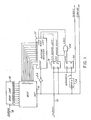
- Fig. 1 there is shown in schematic form an embodiment of the digital phase correlator of the present invention, which receives two clock signals Clock 1 and Clock 2 at lines 10 and 12, respectively.
- Clock 2 is applied to an input of a multitap delay line 14, having a plurality, here, for illustrative purposes, 10'taps, which provides delays at equal increments of ⁇ .
- the delay provided to Clock 2 at tap 4 ⁇ is four times the incremental delay ⁇ .
- the undelayed Clock 2 as well as the outputs of the taps of delay line 14 are applied as the inputs of a switching means or multiplexer 16.
- the other input clock Clock 1 is applied to the data or D inputs of phase-detect flip-flops 18 and 20.
- the two outputs of flip-flop 18, F F 1 and its inverse FF1 are applied respectively to the rotate left and rotate right control inputs of a rotating shift register 22, the plural stages of which are connected to the select lines of multiplexer 16.
- the output of multiplexer 16 which is the delayed Clock 2 signal or Clock 2D, is applied to the input of an nverter 24, the output of which is applied to the clock input of rotating register 22.
- the Clock 2D signal is also applied to the clock or C input of flip-flop 18 and to a fixed delay line 26 which introduces an additional delay of ⁇ .
- the output of delay line 26, which is Clock 2D + ⁇ , is applied to the clock or C input of flip-flop 20.
- the output FF2 of flip-flop 20 is applied, along with the output FF1 of flip-flop 18; to the inputs of an AND gate 28 the output of which is applied to the lock control input of register 22.
- a logic ONE signal is present in only one of the plurality of stages or bits 0, ⁇ , 2 ⁇ , 3 ⁇
- the ONE bit can be shifted between adjacent stages of rotating register 22 either to the right or to the left in response to a right or left shift control signal applied to the corresponding control input of the register.
- the ONE bit is retained or locked in its bit location when a signal is applied to the lock control input of the register.
- a corresponding tap or output of the delay line 14 is enabled, that is, switched to the output of the multiplexer 16 as the delayed Clock 2D signal. That is, for example, if the ONE is located in the 8 ⁇ bit of rotating register 22, the 8 ⁇ tap of delay line 14 is connected through the multiplexer 16 to the phase-detect flip-flops 18 and 20, such that the Clock 2 input on input line 12 is delayed by 8 ⁇ . Similarly, if the ONE is located in the 4 ⁇ bit of register 22, the 4 ⁇ tap of delay line 14 is selected by multiplexer 16 and the Clock 2D signal is, in this case, the Clock 2 signal delayed by 4 ⁇ .
- phase differences between the Clock 1 and Clock 2D are detected by the phase-detect flip-flops 18 and 20 in the manner now described.
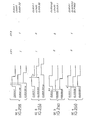
- Fig. 2 illustrates the four conditions of relative phase between the Clock 1, Clock 2D and Clock 2D + D signals.
- Clock 1 leads Clock 2D but the leading edges of Clock 2D and Clock 2D + D both lead the falling or trailing edge of Clock 1.
- Clock 1 again leads Clock 2 D but the leading edge of Clock 2D + ⁇ occurs later than the trailing edge of Clock 1.
- Clock 2 D and Clock 2D + ⁇ both lead Clock 1
- Fig. 2d Clock 1 and Clock 2D + ⁇ are in phase.
- the Clock 2D signal strobes a ONE into flip-flop 18 and the delayed Clock 2D + ⁇ signal strobes a ONE into flip-flop 20 in the first condition (Fig. 2a), and a ZERO into flip-flop 20 in the second condition (Fig. 2b).
- FF1 ONE
- FF 2 redundant and need not be used in this decision
- Clock 1 is always leading Clock 2D and Clock 2D must be shifted to the left to reduce the phase difference between these clock signals.
- a rotate left signal is sent to the'rotating register 22 to cause the ONE bit to be shifted one position to the left.
- the rotating register 22 is preferably initialized by establishing the ONE bit at the 5 ⁇ position; after the first left shift, it moves to the 4 position).
- This 4 ⁇ position selects a 4 A delay from the delay line 14 through the multiplexer 16, as described above, thus moving Clock 2D one ⁇ position to the left. This process reduces by one ⁇ the phase difference between Clock 1 and Clock 2D.
- AND gate 28 combines the FF1 output of flip-flop 18 and the FF2 output of flip-flop 20 into .a lock signal to lock the ONE bit in its current bit location in rotating register 22, thereby to lock Clock 1 and Clock 2D in phase.
- the delay line 14 can be of the R-C type, or may be precision metal lines as in a VLSI circuit. Since in VLSI fabrication such a delay line;can be very accurate and each increment A can be in the picosecond (10 -12 second) range, very high-speed and accurate digital phase correlatior can be implemented with VLSI technology.
- the digital phase correlator of the present invention provides significant advantages over the conventional digital phase-locked loop in that the digital correlator of the invention makes use of the input clock to detect and adjust the phase difference of two input clocks.
- the operating speed of the digital phase correlator of the invention is thus the same as that of the input clocks, as compared to conventional digital phase-locked loops, which use a master clock at a frequency 16 or more times greater than that of the input clocks to detect and adjust phase differences.
- the digital phase correlator of the present invention can thus expand the speed limit of phase correlation by a factor of 16 or more as compared to the conventional digital phase-locked loops.
Landscapes
- Engineering & Computer Science (AREA)
- Computer Networks & Wireless Communication (AREA)
- Signal Processing (AREA)
- Stabilization Of Oscillater, Synchronisation, Frequency Synthesizers (AREA)
- Synchronisation In Digital Transmission Systems (AREA)
Applications Claiming Priority (2)
| Application Number | Priority Date | Filing Date | Title |
|---|---|---|---|
| US689072 | 1985-01-04 | ||
| US06/689,072 US4604582A (en) | 1985-01-04 | 1985-01-04 | Digital phase correlator |
Publications (2)
| Publication Number | Publication Date |
|---|---|
| EP0187504A2 true EP0187504A2 (de) | 1986-07-16 |
| EP0187504A3 EP0187504A3 (de) | 1986-10-08 |
Family
ID=24766934
Family Applications (1)
| Application Number | Title | Priority Date | Filing Date |
|---|---|---|---|
| EP85309222A Withdrawn EP0187504A3 (de) | 1985-01-04 | 1985-12-18 | Digitaler Phasenkorrelator |
Country Status (4)
| Country | Link |
|---|---|
| US (1) | US4604582A (de) |
| EP (1) | EP0187504A3 (de) |
| JP (1) | JPS61163745A (de) |
| CA (1) | CA1215750A (de) |
Cited By (4)
| Publication number | Priority date | Publication date | Assignee | Title |
|---|---|---|---|---|
| FR2608871A1 (fr) * | 1986-12-18 | 1988-06-24 | Cit Alcatel | Procede de multiplexage et de demultiplexage temporel de trains numeriques synchrones |
| EP0369047A1 (de) * | 1988-11-15 | 1990-05-23 | Siemens Aktiengesellschaft | Anordnung zur Umschaltung eines Taktes auf einen Takt gleicher Frequenz aber nacheilender Taktphase |
| EP0317821A3 (de) * | 1987-11-25 | 1990-10-10 | Siemens Aktiengesellschaft | Digitale phasenverriegelte Schleife mit hoher Auflösung |
| EP0531166A1 (de) * | 1991-09-06 | 1993-03-10 | Xerox Corporation | Nahtlose Datenrückgewinnung |
Families Citing this family (44)
| Publication number | Priority date | Publication date | Assignee | Title |
|---|---|---|---|---|
| US4845437A (en) * | 1985-07-09 | 1989-07-04 | Minolta Camera Kabushiki Kaisha | Synchronous clock frequency conversion circuit |
| CA1278627C (en) * | 1986-01-07 | 1991-01-02 | Naonobu Fujimoto | Hierarchical data transmission system |
| US4756011A (en) * | 1986-12-24 | 1988-07-05 | Bell Communications Research, Inc. | Digital phase aligner |
| US4857868A (en) * | 1988-03-30 | 1989-08-15 | Rockwell International Corporation | Data driven clock generator |
| US4965815A (en) * | 1988-07-21 | 1990-10-23 | U.S. Philips Corporation | Phase detection circuit for stepwise measurement of a phase relation |
| US4998262A (en) * | 1989-10-10 | 1991-03-05 | Hewlett-Packard Company | Generation of topology independent reference signals |
| CA2001266C (en) * | 1989-10-23 | 1996-08-06 | John Robert Long | Digital phase aligner and method for its operation |
| US5079440A (en) * | 1990-03-15 | 1992-01-07 | Intel Corporation | Apparatus for generating computer clock pulses |
| US5045715A (en) * | 1990-03-19 | 1991-09-03 | Apple Computer, Inc. | Circuit for generating stretched clock phases on a cycle by cycle basis |
| US4985640A (en) * | 1990-04-04 | 1991-01-15 | Intel Corporation | Apparatus for generating computer clock pulses |
| GB9007790D0 (en) * | 1990-04-06 | 1990-06-06 | Lines Valerie L | Dynamic memory wordline driver scheme |
| FR2662887B1 (fr) * | 1990-06-01 | 1992-08-28 | Telediffusion Fse | Procede pour reduire la composante basse-frequence de la gigue dans un systeme de transmission de donnees numeriques. |
| JPH0440030A (ja) * | 1990-06-05 | 1992-02-10 | Mitsubishi Electric Corp | 信号送受信装置 |
| DE4025004A1 (de) * | 1990-08-07 | 1992-02-13 | Standard Elektrik Lorenz Ag | Schaltungsanordnung zum regenerieren und synchronisieren eines digitalen signals |
| US5124573A (en) * | 1990-12-20 | 1992-06-23 | International Business Machines | Adjustable clock chopper/expander circuit |
| US5327466A (en) * | 1991-08-28 | 1994-07-05 | Frank Marinaro | 1X asynchronous data sampling clock |
| US5272390A (en) * | 1991-09-23 | 1993-12-21 | Digital Equipment Corporation | Method and apparatus for clock skew reduction through absolute delay regulation |
| US5245637A (en) * | 1991-12-30 | 1993-09-14 | International Business Machines Corporation | Phase and frequency adjustable digital phase lock logic system |
| US5451894A (en) * | 1993-02-24 | 1995-09-19 | Advanced Micro Devices, Inc. | Digital full range rotating phase shifter |
| JP3247190B2 (ja) * | 1993-04-13 | 2002-01-15 | 三菱電機株式会社 | 位相同期回路および集積回路装置 |
| FR2711287B1 (fr) * | 1993-10-11 | 1996-01-05 | Sgs Thomson Microelectronics | Circuit d'indication de relation de phase entre plusieurs signaux de même fréquence et son application à un circuit d'ajustage des déphasages entre ces signaux. |
| KR0158762B1 (ko) * | 1994-02-17 | 1998-12-01 | 세키자와 다다시 | 반도체 장치 |
| US6009039A (en) * | 1994-02-17 | 1999-12-28 | Fujitsu Limited | Semiconductor device |
| US5572554A (en) * | 1994-07-29 | 1996-11-05 | Loral Corporation | Synchronizer and method therefor |
| US5796673A (en) * | 1994-10-06 | 1998-08-18 | Mosaid Technologies Incorporated | Delay locked loop implementation in a synchronous dynamic random access memory |
| US5631591A (en) * | 1995-05-30 | 1997-05-20 | National Semiconductor Corporation | Method and apparatus for synchronizing timing signals of two integrated circuit chips |
| JP3639000B2 (ja) * | 1995-06-13 | 2005-04-13 | 富士通株式会社 | 位相合わせ装置及び遅延制御回路 |
| US5744991A (en) * | 1995-10-16 | 1998-04-28 | Altera Corporation | System for distributing clocks using a delay lock loop in a programmable logic circuit |
| US6359483B1 (en) * | 1996-02-26 | 2002-03-19 | Lsi Logic Corporation | Integrated circuit clock distribution system |
| US5909130A (en) * | 1996-04-30 | 1999-06-01 | Lucent Technologies Inc. | Digital lock detector for phase-locked loop |
| JP2993463B2 (ja) * | 1997-05-08 | 1999-12-20 | 日本電気株式会社 | 同期回路制御装置 |
| US6229367B1 (en) * | 1997-06-26 | 2001-05-08 | Vitesse Semiconductor Corp. | Method and apparatus for generating a time delayed signal with a minimum data dependency error using an oscillator |
| US5898640A (en) * | 1997-09-26 | 1999-04-27 | Advanced Micro Devices, Inc. | Even bus clock circuit |
| KR100280447B1 (ko) * | 1998-03-02 | 2001-02-01 | 김영환 | 디지털지연동기루프회로 |
| US6516006B1 (en) | 1999-02-16 | 2003-02-04 | Mitsubishi Electric And Electronics U.S.A., Inc. | Self-adjusting clock phase controlled architecture |
| US6519254B1 (en) | 1999-02-26 | 2003-02-11 | Lucent Technologies Inc. | RSVP-based tunnel protocol providing integrated services |
| EP1250638B1 (de) * | 2000-01-24 | 2008-07-16 | Broadcom Corporation | System und verfahren zur kompensation von durch versorgungsspannung induzierten signalverzögerungsfehlanpassungen |
| EP1172962A3 (de) * | 2000-07-13 | 2003-09-03 | Tektronix, Inc. | Bitratenvariable Taktrückgewinnungsschaltung |
| JP4231230B2 (ja) * | 2002-02-05 | 2009-02-25 | セイコーエプソン株式会社 | パルス波形成形装置、レーザープリンタ、パルス波形成形方法およびレーザープリンタのシリアルビデオデータ生成方法 |
| US6720810B1 (en) * | 2002-06-14 | 2004-04-13 | Xilinx, Inc. | Dual-edge-correcting clock synchronization circuit |
| US7376199B1 (en) * | 2004-08-31 | 2008-05-20 | Xilinx, Inc. | Approach for adjusting the phase of channel-bonded data |
| US7190201B2 (en) | 2005-02-03 | 2007-03-13 | Mosaid Technologies, Inc. | Method and apparatus for initializing a delay locked loop |
| US8258775B2 (en) * | 2009-04-15 | 2012-09-04 | Via Technologies, Inc. | Method and apparatus for determining phase error between clock signals |
| JP7393079B2 (ja) * | 2019-03-26 | 2023-12-06 | ラピスセミコンダクタ株式会社 | 半導体装置 |
Family Cites Families (11)
| Publication number | Priority date | Publication date | Assignee | Title |
|---|---|---|---|---|
| US3028552A (en) * | 1960-04-20 | 1962-04-03 | Ibm | Frequency shifting clock |
| GB1227829A (de) * | 1968-07-17 | 1971-04-07 | ||
| US3908084A (en) * | 1974-10-07 | 1975-09-23 | Bell Telephone Labor Inc | High frequency character receiver |
| US4012598A (en) * | 1976-01-14 | 1977-03-15 | Bell Telephone Laboratories, Incorporated | Method and means for pulse receiver synchronization |
| US4241418A (en) * | 1977-11-23 | 1980-12-23 | Honeywell Information Systems Inc. | Clock system having a dynamically selectable clock period |
| JPS55127745A (en) * | 1979-03-26 | 1980-10-02 | Hitachi Denshi Ltd | Bit buffer system |
| US4290022A (en) * | 1979-04-16 | 1981-09-15 | General Electric Company | Digitally programmable phase shifter |
| FR2458181A1 (fr) * | 1979-06-01 | 1980-12-26 | Thomson Csf | Dispositif de synchronisation d'un signal d'horloge et systemes de transmission de donnees synchrones comportant un tel dispositif |
| NL183214C (nl) * | 1980-01-31 | 1988-08-16 | Philips Nv | Inrichting voor het synchroniseren van de fase van een lokaal opgewekt kloksignaal met de fase van een ingangssignaal. |
| FR2479620B1 (fr) * | 1980-03-28 | 1988-01-08 | Thomson Csf | Dispositif de synchronisation d'informations numeriques transmises par paquets et recepteur comportant un tel dispositif |
| JPS5986385A (ja) * | 1982-11-09 | 1984-05-18 | Toshiba Corp | サンプリングパルス生成回路 |
-
1985
- 1985-01-04 US US06/689,072 patent/US4604582A/en not_active Expired - Fee Related
- 1985-11-21 JP JP60259935A patent/JPS61163745A/ja active Pending
- 1985-11-22 CA CA000495971A patent/CA1215750A/en not_active Expired
- 1985-12-18 EP EP85309222A patent/EP0187504A3/de not_active Withdrawn
Cited By (4)
| Publication number | Priority date | Publication date | Assignee | Title |
|---|---|---|---|---|
| FR2608871A1 (fr) * | 1986-12-18 | 1988-06-24 | Cit Alcatel | Procede de multiplexage et de demultiplexage temporel de trains numeriques synchrones |
| EP0317821A3 (de) * | 1987-11-25 | 1990-10-10 | Siemens Aktiengesellschaft | Digitale phasenverriegelte Schleife mit hoher Auflösung |
| EP0369047A1 (de) * | 1988-11-15 | 1990-05-23 | Siemens Aktiengesellschaft | Anordnung zur Umschaltung eines Taktes auf einen Takt gleicher Frequenz aber nacheilender Taktphase |
| EP0531166A1 (de) * | 1991-09-06 | 1993-03-10 | Xerox Corporation | Nahtlose Datenrückgewinnung |
Also Published As
| Publication number | Publication date |
|---|---|
| JPS61163745A (ja) | 1986-07-24 |
| CA1215750A (en) | 1986-12-23 |
| EP0187504A3 (de) | 1986-10-08 |
| US4604582A (en) | 1986-08-05 |
Similar Documents
| Publication | Publication Date | Title |
|---|---|---|
| US4604582A (en) | Digital phase correlator | |
| KR100319890B1 (ko) | 지연동기루프 및 이에 대한 제어방법 | |
| US6901126B1 (en) | Time division multiplex data recovery system using close loop phase and delay locked loop | |
| US7587012B2 (en) | Dual loop clock recovery circuit | |
| US6310498B1 (en) | Digital phase selection circuitry and method for reducing jitter | |
| EP0688103B1 (de) | Einrichtung zum Ableiten eines Taktsignals | |
| US5887040A (en) | High speed digital data retiming apparatus | |
| GB2331416A (en) | Continuously adjustable delay circuit | |
| JPH08125647A (ja) | 精密タイミング回復用集積回路装置及び方法 | |
| KR100371300B1 (ko) | 비트동기회로 | |
| US20020196886A1 (en) | SYNC pulse compensation and regeneration in a clock synchronizer controller | |
| CN107733428A (zh) | 延迟锁定环电路、集成电路和用于控制它的方法 | |
| US6667639B2 (en) | Frequency multiplying system having a plurality of output frequencies | |
| US6421404B1 (en) | Phase-difference detector and clock-recovery circuit using the same | |
| US20060115035A1 (en) | Clock and data recovery apparatus and method thereof | |
| KR100324188B1 (ko) | 클록복구회로및데이터처리방법 | |
| EP1884057B1 (de) | Daten-flanken-zu-takt-flankenphasendetektor für schnelle schaltungen | |
| US6259278B1 (en) | Phase detector | |
| US7236552B2 (en) | Data transmission | |
| US10396803B2 (en) | Clock and data recovery of sub-rate data | |
| US6218907B1 (en) | Frequency comparator and PLL circuit using the same | |
| US4210776A (en) | Linear digital phase lock loop | |
| US7382163B2 (en) | Phase frequency detector used in digital PLL system | |
| JP2005086789A (ja) | クロックデータリカバリ回路 | |
| JP2001168711A (ja) | 改良された遅延ロックループ回路 |
Legal Events
| Date | Code | Title | Description |
|---|---|---|---|
| PUAI | Public reference made under article 153(3) epc to a published international application that has entered the european phase |
Free format text: ORIGINAL CODE: 0009012 |
|
| AK | Designated contracting states |
Kind code of ref document: A2 Designated state(s): DE FR GB IT NL SE |
|
| PUAL | Search report despatched |
Free format text: ORIGINAL CODE: 0009013 |
|
| AK | Designated contracting states |
Kind code of ref document: A3 Designated state(s): DE FR GB IT NL SE |
|
| 17P | Request for examination filed |
Effective date: 19861215 |
|
| 17Q | First examination report despatched |
Effective date: 19880714 |
|
| STAA | Information on the status of an ep patent application or granted ep patent |
Free format text: STATUS: THE APPLICATION IS DEEMED TO BE WITHDRAWN |
|
| 18D | Application deemed to be withdrawn |
Effective date: 19890926 |
|
| RIN1 | Information on inventor provided before grant (corrected) |
Inventor name: STRENKOWSKI, JOHN G. Inventor name: YANG, JOHN PAO-AN |