EP0187601A2 - Process for dry etching a silicon nitride layer - Google Patents
Process for dry etching a silicon nitride layer Download PDFInfo
- Publication number
- EP0187601A2 EP0187601A2 EP85402634A EP85402634A EP0187601A2 EP 0187601 A2 EP0187601 A2 EP 0187601A2 EP 85402634 A EP85402634 A EP 85402634A EP 85402634 A EP85402634 A EP 85402634A EP 0187601 A2 EP0187601 A2 EP 0187601A2
- Authority
- EP
- European Patent Office
- Prior art keywords
- layer
- silicon
- silicon nitride
- nitride layer
- etching
- Prior art date
- Legal status (The legal status is an assumption and is not a legal conclusion. Google has not performed a legal analysis and makes no representation as to the accuracy of the status listed.)
- Granted
Links
Images


Classifications
-
- H—ELECTRICITY
- H10—SEMICONDUCTOR DEVICES; ELECTRIC SOLID-STATE DEVICES NOT OTHERWISE PROVIDED FOR
- H10P—GENERIC PROCESSES OR APPARATUS FOR THE MANUFACTURE OR TREATMENT OF DEVICES COVERED BY CLASS H10
- H10P14/00—Formation of materials, e.g. in the shape of layers or pillars
- H10P14/60—Formation of materials, e.g. in the shape of layers or pillars of insulating materials
- H10P14/61—Formation of materials, e.g. in the shape of layers or pillars of insulating materials using masks
-
- H—ELECTRICITY
- H10—SEMICONDUCTOR DEVICES; ELECTRIC SOLID-STATE DEVICES NOT OTHERWISE PROVIDED FOR
- H10P—GENERIC PROCESSES OR APPARATUS FOR THE MANUFACTURE OR TREATMENT OF DEVICES COVERED BY CLASS H10
- H10P50/00—Etching of wafers, substrates or parts of devices
- H10P50/20—Dry etching; Plasma etching; Reactive-ion etching
- H10P50/28—Dry etching; Plasma etching; Reactive-ion etching of insulating materials
- H10P50/282—Dry etching; Plasma etching; Reactive-ion etching of insulating materials of inorganic materials
- H10P50/283—Dry etching; Plasma etching; Reactive-ion etching of insulating materials of inorganic materials by chemical means
-
- H—ELECTRICITY
- H10—SEMICONDUCTOR DEVICES; ELECTRIC SOLID-STATE DEVICES NOT OTHERWISE PROVIDED FOR
- H10W—GENERIC PACKAGES, INTERCONNECTIONS, CONNECTORS OR OTHER CONSTRUCTIONAL DETAILS OF DEVICES COVERED BY CLASS H10
- H10W10/00—Isolation regions in semiconductor bodies between components of integrated devices
- H10W10/01—Manufacture or treatment
- H10W10/011—Manufacture or treatment of isolation regions comprising dielectric materials
- H10W10/012—Manufacture or treatment of isolation regions comprising dielectric materials using local oxidation of silicon [LOCOS]
-
- H—ELECTRICITY
- H10—SEMICONDUCTOR DEVICES; ELECTRIC SOLID-STATE DEVICES NOT OTHERWISE PROVIDED FOR
- H10W—GENERIC PACKAGES, INTERCONNECTIONS, CONNECTORS OR OTHER CONSTRUCTIONAL DETAILS OF DEVICES COVERED BY CLASS H10
- H10W10/00—Isolation regions in semiconductor bodies between components of integrated devices
- H10W10/10—Isolation regions comprising dielectric materials
- H10W10/13—Isolation regions comprising dielectric materials formed using local oxidation of silicon [LOCOS], e.g. sealed interface localised oxidation [SILO] or side-wall mask isolation [SWAMI]
Definitions
- the present invention relates to a process for etching a silicon nitride layer. Move specifically, it relates to a process for dry etching a silicon nitride layer on a silicon dioxide layer, useful in a so-called "local oxidation of silicon” (LOCOS) process.
- LOC local oxidation of silicon
- a silicon nitride (Si 3 N 4 ) layer is used as a mask for locally oxidizing a semiconductor bulk, such as a silicon bulk.
- a silicon bulk such as a silicon bulk.
- LOC silicon nitride
- the overall surface of a silicon bulk is first oxidized to a thin thickness, e.g., 50 nm.
- an Si 3 N 4 layer of, e.g., 100 nm thickness is formed on the oxidized surface of the silicon bulk.
- the Si 3 N 4 layer is patterned with a mask of a patterned resist layer formed on the si 3 N 4 layer, the resist layer is removed, then the silicon bulk is locally oxidized by using the patterned Si 3 N 4 layer as a mask.
- An etching gas comprising fluoromethane (fleon), particularly tetrafluoromethane (CF 4 ), and oxigen (O 2 ) is typically used for dry etching an Si 3 N 4 layer in the LOCOS process, which gas needs the above mentioned combination of thicknesses of the SiO 2 and Si 3 N 4 layers of, e.g., 50 nm and 100 nm, respectively, since the above etching gas has a ratio of etching rate of Si 3 N 4 to SiO 2 of about 2 to 3 at the highest.
- fluoromethane fluoromethane
- CF 4 tetrafluoromethane
- O 2 oxigen
- the Si0 2 layer may be over etched during the patterning or etching of an Si 3 N 4 layer on the Si0 2 layer, which causes nonuniform oxidation of the silicon bulk existing under the SiO 2 layer.
- etching gases for example, a mixed gas of sulfur hexafluoride (SF 6 ) and chlorine (C1 2 ) for etching silicon (Japanese Unexamined Patent Publication (Kokai) No. 58-7829); a gas of SF 6 , nitrogen trifluoride (NF 3 ), fluorine (F 2 ), or C1 2 for etching silicon (Japanese Unexamined Patent Publication (Kokai) No. 59-214226); a gas of NF 3 for etching Si 3 N 4 (Japanese Unexamined Patent Publication (Kokai) No.
- the main object of the present invention is to provide an effective dry etching process for etching Si 3 N 4 .
- a further object of the present invention is to provide a dry etching process having a high ratio of etching rate of Si 3 N 4 /Si0 2 , useful for the LOCOS process.
- a still further object of the present invention is to reduce the size of "bird beaks" formed in the LOCOS process in order to densify semiconductor IC devices.
- a process for dry etching an Si 3 N 4 layer with an etching gas comprising SF 6 is based on a finding that SF 6 has a high effectivity of etching Si 3 N 4 and a high selectivity of etching Si 3 N 4 in relation to SiO 2 or a photoresist.
- the etching gas optionally further comprises, e.g., fluoromethane such as CH 3 F, CH 2 F 2 , CHF 3 , and CF 4 .
- fluoromethane such as CH 3 F, CH 2 F 2 , CHF 3 , and CF 4 .
- a combination of SF 6 and CH 2 F 2 is preferred.
- anode coupling reactive ion etching is preferable in a process for dry etching an Si 3 N 4 layer on an Si0 2 layer with an etching gas comprising SF 6 and optionally CH 2 F 2 since it allows a higher etching rate ratio of Si 3 N 4 /SiO 2 , although other types of dry etching, for example, cathode coupling type, reactive ion etching, and downflow type plasma etching, may have some advantages in a process according to the present invention.
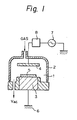
- Figure 1 illustrates an anode coupling type dry etching apparatus.
- a reaction chamber 1 defined by a quartz tube 2
- An upper side electrode 3 is made of aluminum (Al) and anodized on its surface
- a lower side electrode 4 is made of aluminum on which a wafer 5 to be treated is placed.
- the lower side electrode 4 is connected to the ground 6, and the upper side electrode 3 is connected to a radio frequency (RF) source 7 of 13.56 MHz.
- RF radio frequency
- a matching network 8 is inserted between the upper side electrode 3 and the RF source 7.
- the reaction chamber 1 is evacuated by a vacuum pump (not shown).
- a silicon (Si) bulk or wafer 11 was prepared and a surface of the silicon bulk 11 was oxidized to form an Si0 2 layer 12 of 30 nm thickness.
- An Si 3 N 4 layer 13 was deposited onto the SiO 2 layer 12 by sputtering, etc. The thickness of the Si 3 N 4 layer 13 was 100 nm in this case, but could have also been made 150 nm.
- a resist layer 14 was coated on the Si 3 N 4 layer 13 and patterned to leave a square or rectangular shape having a size L of 2.5 um.
- a dry etching apparatus as in Fig. 1, the wafer 1 was placed on the lower side electrode 4.
- a radio frequency of 13.56 MHz was applied between the two electrodes 3 and 4 at a power of about 125 Watts.
- a portion of the Si 3 N 4 layer 13 which was not covered with the patterned resist layer 14, was selectively etched or removed.
- the resist layer 14 was then removed.
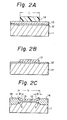
- a patterned Si 3 N 4 layer 13 was obtained on the SiO 2 layer 12; the patterned Si 3 N 4 layer 13 having a square or rectangular shape, as shown in Fig. 2B.
- oxidation was carried out in which the patterned Si 3 N 4 layer 13 was used as a mask to locally oxidize the silicon bulk 11, that is, a portion of the silicon bulk 11 above which no Si 3 N 4 layer exists was oxidized to form a thick Si0 2 layer 14 or a locally oxidized silicon.
- "bird beaks" b were formed but had the width B of only 0.2 ⁇ m to 0.3 ⁇ m which was reduced from the width of the "bird beaks" in the prior art.
- the thickness of the Si0 2 layer had to be 50 nm if the Si 3 N 4 layer had a thickness of 100 nm. This resulted in a width of the "bird beaks" of 0.3 ⁇ m to 0.4 ⁇ m after patterning the Si 3 N 4 layer and oxidizing the silicon bulk under the SiO 2 layer using the Si 3 N 4 layer as a mask.
- the thickness of an Si 3 N 4 layer was made 150 nm while maintaining the thickness of an SiO 2 layer at 30 nm. Successful selective etching of the Si 3 N 4 layer could be done, that is, the Si0 2 layer was not overetched, resulting in excellent local oxidation of a silicon bulk under the Si0 2 layer.
- the flow rate of CH 2 F 2 was varied with the other conditions being fixed.
- the fixed conditions of the test were vacuum of 0.25 Torr, RF power of 125 Watts, flow rate of the SF 6 of 50 SCCM, and temperature of 25°C.
- the etching rates of an Si 3 N 4 layer, an SiO 2 layer, and a resist layer were determined.
- the obtained etching rates and the selectivities of Si 3 N 4 to SiO 2 and resist or ratios of the etching rate of Si 3 N 4 to Si0 2 and resist, respectively, are summarized in the graphs in Figs. 3 and 4.
- a selectivity of etching of Si 3 N 4 to Si0 2 of more than 3, particularly, more than 4 was obtained in a process according to the present invention while at the highest only a selectivity of 2 to 3 could be obtained in a process in the prior art.
- a relatively high selectivity of etching of Si 3 N 4 /resist was obtained and is also preferable.
- a mixing ratio by volume or mole of CH 2 F 2 :CF 6 of up to 35:100, more preferably 8 - 24:100, particularly 20:100, is preferably used in a process according to the present invention. This fact was ascertained in another test in which the flow-rate of CF 6 is varied with the other conditions being fixed.
- a third test in which the degree of vacuum in a reaction chamber was varied and the other conditions were fixed was carried out.
Landscapes
- Drying Of Semiconductors (AREA)
Abstract
Description
- The present invention relates to a process for etching a silicon nitride layer. Move specifically, it relates to a process for dry etching a silicon nitride layer on a silicon dioxide layer, useful in a so-called "local oxidation of silicon" (LOCOS) process.
- A silicon nitride (Si3N4) layer is used as a mask for locally oxidizing a semiconductor bulk, such as a silicon bulk. In this process (LOCOS), the overall surface of a silicon bulk is first oxidized to a thin thickness, e.g., 50 nm. Then., an Si3N4 layer of, e.g., 100 nm thickness is formed on the oxidized surface of the silicon bulk. The Si3N4 layer is patterned with a mask of a patterned resist layer formed on the si3N4 layer, the resist layer is removed, then the silicon bulk is locally oxidized by using the patterned Si3N4 layer as a mask.
- In this local oxidation process, there is the problem of formation of "bird beaks". That is, oxidation of the silicon bulk occurs not only vertically downward from the top surface of a portion of the silicon bulk not covered with the Si3N4 layer as mask but also horizontally toward a portion under the Si3N4 layer. These "bird beaks" create undesired wasteful areas in microcircuit devices, preventing densification of integrated circuit (IC) devices.
- It is known that by decreasing the thickness of a silicon dioxide (SiO2) layer formed on the surface of the silicon bulk and increasing the thickness of an Si3N4 layer or a mask layer for oxidation on the Si02 layer, it is possible to reduce the size of "bird beaks" formed during the local oxidation. However, no currently available etching process allows a desired combination of the thicknesses of the Si02 and Si3N4 layers. An etching gas comprising fluoromethane (fleon), particularly tetrafluoromethane (CF4), and oxigen (O2) is typically used for dry etching an Si3N4 layer in the LOCOS process, which gas needs the above mentioned combination of thicknesses of the SiO2 and Si3N4 layers of, e.g., 50 nm and 100 nm, respectively, since the above etching gas has a ratio of etching rate of Si3N4 to SiO2 of about 2 to 3 at the highest. The above combination of the thicknesses of the two layers, i.e., 50 nm of the SiO2 layer and 100 nm of the Si3N4 layers, not only requires severe control of the process conditions, but also results in "bird beaks" each having a width or lateral size of 0.3 to 0.4 µm.
- If the thickness of the Si02 layer is further reduced in the above prior art process, the Si02 layer may be over etched during the patterning or etching of an Si3N4 layer on the Si02 layer, which causes nonuniform oxidation of the silicon bulk existing under the SiO2 layer.
- There are also known other dry etching gases, for example, a mixed gas of sulfur hexafluoride (SF6) and chlorine (C12) for etching silicon (Japanese Unexamined Patent Publication (Kokai) No. 58-7829); a gas of SF6 , nitrogen trifluoride (NF3), fluorine (F2), or C12 for etching silicon (Japanese Unexamined Patent Publication (Kokai) No. 59-214226); a gas of NF3 for etching Si3N4 (Japanese Unexamined Patent Publication (Kokai) No. 60-20516); a reactive gas mixture comprising predominantly a fluorocarbon gas doped with carbon dioxide for etching an inorganic insulating layer comprising silicon as a main metal element (Japanese Unexamined Patent Publication (Kokai) No. 58-84113); and a combination of a fluorine-system gas such as SF6 or CF4 gas and a carbon-system gas such as ethylene (C2H4) or carbon terachloride (C C14) for etching polycrystalline or crystalline silicon (Japanese Unexamined Patent Publication (Kokai) No. 59-51531). However, some of these publications, disclosing SF6 as a dry etching gas, do not concern etching of Si3N4 and the others, disclosing a gas for dry etching Si3N4 , are not very effective.
- The main object of the present invention is to provide an effective dry etching process for etching Si3N4.
- A further object of the present invention is to provide a dry etching process having a high ratio of etching rate of Si3N4/Si02 , useful for the LOCOS process.
- A still further object of the present invention is to reduce the size of "bird beaks" formed in the LOCOS process in order to densify semiconductor IC devices.
- These and other objects are attained by a process for dry etching an Si3N4 layer with an etching gas comprising SF6 . This invention is based on a finding that SF6 has a high effectivity of etching Si3N4 and a high selectivity of etching Si3N4 in relation to SiO2 or a photoresist.
- The etching gas optionally further comprises, e.g., fluoromethane such as CH3F, CH2F2 , CHF3 , and CF4. A combination of SF6 and CH2F2 is preferred.
- We further found that anode coupling reactive ion etching is preferable in a process for dry etching an Si3N4 layer on an Si02 layer with an etching gas comprising SF6 and optionally CH2F2 since it allows a higher etching rate ratio of Si3N4/SiO2 , although other types of dry etching, for example, cathode coupling type, reactive ion etching, and downflow type plasma etching, may have some advantages in a process according to the present invention.
-
- Figure 1 is a schematic sectional view of an apparatus for dry etching used in a process according to the present invention;
- Figs. 2A, 2B, and 2C are sectional views of a silicon bulk to be locally oxidized in some steps of the LOCOS process according to the present invention;
- Fig. 3 is a graph of the etching rates of Si3N4 , Si02 , and resist when the. flow rate of CH2F2 is varied; and
- Fig. 4 is a graph of the selectivities of etching of Si3N4 to SiO2 and resist when the flow rate of c 2 H 2 is varied.
- Figure 1 illustrates an anode coupling type dry etching apparatus. In a reaction chamber 1 defined by a
quartz tube 2, there areparallel electrodes upper side electrode 3 is made of aluminum (Al) and anodized on its surface, and alower side electrode 4 is made of aluminum on which awafer 5 to be treated is placed. Thelower side electrode 4 is connected to the ground 6, and theupper side electrode 3 is connected to a radio frequency (RF)source 7 of 13.56 MHz. Amatching network 8 is inserted between theupper side electrode 3 and theRF source 7. The reaction chamber 1 is evacuated by a vacuum pump (not shown). - Now, an example of the LOCOS process according to the present invention is described with reference to Figs. 1, 2A, 2B, and 2C. In Fig. 1 a silicon (Si) bulk or
wafer 11 was prepared and a surface of thesilicon bulk 11 was oxidized to form an Si02 layer 12 of 30 nm thickness. An Si3N4layer 13 was deposited onto the SiO2 layer 12 by sputtering, etc. The thickness of the Si3N4 layer 13 was 100 nm in this case, but could have also been made 150 nm. Aresist layer 14 was coated on the Si3N4 layer 13 and patterned to leave a square or rectangular shape having a size L of 2.5 um. - In a dry etching apparatus as in Fig. 1, the wafer 1 was placed on the
lower side electrode 4. A reaction gas of a mixture of SF6 and CH2F2 with flow rates of 50 SCCM (standard cubic centimeter per minute) and 10 SCCM respectively, was introduced into the reaction chamber 1, which was evacuated to about 0.25 Torr. A radio frequency of 13.56 MHz was applied between the twoelectrodes resist layer 14, was selectively etched or removed. Theresist layer 14 was then removed. Thus, a patterned Si3N4 layer 13 was obtained on the SiO2 layer 12; the patterned Si3N4 layer 13 having a square or rectangular shape, as shown in Fig. 2B. - Referring to Fig. 2C, oxidation was carried out in which the patterned Si3N4 layer 13 was used as a mask to locally oxidize the
silicon bulk 11, that is, a portion of thesilicon bulk 11 above which no Si3N4 layer exists was oxidized to form a thick Si02 layer 14 or a locally oxidized silicon. In this oxidation, "bird beaks" b were formed but had the width B of only 0.2 µm to 0.3 µm which was reduced from the width of the "bird beaks" in the prior art. - In the prior art, for example, using an etching gas comprising CF4 and 02 , as described before, the thickness of the Si02 layer had to be 50 nm if the Si3N4 layer had a thickness of 100 nm. This resulted in a width of the "bird beaks" of 0.3 µm to 0.4 µm after patterning the Si3N4 layer and oxidizing the silicon bulk under the SiO2 layer using the Si3N4 layer as a mask.
- In another experiment, the thickness of an Si3N4 layer was made 150 nm while maintaining the thickness of an SiO2 layer at 30 nm. Successful selective etching of the Si3N4 layer could be done, that is, the Si02 layer was not overetched, resulting in excellent local oxidation of a silicon bulk under the Si02 layer.
- Tests were made to ascertain preferable conditions of dry etching according to the present invention.
- First, the flow rate of CH2F2 was varied with the other conditions being fixed. The fixed conditions of the test were vacuum of 0.25 Torr, RF power of 125 Watts, flow rate of the SF6 of 50 SCCM, and temperature of 25°C. Thus, the etching rates of an Si3N4 layer, an SiO2 layer, and a resist layer (novolak resin- containing positive-type photosensitive resist, "ONPR-800 HS1," produced by Tokyo Oka K.K., Japan) were determined. The obtained etching rates and the selectivities of Si3N4 to SiO2 and resist or ratios of the etching rate of Si3N4 to Si02 and resist, respectively, are summarized in the graphs in Figs. 3 and 4.
- As can be seen in Figs. 3 and 4, a flow rate of CH2F2 in a range of 17.5 SCCM or less, preferably in a range of 4 to 12 SCCM, results in successful selectivity of etching of Si3N4 to Si02. It should be noted that a selectivity of etching of Si3N4 to Si02 of more than 3, particularly, more than 4, was obtained in a process according to the present invention while at the highest only a selectivity of 2 to 3 could be obtained in a process in the prior art. It should be also noted that a relatively high selectivity of etching of Si3N4/resist was obtained and is also preferable.
- Thus, a mixing ratio by volume or mole of CH2F2:CF6 of up to 35:100, more preferably 8 - 24:100, particularly 20:100, is preferably used in a process according to the present invention. This fact was ascertained in another test in which the flow-rate of CF6 is varied with the other conditions being fixed.
- A third test in which the degree of vacuum in a reaction chamber was varied and the other conditions were fixed was carried out. We found that a vacuum of 0.1 to 0.3 Torr, more preferably 0.2 to 0.3 Torr, is preferably used.
- A fourth test in which the RF power was varied and the other conditions were fixed was carried out. We found that 50 Watts was sufficient and 100 to 200 Watts was preferable for a process according to the invention.
Claims (13)
Applications Claiming Priority (2)
| Application Number | Priority Date | Filing Date | Title |
|---|---|---|---|
| JP59280138A JPS61158143A (en) | 1984-12-29 | 1984-12-29 | Etching method for insulating film |
| JP280138/84 | 1984-12-29 |
Publications (3)
| Publication Number | Publication Date |
|---|---|
| EP0187601A2 true EP0187601A2 (en) | 1986-07-16 |
| EP0187601A3 EP0187601A3 (en) | 1988-03-16 |
| EP0187601B1 EP0187601B1 (en) | 1991-03-13 |
Family
ID=17620865
Family Applications (1)
| Application Number | Title | Priority Date | Filing Date |
|---|---|---|---|
| EP85402634A Expired - Lifetime EP0187601B1 (en) | 1984-12-29 | 1985-12-26 | Process for dry etching a silicon nitride layer |
Country Status (4)
| Country | Link |
|---|---|
| EP (1) | EP0187601B1 (en) |
| JP (1) | JPS61158143A (en) |
| KR (1) | KR900006020B1 (en) |
| DE (1) | DE3582146D1 (en) |
Cited By (1)
| Publication number | Priority date | Publication date | Assignee | Title |
|---|---|---|---|---|
| WO2003012829A1 (en) * | 2001-07-24 | 2003-02-13 | Osram Opto Semiconductors Gmbh | Method for the production of a lens |
Families Citing this family (1)
| Publication number | Priority date | Publication date | Assignee | Title |
|---|---|---|---|---|
| JP2720962B2 (en) * | 1985-10-29 | 1998-03-04 | ソニー株式会社 | Etching gas and etching method using the same |
Family Cites Families (3)
| Publication number | Priority date | Publication date | Assignee | Title |
|---|---|---|---|---|
| NL8204437A (en) * | 1982-11-16 | 1984-06-18 | Philips Nv | METHOD FOR MANUFACTURING A SEMICONDUCTOR DEVICE USING PLASMA ETCHING |
| DE3420347A1 (en) * | 1983-06-01 | 1984-12-06 | Hitachi, Ltd., Tokio/Tokyo | GAS AND METHOD FOR SELECTIVE ETCHING OF SILICON NITRIDE |
| JPH0612765B2 (en) * | 1983-06-01 | 1994-02-16 | 株式会社日立製作所 | Etching method |
-
1984
- 1984-12-29 JP JP59280138A patent/JPS61158143A/en active Granted
-
1985
- 1985-12-26 DE DE8585402634T patent/DE3582146D1/en not_active Expired - Lifetime
- 1985-12-26 EP EP85402634A patent/EP0187601B1/en not_active Expired - Lifetime
- 1985-12-28 KR KR1019850010029A patent/KR900006020B1/en not_active Expired
Cited By (1)
| Publication number | Priority date | Publication date | Assignee | Title |
|---|---|---|---|---|
| WO2003012829A1 (en) * | 2001-07-24 | 2003-02-13 | Osram Opto Semiconductors Gmbh | Method for the production of a lens |
Also Published As
| Publication number | Publication date |
|---|---|
| EP0187601B1 (en) | 1991-03-13 |
| DE3582146D1 (en) | 1991-04-18 |
| JPS61158143A (en) | 1986-07-17 |
| JPH0426539B2 (en) | 1992-05-07 |
| KR860005431A (en) | 1986-07-23 |
| KR900006020B1 (en) | 1990-08-20 |
| EP0187601A3 (en) | 1988-03-16 |
Similar Documents
| Publication | Publication Date | Title |
|---|---|---|
| US7541270B2 (en) | Methods for forming openings in doped silicon dioxide | |
| US6015760A (en) | Method for enhancing oxide to nitride selectivity through the use of independent heat control | |
| US8093155B2 (en) | Method of controlling striations and CD loss in contact oxide etch | |
| US5013398A (en) | Anisotropic etch method for a sandwich structure | |
| US7166535B2 (en) | Plasma etching of silicon carbide | |
| US7153779B2 (en) | Method to eliminate striations and surface roughness caused by dry etch | |
| US5843226A (en) | Etch process for single crystal silicon | |
| US7273566B2 (en) | Gas compositions | |
| US4717447A (en) | Method of manufacturing a semiconductor device by means of plasma etching | |
| US7074724B2 (en) | Etchant and method of use | |
| JPS6365625A (en) | Etching | |
| US7125804B2 (en) | Etching methods and apparatus and substrate assemblies produced therewith | |
| KR20010042983A (en) | Method of forming high aspect ratio apertures | |
| US4678539A (en) | Dry-etching method | |
| KR100311487B1 (en) | Method for etching of oxidation film | |
| US5180466A (en) | Process for dry etching a silicon nitride layer | |
| US6117788A (en) | Semiconductor etching methods | |
| US6372634B1 (en) | Plasma etch chemistry and method of improving etch control | |
| US6069087A (en) | Highly selective dry etching process | |
| EP0187601B1 (en) | Process for dry etching a silicon nitride layer | |
| US6653237B2 (en) | High resist-selectivity etch for silicon trench etch applications | |
| JPH0859215A (en) | Nitride etching process |
Legal Events
| Date | Code | Title | Description |
|---|---|---|---|
| PUAI | Public reference made under article 153(3) epc to a published international application that has entered the european phase |
Free format text: ORIGINAL CODE: 0009012 |
|
| AK | Designated contracting states |
Kind code of ref document: A2 Designated state(s): DE FR GB |
|
| PUAL | Search report despatched |
Free format text: ORIGINAL CODE: 0009013 |
|
| AK | Designated contracting states |
Kind code of ref document: A3 Designated state(s): DE FR GB |
|
| 17P | Request for examination filed |
Effective date: 19880428 |
|
| 17Q | First examination report despatched |
Effective date: 19900420 |
|
| GRAA | (expected) grant |
Free format text: ORIGINAL CODE: 0009210 |
|
| AK | Designated contracting states |
Kind code of ref document: B1 Designated state(s): DE FR GB |
|
| REF | Corresponds to: |
Ref document number: 3582146 Country of ref document: DE Date of ref document: 19910418 |
|
| ET | Fr: translation filed | ||
| PLBE | No opposition filed within time limit |
Free format text: ORIGINAL CODE: 0009261 |
|
| STAA | Information on the status of an ep patent application or granted ep patent |
Free format text: STATUS: NO OPPOSITION FILED WITHIN TIME LIMIT |
|
| 26N | No opposition filed | ||
| PGFP | Annual fee paid to national office [announced via postgrant information from national office to epo] |
Ref country code: DE Payment date: 19930226 Year of fee payment: 8 |
|
| PG25 | Lapsed in a contracting state [announced via postgrant information from national office to epo] |
Ref country code: DE Effective date: 19940901 |
|
| PGFP | Annual fee paid to national office [announced via postgrant information from national office to epo] |
Ref country code: FR Payment date: 19951212 Year of fee payment: 11 |
|
| PGFP | Annual fee paid to national office [announced via postgrant information from national office to epo] |
Ref country code: GB Payment date: 19951218 Year of fee payment: 11 |
|
| PG25 | Lapsed in a contracting state [announced via postgrant information from national office to epo] |
Ref country code: GB Effective date: 19961226 |
|
| GBPC | Gb: european patent ceased through non-payment of renewal fee |
Effective date: 19961226 |
|
| PG25 | Lapsed in a contracting state [announced via postgrant information from national office to epo] |
Ref country code: FR Effective date: 19970829 |
|
| REG | Reference to a national code |
Ref country code: FR Ref legal event code: ST |