EP0187904B1 - Procédé de traitement thermique d'aciers perlitiques pour rails - Google Patents
Procédé de traitement thermique d'aciers perlitiques pour rails Download PDFInfo
- Publication number
- EP0187904B1 EP0187904B1 EP85113653A EP85113653A EP0187904B1 EP 0187904 B1 EP0187904 B1 EP 0187904B1 EP 85113653 A EP85113653 A EP 85113653A EP 85113653 A EP85113653 A EP 85113653A EP 0187904 B1 EP0187904 B1 EP 0187904B1
- Authority
- EP
- European Patent Office
- Prior art keywords
- rail head
- temperature
- rail
- compressed air
- cooled
- Prior art date
- Legal status (The legal status is an assumption and is not a legal conclusion. Google has not performed a legal analysis and makes no representation as to the accuracy of the status listed.)
- Expired - Lifetime
Links
Images

Classifications
-
- C—CHEMISTRY; METALLURGY
- C21—METALLURGY OF IRON
- C21D—MODIFYING THE PHYSICAL STRUCTURE OF FERROUS METALS; GENERAL DEVICES FOR HEAT TREATMENT OF FERROUS OR NON-FERROUS METALS OR ALLOYS; MAKING METAL MALLEABLE, e.g. BY DECARBURISATION OR TEMPERING
- C21D9/00—Heat treatment, e.g. annealing, hardening, quenching or tempering, adapted for particular articles; Furnaces therefor
- C21D9/04—Heat treatment, e.g. annealing, hardening, quenching or tempering, adapted for particular articles; Furnaces therefor for rails
-
- C—CHEMISTRY; METALLURGY
- C22—METALLURGY; FERROUS OR NON-FERROUS ALLOYS; TREATMENT OF ALLOYS OR NON-FERROUS METALS
- C22C—ALLOYS
- C22C38/00—Ferrous alloys, e.g. steel alloys
- C22C38/001—Ferrous alloys, e.g. steel alloys containing N
-
- C—CHEMISTRY; METALLURGY
- C22—METALLURGY; FERROUS OR NON-FERROUS ALLOYS; TREATMENT OF ALLOYS OR NON-FERROUS METALS
- C22C—ALLOYS
- C22C38/00—Ferrous alloys, e.g. steel alloys
- C22C38/12—Ferrous alloys, e.g. steel alloys containing tungsten, tantalum, molybdenum, vanadium, or niobium
Definitions
- the invention relates to a method for the heat treatment of pearlitic rail steels.
- the usual austenitizing temperature for these processes is 850 to 900 ° C.
- the heating takes place in an oven, inductively or by burner.
- the accelerated cooling is achieved by quenching in oil or blowing with water vapor, a water spray or compressed air.
- the hardness values achieved with these processes are between 320 and 380 HV on the running surface.
- the hardness towards the middle of the rail head drops gradually or with a steep transition to 280 to 300 HV.
- Such heat-treated rails are used in routes with high traffic volumes, tight curve radii and / or with axle loads over 200 kN as well as in switches.
- the strength and wear properties of the above are sufficient for particularly extreme loads. heat-treated splints.
- An increase in strength while maintaining the desired fine pearlitic structure, which is favorable for the wear properties, by adding strength-increasing alloy elements such as chromium, manganese, nickel and molybdenum is not possible, since in the heat treatment described, when these alloy elements are added instead of a transformation in the lower pearlite stage, the transformation partly. in the bainite and martensite stage, and thus structures are formed which have an unfavorable effect on the wear properties and the break resistance.
- High-strength pearlitic rail steels are known from the literature reference DE-Z Technische Mitteilungen Krupp, Werkberichte, Vol. 37 (1979), H. 3, pages 79-87 and 89-94, which have a fine-grained structure with a small lamella spacing and a small thickness Cementite and ferrite lamellae after adding max. 1.4% chromium and max. 2% nickel, based on a steel with approx. 0.75% carbon and approx. 1% manganese tensile strengths up to 1350 N / mm 2 in the naturally hard air-cooled state.
- an increase in this strength through heat treatment for example accelerated cooling into the region of the lower pearlite stage, leads to the above-mentioned undesirable proportions of bainite and martensite in the structure.
- These steels have a ferritic-pearlitic structure with a grain size smaller than 8 according to the A.S.T.M. norm.
- DE-C-2541978 discloses a process for the heat treatment of switch parts made of steels with a composition of 0.6 to 0.8% carbon, 0.05 to 0.5% silicon and 0.8 to 1.3% manganese , in which the running surface of the switch part is heated to austenitizing temperature by means of a burner or inductor and then blown with compressed air in order to quench it in the range of pearlite conversion from 650 to 450 ° C. and subsequently in one or more stages with blowing being throttled compared to the first stage to be deterred so that the temperature range set in the tread before the pearlite transformation is not exceeded and is maintained in the region of the fastest pearlite transformation until the completion of the transformation, after which the water is quenched to below 100.degree.
- tensile strength values up to a maximum of 1200 N / mm 2 (approx. 350 HV) can be achieved in a heat-treated condition up to a depth of 15 mm from the driving surface.
- vanadium of the order of 0.05 to 0.20% in conjunction with the envisaged nitrogen content of 0.010 to 0.025% ensures that after the heat treatment in the ferrite lamellae of the finely streaked perlite finely dispersed precipitates of vanadium nitrides or Vanadium carbonitrides are present. These finely dispersed precipitates cause an increase in strength (precipitation hardening) which overlaps the phase boundary hardening by setting a small lamella spacing.
- the hardness of the rails heat-treated according to the invention is thereby increased compared to a vanadium-free steel.
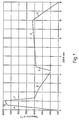
- the decisive factor for the success according to the invention in the process steps is, in particular, the combination of the austenitizing temperature of 950 to 1050 ° C., which is higher than in the prior art, in conjunction with the renewed heating of the rail head to 600 to 650 ° C. after completion of the pearlite transformation.
- the reheating of the rail head leads to a complete separation of the finest vanadium carbonitride particles from the supersaturated solution, in which vanadium, nitrogen and carbon are at 950 to 1050 ° C after austenitizing.
- the elimination of the vanadium carbonitride particles can only take place incompletely; therefore the desired increase in strength will only partially occur.
- the rail head is then quickly cooled to a temperature below 100 ° C using water or other suitable quenching media.
- the reheating of the rail head to 600 to 650 ° C thus causes a complete hardening by excretion of the finest vanadium carbides or vanadium carbonitrides.
- the previous cooling of the rail head to approx. 400 ° C ensures that the conversion in the pearlite stage is complete and that the subsequent hardening can proceed with a high germ density.
- niobium of the order of 0.02 to 0.10% provided according to the invention hardly brings about any additional precipitation hardening. It is designed to prevent grain growth in combination with the intended aluminum additives from 0.010 to 0.070% during austenitizing heating.
- liquid media such as water or steam, can be added to the compressed air, in particular in the first cooling stage.
- the features of claim 5 represent an economical process variant, according to which the rails are treated from the hot forming heat at final roll temperatures of 950 to 1000 ° C.
- heating of the cooled rail to the austenitizing temperature is eliminated, which saves energy costs.
- the rail head is first brought to a fine-lamellar pearlitic structure by blowing with compressed air, and after the pelite conversion has ended at 400 ° C, the rail head is heated again to 600 to 650 ° C and then the entire rail (head, bridge and foot) is mixed with water or other suitable quenching media is rapidly cooled to a temperature below 100 ° C.
Landscapes
- Chemical & Material Sciences (AREA)
- Engineering & Computer Science (AREA)
- Mechanical Engineering (AREA)
- Materials Engineering (AREA)
- Metallurgy (AREA)
- Organic Chemistry (AREA)
- Physics & Mathematics (AREA)
- Thermal Sciences (AREA)
- Crystallography & Structural Chemistry (AREA)
- Heat Treatment Of Articles (AREA)
- Metal Rolling (AREA)
Claims (5)
Priority Applications (1)
| Application Number | Priority Date | Filing Date | Title |
|---|---|---|---|
| AT85113653T ATE56226T1 (de) | 1984-12-21 | 1985-10-26 | Verfahren zur waermebehandlung perlitischer schienenstaehle. |
Applications Claiming Priority (2)
| Application Number | Priority Date | Filing Date | Title |
|---|---|---|---|
| DE3446794 | 1984-12-21 | ||
| DE3446794A DE3446794C1 (de) | 1984-12-21 | 1984-12-21 | Verfahren zur Waermebehandlung perlitischer Schienenstaehle |
Publications (3)
| Publication Number | Publication Date |
|---|---|
| EP0187904A2 EP0187904A2 (fr) | 1986-07-23 |
| EP0187904A3 EP0187904A3 (en) | 1989-07-19 |
| EP0187904B1 true EP0187904B1 (fr) | 1990-09-05 |
Family
ID=6253499
Family Applications (1)
| Application Number | Title | Priority Date | Filing Date |
|---|---|---|---|
| EP85113653A Expired - Lifetime EP0187904B1 (fr) | 1984-12-21 | 1985-10-26 | Procédé de traitement thermique d'aciers perlitiques pour rails |
Country Status (6)
| Country | Link |
|---|---|
| US (1) | US4714500A (fr) |
| EP (1) | EP0187904B1 (fr) |
| JP (1) | JPS61157636A (fr) |
| AT (1) | ATE56226T1 (fr) |
| CA (1) | CA1256004A (fr) |
| DE (2) | DE3446794C1 (fr) |
Cited By (2)
| Publication number | Priority date | Publication date | Assignee | Title |
|---|---|---|---|---|
| EP0693562A1 (fr) | 1994-07-19 | 1996-01-24 | VOEST-ALPINE SCHIENEN GmbH | Procédé et appareil de traitement thermique de laminés profilés |
| US6224694B1 (en) | 1994-07-09 | 2001-05-01 | Voest Alpine Schienen Gmbh & Co., Kg | Method for heat-treating profiled rolling stock |
Families Citing this family (20)
| Publication number | Priority date | Publication date | Assignee | Title |
|---|---|---|---|---|
| LU86510A1 (fr) * | 1986-07-10 | 1988-02-02 | Centre Rech Metallurgique | Procede et dispositif pour fabriquer un rail a haute resistance |
| US4886558A (en) * | 1987-05-28 | 1989-12-12 | Nkk Corporation | Method for heat-treating steel rail head |
| US4895605A (en) * | 1988-08-19 | 1990-01-23 | Algoma Steel Corporation | Method for the manufacture of hardened railroad rails |
| DE4200545A1 (de) * | 1992-01-11 | 1993-07-15 | Butzbacher Weichenbau Gmbh | Gleisteile sowie verfahren zur herstellung dieser |
| KR100186793B1 (ko) * | 1993-12-20 | 1999-04-01 | 다나카 미노루 | 펄라이트 금속 조직을 갖는 고내마모성 및 고인성 레일 및 그 제조 방법 |
| IT1274607B (it) * | 1994-08-09 | 1997-07-18 | Lovere Sidermeccanica Spa | Acciai per cerchioni di ruote e per ruote monoblocco destinate al settore ferroviario e simili |
| RU2112051C1 (ru) * | 1994-11-15 | 1998-05-27 | Ниппон Стил Корпорейшн | Рельс из перлитной стали с высокой износостойкостью и способ производства рельса |
| RU2139946C1 (ru) * | 1996-04-15 | 1999-10-20 | Ниппон Стил Корпорейшн | Обладающие превосходной износостойкостью и свариваемостью рельсы из низколегированной термообработанной перлитной стали, а также способ их производства |
| CN1044723C (zh) * | 1996-09-27 | 1999-08-18 | 攀枝花钢铁(集团)公司钢铁研究院 | 含钒合金钢轨的热处理方法 |
| JP3478174B2 (ja) * | 1999-06-02 | 2003-12-15 | Jfeスチール株式会社 | 耐摩耗性と延性に優れたパーライト鋼レール |
| DE10148305A1 (de) * | 2001-09-29 | 2003-04-24 | Sms Meer Gmbh | Verfahren und Anlage zur thermischen Behandlung von Schienen |
| EP1348770A1 (fr) * | 2002-03-19 | 2003-10-01 | E.C.O. Trading LLC | Installation et procedé de production de petites pièces en acier formées à chaud |
| JP5761116B2 (ja) * | 2012-04-27 | 2015-08-12 | 新日鐵住金株式会社 | 車輪用鋼 |
| BR112017002702B1 (pt) * | 2014-08-20 | 2021-09-08 | Jfe Steel Corporation | Método de fabricação de um trilho de tratamento térmico |
| US10400320B2 (en) | 2015-05-15 | 2019-09-03 | Nucor Corporation | Lead free steel and method of manufacturing |
| US12635041B2 (en) | 2015-12-04 | 2026-05-19 | Arconic Technologies Llc | Methods of cooling an electrically conductive sheet during transverse flux induction heat treatment |
| CN109518114A (zh) * | 2018-08-08 | 2019-03-26 | 宝山钢铁股份有限公司 | 带铝硅合金镀层的热冲压部件的制造方法及热冲压部件 |
| CN109207691A (zh) * | 2018-10-30 | 2019-01-15 | 攀钢集团攀枝花钢铁研究院有限公司 | 重载铁路用钢轨的生产方法 |
| CN112011680B (zh) * | 2020-07-28 | 2022-04-26 | 马鞍山钢铁股份有限公司 | 一种用于铁路车轮的间歇淬火方法 |
| CN112410648B (zh) * | 2020-10-13 | 2021-12-28 | 攀钢集团攀枝花钢铁研究院有限公司 | 一种高致密珠光体组织钢轨及其制备方法 |
Family Cites Families (6)
| Publication number | Priority date | Publication date | Assignee | Title |
|---|---|---|---|---|
| DE1255689B (de) * | 1962-10-12 | 1967-12-07 | United States Steel Corp | Verfahren zur Waermebehandlung von Schienenkopfflaechen |
| GB1342582A (en) * | 1970-03-20 | 1974-01-03 | British Steel Corp | Rail steel |
| US3846183A (en) * | 1973-05-02 | 1974-11-05 | Bethlehem Steel Corp | Method of treating steel rail |
| DE2439338C2 (de) * | 1974-08-16 | 1980-08-28 | Fried. Krupp, Huettenwerke Ag, 4630 Bochum | Verfahren zur Wärmebehandlung von Schienen aus der Walzhitze |
| DE2541978C3 (de) * | 1975-09-20 | 1978-08-24 | Butzbacher Weichenbau Gmbh, 6308 Butzbach | Verfahren zur Wärmebehandlung von Weichenteilen im Durchlaufverfahren |
| JPS54148124A (en) * | 1978-05-12 | 1979-11-20 | Nippon Steel Corp | Manufacture of high strength rall of excellent weldability |
-
1984
- 1984-12-21 DE DE3446794A patent/DE3446794C1/de not_active Expired
-
1985
- 1985-10-26 AT AT85113653T patent/ATE56226T1/de not_active IP Right Cessation
- 1985-10-26 EP EP85113653A patent/EP0187904B1/fr not_active Expired - Lifetime
- 1985-10-26 DE DE8585113653T patent/DE3579578D1/de not_active Expired - Fee Related
- 1985-12-02 US US06/803,744 patent/US4714500A/en not_active Expired - Fee Related
- 1985-12-05 JP JP60272621A patent/JPS61157636A/ja active Pending
- 1985-12-10 CA CA000497233A patent/CA1256004A/fr not_active Expired
Non-Patent Citations (6)
| Title |
|---|
| CHEMICAL ABSTRACTS, vol. 68, no. 26, Seite 11256, 24. Juni 1968, Zusammenfassung Nr. 116634t, Columbus, Ohio, USA; E.L. KOLOSOVA et al.:"Hardening of rail steel by means of small vanadiumadditions" * |
| PATENT ABSTRACTS OF JAPAN, Band 7, Nr. 46(C-153)(1191), 23. Februar 1983; & JP-A-57 198 216 (NIPPON KOKAN) 04.12.1982 * |
| STAHL UND EISEN, 90(1970) ; Manuskript des Seminarvortrages von H. Becker, 15.6.80, "Aufbau und Eigenschaften von mikrolegierten Feinkornsbanstählen" * |
| STAHL UND EISEN, Band 90, Nr. 17, 20. August 1970, Seiten 922-928, Düsseldorf, DE * |
| TECH. MITT. KRUPP, WERKSBERICHTE, Band 37, Heft 3, 1979, Seiten 79-87, Essen, DE; HELLER et al.:"Untersuchung und betriebliche Erprobung neuartiger naturharter Schienenstähle" * |
| TECH. MITT. KRUPP, WERKSBERICHTE, Band 37, Heft 3,1979, Seiten 89-94, Essen, DE; FLUEGGE:"Metallkundliche Zusammenhänge bei perlitischen Schienenstählen" * |
Cited By (4)
| Publication number | Priority date | Publication date | Assignee | Title |
|---|---|---|---|---|
| US6224694B1 (en) | 1994-07-09 | 2001-05-01 | Voest Alpine Schienen Gmbh & Co., Kg | Method for heat-treating profiled rolling stock |
| EP0693562A1 (fr) | 1994-07-19 | 1996-01-24 | VOEST-ALPINE SCHIENEN GmbH | Procédé et appareil de traitement thermique de laminés profilés |
| US6419762B2 (en) | 1994-07-19 | 2002-07-16 | Voest-Alpine Schienen Gmbh | Heat-treated profiled rolling stock |
| US6770155B2 (en) | 1994-07-19 | 2004-08-03 | Voestalpine Schienen Gmbh | Method for heat-treating profiled rolling stock |
Also Published As
| Publication number | Publication date |
|---|---|
| EP0187904A2 (fr) | 1986-07-23 |
| ATE56226T1 (de) | 1990-09-15 |
| CA1256004A (fr) | 1989-06-20 |
| US4714500A (en) | 1987-12-22 |
| DE3579578D1 (de) | 1990-10-11 |
| JPS61157636A (ja) | 1986-07-17 |
| DE3446794C1 (de) | 1986-01-02 |
| EP0187904A3 (en) | 1989-07-19 |
Similar Documents
| Publication | Publication Date | Title |
|---|---|---|
| DE3446794C1 (de) | Verfahren zur Waermebehandlung perlitischer Schienenstaehle | |
| DE3874100T2 (de) | Verfahren zur herstellung von stahl mit niedrigem verhaeltnis der elastizitaetsgrenze zur bruchfestigkeit. | |
| DE60300561T3 (de) | Verfahren zur Herstellung eines warmgewalzten Stahlbandes | |
| DE60205744T2 (de) | Durch beanspruchungsarme bearbeitung und glühen von gewöhnlichem kohlenstoffarmem stahl hergestellte hochfeste und hochduktile stahlplatte mit hyperfeiner kristallkornstruktur und herstellungsverfahren dafür | |
| DE69418565T2 (de) | Wärmeunbehandelter stahl zum warmschmieden, verfahren zur herstellung eines daraus hergestellten schmiedestückes und schmiedestück | |
| DE3617725C2 (fr) | ||
| DE1483218C3 (de) | Verfahren zum Herstellen eines warmfesten, ferritischen Cr-Mo-V-Stahles mit hoher Zeitstandfestigkeit und verbesserter Zeitbruchdehnung | |
| EP0160616B1 (fr) | Utilisation d'un acier dans des atmosphères contenant de l'acide sulfhydrique | |
| DE60011666T2 (de) | Verfahren zur herstellung von ultrafeiner kornstruktur für unlegierte oder niedriglegierte stähle | |
| DE3832014C2 (de) | Verfahren zur Herstellung hochfester nahtloser Stahlrohre | |
| EP2103704B1 (fr) | Produit longitudinal laminé à chaud et son procédé de fabrication | |
| EP1052296B1 (fr) | Utilisation d'un acier pour la fabrication de plaques de blindage | |
| DE102005052069A1 (de) | Verfahren zum Herstellen von Vormaterial aus Stahl durch Warmverformen | |
| DE3616518A1 (de) | Verfahren zum herstellen eines hochfesten stahls | |
| DE60121084T2 (de) | Hochfester warmgewalzter Stahl mit hoher Streckgrenze zur Verwendung in Kraftfahrzeugen | |
| DE3006695C2 (de) | Verfahren zum Wärmebehandeln von Schienen | |
| DE3044338C2 (de) | Verfahren zum Herstellen von Kaltblech und dessen Verwendung | |
| DE112023005500T5 (de) | Ultrahochfestes kaltgewalztes stahlblech und verfahren zur herstellung davon | |
| DE3445794C1 (fr) | ||
| DE112023005449T5 (de) | Hochfestes und hochumformbares Stahlblech und Verfahren zu dessen Herstellung | |
| EP3783120B1 (fr) | Fil de ressort, pince de serrage formée à partir dudit fil de ressort et procédé de fabrication d'un tel fil de ressort | |
| DE69326152T2 (de) | Verfahren zum Herstellen von hochfestem Stahl mit ausgezeichneter Beständigkeit gegen Spannungsrisskorrosion | |
| DE1239110B (de) | Verwendung einer hochverschleissfesten Schienenstahllegierung | |
| AT401359B (de) | Verfahren zur herstellung eines herzstückes | |
| DE19528671C1 (de) | Verwendung eines niedriglegierten hochfesten Feinkornbaustahls für Streckenausbauprofile für Grubenbetriebe und Verfahren zu seiner Herstellung |
Legal Events
| Date | Code | Title | Description |
|---|---|---|---|
| PUAI | Public reference made under article 153(3) epc to a published international application that has entered the european phase |
Free format text: ORIGINAL CODE: 0009012 |
|
| AK | Designated contracting states |
Kind code of ref document: A2 Designated state(s): AT CH DE FR GB LI LU NL |
|
| PUAL | Search report despatched |
Free format text: ORIGINAL CODE: 0009013 |
|
| AK | Designated contracting states |
Kind code of ref document: A3 Designated state(s): AT CH DE FR GB LI LU NL |
|
| 17P | Request for examination filed |
Effective date: 19890705 |
|
| 17Q | First examination report despatched |
Effective date: 19890915 |
|
| RAP1 | Party data changed (applicant data changed or rights of an application transferred) |
Owner name: BUTZBACHER WEICHENBAU GMBH Owner name: VEREINIGTE WEICHENBAU GMBH |
|
| GRAA | (expected) grant |
Free format text: ORIGINAL CODE: 0009210 |
|
| AK | Designated contracting states |
Kind code of ref document: B1 Designated state(s): AT CH DE FR GB LI LU NL |
|
| REF | Corresponds to: |
Ref document number: 56226 Country of ref document: AT Date of ref document: 19900915 Kind code of ref document: T |
|
| ET | Fr: translation filed | ||
| REF | Corresponds to: |
Ref document number: 3579578 Country of ref document: DE Date of ref document: 19901011 |
|
| GBT | Gb: translation of ep patent filed (gb section 77(6)(a)/1977) | ||
| PLBE | No opposition filed within time limit |
Free format text: ORIGINAL CODE: 0009261 |
|
| STAA | Information on the status of an ep patent application or granted ep patent |
Free format text: STATUS: NO OPPOSITION FILED WITHIN TIME LIMIT |
|
| 26N | No opposition filed | ||
| EPTA | Lu: last paid annual fee | ||
| PGFP | Annual fee paid to national office [announced via postgrant information from national office to epo] |
Ref country code: CH Payment date: 19940928 Year of fee payment: 10 |
|
| REG | Reference to a national code |
Ref country code: CH Ref legal event code: PUE Owner name: BUTZBACHER WEICHENBAU GMBH |
|
| REG | Reference to a national code |
Ref country code: GB Ref legal event code: 732E |
|
| REG | Reference to a national code |
Ref country code: FR Ref legal event code: TP |
|
| NLS | Nl: assignments of ep-patents |
Owner name: BUTZBACHER WEICHENBAU GMBH TE BUTZBACH, BONDSREPUB |
|
| PGFP | Annual fee paid to national office [announced via postgrant information from national office to epo] |
Ref country code: LU Payment date: 19951001 Year of fee payment: 11 |
|
| PGFP | Annual fee paid to national office [announced via postgrant information from national office to epo] |
Ref country code: GB Payment date: 19951024 Year of fee payment: 11 |
|
| PG25 | Lapsed in a contracting state [announced via postgrant information from national office to epo] |
Ref country code: LI Effective date: 19951031 Ref country code: CH Effective date: 19951031 |
|
| REG | Reference to a national code |
Ref country code: CH Ref legal event code: PL |
|
| PG25 | Lapsed in a contracting state [announced via postgrant information from national office to epo] |
Ref country code: LU Free format text: LAPSE BECAUSE OF NON-PAYMENT OF DUE FEES Effective date: 19961026 Ref country code: GB Effective date: 19961026 |
|
| GBPC | Gb: european patent ceased through non-payment of renewal fee |
Effective date: 19961026 |
|
| PGFP | Annual fee paid to national office [announced via postgrant information from national office to epo] |
Ref country code: AT Payment date: 19981023 Year of fee payment: 14 |
|
| PGFP | Annual fee paid to national office [announced via postgrant information from national office to epo] |
Ref country code: NL Payment date: 19981030 Year of fee payment: 14 |
|
| PG25 | Lapsed in a contracting state [announced via postgrant information from national office to epo] |
Ref country code: AT Free format text: LAPSE BECAUSE OF NON-PAYMENT OF DUE FEES Effective date: 19991026 |
|
| PG25 | Lapsed in a contracting state [announced via postgrant information from national office to epo] |
Ref country code: NL Free format text: LAPSE BECAUSE OF NON-PAYMENT OF DUE FEES Effective date: 20000501 |
|
| NLV4 | Nl: lapsed or anulled due to non-payment of the annual fee |
Effective date: 20000501 |
|
| PGFP | Annual fee paid to national office [announced via postgrant information from national office to epo] |
Ref country code: DE Payment date: 20040430 Year of fee payment: 19 |
|
| PGFP | Annual fee paid to national office [announced via postgrant information from national office to epo] |
Ref country code: FR Payment date: 20041012 Year of fee payment: 20 |
|
| PG25 | Lapsed in a contracting state [announced via postgrant information from national office to epo] |
Ref country code: DE Free format text: LAPSE BECAUSE OF NON-PAYMENT OF DUE FEES Effective date: 20050503 |