EP0189923A2 - Procédé d'écriture et de lecture de groupes dans une mémoire - Google Patents
Procédé d'écriture et de lecture de groupes dans une mémoire Download PDFInfo
- Publication number
- EP0189923A2 EP0189923A2 EP86101216A EP86101216A EP0189923A2 EP 0189923 A2 EP0189923 A2 EP 0189923A2 EP 86101216 A EP86101216 A EP 86101216A EP 86101216 A EP86101216 A EP 86101216A EP 0189923 A2 EP0189923 A2 EP 0189923A2
- Authority
- EP
- European Patent Office
- Prior art keywords
- group
- groups
- sequential file
- program
- file
- Prior art date
- Legal status (The legal status is an assumption and is not a legal conclusion. Google has not performed a legal analysis and makes no representation as to the accuracy of the status listed.)
- Granted
Links
Images





Classifications
-
- G—PHYSICS
- G06—COMPUTING OR CALCULATING; COUNTING
- G06F—ELECTRIC DIGITAL DATA PROCESSING
- G06F16/00—Information retrieval; Database structures therefor; File system structures therefor
- G06F16/90—Details of database functions independent of the retrieved data types
- G06F16/903—Querying
- G06F16/90335—Query processing
- G06F16/90344—Query processing by using string matching techniques
Definitions
- the invention relates to a method for creating and querying information groups in the memory of a computer system with a tail unit, an arithmetic unit and a memory.
- Another way is to arrange the data in a sequential file and in a strictly ascending order of the order term (e.g. the department number), so that the query programs become less complex.
- the order term e.g. the department number
- the object of the present invention is therefore to specify a method of the type mentioned at the outset which, with little program complexity and simple possibility of changing the stored data, permits flexible query for various logical parameters.
- the invention proposes to arrange the individual data records in a sequential file so that the data records of a logical group follow one another directly, but the logical groups themselves appear in any order. If an additional logical group is to be included, it only needs to be added to the end of the existing data; this feature is of particular value for storage media that cannot be erased, e.g. optical disk storage. Any number sequence (number) can be used as a group parameter in the proposed method; the group to which a data record belongs is then determined by the freely selectable number of high-digit digits of this number. A special group code is therefore not necessary. To identify the group, the integer remainder of a quotient from the number field and a freely selectable divisor is used in particular.
- the evaluation program for creating lists which are arranged according to the groups becomes particularly simple with this choice of the arrangement of the data records; a single pass through the sequential file with just a few query commands is sufficient to output a group overview.
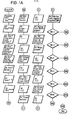
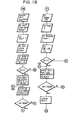
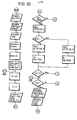
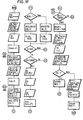
- a first embodiment of the method according to the invention is represented by the BASIC program REM 1, the program list of which is shown in Table 1 and the flowchart of which is shown in FIGS. 1A to G.
- This exemplary embodiment is shown using the example of product groups with their prices, their quantity and their total price.
- the groups are stored in a single file in sequential but non-linear order of the groups.
- an order number with at least five digits is used as the ordering parameter, the last three digits of which are not taken into account for the definition of the product group.
- the product STUHL with the product number 22410 thus belongs to product group 22, the product DISKETTE with the product number -62307 to product group -62.
- the individual goods belonging to a product group are arranged consecutively in the sequential file.
- An example of such a file is shown in Table 5.
- Elements that were added later to a previously entered group can also be added to the end of the sequential file and separately from the other group elements in order to avoid reordering the existing file. In this case, two group output fields with the same name will be created when the inventory is queried.
- Table 2A shows the result of the query of the file according to Table 5 in accordance with sub-step 3 if the entire inventory is to be output, and in accordance with sub-step 4 if the total value of the queried product groups is to be recorded. It can be seen from Table 2A that the individual product groups are output in the same order as they are arranged in the sequential file.
- Table 2 B shows the result of the query of the file according to Table 5 in accordance with sub-step 5, which prints out individual sales groups to be entered in the query, for example the sales group from DM 2000 to DM 2999.
- program lines 10 to 230 of program REM 1 which correspond to FIG. 1A, the user is asked to select one of the functions displayed there by means of a selection code.
- Program lines 1000 to 1150 and FIG. 1B relate to the creation or enrichment of the sequential file, as shown in Table 5. To do this, the program asks for the article number, price and stock quantity and is completed when the value 00000 is entered as the article number. With this type of input, the user must therefore ensure that articles that belong to the same product groups are entered one after the other.
- Program lines 2000 to 2145 and FIG. 1C show the query of the sequential file for a specific article whose article number is entered. With this query, the entire sequential file is read out sentence by sentence until the desired article appears or until the end of the file is reached; in the latter case, the message is then issued that this article is not saved.
- the decisive program line is 3160, in which a query is made as to whether department B of the data record being processed is equal to department C of the data record processed immediately before. If so, the entry of this data record is listed in program lines 3220 to 3225 and the sums are formed in program lines 3230 and 3240, and the program line 3050 loops again to read in a new data record (at 3070). In the other case, the department is closed, at program line 3180, the characteristic line for this department is printed, the sum SUM for the department is deleted and a new data record is read or the program is ended when all data records in the sequential file have been read.
- This simple loop for querying the entire sequential data record enables the output of all product groups in a clear manner.
- a prior sorting of the sequential file according to the goods code is not necessary, so that little processing time is necessary for the execution of the program.
- the program lines 5000 to 5400 represent the function "Query for product groups".
- the desired product group is entered here (program line 5060)
- the group designation B is determined from the two high-digit numbers of the article number, taking the sign into account (program lines 5100 to 5160) and then each read data record compared to the existence of this department (program line 5170).
- program line 5171 When the entire sequential file has been run (program line 5171), the sum SUM is printed out for this department (program line 5220) and asked at program line 5240 whether further departments should be queried. If not, the total sum is printed out for all departments and the program is completed.
- the program part works in a similar manner in lines 6000 to 6300 or Fig. 1 G, however, in that instead of the product group the sales group is to be specified (Program line 6060).
- a search parameter W is then determined by dividing the entered value by 1000 and only considering the integer value of the result (program line 6075). In the case of negative quotients, the integer smaller by 1 is used as the search parameter (program line 6090).
- the turnover SU is then determined from the quantity and price, also divided by 1000, and the integer is formed as a comparison parameter in the query of the program line 6150.
- Articles with matching comparison parameters of the sales group which in the example are between 3000 and 3999 when entering 3000, are then printed out and the sums of the group are formed when the entire file has been run through. If additional sales groups are queried, the program opens the query loop again (program line 6050).
- the sales group can easily be defined differently if values other than 1000 are selected in the division.
- the individual sales do not need to be recorded in the sequential file in groups in succession.
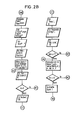
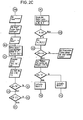
- Table 3 and FIGS. 2A to 2D show a further exemplary embodiment of the invention, in which the individual groups are determined only by positive (and not by negative) parameters.
- This exemplary embodiment is also aimed at product groups with individual article numbers, which, however, cannot assume negative values here.
- the program XLAG of the second exemplary embodiment shows the individual functions of the program for selection in a first part (program line 10 to 230; FIG. 2A). In this case, however, the functions "Output of a product group" and "Output of a sales group" are not shown.
- program line 1000 to 1150; FIG. 2 B the input into the sequential file is described again, which can either be opened or expanded.
- Data records that belong to the same group e.g. goods from the same goods group
- a third program part (program lines 2000 to 2145; FIG. 2 C) relates to the query of the sequential file for a specific data record, here for a specific article.
- the fourth program part (program lines 3000 to 3290; Fig. 2 D) generates the inventory, which, as in the previous embodiment, is again shown according to product groups, the individual product groups appearing in the same order as they are entered in the sequential file.
- the group parameter does not consist of the two high-digit numbers of the article number inel. of the sign is determined, but by dividing the article number by the value 1000 and accepting the remaining whole number (program line 3170).
- Group parameter B which is determined in this way, is then compared again in program line 3180 with group parameter C of the data record processed immediately before, in order to either list the data of the data record currently being processed under the same group if the two parameters are the same, or the group complete when the two parameters are different.
- the query program for the group display can be carried out in an even simpler manner than with the REM 1 program.
- Table 4 shows an example of such a query.
- Table 4 is an example of using the facility and querying groups from a file in a non-linear form.
- the relevant branch number and area number are added to the EAN code in the form
- the head office in Y-City can determine the total outflows of all branches of the respective supplier by querying the supplier number (group) and the article number.
- group the supplier number
- the sales per day of the supplier company can now be determined in the various baking wafer sizes. This is important for Christmas items (seasonal items), since buying behavior changes greatly from week to week. If the branch manager orders too much, he has to keep the baked wafers in stock for a whole year (dead capital). If he orders too little, he accepts losses in sales.
- the buyer now has a decision-making aid based on the existing daily sales and a specially developed program that compares the sales of the previous year in this period. If the supplier (or the trade agency) has an EDP system (e.g. a personal computer), the order can be forwarded directly via data telephone and sent to the distribution center there by printer or, for smaller orders, to his distribution center (or forwarding agent) at the location ( Y city). If this also has a personal computer and printer, the time-consuming route by post can be avoided.
- EDP system e.g. a personal computer
- the above application is exemplary.
- the specified method has a particular advantage if a laser file is used.
- the query takes place at a much higher speed than with conventional memories.
Landscapes
- Engineering & Computer Science (AREA)
- Databases & Information Systems (AREA)
- Theoretical Computer Science (AREA)
- Computational Linguistics (AREA)
- Data Mining & Analysis (AREA)
- Physics & Mathematics (AREA)
- General Engineering & Computer Science (AREA)
- General Physics & Mathematics (AREA)
- Information Retrieval, Db Structures And Fs Structures Therefor (AREA)
- Multi Processors (AREA)
- Radar Systems Or Details Thereof (AREA)
- Communication Control (AREA)
Priority Applications (1)
| Application Number | Priority Date | Filing Date | Title |
|---|---|---|---|
| AT86101216T ATE84156T1 (de) | 1985-01-31 | 1986-01-30 | Verfahren zum anlegen und abfragen von gruppen aus einem speicher. |
Applications Claiming Priority (2)
| Application Number | Priority Date | Filing Date | Title |
|---|---|---|---|
| DE19853503284 DE3503284A1 (de) | 1985-01-31 | 1985-01-31 | Verfahren zum anlegen und abfragen von gruppen aus einem speicher |
| DE3503284 | 1985-01-31 |
Publications (3)
| Publication Number | Publication Date |
|---|---|
| EP0189923A2 true EP0189923A2 (fr) | 1986-08-06 |
| EP0189923A3 EP0189923A3 (en) | 1989-03-15 |
| EP0189923B1 EP0189923B1 (fr) | 1992-12-30 |
Family
ID=6261310
Family Applications (1)
| Application Number | Title | Priority Date | Filing Date |
|---|---|---|---|
| EP86101216A Expired - Lifetime EP0189923B1 (fr) | 1985-01-31 | 1986-01-30 | Procédé d'écriture et de lecture de groupes dans une mémoire |
Country Status (3)
| Country | Link |
|---|---|
| EP (1) | EP0189923B1 (fr) |
| AT (1) | ATE84156T1 (fr) |
| DE (2) | DE3503284A1 (fr) |
Cited By (1)
| Publication number | Priority date | Publication date | Assignee | Title |
|---|---|---|---|---|
| US10845793B2 (en) | 2005-07-11 | 2020-11-24 | Brooks Automation, Inc. | Intelligent condition monitoring and fault diagnostic system for preventative maintenance |
Families Citing this family (1)
| Publication number | Priority date | Publication date | Assignee | Title |
|---|---|---|---|---|
| DE19511773A1 (de) * | 1995-03-30 | 1996-10-02 | Siemens Ag | Verfahren zum Verarbeiten eines Signals |
Family Cites Families (1)
| Publication number | Priority date | Publication date | Assignee | Title |
|---|---|---|---|---|
| US3197742A (en) * | 1960-01-11 | 1965-07-27 | Rca Corp | Search apparatus |
-
1985
- 1985-01-31 DE DE19853503284 patent/DE3503284A1/de not_active Ceased
-
1986
- 1986-01-30 DE DE8686101216T patent/DE3687352D1/de not_active Expired - Fee Related
- 1986-01-30 AT AT86101216T patent/ATE84156T1/de not_active IP Right Cessation
- 1986-01-30 EP EP86101216A patent/EP0189923B1/fr not_active Expired - Lifetime
Cited By (1)
| Publication number | Priority date | Publication date | Assignee | Title |
|---|---|---|---|---|
| US10845793B2 (en) | 2005-07-11 | 2020-11-24 | Brooks Automation, Inc. | Intelligent condition monitoring and fault diagnostic system for preventative maintenance |
Also Published As
| Publication number | Publication date |
|---|---|
| ATE84156T1 (de) | 1993-01-15 |
| DE3687352D1 (de) | 1993-02-11 |
| EP0189923A3 (en) | 1989-03-15 |
| DE3503284A1 (de) | 1986-08-14 |
| EP0189923B1 (fr) | 1992-12-30 |
Similar Documents
| Publication | Publication Date | Title |
|---|---|---|
| DE3855706T2 (de) | Automatisierte Rechnung von Materialien | |
| DE3382808T2 (de) | Datenbankzugriffsverfahren mit einem benutzerfreundlichen Menü | |
| DE69222788T2 (de) | Verfahren, um Vermerke in einer Mehrzahl von Listen in Einklang zu bringen | |
| DE69127847T2 (de) | Verfahren und Gerät zur Klassifizierung von Daten | |
| DE68927196T2 (de) | System zur Vereinfachung der Tätigkeitkoordinierung bei mehreren Tätern | |
| DE19947136A1 (de) | Verfahren und Vorrichtung zum Erstellen und Verteilen von Berichten | |
| DE3126373C2 (de) | Elektronische Registrierkasse | |
| DE69128549T2 (de) | Verfahren zur Anzeige einer Anzahl von Dokumenten | |
| DE3687506T3 (de) | Elektronische Registrierkasse. | |
| Yates | Evolving information use in firms, 1850-1920: ideology and information techniques and technologies | |
| DE1774943A1 (de) | Informationsuebertragungsanordnung | |
| DE68928088T2 (de) | Datenbanksystem mit Faksimileanmerkungen und Verfahren zur Faksimileanmerkungen-Verwaltung | |
| DE69321270T2 (de) | Fensterverwaltungssystem in einem Computerterminal | |
| EP0189923B1 (fr) | Procédé d'écriture et de lecture de groupes dans une mémoire | |
| DE3587388T2 (de) | Dateisystem für elektronische Dokumente. | |
| DE68927942T2 (de) | Relationale Datenwiederauffindungsvorrichtung | |
| DE68908355T2 (de) | Verkaufsdatenverarbeitungsvorrichtung. | |
| DE69911208T2 (de) | System zur simulation eines geschäftsprozesses | |
| Weber | Book catalog trends in 1966 | |
| DE69518271T2 (de) | Verfahren und Vorrichtung zum Speichern und Wiedergewinnen von Daten | |
| DE3534080C2 (fr) | ||
| DE68927206T2 (de) | Verfahren und Apparat zur Aktualisierung von Transaktionsdatei | |
| DE68928011T2 (de) | Datenverarbeitungsgerät | |
| DE19723253B4 (de) | Verfahren zur Aufzeichnung von Daten in einem Computer, Daten-Speicherprodukt sowie POS-Computereinrichtung | |
| DE3112494A1 (de) | Verfahren und geraet zur edv compatiblen visuellen erfassung von belegen etc. |
Legal Events
| Date | Code | Title | Description |
|---|---|---|---|
| PUAI | Public reference made under article 153(3) epc to a published international application that has entered the european phase |
Free format text: ORIGINAL CODE: 0009012 |
|
| AK | Designated contracting states |
Kind code of ref document: A2 Designated state(s): AT BE CH DE FR GB IT LI NL SE |
|
| PUAL | Search report despatched |
Free format text: ORIGINAL CODE: 0009013 |
|
| AK | Designated contracting states |
Kind code of ref document: A3 Designated state(s): AT BE CH DE FR GB IT LI NL SE |
|
| 17P | Request for examination filed |
Effective date: 19890228 |
|
| 17Q | First examination report despatched |
Effective date: 19901204 |
|
| GRAA | (expected) grant |
Free format text: ORIGINAL CODE: 0009210 |
|
| AK | Designated contracting states |
Kind code of ref document: B1 Designated state(s): AT BE CH DE FR GB IT LI NL SE |
|
| PG25 | Lapsed in a contracting state [announced via postgrant information from national office to epo] |
Ref country code: IT Free format text: LAPSE BECAUSE OF FAILURE TO SUBMIT A TRANSLATION OF THE DESCRIPTION OR TO PAY THE FEE WITHIN THE PRE;WARNING: LAPSES OF ITALIAN PATENTS WITH EFFECTIVE DATE BEFORE 2007 MAY HAVE OCCURRED AT ANY TIME BEFORE 2007. THE CORRECT EFFECTIVE DATE MAY BE DIFFERENT FROM THE ONE RECORDED.SCRIBED TIME-LIMIT Effective date: 19921230 Ref country code: FR Effective date: 19921230 Ref country code: SE Effective date: 19921230 Ref country code: BE Effective date: 19921230 Ref country code: NL Effective date: 19921230 Ref country code: GB Effective date: 19921230 |
|
| REF | Corresponds to: |
Ref document number: 84156 Country of ref document: AT Date of ref document: 19930115 Kind code of ref document: T |
|
| PG25 | Lapsed in a contracting state [announced via postgrant information from national office to epo] |
Ref country code: AT Effective date: 19930130 |
|
| PG25 | Lapsed in a contracting state [announced via postgrant information from national office to epo] |
Ref country code: CH Effective date: 19930131 Ref country code: LI Effective date: 19930131 |
|
| REF | Corresponds to: |
Ref document number: 3687352 Country of ref document: DE Date of ref document: 19930211 |
|
| EN | Fr: translation not filed | ||
| NLV1 | Nl: lapsed or annulled due to failure to fulfill the requirements of art. 29p and 29m of the patents act | ||
| GBV | Gb: ep patent (uk) treated as always having been void in accordance with gb section 77(7)/1977 [no translation filed] |
Effective date: 19921230 |
|
| REG | Reference to a national code |
Ref country code: CH Ref legal event code: PL |
|
| PLBE | No opposition filed within time limit |
Free format text: ORIGINAL CODE: 0009261 |
|
| STAA | Information on the status of an ep patent application or granted ep patent |
Free format text: STATUS: NO OPPOSITION FILED WITHIN TIME LIMIT |
|
| 26N | No opposition filed | ||
| PGFP | Annual fee paid to national office [announced via postgrant information from national office to epo] |
Ref country code: DE Payment date: 19980129 Year of fee payment: 13 |
|
| PG25 | Lapsed in a contracting state [announced via postgrant information from national office to epo] |
Ref country code: DE Free format text: LAPSE BECAUSE OF NON-PAYMENT OF DUE FEES Effective date: 19991103 |