EP0191285A2 - Sebosuppressive kosmetische Mittel, enthaltend Benzoesäureesterderivate, sowie neue Benzoesäureesterderivate - Google Patents
Sebosuppressive kosmetische Mittel, enthaltend Benzoesäureesterderivate, sowie neue Benzoesäureesterderivate Download PDFInfo
- Publication number
- EP0191285A2 EP0191285A2 EP86100132A EP86100132A EP0191285A2 EP 0191285 A2 EP0191285 A2 EP 0191285A2 EP 86100132 A EP86100132 A EP 86100132A EP 86100132 A EP86100132 A EP 86100132A EP 0191285 A2 EP0191285 A2 EP 0191285A2
- Authority
- EP
- European Patent Office
- Prior art keywords
- benzoic acid
- alkyl
- alkylbenzyl
- carbon atoms
- derivatives
- Prior art date
- Legal status (The legal status is an assumption and is not a legal conclusion. Google has not performed a legal analysis and makes no representation as to the accuracy of the status listed.)
- Granted
Links
Classifications
-
- A—HUMAN NECESSITIES
- A61—MEDICAL OR VETERINARY SCIENCE; HYGIENE
- A61K—PREPARATIONS FOR MEDICAL, DENTAL OR TOILETRY PURPOSES
- A61K8/00—Cosmetics or similar toiletry preparations
- A61K8/18—Cosmetics or similar toiletry preparations characterised by the composition
- A61K8/30—Cosmetics or similar toiletry preparations characterised by the composition containing organic compounds
- A61K8/33—Cosmetics or similar toiletry preparations characterised by the composition containing organic compounds containing oxygen
- A61K8/37—Esters of carboxylic acids
-
- A—HUMAN NECESSITIES
- A61—MEDICAL OR VETERINARY SCIENCE; HYGIENE
- A61Q—SPECIFIC USE OF COSMETICS OR SIMILAR TOILETRY PREPARATIONS
- A61Q19/00—Preparations for care of the skin
- A61Q19/008—Preparations for oily skin
-
- A—HUMAN NECESSITIES
- A61—MEDICAL OR VETERINARY SCIENCE; HYGIENE
- A61Q—SPECIFIC USE OF COSMETICS OR SIMILAR TOILETRY PREPARATIONS
- A61Q5/00—Preparations for care of the hair
-
- A—HUMAN NECESSITIES
- A61—MEDICAL OR VETERINARY SCIENCE; HYGIENE
- A61Q—SPECIFIC USE OF COSMETICS OR SIMILAR TOILETRY PREPARATIONS
- A61Q5/00—Preparations for care of the hair
- A61Q5/008—Preparations for oily hair
Definitions
- the invention relates to topical cosmetic compositions for improving the greasy and unaesthetic appearance of the hair and skin, which contain certain benzoic acid ester derivatives.
- the invention further relates to new benzoic acid ester derivatives.
- the object of the invention is to provide a cosmetic agent which, compared to the known preparations, has an increased effect without any adverse effects on the human body.
- the compounds to be used according to the claims are new. They can be made by known methods, e.g. B. by alkylation or aralkylation of the corresponding 4-hydroxybenzoic acid esters with halides or ether halides containing radicals corresponding to R 1 , or by esterification of benzoic acids substituted in the 4-position by radicals corresponding to R with hydroxyalkyl compounds corresponding to R 5 . Special esters can also be obtained by transesterification.
- R 1 branched-chain C 8 -C 13 alkyl or C 3 -C 6 alkylbenzyl, in particular poly-branched C 8 -C 13 alkyl, are preferred.
- the compounds have a pronounced sebosuppressive effect with excellent skin and mucous membrane compatibility. They can be incorporated without difficulty into various cosmetic preparations, such as aqueous or alcoholic solutions, oils, suspensions, gels, emulsions, ointments or aerosols, their greater solubility in water and stability to hydrolysis compared to that ent. . speaking esters is of particular advantage.
- cosmetic preparations such as aqueous or alcoholic solutions, oils, suspensions, gels, emulsions, ointments or aerosols, their greater solubility in water and stability to hydrolysis compared to that ent. . speaking esters is of particular advantage.
- these can be used in all customary forms of application, such as hair lotions, hair shampoos, hair treatments, hair rinses, skin lotions or shaking mixtures. Use in hair care products is preferred.
- these cosmetic compositions can contain conventional carriers and auxiliaries, such as water, organic solvents, surface-active compounds, oils, fats, waxes, fragrances, dyes, preservatives and the like.
- auxiliaries such as water, organic solvents, surface-active compounds, oils, fats, waxes, fragrances, dyes, preservatives and the like.
- the new sebosuppressive agents expediently contain 0.005-5% by weight, preferably 0.02-2% by weight, of the claimed benzoic acid ester derivatives.
- the antiseborrheic effect was investigated in more detail in the animal experiments described below.
- test substances in alcoholic solution were each brushed onto the back of 6 rats on one side.
- the other side was only treated with the solvent without active ingredients.
- the first criterion was the difference between the right and left side, whereby 1 point was to be awarded for each judge and animal, in such a way that the
- the differences in intensity of the brown tones were also rated on the following scale: According to this evaluation method, the point total differences between the untreated control animals and in each case the treated and untreated sides ( ⁇ P) of the test animals are formed, again significant differences between control animals and the treated side of the test animals making the effect of a substance clear.
- the sebum reduction is calculated from the point difference in such a way that the quotient of the point difference ⁇ P and the number of points for the control group P k is formed and the value obtained is given in%.
- the benzoic acid ester derivatives were applied in concentrations of 0.01 to 0.5% in alcohol in the manner indicated. The results are summarized in the table. The superior effects of the claimed substances are evident from the values in the table.
Landscapes
- Health & Medical Sciences (AREA)
- Life Sciences & Earth Sciences (AREA)
- Animal Behavior & Ethology (AREA)
- General Health & Medical Sciences (AREA)
- Public Health (AREA)
- Veterinary Medicine (AREA)
- Dermatology (AREA)
- Emergency Medicine (AREA)
- Birds (AREA)
- Epidemiology (AREA)
- Cosmetics (AREA)
- Organic Low-Molecular-Weight Compounds And Preparation Thereof (AREA)
- Acyclic And Carbocyclic Compounds In Medicinal Compositions (AREA)
Abstract
Description
- Die Erfindung betrifft topische, kosmetische Mittel zur Verbesserung des fettigen und unästhetischen Aussehens der Haare und der Haut, welche bestimmte Benzoesäureesterderivate enthalten. Die Erfindung betrifft ferner neue Benzoesäureesterderivate.
- Die moderne Kosmetik Ist bemüht, das durch übermäßig starke Absonderung der Talgdrüsen und der Kopfhaut verursachte fettige und wenig ästhetische Aussehen der Haare zu vermindern. Es ist daher vielfach versucht worden, durch geeignete Mittel die Sekretion der Talgdrüsen zu normalisieren, um dem Haar wieder sein normales Aussehen zu geben. So wurden zur Bekämpfung der Seborrhoe des behaarten Kopfes kosmetische Pflegemittel mit Schwefel-, Quecksilber- oder Teerzusatz verwendet. Dabei hat sich gezeigt, daß diese Zusätze bei längerer Anwendung häufig zu Nebenwirkungen führen, ohne daß wirklich befriedigende Ergebnisse im Hinblick auf Wirksamkeit und anwendungstechnische Eigenschaften erzielt werden konnten. Mehrfach sind auch bereits Derivate von Benzoesäureestern als antiseborrhoische Zusätze für kosmetische Mittel vorgeschlagen worden (DE-OS 31 21 o64, DE-OS 33 01 313), doch besteht weiterhin der Wunsch nach Mitteln mit erhöhter sebosuppressiver Wirksamkeit.
- Aufgabe der Erfindung ist es, ein kosmetisches Mittel bereitzustellen, welches gegenüber den bekannten Präparaten eine verstärke Wirkung, ohne nachteilige Folgen auf den menschlichen Körper hat.
- Es wurde nun gefunden, daß bestimmte Benzoesäureesterderivate hervorragende antiseborrhoische Effekte auch bei sehr geringer Dosierung aufweisen. Gegenüber den bekannten Derivaten von Benzoesäureestern ist die Wirkung überraschenderweise erheblich verbessert, was einen geringeren Mengeneinsatz in den betreffenden sebosuppressiven kosmetischen Mitteln ermöglicht.
- Gegenstand der Erfindung sind sebosuppressive kosmetische Mittel, die gekennzeichnet sind durch einen Gehalt an Benzoesäureesterderivaten der allgemeinen Formel

- (I) R1 = verzweigtkettiges C6-C18-Alkyl, C3-C9-Alkylbenzyl, oder
- (II) R1 = R2-(O-Y)n-R2 = C6-C18-Alkxl, C3-C9-Alkylbenzyl Y = CHR3-CHR4, R3,R4 = H, Methyl n = 1 oder 2 R5 = C1-C4-Alkyl, Methoxy-, Ethoxy alkyl, C1-C4-hydroxyalkyl
- Die anspruchsgemäß zu verwendenden Verbindungen sind neu. Sie können nach bekannten Verfahren hergestellt werden, z. B. durch Alkylierung bzw. Aralkylierung der entsprechenden 4-Hydroxybenzoesäureester mit Halogeniden oder Etherhalogeniden, die Reste entsprechend R1 enthalten, oder durch Veresterung von in 4-Stellung durch Reste entsprechend R substituierten Benzoesäuren mit Hydroxyalkylverbindungen entsprechend R5. Spezielle Ester können auch durch Umesterung erhalten werden.
- Beispielsweise können die durch Veresterung hergestellten Verbindungen folgende Säurekomponenten enthalten:
- (I) für Reste R1 = verzweigtkettiges C6-C18-Alkyl oder C3-C9-Alkylbenzyl: 4-(3,3-Dimethyl-l-butoxy)-, 4-(3,3-Dimethyl-2-butoxy)-, 4-(2-Methyl-l-, -2- bzw. -3-pentoxy)-, 4-(3- bzw. -4-Methyl-l-pentoxy)-4-(3-Ethyl-3-pentoxy)-, 4-(2- bzw. -3-Hexoxy)-,4-(2-Heptoxy)-,4-(4-Heptoxy)-, 4-(2,4,4-Tri- methyl-1-pentoxy)-, 4-(2-, -3- bzw. -4-Octyloxy)-, 4-(2-Ethyl-hexyloxy)-, 4-(3,5,5-Trimethyl-l-hexyloxy-, 4-(3- bzw. -5-Nonyloxy)-, 4-(3,7-Dimethyl-l-octyloxy)-, 4-(5-Undecyloxy)-, 4-(2,4,6-Trimethyl-1-nonyloxy)-, 4-(2-Butyl-l-octyloxy)-, 4-Isotridecyloxy-, 4-(2-Hexyl-1-decyloxy)-, 4-Isooctadecyloxy-, 4-[2-(4,4-Dimethyl-2-pentyl)-5,7,7-trimethyl-l-octyloxy]- , 4-(3- bzw. -4-Isopropyl-benzyloxy)-, 4-(2-, -3- bzw. -4-tert. Butylbenzyl- oxy)-, 4-[4-(3,3-Dimethyl-1-butyl)-benzyloxy]-, 4-[4-(2,4,4-Trimethyl-1-pentyl)-benzyloxy]-, 4-[4-(2-Ethylhexyl)-benzyloxy]-, 4-[4-(3,5,5-Trimethyl-hexyl)-benzyl- oxyl-benzoesäure.
- Bevorzugt werden Verbindungen, für die R1 = verzweigtkettiges C8-C13-Alkyl oder C3-C6-Alkylbenzyl, insbesondere mehrfach verzweigtes C8-C13-Alkyl ist.
- (II) für Reste R1 = R2-(O-Y)n: 4-(2-0ctyloxy-ethoxy)-, 4-(l-Nonyloxy-2-propoxy)-, 4-(2-Decyloxy-1-propoxy)-, 4-(2-Undecyloxy-ethoxy)-, 4-(2-Dodecyloxy-ethoxy)-, 4-[2-(2-Dodecyloxy-ethoxy)-ethoxyJ-, 4-(1-Dodecyloxy-2-propoxy)-, 4-[1-(1-Tetra- decyloxy-2-propoxy)-2-propoxy]-, 4-(2-Hexadecyloxy- ethoxy)-, 4-[2-(2-Hexadecyloxy-ethoxy)-ethoxy]-benzoesäure....
- Bevorzugt werden Verbindungen, für die R2 = C9-C14-Alkyl und n = 1 ist.
- Beispiele für geeignete Reste R5 sind:
- Methyl, Ethyl, Propyl, Isopropyl, Butyl, 2-Butyl, 2-Hydroxy-ethyl oder -propyl, 2-Methoxy-ethyl oder -propyl, 2-Ethoxy-ethyl, 3-Hydroxy-propyl oder -butyl.
- Die Verbindungen besitzen eine ausgeprägte sebosuppressive Wirkung bei ausgezeichneter Haut-, und Schleimhautverträglichkeit. Sie lassen sich ohne Schwierigkeit in verschiedene kosmetische Zubereitungen, wie wäßrige oder alkoholische Lösungen, Öle, Suspensionen, Gele, Emulsionen, Salben oder Aerosole einarbeiten, wobei ihre größere Wasserlöslichkeit und Hydrolysestabilität gegenüber den ent- . .sprechenden Estern von besonderem Vorteil ist. Zur Behandlung von seborrhoischer Haut und fetten Haaren können diese in allen üblichen Applikationsformen, wie Haarwässern, Haarshampoos, Haarkuren, Haarspülungen, Hautlotionen oder Schüttelmixturen eingesetzt werden. Bevorzugt ist die Verwendung in Haarpflegemitteln. Neben der erfindungsgemäßen Wirkstoffkombination können diese kosmetischen Mittel übliche Träger- und Hilfsstoffe, wie Wasser, organische Lösungsmittel, oberflächenaktive Verbindungen, Öle, Fette, Wachse, Duftstoffe, Farbstoffe, Konservierungsmittel und dergleichen enthalten. Die neuen sebosuppressiven Mittel enthalten zweckmäßig 0,005 - 5 Gew.-%, vorzugsweise o,ol - 2 Gew.-% der beanspruchten Benzoesäureesterderivate.
- Die Mischung aus 51,7 g (0,34 Mol) 4-Hydroxy-benzoesäure-methylester, 500 ml Dimethylformamid, 60 g (0,40 Mol) 2-Ethyl-hexylchlorid und 21,8 g (0,40 Mol) Natriummethylat wurde 7 Std. zum Sieden erhitzt und nach Abkühlen und Abfiltrieren des Natriumchlorids unter vermindertem Druck zur Trockne gedampft. Der Rückstand wurde in Methylenchlorid aufgenommen und an Kieselgel (Merck) chromatographiert (Elutionsmittel: Methylenchlorid). Aus DCreinen Fraktionen wurden 43 g (48 % d. Th.) 4-(2-Ethyl- hexyloxy)-benzoesäure-methylester vom Brechungsindex n20 D = 1,5050 erhalten.
- In analoger Weise wurden erhalten:
- B) 4-(Isononyloxy)-benzoesäure-methylester (= 4-(3,5,5-Trimethylhexyloxy)-benzoesäure-methylester) n20 D: 1,5030, Sdp. 142 - 144 °C / 0,013 mbar
- C) 4-(2-Hexyl-decyloxy)-benzoesäuremethylester, n20 D: 1,5050
- D) 4-Isooctadecyloxy-benzoesäure-methylester (= 4-[2-(4,4-Dimethyl-2-pentyl)-5,7,7-trimethyl-1-octyloxy]-benzoesäure-methylester) n20 D : 1,4927
- E) 4-(4-tert. Butyl-benzyloxy)-benzoesäure-methylester, Schmp. 62 - 64 °C
- I) 4-Isotridecyloxy-benzoesäure-methylester n20 D : 1,5011, Sdp. 197 - 200 °C / 0,74 mbar Die Herstellung erfolgte ausgehend von Isotridecanol (einem Oxoalkohol aus Tetrapropylen) über Isotridecylchlorid
- Herstellungsbeispiele für Verbindungen der Gruppe (II)
- Die Mischung aus 20,4 g (0,134 Mol) 4-Hydroxy-benzoesäure-methylester, 200 ml Dimethylformamid, 40 g (0,160 Mol) 2-Dodecyloxy-ethylchlorid (aus 2-Dodecyloxy-ethanol und Thionylchlorid) und 8,6 g (0,160 Mol) Natriummethylat wurde 7 Stdn. zum Sieden erhitzt und nach Abkühlen und Abfiltrieren des Natriumchlorids zur Trockne gedampft. Der Rückstand wurde in Methylenchlorid aufgenommen-und säulenchromatographiert (Kieselgel, Merck / Methylenchlorid). Die nach DC vereinigten Fraktionen ergaben nach Umkristallisieren aus Methanol 30 g (61 % d. Th.) reinen 4-(2-Dodecyloxy-ethoxy)-benzoesäure-methylester vom Schmp. 40 - 42 °C.
- G) 4-[2-(2-Dodecyloxy-ethoxy)-ethoxy]-benzoesäure-methylester
- Wurde analog A) hergestellt. Brechungsindex n20D: 1,4740
- H) 4-(2-Dodecyloxy-ethoxy)-benzoesäure-3-hydroxypropyl- ester
- Die Mischung aus 12 g (0,03 Mol) 4-(2-Dodecyloxy-ethoxy)-benzoesäure-methylester, 60 ml Propan-1,3-diol und 0,2 g Natriummethylat wurde 6 Stdn. auf 150 °C erwärmt, wobei Methanol abdestillierte. Nach Abkühlen wurde in Methylenchlorid gelöst, mit Wasser ausgewaschen, mit Natriumsulfat getrocknet und eingedampft. Es wurden 13 g (95 % d. Th.) 4-(2-Dodecyloxy-ethoxy)-benzoesäure-3-hydroxy- propylester vom Schmp. 38 - 40 °C erhalten. Nach Umkristallisieren aus Petrolether steigt der Schmp. auf 40 - 42 °C.
- Die antiseborrhoische Wirkung wurde durch nachfolgend beschriebene Tierversuche näher untersucht.
- Als Versuchstiere dienten männliche Wistar-Ratten mit einem Körpergewicht von 220 - 230 g zu Versuchsbeginn. Beurteilt wurde visuell der Bräunungsgrad auf dem Rücken der dort geschorenen Ratten. Die Bräunung wird durch das braune Hautöberflächenlipid der Ratten hervorgerufen. Die- ser Test geht von der Beobachtung aus, daß junge weibliche Ratten sowie männliche Ratten nach dem Waschen mit Tensidlösung bzw. einem Lipidlösungsmittel und auch männliche Ratten, die systematisch mit östrogen behandelt wurden, nur die normale helle, rosafarbene Haut nach dem Scheren aufweisen; parallel dazu sind aus den abgeschnittenen Haaren. nur noch vergleichsweise sehr geringe Lipidmengen zu extrahieren.
- Zur Beurteilung der Wirksamkeit wurden die Prüfsubstanzen in alkoholischer Lösung jeweils 6 Ratten halbseitig auf das Rückenfell gepinselt. Die andere Seite wurde nur mit dem Lösungsmittel ohne Wirkstoffe behandelt.
- Während der Versuchsdauer von 14 Tagen wurde an insgesamt 9 Tagen einmal appliziert. Zur weiteren Kontrolle diente eine Gruppe von 6 Ratten, die völlig unbehandelt blieben. Am Ende des Versuchs wurden die Tiere am Rücken und an den Flanken geschoren und von einem Beurteilerpanel (6 Personen) unabhängig unter Doppelblindbedingungen visuell abgemustert.
- Als 1. Kriterium wurde der Unterschied zwischen rechter und linker Seite gewertet, wobei pro Beurteiler und Tier jeweils 1 Punkt zu vergeben war, und zwar in der Weise, daß die

- Signifikkante Differenzen zwischen unbehandelter und behandelter Seite nach dieser Bewertungsmethode zeigen die lokale Wirksamkeit einer Substanz an.
- Als 2. Kriterium wurden außerdem noch die Intensitätsunterschiede der Brauntöne nach folgender Skala bewertet:

- Parallel dazu ist in der Regel auch ein deutlicher.
- Unterschied zwischen der unbehandelten und der behandelten Seite der Versuchstiergruppen zu sehen. Dieser ist aber nicht immer so deutlich wie der zwischen Kontrolltieren und behandelter Seite, wofür es verschiedene Gründe geben kann, wie zum Beispiel mechanische Substanzübertragung von einer auf die andere Seite oder Lösungsmitteleinfluß.
- Zur Differenzierung der Effekte gemäß Beurteilungsmethode 1 und 2 wurde das folgende Schema verwendet:
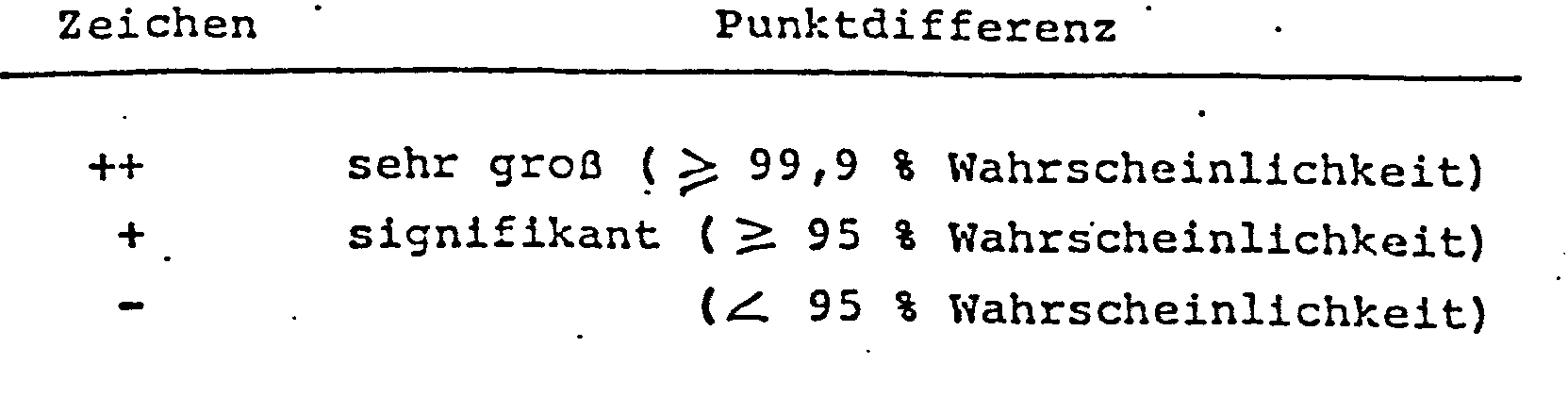
- Die Sebumreduktion errechnet sich aus der Punktedifferenz in der Weise, daß man den Quotienten aus der Punktedifferenz Δ P und der Punktezahl für die Kontrolgruppe Pk bildet und den erhaltenen Wert in % angibt.


- Nachfolgend werden für die erfindungsgemäßen topischen Mittel zur Behandlung von stark fettendem Haar und seborrhoischer Haut Rezepturen gegeben(in Gewichtsprozent)
-

-

-


-

Claims (8)


Priority Applications (1)
| Application Number | Priority Date | Filing Date | Title |
|---|---|---|---|
| AT86100132T ATE58468T1 (de) | 1985-01-14 | 1986-01-07 | Sebosuppressive kosmetische mittel, enthaltend benzoesaeureesterderivate, sowie neue benzoesaeureesterderivate. |
Applications Claiming Priority (2)
| Application Number | Priority Date | Filing Date | Title |
|---|---|---|---|
| DE19853500971 DE3500971A1 (de) | 1985-01-14 | 1985-01-14 | Sebosuppressive kosmetische mittel, enthaltend benzoesaeureesterderivate, sowie neue benzoesaeureesterderivate |
| DE3500971 | 1985-01-14 |
Publications (3)
| Publication Number | Publication Date |
|---|---|
| EP0191285A2 true EP0191285A2 (de) | 1986-08-20 |
| EP0191285A3 EP0191285A3 (en) | 1987-08-26 |
| EP0191285B1 EP0191285B1 (de) | 1990-11-22 |
Family
ID=6259775
Family Applications (1)
| Application Number | Title | Priority Date | Filing Date |
|---|---|---|---|
| EP86100132A Expired - Lifetime EP0191285B1 (de) | 1985-01-14 | 1986-01-07 | Sebosuppressive kosmetische Mittel, enthaltend Benzoesäureesterderivate, sowie neue Benzoesäureesterderivate |
Country Status (6)
| Country | Link |
|---|---|
| US (1) | US4684665A (de) |
| EP (1) | EP0191285B1 (de) |
| JP (1) | JPS61165352A (de) |
| AT (1) | ATE58468T1 (de) |
| DE (2) | DE3500971A1 (de) |
| ES (1) | ES8801541A1 (de) |
Cited By (2)
| Publication number | Priority date | Publication date | Assignee | Title |
|---|---|---|---|---|
| EP0315912A1 (de) * | 1987-11-12 | 1989-05-17 | Henkel Kommanditgesellschaft auf Aktien | Sebosuppressive Zubereitungen |
| WO1990004958A1 (de) * | 1988-11-09 | 1990-05-17 | Henkel Kommanditgesellschaft Auf Aktien | Entzündungshemmende wirkstoffe für kosmetische präparate |
Family Cites Families (7)
| Publication number | Priority date | Publication date | Assignee | Title |
|---|---|---|---|---|
| US2154598A (en) * | 1937-08-27 | 1939-04-18 | Dow Chemical Co | Ethers of the alkyl esters of hydroxy benzoic acids |
| CH568708A5 (de) * | 1969-04-30 | 1975-11-14 | Hoffmann La Roche | |
| US3716644A (en) * | 1971-07-15 | 1973-02-13 | American Cyanamid Co | Hypolipidemic agents |
| IL45396A0 (en) * | 1973-08-23 | 1974-11-29 | Beecham Group Ltd | Pharmaceutical compositions containing aryl aralkyl ether and thioether derivatives,certain such novel compounds and their preparation |
| DE3047106A1 (de) * | 1980-12-13 | 1982-07-29 | Henkel Kgaa | Topische kosmetische zubereitungen zur behandlung von stark fettendem haar und seborrhoeischer haut |
| DE3121064A1 (de) * | 1981-05-27 | 1982-12-16 | Henkel Kgaa | "arencarbonsaeure-derivate als antiseborrhoische zusaetze fuer kosmetische mittel" |
| DE3301313A1 (de) * | 1983-01-17 | 1984-07-19 | Henkel Kgaa | Sebosuppressive kosmetische mittel, enthaltend alkoxybenzoesaeureester, sowie neue alkoxybenzoesaeureester |
-
1985
- 1985-01-14 DE DE19853500971 patent/DE3500971A1/de not_active Withdrawn
-
1986
- 1986-01-07 AT AT86100132T patent/ATE58468T1/de not_active IP Right Cessation
- 1986-01-07 EP EP86100132A patent/EP0191285B1/de not_active Expired - Lifetime
- 1986-01-07 DE DE8686100132T patent/DE3675667D1/de not_active Expired - Fee Related
- 1986-01-10 US US06/818,648 patent/US4684665A/en not_active Expired - Fee Related
- 1986-01-10 JP JP61002342A patent/JPS61165352A/ja active Pending
- 1986-01-14 ES ES550844A patent/ES8801541A1/es not_active Expired
Cited By (3)
| Publication number | Priority date | Publication date | Assignee | Title |
|---|---|---|---|---|
| EP0315912A1 (de) * | 1987-11-12 | 1989-05-17 | Henkel Kommanditgesellschaft auf Aktien | Sebosuppressive Zubereitungen |
| WO1990004958A1 (de) * | 1988-11-09 | 1990-05-17 | Henkel Kommanditgesellschaft Auf Aktien | Entzündungshemmende wirkstoffe für kosmetische präparate |
| EP0370282A3 (de) * | 1988-11-09 | 1990-06-06 | Henkel Kommanditgesellschaft auf Aktien | Entzündungshemmende Wirkstoffe für kosmetische Präparate |
Also Published As
| Publication number | Publication date |
|---|---|
| ATE58468T1 (de) | 1990-12-15 |
| ES550844A0 (es) | 1988-02-01 |
| DE3675667D1 (de) | 1991-01-03 |
| DE3500971A1 (de) | 1986-07-17 |
| EP0191285A3 (en) | 1987-08-26 |
| JPS61165352A (ja) | 1986-07-26 |
| ES8801541A1 (es) | 1988-02-01 |
| EP0191285B1 (de) | 1990-11-22 |
| US4684665A (en) | 1987-08-04 |
Similar Documents
| Publication | Publication Date | Title |
|---|---|---|
| EP0098843B1 (de) | Mittel zur bekämpfung der seborrhoe des behaarten kopfes | |
| EP0071165B1 (de) | Ungesättigte Arylketone als antiseborrhoische Zusätze für kosmetische Mittel | |
| EP0315913B1 (de) | Sebosuppressive topische Zubereitungen | |
| DE2350315A1 (de) | Pharmazeutische und kosmetische praeparate zur aeusserlichen anwendung | |
| DE2102172C3 (de) | Neue Mittel zur Behandlung und Pflege der Haut | |
| EP0141143B1 (de) | Sebosuppressive kosmetische Mittel, enthaltend Benzylalkohol-Derivate | |
| DE3415413C2 (de) | ||
| EP0079913B1 (de) | Arencarbonsäure-derivate als antiseborrhoische zusätze für kosmetische mittel | |
| EP0114051B1 (de) | Verwendung von sebosuppressiven kosmetischen Mitteln, enthaltend Alkoxybenzoesäureester | |
| EP0238927B1 (de) | Sebosuppressive Zubereitungen | |
| EP0191286B1 (de) | Sebosuppressive kosmetische Mittel, enthaltend Alkoxy- oder Alkylbenzyloxy-benzoesäuren oder deren Salze | |
| EP0315912B1 (de) | Sebosuppressive Zubereitungen | |
| EP0191285B1 (de) | Sebosuppressive kosmetische Mittel, enthaltend Benzoesäureesterderivate, sowie neue Benzoesäureesterderivate | |
| EP0140033B1 (de) | Sebosuppressive kosmetische Mittel, enthaltend Alkoxyaryl-alkanole | |
| EP0101918A1 (de) | Verwendung von Aryloxobutensäure-Derivaten in kosmetischen Mitteln, sowie neue Aryloxobutensäurederivate | |
| DE3738407A1 (de) | Sebosuppressive topische zubereitungen | |
| DE3206197A1 (de) | Uracil-derivate als antiseborrhoische zusaetze fuer kosmetische mittel | |
| EP0079899B1 (de) | Topische kosmetische zubereitungen, enthaltend heteroarylmercapto-alkansäure-derivate als antiseborrhoische zusätze | |
| DE3133425A1 (de) | "percarbonsaeuren als antiseborrohische zusaetze fuer kosmetische mittel" | |
| WO1982004190A1 (fr) | Compositions cosmetiques a application topique dans le traitement de la seborrhee | |
| DE3825536A1 (de) | Verwendung von hydroperoxiden zur behandlung von akne und seborrhoe | |
| DE3228810A1 (de) | Sebosuppressive kosmetische mittel, enthaltend diarenoyldisulfide |
Legal Events
| Date | Code | Title | Description |
|---|---|---|---|
| PUAI | Public reference made under article 153(3) epc to a published international application that has entered the european phase |
Free format text: ORIGINAL CODE: 0009012 |
|
| AK | Designated contracting states |
Kind code of ref document: A2 Designated state(s): AT BE CH DE FR GB IT LI NL SE |
|
| PUAL | Search report despatched |
Free format text: ORIGINAL CODE: 0009013 |
|
| AK | Designated contracting states |
Kind code of ref document: A3 Designated state(s): AT BE CH DE FR GB IT LI NL SE |
|
| 17P | Request for examination filed |
Effective date: 19880205 |
|
| 17Q | First examination report despatched |
Effective date: 19890817 |
|
| GRAA | (expected) grant |
Free format text: ORIGINAL CODE: 0009210 |
|
| AK | Designated contracting states |
Kind code of ref document: B1 Designated state(s): AT BE CH DE FR GB IT LI NL SE |
|
| REF | Corresponds to: |
Ref document number: 58468 Country of ref document: AT Date of ref document: 19901215 Kind code of ref document: T |
|
| ET | Fr: translation filed | ||
| GBT | Gb: translation of ep patent filed (gb section 77(6)(a)/1977) | ||
| REF | Corresponds to: |
Ref document number: 3675667 Country of ref document: DE Date of ref document: 19910103 |
|
| ITTA | It: last paid annual fee | ||
| ITF | It: translation for a ep patent filed | ||
| PLBE | No opposition filed within time limit |
Free format text: ORIGINAL CODE: 0009261 |
|
| STAA | Information on the status of an ep patent application or granted ep patent |
Free format text: STATUS: NO OPPOSITION FILED WITHIN TIME LIMIT |
|
| 26N | No opposition filed | ||
| PGFP | Annual fee paid to national office [announced via postgrant information from national office to epo] |
Ref country code: CH Payment date: 19911218 Year of fee payment: 7 |
|
| PGFP | Annual fee paid to national office [announced via postgrant information from national office to epo] |
Ref country code: FR Payment date: 19911223 Year of fee payment: 7 Ref country code: DE Payment date: 19911223 Year of fee payment: 7 |
|
| PGFP | Annual fee paid to national office [announced via postgrant information from national office to epo] |
Ref country code: AT Payment date: 19911227 Year of fee payment: 7 |
|
| PGFP | Annual fee paid to national office [announced via postgrant information from national office to epo] |
Ref country code: GB Payment date: 19920103 Year of fee payment: 7 |
|
| PGFP | Annual fee paid to national office [announced via postgrant information from national office to epo] |
Ref country code: SE Payment date: 19920122 Year of fee payment: 7 |
|
| PGFP | Annual fee paid to national office [announced via postgrant information from national office to epo] |
Ref country code: NL Payment date: 19920131 Year of fee payment: 7 |
|
| PGFP | Annual fee paid to national office [announced via postgrant information from national office to epo] |
Ref country code: BE Payment date: 19920309 Year of fee payment: 7 |
|
| PG25 | Lapsed in a contracting state [announced via postgrant information from national office to epo] |
Ref country code: GB Effective date: 19930107 Ref country code: AT Effective date: 19930107 |
|
| PG25 | Lapsed in a contracting state [announced via postgrant information from national office to epo] |
Ref country code: SE Effective date: 19930108 |
|
| PG25 | Lapsed in a contracting state [announced via postgrant information from national office to epo] |
Ref country code: LI Effective date: 19930131 Ref country code: CH Effective date: 19930131 Ref country code: BE Effective date: 19930131 |
|
| BERE | Be: lapsed |
Owner name: HENKEL K.G.A.A. Effective date: 19930131 |
|
| PG25 | Lapsed in a contracting state [announced via postgrant information from national office to epo] |
Ref country code: NL Effective date: 19930801 |
|
| GBPC | Gb: european patent ceased through non-payment of renewal fee |
Effective date: 19930107 |
|
| NLV4 | Nl: lapsed or anulled due to non-payment of the annual fee | ||
| PG25 | Lapsed in a contracting state [announced via postgrant information from national office to epo] |
Ref country code: FR Effective date: 19930930 |
|
| REG | Reference to a national code |
Ref country code: CH Ref legal event code: PL |
|
| PG25 | Lapsed in a contracting state [announced via postgrant information from national office to epo] |
Ref country code: DE Effective date: 19931001 |
|
| REG | Reference to a national code |
Ref country code: FR Ref legal event code: ST |
|
| EUG | Se: european patent has lapsed |
Ref document number: 86100132.9 Effective date: 19930810 |
|
| PG25 | Lapsed in a contracting state [announced via postgrant information from national office to epo] |
Ref country code: IT Free format text: LAPSE BECAUSE OF NON-PAYMENT OF DUE FEES;WARNING: LAPSES OF ITALIAN PATENTS WITH EFFECTIVE DATE BEFORE 2007 MAY HAVE OCCURRED AT ANY TIME BEFORE 2007. THE CORRECT EFFECTIVE DATE MAY BE DIFFERENT FROM THE ONE RECORDED. Effective date: 20050107 |