EP0191475A2 - Verfahren zur Herstellung dünnschichtigen Materials - Google Patents
Verfahren zur Herstellung dünnschichtigen Materials Download PDFInfo
- Publication number
- EP0191475A2 EP0191475A2 EP86101773A EP86101773A EP0191475A2 EP 0191475 A2 EP0191475 A2 EP 0191475A2 EP 86101773 A EP86101773 A EP 86101773A EP 86101773 A EP86101773 A EP 86101773A EP 0191475 A2 EP0191475 A2 EP 0191475A2
- Authority
- EP
- European Patent Office
- Prior art keywords
- sheet
- orientation
- precursor body
- laminated
- manufacturing
- Prior art date
- Legal status (The legal status is an assumption and is not a legal conclusion. Google has not performed a legal analysis and makes no representation as to the accuracy of the status listed.)
- Withdrawn
Links
Images

Classifications
-
- B—PERFORMING OPERATIONS; TRANSPORTING
- B29—WORKING OF PLASTICS; WORKING OF SUBSTANCES IN A PLASTIC STATE IN GENERAL
- B29C—SHAPING OR JOINING OF PLASTICS; SHAPING OF MATERIAL IN A PLASTIC STATE, NOT OTHERWISE PROVIDED FOR; AFTER-TREATMENT OF THE SHAPED PRODUCTS, e.g. REPAIRING
- B29C70/00—Shaping composites, i.e. plastics material comprising reinforcements, fillers or preformed parts, e.g. inserts
- B29C70/04—Shaping composites, i.e. plastics material comprising reinforcements, fillers or preformed parts, e.g. inserts comprising reinforcements only, e.g. self-reinforcing plastics
- B29C70/28—Shaping operations therefor
- B29C70/54—Component parts, details or accessories; Auxiliary operations, e.g. feeding or storage of prepregs or SMC after impregnation or during ageing
- B29C70/545—Perforating, cutting or machining during or after moulding
-
- B—PERFORMING OPERATIONS; TRANSPORTING
- B29—WORKING OF PLASTICS; WORKING OF SUBSTANCES IN A PLASTIC STATE IN GENERAL
- B29C—SHAPING OR JOINING OF PLASTICS; SHAPING OF MATERIAL IN A PLASTIC STATE, NOT OTHERWISE PROVIDED FOR; AFTER-TREATMENT OF THE SHAPED PRODUCTS, e.g. REPAIRING
- B29C70/00—Shaping composites, i.e. plastics material comprising reinforcements, fillers or preformed parts, e.g. inserts
- B29C70/04—Shaping composites, i.e. plastics material comprising reinforcements, fillers or preformed parts, e.g. inserts comprising reinforcements only, e.g. self-reinforcing plastics
- B29C70/06—Fibrous reinforcements only
- B29C70/10—Fibrous reinforcements only characterised by the structure of fibrous reinforcements, e.g. hollow fibres
- B29C70/16—Fibrous reinforcements only characterised by the structure of fibrous reinforcements, e.g. hollow fibres using fibres of substantial or continuous length
- B29C70/20—Fibrous reinforcements only characterised by the structure of fibrous reinforcements, e.g. hollow fibres using fibres of substantial or continuous length oriented in a single direction, e.g. roofing or other parallel fibres
- B29C70/202—Fibrous reinforcements only characterised by the structure of fibrous reinforcements, e.g. hollow fibres using fibres of substantial or continuous length oriented in a single direction, e.g. roofing or other parallel fibres arranged in parallel planes or structures of fibres crossing at substantial angles, e.g. cross-moulding compound [XMC]
Definitions
- the present invention relates to a method of manufacturing a sheet material having a special fiber orientation used in manufacturing fiber-reinforced plastics (hereinafter abbreviated to "FRP").
- FRP fiber-reinforced plastics
- reinforcing fibers constituting the FRP be oriented along lines of force of stress applied to or generated in the FRP.
- curved-oriented sheet is abbreviated to "COS"
- uni-directionally oriented are suitably laminated, one on the other, as required.
- the inventors have studied a method of manufacturing new sheet materials, specifically, COS material, and have proposed a method of modifying filament windings (as disclosed in Japanese Unexamined Patent Publications Nos. 58-193117 and 58-211417).
- a limit to the amount of curved orientation obtainable with this method and often a desired curved orientation cannot be obtained.
- An object of the present invention is to provide a method of manufacturing a sheet material having substantially any desired curved orientation.
- a method is provided of manufacturing sheet materials, each having a curved orientation, comprising the steps of: preparing a sheet precursor body in which uni-directionally aligned reinforcing fibers are laminated and impregnated with matrix resin and which has at least a portion bent along the direction of orientation of the fibers; and slicing the sheet precursor body along a plane which includes all the laminated surfaces and which is parallel to the orientation of the reinforcing fibers.
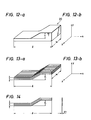
- the expression "at least a part of a sheet precursor body is bent along the orientation of reinforcing fiber” means that the sheet precursor body has at least one bent portion as shown in Figs. 2-1, 3-b-l, 13-a, etc.
- the present invention will be described in brief first as to a sheet-like material in which fibers have a corrugated orientation and another sheet-like material in which the fibers have a concentrical orientation.
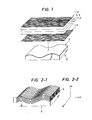
- Figs. 1 and 2 show a precursor body for obtaining a COS and illustrate a method of manufacturing the same.
- reference numerals 1-1 to 1-n represent thin sheet materials (UDS), in each of which fibers are linearly uni-directionally aligned and fixed with matrix resin.
- UDSs are laminated one on one in the direction of an arrow on a base 3 having a wavy surface 2 so as to obtain a laminated body 4, as shown in Fig. 2-1.
- the thickness t of the laminated body 4 is determined depending on the thickness of each of the UDSs and the number of the laminated UDSs. In the laminated body 4, as to the coordinates of Fig.
- the orientation of fibers projected an x-z plane extends linearly parallel with the x-axis, that projected on an y-z plane extends linearly parallel with the y-axis, and that projected on the x-y plane extends wavily in conformance with the wave surface (represented by 2 in Fig. 1).
- the x-direction agrees with the orientation of the fiber in each UDS and the y-direction agrees with the direction of lamination of the UDSs.
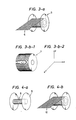
- Fig. 3-a shows a state in which a UDS 6 is wound onto a flanged bobbin 5 so as to obtain a laminated body 7 as shown in Fig. 3-b-1.
- the orientation of the fibers projected on each of the y-z and x-z planes extends linearly, and that projected on the x-y plane extends concentrically.
- the x-direction agrees with the orientation of the fibers in each UDS and the y-direction agrees with the direction of lamination of the UDSs.
- a laminated body As shown in each of the two examples described above, the orientation of fibers constituting the laminated body extends linearly within each of two of the three projecting planes.
- a laminated body is called a sheet precursor body (hereinafter simply referred to as "a precursor body"). Methods of manufacturing such a precursor body as defined above will be described further.
- fibers or strands 10 containing no matrix resin are wound, as shown in Fig. 4-b, onto a flanged bobbin 9 having a perforated core 8, as shown in Fig. 4-a.
- the wound fiber 10 may be obtained by winding fiber in the form of sheet spread over the whole width of the flanged bobbin 9, or, alternatively, by winding one or several strands while slightly traversing in the axial direction of the flanged bobbin 9 so as to fill the whole width of the flanged bobbin 9.
- the thus laminated fiber layers wound on the perforated core 8 are impregnated with matrix resin pressed out of the inside of the perforated core 8 to thereby obtain a precursor body 7 as shown in Fig. 3-b-l in which the fiber is fixed with the matrix resin.
- a strand or a group of strands may be wound onto the flanged bobbin while being impregnated with matrix resin.
- the traversing angle In the case where the strands are traversed in laminating, it is desirable to make the traversing angle to be as small as possible so as to make the strands substantially parallel to the x-axis, the angle being preferably limited within a range.of +5° to -5°.
- the two components constituting the precursor body used in the present invention that is, the fibers and the matrix resin, will be described hereunder.
- the fiber or the strands it is possible to use any organic fibers of an organic material such as puly(vinyl alcohol), nylon, polyester, aramid, or the like, and inorganic fibers of an inorganic material such as glass, carbon, alumina, or the like can be used.
- the kind of the fiber is not particularly limited, for example, boron fibers having a large diameter and high hardness are not preferable.
- thermosetting resin the resin in an unhardened state, that is, the resin in a B-stage state, may be used according to the present invention.
- the laminated body that is, the precursor body described above is desirably pressed during or after lamination to make the laminated body compact and homogeneous.
- the laminated body 4 is pressed in the y-direction, that is, in the direction of lamination (under the condition that the laminated body is restricted in the z-direction), and it is desirable to perform this operation so that the laminated body is pressed to make the laminated body compact and homogeneous in the following manner.
- the U D Ss used for making such a plane laminated body 4 as shown in Fig. 2-1 are generally extremely homogeneous in the longitudinal direction (the orientation direction of the fibers), but are not always homogeneous in the transverse direction (the direction perpendicular to the direction of orientation of the fibers).
- the thus obtained laminated body that is, the precursor body, as described in detail above, is then sliced to obtain sheet-like materials each having a curved orientation.
- the precursor body is sliced over all the laminated surfaces and along the plane parallel to the orientation of the fiber.
- a plane is defined to be a slicing plane.
- the single-dot line indicates such a slicing plane which is parallel to the x-y plane.
- such a slicing plane is slanted relative to the x-y plane and is employed in the case where the precursor body is a plane-like laminated body.
- the slicing plane parallel to or slanting to the x-y plane and extending in the orientation of fiber can be generally defined as a plane containing all the laminated surfaces and extending in the orientation direction of the fibers.
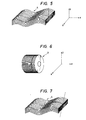
- Fig. 8 illustrates a method of slicing the precursor body 7 shown in Fig. 6.
- the precursor body 7 is a rotary body having a central axis 11 as the center of rotation.
- the precursor body 7 is rotated by a support core 12, and a knife 13 is moved along a slicing plane 14, as indicated by an arrow, to slice the precursor body 7 to a predetermined thickness.
- tool steel such as high speed steel, superhigh speed steel, or the like
- the slicing state depends on the material property of the matrix resin, the shape of the knife, the angle of the knife, the angle at which the knife is inserted in the slicing plane, and the like.
- Concentrically oriented thin sheet materials as shown in Fig. 9 can be obtained from the thus sliced precursor body 7.
- each of the outer and inner diameters D and d of the sheet material can be set to a desired value and the thickness t can be set to a value down to about 0.1 mm to perform stable slicing.
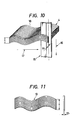
- Fig. 10 shows a method of slicing the precursor body 4 of Fig. 5, which is a non-rotary body, by means of a band knife 15.
- the band knife 15 moves in the direction of an arrow 16 (or reciprocates), while the precursor body 4 moves in the direction of an arrow 17, so that the precursor body is sliced along a slicing plane 18.
- the precursor body 4 is desirably embedded in a material having a good slicing property, representative examples of which include foam, hard polyurethane foam, and the like.
- thin sheet materials 19, as shown in Fig. ll, each having a width of t and a thickness of th and having corrugated fiber orientation, can be obtained.
- slicing similar to the case of slicing the rotary body, it has to be considered that the slicing conditions should be properly selected depending on the material properties of the fibers and the matrix resin constituting the precursor body.
- the laminated sheet precursor body 21 was heated and softened at 50°C for an hour and then pressed with a pressure of 70 kg/cm 2 in the z-direction to be made compact and homogeneous.
- the precursor body was embedded in hard polyurethane foam and sliced to a 0.2 mm thickness by (using a slicer for rubber) along a plane parallel to the x-y plane as shown in Fig. 13-b.
- the thickness of the thus obtained prepreg became 0.17 mm through the process of lamination and hardening.
- the resulting material was found suitable for use as an angled tone arm material for a record player.
- a flanged bobbin such represented by the reference numeral 5 in Fig. 3-a, was prepared, the bobbin being constituted by a nylon solid round bar having a 3iameter of 50 mm and a pair of iron flanges each having a diameter of 200 mm and attached at the opposite ends of the round bar with an interval of 30 mm, and a carbon uni-directional precursor body as described in Example 1 (having a thickness of 0.15 mm) was wound on the flanged bobbin so that the outer diameter of the winding along the orientation of fiber was 200 mm.
- a piece of uni-directional precursor body having a 30 mm width and a 1.5 m length was used so as to prevent irregularities in thickness of the uni-directional precursor from concentrating at specific portions of the winding.
- the laminated body was heated and softened at 50°C for three hours, and then was pressed at a pressure of 70 kg/cm 2 in the z-direction, as shown in Fig. 3-b-2, through iron flanges. By pressing, the outer diameter and thickness of the laminated body were reduced to 204 mm and 27 mm, respectively. The laminated body was then left to cool in the pressed state, and then sliced along the x-y plane with the z-axis as the rotary axis, as shown in Fig. 6. The method employed was the same as that shown in Fig. 8.
- the laminated body was sliced to a 0.1 mm thickness under that conditions that the relative speed between the precursor body 7 and the knife 13 was about 150 m/minute, the angle formed between the slicing surface 14 and the knife 13 was about 2 degrees and the cutting speed (the speed at which the knife 13 was moved in the direction of the arrow in Fig. 8) was 60 mm/minute.
- the thus obtained thin disc-like materials were desired moldings in which carbon fibers were oriented circumferentially.
- the length of 60% or more of the carbon fibers contained in this precursor body was from 20 to 30 mm, and hence a sufficient composite property was obtained.
- Such a precursor body having a circumferential fiber orientation is useful as a reinforcing material for a gear, a high speed rotary disc, etc.
- a perforated pipe in the form of a flanged bobbin as shown in Fig. 4-a in which a pair of iron flanges were provided at an interval of 30 mm on the opposite sides of the pipe (having a 50 mm diameter and small holes formed in the surface thereof) was prepared, and a glass fiber tow which had a diameter of 13 - 14 microns and from which a sizing material was removed was wound on the flanged bobbin at a traverse speed of 2 mm per rotation of the bobbin.
- the laminated body was put into a closed receptacle, the whole body was heated at 280°C, and then the receptacle was deaerated into a vacuum.
- nylon resin heated and melted at 280°C was pressed into the laminated body of glass fiber two from the inside of the perforated pipe so as to impregnate the glass resin layers with the nylon resin.
- the flanges were removed and the laminated body was attached to a lathe with the perforated pipe as a rotary shaft and sliced to a 0.2 mm thickness by a knife at a cutting speed of about 500 m/min.
Landscapes
- Engineering & Computer Science (AREA)
- Chemical & Material Sciences (AREA)
- Composite Materials (AREA)
- Mechanical Engineering (AREA)
- Textile Engineering (AREA)
- Reinforced Plastic Materials (AREA)
- Moulding By Coating Moulds (AREA)
Applications Claiming Priority (2)
| Application Number | Priority Date | Filing Date | Title |
|---|---|---|---|
| JP24605/85 | 1985-02-12 | ||
| JP2460585A JPS61182907A (ja) | 1985-02-12 | 1985-02-12 | プリプレグの製造方法 |
Publications (2)
| Publication Number | Publication Date |
|---|---|
| EP0191475A2 true EP0191475A2 (de) | 1986-08-20 |
| EP0191475A3 EP0191475A3 (de) | 1988-07-27 |
Family
ID=12142779
Family Applications (1)
| Application Number | Title | Priority Date | Filing Date |
|---|---|---|---|
| EP86101773A Withdrawn EP0191475A3 (de) | 1985-02-12 | 1986-02-12 | Verfahren zur Herstellung dünnschichtigen Materials |
Country Status (2)
| Country | Link |
|---|---|
| EP (1) | EP0191475A3 (de) |
| JP (1) | JPS61182907A (de) |
Cited By (6)
| Publication number | Priority date | Publication date | Assignee | Title |
|---|---|---|---|---|
| KR100565565B1 (ko) * | 2001-09-26 | 2006-03-30 | 힐만 그룹, 아이엔씨. | 키식별 시스템 |
| US7608070B2 (en) | 2004-09-30 | 2009-10-27 | Kimberly-Clark Worldwide, Inc. | Foam-based fasteners |
| US7640637B2 (en) | 2005-11-01 | 2010-01-05 | Kimberly-Clark Worldwide, Inc. | Methods to modify the fibrous landing layer of a foam based fastener and products made from the same |
| WO2014044560A1 (de) * | 2012-09-21 | 2014-03-27 | Rwth Aachen | Verfahren zur herstellung eines formteils und verwendung eines entsprechenden formteils |
| DE102015109855A1 (de) * | 2015-06-19 | 2016-12-22 | Airbus Operations Gmbh | Verfahren zur Herstellung von Bauteilen, insbesondere länglichen Profilen aus bandförmigen, vorimprägnierten Fasern (Prepreg) |
| CN111469728A (zh) * | 2020-05-13 | 2020-07-31 | 日本西禄株式会社 | 座位用的坐垫以及座位用坐垫的制造方法 |
Families Citing this family (1)
| Publication number | Priority date | Publication date | Assignee | Title |
|---|---|---|---|---|
| JP2009028229A (ja) * | 2007-07-26 | 2009-02-12 | Shikibo Ltd | クッション材 |
Family Cites Families (4)
| Publication number | Priority date | Publication date | Assignee | Title |
|---|---|---|---|---|
| US3566733A (en) * | 1963-02-12 | 1971-03-02 | Youngstown Sheet And Tube Co | Apparatus for forming multi-ply tape |
| US3736820A (en) * | 1971-12-22 | 1973-06-05 | Krauss & Reichert Maschf | Slicing machine for expanded plastics and similar materials |
| JPS55152052A (en) * | 1979-05-15 | 1980-11-27 | Hasegawa Kagaku Kogyo Kk | Frp reinforced thin board and its preparation |
| US4413860A (en) * | 1981-10-26 | 1983-11-08 | Great Lakes Carbon Corporation | Composite disc |
-
1985
- 1985-02-12 JP JP2460585A patent/JPS61182907A/ja active Granted
-
1986
- 1986-02-12 EP EP86101773A patent/EP0191475A3/de not_active Withdrawn
Cited By (6)
| Publication number | Priority date | Publication date | Assignee | Title |
|---|---|---|---|---|
| KR100565565B1 (ko) * | 2001-09-26 | 2006-03-30 | 힐만 그룹, 아이엔씨. | 키식별 시스템 |
| US7608070B2 (en) | 2004-09-30 | 2009-10-27 | Kimberly-Clark Worldwide, Inc. | Foam-based fasteners |
| US7640637B2 (en) | 2005-11-01 | 2010-01-05 | Kimberly-Clark Worldwide, Inc. | Methods to modify the fibrous landing layer of a foam based fastener and products made from the same |
| WO2014044560A1 (de) * | 2012-09-21 | 2014-03-27 | Rwth Aachen | Verfahren zur herstellung eines formteils und verwendung eines entsprechenden formteils |
| DE102015109855A1 (de) * | 2015-06-19 | 2016-12-22 | Airbus Operations Gmbh | Verfahren zur Herstellung von Bauteilen, insbesondere länglichen Profilen aus bandförmigen, vorimprägnierten Fasern (Prepreg) |
| CN111469728A (zh) * | 2020-05-13 | 2020-07-31 | 日本西禄株式会社 | 座位用的坐垫以及座位用坐垫的制造方法 |
Also Published As
| Publication number | Publication date |
|---|---|
| EP0191475A3 (de) | 1988-07-27 |
| JPH0327002B2 (de) | 1991-04-12 |
| JPS61182907A (ja) | 1986-08-15 |
Similar Documents
| Publication | Publication Date | Title |
|---|---|---|
| US4849150A (en) | Method of manufacturing fiber-reinforced resin pipe | |
| US4385952A (en) | Process for preparing fiber reinforced plastics | |
| CA1259018A (en) | Filamentary structural module for composites | |
| US3837985A (en) | Multi-directional reinforced composite and method of making the same | |
| US3115271A (en) | Method of constructing a reinforced resin, cone-shaped structure and product | |
| US4512836A (en) | Method of producing composite structural members | |
| EP0276169A2 (de) | Verfahren und Einrichtung zum Transversal-Wickeln von Bandmaterial | |
| CA1154042A (en) | Fiber-reinforced tubular spring | |
| GB2041152A (en) | Fibre/resin springs | |
| EP0191475A2 (de) | Verfahren zur Herstellung dünnschichtigen Materials | |
| CA1098329A (en) | Composite tubular element and methods for making same | |
| EP0495746B1 (de) | Verfahren zur Herstellung einer hundfussformigen Schicht aus Verbundwerkstoff und dafür gebrauchtes (benötigtes) Werkzeug | |
| EP0363227B1 (de) | Fadenaufwickelvorrichtung | |
| US5171620A (en) | Honeycomb core | |
| US4685241A (en) | Graphite fiber fishing rod | |
| US20250276511A1 (en) | Laminated sleeve with support layer of spliced structure and manufacturing method thereof | |
| JPH04122631A (ja) | 炭素繊維強化プラスチックの管状物及びその製造方法 | |
| EP0370147B1 (de) | Rohrförmiger Aufbau aus Verbundwerkstoff | |
| EP0531055A2 (de) | Schubrohr mit ausreichender Vibrationsreduzierung | |
| JPH0151586B2 (de) | ||
| US3997954A (en) | Low friction bearing prepared by winding onto a mandrel | |
| US20250369482A1 (en) | Manufacturing method of a composite material rolling bearing cage, rolling bearing cage and associated rolling bearing unit | |
| JPS62214943A (ja) | ステアリングホイ−ル芯材の製造方法 | |
| JP2024078444A (ja) | 回転電機保護リング、その製造方法、回転電機および電動モビリティ機器 | |
| WO2024116982A1 (ja) | 回転電機保護リング、その製造方法、回転電機および電動モビリティ機器 |
Legal Events
| Date | Code | Title | Description |
|---|---|---|---|
| PUAI | Public reference made under article 153(3) epc to a published international application that has entered the european phase |
Free format text: ORIGINAL CODE: 0009012 |
|
| 17P | Request for examination filed |
Effective date: 19860212 |
|
| AK | Designated contracting states |
Kind code of ref document: A2 Designated state(s): DE FR GB IT |
|
| PUAL | Search report despatched |
Free format text: ORIGINAL CODE: 0009013 |
|
| AK | Designated contracting states |
Kind code of ref document: A3 Designated state(s): DE FR GB IT |
|
| STAA | Information on the status of an ep patent application or granted ep patent |
Free format text: STATUS: THE APPLICATION HAS BEEN WITHDRAWN |
|
| 18W | Application withdrawn |
Withdrawal date: 19881128 |
|
| RIN1 | Information on inventor provided before grant (corrected) |
Inventor name: HIRANO, MASAMIMITSUBISHI RAYON CO. LTD. Inventor name: YOKOCHI, TADASHIMITSUBISHI RAYON CO. LTD. Inventor name: GOTOH, HAJIMEMITSUBISHI RAYON CO. LTD. |