EP0191706B1 - Lagerbeständige, wärmehärtbare Mischungen auf Basis von Prepolymeren mit Imidgruppen und Verfahren zu deren Herstellung - Google Patents
Lagerbeständige, wärmehärtbare Mischungen auf Basis von Prepolymeren mit Imidgruppen und Verfahren zu deren Herstellung Download PDFInfo
- Publication number
- EP0191706B1 EP0191706B1 EP86420030A EP86420030A EP0191706B1 EP 0191706 B1 EP0191706 B1 EP 0191706B1 EP 86420030 A EP86420030 A EP 86420030A EP 86420030 A EP86420030 A EP 86420030A EP 0191706 B1 EP0191706 B1 EP 0191706B1
- Authority
- EP
- European Patent Office
- Prior art keywords
- bismaleimide
- radical
- methyl
- phenylene
- compositions according
- Prior art date
- Legal status (The legal status is an assumption and is not a legal conclusion. Google has not performed a legal analysis and makes no representation as to the accuracy of the status listed.)
- Expired
Links
- 239000000203 mixture Substances 0.000 title claims description 56
- 238000000034 method Methods 0.000 title claims description 8
- 238000002360 preparation method Methods 0.000 title claims description 5
- 230000008569 process Effects 0.000 title claims description 5
- 125000005462 imide group Chemical group 0.000 title description 2
- -1 phenylene, 4-methyl-1,3-phenylene, 2-methyl-1 ,3-phenylene, 5-methyl-1,3-phenylene, 2,5-diethyl-3-methyl-1,4-phenylene radicals Chemical class 0.000 claims description 47
- RAXXELZNTBOGNW-UHFFFAOYSA-N imidazole Natural products C1=CNC=N1 RAXXELZNTBOGNW-UHFFFAOYSA-N 0.000 claims description 27
- 150000003961 organosilicon compounds Chemical class 0.000 claims description 22
- 150000003254 radicals Chemical class 0.000 claims description 22
- XQUPVDVFXZDTLT-UHFFFAOYSA-N 1-[4-[[4-(2,5-dioxopyrrol-1-yl)phenyl]methyl]phenyl]pyrrole-2,5-dione Chemical compound O=C1C=CC(=O)N1C(C=C1)=CC=C1CC1=CC=C(N2C(C=CC2=O)=O)C=C1 XQUPVDVFXZDTLT-UHFFFAOYSA-N 0.000 claims description 21
- 125000002887 hydroxy group Chemical group [H]O* 0.000 claims description 16
- 150000001875 compounds Chemical class 0.000 claims description 14
- 150000002460 imidazoles Chemical class 0.000 claims description 14
- 125000004432 carbon atom Chemical group C* 0.000 claims description 13
- KOMNUTZXSVSERR-UHFFFAOYSA-N 1,3,5-tris(prop-2-enyl)-1,3,5-triazinane-2,4,6-trione Chemical compound C=CCN1C(=O)N(CC=C)C(=O)N(CC=C)C1=O KOMNUTZXSVSERR-UHFFFAOYSA-N 0.000 claims description 12
- 229920005989 resin Polymers 0.000 claims description 12
- 239000011347 resin Substances 0.000 claims description 12
- 125000004435 hydrogen atom Chemical group [H]* 0.000 claims description 10
- 125000002496 methyl group Chemical group [H]C([H])([H])* 0.000 claims description 10
- 239000007983 Tris buffer Substances 0.000 claims description 8
- 229920001187 thermosetting polymer Polymers 0.000 claims description 8
- CIUQDSCDWFSTQR-UHFFFAOYSA-N [C]1=CC=CC=C1 Chemical compound [C]1=CC=CC=C1 CIUQDSCDWFSTQR-UHFFFAOYSA-N 0.000 claims description 7
- XUIMIQQOPSSXEZ-UHFFFAOYSA-N Silicon Chemical group [Si] XUIMIQQOPSSXEZ-UHFFFAOYSA-N 0.000 claims description 6
- 125000005439 maleimidyl group Chemical group C1(C=CC(N1*)=O)=O 0.000 claims description 6
- OYWRDHBGMCXGFY-UHFFFAOYSA-N 1,2,3-triazinane Chemical compound C1CNNNC1 OYWRDHBGMCXGFY-UHFFFAOYSA-N 0.000 claims description 5
- PEEHTFAAVSWFBL-UHFFFAOYSA-N Maleimide Chemical compound O=C1NC(=O)C=C1 PEEHTFAAVSWFBL-UHFFFAOYSA-N 0.000 claims description 5
- 125000000217 alkyl group Chemical group 0.000 claims description 5
- ZAMOUSCENKQFHK-UHFFFAOYSA-N Chlorine atom Chemical compound [Cl] ZAMOUSCENKQFHK-UHFFFAOYSA-N 0.000 claims description 4
- 239000003085 diluting agent Substances 0.000 claims description 4
- QUPDWYMUPZLYJZ-UHFFFAOYSA-N ethyl Chemical compound C[CH2] QUPDWYMUPZLYJZ-UHFFFAOYSA-N 0.000 claims description 4
- 125000001997 phenyl group Chemical group [H]C1=C([H])C([H])=C(*)C([H])=C1[H] 0.000 claims description 4
- 229910052710 silicon Inorganic materials 0.000 claims description 4
- HNUALPPJLMYHDK-UHFFFAOYSA-N C[CH]C Chemical compound C[CH]C HNUALPPJLMYHDK-UHFFFAOYSA-N 0.000 claims description 3
- OLLFKUHHDPMQFR-UHFFFAOYSA-N dihydroxy(diphenyl)silane Chemical compound C=1C=CC=CC=1[Si](O)(O)C1=CC=CC=C1 OLLFKUHHDPMQFR-UHFFFAOYSA-N 0.000 claims description 3
- 125000001495 ethyl group Chemical group [H]C([H])([H])C([H])([H])* 0.000 claims description 3
- 238000002844 melting Methods 0.000 claims description 3
- GIWQSPITLQVMSG-UHFFFAOYSA-N 1,2-dimethylimidazole Chemical compound CC1=NC=CN1C GIWQSPITLQVMSG-UHFFFAOYSA-N 0.000 claims description 2
- BDHGFCVQWMDIQX-UHFFFAOYSA-N 1-ethenyl-2-methylimidazole Chemical compound CC1=NC=CN1C=C BDHGFCVQWMDIQX-UHFFFAOYSA-N 0.000 claims description 2
- OSSNTDFYBPYIEC-UHFFFAOYSA-N 1-ethenylimidazole Chemical compound C=CN1C=CN=C1 OSSNTDFYBPYIEC-UHFFFAOYSA-N 0.000 claims description 2
- MCTWTZJPVLRJOU-UHFFFAOYSA-N 1-methyl-1H-imidazole Chemical compound CN1C=CN=C1 MCTWTZJPVLRJOU-UHFFFAOYSA-N 0.000 claims description 2
- HYZJCKYKOHLVJF-UHFFFAOYSA-N 1H-benzimidazole Chemical compound C1=CC=C2NC=NC2=C1 HYZJCKYKOHLVJF-UHFFFAOYSA-N 0.000 claims description 2
- LXBGSDVWAMZHDD-UHFFFAOYSA-N 2-methyl-1h-imidazole Chemical compound CC1=NC=CN1 LXBGSDVWAMZHDD-UHFFFAOYSA-N 0.000 claims description 2
- 125000002915 carbonyl group Chemical group [*:2]C([*:1])=O 0.000 claims description 2
- PFKFTWBEEFSNDU-UHFFFAOYSA-N carbonyldiimidazole Chemical compound C1=CN=CN1C(=O)N1C=CN=C1 PFKFTWBEEFSNDU-UHFFFAOYSA-N 0.000 claims description 2
- 239000000460 chlorine Substances 0.000 claims description 2
- 229910052801 chlorine Inorganic materials 0.000 claims description 2
- 125000001309 chloro group Chemical group Cl* 0.000 claims description 2
- 125000001153 fluoro group Chemical group F* 0.000 claims description 2
- 238000000265 homogenisation Methods 0.000 claims description 2
- 239000011872 intimate mixture Substances 0.000 claims description 2
- 230000008018 melting Effects 0.000 claims description 2
- 125000000449 nitro group Chemical group [O-][N+](*)=O 0.000 claims description 2
- 238000003756 stirring Methods 0.000 claims description 2
- ORGHESHFQPYLAO-UHFFFAOYSA-N vinyl radical Chemical compound C=[CH] ORGHESHFQPYLAO-UHFFFAOYSA-N 0.000 claims description 2
- 229920003192 poly(bis maleimide) Polymers 0.000 claims 12
- LNAIBNHJQKDBNR-UHFFFAOYSA-N 1-[3-(2,5-dioxopyrrol-1-yl)-2-methylphenyl]pyrrole-2,5-dione Chemical compound CC1=C(N2C(C=CC2=O)=O)C=CC=C1N1C(=O)C=CC1=O LNAIBNHJQKDBNR-UHFFFAOYSA-N 0.000 claims 1
- FJKKJQRXSPFNPM-UHFFFAOYSA-N 1-[3-(2,5-dioxopyrrol-1-yl)-4-methylphenyl]pyrrole-2,5-dione Chemical compound CC1=CC=C(N2C(C=CC2=O)=O)C=C1N1C(=O)C=CC1=O FJKKJQRXSPFNPM-UHFFFAOYSA-N 0.000 claims 1
- 125000004956 cyclohexylene group Chemical group 0.000 claims 1
- 238000007872 degassing Methods 0.000 claims 1
- 125000002883 imidazolyl group Chemical group 0.000 claims 1
- 238000002156 mixing Methods 0.000 claims 1
- 125000004429 atom Chemical group 0.000 description 9
- 238000012360 testing method Methods 0.000 description 8
- 238000006243 chemical reaction Methods 0.000 description 7
- 239000003921 oil Substances 0.000 description 7
- USIUVYZYUHIAEV-UHFFFAOYSA-N diphenyl ether Chemical compound C=1C=CC=CC=1OC1=CC=CC=C1 USIUVYZYUHIAEV-UHFFFAOYSA-N 0.000 description 6
- 238000006384 oligomerization reaction Methods 0.000 description 5
- 239000002671 adjuvant Substances 0.000 description 4
- 150000002148 esters Chemical class 0.000 description 4
- 239000000835 fiber Substances 0.000 description 4
- 238000004519 manufacturing process Methods 0.000 description 4
- 230000000750 progressive effect Effects 0.000 description 4
- 238000003860 storage Methods 0.000 description 4
- 239000000758 substrate Substances 0.000 description 4
- 238000012546 transfer Methods 0.000 description 4
- BQTPKSBXMONSJI-UHFFFAOYSA-N 1-cyclohexylpyrrole-2,5-dione Chemical compound O=C1C=CC(=O)N1C1CCCCC1 BQTPKSBXMONSJI-UHFFFAOYSA-N 0.000 description 3
- UHOVQNZJYSORNB-UHFFFAOYSA-N Benzene Chemical compound C1=CC=CC=C1 UHOVQNZJYSORNB-UHFFFAOYSA-N 0.000 description 3
- OKTJSMMVPCPJKN-UHFFFAOYSA-N Carbon Chemical compound [C] OKTJSMMVPCPJKN-UHFFFAOYSA-N 0.000 description 3
- 238000005452 bending Methods 0.000 description 3
- 229910052799 carbon Inorganic materials 0.000 description 3
- 238000000576 coating method Methods 0.000 description 3
- 230000000052 comparative effect Effects 0.000 description 3
- 239000000470 constituent Substances 0.000 description 3
- 239000011521 glass Substances 0.000 description 3
- 125000002768 hydroxyalkyl group Chemical group 0.000 description 3
- 238000005470 impregnation Methods 0.000 description 3
- 239000000047 product Substances 0.000 description 3
- XLYOFNOQVPJJNP-UHFFFAOYSA-N water Substances O XLYOFNOQVPJJNP-UHFFFAOYSA-N 0.000 description 3
- GAWIXWVDTYZWAW-UHFFFAOYSA-N C[CH]O Chemical group C[CH]O GAWIXWVDTYZWAW-UHFFFAOYSA-N 0.000 description 2
- ATUOYWHBWRKTHZ-UHFFFAOYSA-N Propane Chemical compound CCC ATUOYWHBWRKTHZ-UHFFFAOYSA-N 0.000 description 2
- 239000003054 catalyst Substances 0.000 description 2
- 239000003795 chemical substances by application Substances 0.000 description 2
- 239000011248 coating agent Substances 0.000 description 2
- 239000002131 composite material Substances 0.000 description 2
- KZTYYGOKRVBIMI-UHFFFAOYSA-N diphenyl sulfone Chemical compound C=1C=CC=CC=1S(=O)(=O)C1=CC=CC=C1 KZTYYGOKRVBIMI-UHFFFAOYSA-N 0.000 description 2
- CZZYITDELCSZES-UHFFFAOYSA-N diphenylmethane Chemical compound C=1C=CC=CC=1CC1=CC=CC=C1 CZZYITDELCSZES-UHFFFAOYSA-N 0.000 description 2
- 239000010408 film Substances 0.000 description 2
- 238000010304 firing Methods 0.000 description 2
- 150000003949 imides Chemical class 0.000 description 2
- 239000000463 material Substances 0.000 description 2
- 238000005259 measurement Methods 0.000 description 2
- 125000000843 phenylene group Chemical group C1(=C(C=CC=C1)*)* 0.000 description 2
- 229920001296 polysiloxane Polymers 0.000 description 2
- KCIKCCHXZMLVDE-UHFFFAOYSA-N silanediol Chemical compound O[SiH2]O KCIKCCHXZMLVDE-UHFFFAOYSA-N 0.000 description 2
- JHPBZFOKBAGZBL-UHFFFAOYSA-N (3-hydroxy-2,2,4-trimethylpentyl) 2-methylprop-2-enoate Chemical compound CC(C)C(O)C(C)(C)COC(=O)C(C)=C JHPBZFOKBAGZBL-UHFFFAOYSA-N 0.000 description 1
- KPNYFXUDBVQRNK-UHFFFAOYSA-N 1-(4-anilinophenyl)pyrrole-2,5-dione Chemical compound O=C1C=CC(=O)N1C(C=C1)=CC=C1NC1=CC=CC=C1 KPNYFXUDBVQRNK-UHFFFAOYSA-N 0.000 description 1
- KCFXNGDHQPMIAQ-UHFFFAOYSA-N 1-(4-methylphenyl)pyrrole-2,5-dione Chemical compound C1=CC(C)=CC=C1N1C(=O)C=CC1=O KCFXNGDHQPMIAQ-UHFFFAOYSA-N 0.000 description 1
- CVKDEEISKBRPEQ-UHFFFAOYSA-N 1-(4-nitrophenyl)pyrrole-2,5-dione Chemical compound C1=CC([N+](=O)[O-])=CC=C1N1C(=O)C=CC1=O CVKDEEISKBRPEQ-UHFFFAOYSA-N 0.000 description 1
- MKRBAPNEJMFMHU-UHFFFAOYSA-N 1-benzylpyrrole-2,5-dione Chemical compound O=C1C=CC(=O)N1CC1=CC=CC=C1 MKRBAPNEJMFMHU-UHFFFAOYSA-N 0.000 description 1
- HIDBROSJWZYGSZ-UHFFFAOYSA-N 1-phenylpyrrole-2,5-dione Chemical compound O=C1C=CC(=O)N1C1=CC=CC=C1 HIDBROSJWZYGSZ-UHFFFAOYSA-N 0.000 description 1
- 150000003923 2,5-pyrrolediones Chemical class 0.000 description 1
- MILSYCKGLDDVLM-UHFFFAOYSA-N 2-phenylpropan-2-ylbenzene Chemical compound C=1C=CC=CC=1C(C)(C)C1=CC=CC=C1 MILSYCKGLDDVLM-UHFFFAOYSA-N 0.000 description 1
- VXPSQDAMFATNNG-UHFFFAOYSA-N 3-[2-(2,5-dioxopyrrol-3-yl)phenyl]pyrrole-2,5-dione Chemical compound O=C1NC(=O)C(C=2C(=CC=CC=2)C=2C(NC(=O)C=2)=O)=C1 VXPSQDAMFATNNG-UHFFFAOYSA-N 0.000 description 1
- 241000238876 Acari Species 0.000 description 1
- 239000005995 Aluminium silicate Substances 0.000 description 1
- ZOXJGFHDIHLPTG-UHFFFAOYSA-N Boron Chemical compound [B] ZOXJGFHDIHLPTG-UHFFFAOYSA-N 0.000 description 1
- 239000004952 Polyamide Substances 0.000 description 1
- 239000004642 Polyimide Substances 0.000 description 1
- NIXOWILDQLNWCW-UHFFFAOYSA-N acrylic acid group Chemical group C(C=C)(=O)O NIXOWILDQLNWCW-UHFFFAOYSA-N 0.000 description 1
- 239000000853 adhesive Substances 0.000 description 1
- 230000001070 adhesive effect Effects 0.000 description 1
- 235000012211 aluminium silicate Nutrition 0.000 description 1
- 239000004760 aramid Substances 0.000 description 1
- 229920003235 aromatic polyamide Polymers 0.000 description 1
- 229910052796 boron Inorganic materials 0.000 description 1
- 239000006227 byproduct Substances 0.000 description 1
- 150000004649 carbonic acid derivatives Chemical class 0.000 description 1
- 230000015556 catabolic process Effects 0.000 description 1
- 230000003197 catalytic effect Effects 0.000 description 1
- 230000008859 change Effects 0.000 description 1
- 230000001143 conditioned effect Effects 0.000 description 1
- 238000007796 conventional method Methods 0.000 description 1
- 238000001816 cooling Methods 0.000 description 1
- 238000004132 cross linking Methods 0.000 description 1
- 238000002425 crystallisation Methods 0.000 description 1
- 230000008025 crystallization Effects 0.000 description 1
- FNIATMYXUPOJRW-UHFFFAOYSA-N cyclohexylidene Chemical group [C]1CCCCC1 FNIATMYXUPOJRW-UHFFFAOYSA-N 0.000 description 1
- 238000006731 degradation reaction Methods 0.000 description 1
- 238000000151 deposition Methods 0.000 description 1
- 238000013461 design Methods 0.000 description 1
- GAUACDVEQCYBCK-UHFFFAOYSA-N diethoxy(diphenyl)silane;2-methylprop-2-enoic acid Chemical compound CC(=C)C(O)=O.CC(=C)C(O)=O.C=1C=CC=CC=1[Si](OCC)(OCC)C1=CC=CC=C1 GAUACDVEQCYBCK-UHFFFAOYSA-N 0.000 description 1
- 239000006185 dispersion Substances 0.000 description 1
- 239000000975 dye Substances 0.000 description 1
- 238000005538 encapsulation Methods 0.000 description 1
- 238000005516 engineering process Methods 0.000 description 1
- 239000004744 fabric Substances 0.000 description 1
- 239000002657 fibrous material Substances 0.000 description 1
- 238000009730 filament winding Methods 0.000 description 1
- 239000000945 filler Substances 0.000 description 1
- 239000012530 fluid Substances 0.000 description 1
- 239000003292 glue Substances 0.000 description 1
- 238000007654 immersion Methods 0.000 description 1
- 230000006872 improvement Effects 0.000 description 1
- 239000003112 inhibitor Substances 0.000 description 1
- 238000001746 injection moulding Methods 0.000 description 1
- 229940079865 intestinal antiinfectives imidazole derivative Drugs 0.000 description 1
- NLYAJNPCOHFWQQ-UHFFFAOYSA-N kaolin Chemical compound O.O.O=[Al]O[Si](=O)O[Si](=O)O[Al]=O NLYAJNPCOHFWQQ-UHFFFAOYSA-N 0.000 description 1
- 238000003475 lamination Methods 0.000 description 1
- 239000000314 lubricant Substances 0.000 description 1
- 239000010445 mica Substances 0.000 description 1
- 229910052618 mica group Inorganic materials 0.000 description 1
- 239000011325 microbead Substances 0.000 description 1
- 238000000465 moulding Methods 0.000 description 1
- 239000000049 pigment Substances 0.000 description 1
- 238000007747 plating Methods 0.000 description 1
- 229920002647 polyamide Polymers 0.000 description 1
- 229920001721 polyimide Polymers 0.000 description 1
- 229920000642 polymer Polymers 0.000 description 1
- 238000006116 polymerization reaction Methods 0.000 description 1
- 239000000843 powder Substances 0.000 description 1
- 230000002028 premature Effects 0.000 description 1
- 239000001294 propane Substances 0.000 description 1
- 239000010453 quartz Substances 0.000 description 1
- 239000000376 reactant Substances 0.000 description 1
- 239000012429 reaction media Substances 0.000 description 1
- 239000011208 reinforced composite material Substances 0.000 description 1
- 230000002787 reinforcement Effects 0.000 description 1
- 239000012779 reinforcing material Substances 0.000 description 1
- 150000004756 silanes Chemical class 0.000 description 1
- 150000004760 silicates Chemical class 0.000 description 1
- 239000010703 silicon Substances 0.000 description 1
- VYPSYNLAJGMNEJ-UHFFFAOYSA-N silicon dioxide Inorganic materials O=[Si]=O VYPSYNLAJGMNEJ-UHFFFAOYSA-N 0.000 description 1
- 125000005373 siloxane group Chemical group [SiH2](O*)* 0.000 description 1
- 239000000243 solution Substances 0.000 description 1
- 239000002904 solvent Substances 0.000 description 1
- 239000003381 stabilizer Substances 0.000 description 1
- 229910001220 stainless steel Inorganic materials 0.000 description 1
- 239000010935 stainless steel Substances 0.000 description 1
- 239000012258 stirred mixture Substances 0.000 description 1
- 239000000126 substance Substances 0.000 description 1
- 239000010409 thin film Substances 0.000 description 1
- 238000013519 translation Methods 0.000 description 1
- WFKWXMTUELFFGS-UHFFFAOYSA-N tungsten Chemical compound [W] WFKWXMTUELFFGS-UHFFFAOYSA-N 0.000 description 1
- 229910052721 tungsten Inorganic materials 0.000 description 1
- 239000010937 tungsten Substances 0.000 description 1
- 239000003039 volatile agent Substances 0.000 description 1
Classifications
-
- C—CHEMISTRY; METALLURGY
- C08—ORGANIC MACROMOLECULAR COMPOUNDS; THEIR PREPARATION OR CHEMICAL WORKING-UP; COMPOSITIONS BASED THEREON
- C08G—MACROMOLECULAR COMPOUNDS OBTAINED OTHERWISE THAN BY REACTIONS ONLY INVOLVING UNSATURATED CARBON-TO-CARBON BONDS
- C08G73/00—Macromolecular compounds obtained by reactions forming a linkage containing nitrogen with or without oxygen or carbon in the main chain of the macromolecule, not provided for in groups C08G12/00 - C08G71/00
- C08G73/06—Polycondensates having nitrogen-containing heterocyclic rings in the main chain of the macromolecule
- C08G73/10—Polyimides; Polyester-imides; Polyamide-imides; Polyamide acids or similar polyimide precursors
- C08G73/12—Unsaturated polyimide precursors
-
- C—CHEMISTRY; METALLURGY
- C08—ORGANIC MACROMOLECULAR COMPOUNDS; THEIR PREPARATION OR CHEMICAL WORKING-UP; COMPOSITIONS BASED THEREON
- C08G—MACROMOLECULAR COMPOUNDS OBTAINED OTHERWISE THAN BY REACTIONS ONLY INVOLVING UNSATURATED CARBON-TO-CARBON BONDS
- C08G73/00—Macromolecular compounds obtained by reactions forming a linkage containing nitrogen with or without oxygen or carbon in the main chain of the macromolecule, not provided for in groups C08G12/00 - C08G71/00
- C08G73/06—Polycondensates having nitrogen-containing heterocyclic rings in the main chain of the macromolecule
- C08G73/10—Polyimides; Polyester-imides; Polyamide-imides; Polyamide acids or similar polyimide precursors
- C08G73/12—Unsaturated polyimide precursors
- C08G73/125—Unsaturated polyimide precursors the unsaturated precursors containing atoms other than carbon, hydrogen, oxygen or nitrogen in the main chain
-
- C—CHEMISTRY; METALLURGY
- C08—ORGANIC MACROMOLECULAR COMPOUNDS; THEIR PREPARATION OR CHEMICAL WORKING-UP; COMPOSITIONS BASED THEREON
- C08G—MACROMOLECULAR COMPOUNDS OBTAINED OTHERWISE THAN BY REACTIONS ONLY INVOLVING UNSATURATED CARBON-TO-CARBON BONDS
- C08G73/00—Macromolecular compounds obtained by reactions forming a linkage containing nitrogen with or without oxygen or carbon in the main chain of the macromolecule, not provided for in groups C08G12/00 - C08G71/00
- C08G73/06—Polycondensates having nitrogen-containing heterocyclic rings in the main chain of the macromolecule
- C08G73/10—Polyimides; Polyester-imides; Polyamide-imides; Polyamide acids or similar polyimide precursors
- C08G73/12—Unsaturated polyimide precursors
- C08G73/126—Unsaturated polyimide precursors the unsaturated precursors being wholly aromatic
-
- C—CHEMISTRY; METALLURGY
- C08—ORGANIC MACROMOLECULAR COMPOUNDS; THEIR PREPARATION OR CHEMICAL WORKING-UP; COMPOSITIONS BASED THEREON
- C08G—MACROMOLECULAR COMPOUNDS OBTAINED OTHERWISE THAN BY REACTIONS ONLY INVOLVING UNSATURATED CARBON-TO-CARBON BONDS
- C08G73/00—Macromolecular compounds obtained by reactions forming a linkage containing nitrogen with or without oxygen or carbon in the main chain of the macromolecule, not provided for in groups C08G12/00 - C08G71/00
- C08G73/06—Polycondensates having nitrogen-containing heterocyclic rings in the main chain of the macromolecule
- C08G73/10—Polyimides; Polyester-imides; Polyamide-imides; Polyamide acids or similar polyimide precursors
- C08G73/12—Unsaturated polyimide precursors
- C08G73/126—Unsaturated polyimide precursors the unsaturated precursors being wholly aromatic
- C08G73/127—Unsaturated polyimide precursors the unsaturated precursors being wholly aromatic containing oxygen in the form of ether bonds in the main chain
-
- Y—GENERAL TAGGING OF NEW TECHNOLOGICAL DEVELOPMENTS; GENERAL TAGGING OF CROSS-SECTIONAL TECHNOLOGIES SPANNING OVER SEVERAL SECTIONS OF THE IPC; TECHNICAL SUBJECTS COVERED BY FORMER USPC CROSS-REFERENCE ART COLLECTIONS [XRACs] AND DIGESTS
- Y10—TECHNICAL SUBJECTS COVERED BY FORMER USPC
- Y10T—TECHNICAL SUBJECTS COVERED BY FORMER US CLASSIFICATION
- Y10T428/00—Stock material or miscellaneous articles
- Y10T428/31504—Composite [nonstructural laminate]
- Y10T428/31547—Of polyisocyanurate
-
- Y—GENERAL TAGGING OF NEW TECHNOLOGICAL DEVELOPMENTS; GENERAL TAGGING OF CROSS-SECTIONAL TECHNOLOGIES SPANNING OVER SEVERAL SECTIONS OF THE IPC; TECHNICAL SUBJECTS COVERED BY FORMER USPC CROSS-REFERENCE ART COLLECTIONS [XRACs] AND DIGESTS
- Y10—TECHNICAL SUBJECTS COVERED BY FORMER USPC
- Y10T—TECHNICAL SUBJECTS COVERED BY FORMER US CLASSIFICATION
- Y10T428/00—Stock material or miscellaneous articles
- Y10T428/31504—Composite [nonstructural laminate]
- Y10T428/31652—Of asbestos
- Y10T428/31663—As siloxane, silicone or silane
-
- Y—GENERAL TAGGING OF NEW TECHNOLOGICAL DEVELOPMENTS; GENERAL TAGGING OF CROSS-SECTIONAL TECHNOLOGIES SPANNING OVER SEVERAL SECTIONS OF THE IPC; TECHNICAL SUBJECTS COVERED BY FORMER USPC CROSS-REFERENCE ART COLLECTIONS [XRACs] AND DIGESTS
- Y10—TECHNICAL SUBJECTS COVERED BY FORMER USPC
- Y10T—TECHNICAL SUBJECTS COVERED BY FORMER US CLASSIFICATION
- Y10T428/00—Stock material or miscellaneous articles
- Y10T428/31504—Composite [nonstructural laminate]
- Y10T428/31721—Of polyimide
Definitions
- the subject of the present invention is curable compositions based on prepolymers with imide and siloxane groups and various adjuvants making it possible to obtain compositions which are stable on storage, film-forming at temperatures between 40 and 90 ° C, sticky at room temperature and flexible. .
- thermosetting compositions described from bis-maleimides and hydroxylated silanes have been described. These compositions do not have sufficient flexibility properties for some of the applications envisaged. In addition, in a thin layer, they do not have any tack.
- compositions which are stable on film-forming storage at temperatures between 40 and 90 have been described. ° C and preferably between 60 and 80 ° C, sticky at room temperature and flexible.
- composition stable on storage is meant in the present text a composition which remains homogeneous (absence of crystallization of a constituent) and which does not change over time.
- film-forming composition means a composition which is fluid between 40 and 90 ° C. and which may be deposited by coating or other conventional method of depositing on a fabric or a nonwoven, a fiber mat, a transfer paper, the fibers constituting these different supports being continuously covered, either directly or after transfer.
- adhesive composition at room temperature means a composition which deposited on the substrate and brought to room temperature allows this substrate to be positioned by simple pressure and to keep in contact in any position.
- flexible composition is meant a composition which deposited on the substrate does not increase the rigidity of said substrate, allowing the latter to match the shapes of the parts to be obtained which can be, for example, parts of revolution comprising convex and concave parts and having roundings and / or edges.
- the number of maleimide functions provided by the mono-maleimide does not represent more than 30% of the number of maleimide functions involved in the reaction.
- N-phenylmaleimide N-cyclohexylmaleimide, N-phenylmethyl-maleimide, N- (4-methylphenyl) maleimide, N- (4-nitro-phenyl) maleimide, N-phenoxy-4 phenyl) maleimide, N- (4-phenylamino-phenyl) maleimide, the - (phenoxycarbonil-4 phenyl) maleimide, maleimido-1 acetoxysuccinimido-4 benzene, maleimido -1 acetoxysuccinimido-4 'diphenylmethane, maleimido-4 acetoxysuccinimido-4'diphenyl ether, maleimido-4-acetamido-4' diphenyl ether, maleimido-4 acetamido-4 'diphenylmethane, N- (
- y is in reality always an integer, but since these are compounds with a polymeric structure (when y is greater than 1), there is rarely a single compound , but most often a mixture of compounds with the same chemical structure, which differ in the number of recurring units of their molecule; this leads to an average value of y, which can be whole or fractional.
- the hydroxylated organosilicon compounds of the aforementioned type can be characterized by the ratio of the weight of the hydroxyl groups which they possess to the total weight of their molecule.
- the organosilicon compounds which are preferably used to carry out the present invention, are the abovementioned compounds for which the weight ratio of the hydroxyl groups in the molecule is at least equal to 0.05% and preferably to 0.1%.
- the particularly suitable hydroxylated organosilicon compounds can also be mixtures of two or more of the abovementioned compounds.
- commercially available hydroxylated polysiloxane oils or resins can be used for convenience. These are in particular polymethylpolysiloxane- a, ⁇ dihydroxylated oils having from 0.2 to 0.3% by weight of hydroxyl group (Rhône-Poulenc oil 48 V 500), or 10 to 12% by weight of hydroxyl groups (oil from Rhône-Poulenc 48 V 50) or methylphenylpolysiloxane oils or resins- a, co dihydroxylated having 4.5% to 5% by weight of hydroxyl groups (oil 50606 from Rhône-Poulenc) or from 7.5 to 8.5% by weight of hydroxyl groups (resin 50305 from Rhône-Poulenc); these commercial oils or resins are given by way of example, but there are others which may be just as suitable.
- the quantities of reactants are chosen so as to have a weight ratio: between 10% and 40%.
- Another way of defining the relative proportions of bis-imide and of hydroxylated organosilicon compound consists in indicating the ratio between the number of hydroxyl functions of the organosilicon compound and the number of imide groups of the bis-imide. This ratio is preferably between 0.01 and 2.
- the acrylic ester of formula (4) is an acrylic or methacrylic ester which may or may not be substituted on the acrylic radical by a methyl or ethyl radical.
- Diphenyldiethoxysilane dimethacrylate is preferred. This ester will be used at a rate of between 8 and 20% by weight relative to the total composition.
- the triallylisocyanate will also be used at a rate of between 8 and 20% by weight relative to the total composition.
- the imidazole C derivative corresponds to the general formula (6): in which R 7 , R 8 , R 9 and R 10 , identical or different, represent: a hydrogen atom, an alkyl or alkoxy radical having from 1 to 20 atoms carbon, a vinyl radical, a phenyl radical, a nitro group, R 9 can form with R 10 and the carbon atoms to which these radicals are linked a single ring such as for example a benzene ring, R 7 can also represent a linked carbonyl group to a 2nd imidazole cycle.
- imidazole derivatives mention may be made, in particular, of imidazole or glyoxaline, 1-methylimidazole, 2-methylimidazole, 1,2-dimethylimidazole, 1-vinylimidazole, 1-vinyl 2-methylimidazole, benzimidazole, carbonyldiimidazole.
- the imidazole derivative is used in catalytic amounts. Depending on the nature of the imidazole derivative and according to the desired polymerization rate at the implementation stage, the imidazole derivative is used at a rate of between 0.02 and 1% by weight relative to the total composition.
- an imidazole level of 0.05 to 0.5% by weight relative to the total composition is used.
- the N, N ', N "-tri (hydroxyalkyl) hexahydrotriazine D) used in the thermosetting compositions according to the invention is more particularly the N, N', N" -tris (hydroxyethyl) hexahydrotriazine-1,3, -5, N, N ', N "-tris (hydroxypropyl) hexahydrotriazine-1,3,5 and N, N', N" -tris (hydroxybutyl) hexahydrotriazine-1,3,5.
- N ', N', N "-tris (hydroxyethyl) hexahydro triazine-1,3,5 will preferably be used.
- the amount of triazine compound D) used in the thermosetting compositions according to the invention usually represents from 0.2% to 2% by weight of the total composition.
- a level of triazine compound D) is used from 0.5% to 1% by weight.
- adjuvants can be incorporated into the compositions according to the invention.
- These adjuvants usually used and well known to those skilled in the art can for example be stabilizers or degradation inhibitors, lubricants or release agents, dyes or pigments, powdery or particulate fillers such as silicates , carbonates, kaolin, chalk, powdered quartz, mica or glass microbeads ...
- adjuvants which modify the physical structure of the product obtained such as, for example, pore-forming agents or fibrous reinforcers: carbon, polyimide, aromatic polyamide fibrils, whiskers, etc.
- the manufacturing process is such that the ready-to-use resin has sufficient flexibility and tackiness in a thin layer. Furthermore, in order to obtain a homogeneous material after lamination, the reactions generating very volatile compounds at the firing temperatures must be of little importance. For this purpose, when starting from a silanediol, it is desirable to first carry out most of the oligomerization reaction giving water as a by-product; this water can be removed more easily during the manufacture of the resin.
- the maleimide + hydroxylated organosilicon compound mixture is melted in the absence of catalyst at a temperature at most equal to the melting temperature of the most difficult to liquefy maleimide. If one starts from an organosilicon compound rich in hydroxyl groups, the mixture is kept molten so as to carry out part of the oligomerization of silanediol. Preferably, this compound will be heated to approximately 150 ° C. until approximately 40% of the initial hydroxyl groups have disappeared during the oligomerization of this compound. As an alternative, this oligomerization can be carried out before introduction of the compounds with maleimide groups.
- the imidazole derivative C) and the triazine compound D) are added to the well-stirred mixture so as to allow their rapid dispersion.
- the catalyst is particularly active, to avoid its encapsulation in the polymer network which it generates, it is desirable to add it in a diluent compatible with the reaction medium.
- a diluent compatible with the reaction medium We have found that it could be advantageous to use as a diluent all or part of the triallylisocyanurate used in the composition.
- the mixture is degassed to remove volatiles contraindicated for the preparation of laminates. If necessary, the acrylic ester of diphenylated siloxane compound or the triallylisocyanurate is then added if this derivative has not been used as diluent.
- the resin is poured immediately after homogenization.
- thermosetting compositions according to the invention have, compared to the compositions of the prior art, higher mechanical properties in bending.
- compositions can be implemented by molding or impregnation operations. They can be used for the production of coatings, glues, laminates and reinforced composite materials.
- the reinforcing material may be in the form of woven or nonwoven webs, unidirectional elements or natural or synthetic cut fibers such as filaments or fibers of glass, boron, carbon, tungsten, silicon, polyamide- aroma imides or polyamides ticks.
- the compositions are of particular interest for obtaining intermediate articles prepreg without solvent.
- the impregnation of the fibrous material can be carried out by application of the usual techniques such as immersion, coating with a doctor blade or with a curtain or impregnation with transfer.
- the transferable film and prepregs can be used directly or stored for later use; they remarkably retain their properties during cold storage between 0 and 10 ° C.
- the impregnated materials can be used for the production of parts having various shapes and functions in many industries such as for example in aeronautics. These parts which can be parts of revolution are obtained by plating several layers of prepregs on a form or a support.
- Crosslinking is then carried out under the usual technological conditions relating to composite materials and in particular at temperatures between 100 and 300 ° C.
- Prepregs can also be used as reinforcements or means of repairing deteriorated parts.
- the temperature is maintained at 150 ° C for 20 minutes so that the partial oligomerization of diphenylsilanediol is carried out.
- the temperature is then lowered to 120 ° C in 10 minutes.
- reaction mass is then degassed to remove the water formed; this operation lasts 4 minutes during which the pressure is gradually reduced to around 65 Pascals.
- the mixture is stirred for 3 minutes, then degassed for 10 minutes at 120 ° C. while gradually reducing the pressure to approximately 65 Pascals.
- reaction mass thus obtained is then poured into parallelepiped molds preheated to 100 ° C., in order to obtain plates of 140 ⁇ 100 ⁇ 4 mm.
Landscapes
- Chemical & Material Sciences (AREA)
- Health & Medical Sciences (AREA)
- Chemical Kinetics & Catalysis (AREA)
- Medicinal Chemistry (AREA)
- Polymers & Plastics (AREA)
- Organic Chemistry (AREA)
- Compositions Of Macromolecular Compounds (AREA)
- Addition Polymer Or Copolymer, Post-Treatments, Or Chemical Modifications (AREA)
- Silicon Polymers (AREA)
- Macromolecular Compounds Obtained By Forming Nitrogen-Containing Linkages In General (AREA)
- Graft Or Block Polymers (AREA)
- Polymers With Sulfur, Phosphorus Or Metals In The Main Chain (AREA)
Claims (13)

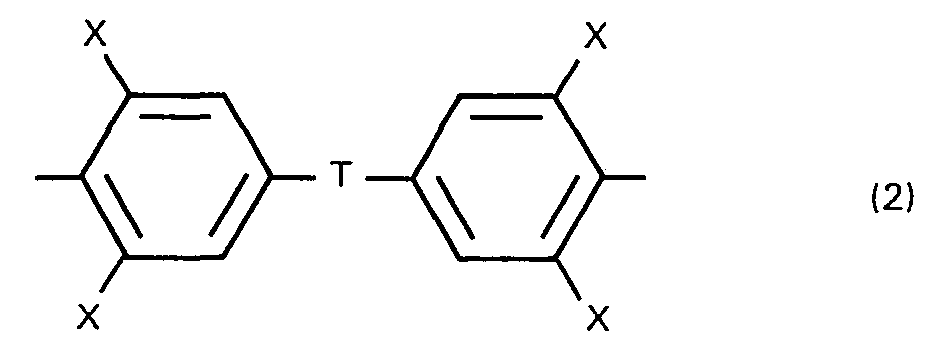


und y ist eine ganze oder Bruchzahl von 0 bis 1000.

Applications Claiming Priority (2)
| Application Number | Priority Date | Filing Date | Title |
|---|---|---|---|
| FR8502008A FR2577229B1 (fr) | 1985-02-08 | 1985-02-08 | Compositions thermodurcissables a base de prepolymere a groupements imides stables au stockage et procede de preparation |
| FR8502008 | 1985-02-08 |
Publications (2)
| Publication Number | Publication Date |
|---|---|
| EP0191706A1 EP0191706A1 (de) | 1986-08-20 |
| EP0191706B1 true EP0191706B1 (de) | 1988-08-24 |
Family
ID=9316206
Family Applications (1)
| Application Number | Title | Priority Date | Filing Date |
|---|---|---|---|
| EP86420030A Expired EP0191706B1 (de) | 1985-02-08 | 1986-01-30 | Lagerbeständige, wärmehärtbare Mischungen auf Basis von Prepolymeren mit Imidgruppen und Verfahren zu deren Herstellung |
Country Status (7)
| Country | Link |
|---|---|
| US (1) | US4650719A (de) |
| EP (1) | EP0191706B1 (de) |
| JP (1) | JPS61183321A (de) |
| DE (1) | DE3660598D1 (de) |
| DK (1) | DK60286A (de) |
| FR (1) | FR2577229B1 (de) |
| IE (1) | IE58293B1 (de) |
Families Citing this family (6)
| Publication number | Priority date | Publication date | Assignee | Title |
|---|---|---|---|---|
| CA1307605C (fr) * | 1987-06-23 | 1992-09-15 | Rene Arpin | Polymeres a groupements imides sans diamine et leur procede de preparation |
| US6464908B1 (en) * | 1988-01-28 | 2002-10-15 | Hyperion Catalysis International, Inc. | Method of molding composites containing carbon fibrils |
| US20100033826A1 (en) | 2007-02-27 | 2010-02-11 | Kolb Brant U | Brightness enhancing film comprising nanocomposite structure having improved crack resistance |
| US20080221291A1 (en) * | 2007-03-07 | 2008-09-11 | 3M Innovative Properties Company | Microstructured optical films comprising biphenyl difunctional monomers |
| WO2008112452A2 (en) | 2007-03-09 | 2008-09-18 | 3M Innovative Properties Company | Triphenyl monomers suitable for microstructured optical films |
| CN101627063B (zh) * | 2007-03-09 | 2012-05-30 | 3M创新有限公司 | 适用于微结构化光学膜的三苯基单体 |
Family Cites Families (3)
| Publication number | Priority date | Publication date | Assignee | Title |
|---|---|---|---|---|
| US3763081A (en) * | 1972-01-17 | 1973-10-02 | Gen Electric | Curable aliphatically unsaturated siloxane and imide blends |
| FR2460308A1 (fr) * | 1979-07-03 | 1981-01-23 | Rhone Poulenc Ind | Procede de preparation de polymeres a groupements imide modifies par du silicium |
| FR2553780B1 (fr) * | 1983-10-25 | 1986-01-17 | Rhone Poulenc Spec Chim | Compositions thermodurcissables a base de prepolymere a groupements imides stables au stockage et procede de preparation |
-
1985
- 1985-02-08 FR FR8502008A patent/FR2577229B1/fr not_active Expired
- 1985-10-25 US US06/791,615 patent/US4650719A/en not_active Expired - Fee Related
-
1986
- 1986-01-14 JP JP61004435A patent/JPS61183321A/ja active Pending
- 1986-01-30 DE DE8686420030T patent/DE3660598D1/de not_active Expired
- 1986-01-30 EP EP86420030A patent/EP0191706B1/de not_active Expired
- 1986-02-06 IE IE33886A patent/IE58293B1/en not_active IP Right Cessation
- 1986-02-07 DK DK60286A patent/DK60286A/da not_active Application Discontinuation
Also Published As
| Publication number | Publication date |
|---|---|
| JPS61183321A (ja) | 1986-08-16 |
| DK60286A (da) | 1986-08-09 |
| IE860338L (en) | 1986-08-08 |
| DK60286D0 (da) | 1986-02-07 |
| DE3660598D1 (en) | 1988-09-29 |
| EP0191706A1 (de) | 1986-08-20 |
| IE58293B1 (en) | 1993-08-25 |
| US4650719A (en) | 1987-03-17 |
| FR2577229B1 (fr) | 1987-02-20 |
| FR2577229A1 (fr) | 1986-08-14 |
Similar Documents
| Publication | Publication Date | Title |
|---|---|---|
| EP0208634B1 (de) | Maleimide und hitzehärtbare Zusammenstellungen die sie enthalten | |
| CA1156796A (fr) | Procede pour eviter la cristallisation des n,n' diphenylene bis-imides dans les compositions thermodurcissables en contenant | |
| EP0141765B1 (de) | Lagerbeständige, wärmehärtbare Mischungen auf Basis von Prepolymeren mit Imidgruppen und Verfahren zu deren Herstellung | |
| EP0397581B1 (de) | Imidgruppen enthaltende Polymere, die aus Maleimiden, von denen eines ein Bismaleimidsiloxan ist, und aromatischen Diaminen hergestellt werden und Herstellungsverfahren | |
| EP0191706A1 (de) | Lagerbeständige, wärmehärtbare Mischungen auf Basis von Prepolymeren mit Imidgruppen und Verfahren zu deren Herstellung | |
| CA1336999C (fr) | Polymeres thermostables a base de maleimides dont eventuellement un bismaleimide siloxane et de diamines siloxanes et leurs procedes de preparation | |
| CA1333119C (fr) | Polymeres a groupements imides faits a partir de diamines encombrees | |
| EP0022049B1 (de) | Verfahren zur Herstellung von Imidgruppen enthaltenden und durch Silicium modifizierten Polymeren und durch dieses Verfahren erhaltene Polymere | |
| EP0424286B1 (de) | Von sterisch gehinderten Diaminen abgeleitete imidgruppenhaltige Polymere | |
| EP0334771B1 (de) | Aus sterisch gehinderten Diaminen abgeleitete, Imidgruppierungen aufweisende Polymerisate und Verfahren zu deren Herstellung | |
| EP0397582B1 (de) | Polymere mit Imidgruppen, ausgehend von gehinderten Diaminen | |
| CA2088672A1 (fr) | Compositions thermodurcissables a base de composes cyanate ester et de composes polyimide a groupement (s) diorganopolysiloxane | |
| EP0296994B1 (de) | Polymere mit Imid-Gruppen ohne Diamin und Verfahren zu deren Herstellung | |
| EP0467796B1 (de) | Imidgruppe enthaltende Polymere und Verfahren zur Herstellung | |
| EP0274967A2 (de) | Maleimidderivate und thermohärtbare Zusammenstellungen, die sie enthalten | |
| FR2584069A1 (fr) | Nouveaux maleimides et nouvelles compositions thermodurcissables les contenant. | |
| FR2597488A1 (fr) | Compositions thermodurcissables a base de prepolymere a groupements imides. | |
| WO1992014767A1 (fr) | Prepolymeres a groupements imides | |
| FR2617173A1 (fr) | Polymeres a groupements imides sans diamine et leur procede de preparation |
Legal Events
| Date | Code | Title | Description |
|---|---|---|---|
| PUAI | Public reference made under article 153(3) epc to a published international application that has entered the european phase |
Free format text: ORIGINAL CODE: 0009012 |
|
| AK | Designated contracting states |
Kind code of ref document: A1 Designated state(s): BE CH DE GB IT LI LU NL SE |
|
| 17P | Request for examination filed |
Effective date: 19861205 |
|
| RAP1 | Party data changed (applicant data changed or rights of an application transferred) |
Owner name: RHONE-POULENC CHIMIE |
|
| 17Q | First examination report despatched |
Effective date: 19880211 |
|
| GRAA | (expected) grant |
Free format text: ORIGINAL CODE: 0009210 |
|
| ITF | It: translation for a ep patent filed | ||
| AK | Designated contracting states |
Kind code of ref document: B1 Designated state(s): BE CH DE GB IT LI LU NL SE |
|
| GBT | Gb: translation of ep patent filed (gb section 77(6)(a)/1977) | ||
| REF | Corresponds to: |
Ref document number: 3660598 Country of ref document: DE Date of ref document: 19880929 |
|
| PG25 | Lapsed in a contracting state [announced via postgrant information from national office to epo] |
Ref country code: LU Free format text: LAPSE BECAUSE OF NON-PAYMENT OF DUE FEES Effective date: 19890131 |
|
| PGFP | Annual fee paid to national office [announced via postgrant information from national office to epo] |
Ref country code: NL Payment date: 19890131 Year of fee payment: 5 |
|
| PLBE | No opposition filed within time limit |
Free format text: ORIGINAL CODE: 0009261 |
|
| STAA | Information on the status of an ep patent application or granted ep patent |
Free format text: STATUS: NO OPPOSITION FILED WITHIN TIME LIMIT |
|
| 26N | No opposition filed | ||
| PGFP | Annual fee paid to national office [announced via postgrant information from national office to epo] |
Ref country code: LU Payment date: 19900116 Year of fee payment: 5 |
|
| PGFP | Annual fee paid to national office [announced via postgrant information from national office to epo] |
Ref country code: SE Payment date: 19900118 Year of fee payment: 5 |
|
| ITTA | It: last paid annual fee | ||
| PGFP | Annual fee paid to national office [announced via postgrant information from national office to epo] |
Ref country code: GB Payment date: 19900131 Year of fee payment: 5 Ref country code: CH Payment date: 19900131 Year of fee payment: 5 |
|
| PGFP | Annual fee paid to national office [announced via postgrant information from national office to epo] |
Ref country code: DE Payment date: 19900228 Year of fee payment: 5 |
|
| PGFP | Annual fee paid to national office [announced via postgrant information from national office to epo] |
Ref country code: BE Payment date: 19900313 Year of fee payment: 5 |
|
| PG25 | Lapsed in a contracting state [announced via postgrant information from national office to epo] |
Ref country code: GB Effective date: 19910130 |
|
| PG25 | Lapsed in a contracting state [announced via postgrant information from national office to epo] |
Ref country code: SE Effective date: 19910131 Ref country code: LI Effective date: 19910131 Ref country code: CH Effective date: 19910131 Ref country code: BE Effective date: 19910131 |
|
| PG25 | Lapsed in a contracting state [announced via postgrant information from national office to epo] |
Ref country code: NL Effective date: 19910801 |
|
| NLV4 | Nl: lapsed or anulled due to non-payment of the annual fee | ||
| GBPC | Gb: european patent ceased through non-payment of renewal fee | ||
| REG | Reference to a national code |
Ref country code: CH Ref legal event code: PL |
|
| PG25 | Lapsed in a contracting state [announced via postgrant information from national office to epo] |
Ref country code: DE Effective date: 19911001 |
|
| EUG | Se: european patent has lapsed |
Ref document number: 86420030.8 Effective date: 19910910 |
|
| PG25 | Lapsed in a contracting state [announced via postgrant information from national office to epo] |
Ref country code: IT Free format text: LAPSE BECAUSE OF NON-PAYMENT OF DUE FEES;WARNING: LAPSES OF ITALIAN PATENTS WITH EFFECTIVE DATE BEFORE 2007 MAY HAVE OCCURRED AT ANY TIME BEFORE 2007. THE CORRECT EFFECTIVE DATE MAY BE DIFFERENT FROM THE ONE RECORDED. Effective date: 20050130 |