EP0424286B1 - Von sterisch gehinderten Diaminen abgeleitete imidgruppenhaltige Polymere - Google Patents
Von sterisch gehinderten Diaminen abgeleitete imidgruppenhaltige Polymere Download PDFInfo
- Publication number
- EP0424286B1 EP0424286B1 EP90420442A EP90420442A EP0424286B1 EP 0424286 B1 EP0424286 B1 EP 0424286B1 EP 90420442 A EP90420442 A EP 90420442A EP 90420442 A EP90420442 A EP 90420442A EP 0424286 B1 EP0424286 B1 EP 0424286B1
- Authority
- EP
- European Patent Office
- Prior art keywords
- bis
- radical
- formula
- methyl
- maleimide
- Prior art date
- Legal status (The legal status is an assumption and is not a legal conclusion. Google has not performed a legal analysis and makes no representation as to the accuracy of the status listed.)
- Expired - Lifetime
Links
- 150000004985 diamines Chemical class 0.000 title claims abstract description 27
- 229920000642 polymer Polymers 0.000 title claims description 30
- 125000005462 imide group Chemical group 0.000 title claims description 8
- 229910052757 nitrogen Inorganic materials 0.000 claims abstract description 67
- 150000003254 radicals Chemical class 0.000 claims abstract description 35
- -1 phenyl radicals Chemical class 0.000 claims abstract description 31
- 150000001875 compounds Chemical class 0.000 claims abstract description 26
- 239000003822 epoxy resin Substances 0.000 claims abstract description 23
- 229920000647 polyepoxide Polymers 0.000 claims abstract description 23
- 239000000460 chlorine Substances 0.000 claims abstract description 14
- 229910052801 chlorine Inorganic materials 0.000 claims abstract description 14
- ZAMOUSCENKQFHK-UHFFFAOYSA-N Chlorine atom Chemical compound [Cl] ZAMOUSCENKQFHK-UHFFFAOYSA-N 0.000 claims abstract description 13
- CIUQDSCDWFSTQR-UHFFFAOYSA-N [C]1=CC=CC=C1 Chemical compound [C]1=CC=CC=C1 CIUQDSCDWFSTQR-UHFFFAOYSA-N 0.000 claims abstract description 4
- 239000007870 radical polymerization initiator Substances 0.000 claims abstract description 4
- 239000000203 mixture Substances 0.000 claims description 48
- 238000000034 method Methods 0.000 claims description 19
- 239000000654 additive Substances 0.000 claims description 18
- UHOVQNZJYSORNB-UHFFFAOYSA-N Benzene Chemical compound C1=CC=CC=C1 UHOVQNZJYSORNB-UHFFFAOYSA-N 0.000 claims description 16
- WKBOTKDWSSQWDR-UHFFFAOYSA-N Bromine atom Chemical group [Br] WKBOTKDWSSQWDR-UHFFFAOYSA-N 0.000 claims description 16
- 230000008569 process Effects 0.000 claims description 15
- 239000003054 catalyst Substances 0.000 claims description 14
- 239000000376 reactant Substances 0.000 claims description 14
- 230000000996 additive effect Effects 0.000 claims description 13
- 238000010438 heat treatment Methods 0.000 claims description 13
- 229910052760 oxygen Inorganic materials 0.000 claims description 13
- 125000002496 methyl group Chemical group [H]C([H])([H])* 0.000 claims description 11
- ATUOYWHBWRKTHZ-UHFFFAOYSA-N Propane Chemical compound CCC ATUOYWHBWRKTHZ-UHFFFAOYSA-N 0.000 claims description 10
- 125000003118 aryl group Chemical group 0.000 claims description 10
- JHIVVAPYMSGYDF-UHFFFAOYSA-N cyclohexanone Chemical compound O=C1CCCCC1 JHIVVAPYMSGYDF-UHFFFAOYSA-N 0.000 claims description 10
- 229920005989 resin Polymers 0.000 claims description 10
- 239000011347 resin Substances 0.000 claims description 10
- IJGRMHOSHXDMSA-UHFFFAOYSA-N Atomic nitrogen Chemical compound N#N IJGRMHOSHXDMSA-UHFFFAOYSA-N 0.000 claims description 9
- ZMXDDKWLCZADIW-UHFFFAOYSA-N N,N-Dimethylformamide Chemical compound CN(C)C=O ZMXDDKWLCZADIW-UHFFFAOYSA-N 0.000 claims description 9
- GDTBXPJZTBHREO-UHFFFAOYSA-N bromine Substances BrBr GDTBXPJZTBHREO-UHFFFAOYSA-N 0.000 claims description 9
- 229910052794 bromium Inorganic materials 0.000 claims description 9
- 125000004435 hydrogen atom Chemical group [H]* 0.000 claims description 9
- 238000002360 preparation method Methods 0.000 claims description 9
- XQUPVDVFXZDTLT-UHFFFAOYSA-N 1-[4-[[4-(2,5-dioxopyrrol-1-yl)phenyl]methyl]phenyl]pyrrole-2,5-dione Chemical compound O=C1C=CC(=O)N1C(C=C1)=CC=C1CC1=CC=C(N2C(C=CC2=O)=O)C=C1 XQUPVDVFXZDTLT-UHFFFAOYSA-N 0.000 claims description 8
- OZAIFHULBGXAKX-UHFFFAOYSA-N 2-(2-cyanopropan-2-yldiazenyl)-2-methylpropanenitrile Chemical compound N#CC(C)(C)N=NC(C)(C)C#N OZAIFHULBGXAKX-UHFFFAOYSA-N 0.000 claims description 8
- HNUALPPJLMYHDK-UHFFFAOYSA-N C[CH]C Chemical compound C[CH]C HNUALPPJLMYHDK-UHFFFAOYSA-N 0.000 claims description 8
- RTZKZFJDLAIYFH-UHFFFAOYSA-N Diethyl ether Chemical compound CCOCC RTZKZFJDLAIYFH-UHFFFAOYSA-N 0.000 claims description 8
- 125000001495 ethyl group Chemical group [H]C([H])([H])C([H])([H])* 0.000 claims description 8
- 239000000178 monomer Substances 0.000 claims description 8
- 150000002989 phenols Chemical class 0.000 claims description 8
- 239000000047 product Substances 0.000 claims description 8
- 239000002904 solvent Substances 0.000 claims description 8
- BRLQWZUYTZBJKN-UHFFFAOYSA-N Epichlorohydrin Chemical compound ClCC1CO1 BRLQWZUYTZBJKN-UHFFFAOYSA-N 0.000 claims description 7
- 150000001335 aliphatic alkanes Chemical class 0.000 claims description 7
- 125000002924 primary amino group Chemical group [H]N([H])* 0.000 claims description 7
- 239000012429 reaction media Substances 0.000 claims description 7
- ZWEHNKRNPOVVGH-UHFFFAOYSA-N 2-Butanone Chemical compound CCC(C)=O ZWEHNKRNPOVVGH-UHFFFAOYSA-N 0.000 claims description 6
- QIGBRXMKCJKVMJ-UHFFFAOYSA-N Hydroquinone Chemical compound OC1=CC=C(O)C=C1 QIGBRXMKCJKVMJ-UHFFFAOYSA-N 0.000 claims description 6
- 229910052799 carbon Inorganic materials 0.000 claims description 6
- YCIMNLLNPGFGHC-UHFFFAOYSA-N catechol Chemical compound OC1=CC=CC=C1O YCIMNLLNPGFGHC-UHFFFAOYSA-N 0.000 claims description 6
- 230000009021 linear effect Effects 0.000 claims description 6
- 150000008442 polyphenolic compounds Chemical class 0.000 claims description 6
- 125000001436 propyl group Chemical group [H]C([*])([H])C([H])([H])C([H])([H])[H] 0.000 claims description 6
- GHMLBKRAJCXXBS-UHFFFAOYSA-N resorcinol Chemical compound OC1=CC=CC(O)=C1 GHMLBKRAJCXXBS-UHFFFAOYSA-N 0.000 claims description 6
- 230000017105 transposition Effects 0.000 claims description 6
- 125000005336 allyloxy group Chemical group 0.000 claims description 5
- 239000004615 ingredient Substances 0.000 claims description 5
- 125000001997 phenyl group Chemical group [H]C1=C([H])C([H])=C(*)C([H])=C1[H] 0.000 claims description 5
- 239000001294 propane Substances 0.000 claims description 5
- SECXISVLQFMRJM-UHFFFAOYSA-N N-Methylpyrrolidone Chemical compound CN1CCCC1=O SECXISVLQFMRJM-UHFFFAOYSA-N 0.000 claims description 4
- ISWSIDIOOBJBQZ-UHFFFAOYSA-N Phenol Chemical compound OC1=CC=CC=C1 ISWSIDIOOBJBQZ-UHFFFAOYSA-N 0.000 claims description 4
- WYURNTSHIVDZCO-UHFFFAOYSA-N Tetrahydrofuran Chemical compound C1CCOC1 WYURNTSHIVDZCO-UHFFFAOYSA-N 0.000 claims description 4
- PXKLMJQFEQBVLD-UHFFFAOYSA-N bisphenol F Chemical compound C1=CC(O)=CC=C1CC1=CC=C(O)C=C1 PXKLMJQFEQBVLD-UHFFFAOYSA-N 0.000 claims description 4
- 150000001721 carbon Chemical group 0.000 claims description 4
- 239000011203 carbon fibre reinforced carbon Substances 0.000 claims description 4
- VNWKTOKETHGBQD-UHFFFAOYSA-N methane Chemical compound C VNWKTOKETHGBQD-UHFFFAOYSA-N 0.000 claims description 4
- IAZDPXIOMUYVGZ-UHFFFAOYSA-N Dimethylsulphoxide Chemical compound CS(C)=O IAZDPXIOMUYVGZ-UHFFFAOYSA-N 0.000 claims description 3
- VCCBEIPGXKNHFW-UHFFFAOYSA-N biphenyl-4,4'-diol Chemical group C1=CC(O)=CC=C1C1=CC=C(O)C=C1 VCCBEIPGXKNHFW-UHFFFAOYSA-N 0.000 claims description 3
- IISBACLAFKSPIT-UHFFFAOYSA-N bisphenol A Chemical compound C=1C=C(O)C=CC=1C(C)(C)C1=CC=C(O)C=C1 IISBACLAFKSPIT-UHFFFAOYSA-N 0.000 claims description 3
- 125000001309 chloro group Chemical group Cl* 0.000 claims description 3
- 239000007859 condensation product Substances 0.000 claims description 3
- 150000001451 organic peroxides Chemical class 0.000 claims description 3
- 239000002685 polymerization catalyst Substances 0.000 claims description 3
- RYHBNJHYFVUHQT-UHFFFAOYSA-N 1,4-Dioxane Chemical compound C1COCCO1 RYHBNJHYFVUHQT-UHFFFAOYSA-N 0.000 claims description 2
- DURPTKYDGMDSBL-UHFFFAOYSA-N 1-butoxybutane Chemical compound CCCCOCCCC DURPTKYDGMDSBL-UHFFFAOYSA-N 0.000 claims description 2
- XNWFRZJHXBZDAG-UHFFFAOYSA-N 2-METHOXYETHANOL Chemical compound COCCO XNWFRZJHXBZDAG-UHFFFAOYSA-N 0.000 claims description 2
- KZBUYRJDOAKODT-UHFFFAOYSA-N Chlorine Chemical compound ClCl KZBUYRJDOAKODT-UHFFFAOYSA-N 0.000 claims description 2
- XDTMQSROBMDMFD-UHFFFAOYSA-N Cyclohexane Chemical compound C1CCCCC1 XDTMQSROBMDMFD-UHFFFAOYSA-N 0.000 claims description 2
- LCGLNKUTAGEVQW-UHFFFAOYSA-N Dimethyl ether Chemical compound COC LCGLNKUTAGEVQW-UHFFFAOYSA-N 0.000 claims description 2
- CPELXLSAUQHCOX-UHFFFAOYSA-N Hydrogen bromide Chemical compound Br CPELXLSAUQHCOX-UHFFFAOYSA-N 0.000 claims description 2
- FXHOOIRPVKKKFG-UHFFFAOYSA-N N,N-Dimethylacetamide Chemical compound CN(C)C(C)=O FXHOOIRPVKKKFG-UHFFFAOYSA-N 0.000 claims description 2
- 125000004432 carbon atom Chemical group C* 0.000 claims description 2
- 125000004956 cyclohexylene group Chemical group 0.000 claims description 2
- 125000000623 heterocyclic group Chemical group 0.000 claims description 2
- WCYWZMWISLQXQU-UHFFFAOYSA-N methyl Chemical compound [CH3] WCYWZMWISLQXQU-UHFFFAOYSA-N 0.000 claims description 2
- 125000004430 oxygen atom Chemical group O* 0.000 claims description 2
- 239000003495 polar organic solvent Substances 0.000 claims description 2
- YLQBMQCUIZJEEH-UHFFFAOYSA-N tetrahydrofuran Natural products C=1C=COC=1 YLQBMQCUIZJEEH-UHFFFAOYSA-N 0.000 claims description 2
- 229920003192 poly(bis maleimide) Polymers 0.000 claims 6
- GYZLOYUZLJXAJU-UHFFFAOYSA-N diglycidyl ether Chemical compound C1OC1COCC1CO1 GYZLOYUZLJXAJU-UHFFFAOYSA-N 0.000 claims 4
- 150000002118 epoxides Chemical class 0.000 claims 4
- 235000013824 polyphenols Nutrition 0.000 claims 4
- 239000004305 biphenyl Substances 0.000 claims 2
- 125000002485 formyl group Chemical class [H]C(*)=O 0.000 claims 2
- QRFTXHFUNIFHST-UHFFFAOYSA-N 4,5,6,7-tetrabromoisoindole-1,3-dione Chemical compound BrC1=C(Br)C(Br)=C2C(=O)NC(=O)C2=C1Br QRFTXHFUNIFHST-UHFFFAOYSA-N 0.000 claims 1
- STENJEVSXWARII-UHFFFAOYSA-N 4-[(4-hydroxyphenyl)-(2-methylphenyl)methyl]phenol Chemical class CC1=CC=CC=C1C(C=1C=CC(O)=CC=1)C1=CC=C(O)C=C1 STENJEVSXWARII-UHFFFAOYSA-N 0.000 claims 1
- YXVSYZRICGNXIH-UHFFFAOYSA-N 4-[1-(4-hydroxyphenyl)-2-phenylethyl]phenol Chemical compound C1=CC(O)=CC=C1C(C=1C=CC(O)=CC=1)CC1=CC=CC=C1 YXVSYZRICGNXIH-UHFFFAOYSA-N 0.000 claims 1
- 229960001760 dimethyl sulfoxide Drugs 0.000 claims 1
- 235000011837 pasties Nutrition 0.000 claims 1
- 125000000843 phenylene group Chemical group C1(=C(C=CC=C1)*)* 0.000 claims 1
- 238000004519 manufacturing process Methods 0.000 abstract description 9
- 125000004429 atom Chemical group 0.000 abstract description 2
- 125000001246 bromo group Chemical group Br* 0.000 abstract description 2
- 229920001577 copolymer Polymers 0.000 abstract 1
- ATVJXMYDOSMEPO-UHFFFAOYSA-N 3-prop-2-enoxyprop-1-ene Chemical compound C=CCOCC=C ATVJXMYDOSMEPO-UHFFFAOYSA-N 0.000 description 28
- 239000003153 chemical reaction reagent Substances 0.000 description 22
- 239000007788 liquid Substances 0.000 description 12
- CZZYITDELCSZES-UHFFFAOYSA-N diphenylmethane Chemical compound C=1C=CC=CC=1CC1=CC=CC=C1 CZZYITDELCSZES-UHFFFAOYSA-N 0.000 description 9
- RYGMFSIKBFXOCR-UHFFFAOYSA-N Copper Chemical compound [Cu] RYGMFSIKBFXOCR-UHFFFAOYSA-N 0.000 description 8
- 239000003085 diluting agent Substances 0.000 description 8
- 239000004593 Epoxy Substances 0.000 description 7
- LNEPOXFFQSENCJ-UHFFFAOYSA-N haloperidol Chemical compound C1CC(O)(C=2C=CC(Cl)=CC=2)CCN1CCCC(=O)C1=CC=C(F)C=C1 LNEPOXFFQSENCJ-UHFFFAOYSA-N 0.000 description 7
- 238000012360 testing method Methods 0.000 description 7
- 0 CC1=CC*C=C1 Chemical compound CC1=CC*C=C1 0.000 description 6
- 239000000470 constituent Substances 0.000 description 6
- 239000011521 glass Substances 0.000 description 6
- 238000005259 measurement Methods 0.000 description 6
- 125000003903 2-propenyl group Chemical group [H]C([*])([H])C([H])=C([H])[H] 0.000 description 5
- PEEHTFAAVSWFBL-UHFFFAOYSA-N Maleimide Chemical compound O=C1NC(=O)C=C1 PEEHTFAAVSWFBL-UHFFFAOYSA-N 0.000 description 5
- 239000000463 material Substances 0.000 description 5
- 241000894007 species Species 0.000 description 5
- WHNWPMSKXPGLAX-UHFFFAOYSA-N N-Vinyl-2-pyrrolidone Chemical compound C=CN1CCCC1=O WHNWPMSKXPGLAX-UHFFFAOYSA-N 0.000 description 4
- YXFVVABEGXRONW-UHFFFAOYSA-N Toluene Chemical compound CC1=CC=CC=C1 YXFVVABEGXRONW-UHFFFAOYSA-N 0.000 description 4
- 239000011889 copper foil Substances 0.000 description 4
- 239000004744 fabric Substances 0.000 description 4
- 150000003949 imides Chemical class 0.000 description 4
- 239000000843 powder Substances 0.000 description 4
- CSCPPACGZOOCGX-UHFFFAOYSA-N Acetone Chemical compound CC(C)=O CSCPPACGZOOCGX-UHFFFAOYSA-N 0.000 description 3
- OKTJSMMVPCPJKN-UHFFFAOYSA-N Carbon Chemical compound [C] OKTJSMMVPCPJKN-UHFFFAOYSA-N 0.000 description 3
- 239000002671 adjuvant Substances 0.000 description 3
- 239000007795 chemical reaction product Substances 0.000 description 3
- 238000002485 combustion reaction Methods 0.000 description 3
- 229910052802 copper Inorganic materials 0.000 description 3
- 239000010949 copper Substances 0.000 description 3
- 230000014509 gene expression Effects 0.000 description 3
- 125000004464 hydroxyphenyl group Chemical group 0.000 description 3
- 238000006116 polymerization reaction Methods 0.000 description 3
- 239000007787 solid Substances 0.000 description 3
- IPJGAEWUPXWFPL-UHFFFAOYSA-N 1-[3-(2,5-dioxopyrrol-1-yl)phenyl]pyrrole-2,5-dione Chemical compound O=C1C=CC(=O)N1C1=CC=CC(N2C(C=CC2=O)=O)=C1 IPJGAEWUPXWFPL-UHFFFAOYSA-N 0.000 description 2
- AQGZJQNZNONGKY-UHFFFAOYSA-N 1-[4-(2,5-dioxopyrrol-1-yl)phenyl]pyrrole-2,5-dione Chemical compound O=C1C=CC(=O)N1C1=CC=C(N2C(C=CC2=O)=O)C=C1 AQGZJQNZNONGKY-UHFFFAOYSA-N 0.000 description 2
- 150000003923 2,5-pyrrolediones Chemical class 0.000 description 2
- HGBNWSMJGHSLRK-UHFFFAOYSA-N 3-[1-(2,5-dioxopyrrol-3-yl)cyclohexyl]pyrrole-2,5-dione Chemical compound O=C1NC(=O)C(C2(CCCCC2)C=2C(NC(=O)C=2)=O)=C1 HGBNWSMJGHSLRK-UHFFFAOYSA-N 0.000 description 2
- 125000004203 4-hydroxyphenyl group Chemical group [H]OC1=C([H])C([H])=C(*)C([H])=C1[H] 0.000 description 2
- SEVNPMKAEISHJM-UHFFFAOYSA-N C1(C=CC(N1)=O)=O.C1(C=CC(N1)=O)=O.CCC Chemical compound C1(C=CC(N1)=O)=O.C1(C=CC(N1)=O)=O.CCC SEVNPMKAEISHJM-UHFFFAOYSA-N 0.000 description 2
- 101100536354 Drosophila melanogaster tant gene Proteins 0.000 description 2
- 238000004458 analytical method Methods 0.000 description 2
- 230000008901 benefit Effects 0.000 description 2
- 238000000748 compression moulding Methods 0.000 description 2
- 238000009833 condensation Methods 0.000 description 2
- 230000005494 condensation Effects 0.000 description 2
- 239000012043 crude product Substances 0.000 description 2
- 238000005553 drilling Methods 0.000 description 2
- 229940082150 encore Drugs 0.000 description 2
- 150000002170 ethers Chemical class 0.000 description 2
- 239000000945 filler Substances 0.000 description 2
- 238000000227 grinding Methods 0.000 description 2
- 230000033001 locomotion Effects 0.000 description 2
- 229910052751 metal Inorganic materials 0.000 description 2
- 239000002184 metal Substances 0.000 description 2
- 230000009257 reactivity Effects 0.000 description 2
- 238000007493 shaping process Methods 0.000 description 2
- 238000003756 stirring Methods 0.000 description 2
- 239000000725 suspension Substances 0.000 description 2
- 230000000930 thermomechanical effect Effects 0.000 description 2
- 229920001187 thermosetting polymer Polymers 0.000 description 2
- WYTZZXDRDKSJID-UHFFFAOYSA-N (3-aminopropyl)triethoxysilane Chemical compound CCO[Si](OCC)(OCC)CCCN WYTZZXDRDKSJID-UHFFFAOYSA-N 0.000 description 1
- HVCJCMUWTJUAQK-UHFFFAOYSA-N 1-(4-prop-2-enoxyphenyl)pyrrole-2,5-dione Chemical compound C1=CC(OCC=C)=CC=C1N1C(=O)C=CC1=O HVCJCMUWTJUAQK-UHFFFAOYSA-N 0.000 description 1
- SCZZNWQQCGSWSZ-UHFFFAOYSA-N 1-prop-2-enoxy-4-[2-(4-prop-2-enoxyphenyl)propan-2-yl]benzene Chemical compound C=1C=C(OCC=C)C=CC=1C(C)(C)C1=CC=C(OCC=C)C=C1 SCZZNWQQCGSWSZ-UHFFFAOYSA-N 0.000 description 1
- TYGPTXIVDGYHPB-UHFFFAOYSA-N 2,3-bis(prop-2-enyl)phenol Chemical compound OC1=CC=CC(CC=C)=C1CC=C TYGPTXIVDGYHPB-UHFFFAOYSA-N 0.000 description 1
- PISLZQACAJMAIO-UHFFFAOYSA-N 2,4-diethyl-6-methylbenzene-1,3-diamine Chemical compound CCC1=CC(C)=C(N)C(CC)=C1N PISLZQACAJMAIO-UHFFFAOYSA-N 0.000 description 1
- XMNIXWIUMCBBBL-UHFFFAOYSA-N 2-(2-phenylpropan-2-ylperoxy)propan-2-ylbenzene Chemical compound C=1C=CC=CC=1C(C)(C)OOC(C)(C)C1=CC=CC=C1 XMNIXWIUMCBBBL-UHFFFAOYSA-N 0.000 description 1
- QIRNGVVZBINFMX-UHFFFAOYSA-N 2-allylphenol Chemical compound OC1=CC=CC=C1CC=C QIRNGVVZBINFMX-UHFFFAOYSA-N 0.000 description 1
- XIXWTBLGKIRXOP-UHFFFAOYSA-N 2-ethenyloxolane Chemical compound C=CC1CCCO1 XIXWTBLGKIRXOP-UHFFFAOYSA-N 0.000 description 1
- KGIGUEBEKRSTEW-UHFFFAOYSA-N 2-vinylpyridine Chemical class C=CC1=CC=CC=N1 KGIGUEBEKRSTEW-UHFFFAOYSA-N 0.000 description 1
- RQEOBXYYEPMCPJ-UHFFFAOYSA-N 4,6-diethyl-2-methylbenzene-1,3-diamine Chemical compound CCC1=CC(CC)=C(N)C(C)=C1N RQEOBXYYEPMCPJ-UHFFFAOYSA-N 0.000 description 1
- OSDWBNJEKMUWAV-UHFFFAOYSA-N Allyl chloride Chemical compound ClCC=C OSDWBNJEKMUWAV-UHFFFAOYSA-N 0.000 description 1
- 239000005995 Aluminium silicate Substances 0.000 description 1
- 238000006677 Appel reaction Methods 0.000 description 1
- 239000004156 Azodicarbonamide Substances 0.000 description 1
- VOWWYDCFAISREI-UHFFFAOYSA-N Bisphenol AP Chemical compound C=1C=C(O)C=CC=1C(C=1C=CC(O)=CC=1)(C)C1=CC=CC=C1 VOWWYDCFAISREI-UHFFFAOYSA-N 0.000 description 1
- 239000004604 Blowing Agent Substances 0.000 description 1
- ZOXJGFHDIHLPTG-UHFFFAOYSA-N Boron Chemical compound [B] ZOXJGFHDIHLPTG-UHFFFAOYSA-N 0.000 description 1
- 239000002970 Calcium lactobionate Substances 0.000 description 1
- DOLQYFPDPKPQSS-UHFFFAOYSA-N Cc(cc1)c(C)cc1N Chemical compound Cc(cc1)c(C)cc1N DOLQYFPDPKPQSS-UHFFFAOYSA-N 0.000 description 1
- YIVJZNGAASQVEM-UHFFFAOYSA-N Lauroyl peroxide Chemical compound CCCCCCCCCCCC(=O)OOC(=O)CCCCCCCCCCC YIVJZNGAASQVEM-UHFFFAOYSA-N 0.000 description 1
- BPQQTUXANYXVAA-UHFFFAOYSA-N Orthosilicate Chemical compound [O-][Si]([O-])([O-])[O-] BPQQTUXANYXVAA-UHFFFAOYSA-N 0.000 description 1
- 239000004642 Polyimide Substances 0.000 description 1
- BLRPTPMANUNPDV-UHFFFAOYSA-N Silane Chemical compound [SiH4] BLRPTPMANUNPDV-UHFFFAOYSA-N 0.000 description 1
- KKEYFWRCBNTPAC-UHFFFAOYSA-N Terephthalic acid Chemical class OC(=O)C1=CC=C(C(O)=O)C=C1 KKEYFWRCBNTPAC-UHFFFAOYSA-N 0.000 description 1
- 240000008042 Zea mays Species 0.000 description 1
- 238000013019 agitation Methods 0.000 description 1
- 150000001299 aldehydes Chemical class 0.000 description 1
- 150000008044 alkali metal hydroxides Chemical class 0.000 description 1
- 229910052782 aluminium Inorganic materials 0.000 description 1
- XAGFODPZIPBFFR-UHFFFAOYSA-N aluminium Chemical compound [Al] XAGFODPZIPBFFR-UHFFFAOYSA-N 0.000 description 1
- 235000012211 aluminium silicate Nutrition 0.000 description 1
- 239000004760 aramid Substances 0.000 description 1
- 150000004945 aromatic hydrocarbons Chemical class 0.000 description 1
- 229920003235 aromatic polyamide Polymers 0.000 description 1
- 239000010425 asbestos Substances 0.000 description 1
- 239000012298 atmosphere Substances 0.000 description 1
- XOZUGNYVDXMRKW-AATRIKPKSA-N azodicarbonamide Chemical compound NC(=O)\N=N\C(N)=O XOZUGNYVDXMRKW-AATRIKPKSA-N 0.000 description 1
- 235000019399 azodicarbonamide Nutrition 0.000 description 1
- 229910052796 boron Inorganic materials 0.000 description 1
- 150000004649 carbonic acid derivatives Chemical class 0.000 description 1
- 238000005266 casting Methods 0.000 description 1
- 230000015556 catabolic process Effects 0.000 description 1
- 230000001413 cellular effect Effects 0.000 description 1
- 239000003795 chemical substances by application Substances 0.000 description 1
- 150000008422 chlorobenzenes Chemical class 0.000 description 1
- 230000003750 conditioning effect Effects 0.000 description 1
- 238000001816 cooling Methods 0.000 description 1
- 238000005520 cutting process Methods 0.000 description 1
- 238000006731 degradation reaction Methods 0.000 description 1
- 230000032798 delamination Effects 0.000 description 1
- 125000000118 dimethyl group Chemical group [H]C([H])([H])* 0.000 description 1
- 239000000975 dye Substances 0.000 description 1
- 238000005538 encapsulation Methods 0.000 description 1
- 125000003700 epoxy group Chemical group 0.000 description 1
- 238000001125 extrusion Methods 0.000 description 1
- 239000000835 fiber Substances 0.000 description 1
- 239000002657 fibrous material Substances 0.000 description 1
- 238000001914 filtration Methods 0.000 description 1
- 230000004927 fusion Effects 0.000 description 1
- 230000009477 glass transition Effects 0.000 description 1
- 239000008187 granular material Substances 0.000 description 1
- 229910002804 graphite Inorganic materials 0.000 description 1
- 239000010439 graphite Substances 0.000 description 1
- 150000008282 halocarbons Chemical class 0.000 description 1
- 238000010348 incorporation Methods 0.000 description 1
- 230000001965 increasing effect Effects 0.000 description 1
- 239000003112 inhibitor Substances 0.000 description 1
- 239000011872 intimate mixture Substances 0.000 description 1
- NLYAJNPCOHFWQQ-UHFFFAOYSA-N kaolin Chemical compound O.O.O=[Al]O[Si](=O)O[Si](=O)O[Al]=O NLYAJNPCOHFWQQ-UHFFFAOYSA-N 0.000 description 1
- 210000004185 liver Anatomy 0.000 description 1
- 239000000314 lubricant Substances 0.000 description 1
- 238000003754 machining Methods 0.000 description 1
- 238000002844 melting Methods 0.000 description 1
- 230000008018 melting Effects 0.000 description 1
- 150000002739 metals Chemical class 0.000 description 1
- 229940032007 methylethyl ketone Drugs 0.000 description 1
- 239000010445 mica Substances 0.000 description 1
- 229910052618 mica group Inorganic materials 0.000 description 1
- 239000011325 microbead Substances 0.000 description 1
- 238000002156 mixing Methods 0.000 description 1
- 239000006082 mold release agent Substances 0.000 description 1
- 239000012299 nitrogen atmosphere Substances 0.000 description 1
- 230000003534 oscillatory effect Effects 0.000 description 1
- RVTZCBVAJQQJTK-UHFFFAOYSA-N oxygen(2-);zirconium(4+) Chemical compound [O-2].[O-2].[Zr+4] RVTZCBVAJQQJTK-UHFFFAOYSA-N 0.000 description 1
- 230000036961 partial effect Effects 0.000 description 1
- 239000000049 pigment Substances 0.000 description 1
- 239000004033 plastic Substances 0.000 description 1
- 229920003023 plastic Polymers 0.000 description 1
- 229920001721 polyimide Polymers 0.000 description 1
- 239000003505 polymerization initiator Substances 0.000 description 1
- 238000011417 postcuring Methods 0.000 description 1
- 238000001556 precipitation Methods 0.000 description 1
- 239000011541 reaction mixture Substances 0.000 description 1
- 238000007717 redox polymerization reaction Methods 0.000 description 1
- 230000002787 reinforcement Effects 0.000 description 1
- 239000012744 reinforcing agent Substances 0.000 description 1
- 229910052895 riebeckite Inorganic materials 0.000 description 1
- 229910000077 silane Inorganic materials 0.000 description 1
- 150000004760 silicates Chemical class 0.000 description 1
- 239000003381 stabilizer Substances 0.000 description 1
- 239000007858 starting material Substances 0.000 description 1
- 239000000126 substance Substances 0.000 description 1
- 238000006467 substitution reaction Methods 0.000 description 1
- 239000000758 substrate Substances 0.000 description 1
- 239000004634 thermosetting polymer Substances 0.000 description 1
- 230000001988 toxicity Effects 0.000 description 1
- 231100000419 toxicity Toxicity 0.000 description 1
- 238000011282 treatment Methods 0.000 description 1
- 239000008096 xylene Substances 0.000 description 1
- 150000003738 xylenes Chemical class 0.000 description 1
- 229910001928 zirconium oxide Inorganic materials 0.000 description 1
Classifications
-
- C—CHEMISTRY; METALLURGY
- C08—ORGANIC MACROMOLECULAR COMPOUNDS; THEIR PREPARATION OR CHEMICAL WORKING-UP; COMPOSITIONS BASED THEREON
- C08F—MACROMOLECULAR COMPOUNDS OBTAINED BY REACTIONS ONLY INVOLVING CARBON-TO-CARBON UNSATURATED BONDS
- C08F22/00—Homopolymers and copolymers of compounds having one or more unsaturated aliphatic radicals each having only one carbon-to-carbon double bond, and at least one being terminated by a carboxyl radical and containing at least one other carboxyl radical in the molecule; Salts, anhydrides, esters, amides, imides or nitriles thereof
- C08F22/36—Amides or imides
- C08F22/40—Imides, e.g. cyclic imides
-
- C—CHEMISTRY; METALLURGY
- C08—ORGANIC MACROMOLECULAR COMPOUNDS; THEIR PREPARATION OR CHEMICAL WORKING-UP; COMPOSITIONS BASED THEREON
- C08G—MACROMOLECULAR COMPOUNDS OBTAINED OTHERWISE THAN BY REACTIONS ONLY INVOLVING UNSATURATED CARBON-TO-CARBON BONDS
- C08G73/00—Macromolecular compounds obtained by reactions forming a linkage containing nitrogen with or without oxygen or carbon in the main chain of the macromolecule, not provided for in groups C08G12/00 - C08G71/00
- C08G73/06—Polycondensates having nitrogen-containing heterocyclic rings in the main chain of the macromolecule
- C08G73/10—Polyimides; Polyester-imides; Polyamide-imides; Polyamide acids or similar polyimide precursors
- C08G73/12—Unsaturated polyimide precursors
- C08G73/121—Preparatory processes from unsaturated precursors and polyamines
-
- C—CHEMISTRY; METALLURGY
- C08—ORGANIC MACROMOLECULAR COMPOUNDS; THEIR PREPARATION OR CHEMICAL WORKING-UP; COMPOSITIONS BASED THEREON
- C08J—WORKING-UP; GENERAL PROCESSES OF COMPOUNDING; AFTER-TREATMENT NOT COVERED BY SUBCLASSES C08B, C08C, C08F, C08G or C08H
- C08J5/00—Manufacture of articles or shaped materials containing macromolecular substances
- C08J5/24—Impregnating materials with prepolymers which can be polymerised in situ, e.g. manufacture of prepregs
- C08J5/241—Impregnating materials with prepolymers which can be polymerised in situ, e.g. manufacture of prepregs using inorganic fibres
- C08J5/244—Impregnating materials with prepolymers which can be polymerised in situ, e.g. manufacture of prepregs using inorganic fibres using glass fibres
-
- C—CHEMISTRY; METALLURGY
- C08—ORGANIC MACROMOLECULAR COMPOUNDS; THEIR PREPARATION OR CHEMICAL WORKING-UP; COMPOSITIONS BASED THEREON
- C08J—WORKING-UP; GENERAL PROCESSES OF COMPOUNDING; AFTER-TREATMENT NOT COVERED BY SUBCLASSES C08B, C08C, C08F, C08G or C08H
- C08J2379/00—Characterised by the use of macromolecular compounds obtained by reactions forming in the main chain of the macromolecule a linkage containing nitrogen with or without oxygen, or carbon only, not provided for in groups C08J2361/00 - C08J2377/00
- C08J2379/04—Polycondensates having nitrogen-containing heterocyclic rings in the main chain; Polyhydrazides; Polyamide acids or similar polyimide precursors
- C08J2379/08—Polyimides; Polyester-imides; Polyamide-imides; Polyamide acids or similar polyimide precursors
Definitions
- a first advantage linked to the implementation of the invention in accordance with the aforementioned French application comes from the size steric amino reagent (b) which is responsible for a lower reactivity of the constituents of the polymerization medium, compared with what happens with polyamino-bis maleimides from uncluttered diamines.
- This lower reactivity of the constituents of the polymerization medium is of particular interest not only for the production of parts requiring the use of a prepolymer in the molten state, but also for the production of parts requiring the use of a work of a prepolymer in the form of a solution in a solvent.
- the viscosity of the prepolymer in the molten state or that of the solution of the prepolymer changes more slowly and this greatly facilitates the use of the prepolymer, in particular in applications requiring a working time of several hours.
- a second advantage linked to the implementation of the invention in accordance with the aforementioned French application resides in the fact that the polymers are prepared without taking any particular precautions in terms of hygiene since the congested diamines (b) used do not present the risks of toxicity which are generally attached to uncluttered aromatic biprimary diamines.
- Thermosetting polymers based on imide and epoxy groups have already been described, which comprise the reaction product of an N, N'-bis-imide of formula (I), of a biprimary diamine and of an epoxy resin ( cf. EP-A-0 277 887).
- chlorinated or brominated epoxy resin (e1) is intended to define an epoxy resin which has an epoxy equivalent weight of between 200 and 2000 and which consists of a glycidic ether obtained by reacting a chlorinated or brominated derivative with epichlorohydrin.
- aromatic nucleus (s) derived from a polyphenol chosen from the group formed by: the family of bis (hydroxyphenyl) alkanes such as bis (4-hydroxyphenyl) -2,2 propane, bis (4-hydroxyphenyl) methane, bis (4-hydroxyphenyl) methyl-phenyl-methane, bis (4-hydroxyphenyl) tolyl-methanes; resorcinol; hydroquinone; pyrocatechol; 4,4 'dihydroxy diphenyl; and the condensation products of the above-mentioned phenols with an aldehyde.
- bis (hydroxyphenyl) alkanes such as bis (4-hydroxyphenyl) -2,2 propane, bis (4-hydroxyphenyl) methane, bis (4-hydroxyphenyl) methyl-phenyl-methane, bis (4-hydroxyphenyl) tolyl-methanes
- resorcinol hydroquinone
- pyrocatechol 4,4 'dihydroxy
- epoxy equivalent weight which appears above, can be defined as being the resin weight (in grams) containing a epoxy function
- a chlorinated or brominated epoxy resin having an epoxy equivalent weight of between 250 and 500 is preferably chosen.
- An epoxy resin (e1) consisting entirely of a resin belonging to the family of glycidic ethers of bis is most preferably used in the present invention. (hydroxyphenyl) alkanes, brominated on aromatic rings, which we mentioned above about the detailed definition of the resin (e1).
- an N, N'-alkylene-bis-tetrabromophthalimide is preferably chosen.
- N, N'-ethylene-bis-tetrabromophthalimide is most preferably used in the present invention.
- n is an integer equal to 1, 2 or 3.
- the bis (4-allyloxy-3,5-dibromo-phenyl) -2,2 propane is most preferably used in the present invention.
- non-halogenated epoxy resin (e4) is intended to define an epoxy resin which has an epoxy equivalent weight of between 100 and 1000 and which consists of a glycidic ether obtained by reacting with epichlorohydrin a non-chlorinated or non-chlorinated polyphenol. brominated on the aromatic nucleus (s) chosen from the group of phenols mentioned above with regard to the definition of resin (e1).
- a non-halogenated epoxy resin having an epoxy equivalent weight of between 150 and 300 is preferably chosen.
- An epoxy resin (e4) consisting very preferably of a resin belonging to the family of glycidic ethers of bis (hydroxyphenyl) alkanes is used, non-halogenated on aromatic rings, which we discussed above about the detailed definition of the resin (e1).
- mixtures (e5) a mixture of two or more than two of the preferred compounds (e1) to (e4) which have been mentioned above is preferably chosen.
- the amount of the additive (e) generally represents 2% to 30% and, preferably, 3% to 15% of the weight of the bis-imide mixture (s) (a) + diamine (s) (b) + possibly reactive (vs).
- the amount of chlorine or bromine that can be. provided in the polymers according to the invention by the additive (e) is likely to influence certain properties of the cured polymers obtained, in particular the properties in terms of thermal stability and those in terms of adhesion of the polymers to metals such as by for example copper.
- this quantity of chlorine or bromine provided by the additive (e) expressed by the percentage by weight of elemental chlorine or elemental bromine relative to the weight of the overall bis-imide mixture ( s) (a) + diamine (s) (b) + optional reagent (c) + additives (e) and (f), represents at most 8%; this amount of chlorine or bromine is preferably in the range from 1 to 6%.
- the quantity of chore or bromine can easily be adjusted to the desired value by using, for example, epoxy resins (e1) having a greater or lesser chlorine or bromine content or starting from mixtures of chlorinated or brominated epoxy resins (e1) with non-halogenated epoxy resins (e4) or again starting from mixtures of compounds (e2) and / or (e3) with non-halogenated epoxy resins (e4).
- epoxy resins (e1) having a greater or lesser chlorine or bromine content or starting from mixtures of chlorinated or brominated epoxy resins (e1) with non-halogenated epoxy resins (e4) or again starting from mixtures of compounds (e2) and / or (e3) with non-halogenated epoxy resins (e4).
- the alkenylphenols are prepared, as is well known, by thermal transposition (claisen) of the allyl ethers of phenols, which allyl ethers are obtained in a manner known per se by reacting for example phenols and allyl chloride in the presence of an alkali metal hydroxide and solvents.
- an additive (f) consisting of O, O'-diallyl-bisphenol A taken alone or as a mixture with the diallyl ether of bisphenol A.
- the amount of the additive (f) generally represents 2% to 30% and, preferably, 5% to 15% of the weight of the bis-imide mixture (s) (a) + diamine (s) (b) + possibly reactive (vs).
- N, N'-4,4'-diphenylmethane-bis-maleimide taken alone or as a mixture with N, N'-methyl-2-phenylene-1, 3-bis-maleimide, N, N'-methyl-4-phenylene-1,3-bis-maleimide and / or N, N'-methyl-5-phenylene-1,3-bis-maleimide.
- hindered diamines can be prepared according to the methods described in English patent GB-A-852,651 and American patent US-A-3,481,900. Use is preferably made, for the implementation of the present invention, of 4,4'-diamino-3,3'5,5 'tetramethyl-diphenylmethane, -4,4'-diamino-3,3'5,5 tetraethyl 'diphenylmethane, diamino-4,4' diethyl-3,3 'dimethyl-5,5' diphenylmethane and mixtures thereof.
- N ', N-bis-imide (s) (a) and of hindered diamine (s) (b) are chosen so that the ratio r: is generally in the range from 1.5 / 1 to 20/1 and preferably from 2/1 to 5/1.
- the maleimides of formula (IX) are known products which are described in European patent application EP-A-0,208,634.
- optional reagent (c2) preferably used as compound comprising a mixture of N- (meth) allyloxyphenylmaleimide of formula (IX) with one or more substitution derivative (s) (meth) allyl (s) of formula (s) (X) and possibly (XI), the crude product obtained by implementing the process described in European patent application EP-A-0,274,967.
- optional reagent (c3) it is chosen from: vinylpyridines, N-vinylpyrrolidone, allyl isocyanurate, vinyltetrahydrofuran, and their mixtures.
- the quantity of the optional reactant (c) generally represents less than 60% and, preferably, from 2% to 25% of the total weight of the reactants (a) and (b).
- the optional catalyst (d) is a radical polymerization initiator advantageously consisting of an organic peroxide such as, for example, dicumyl peroxide, lauroyl peroxide, as well as in azo-bis-isobutyronitrile.
- the catalyst is used at a rate lying in the range generally ranging from 0.01 to 5% by weight relative to all the reagents (a) + (b) + optionally (c) and, preferably, ranging from 0.1 to 1%.
- adjuvants can be incorporated at various times in the polymers according to the invention.
- These adjuvants can be, for example stabilizers or degradation inhibitors, lubricants or mold release agents, dyes or pigments, pulverulent or particulate fillers such as silicates, carbonates, kaolin, chalk, sprayed quarters, mica or glass microbeads.
- adjuvants which modify the physical structure of the product obtained. such as, for example, pore-forming agents or fibrous reinforcing agents such as in particular carbon, polyimide, aromatic polyamide fibrils, whiskers.
- the polymers according to the invention can be prepared by direct heating of the bis-imide (s) (a), of the amino reagent (b) and of the additives (e) and (f), optionally in the presence of the reagent (c) and / or catalyst (d), at least until a homogeneous liquid mixture is obtained.
- the temperature can vary depending on the physical state of the compounds present, but it is generally between 50 ° C and 300 ° C. It is advantageous to bring and maintain the starting compounds in a state of intimate mixing before and during the heating using for example good agitation.
- the reactant (c) and / or the catalyst (d) When the reactant (c) and / or the catalyst (d) are used, it (s) is (are) preferably added (s) to the well stirred reaction mixture after having carried out the melting of the mixture (a) + (b ) + (e) + (f).
- the catalyst (d) When the catalyst (d) is particularly active, to avoid its encapsulation in the polymer network generated, it is desirable to add it in a solvent or diluent compatible with the reaction medium; it has been found that it could be advantageous to use as a solvent or diluent one of the polar organic liquids which is discussed below.
- the preparation of the polymers according to the invention can also be carried out by heating the mixture of reactants in the presence of variable amounts of an organic diluent which is liquid in at least part of the range 50 ° C-250 ° C.
- organic diluent which is liquid in at least part of the range 50 ° C-250 ° C.
- aromatic hydrocarbons such as xylenes and toluene
- halogenated hydrocarbons such as chlorobenzenes
- polar organic liquids such as dioxane, tetrahydrofuran, dibutyl oxide, dimethylformamide, dimethylsulfoxide, N-methylpyrrolidone, dimethylacetamide, cyclohexanone, methylglycol and methyl-ethyl-ketone.
- Polymer solutions or suspensions can be used as they are for many uses; the polymers can also be isolated, for example by filtration, optionally after precipitation using an organic diluent miscible with the solvent used
- the properties of the polymers according to the invention can vary to a large extent depending in particular on the exact nature of the reagents used, the proportions of reagents chosen and the precise temperature conditions adopted in the range mentioned above.
- these can be hardened polymers, insoluble in the usual solvents such as for example the polar organic liquids mentioned in the preceding paragraph and which do not exhibit any significant softening below the temperature at which they start to degrade.
- these polymers can also be in the form of prepolymers (P) soluble in polar organic solvents such as for example those mentioned above and having a softening point at a temperature below 200 ° C. [in general this point softening is between 50 ° and 150 ° C.]
- P prepolymers
- polar organic solvents such as for example those mentioned above and having a softening point at a temperature below 200 ° C. [in general this point softening is between 50 ° and 150 ° C.]
- These prepolymers can be obtained in bulk by heating the mixture of reagents until a homogeneous or pasty product is obtained at a temperature generally between 50 ° and 180 ° C for a period which can range from a few minutes to a few hours, this period being shorter the higher the temperature adopted.
- the preparation of the prepolymers can also be carried out in the presence of variable amounts of a diluent which is liquid in at least part of the range 50 ° -180 ° C. In this context, it is advantageous to use as diluent the polar organic liquids of which we have spoken above.
- the prepolymers (P) can be used in the liquid mass state, a simple hot casting sufficient for the shaping and the production of molded objects. It is also possible, after cooling and grinding, to use them in the form of powders which lend themselves remarkably to compression molding operations, possibly in the presence of fillers in the form of powders, spheres, granules, fibers or flakes. . In the form of suspensions or solutions, the prepolymers (P) can be used for the production of coatings and intermediate prepreg articles, the reinforcement of which may consist of fibrous materials based on silicate or aluminum or zirconium oxide, carbon, graphite, boron, asbestos or glass. These prepolymers (P) can also be used for the production of cellular materials after incorporation of a blowing agent such as for example azodicarbonamide.
- a blowing agent such as for example azodicarbonamide.
- the prepolymers (P) can be hardened by heating to temperatures of the order of 300 ° C, generally between 150 ° and 300 ° C; additional shaping can be carried out during hardening, possibly under vacuum or under super-atmospheric pressure, these operations can also be consecutive.
- the operation is carried out in two stages, the first stage consisting in heating the mixture of the reactants between 50 ° and 180 ° C to form a prepolymer (P), the second stage consisting in hardening the prepolymer (P), after having given it the desired shape, by heating to temperatures of the order of 300 ° C, generally between 150 ° C and 300 ° C.
- screw extruder mixer a device which does not have a dead zone during the progression of the material.
- Devices of this kind which may include one or more screws are described in the work of EG FISHER-Extrusion of Plastics (Interscience Publisher 1964) pages 104 to 108.
- These mixers can have two endless screws which mesh intimately with each other and rotate in the same direction; an apparatus of this type equipped more particularly for the preparation of alkaline terephthalates is described in French patent FR-A-1,462,935.
- mixers that can be used is constituted by devices comprising an endless screw with interrupted thread simultaneously carrying out a rotational movement and an oscillatory movement in the direction of the axis, housed in an envelope comprising teeth which cooperate with the interrupted fins. of the screw.
- Devices of this type are described in French patents FR-A-1,184,392, 1,184,393, 1,307,106 and 1,369,283.
- the polymers according to the invention interest the fields of industry which require materials endowed with good mechanical and electrical properties as well as a great chemical inertness at temperatures of 200 ° to 300 ° C.
- they are particularly suitable for the manufacture of prepreg intermediate articles, for example of the glass fabric / prepolymer (P) type, making it possible to produce multilayer circuits under the best conditions for the computer industry and for space, aeronautical and industrial electronics.
- prepregs allow the speed of drilling holes in the circuits to be increased, even when these holes are very closely spaced, which is the case for circuits with a high density of components.
- the reactor is immersed in an oil bath preheated to 160 ° C and the mixture is stirred until complete fusion of the ingredients involved and obtaining a homogeneous mass. The duration of this stage is 5 minutes.
- the molten mixture thus obtained is cooled to 130 ° C. and 8 g of N-vinylpyrrolidone-2 are introduced, then the whole is left to react with stirring for 20 minutes.
- a prepolymer is thus obtained having a softening point close to 80 ° C.
- the approximate temperature at which a 6 mm diameter glass rod can easily sink a few millimeters into the prepolymer is called a softening point.
- This prepolymer is soluble in solvents such as, for example, N-methylpyrrolidone, dimethylformamide, cyclohexanone and acetone.
- prepregs containing 45% by weight of prepolymer and laminates comprising 5 plies are prepared under the conditions described above (note that no copper foil is used here).
- combustibility measurements are carried out using the vertical UL 94 test (thickness of the laminate-based test pieces: 0.8 mm; the resin content in the laminate is about 40% by weight; the combustion time is determined after conditioning for 48 hours, at 23 ° C and under 50% relative humidity; the classification is established on the average of 10 results: 5 test pieces and 2 tests on each test tube): VO classification.
- a compression molding is carried out.
- the powder obtained is introduced, in an amount of 7.5 g, into a cylindrical mold (diameter: 10 cm) and the assembly is installed between the two circular plates of a press (these plates are adapted to the size of the mold and preheated to 150 ° C) to which a pressure of 0.1 MPa is applied.
- a pressure of 4 MPa is applied.
- the thermal equilibrium is reached, that is to say when the temperature of the material is at 150 ° C., the assembly is kept under these conditions for a further 2 hours.
- the mold and its contents are then left to cool for 1 hour under 4 MPa of pressure.
- a cylindrical molded object is obtained (diameter: 10 cm; height: 4 mm) which is placed in an oven preheated to 200 ° C for 16 hours.
- the molded object is subjected to non-notched CHARPY impact tests, according to the indications of standard NF T 51035, to measure the surface resilience Rc at 23 ° C: this resilience is found to be 18 kJ / m2; under the same conditions, the molded object made from a prepolymer prepared as indicated above but in the absence of O, O'-diallyl-bisphenol A, leads to a resilience which is found to be 12 kJ / m2.
- the crack propagation energy G1C is also measured, according to the claims of standard ASTM E 399: it is found equal to 90 J / m2; in the absence of diallylphenol, it is found equal to 60 J / m2.
- prepregs are prepared at 40% by weight of prepolymer and laminates comprising 22 plies under the conditions described above (no copper foil is used here too).
- TMA Thermomechanical Analysis
- the glass transition temperature of the cured polymer which was evaluated during the measurements carried out by Thermomechanical Analysis, is found to be 250 ° C.
Landscapes
- Chemical & Material Sciences (AREA)
- Health & Medical Sciences (AREA)
- Chemical Kinetics & Catalysis (AREA)
- Medicinal Chemistry (AREA)
- Polymers & Plastics (AREA)
- Organic Chemistry (AREA)
- Materials Engineering (AREA)
- Engineering & Computer Science (AREA)
- Inorganic Chemistry (AREA)
- Manufacturing & Machinery (AREA)
- Macromolecular Compounds Obtained By Forming Nitrogen-Containing Linkages In General (AREA)
- Polymers With Sulfur, Phosphorus Or Metals In The Main Chain (AREA)
- Indole Compounds (AREA)
- Compositions Of Macromolecular Compounds (AREA)
- Epoxy Resins (AREA)
- Addition Polymer Or Copolymer, Post-Treatments, Or Chemical Modifications (AREA)
- Reinforced Plastic Materials (AREA)
- Other Resins Obtained By Reactions Not Involving Carbon-To-Carbon Unsaturated Bonds (AREA)
Claims (13)
- Verfahren zur Herstellung von Polymeren mit Imidgruppen, die in Form von gehärteten Polymeren vorliegen, unlöslich in den folgenden Lösungsmitteln: Dioxan, Tetrahydrofuran, Dibutyloxid, Dimethylformamid, Dimethylsulfoxid, N-Methylpyrrolidon, Dimethylacetamid, Cyclohexanon, Methylglycol und Methylethylceton, und die unterhalb der Temperatur, bei der sie beginnen sich zu zersetzen, keine Erweichung zeigen, das darin besteht, die Mischung der folgenden Bestandteile direkt auf eine Temperatur zwischen 50 °C und 300 °C zu erhitzen:
(a) ein N,N'-Bis-Imid oder eine Assoziation mehrerer Bis-Imide der Formel (I) · die Symbole Y, gleich oder verschieden, jeweils Wasserstoff, CH₃ oder Chlor darstellen,· das Symbol A einen divalenten Rest bedeutet, ausgewählt aus der Gruppe der folgenden Reste: Cyclohexylen, Phenylene,4-Methyl-1,3-phenylen, 2-Methyl-1,3-phenylen, 5-Methyl-1,3-phenylen, 2,5-Diethyl-3-methyl-1,4-phenylen und den Resten der Formel(b) ein oder mehrere sterisch gehinderte biprimäre Diamine;

(c) gegebenenfalls ein oder mehrere nicht halogenierte Monomere,
(c1) entweder ein oder mehrere Monomere der Formel (IX)
(c2) eine Verbindung, die umfaßt:- eine Mischung eines Monomers der Formel (IX) - mit:oder· mindestens einem monosubstituierten Derivat der Formel (X)
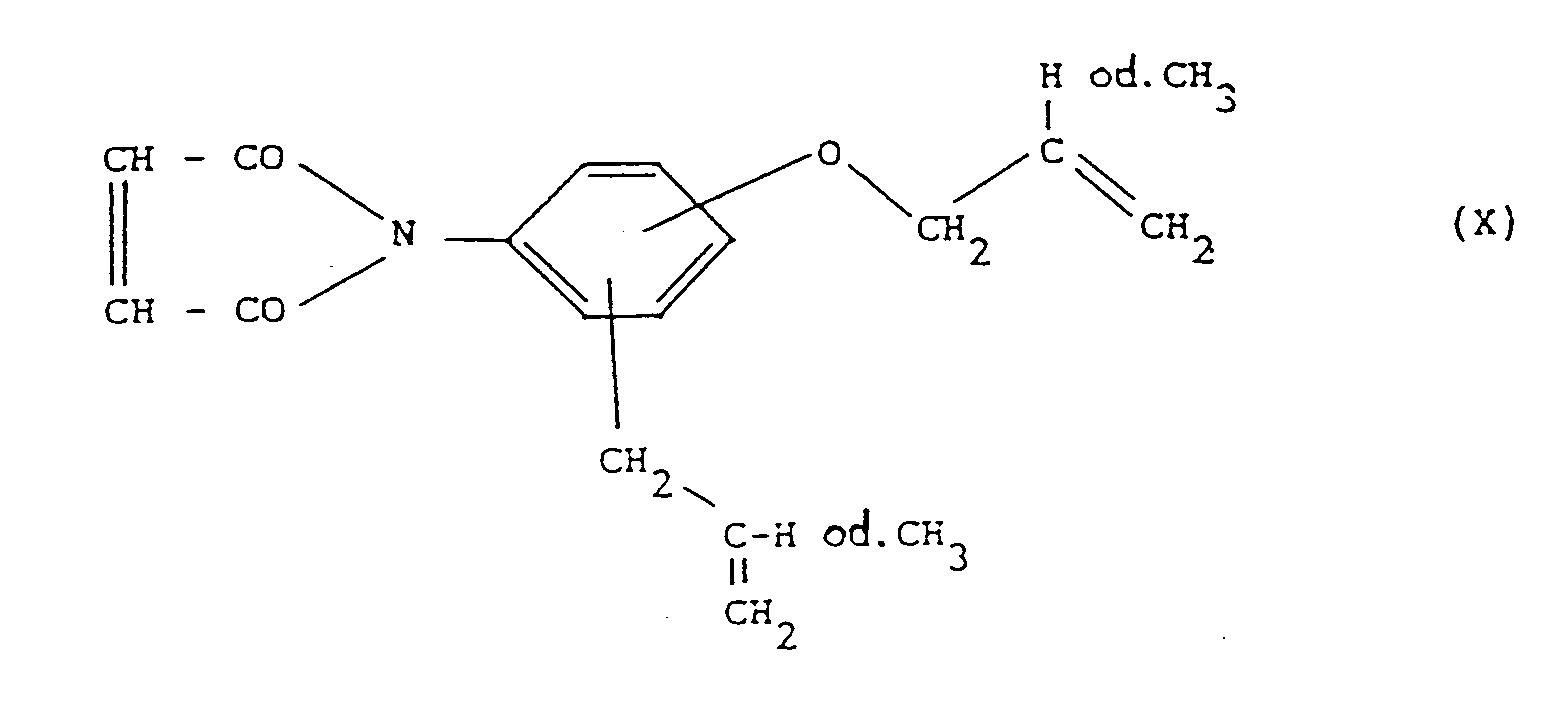 · und gegebenenfalls einem oder mehreren disubstituierten Derivaten der Formel (XI)
(c3) einem oder mehreren substituierten Heterocyclen, die eine oder mehrere Kohlenstoff-Kohlenstoff-Doppelbindungen umfassen, und
(d) gegebenenfalls einen Polymerisations-Katalysator; wobei die genannten Polymere mit Imidgruppen durch die folgenden Punkte gekennzeichnet sind:- Punkt 1: das zur Herstellung dienende Reaktionsmedium enthält als Amino-Reaktionspartner (b) ein oder mehrere biprimäre, sterisch gehinderte Diamine, ausgewählt aus der Gruppe, die gebildet wird durch:(i) die Verbindungen der allgemeinen Formel (IV) · die Symbole R₁, R₂, R₃ und R₄, gleich oder verschieden, jeweils einen Methyl-, Ethyl, Propyl- oder Isopropylrest darstellen;· die Symbole Z, gleich oder verschieden, jeweils ein Wasserstoffatom oder ein Chloratom bedeuten;· das Symbol B ein divalenter Rest ist, ausgewählt aus der Gruppe, die gebildet wird aus den Resten: -CH₂-;
 (2i) und die Verbindungen der allgemeinen Formel (III)
 · sich die Aminoreste untereinander in meta- oder para-Stellung befinden;· die Symbole R₅, gleich oder verschieden, jeweils einen Methyl-, Ethyl-, Propyl- oder Isopropylrest darstellen- Punkt 2: das Reaktionsmedium enthält außerdem zwei obligatorische Zusatzstoffe (e) und (f):
· (e) besteht aus einer Verbindung, ausgewählt aus der Gruppe, die gebildet wird durch:
* (e1) ein bromiertes oder chloriertes Epoxy-Harz mit einem Epoxy-Äquivalent-Gewicht zwischen 200 und 2000, das aus einem Glycid-Ether besteht, erhalten durch Reaktion mit dem Epichlorhydrin eines Derivates, das an dem oder den aromatischen Kern(en) bromiert oder chloriert ist, stammend von einem Polyphenol, ausgewählt aus der folgenden Gruppe: Familie der Bis(Hydroxyphenyl)-alkane, Resorcin; Hydrochinon; Brenzkatechin; 4,4'-Dihydroxy-diphenyl; und den Kondensationsprodukten der obengenannten Phenole mit einem Aldehyd;
* (e2) ein N,N'-Alkylen-bis-tetrahalogenphthalimid der Formel (V)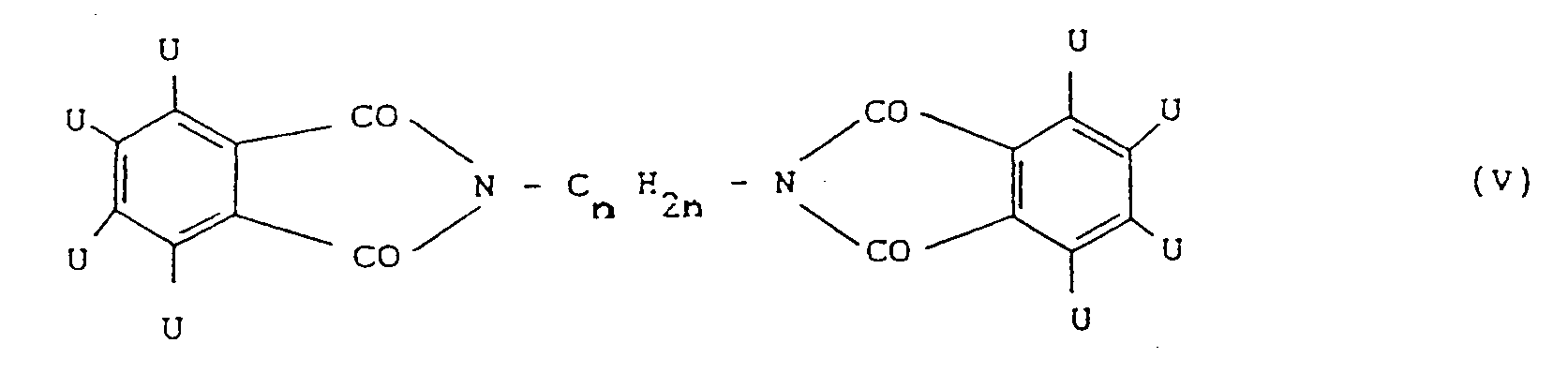 · die Symbole U, gleich oder verschieden, jeweils ein Chloratom oder Bromatom darstellen;· der Alkylenrest -CnH2n- gerade oder verzweigt sein kann;· n eine ganze Zahl von 1, 2, 3 oder 4 ist;* (e3) ein halogeniertes Produkt der Formel (VI)
 · die Symbole U die oben angegebene Bedeutung besitzen;· das Symbol V eine einfache Valenzbindung, einen geraden oder verzweigten Alkylenrest -CnH2n- mit n gleich 1, 2, 3 oder 4 oder ein Sauerstoffatom darstellt;· p eine ganze Zahl von 2, 3 oder 4 ist;* (e4) ein nicht halogeniertes Epoxy-Harz mit einem Epoxy-Äquivalent-Gewicht zwischen 100 und 1000, das aus einem Glycid-Ether besteht, erhalten durch Reaktion mit dem Epichlorhydrin eines Polyphenols, das an dem oder den aromatischen Kern(en) nicht bromiert oder chloriert ist, ausgewählt aus der bereits oben bei der Definition des Harzes (e1) erwähnten Gruppe von Phenolen;
* und (e5) eine Mischung von zwei oder mehr als zwei der vorstehend genannten Verbindungen (e1) bis (e4) untereinander;
(f) besteht aus einer Verbindung, die ein oder mehrere Alkenylphenole der Formel (VII) · das Symbol E eine einfache Valenzbindung oder einen divalenten Rest darstellt, ausgewählt aus der durch die folgenden Reste gebildeten Gruppe:
 · die Symbole R₆, gleich oder verschieden, jeweils ein Wasserstoffatom oder einen Methylrest darstellen;· die Symbole R₇, gleich oder verschieden, jeweils ein Wasserstoffatom oder einen geraden oder verzweigten Alkylrest mit 1 bis 6 Kohlenstoffatomen oder einen Phenylrest bedeuten;- Punkt 3: das Reaktionsmedium enthält in dem Fall, wo man auf einen Katalysator (d) zurückgreift, als Katalysator einen radikalischen Polymerisations-Initiator, der aus einem organischen Peroxid oder aus Azo-bis-isobutyronitril besteht.
 - Verfahren nach Anspruch 1, dadurch gekennzeichnet, daß der Reaktionspartner (a) aus der folgenden Gruppe ausgewählt wird:- N,N'-Metaphenylen-bis-maleimid,- N,N'-Paraphenylen-bis-maleimid,- N,N'-4,4'-Diphenylmethan-bis-maleimid,- N,N'-4,4'-Diphenylether-bis-maleimid,- N,N'-4,4'-Diphenylsulfon-bis-maleimid,- N,N'-1,4-Cyclohexylen-bis-maleimid,- N,N'-4,4'-(1,1-Diphenyl-cyclohexan)-bis-maleimid,- N,N'-4,4'-(2,2-Diphenyl-propan)-bis-maleimid,- N,N'-4,4'-Triphenylmethan-bis-maleimid,- N,N'-2-Methyl-1,3-phenylen-bis-maleimid,- N,N'-4-Methyl-1,3-phenylen-bis-maleimid,- N,N'-5-Methyl-1,3-phenylen-bis-maleimid,- ihren Mischungen
- Verfahren nach irgendeinem der Ansprüche 1 und 2, dadurch gekennzeichnet, daß der Reaktionspartner (b) aus der folgenden Gruppe ausgewählt wird:- 4,4'-Diamino-3,3',5,5'-tetramethyl-diphenylmethan,- 4,4'-Diamino-3,3',5,5'-tetraethyl-diphenylmethan,- 4,4'-Diamino-3,5-dimethyl-3',5'-diethyl-diphenylmethan,- 4,4'-Diamino-3,3'-diethyl-5,5'-dimethyl-diphenylmethan,- 4,4'-Diamino-3,3',5,5'-tetraisopropyl-diphenylmethan,- 4,4'-Diamino-3,3'-diisopropyl-5,5'-dimethyl-diphenylmethan,- Bis-1,4-(4-Amino-3,5-dimethyl-α,α-dimethylbenzyl)-benzol,- Bis-1,3-(4-Amino-3,5-dimethyl-α,α-dimethylbenzyl)-benzol,- 1,3-Diamino-2,4-diethyl-6-methyl-benzol,- 1,3-Diamino-2-methyl-4,6-diethyl-benzol,- und ihren Mischungen
- Verfahren nach irgendeinem der Ansprüche 1 bis 3, dadurch gekennzeichnet, daß der Zusatzstoff (e) aus einer aus der folgenden Gruppe ausgewählten Verbindung besteht:
* (e1) ein bromiertes oder chloriertes Epoxy-Harz mit einem Epoxy-Äquivalent-Gewicht zwischen 200 und 2000, das aus einem Glycid-Ether besteht, erhalten durch Reaktion mit dem Epichlorhydrin eines Derivates, das an dem oder den aromatischen Kern(en) bromiert oder chloriert ist, stammend von einem Polyphenol, ausgewählt aus der folgenden Gruppe: Familie der Bis(Hydroxyphenyl)-alkane wie Bis-2,2-(4-Hydroxyphenyl)-propan, Bis-(4-Hydroxyphenyl)-methan, Bis-(4-Hydroxyphenyl)-methylphenyl-methan, Bis-(4-Hydroxyphenyl)-tolyl-methane; Resorcin; Hydrochinon; Brenzkatechin; 4,4'-Dihydroxy-diphenyl; und den Kondensationsprodukten der obengenannten Phenole mit einem Aldehyd;
* (e2) ein N,N'-Alkylen-bis-tetrabromphthalimid;
* (e3) ein Bis-(Allyloxydibromphenyl)-alkan der Formel (VIII)
* (e4) ein nicht halogeniertes Epoxy-Harz mit einem Epoxy-Äquivalent-Gewicht zwischen 100 und 1000, das aus einem Glycid-Ether besteht, erhalten durch Reaktion mit dem Epichlorhydrin eines Polyphenols, das an dem oder den aromatischen Kern(en) nicht bromiert oder chloriert ist, ausgewählt aus der bereits oben in dem vorliegenden Anspruch bei der Definition des Harzes (e1) erwähnten Gruppe von Phenolen;
* und (e5) eine Mischung von zwei oder mehr als zwei der oben in dem vorliegenden Anspruch genannten Verbindungen (e1) bis (e4) untereinander. - Verfahren zur Herstellung von Polymeren mit Imid-Gruppen, die in Form von wärmehärtbaren Prepolymeren (P) vorliegen, löslich in den üblichen polaren organischen Lösungsmitteln, und einen Erweichungspunkt bei einer Temperatur von unterhalb 200 °C aufweisen, das darin besteht, die wie vorstehend in Anspruch 1 definierte Mischung der Bestandteile (a) + (b) + (e) + (f) + gegebenenfalls (c) + gegebenenfalls (d) direkt auf eine Temperatur von 50 °C bis 180 °C bis zum vorliegen eines homogenen oder pastösen Produktes zu erhitzen.
- Verfahren nach Anspruch 1, dadurch gekennzeichnet, daß es darin besteht, die Mischung der Ausgangsbestandteile auf eine Temperatur zwischen 50 °C und 180 °C zu erhitzen, um in einem ersten Zeitraum ein Prepolymer (P) zu bilden, und anschließend die Härtung des Prepolymers (P) durch Erhitzen auf eine Temperatur zwischen 150 °C und 300 °C durchzuführen.
- Verfahren nach irgendeinem der Ansprüche 1 bis 6, dadurch gekennzeichnet, daß der Zusatzstoff (f) besteht aus:- entweder einem oder mehreren Alkylphenolen der Formel (VII),- oder aus einer Mischung, die (i) ein oder mehrere Alkylphenole der Formel (VII) und (2i) ein oder mehrere diesem oder diesen Phenol(en) entsprechende Allylether enthält, das heißt, ein oder mehrere Allylether, die sich durch Transposition von diesem(n) Phenol(en) ableiten.
- Verfahren nach Anspruch 7, dadurch gekennzeichnet, daß das oder die Alkylphenol(e) der Formel (VII) aus der Gruppe ausgewählt werde, die gebildet wird durch:- 4,4'-Dihydroxy-3,3'-diallyl-bisphenyl,- Bis-(4-Hydroxy-3-allylphenyl)-methan,- Bis-(4-Hydroxy-3-allylphenyl)-ether,- Bis-2,2-(4-Hydroxy-3-allylphenyl)-propan oder O,O'-Diallylbisphenol A,- den Methylether, der dem einem oder anderen der vorstehend genannten Alkenylphenole entspricht.
- Verfahren nach irgendeinem der Ansprüche 1 bis 8, dadurch gekennzeichnet, daß die Mengen von N,N'-Bis-Imid(en) (a) und sterisch gehindertem(n) Diamin(en) (b) in der Weise gewählt werden, daß das Verhältnis r:

- Verfahren nach irgendeinem der Ansprüche 1 bis 9, dadurch gekennzeichnet, daß der wahlweise Reaktionspartner (c) im Fall seiner Verwendung in Mengen eingesetzt wird, die mindestens 60 % des Gesamtgewichtes der Reaktionspartner (a) + (b) entsprechen.
- Verfahren nach irgendeinem der Ansprüche 1 bis 10, dadurch gekennzeichnet, daß der wahlweise Katalysator (d) im Fall seiner Verwendung in Mengen eingesetzt wird, die im Intervall von 0,01 bis 5 Gewichtsprozent liegen, bezogen auf die Gesamtheit der Reaktionspartner (a) + (b) + gegebenenfalls (c).
- Verfahren nach irgendeinem der Ansprüche 1 bis 11, dadurch gekennzeichnet, daß einerseits die Menge an Zusatzstoff (e) 2 bis 30 % des Gewichtes der Mischung Bis-Imid(e) (a) + Diamin(e) (b) + gegebenenfalls Reaktionspartner (c) darstellt und andererseits die durch den Zusatzstoff (e) eingebrachte Menge an Chlor oder Brom, ausgedrückt in Gewichtsprozent von elementarem Chlor oder elementarem Brom, bezogen auf das Gewicht der Gesamt mischung Bis-Imid(e) (a) + Diamin(e) (b) + wahlweiser Reaktionspartner (c) + Zusatzstoffe (e) und (f), höchstens 8 % ausmacht.
- Verfahren nach irgendeinem der Ansprüche 1 bis 12, dadurch gekennzeichnet, daß die Menge an Zusatzstoff (f) 2 bis 30 % des Gewichtes der Mischung Bis-Imid(e) (a) + Diamin(e) (b) + gegebenenfalls Reaktionspartner (c) darstellt.
Applications Claiming Priority (2)
| Application Number | Priority Date | Filing Date | Title |
|---|---|---|---|
| FR8913713A FR2653130B1 (fr) | 1989-10-16 | 1989-10-16 | Polymeres a groupements imides faits a partir de diamines encombrees. |
| FR8913713 | 1989-10-16 |
Publications (2)
| Publication Number | Publication Date |
|---|---|
| EP0424286A1 EP0424286A1 (de) | 1991-04-24 |
| EP0424286B1 true EP0424286B1 (de) | 1994-11-09 |
Family
ID=9386578
Family Applications (1)
| Application Number | Title | Priority Date | Filing Date |
|---|---|---|---|
| EP90420442A Expired - Lifetime EP0424286B1 (de) | 1989-10-16 | 1990-10-11 | Von sterisch gehinderten Diaminen abgeleitete imidgruppenhaltige Polymere |
Country Status (15)
| Country | Link |
|---|---|
| US (1) | US5034503A (de) |
| EP (1) | EP0424286B1 (de) |
| JP (1) | JP2572679B2 (de) |
| KR (1) | KR910008022A (de) |
| AT (1) | ATE113970T1 (de) |
| AU (1) | AU635570B2 (de) |
| BR (1) | BR9005170A (de) |
| CA (1) | CA2027614C (de) |
| DE (1) | DE69014071T2 (de) |
| ES (1) | ES2063949T3 (de) |
| FR (1) | FR2653130B1 (de) |
| IE (1) | IE903609A1 (de) |
| IL (1) | IL96006A0 (de) |
| PT (1) | PT95590A (de) |
| ZA (1) | ZA908221B (de) |
Families Citing this family (9)
| Publication number | Priority date | Publication date | Assignee | Title |
|---|---|---|---|---|
| FR2645539B1 (fr) * | 1989-04-10 | 1991-06-14 | Rhone Poulenc Chimie | Polymeres a groupements imides faits a partir de diamines encombrees |
| FR2645540B1 (fr) * | 1989-04-10 | 1991-06-14 | Rhone Poulenc Chimie | Polymeres a groupements imide a base de maleimides dont un bismaleimide siloxane et de diamines aromatiques et leur procede de preparation |
| US5302723A (en) * | 1993-10-04 | 1994-04-12 | Monsanto Company | Process for preparing flame retardant bisimide compositions |
| US5393887A (en) * | 1993-10-04 | 1995-02-28 | Monsanto Company | Bisimide compositions |
| US8426532B2 (en) * | 2010-09-17 | 2013-04-23 | Sabic Innovative Plastics Ip B.V. | Polycarbonate graft copolymers |
| CN103304811B (zh) * | 2013-06-06 | 2015-12-02 | 北京京东方光电科技有限公司 | 一种固化树脂、蓝色光阻剂、彩色滤光片及它们的制备方法、彩色显示器件 |
| CN103304813B (zh) | 2013-06-06 | 2015-09-23 | 北京京东方光电科技有限公司 | 一种固化树脂、间隔物剂、滤光片及它们的制备方法、显示器件 |
| CN103319713B (zh) * | 2013-06-06 | 2015-11-25 | 北京京东方光电科技有限公司 | 一种固化树脂、黑色光阻剂、滤光片及它们的制备方法、显示器件 |
| WO2017209237A1 (ja) * | 2016-06-03 | 2017-12-07 | Dic株式会社 | 置換または非置換アリル基含有マレイミド化合物およびその製造方法、並びに前記化合物を用いた組成物および硬化物 |
Family Cites Families (10)
| Publication number | Priority date | Publication date | Assignee | Title |
|---|---|---|---|---|
| FR2472586A1 (fr) * | 1979-12-28 | 1981-07-03 | Rhone Poulenc Ind | Compositions a base de polymeres a groupements imide et de lactame |
| GB2093847B (en) * | 1981-03-04 | 1984-09-05 | Du Pont | Epoxy imide compositions |
| FR2608613B1 (fr) * | 1986-12-17 | 1989-03-31 | Rhone Poulenc Chimie | Polymeres a groupements imides faits a partir de diamines encombrees et leurs procedes de preparation |
| FR2609467B1 (fr) * | 1987-01-09 | 1989-06-09 | Rhone Poulenc Chimie | Compositions thermodurcissables a base de groupements imide et epoxy |
| EP0292434B1 (de) * | 1987-05-22 | 1992-07-08 | Ciba-Geigy Ag | Ungesättigte Bisimide und deren Polymeren |
| CA1307605C (fr) * | 1987-06-23 | 1992-09-15 | Rene Arpin | Polymeres a groupements imides sans diamine et leur procede de preparation |
| FR2628111B1 (fr) * | 1988-03-03 | 1992-01-24 | Rhone Poulenc Chimie | Polymeres a groupements imides faits a partir de diamines encombrees et leurs procedes de preparation |
| FR2638163B1 (fr) * | 1988-10-26 | 1991-01-11 | Rhone Poulenc Chimie | Polymeres a groupements imides faits a partir de diamines encombrees |
| FR2645539B1 (fr) * | 1989-04-10 | 1991-06-14 | Rhone Poulenc Chimie | Polymeres a groupements imides faits a partir de diamines encombrees |
| FR2645540B1 (fr) * | 1989-04-10 | 1991-06-14 | Rhone Poulenc Chimie | Polymeres a groupements imide a base de maleimides dont un bismaleimide siloxane et de diamines aromatiques et leur procede de preparation |
-
1989
- 1989-10-16 FR FR8913713A patent/FR2653130B1/fr not_active Expired - Lifetime
-
1990
- 1990-10-09 IE IE360990A patent/IE903609A1/en unknown
- 1990-10-11 AT AT90420442T patent/ATE113970T1/de not_active IP Right Cessation
- 1990-10-11 DE DE69014071T patent/DE69014071T2/de not_active Expired - Fee Related
- 1990-10-11 EP EP90420442A patent/EP0424286B1/de not_active Expired - Lifetime
- 1990-10-11 ES ES90420442T patent/ES2063949T3/es not_active Expired - Lifetime
- 1990-10-12 AU AU64576/90A patent/AU635570B2/en not_active Ceased
- 1990-10-12 PT PT95590A patent/PT95590A/pt not_active Application Discontinuation
- 1990-10-15 CA CA002027614A patent/CA2027614C/fr not_active Expired - Fee Related
- 1990-10-15 ZA ZA908221A patent/ZA908221B/xx unknown
- 1990-10-15 JP JP2273515A patent/JP2572679B2/ja not_active Expired - Fee Related
- 1990-10-15 BR BR909005170A patent/BR9005170A/pt unknown
- 1990-10-15 IL IL96006A patent/IL96006A0/xx unknown
- 1990-10-16 US US07/598,126 patent/US5034503A/en not_active Expired - Lifetime
- 1990-10-16 KR KR1019900016478A patent/KR910008022A/ko not_active Ceased
Also Published As
| Publication number | Publication date |
|---|---|
| DE69014071T2 (de) | 1995-03-30 |
| JP2572679B2 (ja) | 1997-01-16 |
| ES2063949T3 (es) | 1995-01-16 |
| ZA908221B (en) | 1991-08-28 |
| AU635570B2 (en) | 1993-03-25 |
| DE69014071D1 (de) | 1994-12-15 |
| IL96006A0 (en) | 1991-07-18 |
| JPH03139524A (ja) | 1991-06-13 |
| FR2653130B1 (fr) | 1992-01-03 |
| BR9005170A (pt) | 1991-09-17 |
| FR2653130A1 (fr) | 1991-04-19 |
| CA2027614C (fr) | 1996-01-02 |
| US5034503A (en) | 1991-07-23 |
| EP0424286A1 (de) | 1991-04-24 |
| AU6457690A (en) | 1991-04-18 |
| PT95590A (pt) | 1991-09-13 |
| KR910008022A (ko) | 1991-05-30 |
| CA2027614A1 (fr) | 1991-04-17 |
| IE903609A1 (en) | 1991-04-24 |
| ATE113970T1 (de) | 1994-11-15 |
Similar Documents
| Publication | Publication Date | Title |
|---|---|---|
| EP0284520B1 (de) | Hitzebeständige Polymere auf Basis von Maleimiden, darunter ein Bis-maleimid-Siloxan, sowie Verfahren zur Herstellung | |
| CA2027614C (fr) | Polymeres a groupements imides faits a partir de diamines encombree | |
| EP0287479B1 (de) | Hitzestabile Polymere auf Basis von Maleimiden und Diamin-Siloxanen, und Verfahren zu ihrer Herstellung | |
| EP0397581B1 (de) | Imidgruppen enthaltende Polymere, die aus Maleimiden, von denen eines ein Bismaleimidsiloxan ist, und aromatischen Diaminen hergestellt werden und Herstellungsverfahren | |
| EP0366576A1 (de) | Imidgruppen enthaltende, aus ungehinderten Diaminen bereitete Polymere | |
| EP0397582B1 (de) | Polymere mit Imidgruppen, ausgehend von gehinderten Diaminen | |
| EP0284524B1 (de) | Hitzestabile Polymere auf der Basis von Maleimiden, wovon eins ein Bismaleimid-Siloxan ist, und aromatischen Diaminen, Verfahren zu ihrer Herstellung | |
| EP0334771B1 (de) | Aus sterisch gehinderten Diaminen abgeleitete, Imidgruppierungen aufweisende Polymerisate und Verfahren zu deren Herstellung | |
| EP0296994B1 (de) | Polymere mit Imid-Gruppen ohne Diamin und Verfahren zu deren Herstellung | |
| CA2088672A1 (fr) | Compositions thermodurcissables a base de composes cyanate ester et de composes polyimide a groupement (s) diorganopolysiloxane | |
| EP0467796B1 (de) | Imidgruppe enthaltende Polymere und Verfahren zur Herstellung | |
| KR100204326B1 (ko) | 난연성 폴리이미드 조성물 | |
| FR2605636A1 (fr) | Polymeres a groupements imides sans diamine et leurs procedes de preparation | |
| FR2617173A1 (fr) | Polymeres a groupements imides sans diamine et leur procede de preparation |
Legal Events
| Date | Code | Title | Description |
|---|---|---|---|
| PUAI | Public reference made under article 153(3) epc to a published international application that has entered the european phase |
Free format text: ORIGINAL CODE: 0009012 |
|
| AK | Designated contracting states |
Kind code of ref document: A1 Designated state(s): AT BE CH DE DK ES FR GB GR IT LI LU NL SE |
|
| 17P | Request for examination filed |
Effective date: 19910521 |
|
| RAP1 | Party data changed (applicant data changed or rights of an application transferred) |
Owner name: CIBA-GEIGY AG |
|
| 17Q | First examination report despatched |
Effective date: 19930115 |
|
| GRAA | (expected) grant |
Free format text: ORIGINAL CODE: 0009210 |
|
| ITF | It: translation for a ep patent filed | ||
| AK | Designated contracting states |
Kind code of ref document: B1 Designated state(s): AT BE CH DE DK ES FR GB GR IT LI LU NL SE |
|
| PG25 | Lapsed in a contracting state [announced via postgrant information from national office to epo] |
Ref country code: NL Effective date: 19941109 Ref country code: GR Free format text: LAPSE BECAUSE OF FAILURE TO SUBMIT A TRANSLATION OF THE DESCRIPTION OR TO PAY THE FEE WITHIN THE PRESCRIBED TIME-LIMIT Effective date: 19941109 Ref country code: DK Effective date: 19941109 Ref country code: AT Effective date: 19941109 |
|
| REF | Corresponds to: |
Ref document number: 113970 Country of ref document: AT Date of ref document: 19941115 Kind code of ref document: T |
|
| REF | Corresponds to: |
Ref document number: 69014071 Country of ref document: DE Date of ref document: 19941215 |
|
| REG | Reference to a national code |
Ref country code: ES Ref legal event code: FG2A Ref document number: 2063949 Country of ref document: ES Kind code of ref document: T3 |
|
| GBT | Gb: translation of ep patent filed (gb section 77(6)(a)/1977) |
Effective date: 19950109 |
|
| PG25 | Lapsed in a contracting state [announced via postgrant information from national office to epo] |
Ref country code: SE Effective date: 19950209 |
|
| NLV1 | Nl: lapsed or annulled due to failure to fulfill the requirements of art. 29p and 29m of the patents act | ||
| PLBE | No opposition filed within time limit |
Free format text: ORIGINAL CODE: 0009261 |
|
| STAA | Information on the status of an ep patent application or granted ep patent |
Free format text: STATUS: NO OPPOSITION FILED WITHIN TIME LIMIT |
|
| PG25 | Lapsed in a contracting state [announced via postgrant information from national office to epo] |
Ref country code: LU Free format text: LAPSE BECAUSE OF NON-PAYMENT OF DUE FEES Effective date: 19951031 Ref country code: BE Effective date: 19951031 |
|
| 26N | No opposition filed | ||
| PGFP | Annual fee paid to national office [announced via postgrant information from national office to epo] |
Ref country code: CH Payment date: 19951221 Year of fee payment: 6 |
|
| BERE | Be: lapsed |
Owner name: CIBA-GEIGY A.G. Effective date: 19951031 |
|
| PG25 | Lapsed in a contracting state [announced via postgrant information from national office to epo] |
Ref country code: LI Effective date: 19961031 Ref country code: CH Effective date: 19961031 |
|
| REG | Reference to a national code |
Ref country code: GB Ref legal event code: 732E |
|
| REG | Reference to a national code |
Ref country code: CH Ref legal event code: PL |
|
| REG | Reference to a national code |
Ref country code: FR Ref legal event code: TP |
|
| REG | Reference to a national code |
Ref country code: ES Ref legal event code: PC2A |
|
| REG | Reference to a national code |
Ref country code: GB Ref legal event code: 732E |
|
| REG | Reference to a national code |
Ref country code: GB Ref legal event code: IF02 |
|
| REG | Reference to a national code |
Ref country code: FR Ref legal event code: TP |
|
| PGFP | Annual fee paid to national office [announced via postgrant information from national office to epo] |
Ref country code: GB Payment date: 20030929 Year of fee payment: 14 |
|
| PGFP | Annual fee paid to national office [announced via postgrant information from national office to epo] |
Ref country code: FR Payment date: 20031009 Year of fee payment: 14 |
|
| PGFP | Annual fee paid to national office [announced via postgrant information from national office to epo] |
Ref country code: DE Payment date: 20031010 Year of fee payment: 14 |
|
| PGFP | Annual fee paid to national office [announced via postgrant information from national office to epo] |
Ref country code: ES Payment date: 20031017 Year of fee payment: 14 |
|
| PG25 | Lapsed in a contracting state [announced via postgrant information from national office to epo] |
Ref country code: GB Free format text: LAPSE BECAUSE OF NON-PAYMENT OF DUE FEES Effective date: 20041011 |
|
| PG25 | Lapsed in a contracting state [announced via postgrant information from national office to epo] |
Ref country code: ES Free format text: LAPSE BECAUSE OF NON-PAYMENT OF DUE FEES Effective date: 20041013 |
|
| PG25 | Lapsed in a contracting state [announced via postgrant information from national office to epo] |
Ref country code: DE Free format text: LAPSE BECAUSE OF NON-PAYMENT OF DUE FEES Effective date: 20050503 |
|
| GBPC | Gb: european patent ceased through non-payment of renewal fee |
Effective date: 20041011 |
|
| PG25 | Lapsed in a contracting state [announced via postgrant information from national office to epo] |
Ref country code: FR Free format text: LAPSE BECAUSE OF NON-PAYMENT OF DUE FEES Effective date: 20050630 |
|
| REG | Reference to a national code |
Ref country code: FR Ref legal event code: ST |
|
| PG25 | Lapsed in a contracting state [announced via postgrant information from national office to epo] |
Ref country code: IT Free format text: LAPSE BECAUSE OF NON-PAYMENT OF DUE FEES;WARNING: LAPSES OF ITALIAN PATENTS WITH EFFECTIVE DATE BEFORE 2007 MAY HAVE OCCURRED AT ANY TIME BEFORE 2007. THE CORRECT EFFECTIVE DATE MAY BE DIFFERENT FROM THE ONE RECORDED. Effective date: 20051011 |
|
| REG | Reference to a national code |
Ref country code: ES Ref legal event code: FD2A Effective date: 20041013 |