EP0192988A2 - Procédé pour la solubilisation, purification et caractérisation de protéines à partir d'aggrégats ou complexes de protéines insolubles et compositions s'y rapportant - Google Patents
Procédé pour la solubilisation, purification et caractérisation de protéines à partir d'aggrégats ou complexes de protéines insolubles et compositions s'y rapportant Download PDFInfo
- Publication number
- EP0192988A2 EP0192988A2 EP86101209A EP86101209A EP0192988A2 EP 0192988 A2 EP0192988 A2 EP 0192988A2 EP 86101209 A EP86101209 A EP 86101209A EP 86101209 A EP86101209 A EP 86101209A EP 0192988 A2 EP0192988 A2 EP 0192988A2
- Authority
- EP
- European Patent Office
- Prior art keywords
- protein
- aggregate
- urea
- solution
- complex
- Prior art date
- Legal status (The legal status is an assumption and is not a legal conclusion. Google has not performed a legal analysis and makes no representation as to the accuracy of the status listed.)
- Granted
Links
Images

Classifications
-
- C—CHEMISTRY; METALLURGY
- C07—ORGANIC CHEMISTRY
- C07K—PEPTIDES
- C07K1/00—General methods for the preparation of peptides, i.e. processes for the organic chemical preparation of peptides or proteins of any length
- C07K1/107—General methods for the preparation of peptides, i.e. processes for the organic chemical preparation of peptides or proteins of any length by chemical modification of precursor peptides
- C07K1/113—General methods for the preparation of peptides, i.e. processes for the organic chemical preparation of peptides or proteins of any length by chemical modification of precursor peptides without change of the primary structure
- C07K1/1136—General methods for the preparation of peptides, i.e. processes for the organic chemical preparation of peptides or proteins of any length by chemical modification of precursor peptides without change of the primary structure by reversible modification of the secondary, tertiary or quarternary structure, e.g. using denaturating or stabilising agents
-
- C—CHEMISTRY; METALLURGY
- C07—ORGANIC CHEMISTRY
- C07K—PEPTIDES
- C07K14/00—Peptides having more than 20 amino acids; Gastrins; Somatostatins; Melanotropins; Derivatives thereof
- C07K14/005—Peptides having more than 20 amino acids; Gastrins; Somatostatins; Melanotropins; Derivatives thereof from viruses
-
- C—CHEMISTRY; METALLURGY
- C12—BIOCHEMISTRY; BEER; SPIRITS; WINE; VINEGAR; MICROBIOLOGY; ENZYMOLOGY; MUTATION OR GENETIC ENGINEERING
- C12N—MICROORGANISMS OR ENZYMES; COMPOSITIONS THEREOF; PROPAGATING, PRESERVING, OR MAINTAINING MICROORGANISMS; MUTATION OR GENETIC ENGINEERING; CULTURE MEDIA
- C12N2710/00—MICROORGANISMS OR ENZYMES; COMPOSITIONS THEREOF; PROPAGATING, PRESERVING, OR MAINTAINING MICROORGANISMS; MUTATION OR GENETIC ENGINEERING; CULTURE MEDIA dsDNA viruses
- C12N2710/00011—Details
- C12N2710/16011—Herpesviridae
- C12N2710/16611—Simplexvirus, e.g. human herpesvirus 1, 2
- C12N2710/16622—New viral proteins or individual genes, new structural or functional aspects of known viral proteins or genes
-
- Y—GENERAL TAGGING OF NEW TECHNOLOGICAL DEVELOPMENTS; GENERAL TAGGING OF CROSS-SECTIONAL TECHNOLOGIES SPANNING OVER SEVERAL SECTIONS OF THE IPC; TECHNICAL SUBJECTS COVERED BY FORMER USPC CROSS-REFERENCE ART COLLECTIONS [XRACs] AND DIGESTS
- Y10—TECHNICAL SUBJECTS COVERED BY FORMER USPC
- Y10S—TECHNICAL SUBJECTS COVERED BY FORMER USPC CROSS-REFERENCE ART COLLECTIONS [XRACs] AND DIGESTS
- Y10S530/00—Chemistry: natural resins or derivatives; peptides or proteins; lignins or reaction products thereof
- Y10S530/808—Materials and products related to genetic engineering or hybrid or fused cell technology, e.g. hybridoma, monoclonal products
- Y10S530/809—Fused cells, e.g. hybridoma
-
- Y—GENERAL TAGGING OF NEW TECHNOLOGICAL DEVELOPMENTS; GENERAL TAGGING OF CROSS-SECTIONAL TECHNOLOGIES SPANNING OVER SEVERAL SECTIONS OF THE IPC; TECHNICAL SUBJECTS COVERED BY FORMER USPC CROSS-REFERENCE ART COLLECTIONS [XRACs] AND DIGESTS
- Y10—TECHNICAL SUBJECTS COVERED BY FORMER USPC
- Y10S—TECHNICAL SUBJECTS COVERED BY FORMER USPC CROSS-REFERENCE ART COLLECTIONS [XRACs] AND DIGESTS
- Y10S530/00—Chemistry: natural resins or derivatives; peptides or proteins; lignins or reaction products thereof
- Y10S530/82—Proteins from microorganisms
- Y10S530/825—Bacteria
-
- Y—GENERAL TAGGING OF NEW TECHNOLOGICAL DEVELOPMENTS; GENERAL TAGGING OF CROSS-SECTIONAL TECHNOLOGIES SPANNING OVER SEVERAL SECTIONS OF THE IPC; TECHNICAL SUBJECTS COVERED BY FORMER USPC CROSS-REFERENCE ART COLLECTIONS [XRACs] AND DIGESTS
- Y10—TECHNICAL SUBJECTS COVERED BY FORMER USPC
- Y10S—TECHNICAL SUBJECTS COVERED BY FORMER USPC CROSS-REFERENCE ART COLLECTIONS [XRACs] AND DIGESTS
- Y10S530/00—Chemistry: natural resins or derivatives; peptides or proteins; lignins or reaction products thereof
- Y10S530/82—Proteins from microorganisms
- Y10S530/826—Viruses
Definitions
- This invention relates generally to a purification process for proteins which are present in insoluble complexes or aggregates.
- this invention concerns the use of a dissociating concentration step gradient such as an urea concentration gradient to selectively solubilize and separate proteins in complexes or aggregates as well as characterize said proteins.
- this invention concerns compositions of matter comprising one or more proteins which have been solubilized and purified from insoluble protein aggregates according to the process of this invention.
- HSV gD-l Herpes simplex virus Type 1 glycoprotein D
- the invention is not limited thereto but concerns the solubilization and purification of proteins from insoluble protein complexes or aggregates in general as well as compositions of matter derived therefrom.
- protein aggregates are to include and be considered the same as protein complexes.
- compositions of matter such as vaccines comprising one or more proteins which heretofore existed as insoluble protein aggregates.
- the novel process of this invention comprises layering protein aggregates onto a step gradient of two or more varying concentrations of a solution of a dissociating compound, centrifuging the gradient and then fractionating the resulting gradient to locate the solubilized protein of choice.
- the novel process of this invention identifies a concentration or concentrations of a solution of a dissociating compound which can then be employed to solubilize protein from aggregates without the subsequent use of a step gradient.
- Proteins which have been solubilized and purified from insoluble protein aggregates according to this invention are employed in a conventional manner to produce vaccines and other compositions of matter comprising said proteins.
- the novel process of this invention has, as its essential attribute, the capacity to solubilize and partially purify protein aggregate components during centrifugation as well as characterize the solubility of the protein aggregate.
- an urea step gradient is employed herein.
- urea in a step gradient provides a combined density and dissociating gradient which is a novel system.
- the sedimentation and dissociation properties of protein aggregates are utilized to fractionate and thereby partially purify component proteins of such aggregates.
- the use of guanidine HC1 or sodium dodecyl sulphate (SDS) is not an acceptable means of solubilization for certain proteins such as those to be employed as injectables since guanidine HC1 may be deleterious to the immunogenicity of the protein and SDS binds tenaciously to proteins. Urea does not exhibit the. problems which the use of guanidine HC1 and SDS produce and, additionally, urea can be quantitatively removed by dialysis after centrifugation and fractionation.
- urea solutions of two or more varying concentrations in a suitable buffer are layered, one on top of the other, in descending concentration in a centrifuge tube. This layering results in the formation of a step gradient.
- Protein aggregates, suspended in a suitable buffer such as phosphate buffered saline (PBS) are layered on top of the gradient and the gradient is centrifuged. During centrifugation, the aggregates sediment through the urea until an urea concentration is reached which solubilizes the aggregate.
- PBS phosphate buffered saline
- novel features of the present invention and, more particularly, the novel urea step gradient perform numerous functions in solubilizing and partially purifying proteins of aggregates.
- the lower concentrations of urea i.e. the upper part of the gradient
- the urea solubilized protein remains at the concentration of urea where it is solubilized. Additionally, contaminating components which are insoluble in all urea concentrations employed pellet to the bottom of the centrifuge tube.
- the concentration of urea capable of solubilizing the protein of interest is determined by use of the step gradient, direct solubilization without use of the step gradient using the determined urea concentration can be effected, followed by centrifugation to pellet insoluble matter not of interest.
- the present invention describes by way of examples the use of this novel process to purify and solubilize recombinant glycoprotein D of Herpes simplex virus Type 1 from aggregates of a total cell extract of Escherichia coli.
- the process of the present invention can be applied to protein aggregates of Hepatitis B surface antigens, poliovirus proteins and growth hormone aggregates. Any such variations necessary for the process of this invention to be employed in the purification of a particular protein of an aggregate are, with the disclosure contained herein, within the knowledge of those skilled in the art.
- the process can be varied to purify different aggregate proteins of similar properties by varying the urea concentrations, pH, salt and ionic concentrations of the buffers and centrifugation conditions that are employed without departing from the scope of the present invention with the proviso that the aggregates must ' be soluble in at least high molar urea for use of the urea step gradient.
- Other step gradients such as guanidine HCl can be employed where suitable without departing from the scope of this invention.
- the centrifugation speed used will depend upon the sedimentation rate of the aggregate as well as the size of the aggregate. Determination of the appropriate centrifugation speed is within the knowledge of those skilled in the art.
- the urea step gradient comprises urea concentrations of 7M, 6M, 5M, 4M and 3M.
- the urea step gradient comprises urea concentrations of 8M, 7M, 6M, 5M and 4M.
- the gradient can be centrifuged at about 113,000 xg(r maX ) at a temperature of about 4°C to about 15°C for about one hour.
- the urea concentrations are prepared in buffer comprising 50 mM TRIS(tris(hydroxymethyl)aminomethane), lmM EDTA(ethylenediaminetetraacetic acid) and lmM DTT(1,4- dithiothreitol), pH 9.0.
- the protein aggregates of such preferred embodiment are suspended in PBS comprising 0.8 mM sodium phosphate, dibasic, 2.3 mM potassium phosphate, monobasic and 0.15 M sodium chloride.
- the urea concentrations employed in said preferred embodiment are 7M, 6M, 5M, 4M and 3M and the gradient with protein aggregate is centrifuged for about 45 minutes at about 113,000xg(r max ) at about 10 0 C.
- the gradient is fractionated.
- One such method of fractionation is to puncture the gradient tube at the bottom and to the side of the pellet. Then fractions are collected from the bottom of the tube.
- fractions collected as described above can then be assayed for detection of the protein of interest.
- samples from the fractions can be assayed by SDS-polyacrylamide gel electrophoresis or other means well known to those skilled in the art. In this manner, the fractions that contain the protein of interest can be ascertained.
- the protein contained in the fractions, as determined above, can then be subjected to further purification and/or concentration as needed using techniques that are well known to those skilled in the art. Such techniques include ion exchange chromatography, dialysis and ultra filtration.
- compositions of matter such as vaccines may then be produced according to conventional methods employing proteins which have been solubilized and purified according to the process of this invention.
- the proteins may be bound to aluminum hydroxide, aluminum phosphate or other pharmaceutically acceptable adjuvant or carrier.
- Vaccine compositions may include, in addition to the protein or proteins, immunologically acceptable diluents and carriers as well as commonly employed adjuvants such as alum, Freund's Complete Adjuvant, saponin, and the like.
- the vaccine compositions of the present invention can be administered alone or, where immunologically acceptable, in combination with other vaccines.
- the process of this invention as applied to the purification of recombinant glycoprotein D-l(gD-l) from a strain of Escherichia coli (NF 1829) containing a recombinant plasmid coding for a major portion of gD-1 (pEH 102) is described below.
- the strain of Escherichia coli (NF 1829) containing the recombinant plasmid pEH 102 as well as the glycoprotein D-1 produced thereby is disclosed in the U. S. patent application of Roger J. Watson, John H. Weis and Lynn W. Enquist, docket number 2697046 of Pennie and Edmonds, 1155 Avenue of the Americas, New York, New York, attorneys for the applicants therein.
- the recombinant gD-I protein that is produced thereby is approximately 45K in size (i.e. a molecular weight of approximately 45,000). Therefore, the recombinant gD-1 protein will be referred'to hereinafter as 45K or 45K protein.
- the description of the process as applied to the purfication of the 45K protein is provided by way of example and should not be construed to limit this invention in any way to the specific purification process described hereinafter.
- a 38.2 g (wet weight) portion of a pellet of bacterial cells recovered from the fermentation of NF1829 (pEH 102) strain was resuspended to a total volume of 180 ml in a bacterial cell extraction buffer comprising 20 mM sodium/po- tassium phosphate, 10% glycerol, 0.5% NP40 (Nonidet P-40, Bethesda Research Laboratories) and 1.0 mM EDTA. The mixture was incubated for about 30 minutes at 4 0 C with occasional mixing. Then, 36.0 mg of lysozyme were added to the bacterial cell suspension and the suspension was mixed occasionally while incubating at 4 0 C for one hour.
- a 450 mg amount of 23-14 powder (Zwittergent 3-14, Calbiochem-Behring Corporation) was added to the above suspension with mixing. Then, the suspension was allowed to incubate at 4 0 C with occasional mixing for approximately 30 minutes resulting in a dramatic increase in viscosity.
- the bacterial lysate was sonicated vigorously for 2 minutes, in one minute bursts with a Heat Systems W-375 sonicator (Ultrasonics Inc.), then centrifuged at 65 xg(r max ) (500 rpm in 259 rotor in a PR-6000 centrifuge (International Equipment Co.)), for 5 minutes, at 4 0 C.
- the residual pellets were resuspended in PBS (0.8 mM sodium phosphate, dibasic, 2.3 mM potassium phosphate, monobasic and 0.15 M sodium chloride), sonicated as described hereinabove, then stored at -70 0 C.
- PBS 0.8 mM sodium phosphate, dibasic, 2.3 mM potassium phosphate, monobasic and 0.15 M sodium chloride
- the tubes were filled with bacterial cell extraction buffer and centrifuged at 113,000 xg(r max ) (25,000 rpm) for one hour at 4°C in a L2-65 ultracentrifuge. The supernatant and sucrose cuts from each tube were collected and pooled separately leaving the aggregates which had pelleted. The aggregates were resuspended in sterile filtered PBS-EDTA and pooled. The tubes were rinsed with additional buffer and the washes were added to the pooled aggregates which were sonicated for 60 seconds as hereinbefore described. The suspension was then adjusted to a volume of 50.0 ml with sterile filtered PBS-EDTA. This suspension was then stored at 4o C.
- a stock solution of 8M urea was prepared by dissolving 240.24 g of urea in about 400 ml of distilled water containing 3.0285 g of tris(hydroxymethyl)aminomethane (TRIS), 146.1 mg of ethylenediaminetetraacetic acid (EDTA) and 77.1 mg of 1,4-dithiothreitol (DTT).
- TIS tris(hydroxymethyl)aminomethane
- EDTA ethylenediaminetetraacetic acid
- DTT 1,4-dithiothreitol
- the solution was adjusted to pH 9.0 with hydrochloric acid, the volume was brought to 500 ml with distilled water and the solution was filtered through a Nalgene O 0.2 ⁇ m filter (Nalge Co., Division of Sybron Corp., Rochester, NY 14602).
- the resulting solution (Buffer A) comprises 8M urea, 50 mM TRIS HC1, 1 mM EDTA and 1 mM
- a stock buffered solution without urea (Buffer B) was also prepared in the manner described above comprising 50 mM TRIS, 1 mM EDTA and 1 mM DTT, adjusted to pH 9.0 with hydrochloric acid.
- the gradient tubes were placed in a SW27 rotor and centrifuged at about 10 0 C and about 113,000 xg(r max ) (25,000 rpm) in a L2-65 ultracentrifuge for about 45 minutes. Gradient fractions were collected from the bottom of the tubes through a needle puncture to the side of the residual pellet. The individual fractions of the 7M, 6M, 5M, 4M and 3M concentrations were collected in separate centrifuge tubes which were labeled according to the molar concentration of urea in the fraction. A yellow colored band which was evident at the interface between fractions aided in the collection. The fraction collection was also aided by the application of air pressure to the top surface of the liquid in the tube.
- the gel was stained in a solution containing 0.5% (w/v) coomassie blue - R250 (Bio-Rad) in 50% (v/v) methanol and 7% acetic acid. Excess dye was removed by washing in 5% methanol and 7% acetic acid. Photographs were taken of wet gels after removal of unbound dye. The gel showed the urea solubilized protein was present in the 7M, 6M, 5M and 4M fractions. Then, the 7M, 6M, 5M and 4M urea fractions (total volume of 24 ml) from each* of the six gradients were pooled to give 144 ml. Ion Exchange Chromatography
- the pooled fractions (144 ml) containing the soluble 45K protein were mixed with 45 ml of DEAE-Sephacel beads (Pharmacia Fine Chemicals AB, Uppsala, Sweden) which had been previously equilibrated with 0.5M sodium chloride in Buffer A followed by Buffer A without sodium chloride.
- the beads were reacted with the pooled mixture on a rotating shaker at 4°c for 48 hours.
- the 45K protein solution and beads were loaded slowly into a 48 ml Econo-Column (1.5 cm x 30 cm) from Bio-Rad Laboratories, Richmond, CA 94804.
- the column was then washed with 50 ml of Buffer A and the collection of 4.0 ml fractions of eluate was started. Elution of the protein-was then begun by running Buffer A containing 0.5M sodium chloride through the column. The collection of 4.0 ml fractions was continued throughout, monitoring the fractions by SDS-PAGE gel electrophoresis for the presence of 45K protein.
- eluate fractions 11-34 were dialyzed versus a buffer made up of sodium phosphate, dibasic 0.83 g/L, potassium phosphate, monobasic 0.113 g/L, sodium chloride 8.50 g/L and 2% sodium thimerosal.
- a quantitative protein determination was performed on the dialyzed fractions using a modification of the Lowry protein assay as reported by Sidney P. Colowich and Nathan 0. Kaplan in Methods in Enzymology, Vol. III, (Academic Press, Inc., 1957) p.447.
- fractions 39-50 were individually assayed by electrophoresis on a 5-20% SDS-PAGE gel as hereinbefore described. The results of the protein determinations and the electrophoreses indicated that 45K protein was slowly eluting from the column in the presence of 0.5M sodium chloride.
- Fractions 51-58 and 59-66 were pooled separately and dialyzed as hereinbefore described to give 33.0 ml and 32.0 ml respectively.
- the total protein content of the pooled fractions was determined by the Lowry procedure to be 10.82 mg and 11.64 mg respectively.
- the two volumes were combined (65 ml) and concentrated to 40.0 ml in a 50 ml Amicon® filtration unit (Amicon Corporation, Danvers, MA 01923) fitted with a PM-10 membrane using 40 psi of nitrogen gas.
- the concentrated filtrate was assayed by the Lowry protein assay and showed that 73.5% (0.4129 "g/ml) of the total protein loaded onto the column was recovered.
- the 45K protein concentrate was then assayed by gel electrophoresis on a 5-20% SDS-PAGE gel as described above by applying 2.5 and 5.0 microliter aliquots of the concentrate to the gel and comparing the protein with high molecular weight protein markers (HMW) and a 1.0 microliter aliquot of the 45K pooled aggregate prior to centrifugation through the urea step gradient. See Figure 1 below.
- HMW high molecular weight protein markers
- Figure 1 is a photograph of SDS-PAGE showing the location of: the HMW markers at gel slot 2; the 2.5 microliter aliquot of the purified 45K concentrate at gel slot 4; the 5.0 microliter aliquot of the purified 45K concentrate at gel slot 6; and the one microliter aliquot of the 45K pooled aggregate at gel slot 8.
- the soluble 45K protein produced according to the process of this invention provides protection of mice against footpad challenge with Herpes simplex virus type 2.
- a test designed to determine the protection of mice against footpad challenge with Herpes simplex virus Type 2 (HSV-2) after immunization with gD-related recombinant proteins uses female, Balb/c mice. Groups of six to ten mice were used for each vaccine tested, with 10 unimmunized mice used as a control.
- the vaccines tested were: 45K aggregate in PBS; soluble 45K in PBS; soluble 45K bound to aluminum hydroxide; and native gD-1 (native glycoprotein D from HSV-1 infected cells) bound to aluminum hydroxide. Also evaluated separately were the PBS and aluminum hydroxide vehicles.
- mice were inoculated intramuscularly (first immunization) with 0.2 ml of vaccine or vehicle on day zero.
- first immunization the animals received a second intramuscular inoculation (immunization) with 0.2 ml of the vaccine or vehicle.
- Recombinant proteins were given at a total dose of 100 pg/mouse (50 ⁇ g/mouse/immunization) and native gD-1 at a total.dose of 6 ⁇ g/mouse (3 ⁇ g/mouse/immunization).
- mice were bled by retro-orbital bleeding. Then, on day 30, mice were inoculated with HSV-2 strain 186, the challenge virus.
- the dose of challenge virus inoculated per mouse was calculated to have 7 32 PD 50 .
- One PD 50 is the dose of the virus that causes paralysis in 50% of the mice inoculated.
- the challenge dose was administered by inoculating 0.03 ml of the virus into the right hind leg footpad of each mouse. An observation period of 50 days from the virus challenge was then begun.
- the soluble 45K was tested in vitro according to a microneutralization assay which is described below.
- Ninety--six well tissue culture plates were seeded with Baby Hamster Kidney (BHK) cells at a density of 4.5x10 4 cells per well in Eagle's minimal essential medium (EMEM) containing 5% fetal calf serum (FCS) and 0.1% gentamycin. The plates then were incubated at 37 0 C in a 5% C0 2 incubator until the cells grew to confluency. Then, serial two-fold dilutions of control or experimental sera from immunized mice were prepared in 96- well dilution plates (wells G through A) using EMEM as diluent.
- EMEM Eagle's minimal essential medium
- FCS 5% fetal calf serum
- Row H received 15 ⁇ l of diluent per ml and represented serum-free controls.
- Row G was used to prepare the initial 30 ⁇ l of a 1:3 dilution of serum samples. Serial two-fold, dilutions of serum were prepared from row G to row A. Final dilutions ranged from 1:6 to 1:384.
- HSV-1 Herpes simplex virus Type 1 (HSV-1) strain McIntyre or Type 2 (HSV-2) strain savage were diluted into EMEM containing 30% heat inactivated (56°c, 30 min.) FCS and 10% guinea pig complement. Final virus dilutions were prepared so that 15 ⁇ l contained 60 plaque forming units (PFU) of virus. Fifteen ⁇ l aliquots of the appropriate virus type and dilution were added to each of the 15 ⁇ l serum dilutions in the 96 well dilution plates (see above).
- PFU plaque forming units
- the plates were incubated at 37 0 C for 60 min, then 25 f .cl aliquots were removed from each well and transferred to the corresponding wells in freshly evaluated 96- well tissue culture plates containing confluent monolayers of BHK cells. Cell cultures were incubated for 90 min. at 37 0 C, then 200 ⁇ l of EMEM containing 1.5% methylcellulose, 5% FCS, and 0.1% gentamycin was added to each well. Plates were incubated at 37 0 C overnight or until virus plaques developed as determined by light microscopy. Plaques were counted and neutralizing titers were expressed as the'highest serum dilution resulting in 50% plaque reduction.
- mice immunized with soluble 45K exhibit high serum neutralization.
- the serum from mice immunized with soluble 45K - Al(OH) 3 exhibits serum neutralization comparable to serum from mice immunized with native gD-1.
- a 72.55 g (wet weight) portion of bacterial cells recovered from the fermentation of NF1829 (pEH 102) strain was resuspended in bacterial cell extraction buffer as described in Example 1 to a total volume of 325 ml.
- the suspension was mixed well and then 6 ml of a 12 mg/ml lysozyme solution (72 mg) were added.
- the suspension with the lysozyme was incubated on a rotator at 4 0 C for 1 hour.
- 18.4 ml of 10% Z3-14 Zwittergent 3-14, Calbiochem-Behring Corporation
- the stored 45K aggregate suspension was thawed and 44.4 ml aliquots of one (1) 125 ml portion were mixed well with 177.6 ml of Buffer A as described in Example 1.
- the mixture was distributed into 6 SW27 centrifuge tubes (37 ml per tube) and centrifuged at about 113,000xg (r max ) as described above.
- the supernatants were pooled and stored at -70 o C.
- One pellet was resuspended in PBS for assay by SDS-PAGE as described in Example 1.
- the remaining 125 ml portion of the thawed 45K aggregate suspension was diluted 1:2 with PBS. Then 52 ml of the suspension was mixed with Buffer A as described above. The remaining 198 ml of suspension was subjected to urea step gradient centrifugation (8M-2M gradient) as described in Example 1. The urea step gradient fractions containing the 45K protein in solution were re-centrifuged at about 113,000xg (r max ) and about 10 0 C and the supernatants of all fractions were pooled, resulting in a total volume of 400 ml.
- the beads were pelleted twice at low speed (600 rpm) for 5 minutes in a PR-6000 centrifuge (International Equipment Co.).
- the protein was eluted from the beads as follows. With approximately 100 ml of beads containing bound protein in two (2) 250 ml centrifuge tubes, 100 ml of an elution buffer was added. The suspension was incubated for 8 minutes at room temperature and then centrifuged at 600 rpm for 5 minutes at 10°C. The supernatant was removed and stored at -70°C and the next elution buffer was mixed with the beads. Then, the process was repeated saving the supernatants after each elution.
- Buffer A containing the following NaCl concentrations was employed in the order as indicated below: (1) OM NaCl, (2) OM NaCl, (3) 0.2MNaCl, (4) 0.4M NaCl, (5) 0.6M NaCl, (6) 0.8M NaCl, (7) 1.OM NaCl, (8) 1.OM NaCl.
- the last elution buffer (8) was incubated overnight before centrifugation.
- the remaining protein in the supernatant following initial reaction with the DEAE-Sephacel beads can be mixed again with the beads and subjected to elution. Accordingly, the beads were reacted for 2 hours at room temperature on a rotator with the supernatant containing residual 45K protein.
- the beads were pelleted as described above, washed three times with Buffer A and then eluted six times as described above but using 10mM NaCl buffer for the first three elutions and 0.8M NaCl buffer for the last three elutions. Then, a final elution was performed by adding 1.OM NaCl, incubating overnight on a rotator at room temperature and then pelleting the beads.
- the 45K protein solution eluted from the beads was dialysed against sterile, pyrogen free PBS, pH 7.0 with three changes which reduced the urea concentration of the solution to approximately 0.00792M. It should be noted, however, that the concentration of the 45K protein may be too great to maintain the protein in solution following dialysis. To eliminate this problem the solution can be diluted before dialysis. If precipitation occurs during dialysis, the precipitate can be redissolved in Buffer A (which also results in a dilution) and dialysed again. For the 45K protein, a concentration greater than about 4 mg/ml was found to precipitate upon the removal of urea.
- the protein solution can then be concentrated to the limit of solubility using techniques known to those skilled in the art such as ultrafiltration.
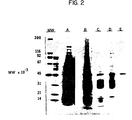
- Figure 2 shows the results of SDS-PAGE, as described in Example 1, on (A) total cell extract, (B) 45K aggregate, (C) a sample of the concentrated pellet after urea solubilization of aggregates and ultracentrifugation, (D) the supernatant fraction after urea solubilization of aggregates and centrifugation, and (E) soluble 45K after DEAE--Sephacel elution. Also included in Figure 2 are molecular weight markers (MW) and the numbers to the left in the figure correspond to the molecular weight x10 -3 .
- MW molecular weight markers
Landscapes
- Chemical & Material Sciences (AREA)
- Organic Chemistry (AREA)
- Health & Medical Sciences (AREA)
- Life Sciences & Earth Sciences (AREA)
- Molecular Biology (AREA)
- Proteomics, Peptides & Aminoacids (AREA)
- Biophysics (AREA)
- General Health & Medical Sciences (AREA)
- Genetics & Genomics (AREA)
- Medicinal Chemistry (AREA)
- Biochemistry (AREA)
- Gastroenterology & Hepatology (AREA)
- Virology (AREA)
- Crystallography & Structural Chemistry (AREA)
- Chemical Kinetics & Catalysis (AREA)
- General Chemical & Material Sciences (AREA)
- Analytical Chemistry (AREA)
- Peptides Or Proteins (AREA)
- Preparation Of Compounds By Using Micro-Organisms (AREA)
- Medicines Containing Antibodies Or Antigens For Use As Internal Diagnostic Agents (AREA)
Priority Applications (1)
| Application Number | Priority Date | Filing Date | Title |
|---|---|---|---|
| AT86101209T ATE81510T1 (de) | 1985-02-27 | 1986-01-30 | Loeslichkeits-, reinigungs- und charakterisierungsverfahren fuer proteine aus unloeslichen proteinaggregaten oder proteinkomplexen und diesbezuegliche praeparate. |
Applications Claiming Priority (2)
| Application Number | Priority Date | Filing Date | Title |
|---|---|---|---|
| US706533 | 1985-02-27 | ||
| US06/706,533 US4659568A (en) | 1985-02-27 | 1985-02-27 | Process for solubilization, purification and characterization of protein from insoluble protein aggregates or complexes and compositions of matter therefrom |
Publications (3)
| Publication Number | Publication Date |
|---|---|
| EP0192988A2 true EP0192988A2 (fr) | 1986-09-03 |
| EP0192988A3 EP0192988A3 (en) | 1989-03-15 |
| EP0192988B1 EP0192988B1 (fr) | 1992-10-14 |
Family
ID=24838031
Family Applications (1)
| Application Number | Title | Priority Date | Filing Date |
|---|---|---|---|
| EP86101209A Expired EP0192988B1 (fr) | 1985-02-27 | 1986-01-30 | Procédé pour la solubilisation, purification et caractérisation de protéines à partir d'aggrégats ou complexes de protéines insolubles et compositions s'y rapportant |
Country Status (6)
| Country | Link |
|---|---|
| US (1) | US4659568A (fr) |
| EP (1) | EP0192988B1 (fr) |
| JP (1) | JPH0660197B2 (fr) |
| AT (1) | ATE81510T1 (fr) |
| CA (1) | CA1285699C (fr) |
| DE (1) | DE3686954T2 (fr) |
Cited By (2)
| Publication number | Priority date | Publication date | Assignee | Title |
|---|---|---|---|---|
| EP0300425A3 (fr) * | 1987-07-20 | 1991-08-07 | Roche Diagnostics GmbH | Procédé de production de protéines sous forme soluble |
| WO2013132265A3 (fr) * | 2012-03-09 | 2014-01-09 | Nandi Proteins Limited | Procédé pour modifier des protéines |
Families Citing this family (16)
| Publication number | Priority date | Publication date | Assignee | Title |
|---|---|---|---|---|
| GB8508340D0 (en) * | 1985-03-29 | 1985-05-09 | Creighton T E | Production of protein |
| US4748234A (en) * | 1985-06-26 | 1988-05-31 | Cetus Corporation | Process for recovering refractile bodies containing heterologous proteins from microbial hosts |
| AU597924B2 (en) * | 1985-12-11 | 1990-06-14 | Natinco Nv | Solubilization of protein aggregates |
| US4929700A (en) * | 1987-04-16 | 1990-05-29 | Cetus Corporation | Production of purified, biologically active, bacterially produced recombinant human CSF-1 |
| CA1339757C (fr) * | 1987-04-16 | 1998-03-17 | Robert F. Halenbeck | Methode de production bacteriologique de csf-1 humain recombinant biologiquement actif pur |
| US4931543A (en) * | 1987-05-11 | 1990-06-05 | Cetus Corporation | Process for recovering microbially produced interleukin-2 |
| US5162507A (en) * | 1987-05-11 | 1992-11-10 | Cetus Corporation | Process for recovering purified, oxidized, renatured recombinant interleukin-2 from microorganisms |
| US4743583A (en) * | 1987-07-20 | 1988-05-10 | Temple University | Sustained release protein compositions and method for making |
| US5520817A (en) * | 1994-10-04 | 1996-05-28 | Biologica Co. | Method of fractionating components in liquid chromatography |
| EP1095056B1 (fr) | 1998-07-09 | 2006-12-27 | BaroFold, Inc. | Renaturation haute pression d'agregats de proteines et de corps d'inclusion |
| CA2434045A1 (fr) * | 2000-10-31 | 2002-08-15 | The Regents Of The University Of Colorado, A Body Corporate | Repliement et desagregation ameliore des proteines sous haute pression |
| FR2860796B1 (fr) * | 2003-10-14 | 2006-02-10 | Centre Nat Rech Scient | Procede de dissociation de la molecule d'hemoglobine extracellulaire d'arenicola marina, chaines proteiques constituant ladite molecule et sequences nucleotidiques codant pour lesdites chaines proteiques |
| GB0407701D0 (en) * | 2004-04-05 | 2004-05-12 | Johnson Matthey Plc | Adhesion promoting compound |
| CA2663416A1 (fr) * | 2006-09-15 | 2008-03-20 | Barofold, Inc. | Traitement de proteines sous haute pression permettant de reduire leur immunogenicite |
| DE102008030142A1 (de) * | 2008-06-27 | 2009-12-31 | Qiagen Gmbh | Verfahren zur Proteinaufreinigung unter denaturierenden Bedingungen |
| US9539233B2 (en) | 2009-05-04 | 2017-01-10 | Aridis Pharmaceuticals Inc. | Gallium formulation for the treatment and prevention of infectious diseases |
Family Cites Families (4)
| Publication number | Priority date | Publication date | Assignee | Title |
|---|---|---|---|---|
| US3519400A (en) * | 1967-01-25 | 1970-07-07 | Atomic Energy Commission | Method of centrifugal separation and recovery of chemical species utilizing a liquid medium |
| GB1356413A (en) * | 1971-09-09 | 1974-06-12 | Pfizer Ltd | Method of obtaining purified australia antigen from blood serum |
| PT77014B (en) * | 1982-07-20 | 1986-01-24 | Molecular Genetics Inc | Production of herpes simplex viral proteins |
| DE3228501A1 (de) * | 1982-07-30 | 1984-02-02 | Behringwerke Ag, 3550 Marburg | Verfahren zur herstellung eines herpes-antigens, dazu geeignetes mittel sowie verfahren zu seiner herstellung und die verwendung dieses antigens |
-
1985
- 1985-02-27 US US06/706,533 patent/US4659568A/en not_active Expired - Lifetime
-
1986
- 1986-01-30 DE DE8686101209T patent/DE3686954T2/de not_active Expired - Fee Related
- 1986-01-30 EP EP86101209A patent/EP0192988B1/fr not_active Expired
- 1986-01-30 AT AT86101209T patent/ATE81510T1/de not_active IP Right Cessation
- 1986-02-25 CA CA000502606A patent/CA1285699C/fr not_active Expired - Fee Related
- 1986-02-27 JP JP61042772A patent/JPH0660197B2/ja not_active Expired - Lifetime
Cited By (3)
| Publication number | Priority date | Publication date | Assignee | Title |
|---|---|---|---|---|
| EP0300425A3 (fr) * | 1987-07-20 | 1991-08-07 | Roche Diagnostics GmbH | Procédé de production de protéines sous forme soluble |
| US6284484B1 (en) | 1987-07-20 | 2001-09-04 | Roche Diagnostics Gmbh | Process for the production of proteins in soluble form by modulation of an inducible promoter |
| WO2013132265A3 (fr) * | 2012-03-09 | 2014-01-09 | Nandi Proteins Limited | Procédé pour modifier des protéines |
Also Published As
| Publication number | Publication date |
|---|---|
| EP0192988B1 (fr) | 1992-10-14 |
| ATE81510T1 (de) | 1992-10-15 |
| CA1285699C (fr) | 1991-07-02 |
| JPS61267599A (ja) | 1986-11-27 |
| DE3686954D1 (de) | 1992-11-19 |
| DE3686954T2 (de) | 1993-04-01 |
| JPH0660197B2 (ja) | 1994-08-10 |
| US4659568A (en) | 1987-04-21 |
| EP0192988A3 (en) | 1989-03-15 |
Similar Documents
| Publication | Publication Date | Title |
|---|---|---|
| US4659568A (en) | Process for solubilization, purification and characterization of protein from insoluble protein aggregates or complexes and compositions of matter therefrom | |
| Keiser et al. | Immunochemistry of cartilage proteoglycan. Immunodiffusion and gel-electrophoretic studies | |
| Eisenberg et al. | Purification of glycoprotein gD of herpes simplex virus types 1 and 2 by use of monoclonal antibody | |
| EP0156242B1 (fr) | Vaccin lyophilisé contre l'hépatite B | |
| US4707542A (en) | Immunogenic HbsAg derived from transformed yeast | |
| US4140763A (en) | Vaccine for foot and mouth disease | |
| Baker et al. | The purification and cyanogen bromide cleavage of the ‘link proteins’ from cartilage proteoglycan | |
| US4681761A (en) | Major iron-regulated protein of Neisseria gonorrhoeae and its use as vaccine | |
| Eisenberg et al. | Comparative structural analysis of glycoprotein gD of herpes simplex virus types 1 and 2 | |
| Rudman et al. | A new method for isolating the nonidentical protein subunits of human plasma α-lipoprotein | |
| US4624918A (en) | Purification process for hepatitis surface antigen and product thereof | |
| US5098704A (en) | Hepatitis surface antigen particle vaccine | |
| EP0155007B1 (fr) | Méthode de purification d'antigène HBs | |
| CA1276899C (fr) | Methode de purification des produits d'expression des genes obtenus par une technique utilisant l'adn recombinant | |
| Dietzschold et al. | Serological characterization of the three major proteins of vesicular stomatitis virus | |
| CA1339773C (fr) | Derives de peptides d'antigene du virus del la leucemie a cellules t de l'adulte | |
| EP0138167B1 (fr) | Méthode de purification d'HBs antigène | |
| US4695454A (en) | Process for preparing hepatitis B surface antigen containing particles in novel forms which are highly immunogenic | |
| EP0112506B1 (fr) | Procédé de production d'un vaccin pour prévenir une infection d'hépatite B | |
| EP0135435A2 (fr) | HBsAg immunogénique dérivé de levure transformée | |
| EP0359919B1 (fr) | Antigène recombinant de mycoplasma hyopneumoniae et utilisations de celui-ci | |
| Shire et al. | Purification and immunogenicity of fusion VP1 protein of foot and mouth disease virus | |
| Cresta et al. | Biological properties of junin virus proteins: I. identification of the immunogenic glycoprotein | |
| Long et al. | Marek's Disease Herpesviruses II. Purification and Further Characterization of Marek's Disease Herpesvirus A Antigen | |
| EP0216195A1 (fr) | Plasmide recombinant inséré avec un gène du virus de l'Herpes simplex |
Legal Events
| Date | Code | Title | Description |
|---|---|---|---|
| PUAI | Public reference made under article 153(3) epc to a published international application that has entered the european phase |
Free format text: ORIGINAL CODE: 0009012 |
|
| AK | Designated contracting states |
Kind code of ref document: A2 Designated state(s): AT BE CH DE FR GB IT LI NL SE |
|
| PUAL | Search report despatched |
Free format text: ORIGINAL CODE: 0009013 |
|
| AK | Designated contracting states |
Kind code of ref document: A3 Designated state(s): AT BE CH DE FR GB IT LI NL SE |
|
| 17P | Request for examination filed |
Effective date: 19890912 |
|
| 17Q | First examination report despatched |
Effective date: 19910502 |
|
| GRAA | (expected) grant |
Free format text: ORIGINAL CODE: 0009210 |
|
| AK | Designated contracting states |
Kind code of ref document: B1 Designated state(s): AT BE CH DE FR GB IT LI NL SE |
|
| REF | Corresponds to: |
Ref document number: 81510 Country of ref document: AT Date of ref document: 19921015 Kind code of ref document: T |
|
| REF | Corresponds to: |
Ref document number: 3686954 Country of ref document: DE Date of ref document: 19921119 |
|
| ET | Fr: translation filed | ||
| ITF | It: translation for a ep patent filed | ||
| PLBE | No opposition filed within time limit |
Free format text: ORIGINAL CODE: 0009261 |
|
| STAA | Information on the status of an ep patent application or granted ep patent |
Free format text: STATUS: NO OPPOSITION FILED WITHIN TIME LIMIT |
|
| 26N | No opposition filed | ||
| EAL | Se: european patent in force in sweden |
Ref document number: 86101209.4 |
|
| PGFP | Annual fee paid to national office [announced via postgrant information from national office to epo] |
Ref country code: AT Payment date: 20011211 Year of fee payment: 17 |
|
| PGFP | Annual fee paid to national office [announced via postgrant information from national office to epo] |
Ref country code: NL Payment date: 20011214 Year of fee payment: 17 Ref country code: GB Payment date: 20011214 Year of fee payment: 17 |
|
| REG | Reference to a national code |
Ref country code: GB Ref legal event code: IF02 |
|
| PGFP | Annual fee paid to national office [announced via postgrant information from national office to epo] |
Ref country code: FR Payment date: 20020104 Year of fee payment: 17 |
|
| PGFP | Annual fee paid to national office [announced via postgrant information from national office to epo] |
Ref country code: SE Payment date: 20020107 Year of fee payment: 17 |
|
| PGFP | Annual fee paid to national office [announced via postgrant information from national office to epo] |
Ref country code: DE Payment date: 20020131 Year of fee payment: 17 |
|
| PGFP | Annual fee paid to national office [announced via postgrant information from national office to epo] |
Ref country code: BE Payment date: 20020220 Year of fee payment: 17 |
|
| PGFP | Annual fee paid to national office [announced via postgrant information from national office to epo] |
Ref country code: CH Payment date: 20020326 Year of fee payment: 17 |
|
| PG25 | Lapsed in a contracting state [announced via postgrant information from national office to epo] |
Ref country code: GB Free format text: LAPSE BECAUSE OF NON-PAYMENT OF DUE FEES Effective date: 20030130 Ref country code: AT Free format text: LAPSE BECAUSE OF NON-PAYMENT OF DUE FEES Effective date: 20030130 |
|
| PG25 | Lapsed in a contracting state [announced via postgrant information from national office to epo] |
Ref country code: SE Free format text: LAPSE BECAUSE OF NON-PAYMENT OF DUE FEES Effective date: 20030131 Ref country code: LI Free format text: LAPSE BECAUSE OF NON-PAYMENT OF DUE FEES Effective date: 20030131 Ref country code: CH Free format text: LAPSE BECAUSE OF NON-PAYMENT OF DUE FEES Effective date: 20030131 Ref country code: BE Free format text: LAPSE BECAUSE OF NON-PAYMENT OF DUE FEES Effective date: 20030131 |
|
| PG25 | Lapsed in a contracting state [announced via postgrant information from national office to epo] |
Ref country code: NL Free format text: LAPSE BECAUSE OF NON-PAYMENT OF DUE FEES Effective date: 20030801 Ref country code: DE Free format text: LAPSE BECAUSE OF NON-PAYMENT OF DUE FEES Effective date: 20030801 |
|
| EUG | Se: european patent has lapsed | ||
| REG | Reference to a national code |
Ref country code: CH Ref legal event code: PL |
|
| GBPC | Gb: european patent ceased through non-payment of renewal fee | ||
| PG25 | Lapsed in a contracting state [announced via postgrant information from national office to epo] |
Ref country code: FR Free format text: LAPSE BECAUSE OF NON-PAYMENT OF DUE FEES Effective date: 20030930 |
|
| NLV4 | Nl: lapsed or anulled due to non-payment of the annual fee |
Effective date: 20030801 |
|
| REG | Reference to a national code |
Ref country code: FR Ref legal event code: ST |
|
| PG25 | Lapsed in a contracting state [announced via postgrant information from national office to epo] |
Ref country code: IT Free format text: LAPSE BECAUSE OF NON-PAYMENT OF DUE FEES Effective date: 20050130 |