EP0193394B1 - Appareil pour l'étude de particules - Google Patents
Appareil pour l'étude de particules Download PDFInfo
- Publication number
- EP0193394B1 EP0193394B1 EP86301375A EP86301375A EP0193394B1 EP 0193394 B1 EP0193394 B1 EP 0193394B1 EP 86301375 A EP86301375 A EP 86301375A EP 86301375 A EP86301375 A EP 86301375A EP 0193394 B1 EP0193394 B1 EP 0193394B1
- Authority
- EP
- European Patent Office
- Prior art keywords
- fluid
- aperture
- sensing region
- detecting
- pulses
- Prior art date
- Legal status (The legal status is an assumption and is not a legal conclusion. Google has not performed a legal analysis and makes no representation as to the accuracy of the status listed.)
- Expired
Links
- 239000002245 particle Substances 0.000 title claims description 47
- 239000012530 fluid Substances 0.000 claims description 33
- 238000000034 method Methods 0.000 claims description 6
- 230000001052 transient effect Effects 0.000 claims description 5
- 229910052751 metal Inorganic materials 0.000 claims description 3
- 239000002184 metal Substances 0.000 claims description 3
- 235000021251 pulses Nutrition 0.000 description 20
- 238000011144 upstream manufacturing Methods 0.000 description 6
- 239000011324 bead Substances 0.000 description 4
- 230000007423 decrease Effects 0.000 description 3
- 230000003247 decreasing effect Effects 0.000 description 2
- 239000006185 dispersion Substances 0.000 description 2
- 239000000835 fiber Substances 0.000 description 2
- 238000005259 measurement Methods 0.000 description 2
- 150000002739 metals Chemical class 0.000 description 2
- 230000000750 progressive effect Effects 0.000 description 2
- 239000004411 aluminium Substances 0.000 description 1
- 229910052782 aluminium Inorganic materials 0.000 description 1
- XAGFODPZIPBFFR-UHFFFAOYSA-N aluminium Chemical compound [Al] XAGFODPZIPBFFR-UHFFFAOYSA-N 0.000 description 1
- 238000010586 diagram Methods 0.000 description 1
- 230000005684 electric field Effects 0.000 description 1
- 239000011521 glass Substances 0.000 description 1
- 239000007788 liquid Substances 0.000 description 1
- 238000004513 sizing Methods 0.000 description 1
- 238000006467 substitution reaction Methods 0.000 description 1
- 230000009897 systematic effect Effects 0.000 description 1
- XLYOFNOQVPJJNP-UHFFFAOYSA-N water Substances O XLYOFNOQVPJJNP-UHFFFAOYSA-N 0.000 description 1
Images
Classifications
-
- G—PHYSICS
- G01—MEASURING; TESTING
- G01N—INVESTIGATING OR ANALYSING MATERIALS BY DETERMINING THEIR CHEMICAL OR PHYSICAL PROPERTIES
- G01N15/00—Investigating characteristics of particles; Investigating permeability, pore-volume or surface-area of porous materials
- G01N15/10—Investigating individual particles
- G01N15/1031—Investigating individual particles by measuring electrical or magnetic effects
- G01N15/12—Investigating individual particles by measuring electrical or magnetic effects by observing changes in resistance or impedance across apertures when traversed by individual particles, e.g. by using the Coulter principle
- G01N15/13—Details pertaining to apertures
Definitions
- U.S. Patent 2,656,508 issued 20th October, 1953 describes a system, known as the resistive pulse technique, for counting particles suspended in an electrically conducting fluid medium.
- An electrically insulating wall including an aperture several to several hundred micrometers in diameter, is immersed in the fluid.
- a pair of electrodes are disposed in the fluid on opposite sides of the wall to establish a current path between them through the fluid and passing through the aperture.
- the fluid is caused to pass through the aperture at a known rate, and an electric current is passed between the two electrodes.
- the aperture and the resulting constricted electric field in and around it constitute a scanning zone.
- U.S. 3,668,531 describe how it is possible to use the amplitude of each voltage pulse to determine the size of the particle responsible.
- U.S. Patent 3628140 provides a conical chamber upstream and/or downstream ofthe aperture in order to increase resolution.
- U.S. Patent 3,441,848 is concerned with measuring the lengths of fibres. Fibres suspended in a fluid pass through an aperture lengthwise, and the patent takes advantage of this to use the duration of each voltage pulse to determine the length of the fibre responsible. In U.S. 3,890,568, a combination of voltage pulse amplitude and duration are used to provide a more accurate measure of fibre length.
- the cross-sectional area of the aperture has been constant along its length, or has been shaped at its upstream and downstream ends to achieve non-turbulent flow of fluid, but has not been caused to change along its length in any systematic way in order to provide additional information.
- the aperture has a finite length in the direction of flow of the fluid and the cross-section of the aperture is caused to change progressively along at least part of its length.
- the duration of a resistive pulse caused by passage of a particle through the aperture depends on the size of the particle.
- resistive pulse is meant either a transient increase in voltage at constant current or a transient decrease in current at constant voltage.
- constant current conditions are used, and the length of time the voltage exceeds an arbitrary threshold value is measured.
- the progressive change in cross-section can be achieved by providing a truncated cone-shaped aperture.
- the aperture can be shaped like the hole in a torus. Other shapes are possible.
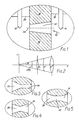
- an electrically insulating wall 10 including an aperture 12 therethrough, a pair of electrodes 14, 16 disposed on opposite sides of the wall, all immersed in an electrically conducting fluid having surfaces 18, 20 on opposite sides of the wall.
- the fluid is caused to pass through the aperture in the direction of the arrow 22 at a controlled flow rate.
- a constant current is passed between the electrodes, and voltage pulses caused by particles passing through the aperture are detected and analysed (by means not shown).
- the aperture is shown as having the shape of a truncated cone having a longitudinal axis 24 and a diameter that decreases in the direction of flow of the fluid.
- D(X) KX (3)
- the volume of a cone is known to be:
- Equation (2) into equation (4) into equation (8) provides an explicit equation giving the time over which a particle of diameter "d” will cause an increase in the electrical resistance ⁇ R of the opening of the particle diameter "d”: or, more conveniently as in the preferred embodiment, in terms of the voltage change ( ⁇ V) in the presence of an applied current I: where Di is the diameter of the smaller end of the truncated cone.
- the length of the aperture in the direction of flow of the fluid, should be substantially greater than the length of individual particles, but sufficiently small that the aperture (or the sensing zone associated with it) generally contains not more than one particle at a time.
- the above equations apply only with somewhat less accuracy, and the invention is thus particularly useful where the suspended particles, as is generally the case with particles suspended in molten metals, do not differ markedly from spherical.
- the minimum diameter and angle of taper may be chosen having regard to the expected size range of the suspended particles.
- the upstream and downstream ends of the aperture may be profiled to promote streamlined fluid flow.
- an aperture has an upstream section 25 in the form of a truncated cone whose diameter decreases in the direction of the fluid flow (from left to right), and a downstream section 26 in the form of a cylinder.
- a measurement of the duration of a voltage pulse (above a datum level), as a particle passes through section 24 of the aperture, can be combined with a measurement of the amplitude of the voltage pulse, as the particle passes through section 26, to provide a good determination of particle size.
- the aperture of Figure 3 could alternatively be used with fluid flow from right to left, albeit with somewhat greater risk of turbulence.
- an aperture comprises an upstream section 28 in the form of a truncated cone of decreasing diameter, and a downstream section 30 in the form of a truncated cone of increasing diameter.
- This profile has the advantage that the change in duration of the voltage pulse for a given change in particle size is doubled in comparison with the profile of Figure 1.
- an aperture has an upstream section 32 in the form of a truncated cone of decreasing diameter, in intermediate section 34 in the form of a cylinder, and a downstream section 36 in the form of a truncated cone of increasing diameter.
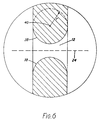
- a wall 10 has an aperture 12 having a longitudinal axis 24.
- the walls 38 defining the aperture are not straight in a direction parallel to the axis, but are curved.
- the aperture has the shape of the hole in a torus and may be notionally generated by rotating a circle having a radius r centered at 40 round the axis 24.
- the notional circle could have been substituted an ellipse with its major axis parallel or perpendicular to the axis 24 of the aperture.
- the curved surfaces 38 could have been shaped in a variety of ways consistent with the requirement that the cross-sectional area of the aperture changes progressively along at least part of its length.
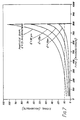
- Figure 7 is a graphical presentation of the mathematical treatment of the invention.
- the graph is in the form of theoretical voltage-time curves for the passage of particles of diameters ranging from 20 to 35 microns through a conical aperture having a maximum diameter of 0.6 mm, a minimum diameter of 0.3 mm and a length of 1.3 mm.
- the curves have been generated by a computer programme using increments of distance, i.e. V has been calculated using equation (1) under constant current conditions, at increments of 5 micrometers measured along the axis of the aperture.
- a dashed line has been drawn to illustrate the fact that the duration for which the voltage pulse exceeds a given threshold value, say 10 microvolts, increases with increasing particle size.
Landscapes
- Chemical & Material Sciences (AREA)
- Dispersion Chemistry (AREA)
- Physics & Mathematics (AREA)
- Health & Medical Sciences (AREA)
- Life Sciences & Earth Sciences (AREA)
- Analytical Chemistry (AREA)
- Biochemistry (AREA)
- General Health & Medical Sciences (AREA)
- General Physics & Mathematics (AREA)
- Immunology (AREA)
- Pathology (AREA)
- Investigating Or Analyzing Materials By The Use Of Electric Means (AREA)
- Investigating And Analyzing Materials By Characteristic Methods (AREA)
- Sampling And Sample Adjustment (AREA)
- Inert Electrodes (AREA)
- Developing Agents For Electrophotography (AREA)
- Powder Metallurgy (AREA)
- Manufacture Of Metal Powder And Suspensions Thereof (AREA)
Claims (5)
- Appareil pour l'étude de particules en suspension dans un fluide électriquement conducteur, cet appareil comprenant une paroi électriquement isolante (10) qui comporte une ouverture (12) qui la traverse, une paire d'électrodes (14, 16) qui sont placées sur des côtés opposés de la paroi (10) afin d'établir une voie de courant entre elles au travers du fluide, cette voie de courant traversant l'ouverture (12), un moyen pour forcer le fluide à traverser l'ouverture (12) selon un débit contrôlé et pour simultanément faire passer un courant électrique entre les deux électrodes (14, 16) au moyen de ladite voie de courant et un moyen pour détecter des impulsions résistives qui sont représentatives de variations de la résistance électrique au travers de la paroi (10), ces variations résultant des particules qui sont en suspension dans le fluide et qui traversent l'ouverture (12), l'ouverture (12) ayant une longueur finie suivant la direction de l'écoulement du fluide (22) et la section en coupe transversale de l'ouverture (12) changeant progressivement le long d'au moins une partie de ladite longueur de l'ouverture, cet appareil étant caractérisé en ce que le moyen de détection comporte un moyen pour analyser la durée des impulsions résistives afin de fournir une information relative à la taille des particules.
- Appareil selon la revendication 1, cet appareil étant étudié pour fonctionner à des conditions de courant constant, dans lequel le moyen qui permet de détecter des variations de la résistance électrique est un moyen qui permet de détecter des accroissements de tension transitoires.
- Procédé pour l'étude de particules en suspension dans une fluide électriquement conducteur, ce procédé comprenant l'établissement d'une région de détection à l'intérieur du fluide, laquelle région de détection a un axe longitudinal et une section en coupe transversale, ce procédé consistant à forcer l'écoulement d'un courant électrique le long d'une voie de courant qui s'étend longitudinalement par rapport à la région de détection, à forçer le fluide à s'écouler selon un débit contrôlé suivant une direction longitudinale au travers de la région de détection et à détecter des impulsions résistives dans la résistance électrique du fluide qui traverse la région de détection, ces impulsions résistives résultant de la présence dans le fluide desdites particules, la région de détection ayant une longueur finie suivant une direction longitudinale, la section en coupe transversale de la région de détection variant progressivement le long d'au moins une partie de la longueur de ladite région, ce procédé étant caractérisé en ce que la détection des impulsions de tension résistives inclut l'analyse de la durée desdites impulsions pour fournir une information relative à la taille des particules.
- Procédé selon la revendication 3 dans lequel le fluide électriquement conducteur est un métal en fusion.
- Procédé selon la revendication 3 dans lequel le courant est forcé à s'écouler à des conditions de courant constant et dans lequel des modifications de la résistance électrique sont détectées sous la forme d'augmentations de tension transitoires.
Applications Claiming Priority (2)
| Application Number | Priority Date | Filing Date | Title |
|---|---|---|---|
| GB858505047A GB8505047D0 (en) | 1985-02-27 | 1985-02-27 | Studying particles |
| GB8505047 | 1985-02-27 |
Publications (3)
| Publication Number | Publication Date |
|---|---|
| EP0193394A2 EP0193394A2 (fr) | 1986-09-03 |
| EP0193394A3 EP0193394A3 (en) | 1987-09-23 |
| EP0193394B1 true EP0193394B1 (fr) | 1991-07-24 |
Family
ID=10575165
Family Applications (1)
| Application Number | Title | Priority Date | Filing Date |
|---|---|---|---|
| EP86301375A Expired EP0193394B1 (fr) | 1985-02-27 | 1986-02-26 | Appareil pour l'étude de particules |
Country Status (11)
| Country | Link |
|---|---|
| US (1) | US4926114A (fr) |
| EP (1) | EP0193394B1 (fr) |
| JP (1) | JPS61205844A (fr) |
| AU (1) | AU588022B2 (fr) |
| BR (1) | BR8600817A (fr) |
| CA (1) | CA1325243C (fr) |
| DE (1) | DE3680359D1 (fr) |
| ES (1) | ES8800753A1 (fr) |
| GB (1) | GB8505047D0 (fr) |
| MY (1) | MY101191A (fr) |
| NO (1) | NO164319C (fr) |
Cited By (1)
| Publication number | Priority date | Publication date | Assignee | Title |
|---|---|---|---|---|
| US7771658B2 (en) | 2002-06-11 | 2010-08-10 | Chempaq A/S | Disposable cartridge for characterizing particles suspended in a liquid |
Families Citing this family (20)
| Publication number | Priority date | Publication date | Assignee | Title |
|---|---|---|---|---|
| CA1328679C (fr) * | 1989-05-18 | 1994-04-19 | Raynald Hachey | Appareil de detection-comptage d'inclusions non metalliques dans un metal en fusion |
| US5376878A (en) * | 1991-12-12 | 1994-12-27 | Fisher; Timothy C. | Multiple-aperture particle counting sizing and deformability-measuring apparatus |
| US20120160687A1 (en) | 1995-03-17 | 2012-06-28 | President And Fellows Of Harvard College | Characterization of individual polymer molecules based on monomer-interface interactions |
| US6362002B1 (en) * | 1995-03-17 | 2002-03-26 | President And Fellows Of Harvard College | Characterization of individual polymer molecules based on monomer-interface interactions |
| US5834928A (en) * | 1995-10-04 | 1998-11-10 | Alcan International Limited | Method and apparatus for the detection and measurement of solid particles in molten metal |
| GB9624096D0 (en) | 1996-11-20 | 1997-01-08 | Microbial Systems Ltd | Apparatus and method of use thereof |
| GB2337599B (en) * | 1996-11-20 | 2000-08-16 | Microbial Systems Ltd | Particle sizing apparatus |
| US6418802B1 (en) * | 1996-11-21 | 2002-07-16 | Michael Anthony Wood | Particle sizing apparatus and method of use thereof |
| EP1192103A1 (fr) * | 1999-06-22 | 2002-04-03 | President And Fellows of Harvard College | Procede permettant de respecter les caracteristiques dimensionnelles d'une structure a l'etat solide |
| DE19946458C2 (de) * | 1999-09-28 | 2002-10-24 | Fraunhofer Ges Forschung | Vorrichtung und Verfahren zur Charakterisierung von Sphäroiden |
| CA2302121A1 (fr) * | 2000-03-27 | 2001-09-27 | Limca Research Inc. | Sondes de mesure de la qualite d'un metal fondu |
| WO2005017025A2 (fr) | 2003-08-15 | 2005-02-24 | The President And Fellows Of Harvard College | Etude de molecules de polymere et conformations avec un nanopore |
| WO2006028508A2 (fr) | 2004-03-23 | 2006-03-16 | President And Fellows Of Harvard College | Procedes et appareil de caracterisation de polynucleotides |
| CA2855108A1 (fr) | 2005-02-10 | 2006-08-17 | Koninklijke Philips Electronics N.V. | Cartouche echantillon double et procede de caracterisation d'une particule dans un liquide |
| AU2006212607B2 (en) | 2005-02-10 | 2010-12-09 | Koninklijke Philips Electronics N.V. | Dual sample cartridge and method for characterizing particle in liquid |
| DE102006032906B4 (de) * | 2005-07-18 | 2009-01-08 | Entec-Gmbh Environmental Technology | Vorrichtung und Verfahren zur Erfassung und Bewertung von Partikeln in einem Gasstrom |
| CN101165485B (zh) * | 2006-10-18 | 2012-09-19 | 深圳迈瑞生物医疗电子股份有限公司 | 一种血液细胞检测的装置及其微孔传感器组件 |
| US8828211B2 (en) | 2010-06-08 | 2014-09-09 | President And Fellows Of Harvard College | Nanopore device with graphene supported artificial lipid membrane |
| CN103086979B (zh) * | 2013-02-04 | 2014-10-22 | 江苏康乐新材料科技有限公司 | 一种制备咪唑醛的方法 |
| US11525765B2 (en) * | 2017-02-10 | 2022-12-13 | Tosoh Corporation | Particle detection device and particle detection method |
Family Cites Families (15)
| Publication number | Priority date | Publication date | Assignee | Title |
|---|---|---|---|---|
| US2434835A (en) * | 1946-05-04 | 1948-01-20 | Goodrich Co B F | Variable fluid passage |
| US2998198A (en) * | 1959-10-07 | 1961-08-29 | Int Nickel Co | Variable size flow nozzle |
| DE1977607U (de) * | 1961-11-20 | 1968-01-25 | Toa Tokushu Denki Kabushiki Ka | Messgefaess fuer eine einrichtung zum zaehlen von suspendierten teilchen. |
| US3441848A (en) * | 1968-04-29 | 1969-04-29 | Coulter Electronics | Particle length measuring apparatus |
| BE758383A (nl) * | 1969-11-06 | 1971-04-16 | Coulter Electronics | Aftastelement en doorboord plaatje voor het electronisch tellenen sorteren van deeltjes |
| DE2122445C3 (de) * | 1971-05-06 | 1975-03-20 | Phywe Ag, 3400 Goettingen | DurchfluBöffnung eines elektrischen Zähl- und Meßgerätes für in eine Flüssigkeit suspendierte Teilchen |
| JPS5528334B2 (fr) * | 1973-05-07 | 1980-07-26 | ||
| US3924180A (en) * | 1973-10-12 | 1975-12-02 | Us Energy | Potential sensing cell analyzer |
| NL7413993A (nl) * | 1973-10-30 | 1975-05-02 | Hoechst Ag | Werkwijze voor het bereiden van een aminoben- zeenderivaat. |
| JPS5247716A (en) * | 1975-10-14 | 1977-04-15 | Canon Inc | Data photographing device for the camera |
| US4491786A (en) * | 1978-09-13 | 1985-01-01 | Coulter Electronics, Inc. | Transducer for measuring particles suspended in a fluid |
| JPS5619006U (fr) * | 1979-07-23 | 1981-02-19 | ||
| AU545069B2 (en) * | 1981-03-30 | 1985-06-27 | Particle Data Inc. | Controlled orientation of particles for measurement |
| US4412175A (en) * | 1981-04-30 | 1983-10-25 | Coulter Electronics, Inc. | Debris alarm |
| US4555662A (en) * | 1983-03-03 | 1985-11-26 | Limca Research Inc. | Method and apparatus for the detection and measurement of particulates in molten metal |
-
1985
- 1985-02-27 GB GB858505047A patent/GB8505047D0/en active Pending
-
1986
- 1986-02-26 EP EP86301375A patent/EP0193394B1/fr not_active Expired
- 1986-02-26 CA CA000502788A patent/CA1325243C/fr not_active Expired - Lifetime
- 1986-02-26 AU AU54095/86A patent/AU588022B2/en not_active Ceased
- 1986-02-26 DE DE8686301375T patent/DE3680359D1/de not_active Expired - Lifetime
- 1986-02-26 NO NO860720A patent/NO164319C/no unknown
- 1986-02-26 BR BR8600817A patent/BR8600817A/pt not_active IP Right Cessation
- 1986-02-26 ES ES552417A patent/ES8800753A1/es not_active Expired
- 1986-02-27 JP JP61042785A patent/JPS61205844A/ja active Pending
-
1987
- 1987-09-29 MY MYPI87002217A patent/MY101191A/en unknown
-
1989
- 1989-09-08 US US07/405,042 patent/US4926114A/en not_active Expired - Lifetime
Cited By (3)
| Publication number | Priority date | Publication date | Assignee | Title |
|---|---|---|---|---|
| US7771658B2 (en) | 2002-06-11 | 2010-08-10 | Chempaq A/S | Disposable cartridge for characterizing particles suspended in a liquid |
| US7797990B2 (en) | 2002-06-11 | 2010-09-21 | Chempaq A/S | Disposable cartridge for characterizing particles suspended in a liquid |
| US8227250B2 (en) | 2002-06-11 | 2012-07-24 | Koninklijke Philips Electronics N.V. | Lysing reagent, cartridge and automatic electronic cell counter for simultaneous enumeration of different types of white blood cells |
Also Published As
| Publication number | Publication date |
|---|---|
| EP0193394A2 (fr) | 1986-09-03 |
| AU588022B2 (en) | 1989-09-07 |
| GB8505047D0 (en) | 1985-03-27 |
| DE3680359D1 (de) | 1991-08-29 |
| BR8600817A (pt) | 1986-11-04 |
| JPS61205844A (ja) | 1986-09-12 |
| EP0193394A3 (en) | 1987-09-23 |
| MY101191A (en) | 1991-07-31 |
| CA1325243C (fr) | 1993-12-14 |
| ES552417A0 (es) | 1987-11-16 |
| NO164319C (no) | 1990-09-19 |
| NO860720L (no) | 1986-08-28 |
| US4926114A (en) | 1990-05-15 |
| NO164319B (no) | 1990-06-11 |
| AU5409586A (en) | 1986-09-04 |
| ES8800753A1 (es) | 1987-11-16 |
Similar Documents
| Publication | Publication Date | Title |
|---|---|---|
| US4926114A (en) | Apparatus for studying particles having an aperture whose cross-sectional area changes progressively along at least part of its length | |
| US2656508A (en) | Means for counting particles suspended in a fluid | |
| Nakagawa et al. | Structure of space-time correlations of bursting phenomena in an open-channel flow | |
| Wells et al. | The effects of crossing trajectories on the dispersion of particles in a turbulent flow | |
| SATO et al. | Flow pattern and pulsation properties of cocurrent gas-liquid downflow in packed beds | |
| Jones | Electromagnetic wave scattering by assemblies of particles in the Rayleigh approximation | |
| Hammer et al. | The spatial filtering effect of capacitance transducer electrodes (flow measurement) | |
| KR970000633B1 (ko) | 입자 크기 및 전하량 측정 방법 및 장치 | |
| KR950014880A (ko) | 입자분석장치 | |
| Angeli | Liquid-liquid dispersed flows in horizontal pipes | |
| EP0874983B1 (fr) | Procede et dispositif d'evaluation de la teneur de globules rouges individuels en hemoglobine | |
| US4484134A (en) | Elongate particle sensing aperture | |
| US3739258A (en) | Method and apparatus for detecting and sizing microscopic particles | |
| JP3018178B1 (ja) | 光ファイバープローブによる気泡計測方法及び装置 | |
| BERMAN | Velocity fluctuations in non-homogeneous drag reduction | |
| Kramer et al. | Particle size distributions in turbulent air-water flows | |
| Li et al. | Liquid metal cleanliness analyzer (LiMCA) in molten aluminum | |
| US3739268A (en) | Particle sensing apparatus, method and flow direction collar therefor | |
| DE2819506C2 (de) | Vorrichtung zum Ermitteln des Absetzbeginns der Feststoffphase einer strömenden Feststoff-Flüssigkeits-Suspension | |
| Gallily | On the filtration of aerosols by filter models of various porosities | |
| Merkus et al. | Improved resolution and accuracy in electrical sensing zone particle counters through hydrodynamic focussing | |
| Hignett et al. | The entry correction in the electrostatic charging of fluids flowing through pipes | |
| JPH03110456A (ja) | 液中気泡測定用センサ | |
| Ōyabu et al. | Studies on interfacial electrochemical phenomena in pigment-vehicle systems | |
| McKinney et al. | Electrohydrodynamic flow in a barbed plate electrostatic precipitator |
Legal Events
| Date | Code | Title | Description |
|---|---|---|---|
| PUAI | Public reference made under article 153(3) epc to a published international application that has entered the european phase |
Free format text: ORIGINAL CODE: 0009012 |
|
| AK | Designated contracting states |
Kind code of ref document: A2 Designated state(s): BE CH DE FR GB IT LI |
|
| PUAL | Search report despatched |
Free format text: ORIGINAL CODE: 0009013 |
|
| AK | Designated contracting states |
Kind code of ref document: A3 Designated state(s): BE CH DE FR GB IT LI |
|
| 17P | Request for examination filed |
Effective date: 19880220 |
|
| 17Q | First examination report despatched |
Effective date: 19890619 |
|
| GRAA | (expected) grant |
Free format text: ORIGINAL CODE: 0009210 |
|
| ITF | It: translation for a ep patent filed | ||
| AK | Designated contracting states |
Kind code of ref document: B1 Designated state(s): BE CH DE FR GB IT LI |
|
| REF | Corresponds to: |
Ref document number: 3680359 Country of ref document: DE Date of ref document: 19910829 |
|
| ET | Fr: translation filed | ||
| PLBE | No opposition filed within time limit |
Free format text: ORIGINAL CODE: 0009261 |
|
| STAA | Information on the status of an ep patent application or granted ep patent |
Free format text: STATUS: NO OPPOSITION FILED WITHIN TIME LIMIT |
|
| 26N | No opposition filed | ||
| PGFP | Annual fee paid to national office [announced via postgrant information from national office to epo] |
Ref country code: CH Payment date: 19940113 Year of fee payment: 9 |
|
| PGFP | Annual fee paid to national office [announced via postgrant information from national office to epo] |
Ref country code: BE Payment date: 19940125 Year of fee payment: 9 |
|
| PG25 | Lapsed in a contracting state [announced via postgrant information from national office to epo] |
Ref country code: LI Effective date: 19950228 Ref country code: CH Effective date: 19950228 Ref country code: BE Effective date: 19950228 |
|
| BERE | Be: lapsed |
Owner name: ALCAN INTERNATIONAL LTD Effective date: 19950228 |
|
| REG | Reference to a national code |
Ref country code: GB Ref legal event code: IF02 |
|
| PGFP | Annual fee paid to national office [announced via postgrant information from national office to epo] |
Ref country code: FR Payment date: 20050217 Year of fee payment: 20 |
|
| PGFP | Annual fee paid to national office [announced via postgrant information from national office to epo] |
Ref country code: GB Payment date: 20050223 Year of fee payment: 20 |
|
| PG25 | Lapsed in a contracting state [announced via postgrant information from national office to epo] |
Ref country code: IT Free format text: LAPSE BECAUSE OF NON-PAYMENT OF DUE FEES Effective date: 20050226 |
|
| REG | Reference to a national code |
Ref country code: GB Ref legal event code: PE20 |
|
| PGFP | Annual fee paid to national office [announced via postgrant information from national office to epo] |
Ref country code: DE Payment date: 20050331 Year of fee payment: 20 |
|
| PG25 | Lapsed in a contracting state [announced via postgrant information from national office to epo] |
Ref country code: GB Free format text: LAPSE BECAUSE OF EXPIRATION OF PROTECTION Effective date: 20060225 |