EP0194457B1 - Procédé de préparation de polyoléfines, de polydiènes et de leurs copolymères - Google Patents
Procédé de préparation de polyoléfines, de polydiènes et de leurs copolymères Download PDFInfo
- Publication number
- EP0194457B1 EP0194457B1 EP86101782A EP86101782A EP0194457B1 EP 0194457 B1 EP0194457 B1 EP 0194457B1 EP 86101782 A EP86101782 A EP 86101782A EP 86101782 A EP86101782 A EP 86101782A EP 0194457 B1 EP0194457 B1 EP 0194457B1
- Authority
- EP
- European Patent Office
- Prior art keywords
- polymerization
- sub
- process according
- titanium
- specifically
- Prior art date
- Legal status (The legal status is an assumption and is not a legal conclusion. Google has not performed a legal analysis and makes no representation as to the accuracy of the status listed.)
- Expired - Lifetime
Links
- 229920001577 copolymer Polymers 0.000 title claims abstract description 9
- 229920000098 polyolefin Polymers 0.000 title claims abstract description 4
- 238000004519 manufacturing process Methods 0.000 title description 3
- 239000003054 catalyst Substances 0.000 claims abstract description 41
- 239000010936 titanium Substances 0.000 claims abstract description 33
- 229910052719 titanium Inorganic materials 0.000 claims abstract description 27
- -1 aluminium alkyl compound Chemical class 0.000 claims abstract description 26
- 229910012375 magnesium hydride Inorganic materials 0.000 claims abstract description 26
- RTAQQCXQSZGOHL-UHFFFAOYSA-N Titanium Chemical compound [Ti] RTAQQCXQSZGOHL-UHFFFAOYSA-N 0.000 claims abstract description 22
- 238000006116 polymerization reaction Methods 0.000 claims abstract description 21
- 238000000034 method Methods 0.000 claims abstract description 18
- 239000004411 aluminium Substances 0.000 claims abstract description 17
- 229910052782 aluminium Inorganic materials 0.000 claims abstract description 17
- 239000000460 chlorine Substances 0.000 claims abstract description 13
- 229910052801 chlorine Inorganic materials 0.000 claims abstract description 13
- 229910052736 halogen Inorganic materials 0.000 claims abstract description 9
- 150000002367 halogens Chemical class 0.000 claims abstract description 9
- 229910052723 transition metal Inorganic materials 0.000 claims abstract description 9
- 150000003624 transition metals Chemical class 0.000 claims abstract description 9
- ZAMOUSCENKQFHK-UHFFFAOYSA-N Chlorine atom Chemical compound [Cl] ZAMOUSCENKQFHK-UHFFFAOYSA-N 0.000 claims abstract description 8
- 239000000178 monomer Substances 0.000 claims abstract description 6
- 239000002904 solvent Substances 0.000 claims abstract description 6
- 150000003623 transition metal compounds Chemical class 0.000 claims abstract description 5
- 150000001875 compounds Chemical class 0.000 claims abstract description 4
- 239000007788 liquid Substances 0.000 claims abstract description 4
- 238000002360 preparation method Methods 0.000 claims abstract description 4
- 125000001495 ethyl group Chemical group [H]C([H])([H])C([H])([H])* 0.000 claims abstract description 3
- 239000007792 gaseous phase Substances 0.000 claims abstract description 3
- RSHAOIXHUHAZPM-UHFFFAOYSA-N magnesium hydride Chemical compound [MgH2] RSHAOIXHUHAZPM-UHFFFAOYSA-N 0.000 claims abstract 5
- VGGSQFUCUMXWEO-UHFFFAOYSA-N Ethene Chemical compound C=C VGGSQFUCUMXWEO-UHFFFAOYSA-N 0.000 claims description 17
- 239000005977 Ethylene Substances 0.000 claims description 17
- QQONPFPTGQHPMA-UHFFFAOYSA-N Propene Chemical compound CC=C QQONPFPTGQHPMA-UHFFFAOYSA-N 0.000 claims description 17
- XJDNKRIXUMDJCW-UHFFFAOYSA-J titanium tetrachloride Chemical compound Cl[Ti](Cl)(Cl)Cl XJDNKRIXUMDJCW-UHFFFAOYSA-J 0.000 claims description 16
- VXNZUUAINFGPBY-UHFFFAOYSA-N 1-Butene Chemical compound CCC=C VXNZUUAINFGPBY-UHFFFAOYSA-N 0.000 claims description 13
- XAGFODPZIPBFFR-UHFFFAOYSA-N aluminium Chemical compound [Al] XAGFODPZIPBFFR-UHFFFAOYSA-N 0.000 claims description 9
- IAQRGUVFOMOMEM-UHFFFAOYSA-N butene Natural products CC=CC IAQRGUVFOMOMEM-UHFFFAOYSA-N 0.000 claims description 9
- 238000006243 chemical reaction Methods 0.000 claims description 9
- 239000004743 Polypropylene Substances 0.000 claims description 8
- 229920001083 polybutene Polymers 0.000 claims description 8
- 229920001155 polypropylene Polymers 0.000 claims description 8
- 229920000642 polymer Polymers 0.000 claims description 7
- 239000004711 α-olefin Substances 0.000 claims description 7
- VEXZGXHMUGYJMC-UHFFFAOYSA-N Hydrochloric acid Chemical compound Cl VEXZGXHMUGYJMC-UHFFFAOYSA-N 0.000 claims description 5
- 239000007795 chemical reaction product Substances 0.000 claims description 5
- IXCSERBJSXMMFS-UHFFFAOYSA-N hydrogen chloride Substances Cl.Cl IXCSERBJSXMMFS-UHFFFAOYSA-N 0.000 claims description 5
- 229910000041 hydrogen chloride Inorganic materials 0.000 claims description 5
- 238000007334 copolymerization reaction Methods 0.000 claims description 3
- 125000004169 (C1-C6) alkyl group Chemical group 0.000 claims description 2
- LIKMAJRDDDTEIG-UHFFFAOYSA-N 1-hexene Chemical compound CCCCC=C LIKMAJRDDDTEIG-UHFFFAOYSA-N 0.000 claims description 2
- 125000000217 alkyl group Chemical group 0.000 abstract description 2
- 150000002681 magnesium compounds Chemical class 0.000 abstract 1
- YXFVVABEGXRONW-UHFFFAOYSA-N Toluene Chemical compound CC1=CC=CC=C1 YXFVVABEGXRONW-UHFFFAOYSA-N 0.000 description 21
- FYYHWMGAXLPEAU-UHFFFAOYSA-N Magnesium Chemical compound [Mg] FYYHWMGAXLPEAU-UHFFFAOYSA-N 0.000 description 18
- 239000004698 Polyethylene Substances 0.000 description 13
- 229920000573 polyethylene Polymers 0.000 description 13
- 230000000694 effects Effects 0.000 description 11
- 239000000203 mixture Substances 0.000 description 10
- OKKJLVBELUTLKV-UHFFFAOYSA-N Methanol Chemical compound OC OKKJLVBELUTLKV-UHFFFAOYSA-N 0.000 description 9
- 229910052749 magnesium Inorganic materials 0.000 description 6
- 239000011777 magnesium Substances 0.000 description 6
- 239000000843 powder Substances 0.000 description 5
- VOITXYVAKOUIBA-UHFFFAOYSA-N triethylaluminium Chemical compound CC[Al](CC)CC VOITXYVAKOUIBA-UHFFFAOYSA-N 0.000 description 5
- XKRFYHLGVUSROY-UHFFFAOYSA-N Argon Chemical compound [Ar] XKRFYHLGVUSROY-UHFFFAOYSA-N 0.000 description 4
- MTZQAGJQAFMTAQ-UHFFFAOYSA-N ethyl benzoate Chemical compound CCOC(=O)C1=CC=CC=C1 MTZQAGJQAFMTAQ-UHFFFAOYSA-N 0.000 description 4
- 229910052739 hydrogen Inorganic materials 0.000 description 4
- 230000037048 polymerization activity Effects 0.000 description 4
- 239000000725 suspension Substances 0.000 description 4
- 238000000227 grinding Methods 0.000 description 3
- 230000000379 polymerizing effect Effects 0.000 description 3
- TWRXJAOTZQYOKJ-UHFFFAOYSA-L Magnesium chloride Chemical compound [Mg+2].[Cl-].[Cl-] TWRXJAOTZQYOKJ-UHFFFAOYSA-L 0.000 description 2
- VYPSYNLAJGMNEJ-UHFFFAOYSA-N Silicium dioxide Chemical compound O=[Si]=O VYPSYNLAJGMNEJ-UHFFFAOYSA-N 0.000 description 2
- 229910003074 TiCl4 Inorganic materials 0.000 description 2
- 239000000654 additive Substances 0.000 description 2
- 229910052786 argon Inorganic materials 0.000 description 2
- 230000001143 conditioned effect Effects 0.000 description 2
- 239000011521 glass Substances 0.000 description 2
- 238000010438 heat treatment Methods 0.000 description 2
- 229910052751 metal Inorganic materials 0.000 description 2
- 239000002184 metal Substances 0.000 description 2
- 229910052987 metal hydride Inorganic materials 0.000 description 2
- 150000004681 metal hydrides Chemical class 0.000 description 2
- 238000002203 pretreatment Methods 0.000 description 2
- 238000010926 purge Methods 0.000 description 2
- 239000004215 Carbon black (E152) Substances 0.000 description 1
- UFHFLCQGNIYNRP-UHFFFAOYSA-N Hydrogen Chemical compound [H][H] UFHFLCQGNIYNRP-UHFFFAOYSA-N 0.000 description 1
- 239000012190 activator Substances 0.000 description 1
- GRJWDJVTZAUGDZ-UHFFFAOYSA-N anthracene;magnesium Chemical compound [Mg].C1=CC=CC2=CC3=CC=CC=C3C=C21 GRJWDJVTZAUGDZ-UHFFFAOYSA-N 0.000 description 1
- 239000003153 chemical reaction reagent Substances 0.000 description 1
- 238000009833 condensation Methods 0.000 description 1
- 230000005494 condensation Effects 0.000 description 1
- 230000003247 decreasing effect Effects 0.000 description 1
- 150000001993 dienes Chemical class 0.000 description 1
- 238000009826 distribution Methods 0.000 description 1
- 239000012467 final product Substances 0.000 description 1
- 229930195733 hydrocarbon Natural products 0.000 description 1
- 150000002430 hydrocarbons Chemical class 0.000 description 1
- 239000001257 hydrogen Substances 0.000 description 1
- 125000004435 hydrogen atom Chemical group [H]* 0.000 description 1
- 238000005984 hydrogenation reaction Methods 0.000 description 1
- 238000002329 infrared spectrum Methods 0.000 description 1
- 229910001629 magnesium chloride Inorganic materials 0.000 description 1
- CPLXHLVBOLITMK-UHFFFAOYSA-N magnesium oxide Inorganic materials [Mg]=O CPLXHLVBOLITMK-UHFFFAOYSA-N 0.000 description 1
- 239000000395 magnesium oxide Substances 0.000 description 1
- AXZKOIWUVFPNLO-UHFFFAOYSA-N magnesium;oxygen(2-) Chemical compound [O-2].[Mg+2] AXZKOIWUVFPNLO-UHFFFAOYSA-N 0.000 description 1
- 150000002736 metal compounds Chemical class 0.000 description 1
- 150000002894 organic compounds Chemical class 0.000 description 1
- 125000002524 organometallic group Chemical group 0.000 description 1
- 125000005575 polycyclic aromatic hydrocarbon group Chemical group 0.000 description 1
- 239000002685 polymerization catalyst Substances 0.000 description 1
- 125000004805 propylene group Chemical group [H]C([H])([H])C([H])([*:1])C([H])([H])[*:2] 0.000 description 1
- 229920006395 saturated elastomer Polymers 0.000 description 1
- 238000005204 segregation Methods 0.000 description 1
- 239000000377 silicon dioxide Substances 0.000 description 1
- 235000012239 silicon dioxide Nutrition 0.000 description 1
- 238000001228 spectrum Methods 0.000 description 1
- 230000002269 spontaneous effect Effects 0.000 description 1
- 239000007858 starting material Substances 0.000 description 1
- 230000003068 static effect Effects 0.000 description 1
- 238000012721 stereospecific polymerization Methods 0.000 description 1
- 239000000126 substance Substances 0.000 description 1
- 125000000383 tetramethylene group Chemical group [H]C([H])([*:1])C([H])([H])C([H])([H])C([H])([H])[*:2] 0.000 description 1
- 238000005406 washing Methods 0.000 description 1
Images
Classifications
-
- C—CHEMISTRY; METALLURGY
- C08—ORGANIC MACROMOLECULAR COMPOUNDS; THEIR PREPARATION OR CHEMICAL WORKING-UP; COMPOSITIONS BASED THEREON
- C08F—MACROMOLECULAR COMPOUNDS OBTAINED BY REACTIONS ONLY INVOLVING CARBON-TO-CARBON UNSATURATED BONDS
- C08F10/00—Homopolymers and copolymers of unsaturated aliphatic hydrocarbons having only one carbon-to-carbon double bond
-
- C—CHEMISTRY; METALLURGY
- C08—ORGANIC MACROMOLECULAR COMPOUNDS; THEIR PREPARATION OR CHEMICAL WORKING-UP; COMPOSITIONS BASED THEREON
- C08F—MACROMOLECULAR COMPOUNDS OBTAINED BY REACTIONS ONLY INVOLVING CARBON-TO-CARBON UNSATURATED BONDS
- C08F36/00—Homopolymers and copolymers of compounds having one or more unsaturated aliphatic radicals, at least one having two or more carbon-to-carbon double bonds
- C08F36/02—Homopolymers and copolymers of compounds having one or more unsaturated aliphatic radicals, at least one having two or more carbon-to-carbon double bonds the radical having only two carbon-to-carbon double bonds
- C08F36/04—Homopolymers and copolymers of compounds having one or more unsaturated aliphatic radicals, at least one having two or more carbon-to-carbon double bonds the radical having only two carbon-to-carbon double bonds conjugated
Definitions
- the present invention relates to a process for the polymerization of ethylene, other a-olefins and dienes using new catalysts and, more specifically, a process for preparing polyethylene, isotactic polypropylene and copolymers of ethylene with propylene or butene at a temperature between -20°C and 150°C using a heterogeneous supported catalyst based on magnesium hydride, titanium tetrachloride and aluminium trialkyl.
- transition metal compounds in combination with main group metal alkyls are capable of polymerizing ethylene at a low pressure and at a temperature below 100°C.
- a significant increase of the polymerization activity could be achieved due to the introduction of the so-called supported Ziegler catalysts.
- the transition metal compound prior to the polymerization is pre-reacted with a main group metal compound such as, e.g., silicon dioxide, magnesium oxide, magnesium chloride or magnesium alkyls whereby the transition metal is "fixed" onto the surface of the support.
- an organic electron donor compound such as, e.g., benzoic acid ethyl ester it is possible to effect stereospecific polymerizations of ⁇ -olefins.
- an organic electron donor compound such as, e.g., benzoic acid ethyl ester
- One possibility of increasing the polymerization activity is grinding the catalyst or individual components thereof to increase the specific surface area of the catalyst.
- EP-A-0 090 926 describes a magnesium hydride reagent soluble in certain organic compounds.
- the mixture comprises magnesium metal and at least an equimolar amount of magnesium halide with a mixture that contains a transition metal halide, a condensed polycyclic aromatic hydrocarbon, an organometallic, organometallic halide, metal hydride or a combination of these.
- US-A-3 478 008 relates to a polymerization catalyst composition which is useful for polymerizing ethylenically unsaturated monomers.
- the catalyst composition is a mixture of a trialkylaluminum and the reaction product of a mixture of a metal hydride having only metal and hydrogen atoms, an alkyl aluminum halide activator and titanium tetrachloride. This mixture has been heated at temperatures of up to 250 °C.
- magnesium hydride as a fine gray powder, has a very high specific surface area of about 90 m2/g and that said specific surface area may even be enlarged up to about 150 m2/g, depending on the type of treatment with titanium tetrachloride.
- the catalyst is generally prepared by the reaction of magnesium hydride and titaniumtetrachloride in a hydrocarbon at a temperature of 90°C for 2 hours. Said catalyst is usable after simply having been dried in vacuum without any further treatment. Activity and surface area of the catalyst are readily controllable by the variation of the molar ratio of magnesium hydride to titanium tetrachloride.
- a catalyst prepared with a molar ratio of magnesium hydride to titanium tetrachloride of 40:1 has a surface 4 to 5 times larger and an activity 3 to 4 times higher than those of a catalyst prepared with said ratio being 1:1.
- the titanium load of the catalyst may be adjusted within limits between 4 and 15% by weight. Thus, in comparison to the previous Ziegler catalysts, smaller amounts of titanium tetrachloride are required.
- the time-consuming pre-treatment of the catalyst such as, e.g., grinding in a ball mill for 24 hours in the presence of various additives, are no longer required to produce specific surface areas.
- the present invention relates to a process for the preparation of polyolefins, polydienes and copolymers thereof by polymerization in solvents, liquid monomers or in the gaseous phase at a temperature between -20°C and 150°C using magnesium hydride, a halogen-containing transition metal compound of Group IV and an aluminium alkyl compound, characterized in that the polymerization is carried out in the presence of a catalyst system obtained by a reaction comprising the steps of:
- aluminium alkyl amounts in a molar ratio aluminium to titanium of 10:1 are required. With most of the prior art catalysts the required molar ratios are 100:1 or more. Thus, the amount of the aluminium alkyl which is difficult to handle is also reduced.
- the process according to the invention is preferably carried out in the presence of a catalyst consisting of titanium tetrachloride, magnesium hydride or its reaction product with hydrogen chloride or chlorine, respectively, and aluminium triethyl.
- the catalyst has been prepared at a molar ratio of magnesium hydride to titanium tetrachloride of from 102:1 to 10 ⁇ 2:1, and preferably at a ratio of 40:1.
- the process according to the invention is further charactrized in that in the polymerization an aluminium : titanium ratio of from 102:1 to 1:1, and preferably of 10: 1 is employed and that the polymerization in solvents is preferably carried out at a titanium concentration of from 10 ⁇ 2 to 10 ⁇ 4 mol/l.
- the polymerization When the polymerization is carried out in a solvent, it is advantageous to employ catalyst concentrations of 10 ⁇ 3 mol/l, based on titanium.
- the most appropriate temperature is from 20°C to 100°C, and preferably at 30°C.
- the molecular weight of the produced polyethylene may be adjusted to a value within a wide range of, e.g., from 600 000 at 60°C to 7 000 000 at 0°C. A reduction in molecular weight may also be effected by polymerization in the presence of hydrogen.
- the produced polyethylene in general is one having a high molecular weight (in excess of 1 million) and exhibits a molecular weight distribution M w /M n equal to about 7.
- the polyethylene has a high density and a high degree of crystallinity.
- the density and molecular weight are controlled by polymerizing in the presence of small amounts of ⁇ -olefins such as, e.g., butene and hexene.
- an isotactic polypropylene or polybutene is prepared by using the above catalyst system.
- electron donors such as e.g., benzoic acid ethyl ester or the like.
- copolymers In the copolymerization of ethylene with propene or butene there are obtained copolymers the compositions of which can deliberately be chosen. In accordance with the IR spectroscopical results the propene or butene units, respectively, are present in said copolymers in the form of blocks.
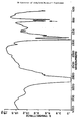
- the attached Figure shows the IR spectrum of a poly(ethylene/butene-1) copolymer.
- the peak at 770 cm ⁇ 1 relates to the proportion of polybutene sequences (cf. Hummel-Scholl, Atlas der Polymer- und Kunststoff analyses, vol. 1, page 11, spectrum # 33).
- Example 2 On the analogy of Example 1 there were charged 22.68 g (0.86 moles) of MgH2 in 150 ml of dry toluene.
- a 500 ml glass autoclave pre-conditioned by heating and purging with argon was charged with 312 mg of a catalyst prepared as in Example 1 and having a Ti content of 4.81% (0.31 millimoles of Ti) in 270 ml of toluene.
- a catalyst prepared as in Example 1 Prior to use the catalyst in 50 ml of toluene had been pre-treated in an ultrasonic bath for 5 minutes.
- the dark brown suspension was thermostated at 20°C, degassed by multiple short-time application of vacuum and saturated with ethylene under a static pressure of 2 bar.
- the reaction was stopped by addition of methanol, the polymer was stirred in a methanol/HCl mixture, filtrated, several times washed with methanol and dried under vacuum.
- the yield was 23.9 g of a white fine-grain powder.
- the activity was calculated to be 4 825 g of polyethylene (PE) per gram titanium and per hour.
- the average molecular weight as determined by viscosimetry was 3 700 000.
- Propene was polymerized at 20°C using 399 mg catalyst prepared according to Example 1 having a titanium content of 10.68% (0.89 millimoles) and 0.24 ml (1.78 millimoles) of aluminium triethyl.
- the polymerization procedure as further carried out was on the analogy of Example 3. After 30 minutes the yield was 4.1 g of isotactic polypropylene (PP) having a soft consistency and an average molecular weight of 150 000.
- the activity was 200 g of PP per gram titanium and per hour.
- Butene was polymerized at 20°C on the analogy of Example 4. The pressure was measured within the range of from 1 bar to 0.6 bar.
- catalyst prepared according to Example 1 having a titanium content of 7.29% (1.17 millimoles) and 0.32 ml (2.34 millimoles) of triethyl aluminium, there were obtained after a polymerization period of 1 hour 4.0 g of a soft isotactic polybutene having an average molecular weight of 260 000.
- the activity was calculated to be 70 g of polybutene (PB) per gram titanium and per hour.
- the polymerization was carried out on the analogy of Example 3. Prior to saturation with ethylene there were introduced 16 g of butene 1 by condensation. Upon pressurization with ethylene to 2 bar the polymerization was initiated by increasing the revolution of the stirrer. Upon use of 501 mg (0.76 millimoles) of catalyst (according to Example 5) and 0.21 ml (1.52 millimoles) of triethyl aluminium, there were obtained after 20 minutes 14.8 g of a copolymer having an average molecular weight of 150 000.
- the PE/PB copolymer is composed of crystalline PE regions and isotactic PB blocks.
- the activity is 1220 g of polymer per gram titanium and per hour, as compared to 70 g of polymer per gram titanium and per hour for neat butene and 910 g of polymer having a molecular weight of 1,100,000 per gram titanium and per hour for neat ethylene.
- Example 2 Using 610 mg of a catalyst prepared in accordance with Example 2, having a Ti content of 0.98% (0.12 millimoles) and 0.17 ml (1.25 millimoles) of triethyl aluminium, ethylene was polymerized at 30°C and under a pressure of 2 bar on the analogy of Example 3. The segregation of the polymer flakes was also to be observed, however the flakes themselves were smaller than with a polyethylene produced using a catalyst prepared according to Example 1. After 30 minutes the yield of a white fine-grain polyethylene having an average molecular weight of 1 100 000 was 44.7 g. Therefrom the activity was calculated to be 14 950 g of PE per gram titanium and per hour.
- Example 4 Using 854 mg of a catalyst prepared in accordance with Example 2 having a Ti content of 1.55% (0.28 millimoles) and 0.08 ml (0.056 millimoles) of triethyl aluminium, propene was polymerized on the analogy of Example 4. The yield after 60 minutes was 20.3 g of polypropylene having an average molecular weight of 200 000. The activity was found to be 1 540 g of PP per gram titanium and per hour.
Landscapes
- Chemical & Material Sciences (AREA)
- Health & Medical Sciences (AREA)
- Chemical Kinetics & Catalysis (AREA)
- Medicinal Chemistry (AREA)
- Polymers & Plastics (AREA)
- Organic Chemistry (AREA)
- Transition And Organic Metals Composition Catalysts For Addition Polymerization (AREA)
- Addition Polymer Or Copolymer, Post-Treatments, Or Chemical Modifications (AREA)
Claims (8)
- Procédé de préparation de polyoléfines, polydiènes et leurs copolymères par polymérisation dans des solvants, des monomères liquides ou en phase gazeuse à une température comprise entre -20°C et 150°C en utilisant de l'hydrure de magnésium, un composé de métal de transition du groupe IV contenant un halogène et un composé d'alkyl-aluminium, caractérisé en ce qu'on conduit la polymérisation en présence d'un système catalyseur obtenu par une réaction dans laquelle on fait réagira) un hydrure de magnésium de Bogdanovic MgH₂ ayant une surface spécifique comprise entre 90 et 150 m²/g , avecb) un composé d'un métal de transition du groupe IV ayant la formule générale
MeHal₄
dans laquelle Me est un métal de transition, plus spécifiquement le titane, et Hal est un halogène, plus spécifiquement le chlore; et l'on fait réagir le produit de la réaction avecc) un composé d'alkyl-aluminium ayant la formule générale
AlRnHal(3-n)
dans laquelle R est un résidu alkyle en C₁ à C₆ ,plus spécifiquement éthyle, Hal est un halogène, plus spécifiquement le chlore, et n est un nombre variant de 1 à 3, et de préférence 3. - Procédé selon la revendication 1, caractérisé en ce que la polymérisation est conduite en présence d'un catalyseur constitué de tétrachlorure de titane, d'hydrure de magnésium ou de son produit de réaction avec l'acide chlorhydrique ou le chlore, respectivement, et l'aluminium triéthyle.
- Procédé selon les revendications 1 et 2, caractérisé en ce que le catalyseur a été préparé à un rapport molaire de l'hydrure de magnésium au tétrachlorure de titane allant de 10²:1 à 10⁻²:1, et de préférence à un rapport de 40:1.
- Procédé selon les revendications 1 à 3, caractérisé en ce que dans la polymérisation on emploie un rapport aluminium:titane de 10²:1 à 1:1 , et de préférence de 10:1.
- Procédé selon les revendications 1 à 4, caractérisé en ce que la polymérisation dans des solvants est de préférence conduite à une concentration de titane allant de 10⁻² à 10⁻⁴ mol/litre.
- Procédé selon les revendications 1 à 5, caractérisé en ce que dans la polymérisation du propène ou du butène se forment du polypropylène et du polybutène isotactiques, respectivement.
- Procédé selon les revendications 1 à 5, caractérisé en ce que la copolymérisation de l'éthylène est conduite en présence d' α-oléfines, et de préférence d'hexène, pour réduire la densité et le poids moléculaire du polymère.
- Procédé selon les revendications 1 à 5, caractérisé en ce qu'on procède à la copolymérisation de l'éthylène avec du propène et/ou du butène.
Priority Applications (1)
| Application Number | Priority Date | Filing Date | Title |
|---|---|---|---|
| AT86101782T ATE74139T1 (de) | 1985-02-13 | 1986-02-12 | Verfahren zur herstellung von polyolefinen, polydienen und ihren copolymeren. |
Applications Claiming Priority (2)
| Application Number | Priority Date | Filing Date | Title |
|---|---|---|---|
| DE3504808 | 1985-02-13 | ||
| DE19853504808 DE3504808A1 (de) | 1985-02-13 | 1985-02-13 | Verfahren zur herstellung von polyolefinen, polydienen und deren copolymerisaten |
Publications (3)
| Publication Number | Publication Date |
|---|---|
| EP0194457A2 EP0194457A2 (fr) | 1986-09-17 |
| EP0194457A3 EP0194457A3 (en) | 1988-05-11 |
| EP0194457B1 true EP0194457B1 (fr) | 1992-03-25 |
Family
ID=6262341
Family Applications (1)
| Application Number | Title | Priority Date | Filing Date |
|---|---|---|---|
| EP86101782A Expired - Lifetime EP0194457B1 (fr) | 1985-02-13 | 1986-02-12 | Procédé de préparation de polyoléfines, de polydiènes et de leurs copolymères |
Country Status (6)
| Country | Link |
|---|---|
| US (1) | US4980431A (fr) |
| EP (1) | EP0194457B1 (fr) |
| JP (1) | JPS61228005A (fr) |
| AT (1) | ATE74139T1 (fr) |
| CA (1) | CA1266947A (fr) |
| DE (2) | DE3504808A1 (fr) |
Family Cites Families (13)
| Publication number | Priority date | Publication date | Assignee | Title |
|---|---|---|---|---|
| US2905645A (en) * | 1954-08-16 | 1959-09-22 | Du Pont | Polymerization catalysts |
| US3058963A (en) * | 1955-04-07 | 1962-10-16 | Hercules Powder Co Ltd | Process for polymerizing olefins |
| BE575276A (fr) * | 1958-02-06 | |||
| US3478008A (en) * | 1965-07-12 | 1969-11-11 | Dow Chemical Co | Preparation of propylene having intermediate crystallinity with a catalyst comprising (1) ticl4-metal hydride-alkyl aluminum halide and (2) aluminum trialkyl |
| NL162661B (nl) * | 1968-11-21 | 1980-01-15 | Montedison Spa | Werkwijze om een katalysator te bereiden voor de poly- merisatie van alkenen-1. |
| YU35844B (en) * | 1968-11-25 | 1981-08-31 | Montedison Spa | Process for obtaining catalysts for the polymerization of olefines |
| GB1299862A (en) * | 1969-01-23 | 1972-12-13 | Shell Int Research | Improvements in or relating to the catalytic polymerisation of olefins |
| US4113654A (en) * | 1971-04-20 | 1978-09-12 | Montecatini Edison S.P.A. | Catalysts for the polymerization of olefins |
| FR2342306A1 (fr) * | 1976-02-25 | 1977-09-23 | Charbonnages Ste Chimique | Procede ameliore de polymerisation ionique de l'ethylene sous haute pression |
| FR2424760A1 (fr) * | 1978-05-05 | 1979-11-30 | Charbonnages Ste Chimique | Catalyseurs comprenant du magnesium et un metal de transition |
| EP0019312B1 (fr) * | 1979-04-30 | 1983-08-17 | Shell Internationale Researchmaatschappij B.V. | Compositions catalytiques de polymérisation d'oléfines et procédé de polymérisation d'oléfines à l'aide de ces compositions |
| EP0090926A1 (fr) * | 1982-03-26 | 1983-10-12 | Conoco Phillips Company | Réactif d'hydrure de magnésium soluble |
| US4458027A (en) * | 1983-03-18 | 1984-07-03 | E. I. Du Pont De Nemours And Company | Olefin polymerization catalysts |
-
1985
- 1985-02-13 DE DE19853504808 patent/DE3504808A1/de not_active Withdrawn
-
1986
- 1986-02-10 CA CA000501524A patent/CA1266947A/fr not_active Expired - Lifetime
- 1986-02-12 EP EP86101782A patent/EP0194457B1/fr not_active Expired - Lifetime
- 1986-02-12 AT AT86101782T patent/ATE74139T1/de not_active IP Right Cessation
- 1986-02-12 DE DE8686101782T patent/DE3684494D1/de not_active Expired - Lifetime
- 1986-02-13 JP JP61030593A patent/JPS61228005A/ja active Pending
-
1987
- 1987-05-08 US US07/047,812 patent/US4980431A/en not_active Expired - Fee Related
Also Published As
| Publication number | Publication date |
|---|---|
| US4980431A (en) | 1990-12-25 |
| EP0194457A2 (fr) | 1986-09-17 |
| DE3504808A1 (de) | 1986-08-14 |
| CA1266947A (fr) | 1990-03-20 |
| ATE74139T1 (de) | 1992-04-15 |
| DE3684494D1 (de) | 1992-04-30 |
| EP0194457A3 (en) | 1988-05-11 |
| JPS61228005A (ja) | 1986-10-11 |
Similar Documents
| Publication | Publication Date | Title |
|---|---|---|
| US4636486A (en) | Polymerization catalysts | |
| US7592286B2 (en) | Process for the preparation of a catalyst component and components therefrom obtained | |
| US4748221A (en) | Polymerization of olefins using a ziegler-natta catalyst and two organometallic compounds | |
| US4013823A (en) | Process for preparing elastomeric copolymers of ethylene and higher alpha-olefins | |
| EP0012397B1 (fr) | Catalyseur de polymérisation et procédé pour la polymérisation d'alpha-oléfines | |
| US20060089251A1 (en) | Catalyst components for the polymerization of olefins | |
| JPS5850242B2 (ja) | α−オレフインの重合方法 | |
| JP3168341B2 (ja) | オレフィン重合触媒及び方法 | |
| US4477586A (en) | Polymerization of olefins | |
| US4220745A (en) | Process for polymerization of α-olefins | |
| JPH07649B2 (ja) | オレフィン重合用触媒成分の製造方法 | |
| JPH07650B2 (ja) | オレフィン重合用触媒成分の製造方法 | |
| US4686200A (en) | Catalyst for the polymerization of olefins | |
| US4542197A (en) | Polymerization catalyst | |
| CA1152055A (fr) | Procede de fabrication d'un catalyseur mixte | |
| US4208304A (en) | Catalyst system for producing ethylene polymers | |
| HK219896A (en) | Solid catalyst for use in stereospecific x-olefin polymerization, process of preparation and polymerization process using the same | |
| US4384984A (en) | Titanium catalyst for polymerizing olefins | |
| US4980431A (en) | Process for preparing polyolefins, polydienes and copolymers thereof | |
| US4567154A (en) | Mixed metal alkyl catalyst for olefin polymerization | |
| US4540757A (en) | Polymerization and catalyst | |
| US5064795A (en) | Polymerization of olefins | |
| US4663403A (en) | Polymerization of olefins | |
| EP0567286B1 (fr) | Procédé de préparation de polymères d'éthylène | |
| JPS5812889B2 (ja) | ポリエチレンノ セイゾウホウホウ |
Legal Events
| Date | Code | Title | Description |
|---|---|---|---|
| PUAI | Public reference made under article 153(3) epc to a published international application that has entered the european phase |
Free format text: ORIGINAL CODE: 0009012 |
|
| AK | Designated contracting states |
Kind code of ref document: A2 Designated state(s): AT BE CH DE FR GB IT LI LU NL |
|
| RIN1 | Information on inventor provided before grant (corrected) |
Inventor name: KINKELIN, EBERHARD Inventor name: FINK, GERHARD, DR. |
|
| PUAL | Search report despatched |
Free format text: ORIGINAL CODE: 0009013 |
|
| AK | Designated contracting states |
Kind code of ref document: A3 Designated state(s): AT BE CH DE FR GB IT LI LU NL |
|
| 17P | Request for examination filed |
Effective date: 19880630 |
|
| 17Q | First examination report despatched |
Effective date: 19890530 |
|
| GRAA | (expected) grant |
Free format text: ORIGINAL CODE: 0009210 |
|
| AK | Designated contracting states |
Kind code of ref document: B1 Designated state(s): AT BE CH DE FR GB IT LI LU NL |
|
| REF | Corresponds to: |
Ref document number: 74139 Country of ref document: AT Date of ref document: 19920415 Kind code of ref document: T |
|
| ITF | It: translation for a ep patent filed | ||
| REF | Corresponds to: |
Ref document number: 3684494 Country of ref document: DE Date of ref document: 19920430 |
|
| ET | Fr: translation filed | ||
| PLBE | No opposition filed within time limit |
Free format text: ORIGINAL CODE: 0009261 |
|
| STAA | Information on the status of an ep patent application or granted ep patent |
Free format text: STATUS: NO OPPOSITION FILED WITHIN TIME LIMIT |
|
| ITTA | It: last paid annual fee | ||
| 26N | No opposition filed | ||
| PGFP | Annual fee paid to national office [announced via postgrant information from national office to epo] |
Ref country code: DE Payment date: 19940112 Year of fee payment: 9 Ref country code: CH Payment date: 19940112 Year of fee payment: 9 |
|
| PGFP | Annual fee paid to national office [announced via postgrant information from national office to epo] |
Ref country code: GB Payment date: 19940113 Year of fee payment: 9 |
|
| PGFP | Annual fee paid to national office [announced via postgrant information from national office to epo] |
Ref country code: FR Payment date: 19940114 Year of fee payment: 9 Ref country code: BE Payment date: 19940114 Year of fee payment: 9 |
|
| PGFP | Annual fee paid to national office [announced via postgrant information from national office to epo] |
Ref country code: AT Payment date: 19940117 Year of fee payment: 9 |
|
| PGFP | Annual fee paid to national office [announced via postgrant information from national office to epo] |
Ref country code: LU Payment date: 19940131 Year of fee payment: 9 |
|
| PGFP | Annual fee paid to national office [announced via postgrant information from national office to epo] |
Ref country code: NL Payment date: 19940228 Year of fee payment: 9 |
|
| EPTA | Lu: last paid annual fee | ||
| PG25 | Lapsed in a contracting state [announced via postgrant information from national office to epo] |
Ref country code: LU Free format text: LAPSE BECAUSE OF NON-PAYMENT OF DUE FEES Effective date: 19950212 Ref country code: GB Effective date: 19950212 Ref country code: AT Effective date: 19950212 |
|
| PG25 | Lapsed in a contracting state [announced via postgrant information from national office to epo] |
Ref country code: LI Effective date: 19950228 Ref country code: CH Effective date: 19950228 Ref country code: BE Effective date: 19950228 |
|
| BERE | Be: lapsed |
Owner name: STUDIEN G.- KOHLE M.B.H. Effective date: 19950228 |
|
| PG25 | Lapsed in a contracting state [announced via postgrant information from national office to epo] |
Ref country code: NL Effective date: 19950901 |
|
| GBPC | Gb: european patent ceased through non-payment of renewal fee |
Effective date: 19950212 |
|
| PG25 | Lapsed in a contracting state [announced via postgrant information from national office to epo] |
Ref country code: FR Effective date: 19951031 |
|
| NLV4 | Nl: lapsed or anulled due to non-payment of the annual fee |
Effective date: 19950901 |
|
| PG25 | Lapsed in a contracting state [announced via postgrant information from national office to epo] |
Ref country code: DE Effective date: 19951201 |
|
| REG | Reference to a national code |
Ref country code: FR Ref legal event code: ST |
|
| PG25 | Lapsed in a contracting state [announced via postgrant information from national office to epo] |
Ref country code: IT Free format text: LAPSE BECAUSE OF NON-PAYMENT OF DUE FEES Effective date: 20050212 |