EP0194813A2 - Verfahren und Vorrichtung zum Konditionieren von Geweben in einem Trommeltrockner - Google Patents
Verfahren und Vorrichtung zum Konditionieren von Geweben in einem Trommeltrockner Download PDFInfo
- Publication number
- EP0194813A2 EP0194813A2 EP86301604A EP86301604A EP0194813A2 EP 0194813 A2 EP0194813 A2 EP 0194813A2 EP 86301604 A EP86301604 A EP 86301604A EP 86301604 A EP86301604 A EP 86301604A EP 0194813 A2 EP0194813 A2 EP 0194813A2
- Authority
- EP
- European Patent Office
- Prior art keywords
- soap
- weight
- container
- fabrics
- powder
- Prior art date
- Legal status (The legal status is an assumption and is not a legal conclusion. Google has not performed a legal analysis and makes no representation as to the accuracy of the status listed.)
- Granted
Links
Images



Classifications
-
- C—CHEMISTRY; METALLURGY
- C11—ANIMAL OR VEGETABLE OILS, FATS, FATTY SUBSTANCES OR WAXES; FATTY ACIDS THEREFROM; DETERGENTS; CANDLES
- C11D—DETERGENT COMPOSITIONS; USE OF SINGLE SUBSTANCES AS DETERGENTS; SOAP OR SOAP-MAKING; RESIN SOAPS; RECOVERY OF GLYCEROL
- C11D17/00—Detergent materials or soaps characterised by their shape or physical properties
- C11D17/04—Detergent materials or soaps characterised by their shape or physical properties combined with or containing other objects
- C11D17/041—Compositions releasably affixed on a substrate or incorporated into a dispensing means
- C11D17/047—Arrangements specially adapted for dry cleaning or laundry dryer related applications
-
- C—CHEMISTRY; METALLURGY
- C11—ANIMAL OR VEGETABLE OILS, FATS, FATTY SUBSTANCES OR WAXES; FATTY ACIDS THEREFROM; DETERGENTS; CANDLES
- C11D—DETERGENT COMPOSITIONS; USE OF SINGLE SUBSTANCES AS DETERGENTS; SOAP OR SOAP-MAKING; RESIN SOAPS; RECOVERY OF GLYCEROL
- C11D10/00—Compositions of detergents, not provided for by one single preceding group
- C11D10/04—Compositions of detergents, not provided for by one single preceding group based on mixtures of surface-active non-soap compounds and soap
- C11D10/045—Compositions of detergents, not provided for by one single preceding group based on mixtures of surface-active non-soap compounds and soap based on non-ionic surface-active compounds and soap
-
- C—CHEMISTRY; METALLURGY
- C11—ANIMAL OR VEGETABLE OILS, FATS, FATTY SUBSTANCES OR WAXES; FATTY ACIDS THEREFROM; DETERGENTS; CANDLES
- C11D—DETERGENT COMPOSITIONS; USE OF SINGLE SUBSTANCES AS DETERGENTS; SOAP OR SOAP-MAKING; RESIN SOAPS; RECOVERY OF GLYCEROL
- C11D1/00—Detergent compositions based essentially on surface-active compounds; Use of these compounds as a detergent
- C11D1/66—Non-ionic compounds
- C11D1/72—Ethers of polyoxyalkylene glycols
Definitions
- the present invention relates to a method and device for conditioning fabrics in a tumble-dryer.
- conditioning is used herein to mean the imparting of certain consumer benefits, including softness and reduced static cling, to washed fabrics.
- a fabric conditioning agent in the form of a free-flowing powder is applied directly to the fabrics before or during drying in the tumble-dryer.
- the present invention represents an improved modification of the invention described and claimed in GB 2 136 028A (Unilever), which is concerned with a fabric conditioning method and device using a soap-based fabric conditioning agent in the form of a simple, uncoated free-flowing powder.
- a method of conditioning fabrics which comprises tumbling damp fabrics under the action of heat in a laundry dryer together with a conditioning agent in the form of a free-flowing powder and having a particle size range within the range of from 20 to 1000 ⁇ m, said powder consisting to an extent of at least 55% by weight of one or more water-soluble soaps of C 8 to C 22 saturated or unsaturated fatty acids, said soap blend containing at least 5% by weight of C 12 soap, at least 5% by weight of C 14 soap, at least 12% by weight of C 16 soap and at least 20% by weight of C 18 soap, said soap blend being in the form of a powder free of any protective coating.
- US 4 049 858 and US 4 09-6 071 disclose a fabric softening composition
- a fabric softening composition comprising a sorbitan ester, together with a phase modifier (a soap or an alkyl sulphate) in a ratio of 100:1 to 1:1.
- the composition may be applied to the fabric load prior to drying as a foam or dispersion or by sprinkling from a shaker; or it may be enclosed in a hollow, open-pore polyurethane foam sponge pouch which is placed in the dryer with the fabrics.
- GB 1 482 782 discloses fabric conditioning compositions that impart crispness to the fabric.
- the compositions contain nonionic surfactant and a crisping component insoluble in water that may be a fatty alcohol, a fatty acid, or an insoluble (calcium or magnesium) soap of a fatty acid.
- the composition may be dispensed from a hollow sponge, a bag or a sheet substrate, or manually scattered, in granular form, onto the fabrics before the start of the drying cycle.
- the present invention provides a method of conditioning fabrics, which comprises tumbling damp fabrics under the action of heat in a laundry dryer together with a conditioning agent in the form of a free-flowing powder having a particle size within the range of from 20 to 1000 ⁇ m, said powder comprising
- compositions as defined above when applied as a free-flowing powder to fabrics in the tumble-dryer, are highly effective fabric softeners and also reduce static cling just as well as the soap/cationic blends of GB 2 136 028A.
- the fabric conditioning agent be in powder form. Soap-based conditioning compositions applied as a coating or impregnant on a sheet substrate, without distributing agent, were found to be delivered very poorly to the fabrics, so that very little softening benefit was obtained; a substantial proportion of the soap remained on the sheet substrate. According to the present invention, on the other hand, 100% delivery of the conditioning agent to the fabrics may easily be achieved without the use of a distributing agent.
- the particle size of the powder will influence the speed and uniformity of delivery. Particle sizes above 1000 ⁇ m have been found to give insufficiently uniform conditioning, and thus powders having particle sizes above this figure, which may more properly be regarded as granules, are outside the scope of the invention.
- the smaller the particle size of the powder the greater the uniformity of its distribution on the fabrics in the dryer; but a particle size smaller than 20 ⁇ m is undesirable on safety grounds because of its respirability.
- a preferred particle size range is 70 to 500 ⁇ m, more preferably 90 to 250 ⁇ m.
- the powdered conditioning agent used according to the invention consists, to an extent of at least 80% by weight, preferably at least 90% by weight, of the soap blend as defined above.
- the cation is generally alkali metal, preferably sodium or potassium; ammonium; or substituted ammonium, for example, triethanolamine.
- the blend preferably contains at least 7% by weight of C 12 soap, especially from 7 to 27%; at least 6% by weight of C1 4 soap, especially from 6 to 12%; at least 15% by weight of C 16 soap, especially from 18 to 28%; and at least 25% by weight of C 18 soap, especially from 32 to 54% by weight.
- the soap blend used in the process of the invention thus contains significant amounts of four different chain lengths, the spread of chain lengths - from C 12 to C 18 - being relatively wide.
- the blend may contain both saturated and unsaturated soaps.
- the blend contains at least 15% by weight of C 18 unsaturated soap, preferably at least 20% by weight and especially from 22 to 38% by weight.
- Single-chain-length soaps show a slight fabric softening effect, as do soap blends having a limited chain length spread, such as tallow soap and coconut soap. All these soaps, however, are inferior softeners to commercially available impregnated sheets carrying cationic fabric conditioner and spreading agent. As described in GB 2 136 028A, however, blends having a wider and more balanced chain length spread, obtainable by mixing tallow and coconut soaps, have been found to give highly efficient softening which, at a dosage of 3 g per fabric load, is consistently as good as, if not better than, that obtained using the impregnated sheet type of article.
- blends may advantageously contain from 45 to 85% by weight of tallow soap, the balance being coconut soap
- coconut soap Commercial blends of coconut and tallow soaps as used in toilet soap bars and fabric washing soap flakes have been found to offer excellent softening performance.
- These blends may in some cases be superfatted, that is to say, they contain up to about 10% by weight of free fatty acids. This appears not to be detrimental in terms of softening performance, but can make the milling of the soap to a free-flowing powder more difficult.
- the powdered fabric conditioning agents used according to the present invention also contain minor amounts, not exceeding 20%, of specified nonionic surfactants: C16 C22 aliphatic alcohol 5-30 EO ethoxylates. These materials do not themselves have appreciable softening properties, so it is not desirable to use high proportions of them in the conditioning compositions, but in minor amounts of 5-20% by weight, preferably 5-10% by weight, they considerably enhance the antistatic properties of the fabric conditioning compositions.
- nonionic surfactant that has a melting point above about 20°C. Accordingly materials with relatively long hydrocarbon chains (C 16 and above) are preferred. Ethoxylates of tallow alcohol, for example the 9 EO, 18 EO and 25 EO ethoxylates are all useful in the present invention: these have melting points of about 33°C, 37°C and 44°C respectively. The 25 EO material is especially preferred for ease of processing because it is available as a free-flowing spray-cooled powder. Tallow alcohols consist mostly of C 18 alcohol. Petrochemically derived C 16 -C 19 OXO alcohol mixes with 7-20 ethylene oxide groups per mole (average) have also been used successfully in the present invention.
- the powdered fabric conditioning agent used in accordance with the present invention may, for example, be prepared by slurrying together the soap and alcohol ethoxylate, drying the slurry, grinding and sieving to a desired particle size range.
- the nonionic surfactant is a free-flowing powder itself, the ingredients may be ground and sieved separately and then dry mixed.
- Other processing possibilities will readily suggest themselves to one skilled in the art.
- composition will consist predominantly of the two principal ingredients already mentioned, but may also include minor amounts of other materials chosen to enhance the overall fabric conditioning effect, for example, to impart crispness, perfume or easy-iron characteristics, or to improve powder properties.
- Any perfume included is preferably fabric-substantive, and may advantageously be protected by encapsulation.
- the amount of_powdered conditioning agent used per fabric load will of course depend both on the fabric load and the size of the machine. For use in a domestic UK or European tumble-dryer, amounts of from 1.5 to 12 g, preferably from 2.5 to 10 g and especially from 2.5 to 7 g, have been found to be optimum.
- the powdered conditioning agent may simply be scattered by hand onto the fabrics in the tumble-dryer before the dryer is switched on, but in a preferred embodiment of the powdered conditioning agent is contained within a dispensing device and is sprinkled onto the fabrics during the actual drying process.
- the dispensing device may be fixed to an internal surface of the dryer, either a stationary surface such as the door or, preferably, a moving surface such as the drum wall. More preferably, however, the dispensing device is loose in the dryer and moves freely among the fabrics as drying progresses.
- the use of a dispensing device allows the scattering of the conditioning agent onto the fabrics to take place gradually during the early part of the drying cycle, rather than instantaneously.
- the powder should all be dispensed onto the fabric while the fabrics are still damp enough for the powder to adhere to them.
- the time over which the powder should be dispensed accordingly depends on the fabric load and its initial water content, as well as on the tumble dryer itself. For UK or European tumble dryers it has been found that the powder should preferably be dispensed over a period of at least 2.5 minutes and not exceeding 20 minutes, preferably not exceeding 10 minutes.
- the conditioning agent must obviously remain in fine powder form while it is inside the dispensing device; conversion to a fluid form must take place later when the powder has been deposited on the fabrics. It has been found that the soap-based powdered conditioning agent used according to the present invention has excellent characteristics in this respect.
- a dispensing device also allows more accurate control of the amount of conditioning agent, especially if it is of the disposable unit dose type containing the correct amount of conditioning agent for a single load.
- a dispensing device may take the form of a small container having openings of a size such that gradual and uniform dispensing of the powder will occur.
- the present invention provides an article for conditioning fabrics in a tumble-dryer, comprising a container having a plurality of openings the largest dimension of which does not exceed 2.5 mm, and containing from 1.5 to 12 g of a fabric conditioning agent as defined above.
- the container is of such a size that it can contain the appropriate quantity (1.5 to 12 g, preferably 2.5 to 10 g) of conditioning agent and deliver it at an appropriate rate. It should not be too small, or it will become caught among the fabrics.
- the hole size of the container is advantageously matched to the particle size of the powdered conditioning agent, so that the latter is dispensed in a controlled manner.
- the container is advantageously substantially free of openings larger than 2000 ⁇ m, and more preferably substantially free of openings larger than 1000 um.
- Use of a container having a hole size approximately equal to the largest particle size of the powder used gives especially uniform conditioning.
- Some powders may, however, have a tendency to agglomerate under tumble-dryer conditions to form larger particles and in this case the openings must be sufficiently large to accommodate the agglomerate.
- the container is a sachet of flexible sheet material provided over part or whole of its surface with openings to provide permeability to the powder.
- Suitable materials include paper, nonwoven fabrics, plastics films, and laminates of these.
- one or more sachet walls may be constituted by a material provided with openings uniformly over its whole surface; an example of a highly suitable material of this type is the paper used to make tea and coffee bags. This has been found to be suitable for dispensing powders having a particle size of less than 250 ⁇ m.
- an essentially non-porous material may be used and provided with a chosen number of perforations or slits of a chosen size in a chosen arrangement; this second possibility is preferred when relatively large, for example, 2000 gm, openings are required.
- a sachet of this type is described and claimed in GB 2 149 825 A (UNILEVER).
- the sachet or other container is preferably provided with a removable outer covering, impermeable to the powdered conditioning agent, which covers all the openings and is in intimate contact with the container in the region of the openings, so as to prevent premature escape of the powder.
- This outer covering is removed by the consumer immediately before placing the container in the tumble-dryer.
- the sachet or other container may be placed, for use in the tumble dryer, within a larger, also powder-permeable container.
- This arrangement means that at the beginning of the drying cycle the smaller container is prevented from coming into direct contact with the damp fabrics and with water droplets, which contact could cause clogging.
- the use of an outer container also helps to reduce the incidence of local overloading of conditioner, and hence spotting and staining.
- the inner container may be smaller without catching in the fabrics, because additional size is provided by the outer container.
- the outer container may be, for example, a sachet or bag within which the small inner container preferably fits rather loosely. A loose fit is preferred because it lessens the chance of direct contact of the bulk of the powder in the inner container with damp fabrics or water droplets.
- the outer container is advantageously reusable and can be refilled with disposable inner containers; it may be closable, for example, by means of a drawstring, elastic, press-studs, a zip-fastener or the like.
- the outer bag may be made, for example, of a suitably open-weave textile material; or it may be similar in materials and construction to the sachet embodiment of the inner container described previously.
- the powdered soap-based fabric conditioning agent is dispensed during tumble-drying by means of a device as described and claimed in GB 2 122 657A (Unilever).
- the powdered fabric conditioning agent is disposed within a first container of material permeable to said composition in powder form, the first container being disposed within a second container having openings for the egress of said composition in powder form, the second container being substantially form-retaining and of a shape such as to allow ready movement thereof among the fabrics in a dryer.
- the outer container is substantially form-retaining, but need not be completely rigid. It should not be significantly deformed by the tumbling fabrics as it moves among them. Furthermore the container should be to some extent energy-absorbing, and thus sound-absorbing, so that the noise it makes on impact with the drum is not excessive, thus some flexing of the container walls is desirable.
- the shape and size of the outer container should be such that it moves freely among the fabric load under the motion of the dryer and distributes its contents as uniformly as possible.
- the outer surface should be as smoothly contoured as possible, and free of protrusions and sharp edges that can catch on the fabrics. In principle any shape is suitable provided that angles between adjacent faces are not too small; any edges and corners are advantageously rounded off.
- the ratio of the principal axes (major to minor) is preferably not greater than 5:1, and is advantageously 2:1 or less, a ratio of approximately 1:1 being especially preferred.
- the ideal shape appears to be spherical or substantially spherical, and spheroidal, ellipsoidal, cylindrical and frustoconical shapes are also highly advantageous.
- Other shapes of interest include cubes, hexagonal prisms, and pairs of frustocones abutting at their larger ends, and other possible shapes will readily suggest themselves to one skilled in the art.
- the largest dimension of the outer container is preferably at least 6 cm. Smaller containers tend to become caught among the fabrics.
- the outer container can be of any reasonable mass, but should not be too heavy, otherwise damage to the dryer could result.
- the material of the outer container must be relatively robust, as it will be knocked frequently against the walls of the dryer and compressed by the fabrics. It must also be stable at the temperatures encountered in the dryer, which generally should not exceed 70°C but may rise to 100°C or above in old or poorly maintained machines. Accordingly the material of the outer container is preferably stable at temperatures up to at least 130°C, and preferably up to about 170°C.
- Suitable materials include thermoplastic and thermosetting resins, wood, resin-bonded cardboard, papier-mache and casein, natural and synthetic rubbers, and lightweight metals, for example aluminium. Materials that are unsuitable for contact with wet fabrics, for example cardboard, may be protected by a coating of, for example, rubber or plastics material or metal foil. Many other lightweight, robust and heat-stable materials will readily suggest themselves to the skilled worker in the art.
- Thermoplastic materials of sufficiently high softening point (preferably above 130°C) and robustness offer manufacturing advantages in that suitable shapes can readily be made by moulding techniques such as injection, extrusion or blow-moulding.
- Preferred materials include polystyrene, high-density polyethylene and, in particular, polypropylene.
- the softening point of the last-mentioned material is above 130°C.
- the outer container is provided with openings, for example, slits or circular holes, through which the powdered conditioning agent passes. These are larger than the openings in the inner container so that they provide no impedance to the passage of the powdered conditioning agent.
- the total area of the openings in the outer container is at least 3 times as large as the total area of the openings in the inner container, and advantageously at least 5 times as large.
- the individual openings are desirably as large as possible provided that the inner container cannot fall out and the outer container has sufficient integrity and robustness.
- the shape of the openings is not important as far as delivery of the powder is concerned, but may have some influence on the strength and flexibility of the outer container and its noisiness in use. It has been found, for example, that in the case of a spherical polypropylene container the use of elongate slits rather than circular holes gives substantially less noise in use, presumably because of greater flexibility.
- the surface of the outer container may be rendered to some extent hydrophobic (if not inherently so) to prevent or reduce the penetration into its interior of water droplets, which may collect on the outer surface at an early stage in the dryer cycle.
- the interior of the outer container may optionally be provided with means for keeping the inner containerat a distance from its outer wall(s) and thus ensuring that no direct contact with damp fabrics or water droplets occurs.
- the inner wall(s) may, for example, be provided with protrusions which act as spacers.
- locating means such as pins or pegs, may be provided to hold the inner container in a fixed position; this measure has the advantage that in the case of a flexible inner container such as a sachet the latter is prevented from becoming crumpled up.
- the outer container is injection-moulded, such pins or pegs may readily be formed as an integral part of it. Spacer ribs or other protrusions as mentioned above may also easily be formed in this way.
- the inner container may be rigid or flexible but if free to move around in the outer container is preferably flexible. This is for noise reasons. If, however, locating means as described in the previous paragraph are provided in the outer container, a rigid inner container may if desired be used without creating a noise problem.
- the outer container is sufficiently robust to be reusable, and is so constructed that an inner container may readily be inserted or removed.
- the outer container may, for example be so designed that, by flexing, one of its apertures may be enlarged to a sufficient extent that an inner container can be inserted or removed.
- the outer container may be constructed in two or more parts that can readily be separated and re-joined. The parts may if desired be connected by a hinge or the like so that they never become completely separated. The parts should join up by a mechanism that leaves the outer surface of the closed container as smooth as possible, and that will not accidentally come open during use in the tumble-dryer. Examples of suitable mechanisms include snap-fit, a lock screw, and internal hooks joined by elastic.
- a succession of inner containers is to be used with the same outer container, it may be unnecessary to remove the spent inner containers before inserting a new one, if the inner containers are of a type, for example, a flexible sachet, that once empty occupies little space. In practice it has been found that ten sachets may be used successively within a slitted polypropylene sphere without removing the empty sachets.
- outer container is reusable and full inner containers are separately available as refills, it is clearly desirable for these inner containers to be provided with outer packaging or covering in order to prevent premature discharge of their contents.
- the outer packaging or covering is advantageously also moisture-proof in order to protect the powdered conditioning agent from atmospheric moisture during storage and handling prior to use.
- the outer packaging or covering is thus preferably a flexible sheet material that can be made to conform intimately and accurately to any permeable surface region of the inner container.
- Any film or sheet that can be made to adhere.to the inner container and subsequently removed is in principle suitable, the choice of material depending among other things on the material used for the inner container itself - and the area required to be covered.
- the outer covering is preferably a relatively durable material impermeable to moisture and perfume so that the product has a reasonable storage life. Materials that can be heat-sealed, either inherently or with the aid of hot-melt adhesives, are especially advantageous.
- Plastic films may be suitable, but thin films of the "clingfilm” type (polyvinylidene chloride) that depend on static electrical attraction for adhesion are ineffective for powdered conditioning agents including an anti-static agent.
- Other plastic films that do not depend on static attraction may, however, be suitable. Examples include Nescofilm (Trade Mark), a plasticised polyethylene film, and Parafilm (Trade Mark), a paraffin-wax - coated packaging film.
- the outer covering includes or consists of a metal foil, aluminium foil being especially preferred because it is non-stretching, readily laminated, readily removable, and provides a moisture-proof outer layer which also prevents or reduces perfume loss during storage.
- the foil may be laminated to an outer layer of paper, so that a very thin layer of the relatively expensive foil may be used.
- metallised thermoplastic (for example, polyester) film can conveniently combine moisture-impermeability and heat-sealability. Paper itself is not ideal because of its inadequate resistance to moisture, but paper coated or laminated with wax or plastics material can be highly suitable.
- a sachet may conveniently be formed of a laminate of metal foil/paper or paper/metal foil/paper, the term paper here being ised to include nonwoven fabric.
- One side of the sachet ma 3 for example be of powder-permeable paper or nonwoven fabric, for example tea bag paper, laminated onto metal foil, optionally with a further outer layer of paper, and the other of impermeable material (metal foil alone, impermeable paper or nonwoven fabric alone, or a laminate).
- the bonding between the various layers is preferably by means of heat-sealing, using small amounts of hot-melt adhesive.
- the bonding between the metal foil and the permeable material is deliberately weak so that the outer (foil) layer can be peeled off immediately prior to insertion in the outer container and use.
- An example of an inner container of this type is a sachet of plastics film, for example, polyethylene, having a small number of perforations positioned relatively closely together in one wall only.
- An adhesive-coated label of strong paper may be used to cover just the perforated region.
- a problem with this type of sachet arises from the low adhesiveness of plastics film, so that the label may be detached prematurely during transit or storage. This problem may be alleviated by subjecting the plastics film to a suitable surface treatment or, preferably, making the entire sachet, or the perforated wall, of a laminate of the plastics film with paper or nonwoven fabric, the latter layer being outermost.
- This is another example of a composite material that combines desired properties.
- the method and device of the invention have been found to give highly effective fabric softening, using a cheap and environmentally unobjectionable material and without the need for additives such as distributing agents.
- a device 1 suitable for use in the process of the invention consists of an outer container 2, and an inner container 3 containing a powdered fabric conditioning agent 4.
- the outer container 2 is a hollow polypropylene sphere having a diameter of at least 6 cm, for example,. 9 cm, and consisting of upper and lower hemispheres 5 and 6 fitted together by means of a firm snap-fit arrangement 7 such that the outer surface is smooth. Both hemispheres are provided with a plurality of parallel slits 8 each having a width of about 2 to 3 mm.
- the lower hemisphere 6 includes four integral pins 9 which extend upwardly from its base.
- the inner container 3 which is a sachet of flexible porous web material of a size, for example 4 cm x 4 cm, such that when wedged firmly between the pins 9 it is spaced from each wall of the sphere 2.
- the sachet 3 contains a powdered fabric conditioning composition milled to a particle size of 180-250 ⁇ m.
- the consumer may initially be supplied, for example, with one sphere 2 and a plurality of sachets 3.
- a first wall 10 of the sachet 3 is of material impermeable to the powdered fabric conditioning composition 4, and consists of an outer layer 11 of aluminium foil laminated to an inner layer 12 of paper.
- the foil layer 11 can be very thin as it is supported and reinforced by the paper layer 12.
- a second wall 13 of the sachet also consists of a laminate, its inner layer 14 being of porous paper, of pore size approximately 250 ⁇ m, as used for tea and coffee bags, and its outer layer 15 being of aluminium foil. If desired an additional layer of paper (not shown) could be laminated to the outer side of one or both of the foil layers 11 and 15. This would allow even thinner layers of foil to be used.
- the thicknesses of all four layers shown in Figures 5 and 6 have of course been greatly exaggerated for the sake of clarity.
- the layers are bonded together at their edge regions 16 by means of heat-sealing, a small amount of hot-melt adhesive having been provided there for that purpose.
- the bond between the paper layers 12 and 14 are relatively strong whereas the bonds between the aluminium layers 11 and 15 and the paper layers 12 and 14 respectively are relatively-weak, because of the inherently lower adhesion of aluminium.
- An end region 17 of the layer 15 extends beyond one region of sealing to form a pull-tab for the consumer.
- the consumer grasps the pull tab 17 and removes the layer 15, thus exposing the permeable layer 14, as shown in Figure 6.
- the layer 15 comes away easily without tearing the layer 14 or opening the seals between the other layers, because, as previously mentioned, it is bonded relatively weakly to the other parts of the sachet. The layer 15 can then be discarded and the sachet 3 is ready for use.
- the bond between the layers 11 and 12 is also relatively weak, the aluminium layer 11 does not in general come off because no pull-tab or other starting device is provided.
- the device is now ready for use in a tumble-dryer.
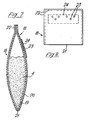
- Figures 7 and 8 shown an alternative form of sachet suitable for use in the process of the invention.
- the sachet 18, shown in Figure 8 at approximately its actual size and in Figure 7 at an enlarged scale corresponding to that of Figures 5 and 6, is formed of a laminate of polyethylene film 19 and paper 20, the film 19 being innermost.
- the sachet 18 is composed of a single sheet of laminate, one edge 21 being constituted by a fold and the other edges 22 being closed by heat-sealing; alternatively, two sheets could have been used and all four edges closed by heat-sealing.
- Holes 23 of approximately 2 mm (2000 ⁇ m) diameter have been punched in one wall of the sachet, the number of holes and their size having been chosen to give an appropriate delivery rate for the powder 4.
- the holes 23 are positioned relatively closely together so as to occupy a relatively small area of the sachet wall.
- An adhesive label 24, indicated in Figure 8 by a dotted line, covers the region occupied by the holes; it adheres without difficulty to the paper of the outer sachet wall, but can readily be removed by the consumer immediately prior to use.
- Figures 9, 10 and 11 show alternative forms of outer container for use in the process of the present invention.
- the container 25 of Figure 9 is in the shape of a hexagonal prism having an aspect ratio (ratio of major axis to minor axis) of about 1:1, formed of folded resin-bonded cardboard, and having relatively large circular openings 26.
- Figures 10 and 11 show two containers 27 and 28 of injection-moulded plastics material, each in the shape of two abutting frustocones, the containers 27 and 28 having aspect ratios of about 2:1 and about 1.5:1 respectively.
- Each can be separated into upper and lower parts 29 and 30 connected only by a small integral "hinge" (not shown), for insertion of an inner container, and the two parts can then be snap-fitted together.
- Test pieces of nylon and woven polyester sheet measuring 6 cm x 3 cm were included in clean loads of mixed articles (2.2 kg dry weight) comprising approximately half cotton and half synthetic fabrics (nylon, acrylic, polyesters).
- the loads were washed in a Miele (Trade Mark) 429 front-loading authomatic washing machine using 100g per load of Persil (Trade Mark) Automatic washing powder and without using a rinse conditioner. After rinsing and spinning, the loads were tumble-dried as specified below.
- test pieces were then extracted from the tumble-dried loads and their cling times measured as follows.
- the cling time apparatus consisted of a base to which were attached four earthed metal plates each measuring 25 cm x 10 cm and inclined at 20° to the vertical.
- the test piece under examination was held in place on a selected plate which was then charged to 6.5 kV using an E.H.T. supply: the induced charge caused the test piece to cling to the plate by electrostatic attraction but as the charge leaked away the attraction decreased and eventually the test piece slid off the plate under its own weight.
- the time for which the test piece clung to the plate before sliding off - the cling time - was measured. The measurement was then repeated on a different plate and an average cling time calculated.
- the soap blend used consisted of 82% tallow soap and 18% coconut soap; the tallow alcohol 25 EO was Lutensol (Trade Mark) AT25 ex BASF in spray-cooled powder form; and powders of particle size ⁇ 300 ⁇ m were prepared by grinding and sieving the separate ingredients followed by dry mixing. 6g doses of powder were packed in sachets of Storalene (Trade Mark) nonwoven fabric, measuring 6 cm x 6.5 cm, provided with dispensing holes of 2 mm diameter as described above with reference to Figures 7 and 8 of the accompanying drawings.
- each sachet was placed inside a spherical outer container of polypropylene, as described above with reference to Figures 1 to 4 of the accompanying drawings: the sphere had a diameter of 9 cm.
- the spherical container was placed together with the washed and spun fabric load in a Creda (Trade Mark) Debonair (Trade Mark) tumble dryer, and the load was then dried using the low heat setting. Test pieces were then extracted and cling times measured. The results were as follows:
- Example 2 In a similar procedure to that of Example 1, the effect of varying the degree of ethoxylation of the tallow alcohol was studied.
- the conditioning compositions containing the 18 EO and 9 EO ethoxylates could not be prepared by dry mixing because the ethoxylates were too sticky. Accordingly, all the compositions were prepared by slurrying, drying, grinding and sieving, those containing the 18 EO and 9 EO ethoxylates being frozen after drying to facilitate the grinding operation.
- the compositions were dispensed as described in Example 1, in 6g doses from ball and sachet devices: each composition contained 91.7% by weight of soap (60% tallow, 40% coconut, plus 7.5% free fatty acid), and 8.3% by weight of ethoxylated tallow alcohol.
- the tumble dryer used this time was a Creda Reversair (Trade Mark), and both high and low heat settings were used. The results were as follows:
- Example 2 The test procedure of Example 2 was repeated using C 16 -C 19 OXO alcohols of varying degrees of ethoxylation instead of the tallow alcohol ethoxylates; the soap blend used was that of Example 1 (82% tallow, 18% coconut), and the proportions were again 91.7% soap, 8.3% ethoxylated alcohol.
- the melting points of the ethoxylates were as follows: 20 EO 37.5°C, 15 EO 36°C, 12 EO 29..5°C, 7 EO 24°C. All the compositions were prepared by slurrying, drying, freezing, grinding and sieving. The tumble dryer used was the Creda Debonair, on a low heat setting. The results were as follows:
Landscapes
- Chemical & Material Sciences (AREA)
- Organic Chemistry (AREA)
- Engineering & Computer Science (AREA)
- Chemical Kinetics & Catalysis (AREA)
- Oil, Petroleum & Natural Gas (AREA)
- Wood Science & Technology (AREA)
- Life Sciences & Earth Sciences (AREA)
- Detergent Compositions (AREA)
- Drying Of Solid Materials (AREA)
- Chemical Or Physical Treatment Of Fibers (AREA)
- Treatments For Attaching Organic Compounds To Fibrous Goods (AREA)
- Treatment Of Fiber Materials (AREA)
- Accessory Of Washing/Drying Machine, Commercial Washing/Drying Machine, Other Washing/Drying Machine (AREA)
Priority Applications (1)
| Application Number | Priority Date | Filing Date | Title |
|---|---|---|---|
| AT86301604T ATE56747T1 (de) | 1985-03-08 | 1986-03-06 | Verfahren und vorrichtung zum konditionieren von geweben in einem trommeltrockner. |
Applications Claiming Priority (2)
| Application Number | Priority Date | Filing Date | Title |
|---|---|---|---|
| GB858506026A GB8506026D0 (en) | 1985-03-08 | 1985-03-08 | Conditioning fabrics in tumble-dryer |
| GB8506026 | 1985-03-08 |
Publications (3)
| Publication Number | Publication Date |
|---|---|
| EP0194813A2 true EP0194813A2 (de) | 1986-09-17 |
| EP0194813A3 EP0194813A3 (en) | 1988-11-30 |
| EP0194813B1 EP0194813B1 (de) | 1990-09-19 |
Family
ID=10575662
Family Applications (1)
| Application Number | Title | Priority Date | Filing Date |
|---|---|---|---|
| EP86301604A Expired - Lifetime EP0194813B1 (de) | 1985-03-08 | 1986-03-06 | Verfahren und Vorrichtung zum Konditionieren von Geweben in einem Trommeltrockner |
Country Status (7)
| Country | Link |
|---|---|
| EP (1) | EP0194813B1 (de) |
| JP (1) | JPS61207668A (de) |
| AT (1) | ATE56747T1 (de) |
| AU (1) | AU5427786A (de) |
| CA (1) | CA1280592C (de) |
| DE (1) | DE3674228D1 (de) |
| GB (1) | GB8506026D0 (de) |
Cited By (4)
| Publication number | Priority date | Publication date | Assignee | Title |
|---|---|---|---|---|
| WO1997026316A1 (en) * | 1996-01-19 | 1997-07-24 | Unilever Plc | Non-cationic systems for dryer sheets |
| WO2016166736A1 (en) * | 2015-04-17 | 2016-10-20 | Castelberg Technologies S.R.L. | Scented device for laundry to be used in dryer machines |
| CN117781651A (zh) * | 2024-02-23 | 2024-03-29 | 烟台大学 | 一种体育器材清洗后干燥装置 |
| US12616645B2 (en) | 2023-07-13 | 2026-05-05 | Furlosophy Petcare LLC | Water soluble shampoo container |
Family Cites Families (2)
| Publication number | Priority date | Publication date | Assignee | Title |
|---|---|---|---|---|
| US4567675A (en) * | 1982-05-20 | 1986-02-04 | Lever Brothers Company | Device for conditioning fabrics in a tumble-dryer |
| GB8306308D0 (en) * | 1983-03-08 | 1983-04-13 | Unilever Plc | Conditioning fabrics in tumbledryer |
-
1985
- 1985-03-08 GB GB858506026A patent/GB8506026D0/en active Pending
-
1986
- 1986-03-03 CA CA000503098A patent/CA1280592C/en not_active Expired - Fee Related
- 1986-03-04 AU AU54277/86A patent/AU5427786A/en not_active Abandoned
- 1986-03-06 DE DE8686301604T patent/DE3674228D1/de not_active Expired - Fee Related
- 1986-03-06 JP JP61049511A patent/JPS61207668A/ja active Granted
- 1986-03-06 AT AT86301604T patent/ATE56747T1/de not_active IP Right Cessation
- 1986-03-06 EP EP86301604A patent/EP0194813B1/de not_active Expired - Lifetime
Cited By (5)
| Publication number | Priority date | Publication date | Assignee | Title |
|---|---|---|---|---|
| WO1997026316A1 (en) * | 1996-01-19 | 1997-07-24 | Unilever Plc | Non-cationic systems for dryer sheets |
| US6133226A (en) * | 1996-01-19 | 2000-10-17 | Lever Brothers Company, Division Of Conopco, Inc. | Non-cationic systems for dryer sheets |
| WO2016166736A1 (en) * | 2015-04-17 | 2016-10-20 | Castelberg Technologies S.R.L. | Scented device for laundry to be used in dryer machines |
| US12616645B2 (en) | 2023-07-13 | 2026-05-05 | Furlosophy Petcare LLC | Water soluble shampoo container |
| CN117781651A (zh) * | 2024-02-23 | 2024-03-29 | 烟台大学 | 一种体育器材清洗后干燥装置 |
Also Published As
| Publication number | Publication date |
|---|---|
| DE3674228D1 (de) | 1990-10-25 |
| CA1280592C (en) | 1991-02-26 |
| GB8506026D0 (en) | 1985-04-11 |
| EP0194813B1 (de) | 1990-09-19 |
| JPH0123584B2 (de) | 1989-05-08 |
| EP0194813A3 (en) | 1988-11-30 |
| JPS61207668A (ja) | 1986-09-16 |
| ATE56747T1 (de) | 1990-10-15 |
| AU5427786A (en) | 1986-11-06 |
Similar Documents
| Publication | Publication Date | Title |
|---|---|---|
| EP0118313B1 (de) | Verfahren und Vorrichtung zum Behandeln von Textilien in einem Trommeltrockner | |
| CA1205423A (en) | Device for conditioning fabrics in a tumble-dryer | |
| US4139475A (en) | Laundry finishing treatment agent package and method | |
| US4167594A (en) | Combined laundry finishing treatment agent package and method | |
| US4882917A (en) | Rinse release laundry additive and dispenser | |
| ES2260191T3 (es) | Bolsa soluble en agua. | |
| US4118525A (en) | Article and method for fabric softening and static control | |
| US4982467A (en) | Rinse release laundry additive and dispenser | |
| JPH01221500A (ja) | 改良されたクリーニング性能用の洗濯洗剤含有汚れ剥離重合体被覆基体 | |
| WO1980001077A1 (en) | Detergent products | |
| CA1250816A (en) | Device for conditioning fabrics in the tumble dryer | |
| EP0194813B1 (de) | Verfahren und Vorrichtung zum Konditionieren von Geweben in einem Trommeltrockner | |
| CA2423255C (en) | Anti-static cleaning wipes | |
| GB1571526A (en) | Fabric treatment compositions containing | |
| US5030375A (en) | Powder-coated laundry detergent sheet | |
| US4919835A (en) | Powder-coated laundry detergent sheet | |
| EP0144186B1 (de) | Verfahren zum Konditionieren von Geweben in einem Trommeltrockner | |
| CA1130694A (en) | Detergent products | |
| WO2019108143A1 (en) | Unit dose cleaning product with nonwoven websheet cover | |
| CA2381454A1 (en) | Multiple use softener/antistatic pouch for fabrics in clothes dryer | |
| JPH0249695A (ja) | 粒状製品で機械により洗濯物を洗浄するための方法及び装置 |
Legal Events
| Date | Code | Title | Description |
|---|---|---|---|
| PUAI | Public reference made under article 153(3) epc to a published international application that has entered the european phase |
Free format text: ORIGINAL CODE: 0009012 |
|
| AK | Designated contracting states |
Kind code of ref document: A2 Designated state(s): AT BE CH DE FR GB IT LI NL SE |
|
| PUAL | Search report despatched |
Free format text: ORIGINAL CODE: 0009013 |
|
| AK | Designated contracting states |
Kind code of ref document: A3 Designated state(s): AT BE CH DE FR GB IT LI NL SE |
|
| 17P | Request for examination filed |
Effective date: 19881119 |
|
| 17Q | First examination report despatched |
Effective date: 19891106 |
|
| GRAA | (expected) grant |
Free format text: ORIGINAL CODE: 0009210 |
|
| AK | Designated contracting states |
Kind code of ref document: B1 Designated state(s): AT BE CH DE FR GB IT LI NL SE |
|
| PG25 | Lapsed in a contracting state [announced via postgrant information from national office to epo] |
Ref country code: BE Effective date: 19900919 Ref country code: AT Effective date: 19900919 |
|
| REF | Corresponds to: |
Ref document number: 56747 Country of ref document: AT Date of ref document: 19901015 Kind code of ref document: T |
|
| REF | Corresponds to: |
Ref document number: 3674228 Country of ref document: DE Date of ref document: 19901025 |
|
| ET | Fr: translation filed | ||
| ITF | It: translation for a ep patent filed | ||
| PLBE | No opposition filed within time limit |
Free format text: ORIGINAL CODE: 0009261 |
|
| STAA | Information on the status of an ep patent application or granted ep patent |
Free format text: STATUS: NO OPPOSITION FILED WITHIN TIME LIMIT |
|
| 26N | No opposition filed | ||
| ITTA | It: last paid annual fee | ||
| EAL | Se: european patent in force in sweden |
Ref document number: 86301604.4 |
|
| PGFP | Annual fee paid to national office [announced via postgrant information from national office to epo] |
Ref country code: FR Payment date: 19960208 Year of fee payment: 11 |
|
| PGFP | Annual fee paid to national office [announced via postgrant information from national office to epo] |
Ref country code: SE Payment date: 19960214 Year of fee payment: 11 |
|
| PGFP | Annual fee paid to national office [announced via postgrant information from national office to epo] |
Ref country code: GB Payment date: 19960227 Year of fee payment: 11 Ref country code: DE Payment date: 19960227 Year of fee payment: 11 |
|
| PGFP | Annual fee paid to national office [announced via postgrant information from national office to epo] |
Ref country code: CH Payment date: 19960305 Year of fee payment: 11 |
|
| PGFP | Annual fee paid to national office [announced via postgrant information from national office to epo] |
Ref country code: NL Payment date: 19960320 Year of fee payment: 11 |
|
| PG25 | Lapsed in a contracting state [announced via postgrant information from national office to epo] |
Ref country code: GB Effective date: 19970306 |
|
| PG25 | Lapsed in a contracting state [announced via postgrant information from national office to epo] |
Ref country code: SE Effective date: 19970307 |
|
| PG25 | Lapsed in a contracting state [announced via postgrant information from national office to epo] |
Ref country code: LI Effective date: 19970331 Ref country code: CH Effective date: 19970331 |
|
| PG25 | Lapsed in a contracting state [announced via postgrant information from national office to epo] |
Ref country code: NL Effective date: 19971001 |
|
| GBPC | Gb: european patent ceased through non-payment of renewal fee |
Effective date: 19970306 |
|
| REG | Reference to a national code |
Ref country code: CH Ref legal event code: PL |
|
| PG25 | Lapsed in a contracting state [announced via postgrant information from national office to epo] |
Ref country code: FR Free format text: LAPSE BECAUSE OF NON-PAYMENT OF DUE FEES Effective date: 19971128 |
|
| NLV4 | Nl: lapsed or anulled due to non-payment of the annual fee |
Effective date: 19971001 |
|
| PG25 | Lapsed in a contracting state [announced via postgrant information from national office to epo] |
Ref country code: DE Effective date: 19971202 |
|
| EUG | Se: european patent has lapsed |
Ref document number: 86301604.4 |
|
| REG | Reference to a national code |
Ref country code: FR Ref legal event code: ST |
|
| PG25 | Lapsed in a contracting state [announced via postgrant information from national office to epo] |
Ref country code: IT Free format text: LAPSE BECAUSE OF NON-PAYMENT OF DUE FEES Effective date: 20050306 |