EP0195230A2 - Verfahren zur Coenzymregenerierung - Google Patents
Verfahren zur Coenzymregenerierung Download PDFInfo
- Publication number
- EP0195230A2 EP0195230A2 EP86101648A EP86101648A EP0195230A2 EP 0195230 A2 EP0195230 A2 EP 0195230A2 EP 86101648 A EP86101648 A EP 86101648A EP 86101648 A EP86101648 A EP 86101648A EP 0195230 A2 EP0195230 A2 EP 0195230A2
- Authority
- EP
- European Patent Office
- Prior art keywords
- nad
- phosphate
- acetyl
- dsm
- coenzymes
- Prior art date
- Legal status (The legal status is an assumption and is not a legal conclusion. Google has not performed a legal analysis and makes no representation as to the accuracy of the status listed.)
- Withdrawn
Links
- 239000005515 coenzyme Substances 0.000 title claims abstract description 32
- 238000000034 method Methods 0.000 title claims abstract description 29
- 230000001172 regenerating effect Effects 0.000 title description 3
- ZSLZBFCDCINBPY-ZSJPKINUSA-N acetyl-CoA Chemical compound O[C@@H]1[C@H](OP(O)(O)=O)[C@@H](COP(O)(=O)OP(O)(=O)OCC(C)(C)[C@@H](O)C(=O)NCCC(=O)NCCSC(=O)C)O[C@H]1N1C2=NC=NC(N)=C2N=C1 ZSLZBFCDCINBPY-ZSJPKINUSA-N 0.000 claims abstract description 25
- 241000186570 Clostridium kluyveri Species 0.000 claims abstract description 22
- 229930027945 nicotinamide-adenine dinucleotide Natural products 0.000 claims abstract description 22
- LIPOUNRJVLNBCD-UHFFFAOYSA-N acetyl dihydrogen phosphate Chemical compound CC(=O)OP(O)(O)=O LIPOUNRJVLNBCD-UHFFFAOYSA-N 0.000 claims abstract description 12
- 244000005700 microbiome Species 0.000 claims abstract description 12
- BOPGDPNILDQYTO-NNYOXOHSSA-N nicotinamide-adenine dinucleotide Chemical compound C1=CCC(C(=O)N)=CN1[C@H]1[C@H](O)[C@H](O)[C@@H](COP(O)(=O)OP(O)(=O)OC[C@@H]2[C@H]([C@@H](O)[C@@H](O2)N2C3=NC=NC(N)=C3N=C2)O)O1 BOPGDPNILDQYTO-NNYOXOHSSA-N 0.000 claims abstract description 12
- BAWFJGJZGIEFAR-NNYOXOHSSA-N NAD zwitterion Chemical compound NC(=O)C1=CC=C[N+]([C@H]2[C@@H]([C@H](O)[C@@H](COP([O-])(=O)OP(O)(=O)OC[C@@H]3[C@H]([C@@H](O)[C@@H](O3)N3C4=NC=NC(N)=C4N=C3)O)O2)O)=C1 BAWFJGJZGIEFAR-NNYOXOHSSA-N 0.000 claims abstract description 10
- 239000013592 cell lysate Substances 0.000 claims abstract description 10
- 230000002255 enzymatic effect Effects 0.000 claims abstract description 6
- 239000007800 oxidant agent Substances 0.000 claims abstract description 6
- 238000004519 manufacturing process Methods 0.000 claims abstract description 4
- 239000002243 precursor Substances 0.000 claims abstract description 4
- LFQSCWFLJHTTHZ-UHFFFAOYSA-N Ethanol Chemical compound CCO LFQSCWFLJHTTHZ-UHFFFAOYSA-N 0.000 claims description 40
- 229950006238 nadide Drugs 0.000 claims description 39
- 102000004190 Enzymes Human genes 0.000 claims description 28
- 108090000790 Enzymes Proteins 0.000 claims description 28
- 229940088598 enzyme Drugs 0.000 claims description 26
- IKHGUXGNUITLKF-UHFFFAOYSA-N Acetaldehyde Chemical compound CC=O IKHGUXGNUITLKF-UHFFFAOYSA-N 0.000 claims description 25
- 239000006166 lysate Substances 0.000 claims description 25
- ZKHQWZAMYRWXGA-KQYNXXCUSA-J ATP(4-) Chemical compound C1=NC=2C(N)=NC=NC=2N1[C@@H]1O[C@H](COP([O-])(=O)OP([O-])(=O)OP([O-])([O-])=O)[C@@H](O)[C@H]1O ZKHQWZAMYRWXGA-KQYNXXCUSA-J 0.000 claims description 21
- ZKHQWZAMYRWXGA-UHFFFAOYSA-N Adenosine triphosphate Natural products C1=NC=2C(N)=NC=NC=2N1C1OC(COP(O)(=O)OP(O)(=O)OP(O)(O)=O)C(O)C1O ZKHQWZAMYRWXGA-UHFFFAOYSA-N 0.000 claims description 21
- 210000004027 cell Anatomy 0.000 claims description 14
- 229940100228 acetyl coenzyme a Drugs 0.000 claims description 11
- 102000004169 proteins and genes Human genes 0.000 claims description 11
- 108090000623 proteins and genes Proteins 0.000 claims description 11
- 239000000758 substrate Substances 0.000 claims description 10
- 108010092060 Acetate kinase Proteins 0.000 claims description 9
- 239000000203 mixture Substances 0.000 claims description 8
- 125000004432 carbon atom Chemical group C* 0.000 claims description 7
- 239000007853 buffer solution Substances 0.000 claims description 6
- 230000015572 biosynthetic process Effects 0.000 claims description 5
- 235000010335 lysozyme Nutrition 0.000 claims description 5
- 102000016943 Muramidase Human genes 0.000 claims description 4
- 108010014251 Muramidase Proteins 0.000 claims description 4
- 108010062010 N-Acetylmuramoyl-L-alanine Amidase Proteins 0.000 claims description 4
- 239000004325 lysozyme Substances 0.000 claims description 4
- 229960000274 lysozyme Drugs 0.000 claims description 4
- 239000000463 material Substances 0.000 claims description 4
- 230000004962 physiological condition Effects 0.000 claims description 4
- 102000016911 Deoxyribonucleases Human genes 0.000 claims description 3
- 108010053770 Deoxyribonucleases Proteins 0.000 claims description 3
- 229910019142 PO4 Inorganic materials 0.000 claims description 3
- 239000010452 phosphate Substances 0.000 claims description 3
- 239000008055 phosphate buffer solution Substances 0.000 claims description 3
- 230000035484 reaction time Effects 0.000 claims description 3
- -1 Acetyi-CoA Chemical compound 0.000 claims description 2
- QTXZASLUYMRUAN-QLQASOTGSA-N Acetyl coenzyme A (Acetyl-CoA) Chemical compound O[C@@H]1[C@H](OP(O)(O)=O)[C@@H](COP(O)(=O)OP(O)(=O)OCC(C)(C)[C@@H](O)C(=O)NCCC(=O)NCCSC(=O)C)O[C@H]1N1C2=NC=NC(N)=C2N=C1.O[C@@H]1[C@H](OP(O)(O)=O)[C@@H](COP(O)(=O)OP(O)(=O)OCC(C)(C)[C@@H](O)C(=O)NCCC(=O)NCCSC(=O)C)O[C@H]1N1C2=NC=NC(N)=C2N=C1 QTXZASLUYMRUAN-QLQASOTGSA-N 0.000 claims description 2
- 238000009010 Bradford assay Methods 0.000 claims description 2
- ACFIXJIJDZMPPO-NNYOXOHSSA-N NADPH Chemical compound C1=CCC(C(=O)N)=CN1[C@H]1[C@H](O)[C@H](O)[C@@H](COP(O)(=O)OP(O)(=O)OC[C@@H]2[C@H]([C@@H](OP(O)(O)=O)[C@@H](O2)N2C3=NC=NC(N)=C3N=C2)O)O1 ACFIXJIJDZMPPO-NNYOXOHSSA-N 0.000 claims description 2
- 210000002421 cell wall Anatomy 0.000 claims description 2
- 229910052739 hydrogen Inorganic materials 0.000 claims description 2
- NBIIXXVUZAFLBC-UHFFFAOYSA-K phosphate Chemical compound [O-]P([O-])([O-])=O NBIIXXVUZAFLBC-UHFFFAOYSA-K 0.000 claims description 2
- 238000009210 therapy by ultrasound Methods 0.000 claims description 2
- XJLXINKUBYWONI-NNYOXOHSSA-O NADP(+) Chemical compound NC(=O)C1=CC=C[N+]([C@H]2[C@@H]([C@H](O)[C@@H](COP(O)(=O)OP(O)(=O)OC[C@@H]3[C@H]([C@@H](OP(O)(O)=O)[C@@H](O3)N3C4=NC=NC(N)=C4N=C3)O)O2)O)=C1 XJLXINKUBYWONI-NNYOXOHSSA-O 0.000 claims 3
- 229930024421 Adenine Natural products 0.000 claims 1
- GFFGJBXGBJISGV-UHFFFAOYSA-N Adenine Chemical compound NC1=NC=NC2=C1N=CN2 GFFGJBXGBJISGV-UHFFFAOYSA-N 0.000 claims 1
- 229960000643 adenine Drugs 0.000 claims 1
- 239000011541 reaction mixture Substances 0.000 claims 1
- 239000002002 slurry Substances 0.000 claims 1
- XJLXINKUBYWONI-DQQFMEOOSA-N [[(2r,3r,4r,5r)-5-(6-aminopurin-9-yl)-3-hydroxy-4-phosphonooxyoxolan-2-yl]methoxy-hydroxyphosphoryl] [(2s,3r,4s,5s)-5-(3-carbamoylpyridin-1-ium-1-yl)-3,4-dihydroxyoxolan-2-yl]methyl phosphate Chemical compound NC(=O)C1=CC=C[N+]([C@@H]2[C@H]([C@@H](O)[C@H](COP([O-])(=O)OP(O)(=O)OC[C@@H]3[C@H]([C@@H](OP(O)(O)=O)[C@@H](O3)N3C4=NC=NC(N)=C4N=C3)O)O2)O)=C1 XJLXINKUBYWONI-DQQFMEOOSA-N 0.000 abstract description 13
- 239000003638 chemical reducing agent Substances 0.000 abstract description 8
- 239000003054 catalyst Substances 0.000 abstract description 4
- ZKHQWZAMYRWXGA-KQYNXXCUSA-N Adenosine triphosphate Chemical compound C1=NC=2C(N)=NC=NC=2N1[C@@H]1O[C@H](COP(O)(=O)OP(O)(=O)OP(O)(O)=O)[C@@H](O)[C@H]1O ZKHQWZAMYRWXGA-KQYNXXCUSA-N 0.000 abstract 1
- 230000008929 regeneration Effects 0.000 description 24
- 238000011069 regeneration method Methods 0.000 description 24
- 238000006243 chemical reaction Methods 0.000 description 19
- RGJOEKWQDUBAIZ-IBOSZNHHSA-N CoASH Chemical compound O[C@@H]1[C@H](OP(O)(O)=O)[C@@H](COP(O)(=O)OP(O)(=O)OCC(C)(C)[C@@H](O)C(=O)NCCC(=O)NCCS)O[C@H]1N1C2=NC=NC(N)=C2N=C1 RGJOEKWQDUBAIZ-IBOSZNHHSA-N 0.000 description 10
- RGJOEKWQDUBAIZ-UHFFFAOYSA-N coenzime A Natural products OC1C(OP(O)(O)=O)C(COP(O)(=O)OP(O)(=O)OCC(C)(C)C(O)C(=O)NCCC(=O)NCCS)OC1N1C2=NC=NC(N)=C2N=C1 RGJOEKWQDUBAIZ-UHFFFAOYSA-N 0.000 description 10
- 230000000694 effects Effects 0.000 description 10
- 230000003197 catalytic effect Effects 0.000 description 8
- WQZGKKKJIJFFOK-GASJEMHNSA-N Glucose Natural products OC[C@H]1OC(O)[C@H](O)[C@@H](O)[C@@H]1O WQZGKKKJIJFFOK-GASJEMHNSA-N 0.000 description 7
- 125000002485 formyl group Chemical group [H]C(*)=O 0.000 description 7
- 239000008103 glucose Substances 0.000 description 7
- XTWYTFMLZFPYCI-KQYNXXCUSA-N 5'-adenylphosphoric acid Chemical compound C1=NC=2C(N)=NC=NC=2N1[C@@H]1O[C@H](COP(O)(=O)OP(O)(O)=O)[C@@H](O)[C@H]1O XTWYTFMLZFPYCI-KQYNXXCUSA-N 0.000 description 6
- XTWYTFMLZFPYCI-UHFFFAOYSA-N Adenosine diphosphate Natural products C1=NC=2C(N)=NC=NC=2N1C1OC(COP(O)(=O)OP(O)(O)=O)C(O)C1O XTWYTFMLZFPYCI-UHFFFAOYSA-N 0.000 description 6
- 238000013459 approach Methods 0.000 description 6
- 239000000872 buffer Substances 0.000 description 6
- IJGRMHOSHXDMSA-UHFFFAOYSA-N Atomic nitrogen Chemical compound N#N IJGRMHOSHXDMSA-UHFFFAOYSA-N 0.000 description 4
- 241000023502 Clostridium kluyveri DSM 555 Species 0.000 description 4
- NBSCHQHZLSJFNQ-GASJEMHNSA-N D-Glucose 6-phosphate Chemical compound OC1O[C@H](COP(O)(O)=O)[C@@H](O)[C@H](O)[C@H]1O NBSCHQHZLSJFNQ-GASJEMHNSA-N 0.000 description 4
- 241000588724 Escherichia coli Species 0.000 description 4
- VFRROHXSMXFLSN-UHFFFAOYSA-N Glc6P Natural products OP(=O)(O)OCC(O)C(O)C(O)C(O)C=O VFRROHXSMXFLSN-UHFFFAOYSA-N 0.000 description 4
- 108010050375 Glucose 1-Dehydrogenase Proteins 0.000 description 4
- 240000004808 Saccharomyces cerevisiae Species 0.000 description 4
- 239000004098 Tetracycline Substances 0.000 description 4
- 230000001419 dependent effect Effects 0.000 description 4
- 239000000047 product Substances 0.000 description 4
- 239000000243 solution Substances 0.000 description 4
- 229960002180 tetracycline Drugs 0.000 description 4
- 229930101283 tetracycline Natural products 0.000 description 4
- 235000019364 tetracycline Nutrition 0.000 description 4
- 150000003522 tetracyclines Chemical class 0.000 description 4
- LWIHDJKSTIGBAC-UHFFFAOYSA-K tripotassium phosphate Chemical compound [K+].[K+].[K+].[O-]P([O-])([O-])=O LWIHDJKSTIGBAC-UHFFFAOYSA-K 0.000 description 4
- 102000005548 Hexokinase Human genes 0.000 description 3
- 108700040460 Hexokinases Proteins 0.000 description 3
- 235000014680 Saccharomyces cerevisiae Nutrition 0.000 description 3
- 239000006285 cell suspension Substances 0.000 description 3
- 239000005516 coenzyme A Substances 0.000 description 3
- 229940093530 coenzyme a Drugs 0.000 description 3
- 230000006378 damage Effects 0.000 description 3
- 238000006356 dehydrogenation reaction Methods 0.000 description 3
- KDTSHFARGAKYJN-UHFFFAOYSA-N dephosphocoenzyme A Natural products OC1C(O)C(COP(O)(=O)OP(O)(=O)OCC(C)(C)C(O)C(=O)NCCC(=O)NCCS)OC1N1C2=NC=NC(N)=C2N=C1 KDTSHFARGAKYJN-UHFFFAOYSA-N 0.000 description 3
- 239000012299 nitrogen atmosphere Substances 0.000 description 3
- 230000003647 oxidation Effects 0.000 description 3
- 238000007254 oxidation reaction Methods 0.000 description 3
- 238000002360 preparation method Methods 0.000 description 3
- YBJHBAHKTGYVGT-ZKWXMUAHSA-N (+)-Biotin Chemical compound N1C(=O)N[C@@H]2[C@H](CCCCC(=O)O)SC[C@@H]21 YBJHBAHKTGYVGT-ZKWXMUAHSA-N 0.000 description 2
- KPGXRSRHYNQIFN-UHFFFAOYSA-N 2-oxoglutaric acid Chemical compound OC(=O)CCC(=O)C(O)=O KPGXRSRHYNQIFN-UHFFFAOYSA-N 0.000 description 2
- DVLFYONBTKHTER-UHFFFAOYSA-N 3-(N-morpholino)propanesulfonic acid Chemical compound OS(=O)(=O)CCCN1CCOCC1 DVLFYONBTKHTER-UHFFFAOYSA-N 0.000 description 2
- ALYNCZNDIQEVRV-UHFFFAOYSA-N 4-aminobenzoic acid Chemical compound NC1=CC=C(C(O)=O)C=C1 ALYNCZNDIQEVRV-UHFFFAOYSA-N 0.000 description 2
- QTBSBXVTEAMEQO-UHFFFAOYSA-N Acetic acid Chemical compound CC(O)=O QTBSBXVTEAMEQO-UHFFFAOYSA-N 0.000 description 2
- NLXLAEXVIDQMFP-UHFFFAOYSA-N Ammonia chloride Chemical compound [NH4+].[Cl-] NLXLAEXVIDQMFP-UHFFFAOYSA-N 0.000 description 2
- 101000950981 Bacillus subtilis (strain 168) Catabolic NAD-specific glutamate dehydrogenase RocG Proteins 0.000 description 2
- ZTQSAGDEMFDKMZ-UHFFFAOYSA-N Butyraldehyde Chemical compound CCCC=O ZTQSAGDEMFDKMZ-UHFFFAOYSA-N 0.000 description 2
- UDMBCSSLTHHNCD-UHFFFAOYSA-N Coenzym Q(11) Natural products C1=NC=2C(N)=NC=NC=2N1C1OC(COP(O)(O)=O)C(O)C1O UDMBCSSLTHHNCD-UHFFFAOYSA-N 0.000 description 2
- 102000016901 Glutamate dehydrogenase Human genes 0.000 description 2
- UFHFLCQGNIYNRP-UHFFFAOYSA-N Hydrogen Chemical compound [H][H] UFHFLCQGNIYNRP-UHFFFAOYSA-N 0.000 description 2
- XEEYBQQBJWHFJM-UHFFFAOYSA-N Iron Chemical compound [Fe] XEEYBQQBJWHFJM-UHFFFAOYSA-N 0.000 description 2
- WHUUTDBJXJRKMK-VKHMYHEASA-N L-glutamic acid Chemical compound OC(=O)[C@@H](N)CCC(O)=O WHUUTDBJXJRKMK-VKHMYHEASA-N 0.000 description 2
- FYYHWMGAXLPEAU-UHFFFAOYSA-N Magnesium Chemical compound [Mg] FYYHWMGAXLPEAU-UHFFFAOYSA-N 0.000 description 2
- 108091005804 Peptidases Proteins 0.000 description 2
- 102000035195 Peptidases Human genes 0.000 description 2
- NBBJYMSMWIIQGU-UHFFFAOYSA-N Propionic aldehyde Chemical compound CCC=O NBBJYMSMWIIQGU-UHFFFAOYSA-N 0.000 description 2
- PLXBWHJQWKZRKG-UHFFFAOYSA-N Resazurin Chemical compound C1=CC(=O)C=C2OC3=CC(O)=CC=C3[N+]([O-])=C21 PLXBWHJQWKZRKG-UHFFFAOYSA-N 0.000 description 2
- FAPWRFPIFSIZLT-UHFFFAOYSA-M Sodium chloride Chemical compound [Na+].[Cl-] FAPWRFPIFSIZLT-UHFFFAOYSA-M 0.000 description 2
- 239000002253 acid Substances 0.000 description 2
- UDMBCSSLTHHNCD-KQYNXXCUSA-N adenosine 5'-monophosphate Chemical compound C1=NC=2C(N)=NC=NC=2N1[C@@H]1O[C@H](COP(O)(O)=O)[C@@H](O)[C@H]1O UDMBCSSLTHHNCD-KQYNXXCUSA-N 0.000 description 2
- LNQVTSROQXJCDD-UHFFFAOYSA-N adenosine monophosphate Natural products C1=NC=2C(N)=NC=NC=2N1C1OC(CO)C(OP(O)(O)=O)C1O LNQVTSROQXJCDD-UHFFFAOYSA-N 0.000 description 2
- QVGXLLKOCUKJST-UHFFFAOYSA-N atomic oxygen Chemical compound [O] QVGXLLKOCUKJST-UHFFFAOYSA-N 0.000 description 2
- 239000011942 biocatalyst Substances 0.000 description 2
- 210000000170 cell membrane Anatomy 0.000 description 2
- 230000029087 digestion Effects 0.000 description 2
- 238000006911 enzymatic reaction Methods 0.000 description 2
- 229930195712 glutamate Natural products 0.000 description 2
- 239000011777 magnesium Substances 0.000 description 2
- 229910052749 magnesium Inorganic materials 0.000 description 2
- 229910052757 nitrogen Inorganic materials 0.000 description 2
- 239000001301 oxygen Substances 0.000 description 2
- 229910052760 oxygen Inorganic materials 0.000 description 2
- BWHMMNNQKKPAPP-UHFFFAOYSA-L potassium carbonate Chemical compound [K+].[K+].[O-]C([O-])=O BWHMMNNQKKPAPP-UHFFFAOYSA-L 0.000 description 2
- 229910000160 potassium phosphate Inorganic materials 0.000 description 2
- 239000008057 potassium phosphate buffer Substances 0.000 description 2
- 235000011009 potassium phosphates Nutrition 0.000 description 2
- BDERNNFJNOPAEC-UHFFFAOYSA-N propan-1-ol Chemical compound CCCO BDERNNFJNOPAEC-UHFFFAOYSA-N 0.000 description 2
- 239000000126 substance Substances 0.000 description 2
- KJZHLKZXRSCVKH-UHFFFAOYSA-N 1-methyl-4-(1-methyl-4h-pyridin-4-yl)-4h-pyridine Chemical compound C1=CN(C)C=CC1C1C=CN(C)C=C1 KJZHLKZXRSCVKH-UHFFFAOYSA-N 0.000 description 1
- NEAQRZUHTPSBBM-UHFFFAOYSA-N 2-hydroxy-3,3-dimethyl-7-nitro-4h-isoquinolin-1-one Chemical compound C1=C([N+]([O-])=O)C=C2C(=O)N(O)C(C)(C)CC2=C1 NEAQRZUHTPSBBM-UHFFFAOYSA-N 0.000 description 1
- BIRSGZKFKXLSJQ-SQOUGZDYSA-N 6-Phospho-D-gluconate Chemical compound OP(=O)(O)OC[C@@H](O)[C@@H](O)[C@H](O)[C@@H](O)C(O)=O BIRSGZKFKXLSJQ-SQOUGZDYSA-N 0.000 description 1
- 102100031126 6-phosphogluconolactonase Human genes 0.000 description 1
- 108010029731 6-phosphogluconolactonase Proteins 0.000 description 1
- 230000002407 ATP formation Effects 0.000 description 1
- QTBSBXVTEAMEQO-UHFFFAOYSA-M Acetate Chemical compound CC([O-])=O QTBSBXVTEAMEQO-UHFFFAOYSA-M 0.000 description 1
- QGZKDVFQNNGYKY-UHFFFAOYSA-O Ammonium Chemical compound [NH4+] QGZKDVFQNNGYKY-UHFFFAOYSA-O 0.000 description 1
- FERIUCNNQQJTOY-UHFFFAOYSA-M Butyrate Chemical compound CCCC([O-])=O FERIUCNNQQJTOY-UHFFFAOYSA-M 0.000 description 1
- FERIUCNNQQJTOY-UHFFFAOYSA-N Butyric acid Natural products CCCC(O)=O FERIUCNNQQJTOY-UHFFFAOYSA-N 0.000 description 1
- OYPRJOBELJOOCE-UHFFFAOYSA-N Calcium Chemical compound [Ca] OYPRJOBELJOOCE-UHFFFAOYSA-N 0.000 description 1
- 241000193470 Clostridium sporogenes Species 0.000 description 1
- 241000235646 Cyberlindnera jadinii Species 0.000 description 1
- RGHNJXZEOKUKBD-SQOUGZDYSA-M D-gluconate Chemical compound OC[C@@H](O)[C@@H](O)[C@H](O)[C@@H](O)C([O-])=O RGHNJXZEOKUKBD-SQOUGZDYSA-M 0.000 description 1
- 101710088194 Dehydrogenase Proteins 0.000 description 1
- 102000028526 Dihydrolipoamide Dehydrogenase Human genes 0.000 description 1
- 108010028127 Dihydrolipoamide Dehydrogenase Proteins 0.000 description 1
- 108010018962 Glucosephosphate Dehydrogenase Proteins 0.000 description 1
- 108010020056 Hydrogenase Proteins 0.000 description 1
- PWHULOQIROXLJO-UHFFFAOYSA-N Manganese Chemical compound [Mn] PWHULOQIROXLJO-UHFFFAOYSA-N 0.000 description 1
- 239000004365 Protease Substances 0.000 description 1
- VMHLLURERBWHNL-UHFFFAOYSA-M Sodium acetate Chemical compound [Na+].CC([O-])=O VMHLLURERBWHNL-UHFFFAOYSA-M 0.000 description 1
- 239000007983 Tris buffer Substances 0.000 description 1
- IKHGUXGNUITLKF-XPULMUKRSA-N acetaldehyde Chemical compound [14CH]([14CH3])=O IKHGUXGNUITLKF-XPULMUKRSA-N 0.000 description 1
- 229960000583 acetic acid Drugs 0.000 description 1
- 150000007513 acids Chemical class 0.000 description 1
- 239000013543 active substance Substances 0.000 description 1
- 150000003838 adenosines Chemical class 0.000 description 1
- 150000001299 aldehydes Chemical class 0.000 description 1
- VFRROHXSMXFLSN-KCDKBNATSA-N aldehydo-D-galactose 6-phosphate Chemical compound OP(=O)(O)OC[C@@H](O)[C@H](O)[C@H](O)[C@@H](O)C=O VFRROHXSMXFLSN-KCDKBNATSA-N 0.000 description 1
- 235000019270 ammonium chloride Nutrition 0.000 description 1
- BFNBIHQBYMNNAN-UHFFFAOYSA-N ammonium sulfate Chemical compound N.N.OS(O)(=O)=O BFNBIHQBYMNNAN-UHFFFAOYSA-N 0.000 description 1
- 229910052921 ammonium sulfate Inorganic materials 0.000 description 1
- 235000011130 ammonium sulphate Nutrition 0.000 description 1
- 238000004458 analytical method Methods 0.000 description 1
- 239000003242 anti bacterial agent Substances 0.000 description 1
- 230000003466 anti-cipated effect Effects 0.000 description 1
- 229940088710 antibiotic agent Drugs 0.000 description 1
- 238000005842 biochemical reaction Methods 0.000 description 1
- 229960002685 biotin Drugs 0.000 description 1
- 235000020958 biotin Nutrition 0.000 description 1
- 239000011616 biotin Substances 0.000 description 1
- 239000011575 calcium Substances 0.000 description 1
- 229910052791 calcium Inorganic materials 0.000 description 1
- 229910052799 carbon Inorganic materials 0.000 description 1
- 230000015556 catabolic process Effects 0.000 description 1
- 238000004113 cell culture Methods 0.000 description 1
- 230000010261 cell growth Effects 0.000 description 1
- 238000005119 centrifugation Methods 0.000 description 1
- 238000003889 chemical engineering Methods 0.000 description 1
- 239000003795 chemical substances by application Substances 0.000 description 1
- 238000003776 cleavage reaction Methods 0.000 description 1
- 230000002860 competitive effect Effects 0.000 description 1
- 239000000287 crude extract Substances 0.000 description 1
- 239000013078 crystal Substances 0.000 description 1
- 230000009089 cytolysis Effects 0.000 description 1
- 238000006731 degradation reaction Methods 0.000 description 1
- 238000001514 detection method Methods 0.000 description 1
- MNNHAPBLZZVQHP-UHFFFAOYSA-N diammonium hydrogen phosphate Chemical compound [NH4+].[NH4+].OP([O-])([O-])=O MNNHAPBLZZVQHP-UHFFFAOYSA-N 0.000 description 1
- 229910000388 diammonium phosphate Inorganic materials 0.000 description 1
- 235000019838 diammonium phosphate Nutrition 0.000 description 1
- 230000003467 diminishing effect Effects 0.000 description 1
- ZPWVASYFFYYZEW-UHFFFAOYSA-L dipotassium hydrogen phosphate Chemical compound [K+].[K+].OP([O-])([O-])=O ZPWVASYFFYYZEW-UHFFFAOYSA-L 0.000 description 1
- 238000005516 engineering process Methods 0.000 description 1
- 150000002148 esters Chemical class 0.000 description 1
- 238000002474 experimental method Methods 0.000 description 1
- 239000000284 extract Substances 0.000 description 1
- 230000008014 freezing Effects 0.000 description 1
- 238000007710 freezing Methods 0.000 description 1
- 239000007789 gas Substances 0.000 description 1
- 239000012362 glacial acetic acid Substances 0.000 description 1
- 229940050410 gluconate Drugs 0.000 description 1
- 239000001963 growth medium Substances 0.000 description 1
- 238000003306 harvesting Methods 0.000 description 1
- FUZZWVXGSFPDMH-UHFFFAOYSA-M hexanoate Chemical compound CCCCCC([O-])=O FUZZWVXGSFPDMH-UHFFFAOYSA-M 0.000 description 1
- 150000003840 hydrochlorides Chemical class 0.000 description 1
- 239000001257 hydrogen Substances 0.000 description 1
- 238000005984 hydrogenation reaction Methods 0.000 description 1
- 239000013067 intermediate product Substances 0.000 description 1
- 229910052742 iron Inorganic materials 0.000 description 1
- 238000002955 isolation Methods 0.000 description 1
- 239000007788 liquid Substances 0.000 description 1
- 229910052748 manganese Inorganic materials 0.000 description 1
- 239000011572 manganese Substances 0.000 description 1
- 229940099596 manganese sulfate Drugs 0.000 description 1
- 239000011702 manganese sulphate Substances 0.000 description 1
- 235000007079 manganese sulphate Nutrition 0.000 description 1
- SQQMAOCOWKFBNP-UHFFFAOYSA-L manganese(II) sulfate Chemical compound [Mn+2].[O-]S([O-])(=O)=O SQQMAOCOWKFBNP-UHFFFAOYSA-L 0.000 description 1
- 239000002609 medium Substances 0.000 description 1
- 230000002503 metabolic effect Effects 0.000 description 1
- MYWUZJCMWCOHBA-VIFPVBQESA-N methamphetamine Chemical compound CN[C@@H](C)CC1=CC=CC=C1 MYWUZJCMWCOHBA-VIFPVBQESA-N 0.000 description 1
- 150000007522 mineralic acids Chemical class 0.000 description 1
- INFDPOAKFNIJBF-UHFFFAOYSA-N paraquat Chemical compound C1=C[N+](C)=CC=C1C1=CC=[N+](C)C=C1 INFDPOAKFNIJBF-UHFFFAOYSA-N 0.000 description 1
- 239000008363 phosphate buffer Substances 0.000 description 1
- 229910000027 potassium carbonate Inorganic materials 0.000 description 1
- SSOLNOMRVKKSON-UHFFFAOYSA-N proguanil Chemical compound CC(C)\N=C(/N)N=C(N)NC1=CC=C(Cl)C=C1 SSOLNOMRVKKSON-UHFFFAOYSA-N 0.000 description 1
- 229940024999 proteolytic enzymes for treatment of wounds and ulcers Drugs 0.000 description 1
- 150000003222 pyridines Chemical class 0.000 description 1
- 238000006268 reductive amination reaction Methods 0.000 description 1
- 230000007017 scission Effects 0.000 description 1
- 239000001632 sodium acetate Substances 0.000 description 1
- 235000017281 sodium acetate Nutrition 0.000 description 1
- 239000011780 sodium chloride Substances 0.000 description 1
- JVBXVOWTABLYPX-UHFFFAOYSA-L sodium dithionite Chemical compound [Na+].[Na+].[O-]S(=O)S([O-])=O JVBXVOWTABLYPX-UHFFFAOYSA-L 0.000 description 1
- 159000000000 sodium salts Chemical class 0.000 description 1
- 239000007787 solid Substances 0.000 description 1
- 238000000527 sonication Methods 0.000 description 1
- 241000894007 species Species 0.000 description 1
- 238000011924 stereoselective hydrogenation Methods 0.000 description 1
- 238000003756 stirring Methods 0.000 description 1
- 239000000725 suspension Substances 0.000 description 1
- 238000010189 synthetic method Methods 0.000 description 1
- LENZDBCJOHFCAS-UHFFFAOYSA-N tris Chemical compound OCC(N)(CO)CO LENZDBCJOHFCAS-UHFFFAOYSA-N 0.000 description 1
- 238000002604 ultrasonography Methods 0.000 description 1
- 241001148471 unidentified anaerobic bacterium Species 0.000 description 1
- 238000005406 washing Methods 0.000 description 1
- XLYOFNOQVPJJNP-UHFFFAOYSA-N water Substances O XLYOFNOQVPJJNP-UHFFFAOYSA-N 0.000 description 1
- 210000005253 yeast cell Anatomy 0.000 description 1
Classifications
-
- C—CHEMISTRY; METALLURGY
- C12—BIOCHEMISTRY; BEER; SPIRITS; WINE; VINEGAR; MICROBIOLOGY; ENZYMOLOGY; MUTATION OR GENETIC ENGINEERING
- C12N—MICROORGANISMS OR ENZYMES; COMPOSITIONS THEREOF; PROPAGATING, PRESERVING, OR MAINTAINING MICROORGANISMS; MUTATION OR GENETIC ENGINEERING; CULTURE MEDIA
- C12N9/00—Enzymes; Proenzymes; Compositions thereof; Processes for preparing, activating, inhibiting, separating or purifying enzymes
- C12N9/0004—Oxidoreductases (1.)
- C12N9/0006—Oxidoreductases (1.) acting on CH-OH groups as donors (1.1)
-
- C—CHEMISTRY; METALLURGY
- C12—BIOCHEMISTRY; BEER; SPIRITS; WINE; VINEGAR; MICROBIOLOGY; ENZYMOLOGY; MUTATION OR GENETIC ENGINEERING
- C12P—FERMENTATION OR ENZYME-USING PROCESSES TO SYNTHESISE A DESIRED CHEMICAL COMPOUND OR COMPOSITION OR TO SEPARATE OPTICAL ISOMERS FROM A RACEMIC MIXTURE
- C12P1/00—Preparation of compounds or compositions, not provided for in groups C12P3/00 - C12P39/00, by using microorganisms or enzymes
-
- C—CHEMISTRY; METALLURGY
- C12—BIOCHEMISTRY; BEER; SPIRITS; WINE; VINEGAR; MICROBIOLOGY; ENZYMOLOGY; MUTATION OR GENETIC ENGINEERING
- C12P—FERMENTATION OR ENZYME-USING PROCESSES TO SYNTHESISE A DESIRED CHEMICAL COMPOUND OR COMPOSITION OR TO SEPARATE OPTICAL ISOMERS FROM A RACEMIC MIXTURE
- C12P13/00—Preparation of nitrogen-containing organic compounds
- C12P13/04—Alpha- or beta- amino acids
- C12P13/14—Glutamic acid; Glutamine
-
- C—CHEMISTRY; METALLURGY
- C12—BIOCHEMISTRY; BEER; SPIRITS; WINE; VINEGAR; MICROBIOLOGY; ENZYMOLOGY; MUTATION OR GENETIC ENGINEERING
- C12P—FERMENTATION OR ENZYME-USING PROCESSES TO SYNTHESISE A DESIRED CHEMICAL COMPOUND OR COMPOSITION OR TO SEPARATE OPTICAL ISOMERS FROM A RACEMIC MIXTURE
- C12P19/00—Preparation of compounds containing saccharide radicals
- C12P19/02—Monosaccharides
-
- Y—GENERAL TAGGING OF NEW TECHNOLOGICAL DEVELOPMENTS; GENERAL TAGGING OF CROSS-SECTIONAL TECHNOLOGIES SPANNING OVER SEVERAL SECTIONS OF THE IPC; TECHNICAL SUBJECTS COVERED BY FORMER USPC CROSS-REFERENCE ART COLLECTIONS [XRACs] AND DIGESTS
- Y10—TECHNICAL SUBJECTS COVERED BY FORMER USPC
- Y10S—TECHNICAL SUBJECTS COVERED BY FORMER USPC CROSS-REFERENCE ART COLLECTIONS [XRACs] AND DIGESTS
- Y10S435/00—Chemistry: molecular biology and microbiology
- Y10S435/8215—Microorganisms
- Y10S435/822—Microorganisms using bacteria or actinomycetales
- Y10S435/842—Clostridium
Definitions
- the invention relates to a simple method which allows a series of coenzymes such as adenosine triphosphate (ATP), acetyl-coenzyme A (acetyl-CoA), acetyl phosphate, oxidized or reduced nicotinamide-adenine dinucleotide and nicotinamide-adenine dinucleotide phosphate during a biochemical reaction consuming them attributed to the original form. Only an alcohol or aldehyde such as ethanol or ethanal is used as the agent.
- the catalyst is the lysate of a microorganism of the species Clostridium kluyveri.
- enzyme reactions are becoming increasingly important in chemical engineering because they take place under mild conditions and in many cases are more selective than other available preparative methods.
- very few of the enzymes known to date and described in the literature have so far been used for technical purposes.
- the use of enzymes that are present inside cells and do not represent the exocellular metabolic product of single cells is limited to a few examples.
- the group of cosubstrate-dependent enzymes is practically only used in scientific studies. Enzymes dependent on cosubstrate are understood to be those which, to catalyze a chemical reaction, contain a cosubstrate (also Use coenzyme) in stoichiometric amounts with the substrate.
- the rare use of such enzymes in technology is explained by the fact that the provision of the cosubstrates in large quantities is too complex and therefore enzymatic processes which require coenzyme-dependent enzymes are generally not competitive with other synthetic methods.
- NAD NAD
- P NAD
- P H NAD
- lipoamide dehydrogenase EC 1.6.4.3.
- extracts from various microorganisms in the presence of reduced methyl viologen (1,1'-dimethyl-4, 4-bipyridinium) which has been regenerated by hydrogen and hydrogenase or direct current, has an effect on NAD (P).
- NA (P) DH the amount of NA (P) DH to be used for a special enzymatic reaction can be greatly limited by this method, working in an electrochemical cell is relatively complex.
- other coenzymes such as acetyl-CoA, acetylphosphate or ATP, have also been suggested for regeneration reactions which, however, require isolated purified enzymes and / or other substrates which are difficult to access (GM Whitesides, Ch.-H. Wong , Aldrichimica Acta 16 (1983) 27).
- the invention thus relates to a process for the enzymatic production of the coenzymes adenosine triphosphate, acetyl-coenzyme A, acetyl phosphate, reduced nicotinamide adenine dinucleotide and / or reduced nicotinamide adenine dinucleotide phosphate from their direct precursors which occur under physiological conditions, characterized in that the intermediate products, on the one hand, and on the other hand, primary alkanols and / or alkanals with 2 to 4 C atoms each as reducing agents or alkanals with 2 - 4 C atoms as oxidizing agents in the presence of a cell lysate of a microorganism strain of the species Clostridium kluyveri and, if desired, in the presence of further enzymes leaves.
- Microorganisms of the species Clostridium kluyveri have been known for a long time. These are anaerobic bacteria that are able to convert ethanol and acetate to butyrate, caproate and molecular hydrogen. Numerous endocellular enzymes from various strains of this species are also described in the scientific literature. For example, RM Burton et. al. the oxidation of acetaldehyde to acetyl-coenzyme A (J. Biol. Chem. 202 (1953), p. 873). R. Lurz (Arch. Microbiol. 120 (1979), p. 255) describes the isolation of a special alcohol-acetaldehyde dehydrogenase complex from Clostridium kluyveri.
- J. Bader et. al. (Arch. Microbiol. 127 (1980), p. 279) described the hydrogenation of alpha-beta-unsaturated carboxylic acid compound using a lysate from Clostridium kluyveri.
- the regeneration reactions can be simplified by the following scheme: (The solid arrows show the reactions for the regeneration of NAD (P) H, acetyl-CoA, acetyl-phosphate or ATP. The dashed arrows indicate the course of the reaction for the regeneration of NAD (P) ).
- a cell culture of a strain of Clostridium kluyveri is assumed. Suitable strains are, in particular, the strain Clostridium kluyveri DSM 555 (ATCC 8527) or ATCC 12489. Strains DSM 556, 557, 560, 562, 563 and 564 are also suitable. The person skilled in the art will in any case choose the most suitable strains Check the ability of the lysates to regenerate coenzymes, as described in the examples below. The values achieved with strain DSM 555, based on enzyme units, should be at least 20%, preferably at least 60%.
- a culture of a Clostridium kluyveri strain is first prepared in a known manner. The cultivation takes place in the absence of oxygen.
- the media known in the literature can be used. S o is suitable for example et one of Stadtman. al. Medium described (In: Methods in enzymology, Vol. 1. SP Colowick, NO Kaplan, Eds., pp. 518-523, New York: Academic Press (1955). Also suitable are media developed by J. Bader et. al. in Hoppe-Seyler's Z. Physiol. Chem. Bad. 359, page 20.
- the culture medium is made oxygen-suitable in a suitable manner and inoculated at 37 ° C. Stirring can take place during cell growth. It is advantageous to pass a sterilized, oxygen-free gas, such as nitrogen, through the batches. Centrifugation is preferred to harvest the cells. If washing is desired, the cell mass is slurried at 0 ° C under nitrogen in a 0.05 molar phosphate buffer solution of pH 7, which contains 0.14 mol sodium chloride and 1 mg resazurin per liter. 10 mg sodium dithionite can be added per liter. For further details, reference is made to the reference by J. Bader et. al. referred.
- the freshly harvested cells or frozen and thawed cell suspensions under freezing conditions are subjected to a treatment in the absence of oxygen in which the cell membranes are destroyed.
- the destruction of the cell membranes is preferably carried out enzymatically.
- mechanical destruction for example by ultrasound, is also conceivable.
- chemical or physico-chemical destruction can also be anticipated, for example by adding surface-active substances.
- this is less preferred.
- cell lysates are viscous liquids due to the high molecular nature of the DNA in them, which are not very suitable for many applications, it is recommended to cleave the DNA to reduce viscosity. This is preferably done by DNA-cleaving enzymes (DNases).
- DNases DNA-cleaving enzymes
- the cells are preferably slurried in a buffer solution, in particular a phosphate buffer solution, at a concentration of 0.1-0.5 mol per liter.
- the pH of this solution is 6 to 8, preferably around 7. It is thus possible in particular to work with buffer solutions which have a pH in the range from 6.75 to 7.5.
- the enzymes that cleave the cell wall are used in amounts of 5 to 30 mg, preferably 15 to 20 mg, per gram of moist cell material.
- Commercial lysozymes e.g. the product lysozyme (hydrochloride) from Boehringer, Mannheim.
- 0.5 to 3 mg, preferably 1.5 to 2 mg, of a commercially available DNase are added per gram of moist cell material.
- the lysates are produced at temperatures between 25 and 40 ° C, in particular at temperatures around 37 ° C, ie between 35 and 37 ° C.
- the reaction times for the enzymatic process of cell cleavage and DNas degradation are 20 to 90 minutes, preferably 60-80 minutes.
- an ultrasound treatment can be added at 0 ° C to increase the activity.
- the sonication time is 2 minutes in a 30 watt device.
- antibiotics to the lysates.
- One milligram of tetracycline or its HCl salt can be added per gram of cell material.
- the cell lysates produced in this way show a high enzyme activity. According to the invention they are used for the regeneration of coenzymes.
- ATP can be produced from AMP (adenosine monophosphate) in the presence of catalytic amounts of ADP or in particular from ADP (adenosine diphosphate).
- ADP adenosine diphosphate
- Another reaction is the regeneration of acetyl-coenzyme A from, for example, acetaldehyde and HS-CoA or coenzyme A.
- NAD (P) can also be made from NAD (P) H.
- NAD (P) H and ATP or acetyl-CoA or acetyl phosphate can be carried out simultaneously.
- the cosubstrates mentioned can also be regenerated individually. For example, if only ATP regeneration is desired, only catalytic amounts of NAD are required, since the NADH formed can be reoxidized to NAD with the formation of ethanol.
- an auxiliary substrate is used as the reducing agent.
- the process according to the invention makes it possible to use an alkanol or an alkanal having 2 to 4 carbon atoms as auxiliary substrates, specifically an alkanol or alkanal as a reducing agent for NAD (P) or an alkanal as an oxidizing agent for NAD (P) H.
- the process can in principle be carried out with n-butanoi, n-butanal, n-propanol, n-propanal, it is preferred in any case to use ethanol and / or acetaldehyde.
- the reducing agents alkanol and / or alkanal or the oxidizing agent alkanal are used in a slight stoichiometric excess, based on the substrates to be reacted under coenzyme regeneration.
- the existing coenzyme quantities are regenerated several times, for example a few hundred times.
- An excess of reducing agent or oxidizing agent of 10-50 mol% or, if desired, a very large excess of several hundred mol% is expediently used.
- Buffer solutions of suitable strength are therefore used. Buffer solutions with a pH between 6 and 8 are preferred, in particular between 6.75 and 7.5.
- Suitable buffer solutions are phosphate buffers or other physiologically compatible buffers.
- buffers based on the sodium salt of morpholinopropanesulfonic acid (MOPS) can be used, especially if acetyl-CoA is to be regenerated.
- MOPS morpholinopropanesulfonic acid
- TMS R 2-amino-2-hydroxymethyl-1,3-propanediol
- HCI 2-amino-2-hydroxymethyl-1,3-propanediol
- the process according to the invention requires the lysate of a microorganism of the species Clostridium kluyveri only in catalytic amounts.
- a microorganism of the species Clostridium kluyveri only in catalytic amounts.
- 2-450 mg, preferably only 20-40 mg, of lysate protein are used per mmol of product to be formed with coenzyme regeneration in 4 to 7 hours (literature: SM Read, DH Northcofe, Anal.Biochem. 116 (1981), p. 53).
- higher amounts can be used for longer reaction times.
- acetate kinase is additionally added.
- 5-20, preferably 10-15 U acetate kinase can be added per mmol of substrate converted using ATP.
- the unit U is defined so that 1 U enzyme converts 1 ⁇ mol substrate per minute under physiological conditions.
- Suitable acetate kinases (EC2.7.2.1.) Can be obtained, for example, from E. coli and as such are commercially available (Boehringer, Mannheim).
- acetate kinases from any other microorganisms can be used if they have the appropriate activity.
- the method according to the invention can be used for the preparative production of the coenzymes.
- it is possible according to the invention which is difficult per se only use accessible coenzymes in reactions in which they are consumed, only in catalytic amounts and to regenerate them continuously during the consumption reaction with the aid of the lysate of Clostridium kluyveri and the reducing agent, for example ethanol or ethanal.
- the coenzyme ATP and / or the coenzyme NAD (P) H can be regenerated 300 times or much more frequently. This also applies to acetyl CoA and / or acetyl phosphate alone or mixtures with the aforementioned coenzymes.
- the lysate used according to the invention is an enzyme catalyst, ie not a mixture which is effective only because of its stationary concentration of regenerated coenzymes. If the NAD (P) H is also not used for the desired ATP-consuming reaction, NAD (P) is regenerated with the formation of ethanol (from acetaldehyde).
- the batches also contain 50-60 mM (NH 4 ) 2 SO 4 , since the 20 added enzymes Ak, Hk (acetate kinase and hexosekinase) as a crystal suspension in 3.2. M NH 4 SO 4 can be supplied.
- Table 3 shows that ATP and NADH can be regenerated simultaneously. This approach contained in addition to the 100 mM glucose, 15 U hexokinase, 2 mg protein of a crude lysate from Clostridium sporogenes ATCC 3584 mentioned in Example 2 and 50 mM acetaldehyde was added at intervals of one hour. NADPH regeneration is analogous.
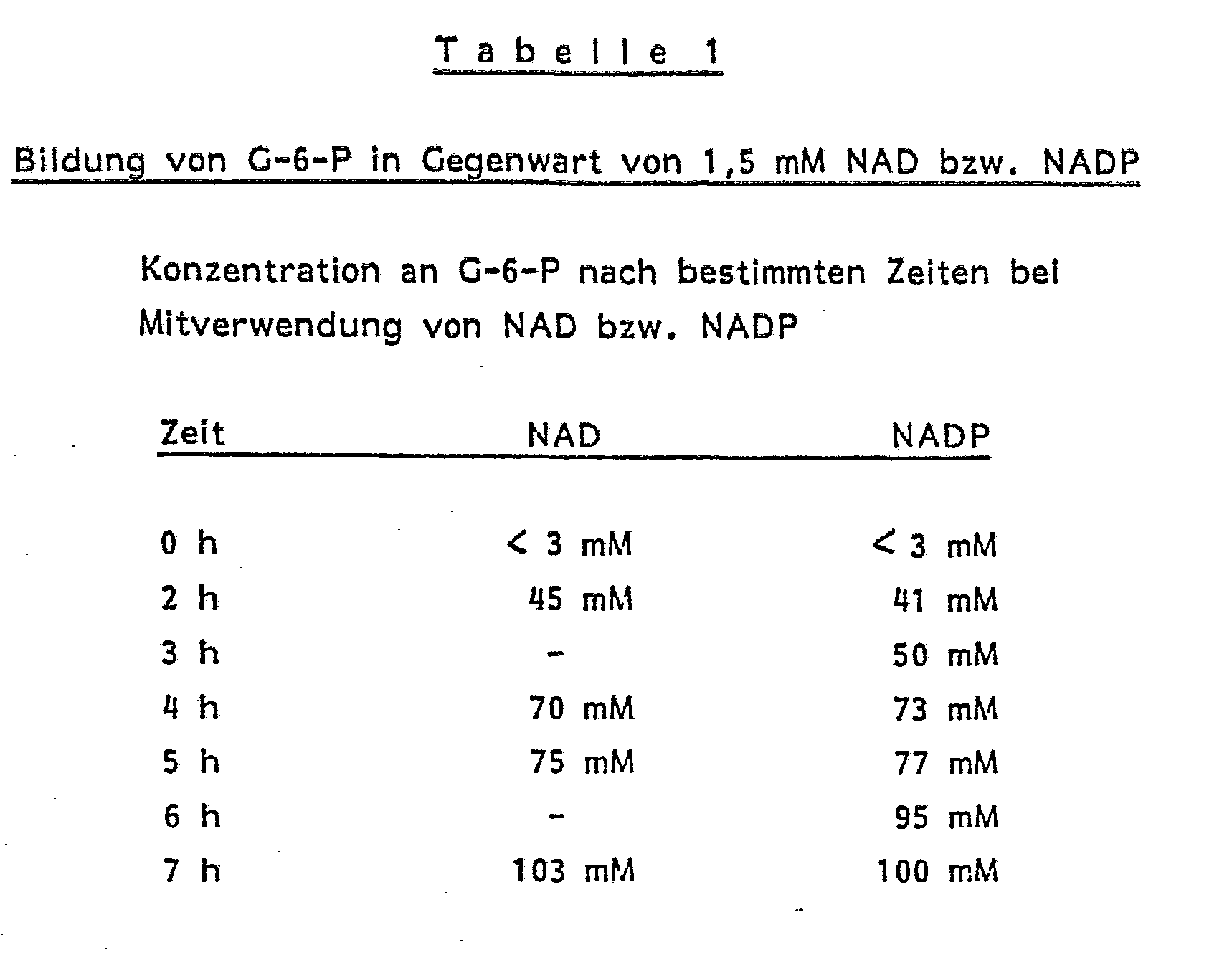
- Table 4 shows the time course of the dehydrogenation of glucose-6-phosphate.
- the mixture contained in mM concentrations: 2 00 potassium phosphate buffer pH 7.0, 1.5 NADP, 100 glucose-6-phosphate, 60 mM acetaldehyde, 2 mg protein / ml and 5 U glucose-6-phosphate dehydrogenase / ml.
Landscapes
- Chemical & Material Sciences (AREA)
- Organic Chemistry (AREA)
- Life Sciences & Earth Sciences (AREA)
- Engineering & Computer Science (AREA)
- Zoology (AREA)
- Wood Science & Technology (AREA)
- Health & Medical Sciences (AREA)
- Genetics & Genomics (AREA)
- Bioinformatics & Cheminformatics (AREA)
- General Health & Medical Sciences (AREA)
- Biochemistry (AREA)
- General Engineering & Computer Science (AREA)
- Microbiology (AREA)
- Biotechnology (AREA)
- Chemical Kinetics & Catalysis (AREA)
- General Chemical & Material Sciences (AREA)
- Medicinal Chemistry (AREA)
- Molecular Biology (AREA)
- Biomedical Technology (AREA)
- Mycology (AREA)
- Preparation Of Compounds By Using Micro-Organisms (AREA)
- Enzymes And Modification Thereof (AREA)
Abstract
Description
- Die Erfindung betrifft ein einfaches Verfahren, das es erlaubt, eine Reihe von Coenzymen wie Adenosintriphosphat (ATP), Acetyl-Coenzym A (Acetyl-CoA), Acetylphosphat, oxidiertes oder reduziertes Nikotinamid-adenindinucleotid und Nikotinamid-Adenindinucleotidphosphat während einer sie verbrauchenden biochemischen Reaktion simultan in die Ausgangsform zurückzuführen. Als Agens wird dabei lediglich ein Alkohol oder Aldehyd wie Ethanol oder Ethanal verbraucht. Katalysator ist das Lysat eines Mikroorganismus' der Spezies Clostridium kluyveri.
- Enzymreaktionen gewinnen bekanntlich in der chemischen Technik immer größere Bedeutung, da sie unter milden Bedingungen ablaufen und in vielen Fällen selektiver sind als andere zur Verfügung stehende präparative Methoden. Von den bisher bekannten und in der Literatur beschriebenen Enzymen können jedoch bisher nur sehr wenige für technische Zwecke angewendet werden. So ist beispielsweise die Nutzung von Enzymen, die im Inneren von Zellen vorhanden sind und nicht das exozelluläre Stoffwechselprodukt von Einzellern darstellen, auf recht wenige Beispiele begrenzt. Unter diesen Enzymen wiederum findet die Gruppe der cosubstratabhängigen Enzyme praktisch nur in wissenschaftlichen Untersuchungen Anwendung. Unter cosubstratabhängigen Enzymen versteht man solche, die zur Katalyse einer chemischen Reaktion ein Cosubstrat (auch Coenzym genannt) in stöchiometrischen Mengen mit dem Substrat verbrauchen. Der seltene Einsatz derartiger Enzyme in der Technik erklärt sich daraus, daß die Bereitstellung der Cosubstrate in großen Mengen zu aufwendig ist und daher enzymatische Verfahren, die coenzymabhängige Enzyme benötigen, im allgemeinen gegenüber anderen Synthesemethoden nicht konkurrenzfähig sind.
- Um hier Abhilfe zu schaffen, hat man bereits versucht, einzelne Coenzyme zu regenerieren. So ist es beispielsweise bekant, NAD(P) in NAD(P)H zu überführen, indem man beispielsweise Lipoamiddehydrogenase (EC 1.6.4.3.) oder Extrakte von verschiedenen Mikroorganismen in Gegenwart von reduziertem Methylviologen (1,1'-Dimethyl-4,4-bipyridinium), das durch Wasserstoff und Hydrogenase oder Gleichstrom regeneriert wurde, auf NAD(P) einwirken läßt. Siehe Ch.-M. Wong et al. J. Am. Chem. Soc. 103 (1981) S. 6227 sowie J. Bader et at. J. Biotechn. 1 (1984), 95.
- Wenngleich nach diesem Verfahren für eine spezielle enzymatische Reaktion die einzusetzende Menge an NA(P)DH stark begrenzt werden kann, so ist das Arbeiten in einer elektrochemischen Zelle doch relativ aufwendig. In ähnlicher Weise sind auch für andere Coenzyme wie beispielsweise Acetyl-CoA, Acetylphosphat oder ATP Reaktionen zur Regenerierung vorgeschlagen worden, die jedoch in aufwendiger Weise isolierte gereinigte Enzyme und/oder weitere, schwer zugängliche Substrate benötigen (G.M. Whitesides, Ch.-H. Wong, Aldrichimica Acta 16 (1983) 27).
- Auf dem genannten Fachgebiet besteht daher ein Bedarf nach einem einfachen Regenerierverfahren für Coenzymmischungen oder einzelne Coenzyme. Die Erfinder haben sich daher die Aufgabe gestellt, ein solches Verfahren, ausgehend von Alkanolen oder Alkanalen mit 2 bis 4 C-Atomen und einer durch Lyse einer Zellsuspension in einfacher Weise herstellbaren Enzymzubereitung, zur Verfügung zu stellen.
- Gegenstand der Erfindung ist somit ein Verfahren zur enzymatischen Herstellung der Coenzyme Adenosintriphosphat, Acetyl-Coenzym A, Acetylphosphat, reduziertes Nikotinamid-adenindinucleotid und/oder reduziertes Nikotinamid-adenin-dinucleotid- phosphat aus ihren unter physiologischen Bedingungen auftretenden direkten Vorprodukten, dadurch gekennzeichnet, daß man die Vorprodukte einerseits sowie andererseits als Reduktionsmittel primäre Alkanole und/oder Alkanale mit je 2 bis 4 C-Atomen oder als Oxidationsmittel Alkanale mit 2 - 4 C-Atomen in Gegenwart eines Zellysats eines Mikroorganismenstammes der Spezies Clostridium kluyveri und gewünschtenfalls in Gegenwart weiterer Enzyme, reagieren läßt.
- Mikroorganismen der Spezies Clostridium kluyveri sind seit langem bekannt. Es handelt sich dabei um anaerobe Bakterien, die in der Lage sind, Ethanol und Acetat zu Butyrat, Caproat und molekularem Wasserstoff umzuwandeln. In der wissenschaftlichen Literatur sind auch zahlreiche endozelluläre Enzyme verschiedener Stämme dieser Spezies beschrieben. So beschreiben beispielsweise R.M. Burton et. al. die Oxidation von Acetaldehyd zu Acetyl-Coenzym A (J. Biol. Chem. 202 (1953), S. 873). Von R. Lurz (Arch. Microbiol. 120 (1979), S. 255) wird die Isolierung eines speziellen Alkohol-Acetaldehyddehydrogenase-Komplexes aus Clostridium kluyveri beschrieben. Schließlich wird von J. Bader et. al. (Arch. Microbiol. 127 (1980), S. 279) die Hydrierung alpha-beta-ungesättigter Carbonsäureverbindung mit Hilfe eines Lysats von Clostridium kluyveri beschrieben. Wenn somit für den Fachmann bekannt war, daß der genannte Mikroorganismus über Enzyme verfügt, mit deren Hilfe auch Coenzyme regeneriert werden können, und wenn auch bereits bei speziellen stereoselektiven Hydrierungen mit dem Lysat von Clostridium kluyveri gearbeitet wurde, so ist es doch überraschend, daß derartige Lysate Biokatalysatoren darstellen, die eine für einen technischen Prozess ausreichende Stabilität der Enzymaktivität aufweisen und die über derartig komplexe Enzymaktivitäten verfügen, daß mehrere Coenzyme, wie beispielsweise ATP, Acetyl-CoA, Acetylphosphat und NAD (P) H nebeneinander regeneriert werden können. Wenngleich die überraschende Stabilität der Enzymaktivität des Lysats wissenschaftiich nicht begründet werden kann, so ist doch anzunehmen, daß sie in der Besonderheit begründet wird, daß der Mikroorganismus Clostridium kluyveri nicht über Proteasen verfügt und auch nicht oder höchstens in untergeordneter Menge über Enzyme, die Adenosinnukleotide undloder Pyridinnukleotide angreifen. So wären beispielsweise Lysate von Hefezellen der Spezies Saccharomyces cerevisiae oder Candida utilis für das erfindungsgemäße Verfahren trotz einer ähnlichen Enzymausstattung ungeeignet, da hier proteolytische Enzyme vorhanden sind.
- Mit Hilfe des erfindungsgemäßen Verfahrens ist es summarisch möglich, die Coenzyme ATP, Acetyl-CoA, Acetylphosphat und NAD(P)H unter Oxidation eines Alkanols oder Alkanals mit 2 bis 4 C-Atomen, insbesondere Ethanol oder Ethanal, zu regenerieren. Sollen NAD bzw. NADP regeneriert werden, so ist der Einsatz von Alkanalen, insbesondere Ethanal erforderlich. Bei der Regenerierung mehrerer Coenzyme sowie bei der Regenerierung von NAD(P)H alleine wird bevorzugt Ethanoi eingesetzt. Vereinfacht lassen sich die Regenerierungsreaktionen durch das folgende Schema verdeutlichen: (Die durchgezogenen Pfeile zeigen die Reaktionen zur Regenerierung von NAD(P)H, Acetyl-CoA, Acetyl-phosphat oder ATP. Die gestrichelten Pfeile ergeben den Reaktionsverlauf zur Regenerierung von NAD(P)).

- Zur Herstellung des dabei als Katalysator verwendeten Zellysats geht man von einer Zellkultur eines Stammes von Clostridium kluyveri aus. Geeignete Stämme sind insbesondere der Stamm Clostridium kluyveri DSM 555 (ATCC 8527) bzw. ATCC 12489. Weiter geeignet sind auch die Stämme DSM 556, 557, 560, 562, 563 und 564. Zur Auswahl besonders geeigneter Stämme wird der Fachmann in jedem Fall die Fähigkeit der Lysate zur Coenzymregenerierung, wie in den nachfolgenden Beispielen geschildert, überprüfen. Dabei sollten die mit dem Stamm DSM 555 erreichten Werte, bezogen auf Enzymeinheiten, zu mindestens zu 20 %, vorzugsweise zu mindestens 60 %, erreicht werden.
- Zur Gewinnung der Zellysate wird zunächst eine Kultur eines Stammes Clostridium kluyveri in bekannter Weise hergestellt. Die Anzucht erfolgt unter Sauerstoffausschluß. Es können dabei die in der Literatur bekannten Medien verwendet werden. So eignet sich beispielweise ein von Stadtman et. al. beschriebenes Medium (In: Methods in enzymology, Vol. 1. S.P. Colowick, N.O. Kaplan, Eds., pp. 518 - 523, New York : Academic Press (1955). Weiterhin geeignet sind auch Medien, die von J. Bader et. al. in Hoppe-Seyler's Z. Physiol. Chem. Bad. 359, S. 20 beschrieben worden sind. Danach verwendet man 16 ml Ethanol, 7,5 g Natriumacetat, 2,5 g Eisessig, 150 mg Diammoniumhydrogenphosphat, 100 mg Dikaliumhydrogenphosphat, 33 mg Magnesiumchlorid-6-H20, 0,6 mg Magnesiumsulfat-7-H20, 40 mg Calciumchlorid-2-H2O, 0,4 mg Mangansulfat-2-H20, 0,4 mg Eisensulfat-7-H20, 50 mg Ammoniumchlorid, 10 mg Ammoniumolydat-4-H2O, 0,04 mg Biotin, 0,8 mg Paraaminobenzoesäure, 1 mg Resazurin, 6 ml 50 %ige Lösung von Kaliumcarbonat und 1 Liter demineralisiertes Wasser. Das Zuchtmedium wird in geeigneter Weise sauerstofffrel gemacht und bei 37°C beimpft. Während des Zellwachstums kann gerührt werden. Es ist von Vorteil, ein sterilisiertes, sauerstofffreies Gas, wie etwa Stickstoff, durch die Ansätze zu leiten. Zum Ernten der Zellen wird vorzugsweise zentrifugiert. Falls Waschen gewünscht wird, wird die Zelimasse bei 0°C unter Stickstoff in einer 0,05-molaren Phosphatpufferlösung von pH 7, die 0,14 mol Natriumchlorid und 1 mg Resazurin pro Liter enthält, aufgeschlämmt. Dabei kann pro Liter 10 mg Natriumdithionit zugegeben werden. Bezüglich weiterer Einzelheiten sei auf die oben zitierte Literaturstelle von J. Bader et. al. verwiesen.
- Zur Herstellung eines Zellysats werden die frisch geernteten Zellen oder auch unter Tiefkühlbedingungen (Temperaturen <-10°C) eingefrorene und wieder aufgetaute Zellsuspensionen unter Auschluß von Sauerstoff einer Behandlung unterzogen, bei der die Zellmembranen zerstört werden. Die Zerstörung der Zellmembranen wird vorzugsweise enzymatisch durchgeführt. Denkbar ist jedoch auch eine mechanische Zerstörung, beispielsweise durch Ultraschall. In speziellen Fällen kann auch eine chemische oder physikalisch-chemische Zerstörung vorweggenommen werden, etwa durch Zugabe oberflächenaktiver Substanzen. Dies ist jedoch weniger bevorzugt. Da Zellysate aufgrund des hochmolekularen Charakters der in ihnen vorhandenen DNS viskose Flüssigkeiten darstellen, die für viele Anwendungen wenig geeignet sind, ist es empfehlenswert, zur Viskositätsminderung die DNS zu spalten. Dies wird vorzugsweise durch DNS-spaltende Enzyme (DNasen) durchgeführt.
- Zur Herstellung besonders geeigneter Zellsuspensionen werden die Zellen vorzugsweise in einer Pufferlösung, insbesondere einer Phosphatpufferlösung, mit einer Konzentration von 0,1 - 0,5 mol pro Liter aufgeschlämmt. der pH dieser Lösung beträgt 6 bis 8, vorzugsweise um 7. So kann insbesondere mit Pufferlösungen, die einen pH-Wert in der Bandbreite von 6,75 bis 7,5 haben, gearbeitet werden. Die Enzyme, die die Zellwand spalten, werden in Mengen von 5 bis 30 mg, vorzugsweise 15 bis 20 mg pro Gramm feuchtes Zellmaterial, eingesetzt. Bevorzugt sind hier handelsübliche Lysozyme, z.B. das Produkt Lysozym (Hydrochlorid) der Firma Boehringer, Mannheim. Gemeinsam mit oder nach der Lysozymbehandlung werden 0,5 bis 3 mg, vorzugsweise 1,5 bis 2 mg, einer handelsüblichen DNase pro Gramm feuchtes Zellmaterial zugegeben. Die Lysate werden bei Temperaturen zwischen 25 und 40°C, insbesondere bei Temperaturen um 37°C, also zwischen 35 und 37°C, hergestellt. Die Reaktionszeiten für den enzymatischen Prozess der Zellspaltung und des DNas-Abbaus betragen 20 bis 90 Minuten, vorzugsweise 60 - 80 Minuten. Zur Steigerung der Aktivität kann gewünschtenfalls bei 0°C eine Ultraschallbehandlung angeschlossen werden. Für kleine Probemengen, also zum Beispiel ein Lysat auf Basis von einem Gramm feuchter Zellen, beträgt dabei die Beschallungsdauer 2 Minuten in einem 30-Watt-Gerät. In vielen Fällen ist es wünschenswert, den Lysaten Antibiotika zuzusetzen. So kann pro Gramm Zellmaterial ein Milligramm Tetracyclin oder dessen HCI-Salz zugegeben werden.
- Die so hergestellten Zellysate zeigen eine hohe Enzymaktivität. Erfindungsgemäß werden sie zur Regenerierung von Coenzymen eingesetzt. Dabei kann beispielsweise ATP aus AMP (Adenosinmonophosphat) in Gegenwart katalytischer Mengen von ADP oder insgesondere aus ADP (Adenosindiphosphat) hergestellt werden. Eine weitere Reaktion ist die Regenerierung von Acetyl-Coenzym A aus beispielsweise Acetaldehyd und HS-CoA oder Coenzym A. Weiterhin können NADPH und/oder NADH aus NADP bzw. NAD hergestellt werden. Hergestellt werden kann aber auch NAD(P) aus NAD(P)H. Aufgrund der Fähigkeiten des verwendeten Biokatalysators ist es möglich, die Regenerierungen von NAD(P)H und ATP oder Acetyl-CoA bzw. Acetylphosphat simultan durchzuführen. Die genannten Cosubstrate können auch einzeln regeneriert werden. Wird z.B. nur ATP-Regenerierung gewünscht, so sind auch nur katalytische Mengen von NAD erforderlich, da das gebildete NADH unter Bildung von Ethanol wieder zu NAD reoxidiert werden kann.
- Bei den genannten Regenerierungsreaktionen wird ein Hilfssubstrat als Reduktionsmittel verbraucht. Das erfindungsgemäße Verfahren erlaubt es, als Hilfssubstrate ein Alkanol oder ein Alkanal mit 2 bis 4 C-Atomen einzusetzen und zwar ein Alkanol oder Alkanal als Reduktionsmittel für NAD(P) bzw. ein Alkanal als Oxidationsmittel für NAD(P)H. Wenngleich das Verfahren mit n-Butanoi, n-Butanal, n-Propanol, n-Propanal prinzipiell durchgeführt werden kann, so ist es doch in jedem Falle bevorzugt, Ethanol und/oder Acetaldehyd einzusetzen. Die Reduktionsmittel Alkanol und/oder Alkanal bzw. das Oxidationsmittel Alkanal werden dabei in leichtem stöchiometrischem Überschuß, bezogen auf die unter Coenzymregenerierung umzusetzende Substrate angewandt. Dabei werden die vorhandenen Coenzymmengen mehrfach, beispielsweise einige hundert Mal, regeneriert. Zweckmäßigerweise wird ein überschuß an Reduktions- bzw. Oxidationsmittel von 10 - 50 mol-% oder gewünschtenfalls ein sehr hoher Überschuß von mehreren hundert mol-% eingesetzt.
- Bei länger laufenden Anwendungen des erfindungsgemäßen Verfahrens hat der Fachmann dafür Sorge zu tragen, daß Säuren, die als Oxidationsprodukte des Reduktionsmittels auftreten, den Reaktionsverlauf nicht stören. Es wird daher in Pufferlösungen geeigneter Stärke gearbeitet. Bevorzugt sind Pufferlösungen mit einem pH zwischen 6 und 8, insbesondere zwischen 6,75 und 7,5. Geeignete Pufferlösungen sind Phosphatpuffer oder andere physiologisch verträgliche Puffer. So können beispielsweise Puffer auf Basis des Natriumsalzes der Morpholinopropansulfonsäure (MOPS) eingesetzt werden, insbesondere falls Acetyl-CoA regeneriert werden soll. Prinzipiell verwendbar, aber für manche Reaktionen wenig geeignet, sind Puffer auf Basis von 2-Amino-2-hydroxymethyl-1,3-propandiol (TRISR) und anorganischen Säuren wie HCI.
- Das erfindungsgemäße Verfahren benötigt das Lysat eines Mikroorganismus' der Spezies Clostridium kluyveri nur in katalytischen Mengen. So werden beispielsweise pro mmol unter Coenzymregenerierung zu bildendes Produkt in 4 - 7 Stunden nur 2 - 50 mg, vorzugsweise nur 20 - 40 mg Lysatprotein (bestimmt nach der Methode von Bradford) eingesetzt (Literatur: S.M. Read, D.H. Northcofe, Anal.Biochem. 116 (1981), S. 53). Für längere Reaktionszeiten können entsprechend höhere Mengen verwendet werden.
- Die Aktivität des Lysats von Clostridium kluyveri ist durch die Acetatkinase-Aktivität begrenzt. Daher wird nach einer weiteren Ausführungsform der Erfindung zusätzlich Acetatkinase zugegeben. So können beispielsweise pro mmol unter ATP-Verbrauch umgesetztes Substrat 5 - 20, vorzugsweise 10 - 15 U Acetatkinase zugegeben werden. Die Einheit U ist so definiert, daß 1 U Enzym unter physiologischen Bedingunen 1 µmol Substrat pro Minute umsetzt. Geeignete Acetatkinasen (EC2.7.2.1.) können beispielsweise aus E.coli erhalten werden und sind als solche im Handel (Fa. Boehringer, Mannheim). Darüber hinaus können Acetatkinasen aus beliebigen anderen Mikroorganismen eingesetzt werden, wenn sie über die entsprechende Aktivität verfügen.
- Das erfindungsgemäße Verfahren kann zur präparativen Herstellung der Coenzyme eingesetzt werden. Von besonderem Wert ist jedoch, daß es erfindungsgemäß möglich ist, die an sich schwer zugänglichen Coenzyme bei Reaktionen, in denen sie verbraucht werden, nur in katalytischen Mengen einzusetzen und während der Verbrauchsreaktion mit Hilfe des Lysats von Clostridium kluyveri und des Reduktionsmittels, also beispielsweise Ethanol oder Ethanal, kontinuierlich zu regenerieren. So kann während einer solchen Reaktion das Coenzym ATP und/oder die Coenzyme NAD(P)H 300mal oder auch weitaus häufiger regeneriert werden. Dies gilt auch für Acetyl-CoA und/oder Acetylphosphat für sich alleine oder Mischungen mit den vorgenannten Coenzymen. Dabei hat sich gezeigt, daß das erfindungsgemäß eingesetzte Lysat einen Enzymkatalysator darstellt, also keine Mischung, die nur aufgrund ihrer stationären Kcnzentration an regenerierten Coenzymen wirksam ist. Falls das NAD(P)H nicht für die gewünschte ATP verbrauchende Reaktion ebenfalls verbraucht wird, wird NAD(P) unter Ethanolbildung (aus Acetaldehyd) regeneriert.
- In den folgenden Beispielen werden coenzymabhängige Reaktionen beschrieben. Aus der Reaktionskinetik ergibt sich, daß die in katalytischen Konzentrationen eingesetzten Coenzyme durch das zugegebene Lysat von Clostridium kluyveri DSM 555 und Ethanol bzw. Ethanol kontinuierlich regeneriert werden. Als Beispiele für die intermediäre ATP-Regenerierung wurde die Darstellung von G!ucose-6-phosphat und Giycerin-3-.phosphat durchgeführt. Für die NADH- bzw. NADPH-Regenerierung wurde die reduktive Aminierung von 2-Oxoglutarat zu Glutamat und für die NAD(P)-Regenerierung wurde die Dehydrierung von Glucose-6-phosphat zu 6-Phosphogluconat bzw. von Glucose zu Gluconat bewerkstelligt. figt. Es werden die in der biochemischen Fachliteratur gebräuchlichen Abkürzungen verwendet.
- Allgemeiner Ansatz:
- Bedingungen, falls nicht anders angegeben: Temp. 36°C, Stickstoffatmosphäre, 0,3 M Kaliumphosphat, pH 7; Gesamtvolumen 1 ml; Parallel-Ansätze in Rollfläschchen mit Septenverschluß im Warburg-Schüttler. Die Proteinbestimmungen erfolgten nach Bradford.
- Inkubiert wurden in Puffer: HSCoA 0,3 mM, NAD(P) 1,5 mM, 1) ADP 3,0 mM, MgCl2 2,5 mM, Tetracyclin 15 µl (1,5 mg/mi), Lysat C.klyveri DSM 555 3,2 mg Protein (nach Bradford-Test), Glucose 150 mM, 4 U Acetatkinase (EC 2.7.2.1) (E.coli, Fa. Böhringer), ca. 4 U Hexokinase (EC 2.7.1.1) (Hefe, Fa. Böhringer). Stündlich wurden 30 µl einer Lösung von 1.78 M CH3CHO in 1 M K2HP04 zugegeben. Die Ansätze enthalten ferner 50 - 60 mM (NH4)2SO4, da die 20 zugesetzten Enzyme Ak, Hk (Acetatkinase und Hexosekinase) als Kristallsuspension in 3.2. M NH4SO4 geliefert werden.
- Ein Ansatz mit stündlicher Zugabe von 45 - 50 mM Acetaldehyd ist in Tabelle 1 gezeigt. Die katalytischen Mengen von 0,3 mM HSCoA werden bei der ATP-Regenerierung ca. 330-fach regeneriert und das NAD ca. 67-fach.
- 1) Statt Mengen werden Konzentrationen angegeben, die sich auf eine einheitliche Ansatzgröße beziehen.
-
- Ansatz mit kontinuierlicher Substratzugabe (CN3CHO):
- Allgemeine Bedingungen: VAnfang = 3 ml, VEnde = 4 ml, Temp. 370C, Stickstoffatmosphäre, Magnetrührer, KPP 300 mM.
- Inkubiert wurden: NAD 1.66 mM, ADP 3,33 mM, HSCoA 0.5 mM, NH4SO4 85 mM, MgSO4 10 mM, Tetracyclin 50 µl (1.5 ma/ml), Glucose 350 mM, CH3CHO: 4 M CH3CHO in K2HPO4 (2 M), Flow 50 µl/h, Hk (Hefe) ca. 40 U (Hefe, Fa. Boehringer), Ak (E.coli) ca. 20 U (E.coli), Fa. Boehringer), Lysat Clostridium kluyveri DSM 555 : 600 ul - 9.72 mg Protein im Aufschluß.
- Nach 18.5 h konnten 195 mM G-6-P im Ansatz nachgewiesen werden. (Nachweismethode: Enzymatisch nach G. Lang und G.
- Michal in H.U. Bergmeyer (Hrsg.) Meth. der enzym. Analyse, 3. Auflage, Band II, 1283, Verlag Chemie, Weinheim, 1974).
- Bildung von Acetyl-CoA
- Bedingungen: Temp. 36°C, Stickstoffatmosphäre, Gesamtvolumen 1 ml, 0.1 M Mops-Puffer, pH 7.5 (Fa. Sigma)
- Inkubiert wurden: NAD 1.25 mM, HSCoA 20 mM, Lysat C.kluyveri DSM 555 - 3.5 mg Protein/ml, (Lysozym-Aufschluß in Mops-Puffer 0.1 molar, pH 7.5), CH3CHO: 50 mM (30 µl einer CH3CHO-Lösung - 1 : 10 in Mops, pH 7.5 verdünnt). Nach 14.5 h konnten 19.75 mM (98 % Ausbeute) CoA-Ester nachgewiesen werden (Hydroxamsäure-Test).
- NADH und NADPH-Regenerierung ohne gleichzeitige ATP-Bildung.
- Dabei wird von folgenden Reaktionen Gebrauch gemacht:

- Der Ansatz enthielt in mM Konzentrationen: 300 Kaliumphosphat pH 8, 1.5. NAD oder NADP, 0.3 HSCoA, 3.0 ADP (zur Aktivierung der Glutamatdehydrogenase), 100 2-Oxoglutarat, 200 Ammoniumsulfat, 1.2 Mangansulfat, 688 Ethanol, 0.022 mg Tetracyclin/ml, 15 U Glutamat-Dehydrogenase und Lysat von C.kluyveri DSM 555 entsprechend 3.5 mg Protein.
- Unter den hier angegebenen Bedingungen kann der Zusatz von Coenzym A (HSCoA) unterbleiben. Die Reaktionsgeschwindigkeit ist mit und ohne Coenzym A gleich.
- Die Bildung von Glutamat in Gegenwart katalytischer Mengen NAD ist in Tabelle 2 gezeigt.
- Dieses Experiment zeigt folgendes: NADH und NADPH können mit dem System regeneriert werden. Dazu ist es nicht notwendig, das entstehende Acetyl-P durch irgendwelche zusätzliche Maßnahmen zu spalten. Die katalytischen Mengen von 1.5 mM NAD werden bei der NADH-Regenerierung 67-fach cyclisiert, ohne daß die Aktivität des Lysats nachließ.

- Die Tabelle 3 zeigt, daß ATP und NADH gleichzeitig regeneriert werden können. Dieser Ansatz enthielt zusätzlich zu dem in Beispiel 2 genannten 100 mM Glucose, 15 U Hexokinase, 2 mg Protein eines Rohlysats von Clostridium sporogenes ATCC 3584 und im Abstand von einer Stunde wurde 50 mM Acetaldehyd zugegeben. NADPH-Regenerierung verläuft analog.

- Diese Regenerierung ist ebenfalls durch das System Acetaldehyd/Rohextrakt C.kluyveri möglich. Dies wurde durch die Reaktionsfolge:

- Tabelle 4 zeigt den zeitlichen Verlauf der Dehydrierung von Glucose-6-phosphat. Der Ansatz enthielt in mM Konzentrationen: 200 Kaliumphosphatpuffer pH 7.0, 1.5 NADP, 100 Glucose-6-phosphat, 60 mM Acetaldehyd, 2 mg Protein/ml und 5 U Glucose-6-phosphat-Dehydrogenase/ml.

- Die Regenerierung von NAD:
- Die Regenerierung wurde durch folgende Reaktionsfolge nachgewiesen:

- Tabelle 5 zeigt den zeitlichen Verlauf der Dehydrierung von Glucose. Unter Bedingungen des allgemeinen Ansatzes wurden folgende Konzentrationen in mM inkubiert:
- 200 Kaliumphosphatpuffer pH 7.0, 1 NAD, 100 Glucose, 20 U Glucose-Dehydrogenase (EC 1.1.1.47) (Fa. Merck), 2.7 mg Protein (Lysat C. kluyveri), CH3CHO 53 mM zur Zeit t = 0 h und t = 1/2 h.

Claims (11)
aus ihren unter physiologischen Bedingungen auftretenden direkten Vorprodukten, dadurch gekennzeichnet, daß man die Vorprodukte einerseits sowie andererseits als Reduktionsmittel primäre Alkanole und/oder Alkanale mit je 2 bis 4 C-Atomen oder als Oxidationsmittel Alkanale mit 2 - 4 C-Atomen in Gegenwart eines Zellysats eines Mikroorganismenstammes der Spezies Clostridium kluyveri und gewünschtenfalls in Gegenwart weiterer Enzyme, reagieren läßt.
Applications Claiming Priority (2)
| Application Number | Priority Date | Filing Date | Title |
|---|---|---|---|
| DE3505397 | 1985-02-16 | ||
| DE19853505397 DE3505397A1 (de) | 1985-02-16 | 1985-02-16 | Verfahren zur coenzymregenerierung |
Publications (2)
| Publication Number | Publication Date |
|---|---|
| EP0195230A2 true EP0195230A2 (de) | 1986-09-24 |
| EP0195230A3 EP0195230A3 (de) | 1987-10-14 |
Family
ID=6262714
Family Applications (1)
| Application Number | Title | Priority Date | Filing Date |
|---|---|---|---|
| EP86101648A Withdrawn EP0195230A3 (de) | 1985-02-16 | 1986-02-08 | Verfahren zur Coenzymregenerierung |
Country Status (4)
| Country | Link |
|---|---|
| US (1) | US4766071A (de) |
| EP (1) | EP0195230A3 (de) |
| JP (1) | JPS61187798A (de) |
| DE (1) | DE3505397A1 (de) |
Families Citing this family (9)
| Publication number | Priority date | Publication date | Assignee | Title |
|---|---|---|---|---|
| ATE135746T1 (de) * | 1989-08-28 | 1996-04-15 | Hoffmann La Roche | Enzymatisches verfahren zur bestimmung der analyt-konzentration |
| JP2818695B2 (ja) * | 1991-01-25 | 1998-10-30 | 財団法人野田産業科学研究所 | Nadhキナーゼ及びその製造法 |
| JP2818696B2 (ja) * | 1991-01-25 | 1998-10-30 | 財団法人野田産業科学研究所 | Nadhキナーゼを用いる高感度定量法 |
| CA2466133A1 (en) * | 2001-11-02 | 2003-05-15 | Rice University | Recycling system for manipulation of intracellular nadh availability |
| US20040199941A1 (en) * | 2003-03-24 | 2004-10-07 | Rice University | Increased bacterial CoA and acetyl-CoA pools |
| US8143035B2 (en) * | 2006-09-22 | 2012-03-27 | Rice University | Pantothenate kinase overexpression and pantothenic acid supplementation in actinomycetes |
| WO2009113101A2 (en) * | 2008-02-20 | 2009-09-17 | Nagarjuna Fertilizers And Chemicals Limited | Genetically transformed microorganisms with simultaneous enhancement of reduction potential and reductive enzyme activities for biomass fermentation |
| CN109666713B (zh) * | 2019-01-18 | 2021-12-17 | 华南理工大学 | 一种酶催化氧化型烟酰胺辅酶的再生方法及应用 |
| EP4438735A1 (de) | 2023-03-27 | 2024-10-02 | Cascat GmbH | Biokatalytische herstellung einer organischen substanz mit einer carbonylgruppe |
Family Cites Families (3)
| Publication number | Priority date | Publication date | Assignee | Title |
|---|---|---|---|---|
| FR2303854A1 (fr) * | 1975-03-11 | 1976-10-08 | Kaplan Bureau D Etudes | Dispositif d'obtention d'hydrocarbures et/ou d'energie electrique |
| DE2514638A1 (de) * | 1975-04-03 | 1976-10-14 | Fresenius Inst | Verfahren und vorrichtung zur durchfuehrung enzymkatalysierter redoxreaktionen |
| US4352885A (en) * | 1980-05-09 | 1982-10-05 | Wisconsin Alumni Research Foundation | Preparation of a novel NADP linked alcohol-aldehyde/ketone oxidoreductase from thermophilic anaerobic bacteria for analytical and commercial use |
-
1985
- 1985-02-16 DE DE19853505397 patent/DE3505397A1/de not_active Withdrawn
-
1986
- 1986-02-08 EP EP86101648A patent/EP0195230A3/de not_active Withdrawn
- 1986-02-14 US US06/829,732 patent/US4766071A/en not_active Expired - Fee Related
- 1986-02-17 JP JP61033676A patent/JPS61187798A/ja active Pending
Also Published As
| Publication number | Publication date |
|---|---|
| JPS61187798A (ja) | 1986-08-21 |
| DE3505397A1 (de) | 1986-08-21 |
| EP0195230A3 (de) | 1987-10-14 |
| US4766071A (en) | 1988-08-23 |
Similar Documents
| Publication | Publication Date | Title |
|---|---|---|
| DE3689196T2 (de) | Verfahren zur Herstellung von Amiden unter Verwendung von Mikroorganismen. | |
| DE69620819T2 (de) | Enzymatische Produktion von Glukonsäure und ihrer Salzen | |
| DE4480132C2 (de) | Verfahren und Rhodococcus rhodochrous-Stamm zur Herstellung von Amiden aus Nitrilen | |
| EP0008031B1 (de) | Verfahren zur Herstellung von 6-Amino-6-desoxy-L-sorbose | |
| DE2061371C3 (de) | Verfahren zur Herstellung eines immobilisierten Glucoseisomeraseenzymkomplexes und dessen Verwendung | |
| DE3787194T2 (de) | Verfahren zur Erhaltung der Nitrilhydrierungsaktivität. | |
| EP0152948B1 (de) | Verfahren zur Herstellung von 6-Hydroxynikotinsäure | |
| DE2716335C2 (de) | Neue Cholinoxydase und Verfahren zu ihrer Herstellung | |
| DE3505397A1 (de) | Verfahren zur coenzymregenerierung | |
| DE69010030T2 (de) | Verfahren zur Produktion von Fruktose-1,6-diphosphat. | |
| DE2424833C3 (de) | Verfahren zur Herstellung von Maltose | |
| DD157564A5 (de) | Verfahren zur bildung des enzyms alpha-galactoxidase und zur hydrolyse von raffinose unter verwendung dieses enzyms | |
| DE3600563C2 (de) | ||
| DE3714544A1 (de) | Glucosedehydrogenase und verfahren zu deren herstellung | |
| CH616706A5 (de) | ||
| DE3024915C2 (de) | ||
| DE2733273C3 (de) | Endonucleasen und Verfahren zu ihrer Herstellung | |
| EP0154269A2 (de) | Nucleosidtriphosphat-abhängige 1-Methylhydantoinase und ihre Verwendung | |
| DE3725851A1 (de) | Nad(p)h-oxidase, verfahren zu ihrer isolierung und anwendung | |
| DE2746939A1 (de) | Glucose isomerierendes enzym | |
| EP0040430B1 (de) | Verfahren zur Gewinnung von Glucosedehydrogenase und hierfür geeignete Mikroorganismen | |
| DE3689181T2 (de) | Thermostabile Tryptophanase, Verfahren zu deren Herstellung und thermostabile Tryptophanase erzeugender Mikroorganismus. | |
| DE3505353C2 (de) | Verfahren zur Herstellung von L-Serin | |
| DE3884468T2 (de) | Verfahren zur Herstellung von L-Tryptophan. | |
| DE2167034C3 (de) | Creatinin-amidohydrolase |
Legal Events
| Date | Code | Title | Description |
|---|---|---|---|
| PUAI | Public reference made under article 153(3) epc to a published international application that has entered the european phase |
Free format text: ORIGINAL CODE: 0009012 |
|
| AK | Designated contracting states |
Kind code of ref document: A2 Designated state(s): AT BE CH DE FR GB IT LI NL SE |
|
| PUAL | Search report despatched |
Free format text: ORIGINAL CODE: 0009013 |
|
| AK | Designated contracting states |
Kind code of ref document: A3 Designated state(s): AT BE CH DE FR GB IT LI NL SE |
|
| 17P | Request for examination filed |
Effective date: 19880310 |
|
| STAA | Information on the status of an ep patent application or granted ep patent |
Free format text: STATUS: THE APPLICATION HAS BEEN WITHDRAWN |
|
| 18W | Application withdrawn |
Withdrawal date: 19891106 |
|
| R18W | Application withdrawn (corrected) |
Effective date: 19891106 |
|
| RIN1 | Information on inventor provided before grant (corrected) |
Inventor name: SIMON, HELMUT, PROF.DR. Inventor name: DEFFNER, ALEXANDER |