EP0195232B1 - Piezoresistiver Belastungsfühler - Google Patents
Piezoresistiver Belastungsfühler Download PDFInfo
- Publication number
- EP0195232B1 EP0195232B1 EP86101679A EP86101679A EP0195232B1 EP 0195232 B1 EP0195232 B1 EP 0195232B1 EP 86101679 A EP86101679 A EP 86101679A EP 86101679 A EP86101679 A EP 86101679A EP 0195232 B1 EP0195232 B1 EP 0195232B1
- Authority
- EP
- European Patent Office
- Prior art keywords
- type diffused
- crystal
- diffused resistors
- resistors
- sensing device
- Prior art date
- Legal status (The legal status is an assumption and is not a legal conclusion. Google has not performed a legal analysis and makes no representation as to the accuracy of the status listed.)
- Expired
Links
- 239000013078 crystal Substances 0.000 claims description 62
- 239000000758 substrate Substances 0.000 claims description 34
- 239000004065 semiconductor Substances 0.000 claims description 26
- 239000010409 thin film Substances 0.000 claims description 11
- 238000004519 manufacturing process Methods 0.000 claims description 5
- 239000010410 layer Substances 0.000 description 17
- XUIMIQQOPSSXEZ-UHFFFAOYSA-N Silicon Chemical compound [Si] XUIMIQQOPSSXEZ-UHFFFAOYSA-N 0.000 description 14
- 229910052710 silicon Inorganic materials 0.000 description 11
- 239000010703 silicon Substances 0.000 description 11
- 239000010408 film Substances 0.000 description 5
- VYPSYNLAJGMNEJ-UHFFFAOYSA-N Silicium dioxide Chemical compound O=[Si]=O VYPSYNLAJGMNEJ-UHFFFAOYSA-N 0.000 description 4
- 238000005259 measurement Methods 0.000 description 4
- 238000000034 method Methods 0.000 description 4
- 229910052681 coesite Inorganic materials 0.000 description 2
- 229910052906 cristobalite Inorganic materials 0.000 description 2
- 238000001514 detection method Methods 0.000 description 2
- 239000002019 doping agent Substances 0.000 description 2
- 239000011521 glass Substances 0.000 description 2
- 238000002161 passivation Methods 0.000 description 2
- 239000000377 silicon dioxide Substances 0.000 description 2
- 235000012239 silicon dioxide Nutrition 0.000 description 2
- 238000004544 sputter deposition Methods 0.000 description 2
- 229910052682 stishovite Inorganic materials 0.000 description 2
- 239000002344 surface layer Substances 0.000 description 2
- 229910052905 tridymite Inorganic materials 0.000 description 2
- 238000007738 vacuum evaporation Methods 0.000 description 2
- XAGFODPZIPBFFR-UHFFFAOYSA-N aluminium Chemical compound [Al] XAGFODPZIPBFFR-UHFFFAOYSA-N 0.000 description 1
- 229910052782 aluminium Inorganic materials 0.000 description 1
- 239000004411 aluminium Substances 0.000 description 1
- 230000007423 decrease Effects 0.000 description 1
- 238000000151 deposition Methods 0.000 description 1
- 230000008021 deposition Effects 0.000 description 1
- 230000005611 electricity Effects 0.000 description 1
- 238000005530 etching Methods 0.000 description 1
- 238000001704 evaporation Methods 0.000 description 1
- 230000008020 evaporation Effects 0.000 description 1
- 229910052732 germanium Inorganic materials 0.000 description 1
- GNPVGFCGXDBREM-UHFFFAOYSA-N germanium atom Chemical compound [Ge] GNPVGFCGXDBREM-UHFFFAOYSA-N 0.000 description 1
- 239000012212 insulator Substances 0.000 description 1
- 239000011159 matrix material Substances 0.000 description 1
- 238000002844 melting Methods 0.000 description 1
- 239000011347 resin Substances 0.000 description 1
- 229920005989 resin Polymers 0.000 description 1
- 230000035945 sensitivity Effects 0.000 description 1
- 239000000126 substance Substances 0.000 description 1
Images


Classifications
-
- G—PHYSICS
- G01—MEASURING; TESTING
- G01L—MEASURING FORCE, STRESS, TORQUE, WORK, MECHANICAL POWER, MECHANICAL EFFICIENCY, OR FLUID PRESSURE
- G01L9/00—Measuring steady of quasi-steady pressure of fluid or fluent solid material by electric or magnetic pressure-sensitive elements; Transmitting or indicating the displacement of mechanical pressure-sensitive elements, used to measure the steady or quasi-steady pressure of a fluid or fluent solid material, by electric or magnetic means
- G01L9/0041—Transmitting or indicating the displacement of flexible diaphragms
- G01L9/0051—Transmitting or indicating the displacement of flexible diaphragms using variations in ohmic resistance
- G01L9/0052—Transmitting or indicating the displacement of flexible diaphragms using variations in ohmic resistance of piezoresistive elements
-
- G—PHYSICS
- G01—MEASURING; TESTING
- G01L—MEASURING FORCE, STRESS, TORQUE, WORK, MECHANICAL POWER, MECHANICAL EFFICIENCY, OR FLUID PRESSURE
- G01L1/00—Measuring force or stress, in general
- G01L1/18—Measuring force or stress, in general using properties of piezo-resistive materials, i.e. materials of which the ohmic resistance varies according to changes in magnitude or direction of force applied to the material
-
- G—PHYSICS
- G01—MEASURING; TESTING
- G01L—MEASURING FORCE, STRESS, TORQUE, WORK, MECHANICAL POWER, MECHANICAL EFFICIENCY, OR FLUID PRESSURE
- G01L5/00—Apparatus for, or methods of, measuring force, work, mechanical power, or torque, specially adapted for specific purposes
- G01L5/16—Apparatus for, or methods of, measuring force, work, mechanical power, or torque, specially adapted for specific purposes for measuring several components of force
- G01L5/161—Apparatus for, or methods of, measuring force, work, mechanical power, or torque, specially adapted for specific purposes for measuring several components of force using variations in ohmic resistance
- G01L5/162—Apparatus for, or methods of, measuring force, work, mechanical power, or torque, specially adapted for specific purposes for measuring several components of force using variations in ohmic resistance of piezoresistors
-
- G—PHYSICS
- G01—MEASURING; TESTING
- G01L—MEASURING FORCE, STRESS, TORQUE, WORK, MECHANICAL POWER, MECHANICAL EFFICIENCY, OR FLUID PRESSURE
- G01L9/00—Measuring steady of quasi-steady pressure of fluid or fluent solid material by electric or magnetic pressure-sensitive elements; Transmitting or indicating the displacement of mechanical pressure-sensitive elements, used to measure the steady or quasi-steady pressure of a fluid or fluent solid material, by electric or magnetic means
- G01L9/02—Measuring steady of quasi-steady pressure of fluid or fluent solid material by electric or magnetic pressure-sensitive elements; Transmitting or indicating the displacement of mechanical pressure-sensitive elements, used to measure the steady or quasi-steady pressure of a fluid or fluent solid material, by electric or magnetic means by making use of variations in ohmic resistance, e.g. of potentiometers, electric circuits therefor, e.g. bridges, amplifiers or signal conditioning
- G01L9/06—Measuring steady of quasi-steady pressure of fluid or fluent solid material by electric or magnetic pressure-sensitive elements; Transmitting or indicating the displacement of mechanical pressure-sensitive elements, used to measure the steady or quasi-steady pressure of a fluid or fluent solid material, by electric or magnetic means by making use of variations in ohmic resistance, e.g. of potentiometers, electric circuits therefor, e.g. bridges, amplifiers or signal conditioning of piezo-resistive devices
- G01L9/065—Measuring steady of quasi-steady pressure of fluid or fluent solid material by electric or magnetic pressure-sensitive elements; Transmitting or indicating the displacement of mechanical pressure-sensitive elements, used to measure the steady or quasi-steady pressure of a fluid or fluent solid material, by electric or magnetic means by making use of variations in ohmic resistance, e.g. of potentiometers, electric circuits therefor, e.g. bridges, amplifiers or signal conditioning of piezo-resistive devices with temperature compensating means
-
- H—ELECTRICITY
- H10—SEMICONDUCTOR DEVICES; ELECTRIC SOLID-STATE DEVICES NOT OTHERWISE PROVIDED FOR
- H10D—INORGANIC ELECTRIC SEMICONDUCTOR DEVICES
- H10D48/00—Individual devices not covered by groups H10D1/00 - H10D44/00
- H10D48/50—Devices controlled by mechanical forces, e.g. pressure
-
- H—ELECTRICITY
- H10—SEMICONDUCTOR DEVICES; ELECTRIC SOLID-STATE DEVICES NOT OTHERWISE PROVIDED FOR
- H10D—INORGANIC ELECTRIC SEMICONDUCTOR DEVICES
- H10D84/00—Integrated devices formed in or on semiconductor substrates that comprise only semiconducting layers, e.g. on Si wafers or on GaAs-on-Si wafers
- H10D84/201—Integrated devices formed in or on semiconductor substrates that comprise only semiconducting layers, e.g. on Si wafers or on GaAs-on-Si wafers characterised by the integration of only components covered by H10D1/00 or H10D8/00, e.g. RLC circuits
- H10D84/204—Integrated devices formed in or on semiconductor substrates that comprise only semiconducting layers, e.g. on Si wafers or on GaAs-on-Si wafers characterised by the integration of only components covered by H10D1/00 or H10D8/00, e.g. RLC circuits of combinations of diodes or capacitors or resistors
- H10D84/209—Integrated devices formed in or on semiconductor substrates that comprise only semiconducting layers, e.g. on Si wafers or on GaAs-on-Si wafers characterised by the integration of only components covered by H10D1/00 or H10D8/00, e.g. RLC circuits of combinations of diodes or capacitors or resistors of only resistors
Definitions
- the present invention relates to a piezoresistive strain sensing device in which diffused resistors are formed in a semiconductor single-crystal substrate. More particularly, it relates to a piezoresistive strain sensing device which is well suited to sensitively and precisely detect a stress field acting on an IC chip within a semiconductor package.
- a semiconductor strain sensor as disclosed in the official gazette of Japanese Patent Application Laid-open No. 56-140229.
- a bridge circuit is formed by diffused resistors on a diaphragm of silicon, and a strain is measured by detecting the fractional change in resistivity based on the deformation of the diaphragm attendant upon a surface strain.
- US-A-3 277 698 describes a piezoresistive strain sensing device comprising a semiconductor single-crystal substrate and a diffused resistance gauge constructed of a p-type diffused resistor and a n-type diffused resistor which are formed in said substrate, wherein the major axes of the crystal plane of the device are ⁇ 111 ⁇ and ⁇ 100 ⁇ , which implies that at least one of the indices of the plane is zero, and wherein two p-type resistors and two n-type resistors may be diffused in the single crystal substrate parallel to each other, constructing the resistance gauge.
- WO-A-8103086 discloses, in connection with a silicon pressure sensor comprising only one diffused resistor, that variations in the orientation of the crystal plane and in the directions of the resistor of the values claimed are possible and that said resistor may be rectangular and have electrode terminals provided on the four rectangle sides.
- An object of the present invention is to provide a piezoresistive strain sensing device which sensitively and precisely detects a stress field acting in an observation surface.
- a piezoresistive strain sensing device comprising a semiconductor single-crystal substrate which has such a crystal plane that at least one of crystal plane indices h , k and l becomes zero (but that all of the indices h , k and l do not simultaneously become zero), and p-type diffused resistors and n-type diffused resistors which are formed in said substrate, a diffused resistance gauge being constructed of respective resistor gauges of said p-type diffused resistors and said n-type diffused resistors, characterized in that the crystal plane indices of said semiconductor single-crystal substrate are (100), that said each p-type diffused resistor is arranged in a direction of a crystal axis ⁇ 011 ⁇ , whilstsaid each n-type diffused resistor is arranged in a direction of a crystal axis ⁇ 001 ⁇ , or vice versa,and that a common electrode terminal is held in communication with ends of
- a piezoresistive strain sensing device comprising a semiconductor single-crystal substrate and p-type diffused resistors and n-type diffused resistors which are formed in said substrate, a diffused resistance gauge being constructed of respective resistor gauges of said p-type diffused resistors and said n-type diffused resistors, characterized in that the crystal plane indices of said semiconductor single-crystal substrate are (111), that three p-type diffused resistors are arranged at angular intervals of 45°, whilst three n-type diffused resistors are arranged at angular intervals of 45°, and that a common electrode terminal is held in communication with ends of said three p-type diffused resistors on one side and independent electrode terminals are held in communication with ends thereof on the other side, whilst a common electrode terminal is held in communication with ends of said three n-type diffused resistors on one side and independent electrode terminals are held in communication with ends thereof on the other side, whilst
- the piezoresistance effect in a semiconductor such as silicon is expressed as: using a resistivity ⁇ and a stress tensor X each of which is denoted by a tensor of the second order, and a tensor ⁇ of the fourth order.
- the tensor of the second order such as ⁇ or X is given by a six-component vector notation
- the tensor ⁇ of the fourth order is expressed as a 6 x 6-element tensor.
- Eq. (1) can be expressed as:
- ⁇ is called the "components of the piezoresistance tensor" and consists, in general, of 21 components. The number of the independent components decreases in a crystal of good symmetry, and it becomes 3 in a crystal having the cubic symmetry such as silicon or germanium.
- a diffused strain gauge for detection needs to be constructed of a plurality of independent diffused resistors.
- at least two sorts of diffused resistors must be formed.
- the piezoresistance coefficients which are sensitivities to a stress differ greatly, depending upon the kinds of dopants.
- diffused resistors of the p-type and n-type are formed on a semiconductor substrate having a crystal plane, all of the crystal plane indices (h, k, l) of which have values different from zero, and three independent resistance components are detected in each of the regions, whereby six independent resistance components on the same plane become detectible.
- the three-dimensional stress field acting in the observation plane can be uniquely determined.
- stress components which affect the fractional changes of resistivity are four components, and the resistivity changes which are independently detectible are of three components, so that the stress field acting in the crystal plane cannot be uniquely determined.
- the piezoresistance coefficients ⁇ ⁇ differ depending upon the kinds of dopants used for diffused resistors, the resistivity changes can be independently detected in the respective diffused regions of the p-type diffused resistor and the n-type diffused resistor which are arranged in proximity to each other, and hence, the resistivity changes of six components can be independently measured in both the regions.
- p-type and n-type diffused resistors are formed in the surface layer of a semiconductor substrate having a crystal plane orientation as to which at least one of crystal plane indices (h, k, l) becomes zero (however, all the indices h, k and l do not become zero simultaneously), whereby four resistor gauges capable of independent measurements can be provided, and the four stress components influential on the resistivity changes can be uniquely determined. Further, it is readily derived from Eq. (1) or Eq. (2) that the same holds within a crystal plane in which the direction of the crystal axis ⁇ 100 ⁇ is included.
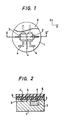
- a strain sensor is constructed by making a p-type diffused resistor 3 and an n-type diffused resistor 2 on an n-type silicon (100) substrate 1 by the use of the CMOS process.
- Fig. 1 shows a plan view
- Fig. 2 shows a sectional view taken along line II - II' in Fig. 1 and illustrates the formed states of the diffused resistors.
- the p-type diffused resistor 3 and the n-type diffused resistor 2, which is buried in a p-type diffused resistor layer 7, are respectively made in the shape of rectangles in proximity to each other, and electrode terminals 4 are provided on the four sides of each rectangle.
- the electrode terminals 4 are isolated by an SiO2 film 5, and the whole surface is covered with a passivation film 6.
- the direction along the line II - II' is set to be the x-direction, and the direction orthogonal thereto in the same plane is set to be the y-direction. A method of measuring the changes of a resistivity in each diffused resistor will be described.
- four independent resistivity changes can be measured within the (100) crystal plane of silicon, and this brings forth the effect that stresses ⁇ x and ⁇ y in the directions of two axes, a shear stress ⁇ xy and a stress ⁇ z perpendicular to the plane, which act on the crystal plane, can be uniquely determined.
- FIG. 3 shows a plan view of a thin-film stress/strain sensor to which the present invention is applied.
- a single-crystal thin film of silicon having the (100) plane is formed on a film substrate (of, for example, PIQ) 8, and p-type diffused resistors 3 and n-type diffused resistors 2 are formed as shown in the figure.
- the ends of these diffused resistors 2 and 3 on one side are connected by a common pattern 12, and are held in communication with a common electrode terminal 13.
- the single-crystal thin film is produced by a thin-film manufacturing process such as vacuum evaporation, CVD (Chemical Vapored Deposition), sputtering evaporation or epitaxial growth.
- a thin-film manufacturing process such as vacuum evaporation, CVD (Chemical Vapored Deposition), sputtering evaporation or epitaxial growth.
- CVD Chemical Vapored Deposition
- sputtering evaporation epitaxial growth.
- ⁇ ij denotes a piezoresistance coefficient in the case where the direction of the ⁇ 001 ⁇ crystal axis is brought into agreement with the directions of the right-angled three axes.
- FIG. 4 is a sectional view in the case where a semiconductor pressure sensor is constructed.
- a p-type diffused resistor 3 and an n-type diffused resistor 2 are formed to construct a gauge.
- the single-crystal substrate 1 is bonded to a glass substratum 10 by a low-melting glass 9.
- an n-type diffused resistor 11 is formed in a p-type diffused layer 7, to construct a p/n-junction, whereupon the temperature of the gauge is detected.
- a temperature compensation circuit is formed, and measurements in a wide temperature range become possible.
- the silicon substrate may be in the shape of the disc, a high degree of etching technique as in the case of making a diaphragm is dispensed with, to bring forth the effect that the available percentage in production is enhanced.
- a fourth embodiment of the piezoresistive strain sensing device of the present invention will be described with reference to Figs. 5 and 6.
- This embodiment is a stress sensor which is fabricated using an n-type silicon (111) single-crystal disc 21 as a substrate
- Fig. 5 is a plan view
- Fig. 6 is a schematic sectional view taken along line VI - VI' in Fig. 5.
- Six diffused resistors 22 and 23 formed on the substrate 21 consist of three p-type diffused layers 22 and three n-type diffused layers 23, and the ends of the respective layers 22 or 23 on one side are connected by a single aluminium pattern 24 or 32. It is assumed that the individual diffused resistors 22 or 23 be formed at angular intervals of 45 °.
- the direction of the line VI - VI' agree with the direction of the ⁇ 112 ⁇ crystal axis.
- the ends of the three p-type diffused resistors 22 on one side are connected to a common electrode terminal 29 through the single common A1 pattern 24, whereas the ends thereof on the other side are connected to separate electrode terminals 31 through separate A1 patterns 30.
- the ends of the three n-type diffused resistors 23 on one side are connected to a common electrode terminal 33 through the single common A1 pattern 32, whereas the ends thereof on the other side are connected to separate electrode terminals 35 through separate A1 patterns 34.
- the n-type diffused resistors 23 are formed in a p-type diffused layer 25.
- the p-type diffused layer 25 is formed with an n-type diffused resistor 28, to simultaneously make a p/n-junction for temperature compensation. Now, the operation of this sensor will be described.
- the corresponding resistivity changes are expressed as:
- the embodiment thus far described brings forth the effect that a sensor for detecting a three-dimensional stress field can be realized, and the effect that measurements at temperatures in a wide range are permitted by utilizing a p/n-junction for temperature compensation.
- the individual diffused resistors 22 or 23 are formed at the angular intervals of 45 °. This takes it into consideration that, on the (111) crystal plane, the lengthwise directions of the resistor layers are brought into agreement with the ⁇ 112 ⁇ crystal axis and the ⁇ 110 ⁇ crystal axis, while one resistor layer is arranged in the direction of 45 ° between them. In principle, however, the directions of the arrangement of the resistor layers may be as desired (except a case where two or more resistors become parallel among the same kind of diffused resistor layers).
- the number of the arrangement in each kind of diffused layers may well be four or more. Since the number of stress components acting independently is six, the stress components are uniquely determined when there are at least three diffused resistors in each kind of layers, namely, at least six resistors in total. In the case of forming at least four diffused resistors in the same kind of diffused layers, at least three of them may extend in crystal orientations differing from one another.
- the semiconductor single-crystal substrate may well be replaced with a single-crystal thin film produced by a thin-film manufacturing process such as vacuum evaporation, CVD, sputtering or epitaxial growth.
- a thin-film manufacturing process such as vacuum evaporation, CVD, sputtering or epitaxial growth.
Landscapes
- Physics & Mathematics (AREA)
- General Physics & Mathematics (AREA)
- Pressure Sensors (AREA)
- Measuring Fluid Pressure (AREA)
- Measurement Of Length, Angles, Or The Like Using Electric Or Magnetic Means (AREA)
Claims (7)
- Piezoresistive Belastungsfühleranordnung mit einem Halbleitereinkristallsubstrat (21), das eine solche Kristallebene hat, daß wenigstens einer der Kristallebenenindices h, k und l null wird (daß jedoch nicht alle der Indices h, k und l gleichzeitig null werden), und mit p-Typ-diffundierten Widerständen (22) und n-Typ-diffundierten Widerständen (23), die im Substrat (21) gebildet sind, wobei eine diffundierte Widerstandsmeßstrecke aus den jeweiligen Widerstandsmeßstrecken der p-Typ-diffundierten Widerstände (22) und der n-Typ-diffundierten Widerstände (23) gebildet wird,
dadurch gekennzeichnet,
daß die Kristallebenenindices des Halbleitereinkristallsubstrats (21) (100) sind, daß jeder p-Typ-diffundierte Widerstand (22) in einer Richtung einer Kristallachse 〈011〉 angeordnet ist, während jeder n-Typ-diffundierte Widerstand (23) in einer Richtung einer Kristallachse 〈001〉 angeordnet ist, oder umgekehrt, und daß ein gemeinsamer Elektrodenanschluß (29; 33) in Verbindung mit Enden der jeweiligen diffundierten Widerstände an einer Seite gehalten wird, während unabhängige Elektrodenanschlüsse (31; 35) in Verbindung mit Enden der jeweiligen diffundierten Widerstände an der anderen Seite gehalten werden. - Piezoresistive Belastungsfühleranordnung nach Anspruch 1,
die weiter einen p-n-Übergang zur Temperaturkompensation aufweist, der nahe der im Halbleitereinkristallsubstrat (21) gebildeten diffundierten Widerstandsmeßstrecke gebildet ist. - Piezoresistive Belastungsfühleranordnung nach Anspruch 1 oder 2,
wobei das Halbleitereinkristallsubstrat (21) ein Einkristalldünnfilm ist, der durch ein Dünnfilmherstellverfahren hergestellt wird. - Piezoresistive Belastungsfühleranordnung nach Anspruch 1,
wobei die p-Typ-diffundierten Widerstände (22) und die n-Typ-diffundierten Widerstände (23) in der Form von Rechtecken gebildet sind und Elektrodenanschlüsse an vier Seiten jedes Rechtecks vorgesehen sind. - Piezoresistive Belastungsfühleranordnung mit einem Halbleitereinkristallsubstrat (21) und p-Typ-diffundierten Widerständen (22) und n-Typ-diffundierten Widerständen (23), die im Substrat (21) gebildet sind, wobei eine diffundierte Widerstandsmeßstrecke aus den jeweiligen Widerstandsmeßstrecken der p-Typ-diffundierten Widerstände (22) und der n-Typ-diffundierten Widerstände (23) gebildet wird,
dadurch gekennzeichnet,
daß die Kristallebenenindices des Halbleitereinkristallsubstrats (21) (111) sind, daß drei p-Typ-diffundierte Widerstände (22) in Winkelabständen von 45° angeordnet sind, während drei n-Typ-diffundierte Widerstände (23) in Winkelabständen von 45° angeordnet sind, und daß ein gemeinsamer Elektrodenanschluß (29) in Verbindung mit Enden der drei p-Typ-diffundierten Widerstände (22) an einer Seite gehalten wird und unabhängige Elektrodenanschlüsse (31) in Verbindung mit deren Enden an der anderen Seite gehalten werden, während ein gemeinsamer Elektrodenanschluß (33) in Verbindung mit Enden der drei n-Typ-diffundierten Widerstände (23) an einer Seite gehalten wird und unabhängige Elektrodenanschlüsse (35) in Verbindung mit deren Enden an der anderen Seite gehalten werden. - Piezoresistive Belastungsfühleranordnung nach Anspruch 5,
die weiter einen p-n-Übergang zur Temperaturkompensation aufweist, der nahe der im Halbleitereinkristallsubstrat (21) gebildeten diffundierten Widerstandsmeßstrecke gebildet ist. - Piezoresistive Belastungsfühleranordnung nach Anspruch 5 oder Anspruch 6,
wobei das Halbleitereinkristallsubstrat (21) ein Einkristalldünnfilm ist, der durch ein Dünnfilmherstellverfahren hergestellt wird.
Applications Claiming Priority (4)
| Application Number | Priority Date | Filing Date | Title |
|---|---|---|---|
| JP5447385A JPH0697697B2 (ja) | 1985-03-20 | 1985-03-20 | 半導体圧力変換装置 |
| JP5447485A JPS61214583A (ja) | 1985-03-20 | 1985-03-20 | 半導体圧力変換装置 |
| JP54473/85 | 1985-03-20 | ||
| JP54474/85 | 1985-03-20 |
Publications (3)
| Publication Number | Publication Date |
|---|---|
| EP0195232A2 EP0195232A2 (de) | 1986-09-24 |
| EP0195232A3 EP0195232A3 (en) | 1989-10-25 |
| EP0195232B1 true EP0195232B1 (de) | 1991-12-11 |
Family
ID=26395238
Family Applications (1)
| Application Number | Title | Priority Date | Filing Date |
|---|---|---|---|
| EP86101679A Expired EP0195232B1 (de) | 1985-03-20 | 1986-02-10 | Piezoresistiver Belastungsfühler |
Country Status (3)
| Country | Link |
|---|---|
| US (1) | US4739381A (de) |
| EP (1) | EP0195232B1 (de) |
| DE (1) | DE3682793D1 (de) |
Families Citing this family (23)
| Publication number | Priority date | Publication date | Assignee | Title |
|---|---|---|---|---|
| JPH0740596B2 (ja) | 1986-04-25 | 1995-05-01 | 株式会社日立製作所 | 半導体装置 |
| WO1988008522A1 (fr) * | 1987-04-24 | 1988-11-03 | Kabushiki Kaisha Nexy Kenkyusho | Detecteur de forces, d'acceleration et de magnetisme, utilisant des resistances |
| US4873871A (en) * | 1988-06-17 | 1989-10-17 | Motorola, Inc. | Mechanical field effect transistor sensor |
| US5119166A (en) * | 1990-02-06 | 1992-06-02 | Honeywell Inc. | Hall effect element aligned to reduce package-induced offsets |
| US5076106A (en) * | 1990-03-21 | 1991-12-31 | Amp Incorporated | Normal force transducer |
| US5172205A (en) * | 1990-09-26 | 1992-12-15 | Nissan Motor Co., Ltd. | Piezoresistive semiconductor device suitable for use in a pressure sensor |
| JP2553199Y2 (ja) * | 1991-12-26 | 1997-11-05 | 株式会社豊田中央研究所 | 力変換素子 |
| JP3114453B2 (ja) * | 1993-10-05 | 2000-12-04 | 株式会社日立製作所 | 物理量検出センサ及びプロセス状態検出器 |
| US6150917A (en) * | 1995-02-27 | 2000-11-21 | Motorola, Inc. | Piezoresistive sensor bridge having overlapping diffused regions to accommodate mask misalignment and method |
| JP4161410B2 (ja) * | 1997-07-25 | 2008-10-08 | 株式会社デンソー | 圧力検出装置 |
| US6550337B1 (en) * | 2000-01-19 | 2003-04-22 | Measurement Specialties, Inc. | Isolation technique for pressure sensing structure |
| US7082835B2 (en) * | 2003-06-18 | 2006-08-01 | Honeywell International Inc. | Pressure sensor apparatus and method |
| DE10331096B4 (de) * | 2003-07-09 | 2014-02-13 | Austriamicrosystems Ag | Integrierte Halbleiteranordnung und Verfahren |
| DE102004003853B4 (de) * | 2004-01-26 | 2009-12-17 | Infineon Technologies Ag | Vorrichtung und Verfahren zur Kompensation von Piezo-Einflüssen auf eine integrierte Schaltungsanordnung |
| US7597005B2 (en) | 2005-11-10 | 2009-10-06 | Honeywell International Inc. | Pressure sensor housing and configuration |
| US7921731B2 (en) * | 2007-12-03 | 2011-04-12 | The United States Of America As Represented By The Administrator Of The National Aeronautics And Space Administration | Two-axis direct fluid shear stress sensor |
| WO2012068671A1 (en) * | 2010-11-24 | 2012-05-31 | The Governors Of The University Of Alberta | A novel embedded 3d stress and temperature sensor utilizing silicon doping manipulation |
| JP5649478B2 (ja) * | 2011-02-16 | 2015-01-07 | 三菱電機株式会社 | 半導体装置及びその試験方法 |
| EP3323778B1 (de) | 2016-11-22 | 2020-01-08 | NXP USA, Inc. | Mems-vorrichtung und verfahren zur kalibrierung einer mems-vorrichtung |
| US10352792B2 (en) * | 2017-02-15 | 2019-07-16 | Texas Instruments Incorporated | Device and method for on-chip mechanical stress sensing |
| CN113227954B (zh) * | 2018-12-20 | 2025-01-24 | 深圳纽迪瑞科技开发有限公司 | 压力感应装置、压力感应方法及电子终端 |
| CN110333221B (zh) * | 2019-07-15 | 2020-08-21 | 天津大学 | {110}晶面平面应力分量测量方法及系统 |
| WO2021185004A1 (zh) | 2020-03-19 | 2021-09-23 | 深圳纽迪瑞科技开发有限公司 | 一种压力感应装置及压力感应设备 |
Family Cites Families (16)
| Publication number | Priority date | Publication date | Assignee | Title |
|---|---|---|---|---|
| US3123788A (en) * | 1964-03-03 | Piezoresistive gage | ||
| US3132788A (en) * | 1961-10-25 | 1964-05-12 | Axel H Johnson | Tape transporting means for a magnetic recorder |
| US3277698A (en) * | 1963-11-15 | 1966-10-11 | Bell Telephone Labor Inc | Stress sensing semiconductive devices |
| CH423939A (fr) * | 1965-06-04 | 1967-05-13 | Centre Electron Horloger | Résistance diffusée dans un circuit intégré |
| FR1522471A (fr) * | 1967-03-15 | 1968-04-26 | Csf | Dispositif de mesure de contrainte |
| US3537319A (en) * | 1968-07-26 | 1970-11-03 | Gen Electric | Silicon diaphragm with optimized integral strain gages |
| US4028564A (en) * | 1971-09-22 | 1977-06-07 | Robert Bosch G.M.B.H. | Compensated monolithic integrated current source |
| US3818289A (en) * | 1972-04-10 | 1974-06-18 | Raytheon Co | Semiconductor integrated circuit structures |
| US3922705A (en) * | 1973-06-04 | 1975-11-25 | Gen Electric | Dielectrically isolated integral silicon diaphram or other semiconductor product |
| US3899695A (en) * | 1973-09-24 | 1975-08-12 | Nat Semiconductor Corp | Semiconductor pressure transducer employing novel temperature compensation means |
| JPS5660066A (en) * | 1979-10-19 | 1981-05-23 | Nec Corp | Semiconductor strain detector |
| JPS56140229A (en) * | 1980-04-02 | 1981-11-02 | Toshiba Corp | Pressure converter |
| US4317126A (en) * | 1980-04-14 | 1982-02-23 | Motorola, Inc. | Silicon pressure sensor |
| JPS5795673A (en) * | 1980-12-05 | 1982-06-14 | Toshiba Corp | Pressure sensitive semiconductor device |
| US4510671A (en) * | 1981-08-31 | 1985-04-16 | Kulite Semiconductor Products, Inc. | Dielectrically isolated transducer employing single crystal strain gages |
| JPS60128673A (ja) * | 1983-12-16 | 1985-07-09 | Hitachi Ltd | 半導体感圧装置 |
-
1986
- 1986-02-10 EP EP86101679A patent/EP0195232B1/de not_active Expired
- 1986-02-10 DE DE8686101679T patent/DE3682793D1/de not_active Expired - Lifetime
- 1986-03-12 US US06/838,954 patent/US4739381A/en not_active Expired - Lifetime
Also Published As
| Publication number | Publication date |
|---|---|
| EP0195232A2 (de) | 1986-09-24 |
| DE3682793D1 (de) | 1992-01-23 |
| US4739381A (en) | 1988-04-19 |
| EP0195232A3 (en) | 1989-10-25 |
Similar Documents
| Publication | Publication Date | Title |
|---|---|---|
| EP0195232A2 (de) | Piezoresistiver Belastungsfühler | |
| US10775248B2 (en) | MEMS strain gauge sensor and manufacturing method | |
| EP0311695B1 (de) | Kraft- und momentendetektor unter verwendung eines widerstandes | |
| US5485753A (en) | Piezoresistive silicon pressure sensor implementing long diaphragms with large aspect ratios | |
| US6973836B2 (en) | Semiconductor pressure sensor having diaphragm | |
| US4430895A (en) | Piezoresistive accelerometer | |
| EP0735352B1 (de) | Kraftwandler und Herstellungsverfahren dazu | |
| US5239870A (en) | Semiconductor acceleration sensor with reduced cross axial sensitivity | |
| KR930003148B1 (ko) | 반도체 압력 감지장치 | |
| EP0381187A2 (de) | Kraft-Messfühler mit Widerstandselementen | |
| EP3534126B1 (de) | Messvorrichtung, insbesondere eine lastmessvorrichtung | |
| US10607901B2 (en) | Stress sensor for semiconductor components | |
| JPH0479420B2 (de) | ||
| JPH0833409B2 (ja) | 加速度測定装置及びその製造方法 | |
| EP4567393A1 (de) | Piezoresistives sensorelement und piezoresistiver drucksensor mit minimierter langfristiger drift | |
| EP0456190B1 (de) | Piezoresistiver Beschleunigungsmesser | |
| US6763719B2 (en) | Acceleration sensor | |
| US6865951B2 (en) | Semiconductor pressure sensor | |
| CN118882901B (zh) | 六轴力传感器及其制造方法 | |
| US20050268726A1 (en) | Thick film strain gage sensor | |
| RU2050033C1 (ru) | Интегральный балочный тензопреобразователь | |
| JPH0697697B2 (ja) | 半導体圧力変換装置 | |
| JPH01287470A (ja) | 半導体加速度センサ | |
| JPS61214583A (ja) | 半導体圧力変換装置 | |
| JPH0560672B2 (de) |
Legal Events
| Date | Code | Title | Description |
|---|---|---|---|
| PUAI | Public reference made under article 153(3) epc to a published international application that has entered the european phase |
Free format text: ORIGINAL CODE: 0009012 |
|
| AK | Designated contracting states |
Kind code of ref document: A2 Designated state(s): DE FR GB |
|
| PUAL | Search report despatched |
Free format text: ORIGINAL CODE: 0009013 |
|
| AK | Designated contracting states |
Kind code of ref document: A3 Designated state(s): DE FR GB |
|
| 17P | Request for examination filed |
Effective date: 19890912 |
|
| 17Q | First examination report despatched |
Effective date: 19900723 |
|
| GRAA | (expected) grant |
Free format text: ORIGINAL CODE: 0009210 |
|
| AK | Designated contracting states |
Kind code of ref document: B1 Designated state(s): DE FR GB |
|
| REF | Corresponds to: |
Ref document number: 3682793 Country of ref document: DE Date of ref document: 19920123 |
|
| ET | Fr: translation filed | ||
| PLBE | No opposition filed within time limit |
Free format text: ORIGINAL CODE: 0009261 |
|
| STAA | Information on the status of an ep patent application or granted ep patent |
Free format text: STATUS: NO OPPOSITION FILED WITHIN TIME LIMIT |
|
| 26N | No opposition filed | ||
| REG | Reference to a national code |
Ref country code: GB Ref legal event code: IF02 |
|
| PGFP | Annual fee paid to national office [announced via postgrant information from national office to epo] |
Ref country code: FR Payment date: 20040122 Year of fee payment: 19 |
|
| PGFP | Annual fee paid to national office [announced via postgrant information from national office to epo] |
Ref country code: GB Payment date: 20040202 Year of fee payment: 19 |
|
| PGFP | Annual fee paid to national office [announced via postgrant information from national office to epo] |
Ref country code: DE Payment date: 20040304 Year of fee payment: 19 |
|
| PG25 | Lapsed in a contracting state [announced via postgrant information from national office to epo] |
Ref country code: GB Free format text: LAPSE BECAUSE OF NON-PAYMENT OF DUE FEES Effective date: 20050210 |
|
| PG25 | Lapsed in a contracting state [announced via postgrant information from national office to epo] |
Ref country code: DE Free format text: LAPSE BECAUSE OF NON-PAYMENT OF DUE FEES Effective date: 20050901 |
|
| GBPC | Gb: european patent ceased through non-payment of renewal fee |
Effective date: 20050206 |
|
| PG25 | Lapsed in a contracting state [announced via postgrant information from national office to epo] |
Ref country code: FR Free format text: LAPSE BECAUSE OF NON-PAYMENT OF DUE FEES Effective date: 20051031 |
|
| REG | Reference to a national code |
Ref country code: FR Ref legal event code: ST Effective date: 20051031 |