EP0196033A2 - Enregistrement à plusieurs niveaux dans une couche photopolymérisable formant relief pour l'obtention de moules - Google Patents
Enregistrement à plusieurs niveaux dans une couche photopolymérisable formant relief pour l'obtention de moules Download PDFInfo
- Publication number
- EP0196033A2 EP0196033A2 EP86103949A EP86103949A EP0196033A2 EP 0196033 A2 EP0196033 A2 EP 0196033A2 EP 86103949 A EP86103949 A EP 86103949A EP 86103949 A EP86103949 A EP 86103949A EP 0196033 A2 EP0196033 A2 EP 0196033A2
- Authority
- EP
- European Patent Office
- Prior art keywords
- layer
- back surface
- actinic radiation
- photohardenable
- insoluble
- Prior art date
- Legal status (The legal status is an assumption and is not a legal conclusion. Google has not performed a legal analysis and makes no representation as to the accuracy of the status listed.)
- Withdrawn
Links
Images


Classifications
-
- G—PHYSICS
- G03—PHOTOGRAPHY; CINEMATOGRAPHY; ANALOGOUS TECHNIQUES USING WAVES OTHER THAN OPTICAL WAVES; ELECTROGRAPHY; HOLOGRAPHY
- G03F—PHOTOMECHANICAL PRODUCTION OF TEXTURED OR PATTERNED SURFACES, e.g. FOR PRINTING, FOR PROCESSING OF SEMICONDUCTOR DEVICES; MATERIALS THEREFOR; ORIGINALS THEREFOR; APPARATUS SPECIALLY ADAPTED THEREFOR
- G03F7/00—Photomechanical, e.g. photolithographic, production of textured or patterned surfaces, e.g. printing surfaces; Materials therefor, e.g. comprising photoresists; Apparatus specially adapted therefor
- G03F7/20—Exposure; Apparatus therefor
- G03F7/2022—Multi-step exposure, e.g. hybrid; backside exposure; blanket exposure, e.g. for image reversal; edge exposure, e.g. for edge bead removal; corrective exposure
-
- G—PHYSICS
- G03—PHOTOGRAPHY; CINEMATOGRAPHY; ANALOGOUS TECHNIQUES USING WAVES OTHER THAN OPTICAL WAVES; ELECTROGRAPHY; HOLOGRAPHY
- G03F—PHOTOMECHANICAL PRODUCTION OF TEXTURED OR PATTERNED SURFACES, e.g. FOR PRINTING, FOR PROCESSING OF SEMICONDUCTOR DEVICES; MATERIALS THEREFOR; ORIGINALS THEREFOR; APPARATUS SPECIALLY ADAPTED THEREFOR
- G03F7/00—Photomechanical, e.g. photolithographic, production of textured or patterned surfaces, e.g. printing surfaces; Materials therefor, e.g. comprising photoresists; Apparatus specially adapted therefor
- G03F7/20—Exposure; Apparatus therefor
Definitions
- This invention relates to a process for fabricating male patterns used to make casting molds. More particularly, this invention relates to a process for making male patterns used to make casting molds by photofabrication.
- a female mold is usually prepared into which bronze or other metal is poured to produce a plaque having a raised inscription and/or design.
- Commemorative or decorative signs and plaques produced by cast metal, especially bronze tend to have a rough and generally unappealing surface texture. While the top surface of the raised portions may be easily polished, the recessed background areas cannot be polished unless one goes to great expense to grind off the surface of the background areas using specialized equipment. It has been, therefore, common practice in the industry. to prepare a mold which reproduces a textured surface as background, such surface usually being a likeness of a leather pattern.
- a mold To prepare a mold, one must first make a three-dimensional male pattern which is basically a duplicate of the finished product. Typically, a leather-textured sheet is first attached to a wooden support to provide the needed background texture. Then any decorative patterns are glued over the textured surface or in place of sections of the textured surface. Decorative patterns involving intricate lace-like work are also very hard to reproduce in the mold and are usually first hand-carved or etched and then attached to the remaining art work used in the making of the mold. Finally, the lettering or other pattern is glued over the textured surface in the form of a three-dimensional carving.
- a process for photofabricating master relief patterns for the production of casting molds using a photohardenable, solvent soluble layer having a front and a back surface and a thickness in the range of 0.010-to 0.5 inch (0.25 to 12.7 mm), comprising the steps of:
- solvent means any fluid capable of dissolving unhardened photohardenable material, including organic solvents, aqueous solutions, or mixtures thereof.
- master for the subsequent production of casting molds there is utilized a single layer of a photohardenable composition
- a photohardenable composition comprising a polymer of a conjugated diolefin hydrocarbon, a nongaseous. ethylenically unsaturated compound, an organic, radiation-sensitive, free-radical generating photoinitiator or system as well as other additives discussed below.
- the compositions may be used in layer form or the layer may be adhered to flexible supports, or a temporary support may be used.
- Another configuration may have a cover sheet and polymeric layer on each side of the photosensitive layer.
- the support and/or cover sheet are transparent to actinic radiation used to expose the photohardenable layer as described more fully below.
- the support and cover sheet are generally as thin as possible so that in the event they are present during exposure the scattering of actinic radiation will be kept to a minimum.
- Non-transparent supports or cover sheets must be removed prior to exposure to actinic radiation without damaging the photohardenable layer.
- the preferred support and cover sheet are removed prior to said exposure.
- Useful supports and cover sheets include plastic films, e.g., polyethylene terephthalate. polyvinyl chloride, polyamide, polyurethane, etc. To aid in removal of the support and cover sheet they are treated with release agents such as silicone or other known release agents.
- the process of this invention as described above is illustrated in the block diagram shown in Figure 1.
- the first exposure is a backside imagewise exposure followed by an overall exposure through the backside designated "Backflash" and frontal imagewise exposure through a phototool. e.g., image-bearing transparency or mask which bears the image or design desired.
- a phototool e.g., image-bearing transparency or mask which bears the image or design desired.
- the order of exposure through the backside can be reversed, i.e., the backflash can occur first followed by a backside imagewise exposure.
- the unhardened areas of the layer are removed by solvent development to form the master.
- the master is then used in mold casting whereby a mixture of mold-making material, e.g., comprising sand and wax as known to those skilled in the art, is packed over the master to replicate a complementary relief pattern, and, following removal of the master, a female mold results which is suitable for casting of a metal decorative plaque or other article.
- mold-making material e.g., comprising sand and wax as known to those skilled in the art
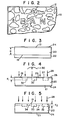
- Figure 2 shows a portion of a typical decorative plaque 10 prepared by the process intended for use in a banking establishment.
- the plaque typically prepared from bronze comprises a background portion 15 containing a decorative leather-like textured pattern 16.
- the plaque may be surrounded by a raised border 12.
- the plaque will further contain raised letters 14 and/or a decorative design not shown.
- molten bronze or other known casting metals e.g.. silver, aluminum, gold, platinum, copper, etc. is cast into a mold containing a complementary recessed pattern of the raised pattern found in the plaque.
- the photohardenable layer useful in the practice of the invention is formed from a composition, a polymer of a conjugated diolefin hydrocarbon, an ethylenically unsaturated compound and an initiator activatable by actinic radiation.
- the photohardenable layer is developable in its unexposed state in aqueous, semiaqueous basic, or organic solvent solutions depending on the particular polymeric binder or binders present therein.
- the layers are in a thickness range of about 0.010 to 0.500 inch (about 0.25 to 12.7 mm) or more.
- Suitable binders include natural or synthetic polymers of conjugated diolefin hydrocarbons.
- the binders include: 1,2-polybutadiene, 1.4-polybutadiene. butadiene/acrylonitrile. butadiene/styrene, block copolymers of the A-B-A type, e.g.. styrene-butadiene-styrene block copolymer, styrene-isoprene-styrene block copolymer, etc., and copolymers of the binders.
- the block copolymers may be of the linear, radial, or sequential type.
- block copolymers of the A-B-C type which have A and B blocks and a C block of a random copolymer of the A and B components or other components.
- Such copolymers are disclosed in Heinz et al., U.S. Patent 4,328.188, which is incorporated herein by reference.
- the preferred binders are the styrene-isoprene-styrene or styrene-butadiene-styrene block copolymers and butadiene/acrylonitrile copolymers optionally having a carboxyl content.
- Useful linear block copolymers of this invention have at least one unit of the general formula, A-B-A. wherein each A is an independently selected nonelastomeric polymer block having a number average molecular weight (Mn) of 2000-100.000 and a glass transition temperature above 25°C and B is an elastomeric polymer block having an average molecular weight between about 25.000 and 1,000,000 and a glass transition temperature below about 10°C.
- the nonelastomeric blocks, A, having between them an elastomeric block, B, together comprise the unit A-B-A which represents the copolymers uniquely suitable for use in combination with the photopolymerizable components in the compositions of the invention.
- This unit may comprise the entire general formula of the copolymer: it may be appended to another polymer chain; or it may be repeating. It is, of course, possible to vary the precise nature of the unit within the scope of the invention, e.g., by using two different nonelastomeric terminal blocks, A, or by creating block or graft polymeric substitutions in blocks A and B.
- the elastomeric mid-section blocks, B are polymers of aliphatic conjugated diolefins while the nonelastomeric blocks, A, are those formed by polymerizing alkenyl aromatic hydrocarbons, preferably vinyl substituted aromatic hydrocarbons. and still more preferably vinyl monocyclic aromatic hydrocarbons.
- the block copolymers are disclosed in Holden et al.
- Particularly preferred species of the subject copolymers comprise block copolymers of polystyrene terminal groups connected by a mid-section of polyisoprene or polybutadiene, e.g., polystyrene-polyisoprene-polystyrene or polystyrene-polybutadiene-polystyrene. the polydiene block being 70 to 90% by weight of the block copolymer.
- block copolymers useful in this invention are polystyrene-polybutadiene-polystyrene and polystyrene-polyisoprene-polystyrene block copolymers which have been hydrogenated according to the teachings of Jones. U.S. Patent 3,431,323 and Hefele et al., U.S. Patent 3,333,024.
- the hydrogenated block copolymers have the additional advantage of improved thermal and oxidative resistance.
- some residual unsaturation in hydrogenated block copolymers is desirable, since only very small concentrations of monomer are then needed in the photosensitive compositions to reduce solvent solubility upon exposure to actinic radiation.
- Still other typical block copolymers useful in this invention are those wherein the terminal blocks are polyalkyl styrenes, e.g., poly( ⁇ -methyl styrene)-polyisoprene-poly (a-methyl styrene), and those composed of a plurality of polymer blocks, e.g., polyisoprene-polystyrene-polybutadiene-polystyrene-polyisoprene.
- polyalkyl styrenes e.g., poly( ⁇ -methyl styrene)-polyisoprene-poly (a-methyl styrene)
- polyisoprene-polystyrene-polybutadiene-polystyrene-polyisoprene e.g., polyisoprene-polystyrene-polybutadiene-polystyrene
- the number average molecular weights for the block copolymers can be determined by membrane osmometry utilizing a gel cellophane 600 W membrane manufactured by Arro Laboratories, Inc., Joliet, IL and toluene as the solvent at 29°C.
- the Mn for the nonelastomeric polymer blocks and elastomeric polymer blocks are preferably determined as follows:
- Useful butadiene/acrylonitrile copolymers are high molecular weight butadiene/acrylonitrile copolymers having a number average molecular weight (Mn) in the range of about 20.000 to about 75,000, preferably in the range of about 25.000 to about 50,000.
- Mn number average molecular weight
- the Mn for the polymers described herein can be determined by gel permeation chromatography employing a polybutadiene standard.
- the acrylonitrile content of the polymers varies from about 10 to about 50% by weight, preferably from about 15 to about 40%.
- the copolymer also has a carboxyl content of 0 to about 15% by weight. When the copolymer contains carboxyl groups, the carboxyl content is preferably in the range of about 1 to about 15%.
- the copolymer is present in an amount of about 55 to 90% by weight. based on the total weight of the composition, and preferably about 60 to about 75% by weight. At least about 55% by weight of the copolymer is necessary to give adequate flexibility and physical integrity to the photosensitive elements, particularly for flexographic plates.
- Carboxyl groups may be incorporated into the high molecular weight copolymer by addition to the polymerization process of a carboxyl containing monomer, e.g., acrylic or methacrylic acid, or a monomer which is convertible to a carboxyl containing group. e.g., maleic anhydride or methyl methacrylate.
- a carboxyl containing monomer e.g., acrylic or methacrylic acid
- a monomer which is convertible to a carboxyl containing group e.g., maleic anhydride or methyl methacrylate.
- Hycar® e.g., from the B. F. Goodrich Chemical Company under the trade name Hycar®.
- Another essential ingredient of the photosensitive compositions of this invention is a nongaseous, ethylenically unsaturated compound, preferably containing at least one terminal ethylenic group.
- These compounds generally are capable of forming a high polymer by free-radical initiated chain-propagating addition polymerization and be compatible with the high molecular weight polymers described above.
- Ethylenically unsaturated compounds which are compatible with the A-B-A type block copolymers set forth above are disclosed in British Patent 1,366,769 incorporated herein by reference. Many of these monomers are specifically disclosed below.
- One class of suitable ethylenically unsaturated compounds includes unsaturated esters of alcohols, especially such esters of ⁇ -methylene carboxylic acids and substituted ⁇ -methylene carboxylic acids, more especially such esters of alkylene polyols and polyalkylene polyols, and most especially alkylene polyol di- and tri-acrylates and polyalkylene polyol di- and tri-acrylates prepared from alkylene polyols of 2-15 carbon atoms or polyalkylene ether polyols or glycols of 1-10 ether linkages.
- ethylene glycol diacrylate diethylene glycol diacrylate, glycerol diacrylate, glycerol triacrylate. trimethylolpropane triacrylate.
- 1.2-benzenedimethanol diacrylate pentaerythritol triacrylate, pentaerythritol tetra- methacrylate, 1,3-propanediol diacrylate, 1.3-pentane- diol dimethacrylate, p- ⁇ , ⁇ -dimethylbenzylphenyl acrylate, t-butyl acrylate, N,N-diethylaminoethyl acrylate, diethylaminoethyl methacrylate.
- 1,4-butane-diol diacrylate hexamethylene glycol diacrylate, decamethylene glycol diacrylate, 2,2-dimethylolpropane diacrylate, tripropylene glycol diacrylate, 2.2-di(p-hydroxy-phenyl)propane diacrylate, 2,2-di(p-hydroxy- phenyl)propane dimethacrylate, polyoxyethyl-2,2-di(p-hydroxyphenyl)propane triacrylate (molecular weight of 462), 1,4-butanediol dimethacrylate, hexamethylene glycol dimethacrylate, 2.2.4-trimethyl-1.3-pentanediol dimethacrylate, 1-phenylethylene-1,2-dimethacrylate, trimethylolpropane trimethacrylate, triethylene glycol diacrylate, ethylene glycol acrylate phthalate, polyoxyethyltrimethylolpropane triacrylate, diacrylate and
- ethylenically unsaturated compounds includes the compounds disclosed by Martin and Barney in U.S. Patent 2,927,022 which is incorporated herein by reference, e.g., those having a plurality of addition polymerizable ethylenic linkages, particularly when present as terminal linkages, and especially those wherein at least one and preferably most of such linkages are conjugated with a double bonded carbon, including carbon double bonded to carbon and to heteroatoms such as nitrogen, oxygen and sulfur.
- Such compounds include unsaturated amides, particularly those of ⁇ -methylene carboxylic acids, especially with ⁇ -omega-diamines and oxygen-interrupted omega- diamines, such as methylene bis-acrylamide. methylene bis-methacrylamide, ethylene bis-methacrylamide. 1.6-hexamethylene bis-acrylamide. diethylene triamine trismethacrylamide, bis( ⁇ -methacrylamidopropoxy)-ethane, B-methacrylamidoethyl methaerylate.
- vinyl esters such as divinyl succinate, divinyl adipate, divinyl phthalate, divinyl terephthalate, divinyl benzene-1.3-disulfonate, and divinyl butane-1,4-disulfonate
- diallyl fumarate etc.
- Additional ethylenically unsaturated compounds which may be used include styrene and derivatives thereof: 1,4-diisopropenylbenzene.
- 1,3,5-triisopropenyl-benzene itaconic anhydride adducts with hydroxyethyl acrylate (1:1), itaconic anhydride adducts with liquid butadiene/acrylonitrile polymers containing terminal amino groups, and itaconic anhydride adducts with the diacrylate and dimethacrylate esters of diepoxy polyethers described in Crary U.S. Patent 3,661,576: polybutadiene and butadiene/acrylonitrile copolymers containing terminal and pendant vinyl groups; and unsaturated aldehydes, such as sorbaldehyde (2.4-hexadienal).
- Ethylenically unsaturated compounds which are water soluble or contain carboxyl or other alkali- reactive groups are especially suitable when aqueous basic-developable systems are involved.
- the polymerizable, ethylenically unsaturated polymers of Burg. U.S. Patent 3,043,805; Martin, U.S. Patent 2,929,710: and similar materials may be used alone or mixed with other materials.
- Acrylic and methacrylic esters of adducts of ethylene oxide and polyhydroxy compounds such as those described by Cohen and Schoenthaler in U.S. Patent 3,380,831 are also useful.
- the photocrosslinkable polymers disclosed in Schoenthaler, U.S. Patent 3,418,295, and Celeste, U.S. Patent 3,448,089, may also be used. All of these patents are incorporated herein by reference.
- the ratio of the weight of block copolymer used to the weight of addition polymerizable ethylenically unsaturated compound use is 99:1 to about 1:1.
- the amount of unsaturated compound present in a photosensitive composition containing a butadiene/acrylonitrile copolymer should be in the range of about 2 to about 40% by weight, based on the total weight of composition. The specific amount for optimum results will vary depending on the particular polymers used. Preferably the amount of unsaturated compound is in the range of about 5 to about 25%.
- the ethylenically unsaturated compound preferably-has a boiling point at normal pressure of over about 100°C.
- the most preferred ethylenically unsaturated compounds are triethylene glycol diacrylate, triethylene glycol dimethacrylate, hexamethylene glycol dimethacrylate and hexamethylene glycol diacrylate.
- the photosensitive compositions of this invention substantially do not scatter actinic radiation when in the form of thin layers, as described above.
- the polymer binder components should be compatible with. and preferably soluble in, the ethylenically unsaturated compound in the proportions used.
- compatible is meant the ability of two or more constituents to remain dispersed in one another without causing any significant amount of scattering of actinic radiation. Compatibility is often limited by the relative proportions of the constituents, and incompatibility is evidenced by formation of haze in the photosensitive composition. Some slight haze can be tolerated from such compositions before or during exposure in the preparation of printing reliefs, but when fine detail is desired, haze should be completely avoided. The amount of ethylenically unsaturated compound, or any other constituent, used is therefore limited to those concentrations which do not produce undesired light scatter or haze.
- the photosensitive compositions also contain an organic, radiation-sensitive, free-radical generating system. Practically any organic, radiation-sensitive, free-radical generating system which initiates polymerization of the unsaturated compound and does not excessively terminate the polymerization can be used in the photosensitive compositions of this invention.
- organic is used here and in the claims to designate compounds which contain carbon, and one or more of oxygen. hydrogen, nitrogen, sulfur and halogen, but no metal. Because process transparencies transmit heat originating from conventional sources of actinic radiation, and since the photosensitive compositions are usually prepared under conditions resulting in elevated temperatures, the preferred free-radical generating compounds are inactive thermally below 85°C and more preferably below 185°C.
- initiators should be dispersible in the composition to the extent necessary for initiating the desired polymerization or cross- linking under the influence of the amount of radiation absorbed in relatively short term exposures.
- These initiators are useful in amounts from about 0.001 to about 10% by weight, and preferably from about 0.1 to about 5% based on the total weight of the solvent-free photosensitive composition.
- the free-radical generating system absorbs radiation within the range of about 2000 to about 8000 A and has at least one component that has an active radiation absorption band with molar extinction coefficient of at least about 50 within the range of about 2500 to about 8000 A. and preferably about 2500 to about 5000 A.
- active radiation absorption band means a band of radiation which is active to produce the free radicals necessary to initiate polymerization or crosslinking of the unsaturated material.
- the free-radical generating system can comprise one or more compounds which directly furnish free radicals when activated by radiation. It can also comprise a plurality of compounds, one of which yields the free radicals after having been caused to do so by a sensitizer which is activated by the radiation.
- a large number of such free-radical generating compounds can be utilized in the practice of the invention and include aromatic ketones such as benzophenone, Michler's ketone [4,4'-bis(dimethyl- amino)benzophenone], 4.4'-bis(diethylamino)benzophenone. 4-acryloxy-4'-dimethylaminobenzophenone, 4-acryloxy-4'-diethylaminobenzophenone, 4-methoxy-4'-dimethylaminobenzophenone.
- benzoin benzoin ethers such as benzoin methyl ether, benzoin ethyl ether, benzoin isobutyl ether, and benzoin phenyl ether, methylbenzoin, ethylbenzoin and other benzoins
- 2,4,5-triarylimidazolyl dimers such as 2-(o-chloro-phenyl)-4,5-diphenylimidazolyl dimer, 2-(o-chloro- phenyl-4,5-di(m-methoxyphenyl)imidazolyl dimer, 2-(o-fluorophenyl)-4,5-diphenylimidazolyl dimer, 2-(o-methoxyphenyl(-4,5-diphenylimidazolyl dimer, 2-(p-methoxyphenyl(-4,5-diphenylimid
- the imidazolyl dimers can be used with a free-radical producing electron donor such as 2-mercaptobenzoxazole, Leuco Crystal Violet or tri (4-diethylamino-2-methylphenyl)methane.
- a free-radical producing electron donor such as 2-mercaptobenzoxazole, Leuco Crystal Violet or tri (4-diethylamino-2-methylphenyl)methane.
- sensitizers as Michler's ketone may be added.
- Various energy transfer dyes such as Rose Bengal and Eosin Y can also be used. Additional examples of suitable initiators are disclosed by Plambeck in U.S. Patent 2,760,863 which is incorporated herein by reference.
- the photosensitive compositions may also contain a small amount of thermal addition polymerization inhibitor, e.g., 0.001% to 2.0%, based on the weight of the total solvent-free photosensitive composition.
- Suitable inhibitors include hydroquinone and alkyl and aryl-substituted hydroquinones. 2,6-di-tert-butyl-4-methylphenol, p-methoxyphenol, tert-butylpyrocatechol, pyrogallol, B-naphthol, 2.6-di-tert-butyl-p-cresol. phenothiazine, pyridine, nitrobenzene, dinitrobenzene and the nitroso dimer inhibitor systems described in U.S.
- Patent 4,168,982 which is incorporated herein by reference.
- Other useful inhibitors include p-toluquinone, chloranil and thiazine dyes, e.g., Thionine Blue G (CI 52025), Methylene Blue B (CI 52015) and Toluidine Blue (CI 52040).
- Such compositions can be photopolymerized or photocrosslinked without removal of the inhibitor.
- the preferred inhibitors are 2.6-di-tert-butyl-4-methylphenol and p-methoxyphenol.
- the first step of the process involves the backside imagewise exposure of the photohardenable layer 20.
- This operation is best understood with reference to Figure 4.
- the layer is placed in an exposure unit, generally equipped with a vacuum frame, backside up, preferably with support 22 removed.
- the exposure unit has been omitted from the figures for simplicity.
- a source of actinic radiation 30 at a given distance from the exposure unit and the photohardenable layer is depicted.
- Actinic radiation 28 from the source is directed towards the layer.
- the actinic radiation be collimated: usually a point source of light such as a NAPPS exposure unit may be used. This is desirable to prevent sidewise spread of the light and loss of resolution during the exposure process.
- Other known exposure sources are also useful: those rich in ultraviolet radiation are preferred.
- a light modulator which may consist of a transparency 26 having imagewise transparent 27 and opaque 29 areas. preferably having a matte surface, is place over layer 20.
- the modulator 26 allows actinic radiation 28 to expose the photosensitive layer 20 in a pattern of a desired background, e.g., as a reproduction of textured leather.
- the exposure time and the intensity of the actinic radiation 28 is calculated such as to render insoluble the portions 32 of the photohardenable layer 20 that are exposed to the radiation, to a depth d1 preselected to correspond to the raised portions of the background level of the finished master.
- d is 0.040 to 0.050 inch (1.016 to 1.27 mm).
- the modulator 26 is removed and the photohardenable layer is subjected to a second non-modulated back exposure as shown in Figure 5.
- This exposure known as backflash is calculated to render uniformly insoluble a layer 34 extending a second predetermined depth d 2 as measured from the backside 19 of the photosensitive layer 20.
- d 2 is .010 to .020 inch (0.254 to 0.5 mm).
- this depth as measured from surface 19 is less than the depth d 1 to which the photohardenable layer has been rendered insoluble in an imagewise pattern by the first exposure. This determines how deep will be the relief of the background pattern. Typically this relief is about 0.030 inch (0.762 mm).
- the backflash exposure step is not needed. However, care must be used in calculating the first exposure to provide a depth d 1 exceeding the depth d 2 of insoluble layer produced by this unmodulated backflash exposure.
- the layer with cover sheet 24 is now taken out of the exposure station and the supporting base 22 replaced over the back surface 19 of the photohardenable layer 20.
- the plate is next placed back on the exposure station with frontside 21 now facing the actinic radiation source.
- the cover layer 24 is removed and a second modulator 36 which contains the art work representing the raised portions of the final plaque or article is placed over surface of front side 21.
- this modulator contains transparent 40 and opaque 38 areas corresponding to the art work.
- the modulator can be a litho type transparency preferably having a matte surface.
- the photohardenable layer is now exposed to a second imagewise exposure for a preselected time sufficient to render it insoluble to a depth at least as great as D - d 2 as measured from the top surface of front side 21, i.e.. the exposed areas will become insoluble through the entire thickness of the photohardenable layer.
- Hardened area 42 shows a depth of at least D - d 2 .
- the layer is placed in a standard developing apparatus where under the action of solvent the soluble portions of the plate are washed away leaving a relief image on a base layer which replicates both the background pattern and the relief art work.
- the master 43 shown in Figure 7 is prepared after liquid development which may be used to produce a casting mold.
- mold 46 The making of a mold proceeds along the traditional casting mold making operations. As shown in Figure 8, a mixture of sand and wax of a composition known to those skilled in the art 44 is poured and pressed all around the relief portions of the master. The master is then removed leaving behind a mold 46 having complementary indentations 48 corresponding to the relief 42 as shown in Figure 9. Mold 46 may now be used for the casting of the metal to produce the plaque.
- a scanning light source such as a scanning laser beam and combine such a source with an electro-optical or other similar modulator. While best results have been obtained using the process step sequence discussed, the order of the three exposure steps may be altered provided that the various exposures are precalculated to render insoluble the photohardenable layer to depths as disclosed above.
- a flexographic printing plate commercially available under the trade name Cyrele 112SC (E. I. du Pont de Nemours and Company, Wilmington, DE) was first exposed to modulated actinic radiation in a commercial Cyrele 3040 exposure unit comprising a bank of 24 U.V. fluorescent black light tube lamps made by Sylvania Co., type 7R-48T-12/B2/VHO/180. Prior to this exposure the polyethylene terephthalate film support was removed from the flexographic printing plate. The film was placed in the exposure unit with the uncovered side facing the exposure source.
- a matte surface litho-type negative such as the Cronar ⁇ Polyester Photographic Film (E. I.
- du Pont de Nemours and Company, Wilmington, DE containing the pattern desired to be reproduced as background for a given plaque is placed over the plate. Vacuum was applied to provide good contact between the negative and the plate and the plate was exposed to actinic radiation for 12 seconds. Following this first exposure, the Cronar® Polyester Photographic Film negative was removed and using the same exposure equipment the plate was exposed to actinic radiation for an additional 5 seconds. The plate was then removed from the exposure equipment and the polyethylene terephthalate film support readhered to the exposed surface of the plate. The cover sheet of the plate was next removed and the plate placed again in the exposure equipment stripped side up.
- a second litho negative of the same type as before bearing an image of the raised inscription of the plaque was next placed on the plate and the plate was placed under vacuum and exposed as before to actinic radiation for 4.5 minutes.
- the exposed plate was subsequently placed in a processing machine for this type of flexographic printing plate where using Cyrel4D Flex Solvent (E. I. du Pont de Nemours and Company, Wilmington. DE) the unexposed, unhardened areas of the plate were washed off, in about 13 minutes, leaving behind a three dimensional pattern.
- a conventional mixture of sand and wax was now packed over this pattern to form upon removal of the plate a female mold into which bronze was cast to form a plaque which faithfully reproduced both the background pattern as well as the raised lettering.
- the plaque was finished with buffing of the raised letters and staining of the background as is customary in this trade.
Landscapes
- Physics & Mathematics (AREA)
- General Physics & Mathematics (AREA)
- Photosensitive Polymer And Photoresist Processing (AREA)
- Exposure And Positioning Against Photoresist Photosensitive Materials (AREA)
- Molds, Cores, And Manufacturing Methods Thereof (AREA)
- Moulds For Moulding Plastics Or The Like (AREA)
Applications Claiming Priority (2)
| Application Number | Priority Date | Filing Date | Title |
|---|---|---|---|
| US06/716,096 US4668607A (en) | 1985-03-26 | 1985-03-26 | Multilevel imaging of photopolymer relief layer for the preparation of casting molds |
| US716096 | 1985-03-26 |
Publications (2)
| Publication Number | Publication Date |
|---|---|
| EP0196033A2 true EP0196033A2 (fr) | 1986-10-01 |
| EP0196033A3 EP0196033A3 (fr) | 1988-09-07 |
Family
ID=24876731
Family Applications (1)
| Application Number | Title | Priority Date | Filing Date |
|---|---|---|---|
| EP86103949A Withdrawn EP0196033A3 (fr) | 1985-03-26 | 1986-03-22 | Enregistrement à plusieurs niveaux dans une couche photopolymérisable formant relief pour l'obtention de moules |
Country Status (4)
| Country | Link |
|---|---|
| US (1) | US4668607A (fr) |
| EP (1) | EP0196033A3 (fr) |
| JP (1) | JPS61253142A (fr) |
| CA (1) | CA1272062A (fr) |
Cited By (6)
| Publication number | Priority date | Publication date | Assignee | Title |
|---|---|---|---|---|
| EP0468666A1 (fr) * | 1990-07-26 | 1992-01-29 | Minnesota Mining And Manufacturing Company | Irradiation ionisante dorsale dans un procédé pour une plaque d'impression flexographique |
| GB2248506A (en) * | 1990-04-19 | 1992-04-08 | James George Birkholm | Process for preparing imaged material |
| US5589306A (en) * | 1988-03-26 | 1996-12-31 | Asahi Kasei Kogyo Kabushiki Kaisha | Photosensitive resin composition for producing a relief printing plate |
| US6878333B1 (en) | 1999-09-13 | 2005-04-12 | 3M Innovative Properties Company | Barrier rib formation on substrate for plasma display panels and mold therefor |
| EP2577400A4 (fr) * | 2010-06-04 | 2013-06-12 | Macdermid Printing Solutions | Procédé de production d'un hologramme à partir d'une résine photopolymérisable liquide |
| US9851640B2 (en) | 2010-10-11 | 2017-12-26 | Graphic Ip Limited | Method of casting |
Families Citing this family (19)
| Publication number | Priority date | Publication date | Assignee | Title |
|---|---|---|---|---|
| JPH0675925B2 (ja) * | 1986-12-10 | 1994-09-28 | 富士通株式会社 | 立体形状形成装置 |
| US4869760A (en) * | 1987-01-28 | 1989-09-26 | Kayoh Technical Industry Co., Ltd. | Method for production of metallic sticker |
| US4891302A (en) * | 1987-05-06 | 1990-01-02 | Gordon Douglas C | Method of preparing a contoured plate |
| GB8714177D0 (en) * | 1987-06-17 | 1987-07-22 | Grace W R Ltd | Printing plate manufacture |
| US4818660A (en) * | 1987-11-04 | 1989-04-04 | E. I. Du Pont De Nemours And Company | Photohardenable electrostatic master having improved backtransfer and charge decay |
| US4849314A (en) * | 1987-11-04 | 1989-07-18 | E. I. Du Pont De Nemours And Company | Photohardenable electrostatic master containing electron acceptor or donor |
| JPH01218831A (ja) * | 1988-02-27 | 1989-09-01 | Japan Synthetic Rubber Co Ltd | 立体形状形成法 |
| JP2738018B2 (ja) * | 1989-05-25 | 1998-04-08 | ブラザー工業株式会社 | 三次元成形装置 |
| IT1250214B (it) * | 1991-11-22 | 1995-04-03 | Rivestimento al nitruro di titanio per conchiglie per pistoni. | |
| US5658413A (en) * | 1994-10-19 | 1997-08-19 | Hewlett-Packard Company | Miniaturized planar columns in novel support media for liquid phase analysis |
| US5932397A (en) * | 1996-05-28 | 1999-08-03 | Rvm Scientific, Inc. | Multicolor lithography for control of three dimensional refractive index gradient processing |
| US5932315A (en) * | 1997-04-30 | 1999-08-03 | Hewlett-Packard Company | Microfluidic structure assembly with mating microfeatures |
| US5972566A (en) * | 1997-05-21 | 1999-10-26 | Identity Group, Inc. | Releasable photopolymer printing plate and method of forming same |
| WO2000021758A1 (fr) | 1998-10-15 | 2000-04-20 | Identity Group, Inc. | Imprimante et procede d'utilisation de celle-ci pour imprimer sur un support thermoplastique |
| US6843952B1 (en) * | 1999-03-25 | 2005-01-18 | 3M Innovative Properties Company | Method of producing substrate for plasma display panel and mold used in the method |
| US8034540B2 (en) * | 2008-07-31 | 2011-10-11 | Eastman Kodak Company | System and method employing secondary back exposure of flexographic plate |
| US8333148B2 (en) | 2008-11-26 | 2012-12-18 | Psa Essentials Llc | Photopolymer stamp manufacturing process and preparation system and photopolymer stamp dies |
| EP2623331A4 (fr) * | 2010-09-30 | 2014-07-09 | Toray Industries | Procédé de production d'un original de plaque flexographique pour gravure au laser |
| US10625334B2 (en) | 2017-04-11 | 2020-04-21 | Macdermid Graphics Solutions, Llc | Method of producing a relief image from a liquid photopolymer resin |
Family Cites Families (18)
| Publication number | Priority date | Publication date | Assignee | Title |
|---|---|---|---|---|
| DE397983C (de) * | 1924-07-01 | Werner Robert Busch Larsen | Verfahren zur Herstellung von Druckformen aus gehaerteten Kolloiden | |
| US2244187A (en) * | 1938-04-18 | 1941-06-03 | Coppertone Inc | Process of molding printing cuts from photographic plates |
| US3249436A (en) * | 1960-06-29 | 1966-05-03 | Du Pont | Process for preparing printing plates from photopolymerizable materials by the use of a masking technique |
| US3277541A (en) * | 1964-06-26 | 1966-10-11 | Ralph P Wilton | Photographic method of making a pattern for molding |
| US3663222A (en) * | 1968-06-06 | 1972-05-16 | Asahi Chemical Ind | Process for preparing steric block with liquid photopolymerizable composition |
| GB1304835A (fr) * | 1969-01-03 | 1973-01-31 | ||
| DE1917294A1 (de) * | 1969-04-03 | 1970-10-15 | Hugo Brendel | Verfahren zur Herstellung dickschichtiger Abbildungen |
| JPS4983501A (fr) * | 1972-12-18 | 1974-08-12 | ||
| JPS5095005A (fr) * | 1973-12-21 | 1975-07-29 | ||
| DE2444118C2 (de) * | 1974-09-14 | 1987-02-12 | Basf Ag, 6700 Ludwigshafen | Mehrschichtige Druckplatte sowie mehrschichtige Reliefdruckform für den Flexodruck |
| JPS5137703A (ja) * | 1975-05-22 | 1976-03-30 | Asahi Chemical Ind | Shinkinainsatsuban |
| JPS51115102A (en) * | 1975-03-31 | 1976-10-09 | Asahi Chemical Ind | Method of making new printing plate |
| JPS5137701A (en) * | 1974-09-26 | 1976-03-30 | Asahi Chemical Ind | Shinkinainsatsubannosakuseihoho |
| DE2542815C2 (de) * | 1974-09-26 | 1983-07-14 | Asahi Kasei Kogyo K.K., Osaka | Verfahren zur Herstellung von Druckformen auf fotomechanischem Wege |
| JPS51116703A (en) * | 1975-04-04 | 1976-10-14 | Asahi Chemical Ind | Method of producing photosensitive resin plate |
| GB2035602B (en) * | 1978-12-14 | 1984-03-07 | Pollak J | Forming three-dimensional objects from two-dimensional designs using photopolymerisable compositions |
| US4329385A (en) * | 1980-12-19 | 1982-05-11 | The United States Of America As Represented By The Administrator Of The National Aeronautics And Space Administration | Texturing polymer surfaces by transfer casting |
| DE3585753D1 (de) * | 1984-07-23 | 1992-05-07 | Asahi Chemical Ind | Kunststoffdruckplatte und verfahren zur herstellung. |
-
1985
- 1985-03-26 US US06/716,096 patent/US4668607A/en not_active Expired - Fee Related
-
1986
- 1986-03-20 CA CA000504597A patent/CA1272062A/fr not_active Expired
- 1986-03-22 EP EP86103949A patent/EP0196033A3/fr not_active Withdrawn
- 1986-03-25 JP JP61065012A patent/JPS61253142A/ja active Granted
Cited By (8)
| Publication number | Priority date | Publication date | Assignee | Title |
|---|---|---|---|---|
| US5589306A (en) * | 1988-03-26 | 1996-12-31 | Asahi Kasei Kogyo Kabushiki Kaisha | Photosensitive resin composition for producing a relief printing plate |
| GB2248506A (en) * | 1990-04-19 | 1992-04-08 | James George Birkholm | Process for preparing imaged material |
| GB2248506B (en) * | 1990-04-19 | 1995-01-04 | James George Birkholm | Process for preparing electromagnetic radiation imaged material |
| EP0468666A1 (fr) * | 1990-07-26 | 1992-01-29 | Minnesota Mining And Manufacturing Company | Irradiation ionisante dorsale dans un procédé pour une plaque d'impression flexographique |
| US6878333B1 (en) | 1999-09-13 | 2005-04-12 | 3M Innovative Properties Company | Barrier rib formation on substrate for plasma display panels and mold therefor |
| EP2577400A4 (fr) * | 2010-06-04 | 2013-06-12 | Macdermid Printing Solutions | Procédé de production d'un hologramme à partir d'une résine photopolymérisable liquide |
| US8476000B2 (en) | 2010-06-04 | 2013-07-02 | Ryan Vest | Method of producing a relief image from a liquid photopolymer resin |
| US9851640B2 (en) | 2010-10-11 | 2017-12-26 | Graphic Ip Limited | Method of casting |
Also Published As
| Publication number | Publication date |
|---|---|
| JPH0327893B2 (fr) | 1991-04-17 |
| CA1272062A (fr) | 1990-07-31 |
| JPS61253142A (ja) | 1986-11-11 |
| US4668607A (en) | 1987-05-26 |
| EP0196033A3 (fr) | 1988-09-07 |
Similar Documents
| Publication | Publication Date | Title |
|---|---|---|
| US4668607A (en) | Multilevel imaging of photopolymer relief layer for the preparation of casting molds | |
| CA1336048C (fr) | Methode de production de plaques flexographiques plus souple | |
| US4272608A (en) | Photosensitive compositions containing thermoplastic ionomeric elastomers useful in flexographic printing plates | |
| EP0084851B2 (fr) | Procédé pour produire une plaque d'impression photopolymérique portant une couche de couverture | |
| US4431723A (en) | Aqueous processible, alcohol resistant flexographic printing plates | |
| US4177074A (en) | Butadiene/acrylonitrile photosensitive, elastomeric polymer compositions for flexographic printing plates | |
| US4460675A (en) | Process for preparing an overcoated photopolymer printing plate | |
| US3658526A (en) | Hologram recording in photopolymerizable layers | |
| EP0107065B1 (fr) | Plaque flexographique précourbée | |
| US4400460A (en) | Process for surface treatment of flexographic printing plates containing butadiene/acrylonitrile copolymers | |
| US4400459A (en) | Process for bromine surface treatment of photosensitive elastomeric flexographic printing plates | |
| EP0474178A1 (fr) | Elément d'élastomère photosensible ayant une résistance aux solvants améliorée | |
| US4415649A (en) | Flexographic printing plates containing blended adhesives | |
| EP0464398B1 (fr) | Procédé pour la stabilisation dimensionnelle des plaques d'impression flexographiques photopolymères | |
| US3879204A (en) | Two-layer photopolymerizable gravure resist film | |
| EP0096835B1 (fr) | Procédé pour le traitement de plaques d'impression flexographiques contenant des copolymères de butadiène-acrylonitrile avec des halogènes | |
| CA1174890A (fr) | Methode pour traiter en surface des plaques d'impression flexographiques elastomeres, photosensibles, a l'aide de monopersulfate et de bromures | |
| US4446220A (en) | Method of making a photosensitive elastomeric composition | |
| EP0064565B1 (fr) | Procédé pour le traitement des surfaces de plaques d'impression photosensibles élastomères flexographiques du brome | |
| EP0064564B1 (fr) | Procédé pour le traitement des surfaces de plaques d'impression flexographiques contenant des copolymères de butadiène/acrylonitrile | |
| EP0058737B1 (fr) | Plaques pour l'impression flexographique contenant des mélanges d'adhésifs | |
| CA1174891A (fr) | Methode de traitement en surface, par le brome, de plaques d'impression flexographiques contenant des copolymeres de butadiene-acrylonitrile | |
| CA1178476A (fr) | Plaques imprimantes flexographiques contenant un melange d'adhesifs | |
| JPS60181740A (ja) | フレキソ印刷版用感光性エラストマ−組成物 |
Legal Events
| Date | Code | Title | Description |
|---|---|---|---|
| PUAI | Public reference made under article 153(3) epc to a published international application that has entered the european phase |
Free format text: ORIGINAL CODE: 0009012 |
|
| AK | Designated contracting states |
Kind code of ref document: A2 Designated state(s): DE FR GB IT NL SE |
|
| PUAL | Search report despatched |
Free format text: ORIGINAL CODE: 0009013 |
|
| AK | Designated contracting states |
Kind code of ref document: A3 Designated state(s): DE FR GB IT NL SE |
|
| 17P | Request for examination filed |
Effective date: 19890304 |
|
| 17Q | First examination report despatched |
Effective date: 19910228 |
|
| STAA | Information on the status of an ep patent application or granted ep patent |
Free format text: STATUS: THE APPLICATION HAS BEEN WITHDRAWN |
|
| 18W | Application withdrawn |
Withdrawal date: 19920625 |
|
| RIN1 | Information on inventor provided before grant (corrected) |
Inventor name: WOJCIK, MICHAEL S. |