EP0196073A1 - Chant de coupe pour un conteneur de distribution et conteneur avec ce chant de coupe - Google Patents
Chant de coupe pour un conteneur de distribution et conteneur avec ce chant de coupe Download PDFInfo
- Publication number
- EP0196073A1 EP0196073A1 EP19860104111 EP86104111A EP0196073A1 EP 0196073 A1 EP0196073 A1 EP 0196073A1 EP 19860104111 EP19860104111 EP 19860104111 EP 86104111 A EP86104111 A EP 86104111A EP 0196073 A1 EP0196073 A1 EP 0196073A1
- Authority
- EP
- European Patent Office
- Prior art keywords
- cutter
- adhesive agent
- dispensing container
- granules
- substrate
- Prior art date
- Legal status (The legal status is an assumption and is not a legal conclusion. Google has not performed a legal analysis and makes no representation as to the accuracy of the status listed.)
- Granted
Links
- 239000000853 adhesive Substances 0.000 claims abstract description 123
- 239000008187 granular material Substances 0.000 claims abstract description 102
- 239000000758 substrate Substances 0.000 claims abstract description 64
- 230000001788 irregular Effects 0.000 claims abstract description 63
- 239000000463 material Substances 0.000 claims abstract description 51
- 239000004820 Pressure-sensitive adhesive Substances 0.000 claims description 14
- 229910052751 metal Inorganic materials 0.000 claims description 8
- 239000002184 metal Substances 0.000 claims description 8
- 239000000203 mixture Substances 0.000 claims description 5
- 230000008023 solidification Effects 0.000 claims 2
- 238000007711 solidification Methods 0.000 claims 2
- 238000000926 separation method Methods 0.000 abstract description 13
- 230000001939 inductive effect Effects 0.000 abstract description 3
- 239000010410 layer Substances 0.000 description 27
- 239000000123 paper Substances 0.000 description 18
- 238000005520 cutting process Methods 0.000 description 17
- 238000000034 method Methods 0.000 description 9
- 230000001681 protective effect Effects 0.000 description 8
- 238000006243 chemical reaction Methods 0.000 description 7
- 238000004519 manufacturing process Methods 0.000 description 7
- 230000000052 comparative effect Effects 0.000 description 6
- 230000015572 biosynthetic process Effects 0.000 description 5
- 229920001971 elastomer Polymers 0.000 description 5
- 239000005060 rubber Substances 0.000 description 5
- 229920003002 synthetic resin Polymers 0.000 description 5
- 239000000057 synthetic resin Substances 0.000 description 5
- 238000000151 deposition Methods 0.000 description 4
- 239000011086 glassine Substances 0.000 description 4
- 244000137852 Petrea volubilis Species 0.000 description 3
- 230000001154 acute effect Effects 0.000 description 3
- 239000011248 coating agent Substances 0.000 description 3
- 238000000576 coating method Methods 0.000 description 3
- 230000008021 deposition Effects 0.000 description 3
- 238000001035 drying Methods 0.000 description 3
- 238000002474 experimental method Methods 0.000 description 3
- 239000011888 foil Substances 0.000 description 3
- XEEYBQQBJWHFJM-UHFFFAOYSA-N Iron Chemical compound [Fe] XEEYBQQBJWHFJM-UHFFFAOYSA-N 0.000 description 2
- 238000005299 abrasion Methods 0.000 description 2
- 230000001070 adhesive effect Effects 0.000 description 2
- XAGFODPZIPBFFR-UHFFFAOYSA-N aluminium Chemical compound [Al] XAGFODPZIPBFFR-UHFFFAOYSA-N 0.000 description 2
- 229910052782 aluminium Inorganic materials 0.000 description 2
- 238000010276 construction Methods 0.000 description 2
- 238000001514 detection method Methods 0.000 description 2
- 238000010586 diagram Methods 0.000 description 2
- 230000000694 effects Effects 0.000 description 2
- 239000004814 polyurethane Substances 0.000 description 2
- 229920000915 polyvinyl chloride Polymers 0.000 description 2
- 239000004800 polyvinyl chloride Substances 0.000 description 2
- OEPOKWHJYJXUGD-UHFFFAOYSA-N 2-(3-phenylmethoxyphenyl)-1,3-thiazole-4-carbaldehyde Chemical compound O=CC1=CSC(C=2C=C(OCC=3C=CC=CC=3)C=CC=2)=N1 OEPOKWHJYJXUGD-UHFFFAOYSA-N 0.000 description 1
- 229910001369 Brass Inorganic materials 0.000 description 1
- RYGMFSIKBFXOCR-UHFFFAOYSA-N Copper Chemical compound [Cu] RYGMFSIKBFXOCR-UHFFFAOYSA-N 0.000 description 1
- 244000043261 Hevea brasiliensis Species 0.000 description 1
- 239000004640 Melamine resin Substances 0.000 description 1
- 229920000877 Melamine resin Polymers 0.000 description 1
- 229920000459 Nitrile rubber Polymers 0.000 description 1
- 239000005062 Polybutadiene Substances 0.000 description 1
- 239000004698 Polyethylene Substances 0.000 description 1
- 229920001328 Polyvinylidene chloride Polymers 0.000 description 1
- ATJFFYVFTNAWJD-UHFFFAOYSA-N Tin Chemical compound [Sn] ATJFFYVFTNAWJD-UHFFFAOYSA-N 0.000 description 1
- 229920001807 Urea-formaldehyde Polymers 0.000 description 1
- 208000027418 Wounds and injury Diseases 0.000 description 1
- HCHKCACWOHOZIP-UHFFFAOYSA-N Zinc Chemical compound [Zn] HCHKCACWOHOZIP-UHFFFAOYSA-N 0.000 description 1
- 239000012790 adhesive layer Substances 0.000 description 1
- 239000005030 aluminium foil Substances 0.000 description 1
- PNEYBMLMFCGWSK-UHFFFAOYSA-N aluminium oxide Inorganic materials [O-2].[O-2].[O-2].[Al+3].[Al+3] PNEYBMLMFCGWSK-UHFFFAOYSA-N 0.000 description 1
- 239000010951 brass Substances 0.000 description 1
- 230000001680 brushing effect Effects 0.000 description 1
- 230000015556 catabolic process Effects 0.000 description 1
- 239000003795 chemical substances by application Substances 0.000 description 1
- UFGZSIPAQKLCGR-UHFFFAOYSA-N chromium carbide Chemical compound [Cr]#C[Cr]C#[Cr] UFGZSIPAQKLCGR-UHFFFAOYSA-N 0.000 description 1
- 238000010288 cold spraying Methods 0.000 description 1
- 229910052802 copper Inorganic materials 0.000 description 1
- 239000010949 copper Substances 0.000 description 1
- 230000006378 damage Effects 0.000 description 1
- 230000003247 decreasing effect Effects 0.000 description 1
- 238000006731 degradation reaction Methods 0.000 description 1
- 239000003822 epoxy resin Substances 0.000 description 1
- 239000004744 fabric Substances 0.000 description 1
- 230000002650 habitual effect Effects 0.000 description 1
- 230000001771 impaired effect Effects 0.000 description 1
- 208000014674 injury Diseases 0.000 description 1
- 150000002500 ions Chemical class 0.000 description 1
- 229910052742 iron Inorganic materials 0.000 description 1
- 238000002372 labelling Methods 0.000 description 1
- 150000002739 metals Chemical class 0.000 description 1
- 229920003052 natural elastomer Polymers 0.000 description 1
- 229920001194 natural rubber Polymers 0.000 description 1
- 210000005036 nerve Anatomy 0.000 description 1
- 231100000989 no adverse effect Toxicity 0.000 description 1
- 239000011088 parchment paper Substances 0.000 description 1
- 230000035515 penetration Effects 0.000 description 1
- 239000005011 phenolic resin Substances 0.000 description 1
- 229920002857 polybutadiene Polymers 0.000 description 1
- 229920000647 polyepoxide Polymers 0.000 description 1
- -1 polyethylene Polymers 0.000 description 1
- 229920000573 polyethylene Polymers 0.000 description 1
- 229920001296 polysiloxane Polymers 0.000 description 1
- 229920002635 polyurethane Polymers 0.000 description 1
- 229920005749 polyurethane resin Polymers 0.000 description 1
- 229920002689 polyvinyl acetate Polymers 0.000 description 1
- 239000011118 polyvinyl acetate Substances 0.000 description 1
- 239000005033 polyvinylidene chloride Substances 0.000 description 1
- 230000002265 prevention Effects 0.000 description 1
- 230000001902 propagating effect Effects 0.000 description 1
- 238000010298 pulverizing process Methods 0.000 description 1
- 229920003987 resole Polymers 0.000 description 1
- HBMJWWWQQXIZIP-UHFFFAOYSA-N silicon carbide Chemical compound [Si+]#[C-] HBMJWWWQQXIZIP-UHFFFAOYSA-N 0.000 description 1
- 229910010271 silicon carbide Inorganic materials 0.000 description 1
- 238000005507 spraying Methods 0.000 description 1
- 229910001220 stainless steel Inorganic materials 0.000 description 1
- 239000010935 stainless steel Substances 0.000 description 1
- 229920003048 styrene butadiene rubber Polymers 0.000 description 1
- 239000000126 substance Substances 0.000 description 1
- 229910052718 tin Inorganic materials 0.000 description 1
- 239000011135 tin Substances 0.000 description 1
- 229910003470 tongbaite Inorganic materials 0.000 description 1
- 238000005303 weighing Methods 0.000 description 1
- 239000011701 zinc Substances 0.000 description 1
- 229910052725 zinc Inorganic materials 0.000 description 1
Images




Classifications
-
- B—PERFORMING OPERATIONS; TRANSPORTING
- B65—CONVEYING; PACKING; STORING; HANDLING THIN OR FILAMENTARY MATERIAL
- B65H—HANDLING THIN OR FILAMENTARY MATERIAL, e.g. SHEETS, WEBS, CABLES
- B65H35/00—Delivering articles from cutting or line-perforating machines; Article or web delivery apparatus incorporating cutting or line-perforating devices, e.g. adhesive tape dispensers
- B65H35/0006—Article or web delivery apparatus incorporating cutting or line-perforating devices
- B65H35/002—Hand-held or table apparatus
-
- B—PERFORMING OPERATIONS; TRANSPORTING
- B26—HAND CUTTING TOOLS; CUTTING; SEVERING
- B26F—PERFORATING; PUNCHING; CUTTING-OUT; STAMPING-OUT; SEVERING BY MEANS OTHER THAN CUTTING
- B26F3/00—Severing by means other than cutting; Apparatus therefor
- B26F3/002—Precutting and tensioning or breaking
-
- B—PERFORMING OPERATIONS; TRANSPORTING
- B26—HAND CUTTING TOOLS; CUTTING; SEVERING
- B26F—PERFORATING; PUNCHING; CUTTING-OUT; STAMPING-OUT; SEVERING BY MEANS OTHER THAN CUTTING
- B26F3/00—Severing by means other than cutting; Apparatus therefor
- B26F3/02—Tearing
-
- B—PERFORMING OPERATIONS; TRANSPORTING
- B65—CONVEYING; PACKING; STORING; HANDLING THIN OR FILAMENTARY MATERIAL
- B65D—CONTAINERS FOR STORAGE OR TRANSPORT OF ARTICLES OR MATERIALS, e.g. BAGS, BARRELS, BOTTLES, BOXES, CANS, CARTONS, CRATES, DRUMS, JARS, TANKS, HOPPERS, FORWARDING CONTAINERS; ACCESSORIES, CLOSURES, OR FITTINGS THEREFOR; PACKAGING ELEMENTS; PACKAGES
- B65D83/00—Containers or packages with special means for dispensing contents
- B65D83/08—Containers or packages with special means for dispensing contents for dispensing thin flat articles in succession
- B65D83/0847—Containers or packages with special means for dispensing contents for dispensing thin flat articles in succession through an aperture at the junction of two walls
- B65D83/0852—Containers or packages with special means for dispensing contents for dispensing thin flat articles in succession through an aperture at the junction of two walls with means for assisting dispensing
- B65D83/0882—Containers or packages with special means for dispensing contents for dispensing thin flat articles in succession through an aperture at the junction of two walls with means for assisting dispensing and for cutting interconnected articles
-
- B—PERFORMING OPERATIONS; TRANSPORTING
- B65—CONVEYING; PACKING; STORING; HANDLING THIN OR FILAMENTARY MATERIAL
- B65H—HANDLING THIN OR FILAMENTARY MATERIAL, e.g. SHEETS, WEBS, CABLES
- B65H35/00—Delivering articles from cutting or line-perforating machines; Article or web delivery apparatus incorporating cutting or line-perforating devices, e.g. adhesive tape dispensers
- B65H35/04—Delivering articles from cutting or line-perforating machines; Article or web delivery apparatus incorporating cutting or line-perforating devices, e.g. adhesive tape dispensers from or with transverse cutters or perforators
-
- B—PERFORMING OPERATIONS; TRANSPORTING
- B65—CONVEYING; PACKING; STORING; HANDLING THIN OR FILAMENTARY MATERIAL
- B65D—CONTAINERS FOR STORAGE OR TRANSPORT OF ARTICLES OR MATERIALS, e.g. BAGS, BARRELS, BOTTLES, BOXES, CANS, CARTONS, CRATES, DRUMS, JARS, TANKS, HOPPERS, FORWARDING CONTAINERS; ACCESSORIES, CLOSURES, OR FITTINGS THEREFOR; PACKAGING ELEMENTS; PACKAGES
- B65D2583/00—Containers or packages with special means for dispensing contents
- B65D2583/08—Containers or packages with special means for dispensing contents for dispensing thin flat articles in succession
- B65D2583/082—Details relating to containers for dispensing thin flat articles in succession
- B65D2583/085—Details relating to the cutting means
- B65D2583/087—Details relating to the cutting means with cutting edges being impregnated or coated
-
- Y—GENERAL TAGGING OF NEW TECHNOLOGICAL DEVELOPMENTS; GENERAL TAGGING OF CROSS-SECTIONAL TECHNOLOGIES SPANNING OVER SEVERAL SECTIONS OF THE IPC; TECHNICAL SUBJECTS COVERED BY FORMER USPC CROSS-REFERENCE ART COLLECTIONS [XRACs] AND DIGESTS
- Y10—TECHNICAL SUBJECTS COVERED BY FORMER USPC
- Y10T—TECHNICAL SUBJECTS COVERED BY FORMER US CLASSIFICATION
- Y10T225/00—Severing by tearing or breaking
- Y10T225/20—Severing by manually forcing against fixed edge
- Y10T225/238—With housing for work supply
- Y10T225/248—Single blank container
-
- Y—GENERAL TAGGING OF NEW TECHNOLOGICAL DEVELOPMENTS; GENERAL TAGGING OF CROSS-SECTIONAL TECHNOLOGIES SPANNING OVER SEVERAL SECTIONS OF THE IPC; TECHNICAL SUBJECTS COVERED BY FORMER USPC CROSS-REFERENCE ART COLLECTIONS [XRACs] AND DIGESTS
- Y10—TECHNICAL SUBJECTS COVERED BY FORMER USPC
- Y10T—TECHNICAL SUBJECTS COVERED BY FORMER US CLASSIFICATION
- Y10T225/00—Severing by tearing or breaking
- Y10T225/20—Severing by manually forcing against fixed edge
- Y10T225/298—Blades or severing devices
Definitions
- This invention relates to a cutter attached to a dispensing container for a sheet material such as synthetic resin film, aluminum foil, wax paper, or glassine and used for cutting a necessary length of the sheet material drawn out of the dispensing container and to a dispensing container provided with the cutter. More particularly, this invention relates to a cutter for cutting the sheet material by dint of a coarse surface such as of a sandpaper which has no possibility of inflicting any injury upon the user's fingers and to a dispensing container provided with this cutter.
- a cutter for a dispensing container which uses a coarse file-like surface as a blade for cutting the sheet material is disclosed in the specification of U.S. Patent No. 4,465,215. This cutter is produced by forming a file-like coarse surface on one side of a substrate.
- the file-like coarse surface is obtained by applying an adhesive agent containing abrasive granules on one side of the substrate or by applying an adhesive agent on one side of the substrate and subsequently sprinkling abrasive granules on the applied adhesive layer.
- the cutter using a file-like coarse surface as its cutting blade cuts a given sheet material by first inserting a slit at one end of the sheet material by the pressure exerted thereon against a fine, sharp corner of the cutting blade and causing the slit to propagate in the sheet material throughout the entire width thereof.
- this cutter is to be attached to a dispensing container, the convenience of the cutter for cutting the sheet material is improved by folding the cutter and fastening the folded cutter to the dispensing container in such a manner as to cover one corner of the dispensing container in the direction in which the sheet material is drawn out of the dispensing container thereby allowing the part of the sheet material selected for cutting to be pressed and rubbed against the cutter as disclosed in the aforementioned U.S. patent specification.
- the method described above has an advantage of facilitating the work of attachment of the cutter to the dispensing container.
- the first object of this invention is to provide a cutter such that abrasive granules or other irregular granules forming a file-like coarse surface thereof will not come loose even when the cutter is folded.
- the second object of this invention is to provide a dispensing container provided with the cutter which, owing to the absence of unwanted separation of irregular granules, enjoys practical utility intact and warrants convenience of use and ease of manufacture.
- the first object mentioned above is accomplished by causing abrasive granules or other irregular granules selected for formation of a file-like coarse surface to adhere fast to a substrate through the medium of a soft adhesive agent instead of a hard adhesive agent generally used in sandpapers.
- a soft adhesive agent instead of a hard adhesive agent generally used in sandpapers.
- the use of the soft adhesive agent has no possibility of entailing unwanted separation of irregular granules.
- the soft adhesive agent used therein readily stretches itself and avoids sustaining any crack.
- the use of the soft adhesive agent dissipates the fear that a fold formed in the cutter will inflict a crack in the adhesive agent and induce unwanted separation of irregular granules from the adhesive agent.
- the second object mentioned above is accomplished by folding the aforementioned cutter lengthwise in a cross section of the shape of the letter L and fastening the folded cutter to a dispensing container in such a manner as to cover its corner at the position falling in a direction in which the sheet material is drawn out of the dispensing container. Since the cutter used herein has the irregular granules fastened in place with the aforementioned soft adhesive agent, it avoids inducing unwanted separation of irregular granules in spite of the fold formed in the cutter. Further, since the cutter is disposed so as to cover the corner of the dispensing container, the sheet material drawn out of the dispensing container can be pressed and rubbed against the cutter with ease.
- this cutter Even if this cutter deviates slightly from its normal position, it fulfils its function effectively so long as it avoids completely coming off the apex of the corner. As a result, the attachment of this cutter to the dispensing container is easy and the manufacture of the dispensing container provided with the cutter is also easy.
- the cutter 1 according to this invention is intended to be used as attached to a dispensing container 3 accommodating a sheet material 2 as illustrated in Fig. 1, for example.
- the dispensing container 3 is an oblong rectangular parallelepiped which can be opened lengthwise by pulling up a covering piece 4 thereof. Inside this dispensing container 3 is held a roll of the sheet material 2. When the dispensing container 3 is opened by pulling up the covering piece 4, the sheet material 2 is ready to be drawn out of the dispensing container 3.
- This sheet material 2 may be a synthetic resin film such as polyvinylidene chloride, polyethylene, polyvinyl chloride, or polybutadiene, a metal foil such as aluminum foil, a paper such as was paper, parchment paper, or glassine, or a laminate thereof.
- the cutters 1 folded lengthwise at an angle of about 90° are fastened, with the file-like coarse surfaces 6 thereof held on the outer side, to the dispensing container 3 in such a manner as to cover the opposite ends of a ridge 5 of the dispensing container 3 positioned in a direction in which the sheet material 2 is drawn out of the container.
- a slit is formed in the lateral end part of the sheet material 2.
- the required length of the sheet material can be cut off from the sheet material by propagating the slit along a ridge 5 as shown in Fig. 2 (c).
- the cutter 1 may be given a file-like coarse surface 6 by applying a soft adhesive agent 9 on the surface of a substrate 7 and sprinkling irregular granules 10 on the layer of adhesive agent thereby allowing the irregular granules 10 to dip into the layer of soft adhesive agent so much that the head parts of the irregular granules 10 will remain substantially bare of the soft adhesive agent 9 as shown in Fig. 3 and Fig. 4.
- the soft adhesive agent 9 is applied on the surface of the substrate 7, the irregular granules 10 sprinkled onto the layer of the soft adhesive agent 9 are required to be buried to a certain depth into the layer and, at times, to be pushed down farther into the layer.
- the cutter 1, therefore, is preferred to be made as shown in Fig. 5 and Fig. 6.
- the cutter 1 illustrated in Fig. 5 and Fig. 6 is given a file-like coarse surface 6 by applying an undercoating adhesive agent 8 on the surface of a substrate 7, sprinkling irregular granules 10 on the applied layer of the undercoating adhesive agent 8, allowing the layer of the undercoating adhesive agent 8 to cure by chemical reaction or desiccation, brushing loose irregular granules 10 off the cured layer of the undercoating adhesive agent, then applying a soft adhesive agent 9 on the irregular granules 10 firmly planted in the layer of the undercoating adhesive agent.
- the cutter 1 illustrated in Fig. 5 and Fig. 6 is enabled to keep firm hold of the irregular granules 10 by dint of the layer of the soft adhesive agent 9 covering the irregular granules 10.
- the cutter 1 on the construction under discussion has an advantage of ensuring safe prevention of unwanted separation of the irregular granules 10.
- the adhesion of irregular granules 10 to the surface of the substrate 7 with the layer of soft adhesive agent 9 covering the irregular granules 10 is otherwise attained by applying a mixture of irregular granules 10 with a soft adhesive agent 9 directly on the surface of the substrate 7 without using any undercoating adhesive agent 8. Even in this case, use of the undercoating adhesive agent 8 proves advantageous because the mixture cannot be easily applied evenly on the substrate.
- the cutter 1 of Fig. 3 and Fig. 4 and the cutter 1 of Fig. 5 and Fig. 8 have a common fact that a pressure-sensitive adhesive 11 is applied on the rear side of the substrate 7.
- the pressure-sensitive adhesive 11 is kept covered with a release paper 12.
- the cutter 1, therefore, is fastened to the dispensing container 3 when this pressure-sensitive adhesive 11 is stripped of the release paper 12 and pressed against the dispensing container 3.
- the cutter 1 has no use for the pressure-sensitive adhesive 11 when it is fastened to the dispensing container 3 with a separately prepared adhesive agent.
- the substrate 7 is made of a material which is readily folded and is settled snugly at a prescribed position on the dispensing container 3.
- the materials include paper, fabric, synthetic resin sheet, and laminates thereof.
- the substrate 7 is required to permit fair penetration therein of the soft adhesive agent 9 or the undercoating adhesive agent 8 and to warrant intimate union thereof with the irregular granules 10.
- paper is the optimum material for the substrate 7.
- this paper is expected to possess proper nerve enough to ensure ease of handling and proper snugness enough to warrant fast attachment of the cutter 1 to the dispensing container 3.
- the paper proves fit when the flexibility thereof falls in the range of 5 to 30 cm/15 mm, preferably 10 to 20 cm/15 mm, as measured by the method specified in JIS P-8143.
- the undercoating adhesive agent 8 to be used in the cutter 1 illustrated in Fig. 5 and Fig. 6 may be the same as or different from the soft adhesive agent 9 which is to be superposed thereon.
- the undercoating adhesive agent 8 is different from the soft adhesive agent 9, it is desired to be a hard adhesive agent which hardens after being cured by a chemical reaction or desiccation.
- the hard adhesive agent is used, the adhesion of irregular granules 10 to the substrate 7 is attained with greater fastness.
- the hard adhesive agent to be used as the undercoating adhesive agent 8 is desired to exhibit satisfactory adhesiveness to the substrate 7 and the irregular granules 10 and, after being cured by a chemical reaction or desiccation, acquire a Viewers hardness in the range of 5 to 40 Hv as measured at 200 g/sec.
- hard adhesive agents include hard synthetic resin type adhesive agents formed preponderantly of resol type phenol resin, epoxy resin, melamine resin, hard polyurethane, and urea resin.
- the soft adhesive agent 9 retains its flexibility even after it is cured as by a chemical reaction or desiccation. With the flexibility enough to be expanded or contracted on exposure to a fold formed in the cutter 1, this soft adhesive agent 8 serves to hold the irregular granules 10 fast to the substrate 7.
- a hard adhesive agent is used as the undercoating adhesive agent 8 illustrated in Fig. 5 and Fig. 6, the soft adhesive agent 9 joins intimately with the hard adhesive agent serving as the undercoating adhesive agent 8, presses it down with flexibility, and prevents the undercoating adhesive agent 8 from sustaining a crack when the cutter 1 is folded as illustrated in Fig. 8.
- This cutter 1, therefore, is free from the possibility that the layer of adhesive agent holding the irregular granules 10 fast to the substrate 7 will sustain a crack and induce unwanted separation of the irregular granules 10 when the cutter is folded.
- the soft adhesive agent 8 is required to exhibit satisfactory adhesiveness to the irregular granules 10, the substrate 7, and the undercoating adhesive agent 8 and, after being cured as by a chemical reaction or desiccation, produce an elongation of 130 to 700%, preferably 150 to 500%, and more preferably 180 to 400%, as measured by the method specified by ASTM D-882. If the elongation is very small, the cutter 1 is liable to sustain a crack when it is folded. Conversely, if the elongation is very large, the fastness of the adhesion of irregular granules 10 is liable to be insufficient.
- soft adhesive agents 9 are rubber or soft synthetic resin type adhesive agents such as styrene-butadiene rubbers, nitrile-butadiene rubbers, polyvinyl chloride type rubbers, polyvinyl acetate type rubbers, natural rubbers, and soft polyurethane.
- the irregular granules 10 to be adhered on the surface of the substrate 7 are desired to be minute granules rich in random corners with acute and obtuse angles and at least harder than the sheet material to be cut.
- Concrete examples of granules are such conventional abrasive granules as alundum and silicon carbide, granules of such metals as stainless steel, zinc, tin, iron, chromium carbide, copper, and brass, and mixtures of abrasive granules with metal granules.
- the metal granules can be produced by such methods as supercool pulverization and cold spraying, for example.
- the metal granules are--desirable because they do not produce chippings when the file-like coarse surface 8 accidentally collides with a hard object.
- the diameters of the irregular granules 10 are variable with the kind of substance forming the sheet material 2, they generally fall in the range of 30 to 500 ⁇ , preferably 50 to 300 A. If the diameters are very large, the irregular granules are liable to separate from the substrate. If they are very small, the cutter loses sharpness.
- the diameters suitable for practical purposes are 100 to 260 ⁇ , where the sheet material 2 is a film of vinylidene chloride, 150 to 260 ⁇ where it is a wax paper, 200 to 260 ⁇ where it is glassine, and 70 to 260 ⁇ where it is aluminium foil.
- the irregular granules 10 are desired to be deposited so that 1/2 to 9/10 of their height, H, is buried in the layer of the soft adhesive agent 9 or the combined layer of the soft adhesive agent 9 and undercoating adhesive agent 8 as illustrated in Fig. 3 and Fig. 5 and their height, h, protruded from the surface of the layer of the soft adhesive agent 9 is not less than 30 AL. If the buried depth is smaller, the irregular granules 10 are liable to come loose. Conversely if the buried depth is very large and the protruded height is very small, the cutter loses its sharpness.
- the thicknesses, T and t, of the layers of the soft adhesive agent 9 and the undercoating adhesive agent 8 are desired to be such that the ratio of T to t will fall approximately in the range of 1 : 1 to 20 : 1. If the thickness of the layer of the undercoating adhesive agent 8 is very small, the improvement in the adhesiveness expected of the undercoating adhesive agent 8 is not attained. Conversely if the thickness of the layer of the undercoating adhesive agent 8 is increased and that of the soft adhesive agent 9 is decreased proportionately, the layer of the undercoating adhesive agent 8 is liable to sustain a crack when the cutter 1 is folded.
- the cutters 1 of the present invention can be easily mass produced by forming the file-like coarse surface 8 as described above on the entire surface of a large substrate 7 and cutting the substrate along cutting lines 13 indicated by dot and dash lines as illustrated in Fig. 7 thereby obtaining cutters 1 as illustrated in Fig. 8.
- the blade of a device used in inserting cuts along the cutting lines 13 collides with the file-like coarse surface 6, it undergoes heavy abrasion when the irregular granules 10 are hard abrasive granules. This heavy abrasion of the blade can be precluded by using metal granules softer than the blade of the device for cutting the large substrate 7 as irregular granules 10.
- the cutters 1 are desired to be produced by forming file-like coarse surfaces 6 of a fixed rectangular area as arrayed on the entire surface of a large substrate 7 and cutting the substrate along the cutting lines indicated by dot and dash lines drawn in the portions outside the rectangular file-like coarse surfaces 8 as illustrated in Fig. 9 and separating sections of file-like coarse surfaces enclosed with marginal parts 14 bare of irregular granules 10 as illustrated in Fig. 10.
- the formation of such sectioned file-like coarse surfaces 6 is easily accomplished by applying the hard adhesive agent 8 selectively on the necessary portions of the substrate 7.
- the soft adhesive agent 9 may be applied on the entire surface of the substrate 7 instead of being selectively applied on the portions destined to permit deposition of irregular granules 10.
- the cutter 1 of this invention may have the file-like coarse surface 8 formed thereon in the shape of letters or patterns as illustrated in Fig. 11.
- a marginal part 14 formed as illustrated serves to preclude the possibility of such letters or patterns being accidentally torn when the aforementioned sectioned coarse surfaces are cut off the large substrate 7 (Fig. 7 and Fig. 9).
- the formation of a file-like coarse surface 6 on a large substrate 7 can be easily accomplished by the use of any conventional device used for the production of sandpapers.
- the separation of small sectioned cutters of file-like coarse surfaces from the large substrate can also be easily accomplished by the use of any conventional cutting device.
- the cutter 1 of the present invention can be produced not only in a rectangular shape as illustrated in Fig. 8, Fig. 10, and Fig. 11 but also in the shape of a strip, a triangle, a circle, or other figures.
- the undercoating adhesive agent 8 is desired to have viscosity of 300 to 1,500 cps/at the time of its application. If the viscosity is very low, the undercoating adhesive agent 8 applied on the surface of the substrate 7 is liable to flow down the surface and cannot be deposited in a required thickness on the surface. Thus, it fails to fulfil the function of improving the adhesiveness of the substrate to the irregular granules 10. If the viscosity is very high, the undercoating adhesive agent 8 cannot be easily applied evenly to the surface and tends to give rise to portions permitting easy local separation of irregular granules 10.
- the irregular granules 10 may be deposited as mixed with the undercoating adhesive agent 8 on the substrate.
- the application of this mixture renders the aforementioned use of the conventional sandpaper manufacturing device infeasible. It is, therefore, more desirable to effect the deposition of irregular granules on the substrate 7 separately of the application of the undercoating adhesive agent.
- the soft adhesive agent 9 is desired to have viscosity in the range of 50 to 250 cps/at the time of its application. If the viscosity is very low, the soft adhesive agent 9 cannot be easily applied in a required thickness and fails to keep hold of irregular granules 10 with sufficient fastness. Conversely, if the viscosity is very high, the soft adhesive agent 9 tends to form a thick film covering the upper parts of the irregular granules 10 during the production of the cutter 1 illustrated in Fig. 5 and Fig. 6 and the cutter 1, therefore, is liable to lose sharpness.
- cutters 1 of this invention should be attached one each at the opposite end parts of a dispensing container 3 as illustrated in Fig. 1. Instead, only one cutter 1 of the invention may be fastened to either end part of the dispensing container to be selected by the user's habitual use of either hand. Otherwise, one cutter 1 in the form of a strip may be fastened to the dispensing container along the entire length of a ridge 5. Where the cutter 1 is to be used in the form of a strip, one strip may be cut from the large substrate 7 illustrated in Fig. 9 to produce a cutter 1 having file-like coarse surfaces 8 formed thereon intermittently and this cutter 1 may be attached to the dispensing container 3 as illustrated in Fig. 12.
- the attachment of the cutter 1 of this invention to the dispensing container 3 can be effected by the use of a conventional labeling machine, on the condition that the cutter 1 is provided on the rear side thereof with a pressure-sensitive adhesive 11 and a release paper 12.
- the dispensing container 3 to which the cutter 1 of the present invention is attached is intended to hold a roll of sheet material 2, it is desired to have a length greater so much than the width of the sheet material 2 as to accommodate therein the sheet material 2 with a margin W of not less than 5 mm in the direction of width of the sheet material 2. If the length of the dispensing container 3 and the width of the sheet material 2 are substantially equal, the cutter 1 of the present invention must be disposed as closely to the lateral end of the dispensing container 3 as possible for the purpose of enabling the lateral end of the sheet material 2, the most desirable position for starting the cutting of the sheet material 2, to be easily applied on the file-like coarse surface 6.
- the cutter 1 it is difficult for the cutter 1 to be mechanically attached with accuracy as closely to the lateral end of the dispensing container 3 as possible.
- the sheet material 2 is held in the dispensing container 3 with the margin W left in the direction of width, since the lateral end of the sheet material 2 falls at a position inwardly by the distance of the margin W from the corresponding lateral end of the dispensing container 3, the lateral end of the sheet material 2 can be easily applied to the file-like coarse surface 6 even if the cutter 1 is positioned more or less inwardly from the lateral end of the dispensing container 3 as illustrated in Fig. 13.
- the core tube 18 on which the roll of sheet material 2 is wound has a length substantially equal to the length of the dispensing container 3. In this arrangement, any unwanted play of the roll of sheet material 2 inside the dispensing container 3 can be eliminated. Moreover, since the lateral ends of the core tube 18 support the lateral wall parts of the dispensing container 3 from inside, they prevent the lateral wall parts from being crushed from outside.
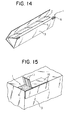
- the dispensing container 3 to which the cutter 1 of the present invention is attached is formed in the shape of a triangular prism as illustrated in Fig. 14 and the cutter 1 is attached to the dispensing container 3 in such a manner as to cover the ridge 5 at a position falling in the direction in which the sheet material 2 is drawn out of the container, the file-like coarse surface 6 can be formed in an acute angle.
- the sheet material 2 can be pressed more easily against the file-like coarse surface 8 and the cutter 1 itself gains in sharpness.
- the cutter 1 is folded with such an acute angle as described above, the possibility of the applied layer of the adhesive agent sustaining a crack and inducing unwanted separation of irregular granules 10 can be eliminated.
- the file-like coarse surface 6 of the cutter 1 attached to the dispensing container 3 may be covered with a protective sheet 16 as illustrated in Fig. 15.
- the protective sheet 16 can be made of the same material as the aforementioned substrate 7.
- the deposition of this protective sheet 18 on the file-like coarse surface 6 can be accomplished by applying on one side of the protective sheet 16 a pressure-sensitive adhesive 17 having a relatively weak adhesive force such that the protective sheet 16 will be easily peeled off the file-like coarse surface 6. If part of the pressure-sensitive adhesive 17 remains on the file-like coarse surface 6 when the protective sheet 16 is peeled off, the sharpness of the cutter 1 is impaired.
- the application of the pressure-sensitive adhesive 17 on the protective sheet 16 is desired to be made in the form of a line as illustrated in Fig. 15 or in the form of dots (not illustrated in the diagram).
- a cutter of this invention was manufactured by using a substrate, an undercoating adhesive agent (hard adhesive agent), a soft adhesive agent, irregular granules, a pressure-sensitive adhesive, and a release paper described below.
- an undercoating adhesive agent hard adhesive agent
- a soft adhesive agent soft adhesive agent
- irregular granules irregular granules
- a pressure-sensitive adhesive and a release paper described below.
- the pressure-sensitive adhesive was applied and covered with the release paper.
- the undercoating adhesive agent was applied with a rubber roll at a rate of about 100 g/m 2 .
- the irregular granules were sprinkled at a rate of about 500 g/m z .
- the soft adhesive agent was applied by spraying at a rate of about 200 g/s 2 . The applied layer of the soft adhesive agent was thoroughly dried.
- the cutter obtained as described above was stripped of the release paper, folded at an angle of about 90°, and attached in such a manner as to cover one corner of an eraser.
- the file-like coarse surface of the cutter was examined for possible detection of a crack, only in vain.
- a magnified photograph of a side view of the cutter attached to the corner of the eraser and a magnified photograph of the front view of the corner are shown respectively in Fig. 18 and Fig. 17.
- the undercoating adhesive agent used in this working * example showed viscosity of 700/cps at the time of application and Vickers hardness of 20 Hv after drying.
- the soft adhesive * * agent showed viscosity of 150 cps at the time of application and an elongation of 350% after drying as measured by the method of ASTM D-882.
Landscapes
- Engineering & Computer Science (AREA)
- Mechanical Engineering (AREA)
- Life Sciences & Earth Sciences (AREA)
- Forests & Forestry (AREA)
- Adhesive Tapes (AREA)
Applications Claiming Priority (4)
| Application Number | Priority Date | Filing Date | Title |
|---|---|---|---|
| JP5827985A JPS61217345A (ja) | 1985-03-25 | 1985-03-25 | 巻回フイルムの切断具 |
| JP58280/85 | 1985-03-25 | ||
| JP58279/85 | 1985-03-25 | ||
| JP5828085A JPS61217189A (ja) | 1985-03-25 | 1985-03-25 | 縁どりを有するやすりシ−ト片 |
Publications (2)
| Publication Number | Publication Date |
|---|---|
| EP0196073A1 true EP0196073A1 (fr) | 1986-10-01 |
| EP0196073B1 EP0196073B1 (fr) | 1989-01-11 |
Family
ID=26399336
Family Applications (1)
| Application Number | Title | Priority Date | Filing Date |
|---|---|---|---|
| EP86104111A Expired EP0196073B1 (fr) | 1985-03-25 | 1986-03-25 | Chant de coupe pour un conteneur de distribution et conteneur avec ce chant de coupe |
Country Status (5)
| Country | Link |
|---|---|
| US (1) | US4679718A (fr) |
| EP (1) | EP0196073B1 (fr) |
| AU (1) | AU580661B2 (fr) |
| CA (1) | CA1257567A (fr) |
| DE (1) | DE3661723D1 (fr) |
Families Citing this family (6)
| Publication number | Priority date | Publication date | Assignee | Title |
|---|---|---|---|---|
| US6173876B1 (en) * | 1991-09-12 | 2001-01-16 | Oji Paper Co., Ltd. | Vulcanized fiber sheet having a serrated cutting edge, a carton having said sheet adhered thereto, and a method of adhesion thereof |
| US5732868A (en) * | 1994-04-20 | 1998-03-31 | Reynolds Metals Company | System for safely storing and dispensing a thin sheet-like material |
| US5772094A (en) * | 1995-10-24 | 1998-06-30 | Allen-Reed Company, Inc. | Cutting blade |
| US5823001A (en) | 1995-10-24 | 1998-10-20 | Mid-South Industries, Inc. | Method and apparatus for providing ice |
| US7000520B2 (en) | 2002-06-12 | 2006-02-21 | Reynolds Metals Company | Roll supporting slide cutter assembly incorporating a traversable cutter tab and in particular capable of being supported within a carton enclosure associated with a wrap material roll |
| WO2010146650A1 (fr) * | 2009-06-15 | 2010-12-23 | トヨタ自動車株式会社 | Système de freinage et procédé de production d'un matériau de friction |
Citations (2)
| Publication number | Priority date | Publication date | Assignee | Title |
|---|---|---|---|---|
| DE2927195A1 (de) * | 1979-07-05 | 1981-01-15 | Huggle & Meurer Kg | Verpackung fuer folienbahn sowie verfahren zu deren herstellung |
| US4465215A (en) * | 1981-01-27 | 1984-08-14 | Asahi-Dow Limited | Cutting edge for dispensing container |
Family Cites Families (4)
| Publication number | Priority date | Publication date | Assignee | Title |
|---|---|---|---|---|
| US2024591A (en) * | 1933-12-04 | 1935-12-17 | Wingfoot Corp | Abrasive wheel |
| US2888181A (en) * | 1956-04-05 | 1959-05-26 | Dow Chemical Co | Dispensing container for sheet material |
| US4346830A (en) * | 1980-04-14 | 1982-08-31 | The C. W. Zumbiel Company | Dispenser carton |
| CH669138A5 (de) * | 1982-11-22 | 1989-02-28 | Schweizer Schmirgel Schleif | Schleifmittel auf dehnbarer und flexibler unterlage. |
-
1986
- 1986-03-24 CA CA000504933A patent/CA1257567A/fr not_active Expired
- 1986-03-24 US US06/843,471 patent/US4679718A/en not_active Expired - Lifetime
- 1986-03-24 AU AU55081/86A patent/AU580661B2/en not_active Ceased
- 1986-03-25 DE DE8686104111T patent/DE3661723D1/de not_active Expired
- 1986-03-25 EP EP86104111A patent/EP0196073B1/fr not_active Expired
Patent Citations (2)
| Publication number | Priority date | Publication date | Assignee | Title |
|---|---|---|---|---|
| DE2927195A1 (de) * | 1979-07-05 | 1981-01-15 | Huggle & Meurer Kg | Verpackung fuer folienbahn sowie verfahren zu deren herstellung |
| US4465215A (en) * | 1981-01-27 | 1984-08-14 | Asahi-Dow Limited | Cutting edge for dispensing container |
Also Published As
| Publication number | Publication date |
|---|---|
| US4679718A (en) | 1987-07-14 |
| DE3661723D1 (en) | 1989-02-16 |
| AU5508186A (en) | 1986-10-02 |
| EP0196073B1 (fr) | 1989-01-11 |
| AU580661B2 (en) | 1989-01-27 |
| CA1257567A (fr) | 1989-07-18 |
Similar Documents
| Publication | Publication Date | Title |
|---|---|---|
| DE69114019T2 (de) | Blattstapel und seine ausgabeverpackung. | |
| US5049445A (en) | Masking tape and method for manufacturing rolls of such tape | |
| CA1138835A (fr) | Distributeur de disques abrasifs | |
| US5798159A (en) | Adhesive sheet pad with center tabbed leader strip | |
| US4989801A (en) | Adhesive note roll and dispenser | |
| JPH07504639A (ja) | シート束用ディスペンサー | |
| EP1093501B1 (fr) | Dispositif de transfert d'adhesif | |
| US2808358A (en) | Composite tape for use with masking paper and method of application | |
| DE69609354T2 (de) | Klebe streifen und reiterblock mit zentralem anfangstreifen. | |
| CA2233098A1 (fr) | Ruban d'identification | |
| EP0196073B1 (fr) | Chant de coupe pour un conteneur de distribution et conteneur avec ce chant de coupe | |
| US4512462A (en) | Adhesive tape tab | |
| US20030170452A1 (en) | Masking device and method | |
| US20150307247A1 (en) | Perforated, adhesive coated wrapping material | |
| CA1175015A (fr) | Debiteur de materiau en feuillle | |
| CA2187435A1 (fr) | Bande adhesive perforee pour emballages, mecanisme pour la devider et pour produire les perforations | |
| CA2505457A1 (fr) | Protege-lame pour devidoir de ruban adhesif | |
| GB1599738A (en) | Adhesive tape strips | |
| US6383590B1 (en) | Tear-along structure of a sheet material | |
| WO1980002391A1 (fr) | Appareil de peinture de finition | |
| EP0813179B1 (fr) | Bande d'étiquettes sensible à la pression | |
| EP1156933B1 (fr) | Bandes predecoupees, recouvertes d'adhesif et a resistance elevee | |
| EP1233046A1 (fr) | Revêtement détachable comportant un ruban adhésif double face, et son utilisation dans une étiqueteuse à main | |
| JPH0680148A (ja) | 封 筒 | |
| JPS62208361A (ja) | 鋭角部を有する巻回フイルムの容器 |
Legal Events
| Date | Code | Title | Description |
|---|---|---|---|
| PUAI | Public reference made under article 153(3) epc to a published international application that has entered the european phase |
Free format text: ORIGINAL CODE: 0009012 |
|
| AK | Designated contracting states |
Kind code of ref document: A1 Designated state(s): DE FR GB IT NL |
|
| 17P | Request for examination filed |
Effective date: 19861205 |
|
| 17Q | First examination report despatched |
Effective date: 19870928 |
|
| GRAA | (expected) grant |
Free format text: ORIGINAL CODE: 0009210 |
|
| AK | Designated contracting states |
Kind code of ref document: B1 Designated state(s): DE FR GB IT NL |
|
| REF | Corresponds to: |
Ref document number: 3661723 Country of ref document: DE Date of ref document: 19890216 |
|
| ET | Fr: translation filed | ||
| ITF | It: translation for a ep patent filed | ||
| PLBE | No opposition filed within time limit |
Free format text: ORIGINAL CODE: 0009261 |
|
| STAA | Information on the status of an ep patent application or granted ep patent |
Free format text: STATUS: NO OPPOSITION FILED WITHIN TIME LIMIT |
|
| 26N | No opposition filed | ||
| ITTA | It: last paid annual fee | ||
| PGFP | Annual fee paid to national office [announced via postgrant information from national office to epo] |
Ref country code: FR Payment date: 19940310 Year of fee payment: 9 |
|
| PGFP | Annual fee paid to national office [announced via postgrant information from national office to epo] |
Ref country code: NL Payment date: 19940331 Year of fee payment: 9 |
|
| PG25 | Lapsed in a contracting state [announced via postgrant information from national office to epo] |
Ref country code: NL Effective date: 19951001 |
|
| PG25 | Lapsed in a contracting state [announced via postgrant information from national office to epo] |
Ref country code: FR Free format text: LAPSE BECAUSE OF NON-PAYMENT OF DUE FEES Effective date: 19951130 |
|
| NLV4 | Nl: lapsed or anulled due to non-payment of the annual fee |
Effective date: 19951001 |
|
| REG | Reference to a national code |
Ref country code: FR Ref legal event code: ST |
|
| PGFP | Annual fee paid to national office [announced via postgrant information from national office to epo] |
Ref country code: GB Payment date: 19990325 Year of fee payment: 14 |
|
| PGFP | Annual fee paid to national office [announced via postgrant information from national office to epo] |
Ref country code: DE Payment date: 19990406 Year of fee payment: 14 |
|
| PG25 | Lapsed in a contracting state [announced via postgrant information from national office to epo] |
Ref country code: GB Free format text: LAPSE BECAUSE OF NON-PAYMENT OF DUE FEES Effective date: 20000325 |
|
| GBPC | Gb: european patent ceased through non-payment of renewal fee |
Effective date: 20000325 |
|
| PG25 | Lapsed in a contracting state [announced via postgrant information from national office to epo] |
Ref country code: DE Free format text: LAPSE BECAUSE OF NON-PAYMENT OF DUE FEES Effective date: 20010103 |
|
| PG25 | Lapsed in a contracting state [announced via postgrant information from national office to epo] |
Ref country code: IT Free format text: LAPSE BECAUSE OF NON-PAYMENT OF DUE FEES Effective date: 20050325 |