EP0196207B1 - Fäulnisverhütendes Material und Verfahren zu dessen Herstellung - Google Patents
Fäulnisverhütendes Material und Verfahren zu dessen Herstellung Download PDFInfo
- Publication number
- EP0196207B1 EP0196207B1 EP86302149A EP86302149A EP0196207B1 EP 0196207 B1 EP0196207 B1 EP 0196207B1 EP 86302149 A EP86302149 A EP 86302149A EP 86302149 A EP86302149 A EP 86302149A EP 0196207 B1 EP0196207 B1 EP 0196207B1
- Authority
- EP
- European Patent Office
- Prior art keywords
- particles
- web
- dip
- elastomer
- adhered
- Prior art date
- Legal status (The legal status is an assumption and is not a legal conclusion. Google has not performed a legal analysis and makes no representation as to the accuracy of the status listed.)
- Expired - Lifetime
Links
- 239000000463 material Substances 0.000 title claims abstract description 19
- 230000003373 anti-fouling effect Effects 0.000 title claims abstract description 14
- 238000004519 manufacturing process Methods 0.000 title claims description 4
- 239000002245 particle Substances 0.000 claims abstract description 40
- 229920001971 elastomer Polymers 0.000 claims abstract description 15
- 239000000806 elastomer Substances 0.000 claims abstract description 13
- 238000000034 method Methods 0.000 claims abstract description 12
- 239000007767 bonding agent Substances 0.000 claims abstract description 7
- 239000000853 adhesive Substances 0.000 claims description 16
- 230000001070 adhesive effect Effects 0.000 claims description 16
- RYGMFSIKBFXOCR-UHFFFAOYSA-N Copper Chemical compound [Cu] RYGMFSIKBFXOCR-UHFFFAOYSA-N 0.000 claims description 6
- 239000010949 copper Substances 0.000 claims description 5
- 229910052802 copper Inorganic materials 0.000 claims description 4
- 238000003825 pressing Methods 0.000 claims description 3
- 238000002360 preparation method Methods 0.000 claims description 2
- 238000005096 rolling process Methods 0.000 claims 2
- 229910000881 Cu alloy Inorganic materials 0.000 claims 1
- 239000011248 coating agent Substances 0.000 abstract 1
- 238000000576 coating method Methods 0.000 abstract 1
- 239000008187 granular material Substances 0.000 description 9
- 239000007921 spray Substances 0.000 description 4
- 238000005507 spraying Methods 0.000 description 4
- 239000000758 substrate Substances 0.000 description 4
- 229910000570 Cupronickel Inorganic materials 0.000 description 3
- 239000002390 adhesive tape Substances 0.000 description 3
- 239000010410 layer Substances 0.000 description 3
- 239000002184 metal Substances 0.000 description 2
- 229910052751 metal Inorganic materials 0.000 description 2
- 230000000630 rising effect Effects 0.000 description 2
- 238000006243 chemical reaction Methods 0.000 description 1
- 238000005520 cutting process Methods 0.000 description 1
- 238000009826 distribution Methods 0.000 description 1
- 238000000605 extraction Methods 0.000 description 1
- 239000004744 fabric Substances 0.000 description 1
- 239000012467 final product Substances 0.000 description 1
- 238000010438 heat treatment Methods 0.000 description 1
- 238000003475 lamination Methods 0.000 description 1
- 238000000465 moulding Methods 0.000 description 1
- 239000000047 product Substances 0.000 description 1
- 230000002787 reinforcement Effects 0.000 description 1
- 230000003252 repetitive effect Effects 0.000 description 1
- 239000002356 single layer Substances 0.000 description 1
- 239000002344 surface layer Substances 0.000 description 1
Images

Classifications
-
- B—PERFORMING OPERATIONS; TRANSPORTING
- B05—SPRAYING OR ATOMISING IN GENERAL; APPLYING FLUENT MATERIALS TO SURFACES, IN GENERAL
- B05D—PROCESSES FOR APPLYING FLUENT MATERIALS TO SURFACES, IN GENERAL
- B05D7/00—Processes, other than flocking, specially adapted for applying liquids or other fluent materials to particular surfaces or for applying particular liquids or other fluent materials
- B05D7/02—Processes, other than flocking, specially adapted for applying liquids or other fluent materials to particular surfaces or for applying particular liquids or other fluent materials to macromolecular substances, e.g. rubber
- B05D7/04—Processes, other than flocking, specially adapted for applying liquids or other fluent materials to particular surfaces or for applying particular liquids or other fluent materials to macromolecular substances, e.g. rubber to surfaces of films or sheets
-
- B—PERFORMING OPERATIONS; TRANSPORTING
- B05—SPRAYING OR ATOMISING IN GENERAL; APPLYING FLUENT MATERIALS TO SURFACES, IN GENERAL
- B05D—PROCESSES FOR APPLYING FLUENT MATERIALS TO SURFACES, IN GENERAL
- B05D1/00—Processes for applying liquids or other fluent materials
- B05D1/28—Processes for applying liquids or other fluent materials performed by transfer from the surfaces of elements carrying the liquid or other fluent material, e.g. brushes, pads, rollers
- B05D1/286—Processes for applying liquids or other fluent materials performed by transfer from the surfaces of elements carrying the liquid or other fluent material, e.g. brushes, pads, rollers using a temporary backing to which the coating has been applied
-
- B—PERFORMING OPERATIONS; TRANSPORTING
- B63—SHIPS OR OTHER WATERBORNE VESSELS; RELATED EQUIPMENT
- B63B—SHIPS OR OTHER WATERBORNE VESSELS; EQUIPMENT FOR SHIPPING
- B63B59/00—Hull protection specially adapted for vessels; Cleaning devices specially adapted for vessels
- B63B59/04—Preventing hull fouling
-
- B—PERFORMING OPERATIONS; TRANSPORTING
- B05—SPRAYING OR ATOMISING IN GENERAL; APPLYING FLUENT MATERIALS TO SURFACES, IN GENERAL
- B05D—PROCESSES FOR APPLYING FLUENT MATERIALS TO SURFACES, IN GENERAL
- B05D1/00—Processes for applying liquids or other fluent materials
- B05D1/18—Processes for applying liquids or other fluent materials performed by dipping
-
- B—PERFORMING OPERATIONS; TRANSPORTING
- B05—SPRAYING OR ATOMISING IN GENERAL; APPLYING FLUENT MATERIALS TO SURFACES, IN GENERAL
- B05D—PROCESSES FOR APPLYING FLUENT MATERIALS TO SURFACES, IN GENERAL
- B05D2401/00—Form of the coating product, e.g. solution, water dispersion, powders or the like
- B05D2401/30—Form of the coating product, e.g. solution, water dispersion, powders or the like the coating being applied in other forms than involving eliminable solvent, diluent or dispersant
- B05D2401/32—Form of the coating product, e.g. solution, water dispersion, powders or the like the coating being applied in other forms than involving eliminable solvent, diluent or dispersant applied as powders
-
- B—PERFORMING OPERATIONS; TRANSPORTING
- B05—SPRAYING OR ATOMISING IN GENERAL; APPLYING FLUENT MATERIALS TO SURFACES, IN GENERAL
- B05D—PROCESSES FOR APPLYING FLUENT MATERIALS TO SURFACES, IN GENERAL
- B05D5/00—Processes for applying liquids or other fluent materials to surfaces to obtain special surface effects, finishes or structures
Definitions
- This invention relates to anti fouling materials and methods of making them.
- the present invention is concerned with in particular a way of making panels or strips of flexible material and having an anti fouling character due to the presence, in a surface layer of those panels or strips, of anti fouling metal and in particular copper or copper-containing, particles.
- US-A-4212691 shows a method of making a decorative material wherein a charge of decorative chips is trapped between a vertical wall and a run of a wet, tacky, substrate rising from a gap under the wall. Some of the chips adhere to the substrate; excess material is shaken off and returns to the charge. The adhering chips are then consolidated onto the substrate to yield the final product.
- the method of the present invention is a transfer process.
- a flexible web (which may be in discontinuous sheet or continuous strip form) having an adhesive surface is drawn along over a conformation which leaves a dip in the web immediately before it is caused to rise steeply.
- particles are charged onto the web to lie in the dip immediately in front of the rise, at a depth greater than a single layer depth.
- the particles are of an anti-fouling material, according to the invention, and the adhered particles are then treated by the application of a bonding agent.
- the initial adhesiveness of the web may be achieved by means which are conventional for self-adhesive tapes; the web may indeed be a heat-resistant "sticky tape" as is readily available in industry.
- Preferred particles are chopped copper or cupro-nickel wire, the thickness of the wire being of the order of 1 mm and a preferred length of the chop being about 1 mm.
- the density of particles adhered on the surface of the web which can be controlled by the angle of rise, the rate of progress, the thickness and nature of the adhesive and the size of charge of the particles, should be approximately 4 to 5 or more preferably 4.3 to 4.7 kg per square metre.
- the web with its particles adhered is placed in contact with an uncured (unvulcanized) or partly cured (part vulcanized) elastomer web (again a discontinuous sheet or panel, or a continuous strip) so that the particles contact the rubber.
- the two are then moulded together so that the rubber bonds to and around the particles assisted by the bonding agent, but leaving them adhered to the adhesive strip. This is then removed to leave the finished product with exposed particles on one surface.
- the invention includes therefore a method of preparing a transfer material in the preparation of an anti-fouling material as defined in claim 1 as well as a method of making an anti-fouling mat- rial as defined in claim 2.
- the drawings illustrate apparatus for the application of cupro nickel granules to adhesive tape.
- the apparatus should be capable of applying granules to adhesive strip or sheet of widths between about 0.3 and 1 m.
- a backing web 1 of material with an adhesive surface 1 is pulled off a roll 2 of tape by means of a knurled roller 3 driven through a belt 4 by an electric motor 5.
- a suitable web is available from Adhesive Tapes and Conversions Limited, Crow- borough, London, England, under the name PPI 1022.
- the web passes over an idler roller 6 downwardly into a dip 7 before rising at 8 to a roller 9 which is driven by belt 10 from the motor 5 via belt 4.
- Photo electric sensors 11, 12 detect if the base of the dip reaches a level below sensor 11 or above sensor 12, and stop the drive if it does.
- End plates 13 are similar to the guides on a mill roll and can be set to accommodate the width of the web with a minimum or zero gap between the edges of the web and themselves.
- a trough 14 is below the dip.
- a bank of granules 15 such as the chopped copper or copper wire as described above is placed on the adhesive web 1 in the dip 7 and is held on it by the end plates 13. It has been found that, when the strip is pulled through by the roller 9, the weight of the granules is sufficient to preserve the dip 7 and the granules roll, providing excellent coverage of the tape by an adhered layer 16 of granules. Granules which are not adhering to the tape will roll back down the incline 8. The only escape for the granules is that some will fall over the edges and these are caught in the tray 14. These can be led back to the bank 15. Guide surfaces (not shown) may be provided especially behind the rise run 8 to help form the dip and prevent bulging or swinging.
- the web with granules on its surface passes between the driven roller 9 and a pressure roller 17 to consolidate the adhered layer 16 and then a variable loop 18 to a main conveyor 19 which indluces a spraying zone 10.
- a spraying zone 10 which indluces a spraying zone 10.
- the number of spray guns can be activated according to the required width and spray beyond the edges of the web can be blanked off.
- the first row 21 of spray guns would be spraying a primer such as Chemlok primer 205 and the second row 22 an adhesive such as Chemlok Adhesive CH47. Extraction and hot air driers are provided and, if necessary, infra-red heating.
- a primer such as Chemlok primer 205
- an adhesive such as Chemlok Adhesive CH47. Extraction and hot air driers are provided and, if necessary, infra-red heating.
- the total length of the run of the main conveyor 19 should be 1 m. in the region 23 before the spraying zone, 2m. in the spray zone 20 and 5m. in the region 24. This will provide room for material to be cut to length and removed sideways from the conveyor 19.
- This main conveyor 5 (as also the web drives) can be hand driven but preferably will be powered.
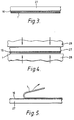
- an uncured or partly cured (unvulcanized or partly vulcanized) elastomer sheet 27 is brought into contact (Fig. 3) with the particles in the layer 16 on the web 1, and the two are moulded together in a press mould 28 (Fig. 4). Pressures of between about 5 and about 10 bar, most preferably about 7 bar are preferred.
- the particles are pressed into the elastomer surface and are bonded there as it cures or vulcanizes, assisted by the bonding agent coated onto them. They preserve the frequency and distribution of their adhesion on the adhesive strip or sheet.
- the backing web 1 is peeled off (Fig. 5), leaving particles 16 uniformly (but with different areas of respective particles) exposed at one surface of the finished article, which may be a strip or panel ready for use or which may be subdivided to form a plurality of them.
- the one surface may be buffed or polished to ensure presentation of clean metal surfaces.
Landscapes
- Engineering & Computer Science (AREA)
- Combustion & Propulsion (AREA)
- Mechanical Engineering (AREA)
- Ocean & Marine Engineering (AREA)
- Life Sciences & Earth Sciences (AREA)
- Wood Science & Technology (AREA)
- Chemical & Material Sciences (AREA)
- Laminated Bodies (AREA)
- Application Of Or Painting With Fluid Materials (AREA)
- Moulding By Coating Moulds (AREA)
- Materials For Medical Uses (AREA)
- Glass Compositions (AREA)
- Adhesive Tapes (AREA)
- Other Surface Treatments For Metallic Materials (AREA)
- Preventing Corrosion Or Incrustation Of Metals (AREA)
- Macromolecular Compounds Obtained By Forming Nitrogen-Containing Linkages In General (AREA)
- Paints Or Removers (AREA)
Claims (8)
Priority Applications (1)
| Application Number | Priority Date | Filing Date | Title |
|---|---|---|---|
| AT86302149T ATE50930T1 (de) | 1985-03-26 | 1986-03-24 | Faeulnisverhuetendes material und verfahren zu dessen herstellung. |
Applications Claiming Priority (2)
| Application Number | Priority Date | Filing Date | Title |
|---|---|---|---|
| GB858507856A GB8507856D0 (en) | 1985-03-26 | 1985-03-26 | Anti-fouling material |
| GB8507856 | 1985-03-26 |
Publications (3)
| Publication Number | Publication Date |
|---|---|
| EP0196207A2 EP0196207A2 (de) | 1986-10-01 |
| EP0196207A3 EP0196207A3 (en) | 1987-05-27 |
| EP0196207B1 true EP0196207B1 (de) | 1990-03-14 |
Family
ID=10576665
Family Applications (1)
| Application Number | Title | Priority Date | Filing Date |
|---|---|---|---|
| EP86302149A Expired - Lifetime EP0196207B1 (de) | 1985-03-26 | 1986-03-24 | Fäulnisverhütendes Material und Verfahren zu dessen Herstellung |
Country Status (6)
| Country | Link |
|---|---|
| US (1) | US4753701A (de) |
| EP (1) | EP0196207B1 (de) |
| JP (1) | JPS61276984A (de) |
| AT (1) | ATE50930T1 (de) |
| DE (1) | DE3669447D1 (de) |
| GB (1) | GB8507856D0 (de) |
Families Citing this family (3)
| Publication number | Priority date | Publication date | Assignee | Title |
|---|---|---|---|---|
| GB8610331D0 (en) * | 1986-04-28 | 1986-06-04 | Avon Rubber Plc | Underwater marker |
| GB0130452D0 (en) * | 2001-12-20 | 2002-02-06 | Balmoral Group | Antifouling prodct and method of making it |
| US20130052437A1 (en) * | 2011-08-24 | 2013-02-28 | Pratt & Whitney | Substrates Coated with Wear Resistant Layers and Methods of Applying Wear Resistant Layers to Same |
Family Cites Families (11)
| Publication number | Priority date | Publication date | Assignee | Title |
|---|---|---|---|---|
| US29072A (en) * | 1860-07-10 | Lith o | ||
| US1345922A (en) * | 1912-12-26 | 1920-07-06 | West Coast Roofing And Mfg Com | Method for producing roofing material |
| USRE29072E (en) | 1971-10-21 | 1976-12-14 | Method of protecting the hulls of marine vessels from fouling | |
| IT1081730B (it) * | 1977-05-04 | 1985-05-21 | Ind Veneta Gomma Colbachini I | Metodo ed apparecchiatura per la produzione di nastri continui "telati" o "rinforzati" in gomma od equivalente materiale elastomerico vulcanizzabile,in particolare per il confezionamento di tubi rinforzati |
| GB1604062A (en) * | 1978-01-11 | 1981-12-02 | United Wire Group Ltd | Coverings for submersible or semi-submersible structures |
| US4215170A (en) * | 1978-02-28 | 1980-07-29 | Eurographics Holding, N. V. | Metallization process |
| US4323599A (en) * | 1978-03-15 | 1982-04-06 | Kennecott Corporation | Method for achieving particle-to-particle contact in an antifouling coating |
| US4231830A (en) * | 1978-10-17 | 1980-11-04 | Ferro Corporation | Process for preparing reflecting sheeting having wide angle response |
| US4212691A (en) * | 1978-11-21 | 1980-07-15 | Congoleum Corporation | Methods and apparatus for making decorative inlaid types of resilient sheet materials and the like |
| GB2040232A (en) * | 1979-01-11 | 1980-08-28 | United Wire Group Ltd | Submersible or semi-submersible structures |
| GB2126959B (en) * | 1982-09-14 | 1985-12-24 | United Wire Group Plc | Marine antifouling materials and markers |
-
1985
- 1985-03-26 GB GB858507856A patent/GB8507856D0/en active Pending
-
1986
- 1986-03-24 EP EP86302149A patent/EP0196207B1/de not_active Expired - Lifetime
- 1986-03-24 AT AT86302149T patent/ATE50930T1/de not_active IP Right Cessation
- 1986-03-24 DE DE8686302149T patent/DE3669447D1/de not_active Expired - Lifetime
- 1986-03-25 US US06/843,739 patent/US4753701A/en not_active Expired - Fee Related
- 1986-03-26 JP JP61066088A patent/JPS61276984A/ja active Pending
Also Published As
| Publication number | Publication date |
|---|---|
| DE3669447D1 (de) | 1990-04-19 |
| EP0196207A3 (en) | 1987-05-27 |
| US4753701A (en) | 1988-06-28 |
| ATE50930T1 (de) | 1990-03-15 |
| GB8507856D0 (en) | 1985-05-01 |
| EP0196207A2 (de) | 1986-10-01 |
| JPS61276984A (ja) | 1986-12-06 |
Similar Documents
| Publication | Publication Date | Title |
|---|---|---|
| US4631103A (en) | Process for peeling protective film off a thin article | |
| KR20090017529A (ko) | 외층체의 박리 방법 및 박리 장치 | |
| JP2001192246A (ja) | 接合ガラスとその製造方法及び製造装置 | |
| JPH0514611B2 (de) | ||
| EP0196207B1 (de) | Fäulnisverhütendes Material und Verfahren zu dessen Herstellung | |
| US3837952A (en) | Process and apparatus for forming a glass and film laminate | |
| EP0244994B1 (de) | Verfahren zur Herstellung einer Unterwassermarkierung | |
| CA1038275A (en) | Reflective laminated safety glass | |
| CN102555412A (zh) | 镜面不锈钢带表面涂胶工装及其生产工艺 | |
| JP7114022B2 (ja) | ストリップゴム貼付方法およびストリップゴム貼付装置 | |
| JPH03117595A (ja) | シート切断装置 | |
| JPH10323958A (ja) | 化粧板の製造方法 | |
| CN115071122B (zh) | 一种自动化贴防水膜装置及防水膜自动剥离方法 | |
| JP2004235394A (ja) | チップ部品分離方法及び装置 | |
| JPH0890510A (ja) | ケーシング製造方法とその装置 | |
| JP2006341564A (ja) | 多層接着性フィルムの貼着方法及びこの方法により製作された多層接着性フィルム貼着板ガラス | |
| JPH03221169A (ja) | 塗膜保護方法 | |
| GB1352187A (en) | Method and apparatus for applying a layer of thermoplastic adhesive to the surface of an article | |
| JP2003147293A (ja) | 粘着式シート及び該粘着式シートの製造方法 | |
| JPS63230475A (ja) | 熱圧着テ−プの貼付装置 | |
| ATE481703T1 (de) | Verfahren und vorrichtung zur herstellung von klebeetiketten oder klebetapeten | |
| JPS6336946B2 (de) | ||
| US20100260959A1 (en) | Hot-melt extruded adhesive tape | |
| JPH0688388B2 (ja) | 断熱材被着帯板の製造装置 | |
| JPH02292030A (ja) | 合成樹脂シート状物の貼着方法及びその装置 |
Legal Events
| Date | Code | Title | Description |
|---|---|---|---|
| PUAI | Public reference made under article 153(3) epc to a published international application that has entered the european phase |
Free format text: ORIGINAL CODE: 0009012 |
|
| AK | Designated contracting states |
Kind code of ref document: A2 Designated state(s): AT BE CH DE FR GB IT LI LU NL SE |
|
| PUAL | Search report despatched |
Free format text: ORIGINAL CODE: 0009013 |
|
| AK | Designated contracting states |
Kind code of ref document: A3 Designated state(s): AT BE CH DE FR GB IT LI LU NL SE |
|
| 17P | Request for examination filed |
Effective date: 19870727 |
|
| 17Q | First examination report despatched |
Effective date: 19880505 |
|
| GRAA | (expected) grant |
Free format text: ORIGINAL CODE: 0009210 |
|
| AK | Designated contracting states |
Kind code of ref document: B1 Designated state(s): AT BE CH DE FR GB IT LI LU NL SE |
|
| REF | Corresponds to: |
Ref document number: 50930 Country of ref document: AT Date of ref document: 19900315 Kind code of ref document: T |
|
| PG25 | Lapsed in a contracting state [announced via postgrant information from national office to epo] |
Ref country code: AT Effective date: 19900324 |
|
| ITTA | It: last paid annual fee | ||
| PG25 | Lapsed in a contracting state [announced via postgrant information from national office to epo] |
Ref country code: LU Free format text: LAPSE BECAUSE OF NON-PAYMENT OF DUE FEES Effective date: 19900331 Ref country code: LI Effective date: 19900331 Ref country code: CH Effective date: 19900331 |
|
| REF | Corresponds to: |
Ref document number: 3669447 Country of ref document: DE Date of ref document: 19900419 |
|
| PGFP | Annual fee paid to national office [announced via postgrant information from national office to epo] |
Ref country code: FR Payment date: 19900518 Year of fee payment: 5 |
|
| PGFP | Annual fee paid to national office [announced via postgrant information from national office to epo] |
Ref country code: SE Payment date: 19900522 Year of fee payment: 5 |
|
| PGFP | Annual fee paid to national office [announced via postgrant information from national office to epo] |
Ref country code: BE Payment date: 19900523 Year of fee payment: 5 |
|
| PGFP | Annual fee paid to national office [announced via postgrant information from national office to epo] |
Ref country code: DE Payment date: 19900525 Year of fee payment: 5 |
|
| ITF | It: translation for a ep patent filed | ||
| ET | Fr: translation filed | ||
| REG | Reference to a national code |
Ref country code: CH Ref legal event code: PL |
|
| PLBE | No opposition filed within time limit |
Free format text: ORIGINAL CODE: 0009261 |
|
| STAA | Information on the status of an ep patent application or granted ep patent |
Free format text: STATUS: NO OPPOSITION FILED WITHIN TIME LIMIT |
|
| 26N | No opposition filed | ||
| PG25 | Lapsed in a contracting state [announced via postgrant information from national office to epo] |
Ref country code: SE Effective date: 19910325 |
|
| PG25 | Lapsed in a contracting state [announced via postgrant information from national office to epo] |
Ref country code: BE Effective date: 19910331 |
|
| BERE | Be: lapsed |
Owner name: AVON RUBBER P.L.C. Effective date: 19910331 |
|
| PG25 | Lapsed in a contracting state [announced via postgrant information from national office to epo] |
Ref country code: FR Effective date: 19911129 |
|
| PG25 | Lapsed in a contracting state [announced via postgrant information from national office to epo] |
Ref country code: DE Effective date: 19920101 |
|
| REG | Reference to a national code |
Ref country code: FR Ref legal event code: ST |
|
| EUG | Se: european patent has lapsed |
Ref document number: 86302149.9 Effective date: 19911009 |
|
| PGFP | Annual fee paid to national office [announced via postgrant information from national office to epo] |
Ref country code: NL Payment date: 19970320 Year of fee payment: 12 |
|
| PG25 | Lapsed in a contracting state [announced via postgrant information from national office to epo] |
Ref country code: NL Free format text: LAPSE BECAUSE OF NON-PAYMENT OF DUE FEES Effective date: 19981001 |
|
| NLV4 | Nl: lapsed or anulled due to non-payment of the annual fee |
Effective date: 19981001 |
|
| REG | Reference to a national code |
Ref country code: GB Ref legal event code: IF02 |
|
| PGFP | Annual fee paid to national office [announced via postgrant information from national office to epo] |
Ref country code: GB Payment date: 20020314 Year of fee payment: 17 |
|
| PG25 | Lapsed in a contracting state [announced via postgrant information from national office to epo] |
Ref country code: GB Free format text: LAPSE BECAUSE OF NON-PAYMENT OF DUE FEES Effective date: 20030324 |
|
| GBPC | Gb: european patent ceased through non-payment of renewal fee |
Effective date: 20030324 |
|
| PG25 | Lapsed in a contracting state [announced via postgrant information from national office to epo] |
Ref country code: IT Free format text: LAPSE BECAUSE OF NON-PAYMENT OF DUE FEES;WARNING: LAPSES OF ITALIAN PATENTS WITH EFFECTIVE DATE BEFORE 2007 MAY HAVE OCCURRED AT ANY TIME BEFORE 2007. THE CORRECT EFFECTIVE DATE MAY BE DIFFERENT FROM THE ONE RECORDED. Effective date: 20050324 |