EP0196565B1 - Polyalkylenoxide mit ungesättigten Endgruppen mit einer begrenzten Molekülmassenverteilung - Google Patents
Polyalkylenoxide mit ungesättigten Endgruppen mit einer begrenzten Molekülmassenverteilung Download PDFInfo
- Publication number
- EP0196565B1 EP0196565B1 EP86103830A EP86103830A EP0196565B1 EP 0196565 B1 EP0196565 B1 EP 0196565B1 EP 86103830 A EP86103830 A EP 86103830A EP 86103830 A EP86103830 A EP 86103830A EP 0196565 B1 EP0196565 B1 EP 0196565B1
- Authority
- EP
- European Patent Office
- Prior art keywords
- group
- compound
- molecular weight
- oxide
- unsaturated
- Prior art date
- Legal status (The legal status is an assumption and is not a legal conclusion. Google has not performed a legal analysis and makes no representation as to the accuracy of the status listed.)
- Expired
Links
- 0 CC(*)C(*)CC(N=CC(C*)=C(CC(*)C(*)[C@]1C)NC1=C(*)C1=NCC(*)=C1C)=C(C*)C(N)=C(*)C(*)=C(C)C* Chemical compound CC(*)C(*)CC(N=CC(C*)=C(CC(*)C(*)[C@]1C)NC1=C(*)C1=NCC(*)=C1C)=C(C*)C(N)=C(*)C(*)=C(C)C* 0.000 description 1
Images

Classifications
-
- C—CHEMISTRY; METALLURGY
- C08—ORGANIC MACROMOLECULAR COMPOUNDS; THEIR PREPARATION OR CHEMICAL WORKING-UP; COMPOSITIONS BASED THEREON
- C08G—MACROMOLECULAR COMPOUNDS OBTAINED OTHERWISE THAN BY REACTIONS ONLY INVOLVING UNSATURATED CARBON-TO-CARBON BONDS
- C08G65/00—Macromolecular compounds obtained by reactions forming an ether link in the main chain of the macromolecule
- C08G65/02—Macromolecular compounds obtained by reactions forming an ether link in the main chain of the macromolecule from cyclic ethers by opening of the heterocyclic ring
- C08G65/32—Polymers modified by chemical after-treatment
- C08G65/329—Polymers modified by chemical after-treatment with organic compounds
- C08G65/337—Polymers modified by chemical after-treatment with organic compounds containing other elements
-
- C—CHEMISTRY; METALLURGY
- C08—ORGANIC MACROMOLECULAR COMPOUNDS; THEIR PREPARATION OR CHEMICAL WORKING-UP; COMPOSITIONS BASED THEREON
- C08G—MACROMOLECULAR COMPOUNDS OBTAINED OTHERWISE THAN BY REACTIONS ONLY INVOLVING UNSATURATED CARBON-TO-CARBON BONDS
- C08G65/00—Macromolecular compounds obtained by reactions forming an ether link in the main chain of the macromolecule
- C08G65/02—Macromolecular compounds obtained by reactions forming an ether link in the main chain of the macromolecule from cyclic ethers by opening of the heterocyclic ring
- C08G65/04—Macromolecular compounds obtained by reactions forming an ether link in the main chain of the macromolecule from cyclic ethers by opening of the heterocyclic ring from cyclic ethers only
- C08G65/06—Cyclic ethers having no atoms other than carbon and hydrogen outside the ring
- C08G65/08—Saturated oxiranes
- C08G65/10—Saturated oxiranes characterised by the catalysts used
- C08G65/12—Saturated oxiranes characterised by the catalysts used containing organo-metallic compounds or metal hydrides
Definitions
- the present invention relates to a process for preparing a polyalkylene oxide having an unsaturated group at its polymer end or ends, having any desired molecular weight, and having a narrow distribution of molecular weight.
- polyalkylene oxides having unsaturated groups at both ends of the polymers There have been known polyalkylene oxides having unsaturated groups at both ends of the polymers. These polyalkylene oxides having unsaturated groups at their polymer ends are used as rubber materials by curing them alone, or are used as crosslinkable modifiers for blending with other polymers. Further, as disclosed in U.S. Patent No. 3,971,751, polyalkylene oxides where unsaturated end groups are converted to other more active functional groups such as hydrolyzable silyl groups can be employed in various uses as a telechelic liquid rubbers.
- polyoxypropylenes having an unsaturated end group can be prepared by using a polyoxypropylene obtained by a usual anion-polymerization in the presence of KOH as a starting material, converting the hydroxyl group of the polyoxypropylene to an alkoxide group by using metal sodium and the like, and then reacting with a halogenated compound which contains an unsaturated group such as allyl chloride.
- KOH a halogenated compound which contains an unsaturated group
- a polyoxypropylene having unsaturated groups at its both ends is produced by converting the hydroxyl groups of a polyoxypropylene to alkoxide groups with metal sodium or the like, reacting with a polyhalogenated compound such as methylene chloride to increase the molecular weight, and then reacting with an active halogen-containing compound having an unsaturated group. It is difficult however, to precisely prepare a polymer having a desired molecular weight according to those conventional processes. Further, the distribution of molecular weight of the polymer product becomes wide because the chain propagation reaction caused by the polyhalogenated compound occurs ununiformly. When using a polyalkylene oxide having a wide distribution of molecular weight, there is a problem that tensile properties of the cured produce are inferior.
- T. Yasuda et al. disclose a process for polymerizing alkylene oxides using a catalyst prepared from an aluminium porphyrin complex and a compound containing an active hydrogen.
- the polymer has an unsaturated end group in the main claim in an amount of up to 50% (J. Macromol. Sci.-Chem. 1984, A 21 (8-9), 1035).
- FR-A-2 232 562 discloses a process for preparing a polymer having an unsaturated end group, the polyalkylene oxide chain being terminated by reaction with a halogenated compound.
- the polymerization method is an anion polymerization using alkali metals.
- the present inventors found that living polymerization of propylene oxide can be carried out by using a complex catalyst of the reaction product of an organoaluminium compound with a porphyrin compound, and that a polymer having a narrow distribution of molecular weight can be prepared according to such a process (T. Aida et al, "Makromol. Chem.” 182, 1073-1079 (1981
- a polyoxypropylene having unsaturated groups at its ends and having any desired molecular weight, especially a relatively high molecular weight of not less than 4,000, and also having a narrow distribution of molecular weight can be easily prepared.
- a process for preparing a polyalkylene oxide having any desired molecular weight, especially a number average molecular weight of 4,000 to 20,000 and having a distribution of molecular weight (Mw/Mn) of not more than 1.5 which comprises a main chain consisting essentially of a recurring unit of the formula (I): wherein R 1 is a hydrogen atom or a monovalent C 1 to C 6 organic group, and may be the same or different in the different recurring units, the main chain having an unsaturated end group of the formula (II): wherein R 2 is a divalent C 1 to C 8 organic group, a is 0 or 1, and R 3 is hydrogen atom or methyl, in an amount of not less than 70% of the total end groups; which comprises
- a complex catalyst prepared by reacting an active hydrogen-containing compound with an aluminium porphyrin complex, and reacting the obtained polymer with an active halogen-containing compound, the active hydrogen-containing compound being an organic compound selected from the group consisting of
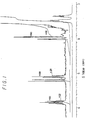
- Figs. 1 and 2 are 1 H-NMR spectrum charts of the polypropylene oxides prepared in Examples 1 and 2, respectively.
- the polyalkylene oxide can be prepared by polymerizing an alkylene oxide in the presence of a reaction product of an aluminium porphyrin complex and an active hydrogen-containing compound, and then reacting the obtained polymer with an active halogen-containing compound.
- the aluminium porphyrin complex can be prepared by reacting an organoaluminium compound with a porphyrin compound.
- organoaluminium compound examples include, for instance trialkylaluminiums having alkyl groups of C 1 to C 4 such as trimethylaluminium, triethylaluminium, tripropylaluminium and triisobutylaluminium; alkylaluminium hydrides having hydrogen atoms and alkyl groups of C 1 to C 4 such as diethylaluminium hydride and diisobutylaluminium hydride.
- the trialkylaluminium, particularly triethylaluminium is preferably employed.
- the porphyrin compound is represented by the formula (III): wherein R 4 are the same or different, and each is a monovalent group selected from hydrogen atom and an alkyl group of C, to C 4 , R 5 is hydrogen atom or a monovalent hydrocarbon residue of C 1 to C lo .
- R 4 are the same or different, and each is a monovalent group selected from hydrogen atom and an alkyl group of C, to C 4
- R 5 is hydrogen atom or a monovalent hydrocarbon residue of C 1 to C lo .
- the porphyrin compound are, for instance, tetramethyltetraethylporphyrin, octaethylporphyrin, tetraphenylporphyrin, and the like. Among them there is preferably employed tetraphenylporphyrin (R 4 : H, R 5 : phenyl in the formula (III)).
- the aluminium porphyrin complex (A) prepared by reacting the organoaluminium compound with the porphyrin compound is represented by the formula (IV): wherein X is a group selected from hydrogen atom and an alkyl group of C 1 to C 4 .
- the complex can be prepared by adding an equimolecular amount of the organoaluminium compound to the porphyrin compound in the presence of a solvent under an inert gas atmosphere such as nitrogen gas.
- a solvent there can be used hydrocarbons such as benzene, toluene and xylene; and halogenated hydrocarbons such as methylene chloride, chloroform and dichloroethane.
- the aluminium porphyrin complex (A) is reacted with an active hydrogen-containing compound to prepare a complex catalyst (B) for polymerization of an alkylene oxide.
- an active hydrogen-containing compound there can be employed (a) an organic compound having both of an unsaturated group and an active hydrogen atom-containing group selected from hydroxyl group and carboxylic group in one molecule, or (b) an organic compound having at least two active hydrogen atom-containing groups selected from hydroxyl group and carboxylic group in one molecule.
- Examples of the compound (a) are, for instance, unsaturated aliphatic alcohols such as allyl alcohol, ethylene glycol monoallyl ether, 3-butenyl alcohol and 2-hydroxyethyl acrylate; unsaturated phenols such as vinylphenol and allyloxyphenol; unsaturated carboxylic acids such as acrylic acid and methacrylic acid; and the like.
- Examples of the compound (b) are, for instance, polyhydric alcohols such as triethylene glycol, tripropylene glycol, 2,2- bis(4-hydroxyphenyl) propane and glycerol; polycarboxylic acids such as adipic acid and sebacic acid; and the like.
- the compound (a) particularly allyl alcohol or acrylic acid is preferably employed.
- the complex catalyst (B) can be prepared by mixing the aluminium porphyrin complex (A) with an equivalent amount of the active hydrogen-containing compound.
- the alkylene oxide is polymerized by using the complex catalyst (B) under an inert gas atmosphere in the presence of or in the absence of a solvent.
- a solvent there is preferably employed nitrogen gas as the inert gas.
- the solvent are, for instance, hydrocarbons such as benzene, toluene and xylene; halogenated hydrocarbons such as methylene chloride, chloroform and dichloroethane; and the like.
- An amount of the solvent can be optionally selected.
- the polymerization reaction can be satisfactorily conducted at normal temperature, and also can be carried out with heating.
- alkylene oxide examples include, for instance, aliphatic alkylene oxides having epoxy group at the end such as ethylene oxide, propylene oxide, 1-butylene oxide and epichlorohydrin; aromatic alkylene oxides having epoxy group at the end such as styrene oxide; and the like.
- aliphatic alkylene oxide particularly propylene oxide is preferably employed.
- the molecular weight of the obtained polyalkylene oxide is automatically determined by the amount of the alkylene oxide polymerized to that of the complex catalyst (B), and becomes larger with the increase of amount of the alkylene oxide to the amount of the complex catalyst (B).
- the amount of the alkylene oxide can be optionally determined, and is generally 10 to 1000 moles to one mole of the complex catalyst (B). Particularly, there is preferably employed in an amount of 50 to 500 moles to one mole of the complex catalyst (B).
- an polyalkylene oxide having unsaturated groups at the chain ends can be prepared by reacting the polyalkylene oxide with an active halogen-containing compound selected from the group consisting of (c) an organic compound having an active halogen atom and an unsaturated group in one molecule and (d) an organic compound having at least two active halogen atoms in one molecule.
- an active halogen-containing compound selected from the group consisting of (c) an organic compound having an active halogen atom and an unsaturated group in one molecule and (d) an organic compound having at least two active halogen atoms in one molecule.
- Examples of the compound (c) are, for instance, allyl halogen compounds such as allyl chloride, allyl bromide and allyl iodide; benzyl type halogen compounds such as vinylbenzyl chloride and allylbenzyl chloride; acid halogen compounds such as acrylic acid chloride, methacrylic acid chloride and chloroformic acid chloride; and the like.
- allyl halogen compounds such as allyl chloride, allyl bromide and allyl iodide
- benzyl type halogen compounds such as vinylbenzyl chloride and allylbenzyl chloride
- acid halogen compounds such as acrylic acid chloride, methacrylic acid chloride and chloroformic acid chloride; and the like.
- Examples of the compound (d) are, for instance, halogen compounds containing at least two halogen atoms of a benzyl type or an acid halogen type such as bis(chloromethyl)benzene, bis(bromomethyl)benzene, tris(bromomethyl)benzene, adipic acid dichloride and phosgene, and the like.
- the compound (c) particularly the allyl halogen compound or acrylic acid chloride is preferably employed.
- the molecular amount of the compound to be reacted is equal or more than that of the complex catalyst (B).
- the reaction is carried out under such a condition that the active halogen of the compound (d) is used approximately in equimolecular amount with the complex catalyst (B).
- Non-restrictive embodiments of the process for preparing the polyalkylene oxide having the unsaturated end groups are explained in the followings.
- the active hydrogen atom of the organic compound (a) is reacted with the group X of the aluminiumn porphyrin complex (A) of the formula (IV) wherein X is hydrogen atom or an alkyl group in an equimolecular amount to prepare the complex catalyst (B), and the alkylene oxide is polymerized by using the resulting complex catalyst (B), and then the polymerization is terminated by using the compound (c).
- the residual group which is obtained by removing a halogen atom from the compound (d) is introduced into the main chain of the polyalkylene oxide to give the polyalkylene oxide having the unsaturated end groups in one step.
- the organic compound (b) is reacted with the aluminium porphyrin complex (A) wherein X is hydrogen atom or an alkyl group in an equimolecular amount to prepare the complex catalyst (B), and the alkylene oxide is polymerized by using the resulting complex catalyst (B), and then the polymerization is terminated by using the compound (c).
- the polyalkylene oxide having the unsaturated end groups can be obtained in one step.
- the process (1) is preferable because the amount of the catalyst to be used and the amount of the produced salts can be reduced.
- the polyalkylene oxide having unsaturated end groups having a distribution of molecular weight Mw/ Mn of not more than 1.5 can be identified in the following method.
- the structural analysis and the quantitative analysis of the unsaturated end group can be determined by 13 C ⁇ NMR, 1 H-HNR, and IR.
- the number average molecular weight and the distribution of molecular weight Mw/Mn can be measured by GPC.
- the polyalkylene oxide of the prsent invention can be used, as it is or after converting the unsaturated end groups to other active functional groups, as reactive liquid rubber materials.
- the polyalkylene oxide of the present invention can provide cured rubbers having excellent tensile properties, especially elongation, because of a narrow distribution of molecular weight, i.e. not more than 1.5. Especially when the molecular weight of the polyalkylene oxide is not less than 4,000, an improvement in elongation is remarkably obtained. Particularly when the molecular weight is not less than 5,000 and the molecular weight distribution is not more than 1.3, the resulting cured rubber is more excellent in elongation.
- the molecular weight and the distribution of molecular weight of the polypropylene oxide were measured by GPC. The results are shown in Table 1.
- the GPC measurement was carried out by using a column charged with a polystyrene gel (available from Toyo Soda Co., Ltd., using tetrahydrofuran as an eluent, and carrying out at an oven temperature of 40°C).
- the distribution of molecular weight (Mw/Mn) of the polypropylene oxide was very narrow, i.e. 1.12, while the number average molecular weight (Mn) was high, i.e. 8,190.
- the end group of the polypropylene oxide was analyzed by means of 1 H ⁇ NMR.
- the proton of the carbon (a) was observed at about 6 5.0 to 5.3 ppm
- the proton of the carbon (b) was observed at about 5 5.7 to 5.9 ppm
- the proton of the carbon (c) was observed at about 6 3.9 to 4.1 ppm.
- the proton in methyl of the main chain of the polypropylene oxide was observed at about 5 1.0 to 1.1 ppm.
- the content of the unsaturated end group was calculated on the basis of the ratio of the integral ratios of the methyl proton and the proton bonded to the carbon (a) of the allyloxy. As a result of the calculation by using the number average molecular weight, i.e. 8,190 measured by GPC, it was presumed that about 78% of the total end groups was allyloxy.
- An egg-plant type flask was charged with 3.0 of polypropylene oxide prepared in Example 1.
- To the polymer 1 ml of 28% methanol solution of sodium methoxide was added, and was heated to 80°C with stirring. After removing methanol under reduced pressure 2 ml of allyl chloride was added, and was reacted at 60°C for two hours, and then at 80°C for two hours. After cooling the reaction mixture to normal temperature, hexane was added thereto. The mixture was washed with water, and the hexane layer was dried with magnesium sulfate. After filtration, hexane was removed with heating under reduced pressure to give a polymer.
- the polypropylene oxide obtained in this Example did not show any resonance absorption due to the carbon atom bonded to hydroxyl group near 66.5 ppm.
- the carbon (a) was observed at 115 to 116 ppm
- the carbon (b) was observed at 133 to 134 ppm
- the carbon (c) was observed at 70 to 72 ppm.
- the absorption of the carbon in methyl bonded to the main chain of the polypropylene oxide was osberved at 17.3 ppm.
- the integral ratios of methyl on the main chain and of allyloxy at the chain end were measured. Assuming that allyloxy is introduced to both ends, the presumed molecular weight was determined. Since the presumed value almost corresponded to the number average molecular weight measured by GPC, the polypropylene oxide obtained in this Example had allyloxy at both ends.
- Example 3 The same procedures as in Example 3 were repeated except that the complex catalyst (2) obtained in Reference Example 2 was employed instead of the complex catalyst (1) and that acrylic acid chloride was employed after the polymerization instead of allyl bromide.
- the polymerization conditions, the reaction conditions and the analyzed results of the product are shown in Table 1.
- the end group of the polymer was analyzed by means of 13 C ⁇ NMR and IR. From IR analysis the characteristic absorption of hydroxyl group near 3500 cm- 1 was not observed, and from 13 C ⁇ NMR analysis the resonance absorption of the carbon to which hydroxyl group was bonded was not observed near 66.5 ppm. These results show the fact that the polypropylene oxide had little hydroxyl group at the chain end.
- the carbon (a) was observed at about 130 to 132 ppm
- the carbon (b) was observed at about 128 to 130 ppm
- the carbon (c) was observed at about 165 to 166 ppm.
- an absorption of the ester was observed at 1725 cm- 1
- an absorption of the unsaturated group was observed at 1620 to 1640 cm- 1 .
Landscapes
- Chemical & Material Sciences (AREA)
- Health & Medical Sciences (AREA)
- Chemical Kinetics & Catalysis (AREA)
- Medicinal Chemistry (AREA)
- Polymers & Plastics (AREA)
- Organic Chemistry (AREA)
- General Chemical & Material Sciences (AREA)
- Macromonomer-Based Addition Polymer (AREA)
- Polyethers (AREA)
Claims (7)


Applications Claiming Priority (4)
| Application Number | Priority Date | Filing Date | Title |
|---|---|---|---|
| JP58745/85 | 1985-03-22 | ||
| JP5874585A JPH072838B2 (ja) | 1985-03-22 | 1985-03-22 | 分子末端に不飽和基を含有するポリアルキレンオキシドの製造方法 |
| JP60221/85 | 1985-03-25 | ||
| JP6022185A JPH0613605B2 (ja) | 1985-03-25 | 1985-03-25 | 分子末端に不飽和基を含有する分子量分布の狭いポリアルキレンオキシド |
Publications (2)
| Publication Number | Publication Date |
|---|---|
| EP0196565A1 EP0196565A1 (de) | 1986-10-08 |
| EP0196565B1 true EP0196565B1 (de) | 1990-01-03 |
Family
ID=26399764
Family Applications (1)
| Application Number | Title | Priority Date | Filing Date |
|---|---|---|---|
| EP86103830A Expired EP0196565B1 (de) | 1985-03-22 | 1986-03-20 | Polyalkylenoxide mit ungesättigten Endgruppen mit einer begrenzten Molekülmassenverteilung |
Country Status (4)
| Country | Link |
|---|---|
| US (1) | US4904745A (de) |
| EP (1) | EP0196565B1 (de) |
| CA (1) | CA1255050A (de) |
| DE (1) | DE3667991D1 (de) |
Cited By (2)
| Publication number | Priority date | Publication date | Assignee | Title |
|---|---|---|---|---|
| EP1965658A1 (de) | 2005-11-18 | 2008-09-10 | Commonwealth Scientific and Industrial Research Organisation | Futtermittel für die aquakultur, die stearidonsäure futtermittel für die aquakultur enthalten |
| CN107129571A (zh) * | 2017-05-26 | 2017-09-05 | 浙江皇马科技股份有限公司 | 一种异戊烯醇无规聚醚及其制备方法 |
Families Citing this family (19)
| Publication number | Priority date | Publication date | Assignee | Title |
|---|---|---|---|---|
| DE3917457A1 (de) * | 1989-05-30 | 1990-12-06 | Basf Ag | Polytetrahydrofuranether |
| US6576733B1 (en) * | 1990-03-09 | 2003-06-10 | Kanegafuchi Chemical Industry Co., Ltd. | Curable oxypropylene polymer composition |
| JP2516451B2 (ja) * | 1990-04-04 | 1996-07-24 | 信越化学工業株式会社 | 硬化性組成物及びその硬化物 |
| US6369187B1 (en) * | 1990-04-09 | 2002-04-09 | Kanegafuchi Chemical Industry Co., Ltd. | Reactive silicon group-containing oxypropylene polymer and method of producing same |
| BR9105577A (pt) * | 1990-12-26 | 1992-09-01 | Union Carbide Chem Plastic | Processo para producao de poliesteres terminados em alcoxi silanos |
| US5286887A (en) * | 1991-09-24 | 1994-02-15 | Regents Of The University Of California | Polymers of macrocyclic metal chelators and methods for the preparation and use thereof |
| US5302255A (en) * | 1992-03-06 | 1994-04-12 | E. I. Du Pont De Nemours And Company | Reducing molecular weight distribution of polyether glycols by short-path distillation |
| JP4655509B2 (ja) * | 2004-05-13 | 2011-03-23 | 住友化学株式会社 | 接触処理物、付加重合用触媒成分、付加重合用触媒および付加重合体の製造方法 |
| JP5138579B2 (ja) | 2005-04-06 | 2013-02-06 | ダウ コーニング コーポレーション | オルガノシロキサン組成物 |
| GB0905205D0 (en) | 2009-03-26 | 2009-05-13 | Dow Corning | Preparation of organosiloxane polymer |
| GB0905204D0 (en) | 2009-03-26 | 2009-05-13 | Dow Corning | Preparation of organosiloxane polymers |
| CN103298535B (zh) | 2011-03-25 | 2015-01-28 | 英派尔科技开发有限公司 | 用于纳米粒子污染物的絮凝剂 |
| US10704254B2 (en) | 2014-02-18 | 2020-07-07 | 3M Innovative Properties Company | Easy to apply air and water barrier articles |
| US11731394B2 (en) | 2014-12-22 | 2023-08-22 | 3M Innovative Properties Company | Air and water barrier articles |
| WO2017031275A1 (en) | 2015-08-18 | 2017-02-23 | 3M Innovative Properties Company | Self-sealing articles including elastic porous layer |
| EP3393791A4 (de) | 2015-12-22 | 2020-01-29 | 3M Innovative Properties Company | Walze mit luft- und wasserbarriereartikel und verfahren zur verwendung davon |
| EP3444302B1 (de) * | 2016-04-13 | 2020-07-08 | Kaneka Corporation | Zäh gemachte epoxidharzzusammensetzung |
| US11365328B2 (en) | 2017-02-23 | 2022-06-21 | 3M Innovative Properties Company | Air and water barrier article including inelastic porous layer |
| EP4010184A1 (de) | 2019-08-07 | 2022-06-15 | 3M Innovative Properties Company | Band, artikel mit band und verbundschicht sowie zugehörige verfahren |
Family Cites Families (8)
| Publication number | Priority date | Publication date | Assignee | Title |
|---|---|---|---|---|
| GB1439577A (en) * | 1973-06-07 | 1976-06-16 | Kanegafuchi Chemical Ind | Process for preparing polyoxalkylene having allyl end-group |
| US4163113A (en) * | 1977-09-29 | 1979-07-31 | Union Carbide Corporation | Ester diol alkoxylate acrylates |
| US4256904A (en) * | 1979-09-06 | 1981-03-17 | The B. F. Goodrich Company | Reactive liquid polymers |
| JPS578223A (en) * | 1980-06-19 | 1982-01-16 | Mitsui Petrochem Ind Ltd | Production of alkylene oxide block copolymer |
| US4393199A (en) * | 1981-05-12 | 1983-07-12 | S R I International | Cationic polymerization |
| JPS61197631A (ja) * | 1985-02-28 | 1986-09-01 | Kanegafuchi Chem Ind Co Ltd | 分子量分布の狭いポリアルキレンオキシドの製造方法 |
| JPH0613604B2 (ja) * | 1985-03-22 | 1994-02-23 | 鐘淵化学工業株式会社 | 分子末端に不飽和基を含有するポリアルキレンオキシドの製造法 |
| US4722978A (en) * | 1985-08-30 | 1988-02-02 | The B. F. Goodrich Company | Allyl terminated macromolecular monomers of polyethers |
-
1986
- 1986-03-20 DE DE8686103830T patent/DE3667991D1/de not_active Expired - Lifetime
- 1986-03-20 CA CA000504656A patent/CA1255050A/en not_active Expired
- 1986-03-20 EP EP86103830A patent/EP0196565B1/de not_active Expired
-
1988
- 1988-03-14 US US07/170,571 patent/US4904745A/en not_active Expired - Fee Related
Cited By (2)
| Publication number | Priority date | Publication date | Assignee | Title |
|---|---|---|---|---|
| EP1965658A1 (de) | 2005-11-18 | 2008-09-10 | Commonwealth Scientific and Industrial Research Organisation | Futtermittel für die aquakultur, die stearidonsäure futtermittel für die aquakultur enthalten |
| CN107129571A (zh) * | 2017-05-26 | 2017-09-05 | 浙江皇马科技股份有限公司 | 一种异戊烯醇无规聚醚及其制备方法 |
Also Published As
| Publication number | Publication date |
|---|---|
| CA1255050A (en) | 1989-05-30 |
| DE3667991D1 (de) | 1990-02-08 |
| EP0196565A1 (de) | 1986-10-08 |
| US4904745A (en) | 1990-02-27 |
Similar Documents
| Publication | Publication Date | Title |
|---|---|---|
| EP0196565B1 (de) | Polyalkylenoxide mit ungesättigten Endgruppen mit einer begrenzten Molekülmassenverteilung | |
| EP0196569B1 (de) | Verfahren zur Herstellung von Polyalkylenoxiden mit ungesättigten Endgruppen | |
| JPH072838B2 (ja) | 分子末端に不飽和基を含有するポリアルキレンオキシドの製造方法 | |
| EP0195951B1 (de) | Verfahren zur Herstellung von Polyalkylenoxiden mit begrenzter Molekulargewichtverteilung | |
| JPH0613605B2 (ja) | 分子末端に不飽和基を含有する分子量分布の狭いポリアルキレンオキシド | |
| US4722978A (en) | Allyl terminated macromolecular monomers of polyethers | |
| US4680358A (en) | Styryl terminated macromolecular monomers of polyethers | |
| US5091480A (en) | Comb-like polymers and graft copolymers from polyarylene polyether macromonomers | |
| CA1204453A (en) | Process for the production of bifunctional polyphenylene ethers | |
| KR102783437B1 (ko) | 폴리에테르-개질된 폴리부타디엔 및 그의 제조 방법 | |
| US5130413A (en) | Process for producing unsaturated group-terminated high-molecular weight polyalkylene oxide | |
| US3205183A (en) | Process for preparing polymeric oxetanes using hydrocarbonaluminum chelates as catalysts | |
| JP4426318B2 (ja) | 末端にエポキシ基および/またはオキセタン基含有ケイ素基を有する有機重合体およびその製造方法 | |
| JPS62169823A (ja) | 側鎖にエポキシ基を有するポリエ−テル共重合体およびその製造法 | |
| US3442876A (en) | Novel rubbery polyoxyalkylene copolymers | |
| Shih et al. | Poly [(2‐chloroethyl) oxirane], poly [(3‐chloropropyl)‐oxirane] and poly [(4‐chlorobutyl) oxirane]: New polyether elastomers of improved chemical reactivity | |
| US3925317A (en) | Alkene oxide or acrylate polymerization or copolymerization catalyzed by organoaluminum-organophosphine-metal salt of a beta-diketone | |
| CN114479047B (zh) | 一种由环氧单体制备含季鏻盐聚合物的方法及其产品和应用 | |
| US4345051A (en) | Block copolymers of polyphenylene oxides and polyformals of sterically-hindered dihydric phenols | |
| JPH02132123A (ja) | エピクロルヒドリンと二酸化炭素との共重合体 | |
| US7456127B2 (en) | Organoaluminum catalyst | |
| JP3394591B2 (ja) | ラクトン化合物の開環重合によるポリエステル型マクロモノマーの製造方法 | |
| US3661865A (en) | Production of abc terpolymers | |
| JPH01131135A (ja) | パーフルオロポリエーテルジアクリレート | |
| EP1406726B1 (de) | Aluminiumorganischer katalysator, seine herstellung und seine verwendung in einem verfahren zur alkylenoxid-polymerisation |
Legal Events
| Date | Code | Title | Description |
|---|---|---|---|
| PUAI | Public reference made under article 153(3) epc to a published international application that has entered the european phase |
Free format text: ORIGINAL CODE: 0009012 |
|
| AK | Designated contracting states |
Kind code of ref document: A1 Designated state(s): BE CH DE FR GB IT LI NL SE |
|
| 17P | Request for examination filed |
Effective date: 19870328 |
|
| 17Q | First examination report despatched |
Effective date: 19880616 |
|
| GRAA | (expected) grant |
Free format text: ORIGINAL CODE: 0009210 |
|
| AK | Designated contracting states |
Kind code of ref document: B1 Designated state(s): BE CH DE FR GB IT LI NL SE |
|
| REF | Corresponds to: |
Ref document number: 3667991 Country of ref document: DE Date of ref document: 19900208 |
|
| ET | Fr: translation filed | ||
| ITF | It: translation for a ep patent filed | ||
| PLBE | No opposition filed within time limit |
Free format text: ORIGINAL CODE: 0009261 |
|
| STAA | Information on the status of an ep patent application or granted ep patent |
Free format text: STATUS: NO OPPOSITION FILED WITHIN TIME LIMIT |
|
| 26N | No opposition filed | ||
| ITTA | It: last paid annual fee | ||
| PGFP | Annual fee paid to national office [announced via postgrant information from national office to epo] |
Ref country code: GB Payment date: 19940310 Year of fee payment: 9 Ref country code: FR Payment date: 19940310 Year of fee payment: 9 |
|
| PGFP | Annual fee paid to national office [announced via postgrant information from national office to epo] |
Ref country code: CH Payment date: 19940315 Year of fee payment: 9 |
|
| PGFP | Annual fee paid to national office [announced via postgrant information from national office to epo] |
Ref country code: SE Payment date: 19940316 Year of fee payment: 9 |
|
| PGFP | Annual fee paid to national office [announced via postgrant information from national office to epo] |
Ref country code: DE Payment date: 19940323 Year of fee payment: 9 |
|
| PGFP | Annual fee paid to national office [announced via postgrant information from national office to epo] |
Ref country code: NL Payment date: 19940331 Year of fee payment: 9 |
|
| PGFP | Annual fee paid to national office [announced via postgrant information from national office to epo] |
Ref country code: BE Payment date: 19940427 Year of fee payment: 9 |
|
| EAL | Se: european patent in force in sweden |
Ref document number: 86103830.5 |
|
| PG25 | Lapsed in a contracting state [announced via postgrant information from national office to epo] |
Ref country code: GB Effective date: 19950320 |
|
| PG25 | Lapsed in a contracting state [announced via postgrant information from national office to epo] |
Ref country code: SE Effective date: 19950321 |
|
| PG25 | Lapsed in a contracting state [announced via postgrant information from national office to epo] |
Ref country code: LI Effective date: 19950331 Ref country code: CH Effective date: 19950331 Ref country code: BE Effective date: 19950331 |
|
| BERE | Be: lapsed |
Owner name: KANEGAFUCHI KAGAKU KOGYO K.K. Effective date: 19950331 |
|
| PG25 | Lapsed in a contracting state [announced via postgrant information from national office to epo] |
Ref country code: NL Effective date: 19951001 |
|
| GBPC | Gb: european patent ceased through non-payment of renewal fee |
Effective date: 19950320 |
|
| PG25 | Lapsed in a contracting state [announced via postgrant information from national office to epo] |
Ref country code: FR Free format text: LAPSE BECAUSE OF NON-PAYMENT OF DUE FEES Effective date: 19951130 |
|
| REG | Reference to a national code |
Ref country code: CH Ref legal event code: PL |
|
| NLV4 | Nl: lapsed or anulled due to non-payment of the annual fee |
Effective date: 19951001 |
|
| PG25 | Lapsed in a contracting state [announced via postgrant information from national office to epo] |
Ref country code: DE Effective date: 19951201 |
|
| EUG | Se: european patent has lapsed |
Ref document number: 86103830.5 |
|
| REG | Reference to a national code |
Ref country code: FR Ref legal event code: ST |
|
| PG25 | Lapsed in a contracting state [announced via postgrant information from national office to epo] |
Ref country code: IT Free format text: LAPSE BECAUSE OF NON-PAYMENT OF DUE FEES;WARNING: LAPSES OF ITALIAN PATENTS WITH EFFECTIVE DATE BEFORE 2007 MAY HAVE OCCURRED AT ANY TIME BEFORE 2007. THE CORRECT EFFECTIVE DATE MAY BE DIFFERENT FROM THE ONE RECORDED. Effective date: 20050320 |