EP0196639B1 - Verfahren zur Herstellung von Aminopropylalkoxysilanen - Google Patents
Verfahren zur Herstellung von Aminopropylalkoxysilanen Download PDFInfo
- Publication number
- EP0196639B1 EP0196639B1 EP86104306A EP86104306A EP0196639B1 EP 0196639 B1 EP0196639 B1 EP 0196639B1 EP 86104306 A EP86104306 A EP 86104306A EP 86104306 A EP86104306 A EP 86104306A EP 0196639 B1 EP0196639 B1 EP 0196639B1
- Authority
- EP
- European Patent Office
- Prior art keywords
- rhodium
- recited
- triphenylphosphine
- equivalents
- complex
- Prior art date
- Legal status (The legal status is an assumption and is not a legal conclusion. Google has not performed a legal analysis and makes no representation as to the accuracy of the status listed.)
- Expired - Lifetime
Links
- 238000000034 method Methods 0.000 title claims abstract description 51
- 238000002360 preparation method Methods 0.000 title abstract description 6
- 239000003054 catalyst Substances 0.000 claims abstract description 37
- RIOQSEWOXXDEQQ-UHFFFAOYSA-N triphenylphosphine Chemical group C1=CC=CC=C1P(C=1C=CC=CC=1)C1=CC=CC=C1 RIOQSEWOXXDEQQ-UHFFFAOYSA-N 0.000 claims description 45
- 229910052703 rhodium Inorganic materials 0.000 claims description 39
- 239000010948 rhodium Substances 0.000 claims description 39
- MHOVAHRLVXNVSD-UHFFFAOYSA-N rhodium atom Chemical compound [Rh] MHOVAHRLVXNVSD-UHFFFAOYSA-N 0.000 claims description 39
- 239000003446 ligand Substances 0.000 claims description 20
- 238000006243 chemical reaction Methods 0.000 claims description 19
- BLRPTPMANUNPDV-UHFFFAOYSA-N Silane Chemical compound [SiH4] BLRPTPMANUNPDV-UHFFFAOYSA-N 0.000 claims description 11
- 239000011541 reaction mixture Substances 0.000 claims description 11
- 229910000077 silane Inorganic materials 0.000 claims description 11
- 150000001412 amines Chemical class 0.000 claims description 10
- 239000001257 hydrogen Substances 0.000 claims description 10
- 229910052739 hydrogen Inorganic materials 0.000 claims description 10
- 125000004169 (C1-C6) alkyl group Chemical group 0.000 claims description 4
- UFHFLCQGNIYNRP-UHFFFAOYSA-N Hydrogen Chemical compound [H][H] UFHFLCQGNIYNRP-UHFFFAOYSA-N 0.000 claims description 4
- 125000004435 hydrogen atom Chemical group [H]* 0.000 claims description 4
- 125000002496 methyl group Chemical group [H]C([H])([H])* 0.000 claims description 4
- 125000004432 carbon atom Chemical group C* 0.000 claims description 3
- GGRQQHADVSXBQN-FGSKAQBVSA-N carbon monoxide;(z)-4-hydroxypent-3-en-2-one;rhodium Chemical compound [Rh].[O+]#[C-].[O+]#[C-].C\C(O)=C\C(C)=O GGRQQHADVSXBQN-FGSKAQBVSA-N 0.000 claims description 3
- 125000000962 organic group Chemical group 0.000 claims description 3
- 125000000008 (C1-C10) alkyl group Chemical group 0.000 claims description 2
- POILWHVDKZOXJZ-ARJAWSKDSA-M (z)-4-oxopent-2-en-2-olate Chemical compound C\C([O-])=C\C(C)=O POILWHVDKZOXJZ-ARJAWSKDSA-M 0.000 claims description 2
- 125000006725 C1-C10 alkenyl group Chemical group 0.000 claims description 2
- 125000001495 ethyl group Chemical group [H]C([H])([H])C([H])([H])* 0.000 claims description 2
- 150000002431 hydrogen Chemical class 0.000 claims description 2
- 238000004519 manufacturing process Methods 0.000 claims description 2
- 125000001997 phenyl group Chemical group [H]C1=C([H])C([H])=C(*)C([H])=C1[H] 0.000 claims description 2
- FQSDTIQFGVAWNS-UHFFFAOYSA-N rhodium;(triphenyl-$l^{5}-phosphanylidene)methanone Chemical compound [Rh].C=1C=CC=CC=1P(C=1C=CC=CC=1)(=C=O)C1=CC=CC=C1 FQSDTIQFGVAWNS-UHFFFAOYSA-N 0.000 claims description 2
- 125000000217 alkyl group Chemical group 0.000 claims 2
- 238000006459 hydrosilylation reaction Methods 0.000 abstract description 12
- 239000012467 final product Substances 0.000 abstract description 4
- VVJKKWFAADXIJK-UHFFFAOYSA-N Allylamine Chemical compound NCC=C VVJKKWFAADXIJK-UHFFFAOYSA-N 0.000 description 18
- 238000004817 gas chromatography Methods 0.000 description 13
- WYTZZXDRDKSJID-UHFFFAOYSA-N (3-aminopropyl)triethoxysilane Chemical compound CCO[Si](OCC)(OCC)CCCN WYTZZXDRDKSJID-UHFFFAOYSA-N 0.000 description 12
- 238000007792 addition Methods 0.000 description 11
- 239000000047 product Substances 0.000 description 10
- 230000000052 comparative effect Effects 0.000 description 9
- QQQSFSZALRVCSZ-UHFFFAOYSA-N triethoxysilane Chemical compound CCO[SiH](OCC)OCC QQQSFSZALRVCSZ-UHFFFAOYSA-N 0.000 description 8
- CTQNGGLPUBDAKN-UHFFFAOYSA-N O-Xylene Chemical compound CC1=CC=CC=C1C CTQNGGLPUBDAKN-UHFFFAOYSA-N 0.000 description 4
- 238000010438 heat treatment Methods 0.000 description 4
- 230000035484 reaction time Effects 0.000 description 4
- HVLLSGMXQDNUAL-UHFFFAOYSA-N triphenyl phosphite Chemical compound C=1C=CC=CC=1OP(OC=1C=CC=CC=1)OC1=CC=CC=C1 HVLLSGMXQDNUAL-UHFFFAOYSA-N 0.000 description 4
- 239000008096 xylene Substances 0.000 description 4
- UGFAIRIUMAVXCW-UHFFFAOYSA-N Carbon monoxide Chemical compound [O+]#[C-] UGFAIRIUMAVXCW-UHFFFAOYSA-N 0.000 description 3
- YXFVVABEGXRONW-UHFFFAOYSA-N Toluene Chemical compound CC1=CC=CC=C1 YXFVVABEGXRONW-UHFFFAOYSA-N 0.000 description 3
- 229910002091 carbon monoxide Inorganic materials 0.000 description 3
- 239000007795 chemical reaction product Substances 0.000 description 3
- 239000000460 chlorine Substances 0.000 description 3
- GAURFLBIDLSLQU-UHFFFAOYSA-N diethoxy(methyl)silicon Chemical compound CCO[Si](C)OCC GAURFLBIDLSLQU-UHFFFAOYSA-N 0.000 description 3
- 238000011065 in-situ storage Methods 0.000 description 3
- BASFCYQUMIYNBI-UHFFFAOYSA-N platinum Chemical compound [Pt] BASFCYQUMIYNBI-UHFFFAOYSA-N 0.000 description 3
- 239000004576 sand Substances 0.000 description 3
- 239000002904 solvent Substances 0.000 description 3
- 229910001220 stainless steel Inorganic materials 0.000 description 3
- 239000010935 stainless steel Substances 0.000 description 3
- 239000007858 starting material Substances 0.000 description 3
- -1 trioctyloxysilane Chemical compound 0.000 description 3
- HXLAEGYMDGUSBD-UHFFFAOYSA-N 3-[diethoxy(methyl)silyl]propan-1-amine Chemical compound CCO[Si](C)(OCC)CCCN HXLAEGYMDGUSBD-UHFFFAOYSA-N 0.000 description 2
- SJECZPVISLOESU-UHFFFAOYSA-N 3-trimethoxysilylpropan-1-amine Chemical compound CO[Si](OC)(OC)CCCN SJECZPVISLOESU-UHFFFAOYSA-N 0.000 description 2
- ZAMOUSCENKQFHK-UHFFFAOYSA-N Chlorine atom Chemical compound [Cl] ZAMOUSCENKQFHK-UHFFFAOYSA-N 0.000 description 2
- 238000004458 analytical method Methods 0.000 description 2
- 125000004429 atom Chemical group 0.000 description 2
- 230000003197 catalytic effect Effects 0.000 description 2
- 229910052801 chlorine Inorganic materials 0.000 description 2
- 150000001875 compounds Chemical class 0.000 description 2
- 125000004437 phosphorous atom Chemical group 0.000 description 2
- 229910052698 phosphorus Inorganic materials 0.000 description 2
- 238000003756 stirring Methods 0.000 description 2
- 239000000126 substance Substances 0.000 description 2
- YUYCVXFAYWRXLS-UHFFFAOYSA-N trimethoxysilane Chemical compound CO[SiH](OC)OC YUYCVXFAYWRXLS-UHFFFAOYSA-N 0.000 description 2
- LGXAANYJEHLUEM-UHFFFAOYSA-N 1,2,3-tri(propan-2-yl)benzene Chemical compound CC(C)C1=CC=CC(C(C)C)=C1C(C)C LGXAANYJEHLUEM-UHFFFAOYSA-N 0.000 description 1
- HXJZEGBVQCRLOD-UHFFFAOYSA-N 1-triethoxysilylpropan-2-amine Chemical compound CCO[Si](CC(C)N)(OCC)OCC HXJZEGBVQCRLOD-UHFFFAOYSA-N 0.000 description 1
- VXDHQYLFEYUMFY-UHFFFAOYSA-N 2-methylprop-2-en-1-amine Chemical compound CC(=C)CN VXDHQYLFEYUMFY-UHFFFAOYSA-N 0.000 description 1
- ZYAASQNKCWTPKI-UHFFFAOYSA-N 3-[dimethoxy(methyl)silyl]propan-1-amine Chemical compound CO[Si](C)(OC)CCCN ZYAASQNKCWTPKI-UHFFFAOYSA-N 0.000 description 1
- OXKAXHPVFLEQHV-UHFFFAOYSA-N 3-tri(propan-2-yloxy)silylpropan-1-amine Chemical compound CC(C)O[Si](OC(C)C)(OC(C)C)CCCN OXKAXHPVFLEQHV-UHFFFAOYSA-N 0.000 description 1
- MWZXHAXMAVEYGN-UHFFFAOYSA-N 3-triethoxysilyl-n,n-bis(3-triethoxysilylpropyl)propan-1-amine Chemical compound CCO[Si](OCC)(OCC)CCCN(CCC[Si](OCC)(OCC)OCC)CCC[Si](OCC)(OCC)OCC MWZXHAXMAVEYGN-UHFFFAOYSA-N 0.000 description 1
- RWLDCNACDPTRMY-UHFFFAOYSA-N 3-triethoxysilyl-n-(3-triethoxysilylpropyl)propan-1-amine Chemical compound CCO[Si](OCC)(OCC)CCCNCCC[Si](OCC)(OCC)OCC RWLDCNACDPTRMY-UHFFFAOYSA-N 0.000 description 1
- KHLWLJFRUQJJKQ-UHFFFAOYSA-N 3-trimethoxysilyl-n,n-bis(3-trimethoxysilylpropyl)propan-1-amine Chemical compound CO[Si](OC)(OC)CCCN(CCC[Si](OC)(OC)OC)CCC[Si](OC)(OC)OC KHLWLJFRUQJJKQ-UHFFFAOYSA-N 0.000 description 1
- TZZGHGKTHXIOMN-UHFFFAOYSA-N 3-trimethoxysilyl-n-(3-trimethoxysilylpropyl)propan-1-amine Chemical compound CO[Si](OC)(OC)CCCNCCC[Si](OC)(OC)OC TZZGHGKTHXIOMN-UHFFFAOYSA-N 0.000 description 1
- PQAAEGLATBQCKH-UHFFFAOYSA-N CCCCCCCCO[SiH](C)C Chemical compound CCCCCCCCO[SiH](C)C PQAAEGLATBQCKH-UHFFFAOYSA-N 0.000 description 1
- 239000004593 Epoxy Substances 0.000 description 1
- 229910002621 H2PtCl6 Inorganic materials 0.000 description 1
- 229920001944 Plastisol Polymers 0.000 description 1
- BTKXSYWWRGMQHR-UHFFFAOYSA-N [amino(diethoxy)silyl]oxyethane Chemical compound CCO[Si](N)(OCC)OCC BTKXSYWWRGMQHR-UHFFFAOYSA-N 0.000 description 1
- NIXOWILDQLNWCW-UHFFFAOYSA-N acrylic acid group Chemical group C(C=C)(=O)O NIXOWILDQLNWCW-UHFFFAOYSA-N 0.000 description 1
- 239000000654 additive Substances 0.000 description 1
- 239000002318 adhesion promoter Substances 0.000 description 1
- 125000001931 aliphatic group Chemical group 0.000 description 1
- 239000011230 binding agent Substances 0.000 description 1
- 229910052799 carbon Inorganic materials 0.000 description 1
- 238000006555 catalytic reaction Methods 0.000 description 1
- 239000007822 coupling agent Substances 0.000 description 1
- 230000002939 deleterious effect Effects 0.000 description 1
- 239000003085 diluting agent Substances 0.000 description 1
- PKTOVQRKCNPVKY-UHFFFAOYSA-N dimethoxy(methyl)silicon Chemical compound CO[Si](C)OC PKTOVQRKCNPVKY-UHFFFAOYSA-N 0.000 description 1
- QXKPLZDCTKREIA-UHFFFAOYSA-N diphenoxy(phenyl)phosphane Chemical compound C=1C=CC=CC=1OP(C=1C=CC=CC=1)OC1=CC=CC=C1 QXKPLZDCTKREIA-UHFFFAOYSA-N 0.000 description 1
- YSLVSGVAVRTLAV-UHFFFAOYSA-N ethyl(dimethoxy)silane Chemical compound CC[SiH](OC)OC YSLVSGVAVRTLAV-UHFFFAOYSA-N 0.000 description 1
- 229930195733 hydrocarbon Natural products 0.000 description 1
- 150000002430 hydrocarbons Chemical class 0.000 description 1
- 239000000976 ink Substances 0.000 description 1
- 239000007791 liquid phase Substances 0.000 description 1
- 229910052751 metal Inorganic materials 0.000 description 1
- 239000002184 metal Substances 0.000 description 1
- MDLRQEHNDJOFQN-UHFFFAOYSA-N methoxy(dimethyl)silicon Chemical compound CO[Si](C)C MDLRQEHNDJOFQN-UHFFFAOYSA-N 0.000 description 1
- XLLYUERXCMQNHH-UHFFFAOYSA-N methyl(dioctoxy)silane Chemical compound CCCCCCCCO[SiH](C)OCCCCCCCC XLLYUERXCMQNHH-UHFFFAOYSA-N 0.000 description 1
- 239000000203 mixture Substances 0.000 description 1
- 239000003607 modifier Substances 0.000 description 1
- INJVFBCDVXYHGQ-UHFFFAOYSA-N n'-(3-triethoxysilylpropyl)ethane-1,2-diamine Chemical compound CCO[Si](OCC)(OCC)CCCNCCN INJVFBCDVXYHGQ-UHFFFAOYSA-N 0.000 description 1
- JWAJUTZQGZBKFS-UHFFFAOYSA-N n,n-diethylprop-2-en-1-amine Chemical compound CCN(CC)CC=C JWAJUTZQGZBKFS-UHFFFAOYSA-N 0.000 description 1
- GBCKRQRXNXQQPW-UHFFFAOYSA-N n,n-dimethylprop-2-en-1-amine Chemical compound CN(C)CC=C GBCKRQRXNXQQPW-UHFFFAOYSA-N 0.000 description 1
- LIBWSLLLJZULCP-UHFFFAOYSA-N n-(3-triethoxysilylpropyl)aniline Chemical compound CCO[Si](OCC)(OCC)CCCNC1=CC=CC=C1 LIBWSLLLJZULCP-UHFFFAOYSA-N 0.000 description 1
- NQKOSCFDFJKWOX-UHFFFAOYSA-N n-[3-[diethoxy(methyl)silyl]propyl]aniline Chemical compound CCO[Si](C)(OCC)CCCNC1=CC=CC=C1 NQKOSCFDFJKWOX-UHFFFAOYSA-N 0.000 description 1
- LQFLWKPCQITJIH-UHFFFAOYSA-N n-allyl-aniline Chemical compound C=CCNC1=CC=CC=C1 LQFLWKPCQITJIH-UHFFFAOYSA-N 0.000 description 1
- DYUWTXWIYMHBQS-UHFFFAOYSA-N n-prop-2-enylprop-2-en-1-amine Chemical compound C=CCNCC=C DYUWTXWIYMHBQS-UHFFFAOYSA-N 0.000 description 1
- 150000007524 organic acids Chemical class 0.000 description 1
- 125000004430 oxygen atom Chemical group O* 0.000 description 1
- ISWSIDIOOBJBQZ-UHFFFAOYSA-N phenol group Chemical group C1(=CC=CC=C1)O ISWSIDIOOBJBQZ-UHFFFAOYSA-N 0.000 description 1
- UPDNYUVJHQABBS-UHFFFAOYSA-N phenoxy(diphenyl)phosphane Chemical compound C=1C=CC=CC=1OP(C=1C=CC=CC=1)C1=CC=CC=C1 UPDNYUVJHQABBS-UHFFFAOYSA-N 0.000 description 1
- 229920003023 plastic Polymers 0.000 description 1
- 239000004033 plastic Substances 0.000 description 1
- 239000004999 plastisol Substances 0.000 description 1
- 229910052697 platinum Inorganic materials 0.000 description 1
- SYKXNRFLNZUGAJ-UHFFFAOYSA-N platinum;triphenylphosphane Chemical compound [Pt].C1=CC=CC=C1P(C=1C=CC=CC=1)C1=CC=CC=C1.C1=CC=CC=C1P(C=1C=CC=CC=1)C1=CC=CC=C1.C1=CC=CC=C1P(C=1C=CC=CC=1)C1=CC=CC=C1.C1=CC=CC=C1P(C=1C=CC=CC=1)C1=CC=CC=C1 SYKXNRFLNZUGAJ-UHFFFAOYSA-N 0.000 description 1
- 229920003225 polyurethane elastomer Polymers 0.000 description 1
- 150000003283 rhodium Chemical class 0.000 description 1
- QBERHIJABFXGRZ-UHFFFAOYSA-M rhodium;triphenylphosphane;chloride Chemical class [Cl-].[Rh].C1=CC=CC=C1P(C=1C=CC=CC=1)C1=CC=CC=C1.C1=CC=CC=C1P(C=1C=CC=CC=1)C1=CC=CC=C1.C1=CC=CC=C1P(C=1C=CC=CC=1)C1=CC=CC=C1 QBERHIJABFXGRZ-UHFFFAOYSA-M 0.000 description 1
- 150000004756 silanes Chemical class 0.000 description 1
- 229910000029 sodium carbonate Inorganic materials 0.000 description 1
- 239000000243 solution Substances 0.000 description 1
- JGABXROLARSPEN-UHFFFAOYSA-N tri(propan-2-yloxy)silane Chemical compound CC(C)O[SiH](OC(C)C)OC(C)C JGABXROLARSPEN-UHFFFAOYSA-N 0.000 description 1
- VPYJNCGUESNPMV-UHFFFAOYSA-N triallylamine Chemical compound C=CCN(CC=C)CC=C VPYJNCGUESNPMV-UHFFFAOYSA-N 0.000 description 1
- UCSBCWBHZLSFGC-UHFFFAOYSA-N tributoxysilane Chemical compound CCCCO[SiH](OCCCC)OCCCC UCSBCWBHZLSFGC-UHFFFAOYSA-N 0.000 description 1
- XTTGYFREQJCEML-UHFFFAOYSA-N tributyl phosphite Chemical compound CCCCOP(OCCCC)OCCCC XTTGYFREQJCEML-UHFFFAOYSA-N 0.000 description 1
- CYTQBVOFDCPGCX-UHFFFAOYSA-N trimethyl phosphite Chemical compound COP(OC)OC CYTQBVOFDCPGCX-UHFFFAOYSA-N 0.000 description 1
- DMEUUKUNSVFYAA-UHFFFAOYSA-N trinaphthalen-1-ylphosphane Chemical compound C1=CC=C2C(P(C=3C4=CC=CC=C4C=CC=3)C=3C4=CC=CC=C4C=CC=3)=CC=CC2=C1 DMEUUKUNSVFYAA-UHFFFAOYSA-N 0.000 description 1
- OZWKZRFXJPGDFM-UHFFFAOYSA-N tripropoxysilane Chemical compound CCCO[SiH](OCCC)OCCC OZWKZRFXJPGDFM-UHFFFAOYSA-N 0.000 description 1
- VDAQOERDAAOXQV-UHFFFAOYSA-N tris(4-methoxyphenyl) phosphite Chemical compound C1=CC(OC)=CC=C1OP(OC=1C=CC(OC)=CC=1)OC1=CC=C(OC)C=C1 VDAQOERDAAOXQV-UHFFFAOYSA-N 0.000 description 1
- 125000000391 vinyl group Chemical group [H]C([*])=C([H])[H] 0.000 description 1
- 229920002554 vinyl polymer Polymers 0.000 description 1
- XLYOFNOQVPJJNP-UHFFFAOYSA-N water Substances O XLYOFNOQVPJJNP-UHFFFAOYSA-N 0.000 description 1
Classifications
-
- C—CHEMISTRY; METALLURGY
- C07—ORGANIC CHEMISTRY
- C07F—ACYCLIC, CARBOCYCLIC OR HETEROCYCLIC COMPOUNDS CONTAINING ELEMENTS OTHER THAN CARBON, HYDROGEN, HALOGEN, OXYGEN, NITROGEN, SULFUR, SELENIUM OR TELLURIUM
- C07F7/00—Compounds containing elements of Groups 4 or 14 of the Periodic Table
- C07F7/02—Silicon compounds
- C07F7/08—Compounds having one or more C—Si linkages
- C07F7/18—Compounds having one or more C—Si linkages as well as one or more C—O—Si linkages
- C07F7/1804—Compounds having Si-O-C linkages
- C07F7/1872—Preparation; Treatments not provided for in C07F7/20
- C07F7/1876—Preparation; Treatments not provided for in C07F7/20 by reactions involving the formation of Si-C linkages
Definitions
- This invention relates to a process for preparing aminopropylalkoxysilanes. More particularly, this invention relates to a process for hydrosilation of allylamines (including N-substituted allylamines) with alkoxyhydrosilanes in the presence of a rhodium-triorganophosphorus-complex catalyst.
- Catalyzed additions of allylamines to alkoxyhydrosilanes are known methods for preparation of aminopropylalkoxysilanes.
- platinum catalysts have been shown to be the most useful for these reactions.
- These platinum-catalyzed reactions produce both gamma- and beta-isomers of the final product, e.g., a gamma- to beta-isomer ratio of up to about 15:1 has been described in US-A-4,481,364. Since the gamma-isomer is the desirable isomer, the beta-isomer must be removed to obtain a relatively pure (>95%) product of the gamma-isomer.
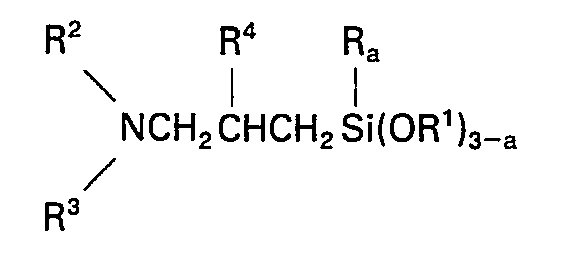
- This invention involves a process for the preparation of an aminopropylalkoxysilane having the formula wherein R and R' individually are C 1 -C 6 alkyl; R 2 and R 3 individually are hydrogen, C 1 ⁇ C 10 alkyl, C 1 ⁇ C 10 alkenyl, phenyl; R 4 is hydrogen or C 1 ⁇ C 6 alkyl; and a is 0, 1 or 2, which process comprises reacting a silane of the formula wherein R, R', and a are as defined above, with an amine of the formula wherein R 2 , R 3 and R 4 are as defined above, in the presence of a catalytic amount of a rhodium-triorganophosphorus-complex catalyst comprising rhodium in chlorine-free complex combination with a triorganophosphorus ligand wherein the organo moiety contains from 1 to 18 carbon atoms, to produce the aminopropylalkoxysilane.
- silane starting materials useful in the process of this invention include those wherein a is O and R and R' are methyl or ethyl.
- Illustrative of the silanes that can be used in the process of this invention are triethoxysilane, trimethoxysilane, tripropoxysilane, tri-isopropoxysilane, tributoxysilane, methyl- dimethoxysilane, ethyldimethoxysilane, methyldiethoxysilane, dimethylmethoxysilane, trioctyloxysilane, methyldioctyloxysilane and dimethyloctyloxysilane.
- Preferable amine starting materials useful in the process of this invention include allylamines wherein R 2 and R 3 are both hydrogen and R 4 is hydrogen or methyl.
- Illustrative of the amines that can be used in the process of this invention are allylamine, N,N-dimethylallylamine, N,N-diethylallylamine, N-allylaniline, methallylamine, diallylamine, triallylamine, allylethylenediamine and allyldiethylenetriamine.
- the ratio of the silane starting material to amine useful in the process of this invention can be varied from 1.5:1 to 1:1.5 and is preferably in the range of 1.1:1 to 1:1.1.
- the rhodium-triorganophosphorus-complex catalysts useful in the process of this invention comprise rhodium in complex combination with a triorganophosphorus ligand wherein each organo moiety is monovalently bonded to the phosphorus atom through a carbon atom or an aliphatic etheric oxygen atom and the phosphorus atom possesses one available pair of electrons.
- complex as used in the specification and claims means a coordination compound formed by the union of one or more electronically rich molecules or atoms capable of independent existence with one or more electronically poor molecules or atoms, each of which is also capable of independent existence.
- the complex may contain additional components besides the rhodium and the ligand, such as hydrogen or carbon monoxide, provided that the additional components have no deleterious effect on the catalytic activity of the complex.
- Chlorine for example, may not be an acceptable component of the complex because the addition of chlorine to the hydrosilation reaction mixture could reduce the gamma- to beta-isomer ratio of the aminopropylalkoxysilane end product produced.
- Certain rhodium-triorganophosphorus-complex catalysts of the type that are utilized in the process of this invention are known. See, e.g. US ⁇ A ⁇ 3,527,809 and 4,148,430.
- the reaction be effected in the presence of free triorganophosphorus ligand which can be considered, if desired, as a modifier or cocatalyst and/or diluent.
- free triorganophosphorus ligand is meant the triorganophosphorus compounds that are not complexed with the rhodium atom in the active complex catalyst. It is preferable that at least about 2 equivalents of free triorganophosphorus ligand be present per equivalent of rhodium.
- triorganophosphorus ligands which are contemplated in the practice of this invention are trialkylphosphites, triarylphosphites and triarylphosphines.
- Triarylphosphines are the preferred class of ligands.
- Illustrative of the ligands which are suitable for forming the complex catalysts are trimethylphosphite, tri-n-butylphosphite, triphenylphosphite, trinaphthylphosphite, triphenylphosphine, tri- naphthylphosphine, phenyl diphenylphosphinite, diphenyl phenylphosphonite and tri-(p-methoxyphenyl) phosphite.
- Triphenylphosphine is the most preferred ligand.
- the preparation of the complex catalysts utilized in the process of this invention is documented in the literature.
- a suitable method is to combine the rhodium salt of an organic acid with the ligand, e.g., triphenylphosphite, triphenylphosphine, etc., in liquid phase.
- the valence state of rhodium may then be reduced by hydrogenating the solution prior to the use of the catalysts therein.
- the catalysts may be prepared from a carbon monoxide complex of rhodium. For example, one could start with dirhodium octacarbonyl, and by heating this substance with the ligand, the ligand will replace one or more of the carbon monoxide molecules, thus producing the desired catalyst.
- ligand of choice and rhodium metal; or an oxide of rhodium
- active catalyst species in situ during the hydrosilation reaction.
- preformed catalysts are rhodium hydridocarbonyl-tris-(triphenylphosphin) and rhodium hydrido-tetrakis-(triphenylphosphine).
- Preparation of the active catalyst in situ can be accomplished, for example, by the addition of rhodium dicarbonyl acetylacetonate, or rhodium carbonyl triphenylphosphine acetylacetonate, and free triphenylphosphine to the hydrosilation reaction mixture, preferably utilizing about 50 equivalents of free triphenylphosphine per equivalent of rhodium.
- the hydrosilation reaction involved in the process of this invention can be conducted at room temperature if desired but, as a practical matter, the reaction temperature should be at least about 50°C, preferably between 100°C to 175°C and most preferably between 110°C to 135°C.
- the pressure of the reaction is not critical.
- the reaction can be conducted at atmospheric, sub-atmospheric or superatmospheric pressure.
- the concentration of the rhodium-triorganophosphorus-complex catalyst used in the process of this invention depends on reaction temperature and time but, in general, should be greater than about 5 ppm rhodium, based on the total combined weight of the silane and amine used.
- the upper limit on the catalyst concentration is not critical and would be determined largely by commercial and economic considerations.
- the catalyst concentration should be in the range of 40-200 ppm rhodium, and most preferably in the range of 50-100 ppm rhodium, based on the total combined weight of the silane and amine used.
- the reaction time used in the process of this invention will vary depending upon the other conditions, such as amount of catalyst or the reaction temperature.
- a reaction time of 2-5 hours is sufficient although the yield of the reaction is not significantly affected when a longer reaction time, such as 10 hours, is used.
- solvent is necessary for the hydrosilation reaction involved in the process of this invention.
- suitable solvents are hydrocarbons such as xylene, toluene, tri-isopropylbenzene, and the like.
- aminopropylalkoxysilanes obtained by the process of this invention are useful, for example, as glass-plastic coupling agents, bonding aids, additives to phenolic binder/foundry mixtures, adhesion promoters for vinyl plastisols, polyurethane elastomers, and epoxy and acrylic-based inks.
- aminopropylalkoxysilanes are aminopropyltrimethoxysilane, aminopropyltriethoxysilane, aminopropylmethyldimethoxysilane, aminopropyltri-isopropoxysilane, N-phenylaminopropyltriethoxysilane, N-phenylaminopropylmethyldiethoxysilane, tris-(triethoxysilylpropyl)amine, bis-(triethoxysilylpropyl)amine, tris-(trimethoxysilylpropyl)amine, bis-(trimethoxysilylpropyl)amine and N-(beta-aminoethyl)aminopropyltriethoxysilane.
- the process of this invention will produce, as reaction products, aminopropylalkoxysilanes wherein the gamma- to beta-isomer ratio is, in general, greater than 15 to 1.
- the gamma- to beta-isomer ratio achieved utilizing the preferred embodiment of this invention is at least about 25 to 1 and more preferably at least 50 to 1. This is a significant improvement over the gamma- to beta-isomer ratio ( ⁇ ⁇ 15 to 1) obtained using known methods for the hydrosilation reaction.
- Example 2 The same procedure as described in Example 1 was used except that rhodium hydridotetrakis-(triphenylphosphine) (100 ppm rhodium) was used as the catalyst.
- GC analysis showed a yield of aminopropyltriethoxysilane greater than 70% with a gamma- to beta-isomer ratio of 30 to 1.
- Example 3 The same procedure as described in Example 3 was used, except that 100 equivalents of triphenylphosphine (51.6 mg) per equivalent of rhodium was used. GC analysis showed a yield of aminopropyltriethoxysilane was greater than 70% with a gamma- to beta-isomer ratio of 31 to 1.
- Example 3 The same procedure as described in Example 3 was used, except that 200 equivalents of triphenylphosphine (51.6 mg) per equivalent of rhodium was added. GC analysis showed a yield of aminopropyltriethoxysilane greater than 70% with a gamma- to beta-isomer ratio of 59 to 1.
- a 250 ml round bottom flask was equipped with a magnetic stirrer and stir bar, standard heating mantle with thermowatch, thermometer, 125 ml addition funnel, Freidrick's condenser, and N 2 inlet/ bubbler.
- the flask was then charged with 82.0 g (0.499 mole) of triethoxysilane followed by 2.0 g triphenylphosphine and 0.140 g of rhodium hydridocarbonyl-tris-(triphenylphosphine).
- a dropwise addition of allylamine was begun. The addition was split into 1 ml additions spaced 10 minutes apart.
- Example 7 The same procedure as described in Example 7 was used, except that methyldiethoxysilane was used as the starting silane and the reaction temperature was about 100°C. GC analysis of the product so formed showed that aminopropylmethyldiethoxysilane was formed in a yield greater than 60% with a gamma- to beta-isomer ratio of 28 to 1.
- a 100 ml three-neck round bottom flask was equipped with a magnetic stir bar, standard heating mantel, thermometer, 10 ml addition funnel, water condenser and N 2 inlet/bubbler.
- the flask was charged with 20 g (0.122 moles) of triethoxysilane followed by 0.01 g of rhodium dicarbonyl acetylacetonate (200 ppm rhodium based on triethoxysilane charged), 2.03 g of triphenylphosphine (200 eq. triphenyl- phosphine/eq. rhodium) and 20 g of xylene.
Landscapes
- Chemical & Material Sciences (AREA)
- Organic Chemistry (AREA)
- Chemical Kinetics & Catalysis (AREA)
- Low-Molecular Organic Synthesis Reactions Using Catalysts (AREA)
- Pharmaceuticals Containing Other Organic And Inorganic Compounds (AREA)
- Saccharide Compounds (AREA)
Claims (15)



Priority Applications (1)
| Application Number | Priority Date | Filing Date | Title |
|---|---|---|---|
| AT86104306T ATE57931T1 (de) | 1985-03-28 | 1986-03-27 | Verfahren zur herstellung von aminopropylalkoxysilanen. |
Applications Claiming Priority (2)
| Application Number | Priority Date | Filing Date | Title |
|---|---|---|---|
| US06/717,036 US4556722A (en) | 1985-03-28 | 1985-03-28 | Process for the preparation of aminopropylalkoxysilanes |
| US717036 | 1991-06-18 |
Publications (3)
| Publication Number | Publication Date |
|---|---|
| EP0196639A2 EP0196639A2 (de) | 1986-10-08 |
| EP0196639A3 EP0196639A3 (en) | 1988-06-08 |
| EP0196639B1 true EP0196639B1 (de) | 1990-10-31 |
Family
ID=24880449
Family Applications (1)
| Application Number | Title | Priority Date | Filing Date |
|---|---|---|---|
| EP86104306A Expired - Lifetime EP0196639B1 (de) | 1985-03-28 | 1986-03-27 | Verfahren zur Herstellung von Aminopropylalkoxysilanen |
Country Status (8)
| Country | Link |
|---|---|
| US (1) | US4556722A (de) |
| EP (1) | EP0196639B1 (de) |
| JP (1) | JPS61229885A (de) |
| AT (1) | ATE57931T1 (de) |
| AU (1) | AU585329B2 (de) |
| BR (1) | BR8601397A (de) |
| CA (1) | CA1285957C (de) |
| DE (1) | DE3675239D1 (de) |
Families Citing this family (22)
| Publication number | Priority date | Publication date | Assignee | Title |
|---|---|---|---|---|
| US4822859A (en) * | 1986-06-10 | 1989-04-18 | E. I. Du Pont De Nemours And Company | Group transfer polymerization and initiators therefor |
| JP2582100B2 (ja) * | 1987-03-27 | 1997-02-19 | 東燃株式会社 | アミノプロピルアルコキシシラン類の製造方法 |
| EP0284447B1 (de) * | 1987-03-27 | 1991-10-16 | Tonen Corporation | Verfahren zur Herstellung von Aminopropylalkoxysilanen |
| JP2535028B2 (ja) * | 1987-07-31 | 1996-09-18 | 東燃株式会社 | アミノプロピルアルコキシシラン類の製造方法 |
| JPH0796555B2 (ja) * | 1987-12-14 | 1995-10-18 | 東燃株式会社 | アミノプロピルシリル化合物の製造方法 |
| JPH0296583A (ja) * | 1988-09-30 | 1990-04-09 | Toshiba Silicone Co Ltd | アミノアルキルアルコキシシランの製造方法 |
| JP2665250B2 (ja) * | 1989-02-10 | 1997-10-22 | 昭和電工株式会社 | アミノプロピルアルコキシシランの製造法 |
| JP2606924B2 (ja) * | 1989-05-31 | 1997-05-07 | 東燃株式会社 | アミノプロピルシラン化合物の製造方法 |
| US5030746A (en) * | 1990-05-29 | 1991-07-09 | Union Carbide Chemicals And Plastics Technology Corporation | Sterically hindered aminohydrocarbylsilanes and process of preparation |
| US5212017A (en) * | 1990-12-14 | 1993-05-18 | General Electric Company | Aminopropyltrimethoxy silane primer composition and coated articles made therewith |
| DE4435390C2 (de) * | 1994-10-04 | 2001-07-26 | Degussa | Verfahren zur Herstellung von Aminopropylalkoxysilanen in Gegenwart von geformten polymeren Rhodiumkomplex-Katalysatoren und deren Verwendung |
| US6809213B2 (en) * | 2000-05-05 | 2004-10-26 | General Electric Company | Preparation of secondary aminoisobutylalkoxysilanes |
| US6417381B1 (en) | 2001-11-15 | 2002-07-09 | Crompton Corporation | Process for preparing bis(silylorgano)amines |
| JP2012025668A (ja) * | 2010-07-20 | 2012-02-09 | Shin-Etsu Chemical Co Ltd | アルコキシシリル化鎖状炭化水素の製造方法及びアルコキシシリル化鎖状炭化水素 |
| JP2015098459A (ja) * | 2013-11-20 | 2015-05-28 | 信越化学工業株式会社 | 含窒素オルガノキシシラン化合物含有組成物及びその製造方法 |
| DE102015225879A1 (de) | 2015-12-18 | 2017-06-22 | Evonik Degussa Gmbh | Tris-(alkylalkoxysilyl)amin-reiche Zusammensetzungen, deren Herstellung und deren Verwendung |
| DE102015225883A1 (de) | 2015-12-18 | 2017-06-22 | Evonik Degussa Gmbh | Bis(alkylalkoxysilyl)amin-reiche Zusammensetzungen, ein Verfahren zur deren Herstellung und deren Verwendung |
| DE102016215255A1 (de) | 2016-08-16 | 2018-02-22 | Evonik Degussa Gmbh | Verfahren zur Herstellung von Bis- und Tris(alkylalkoxysilyl)amine enthaltende Zusammensetzungen und deren Verwendung |
| DE102016215259A1 (de) | 2016-08-16 | 2018-02-22 | Evonik Degussa Gmbh | Verfahren zur Herstellung von Mono- und Oligo-(alkoxysilylalkyl)aminen enthaltenden Zusammensetzungen |
| DE102016215257A1 (de) | 2016-08-16 | 2018-02-22 | Evonik Degussa Gmbh | Mono- und Bis(organosilyl)amine enthaltende Zusammensetzungen, deren Herstellung und deren Verwendung |
| DE102016215260A1 (de) | 2016-08-16 | 2018-02-22 | Evonik Degussa Gmbh | Verwendung einer (Alkylalkoxysily)amin-, Bis-(alkylalkoxysilyl)amin und/oder Tris-(alkylalkoxysilyl)amin-enthaltenden Zusammensetzung |
| DE102016215256A1 (de) | 2016-08-16 | 2018-02-22 | Evonik Degussa Gmbh | Bis- und Tris(organosilyl)amine enthaltende Zusammensetzungen, deren Herstellung und deren Verwendung |
Family Cites Families (7)
| Publication number | Priority date | Publication date | Assignee | Title |
|---|---|---|---|---|
| US2762823A (en) * | 1953-12-17 | 1956-09-11 | Dow Corning | Organosiloxane amines |
| US3527809A (en) * | 1967-08-03 | 1970-09-08 | Union Carbide Corp | Hydroformylation process |
| US3665027A (en) * | 1969-07-23 | 1972-05-23 | Inst Silikon & Fluorkarbonchem | Process for preparing gamma-aminopropylalkoxy-silanes and gamma-aminopropylalkylalkoxysilanes |
| US3657304A (en) * | 1969-11-28 | 1972-04-18 | Gen Electric | Bis(cyanoorganosilyl)hydrocarbons bis (aminoorganosilyl)hydrocarbons and methods for making them |
| US3864373A (en) * | 1971-12-13 | 1975-02-04 | Dynamit Nobel Ag | Manufacture of trialkoxysilylamino compounds |
| US4148830A (en) * | 1975-03-07 | 1979-04-10 | Union Carbide Corporation | Hydroformylation of olefins |
| US4481364A (en) * | 1983-09-26 | 1984-11-06 | Union Carbide Corporation | Preparation of aminopropyltrialkoxysilanes and/or aminoalkylalkoxysilanes |
-
1985
- 1985-03-28 US US06/717,036 patent/US4556722A/en not_active Expired - Lifetime
-
1986
- 1986-03-21 CA CA000504778A patent/CA1285957C/en not_active Expired - Lifetime
- 1986-03-26 BR BR8601397A patent/BR8601397A/pt unknown
- 1986-03-27 AT AT86104306T patent/ATE57931T1/de not_active IP Right Cessation
- 1986-03-27 AU AU55546/86A patent/AU585329B2/en not_active Ceased
- 1986-03-27 EP EP86104306A patent/EP0196639B1/de not_active Expired - Lifetime
- 1986-03-27 DE DE8686104306T patent/DE3675239D1/de not_active Expired - Lifetime
- 1986-03-28 JP JP61068850A patent/JPS61229885A/ja active Granted
Also Published As
| Publication number | Publication date |
|---|---|
| DE3675239D1 (de) | 1990-12-06 |
| JPS6355516B2 (de) | 1988-11-02 |
| CA1285957C (en) | 1991-07-09 |
| AU585329B2 (en) | 1989-06-15 |
| US4556722A (en) | 1985-12-03 |
| JPS61229885A (ja) | 1986-10-14 |
| EP0196639A2 (de) | 1986-10-08 |
| ATE57931T1 (de) | 1990-11-15 |
| AU5554686A (en) | 1986-10-02 |
| EP0196639A3 (en) | 1988-06-08 |
| BR8601397A (pt) | 1986-12-09 |
Similar Documents
| Publication | Publication Date | Title |
|---|---|---|
| US4556722A (en) | Process for the preparation of aminopropylalkoxysilanes | |
| US4481364A (en) | Preparation of aminopropyltrialkoxysilanes and/or aminoalkylalkoxysilanes | |
| US5750753A (en) | Method for manufacturing acryloxypropysilane | |
| EP0262642A2 (de) | Verfahren zur Herstellung von Epoxyorganoalkoxysilanen | |
| EP0189197B1 (de) | Verfahren zur Herstellung von vinyl-tri-(tertiär-substituierten) Alkoxysilanen | |
| EP0382258A1 (de) | Verfahren zur Herstellung von Aminopropylalkoxysilanen | |
| US4658050A (en) | Novel process for the preparation of halopropyltrialkoxysilanes and halopropylalkylalkoxysilanes | |
| JP2535028B2 (ja) | アミノプロピルアルコキシシラン類の製造方法 | |
| KR100818835B1 (ko) | 2급 아미노이소부틸알콕시실란의 제조 방법 | |
| EP0525997A1 (de) | Katalysatoren für die Addition von Siliziumhydriden an alpha, beta ungesättigte olefinische Nitrile | |
| US7279589B2 (en) | Preparation of 1-(alkoxysilyl)ethyl-1,1,3,3-tetramethyldisiloxane | |
| US5281736A (en) | Method for the preparation of 1-aza-2-silacyclopentane compounds | |
| JP2976011B2 (ja) | 3―クロロプロピルトリアルコキシシラン類の製造方法 | |
| US6872845B2 (en) | Process for making haloorganoalkoxysilanes | |
| US2908699A (en) | Process for producing cyanoalkylsilanes employing hydrocarbyl phosphorous halide catalysts | |
| JP3856050B2 (ja) | 3−クロロプロピルシラン類の製造方法 | |
| US20020035286A1 (en) | Preparation of bissilylnorbornane compounds | |
| JPH0259591A (ja) | アミノプロピルアルコキシシランの製造方法 | |
| JP2538917B2 (ja) | アミノプロピルアルコキシシラン類の製造法 |
Legal Events
| Date | Code | Title | Description |
|---|---|---|---|
| PUAI | Public reference made under article 153(3) epc to a published international application that has entered the european phase |
Free format text: ORIGINAL CODE: 0009012 |
|
| AK | Designated contracting states |
Kind code of ref document: A2 Designated state(s): AT BE CH DE FR GB IT LI LU NL SE |
|
| PUAL | Search report despatched |
Free format text: ORIGINAL CODE: 0009013 |
|
| AK | Designated contracting states |
Kind code of ref document: A3 Designated state(s): AT BE CH DE FR GB IT LI LU NL SE |
|
| 17P | Request for examination filed |
Effective date: 19880705 |
|
| 17Q | First examination report despatched |
Effective date: 19890403 |
|
| GRAA | (expected) grant |
Free format text: ORIGINAL CODE: 0009210 |
|
| AK | Designated contracting states |
Kind code of ref document: B1 Designated state(s): AT BE CH DE FR GB IT LI LU NL SE |
|
| REF | Corresponds to: |
Ref document number: 57931 Country of ref document: AT Date of ref document: 19901115 Kind code of ref document: T |
|
| ITF | It: translation for a ep patent filed | ||
| REF | Corresponds to: |
Ref document number: 3675239 Country of ref document: DE Date of ref document: 19901206 |
|
| ET | Fr: translation filed | ||
| PGFP | Annual fee paid to national office [announced via postgrant information from national office to epo] |
Ref country code: AT Payment date: 19910228 Year of fee payment: 6 |
|
| PGFP | Annual fee paid to national office [announced via postgrant information from national office to epo] |
Ref country code: CH Payment date: 19910328 Year of fee payment: 6 |
|
| ITTA | It: last paid annual fee | ||
| PLBE | No opposition filed within time limit |
Free format text: ORIGINAL CODE: 0009261 |
|
| STAA | Information on the status of an ep patent application or granted ep patent |
Free format text: STATUS: NO OPPOSITION FILED WITHIN TIME LIMIT |
|
| 26N | No opposition filed | ||
| PG25 | Lapsed in a contracting state [announced via postgrant information from national office to epo] |
Ref country code: AT Effective date: 19920327 |
|
| PG25 | Lapsed in a contracting state [announced via postgrant information from national office to epo] |
Ref country code: LI Effective date: 19920331 Ref country code: CH Effective date: 19920331 |
|
| REG | Reference to a national code |
Ref country code: CH Ref legal event code: PL |
|
| PGFP | Annual fee paid to national office [announced via postgrant information from national office to epo] |
Ref country code: LU Payment date: 19930210 Year of fee payment: 8 |
|
| EPTA | Lu: last paid annual fee | ||
| PGFP | Annual fee paid to national office [announced via postgrant information from national office to epo] |
Ref country code: SE Payment date: 19931223 Year of fee payment: 9 |
|
| PG25 | Lapsed in a contracting state [announced via postgrant information from national office to epo] |
Ref country code: LU Free format text: LAPSE BECAUSE OF NON-PAYMENT OF DUE FEES Effective date: 19940327 |
|
| PGFP | Annual fee paid to national office [announced via postgrant information from national office to epo] |
Ref country code: NL Payment date: 19940331 Year of fee payment: 9 |
|
| EAL | Se: european patent in force in sweden |
Ref document number: 86104306.5 |
|
| PG25 | Lapsed in a contracting state [announced via postgrant information from national office to epo] |
Ref country code: SE Effective date: 19950328 |
|
| PG25 | Lapsed in a contracting state [announced via postgrant information from national office to epo] |
Ref country code: NL Effective date: 19951001 |
|
| NLV4 | Nl: lapsed or anulled due to non-payment of the annual fee |
Effective date: 19951001 |
|
| EUG | Se: european patent has lapsed |
Ref document number: 86104306.5 |
|
| REG | Reference to a national code |
Ref country code: GB Ref legal event code: IF02 |
|
| REG | Reference to a national code |
Ref country code: GB Ref legal event code: 732E |
|
| PGFP | Annual fee paid to national office [announced via postgrant information from national office to epo] |
Ref country code: FR Payment date: 20050321 Year of fee payment: 20 |
|
| PGFP | Annual fee paid to national office [announced via postgrant information from national office to epo] |
Ref country code: GB Payment date: 20050323 Year of fee payment: 20 |
|
| PGFP | Annual fee paid to national office [announced via postgrant information from national office to epo] |
Ref country code: IT Payment date: 20050330 Year of fee payment: 20 |
|
| PGFP | Annual fee paid to national office [announced via postgrant information from national office to epo] |
Ref country code: BE Payment date: 20050429 Year of fee payment: 20 |
|
| PGFP | Annual fee paid to national office [announced via postgrant information from national office to epo] |
Ref country code: DE Payment date: 20050502 Year of fee payment: 20 |
|
| REG | Reference to a national code |
Ref country code: FR Ref legal event code: TP Ref country code: FR Ref legal event code: CD |
|
| REG | Reference to a national code |
Ref country code: GB Ref legal event code: 732E |
|
| PG25 | Lapsed in a contracting state [announced via postgrant information from national office to epo] |
Ref country code: GB Free format text: LAPSE BECAUSE OF EXPIRATION OF PROTECTION Effective date: 20060326 |
|
| REG | Reference to a national code |
Ref country code: GB Ref legal event code: PE20 |
|
| BE20 | Be: patent expired |
Owner name: *UNION CARBIDE CORP. Effective date: 20060327 |