EP0197545A2 - Fehlerkontrollenkodierungssystem, Verfahren und Gerät - Google Patents
Fehlerkontrollenkodierungssystem, Verfahren und Gerät Download PDFInfo
- Publication number
- EP0197545A2 EP0197545A2 EP86104792A EP86104792A EP0197545A2 EP 0197545 A2 EP0197545 A2 EP 0197545A2 EP 86104792 A EP86104792 A EP 86104792A EP 86104792 A EP86104792 A EP 86104792A EP 0197545 A2 EP0197545 A2 EP 0197545A2
- Authority
- EP
- European Patent Office
- Prior art keywords
- data
- error
- frame
- frame length
- transmitting
- Prior art date
- Legal status (The legal status is an assumption and is not a legal conclusion. Google has not performed a legal analysis and makes no representation as to the accuracy of the status listed.)
- Granted
Links
- 238000000034 method Methods 0.000 title claims abstract description 13
- 238000004891 communication Methods 0.000 claims abstract description 33
- 230000004044 response Effects 0.000 claims abstract description 7
- 230000005540 biological transmission Effects 0.000 claims description 28
- 238000012545 processing Methods 0.000 claims description 9
- 230000003044 adaptive effect Effects 0.000 claims description 4
- 238000009432 framing Methods 0.000 claims description 2
- 238000012544 monitoring process Methods 0.000 claims description 2
- 230000000903 blocking effect Effects 0.000 claims 3
- 238000005562 fading Methods 0.000 abstract description 7
- 238000010295 mobile communication Methods 0.000 abstract description 3
- 238000010586 diagram Methods 0.000 description 6
- 238000001514 detection method Methods 0.000 description 4
- 230000007704 transition Effects 0.000 description 4
- 238000009792 diffusion process Methods 0.000 description 3
- 230000000694 effects Effects 0.000 description 3
- 230000003111 delayed effect Effects 0.000 description 2
- 230000008859 change Effects 0.000 description 1
- 238000012937 correction Methods 0.000 description 1
- 125000004122 cyclic group Chemical group 0.000 description 1
- 229940075591 dalay Drugs 0.000 description 1
- 230000006866 deterioration Effects 0.000 description 1
- 238000011156 evaluation Methods 0.000 description 1
- 230000006872 improvement Effects 0.000 description 1
- 238000012986 modification Methods 0.000 description 1
- 230000004048 modification Effects 0.000 description 1
- 230000002035 prolonged effect Effects 0.000 description 1
Images




Classifications
-
- H—ELECTRICITY
- H04—ELECTRIC COMMUNICATION TECHNIQUE
- H04L—TRANSMISSION OF DIGITAL INFORMATION, e.g. TELEGRAPHIC COMMUNICATION
- H04L1/00—Arrangements for detecting or preventing errors in the information received
- H04L1/12—Arrangements for detecting or preventing errors in the information received by using return channel
- H04L1/16—Arrangements for detecting or preventing errors in the information received by using return channel in which the return channel carries supervisory signals, e.g. repetition request signals
- H04L1/1607—Details of the supervisory signal
- H04L1/1642—Formats specially adapted for sequence numbers
-
- H—ELECTRICITY
- H03—ELECTRONIC CIRCUITRY
- H03M—CODING; DECODING; CODE CONVERSION IN GENERAL
- H03M13/00—Coding, decoding or code conversion, for error detection or error correction; Coding theory basic assumptions; Coding bounds; Error probability evaluation methods; Channel models; Simulation or testing of codes
- H03M13/03—Error detection or forward error correction by redundancy in data representation, i.e. code words containing more digits than the source words
-
- H—ELECTRICITY
- H04—ELECTRIC COMMUNICATION TECHNIQUE
- H04L—TRANSMISSION OF DIGITAL INFORMATION, e.g. TELEGRAPHIC COMMUNICATION
- H04L1/00—Arrangements for detecting or preventing errors in the information received
- H04L1/0001—Systems modifying transmission characteristics according to link quality, e.g. power backoff
- H04L1/0006—Systems modifying transmission characteristics according to link quality, e.g. power backoff by adapting the transmission format
- H04L1/0007—Systems modifying transmission characteristics according to link quality, e.g. power backoff by adapting the transmission format by modifying the frame length
-
- H—ELECTRICITY
- H04—ELECTRIC COMMUNICATION TECHNIQUE
- H04L—TRANSMISSION OF DIGITAL INFORMATION, e.g. TELEGRAPHIC COMMUNICATION
- H04L1/00—Arrangements for detecting or preventing errors in the information received
- H04L1/0001—Systems modifying transmission characteristics according to link quality, e.g. power backoff
- H04L1/0009—Systems modifying transmission characteristics according to link quality, e.g. power backoff by adapting the channel coding
-
- H—ELECTRICITY
- H04—ELECTRIC COMMUNICATION TECHNIQUE
- H04L—TRANSMISSION OF DIGITAL INFORMATION, e.g. TELEGRAPHIC COMMUNICATION
- H04L1/00—Arrangements for detecting or preventing errors in the information received
- H04L1/0001—Systems modifying transmission characteristics according to link quality, e.g. power backoff
- H04L1/0015—Systems modifying transmission characteristics according to link quality, e.g. power backoff characterised by the adaptation strategy
- H04L1/0019—Systems modifying transmission characteristics according to link quality, e.g. power backoff characterised by the adaptation strategy in which mode-switching is based on a statistical approach
- H04L1/002—Algorithms with memory of the previous states, e.g. Markovian models
-
- H—ELECTRICITY
- H04—ELECTRIC COMMUNICATION TECHNIQUE
- H04L—TRANSMISSION OF DIGITAL INFORMATION, e.g. TELEGRAPHIC COMMUNICATION
- H04L1/00—Arrangements for detecting or preventing errors in the information received
- H04L1/0001—Systems modifying transmission characteristics according to link quality, e.g. power backoff
- H04L1/0023—Systems modifying transmission characteristics according to link quality, e.g. power backoff characterised by the signalling
- H04L1/0026—Transmission of channel quality indication
-
- H—ELECTRICITY
- H04—ELECTRIC COMMUNICATION TECHNIQUE
- H04L—TRANSMISSION OF DIGITAL INFORMATION, e.g. TELEGRAPHIC COMMUNICATION
- H04L1/00—Arrangements for detecting or preventing errors in the information received
- H04L1/0001—Systems modifying transmission characteristics according to link quality, e.g. power backoff
- H04L1/0033—Systems modifying transmission characteristics according to link quality, e.g. power backoff arrangements specific to the transmitter
- H04L1/0034—Systems modifying transmission characteristics according to link quality, e.g. power backoff arrangements specific to the transmitter where the transmitter decides based on inferences, e.g. use of implicit signalling
-
- H—ELECTRICITY
- H04—ELECTRIC COMMUNICATION TECHNIQUE
- H04L—TRANSMISSION OF DIGITAL INFORMATION, e.g. TELEGRAPHIC COMMUNICATION
- H04L1/00—Arrangements for detecting or preventing errors in the information received
- H04L1/12—Arrangements for detecting or preventing errors in the information received by using return channel
- H04L1/16—Arrangements for detecting or preventing errors in the information received by using return channel in which the return channel carries supervisory signals, e.g. repetition request signals
- H04L1/18—Automatic repetition systems, e.g. Van Duuren systems
- H04L1/1809—Selective-repeat protocols
-
- H—ELECTRICITY
- H04—ELECTRIC COMMUNICATION TECHNIQUE
- H04L—TRANSMISSION OF DIGITAL INFORMATION, e.g. TELEGRAPHIC COMMUNICATION
- H04L1/00—Arrangements for detecting or preventing errors in the information received
- H04L1/12—Arrangements for detecting or preventing errors in the information received by using return channel
- H04L2001/125—Arrangements for preventing errors in the return channel
Definitions
- the present invention relates to an error control encoding system in effecting data communication via a fading channel dominated by a burse error in the data communication of moving body such as a(n) (auto)mobile.
- Error correcting codes for automatically correcting digital information are essential to improvement of reliability of contemporary computer communication systems.
- the error correcting code is divided into, depending on correctable error patterns, an error correcting code suited to random' errors and that suited to burst errors.
- a severely bad-conditioned transmission line such as a fading channel is dominated by a burst error.
- An interleaving system is known as such a system to correct the burst error, which is described in for example "Error correcting Codes Entering upon Extensive Use in Various Fields" by Tanaka, Nikkei electronics, 1975 12-15, p.p. 48 to 52.
- This employs powerful random error correcting codes for a communication channel dominated by a burst error, renders interleave to digital information for transmission, and transforms a burst error to a random error.
- the interleaving system encounters trouble with a system severely in delay of time since it takes more time for decoding conducted on the basis of the interleave.
- ARQ automatic repent and request system
- the error control encoding system is adapted to detect any error involved in received data as a frame error rate in a data block or bit error rate in a data block when the receiving side receives the data transmitted from the transmitting side, and selects a frame length in response to the extent of the error rate for encoding and decoding the transmission data.
- An error correcting method in a mobile data communication monitors an error rate of data received on the receiving side and adaptively changes a frame length on the transmitting side based on a result of the monitoring, and comprises the steps of:
- a mobile data communication device consists of :
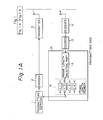
- a first embodiment of an error control encoding system will be described with reference to Fig. 1 and Fig. 2.
- a received error frame is detected on the receiving side and an ACK(acknowledge)signal or an error frame number and an NAK(negative acknowledge)signal are transmitted back to the transmitting side for each data block.
- a frame error rate for each data block is evaluated in the transmitting side and frame length is altered in conformity with the evaluation for error frame retransmission and data transmission thereafter.
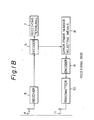
- Fig. 1 designated at 1 is a transmitting terminal, 2 is an encoder, 3 is a transmitter, 4 is a communication channel, 5 is a receiver, 6 is a decoder, 7 is a receiving terminal, 8 is an error frame number selecting means, 9 is an encoder, 10 is a transmitter, 11 is a communication channel, 12 is a receiver, 13 is a decoder, 14 is a frame length selecting part, 15 is in a frame length selecting device, and 16 is a frame length memory.
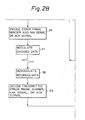
- the encoder 2 encodes the data with an error detecting code (for example, a cyclic code) frames it with the frame length L1, numbers each frame,and blocks it with a prescribed frame number (Fig. 2, box 22).
- an error detecting code for example, a cyclic code
- the encoded data is modulated through the transmitter 3 and transmitted to the communication channel 4 (Fig. 2, box 23).
- the communication channel 4 is a fading channel which produces a burst error on the modulated signal as the mobile travels and the modulated signal with the burst error is received by the receiving side.
- the receiving side demodulates the received signal through the receiver 5 (Fig. 2, box 24).
- the decoder 6 decodes the demodulated signal with use of the error correcting code or the error detecting code for detecting an erroneous frame, and data obtained from frames without any error is supplied to the receiving terminal 7 (Fig. 2, box 25).
- the error frame number selecting means 8 supplies the erroneous frame number and the NAK signal to the encoder 9 for a block decoded by the decoder 6.
- the frame number is yielded by a counter,for example,(not shown) serving to count the frame number involved in one block.
- the error frame number selecting means supplies an ACK signal to the encoder 9 for the correct frames.
- the encoder 9 encodes the frame number and -NAK signal or ACK signal with use of a code having powerful error improving capability such as a majority logic code, and delivers them to the communication channel 11 via the transmitter 10 - (Fig. 2, boxes 26, 27).
- the error frame number and the NAK signal or the ACK signal are sent to a frame length selecting part 14 of the frame length selecting device 15 for each frame via the receiver 12 and the decoder 13 in conformity with arbitrarily set time-out needed to permit the ACK/NAK signal to be properly transmitted.
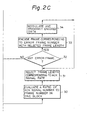
- the frame length selecting part 14 decides on the ACK signal and the NAK signal and on selecting a frame length based on their states. For example, with the ACK signal or the NAK signal received in the order of the arriving frames, the frame length selecting part 14 decides at that time that a longer frame length should be-selected provided all the frames involved in one block are the ACK signal, decides that a shorter frame length should be selected provided a rate of the ACK signal involved in all the frames is less than a predetermined value, and, furthermore, decides that the present frame length should be maintained. These procedures are repeated until no more frame error is found (Fig. 2, boxes 30, 31, 32). The decided results serve ' as a signal for selecting any of the frame lengths L1, L2, L3, and L4 in the frame length memory 16. The selection is effected by allowing a controller (not shown) to receive the concerning signal.
- the frame length is changed to the L2 which is shorter than the L1.
- the encoder 2 for which the frame length L2 in the frame length memory 16 is designated effects data retransmission for a frame having the frame member supplied with the NAK signal, with a new frame length L2 (Fig. 2, boxes 33, 34). Then provided the frame member indicative of the NAK signal is less than the member of frames consituting a block, new data is assigned to the remaining frames based on the frame length L2.
- a further shorter frame length L3 is selected.
- the frame length selecting part 14 selects a longer frame length and delivers input data with its frame length. Details of the retransmission given thereafter will be neglected here.
- An initial state is started from a state 1.
- the state changes toward an arrow 301 based on information on the receiving side indicative of that a frame error rate in one block exceeds a predetermined value. Provided that it is less than the predetermined value, it keeps the same state in accordance with an arrow 303.
- the state changes from the state 1 to the state 2 and with bad channel conditions a frame error rate in one block exceeds a predetermined value
- the state changes to a state 3 in accordance with an arrow 304.
- the state changes to the state 1 in accordance with arrow 302.
- the state keeps the same state in accordance with an arrow 306. Transitions to states 3 and 4 are effected likewise. It is also possible to encode any data with an error correcting code on the receiving side for a frame length of each state. For instance when the state is initiated from the state 1, the state changes to the state 2 in accordance with the arrow 301 based on information on the receiving side indicative of that a frame error rate in-a block is evaluated from data yielded by decoding a predetermined error correcting code and it exceeds a predetermined specific value because all of existent errors are impossible to be corrected.
- the state keeps the same state in accordance with the arrow 303.
- the state changes to the state 3 in accordance with the arrow 304 provided that the errors are incorrectable with the error correcting code in the state 2.
- the state changes to the original state 1 in accordance with the arrow 302.
- the state keeps the same state in accordance with an arrow 306.
- Error correcting codes employed here may differ from each other in each state of Fig. 3. Namely, any error correcting code may be selected and combined, for example, only an automatic repeat request system may be applicable in the state 1, a, BCH (Bose, Chaudhuri, and Hocquenghem) code applicable in the state 2, and a majoring logic code in the state 4.
- the transmitting side adds an error correcting code to data, frames it with an initial setting frame length L2, and transmits it to the receiving side.
- the receiving side effects error detection and transmits back to the transmitting side the member of an erroneous frame together with a NAK signal after applying the error detecting code described above. With any error produced here, the transmitting side sends no data to the receiving side, and so the receiving side again issues the same NAK signal.
- the transmitting side is adapted to simply transmit data and the receiving side adapted to simply receive data to serve as half-duplex transmission, it is evident that the present inventiori is applicable as full duplex since one terminal has both transmitting and receiving parts in general.
- FIG. 5 arrangement of an encoder 2 shown in Fig. 1 is illustrated, which operates with a diffusion code.
- the encoder as is well known, consists of shift registers and exclusive ORs (mod 2).
- a circuit in the encoder 2 is uniquely determined with a generator polynomial. Accordingly, the encoder 2, with the diffusion code described above, is arranged as shown in Fig. 5.
- designated at 50 is an encoder input terminal
- 51 is a b + 1 stage shift register
- 53 and 55 respectively are b -stage shift registers
- 52, 54, and 56 respectively are exclusive ORs
- 57 is a switch for switching between an information mode and a check mode
- 58 is an encoder output terminal.
- Any information bit supplied to the encoder input terminal 50 is delivered on one hand. to the information/check mode switching switch 57, and on the other hand to an input of the b + 1 stage shift regester 51. Thereafter, the information bit is delayed through the exclusive ORs and b -stage shift registers, and a check bit is finally delivered from an output of the exclusive OR 56.
- These information and check bits are alternately supplied to the encoder output terminal 58 through operation of the information/check switching switch 57, and,furthermore, delivered to the transmitter 3.
- the decoder 6 of Fig. 1 comprises a circuit of Fig. 6.
- the decoder 6 of Fig. 1 employs the diffusion code and decodes any data with a majority logic of a convolution code.
- 62 and 63 are b -stage shift registers
- 34 is a b + 1 stage shift register
- 65, 66, 67, 38 and 69, respectively are exclusive ORs. Any information bit is supplied to the b -stage shift register 62 through switch 61 for alternately switching between information and check bits, and delayed via the b + stage shift register 64.
- any check bit is supplied from an output of the exclusive OR 66, which check bit is yielded based on received information bit.
- the check bit is operated with a check bit supplied via the information/check switching switch 61 by an exclusive OR 65.
- An output from the exclusive OR 65 is supplied on one hand to the exclusive OR 71 and error-detected through the exclusive ORs 71, 74, 77, and 79, the single-stage shift register 72, the b -stage shift registers 73 and 76, the b + 1 stage shift register 78, and the majority element 80.
- the output of the majority element 80 provides an error detecting signal for the information bit while the output of the exclusive OR 79 provides that for the check bit.
- an output from the majority element 80 is supplied on one hand to the exclusive OR 69 for effecting error correction for the information bit supplied from the b + 1 stage shift register 64, and a data output signal is delivered to the receiving terminal 7 via the data output terminal 70 of the decoder, the output from the majority element 80, on the other hand,is supplied to an information/check switching switch 81.
- an output from the exclusive OR 79 supplied to the information/check switching switch 81 alternately switches between the error detection signal for the information bit and that for the check bit and outputs any one of them.
- the error detection signal is delivered to be error frame number selecting means 8 via the error detection signal output terminal 82.
- a transmission efficiency of any data is shown with respect to frame lengths with received powers being taken as a parameter when a mobile in travelling at 55 km/h receives the data.
- the transmitting side when the transmitting side receives more NAK signals than those under prescribed conditions and the transmitting side retransmits the data concerned while levelling down a frame length previously prepared by one step at a time, it can transmit the data with the optimum frame length in response to the conditions of a fading channel. Moreover, since any frame length is determined for each block, the present system can follow up abrupt changes of the conditions of the fading channel. Furthermore, when the number of frames received with any NAK signal and needed to be retransmitted is more than half the number of frames transmitted, the data transmission can be effectively achieved provided that the data is retransmitted with a frame length levelled down by two steps from a previously prepared frame length.
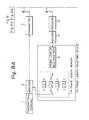
- a second embodiment of an error control encoding system will be described with reference to Fig. 8.
- the first embodiment described above was adapted to change a frame length based on an error frame rate involved in a block
- the present second embodiment estimates a bit error rate of received data for each frame for comparing the estimated value with a specified transmission quality, i.e., a channel error rate, and thereby decides whether or not the frame concerned is an erroneous one for each frame and changes frame length based on a rate of the number of the resultant error frames involved in a block.
- the transmitted data provided by the transmitting terminal 1 is delivered to the encoder 2.
- the encoder 2 encodes the data for frame unit with use of the frame length L1, numbers the length for each frame, and blocks a plurality of the frames. (The present embodiment is assumed to employ a convolutional code as the error correcting code.)
- the blocked encoded data is modulated through the transmitter 3 and provided to the communication channel 4.
- the kind L1 of the frame length is also delivered as data.
- the decoding part 6A decodes the data with use of a prescribed error correcting code or an error detecting code and sends normal data to the receiving terminal 7.
- the burst length measuring part 6B receives the error detecting signal delivered from the decoding part 6A and measures the length of a burst error and the length of an error-free interval for each frame for converting them into a channel bit error rate.
- transmission quality is intended for example to be less than 10- 6 in terms of the channel error rate
- the burst length measuring part 6B decides that the measured frame is correct when its channel error rate is less than 10- 6 while incorrect if more than 10-'
- a data-making device 17 converts the frame number decided to be erroneous to a data format suited to the present processing, and the, encoder 9 encodes this data and provides it to the transmitter 10.
- the encoder 9 executed the encoding in conformity with a predetermined encoding system.
- the encoded data is modulated in the transmitter 10 and delivered to the communication channel 11.
- the transmitting side demodulates received modulated data through the receiver 12 and decodes the encoded data in the decoder 13 for detecting the error frame number. Although the decoded data is retransmitted from the receiving side to the transmitting side, details thereof will be neglected here.
- the frame length selecting part 14 evaluates a rate of the error frame number to the number of all frames previously transmitted and selects a frame length corresponding to this rate from the frame length memory 16.
- the selector of the frame concerned is conducted in the same manner as that described in Fig. 2 and 3. Any frame corresponding to a frame number erroneously received by the receiving side is encoded with a selected frame length, modulated, and retransmitted to the receiving side via the transmitter 3. Thereupon, a kind of a newly selected frame length is also transmitted from the transmitting side to the receiving side.
- the decoding part6A of the receiving side can perform decoding corresponding to the frame length. After that, although the subsequent block data from the transmitting terminal 1 is transmitted with the newly selected frame length, the frame length is thereafter changed corresponding to a frame error rate for each block.
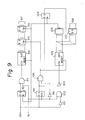
- Fig- 9 illustrating the interior of the burst length measuring part 6B measures the length of a burst error and the length of an error free interval from an error detecting signal provided by the decoding part 6A.
- 90 is an error detecting signal input terminal
- 91 is a receiving clock input terminal
- 92 and 104 respectively are flip-flops
- 94 and 105 respectively are counters.
- 95, 96, 98, and 107, respectively are latches
- 97 is a burst error length output terminal
- 106 is a decoder
- 108 is an error-free interval length output terminal
- 93, 100, 102, respectively are AND gates,and 99, 101, 103, respectively are invertors.
- the flip-flop 92 With a burst error being existent on the communication channel 4, the flip-flop 92 is set by a first error of an error detecting signal supplied by the decoding part 6A via the error detecting signal terminal 90, and an output from the flip-flop is supplied to the counter via the AND gate 93.
- the counter 94 is kept in the latch 95 every time any burst error is produced.
- a clock signal is provided to the counter 105 via the AND gate 102 and the invertor 103.
- the counter 105 counts the length of the state without any burst error. When the counted value by the counter 105 reaches a burst limit, this is detected by the decoder 106.
- an output from the decoder 106 is provided to the clock input of the latch 96 and the burst error length is delivered from the latch 96.
- the output from the decoder 106 is supplied to the flip-flop 92 and a reset terminal (RESET) of the counter 94 to reset them.
- the length of the error-free interval in counting in the counter 105 is delivered from the latch 107 owing to a signal provided via the latch 98 and the flip-flop 104 by a succeeding error.
- the burst error length and the error-free interval length respectively outputs via the burst error length output terminal 97 and the error-free interval length output terminal 108 disposed in the burst length measuring part, and is finallydelivered to the outside via the burst length output terminal 18 and the error-free length output terminal 19 shown in Fig. 8.
Landscapes
- Engineering & Computer Science (AREA)
- Quality & Reliability (AREA)
- Computer Networks & Wireless Communication (AREA)
- Signal Processing (AREA)
- Physics & Mathematics (AREA)
- Probability & Statistics with Applications (AREA)
- Theoretical Computer Science (AREA)
- Artificial Intelligence (AREA)
- Detection And Prevention Of Errors In Transmission (AREA)
Applications Claiming Priority (2)
| Application Number | Priority Date | Filing Date | Title |
|---|---|---|---|
| JP73537/85 | 1985-04-09 | ||
| JP60073537A JPH0618358B2 (ja) | 1985-04-09 | 1985-04-09 | 誤り制御符号化方式 |
Publications (3)
| Publication Number | Publication Date |
|---|---|
| EP0197545A2 true EP0197545A2 (de) | 1986-10-15 |
| EP0197545A3 EP0197545A3 (en) | 1989-05-24 |
| EP0197545B1 EP0197545B1 (de) | 1993-01-07 |
Family
ID=13521075
Family Applications (1)
| Application Number | Title | Priority Date | Filing Date |
|---|---|---|---|
| EP86104792A Expired - Lifetime EP0197545B1 (de) | 1985-04-09 | 1986-04-08 | Fehlerkontrollenkodierungssystem, Verfahren und Gerät |
Country Status (5)
| Country | Link |
|---|---|
| US (1) | US4720829A (de) |
| EP (1) | EP0197545B1 (de) |
| JP (1) | JPH0618358B2 (de) |
| CA (1) | CA1243356A (de) |
| DE (1) | DE3687420T2 (de) |
Cited By (14)
| Publication number | Priority date | Publication date | Assignee | Title |
|---|---|---|---|---|
| GB2197164A (en) * | 1986-10-03 | 1988-05-11 | Oki Electric Ind Co Ltd | Formatting an answer signal |
| GB2179827B (en) * | 1985-08-30 | 1989-08-09 | Oki Electric Ind Co Ltd | Data communication method with improved repeat request |
| FR2658683A1 (fr) * | 1990-02-16 | 1991-08-23 | Philips Lab Electronique | Systeme de codage a longueur variable de signaux numeriques. |
| EP0443061A1 (de) * | 1990-02-21 | 1991-08-28 | Siemens Aktiengesellschaft | Verfahren zur Anpassung der Blocklänge bei serieller Datenübertragung, mit Messverfahren für die Übertragungsgüte und bevorzugter Anwendung des Verfahrens |
| EP0606016A1 (de) * | 1993-01-07 | 1994-07-13 | Kabushiki Kaisha Toshiba | Datenübertragungssystem mit adaptivem Hybrid-ARQ-Verfahren |
| EP0642241A1 (de) * | 1993-09-03 | 1995-03-08 | Alcatel Mobile Communication France | Nachrichtenübertragung mittels Rahmen variabler Länge |
| WO1996035277A1 (en) * | 1995-05-05 | 1996-11-07 | Ionica International Limited | A method and apparatus for transmitting a digital data message according to a second frame format |
| WO1997015131A3 (en) * | 1995-10-18 | 1997-06-05 | Ericsson Telefon Ab L M | Method for improving the efficiency of transmission in mobile networks |
| EP0664620A3 (de) * | 1994-01-18 | 1998-03-11 | Siemens Aktiengesellschaft | Verfahren und Anordnung zum Übertragen von Sprache in einem Funksystem |
| EP0717893A4 (de) * | 1994-07-08 | 1998-07-29 | Motorola Inc | Verfahren und anordnung zur automatischen optimierung der datenrate mit paketen variabler länge und kodeparametern |
| GB2357017B (en) * | 1999-08-27 | 2002-07-10 | Samsung Electronics Co Ltd | Method for controlling errors in link layer in wideband wireless communication and computer readable media therefor |
| EP1286490A3 (de) * | 2001-08-21 | 2003-09-17 | NTT DoCoMo, Inc. | Funkkommunikationssystem, Kommunikationsendgerät und Methode zum Senden von Burstsignalen |
| US7385950B2 (en) | 2001-08-03 | 2008-06-10 | Atmel Germany Gmbh | Method of transmitting data with optimized transmission rate using packet header that defines data encoding parameters |
| EP2755343A1 (de) | 2013-01-15 | 2014-07-16 | S.A.V.E.T. Srl | System und mobiles Gerät mit Datenfragmentierung |
Families Citing this family (51)
| Publication number | Priority date | Publication date | Assignee | Title |
|---|---|---|---|---|
| GB8628821D0 (en) * | 1986-12-02 | 1987-01-07 | Plessey Co Plc | Data transmission systems |
| EP0286744A1 (de) * | 1987-04-14 | 1988-10-19 | Hewlett-Packard Limited | Erkennung von digitaler Fehlerhäufigkeit |
| JPS63304745A (ja) * | 1987-06-05 | 1988-12-13 | Nec Corp | パケットサイズ適応化方式 |
| US5159465A (en) * | 1987-10-09 | 1992-10-27 | Ricoh Company, Ltd. | Facsimile machine having a transmission speed selective shiftdown function |
| EP0317683B1 (de) * | 1987-11-27 | 1993-06-30 | International Business Machines Corporation | Daten-Richtigkeits-Kontrollmittel |
| US4901319A (en) * | 1988-03-18 | 1990-02-13 | General Electric Company | Transmission system with adaptive interleaving |
| US20010050943A1 (en) * | 1989-08-03 | 2001-12-13 | Mahany Ronald L. | Radio frequency communication network having adaptive communication parameters |
| US7606575B2 (en) | 1988-08-04 | 2009-10-20 | Broadcom Corporation | Remote radio data communication system with data rate switching |
| US5010553A (en) * | 1988-12-05 | 1991-04-23 | Compuquest, Inc. | High speed, error-free data transmission system and method |
| FR2644655A1 (fr) * | 1989-03-17 | 1990-09-21 | Trt Telecom Radio Electr | Procede de transmission d'informations dans un reseau de transmission de donnees par voie radioelectrique et systeme pour lequel est mis en oeuvre le procede |
| US5163051A (en) * | 1990-02-02 | 1992-11-10 | Telecom Analysis Systems Inc. | Paired bit error rate tester |
| US5173905A (en) * | 1990-03-29 | 1992-12-22 | Micron Technology, Inc. | Parity and error correction coding on integrated circuit addresses |
| US6148423A (en) * | 1992-07-22 | 2000-11-14 | Alcatel Cit | Signal transmission performance optimization device in a system for transmitting digital data, especially on an optical link |
| FR2694150B1 (fr) * | 1992-07-22 | 1994-08-19 | Cit Alcatel | Système de transmission d'informations numériques, notamment sur une liaison optique. |
| JP2661551B2 (ja) * | 1994-07-13 | 1997-10-08 | 日本電気株式会社 | 無線lanシステム |
| US5699364A (en) * | 1995-03-16 | 1997-12-16 | Kabushiki Kaisha Toshiba | Data communication system, apparatus and method which optimize the set value of parameters |
| US5602831A (en) * | 1995-03-31 | 1997-02-11 | Seiko Communications Systems, Inc. | Optimizing packet size to eliminate effects of reception nulls |
| US5631909A (en) * | 1995-05-31 | 1997-05-20 | Quantum Corporation | Method and apparatus for determining burst errors in an error pattern |
| US5638379A (en) * | 1995-06-06 | 1997-06-10 | Symmetricom, Inc. | Encoding system for distribution of synchronization |
| US5828670A (en) * | 1995-06-06 | 1998-10-27 | Symmetricom, Inc. | Distribution of synchronization in a synchronous optical environment |
| US5761247A (en) * | 1996-08-23 | 1998-06-02 | Paradyne Corporation | Rob bit compensation system and method associated with a receiver or codec |
| US5729226A (en) * | 1996-08-23 | 1998-03-17 | Paradyne Corporation | Rob bit compensation system and method associated with a transmitter or CODEC |
| US5754594A (en) * | 1996-08-23 | 1998-05-19 | Paradyne Corporation | Cooperative feedback system and method for a compensation system associated with a transmitter or codec |
| US5784405A (en) * | 1996-08-23 | 1998-07-21 | Paradyne Corporation | Noncooperative feedback system and method for a compensation system associated with a transmitter or CODEC |
| US6189123B1 (en) * | 1997-03-26 | 2001-02-13 | Telefonaktiebolaget Lm Ericsson | Method and apparatus for communicating a block of digital information between a sending and a receiving station |
| US7184426B2 (en) * | 2002-12-12 | 2007-02-27 | Qualcomm, Incorporated | Method and apparatus for burst pilot for a time division multiplex system |
| US9118387B2 (en) | 1997-11-03 | 2015-08-25 | Qualcomm Incorporated | Pilot reference transmission for a wireless communication system |
| US6552995B1 (en) * | 1998-02-19 | 2003-04-22 | Advantest Corporation | Spectrum diffusion signal analyzer and method of analyzing diffusion signal |
| DE19815408C2 (de) * | 1998-04-06 | 2002-06-20 | Rohde & Schwarz | Anordnung zum Optimieren der Datenübertragung eines gedächtnisbehafteten Funkkanals |
| FI108824B (fi) * | 1998-06-03 | 2002-03-28 | Nokia Corp | Datasiirtomenetelmiä tietoliikennejärjestelmässä |
| US8064409B1 (en) | 1999-08-25 | 2011-11-22 | Qualcomm Incorporated | Method and apparatus using a multi-carrier forward link in a wireless communication system |
| US6621804B1 (en) | 1999-10-07 | 2003-09-16 | Qualcomm Incorporated | Method and apparatus for predicting favored supplemental channel transmission slots using transmission power measurements of a fundamental channel |
| EP1096719A3 (de) * | 1999-11-01 | 2007-12-05 | Matsushita Electric Industrial Co., Ltd. | Verfahren und System zur Relaisdatenwiederübertragung |
| US6397368B1 (en) * | 1999-12-06 | 2002-05-28 | Intellon Corporation | Forward error correction with channel adaptation |
| JP2001298370A (ja) * | 2000-04-13 | 2001-10-26 | Matsushita Electric Ind Co Ltd | 符号化装置 |
| US6694469B1 (en) * | 2000-04-14 | 2004-02-17 | Qualcomm Incorporated | Method and an apparatus for a quick retransmission of signals in a communication system |
| DE10066152B4 (de) * | 2000-07-20 | 2007-01-11 | Adisoft Systems Gmbh & Co. Kg | Verfahren, Vorrichtung und Computerprogramm zum Verwalten einer Datenübertragung |
| JP3821636B2 (ja) * | 2000-08-21 | 2006-09-13 | 松下電器産業株式会社 | 通信端末装置、基地局装置および無線通信方法 |
| US7068683B1 (en) | 2000-10-25 | 2006-06-27 | Qualcomm, Incorporated | Method and apparatus for high rate packet data and low delay data transmissions |
| US6973098B1 (en) * | 2000-10-25 | 2005-12-06 | Qualcomm, Incorporated | Method and apparatus for determining a data rate in a high rate packet data wireless communications system |
| DE10108535A1 (de) * | 2001-02-22 | 2002-09-05 | Caq Ag Factory Systems | Verfahren zur Übertragung von Daten |
| FR2822317B1 (fr) * | 2001-03-16 | 2003-08-08 | Nortel Networks Ltd | Unite d'emission de blocs de donnees en mode acquitte sur un canal comportant un lien radio avec une station mobile |
| US7092717B2 (en) * | 2002-12-20 | 2006-08-15 | Qualcomm Incorporated | Method and system for a dynamic adjustment of a data request channel in a communication system |
| WO2006027672A2 (en) * | 2004-09-10 | 2006-03-16 | Nortel Networks | System and method for adaptive frame size management in a wireless multihop network |
| US7219292B2 (en) * | 2005-04-14 | 2007-05-15 | Industrial Technology Research Institute | Cyclic redundancy check modification for length detection of message with convolutional protection |
| KR100748702B1 (ko) * | 2006-01-27 | 2007-08-13 | 삼성전자주식회사 | 무선 랜 시스템의 프레임 처리 방법 및 그 장치 |
| US20070180349A1 (en) * | 2006-01-31 | 2007-08-02 | Jacobsen Eric A | Techniques for uequal error protection for layered protection applications |
| EP2007051A4 (de) * | 2006-04-19 | 2013-01-09 | Mitsubishi Electric Corp | Datenübertragungssteuerverfahren und sendervorrichtung |
| JP4702443B2 (ja) * | 2008-12-17 | 2011-06-15 | ソニー株式会社 | 通信システム、通信方法、通信装置、およびプログラム |
| US8295307B2 (en) * | 2009-05-07 | 2012-10-23 | Qualcomm Incorporated | System and method for adapting transmit data block size and rate based on quality of communication link |
| US8811200B2 (en) * | 2009-09-22 | 2014-08-19 | Qualcomm Incorporated | Physical layer metrics to support adaptive station-dependent channel state information feedback rate in multi-user communication systems |
Family Cites Families (11)
| Publication number | Priority date | Publication date | Assignee | Title |
|---|---|---|---|---|
| US3449716A (en) * | 1963-05-09 | 1969-06-10 | Sangamo Electric Co | Digital self-optimizing terminal |
| US3534264A (en) * | 1966-04-15 | 1970-10-13 | Ibm | Adaptive digital communication system |
| US3496549A (en) * | 1966-04-20 | 1970-02-17 | Bell Telephone Labor Inc | Channel monitor for error control |
| US3506961A (en) * | 1966-08-15 | 1970-04-14 | American Computer Commun | Adaptively coded data communications system |
| CH531282A (de) * | 1970-04-29 | 1972-11-30 | Siemens Ag | Verfahren zum Messen der Bit- und Blockfehlerhäufigkeit mit wählbarer Blocklänge bei der Übertragung von binärcodierten Datenzeichen |
| US3646518A (en) * | 1970-05-05 | 1972-02-29 | Bell Telephone Labor Inc | Feedback error control system |
| US3657700A (en) * | 1970-07-13 | 1972-04-18 | American Computer Commun | Forward error correcting system |
| JPS5292413A (en) * | 1976-01-30 | 1977-08-03 | Toshiba Corp | Data transfer system |
| JPS52147905A (en) * | 1976-06-03 | 1977-12-08 | Toshiba Corp | Block length variable control system |
| US4270205A (en) * | 1979-02-27 | 1981-05-26 | Phillips Petroleum Company | Serial line communication system |
| JPS59122251A (ja) * | 1982-12-28 | 1984-07-14 | Nec Corp | シンプレツクス無線通信における情報伝送方式 |
-
1985
- 1985-04-09 JP JP60073537A patent/JPH0618358B2/ja not_active Expired - Lifetime
-
1986
- 1986-04-04 US US06/848,112 patent/US4720829A/en not_active Expired - Lifetime
- 1986-04-08 EP EP86104792A patent/EP0197545B1/de not_active Expired - Lifetime
- 1986-04-08 DE DE8686104792T patent/DE3687420T2/de not_active Expired - Fee Related
- 1986-04-08 CA CA000506100A patent/CA1243356A/en not_active Expired
Cited By (22)
| Publication number | Priority date | Publication date | Assignee | Title |
|---|---|---|---|---|
| GB2179827B (en) * | 1985-08-30 | 1989-08-09 | Oki Electric Ind Co Ltd | Data communication method with improved repeat request |
| GB2197164A (en) * | 1986-10-03 | 1988-05-11 | Oki Electric Ind Co Ltd | Formatting an answer signal |
| FR2658683A1 (fr) * | 1990-02-16 | 1991-08-23 | Philips Lab Electronique | Systeme de codage a longueur variable de signaux numeriques. |
| EP0443061A1 (de) * | 1990-02-21 | 1991-08-28 | Siemens Aktiengesellschaft | Verfahren zur Anpassung der Blocklänge bei serieller Datenübertragung, mit Messverfahren für die Übertragungsgüte und bevorzugter Anwendung des Verfahrens |
| US5638384A (en) * | 1993-01-07 | 1997-06-10 | Kabushiki Kaisha Toshiba | Data communication system |
| EP0606016A1 (de) * | 1993-01-07 | 1994-07-13 | Kabushiki Kaisha Toshiba | Datenübertragungssystem mit adaptivem Hybrid-ARQ-Verfahren |
| US5642361A (en) * | 1993-09-03 | 1997-06-24 | Alcatel Mobile Communication France | Message transmission by means of a variable length frame |
| EP0642241A1 (de) * | 1993-09-03 | 1995-03-08 | Alcatel Mobile Communication France | Nachrichtenübertragung mittels Rahmen variabler Länge |
| FR2709626A1 (fr) * | 1993-09-03 | 1995-03-10 | Alcatel Mobile Comm France | Transmission de messages au moyen d'une trame de longueur variable. |
| EP0664620A3 (de) * | 1994-01-18 | 1998-03-11 | Siemens Aktiengesellschaft | Verfahren und Anordnung zum Übertragen von Sprache in einem Funksystem |
| EP0717893A4 (de) * | 1994-07-08 | 1998-07-29 | Motorola Inc | Verfahren und anordnung zur automatischen optimierung der datenrate mit paketen variabler länge und kodeparametern |
| WO1996035277A1 (en) * | 1995-05-05 | 1996-11-07 | Ionica International Limited | A method and apparatus for transmitting a digital data message according to a second frame format |
| WO1997015131A3 (en) * | 1995-10-18 | 1997-06-05 | Ericsson Telefon Ab L M | Method for improving the efficiency of transmission in mobile networks |
| US5757813A (en) * | 1995-10-18 | 1998-05-26 | Telefonaktiebolaget Lm Ericsson | Method for achieving optimal channel coding in a communication system |
| GB2357017B (en) * | 1999-08-27 | 2002-07-10 | Samsung Electronics Co Ltd | Method for controlling errors in link layer in wideband wireless communication and computer readable media therefor |
| US6615382B1 (en) | 1999-08-27 | 2003-09-02 | Samsung Electronics Co., Ltd. | Method for controlling errors in link layer in wideband wireless communication and computer readable media therefor |
| US7385950B2 (en) | 2001-08-03 | 2008-06-10 | Atmel Germany Gmbh | Method of transmitting data with optimized transmission rate using packet header that defines data encoding parameters |
| EP1286490A3 (de) * | 2001-08-21 | 2003-09-17 | NTT DoCoMo, Inc. | Funkkommunikationssystem, Kommunikationsendgerät und Methode zum Senden von Burstsignalen |
| SG115491A1 (en) * | 2001-08-21 | 2005-10-28 | Ntt Docomo Inc | Radio communication system, communication terminal, and method for transmitting burst signals |
| US7190967B2 (en) | 2001-08-21 | 2007-03-13 | Ntt Docomo, Inc. | Radio communication system, communication terminal, and method for transmitting burst signals |
| EP2755343A1 (de) | 2013-01-15 | 2014-07-16 | S.A.V.E.T. Srl | System und mobiles Gerät mit Datenfragmentierung |
| ITFI20130011A1 (it) * | 2013-01-15 | 2014-07-16 | V E T Srl Sa | Sistema e metodo per telecomunicazioni dati con terminali mobili |
Also Published As
| Publication number | Publication date |
|---|---|
| EP0197545B1 (de) | 1993-01-07 |
| US4720829A (en) | 1988-01-19 |
| JPS61232737A (ja) | 1986-10-17 |
| DE3687420D1 (de) | 1993-02-18 |
| JPH0618358B2 (ja) | 1994-03-09 |
| DE3687420T2 (de) | 1993-08-12 |
| EP0197545A3 (en) | 1989-05-24 |
| HK1001484A1 (en) | 1998-06-19 |
| CA1243356A (en) | 1988-10-18 |
Similar Documents
| Publication | Publication Date | Title |
|---|---|---|
| EP0197545B1 (de) | Fehlerkontrollenkodierungssystem, Verfahren und Gerät | |
| US4701923A (en) | Adaptively coded data communication system with half duplex and/or full duplex function | |
| US7236740B2 (en) | Data retransmission apparatus and method in a mobile communication system employing HARQ technique | |
| US4344171A (en) | Effective error control scheme for satellite communications | |
| US5490168A (en) | Method and system for automatic optimization of data throughput using variable packet length and code parameters | |
| EP1401140B1 (de) | Adaptives Hybridwiederholungsaufforderungsverfahren und -system | |
| US6519731B1 (en) | Assuring sequence number availability in an adaptive hybrid-ARQ coding system | |
| US7076005B2 (en) | System and method for transmission format detection | |
| EP1154576A2 (de) | Fehlerdetektion für ARQ Systeme | |
| US20100223529A1 (en) | Communication method and system using two or more coding schemes | |
| US6925502B1 (en) | Methods and systems for improving data transmission rates having adaptive protocols | |
| KR101061116B1 (ko) | 이동통신 시스템에서 상향링크 제어정보 전송 방법 및수신측에서의 제어정보의 복호 방법 | |
| EP1054526A1 (de) | Verfahren und System zur Verbindungsanpassung in Telekommunikationsnetzen | |
| KR100224386B1 (ko) | 무선국 및 신호송수신방법 | |
| US8595598B2 (en) | High-efficiency dynamic transmission that has a high speed and reliability | |
| US20050053040A1 (en) | Apparatus and method for detecting transmitting rate of turbo decoder | |
| US7099637B2 (en) | Method of evaluating the quality of a radio link in a mobile radiocommunication system | |
| JP2001094574A (ja) | 無線lanシステム | |
| WO2002093820A1 (fr) | Procede de communication, dispositif de transmission, dispositif de reception, et systeme de communication equipe de ces dispositifs | |
| JPH0865279A (ja) | 重み付け多数決復号法によるarq通信方法及び装置 | |
| HK1001484B (en) | Error control encoding system, method and device | |
| EP0844760A2 (de) | Rundfunksystem mit Anforderung zur automatischen Sendungswiederholung | |
| JPH06101686B2 (ja) | 多数決復号化装置 | |
| EP1596523B1 (de) | Verfahren zum Empfangen von paketorientierter Information mit automatischer Wiederholungsaufforderung | |
| JP2003174435A (ja) | 自動再送要求データ伝送方法およびその装置 |
Legal Events
| Date | Code | Title | Description |
|---|---|---|---|
| PUAI | Public reference made under article 153(3) epc to a published international application that has entered the european phase |
Free format text: ORIGINAL CODE: 0009012 |
|
| AK | Designated contracting states |
Kind code of ref document: A2 Designated state(s): DE FR GB IT NL SE |
|
| PUAL | Search report despatched |
Free format text: ORIGINAL CODE: 0009013 |
|
| AK | Designated contracting states |
Kind code of ref document: A3 Designated state(s): DE FR GB IT NL SE |
|
| 17P | Request for examination filed |
Effective date: 19890804 |
|
| 17Q | First examination report despatched |
Effective date: 19891026 |
|
| GRAA | (expected) grant |
Free format text: ORIGINAL CODE: 0009210 |
|
| AK | Designated contracting states |
Kind code of ref document: B1 Designated state(s): DE FR GB IT NL SE |
|
| REF | Corresponds to: |
Ref document number: 3687420 Country of ref document: DE Date of ref document: 19930218 |
|
| ET | Fr: translation filed | ||
| ITF | It: translation for a ep patent filed | ||
| PLBE | No opposition filed within time limit |
Free format text: ORIGINAL CODE: 0009261 |
|
| STAA | Information on the status of an ep patent application or granted ep patent |
Free format text: STATUS: NO OPPOSITION FILED WITHIN TIME LIMIT |
|
| 26N | No opposition filed | ||
| EAL | Se: european patent in force in sweden |
Ref document number: 86104792.6 |
|
| REG | Reference to a national code |
Ref country code: GB Ref legal event code: IF02 |
|
| PGFP | Annual fee paid to national office [announced via postgrant information from national office to epo] |
Ref country code: GB Payment date: 20020404 Year of fee payment: 17 |
|
| PGFP | Annual fee paid to national office [announced via postgrant information from national office to epo] |
Ref country code: SE Payment date: 20020405 Year of fee payment: 17 |
|
| PGFP | Annual fee paid to national office [announced via postgrant information from national office to epo] |
Ref country code: FR Payment date: 20020410 Year of fee payment: 17 |
|
| PGFP | Annual fee paid to national office [announced via postgrant information from national office to epo] |
Ref country code: DE Payment date: 20020417 Year of fee payment: 17 |
|
| PGFP | Annual fee paid to national office [announced via postgrant information from national office to epo] |
Ref country code: NL Payment date: 20020426 Year of fee payment: 17 |
|
| PG25 | Lapsed in a contracting state [announced via postgrant information from national office to epo] |
Ref country code: GB Free format text: LAPSE BECAUSE OF NON-PAYMENT OF DUE FEES Effective date: 20030408 |
|
| PG25 | Lapsed in a contracting state [announced via postgrant information from national office to epo] |
Ref country code: SE Free format text: LAPSE BECAUSE OF NON-PAYMENT OF DUE FEES Effective date: 20030409 |
|
| PG25 | Lapsed in a contracting state [announced via postgrant information from national office to epo] |
Ref country code: NL Free format text: LAPSE BECAUSE OF NON-PAYMENT OF DUE FEES Effective date: 20031101 Ref country code: DE Free format text: LAPSE BECAUSE OF NON-PAYMENT OF DUE FEES Effective date: 20031101 |
|
| GBPC | Gb: european patent ceased through non-payment of renewal fee |
Effective date: 20030408 |
|
| NLV4 | Nl: lapsed or anulled due to non-payment of the annual fee |
Effective date: 20031101 |
|
| EUG | Se: european patent has lapsed | ||
| PG25 | Lapsed in a contracting state [announced via postgrant information from national office to epo] |
Ref country code: FR Free format text: LAPSE BECAUSE OF NON-PAYMENT OF DUE FEES Effective date: 20031231 |
|
| REG | Reference to a national code |
Ref country code: FR Ref legal event code: ST |
|
| PG25 | Lapsed in a contracting state [announced via postgrant information from national office to epo] |
Ref country code: IT Free format text: LAPSE BECAUSE OF NON-PAYMENT OF DUE FEES;WARNING: LAPSES OF ITALIAN PATENTS WITH EFFECTIVE DATE BEFORE 2007 MAY HAVE OCCURRED AT ANY TIME BEFORE 2007. THE CORRECT EFFECTIVE DATE MAY BE DIFFERENT FROM THE ONE RECORDED. Effective date: 20050408 |