EP0198232B1 - Verfahren zur reduktiven Dehalogenierung von Halogenverbindungen - Google Patents
Verfahren zur reduktiven Dehalogenierung von Halogenverbindungen Download PDFInfo
- Publication number
- EP0198232B1 EP0198232B1 EP86103448A EP86103448A EP0198232B1 EP 0198232 B1 EP0198232 B1 EP 0198232B1 EP 86103448 A EP86103448 A EP 86103448A EP 86103448 A EP86103448 A EP 86103448A EP 0198232 B1 EP0198232 B1 EP 0198232B1
- Authority
- EP
- European Patent Office
- Prior art keywords
- carbon
- reaction
- hydrogen
- carbon atoms
- boiling
- Prior art date
- Legal status (The legal status is an assumption and is not a legal conclusion. Google has not performed a legal analysis and makes no representation as to the accuracy of the status listed.)
- Expired - Lifetime
Links
Images

Classifications
-
- A—HUMAN NECESSITIES
- A62—LIFE-SAVING; FIRE-FIGHTING
- A62D—CHEMICAL MEANS FOR EXTINGUISHING FIRES OR FOR COMBATING OR PROTECTING AGAINST HARMFUL CHEMICAL AGENTS; CHEMICAL MATERIALS FOR USE IN BREATHING APPARATUS
- A62D3/00—Processes for making harmful chemical substances harmless or less harmful, by effecting a chemical change in the substances
- A62D3/30—Processes for making harmful chemical substances harmless or less harmful, by effecting a chemical change in the substances by reacting with chemical agents
- A62D3/37—Processes for making harmful chemical substances harmless or less harmful, by effecting a chemical change in the substances by reacting with chemical agents by reduction, e.g. hydrogenation
-
- C—CHEMISTRY; METALLURGY
- C07—ORGANIC CHEMISTRY
- C07C—ACYCLIC OR CARBOCYCLIC COMPOUNDS
- C07C1/00—Preparation of hydrocarbons from one or more compounds, none of them being a hydrocarbon
- C07C1/26—Preparation of hydrocarbons from one or more compounds, none of them being a hydrocarbon starting from organic compounds containing only halogen atoms as hetero-atoms
-
- C—CHEMISTRY; METALLURGY
- C07—ORGANIC CHEMISTRY
- C07C—ACYCLIC OR CARBOCYCLIC COMPOUNDS
- C07C17/00—Preparation of halogenated hydrocarbons
-
- C—CHEMISTRY; METALLURGY
- C07—ORGANIC CHEMISTRY
- C07C—ACYCLIC OR CARBOCYCLIC COMPOUNDS
- C07C17/00—Preparation of halogenated hydrocarbons
- C07C17/23—Preparation of halogenated hydrocarbons by dehalogenation
-
- C—CHEMISTRY; METALLURGY
- C07—ORGANIC CHEMISTRY
- C07C—ACYCLIC OR CARBOCYCLIC COMPOUNDS
- C07C45/00—Preparation of compounds having >C = O groups bound only to carbon or hydrogen atoms; Preparation of chelates of such compounds
- C07C45/41—Preparation of compounds having >C = O groups bound only to carbon or hydrogen atoms; Preparation of chelates of such compounds by hydrogenolysis or reduction of carboxylic groups or functional derivatives thereof
-
- C—CHEMISTRY; METALLURGY
- C07—ORGANIC CHEMISTRY
- C07D—HETEROCYCLIC COMPOUNDS
- C07D213/00—Heterocyclic compounds containing six-membered rings, not condensed with other rings, with one nitrogen atom as the only ring hetero atom and three or more double bonds between ring members or between ring members and non-ring members
- C07D213/02—Heterocyclic compounds containing six-membered rings, not condensed with other rings, with one nitrogen atom as the only ring hetero atom and three or more double bonds between ring members or between ring members and non-ring members having three double bonds between ring members or between ring members and non-ring members
- C07D213/04—Heterocyclic compounds containing six-membered rings, not condensed with other rings, with one nitrogen atom as the only ring hetero atom and three or more double bonds between ring members or between ring members and non-ring members having three double bonds between ring members or between ring members and non-ring members having no bond between the ring nitrogen atom and a non-ring member or having only hydrogen or carbon atoms directly attached to the ring nitrogen atom
- C07D213/24—Heterocyclic compounds containing six-membered rings, not condensed with other rings, with one nitrogen atom as the only ring hetero atom and three or more double bonds between ring members or between ring members and non-ring members having three double bonds between ring members or between ring members and non-ring members having no bond between the ring nitrogen atom and a non-ring member or having only hydrogen or carbon atoms directly attached to the ring nitrogen atom with substituted hydrocarbon radicals attached to ring carbon atoms
- C07D213/44—Radicals substituted by doubly-bound oxygen, sulfur, or nitrogen atoms, or by two such atoms singly-bound to the same carbon atom
- C07D213/46—Oxygen atoms
- C07D213/48—Aldehydo radicals
-
- C—CHEMISTRY; METALLURGY
- C07—ORGANIC CHEMISTRY
- C07D—HETEROCYCLIC COMPOUNDS
- C07D307/00—Heterocyclic compounds containing five-membered rings having one oxygen atom as the only ring hetero atom
- C07D307/77—Heterocyclic compounds containing five-membered rings having one oxygen atom as the only ring hetero atom ortho- or peri-condensed with carbocyclic rings or ring systems
- C07D307/87—Benzo [c] furans; Hydrogenated benzo [c] furans
- C07D307/88—Benzo [c] furans; Hydrogenated benzo [c] furans with one oxygen atom directly attached in position 1 or 3
-
- A—HUMAN NECESSITIES
- A62—LIFE-SAVING; FIRE-FIGHTING
- A62D—CHEMICAL MEANS FOR EXTINGUISHING FIRES OR FOR COMBATING OR PROTECTING AGAINST HARMFUL CHEMICAL AGENTS; CHEMICAL MATERIALS FOR USE IN BREATHING APPARATUS
- A62D2101/00—Harmful chemical substances made harmless, or less harmful, by effecting chemical change
- A62D2101/20—Organic substances
- A62D2101/22—Organic substances containing halogen
-
- A—HUMAN NECESSITIES
- A62—LIFE-SAVING; FIRE-FIGHTING
- A62D—CHEMICAL MEANS FOR EXTINGUISHING FIRES OR FOR COMBATING OR PROTECTING AGAINST HARMFUL CHEMICAL AGENTS; CHEMICAL MATERIALS FOR USE IN BREATHING APPARATUS
- A62D2101/00—Harmful chemical substances made harmless, or less harmful, by effecting chemical change
- A62D2101/20—Organic substances
- A62D2101/28—Organic substances containing oxygen, sulfur, selenium or tellurium, i.e. chalcogen
Definitions
- the invention relates to the reductive dehalogenation of vicinal dihalides.
- halogen-substituted olefins in the vinyl or allyl position can be hydrogenated to haloalkanes in the presence of rhodium, palladium or platinum.
- the yields depend on the solvent, catalyst support and the presence of thiophene (J.Org.Chem. 29. 194-198, 1964).
- a disadvantage of the described processes for reductive dehalogenation is that they cannot be used industrially or only to a limited extent, since the reagents are very expensive and large amounts of salt, in many cases heavy metal salts, are obtained.
- PCB polychlorinated biphenyl
- the hydrogen required for the formation of hydrogen halide comes from the alkane, from which mostly carbon is formed in addition to lower-hydrogen derivatives.
- High-boiling mineral oils are advantageously used as alkanes, the boiling temperatures of which are higher than the reaction temperature, which is 100 to 450, preferably 200 to 400, in particular 250 to 350 ° C.
- Such hydrocarbons are e.g. Vacuum gas oil, technical white oil, heating oil S, vacuum residue oil or other high-boiling components resulting from petroleum fractionation. It is also possible to use low-boiling hydrocarbons such as heating oil L, gasoline, light petrol or even liquid gas (see Ullmann, Encyclopedia of Technical Chemistry, 3rd edition, Vol. 6, pp. 595 to 760, 1955 and 4. Ed., Vol. 12, pp. 570 to 573). In order to be able to carry out the reaction in the liquid phase, however, increased pressures are then required. Crude oils of various origins can also be used.
- the alkanes are advantageously used in an amount of 10 to 1000 g, in particular 20 to 80 g, per mole of halogen compound. Amounts of 10 to 2000 g, in particular 100 to 1000 g, per mole of starting material have proven useful for reducing acyl halides.
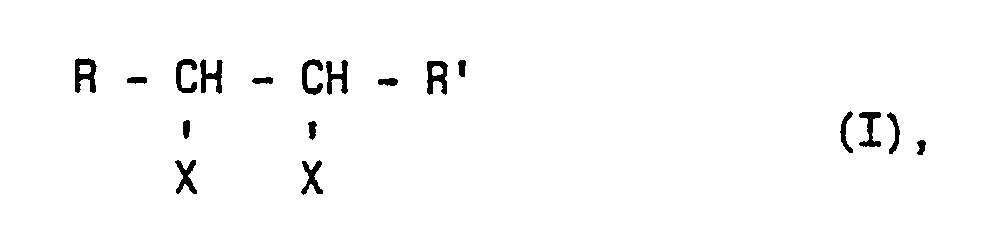
- Starting materials suitable for the implementation according to the invention are vicinal dihalides of the general formula I.
- X represents iodine, bromine and / or chlorine and the radicals R and R 'independently of one another are hydrogen, an aliphatic radical, for example an alkyl group with 1 to 20, in particular 1 to 5 carbon atoms, a cycloalkyl group, for example with 5 to 8 carbon atoms , an aryl group or an aralkyl group, in particular having 6 to 12 carbon atoms, or both radicals together with the carbon atoms to which they are bonded to form a cycloalkane having 4 to 12, in particular 4 to 8, carbon atoms.
- compounds such as 1, 2-dichloropropane, 1, 2-dichlorobutane, 1, 2-dichloropentane, 1, 2-dibromobutane, 2,3-diiodobutane, 1, 2-dibromo-2-methylpropane, 1, 2-dibromocyclobutane or cyclohexane, 1, 2-dichloro-1,2-diphenylethane, 1,2-dichloro-3-phenylpropane, 1-bromo-2-iodobutane, 1-bromo-2-chloroethane,
- halogen compounds can additionally carry substituents which are inert under the reaction conditions, such as cyano, alkoxy, dialkylamino, phenyl or substituted phenyl groups.
- Heterocyclic compounds for example halogen-substituted pyridine, quinoline, pyrrole or imidazole, can also be reacted.
- the reaction is carried out in the liquid phase, at least the majority of the reacting hydrocarbons should be in liquid form.
- the liquid phase contains suspended carbon, which is either present as part of the alkanes used or is added separately.
- the reaction mixture preferably contains 1 to 50, in particular 5 to 20,% by weight of carbon, based on the alkane used.
- Suitable carbon additives are, for example, petroleum coke and carbon black or another form of graphite.
- Activated carbons such as Carboraffin P® or animal charcoal, which are activated with ZnCl2, phosphoric acid or hydrogen, for example, are particularly advantageously used.
- the reaction according to the invention can be carried out batchwise or continuously at normal pressure, elevated or reduced pressure according to the usual techniques, e.g. be carried out in a stirred reactor or in a cylindrical reactor with circulation.
- the dehalogenation is expediently carried out in such a way that, as can be seen in the figure, the halogen compounds (1) are solid, liquid or gaseous, optionally together with an inert gas (2), e.g. Nitrogen feeds the reactor (3) with the liquid elemental carbon-containing alkane phase heated to the reaction temperature. After the reaction, the reaction products generally leave the reactor in gaseous form together with the hydrogen halide formed. The products are isolated by e.g. depending on the boiling point, either condensed before or after separation of the hydrogen halide and, if appropriate, e.g. cleans by distillation. The hydrogen halide is expediently removed by water washing. The hydrohalic acids thus obtained are then neutralized or used. If necessary, the hydrogen halide can also be neutralized immediately by lye washing.
- an inert gas (2) e.g. Nitrogen feeds the reactor (3) with the liquid elemental carbon-containing alkane phase heated to the reaction temperature.
- the reaction products generally leave the reactor in gaseous form
- Example 2 The procedure was as in Example 1, but 0.75 kg of technical white oil with 0.25 kg of Carboraffin P® were used. 14.4 g of condensate with 64% by weight dichloropropane were obtained per hour. This corresponds to a turnover of 80%. In addition, 225 g of aqueous HCl with 10.5% by weight of HCl were obtained. This corresponds to 79% of the Cl used. 16 l of exhaust gas with 41.3% by volume of propene are obtained. This corresponds to a yield of 90%. based on sales.
- Example 2 The procedure was as in Example 1, but 40 ml of 1,2-dibromobutane with 4.5 l of nitrogen were used. 14.5 g of condensate with 76% by weight of dibromobutane were obtained per hour. This corresponds to a turnover of 85%. 385 g of aqueous HBr with 12% by weight of HBr and 8 l of waste gas with 40% by volume of butene-1 were obtained. This corresponds to 85% of the bromine used and a yield of 1-butene of 50%, based on the conversion.
- Example 3 The procedure was as in Example 3, but 250 ° C. was selected as the reaction temperature. 49 g of condensate with 74% by weight of dichloropropane were obtained per hour. This corresponds to a turnover of 21% by weight. 9 l of exhaust gas with 10.2% by volume of propene are obtained. This corresponds to a yield of 48% based on the dichloropropane converted.
- Example 2 The procedure was as in Example 1, but 1.2 kg of high-boiling mineral oil fraction referred to as vacuum gas oil were used. 39 g of condensate with 85.6% by weight of dichloropropane were obtained per hour. This corresponds to a turnover of 28%. In addition, 10.5 l of exhaust gas with 22% by volume of propene were obtained, which corresponds to a yield of 92%, based on the dichloropropane converted.
Landscapes
- Chemical & Material Sciences (AREA)
- Organic Chemistry (AREA)
- Health & Medical Sciences (AREA)
- General Health & Medical Sciences (AREA)
- Toxicology (AREA)
- Chemical Kinetics & Catalysis (AREA)
- General Chemical & Material Sciences (AREA)
- Business, Economics & Management (AREA)
- Emergency Management (AREA)
- Organic Low-Molecular-Weight Compounds And Preparation Thereof (AREA)
- Pyridine Compounds (AREA)
Description
- Die Erfindung betrifft die reduktive Dehalogenierung von vicinalen Dihalogeniden.
- Es ist bekannt, die reduzierende Eliminierung von vicinalen Dihalogeniden mit Metallen wie Na. K, Mg, Zn, Cu mit Organometallverbindungen oder mit Metallhydriden durchzuführen. Eine Zusammenfassung dieser Methoden findet sich in Houben-Weyl, Methoden der Organischen Chemie, 4. Aufl., Bd. V/1b, 1972.
- Die hydrierende Dehalogenierung aliphatischer Halogenverbindungen mit Raney-Nickel in Gegenwart einer zum Halogen äquivalenten Menge an Alkali ist in Chem.Ber. 92. 1700 (1959) beschrieben worden. R. Baltzly und A.P. Phillips lehren die katalytische Hydrogenolyse von aromatischen Halogenverbindungen (J.Amer.Chem.Soc. 68, 261-265, 1946) in neutraler oder saurer wäßriger oder alkoholischer Lösung, wobei als Katalysator Edelmetalle wie Palladium oder Platin, z.B. Palladium/Tierkohle oder Adams-Katalysator Verwendung finden. Nach G.E. Ham und W.P. Coker lassen sich in Vinyl- oder Allylstellung halogensubstituierte Olefine in Gegenwart von Rhodium, Palladium oder Platin zu Halogenalkanen hydrieren. Die Ausbeuten sind abhängig vom Lösungsmittel, Katalysatorträger und Vorhandensein von Thiophen (J.Org.Chem. 29. 194-198, 1964).
- Die Entfernung aromatisch gebundenen Halogens und Ersatz durch Wasserstoff gelingt ebenfalls durch Metalle wie Na, K oder metallorganische Verbindungen oder auch Hydride (siehe Houben-Weyl, Methoden d. org. Chem. , Bd. 5/4, S. 769, 1960). Darüber hinaus läßt sich Halogen in der aromatischen Reihe durch katalytisch angeregten Wasserstoff ersetzen. Als Katalysatoren werden Palladium und Raney-Nickel vorgeschlagen.
- Die selektive Dehalogenierug von Acylchloriden zur Herstellung von Aldehyden ist in Houben-Weyl, Methoden der organischen Chemie, Band VII/1, S. 285ff und Bd. 4/1c, S. 370, beschrieben. Dazu wird in der Regel die Rosenmund-Reduktion (Merck-Index 10. Aufl. ONR-78) angewandt, nach der Acylchloride in Gegenwart eines Katalysators wie Palladium auf Bariumsulfat hydriert werden. Häufig ist es nötig, den Katalysator zu inaktivieren, um eine Weiterreduktion zum Alkohol zu unterdrücken, indem man Katalysatorgifte z.B. "Chinolin-Schwefel" oder Thioharnstoff zusetzt. Eine Schwefelüberdosierung oder die Anwesenheit von Phosphorverbindungen bewirken ein Ausbleiben der Enthalogenierung. Wesentlich für das Gelingen dieses Verfahrens ist weiterhin die Verwendung völlig trockener Lösungsmittel, die frei von unkontrollierbaren Katalysatorgiften sein müssen.
- Nachteilig an den beschriebenen Verfahren zur reduktiven Dehalogenierung ist, daß sie technisch nicht oder nur eingeschränkt zu nutzen sind, da die Reagenzien sehr teuer sind und große Salzmengen, in vielen Fällen Schwermetallsalze anfallen.
- In der japanischen Offenlegungsschrift 216 ,075/1983 wird ein Verfahren zur Enthalogenierung von polychloriertem Biphenyl (PCB) beschrieben, wonach PCB oder Stoffe, die PCB enthalten, unter Sauerstoffausschluß in der Gasphase bei hohen Temperaturen von 400 bis 800°C mit Kohlenstoff in Kontakt gebracht werden. Beispielsweise können so geringe Mengen (1000 ppm) an PCB, gelöst in Hexan, verdampft und an Aktivkohle (5 g) zersetzt werden.
- Aus der US-A- 3 260 761 ist ein Verfahren bekannt, das perhalogenierte Alkane in perhalogenierte Alkene überführt, wobei das als Lösungsmittel fungierende Alkan zum Alkylhalogenid halogeniert wird und nur ein Teil des Halogenids als Säure HX anfällt.
- Es bestand nun die Aufgabe, ein Verfahren zu finden, das sich technisch leicht durchführen läßt, auch im großtechnischen Maßstab anwendbar ist und die beschriebenen Nachteile überwindet.
- Demgemäß wurde ein Verfahren zur reduktiven Dehalogenierung vicinaler Dihalogenide der allgemeinen Formel I

in der X für Iod, Brom und/oder Chlor steht und die Reste R und R' unabhängig voneinander Wasserstoff, eine Alkylgruppe, eine Cycloalkylgruppe, eine Arylgruppe oder eine Aralkylgruppe bedeuten oder beide Reste zusammen mit den C-Atomen, an die sie gebunden sind, zu einem Cycloalkan mit 4 bis 12 Kohlenstoffatomen verbunden sind, welches dadurch gekennzeichnet ist, daß man die Halogenverbindungen in der Flüssigphase mit Alkanen unter zusatz von elementarem Kohlenstoff bei Temperaturen von 100 bis 450°C unter Bildung von Alkenen und Halogenwasserstoffen umgesetzt. - Die reduktive Eliminierung vicinaler Dihalogenide wird durch folgende Gleichung beschrieben:

R, R' = H, Alkyl, Cycloalkyl, Aryl, Aralkyl X = Cl, Br, I - Der für die Bildung von Halogenwasserstoff benötigte Wasserstoff entstammt dem Alkan, aus dem neben wasserstoffärmeren Derivaten überwiegend Kohlenstoff gebildet wird.
- Als Alkane werden zweckmäßig hochsiedende Mineralöle verwendet, deren Siedetemperaturen höher liegen als die Reaktionstemperatur, die 100 bis 450, vorzugsweise 200 bis 400, insbesondere 250 bis 350°C beträgt. Solche Kohlenwasserstoffe sind z.B. Vakuum-Gasöl, technisches Weißöl, Heizöl S, Vakuumrückstandsöl oder sonstige bei der Erdölfraktionierung anfallende hochsiedende Bestandteile. Es ist auch möglich, niedrigersiedende Kohlenwasserstoffe wie Heizöl L, Benzin, Leichtbenzin oder gar Flüssiggas zu verwenden (siehe dazu Ullmann, Enzyklopädie d. techn. Chemie, 3. Aufl., Bd. 6, S. 595 bis 760, 1955 und 4. Aufl., Bd. 12, S. 570 bis 573). Um die Reaktion in der Flüssigphase durchführen zu können, sind dann jedoch erhöhte Drucke erforderlich. Rohöle verschiedener Herkunft sind ebenso einsetzbar.
- Die Alkane werden vorteilhaft in einer Menge von 10 bis 1000 g, insbesondere 20 bis 80 g pro Mol Halogenverbindung verwendet. Zur Reduktion von Acylhalogeniden haben sich Mengen von 10 bis 2000 g, insbesondere 100 bis 1000 g pro Mol Ausgangsstoff bewährt.
- Für die erfindungsgemäße Umsetzung in Betracht kommende Ausgangsstoffe sind vicinale Dihalogenide der allgemeinen Formel I

in der X für Iod, Brom und/oder Chlor steht und die Reste R und R' unabhängig voneinander Wasserstoff, einen aliphatischen Rest, z.B. eine Alkylgruppe mit 1 bis 20, insbesondere 1 bis 5 Kohlenstoffatomen, eine Cycloalkylgruppe, z.B. mit 5 bis 8 Kohlenstoffatomen, eine Arylgruppe oder eine Aralkylgruppe, insbesondere mit 6 bis 12 Kohlenstoffatomen bedeuten oder beide Reste zusammen mit den C-Atomen an die sie gebunden sind zu einem Cycloalkan mit 4 bis 12, insbesondere 4 bis 8 Kohlenstoffatomen verbunden sind. - Beispielsweise kommen Verbindungen wie 1 ,2-Dichlorpropan, 1 ,2-Dichlorbutan, 1 ,2-Dichlorpentan, 1 ,2-Dibrombutan, 2,3-Diiodbutan, 1 ,2-Dibrom-2-methylpropan, 1 ,2-Dibromcyclobutan oder -cyclohexan, 1 ,2-Dichlor-1,2-diphenylethan, 1,2-Dichlor-3-phenyl-propan, 1-Brom-2-iodbutan, 1-Brom-2-chlorethan in Betracht,
- Durch die beschriebenen Ausgangsverbindungen soll die Anwendungsbreite des erfindungsgemäßen Verfahrens nicht eingeschränkt werden. Die Halogenverbindungen können zusätzlich unter den Reaktionsbedingungen inerte Substituenten wie Cyano-, Alkoxy-, Dialkylamino-, Phenyl- oder substituierte Phenylgruppen tragen. Weiterhin können heterocyclische Verbindungen, z.B. halogensubstituiertes Pyridin, Chinolin, Pyrrol oder Imidazol umgesetzt werden.
- Die Reaktion wird in flüssiger Phase durchgeführt, wobei mindestens der Hauptteil der reagierenden Kohlenwasserstoffe flüssig vorliegen sollte. Die flüssige Phase enthält suspendierten Kohlenstoff, der entweder als Bestandteil der eingesetzten Alkane vorhanden ist oder gesondert zugesetzt wird. Vorzugsweise liegen im Reaktionsgemisch 1 bis 50, insbesondere 5 bis 20 Gew.% Kohlenstoff, bezogen auf das verwendete Alkan vor. Geeignete Kohlenstoffzusätze sind z.B. Petrolkoks und Ruß oder eine andere Form das Graphits, besonders vorteilhaft verwendet man Aktivkohlen wie Carboraffin P® oder Tierkohle, die z.B. mit ZnCl₂, Phosphorsäure oder Wasserstoff aktiviert sind.
- Die erfindungsgemäße Umsetzung kann diskontinuierlich oder kontinuierlich bei Normaldruck, erhöhtem oder vermindertem Druck nach den dafür üblichen Techniken, z.B. in einem Rührreaktor oder in einem zylindrischen Reaktor mit Umlauf durchgeführt werden.
- Die Dehalogenierung wird zweckmäßigerweise so durchgeführt, daß man wie der Abbildung zu entnehmen ist, die Halogenverbindungen (1) fest, flüssig oder gasförmig, gegebenenfalls zusammen mit einem Inertgas (2), z.B. Stickstoff dem Reaktor (3) mit der auf Reaktionstemperatur erhitzten flüssigen elementaren Kohlenstoff enthaltenden Alkanphase zuführt. Nach der Umsetzung verlassen die Reaktionsprodukte in der Regel gasförmig zusammen mit dem gebildeten Halogenwasserstoff den Reaktor. Die Produkte werden isoliert, indem man sie z.B. je nach Siedepunkt entweder vor oder nach Abtrennung des Halogenwasserstoffs kondensiert und gegebenenfalls z.B. destillativ reinigt. Die Abtrennung des Halogenwasserstoffs erfolgt zweckmäßig durch eine Wasserwäsche. Die so erhaltenen Halogenwasserstoffsäuren werden dann neutralisiert oder einer Nutzung zugeführt. Gegebenenfalls kann auch der Halogenwasserstoff unmittelbar durch eine Laugewäsche neutralisiert werden.
- Nach dem erfindungsgemäßen Verfahren ist es überraschend auf billige und technisch einfache Art möglich, die Umwelt belastende toxische halogenierte Kohlenwasserstoffe in weniger giftige bzw. unbedenkliche Verbindungen zu überführen, wodurch Entsorgungsprobleme dieser z.T. in großen Mengen bei technischen Prozessen verwendeten bzw. anfallenden Stoffe gelöst werden, ohne daß die bei der Verbrennung üblichen Probleme auftreten. Über die Toxikologie halogenierter Kohlenwasserstoffe, insbesondere Chlorkohlenwasserstoffe siehe Ullmann's Enzyklopädie der techn. Chemie, 4. Aufl., Bd. 9, Seiten 481 bis 490, 521, 522 und 536.
- Wie der abgebildeten Apparatur zu entnehmen ist, wurden durch einen 2 l-Rührkolben (3), gefüllt mit 1,2 kg als Vakuumrückstand bezeichnete hochsiedende Mineralölfraktion bei 350°C stündlich 40 ml 1 ,2-Dichlorpropan (1) und 8 l Stickstoff (2) geleitet.
- Um die Reaktionstemperatur halten zu können, wurde nicht umgesetztes Dichlorpropan zusammen mit Leichtsiedern durch Kondensation (4) bei 90°C aus dem Reaktionsgemisch entfernt.
- Pro Stunde fielen 12,75 g Kondensat (5) mit 80 Gew.% Dichlorpropan an. Daraus errechnet sich ein Umsatz von 78 %. Die gasförmigen Reaktionsprodukte leitete man zwecks Entfernung der Salzsäure durch eine Waschkolonne (6). Man erhielt stündlich 15 l Abgas (7) mit 43 Vol.% Propen. Dies entspricht einer Ausbeute von 90 %, bezogen auf den Umsatz. Stündlich fielen in der Waschkolonne 217 g wäßrige HCl mit 10,5 Gew.% HCl an. Dies entspricht 76 % des im durchgesetzten Dichlorpropan enthaltenen Cl und entspricht dem Umsatz.
- Man verfuhr wie in Beispiel 1, setzte aber 1,2 kg als technisches Weißöl bezeichnete paraffinische Kohlenwasserstoff-Fraktion ein. Pro Stunde fielen 49 g Kondensat mit 77 Gew.% Dichlorpropan an, dies entspricht einem Umsatz von 17 %.
- An Salzsäure wurden 210 g 2,43 Gew.% gewonnen. Dies entspricht 17 % des eingesetzten Cl. Man erhielt 9 l Abgas mit 8,9 Vol.% C₃H₆ Dies entspricht einer Ausbeute von 51 %. bezogen auf den Umsatz.
- Man verfuhr wie in Beispiel 1, setzte aber 0,75 kg technisches Weißöl mit 0,25 kg Carboraffin P® ein. Pro Stunde fielen 14,4 g Kondensat mit 64 Gew.% Dichlorpropan an. Dies entspricht einem Umsatz von 80 %. Daneben erhielt man 225 g wäßrige HCl mit 10,5 Gew.% HCl. Dies entspricht 79 % des eingesetzten Cl. Man erhält 16 l Abgas mit 41,3 Vol.% Propen. Dies entspricht einer Ausbeute von 90 %. bezogen auf den Umsatz.
- Man verfuhr wie in Beispiel 1, setzte aber 40 ml 1 ,2-Dibrombutan mit 4,5 l Stickstoff sein. Man erhielt stündlich 14,5 g Kondensat mit 76 Gew.% Dibrombutan. Dies entspricht einem Umsatz von 85 %. Es fielen 385 g wäßrige HBr mit 12 Gew.% HBr und 8 l Abgas mit 40 Vol.% Buten-1 an. Dies entspricht 85 % des eingesetzten Brom und einer Ausbeute an Buten-1 von 50 %, bezogen auf den Umsatz.
- Man verfuhr wie in Beispiel 3, wählte aber als Reaktionstemperatur 250°C. Pro Stunde fielen 49 g Kondensat mit 74 Gew.% Dichlorpropan an. Dies entspricht einem Umsatz von 21 Gew.%. Man erhält 9 l Abgas mit 10,2 Vol.% Propen. Dies entspricht einer Ausbeute von 48 %` bezogen auf umgesetztes Dichlorpropan.
- Man verfuhr wie in Beispiel 1, setzte aber 1,2 kg als Vakuumgasöl bezeichnete hochsiedende Mineralölfraktion ein. Pro Stunde fielen 39 g Kondensat mit 85,6 Gew.% Dichlorpropan an. Dies entspricht einem Umsatz von 28 %. Man erhielt daneben 10,5 l Abgas mit 22 Vol.% Propen, dies entspricht einer Ausbeute von 92 %, bezogen auf umgesetztes Dichlorpropan.
Claims (5)
- Verfahren zur reduktiven Dehalogenierung vicinaler Dihalogenide der allgemeinen Formel I
- Verfahren gemäß Anspruch 1 , dadurch gekennzeichnet, daß man als Alkane hochsiedende Mineralöle verwendet, deren Siedepunkte höher liegen als die Reaktionstemperatur.
- Verfahren gemäß Anspruch 1 , dadurch gekennzeichnet, daß man als Alkane Vakuumrückstand, Heizöl S oder technisches Weißöl verwendet.
- Verfahren gemäß Anspruch 1 , dadurch gekennzeichnet, daß im Reaktionsgemisch 1 bis 50 Gew.% Kohlenstoff, bezogen auf den Kohlenwasserstoff vorliegt.
- Verfahren gemäß Anspruch 1, dadurch gekennzeichnet, daß man als Alkane niedrigsiedende Kohlenwasserstoffe wie Heizöl L, Benzin, Leichtbenzin oder Flüssiggase verwendet und die Umsetzung unter erhöhtem Druck durchführt.
Priority Applications (1)
| Application Number | Priority Date | Filing Date | Title |
|---|---|---|---|
| AT86103448T ATE63896T1 (de) | 1985-03-20 | 1986-03-14 | Verfahren zur reduktiven dehalogenierung von halogenverbindungen. |
Applications Claiming Priority (2)
| Application Number | Priority Date | Filing Date | Title |
|---|---|---|---|
| DE3510033 | 1985-03-20 | ||
| DE19853510033 DE3510033A1 (de) | 1985-03-20 | 1985-03-20 | Verfahren zur reduktiven dehalogenierung von halogenverbindungen |
Publications (2)
| Publication Number | Publication Date |
|---|---|
| EP0198232A1 EP0198232A1 (de) | 1986-10-22 |
| EP0198232B1 true EP0198232B1 (de) | 1991-05-29 |
Family
ID=6265778
Family Applications (1)
| Application Number | Title | Priority Date | Filing Date |
|---|---|---|---|
| EP86103448A Expired - Lifetime EP0198232B1 (de) | 1985-03-20 | 1986-03-14 | Verfahren zur reduktiven Dehalogenierung von Halogenverbindungen |
Country Status (6)
| Country | Link |
|---|---|
| US (1) | US4824956A (de) |
| EP (1) | EP0198232B1 (de) |
| JP (1) | JPS61215333A (de) |
| AT (1) | ATE63896T1 (de) |
| CA (1) | CA1279331C (de) |
| DE (2) | DE3510033A1 (de) |
Families Citing this family (2)
| Publication number | Priority date | Publication date | Assignee | Title |
|---|---|---|---|---|
| DE3715751A1 (de) * | 1987-05-12 | 1988-11-24 | Basf Ag | Verfahren zur reduktiven dehalogenierung von organischen halogenverbindungen |
| US5059693A (en) * | 1989-10-06 | 1991-10-22 | Pfizer Inc. | Process for making 3-aroyl-2-oxindole-1-carboxamides |
Family Cites Families (5)
| Publication number | Priority date | Publication date | Assignee | Title |
|---|---|---|---|---|
| BE525596A (de) * | ||||
| DE1057080B (de) * | 1954-01-15 | 1959-05-14 | Boehringer Sohn Ingelheim | Verfahren zur Herstellung von chlorierten Benzolen |
| US3260761A (en) * | 1962-06-04 | 1966-07-12 | Du Pont | Production of trichlorethylene |
| US4155941A (en) * | 1977-11-28 | 1979-05-22 | Allied Chemical Corporation | Dechlorination of haloethanes using ethylene |
| JPH02216075A (ja) * | 1989-02-16 | 1990-08-28 | Mitsubishi Electric Corp | 画像目標警戒・追尾装置 |
-
1985
- 1985-03-20 DE DE19853510033 patent/DE3510033A1/de not_active Withdrawn
-
1986
- 1986-03-10 US US06/838,099 patent/US4824956A/en not_active Expired - Fee Related
- 1986-03-10 CA CA000503633A patent/CA1279331C/en not_active Expired - Lifetime
- 1986-03-14 EP EP86103448A patent/EP0198232B1/de not_active Expired - Lifetime
- 1986-03-14 AT AT86103448T patent/ATE63896T1/de not_active IP Right Cessation
- 1986-03-14 DE DE8686103448T patent/DE3679436D1/de not_active Expired - Lifetime
- 1986-03-17 JP JP61057175A patent/JPS61215333A/ja active Granted
Also Published As
| Publication number | Publication date |
|---|---|
| ATE63896T1 (de) | 1991-06-15 |
| EP0198232A1 (de) | 1986-10-22 |
| CA1279331C (en) | 1991-01-22 |
| DE3679436D1 (de) | 1991-07-04 |
| JPH0588688B2 (de) | 1993-12-24 |
| JPS61215333A (ja) | 1986-09-25 |
| US4824956A (en) | 1989-04-25 |
| DE3510033A1 (de) | 1986-09-25 |
Similar Documents
| Publication | Publication Date | Title |
|---|---|---|
| DE112011102210T5 (de) | Mit ionischer Flüssigkeit katalysierte Alkylierung mit Ethylen in ethylenhaltigen Gasströmen | |
| EP0290861B1 (de) | Verfahren zur reduktiven Dehalogenierung von organischen Halogenverbindungen | |
| DE19807226B4 (de) | Verfahren zur Desaktivierung eines Katalysators | |
| DE69024791T2 (de) | Kontinuierliches verfahren zur telomerisation von konjugierten dienen | |
| DE69802360T2 (de) | Hydroformylierungsverfahren | |
| EP0133690B1 (de) | Verfahren zur thermischen Spaltung von 1,2-Dichlorethan | |
| DE68911257T2 (de) | Verfahren zur Herstellung von 2,6-Dimethylnaphthalin. | |
| EP0198232A1 (de) | Verfahren zur reduktiven Dehalogenierung von Halogenverbindungen | |
| EP0199066A1 (de) | Verfahren zur reduktiven Dehalogenierung von Halogenverbindungen | |
| DE69608611T2 (de) | Verfahren zur Verlegung der Doppelbindung in Olefinen in Gegenwart von einer, ein Übergangsmetallcomplex enthaltenden, Katalysatorzusammensetzung | |
| EP0207432B1 (de) | Reduktion von tertiären Phosphinoxiden, -sulfiden oder -dihalogeniden mit Kohlenwasserstoffen | |
| EP0070463B1 (de) | Verfahren zur Herstellung von Säurehalogeniden | |
| DE3941472C1 (de) | ||
| DE69812432T2 (de) | Katalysatorrückgewinnung für halogenaustauschreaktionen | |
| DE69604327T2 (de) | Herstellung von polyalkylierten Cyclopentadienen aus Isobornylcarboxylaten | |
| DE3511399A1 (de) | Verfahren zur herstellung von tert.-butanol und gegebenenfalls methyl-tert.-butylether und/oder ethyl-tert.-butylether | |
| EP0233510B1 (de) | Verfahren zur Herstellung von Di-tert.-butyl-ethylendiamin | |
| DE10010046A1 (de) | Verfahren zur Herstellung von Aminen und neue Amine | |
| EP0259882B1 (de) | Verfahren zur Reduktion organischer Schwefelverbindungen | |
| EP0120404B1 (de) | Verfahren zur Herstellung von Benzalchloriden | |
| DE1170410B (de) | Verfahren zur Umwandlung von halogenhaltigen Organoaluminiumverbindungen in halogenhaltige Aluminiumverbindungen, die andere Kohlenwasserstoffreste enthalten | |
| DE69311171T2 (de) | Ethylendimerisierung | |
| DE1543086C (de) | Verfahren zur Herstellung von Olefinen | |
| DE69802224T2 (de) | Verfahren zur Herstellung von Polyprenolen | |
| DE69005102T2 (de) | Herstellung von 4-substituierten aryl-olefinen. |
Legal Events
| Date | Code | Title | Description |
|---|---|---|---|
| PUAI | Public reference made under article 153(3) epc to a published international application that has entered the european phase |
Free format text: ORIGINAL CODE: 0009012 |
|
| AK | Designated contracting states |
Kind code of ref document: A1 Designated state(s): AT BE CH DE FR GB IT LI NL |
|
| 17P | Request for examination filed |
Effective date: 19860910 |
|
| 17Q | First examination report despatched |
Effective date: 19880621 |
|
| GRAA | (expected) grant |
Free format text: ORIGINAL CODE: 0009210 |
|
| AK | Designated contracting states |
Kind code of ref document: B1 Designated state(s): AT BE CH DE FR GB IT LI NL |
|
| REF | Corresponds to: |
Ref document number: 63896 Country of ref document: AT Date of ref document: 19910615 Kind code of ref document: T |
|
| ITF | It: translation for a ep patent filed | ||
| GBT | Gb: translation of ep patent filed (gb section 77(6)(a)/1977) | ||
| REF | Corresponds to: |
Ref document number: 3679436 Country of ref document: DE Date of ref document: 19910704 |
|
| ET | Fr: translation filed | ||
| PLBE | No opposition filed within time limit |
Free format text: ORIGINAL CODE: 0009261 |
|
| STAA | Information on the status of an ep patent application or granted ep patent |
Free format text: STATUS: NO OPPOSITION FILED WITHIN TIME LIMIT |
|
| 26N | No opposition filed | ||
| PGFP | Annual fee paid to national office [announced via postgrant information from national office to epo] |
Ref country code: FR Payment date: 19930217 Year of fee payment: 8 |
|
| PGFP | Annual fee paid to national office [announced via postgrant information from national office to epo] |
Ref country code: CH Payment date: 19930222 Year of fee payment: 8 |
|
| PGFP | Annual fee paid to national office [announced via postgrant information from national office to epo] |
Ref country code: AT Payment date: 19930226 Year of fee payment: 8 |
|
| PGFP | Annual fee paid to national office [announced via postgrant information from national office to epo] |
Ref country code: GB Payment date: 19930301 Year of fee payment: 8 |
|
| PGFP | Annual fee paid to national office [announced via postgrant information from national office to epo] |
Ref country code: DE Payment date: 19930313 Year of fee payment: 8 |
|
| PGFP | Annual fee paid to national office [announced via postgrant information from national office to epo] |
Ref country code: BE Payment date: 19930318 Year of fee payment: 8 |
|
| PGFP | Annual fee paid to national office [announced via postgrant information from national office to epo] |
Ref country code: NL Payment date: 19930331 Year of fee payment: 8 |
|
| PG25 | Lapsed in a contracting state [announced via postgrant information from national office to epo] |
Ref country code: GB Effective date: 19940314 Ref country code: AT Effective date: 19940314 |
|
| PG25 | Lapsed in a contracting state [announced via postgrant information from national office to epo] |
Ref country code: LI Effective date: 19940331 Ref country code: CH Effective date: 19940331 Ref country code: BE Effective date: 19940331 |
|
| BERE | Be: lapsed |
Owner name: BASF A.G. Effective date: 19940331 |
|
| PG25 | Lapsed in a contracting state [announced via postgrant information from national office to epo] |
Ref country code: NL Effective date: 19941001 |
|
| GBPC | Gb: european patent ceased through non-payment of renewal fee |
Effective date: 19940314 |
|
| NLV4 | Nl: lapsed or anulled due to non-payment of the annual fee | ||
| PG25 | Lapsed in a contracting state [announced via postgrant information from national office to epo] |
Ref country code: FR Effective date: 19941130 |
|
| REG | Reference to a national code |
Ref country code: CH Ref legal event code: PL |
|
| PG25 | Lapsed in a contracting state [announced via postgrant information from national office to epo] |
Ref country code: DE Effective date: 19941201 |
|
| REG | Reference to a national code |
Ref country code: FR Ref legal event code: ST |
|
| PG25 | Lapsed in a contracting state [announced via postgrant information from national office to epo] |
Ref country code: IT Free format text: LAPSE BECAUSE OF NON-PAYMENT OF DUE FEES;WARNING: LAPSES OF ITALIAN PATENTS WITH EFFECTIVE DATE BEFORE 2007 MAY HAVE OCCURRED AT ANY TIME BEFORE 2007. THE CORRECT EFFECTIVE DATE MAY BE DIFFERENT FROM THE ONE RECORDED. Effective date: 20050314 |