EP0200204B1 - Heissschmelzbare Copolyimide - Google Patents
Heissschmelzbare Copolyimide Download PDFInfo
- Publication number
- EP0200204B1 EP0200204B1 EP86105894A EP86105894A EP0200204B1 EP 0200204 B1 EP0200204 B1 EP 0200204B1 EP 86105894 A EP86105894 A EP 86105894A EP 86105894 A EP86105894 A EP 86105894A EP 0200204 B1 EP0200204 B1 EP 0200204B1
- Authority
- EP
- European Patent Office
- Prior art keywords
- polyimide
- bis
- diamine
- amine groups
- divalent radical
- Prior art date
- Legal status (The legal status is an assumption and is not a legal conclusion. Google has not performed a legal analysis and makes no representation as to the accuracy of the status listed.)
- Expired - Lifetime
Links
Classifications
-
- C—CHEMISTRY; METALLURGY
- C08—ORGANIC MACROMOLECULAR COMPOUNDS; THEIR PREPARATION OR CHEMICAL WORKING-UP; COMPOSITIONS BASED THEREON
- C08G—MACROMOLECULAR COMPOUNDS OBTAINED OTHERWISE THAN BY REACTIONS ONLY INVOLVING UNSATURATED CARBON-TO-CARBON BONDS
- C08G73/00—Macromolecular compounds obtained by reactions forming a linkage containing nitrogen with or without oxygen or carbon in the main chain of the macromolecule, not provided for in groups C08G12/00 - C08G71/00
- C08G73/06—Polycondensates having nitrogen-containing heterocyclic rings in the main chain of the macromolecule
- C08G73/10—Polyimides; Polyester-imides; Polyamide-imides; Polyamide acids or similar polyimide precursors
- C08G73/1067—Wholly aromatic polyimides, i.e. having both tetracarboxylic and diamino moieties aromatically bound
- C08G73/1071—Wholly aromatic polyimides containing oxygen in the form of ether bonds in the main chain
-
- C—CHEMISTRY; METALLURGY
- C08—ORGANIC MACROMOLECULAR COMPOUNDS; THEIR PREPARATION OR CHEMICAL WORKING-UP; COMPOSITIONS BASED THEREON
- C08G—MACROMOLECULAR COMPOUNDS OBTAINED OTHERWISE THAN BY REACTIONS ONLY INVOLVING UNSATURATED CARBON-TO-CARBON BONDS
- C08G73/00—Macromolecular compounds obtained by reactions forming a linkage containing nitrogen with or without oxygen or carbon in the main chain of the macromolecule, not provided for in groups C08G12/00 - C08G71/00
- C08G73/06—Polycondensates having nitrogen-containing heterocyclic rings in the main chain of the macromolecule
- C08G73/10—Polyimides; Polyester-imides; Polyamide-imides; Polyamide acids or similar polyimide precursors
- C08G73/1042—Copolyimides derived from at least two different tetracarboxylic compounds or two different diamino compounds
-
- C—CHEMISTRY; METALLURGY
- C08—ORGANIC MACROMOLECULAR COMPOUNDS; THEIR PREPARATION OR CHEMICAL WORKING-UP; COMPOSITIONS BASED THEREON
- C08G—MACROMOLECULAR COMPOUNDS OBTAINED OTHERWISE THAN BY REACTIONS ONLY INVOLVING UNSATURATED CARBON-TO-CARBON BONDS
- C08G73/00—Macromolecular compounds obtained by reactions forming a linkage containing nitrogen with or without oxygen or carbon in the main chain of the macromolecule, not provided for in groups C08G12/00 - C08G71/00
- C08G73/06—Polycondensates having nitrogen-containing heterocyclic rings in the main chain of the macromolecule
- C08G73/10—Polyimides; Polyester-imides; Polyamide-imides; Polyamide acids or similar polyimide precursors
- C08G73/1057—Polyimides containing other atoms than carbon, hydrogen, nitrogen or oxygen in the main chain
- C08G73/1064—Polyimides containing other atoms than carbon, hydrogen, nitrogen or oxygen in the main chain containing sulfur
-
- C—CHEMISTRY; METALLURGY
- C08—ORGANIC MACROMOLECULAR COMPOUNDS; THEIR PREPARATION OR CHEMICAL WORKING-UP; COMPOSITIONS BASED THEREON
- C08G—MACROMOLECULAR COMPOUNDS OBTAINED OTHERWISE THAN BY REACTIONS ONLY INVOLVING UNSATURATED CARBON-TO-CARBON BONDS
- C08G73/00—Macromolecular compounds obtained by reactions forming a linkage containing nitrogen with or without oxygen or carbon in the main chain of the macromolecule, not provided for in groups C08G12/00 - C08G71/00
- C08G73/06—Polycondensates having nitrogen-containing heterocyclic rings in the main chain of the macromolecule
- C08G73/10—Polyimides; Polyester-imides; Polyamide-imides; Polyamide acids or similar polyimide precursors
- C08G73/1067—Wholly aromatic polyimides, i.e. having both tetracarboxylic and diamino moieties aromatically bound
-
- H—ELECTRICITY
- H05—ELECTRIC TECHNIQUES NOT OTHERWISE PROVIDED FOR
- H05K—PRINTED CIRCUITS; CASINGS OR CONSTRUCTIONAL DETAILS OF ELECTRIC APPARATUS; MANUFACTURE OF ASSEMBLAGES OF ELECTRICAL COMPONENTS
- H05K1/00—Printed circuits
- H05K1/02—Details
- H05K1/03—Use of materials for the substrate
- H05K1/0313—Organic insulating material
- H05K1/032—Organic insulating material consisting of one material
- H05K1/0346—Organic insulating material consisting of one material containing N
-
- Y—GENERAL TAGGING OF NEW TECHNOLOGICAL DEVELOPMENTS; GENERAL TAGGING OF CROSS-SECTIONAL TECHNOLOGIES SPANNING OVER SEVERAL SECTIONS OF THE IPC; TECHNICAL SUBJECTS COVERED BY FORMER USPC CROSS-REFERENCE ART COLLECTIONS [XRACs] AND DIGESTS
- Y10—TECHNICAL SUBJECTS COVERED BY FORMER USPC
- Y10T—TECHNICAL SUBJECTS COVERED BY FORMER US CLASSIFICATION
- Y10T428/00—Stock material or miscellaneous articles
- Y10T428/31504—Composite [nonstructural laminate]
- Y10T428/31721—Of polyimide
Definitions
- This invention relates to certain melt-fusible copolyimides useful in the manufacture of sheets, films, fabricated articles, and composite structures.
- melt-fusible means that the material can be heated without significant decomposition above its glass transition temperature (Tg), if it is amorphous, or above its crystalline melting point (Tm), if it has crystallinity, and coalesced under pressure.
- Tg glass transition temperature
- Tm crystalline melting point
- Some of the polyimides of the present invention also are melt-processible, which means that they can be fabricated by conventional melt processing techniques, such as extrusion and injection molding, in which the melt passes through an orifice.
- a melt-fusible copolyimide consisting of two types of repeating units: where Q is a divalent organic radical represented by the following formula (3): where G is selected from isopropylidene, O, S, CH2, SO2, and CO; and n is 0 or 1; neither one of the terminal bonds being in the ortho position; and X is a divalent organic radical represented by the following formula (4): where G' is selected from O, S, SO2, and CO; m and p are 1 q is 0 or 1 and Z is hydrogen or phenyl; or each of m, p and q individually is 0 and Z is one of and is not in the ortho position with respect to both terminal bonds, and the two terminal bonds are not ortho to each other; further provided that any aromatic ring other than the aromatic rings carrying the pendant covalent bonds may be substituted by chlorine, so long as the number of chlorine atoms in the molecule does not exceed 4, and the maximum number of chlorine atoms per aromatic ring is 2;
- Q and X in the polyimide fragment formulas (1) and (2) are the divalent radicals remaining after removing both NH2 groups from the corresponding diamines, as represented by formulas (3) and (4), while the acid moiety in each case is pyromellitic acid.
- diamines from which the divalent radical Q is derived include the following: 2,2-bis(4-aminophenyl)propane, 4,4'-diaminodiphenyl ether, 4,4'-diaminodiphenylmethane, 1,3-diaminobenzene, 1,4-diaminobenzene, 1,4-diaminodiphenyl sulfone, and 1,4-diaminodiphenyl sulfide.
- diamines from which the divalent radical X is derived include, for example, the following: 1,3-bis(3-aminophenoxy)benzene, 2,2-bis(4-aminophenoxyphenyl)propane, 2,2-bis(4-aminophenoxy-3,5-dichlorophenyl)propane, 2-(2,4-diaminophenoxy)biphenyl, and 2-phenyl-1,4-bis(4-aminophenoxy)benzene.
- novel polyimides of the present invention are most conveniently prepared by a two-step process in a polar solvent such, for example, as N,N-dimethylacetamide (sometimes hereafter abbreviated to DMAc).
- a polar solvent such as N,N-dimethylacetamide (sometimes hereafter abbreviated to DMAc).
- suitable solvents include, for example, hexamethylphosphoramide, dimethyl sulfoxide, N-methyl-2-pyrolidone, and diglyme.
- a polyamic acid is prepared by addition of pyromellitic dianhydride (PMDA) to a solution of the appropriate diamines in the selected solvent. Imidization of the polyamic acid is then carried out by dehydration with a refluxing solution of pyridine in acetic anhydride. Dehydration also can be accomplished by heating the polyamic acid to a high temperature with or without a solvent.
- PMDA pyromellitic dianhydride
- the diamines and pyromellitic anhydride can be used either in a stoichiometric ratio (total diamine to PMDA) or in a nonstoichiometric ratio.
- the free end groups preferably should be capped to enhance the melt viscosity stability of the product.
- the capping agent may be another anhydride, e.g., phthalic anhydride or an ester such as, e.g., a monoalkyl phthalate.
- the end-capping compound can suitably be an amine, e.g., aniline.
- the polyimides of the present invention are melt-fusible. They can be compression molded into flexible films or drawn into filaments. Fabricated polyimide articles, both filled and unfilled, may be made by compression molding, extrusion, casting injection molding or drawing. The principal use of these polyimides may be, however, in the manufacture of composite sheets by impregnating a fibrous substrate with polyimide precursor solutions. Those composite sheets can be based on a number of such substrates, woven, nonwoven, tow, felt, unidirectional continuous fibers, etc. For many applications, such as various aerospace components, carbon fibers and aramid fibers, which produce light and strong composites, are the most preferred. Other fibers include, among others, glass, boron, and asbestos fibers.
- the polyimide itself may be filled with reinforcing additives, which may be fibrous, as above, or particulate.
- Particulate fillers include, for example, carbon and graphite powders, mica, silica, clay, and silicon carbide whiskers.
- Fiber-reinforced polyimide compositions will usually contain 5 to 70 volume % of the additive. For particulate-filled compositions, the range is 5-50 volume %, especially 5-25 volume %.
- the usual technique for making composites involves a two-step operation.
- a fibrous substrate is impregnated with a solution of polyimide precursors in an appropriate solvent, and the impregnated substrate is heated, usually at an elevated temperature, to reduce the volatiles content, usually to 25 weight % or less, preferably 10-20%.
- the partly devolatilized, impregnated fibrous substrate, so-called prepreg is then used to form the final shaped article, either as a single layer but normally as a multilayer structure, and the polyimide is formed in situ by heating the shaped article to a suitable temperature, for example, 350°C or higher.
- Prepregs contain up to 70 volume % of fibers (on volatiles-free basis), preferably 40-65%.
- Impregnation of a fibrous substrate directly with a molten stoichiometric polyimide is usually not practical because of excessively high melt viscosity of the polyimide even at temperatures approaching its decomposition temperature.
- impregnation of a fibrous substrate with such a molten polyimide without significant decomposition is entirely feasible.
- Such impregnated structures sometimes called cured prepregs
- Such impregnated structures are formed into shaped articles with the aid of equipment permitting localized heating to high temperature, so that the cured prepreg is heat-shaped into the final article in one step.
- a normal "wet" prepreg can be heated to a high enough temperature to cause both devolatilization and curing and then heat-shaped into the final article.
- the polyimides of the present invention can be used in such diverse applications as composite sheets which can be formed into articles such as aircraft and autobody panels, appliance housings, printed circuit boards, and missile parts; films, especially films which must be capable of withstanding high temperatures, such as, for example, wire insulation and flexible circuits; coatings, e.g. , electrical cable coatings, especially for high temperature applications such as electric motor windings; generator components; and transformer parts.
- Pyromellitic diannydride is commercially available from Veba Huls of the German Federal Republic; however, pyromellitic dianhydride available internally from Du Pont was used.
- N,N-Dimethylacetamide which was used as the solvent in some reactions, was stored over 4A molecular sieves (activated by heating 4 hours at 450°C in a stream of nitrogen), and before use was filtered through activity I acidic alumina (to remove dimethylamine). Pyridine was stored over activated 4A molecular sieves, and in most examples had been distilled from calcium hydride.
- the polyamide acid was chemically imidized with excess acetic anhydride and pyridine, filtered, washed with water and then with methanol, and dried in a vacuum oven at about 200°C.
- the copolyimide could not be melt pressed into a coherent film at 400°C. It showed decomposition at higher temperatures (about 450°C).
- Example 2 The procedure of Example 2 was carried out for the copolyimide preparation, except that 5.0 g (0.025 mole) of 4,4'-diaminodiphenyl ether and 23.6 g (0.0807 mole) of 1,3-bis(3-aminophenoxy)benzene were used.
- the copolyimide could be melt pressed into a coherent film.
Landscapes
- Chemical & Material Sciences (AREA)
- Health & Medical Sciences (AREA)
- Chemical Kinetics & Catalysis (AREA)
- Medicinal Chemistry (AREA)
- Polymers & Plastics (AREA)
- Organic Chemistry (AREA)
- Macromolecular Compounds Obtained By Forming Nitrogen-Containing Linkages In General (AREA)
- Polymers With Sulfur, Phosphorus Or Metals In The Main Chain (AREA)
- Reinforced Plastic Materials (AREA)
- Compositions Of Macromolecular Compounds (AREA)
Claims (17)
- Heißschmelzbares Copolyimid, bestehend aus zwei Arten von sich wiederholenden Einheiten
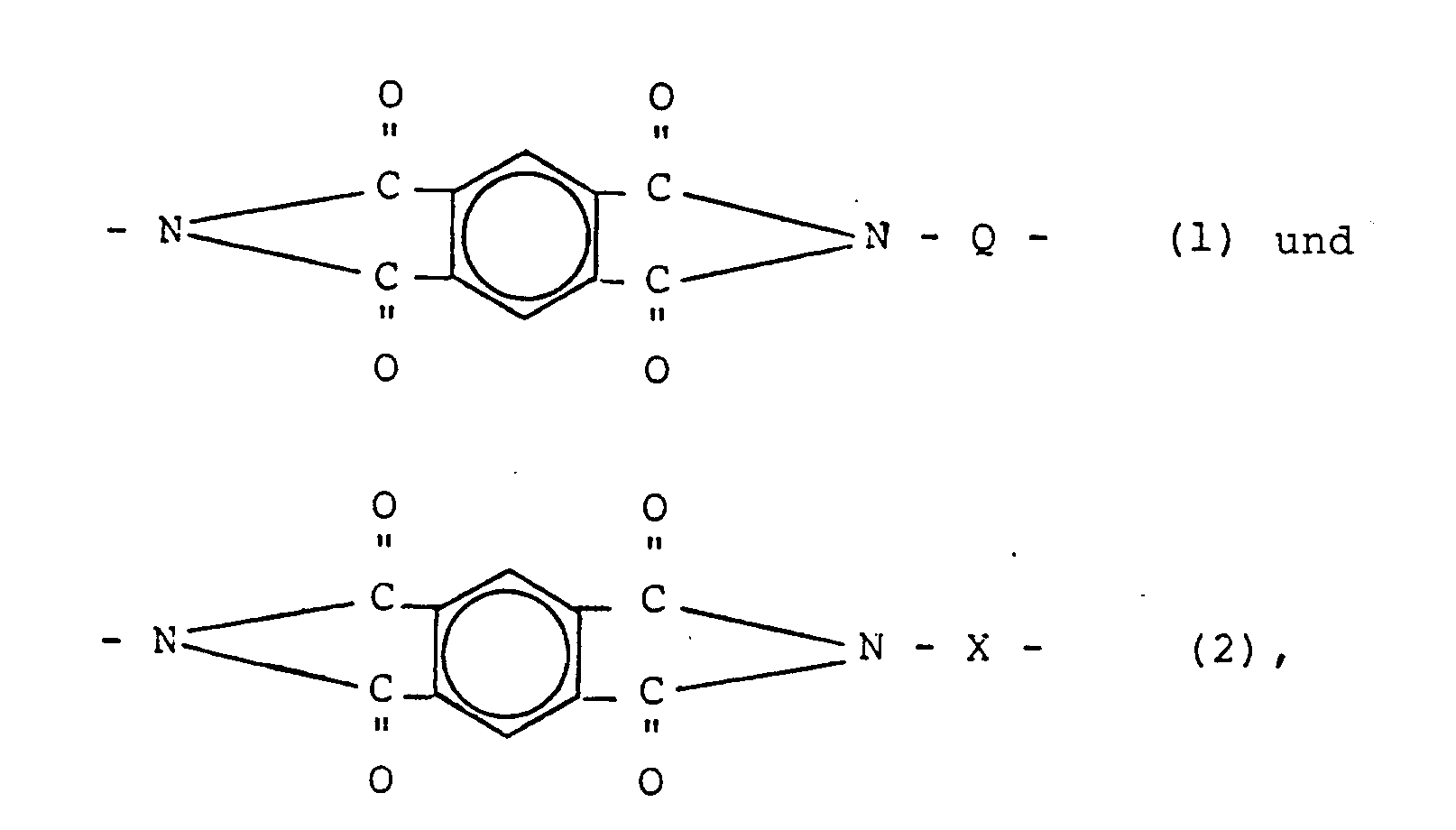

X ein zweiwertiger organischer Rest ist, der durch die folgende Formel (4) repräsentiert wird:

mit der weiteren Maßgabe, daß jeder aromatische Ring außer den aromatischen Ringen, die die anhängenden kovalenten Bindungen tragen, durch Chlor substitutiert sein kann, so lange die Zahl der Chloratome im Molekül 4 nicht übersteigt und die maximale Zahl an Chloratomen pro aromatischer Ring 2 ist;
wobei der Molanteil t der Wiederholungseinheiten der durch Formel (1) repräsentierten Art wenigstens 10 % und der Molanteil u der Wiederholungseinheiten, die durch Formel (2) repräsentiert werden, bis zu 90 % betragen, und wobei der Minimumwert für u derart ist, daß gilt

- Copolyimid nach Anspruch 1, bei welchem Q der zweiwertige Rest ist, der nach Entfernung der Amingruppen von bis(4-Aminophenyl)methan übrigbleibt, und X der zweiwertige Rest ist, der nach Entfernung der Amingruppen von 2,2-bis(4-Aminophenoxyphenyl)propan übrigbleibt.
- Copolyimid nach Anspruch 1, bei welchem Q der zweiwertige Rest ist, der nach Entfernung der Amingruppen von 4,4'-Diaminodiphenylether übrigbleibt und X der zweiwertige Rest ist, der nach Entfernung der Amingruppen von 1,3-bis(3-Aminophenoxy)benzol übrigbleibt.
- Polyimid nach Anspruch 1, worin der zweiwertige Rest Q erhalten wird durch Entfernung der Amingruppen von den folgenden Diaminen:
4,4'-Diaminodiphenylether;
4,4,-Diaminodiphenylmethan;
1,3-Diaminobenzol;
1,4-Diaminobenzol;
1,4-Diaminodiphenylsulfon und
1,4-Diaminodiphenylsulfid. - Polyimid nach Anspruch 1, worin der zweiwertige Rest X erhalten wird durch Entfernung der Amingruppen von den folgenden Diaminen:
1,3-bis(3-Aminophenoxybenzol);
2,2-bis(4-Aminophenoxyphenyl)propan;
2,2-bis(4-Aminophenoxy-3,5-dichlorphenyl)propan;
2-(2,4-Diaminophenoxy)biphenyl und
2-Phenyl-1,4-bis(4-aminophenoxy)benzol. - Vorläuferlösung zur Herstellung eines Polyimids nach Anspruch 1, bestehend aus Pyromellitsäureanhydrid, einem Diamin H₂NQNH₂ und einem Diamin H₂NXNH₂ in einem aprotischen Lösungsmittel und in passenden stöchiometrischen Mengen, um nach vollständiger Reaktion ein Polyimid nach Anpruch 1 zu bilden.
- Vorläuferlösung zur Herstellung eines endverkappten Polyimids nach Anspruch 1, bestehend aus Pyromellitsäureanhydrid, einem Diamin H₂NQNH₂, einem Diamin H₂NXNH₂ und einem Endverkappungsmittel in einem geeigneten Lösungsmittel und in solchen Mengenverhältnissen, daß in der Lösung ein Überschuß von entweder einem Diamin oder Pyromellitsäuredianhydrid vorliegt, und wobei die Menge an Endverkappungsmittel diesem Überschuß etwa stöchiometrisch äquivalent ist.
- Prepreg, bestehend im wesentlichen aus einem faserförmigen Substrat, das mit einer konzentrierten Lösung eines Polyamidvorläufers nach Anspruch 6 oder 7 in einem geeigneten Lösungsmittel imprägniert ist, wobei die Menge an flüchtigen Bestandteilen 25 Gew.-% oder weniger beträgt und der Volumenanteil der Fasern, auf einer von flüchtigen Bestandteilen freien Basis, bis zu 70 % beträgt.
- Prepreg nach Anspruch 8, worin der Gehalt an flüchtigen Bestandteilen 10 bis 20 Gew.-% beträgt.
- Prepreg nach Anspruch 8, worin der Volumenanteil an Fasern, auf einer von flüchtigen Bestandteilen freien Basis, 40 bis 65 % beträgt.
- Gehärtetes Prepreg, erhalten durch Imprägnieren eines faserförmigen Substrats mit einem endverkappten nicht stöchiometrischen geschmolzenen Polyimids nach Anspruch 1.
- Gefüllte Polyimidzusammensetzung, bestehend aus einem Polyimid nach Anspruch 1 und einem faserförmigen oder teilchenförmigen Füllstoff.
- Gefüllte Polyimidzusammensetzung nach Anspruch 12, worin der Füllstoff faserförmig ist und sein Anteil in der Zusammensetzung 5 bis 70 Vol.-% ausmacht.
- Gefüllte Polyimidzusammensetzung nach Anspruch 12, worin der Füllstoff teilchenförmig ist und sein Anteil 5 bis 50 Vol.-% ausmacht.
- Gefüllte Polyimidzusammensetzung nach Anspruch 14, worin der Füllstoffanteil 5 bis 25 Vol.-% beträgt.
- Gefertigter Polyimidgegenstand, hergestellt durch Extrudierung, Formpressen, Gießen, Spritzgießen oder Verstrecken eines Polyimids nach Anspruch 1.
- Gefertigter, gefüllter Polyimidgegenstand, hergestellt durch Formpressen, Extrudieren, Gießen, Spritzgießen oder Verstrecken eines gefüllten Polyimids nach Anspruch 12.
Applications Claiming Priority (2)
| Application Number | Priority Date | Filing Date | Title |
|---|---|---|---|
| US06/728,517 US4725642A (en) | 1985-04-29 | 1985-04-29 | Melt-fusible co-polyimide from diamine mixture |
| US728517 | 2000-11-30 |
Publications (3)
| Publication Number | Publication Date |
|---|---|
| EP0200204A2 EP0200204A2 (de) | 1986-11-05 |
| EP0200204A3 EP0200204A3 (en) | 1988-03-23 |
| EP0200204B1 true EP0200204B1 (de) | 1993-09-01 |
Family
ID=24927172
Family Applications (1)
| Application Number | Title | Priority Date | Filing Date |
|---|---|---|---|
| EP86105894A Expired - Lifetime EP0200204B1 (de) | 1985-04-29 | 1986-04-29 | Heissschmelzbare Copolyimide |
Country Status (5)
| Country | Link |
|---|---|
| US (1) | US4725642A (de) |
| EP (1) | EP0200204B1 (de) |
| JP (1) | JPS61250031A (de) |
| CA (1) | CA1268593A (de) |
| DE (1) | DE3688945T2 (de) |
Families Citing this family (27)
| Publication number | Priority date | Publication date | Assignee | Title |
|---|---|---|---|---|
| US4837300A (en) * | 1985-06-20 | 1989-06-06 | The United States Of America As Represented By The Administration Of The National Aeronautics And Space Administration | Copolyimide with a combination of flexibilizing groups |
| US4847311A (en) * | 1986-04-09 | 1989-07-11 | Mitsui Toatsu Chemicals, Inc. | Polyimide resin composition |
| US5023366A (en) * | 1986-11-05 | 1991-06-11 | Mitsui Toatsu Chemicals, Incorporated | Salicylic acid copolymers and their metal salts, production process thereof, color-developing agents comprising metal salts of the copolymers, and color-developing sheets employing the agents |
| DE3874223T2 (de) * | 1987-05-06 | 1993-04-08 | Mitsui Toatsu Chemicals | Waermehaertbare harzzubereitung. |
| EP0294931B1 (de) * | 1987-05-06 | 1992-09-02 | MITSUI TOATSU CHEMICALS, Inc. | Selbstschmierende wärmehärtbare Harzzubereitung |
| US5288843A (en) * | 1987-05-20 | 1994-02-22 | Mitsui Toatsu Chemicals, Inc. | Polyimides, process for the preparation thereof and polyimide resin compositions |
| US4859530A (en) * | 1987-07-09 | 1989-08-22 | Ethyl Corporation | High temperature adhesive for polymide films |
| US5041520A (en) * | 1988-07-05 | 1991-08-20 | Mitsui Toatsu Chemicals, Inc. | Process for preparing polyimide having excellent high temperature stability |
| CA2002147A1 (en) * | 1988-11-07 | 1990-05-07 | Shuichi Morikawa | Production process for polyimide fibers |
| US5196506A (en) * | 1989-11-17 | 1993-03-23 | Mitsui Toatsu Chemicals, Inc. | Polymide |
| US5268447A (en) * | 1990-06-01 | 1993-12-07 | Mitsui Toatsu Chemicals, Inc. | Readily processable polyimide and preparation process of same |
| US5177180A (en) * | 1990-08-07 | 1993-01-05 | General Electric Company | High temperature mixed polyimides and composites formed therefrom |
| US5231160A (en) * | 1990-09-07 | 1993-07-27 | Mitsui Toatsu Chemicals, Incorporated | Aromatic diamine compound, preparation process of same and polyimide prepared from same |
| JP2748995B2 (ja) * | 1990-11-26 | 1998-05-13 | 三井東圧化学株式会社 | 溶融成形用ポリイミドおよびその製造方法ならびにその樹脂組成物 |
| JPH055033A (ja) * | 1990-11-28 | 1993-01-14 | Mitsui Toatsu Chem Inc | 熱安定性の良好なポリイミドおよびその製造方法 |
| DE69218050T2 (de) * | 1991-06-10 | 1997-10-09 | Mitsui Toatsu Chemicals | Polyimid und Verfahren zur Herstellung |
| US5276133A (en) * | 1991-06-14 | 1994-01-04 | Mitsui Toatsu Chemicals, Inc. | Favorably processable polyimide and process for preparing polyimide |
| KR950013539B1 (ko) * | 1991-11-13 | 1995-11-08 | 재단법인한국화학연구소 | 폴리이미드 공중합체 및 그 제조방법 |
| US5248319A (en) * | 1992-09-02 | 1993-09-28 | E. I. Du Pont De Nemours And Company | Gas separation membranes made from blends of aromatic polyamide, polymide or polyamide-imide polymers |
| US5266100A (en) * | 1992-09-02 | 1993-11-30 | E. I. Du Pont De Nemours And Company | Alkyl substituted polyimide, polyamide and polyamide-imide gas separation membranes |
| US5478913A (en) * | 1993-12-22 | 1995-12-26 | E. I. Du Pont De Nemours And Company | Melt-processible polyimides with high Tg |
| US5688848A (en) * | 1996-10-25 | 1997-11-18 | General Electric Company | Polyimide composition and polyimide composite |
| US20070224422A1 (en) * | 2006-03-25 | 2007-09-27 | Youssef Fakhreddine | Colorfast dyed poly ether imide articles including fiber |
| US20080006970A1 (en) * | 2006-07-10 | 2008-01-10 | General Electric Company | Filtered polyetherimide polymer for use as a high heat fiber material |
| US9416465B2 (en) * | 2006-07-14 | 2016-08-16 | Sabic Global Technologies B.V. | Process for making a high heat polymer fiber |
| KR102111093B1 (ko) | 2013-08-26 | 2020-05-15 | 삼성전자주식회사 | 폴리(이미드-아미드) 코폴리머, 폴리(이미드-아미드) 코폴리머의 제조 방법, 및 상기 폴리(이미드-아미드)를 포함하는 성형품 |
| KR102110520B1 (ko) | 2013-08-26 | 2020-05-14 | 삼성전자주식회사 | 폴리(이미드-아미드) 코폴리머, 및 폴리(이미드-아미드) 코폴리머를 포함하는 조성물 |
Family Cites Families (15)
| Publication number | Priority date | Publication date | Assignee | Title |
|---|---|---|---|---|
| US3234181A (en) * | 1961-03-15 | 1966-02-08 | Du Pont | Melt-fabricable end-capped aromatic polymides |
| US3959350A (en) * | 1971-05-17 | 1976-05-25 | E. I. Du Pont De Nemours And Company | Melt-fusible linear polyimide of 2,2-bis(3,4-dicarboxyphenyl)-hexafluoropropane dianhydride |
| US3845018A (en) * | 1973-04-03 | 1974-10-29 | Hughes Aircraft Co | Acetylene substituted polyamide oligomers |
| JPS5176977A (de) * | 1974-12-27 | 1976-07-03 | Hitachi Ltd | |
| US4017459A (en) * | 1975-09-19 | 1977-04-12 | The Upjohn Company | Polyamide-imides |
| CH621768A5 (de) * | 1976-06-15 | 1981-02-27 | Ciba Geigy Ag | |
| US4336175A (en) * | 1980-10-01 | 1982-06-22 | E. I. Du Pont De Nemours And Company | Polyimide precursor solutions |
| JPS57181146A (en) * | 1981-04-30 | 1982-11-08 | Hitachi Ltd | Resin-sealed semiconductor device |
| JPS58149916A (ja) * | 1981-11-18 | 1983-09-06 | Hitachi Ltd | ポリアミド酸及びポリイミドの製造方法 |
| JPS58157190A (ja) * | 1982-03-12 | 1983-09-19 | 日立化成工業株式会社 | フレキシブル印刷回路用基板の製造法 |
| JPS59157319A (ja) * | 1983-02-22 | 1984-09-06 | Agency Of Ind Science & Technol | 高弾性率の全芳香族ポリイミド成型物の製造法 |
| JPS59170122A (ja) * | 1983-03-14 | 1984-09-26 | イ−・アイ・デユポン・デ・ニモアス・アンド・カンパニ− | 溶融−融合可能なポリイミド |
| US4485140A (en) * | 1983-09-21 | 1984-11-27 | E. I. Du Pont De Nemours And Company | Melt-fusible polyimides |
| US4576857A (en) * | 1983-03-14 | 1986-03-18 | E. I. Du Pont De Nemours And Company | Melt-fusible polyimides |
| JPS60203638A (ja) * | 1984-03-29 | 1985-10-15 | Nitto Electric Ind Co Ltd | ポリイミドフイルム |
-
1985
- 1985-04-29 US US06/728,517 patent/US4725642A/en not_active Expired - Lifetime
-
1986
- 1986-04-22 CA CA000507231A patent/CA1268593A/en not_active Expired
- 1986-04-28 JP JP61097065A patent/JPS61250031A/ja active Pending
- 1986-04-29 DE DE86105894T patent/DE3688945T2/de not_active Expired - Fee Related
- 1986-04-29 EP EP86105894A patent/EP0200204B1/de not_active Expired - Lifetime
Also Published As
| Publication number | Publication date |
|---|---|
| EP0200204A3 (en) | 1988-03-23 |
| DE3688945T2 (de) | 1994-04-07 |
| CA1268593A (en) | 1990-05-01 |
| EP0200204A2 (de) | 1986-11-05 |
| US4725642A (en) | 1988-02-16 |
| JPS61250031A (ja) | 1986-11-07 |
| DE3688945D1 (de) | 1993-10-07 |
Similar Documents
| Publication | Publication Date | Title |
|---|---|---|
| US4725642A (en) | Melt-fusible co-polyimide from diamine mixture | |
| US4576857A (en) | Melt-fusible polyimides | |
| US4485140A (en) | Melt-fusible polyimides | |
| CA2046795A1 (en) | High temperature mixed polyimides and composites formed therefrom | |
| US4454310A (en) | Polyamide acid, process for producing same and polyimide obtained therefrom | |
| JP5027416B2 (ja) | 芳香族ポリアミド酸及びポリイミド | |
| US5061784A (en) | Polymers prepared from 4,4'-bis(3,4-dicarboxyphenyl) hexafluoroisopropyl) diphenyl dianhydride | |
| JP2597183B2 (ja) | 末端変性イミドオリゴマー組成物 | |
| WO1991004300A1 (en) | Miscible blends of polybenzimidazoles and polyamide-imides having fluorine-containing linking groups | |
| US4978737A (en) | Copolyimides derived from 2,2-bis (amino phenyl) hexofluoropropane | |
| EP0304913A2 (de) | Endgruppen modifiziertes Imidoligomer und es enthaltende Lösungszusammensetzung | |
| JPH0632854A (ja) | 末端変性イミドオリゴマーの組成物 | |
| EP0361413A1 (de) | Copolyimide aus 2-(3-Aminophenyl)-2-(4-aminophenyl)-hexafluorpropan | |
| US4978742A (en) | Polymers prepared from 2-(3-aminophenyl)-2-(4-aminophenyl) hexafluoro propane | |
| US5025089A (en) | Copolyimides derived from 2,2-bis (amino phenyl) hexafluoropropane | |
| US3554969A (en) | Polyamide acids and polyimides prepared from a mixture of polycarboxylic acid anhydrides | |
| JP2882114B2 (ja) | 末端変性イミドオリゴマ−組成物 | |
| US5162454A (en) | Polyamide-polyimide block copolymers | |
| JPH082962B2 (ja) | 芳香族ポリチオエーテルイミドの製造方法 | |
| JP2910796B2 (ja) | ポリアミック酸共重合体及びそれからなるポリイミドフィルム並びにそれらの製造方法 | |
| JP4907142B2 (ja) | 芳香族ポリアミド酸、ポリイミド及び配線基板用積層体 | |
| JPH0470332B2 (de) | ||
| JPH05301960A (ja) | 熱硬化性オリゴマー及びその製造方法 | |
| JPH07100693B2 (ja) | 不飽和イミド化合物 | |
| JPH0551455A (ja) | 熱硬化性樹脂組成物 |
Legal Events
| Date | Code | Title | Description |
|---|---|---|---|
| PUAI | Public reference made under article 153(3) epc to a published international application that has entered the european phase |
Free format text: ORIGINAL CODE: 0009012 |
|
| AK | Designated contracting states |
Kind code of ref document: A2 Designated state(s): DE FR GB IT |
|
| PUAL | Search report despatched |
Free format text: ORIGINAL CODE: 0009013 |
|
| AK | Designated contracting states |
Kind code of ref document: A3 Designated state(s): DE FR GB IT |
|
| 17P | Request for examination filed |
Effective date: 19880923 |
|
| 17Q | First examination report despatched |
Effective date: 19900212 |
|
| GRAA | (expected) grant |
Free format text: ORIGINAL CODE: 0009210 |
|
| AK | Designated contracting states |
Kind code of ref document: B1 Designated state(s): DE FR GB IT |
|
| REF | Corresponds to: |
Ref document number: 3688945 Country of ref document: DE Date of ref document: 19931007 |
|
| ITF | It: translation for a ep patent filed | ||
| ET | Fr: translation filed | ||
| PLBE | No opposition filed within time limit |
Free format text: ORIGINAL CODE: 0009261 |
|
| STAA | Information on the status of an ep patent application or granted ep patent |
Free format text: STATUS: NO OPPOSITION FILED WITHIN TIME LIMIT |
|
| 26N | No opposition filed | ||
| PGFP | Annual fee paid to national office [announced via postgrant information from national office to epo] |
Ref country code: FR Payment date: 20000309 Year of fee payment: 15 |
|
| PGFP | Annual fee paid to national office [announced via postgrant information from national office to epo] |
Ref country code: GB Payment date: 20000316 Year of fee payment: 15 |
|
| PGFP | Annual fee paid to national office [announced via postgrant information from national office to epo] |
Ref country code: DE Payment date: 20000318 Year of fee payment: 15 |
|
| PG25 | Lapsed in a contracting state [announced via postgrant information from national office to epo] |
Ref country code: GB Free format text: LAPSE BECAUSE OF NON-PAYMENT OF DUE FEES Effective date: 20010429 |
|
| PG25 | Lapsed in a contracting state [announced via postgrant information from national office to epo] |
Ref country code: FR Free format text: THE PATENT HAS BEEN ANNULLED BY A DECISION OF A NATIONAL AUTHORITY Effective date: 20010430 |
|
| GBPC | Gb: european patent ceased through non-payment of renewal fee |
Effective date: 20010429 |
|
| PG25 | Lapsed in a contracting state [announced via postgrant information from national office to epo] |
Ref country code: DE Free format text: LAPSE BECAUSE OF NON-PAYMENT OF DUE FEES Effective date: 20020201 |
|
| REG | Reference to a national code |
Ref country code: FR Ref legal event code: ST |
|
| PG25 | Lapsed in a contracting state [announced via postgrant information from national office to epo] |
Ref country code: IT Free format text: LAPSE BECAUSE OF NON-PAYMENT OF DUE FEES;WARNING: LAPSES OF ITALIAN PATENTS WITH EFFECTIVE DATE BEFORE 2007 MAY HAVE OCCURRED AT ANY TIME BEFORE 2007. THE CORRECT EFFECTIVE DATE MAY BE DIFFERENT FROM THE ONE RECORDED. Effective date: 20050429 |