EP0201244A2 - Schliessvorrichtung - Google Patents
Schliessvorrichtung Download PDFInfo
- Publication number
- EP0201244A2 EP0201244A2 EP86303096A EP86303096A EP0201244A2 EP 0201244 A2 EP0201244 A2 EP 0201244A2 EP 86303096 A EP86303096 A EP 86303096A EP 86303096 A EP86303096 A EP 86303096A EP 0201244 A2 EP0201244 A2 EP 0201244A2
- Authority
- EP
- European Patent Office
- Prior art keywords
- latch
- bolt
- door
- base plate
- assembly
- Prior art date
- Legal status (The legal status is an assumption and is not a legal conclusion. Google has not performed a legal analysis and makes no representation as to the accuracy of the status listed.)
- Ceased
Links
Images

Classifications
-
- E—FIXED CONSTRUCTIONS
- E05—LOCKS; KEYS; WINDOW OR DOOR FITTINGS; SAFES
- E05B—LOCKS; ACCESSORIES THEREFOR; HANDCUFFS
- E05B15/00—Other details of locks; Parts for engagement by bolts of fastening devices
- E05B15/02—Striking-plates; Keepers; Bolt staples; Escutcheons
-
- E—FIXED CONSTRUCTIONS
- E05—LOCKS; KEYS; WINDOW OR DOOR FITTINGS; SAFES
- E05B—LOCKS; ACCESSORIES THEREFOR; HANDCUFFS
- E05B17/00—Accessories in connection with locks
- E05B17/20—Means independent of the locking mechanism for preventing unauthorised opening, e.g. for securing the bolt in the fastening position
- E05B17/2084—Means to prevent forced opening by attack, tampering or jimmying
- E05B17/2088—Means to prevent disengagement of lock and keeper
-
- E—FIXED CONSTRUCTIONS
- E05—LOCKS; KEYS; WINDOW OR DOOR FITTINGS; SAFES
- E05B—LOCKS; ACCESSORIES THEREFOR; HANDCUFFS
- E05B65/00—Locks or fastenings for special use
- E05B65/10—Locks or fastenings for special use for panic or emergency doors
- E05B65/1046—Panic bars
Definitions
- This invention relates to a latching device for a door or like closure member comprising a latch-bolt assembly and a mated strike assembly, wherein the latch-bolt assembly comprises a base plate and a latch-bolt mechanism including a latch-bolt, together with means for securing the mechanism on the base plate, and wherein the strike assembly comprises a front plate having a recess for receiving the latch of the latch-bolt mechanism, means being provided for securing the base plate of the latch-bolt assembly to a door or like closure member and for securing the front plate of the strike assembly to a frame for such door or like closure member.
- fire doors which preferably are to remain locked during a fire oftentimes spring open due to distortion of the door or door frame member, permitting the latch-bolt to disengage from the strike assembly.
- distortion and disengagement of door members can occur when excessive force is applied to a door member such as a result of the force of water being applied from a fire hose during a fire.
- U.S. Patent No. 2,709,612 is directed to a latching device for use on an automobile door to prevent accidental opening of the door by distortion of the car frame.
- the disclosed device includes provisions for a door member which projects beyond a free or non-hinged edge of the door and cooperating socket means in a door jamb for reception of the door member when the door is closed.
- the outer free or projecting end of the door member is offset from its root portion in a direction vertically and/or inwardly with respect to the cooperating door jamb to provide an overhang and the socket means is correspondingly formed in the jamb to receive the offset door member.
- the device includes a lug or dovetail member secured to the free end of the door so as to project outwardly beyond and away from such edge a short distance, this member being adapted and arranged for reception in a cooperating socket member in the frame.
- U.S. Patent No. 4,401,330 discloses a latching device for securing or maintaining secured a closure such as a door when the door members are subjected to thermal distortion caused by a fire.
- the opening or disengagement of the primary latching device is caused because the door frame member such as a mullion which retains the door strike is fixed at its lower end to the floor and at the upper end to the ceiling.
- the door frame member such as a mullion which retains the door strike is fixed at its lower end to the floor and at the upper end to the ceiling.
- the door member cannot expand, thus causing distortion and deformation and subsequent disengagement of the primary latching device.
- To avoid opening of the door it is proposed in this patent to provide an additional latching device which under normal conditions is always in disengagement but upon elongation due to thermal forces will become engaged and retain the door and door frame such as a mullion in locking relation.
- U.S. Patent No. 4,437,693 discloses a latching device having a cover which melts upon the presence of excessive heat as on the occurrence of fire, thereby allowing a blocking plate to slide into operative position to prevent retraction of the latch-bolt and consequently preventing unlatching of the device.
- the base plate has two projections arranged one at each side of the latch-bolt of the latch-bolt mechanism and extending from the base plate in the direction of movement of the door towards the frame, and the front plate of the strike assembly has corresponding recesses formed therein for receiving, said projections when the door is closed, said recesses thus being arranged at opposite sides of the recess for receiving the latch-bolt.
- the projections when the latching device in accordance with the invention is installed, in the event of a fire or other major distorting force, the projections, while being free to permit limited movement in a vertical direction, will restrict linear extension of the frame in the region of the latching device by engagement of the projections with the walls of the recesses, thereby preventing excessive strain from occurring on the latch-bolt which could cause disengagement of the latch-bolt from the strike assembly. Additionally, the projections in the recesses will limit the lateral movement of the strike assembly and door frame member away from the latch-bolt assembly. The rigid face of the latch-bolt assembly will also limit inward movement of the strike assembly and door frame member towards the latch-bolt assembly.
- the latch-bolt assembly is prevented from becoming disengaged from the strike assembly even when subjected to major forces such as thermal forces caused by a fire, or other physical forces such as an impact from a collision or the like.
- the latching device in accordance with the present invention has application primarily with an outwardly opening door where the latch-bolt assembly is applied to one surface of the door.
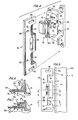
- Figs. 1 to 3 illustrate a door 10 and door frame 20 in which is installed a latching device in accordance with the invention and generally designated 12.
- the device 12 comprises a housing 14 mounted on one surface 10a of the door 10, said housing accommodating a latch-bolt assembly generally designated 30 and being closed by a cover 16 for enclosing the latch-bolt assembly 30 in said housing.
- a push-bar ' 18 is also provided for actuating or releasing a latch 32 of the latch-bolt assembly 30 and in addition, as seen in Fig.
- a knob 19 is positioned at an opposite surface 10b of the door 10, with the actuating mechanism therefor extending through the door also for releasing or actuating the latch 32.
- the latching device also comprises a strike assembly 50 which is anchored to the door frame or mullion 20 for cooperation with the latch-bolt assembly 30. (It will be understood that although the assembly illustrated includes a knob 19, it may be preferable to simply use an internal lock mechanism, permitting the door to be opened from the outside with a key. At other times it may be desirable not to have either a knob or key mechanism. These aspects are not significant to the presently disclosed and claimed invention.)
- the latch-bolt assembly 30 of the latching device 12 comprises- a base plate 31 having projections or lugs 34, 36 extending therefrom in the direction of movement of the door 10 towards the frame member 20. It will be appreciated that the base plate 31 can be constructed integrally with said lugs or projections 34, 36 as a unitized structure from a rigid metal.
- a plurality of mounting holes 38 is provided in the base plate for receiving fasteners 37 (Fig. 5) which are screwed or otherwise secured in the door 10.
- a reinforcing plate 10c is provided through which the fasteners 37 pass.
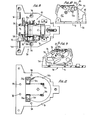
- the base plate 31 has mounting holes therein which are positioned on each side of, and symmetrically arranged in relation to, the pivot pin 35 (Figs. 8 and 9), providing enhanced support whereby twisting of the latch-bolt assembly may be prevented in the event of a major force such as a fire at a critical point.
- a latch-bolt mechanism 40 which comprises a main latch-bolt 32 and an auxiliary latch-bolt 33, both mounted for pivoting movement on a pivot pin 35 having associated therewith a return spring 35a.
- the auxiliary latch-bolt 33 serves a dead-locking function, as described in US-A 3,877,262.
- the latch-bolt 32 has a pin 32a projecting from each side thereof and spaced from the pivot pin 35, which pin rides in arcuate slots 32b (Figs. 9 and 10) provided therefor in upstanding support plate portions 42 which form part of the latch-bolt mechanism 40, which are secured to the base plate 31, and in which the pivot pin 35 is also captive.
- the pins 32a, riding in the slots 32b prevent cocking of the latch-bolt 32 in the support plate portions in the event of a major force such as a fire.
- the support plate portions 42 of the latch-bolt mechanism 40 are secured to the base plate 31 by means of stakes 31a which extend downwardly through openings in the base plate and are bent over beneath the base plate.
- the base plate 31 has in its under-side a recess 31b, so that the bent-over portions lie flush with the surface of the base plate 31 surrounding said recess 31b. Additional anchoring of the support plate portions 42 to the base plate 31 is provided at 31c (Fig. 11).
- the stakes 31a are secured to the under-side of the base plate 31 by means of screws 31d which thus prevent the breaking away of the latch-bolt mechanism 40 from the base plate 31, again in the event of a major force such as a fire.
- the strike assembly 50 comprises a front plate 52 having a plurality of holes and slots 58 for mounting the strike assembly to the door frame 20 by means of fasteners 57 (Figs. 6 and 7) screwed or otherwise secured to the door frame 20.
- the latter is reinforced by a reinforcing plate 20a through which said fasteners 57 pass.
- the front plate 52 is provided with recesses 54, 56 for receiving the projections 34, 36 of the latch-bolt assembly 30 when the door 10 is moved to its closed condition. As illustrated in Figs.
- the recesses 54, 56 are wider than the projections 34, 36, permitting limited vertical movement of the projections in the recesses, while the depth of the recesses 54, 56 is not substantially greater than the thickness of the projections 34, 36,.thereby limiting lateral movement.
- the front plate 52 also comprises, at the side thereof opposite the recesses 54,56 and arranged centrally therebetween, a slot 51 and a ramp 53 for receiving and retaining the latch-bolt 32 when the door 10 is in its closed condition, thereby holding it in its closed condition.
- the front plate 52 of the strike assembly 50 is also of unitized construction from a rigid metal.
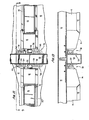
- Figs. 12 and 13 are views similar to the views of Figs. 2 and 3, except that in Figs. 12 and 13 a double door installation is illustrated, each door 10 thereof being provided with a latching device in accordance with the invention, and the strike assemblies 50 of said devices being attached to opposite surfaces of the mullion 20.
- the latch-bolt 32 locks the door 10 to the door frame 20 by engagement with the slot 51 and ramp 53 (see Fig. 6).
- the projections 34, 36 are spaced from the side walls of the recesses 54, 56 by the distance x, thus permitting limited vertical movement of the door 10 in relation to the door frame 20 (see Fig. 5).
- the projections 34, 36 are spaced from the surface of the reinforcing plate 20a and from the bottom wall of the recesses 54,56 respectively by the distances y and z, thus permitting limited lateral movement of the door 10 in relation to the door frame 20 (see Fig. 7).
- the latching device in accordance with the invention functions in a similar manner to any conventional latching device comprising mated latch-bolt and strike assemblies.
- projections 34, 36 on the base plate 31 prevent the door 10 from separating from the door frame 20 by engagement with the walls of the recesses 54, 56 of the strike assembly 50, thereby forcing the door 10 to move with the door frame member 20 in the same relative manner, by restricting linear extension of the door frame 20 in said region and by preventing excessive strain from occurring on the latch-bolt 32 and other components of the latch-bolt assembly as a result of the raised portions of the front plate 52 of the strike assembly 50 forcibly engaging the sides of the latch-bolt 32.
- This restriction also prevents the auxiliary latch-bolt 33 from becoming disengaged from the appropriate surface portion of the front plate 52, which disengagement would allow the dead-locking of the latch-bolt 32 to become inoperative.
- the projections 34,36 of the base plate 31 limit lateral movement of the strike assembly 50 and door frame 20 away from the latch-bolt assembly 30 and the rigid face of the base plate 31 of the latch-bolt assembly limits inward movement of the strike assembly 50 and door frame member 20 towards the latch-bolt assembly 30, thereby stabilizing the latching device.
Landscapes
- Business, Economics & Management (AREA)
- Emergency Management (AREA)
- Special Wing (AREA)
- Connector Housings Or Holding Contact Members (AREA)
- Lock And Its Accessories (AREA)
- Preventing Unauthorised Actuation Of Valves (AREA)
Applications Claiming Priority (2)
| Application Number | Priority Date | Filing Date | Title |
|---|---|---|---|
| US72919885A | 1985-05-01 | 1985-05-01 | |
| US729198 | 1985-05-01 |
Publications (2)
| Publication Number | Publication Date |
|---|---|
| EP0201244A2 true EP0201244A2 (de) | 1986-11-12 |
| EP0201244A3 EP0201244A3 (de) | 1988-02-03 |
Family
ID=24929991
Family Applications (1)
| Application Number | Title | Priority Date | Filing Date |
|---|---|---|---|
| EP86303096A Ceased EP0201244A3 (de) | 1985-05-01 | 1986-04-24 | Schliessvorrichtung |
Country Status (8)
| Country | Link |
|---|---|
| EP (1) | EP0201244A3 (de) |
| JP (1) | JPS61282569A (de) |
| KR (1) | KR900002461B1 (de) |
| CN (1) | CN86103132A (de) |
| AU (1) | AU580159B2 (de) |
| BR (1) | BR8602145A (de) |
| IL (1) | IL78588A0 (de) |
| ZA (1) | ZA863017B (de) |
Cited By (3)
| Publication number | Priority date | Publication date | Assignee | Title |
|---|---|---|---|---|
| EP0611859A3 (de) * | 1993-02-13 | 1994-11-02 | Hardware & Systems Patents Ltd | Sicherheitsbeschlag. |
| WO2002059443A1 (en) | 2001-01-25 | 2002-08-01 | Cisa S.P.A. | Rotating spring-latch lock and corresponding selvage |
| EP1505230A1 (de) * | 2003-08-06 | 2005-02-09 | CISA S.p.A. | Schloss mit Drehfalle |
Families Citing this family (2)
| Publication number | Priority date | Publication date | Assignee | Title |
|---|---|---|---|---|
| AU657828B2 (en) * | 1992-01-09 | 1995-03-23 | Richard Dillon | Security apparatus |
| BE1020811A3 (nl) * | 2012-05-07 | 2014-05-06 | Parys Remi E Van | Paniekslot. |
Family Cites Families (7)
| Publication number | Priority date | Publication date | Assignee | Title |
|---|---|---|---|---|
| US1473076A (en) * | 1922-02-06 | 1923-11-06 | Ralph S Bonilla | Lock |
| US3298729A (en) * | 1965-04-23 | 1967-01-17 | Russell | Mortise lock low friction case liner |
| AU445489B2 (en) * | 1970-07-22 | 1974-02-06 | Meyers Taylor Pty. Ltd | Improvements in and relating to locks |
| US3963269A (en) * | 1974-07-25 | 1976-06-15 | Rosenberg Sheldon R | Security device |
| AU545891B2 (en) * | 1980-06-03 | 1985-08-08 | Hunter Douglas Ltd. | Security door lock |
| US4458928A (en) * | 1981-03-24 | 1984-07-10 | Adams Rite Manufacturing Co. | Rim type panic exit actuator |
| JPS5853158A (ja) * | 1981-09-25 | 1983-03-29 | Furukawa Battery Co Ltd:The | 蓄電池用鉛基合金材の加工法 |
-
1986
- 1986-04-22 ZA ZA863017A patent/ZA863017B/xx unknown
- 1986-04-22 IL IL78588A patent/IL78588A0/xx unknown
- 1986-04-24 EP EP86303096A patent/EP0201244A3/de not_active Ceased
- 1986-04-30 KR KR1019860003368A patent/KR900002461B1/ko not_active Expired
- 1986-04-30 BR BR8602145A patent/BR8602145A/pt not_active IP Right Cessation
- 1986-04-30 AU AU56854/86A patent/AU580159B2/en not_active Ceased
- 1986-04-30 CN CN198686103132A patent/CN86103132A/zh active Pending
- 1986-05-01 JP JP61101875A patent/JPS61282569A/ja active Pending
Cited By (3)
| Publication number | Priority date | Publication date | Assignee | Title |
|---|---|---|---|---|
| EP0611859A3 (de) * | 1993-02-13 | 1994-11-02 | Hardware & Systems Patents Ltd | Sicherheitsbeschlag. |
| WO2002059443A1 (en) | 2001-01-25 | 2002-08-01 | Cisa S.P.A. | Rotating spring-latch lock and corresponding selvage |
| EP1505230A1 (de) * | 2003-08-06 | 2005-02-09 | CISA S.p.A. | Schloss mit Drehfalle |
Also Published As
| Publication number | Publication date |
|---|---|
| AU5685486A (en) | 1986-11-06 |
| KR860009206A (ko) | 1986-12-20 |
| IL78588A0 (en) | 1986-08-31 |
| AU580159B2 (en) | 1989-01-05 |
| CN86103132A (zh) | 1986-11-05 |
| ZA863017B (en) | 1986-12-30 |
| BR8602145A (pt) | 1987-01-13 |
| JPS61282569A (ja) | 1986-12-12 |
| EP0201244A3 (de) | 1988-02-03 |
| KR900002461B1 (ko) | 1990-04-16 |
Similar Documents
| Publication | Publication Date | Title |
|---|---|---|
| US3963269A (en) | Security device | |
| US5544924A (en) | Security mechanism for securing a movable closure | |
| US4283882A (en) | Safety flush bolt entrance door system | |
| US4747629A (en) | Emergency exit lock device | |
| US6058745A (en) | Cover for padlocks | |
| US4435921A (en) | Safety door | |
| US4097078A (en) | Door lock for automotive vehicle | |
| US20230349206A1 (en) | Gate latch | |
| US6131338A (en) | Removable mullion assembly | |
| US5785365A (en) | Anti-snagging striker | |
| GB2296938A (en) | Self-tightening side lock for a roll-up door | |
| GB2287978A (en) | Security bolt | |
| US5360246A (en) | Latch plate for storage lockers | |
| US5280976A (en) | Door security device | |
| US4257633A (en) | Security device | |
| JPS61282569A (ja) | 緊急出口ロツク装置 | |
| WO2004013437A9 (en) | A pivotal bolt | |
| GB2062084A (en) | A Device to Prevent Unauthorised Opening of a Door Having an Espagnolette Closure Such as the Door of a Lorry | |
| US6254149B1 (en) | Live bolt latching and releasing system | |
| US4830415A (en) | Door latching mechanism for roll-up doors | |
| US5280977A (en) | Auxiliary door lock | |
| HUT78079A (hu) | Riasztást kiváltó zárvatartó készülék egy biztosítandó ajtó vagy biztosítandó ablak zár és/vagy zsanér környezetében | |
| IE53361B1 (en) | A fastening means for padlocks and the like | |
| US4580824A (en) | Door lock jamb plate and assembly | |
| WO1998015705A1 (en) | A locking mechanism |
Legal Events
| Date | Code | Title | Description |
|---|---|---|---|
| PUAI | Public reference made under article 153(3) epc to a published international application that has entered the european phase |
Free format text: ORIGINAL CODE: 0009012 |
|
| AK | Designated contracting states |
Kind code of ref document: A2 Designated state(s): DE FR GB IT NL SE |
|
| PUAL | Search report despatched |
Free format text: ORIGINAL CODE: 0009013 |
|
| AK | Designated contracting states |
Kind code of ref document: A3 Designated state(s): DE FR GB IT NL SE |
|
| 17P | Request for examination filed |
Effective date: 19880707 |
|
| 17Q | First examination report despatched |
Effective date: 19890420 |
|
| RAP1 | Party data changed (applicant data changed or rights of an application transferred) |
Owner name: EMHART INDUSTRIES, INC. |
|
| STAA | Information on the status of an ep patent application or granted ep patent |
Free format text: STATUS: THE APPLICATION HAS BEEN REFUSED |
|
| 18R | Application refused |
Effective date: 19920330 |
|
| RIN1 | Information on inventor provided before grant (corrected) |
Inventor name: MILLER, THEODORE H. |