EP0201867A2 - Verfahren zur Herstellung eines bipolaren Transistors - Google Patents
Verfahren zur Herstellung eines bipolaren Transistors Download PDFInfo
- Publication number
- EP0201867A2 EP0201867A2 EP86106270A EP86106270A EP0201867A2 EP 0201867 A2 EP0201867 A2 EP 0201867A2 EP 86106270 A EP86106270 A EP 86106270A EP 86106270 A EP86106270 A EP 86106270A EP 0201867 A2 EP0201867 A2 EP 0201867A2
- Authority
- EP
- European Patent Office
- Prior art keywords
- region
- semiconductor layer
- collector
- conductivity type
- base
- Prior art date
- Legal status (The legal status is an assumption and is not a legal conclusion. Google has not performed a legal analysis and makes no representation as to the accuracy of the status listed.)
- Granted
Links
Images











Classifications
-
- H—ELECTRICITY
- H10—SEMICONDUCTOR DEVICES; ELECTRIC SOLID-STATE DEVICES NOT OTHERWISE PROVIDED FOR
- H10D—INORGANIC ELECTRIC SEMICONDUCTOR DEVICES
- H10D10/00—Bipolar junction transistors [BJT]
- H10D10/01—Manufacture or treatment
- H10D10/051—Manufacture or treatment of vertical BJTs
-
- H—ELECTRICITY
- H10—SEMICONDUCTOR DEVICES; ELECTRIC SOLID-STATE DEVICES NOT OTHERWISE PROVIDED FOR
- H10D—INORGANIC ELECTRIC SEMICONDUCTOR DEVICES
- H10D64/00—Electrodes of devices having potential barriers
- H10D64/20—Electrodes characterised by their shapes, relative sizes or dispositions
- H10D64/23—Electrodes carrying the current to be rectified, amplified, oscillated or switched, e.g. sources, drains, anodes or cathodes
- H10D64/231—Emitter or collector electrodes for bipolar transistors
-
- H—ELECTRICITY
- H10—SEMICONDUCTOR DEVICES; ELECTRIC SOLID-STATE DEVICES NOT OTHERWISE PROVIDED FOR
- H10P—GENERIC PROCESSES OR APPARATUS FOR THE MANUFACTURE OR TREATMENT OF DEVICES COVERED BY CLASS H10
- H10P32/00—Diffusion of dopants within, into or out of wafers, substrates or parts of devices
- H10P32/10—Diffusion of dopants within, into or out of semiconductor bodies or layers
- H10P32/14—Diffusion of dopants within, into or out of semiconductor bodies or layers within a single semiconductor body or layer in a solid phase; between different semiconductor bodies or layers, both in a solid phase
- H10P32/1408—Diffusion of dopants within, into or out of semiconductor bodies or layers within a single semiconductor body or layer in a solid phase; between different semiconductor bodies or layers, both in a solid phase from or through or into an external applied layer, e.g. photoresist or nitride layers
- H10P32/1414—Diffusion of dopants within, into or out of semiconductor bodies or layers within a single semiconductor body or layer in a solid phase; between different semiconductor bodies or layers, both in a solid phase from or through or into an external applied layer, e.g. photoresist or nitride layers the applied layer being silicon, silicide or SIPOS, e.g. polysilicon or porous silicon
-
- H—ELECTRICITY
- H10—SEMICONDUCTOR DEVICES; ELECTRIC SOLID-STATE DEVICES NOT OTHERWISE PROVIDED FOR
- H10P—GENERIC PROCESSES OR APPARATUS FOR THE MANUFACTURE OR TREATMENT OF DEVICES COVERED BY CLASS H10
- H10P32/00—Diffusion of dopants within, into or out of wafers, substrates or parts of devices
- H10P32/10—Diffusion of dopants within, into or out of semiconductor bodies or layers
- H10P32/17—Diffusion of dopants within, into or out of semiconductor bodies or layers characterised by the semiconductor material
- H10P32/171—Diffusion of dopants within, into or out of semiconductor bodies or layers characterised by the semiconductor material being group IV material
-
- H—ELECTRICITY
- H10—SEMICONDUCTOR DEVICES; ELECTRIC SOLID-STATE DEVICES NOT OTHERWISE PROVIDED FOR
- H10P—GENERIC PROCESSES OR APPARATUS FOR THE MANUFACTURE OR TREATMENT OF DEVICES COVERED BY CLASS H10
- H10P76/00—Manufacture or treatment of masks on semiconductor bodies, e.g. by lithography or photolithography
- H10P76/40—Manufacture or treatment of masks on semiconductor bodies, e.g. by lithography or photolithography of masks comprising inorganic materials
-
- H—ELECTRICITY
- H10—SEMICONDUCTOR DEVICES; ELECTRIC SOLID-STATE DEVICES NOT OTHERWISE PROVIDED FOR
- H10W—GENERIC PACKAGES, INTERCONNECTIONS, CONNECTORS OR OTHER CONSTRUCTIONAL DETAILS OF DEVICES COVERED BY CLASS H10
- H10W20/00—Interconnections in chips, wafers or substrates
- H10W20/40—Interconnections external to wafers or substrates, e.g. back-end-of-line [BEOL] metallisations or vias connecting to gate electrodes
- H10W20/41—Interconnections external to wafers or substrates, e.g. back-end-of-line [BEOL] metallisations or vias connecting to gate electrodes characterised by their conductive parts
- H10W20/44—Conductive materials thereof
- H10W20/4451—Semiconductor materials, e.g. polysilicon
Definitions
- the present invention relates to a bipolar transistor used in various semiconductor integrated circuits or the like and a method of manufacturing the same and, more particularly, to a vertical bipolar transistor and a method of manufacturing the same.
- FIG. 27 A typical example of a conventional high-density, high-speed bipolar transistor for a semiconductor IC as described in Electronics Letter, Vol. 19, No. 8, PP. 283 - 284, April 14, 1983 is illustrated in Fig. 27. Referring to Fig.
- reference numeral 1 denotes a p -type silicon substrate; 2, an n-type epitaxial layer constituting a collector region; 3, an n +- type buried layer; 4A to 4E, oxide films; 5, a p +- type channel cut layer; 6, a base region; 7, a base contact region; 8, an emitter region; 9, an intrinsic transistor region (the region surrounded by a broken line); 10, a base metal electrode; 11, an emitter metal electrode; 12,.a collector metal electrode; 13, a polysilicon electrode layer doped with a p-type impurity; 14A and 14B, polysilicon electrode layers containing an n-type impurity; and 15, a nitride film.
- the region 9 is the region indispensable to transistor operation.
- the base, collector and emitter electrodes constituted by polysilicon layers at positions near the region 9 decreases parasitic capacitances and resistances. However, when isolation of the electrodes and mask alignment margins are taken into consideration, the actual transistor size is larger than the region 9.
- the 1- ⁇ m rule is applied to the example in Fig. 27.
- the emitter electrode constituted by the polysilicon layer 14A and the base electrode constituted by the polysilicon layer 13 are self-aligned and formed on the substrate surface adjacent to each other without degrading transistor characteristics, the distance between the emitter and collector electrodes cannot be decreased since it is determined by a photolithographic pattern rule during formation of the underlying films prior to the formation of electrodes.
- Both the junction capacitance between the p -type silicon substrate 1 and the n -type buried layer 3, serving as the collector region, and the area occupied by the transistor as a whole are increased. High-speed operation and high density cannot be achieved.
- a complicated fabrication process is required.
- the npn and pnp transistors are constituted by vertical and lateral transistors, respectively, the electrical characteristics of the pnp transistor are poor.
- bipolar transistor comprising:
- a method of manufacturing a bipolar transistor including at least the steps of: forming a first insulating film as a field insulating film on a semiconductor substrate having a collector region of a first conductivity type; forming a first nondoped semiconductor layer on the first insulating film; oxidizing the first nondoped semiconductor layer except for a part of the collector region to form a second insulating film; doping an impurity of a second conductivity type in part of a region of the first nondoped semiconductor layer, thereby forming a first doped region; partially etching a part of a nondoped portion of the first nondoped semiconductor layer which is adjacent to the first doped region and located on the collector region, thereby forming a groove in the first nondoped semiconductor layer; doping an impurity of the first conductivity type to form a second doped region in a region of the first nondoped semiconductor layer which excludes the first doped region; side-etching
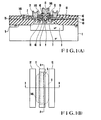
- Figs. 1A shows a vertical npn bipolar transistor according to an embodiment of the present invention when viewed along the line B - B of Fig. 1B and Fig. 1B shows the electrode arrangement thereof.
- the same reference numerals in Figs. 1(A) and 1(B) denote the same parts as in Fig. 27.
- base, collector and emitter electrodes are formed within a single opening defined by an insulating film consisting of an oxide film 4A and a nitride film 15.
- a base electrode connected to a polysilicon layer 13 containing a p-type impurity and a collector electrode connected to a polysilicon layer 14B containing an n-type impurity are formed at edges of the opening.
- An emitter electrode connected to a polysilicon layer 14A containing an n-type impurity is formed between the base and collector electrodes.
- The'base, collector and emitter electrodes are isolated by oxide films 4B, 4D, and 4E. These electrodes are self-aligned in the manner described below.
- the polysilicon layer 14A serves as a diffusion source for forming an emitter region 8.
- the contact widths of the base and collector layers can each be decreased to 0.5 um or less.
- the emitter width can also be easily decreased to 0.5 um or less.
- a collector diffusion layer 16 is formed in the n-type epitaxial layer 2 using the polysilicon layer 14B as a diffusion source.
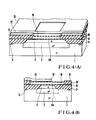
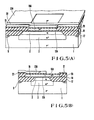
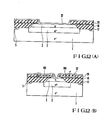
- FIG. 2(A) to 18(A) An example of the fabrication process of the above bipolar transistor is illustrated in Figs. 2(A) to 18(A), in which Figs. 2 (A) , 3(A),... 18(A) correspond to Fig. 1(A) and Figs. 2(B), 3(B),... 18 (B) correspond to the drawings taken along a line A - A of Fig. 1(B).
- a 1- ⁇ m thick n +- type buried layer 3 having an arsenic concentration of 3 x 10 19 atoms/cm 3 , a 1- ⁇ m thick n-type epitaxial layer 2 having a phosphorus concentration of 1 x 10 16 atoms/cm 3 , and a p + -type channel cut layer 5 are formed in a p -type silicon substrate 1 having a resistivity of 30 to 40 ⁇ cm.
- a thick oxide film (SiO 2 film) 17 is formed by LOCOS (Local Oxidation of Silicon) to 0 flatten the surface.
- a 500-A thick oxide film 17A is 0 formed together with the SiO 2 film 17, and 1500-A thick nitride film (Si 3 N 4 film) 18 is then formed over the entire surface (Figs. 2(A) and 2(B)).
- the thin oxide film 17A and the nitride film 18 constitute the field insulating film.
- a 6000- ⁇ thick nondoped polysilicon layer 19 is formed to cover the entire surface of the resultant structure, and an unnecessary region is selectively oxidized to form a 7500-A thick oxide film 20 (Figs. 3(A) 0 0 and 3(B)).
- a 1000-A thick oxide film 21, a 1000-A thick nitride film 22 and a 6000-A thick nondoped polysilicon layer 23 are sequentially formed on the oxide film 20 by CVD (Chemical Vapor Deposition).
- the polysilicon layer 23 and the nitride film 22 are patterned such that one end is located over the n-type epitaxial layer 2 under the thin oxide film 17A to prepare an ion implantation mask (Figs.
- boron ions are implanted as a p-type impurity in the entire surface, they are implanted only in a portion of the polysilicon layer 19 not masked by the polysilicon layer 23 and the nitride film 22, thus forming a boron-doped polysilicon layer 19A having an average boron concentration of 4 x 10 20 atoms/cm 3 .
- the polysilicon layer 23 is also doped with boron ions and converted to boron-doped silicon layer 23A (Figs. 5 (A) and 5(B)). The boron-doped silicon layer 23A is then removed by wet or dry etching.
- the oxide film 21 is side-etched using the nitride film 22 as a mask, so that the surface of the nondoped polysilicon layer 19 is partially exposed.
- the exposed portion is represented by reference numeral 24 (Figs. 6(A) and 6(B)).
- the nondoped polysilicon layer 19 is etched with an etching solution.
- the etching solution is selected such that the etching rate for nondoped polysilicon is about 10 times that for boron-doped polysilicon.
- An example of such an etching solution is potassium hydroxide. This etching forms a 1.5- ⁇ m wide groove 25. The groove 25 determines an active region of the transistor.
- the oxide film 21 is removed (Figs. 7 (A) and 7(B)).
- Thermal oxidation is performed to form a 3000- ⁇ thick oxide film 26.
- a 2- ⁇ m wide window 27 is formed for doping an n-type impurity in the nondoped polysilicon layer 19 (Figs. 8(A) and 8(B)).
- Arsenic or phosphorus as an n-type impurity is ion-implanted or doped by a doped oxide method to convert the nondoped polysilicon layer 19 to an n-type doped polysilicon layer 19B having an impurity concentration of 5 x 10 20 atoms/cm 3 .
- the resultant structure is annealed at a temperature of 900°C for 20 minutes and is oxidized to form an oxide film 28, the thickness of which is about 3000 A.
- a 1500-A nitride film 29 and a 1000-A polysilicon layer 30 are sequentially formed.
- a resist layer (not shown) is formed on the polysilicon layer 30 to sufficiently expose the groove edge portion serving as an active region with respect to the B - B section and to cover the edge of the groove by about 0.5 to 1 ⁇ m with respect to the A - A section.
- a window is formed in the polysilicon layer 30 by a known method such as plasma etching using the resist layer as a mask (Figs. 9(A) and 9(B)).
- 3500 A of the nitride film 29 is side-etched using the polysilicon layer 30 as a mask (Figs. 10(A) and 10(B)), and the polysilicon layer 30 is removed.
- the bottom of the groove serving as the active region is protected by the oxide film 17A, and the polysilicon layers 19A and 19B serving as the base and collector electrodes have not yet been exposed and are protected by the oxide film 28 and the nitride film 18.
- Exposed portions of the nitride films 18 and 2 9 in the groove in the A - A section are etched.
- the nitride film 18 is side-etched, as indicated by reference numerals 31.
- the lower surfaces of the polysilicon layers 19A and 19B serving as the base and 0 collector electrodes are exposed by 2000 A in the B - B section (Fig. 11).
- a 2000-A thick nondoped polysilicon layer 32 is formed by low-pressure CVD on the entire surface to fill the side-etched portions 31 (Figs. 12(A) and 12(B)).
- the silicon layer 32 fills the exposed surface completely, including the side-etched portions 31. Subsequently, the polysilicon layer 32 is removed by isotropic etching. In this case, the side-etched portions 31 are filled by polysilicon layers 32A and 32B in the B - B section. However, the polysilicon layer 32 is not left on the A - A section (Figs. 13(A) and 13(B)). The silicon layer (19A + 32A) is completely isolated from the silicon layer (19B + 32B), as is apparent from Fig. 13B. These layers can be used as independent functional elements as the base and collector electrodes. Therefore, the polysilicon layers as the base and collector electrodes are formed at opposite edges of the single opening. 0
- a 700-A thick oxide film 33 is formed in the inner surface of the groove by thermal oxidation at a temperature of 900°C for 20 minutes.
- impurity ions are diffused from the impurity-doped polysilicon layers 19A and 19B to the nondoped polysilicon layers 32A and 32B contacting the layers 19A and 19B, thereby forming a polysilicon layer 32A' doped with a p-type impurity and a polysilicon layer 32B' doped with an n-type impurity, respectively.
- Boron ions are implanted through the oxide film 33 at an acceleration voltage of 25 keV and a dose of 1.5 x 10 13 ions/cm 2 to form a 2- ⁇ m deep base region 34.
- a 1000-A thick oxide film 35 and a 4500- ⁇ thick polysilicon layer 36 are sequentially formed by CVD to form a self-aligned emitter opening '(Figs. 14(A) and 14(B)).
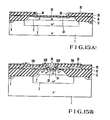
- the polysilicon layer 36 is removed by an anisotropic etching technique such as RIE (Reactive Ion Etching) to leave portions only on groove side walls (Figs. 15 (A) and 15 (B)) ("Reactive Ion Etching of Aluminum using SiCl 4 ", Journal of Vacuum Science & Technology, Vol. 20, 1982, pp. 186 - 190).
- the oxide films 35 and 33 are sequentially etched by a combination of anisotropic etching and wet etching (for removing the damage inflicted by anisotropic etching) to form an opening and expose a silicon surface portion of the base region 34.
- the oxide films 35 and 33 are anisotropically etched by about 1300 ⁇ and then completely removed by wet etching.
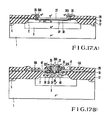
- a 3000-A thick arsenic-doped polysilicon layer 37 having a concentration of 1 x 10 21 atoms/cm 3 is formed to cover the entire surface (Figs. 16(A) and 16(B)). An excess portion of the polysilicon layer 37 is removed by dry etching.
- the resultant structure is then annealed to diffuse the n-type impurity from the polysilicon layer 37 into the monocrystalline silicon of the base region 34, thereby forming a 0.1-pm deep emitter diffusion region 38.
- the polysilicon layers 19B and 32B act as diffusion sources to form a collector contact diffusion region 39.
- the polysilicon layers 19A and 32A act as diffusion sources to form a base contact region 40.
- Arsenic is also diffused in the polysilicon layer 36 contacting the polysilicon layer-37 to form an arsenic-doped polysilicon layer 36A.
- base and collector contact windows 41 and 42 are formed in the oxide film 28 (Figs. 17(A) and 17(B)).
- An oxide film 43 is formed by CVD to cover the entire surface, and emitter, base, and collector contact windows are opened.
- Collector, emitter, and base metal electrodes 44, 45, and 46 of a metal such as aluminum are formed (Figs. 18(A) and 18(B)).
- W F denotes the width of a base edge region in the A - A section
- W CC the width of the collector contact diffusion region 39
- WEC the width of the emitter diffusion region 38
- W BOC the width of the base contact region
- W BC the width of the base region 34
- W F ' the width of the base edge region in the B - B section
- W E the width of the emitter diffusion window
- W C the width of the collector contact diffusion window
- W B the width of the base contact diffusion window
- W OX1 the distance between the emitter diffusion window and the collector contact diffusion window
- W OX2 the distance between the emitter diffusion window and the base contact diffusion window.
- W OX1 is substantially equal to W OX2 , 0.5 ⁇ m or less, and the same as the thickness of the oxide film 28.
- Fig. 19 shows a sectional structure when the interface between the semiconductor substrate and the polysilicon layer and insulating film is viewed from the top.
- the region 100 surrounded by the short broken line represents the base region excluding the base contact diffusion region
- the region surrounded by the alternate long and short dashed line 101 represents the emitter region
- the region surrounded by the long broken line 102 represents the diffusion region formed by diffusion from the p + -type polysilicon
- the region surrounded by the alternate long and two short dashed line 103 represents the diffusion region formed by diffusion from the n +- type polysilicon.
- the regions 104, 105 filled with crosses represent n +- type polysilicon portions, i.e., the polysilicon layer 37 as the emitter electrode region and the polysilicon layer 32B' as the collector electrode region.
- the region 106 filled with dots represents a p + -type polysilicon portion, i.e., the polysilicon layer 32A' as the base region.
- Hatched regions 107 represent the oxide films for insulating the above layers and portions.
- the solid line in Fig. 19 indicates a boundary between the substrate and the polysilicon and oxide films.
- the collector contact diffusion region and the emitter diffusion region are self-aligned with the base contact diffusion region.
- the base and collector electrodes sandwiching the emitter oppose each other, and all are formed in the single opening.
- the distances from the emitter electrode to the base and collector electrodes are the same and very short.
- the area occupied by the transistor and its collector-substrate capacitance are reduced, and high-speed operation can be achieved compared to the conventional structure of Fig. 27.
- npn transistor n-type and p-type conductivities can be interchanged to form a pnp transistor in the same manner as described above.
- the pnp transistor can be formed together with the npn transistor on a single substrate with a small number of changes and additional steps.
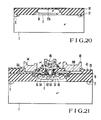
- a pnp transistor is illustrated in Figs. 20 and 21.
- Figs. 20 and 21 are sectional views taken along the line B - B of Fig. 1(B).
- a p-type impurity is implanted in an n-type epitaxial layer 2 through a thin oxide film to form a p-type epitaxial layer 51 for the pnp transistor.
- a thin oxide film 17A and a nitride film 18 are formed (Fig. 20).
- the subsequent steps are the same as those in the fabrication of an npn transistor until the formation of the thin oxide film 33 in Figs. 14 (A) and 14(B).
- Phosphorus ions are implanted through the oxide film 33 to form a base region 52.
- An oxide film 35 and a polysilicon layer 57 are sequentially formed.
- the polysilicon layer 57 is partially removed by anisotropic etching, and the oxide film 35 is partially etched by a combination of anisotropic etching and wet etching to expose a silicon surface portion serving as an emitter region 53.
- a boron-doped polysilicon layer 56 is formed and boron is diffused by annealing to form an emitter diffusion region 53.
- a collector contact diffusion region 54 and a base contact region 55 are formed.
- the subsequent steps are the same as those in the fabrication process of the npn transistor.
- a finished structure with metal electrodes is illustrated in Fig. 21.
- Reference numerals 56 and 57 denote p-type impurity, i.e., boron-doped polysilicon layers serving as the emitter electrode.
- Polysilicon layers 19A and 32A doped with a p-type impurity constitute the collector electrode, and polysilicon layers 19B and 32B doped with an n-type impurity constitute the base electrode.
- the vertical pnp and npn transistors can be easily formed on a single chip to constitute a high-performance complementary bipolar transistor.
- the electrodes are made of polycrystalline silicon. However, part or all of polysilicon may be replaced with a silicide. Alternatively, a metal may be selectively grown on only monocrystalline or polycrystalline silicon to constitute part of the electrodes.
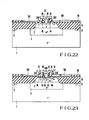
- Figs. 22 to 24 show still another embodiment in which part of polysilicon is replaced with a silicide.
- Figs. 22 to 24 are sectional views taken along the line B - B of Fig. KB).
- a polysilicon layer 37 doped with an n-type impurity is formed and etching is performed using the resultant layer as an etching mask to expose the surfaces of the p-type polysilicon layer 19A serving as the base electrode region and the n-type polysilicon layer 19B serving as the collector electrode region (Fig. 22).
- Subsequent annealing produces an emitter diffusion region 38.
- An oxide film 61 is formed by CVD and etched by anisotropic etching to leave it around only the emitter region (Fig. 23).
- a metal layer such as a Pt layer is formed and alloyed with silicon by annealing to constitute a silicide layer 62.
- a nonalloyed metal layer on the oxide film is removed (Fig. 24), and an oxide film 43 is formed and etched to form contact holes.
- collector, emitter, and base metal electrodes 63, 64, and 65 of aluminum are formed (Fig. 25).
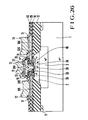
- Fig. 26 shows still another embodiment employing selective growth of a metal.
- a metal layer 71 is selectively grown on the surfaces of the polysilicon layers 19A, 19B, and 37 exposed in the step shown in Fig. 23.
- a thick metal layer of aluminum is formed and patterned to constitute collector, emitter and base metal electrodes 72, 73, and 74.
- the n -type buried layer 3 is formed in the substrate.
- the present invention is also applicable if the substrate does not have an n +- type buried layer.
- the thick oxide film 17 is formed.
- the present invention is also applicable when such a film is not formed.
- the collector and base electrodes are formed within a single opening, and the emitter electrode is formed between the collector and base electrodes within the single opening.
- the electrodes are isolated by insulating interlayers.
- the area occupied by the transistor can be decreased to 1/2 that of the conventional structure. For this reason, a high-density, high-integration LSI can be fabricated. Since the collector-substrate capacitance is decreased, high-speed operation can be achieved.
- Polysilicon or a silicide is used to constitute the electrode regions, so that the emitter, base, and collector regions are connected to the metal electrodes through polysilicon or silicide.
- the emitter, base, and collector regions are therefore free from Schottky tunneling, and stable high-speed operation is guaranteed even with shallow junctions.
- High-performance vertical pnp and npn transistors can be easily formed on a single chip. Because of complicated fabrication processes or the use of a lateral pnp transistor with poor characteristics in place of a vertical pnp transistor to avoid such processes, complementary bipolar LSIs with vertical transistors have . not received a great deal of attention.
- the present invention can provide a high-speed complementary bipolar LSI with low power consumption.
- a semiconductor layer of an SOS structure can be used in place of the semiconductor substrate.
Landscapes
- Bipolar Transistors (AREA)
Applications Claiming Priority (2)
| Application Number | Priority Date | Filing Date | Title |
|---|---|---|---|
| JP96422/85 | 1985-05-07 | ||
| JP60096422A JPH0658912B2 (ja) | 1985-05-07 | 1985-05-07 | バイポーラトランジスタの製造方法 |
Related Child Applications (2)
| Application Number | Title | Priority Date | Filing Date |
|---|---|---|---|
| EP90250256.6 Division-Into | 1986-05-07 | ||
| EP19900250256 Division EP0409370A3 (de) | 1985-05-07 | 1986-05-07 | Bipolartransistor |
Publications (3)
| Publication Number | Publication Date |
|---|---|
| EP0201867A2 true EP0201867A2 (de) | 1986-11-20 |
| EP0201867A3 EP0201867A3 (en) | 1987-05-27 |
| EP0201867B1 EP0201867B1 (de) | 1991-06-19 |
Family
ID=14164544
Family Applications (1)
| Application Number | Title | Priority Date | Filing Date |
|---|---|---|---|
| EP86106270A Expired - Lifetime EP0201867B1 (de) | 1985-05-07 | 1986-05-07 | Verfahren zur Herstellung eines bipolaren Transistors |
Country Status (6)
| Country | Link |
|---|---|
| US (1) | US4780427A (de) |
| EP (1) | EP0201867B1 (de) |
| JP (1) | JPH0658912B2 (de) |
| KR (1) | KR900008651B1 (de) |
| CA (1) | CA1241458A (de) |
| DE (1) | DE3679862D1 (de) |
Cited By (3)
| Publication number | Priority date | Publication date | Assignee | Title |
|---|---|---|---|---|
| EP0362104A1 (de) * | 1988-08-31 | 1990-04-04 | International Business Machines Corporation | Integrierte Bipolar-Transistorschaltungs-Technologie |
| US5026663A (en) * | 1989-07-21 | 1991-06-25 | Motorola, Inc. | Method of fabricating a structure having self-aligned diffused junctions |
| FR2672733A1 (fr) * | 1991-02-13 | 1992-08-14 | France Telecom | Perfectionnement au collecteur d'un transistor bipolaire compatible avec la technologie mos. |
Families Citing this family (18)
| Publication number | Priority date | Publication date | Assignee | Title |
|---|---|---|---|---|
| US4812417A (en) * | 1986-07-30 | 1989-03-14 | Mitsubishi Denki Kabushiki Kaisha | Method of making self aligned external and active base regions in I.C. processing |
| JPS63128750A (ja) * | 1986-11-19 | 1988-06-01 | Toshiba Corp | 半導体装置 |
| JPS63193562A (ja) * | 1987-02-06 | 1988-08-10 | Toshiba Corp | バイポ−ラトランジスタの製造方法 |
| DE3825701A1 (de) * | 1987-07-29 | 1989-02-09 | Toshiba Kawasaki Kk | Verfahren zur herstellung eines bipolaren transistors |
| US4829025A (en) * | 1987-10-02 | 1989-05-09 | Advanced Micro Devices, Inc. | Process for patterning films in manufacture of integrated circuit structures |
| US4946798A (en) * | 1988-02-09 | 1990-08-07 | Oki Electric Industry Co., Ltd. | Semiconductor integrated circuit fabrication method |
| JPH027529A (ja) * | 1988-06-27 | 1990-01-11 | Nec Corp | バイポーラトランジスタ及びその製造方法 |
| US5064772A (en) * | 1988-08-31 | 1991-11-12 | International Business Machines Corporation | Bipolar transistor integrated circuit technology |
| GB2236901A (en) * | 1989-09-20 | 1991-04-17 | Philips Nv | A method of manufacturing a semiconductor device |
| KR100200397B1 (ko) * | 1990-07-23 | 1999-06-15 | 야스카와 히데아키 | 반도체장치 및 그 제조방법 |
| US5071780A (en) * | 1990-08-27 | 1991-12-10 | Taiwan Semiconductor Manufacturing Company, Ltd. | Reverse self-aligned transistor integrated circuit |
| US5389561A (en) * | 1991-12-13 | 1995-02-14 | Sony Corporation | Method for making SOI type bipolar transistor |
| JP3156436B2 (ja) * | 1993-04-05 | 2001-04-16 | 日本電気株式会社 | ヘテロ接合バイポーラトランジスタ |
| JP3307489B2 (ja) | 1993-12-09 | 2002-07-24 | 三菱電機株式会社 | 半導体装置およびその製造方法 |
| US5465006A (en) * | 1994-07-15 | 1995-11-07 | Hewlett-Packard Company | Bipolar stripe transistor structure |
| US5932922A (en) * | 1994-08-08 | 1999-08-03 | Semicoa Semiconductors | Uniform current density and high current gain bipolar transistor |
| JPH09199513A (ja) * | 1996-01-19 | 1997-07-31 | Mitsubishi Electric Corp | バイポーラトランジスタおよび該バイポーラトランジスタを有する半導体装置 |
| AT2489U1 (de) * | 1997-11-20 | 1998-11-25 | Avl List Gmbh | Hubkolbenbrennkraftmaschine mit fremdzündung |
Family Cites Families (11)
| Publication number | Priority date | Publication date | Assignee | Title |
|---|---|---|---|---|
| US3600651A (en) * | 1969-12-08 | 1971-08-17 | Fairchild Camera Instr Co | Bipolar and field-effect transistor using polycrystalline epitaxial deposited silicon |
| US3611067A (en) * | 1970-04-20 | 1971-10-05 | Fairchild Camera Instr Co | Complementary npn/pnp structure for monolithic integrated circuits |
| US4106051A (en) * | 1972-11-08 | 1978-08-08 | Ferranti Limited | Semiconductor devices |
| FR2340619A1 (fr) * | 1976-02-04 | 1977-09-02 | Radiotechnique Compelec | Perfectionnement au procede de fabrication de dispositifs semiconducteurs et dispositifs ainsi obtenus |
| JPS53132275A (en) * | 1977-04-25 | 1978-11-17 | Nippon Telegr & Teleph Corp <Ntt> | Semiconductor device and its production |
| US4160991A (en) * | 1977-10-25 | 1979-07-10 | International Business Machines Corporation | High performance bipolar device and method for making same |
| US4157269A (en) * | 1978-06-06 | 1979-06-05 | International Business Machines Corporation | Utilizing polysilicon diffusion sources and special masking techniques |
| US4483726A (en) * | 1981-06-30 | 1984-11-20 | International Business Machines Corporation | Double self-aligned fabrication process for making a bipolar transistor structure having a small polysilicon-to-extrinsic base contact area |
| JPS587862A (ja) * | 1981-06-30 | 1983-01-17 | インタ−ナシヨナル・ビジネス・マシ−ンズ・コ−ポレ−シヨン | バイポ−ラ型トランジスタ−構造体及びその製造方法 |
| JPS5898964A (ja) * | 1981-12-08 | 1983-06-13 | Matsushita Electric Ind Co Ltd | 半導体装置およびその製造方法 |
| US4431460A (en) * | 1982-03-08 | 1984-02-14 | International Business Machines Corporation | Method of producing shallow, narrow base bipolar transistor structures via dual implantations of selected polycrystalline layer |
-
1985
- 1985-05-07 JP JP60096422A patent/JPH0658912B2/ja not_active Expired - Lifetime
-
1986
- 1986-05-02 CA CA000508270A patent/CA1241458A/en not_active Expired
- 1986-05-07 DE DE8686106270T patent/DE3679862D1/de not_active Expired - Lifetime
- 1986-05-07 KR KR8603554A patent/KR900008651B1/ko not_active Expired
- 1986-05-07 EP EP86106270A patent/EP0201867B1/de not_active Expired - Lifetime
-
1987
- 1987-09-29 US US07/104,544 patent/US4780427A/en not_active Expired - Lifetime
Cited By (6)
| Publication number | Priority date | Publication date | Assignee | Title |
|---|---|---|---|---|
| EP0362104A1 (de) * | 1988-08-31 | 1990-04-04 | International Business Machines Corporation | Integrierte Bipolar-Transistorschaltungs-Technologie |
| US4967253A (en) * | 1988-08-31 | 1990-10-30 | International Business Machines Corporation | Bipolar transistor integrated circuit technology |
| US5026663A (en) * | 1989-07-21 | 1991-06-25 | Motorola, Inc. | Method of fabricating a structure having self-aligned diffused junctions |
| FR2672733A1 (fr) * | 1991-02-13 | 1992-08-14 | France Telecom | Perfectionnement au collecteur d'un transistor bipolaire compatible avec la technologie mos. |
| EP0501896A3 (en) * | 1991-02-13 | 1993-05-12 | France Telecom | Improved collector for a bipolar transistor compatible with mos technology |
| US5298779A (en) * | 1991-02-13 | 1994-03-29 | France Telecom-Establissement Autonome De Droit Public | Collector of a bipolar transistor compatible with MOS technology |
Also Published As
| Publication number | Publication date |
|---|---|
| CA1241458A (en) | 1988-08-30 |
| KR900008651B1 (en) | 1990-11-26 |
| EP0201867B1 (de) | 1991-06-19 |
| JPH0658912B2 (ja) | 1994-08-03 |
| DE3679862D1 (de) | 1991-07-25 |
| JPS61255064A (ja) | 1986-11-12 |
| EP0201867A3 (en) | 1987-05-27 |
| US4780427A (en) | 1988-10-25 |
Similar Documents
| Publication | Publication Date | Title |
|---|---|---|
| US4780427A (en) | Bipolar transistor and method of manufacturing the same | |
| EP0088922B1 (de) | Verfahren zum Herstellen von Elektroden und Verdrahtungsstreifen auf einer Halbleiteranordnung | |
| EP0036082A1 (de) | Selbstjustierendes Verfahren zur Herstellung eines verbesserten hochqualitativen Bipolartransistors | |
| EP0224717B1 (de) | Selbstalignierter Kanalunterbrecher | |
| EP0061855A1 (de) | Verfahren zur Herstellung eines Halbleiterbauelements | |
| US4412378A (en) | Method for manufacturing semiconductor device utilizing selective masking, etching and oxidation | |
| US5003365A (en) | Bipolar transistor with a sidewall-diffused subcollector | |
| JPS62588B2 (de) | ||
| EP0070402B1 (de) | Verfahren zum Formen elektrisch-leitender Muster auf einer Halbleiteranordnung, und eine Halbleiteranordnung hergestellt nach dem Verfahren | |
| EP0193116B1 (de) | Verfahren zum Herstellen eines Halbleiterbauelements mit einem Graben | |
| GB2081507A (en) | High speed bipolar transistor and method of making same | |
| EP0401786B1 (de) | Verfahren zur Herstellung eines lateralen Bipolartransistors | |
| US4674173A (en) | Method for fabricating bipolar transistor | |
| US4686763A (en) | Method of making a planar polysilicon bipolar device | |
| US4979010A (en) | VLSI self-aligned bipolar transistor | |
| EP0281235B1 (de) | Verfahren zum Herstellen eines bipolaren Transistors unter Verwendung von CMOS-Techniken | |
| JPH0241170B2 (de) | ||
| US4407059A (en) | Method of producing semiconductor device | |
| US5049964A (en) | Bipolar transistor and method of manufacturing the same | |
| US5104816A (en) | Polysilicon self-aligned bipolar device including trench isolation and process of manufacturing same | |
| JPS60202965A (ja) | 改良した酸化物画定型トランジスタの製造方法及びその結果得られる構成体 | |
| US4799099A (en) | Bipolar transistor in isolation well with angled corners | |
| JP2597631B2 (ja) | 半導体デバイスおよびその製造方法 | |
| KR950001146B1 (ko) | 폴리실리콘 자체 정렬 바이폴라 장치 및 이의 제조 방법 | |
| US5747374A (en) | Methods of fabricating bipolar transistors having separately formed intrinsic base and link-up regions |
Legal Events
| Date | Code | Title | Description |
|---|---|---|---|
| PUAI | Public reference made under article 153(3) epc to a published international application that has entered the european phase |
Free format text: ORIGINAL CODE: 0009012 |
|
| 17P | Request for examination filed |
Effective date: 19860507 |
|
| AK | Designated contracting states |
Kind code of ref document: A2 Designated state(s): DE FR GB NL |
|
| PUAL | Search report despatched |
Free format text: ORIGINAL CODE: 0009013 |
|
| AK | Designated contracting states |
Kind code of ref document: A3 Designated state(s): DE FR GB NL |
|
| 17Q | First examination report despatched |
Effective date: 19891018 |
|
| GRAA | (expected) grant |
Free format text: ORIGINAL CODE: 0009210 |
|
| RAP1 | Party data changed (applicant data changed or rights of an application transferred) |
Owner name: NIPPON TELEGRAPH AND TELEPHONE CORPORATION |
|
| AK | Designated contracting states |
Kind code of ref document: B1 Designated state(s): DE FR GB NL |
|
| XX | Miscellaneous (additional remarks) |
Free format text: TEILANMELDUNG 90250256.6 EINGEREICHT AM 07/05/86. |
|
| REF | Corresponds to: |
Ref document number: 3679862 Country of ref document: DE Date of ref document: 19910725 |
|
| ET | Fr: translation filed | ||
| PLBE | No opposition filed within time limit |
Free format text: ORIGINAL CODE: 0009261 |
|
| STAA | Information on the status of an ep patent application or granted ep patent |
Free format text: STATUS: NO OPPOSITION FILED WITHIN TIME LIMIT |
|
| 26N | No opposition filed | ||
| REG | Reference to a national code |
Ref country code: FR Ref legal event code: CA |
|
| REG | Reference to a national code |
Ref country code: GB Ref legal event code: IF02 |
|
| PGFP | Annual fee paid to national office [announced via postgrant information from national office to epo] |
Ref country code: GB Payment date: 20050406 Year of fee payment: 20 |
|
| PGFP | Annual fee paid to national office [announced via postgrant information from national office to epo] |
Ref country code: FR Payment date: 20050511 Year of fee payment: 20 |
|
| PGFP | Annual fee paid to national office [announced via postgrant information from national office to epo] |
Ref country code: NL Payment date: 20050527 Year of fee payment: 20 |
|
| PGFP | Annual fee paid to national office [announced via postgrant information from national office to epo] |
Ref country code: DE Payment date: 20050531 Year of fee payment: 20 |
|
| PG25 | Lapsed in a contracting state [announced via postgrant information from national office to epo] |
Ref country code: GB Free format text: LAPSE BECAUSE OF EXPIRATION OF PROTECTION Effective date: 20060506 |
|
| PG25 | Lapsed in a contracting state [announced via postgrant information from national office to epo] |
Ref country code: NL Free format text: LAPSE BECAUSE OF EXPIRATION OF PROTECTION Effective date: 20060507 |
|
| REG | Reference to a national code |
Ref country code: GB Ref legal event code: PE20 |
|
| NLV7 | Nl: ceased due to reaching the maximum lifetime of a patent |
Effective date: 20060507 |