EP0203565A2 - Procédé continu pour le changement du poids moléculaire de composés organosilices - Google Patents
Procédé continu pour le changement du poids moléculaire de composés organosilices Download PDFInfo
- Publication number
- EP0203565A2 EP0203565A2 EP86107150A EP86107150A EP0203565A2 EP 0203565 A2 EP0203565 A2 EP 0203565A2 EP 86107150 A EP86107150 A EP 86107150A EP 86107150 A EP86107150 A EP 86107150A EP 0203565 A2 EP0203565 A2 EP 0203565A2
- Authority
- EP
- European Patent Office
- Prior art keywords
- reactor
- reaction mixture
- organosilicon compounds
- molecular weight
- changing
- Prior art date
- Legal status (The legal status is an assumption and is not a legal conclusion. Google has not performed a legal analysis and makes no representation as to the accuracy of the status listed.)
- Granted
Links
Images
Classifications
-
- C—CHEMISTRY; METALLURGY
- C07—ORGANIC CHEMISTRY
- C07F—ACYCLIC, CARBOCYCLIC OR HETEROCYCLIC COMPOUNDS CONTAINING ELEMENTS OTHER THAN CARBON, HYDROGEN, HALOGEN, OXYGEN, NITROGEN, SULFUR, SELENIUM OR TELLURIUM
- C07F7/00—Compounds containing elements of Groups 4 or 14 of the Periodic Table
- C07F7/02—Silicon compounds
- C07F7/08—Compounds having one or more C—Si linkages
- C07F7/0834—Compounds having one or more O-Si linkage
- C07F7/0838—Compounds with one or more Si-O-Si sequences
- C07F7/0872—Preparation and treatment thereof
- C07F7/0874—Reactions involving a bond of the Si-O-Si linkage
-
- B—PERFORMING OPERATIONS; TRANSPORTING
- B01—PHYSICAL OR CHEMICAL PROCESSES OR APPARATUS IN GENERAL
- B01J—CHEMICAL OR PHYSICAL PROCESSES, e.g. CATALYSIS OR COLLOID CHEMISTRY; THEIR RELEVANT APPARATUS
- B01J19/00—Chemical, physical or physico-chemical processes in general; Their relevant apparatus
- B01J19/18—Stationary reactors having moving elements inside
-
- B—PERFORMING OPERATIONS; TRANSPORTING
- B01—PHYSICAL OR CHEMICAL PROCESSES OR APPARATUS IN GENERAL
- B01J—CHEMICAL OR PHYSICAL PROCESSES, e.g. CATALYSIS OR COLLOID CHEMISTRY; THEIR RELEVANT APPARATUS
- B01J19/00—Chemical, physical or physico-chemical processes in general; Their relevant apparatus
- B01J19/18—Stationary reactors having moving elements inside
- B01J19/1812—Tubular reactors
-
- C—CHEMISTRY; METALLURGY
- C08—ORGANIC MACROMOLECULAR COMPOUNDS; THEIR PREPARATION OR CHEMICAL WORKING-UP; COMPOSITIONS BASED THEREON
- C08G—MACROMOLECULAR COMPOUNDS OBTAINED OTHERWISE THAN BY REACTIONS ONLY INVOLVING UNSATURATED CARBON-TO-CARBON BONDS
- C08G77/00—Macromolecular compounds obtained by reactions forming a linkage containing silicon with or without sulfur, nitrogen, oxygen or carbon in the main chain of the macromolecule
- C08G77/04—Polysiloxanes
- C08G77/06—Preparatory processes
-
- B—PERFORMING OPERATIONS; TRANSPORTING
- B01—PHYSICAL OR CHEMICAL PROCESSES OR APPARATUS IN GENERAL
- B01J—CHEMICAL OR PHYSICAL PROCESSES, e.g. CATALYSIS OR COLLOID CHEMISTRY; THEIR RELEVANT APPARATUS
- B01J2219/00—Chemical, physical or physico-chemical processes in general; Their relevant apparatus
- B01J2219/00002—Chemical plants
- B01J2219/00027—Process aspects
- B01J2219/00033—Continuous processes
-
- B—PERFORMING OPERATIONS; TRANSPORTING
- B01—PHYSICAL OR CHEMICAL PROCESSES OR APPARATUS IN GENERAL
- B01J—CHEMICAL OR PHYSICAL PROCESSES, e.g. CATALYSIS OR COLLOID CHEMISTRY; THEIR RELEVANT APPARATUS
- B01J2219/00—Chemical, physical or physico-chemical processes in general; Their relevant apparatus
- B01J2219/00049—Controlling or regulating processes
- B01J2219/00051—Controlling the temperature
- B01J2219/00074—Controlling the temperature by indirect heating or cooling employing heat exchange fluids
- B01J2219/00087—Controlling the temperature by indirect heating or cooling employing heat exchange fluids with heat exchange elements outside the reactor
- B01J2219/00094—Jackets
Definitions
- the invention relates to a method for continuously changing the molecular weight of organosilicon compounds which contain Si-bonded oxygen by condensation and / or equilibration using one or more catalysts accelerating the condensation and / or equilibration in a reactor by producing an annular flow by stirring becomes.
- the reactor consists of several zones, each with stirring or conveying elements are so equipped. that opposite flows can be generated in two adjacent zones of the reactor.
- the continuous process for changing the molecular weight of organosilicon compounds which contain Si-bonded oxygen is carried out by means of a homogeneous catalyst in a cylindrical, lying reactor which has a ratio of length to inner diameter of 1: 1 to 50 : 1 and the reaction mixture is stirred by a stirrer with one or more stirring blades in such a way that a maximum centrifugal acceleration b max of at least 70 ms -2 , preferably of at least 165 ms -2 , is exerted on the reaction mixture.
- organosilicon compounds which contain Si-bonded oxygen it is possible to use all organosilicon compounds with Si-bonded oxygen whose molecular weight has hitherto been able to be changed continuously.
- linear organo (poly) siloxanes of the formula cyclic organopolysiloxanes of the formula or mixtures of linear or of cyclic organo (poly) siloxanes or mixtures of linear with cyclic organo (poly) siloxanes are examples of linear organo (poly) siloxanes of the formula cyclic organopolysiloxanes of the formula or mixtures of linear or of cyclic organo (poly) siloxanes or mixtures of linear with cyclic organo (poly) siloxanes.
- R is in each case the same or different monovalent, optionally substituted, hydrocarbon radicals
- A is hydrogen or the group -SiR 3 , where R is the meaning given above, n is an integer of at least 1 and n 'is an integer Number from 3 to 7.
- up to 5 mole percent of the diorganosiloxane units can be present through other siloxane units, such as monoorganosiloxane and / or SiO 4 /, which are usually only more or less difficult to avoid. 2 units to be replaced.
- Examples of monovalent hydrocarbon radicals R are alkyl radicals, such as the methyl, n-butyl and sec.-butyl radical; Alkenyl residues, such as the vinyl residue; and aryl groups such as the phenyl group.
- R examples of monovalent, substituted hydrocarbon radicals R are cyanoalkyl radicals, such as the beta-cyanoethyl radical; Haloalkyl radicals, such as the 3,3,3-trifluoropropyl radical and haloaryl radicals, such as o-, m- and p-chlorophenyl radicals.
- R groups are preferably methyl groups.
- R which may be present are preferably vinyl and / or phenyl radicals.
- the viscosity of the organopolysiloxanes used in the process according to the invention is usually 10 to 1000 mPa.s at 25 ° C.
- the chemical reaction on which the process according to the invention for continuously changing the molecular weight of organosilicon compounds which contain Si-bonded oxygen is based can be accelerated by catalysts.
- catalysts are primarily substances which, according to the definition by Brönstedt or Lewis, can be referred to as acids or bases. Since undissolved solids are difficult to remove from highly viscous oils, the process according to the invention is limited to homogeneous catalysts and to catalysts which dissolve in the reaction mixture after they have been deactivated. Homogeneous catalysts are preferred.
- acidic catalysts examples include protonic acids such as sulfuric acid, chlorosulfonic acid, selenic acid, nitric acid, phosphoric acids, boric acid, Lewis acids such as iron (III) chloride, iron (III) chloride hexahydrate, aluminum chloride, boron trifluoride, zinc chloride, tin (IV) -chloride, Phosphorus nitride chlorides, aluminum sulfate, or mixtures of at least two of these substances.
- protonic acids such as sulfuric acid, chlorosulfonic acid, selenic acid, nitric acid, phosphoric acids, boric acid
- Lewis acids such as iron (III) chloride, iron (III) chloride hexahydrate, aluminum chloride, boron trifluoride, zinc chloride, tin (IV) -chloride, Phosphorus nitride chlorides, aluminum sulfate, or mixtures of at least two of these substances.
- Examples of basic catalysts are alkali metal hydroxides, in particular potassium and cesium hydroxide, alkali metal silanolates, alkali metal alkoxides, quaternary ammonium hydroxides such as tetramethylammonium hydroxide, Benzyltrimethylammoniumbutylat, beta-hydroxyethyltrimethylammonium-2-ethylhexoate, quaternary phosphonium hydroxides such as tetra-n-butylphosphonium hydroxide and tri-n-butyl-3- [ tris- (trimethylsiloxy) silyl] -n-propyl-phosphonium hydroxide, potassium amide, amines and amine mixtures and mixtures of at least two of the classes of substances or substances mentioned as basic catalysts.
- alkali metal hydroxides in particular potassium and cesium hydroxide
- alkali metal silanolates alkali metal alkoxides
- the amounts to be used are various.
- Organosilicon compounds which regulate the chain length can also be used in the process according to the invention. Any organosilicon compounds that regulate the chain length can be used, which could be used in the previously known processes for changing the molecular weight of linear or cyclic organo (poly) siloxanes. Examples of such organosilicon compounds which regulate the chain length are in particular those of the formula where R has the meaning given above and m is an integer from 1 to 50, and the formula where R also has the meaning given above for it.
- Important individual examples of such compounds are hexamethyldisiloxane, 1,3-divinyl-1,1,3-3-tetramethyldisiloxane, 1,3-dihydrogen-1,1,3,3-tetramethyldisiloxane and hexamethyldisilazane and those of the formula where R also has the meaning given above for it.
- Important examples of such compounds are trimethylsilanol, dimethylphenylsilanol, methyldiphenylsilanol, triphenylsilanol, dimethylvinylsilanol, methylphenylvinylsilanol, diphenylvinylsilanol and the like.
- the amount of chain length regulating organosilicon veneer depends, as is well known to those skilled in the art, on the desired chain length.
- This amount is preferably at least so large that the organopolysiloxanes obtained in the process according to the invention contribute an average viscosity of 100 to 1 million mPa.s Have 25'C.
- the catalyst can be dissolved or suspended in one or more of the reactants before entering the reactor used in the process according to the invention. But it can also be separated, e.g. B. in the form of a solution or suspension in an inert liquid.
- unsubstituted or substituted hydrocarbons or mixtures thereof can be used as inert liquids.
- unsubstituted hydrocarbons and their mixtures are petroleum distillates such as petroleum ether and gasoline from various boiling ranges, pentane, hexane, heptane, octane, their higher homologues and isomer mixtures; Aromatics such as toluene and xylenes.
- halogenated hydrocarbons such as 1,1,1-trichloroethane and chlorobenzene are particularly suitable for substituted hydrocarbons.
- the process according to the invention can be carried out at room temperature, that is to say about 20 ° C., but it can also be carried out at elevated temperature.
- the process is preferably carried out at elevated temperature.
- the temperature range from 80 to 250 ° C, in particular that from 14 0 to 160 ° C is preferred.
- the process according to the invention can be carried out at the pressure of the surrounding atmosphere, that is to say 10 Pa (abs.) Or about 10 Pa (abs.), But it can also be carried out at higher or lower pressure.
- the work is preferably carried out at 0.1 to 70,000 Pa (abs.), In particular at 100 to 700 Pa (abs.).
- water, solvents and cyclic organosiloxanes may be mentioned here by way of example.
- Water is formed during the condensation of silanol groups. Even if no cyclic organosiloxanes were used, these compounds can be by-products in the reaction mixture in the course of the reaction. arise.
- the centerpiece of the apparatus used in the process according to the invention is a horizontal, cylindrical reactor, the length of which is preferably greater than its inside diameter (tube).
- a shaft runs longitudinally through the reactor, on which a stirring blade or a plurality of stirring blades offset from one another are attached.
- the blade has or the blades are each approximately the same distance from the cylinder inner wall, namely 30 to 90 %, preferably 50 to 70% of the cylinder radius.
- the blade or the stirring blades have an angle of attack of 0 to 45 °, preferably 0 to 10 °, with respect to the shaft.
- the shaft is driven by a motor.
- the rotational speed of the shaft is chosen so high that the reaction mixture is pressed against the inner wall of the reactor by centrifugal acceleration and a gas space essentially free of the reaction mixture is created within the volume swept by the stirrer .
- the required speed of the wool or centrifugal acceleration can be determined visually very easily using the apparatus described below and used in the examples.
- the centrifugal acceleration at the point of the stirring blade furthest from the shaft (maximum centrifugal acceleration bmax) can be specified, for which where ⁇ is the number of circles, r max is the maximum extension of the stirring blade from the shaft towards the inner wall of the reactor and V is the speed of the shaft.
- b max the maximum extension of the stirring blade from the shaft towards the inner wall of the reactor
- V the speed of the shaft.
- the reactor preferably has a heatable jacket.
- the feed line (s) for the starting materials and the catalyst are located at one end of the tube; at the other end of the tube, the tube has a vacuum connection and a discharge line for the product.
- Temperature sensors can be installed near the inner wall.
- one or more starting materials can be preheated before entering the reactor.
- Catalysts which are gaseous under the reaction conditions can, for example, be largely removed by distillation even in the reactor; Acids and bases can be neutralized.
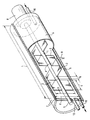
- the reactor used in the following examples consists of a with a heating jacket 7 provided glass tube 6 of 60 mm inner diameter and a length of 360 mm. It has an internal volume of 1,017 cm.
- a shaft 1 runs centrally in the tube and is driven by an external motor 8.
- Rectangular stirring blades 2 of 50 mm in length 3 and 30 mm in width 4 are attached to the shaft and have no inclination to the shaft. The stirring blades are each offset by 90 ° and are 5 mm apart.
- a thermometer 9 is immersed in the reaction mixture approximately in the middle of the longitudinal axis of the reactor.
- the reactor has a feed line 10 for the starting materials at one end and a discharge line 11 for the product and a vacuum connection 12 with a pump connection at the other end of the tube.
- the reaction tube runs largely horizontally (angle of inclination less than 5 °).
- the mixture After leaving the preheater, the mixture is fed 3-0 ppm (rile per million), based on the preheated mixture, of phosphorus nitride chloride as a 0.75% by weight solution in dichloromethane and the reaction mixture thus formed is fed to the reactor.
- the speed of the agitator is 700 rpm, its maximum centrifugal acceleration (b max ) is therefore 134.3 ms -2 ; the inside temperature of the reactor is kept at 160 ° C.
- the average residence time of the reaction mixture in the reactor is 3 minutes.
- an oil with a viscosity of 110,000 mPa.s is obtained.
- a residual Si-OH group content of less than 30 ppm is determined by infrared spectroscopy.
- Example 1 The procedure of Example 1 is repeated with the difference that instead of 15 l / h of a mixture of dihydric xypolyorganosiloxane and ⁇ , ⁇ -tertmethylsiloxy-polydiorganosiloxane, 45 l / h of an ⁇ , ⁇ -dihydroxy polydimethylsiloxane with a viscosity of 140 mm 2 / s together mil 2 ppm is 30 ppm phosphorus nitride chloride metered in; Preheating and reaction temperature are 145 ° C, the pressure in the reactor 79.8 hPa (abs.), The average residence time of the reaction mixture is 1 minute. An oil with a viscosity of 81,500 mPa.s at 25 ° C. is obtained.
- Example 1 The procedure of Example 1 is repeated with the difference that instead of 30 ppm phosphorus nitride chloride as a 0.75% by weight solution in dichloromethane after the preheater, 60 g / h catalyst solution prepared from entry into the preheater according to b) is added (corresponding to 400 ppm T ri-n-butyl-3-tris [(trimethylsiloxy) silyl] -n-propyl-phosphonium hydroxide based on the reaction mixture before entering the preheater) and the temperatures of the preheater and the reactor interior take place at 130 ° C. 160 ° C holds. After leaving the reactor, the reaction mixture is passed through a heat exchanger with an internal temperature of 160 ° C. in order to deactivate the catalyst.
- 60 g / h catalyst solution prepared from entry into the preheater according to b) is added (corresponding to 400 ppm T ri-n-butyl-3-tris [(trimethylsiloxy
Landscapes
- Chemical & Material Sciences (AREA)
- Organic Chemistry (AREA)
- Chemical Kinetics & Catalysis (AREA)
- Health & Medical Sciences (AREA)
- Medicinal Chemistry (AREA)
- Polymers & Plastics (AREA)
- Silicon Polymers (AREA)
Priority Applications (1)
| Application Number | Priority Date | Filing Date | Title |
|---|---|---|---|
| AT86107150T ATE45105T1 (de) | 1985-05-30 | 1986-05-27 | Kontinuierliches verfahren zur aenderung des molekulargewichts von organosiliciumverbindungen. |
Applications Claiming Priority (2)
| Application Number | Priority Date | Filing Date | Title |
|---|---|---|---|
| DE3519411 | 1985-05-30 | ||
| DE19853519411 DE3519411A1 (de) | 1985-05-30 | 1985-05-30 | Kontinuierliches verfahren zur aenderung des molekulargewichts von organosiliciumverbindungen |
Publications (3)
| Publication Number | Publication Date |
|---|---|
| EP0203565A2 true EP0203565A2 (fr) | 1986-12-03 |
| EP0203565A3 EP0203565A3 (en) | 1987-10-21 |
| EP0203565B1 EP0203565B1 (fr) | 1989-08-02 |
Family
ID=6272022
Family Applications (1)
| Application Number | Title | Priority Date | Filing Date |
|---|---|---|---|
| EP86107150A Expired EP0203565B1 (fr) | 1985-05-30 | 1986-05-27 | Procédé continu pour le changement du poids moléculaire de composés organosilices |
Country Status (9)
| Country | Link |
|---|---|
| US (1) | US4739026A (fr) |
| EP (1) | EP0203565B1 (fr) |
| JP (1) | JPS61278531A (fr) |
| AT (1) | ATE45105T1 (fr) |
| AU (1) | AU581762B2 (fr) |
| BR (1) | BR8602456A (fr) |
| CA (1) | CA1285576C (fr) |
| DE (2) | DE3519411A1 (fr) |
| ES (1) | ES8704999A1 (fr) |
Cited By (3)
| Publication number | Priority date | Publication date | Assignee | Title |
|---|---|---|---|---|
| EP0401684A3 (fr) * | 1989-06-05 | 1991-05-15 | Wacker-Chemie Gmbh | Procédé de préparation d'organosiloxanes |
| DE4212752A1 (de) * | 1992-04-16 | 1993-10-21 | Nuenchritz Chemie Gmbh | Verfahren zur Herstellung von Siliconharzen |
| DE4212754A1 (de) * | 1992-04-16 | 1993-10-21 | Nuenchritz Chemie Gmbh | Verfahren zur Herstellung von Polyorganosiloxanen |
Families Citing this family (13)
| Publication number | Priority date | Publication date | Assignee | Title |
|---|---|---|---|---|
| US5173558A (en) * | 1991-05-20 | 1992-12-22 | Dow Corning Corporation | Base catalyzed preparation of polyorganosiloxanes with controlled low levels of hydroxy substitution |
| JP2666661B2 (ja) * | 1992-06-18 | 1997-10-22 | 信越化学工業株式会社 | オルガノポリシロキサンパウダーの製造方法 |
| US5420221A (en) * | 1993-07-15 | 1995-05-30 | General Electric Company | Process for the production of linear organosiloxane polymers by disproportionation |
| DE19832686A1 (de) * | 1998-07-21 | 2000-02-03 | Heidelberger Bauchemie Gmbh | Kondensationsvernetzendes Silikon mit hoher Festigkeit |
| JP3546728B2 (ja) * | 1998-12-02 | 2004-07-28 | 信越化学工業株式会社 | オルガノポリシロキサンガムの連続製造方法 |
| JP3546727B2 (ja) * | 1998-12-02 | 2004-07-28 | 信越化学工業株式会社 | オルガノポリシロキサンガムの製造方法 |
| TW500768B (en) * | 1998-12-02 | 2002-09-01 | Shinetsu Chemical Co | Preparation of organopolysiloxane gum |
| US6414054B1 (en) * | 1999-12-21 | 2002-07-02 | General Electric Company | Continuous preparation of heat-vulcanizable silicone compositions |
| JP4488582B2 (ja) * | 2000-04-13 | 2010-06-23 | 東レ・ダウコーニング株式会社 | 連続的ヒドロシリル化反応方法、変性された液状有機珪素化合物の連続的製造方法および連続的ヒドロシリル化反応装置 |
| US7514263B2 (en) * | 2001-04-02 | 2009-04-07 | 3M Innovative Properties Company | Continuous process for the production of combinatorial libraries of materials |
| US7632916B2 (en) * | 2002-08-02 | 2009-12-15 | 3M Innovative Properties Company | Process to modify polymeric materials and resulting compositions |
| US6897280B2 (en) * | 2002-09-23 | 2005-05-24 | General Electric Company | Continuous manufacture of silicone copolymers via multi-stage blade-mixed plug flow tubular reactor |
| BR102012013097A2 (pt) * | 2012-05-31 | 2014-05-06 | Oliveira Heber Vieira De | Sistema para reprodução tátil e olfativa em equipamentos de áudio e ou vídeo com via internet |
Family Cites Families (8)
| Publication number | Priority date | Publication date | Assignee | Title |
|---|---|---|---|---|
| DE2229514C3 (de) * | 1972-06-16 | 1979-01-04 | Wacker-Chemie Gmbh, 8000 Muenchen | Verfahren zur Förderung von Kondensations- und/oder Äquilibrierungsreaktionen von Organosiliciumverbindungen |
| US3933882A (en) * | 1974-12-02 | 1976-01-20 | Dow Corning Corporation | Tube method for the preparation of olefinic siloxane compounds |
| DE2705563C2 (de) * | 1977-02-10 | 1982-10-14 | Bayer Ag, 5090 Leverkusen | Verfahren zur kontinuierlichen Herstellung von hochviskosen Polydiorganosiloxanen |
| DE2834627A1 (de) * | 1978-02-07 | 1979-08-09 | Bayer Ag | Verfahren zur kontinuierlichen herstellung von polydiorganosiloxanen |
| AU5900880A (en) * | 1979-06-18 | 1981-01-08 | General Electric Company | Continuous manufacture of siloxane polymers |
| FR2505850B1 (fr) * | 1981-05-12 | 1985-06-21 | Rhone Poulenc Spec Chim | Procede d'obtention de polysiloxanes de masses moleculaires elevees par polymerisation et rearrangement de polysiloxanes en presence de catalyseur constitue par un support mineral poreux recouvert d'un film polymerique porteur de groupement sulfonique ou phosphonique |
| US4551515A (en) * | 1984-02-27 | 1985-11-05 | General Electric Company | Process for the continuous manufacture of silicone gums |
| US4599437A (en) * | 1984-10-29 | 1986-07-08 | Wacker-Chemie Gmbh | Continuous process for varying molecular weight of organopolysiloxanes |
-
1985
- 1985-05-30 DE DE19853519411 patent/DE3519411A1/de not_active Withdrawn
-
1986
- 1986-05-19 US US06/864,233 patent/US4739026A/en not_active Expired - Fee Related
- 1986-05-21 CA CA000509603A patent/CA1285576C/fr not_active Expired - Lifetime
- 1986-05-27 AT AT86107150T patent/ATE45105T1/de not_active IP Right Cessation
- 1986-05-27 DE DE8686107150T patent/DE3664728D1/de not_active Expired
- 1986-05-27 EP EP86107150A patent/EP0203565B1/fr not_active Expired
- 1986-05-28 JP JP61121410A patent/JPS61278531A/ja active Granted
- 1986-05-29 AU AU58051/86A patent/AU581762B2/en not_active Ceased
- 1986-05-29 BR BR8602456A patent/BR8602456A/pt unknown
- 1986-05-29 ES ES555441A patent/ES8704999A1/es not_active Expired
Cited By (3)
| Publication number | Priority date | Publication date | Assignee | Title |
|---|---|---|---|---|
| EP0401684A3 (fr) * | 1989-06-05 | 1991-05-15 | Wacker-Chemie Gmbh | Procédé de préparation d'organosiloxanes |
| DE4212752A1 (de) * | 1992-04-16 | 1993-10-21 | Nuenchritz Chemie Gmbh | Verfahren zur Herstellung von Siliconharzen |
| DE4212754A1 (de) * | 1992-04-16 | 1993-10-21 | Nuenchritz Chemie Gmbh | Verfahren zur Herstellung von Polyorganosiloxanen |
Also Published As
| Publication number | Publication date |
|---|---|
| CA1285576C (fr) | 1991-07-02 |
| ATE45105T1 (de) | 1989-08-15 |
| AU5805186A (en) | 1986-12-04 |
| JPS61278531A (ja) | 1986-12-09 |
| JPS6310171B2 (fr) | 1988-03-04 |
| DE3519411A1 (de) | 1986-12-04 |
| DE3664728D1 (en) | 1989-09-07 |
| EP0203565B1 (fr) | 1989-08-02 |
| BR8602456A (pt) | 1987-01-27 |
| ES8704999A1 (es) | 1987-04-16 |
| AU581762B2 (en) | 1989-03-02 |
| US4739026A (en) | 1988-04-19 |
| EP0203565A3 (en) | 1987-10-21 |
| ES555441A0 (es) | 1987-04-16 |
Similar Documents
| Publication | Publication Date | Title |
|---|---|---|
| EP0203565B1 (fr) | Procédé continu pour le changement du poids moléculaire de composés organosilices | |
| DE4423924C2 (de) | Reaktionsprodukte kurzkettiger linearer Phosphazene mit Verbindungen, die ein aktives Proton enthalten als Katalysatoren, Verfahren zu deren Herstellung und deren Verwendung zur Polykondensation von Organopolysiloxandiolen | |
| DE69117094T2 (de) | Verfahren zur Herstellung von Kopolymeren mit Diphenyl- und Dimethylsiloxankettensegmenten | |
| EP0311766B1 (fr) | Préparation et emploi d'un mélange à haute teneur en organocyclosiloxanes | |
| DE3781886T2 (de) | Verfahren zur herstellung eines acrylat- oder methacrylatgruppen enthaltenden polysiloxans. | |
| DE2229514B2 (de) | Verfahren zur Förderung von Kondensations- und/oder Äquilibrierungsreaktionen von Organosiliciumverbindungen | |
| EP0215470B1 (fr) | Procédé de stabilisation d'organopolysiloxanes | |
| DE4424001B4 (de) | Verfahren zum Herstellen linearer Organosiloxanpolymere durch Disproportionierung | |
| DE19713733B4 (de) | Mit peralkylierter Phosphazen-Base katalysiertes Silanol-Kondensationsverfahren | |
| EP0646616B1 (fr) | Organopolysiloxanes ayant des unités terminales bifonctionnelles | |
| EP2050777B1 (fr) | Méthode multi-étapes de préparation de polysiloxanes organiques portant des fonctions aminoalkyles | |
| EP0033891B1 (fr) | Procédé de préparation d'un copolymère séquencé d'organosiloxane | |
| EP0626414B1 (fr) | Phosphazènes contenant des groupes organosiliciques, procédé pour leur préparation et leur emploi | |
| EP0305737A2 (fr) | Procédé de condensation ou d'équilibrage de polysiloxanes | |
| DE60222081T2 (de) | Verfahren zur Herstellung von linearen Organopolysiloxanen | |
| DE69634557T2 (de) | Katalysatoren für Redistribution von Organosiloxan-Polymeren | |
| EP0285091A1 (fr) | Procédé de préparation de diorganopolysiloxanes terminés par des groupes triorganosiloxy | |
| DE2558020C2 (de) | Verfahren zur Herstellung eines Phosphoniumsiloxan-Katalysators | |
| EP0258640B1 (fr) | Procédé de stabilisation du poids moléculaire d'organopolysiloxanes | |
| EP0269886A2 (fr) | Procédé de préparation de polysiloxanes à groupes organiques contenant des atomes d'azote basique | |
| EP1370601B1 (fr) | Procede de production d'hydroxyalkylpolysiloxanes | |
| DE69006864T2 (de) | Verfahren zur Herstellung von Organosiliciumverbindungen. | |
| EP0117503B1 (fr) | Procédé pour stabiliser des organopolysiloxanes | |
| DE2714807A1 (de) | Verfahren zur herstellung aequilibrierter organopolysiloxangemische mit am silicium gebundenen organosulfonsaeuregruppen | |
| DE3914912C2 (fr) |
Legal Events
| Date | Code | Title | Description |
|---|---|---|---|
| PUAI | Public reference made under article 153(3) epc to a published international application that has entered the european phase |
Free format text: ORIGINAL CODE: 0009012 |
|
| 17P | Request for examination filed |
Effective date: 19860527 |
|
| AK | Designated contracting states |
Kind code of ref document: A2 Designated state(s): AT BE CH DE FR GB IT LI NL |
|
| PUAL | Search report despatched |
Free format text: ORIGINAL CODE: 0009013 |
|
| AK | Designated contracting states |
Kind code of ref document: A3 Designated state(s): AT BE CH DE FR GB IT LI NL |
|
| 17Q | First examination report despatched |
Effective date: 19880715 |
|
| ITF | It: translation for a ep patent filed | ||
| GRAA | (expected) grant |
Free format text: ORIGINAL CODE: 0009210 |
|
| AK | Designated contracting states |
Kind code of ref document: B1 Designated state(s): AT BE CH DE FR GB IT LI NL |
|
| REF | Corresponds to: |
Ref document number: 45105 Country of ref document: AT Date of ref document: 19890815 Kind code of ref document: T |
|
| REF | Corresponds to: |
Ref document number: 3664728 Country of ref document: DE Date of ref document: 19890907 |
|
| ET | Fr: translation filed | ||
| GBT | Gb: translation of ep patent filed (gb section 77(6)(a)/1977) | ||
| NLR4 | Nl: receipt of corrected translation in the netherlands language at the initiative of the proprietor of the patent | ||
| ITTA | It: last paid annual fee | ||
| PLBE | No opposition filed within time limit |
Free format text: ORIGINAL CODE: 0009261 |
|
| STAA | Information on the status of an ep patent application or granted ep patent |
Free format text: STATUS: NO OPPOSITION FILED WITHIN TIME LIMIT |
|
| 26N | No opposition filed | ||
| PGFP | Annual fee paid to national office [announced via postgrant information from national office to epo] |
Ref country code: CH Payment date: 19910412 Year of fee payment: 6 Ref country code: AT Payment date: 19910412 Year of fee payment: 6 |
|
| PGFP | Annual fee paid to national office [announced via postgrant information from national office to epo] |
Ref country code: BE Payment date: 19910418 Year of fee payment: 6 |
|
| PGFP | Annual fee paid to national office [announced via postgrant information from national office to epo] |
Ref country code: GB Payment date: 19910426 Year of fee payment: 6 |
|
| PGFP | Annual fee paid to national office [announced via postgrant information from national office to epo] |
Ref country code: FR Payment date: 19910430 Year of fee payment: 6 |
|
| PGFP | Annual fee paid to national office [announced via postgrant information from national office to epo] |
Ref country code: NL Payment date: 19910531 Year of fee payment: 6 |
|
| PGFP | Annual fee paid to national office [announced via postgrant information from national office to epo] |
Ref country code: DE Payment date: 19910605 Year of fee payment: 6 |
|
| PG25 | Lapsed in a contracting state [announced via postgrant information from national office to epo] |
Ref country code: GB Effective date: 19920527 Ref country code: AT Effective date: 19920527 |
|
| PG25 | Lapsed in a contracting state [announced via postgrant information from national office to epo] |
Ref country code: LI Effective date: 19920531 Ref country code: CH Effective date: 19920531 Ref country code: BE Effective date: 19920531 |
|
| BERE | Be: lapsed |
Owner name: WACKER-CHEMIE G.M.B.H. Effective date: 19920531 |
|
| PG25 | Lapsed in a contracting state [announced via postgrant information from national office to epo] |
Ref country code: NL Effective date: 19921201 |
|
| NLV4 | Nl: lapsed or anulled due to non-payment of the annual fee | ||
| GBPC | Gb: european patent ceased through non-payment of renewal fee |
Effective date: 19920527 |
|
| PG25 | Lapsed in a contracting state [announced via postgrant information from national office to epo] |
Ref country code: FR Effective date: 19930129 |
|
| REG | Reference to a national code |
Ref country code: CH Ref legal event code: PL |
|
| PG25 | Lapsed in a contracting state [announced via postgrant information from national office to epo] |
Ref country code: DE Effective date: 19930202 |
|
| REG | Reference to a national code |
Ref country code: FR Ref legal event code: ST |
|
| PG25 | Lapsed in a contracting state [announced via postgrant information from national office to epo] |
Ref country code: IT Free format text: LAPSE BECAUSE OF NON-PAYMENT OF DUE FEES Effective date: 20050527 |