EP0205126A2 - Schuh für Rehabilitationszwecke - Google Patents
Schuh für Rehabilitationszwecke Download PDFInfo
- Publication number
- EP0205126A2 EP0205126A2 EP86107735A EP86107735A EP0205126A2 EP 0205126 A2 EP0205126 A2 EP 0205126A2 EP 86107735 A EP86107735 A EP 86107735A EP 86107735 A EP86107735 A EP 86107735A EP 0205126 A2 EP0205126 A2 EP 0205126A2
- Authority
- EP
- European Patent Office
- Prior art keywords
- wedge
- shoe
- shoe according
- foot
- midsole
- Prior art date
- Legal status (The legal status is an assumption and is not a legal conclusion. Google has not performed a legal analysis and makes no representation as to the accuracy of the status listed.)
- Withdrawn
Links
Images
Classifications
-
- A—HUMAN NECESSITIES
- A43—FOOTWEAR
- A43B—CHARACTERISTIC FEATURES OF FOOTWEAR; PARTS OF FOOTWEAR
- A43B7/00—Footwear with health or hygienic arrangements
- A43B7/14—Footwear with health or hygienic arrangements with foot-supporting parts
- A43B7/1405—Footwear with health or hygienic arrangements with foot-supporting parts with pads or holes on one or more locations, or having an anatomical or curved form
- A43B7/1415—Footwear with health or hygienic arrangements with foot-supporting parts with pads or holes on one or more locations, or having an anatomical or curved form characterised by the location under the foot
- A43B7/144—Footwear with health or hygienic arrangements with foot-supporting parts with pads or holes on one or more locations, or having an anatomical or curved form characterised by the location under the foot situated under the heel, i.e. the calcaneus bone
-
- A—HUMAN NECESSITIES
- A43—FOOTWEAR
- A43B—CHARACTERISTIC FEATURES OF FOOTWEAR; PARTS OF FOOTWEAR
- A43B7/00—Footwear with health or hygienic arrangements
-
- A—HUMAN NECESSITIES
- A43—FOOTWEAR
- A43B—CHARACTERISTIC FEATURES OF FOOTWEAR; PARTS OF FOOTWEAR
- A43B7/00—Footwear with health or hygienic arrangements
- A43B7/14—Footwear with health or hygienic arrangements with foot-supporting parts
Definitions
- the present invention relates to a shoe for rehabilitation purposes according to the preamble of claim 1.
- DE-AS 28 08 968 discloses an orthosis open on the forefoot for postoperative treatment of fractures or joint operations in the foot area with a heel and foot part formed in one piece and an incorporated sole plate. No information is given there about the properties of the sole, apart from the fact that it should be flat in the toe area. This known orthosis is used to immobilize fractures or operated joints, so it must necessarily be stiff.
- the present invention is based on the object of designing a shoe for rehabilitation purposes of the type mentioned at the outset in such a way that rigid supports, such as plaster casts, orthoses or the like, can be removed again as soon as possible in the case of foot injuries or on the foot and the patient as quickly as possible can run again without further damage or consequential damage from, for example, incorrect walking positions due to so-called "gentle postures", particularly in the meniscus, knee or intervertebral disc area.
- agent postures particularly in the meniscus, knee or intervertebral disc area.
- excessive muscle wasting in the affected foot areas and also the stiffening of joints and / or tendons should be reduced or avoided, so that the patient becomes fully operational again more quickly and, for example as an athlete, can start training earlier.
- the slidable sole tip prevents the patient's foot from taking a protective posture, in which the tip of the foot is usually hung downwards and inwards when walking, when touching the ground, even if this is done with the front tip of the shoe abrupt braking is adversely affected. With this posture, the appearance occurs from the tip of the foot and not from the heel. After treading with the tip of the foot, however, there should be good ground contact, which is achieved here by the outsole, which is already grippy in the ball area.
- a soft bending zone is created by the inventive design of the sole as a two-layer wedge sole and the harder design of the wedge in the area of the balls which does not reach from the heel to the balls of the balls. This ensures a good roll and good cushioning after the appearance.
- This bending zone also corresponds at least approximately to the slope of the ball area, since the wedge on the inside of the foot is longer than on the outside of the foot.
- a shoe designed in this way is particularly suitable for injuries and / or after operations in the capsule, capsular ligament and ankle area or in the event of ligament tears.
- DE-GM 82 16 935 and also DE-GM 84 23 344 to stiffen the soles of sports shoes in the rear foot area with a harder insert.
- these stiffening inserts are provided below a soft sole section, either only on the inside or as a C-shaped part with the C opening on the outside and they do not extend to the beginning of the ball area. Optimal flexibility of the sole in the ball area is not achieved.
- shoe 1 denotes a shoe for rehabilitation purposes, in particular in the form of a boot with a relatively high shaft 2.
- Its shoe sole consists of the actual outsole 6 and the wedge midsole 5, which is composed of a good cushioning, continuous midsole 3 and a harder wedge 4 arranged above it.
- the outsole 6 has a toe part 8 which runs from the tip of the shoe 7 to the basic toe joints and is made of flexible, non-profiled material with a low coefficient of friction, at least with regard to the usual running surface, such as plastic or carpets or pavements or road surfaces, such as asphalt, concrete or the like.
- Suede leather such as chrome suede leather or split leather or a low-friction flexible plastic with a roughened, especially modeled on the surface of suede leather, but otherwise non-profiled outer or. Tread.
- the tip part 8 is still pulled up a bit over the tip of the shoe 7 in order to also act as tip protection.
- the tip part 8 is advantageously also in the edge region 9 of the outsole 6 and the midsole 3 pulled up to cover all or part of these sole parts.
- the outsole 6 consists of a profiled outsole part 10.
- This profiled outsole part 10 advantageously consists of a material with a high coefficient of friction, for example of a suitable rubber or plastic mixture with known profiles.
- the dividing line 11 between the non-profiled toe part 8 and the profiled outsole part 10 runs according to the basic toe joints at an angle from the inner side located further forward to the outer rear side of the outer sole 6. This ensures that when the ball 12 occurs, regardless of whether this is large - or small toe ball area, good ground contact is guaranteed immediately.
- the continuous midsole 3 consists of a well-damping, elastic material, preferably foamed polyurethane or the like, with a hardness of 30 to 40 Shore A, in particular with 35 Shore A, while the harder wedge 4 consists of less good damping material, preferably also foam material, with a hardness of 60 to 70 Shore A, in particular 65 Shore A.
- the wedge 4 extends from the heel to at most the tapering metatarsus, ie approximately in the area up to the ball area 12, which is indicated by the dash-dotted line 13 or the dashed line 14. These two lines 13 and 14 thus correspond to the front edge 15 of the wedge 4.
- the wedge 4 has a uniform thickness of, for example, from the heel to approximately the first third of the midfoot 6 to 12 mm, in particular of 10 mm, and then falls continuously at an angle to the front edge 15.
- the wedge 4 is longer on the inside of the sole than on the outside of the sole, so that the edge 15 is approximately the slope of the dividing line 11, i.e. corresponds to the course of the basic toe joints or the toe balls.
- the wedge 4 can have a depression or recess 16 in the area of the heel bone, which is filled with good damping material, in particular with a hardness of 30 to 50 Shore A.
- This recess 16 is shown in dashed lines in Figure 1. It may also be advantageous to leave out the wedge 4 on the inside in such a way that the wedge 4 has the recess 16 'indicated by the +++ line 17 in FIG. 1, that is to say has a U-shaped shape.
- the front section 18 of the midsole 3 and the outsole 6 is formed starting from the base of the toe joint or from the ball area 12, extending obliquely or slightly curved, in which area the midsole 3 is tapered towards the toe 7. This further reduces the risk of getting caught in an unsafe appearance.
- the rear end section 19 of the shoe sole can also be bent or angled upward toward the sole end. This is preferably done by tapering the wedge 4 and / or the midsole 3.
- the actual outsole 6 is advantageously not or only slightly profiled or roughened in the end section 19.
- the inner half 20 located on the inside of the sole can be smooth and that on the sole outer half 21 located on the outside can be slightly profiled or roughened, as can be seen from FIG.
- the continuous midsole 3 can have a thickness of 8 to 18 mm, in particular 13 mm.
- the wedge 4 in the at least approximately equally thick section has a thickness of 6 to 12 mm, in particular 10 mm.
- the tapered section 18 of the midsole 3 in the edge region 9 can also be chamfered upwards and / or rounded, the tip part 8 made of non-profiled material also covering this edge region 9.
- a shoe has been created for rehabilitation purposes, which not only ensures the convalescent a high level of comfort and safety when walking, but in particular also prevents unwanted impacts when the first contact with the ground adversely affect the as yet unhealed foot injury.
Landscapes
- Health & Medical Sciences (AREA)
- Epidemiology (AREA)
- General Health & Medical Sciences (AREA)
- Public Health (AREA)
- Footwear And Its Accessory, Manufacturing Method And Apparatuses (AREA)
- Orthopedics, Nursing, And Contraception (AREA)
Abstract
Ein Schuh für Rehabilitationszwecke, insbesondere zum Tragen bei Fußverletzungen und/oder nach Fußoperationen soll so ausgebildet sein, daß Fußverletzte oder am Fuß Operierte möglichst bald wieder die starren Halterungen, wie Gipsverbände, Orthesen oder dgl. ablegen und möglichst schnell wieder laufen können, ohne daß erneute Schädigungen oder Folgeschäden zu befürchten sind. Dies wird dadurch erreicht, daß die Laufsohle (6) aus einem von der Schuhspitze (7) bis etwa zu den Zehengrundgelenken sich erstreckenden Spitzenteil (8) aus unprofiliertem Material mit geringem Reibungskoeffizienten besteht, dem sich ein profilierter Laufsohlenteil (10) aus abriebfestem, flexiblem Material anschließt. Die Keilzwischensohle (5) setzt sich aus einer durchgehenden Zwischensohle (3) und aus einem von der Ferse bis zum auslaufenden Mittelfuß verlaufenden Keil (4) zusammen. Hierbei weist die Zwischensohle (3) einen höheren Dämpfungskoeffizienten auf als der Keil (4). Schließlich ist der Keil (4) fußinnenseitig länger als fußaußenseitig ausgebildet (Figur 2).
Description
- Die vorliegende Erfindung bezieht sich auf einen Schuh für Rehabilitationszwecke gemäß dem Oberbegriff des Anspruches 1.
- Aus der DE-AS 28 08 968 ist eine am Vorderfuß offene Orthese zur postoperativen Behandlung von Frakturen oder Gelenkoperationen im Fußbereich mit einem in einem Stück geformten Fersen- und Fußteil und einer eingearbeiteten Sohlenplatte bekannt. Über die Eigenschaften der Sohle sind dort keine Angaben gemacht, abgesehen davon, daß sie im Zehenbereich plan sein soll. Diese bekannte Orthese dient zur Ruhigstellung von Frakturen oder operierten Gelenken, sie muß daher zwangsläufig steif sein.
- Der vorliegenden Erfindung liegt demgegenüber die Aufgabe zugrunde, einen Schuh für Rehabilitationszwecke der eingangs erwähnten Art so auszubilden, daß bei Fußverletzten oder am Fuß 0perierten möglichst bald wieder die starren Halterungen, wie Gipsverbände, Orthesen oder dgl. entfernt werden können und der Patient möglichst schnell wieder laufen kann, ohne daß erneute Schädigungen oder Folgeschäden durch beispielsweise falsche Gehstellungen auf Grund sog. "Schonhaltungen",insbesondere im Meniskus-, Knie- oder Bandscheibenbereich,auftreten. Weiterhin soll auch ein zu großer Muskelschwund in den betroffenen Fußpartien und außerdem die Versteifung von Gelenken und/oder Sehnen vermindert oder vermieden werden, so daß der Patient wieder schneller voll einsatzfähig wird und beispielsweise als Sportler wieder früher mit dem Training beginnen kann.
- Diese Aufgabe wird durch die im Kennzeichen des Anspruches 1 angegebenen Merkmale gelöst.
- Durch die gleitfähige Sohlenspitze wird vermieden, daß der Fuß des Patienten bei Einnahme einer Schonhaltung, bei der beim Gehen die Fußspitze üblicherweise nach unten und nach innen hängen gelassen wird, bei Berührung mit dem Boden, auch wenn diese mit der vorderen Schuhspitze erfolgt, nicht durch schroffes Abbremsen in ungünstiger Weise belastet wird. Bei dieser Haltung erfolgt das Auftreten von der Fußspitze und nicht von der Ferse aus. Nach dem Auftreten mit der Fußspitze soll jedoch ein guter Bodenkontakt vorhanden sein, was hier durch die bereits im Ballenbereich wieder griffige Laufsohle erreicht wird. Zugleich wird durch die erfindungsgemäße Ausgestaltung der Sohle als zweischichtige Keilsohle und der härteren Ausbildung des von der Ferse aus nicht bis zu den Ballen reichenden Keils im Ballenbereich eine weiche Biegezone geschaffen. Dadurch wird ein günstiges Abrollen und eine gute Trittdämpfung nach dem Auftreten gewährleistet. Diese Biegezone entspricht dabei außerdem wenigstens annähernd der Schräge des Ballenbereichs, da der Keil fußinnenseitig länger ist als fußaußenseitig.
- Ein derartig ausgeführter Schuh ist besonders geeignet bei Verletzungen und/oder nach Operationen im Kapsel-, Kapselband- und Knöchelbereich oder bei Bänderrissen.
- Zwar ist es bereits aus der DE-OS 26 35 475 bekannt, die Spitze einer Laufsohle mit Verloursleder zu beschichten, um den Verschleiß zu mindern,und um zugleich eine begrenzte Rutschfähigkeit zu ermöglichen. Dort bedeckt das Veloursleder aber auch den Innenballenbereich und es sind dort Maßnahmen vorgesehen, durch Bodenkontakt des Laufsohlenmaterials im Außenballenbereich die Laufsohle ausreichend rutschsicher zu gestalten. Über die übrigen Eigenschaften der Laufsohle ist dort nichts ausgesagt, außer daß die Laufsohle als Schalensohle aus nachgiebigem, weichem Kunststoff, beispielsweise aus PolyurethanSchaum hergestellt sein kann.
- Desweiteren ist es aus dem DE-GM 82 16 935 und aua dem DE-GM 84 23 344 bekannt, die Sohlen von Sportschuhen im Hinterfußbereich mit einer härteren Einlage zu versteifen. Diese Versteifungseinlagen sind jedoch unterhalb eines weichen Sohlenabschnittes vorgesehen und zwar entweder nur auf der Innenseite oder als C-förmiges Teil mit der C-öffnung an der Außenseite und sie reichen nicht bis in den Anfang des Ballenbereiches. Eine optimale Biegsamkeit der Sohle im Ballenbereich wird damit nicht erreicht.
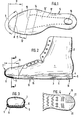
- Weitere vorteilhafte Einzelheiten der Erfindung sind in den Unteransprüchen enthalten und werden nachfolgend anhand von in der Zeichnung veranschaulichten Ausführungsbeispielen näher beschrieben. Dabei zeigen:
- Figur 1 die Schuhsohle für einen Rehabilitationsschuh gemäß der Erfindung von der Unterseite,
- Figur 2 den gesamten Schuh von der Außenseite aus gesehen,
- Figur 3 einen Schnitt gemäß der Schnittebene A-B der Figur 2 und
- Figur 4 die Teilunteransicht einer modifizierten Schuhsohle für einen Rehabilitationsschuh gemäß der Erfindung.
- Mit 1 ist ein Schuh für Rehabilitationszwecke, insbesondere in Form eines Stiefels mit relativ hohem Schaft 2, bezeichnet. Dessen Schuhsohle besteht aus der eigentlichen Laufsohle 6 und der Keilzwischensohle 5, die sich aus einer gut dämpfenden, durchgehenden Zwischensohle 3 und aus einem darüber angeordneten härteren Keil 4 zusammensetzt.
- Die Laufsohle 6 besitzt ein von der Schuhspitze 7 bis zu den Zehengrundgelenken verlaufendes Spitzenteil 8 aus flexiblem, unprofiliertem Material mit geringem Reibungskoeffizienten zumindest hinsichtlich des üblichen Laufgrundes, wie Kunststoff- oder Teppichböden oder Weg- bzw. Straßendecken, wie Asphalt, Beton oder dgl.. Hierfür eignet sich Verloursleder, wie Chromveloursleder oder Verloursspaltleder oder ein reibungsarmer flexibler Kunststoff mit einer gerauhten, insbesondere der Oberfläche von Veloursledern nachgebildeten, ansonsten jedoch unprofilierten Außen--bzw. Lauffläche.
- Das Spitzenteil 8 ist noch über die Schuhspitze 7 ein Stück nach oben gezogen, um auch als Spitzenschutz zu wirken. Vorteilhafterweise ist das Spitzenteil 8 auch im Randbereich 9 der Laufsohle 6 und der Zwischensohle 3 nach oben gezogen, um diese Sohlenteile ganz oder teilweise abzudecken.
- Im Anschluß an das Spitzenteil 8 besteht die Laufsohle 6 aus einem profiliertem Laufsohlenteil 10. Dieses profilierte Laufsohlenteil 10 besteht günstigerweise aus einem Material mit einem hohen Reibungskoeffizienten, beispielsweise aus einer geeigneten Gummi- oder Kunststoffmischung mit an sich bekannten Profilierungen.
- Die Trennlinie 11 zwischen dem unprofilierten Spitzenteil 8 und dem profilierten Laufsohlenteil 10 verläuft entsprechend den Zehengrundgelenken schräg von der weiter vorne gelegenen Innenseite zur weiter hinten gelegenen Außenseite der Laufsohle 6. Dadurch ist gewährleistet, daß beim Auftreten im Ballenbereich 12, unabhängig, ob dies im Groß- oder Kleinzehenballenbereich erfolgt, sofort ein guter Bodenkontakt gewährleistet ist.
- Damit im Ballenbereich 12 eine guteAbbiegung der Schuhsohle möglich ist, besteht die durchgehende Zwischensohle 3 aus gut dämpfendem, elastischem Material, vorzugsweise geschäumtem Polyurethan oder dgl. mit einer Härte von 30 bis 40 Shore A, insbesondere mit 35 Shore A, während der härtere Keil 4 aus weniger gut dämpfendem Material, vorzugsweise ebenfalls Schaumstoffmaterial, mit einer Härte von 60 bis 70 Shore A, insbesondere von 65 Shore A besteht. Der Keil 4 erstreckt sich von der Ferse bis höchstens zum auslaufendem Mittelfuß, d.h. etwa in den Bereich bis zu den Ballenbereich 12, was durch die strichpunktierte Linie 13 oder die gestrichelte Linie 14 angedeutet ist. Diese beiden Linien 13 bzw. 14 entsprechen also der vorderen Kante 15 des Keiles 4. Der Keil 4 besitzt von der Ferse aus bis etwa zum ersten Drittel des Mittelfußes eine gleichmäßige Dicke von beispielsweise 6 bis 12 mm, insbesondere von 10 mm und fällt dann bis zur vorderen Kante 15 stetig schräg ab.
- Der Keil 4 ist an der Sohleninnenseite länger als an der Sohlenaußenseite, so daß die Kante 15 etwa der Schräge der Trennlinie 11, d.h. dem Verlauf der Zehengrundgelenke bzw. der Zehenballen entspricht.
- Vorteilhafterweise kann der Keil 4 im Bereich des Fersenbeines eine Vertiefung oder Aussparung 16 besitzen, die mit gut dämpfendem Material, insbesondere der Härte 30 bis 50 Shore A ausgefüllt ist. Diese Aussparung 16 ist in Figur 1 gestrichelt dargestellt. Auch kann es vorteilhaft sein, den Keil 4 innen so auszusparen, daß der Keil 4 die in Figur 1 mit der +++ Linie 17 angedeutete Aussparung 16' aufweist, also etwa eine U-förmige Gestalt besitzt.
- Günstigerweise ist der vordere Abschnitt 18 der Zwischensohle 3 und der Laufsohle 6 etwa vom Zehengrundgelenkbereich oder vom Ballenbereich 12 ausgehend, schräg oder leicht gebogen nach oben verlaufend ausgebildet, wobei in diesem Bereich die Zwischensohle 3 nach vorne zur Schuhspitze 7 hin verjüngt ist. Dies vermindert die Gefahr des Hängenbleibens bei unsicherem Auftritt noch zusätzlich.
- Ferner kann auch der hintere Endabschnitt 19 der Schuhsohle zum Sohlenende hin nach oben abgebogen oder abgewinkelt sein. Dies geschieht vorzugsweise durch Verjüngung des Keiles 4 und/oder der Zwischensohle 3. Günstigerweise ist die eigentliche Laufsohle 6 im Endabschnitt 19 nicht oder nur leicht profiliert oder gerauht. Insbesondere kann die auf der Sohleninnenseite gelegene innere Hälfte 20 glatt und die auf der Sohlenaußenseite gelegene äußere Hälfte 21 leicht profiliert oder gerauht ausgebildet sein, wie sich aus der Figur 4 ergibt.
- Die durchgehende Zwischensohle 3 kann eine Dicke von 8 bis 18 mm, insbesondere von 13 mm, aufweisen. Demgegenüber besitzt der Keil 4 im zumindest annähernd gleich dicken Abschnitt eine Dicke von 6 bis 12 mm, insbesondere von 10 mm.
- Der verjüngte Abschnitt 18 der Zwischensohle 3 im Randbereich 9 kann auch nach oben abgeschrägt und/oder gerundet sein, wobei der Spitzenteil 8 aus unprofiliertem Material auch diesen Randbereich 9 mit bedeckt.
- Mit der vorliegenden Erfindung ist ein Schuh für Rehabilitationszwecke geschaffen worden, der dem Rekonvaleszenten nicht nur einen hohen Tragekomfort und Sicherheit beim Gehen gewährleistet, sondern insbesondere auch verhindert, daß ungewollte Stöße beim ersten Bodenkontakt sich auf die noch nicht ausgeheilte Fußverletzung nachteilig auswirken.
Claims (14)
1. Schuh für Rehabilitationszwecke, insbesondere zum Tragen bei Fußverletzungen und/oder nach Fußoperationen, dadurch gekennzeichnet, daß die Laufsohle (6) aus einem von der Schuhspitze (7) bis etwa zu den Zehengrundgelenken sich erstreckenden Spitzenteil (8) aus unprofiliertem Material mit geringem Reibungskoeffizienten (hinsichtlich üblicher Straßen-, Weg- und Bodenbeläge) und aus einem daran anschließenden profilierten Laufsohlenteil (10) aus abriebfestem, flexiblem Material besteht, daß eine Keilzwischensohle (5) aus einer durchgehenden, im wesentlichen gleiche Dicke aufweisenden Zwischensohle (3) und aus einem von der Ferse bis zum auslaufenden Mittelfuß verlaufenden, von der Schuhspitze aus gesehen hinter dem Großzehenballen und dem Kleinzehenballen endenden Keil (4) besteht, daß die Zwischensohle (3) einen höheren Dämpfungskoeffizienten (geringere Shore-Härte) aufweist als der Keil (4), und daß der Keil (4) fußinnenseitig länger als fußaußenseitig ausgebildet ist.
2. Schuh nach Anspruch 1, dadurch gekennzeichnet, daß das Spitzenteil (8) die Schuhspitze (7) nach oben zumindest teilweise noch umgreift.
3. Schuh nach Anspruch 1, dadurch gekennzeichnet, daß die Trennlinie (11) zwischen den beiden Laufsohlenteilen (8, 10) wenigstens annähernd als vor dem Großzehenballen und dem Kleinzehenballen verlaufende Gerade ausgebildet ist.
4. Schuh nach Anspruch 1, dadurch gekennzeichnet, daß der Keil (4) eine Härte von 60 bis 70 Shore A, insbesondere von 65 Shore A,und die Zwischensohle (3) eine Härte von 30 bis 40 Shore A, insbesondere von 35 Shore A, besitzt.
5. Schuh nach Anspruch 1 oder 4, dadurch gekennzeichnet, daß der Keil (4) unter dem Fersenbein eine Vertiefung oder eine Aussparung (16) aufweist und daß diese mit Material geringerer Härte, insbesondere zwischen 30 und 50 Shore A, ausgefüllt ist.
6. Schuh nach einem der Ansprüche 1 bis 5, dadurch ge-kennzeichnet, daß der Keil (4) U-förmig gebogen ist, wobei die U-förmigen Schenkel zur Schuhspitze (7) weisen.
7. Schuh nach einem der Ansprüche 1 bis 3, dadurch gekennzeichnet, daß der Spitzenteil (8) aus Veloursleder, insbesondere Chromveloursleder, besteht.
8. Schuh nach einem der Ansprüche 1 bis 7, dadurch gekennzeichnet, daß die Zwischensohle (3) und die Laufsohle (6) in einem Abschnitt (18) vom Zehengrundgelenkbereich oder vom Ballenbereich aus zur Schuhspitze (7) hin leicht schräg nach oben verläuft und nach vorn verjüngt ist.
9. Schuh nach Anspruch 8, dadurch gekennzeichnet, daß der verjüngte Abschnitt (18) im Randbereich (9) nach oben abgeschrägt und /oder gerundet ist und der Spitzenteil (8) aus unprofiliertem Material auch diesen Randbereich (9) bedeckt.
10. Schuh nach einem der Ansprüche 1 bis 9, dadurch gekennzeichnet, daß der Absatz der Schuhsohle im hinteren Endabschnitt (19) nach hinten zu nach oben abgebogen oder abgewinkelt ist.
11. Schuh nach Anspruch 10, dadurch gekennzeichnet, daß die Laufsohle (6) im nach oben abgebogenen oder abgewinkelten Endabschnitt (19) nicht profiliert oder nur leicht profiliert oder gerauht ist.
12. Schuh nach Anspruch 11, dadurch gekennzeichnet, daß im Fersenbereich etwa die innere Hälfte (20) unprofiliert und etwa die äußere Hälfte (21) leicht profiliert oder gerauht ist.
13. Schuh nach einem der Ansprüche 1 bis 12, dadurch gekennzeichnet, daß die Zwischensohle (3) eine Dicke von 8 bis 18 mm, insbesondere von 13 mm, aufweist.
14. Schuh nach einem der Ansprüche 1 bis 13, dadurch gekennzeichnet, daß der Keil (4) im zumindest annähernd gleich dicken Abschnitt eine Dicke von 6 bis 12 mm, insbesondere von 10 mm, aufweist.
Applications Claiming Priority (2)
| Application Number | Priority Date | Filing Date | Title |
|---|---|---|---|
| DE19853520786 DE3520786A1 (de) | 1985-06-10 | 1985-06-10 | Schuh fuer rehabilitationszwecke |
| DE3520786 | 1985-06-10 |
Publications (2)
| Publication Number | Publication Date |
|---|---|
| EP0205126A2 true EP0205126A2 (de) | 1986-12-17 |
| EP0205126A3 EP0205126A3 (de) | 1989-03-22 |
Family
ID=6272902
Family Applications (1)
| Application Number | Title | Priority Date | Filing Date |
|---|---|---|---|
| EP86107735A Withdrawn EP0205126A3 (de) | 1985-06-10 | 1986-06-06 | Schuh für Rehabilitationszwecke |
Country Status (5)
| Country | Link |
|---|---|
| US (1) | US4727660A (de) |
| EP (1) | EP0205126A3 (de) |
| JP (1) | JPS6241657A (de) |
| DE (1) | DE3520786A1 (de) |
| ES (1) | ES294637Y (de) |
Cited By (1)
| Publication number | Priority date | Publication date | Assignee | Title |
|---|---|---|---|---|
| CH681947A5 (de) * | 1990-10-16 | 1993-06-30 | Bernhard Georg Prof Dr M Weber |
Families Citing this family (39)
| Publication number | Priority date | Publication date | Assignee | Title |
|---|---|---|---|---|
| JPS5978138A (ja) * | 1982-10-28 | 1984-05-04 | Sumitomo Chem Co Ltd | 芳香族カルボニル化合物の製造法 |
| US6810606B1 (en) * | 1988-07-15 | 2004-11-02 | Anatomic Research, Inc. | Shoe sole structures incorporating a contoured side |
| US6115941A (en) * | 1988-07-15 | 2000-09-12 | Anatomic Research, Inc. | Shoe with naturally contoured sole |
| US6708424B1 (en) | 1988-07-15 | 2004-03-23 | Anatomic Research, Inc. | Shoe with naturally contoured sole |
| US5317819A (en) * | 1988-09-02 | 1994-06-07 | Ellis Iii Frampton E | Shoe with naturally contoured sole |
| US6675498B1 (en) * | 1988-07-15 | 2004-01-13 | Anatomic Research, Inc. | Shoe sole structures |
| US6314662B1 (en) * | 1988-09-02 | 2001-11-13 | Anatomic Research, Inc. | Shoe sole with rounded inner and outer side surfaces |
| US6668470B2 (en) | 1988-09-02 | 2003-12-30 | Anatomic Research, Inc. | Shoe sole with rounded inner and outer side surfaces |
| US5177882A (en) * | 1989-06-03 | 1993-01-12 | Puma Ag Rudolf Dassler Sport | Shoe with a central fastener |
| US6729046B2 (en) | 1989-08-30 | 2004-05-04 | Anatomic Research, Inc. | Shoe sole structures |
| US6163982A (en) | 1989-08-30 | 2000-12-26 | Anatomic Research, Inc. | Shoe sole structures |
| ES2173844T3 (es) | 1989-10-03 | 2002-11-01 | Anatomic Res Inc | Suela de zapato con suela intermedia que presenta variaciones de la rigidez y densidad. |
| US6789331B1 (en) | 1989-10-03 | 2004-09-14 | Anatomic Research, Inc. | Shoes sole structures |
| ATE199120T1 (de) | 1990-01-10 | 2001-02-15 | Anatomic Res Inc | Schuhsohlenaufbau |
| DE9209383U1 (de) * | 1992-07-13 | 1993-11-11 | Puma Ag Rudolf Dassler Sport, 91074 Herzogenaurach | Schuh, insbesondere Sport-, Freizeit- oder Rehabilitationsschuh |
| DE9209702U1 (de) * | 1992-07-22 | 1993-11-25 | Puma Ag Rudolf Dassler Sport, 91074 Herzogenaurach | Schuh, insbesondere Sport-, Freizeit- oder Rehabilitationsschuh |
| DE9209867U1 (de) * | 1992-07-22 | 1993-11-25 | Puma Ag Rudolf Dassler Sport, 91074 Herzogenaurach | Schuh, insbesondere Sport- oder Freizeitschuh |
| US7546699B2 (en) * | 1992-08-10 | 2009-06-16 | Anatomic Research, Inc. | Shoe sole structures |
| DE9211710U1 (de) * | 1992-08-31 | 1994-01-05 | Puma Ag Rudolf Dassler Sport, 91074 Herzogenaurach | Schuh mit einem Zentralverschluß |
| DE9211711U1 (de) * | 1992-08-31 | 1994-01-05 | Puma Ag Rudolf Dassler Sport, 91074 Herzogenaurach | Schuh mit einem Zentralverschluß |
| AU6290796A (en) * | 1995-06-26 | 1997-01-30 | Frampton Erroll Ellis III | Shoe sole structures |
| US7634529B2 (en) | 1996-11-29 | 2009-12-15 | Ellis Iii Frampton E | Personal and server computers having microchips with multiple processing units and internal firewalls |
| US5832560A (en) * | 1997-02-18 | 1998-11-10 | Depalma; Richard | Caster |
| FR2829500B1 (fr) * | 2001-09-13 | 2003-12-12 | Hemosystem | Procede de concentration et de detection de germes pathogenes a partir de produits sanguins et/ou de leurs derives et dispositif pour le mettre en oeuvre |
| AU2002351418A1 (en) * | 2002-06-07 | 2003-12-22 | David Pochatko | Rigid and flexible shoe |
| US7281341B2 (en) * | 2003-12-10 | 2007-10-16 | The Burton Corporation | Lace system for footwear |
| US12290134B2 (en) | 2004-11-22 | 2025-05-06 | Frampton E. Ellis | Footwear or orthotic sole with microprocessor control of a structural or support element with magnetorheological fluid |
| US8256147B2 (en) | 2004-11-22 | 2012-09-04 | Frampton E. Eliis | Devices with internal flexibility sipes, including siped chambers for footwear |
| US8291618B2 (en) * | 2004-11-22 | 2012-10-23 | Frampton E. Ellis | Devices with internal flexibility sipes, including siped chambers for footwear |
| US8141276B2 (en) | 2004-11-22 | 2012-03-27 | Frampton E. Ellis | Devices with an internal flexibility slit, including for footwear |
| US7490419B1 (en) * | 2004-12-29 | 2009-02-17 | Dennis E. Weiland | Support devices for distributing pressure |
| FR2901281B1 (fr) * | 2006-05-19 | 2008-08-15 | Hemosystem Sa | Procede d'extraction des acides desoxyribonucleiques (adn)de microorganismes eventuellement presents dans un echantillon sanguin |
| US8125796B2 (en) | 2007-11-21 | 2012-02-28 | Frampton E. Ellis | Devices with faraday cages and internal flexibility sipes |
| US8256146B2 (en) * | 2008-04-30 | 2012-09-04 | The Stride Rite Corporation | Infant shoes |
| US8215033B2 (en) * | 2009-04-16 | 2012-07-10 | Nike, Inc. | Article of footwear for snowboarding |
| US8474157B2 (en) * | 2009-08-07 | 2013-07-02 | Pierre-Andre Senizergues | Footwear lacing system |
| US9723890B2 (en) * | 2013-11-22 | 2017-08-08 | Nike, Inc. | Article of footwear incorporating a knitted component with body and heel portions |
| CN107319684A (zh) * | 2017-09-04 | 2017-11-07 | 鹤山市健行鞋业有限公司 | 术后康复鞋的鞋底 |
| US20230337785A1 (en) * | 2022-04-22 | 2023-10-26 | James Yoshitatsu Kobayashi | Anatomically pliant athletic footwear |
Family Cites Families (21)
| Publication number | Priority date | Publication date | Assignee | Title |
|---|---|---|---|---|
| US2885797A (en) * | 1957-08-16 | 1959-05-12 | Edward W Chrencik | Shoe construction with resilient heel and arch support |
| FR1217905A (fr) * | 1958-12-12 | 1960-05-06 | Modern Shoe Components Ltd | Perfectionnements aux bouts et semelles rapportés pour chaussures, ainsi qu'aux pièces pour leur ressemelage |
| FR1397826A (fr) * | 1963-06-06 | 1965-04-30 | Scholl Mfg Co Ltd | Dispositif correctif réglable pour le pied |
| US3661151A (en) * | 1970-02-06 | 1972-05-09 | Psl Ind Inc | Surgical shoe |
| US3584402A (en) * | 1970-04-08 | 1971-06-15 | Jack J Silverman | Sandal for foot cast |
| US3802424A (en) * | 1972-03-13 | 1974-04-09 | A Newell | Cast protective device |
| FR2181449B1 (de) * | 1972-04-25 | 1975-11-28 | Synthelabo | |
| US3905135A (en) * | 1974-07-10 | 1975-09-16 | Autrey O V Debusk | Boot for a foot cast |
| DE2635474B2 (de) * | 1976-08-06 | 1980-07-17 | Adidas Sportschuhfabriken Adi Dassler Kg, 8522 Herzogenaurach | Sportschuh, insbesondere Tennisschuh |
| US4085527A (en) * | 1977-02-01 | 1978-04-25 | Riggs Donnie E | Athletic shoe |
| US4128950A (en) * | 1977-02-07 | 1978-12-12 | Brs, Inc. | Multilayered sole athletic shoe with improved foam mid-sole |
| US4602676A (en) * | 1979-07-03 | 1986-07-29 | Stephen J. Ledet, Jr. | Heat transfer and building support system |
| US4302892A (en) * | 1980-04-21 | 1981-12-01 | Sunstar Incorporated | Athletic shoe and sole therefor |
| US4354318A (en) * | 1980-08-20 | 1982-10-19 | Brs, Inc. | Athletic shoe with heel stabilizer |
| BE885449A (nl) * | 1980-09-29 | 1981-01-16 | Spronken Orthopedie | Loopzool voor gebruik onder een immobiliserend verband van het onderbeen waarbij alle voetgewrichten stijf zijn |
| US4364188A (en) * | 1980-10-06 | 1982-12-21 | Wolverine World Wide, Inc. | Running shoe with rear stabilization means |
| US4446856A (en) * | 1981-12-18 | 1984-05-08 | The Langer Biomechanics Group, Inc. | Orthotic device |
| US4498251A (en) * | 1983-02-07 | 1985-02-12 | Mercury International Trading Corp. | Shoe design |
| US4578882A (en) * | 1984-07-31 | 1986-04-01 | Talarico Ii Louis C | Forefoot compensated footwear |
| DE8423344U1 (de) * | 1984-08-06 | 1984-10-31 | Puma-Sportschuhfabriken Rudolf Dassler Kg, 8522 Herzogenaurach | Schuhsole mit einer aus mehreren Schichten bestehenden Zwischensohle |
| DE8603370U1 (de) * | 1986-02-08 | 1986-04-24 | adidas Sportschuhfabriken Adi Dassler Stiftung & Co KG, 8522 Herzogenaurach | Therapeutischer Schuh |
-
1985
- 1985-06-10 DE DE19853520786 patent/DE3520786A1/de not_active Withdrawn
-
1986
- 1986-06-06 EP EP86107735A patent/EP0205126A3/de not_active Withdrawn
- 1986-06-09 ES ES1986294637U patent/ES294637Y/es not_active Expired
- 1986-06-09 JP JP61132015A patent/JPS6241657A/ja active Pending
- 1986-06-10 US US06/872,734 patent/US4727660A/en not_active Expired - Fee Related
Cited By (1)
| Publication number | Priority date | Publication date | Assignee | Title |
|---|---|---|---|---|
| CH681947A5 (de) * | 1990-10-16 | 1993-06-30 | Bernhard Georg Prof Dr M Weber |
Also Published As
| Publication number | Publication date |
|---|---|
| ES294637Y (es) | 1987-11-01 |
| ES294637U (es) | 1987-03-16 |
| DE3520786A1 (de) | 1986-12-11 |
| EP0205126A3 (de) | 1989-03-22 |
| JPS6241657A (ja) | 1987-02-23 |
| US4727660A (en) | 1988-03-01 |
Similar Documents
| Publication | Publication Date | Title |
|---|---|---|
| DE3520786A1 (de) | Schuh fuer rehabilitationszwecke | |
| DE69503150T2 (de) | Orthopaedische innensohle und verfahren zu seiner herstellung | |
| DE2908019C3 (de) | Fußstützende Sohle | |
| WO1998019572A1 (de) | Schuh- bzw. laufsohle sowie schuh mit dieser sohle | |
| EP0458174A1 (de) | Fussbekleidung mit einem aus wenigstens zwei Schichten bestehenden Boden | |
| DE19904887B4 (de) | Schuh | |
| DE2809251A1 (de) | Schuh | |
| DE7902981U1 (de) | Schuh, insbesondere für die ersten Schritte eines Kindes | |
| DE2939731C2 (de) | Sportschuh, insbesondere Laufschuh | |
| DE3027601C2 (de) | Formsohle mit durchtrittssicherer Einlage | |
| DE9418518U1 (de) | Einlage für einen Schuh, eine Sandale o.dgl. | |
| DE202008002681U1 (de) | Schuhsohle | |
| DE10211362B4 (de) | Sportschuh | |
| EP3520642B1 (de) | Sohle sowie schuh mit einer solchen | |
| DE29720627U1 (de) | Schuh | |
| DE3626871A1 (de) | Therapeutischer schuh | |
| DE10005603C2 (de) | Schuh, insbesondere für Spastiker | |
| CH681947A5 (de) | ||
| DE202004016192U1 (de) | Sohle für einen Schuh | |
| DE3026705C2 (de) | Sohle aus starrem Material, insbesondere Holz, sowie mit dieser versehene Schuhe | |
| DE69127297T2 (de) | Fussstützvorrichtung für schuhe | |
| DE3248233C2 (de) | Fußstütze, insbesondere für die Behandlung von Knickfüßen bei Kindern | |
| DE9420046U1 (de) | Fersenentlastungsorthese | |
| CH670192A5 (en) | Therapeutic boot with joint support | |
| DE8802353U1 (de) | Schuhwerk, insbesondere Wander- oder Sportschuh |
Legal Events
| Date | Code | Title | Description |
|---|---|---|---|
| PUAI | Public reference made under article 153(3) epc to a published international application that has entered the european phase |
Free format text: ORIGINAL CODE: 0009012 |
|
| AK | Designated contracting states |
Kind code of ref document: A2 Designated state(s): AT BE CH DE FR GB IT LI LU NL SE |
|
| PUAL | Search report despatched |
Free format text: ORIGINAL CODE: 0009013 |
|
| AK | Designated contracting states |
Kind code of ref document: A3 Designated state(s): AT BE CH DE FR GB IT LI LU NL SE |
|
| STAA | Information on the status of an ep patent application or granted ep patent |
Free format text: STATUS: THE APPLICATION IS DEEMED TO BE WITHDRAWN |
|
| 18D | Application deemed to be withdrawn |
Effective date: 19880701 |
|
| RIN1 | Information on inventor provided before grant (corrected) |
Inventor name: BERNHARD, CONSTANTIN |