EP0206155A1 - Neue aromatische Verbindungen, ihre Herstellung und Verwendung - Google Patents
Neue aromatische Verbindungen, ihre Herstellung und Verwendung Download PDFInfo
- Publication number
- EP0206155A1 EP0206155A1 EP86108054A EP86108054A EP0206155A1 EP 0206155 A1 EP0206155 A1 EP 0206155A1 EP 86108054 A EP86108054 A EP 86108054A EP 86108054 A EP86108054 A EP 86108054A EP 0206155 A1 EP0206155 A1 EP 0206155A1
- Authority
- EP
- European Patent Office
- Prior art keywords
- compounds
- formula
- alkyl
- preparation
- addition salts
- Prior art date
- Legal status (The legal status is an assumption and is not a legal conclusion. Google has not performed a legal analysis and makes no representation as to the accuracy of the status listed.)
- Granted
Links
- 238000002360 preparation method Methods 0.000 title claims abstract description 23
- 150000001491 aromatic compounds Chemical class 0.000 title claims abstract description 5
- 150000001875 compounds Chemical class 0.000 claims abstract description 80
- 238000000034 method Methods 0.000 claims abstract description 15
- 230000008569 process Effects 0.000 claims abstract description 9
- 239000003814 drug Substances 0.000 claims abstract description 8
- 239000002253 acid Substances 0.000 claims description 17
- 150000003839 salts Chemical class 0.000 claims description 17
- 125000003545 alkoxy group Chemical group 0.000 claims description 12
- 125000000217 alkyl group Chemical group 0.000 claims description 12
- 229910052744 lithium Inorganic materials 0.000 claims description 11
- -1 methoxyphenyl Chemical group 0.000 claims description 11
- UFHFLCQGNIYNRP-UHFFFAOYSA-N Hydrogen Chemical compound [H][H] UFHFLCQGNIYNRP-UHFFFAOYSA-N 0.000 claims description 9
- 239000001257 hydrogen Substances 0.000 claims description 9
- 229910052739 hydrogen Inorganic materials 0.000 claims description 9
- 125000001997 phenyl group Chemical group [H]C1=C([H])C([H])=C(*)C([H])=C1[H] 0.000 claims description 9
- 239000000460 chlorine Substances 0.000 claims description 8
- 229910052801 chlorine Inorganic materials 0.000 claims description 7
- 229910052731 fluorine Inorganic materials 0.000 claims description 6
- 239000011737 fluorine Substances 0.000 claims description 6
- 125000002887 hydroxy group Chemical group [H]O* 0.000 claims description 6
- WKBOTKDWSSQWDR-UHFFFAOYSA-N Bromine atom Chemical compound [Br] WKBOTKDWSSQWDR-UHFFFAOYSA-N 0.000 claims description 5
- ZAMOUSCENKQFHK-UHFFFAOYSA-N Chlorine atom Chemical compound [Cl] ZAMOUSCENKQFHK-UHFFFAOYSA-N 0.000 claims description 5
- 125000005530 alkylenedioxy group Chemical group 0.000 claims description 4
- GDTBXPJZTBHREO-UHFFFAOYSA-N bromine Substances BrBr GDTBXPJZTBHREO-UHFFFAOYSA-N 0.000 claims description 4
- 229910052794 bromium Inorganic materials 0.000 claims description 4
- 125000002485 formyl group Chemical class [H]C(*)=O 0.000 claims description 4
- 125000002924 primary amino group Chemical class [H]N([H])* 0.000 claims description 4
- 125000004076 pyridyl group Chemical group 0.000 claims description 4
- 125000002941 2-furyl group Chemical group O1C([*])=C([H])C([H])=C1[H] 0.000 claims description 3
- 125000000175 2-thienyl group Chemical group S1C([*])=C([H])C([H])=C1[H] 0.000 claims description 3
- 125000003682 3-furyl group Chemical group O1C([H])=C([*])C([H])=C1[H] 0.000 claims description 3
- 125000001541 3-thienyl group Chemical group S1C([H])=C([*])C([H])=C1[H] 0.000 claims description 3
- 229910052736 halogen Inorganic materials 0.000 claims description 3
- 150000002367 halogens Chemical class 0.000 claims description 3
- 125000002023 trifluoromethyl group Chemical group FC(F)(F)* 0.000 claims description 3
- 125000006276 2-bromophenyl group Chemical group [H]C1=C([H])C(Br)=C(*)C([H])=C1[H] 0.000 claims description 2
- 125000004800 4-bromophenyl group Chemical group [H]C1=C([H])C(*)=C([H])C([H])=C1Br 0.000 claims description 2
- 238000005903 acid hydrolysis reaction Methods 0.000 claims description 2
- 150000002431 hydrogen Chemical class 0.000 claims description 2
- 150000002902 organometallic compounds Chemical class 0.000 claims description 2
- 239000000546 pharmaceutical excipient Substances 0.000 claims description 2
- 125000004182 2-chlorophenyl group Chemical group [H]C1=C([H])C(Cl)=C(*)C([H])=C1[H] 0.000 claims 1
- 125000004207 3-methoxyphenyl group Chemical group [H]C1=C([H])C(*)=C([H])C(OC([H])([H])[H])=C1[H] 0.000 claims 1
- YCKRFDGAMUMZLT-UHFFFAOYSA-N Fluorine atom Chemical compound [F] YCKRFDGAMUMZLT-UHFFFAOYSA-N 0.000 claims 1
- 125000000068 chlorophenyl group Chemical group 0.000 claims 1
- 229940079593 drug Drugs 0.000 abstract description 3
- VLKZOEOYAKHREP-UHFFFAOYSA-N n-Hexane Chemical compound CCCCCC VLKZOEOYAKHREP-UHFFFAOYSA-N 0.000 description 21
- 238000006243 chemical reaction Methods 0.000 description 20
- MZRVEZGGRBJDDB-UHFFFAOYSA-N N-Butyllithium Chemical compound [Li]CCCC MZRVEZGGRBJDDB-UHFFFAOYSA-N 0.000 description 16
- 239000000203 mixture Substances 0.000 description 15
- WYURNTSHIVDZCO-UHFFFAOYSA-N Tetrahydrofuran Chemical compound C1CCOC1 WYURNTSHIVDZCO-UHFFFAOYSA-N 0.000 description 14
- RTZKZFJDLAIYFH-UHFFFAOYSA-N Diethyl ether Chemical compound CCOCC RTZKZFJDLAIYFH-UHFFFAOYSA-N 0.000 description 13
- 230000000694 effects Effects 0.000 description 13
- 239000002904 solvent Substances 0.000 description 13
- 150000003254 radicals Chemical class 0.000 description 9
- 239000000126 substance Substances 0.000 description 9
- KFZMGEQAYNKOFK-UHFFFAOYSA-N Isopropanol Chemical compound CC(C)O KFZMGEQAYNKOFK-UHFFFAOYSA-N 0.000 description 8
- VLTRZXGMWDSKGL-UHFFFAOYSA-M perchlorate Inorganic materials [O-]Cl(=O)(=O)=O VLTRZXGMWDSKGL-UHFFFAOYSA-M 0.000 description 8
- VLTRZXGMWDSKGL-UHFFFAOYSA-N perchloric acid Chemical compound OCl(=O)(=O)=O VLTRZXGMWDSKGL-UHFFFAOYSA-N 0.000 description 8
- 239000000243 solution Substances 0.000 description 8
- 239000004480 active ingredient Substances 0.000 description 7
- ZMXDDKWLCZADIW-UHFFFAOYSA-N N,N-Dimethylformamide Chemical compound CN(C)C=O ZMXDDKWLCZADIW-UHFFFAOYSA-N 0.000 description 6
- 239000003054 catalyst Substances 0.000 description 6
- 230000036747 functional refractory period Effects 0.000 description 6
- ZCSHNCUQKCANBX-UHFFFAOYSA-N lithium diisopropylamide Chemical compound [Li+].CC(C)[N-]C(C)C ZCSHNCUQKCANBX-UHFFFAOYSA-N 0.000 description 6
- SLRCCWJSBJZJBV-AJNGGQMLSA-N sparteine Chemical class C1N2CCCC[C@H]2[C@@H]2CN3CCCC[C@H]3[C@H]1C2 SLRCCWJSBJZJBV-AJNGGQMLSA-N 0.000 description 6
- FYYHWMGAXLPEAU-UHFFFAOYSA-N Magnesium Chemical compound [Mg] FYYHWMGAXLPEAU-UHFFFAOYSA-N 0.000 description 5
- 230000003288 anthiarrhythmic effect Effects 0.000 description 5
- 150000004820 halides Chemical class 0.000 description 5
- 239000011777 magnesium Substances 0.000 description 5
- 229910052749 magnesium Inorganic materials 0.000 description 5
- 238000003756 stirring Methods 0.000 description 5
- PAAZPARNPHGIKF-UHFFFAOYSA-N 1,2-dibromoethane Chemical compound BrCCBr PAAZPARNPHGIKF-UHFFFAOYSA-N 0.000 description 4
- VYPSYNLAJGMNEJ-UHFFFAOYSA-N Silicium dioxide Chemical compound O=[Si]=O VYPSYNLAJGMNEJ-UHFFFAOYSA-N 0.000 description 4
- 239000013543 active substance Substances 0.000 description 4
- SLRCCWJSBJZJBV-UHFFFAOYSA-N alpha-isosparteine Natural products C1N2CCCCC2C2CN3CCCCC3C1C2 SLRCCWJSBJZJBV-UHFFFAOYSA-N 0.000 description 4
- 239000002585 base Substances 0.000 description 4
- 239000002775 capsule Substances 0.000 description 4
- XMBWDFGMSWQBCA-UHFFFAOYSA-N hydrogen iodide Chemical compound I XMBWDFGMSWQBCA-UHFFFAOYSA-N 0.000 description 4
- HQKMJHAJHXVSDF-UHFFFAOYSA-L magnesium stearate Chemical compound [Mg+2].CCCCCCCCCCCCCCCCCC([O-])=O.CCCCCCCCCCCCCCCCCC([O-])=O HQKMJHAJHXVSDF-UHFFFAOYSA-L 0.000 description 4
- 238000010992 reflux Methods 0.000 description 4
- 229960001945 sparteine Drugs 0.000 description 4
- 230000001225 therapeutic effect Effects 0.000 description 4
- 125000004105 2-pyridyl group Chemical group N1=C([*])C([H])=C([H])C([H])=C1[H] 0.000 description 3
- 125000000339 4-pyridyl group Chemical group N1=C([H])C([H])=C([*])C([H])=C1[H] 0.000 description 3
- WFDIJRYMOXRFFG-UHFFFAOYSA-N Acetic anhydride Chemical compound CC(=O)OC(C)=O WFDIJRYMOXRFFG-UHFFFAOYSA-N 0.000 description 3
- UHOVQNZJYSORNB-UHFFFAOYSA-N Benzene Chemical compound C1=CC=CC=C1 UHOVQNZJYSORNB-UHFFFAOYSA-N 0.000 description 3
- 229930008564 C01BA04 - Sparteine Natural products 0.000 description 3
- FEWJPZIEWOKRBE-JCYAYHJZSA-N Dextrotartaric acid Chemical compound OC(=O)[C@H](O)[C@@H](O)C(O)=O FEWJPZIEWOKRBE-JCYAYHJZSA-N 0.000 description 3
- VEXZGXHMUGYJMC-UHFFFAOYSA-N Hydrochloric acid Chemical compound Cl VEXZGXHMUGYJMC-UHFFFAOYSA-N 0.000 description 3
- WHXSMMKQMYFTQS-UHFFFAOYSA-N Lithium Chemical compound [Li] WHXSMMKQMYFTQS-UHFFFAOYSA-N 0.000 description 3
- 238000013459 approach Methods 0.000 description 3
- 230000008602 contraction Effects 0.000 description 3
- UAOMVDZJSHZZME-UHFFFAOYSA-N diisopropylamine Chemical compound CC(C)NC(C)C UAOMVDZJSHZZME-UHFFFAOYSA-N 0.000 description 3
- 239000008187 granular material Substances 0.000 description 3
- 229940071870 hydroiodic acid Drugs 0.000 description 3
- 238000004519 manufacturing process Methods 0.000 description 3
- 125000002496 methyl group Chemical group [H]C([H])([H])* 0.000 description 3
- 239000000825 pharmaceutical preparation Substances 0.000 description 3
- 238000000926 separation method Methods 0.000 description 3
- YLQBMQCUIZJEEH-UHFFFAOYSA-N tetrahydrofuran Natural products C=1C=COC=1 YLQBMQCUIZJEEH-UHFFFAOYSA-N 0.000 description 3
- XLYOFNOQVPJJNP-UHFFFAOYSA-N water Substances O XLYOFNOQVPJJNP-UHFFFAOYSA-N 0.000 description 3
- IQHSSYROJYPFDV-UHFFFAOYSA-N 2-bromo-1,3-dichloro-5-(trifluoromethyl)benzene Chemical group FC(F)(F)C1=CC(Cl)=C(Br)C(Cl)=C1 IQHSSYROJYPFDV-UHFFFAOYSA-N 0.000 description 2
- ALKYHXVLJMQRLQ-UHFFFAOYSA-N 3-Hydroxy-2-naphthoate Chemical compound C1=CC=C2C=C(O)C(C(=O)O)=CC2=C1 ALKYHXVLJMQRLQ-UHFFFAOYSA-N 0.000 description 2
- XKRFYHLGVUSROY-UHFFFAOYSA-N Argon Chemical compound [Ar] XKRFYHLGVUSROY-UHFFFAOYSA-N 0.000 description 2
- IJGRMHOSHXDMSA-UHFFFAOYSA-N Atomic nitrogen Chemical compound N#N IJGRMHOSHXDMSA-UHFFFAOYSA-N 0.000 description 2
- 241000700198 Cavia Species 0.000 description 2
- 241000700199 Cavia porcellus Species 0.000 description 2
- 229920002261 Corn starch Polymers 0.000 description 2
- PXGOKWXKJXAPGV-UHFFFAOYSA-N Fluorine Chemical compound FF PXGOKWXKJXAPGV-UHFFFAOYSA-N 0.000 description 2
- VZCYOOQTPOCHFL-OWOJBTEDSA-N Fumaric acid Chemical compound OC(=O)\C=C\C(O)=O VZCYOOQTPOCHFL-OWOJBTEDSA-N 0.000 description 2
- 239000007818 Grignard reagent Substances 0.000 description 2
- GUBGYTABKSRVRQ-QKKXKWKRSA-N Lactose Natural products OC[C@H]1O[C@@H](O[C@H]2[C@H](O)[C@@H](O)C(O)O[C@@H]2CO)[C@H](O)[C@@H](O)[C@H]1O GUBGYTABKSRVRQ-QKKXKWKRSA-N 0.000 description 2
- AFVFQIVMOAPDHO-UHFFFAOYSA-N Methanesulfonic acid Chemical compound CS(O)(=O)=O AFVFQIVMOAPDHO-UHFFFAOYSA-N 0.000 description 2
- KWYHDKDOAIKMQN-UHFFFAOYSA-N N,N,N',N'-tetramethylethylenediamine Chemical compound CN(C)CCN(C)C KWYHDKDOAIKMQN-UHFFFAOYSA-N 0.000 description 2
- 229920003080 Povidone K 25 Polymers 0.000 description 2
- FAPWRFPIFSIZLT-UHFFFAOYSA-M Sodium chloride Chemical compound [Na+].[Cl-] FAPWRFPIFSIZLT-UHFFFAOYSA-M 0.000 description 2
- QAOWNCQODCNURD-UHFFFAOYSA-L Sulfate Chemical compound [O-]S([O-])(=O)=O QAOWNCQODCNURD-UHFFFAOYSA-L 0.000 description 2
- 206010003119 arrhythmia Diseases 0.000 description 2
- QVGXLLKOCUKJST-UHFFFAOYSA-N atomic oxygen Chemical compound [O] QVGXLLKOCUKJST-UHFFFAOYSA-N 0.000 description 2
- 238000010009 beating Methods 0.000 description 2
- ILAHWRKJUDSMFH-UHFFFAOYSA-N boron tribromide Chemical compound BrB(Br)Br ILAHWRKJUDSMFH-UHFFFAOYSA-N 0.000 description 2
- 238000004587 chromatography analysis Methods 0.000 description 2
- 238000001816 cooling Methods 0.000 description 2
- 239000008120 corn starch Substances 0.000 description 2
- 230000005595 deprotonation Effects 0.000 description 2
- 238000010537 deprotonation reaction Methods 0.000 description 2
- 239000003480 eluent Substances 0.000 description 2
- 150000004795 grignard reagents Chemical class 0.000 description 2
- 125000004435 hydrogen atom Chemical group [H]* 0.000 description 2
- 239000005457 ice water Substances 0.000 description 2
- 230000000297 inotrophic effect Effects 0.000 description 2
- 239000008101 lactose Substances 0.000 description 2
- AFRJJFRNGGLMDW-UHFFFAOYSA-N lithium amide Chemical class [Li+].[NH2-] AFRJJFRNGGLMDW-UHFFFAOYSA-N 0.000 description 2
- 235000019359 magnesium stearate Nutrition 0.000 description 2
- 238000002156 mixing Methods 0.000 description 2
- 238000006053 organic reaction Methods 0.000 description 2
- 239000001301 oxygen Substances 0.000 description 2
- 229910052760 oxygen Inorganic materials 0.000 description 2
- 230000000144 pharmacologic effect Effects 0.000 description 2
- 229920000036 polyvinylpyrrolidone Polymers 0.000 description 2
- 239000001267 polyvinylpyrrolidone Substances 0.000 description 2
- 235000013855 polyvinylpyrrolidone Nutrition 0.000 description 2
- 239000011541 reaction mixture Substances 0.000 description 2
- 230000035484 reaction time Effects 0.000 description 2
- 230000036279 refractory period Effects 0.000 description 2
- 239000007858 starting material Substances 0.000 description 2
- 238000006467 substitution reaction Methods 0.000 description 2
- 239000000725 suspension Substances 0.000 description 2
- 230000035488 systolic blood pressure Effects 0.000 description 2
- 229940095064 tartrate Drugs 0.000 description 2
- IMNIMPAHZVJRPE-UHFFFAOYSA-N triethylenediamine Chemical compound C1CN2CCN1CC2 IMNIMPAHZVJRPE-UHFFFAOYSA-N 0.000 description 2
- 239000008215 water for injection Substances 0.000 description 2
- 238000005550 wet granulation Methods 0.000 description 2
- SLRCCWJSBJZJBV-LXTVHRRPSA-N (-)-Spartein Natural products C1N2CCCC[C@@H]2[C@H]2CN3CCCC[C@@H]3[C@H]1C2 SLRCCWJSBJZJBV-LXTVHRRPSA-N 0.000 description 1
- RYHBNJHYFVUHQT-UHFFFAOYSA-N 1,4-Dioxane Chemical compound C1COCCO1 RYHBNJHYFVUHQT-UHFFFAOYSA-N 0.000 description 1
- NIBFJPXGNVPNHK-UHFFFAOYSA-N 2,2-difluoro-1,3-benzodioxole-4-carbaldehyde Chemical group C1=CC(C=O)=C2OC(F)(F)OC2=C1 NIBFJPXGNVPNHK-UHFFFAOYSA-N 0.000 description 1
- VYPYKCPWNPPBBX-UHFFFAOYSA-N 2-(3-bromophenyl)-1,3-dioxolane Chemical compound BrC1=CC=CC(C2OCCO2)=C1 VYPYKCPWNPPBBX-UHFFFAOYSA-N 0.000 description 1
- 125000003349 3-pyridyl group Chemical group N1=C([H])C([*])=C([H])C([H])=C1[H] 0.000 description 1
- ZCYVEMRRCGMTRW-UHFFFAOYSA-N 7553-56-2 Chemical compound [I] ZCYVEMRRCGMTRW-UHFFFAOYSA-N 0.000 description 1
- QTBSBXVTEAMEQO-UHFFFAOYSA-M Acetate Chemical compound CC([O-])=O QTBSBXVTEAMEQO-UHFFFAOYSA-M 0.000 description 1
- 229910002016 Aerosil® 200 Inorganic materials 0.000 description 1
- 206010002383 Angina Pectoris Diseases 0.000 description 1
- FERIUCNNQQJTOY-UHFFFAOYSA-M Butyrate Chemical compound CCCC([O-])=O FERIUCNNQQJTOY-UHFFFAOYSA-M 0.000 description 1
- FERIUCNNQQJTOY-UHFFFAOYSA-N Butyric acid Natural products CCCC(O)=O FERIUCNNQQJTOY-UHFFFAOYSA-N 0.000 description 1
- OKTJSMMVPCPJKN-UHFFFAOYSA-N Carbon Chemical compound [C] OKTJSMMVPCPJKN-UHFFFAOYSA-N 0.000 description 1
- KRKNYBCHXYNGOX-UHFFFAOYSA-K Citrate Chemical compound [O-]C(=O)CC(O)(CC([O-])=O)C([O-])=O KRKNYBCHXYNGOX-UHFFFAOYSA-K 0.000 description 1
- XDTMQSROBMDMFD-UHFFFAOYSA-N Cyclohexane Chemical compound C1CCCCC1 XDTMQSROBMDMFD-UHFFFAOYSA-N 0.000 description 1
- RGHNJXZEOKUKBD-SQOUGZDYSA-M D-gluconate Chemical compound OC[C@@H](O)[C@@H](O)[C@H](O)[C@@H](O)C([O-])=O RGHNJXZEOKUKBD-SQOUGZDYSA-M 0.000 description 1
- XTHFKEDIFFGKHM-UHFFFAOYSA-N Dimethoxyethane Chemical compound COCCOC XTHFKEDIFFGKHM-UHFFFAOYSA-N 0.000 description 1
- 238000003747 Grignard reaction Methods 0.000 description 1
- CPELXLSAUQHCOX-UHFFFAOYSA-N Hydrogen bromide Chemical compound Br CPELXLSAUQHCOX-UHFFFAOYSA-N 0.000 description 1
- 239000002879 Lewis base Substances 0.000 description 1
- 241001465754 Metazoa Species 0.000 description 1
- 229910002651 NO3 Inorganic materials 0.000 description 1
- NHNBFGGVMKEFGY-UHFFFAOYSA-N Nitrate Chemical compound [O-][N+]([O-])=O NHNBFGGVMKEFGY-UHFFFAOYSA-N 0.000 description 1
- MUBZPKHOEPUJKR-UHFFFAOYSA-N Oxalic acid Chemical compound OC(=O)C(O)=O MUBZPKHOEPUJKR-UHFFFAOYSA-N 0.000 description 1
- 229910019142 PO4 Inorganic materials 0.000 description 1
- XBDQKXXYIPTUBI-UHFFFAOYSA-M Propionate Chemical compound CCC([O-])=O XBDQKXXYIPTUBI-UHFFFAOYSA-M 0.000 description 1
- 241000700159 Rattus Species 0.000 description 1
- 244000007853 Sarothamnus scoparius Species 0.000 description 1
- FEWJPZIEWOKRBE-UHFFFAOYSA-N Tartaric acid Natural products [H+].[H+].[O-]C(=O)C(O)C(O)C([O-])=O FEWJPZIEWOKRBE-UHFFFAOYSA-N 0.000 description 1
- YXFVVABEGXRONW-UHFFFAOYSA-N Toluene Chemical compound CC1=CC=CC=C1 YXFVVABEGXRONW-UHFFFAOYSA-N 0.000 description 1
- CIUQDSCDWFSTQR-UHFFFAOYSA-N [C]1=CC=CC=C1 Chemical compound [C]1=CC=CC=C1 CIUQDSCDWFSTQR-UHFFFAOYSA-N 0.000 description 1
- 230000002378 acidificating effect Effects 0.000 description 1
- 150000007513 acids Chemical class 0.000 description 1
- 230000004913 activation Effects 0.000 description 1
- 229930013930 alkaloid Natural products 0.000 description 1
- 150000003797 alkaloid derivatives Chemical class 0.000 description 1
- 150000001350 alkyl halides Chemical class 0.000 description 1
- PNEYBMLMFCGWSK-UHFFFAOYSA-N aluminium oxide Inorganic materials [O-2].[O-2].[O-2].[Al+3].[Al+3] PNEYBMLMFCGWSK-UHFFFAOYSA-N 0.000 description 1
- 239000003708 ampul Substances 0.000 description 1
- 238000004458 analytical method Methods 0.000 description 1
- 239000003416 antiarrhythmic agent Substances 0.000 description 1
- 229910052786 argon Inorganic materials 0.000 description 1
- 230000006793 arrhythmia Effects 0.000 description 1
- 125000003118 aryl group Chemical group 0.000 description 1
- 150000007514 bases Chemical class 0.000 description 1
- WPYMKLBDIGXBTP-UHFFFAOYSA-N benzoic acid Chemical compound OC(=O)C1=CC=CC=C1 WPYMKLBDIGXBTP-UHFFFAOYSA-N 0.000 description 1
- 230000015572 biosynthetic process Effects 0.000 description 1
- 230000037396 body weight Effects 0.000 description 1
- 238000009835 boiling Methods 0.000 description 1
- 150000001649 bromium compounds Chemical class 0.000 description 1
- 125000004432 carbon atom Chemical group C* 0.000 description 1
- 239000004359 castor oil Substances 0.000 description 1
- 235000019438 castor oil Nutrition 0.000 description 1
- 238000007796 conventional method Methods 0.000 description 1
- 238000005661 deetherification reaction Methods 0.000 description 1
- 238000001514 detection method Methods 0.000 description 1
- 239000012973 diazabicyclooctane Substances 0.000 description 1
- 229940043279 diisopropylamine Drugs 0.000 description 1
- POULHZVOKOAJMA-UHFFFAOYSA-M dodecanoate Chemical compound CCCCCCCCCCCC([O-])=O POULHZVOKOAJMA-UHFFFAOYSA-M 0.000 description 1
- 239000008298 dragée Substances 0.000 description 1
- 239000000839 emulsion Substances 0.000 description 1
- 150000002170 ethers Chemical class 0.000 description 1
- 125000001495 ethyl group Chemical group [H]C([H])([H])C([H])([H])* 0.000 description 1
- 238000002474 experimental method Methods 0.000 description 1
- 230000002349 favourable effect Effects 0.000 description 1
- 238000001914 filtration Methods 0.000 description 1
- 125000002541 furyl group Chemical group 0.000 description 1
- 239000007903 gelatin capsule Substances 0.000 description 1
- 239000011521 glass Substances 0.000 description 1
- 229940050410 gluconate Drugs 0.000 description 1
- ZEMPKEQAKRGZGQ-XOQCFJPHSA-N glycerol triricinoleate Natural products CCCCCC[C@@H](O)CC=CCCCCCCCC(=O)OC[C@@H](COC(=O)CCCCCCCC=CC[C@@H](O)CCCCCC)OC(=O)CCCCCCCC=CC[C@H](O)CCCCCC ZEMPKEQAKRGZGQ-XOQCFJPHSA-N 0.000 description 1
- 229930195733 hydrocarbon Natural products 0.000 description 1
- 150000002430 hydrocarbons Chemical class 0.000 description 1
- 238000011065 in-situ storage Methods 0.000 description 1
- 239000011261 inert gas Substances 0.000 description 1
- 238000002329 infrared spectrum Methods 0.000 description 1
- 238000002347 injection Methods 0.000 description 1
- 239000007924 injection Substances 0.000 description 1
- 238000011835 investigation Methods 0.000 description 1
- 229910052740 iodine Inorganic materials 0.000 description 1
- 239000011630 iodine Substances 0.000 description 1
- 125000000959 isobutyl group Chemical group [H]C([H])([H])C([H])(C([H])([H])[H])C([H])([H])* 0.000 description 1
- 125000001449 isopropyl group Chemical group [H]C([H])([H])C([H])(*)C([H])([H])[H] 0.000 description 1
- 229940070765 laurate Drugs 0.000 description 1
- 238000006138 lithiation reaction Methods 0.000 description 1
- 150000002642 lithium compounds Chemical class 0.000 description 1
- 238000001819 mass spectrum Methods 0.000 description 1
- 229940126601 medicinal product Drugs 0.000 description 1
- 238000002844 melting Methods 0.000 description 1
- 230000008018 melting Effects 0.000 description 1
- 239000012528 membrane Substances 0.000 description 1
- 238000006263 metalation reaction Methods 0.000 description 1
- 125000000956 methoxy group Chemical group [H]C([H])([H])O* 0.000 description 1
- 150000007522 mineralic acids Chemical class 0.000 description 1
- 230000002107 myocardial effect Effects 0.000 description 1
- 208000010125 myocardial infarction Diseases 0.000 description 1
- 208000031225 myocardial ischemia Diseases 0.000 description 1
- 210000004165 myocardium Anatomy 0.000 description 1
- 125000004108 n-butyl group Chemical group [H]C([H])([H])C([H])([H])C([H])([H])C([H])([H])* 0.000 description 1
- 125000004123 n-propyl group Chemical group [H]C([H])([H])C([H])([H])C([H])([H])* 0.000 description 1
- PSZYNBSKGUBXEH-UHFFFAOYSA-M naphthalene-1-sulfonate Chemical compound C1=CC=C2C(S(=O)(=O)[O-])=CC=CC2=C1 PSZYNBSKGUBXEH-UHFFFAOYSA-M 0.000 description 1
- 230000007935 neutral effect Effects 0.000 description 1
- 229910052757 nitrogen Inorganic materials 0.000 description 1
- 238000000655 nuclear magnetic resonance spectrum Methods 0.000 description 1
- QIQXTHQIDYTFRH-UHFFFAOYSA-N octadecanoic acid Chemical compound CCCCCCCCCCCCCCCCCC(O)=O QIQXTHQIDYTFRH-UHFFFAOYSA-N 0.000 description 1
- 239000003921 oil Substances 0.000 description 1
- 150000007524 organic acids Chemical class 0.000 description 1
- 235000005985 organic acids Nutrition 0.000 description 1
- 239000003960 organic solvent Substances 0.000 description 1
- 150000002900 organolithium compounds Chemical class 0.000 description 1
- 125000001979 organolithium group Chemical group 0.000 description 1
- 150000002901 organomagnesium compounds Chemical class 0.000 description 1
- 238000010653 organometallic reaction Methods 0.000 description 1
- TWNQGVIAIRXVLR-UHFFFAOYSA-N oxo(oxoalumanyloxy)alumane Chemical compound O=[Al]O[Al]=O TWNQGVIAIRXVLR-UHFFFAOYSA-N 0.000 description 1
- 230000036284 oxygen consumption Effects 0.000 description 1
- 230000020477 pH reduction Effects 0.000 description 1
- 239000008194 pharmaceutical composition Substances 0.000 description 1
- NBIIXXVUZAFLBC-UHFFFAOYSA-K phosphate Chemical compound [O-]P([O-])([O-])=O NBIIXXVUZAFLBC-UHFFFAOYSA-K 0.000 description 1
- 239000010452 phosphate Substances 0.000 description 1
- UHZYTMXLRWXGPK-UHFFFAOYSA-N phosphorus pentachloride Chemical compound ClP(Cl)(Cl)(Cl)Cl UHZYTMXLRWXGPK-UHFFFAOYSA-N 0.000 description 1
- 239000000843 powder Substances 0.000 description 1
- 238000000746 purification Methods 0.000 description 1
- 230000009257 reactivity Effects 0.000 description 1
- 230000009467 reduction Effects 0.000 description 1
- 238000011160 research Methods 0.000 description 1
- 230000033764 rhythmic process Effects 0.000 description 1
- YGSDEFSMJLZEOE-UHFFFAOYSA-M salicylate Chemical compound OC1=CC=CC=C1C([O-])=O YGSDEFSMJLZEOE-UHFFFAOYSA-M 0.000 description 1
- 229960001860 salicylate Drugs 0.000 description 1
- MOODSJOROWROTO-UHFFFAOYSA-N salicylsulfuric acid Chemical compound OC(=O)C1=CC=CC=C1OS(O)(=O)=O MOODSJOROWROTO-UHFFFAOYSA-N 0.000 description 1
- 125000002914 sec-butyl group Chemical group [H]C([H])([H])C([H])([H])C([H])(*)C([H])([H])[H] 0.000 description 1
- 239000000741 silica gel Substances 0.000 description 1
- 229910002027 silica gel Inorganic materials 0.000 description 1
- 239000000377 silicon dioxide Substances 0.000 description 1
- 239000011780 sodium chloride Substances 0.000 description 1
- 239000007787 solid Substances 0.000 description 1
- 239000011877 solvent mixture Substances 0.000 description 1
- 238000010561 standard procedure Methods 0.000 description 1
- 230000000638 stimulation Effects 0.000 description 1
- 125000001424 substituent group Chemical group 0.000 description 1
- KDYFGRWQOYBRFD-UHFFFAOYSA-L succinate(2-) Chemical compound [O-]C(=O)CCC([O-])=O KDYFGRWQOYBRFD-UHFFFAOYSA-L 0.000 description 1
- 229940071103 sulfosalicylate Drugs 0.000 description 1
- 239000000829 suppository Substances 0.000 description 1
- 238000003786 synthesis reaction Methods 0.000 description 1
- 239000006188 syrup Substances 0.000 description 1
- 235000020357 syrup Nutrition 0.000 description 1
- 239000003826 tablet Substances 0.000 description 1
- 235000002906 tartaric acid Nutrition 0.000 description 1
- 239000011975 tartaric acid Substances 0.000 description 1
- 150000003892 tartrate salts Chemical class 0.000 description 1
- 238000002560 therapeutic procedure Methods 0.000 description 1
- VZCYOOQTPOCHFL-UHFFFAOYSA-N trans-butenedioic acid Natural products OC(=O)C=CC(O)=O VZCYOOQTPOCHFL-UHFFFAOYSA-N 0.000 description 1
- FAQYAMRNWDIXMY-UHFFFAOYSA-N trichloroborane Chemical compound ClB(Cl)Cl FAQYAMRNWDIXMY-UHFFFAOYSA-N 0.000 description 1
- 238000002211 ultraviolet spectrum Methods 0.000 description 1
- 238000010792 warming Methods 0.000 description 1
Classifications
-
- C—CHEMISTRY; METALLURGY
- C07—ORGANIC CHEMISTRY
- C07D—HETEROCYCLIC COMPOUNDS
- C07D471/00—Heterocyclic compounds containing nitrogen atoms as the only ring hetero atoms in the condensed system, at least one ring being a six-membered ring with one nitrogen atom, not provided for by groups C07D451/00 - C07D463/00
- C07D471/22—Heterocyclic compounds containing nitrogen atoms as the only ring hetero atoms in the condensed system, at least one ring being a six-membered ring with one nitrogen atom, not provided for by groups C07D451/00 - C07D463/00 in which the condensed systems contains four or more hetero rings
-
- A—HUMAN NECESSITIES
- A61—MEDICAL OR VETERINARY SCIENCE; HYGIENE
- A61P—SPECIFIC THERAPEUTIC ACTIVITY OF CHEMICAL COMPOUNDS OR MEDICINAL PREPARATIONS
- A61P9/00—Drugs for disorders of the cardiovascular system
-
- A—HUMAN NECESSITIES
- A61—MEDICAL OR VETERINARY SCIENCE; HYGIENE
- A61P—SPECIFIC THERAPEUTIC ACTIVITY OF CHEMICAL COMPOUNDS OR MEDICINAL PREPARATIONS
- A61P9/00—Drugs for disorders of the cardiovascular system
- A61P9/06—Antiarrhythmics
-
- A—HUMAN NECESSITIES
- A61—MEDICAL OR VETERINARY SCIENCE; HYGIENE
- A61P—SPECIFIC THERAPEUTIC ACTIVITY OF CHEMICAL COMPOUNDS OR MEDICINAL PREPARATIONS
- A61P9/00—Drugs for disorders of the cardiovascular system
- A61P9/10—Drugs for disorders of the cardiovascular system for treating ischaemic or atherosclerotic diseases, e.g. antianginal drugs, coronary vasodilators, drugs for myocardial infarction, retinopathy, cerebrovascula insufficiency, renal arteriosclerosis
Definitions
- the new compounds show a pronounced reduction in heart rate and an additional antiarrhythmic effect.
- the desired negative influence on the contractility of the heart extremely low. This means that the compounds have a particularly favorable ratio of the heart rate-lowering effect or the effect of prolonging the heart's refractory period to negative inotropic side effects and thus have a wide therapeutic range.
- the quotient F 75% / FRQ 75% from contraction-reducing and heart rate-reducing dose is also given. This quotient provides information about the therapeutic range of the substances in relation to the heart rate-lowering effect.
- Examples 7 to 9 describe pharmaceutical preparations containing the active compounds according to the invention and the preparation of such pharmaceutical preparations.
Landscapes
- Health & Medical Sciences (AREA)
- Chemical & Material Sciences (AREA)
- Organic Chemistry (AREA)
- Engineering & Computer Science (AREA)
- Bioinformatics & Cheminformatics (AREA)
- Life Sciences & Earth Sciences (AREA)
- General Health & Medical Sciences (AREA)
- Cardiology (AREA)
- Chemical Kinetics & Catalysis (AREA)
- General Chemical & Material Sciences (AREA)
- Medicinal Chemistry (AREA)
- Nuclear Medicine, Radiotherapy & Molecular Imaging (AREA)
- Veterinary Medicine (AREA)
- Pharmacology & Pharmacy (AREA)
- Public Health (AREA)
- Animal Behavior & Ethology (AREA)
- Heart & Thoracic Surgery (AREA)
- Urology & Nephrology (AREA)
- Vascular Medicine (AREA)
- Pharmaceuticals Containing Other Organic And Inorganic Compounds (AREA)
- Organic Low-Molecular-Weight Compounds And Preparation Thereof (AREA)
- Medicines Containing Material From Animals Or Micro-Organisms (AREA)
- Steroid Compounds (AREA)
- Nitrogen Condensed Heterocyclic Rings (AREA)
- Saccharide Compounds (AREA)
- Plural Heterocyclic Compounds (AREA)
- Preparation Of Compounds By Using Micro-Organisms (AREA)
- Fats And Perfumes (AREA)
Abstract
Description
- Die Erfindung betrifft neue aromatische Verbindungen der Spartein-Reihe, sowie deren Verwendung und ein Verfahren zu ihrer Herstellung. Sie umfaßt ferner Arzneimittel, die solche Verbindungen enthalten, sowie Verfahren zur Herstellung solcher Arzneimittel.
- Vom Spartein, einem aus Besenginster gewinnbaren Alkaloid, sind herzwirksame Eigenschaften, insbesondere sein Einfluß auf den Herzrhythmus, bereits eingehend beschrieben.
- Eine Wirkungssteigerung hinsichtlich der Verlängerung der Refraktärzeit konnte mit in 17-Stellung durch Alkyl substituierte Sparteine erreicht werden, also Verbindungen, die nachfolgende Struktur aufweisen.

- Solche Verbindungen sind aus der DE-OS 23 60 475 bekannt. Ferner ist aus der EP-A1-0 046 565 ein dimeres Spartein mit antiarrythmischer Wirkung, das 17,17'-Bisspartein bekannt.
- Die Verbindungen nach dem Stand der Technik zeigen zwar gute Eigenschaften bei der Behandlung von Herzrhythmus-Beschwerden, bezüglich des Wirkungsprofiles sind sie aber noch verbesserungsfähig.
- Aufgabe der Erfindung ist es, neue Sparteinderivate mit abgeändertem Wirkungprofil zur Verfügung zu stellen.
- Die Aufgabe wird gelöst durch die Bereitstellung der in den Patentansprüchen angegebenen Verbindungen.
- Die Erfindung umfaßt
- neue aromatische Verbindungen der allgemeinen Formel (I)

- S den 17-Spartein-Rest
- n 0 oder 1
- und A
- al) 2-Furyl, 2-Thienyl, 2-(N-Alkyl)-pyrryl für n = 0 oder
- a2) 3-Furyl, 3-Thienyl für n = 1 oder b) Pyridyl, oder
- c) substituiertes Phenyl der Formel (II)

- C1) Alkyl, vorzugsweise niederes Alkyl
- C2) Alkoxy, vorzugsweise niederes Alkoxy
- C3) Fluor
- C4) Chlor
- C5) Brom
- C6) Trifluormethyl
- C7) zwei benachbarte Reste gemeinsam Alkylendioxy
- C8) -CH-O-(CH2)2-O
- C9) Hydroxy
- C10) -CO-R4
- Sofern A Pyridyl bedeutet, ist darunter 2-, 3- oder 4-Pyridyl, vorzugweise 2- oder 4-Pyridyl zu verstehen.
- Als Alkyl kommt erfindungsgemäß sowohl verzweigtes als auch unverzweigtes Alkyl in Frage. Als niederes Alkyl wird im folgenden Alkyl mit bis zu vier C-Atomen verstanden. Bevorzugte Alkylreste sind somit als verzweigter Rest der Isopropyl-, sec.-Butyl-, (2-Methylpropyl)-Rest und als unverzweigtes Alkyl der Methyl-, Äthyl-, n-Propyl-, n-Butyl-Rest. Unter Alkoxy-Rest wird vorzugsweise niederes Alkoxy wie Methoxy, Äthoxy, Propoxy verstanden.
- Alkylendioxy bezeichnet insbesondere die Gruppierung -0-(CH2)q-0- mit q = 1 bis 2.
- Entsprechend einer Variante der Erfindung bedeutet keiner der Reste R1 bis R3 Wasserstoff. Die entsprechenden Verbindungen werden im folgenden als trisubstituiert bezeichnet. Ein Beispiel für solche Verbindungen ist für n = 1 die Substitution 3,4,5-Trimethoxy.
- Eine andere Variante der Erfindung sieht vor, daß einer der Reste R1 bis R3 Wasserstoff ist. Solche Verbindungen werden als disubstituiert bezeichnet. Beispiele für solche Verbindungen sind für n = 1 die Substitutionen 2,4-Dimethyl, 2,3-Dimethoxy, 2,4-Dichlor, 2,6-Dichlor, 3,5-Dichlor, 2-Fluor-3-methyl, 2,6-Difluor, 2-Fluor-6-chlor, 3-Methoxy-4-formyl.
- Ein besonderer Fall der Disubstitution ist, daß zwei benachbarte Reste R1 bis R3 gemeinsam eine Alkylendioxygruppe bilden. Beispiele für solche Verbindungen sind für n = 1 die Substituenten 3,4-Methylendioxy und 3,4-Äthylendioxy.
- In einer Reihe von Verbindungen besitzen zwei der Reste R1 bis R3 die Bedeutung Wasserstoff. Die entsprechenden Verbindungen werden im folgenden als monosubstituiert bezeichnet. Der Substituent kann dabei in ortho-, meta-oder para-Stellung zur Verknüpfung mit dem Sparteinrest stehen. Für n = 0 in Formel (I) sind monosubstituierte Verbindungen der Formel (Vm)
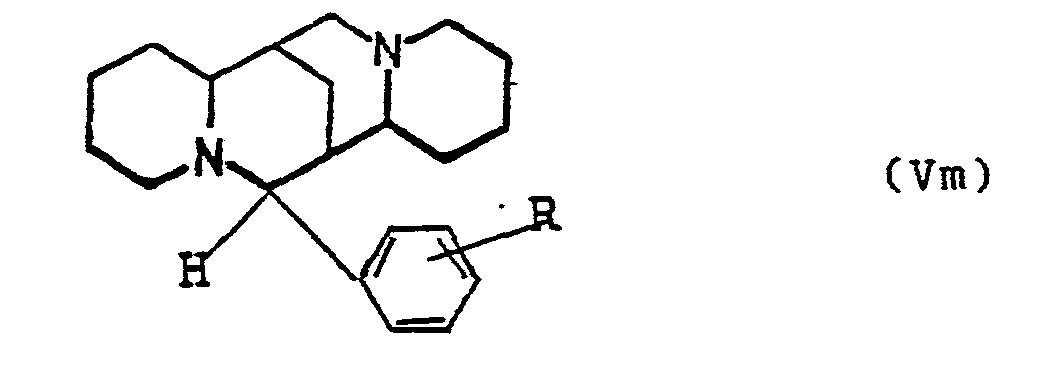
- Für n = 1 in Formel (I) sind monosubstituierte Verbindungen der Formel (VIm) - 1

- besonders zu nennen, in denen R die folgende Bedeutung besitzt.
- 2-Methyl, 3-Methyl, 4-Methyl, 2-Methoxy, 3-Methoxy, 4-Methoxy, 3-Hydroxy, 2-Fluor, 3-Fluor, 4-Fluor, 2-Chlor, 3-Chlor, 4-Chlor, 2-Brom, 3-Brom, 4-Brom, 3-Trifluormethyl, 4-Formyl, 4-(N,N-Diisopropyl)-aminocarbonyl.
- Besonders bevorzugt sind solche Erfindungen der Formel (I), in denen n die Bedeutung 1 besitzt.
- Die Erfindung umfaßt auch Arzneimittel, die mindestens eine der vorgenannten Verbindungen gemäß Formel (I) oder deren pharmakologisch verwendbares Additionssalz enthalten.
- Als pharmakologisch verwendbare Säureadditionssalze eignen sich beispielsweise wasserlösliche und wasserunlösliche Salze von anorganischen oder organischen Säuren wie z.B. das Hydrochlorid, Hydrobromid, Hydrojodid, Phosphat, Nitrat, Sulfat, Perchlorat, Acetat, Citrat, Gluconat, Benzoat, Propionat, Butyrat, Salicylat, Sulfosalicylat, Maleinat, Laurat, Fumarat, Succinat, Oxalat, Tartrat, Stearat, Tosylat (p-Toluolsulfonat), 2-Hydroxy-3-naphthoat, 3-Hydroxy-2-naphthoat, Mesylat (Methansulfonat), Naphthalinsulfonat.
- Die Erfindung umfaßt ferner Arzneimittel, die als Wirkstoff mindestens eine Verbindung der allgemeinen Formel (I) enthalten, in der A zusätzlich unsubstituiertes Phenyl bedeutet, oder deren pharmakologisch verwendbare Additionssalze.
- Diese letztgenannten Verbindungen sind an sich bereits bekannt (Rink, Grabowski, Archiv d. Pharmazie 289, 1956, S. 702). über ihre pharmakologischen Eigenschaften ist allerdings noch nichts beschrieben. Ihre Verwendung bei der therapeutischen Behandlung ist daher neu. Ebenso sind auch Arzneimittel neu, die diese an sich bekannten Verbindungen enthalten.
- Die Erfindung betrifft auch ein Verfahren zur Herstellung von Arzneimitteln, die mindestens eine Verbindung der Formel (I) oder Verbindungen der Formel (I), in denen A zusätzlich unsubstituiertes Phenyl bedeutet, oder deren pharmakologisch verwendbare Säureadditionssalze enthalten. Dieses Verfahren besteht darin, die genannten Verbindungen mit inerten, pharmakologisch geeigneten Trägerstoffen zu vermischen und in an sich bekannter Weise in galenische Zubereitungen zu überführen. Solche Zubereitungen können z.B. sein Tabletten, Dragees, Kapseln, Pulver, Granulate, wäßrige und ölige Suspensionen, Emulsionen, Sirupe oder Lösungen für die orale Anwendung, Suppositorien für die rektale Anwendung oder steril injizierbare Suspensionen oder Lösungen für die parenterale Applikation.
- Die Erfindung umfaßt auch Verfahren zur Herstellung von Verbindungen der Formel (I).
- In einer Variante i) wird dabei 17-Hydroxyspartein oder 17-Dehydrospartein-Salz, insbesondere das Perchlorat, mit einer Grignard-Verbindung der Formel (III)

- In einer Variante ii) wird 17-Dehydrospartein-Salz, insbesondere das Perchlorat, mit einer metallorganischen Verbindung der Formel (IV)

- Die Herstellung der Verbindungen (III) bzw. (IV) ist an sich bekannt und erfolgt durch Umsetzung von Verbindungen der Formel (VII)

- Verbindungen der Art (IV) mit n = 1 können auch aus Verbindungen der Art (VIII)

- Verbindungen der Art (IV) mit n = 0 können auch durch direkte Deprotonierung kernständiger, aktivierter Wasserstoffatome von Verbindungen (IX)

- Die derart hergestellten Verbindungen der Formel (I) kann man als solche oder in Form ihrer pharmakologisch verwendbaren Säureadditionssalze gewinnen. Man kann sie aber auch nach den folgenden Varianten weiter zu anderen Verbindungen der Formel (I) umsetzen:
- iii) Verbindungen, in denen A 2- oder 4-Brom-phenyl oder c2) bedeutet, werden mit Lithiumalkyl metalliert und in an sich bekannter Weise zu Verbindungen (I) mit A = cl), c3) bis c5), c10) weiter umgesetzt;
- iv) Verbindungen, in denen A c2) bedeutet, werden in an sich bekannter Weise mit HJ zu Verbindungen c9) umgesetzt;
- v) Verbindungen, in denen A c8) bedeutet, werden durch saure Hydrolyse zu dem entsprechenden Aldehyd umgesetzt.
- Auch die nach den Varianten iii) bis v) entstandenen Verbindungen können als solche oder in Form ihrer pharmakologisch verwendbaren Säureadditionssalze gewonnen werden.
- Die metallorganischen Reaktionen werden unter Ausschluß von Feuchtigkeit (absolutierte Lösungsmittel) und LuftSauerstoff (unter Inertgasatmosphäre, z.B. Stickstoff, Argon) durchgeführt.
- Als inerte organische Lösungsmittel kommen in Frage Ether (z.B. Diethylether, Tetrahydrofuran, Dioxan, Dimethoxyethan) oder Kohlenwasserstoffe wie z.B. Hexan, Cyclohexan oder Benzol, vorzugsweise Diethylether, Tetrahydrofuran und Hexan bzw. deren Gemische.
- In der Variante (i) erzeugt man zunächst aus dem entsprechenden Halogenid (VII) und fein verteiltem Magnesium entsprechend den Bedingungen der Grignard-Reaktion das Grignard-Reagenz (III) (z.B. K. Nützel, Methoden zur Herstellung und Umwandlung magnesiumorganischer Verbindungen, in: Houben-Weyl, Methoden der organischen Chemie, Band 13/2a, S. 53 ff).
- Zur Erzeugung des Grignard-Reagenzes kann, fal.ls notwendig, ein Katalysator verwendet werden, z.B. Jod oder 1,2-Dibromethan. Die Reaktionstemperatur liegt üblicherweise zwischen Raumtemperatur und dem Siedepunkt des Lösungsmittels oder des Lösungsmittelgemisches.
- In Abhängigkeit von sterischen und elektronischen Eigenschaften der Halogenide (VII) kann die Reaktionsdauer zwischen 30 min und mehreren Stunden betragen.
- Alternativ kann gemäß der Variante ii) auch eine lithiumorganische Reaktion zur Erzeugung der Verbindung (I) durchgeführt werden. Die Darstellung der Lithium-Zwischenstufe erfolgt nach Standardmethoden (z.B. H. Gilman, The Metalation Reaction With Organolithium Compounds, in: Organic Reactions, Vol. 8, S,. 258 ff oder H. R. Rodriguez, Heteroatom-Facilitated Lithiations, in: Organic Reactions, Vol. 26, S. 1 ff), beispielsweise Umsetzungen mit metallischem Lithium, Lithiumalkylen wie vorzugsweise n-Butyl- lithium oder Lithiumamiden wie vorzugsweise Lithiumdiisopropylamid.
- Es ist bekannt, daß stickstoffhaltige Lewis-Basen die Reaktivität der Lithiumverbindungen steigern; daher werden, falls erforderlich, beispielsweise N,N,N',N'-Tetramethylethylendiamin (TMEDA) oder 1,4-Diazabicyclo-[2,2,2]-octan (DABCO) als Katalysatoren eingesetzt.
- Die Reaktionstemperatur liegt üblicherweise zwischen -78 *C und +40 °C. In Abhängigkeit von den sterischen und elektronischen Eigenschaften des Halogenids (VII) kann die Reaktionsdauer zwischen 30 min und mehreren Stunden betragen.
- Die nach der Verfahrensvariante iii) durch Umsetzung der Bromide oder Alkoxyverbindungen mit Lithiumalkyl, vorzugsweise n-Butyllithium, gebildeten Lithiumphenylderivate können in an sich bekannter Weise zu neuen Verbindungen (I) umgesetzt werden (z.B.: N.S. Narasimhan, R.S. Mali, Synthesis 1983, S. 957 ff); beispielsweise erwähnt werden sollen Umsetzungen mit N,N-Dimethylformamid und Alkylhalogeniden.
- Die Etherspaltung gemäß Variante iv) erfolgt nach an sich üblichen Methoden wie Behandlung mit Jodwasserstoffsäure, Bortribromid, Bortrichlorid oder Phosphorpentachlorid, vorzugsweise mit Jodwasserstoffsäure.
- Die Umsetzungen können bei Normaldruck oder auch bei erhöhtem Druck durchgeführt werden, vorzugsweise bei Normaldruck.
- Die Reaktionstemperaturen können je nach Verfahren variieren in einem Bereich von -78 °C bis "200 °C.
- Die gegebenenfalls notwendige Reinigung der erhaltenen Verbindungen erfolgt in üblicher Weise, z.B. durch Säure-Base-Trennung oder chromatographische Verfahren.
- Die erfindungsgemäß erhältlichen Säureadditionssalze erhält man durch an sich bekannte Umsetzung der basischen Verbindungen (I) mit Säuren, welche pharmakologisch verwendbare Salze bilden.
- Die Verbindungen der Formel (I) und ihre pharmakologisch verwendbaren Säureadditionssalze-zeichnen sich durch interessante pharmakologische Eigenschaften aus und zeigen insbesondere sauerstoffeinsparende, frequenzbeeinflussende und rhythmisierende Wirkungen am Herzen. Die neuen Verbindungen zeichnen sich aus durch eine gute Wirksamkeit und hohe Verträglichkeit.
- So zeigen die neuen Verbindungen schon in geringen Dosen eine ausgeprügte Herzfrequenzsenkung und eine zusätzliche antiarrhythmische Wirkung. Darüber hinaus ist die uner- wünschte negative Beeinflussung des Kontraktionsvermögens des Herzens äußerst gering. Das heißt, die Verbindungen weisen ein besonders günstiges Verhältnis von herzfrequenzsenkender bzw. die Refraktärzeit des Herzens verlängernder Wirkung zu negativ inotropen Nebenwirkungen auf und besitzen somit eine große therapeutische Breite.
- Der Einfluß der Wirksubstanz auf den myokardialen Sauerstoffverbrauch wurde an narkotisierten Ratten untersucht und anhand der Methode von Neill (Neill, W.Z., H.H. Levine, R.J. Wagman, R. Gorlin, Circulation Research 12 (1963), 163) berechnet. Die hierzu erforderlichen Kreislaufmeßgrößen systolischer Blutdruck und Herzfrequenz wurden in der Versuchsanordnung nach Buschmann et al. (G. Buschmann, W. Schumacher, R. Budden und U.G. Kühl, J. Cardiovasc. Pharmacol. 2 (1980), 777 bis 795) ermittelt. Wie aus Tabelle A ersichtlich, reduzieren die Wirksubstanzen das Doppelprodukt aus Herzfrequenz und systolischem Blutdruck und führen damit zu einer Sauerstoffeinsparung am Herzen.

- Der direkte Einfluß der Wirksubstanz auf die Herzfrequenz (FRQ) wurde an spontan schlagenden, isolierten rechten Vorhöfen von weiblichen Albino Pirbright-white Meerschweinchen der Gewichtsklasse von 300 bis 400 g geprüft.' In Tabelle B ist als FRQ 75 % diejenige Konzentration in µmol/l angegeben, bei der es 20 min nach der Substanzgabe zu einer Abnahme der Frequenz auf 75 % des Ausgangwertes kommt.
- Angegeben ist weiterhin der Quotient F 75 % / FRQ 75 % aus kontraktionskraftmindernder und herzfrequenzsenkender Dosis. Dieser Quotient gibt Aufschluß über die therapeutische Breite der Substanzen in Bezug auf die herzfrequenssenkende Wirkung.
- Aus der Tabelle B ergibt sich, daß die neuen Substanzen keine nennenswerten unerwünschten negativ inotropen Effekte zeigen, jedoch bereits in sehr niedriger Konzentration eine herzfrequenzsenkende und eine antiarrhythmische Wirkung entfalten.
- Einfluß auf die Frequenz (FRQ) spontanschlagender rechter Meerscheinchenvorhöfe sowie auf die Kontraktionskraft (F) und die funktionelle Refraktärzeit (FRP) elektrisch gereizter linker Meerschweinchenvorhöfe

- Tabelle B gibt auch die Ergebnisse der literaturbekannten Verbindung übersaures Pentylspartein-L(+)-tartrat wieder (EP-A-0025069). Der Vergleich zeigt deutlich die überragende therapeutische Breite in Bezug auf die herzfrequenzsenkende Wirkung der erfindungsgemäßen Verbindungen gegenüber der der bekannten Substanz.
- Die überlegene Wirkung der erfindungsgemäßen Substanzen ist somit gekennzeichnet durch die Kombination von sauerstoffeinsparendem, rhythmisierendem und frequenzbeeinflussendem Effekt am Herzen.
- Dieses Wirkprofil gestattet einen Einsatz bei der ischämischen Herzkrankheit, z.B. Angina pectoris und Myokardinfarkt, sowie bei lebensbedrohlichen Arrhythmien.
- Die zu verwendenden Dosen varriieren naturgemäß je nach Art der verwendeten Substanz, der Applikationsart und des zu behandelnden Zustandes. Im allgemeinen werden jedoch befriedigende Ergebnisse in Tierversuchen mit Dosen von 0,01 bis 100 mg/kg Körpergewicht erhalten.
- Die nachfolgende Beispiele sollen die Herstellung der neuen Verbindungen der Formel (I) näher erläutern, jedoch den Umfang der Erfindung in keiner Weise beschränken.
- Die Strukturen der neuen Verbindungen wurden durch spektroskopische Untersuchungen, insbesondere durch Analyse der NMR-, Massen-, IR und/oder UV-Spektren gesichert.
- Das 17-Hydroxyspartein wurde gemäß DE-OS 28 25 117 aus Spartein gewonnen.
- Das 17-Dehydrosparteinperchlorat wurde nach M. Rink und K. Grabowski, Arch. Pharm. 289, (1956) 695 aus 17-Hydroxyspartein hergestellt.
- In den Beispielen und Tabellen werden folgende Abkürzungen verwendet:
- LSM = Lösungsmittel, THF = Tetrahydrofuran, Et = Diethylether, T = Temperatur (°C), Kat = Katalysator, P = 17-Dehydrosparteinperchlorat, H = 17-Hydroxyspartein, DBE = 1,2-Dibromethan, WS = Weinsäure-Salz, HFu = FumarsäureSalz.
- 0,1 mol Magnesiumspäne werden in 50 ml Lösungsmittel (absolutiert) vorgelegt. Gegebenenfalls wird Katalysator zugesetzt. Nach dem Zutropfen von 0,1 mol (VII) in 50 ml Lösungsmittel hält man den Ansatz bis zur Auflösung des Magnesiums am Rückfluß.
- Der Reaktionsansatz wird als solcher für die Umsetzung in Beispiel 2 verwendet.
- 4,4 mmol n-Butyllithium (als 15 %ige Lösung in Hexan) wird in 30 ml Lösungsmittel (absolutiert) bei -78 °C gelöst. Nach dem langsamen Zutropfen von 4,5 mmol (VII) in 30 ml Lösungsmittel wird für weitere 30 min bei -78 *C gerührt. Dieser Ansatz wird für die Umsetzung in Beispiel 3 verwendet.
- Zur Lösung von 0,1 mol Lithium-Diisopropylamid - hergestellt in situ aus Diisopropylamin und n-Butyllithium - in 100 ml Lösungsmittel (absolutiert) werden bei entsprechender Temperatur 0,1 mol (VIII) eingetropft und weiter gerührt. Danach wird mit 200 ml Lösungsmittel verdünnt und der resultierende Ansatz für die Umsetzung im Beispiel 3 verwendet.
- Zu 0,1 mol (IX) in 50 ml Lösungsmittel werden, gegebenenfalls in Anwesenheit etwa äquimolarer Menge an Katalysator, unter Kühlung (Tl) 62,5 ml einer 1,6 molaren Lösung von n-Butyllithium in Hexan zugetropft. Zur Vervollständigung der Deprotonierung wird bei erhöhter Temperatur (T2) weitergerührt. Der resultierende Ansatz wird für die Umsetzung in Beispiel 3 verwendet, wobei vorher auf Temperatur T3 eingestellt wird.
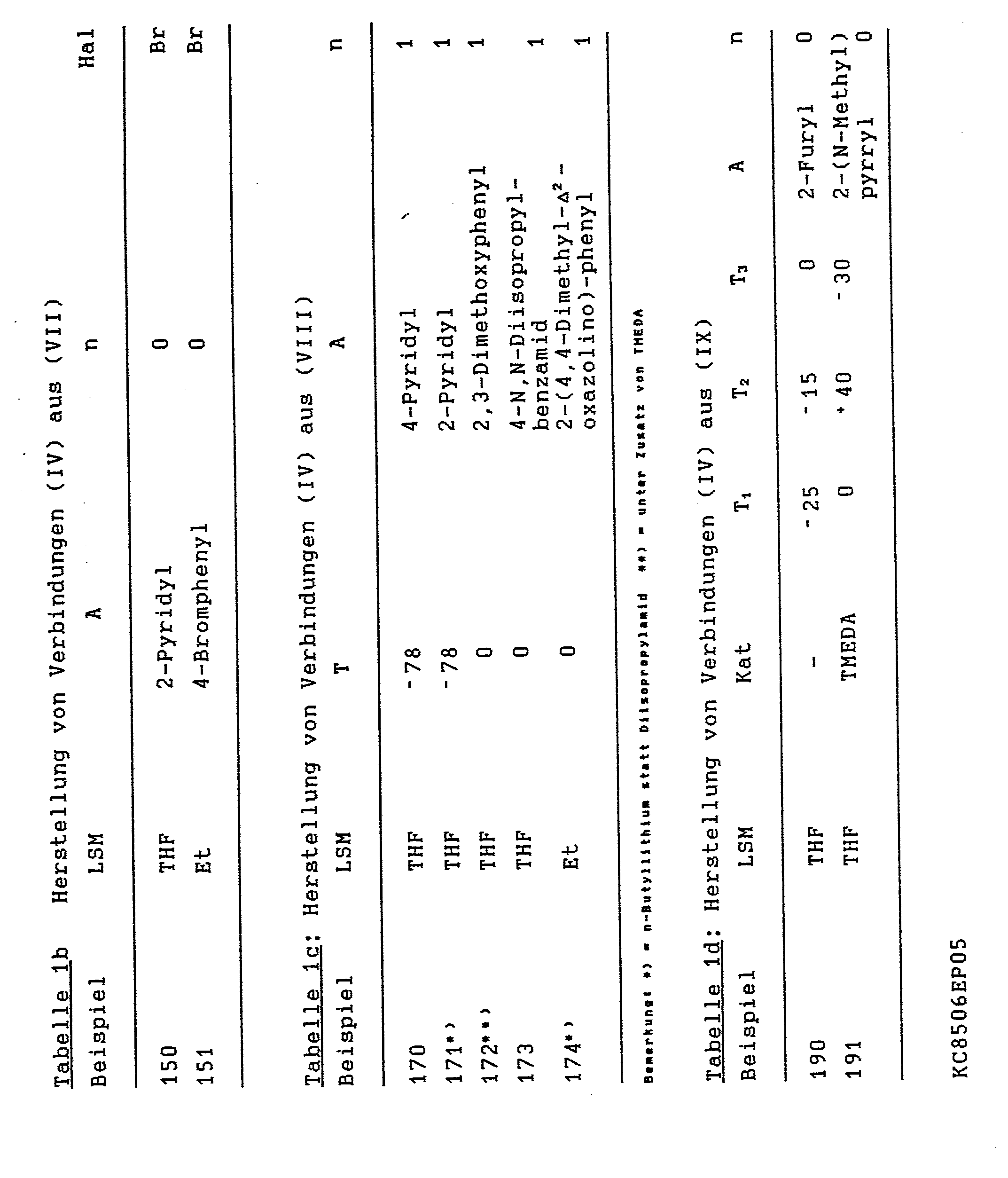
- Angaben zu speziellen Reaktionsbedinungen finden sich in Tabellen la) bis 1d).
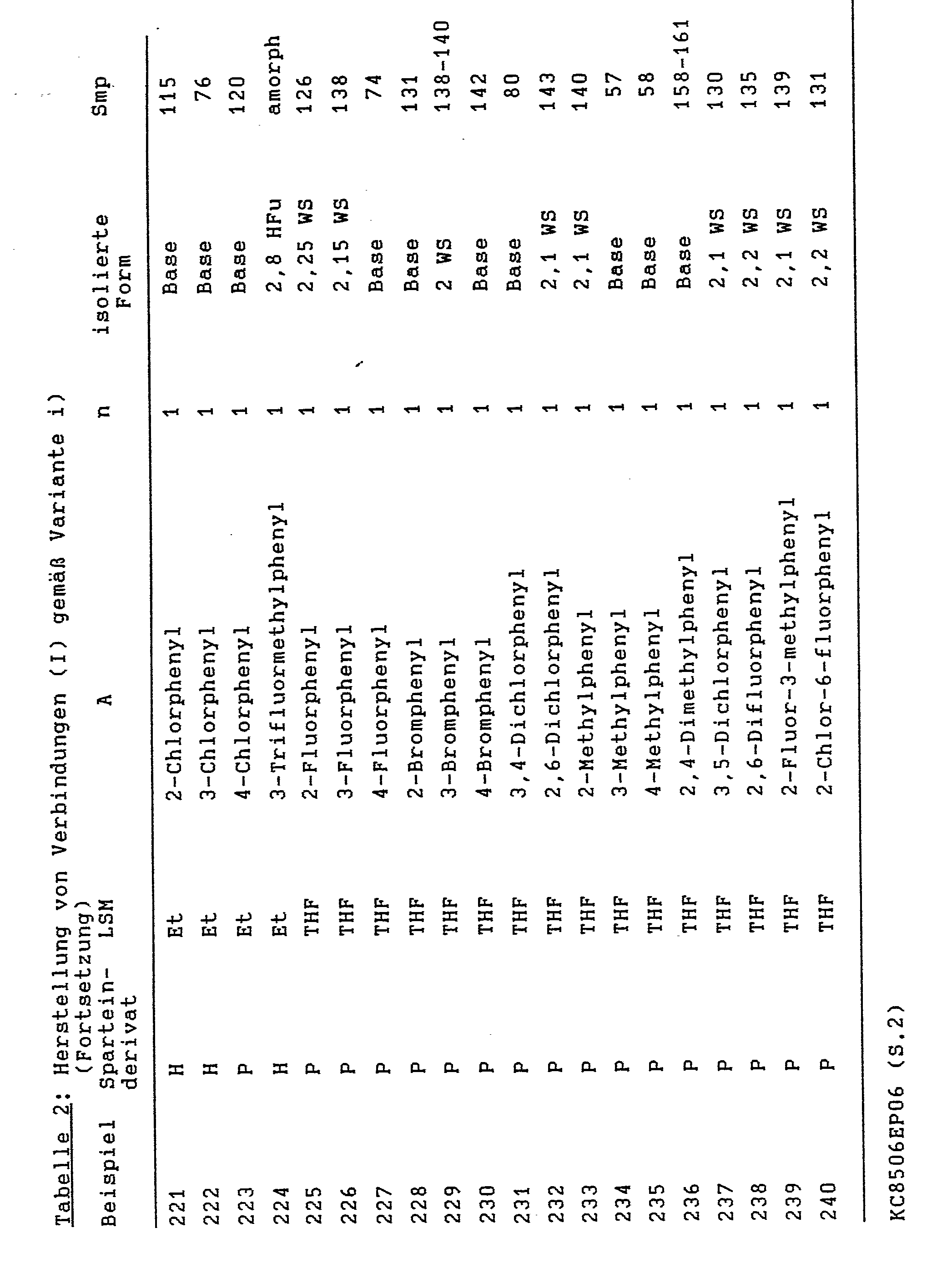
- In den aus Beispiel la) stammenden Ansatz wird 0,05 mol 17-Hydroxyspartein bzw. 17-Dehydrospartein-Perchlorat in 100 ml Lösungsmittel eingegeben und bis zur vollständigen Umsetzung am Rückfluß erwärmt. Nach vorsichtigem Ansäuern mit verdünnter Salzsäure und anschließender Säure/Base-Trennung und Chromatographie an neutralem Aluminiumoxid bzw. Kieselgel mit Äther/Hexan-Gemisch als Laufmittel wird die Verbindung (I) isoliert. In einer Variante wird diese zu ihrem Säureadditionssalz umgesetzt. Spezielle Reaktionsbedingungen und erhaltene Produkte werden in Tabelle 2 wiedergegeben.
- In den aus Beispiel 1b) bzw. 1c) bzw. 1d) erhaltenen Ansatz wird die äquimolare Menge festes 17-Dehydrospartein- Perchlorat gegeben und unter langsamer Erwärmung auf Raumtemperatur bis zur vollständigen Umsetzung weitergerührt. Nach Zugabe von verdünnter Säure oder Eiswasser wird wie in Beispiel 2 aufgearbeitet. Angaben zu speziellen Reaktionsbedingungen und zu erhaltenen Produkten werden in Tabelle 3 gegeben.
- 0,013 mol Edukt werden in Lösungsmittel (absolutiert) gelöst, wobei gegebenenfalls Katalysator zugesetzt wird. Unter Kühlung setzt man tropfenweise 0,02 mol n-Butyllithium (als 15 %ige Lösung in Hexan) zu und nach Rühren bei Raumtemperatur für 1 bis 6 Stunden erfolgt die Zugabe von 0,04 mol N,N-Dimethylformamid in 20 ml Lösungsmittel. Nach Beendigung der Reaktion wird mit Wasser versetzt und wie in Beispiel 2 aufgearbeitet. Spezielle Reaktionsbedingungen und erhaltene Produkte werden in Tabelle 4 charakterisiert.
- Zu 0,017 mol Edukt in 14 ml Essigsäureanhydrid läßt man langsam 30 ml 57 %ige Jodwasserstoffsäure tropfen. Der Ansatz wird 4 Stunden unter Rückfluß erhitzt. Man gibt das Reaktionsgemisch vorsichtig auf Eiswasser und arbeitet wie unter Beispiel 2 angegeben auf. Angaben zu Reaktionsbedingungen und zu erhaltenen Produkten werden in Tabelle 5 wiedergegeben.
- 0,02 mol Magnesium werden in 50 ml absolutem THF vorgelegt. Nach Aktivierung mit 0,2 ml 1,2-Dibromäthan erfolgt tropfenweise Zugabe von 0,02 mol 2-(3-Bromphenyl)-1,3-dioxolan in 10 ml absolutem THF. Nachdem der Ansatz 1 Stunde am Rückfluß erhitzt worden ist, verdünnt man mit 100 ml absolutem THF und versetzt mit 0,01 mol 17-Dehydrospartein- perchlorat und erhitzt erneut bis zur vollständigen Umsetzung.
- Zur Freisetzung des Aldehyds wird mit verdünnter Salzsäure versetzt und 30 min bei Raumtemperatur gerührt. Nach Säure/Base-Trennung und anschließender Filtration über Tonerde mit Äther/Hexan (1 : 1) als Laufmittel kann das Formylderivat als öl isoliert werden. Durch Umsetzung mit 3 Äquivalenten Weinsäure erhält man ein kristallines Tartrat (Schmelzpunkt: 126 bis 130 *C).
- Die folgenden Beispiele 7 bis 9 beschreiben pharmazeutische Zubereitungen enthaltend die erfindungsgemäßen Wirkstoffe sowie die Herstellung solcher pharmazeutischer Zubereitungen.
- Zusammensetzung:

- Der Wirkstoff wird mit Maisstärke und feinpulvriger Lactose in einem Mischer vermischt. Die entstandene Mischung wird mit einer 20 %igen Lösung von Polyvinylpyrrolidon (Kollidon 25, Fa. BASF) in Isopropanol durchfeuchtet.
- Falls erforderlich, wird weiteres Isopropanol hinzugefügt. Das feuchte Granulat wird durch ein 2-mm Sieb passiert, bei 40 *C auf Horden getrocknet und anschließend durch ein 1 mm-Sieb (Frewitt-Maschine) passiert. Nach dem Vermischen des Granulats mit Magnesiumstearat und hydriertem Rizinusöl werden damit Tabletten von 113 mg gepreßt, so daß jede Tablette 20 mg Wirkstoff enthält.
- Zusammensetzung:

- Der Wirkstoff wird mit Maisstärke und feinpulvriger Lactose in einem Mischer vermischt. Die entstandene Mischung wird mit einer 20 %igen Lösung von Polyvinylpyrrolidon (Kollidon 25) in Isopropanol durchfeuchtet. Falls erforderlich, wird weiteres Isopropanol hinzugefügt. Das feuchte Granulat wird durch ein 1,6 mm-Sieb (Frewitt) passiert, bei 40 *C auf Horden getrocknet und anschließend durch ein 1 mm-Sieb (Frewitt) passiert. Nach dem Vermischen des Granulats mit Magnesiumstearat und Kieselsäureaerogel (Aerosil 200, Fa. Degussa) füllt man davon jeweils 90 mg mittels automatischer Kapselmaschine in Hartgelatinekapseln der Größe 4 ab, so daß jede Kapsel 20 mg Wirkstoff enthält.
- Zusammensetzung (pro Ampulle):

- Man löst Natriumchlorid in Wasser für Injektionszwecke auf, fügt den Wirkstoff hinzu und löst unter Rühren. Mit genügend Wasser für Injektionszwecke wird bis zum Endvolumen aufgefüllt. Der Ansatz wird durch ein Membranfilter 0,25 µ passiert. Man füllt in Braunglasampullen jeweils 2,15 ml ab und schmilzt sie zu. Bei 121 °C wird 30 Minuten lang mit Dampf sterilisiert. 2 ml Injektionslösung enthalten 5 mg Wirkstoff.




sind, wobei R4 Wasserstoff, Alkoxy, Hydroxy oder gegebenenfalls substituiertes, vorzugsweise alkylsubstituiertes Amino ist, sowie deren pharmakologisch verwendbare Säureadditionssalze.
Claims (10)


sind, wobei R4 Wasserstoff, Alkoxy, Hydroxy oder gegebenenfalls substituiertes, vorzugsweise alkylsubstituiertes Amino ist,
sowie deren pharmakologisch verwendbare Säureadditionssalze.


und die resultierenden Verbindungen entweder als solche oder in Form ihrer pharmakologisch verwendbaren Säureadditionssalze gewinnt oder sie folgendermaßen weiter zu anderen Verbindungen der Formel (I) umsetzt:
und die derart erhaltenen Verbindungen als solche oder in Form ihrer pharmakologisch verwendbaren Säureadditionssalze gewinnt.
Priority Applications (1)
| Application Number | Priority Date | Filing Date | Title |
|---|---|---|---|
| AT86108054T ATE47391T1 (de) | 1985-06-22 | 1986-06-12 | Neue aromatische verbindungen, ihre herstellung und verwendung. |
Applications Claiming Priority (2)
| Application Number | Priority Date | Filing Date | Title |
|---|---|---|---|
| DE3522475 | 1985-06-22 | ||
| DE19853522475 DE3522475A1 (de) | 1985-06-22 | 1985-06-22 | Neue aromatische verbindungen, ihre herstellung und verwendung |
Publications (2)
| Publication Number | Publication Date |
|---|---|
| EP0206155A1 true EP0206155A1 (de) | 1986-12-30 |
| EP0206155B1 EP0206155B1 (de) | 1989-10-18 |
Family
ID=6273983
Family Applications (1)
| Application Number | Title | Priority Date | Filing Date |
|---|---|---|---|
| EP86108054A Expired EP0206155B1 (de) | 1985-06-22 | 1986-06-12 | Neue aromatische Verbindungen, ihre Herstellung und Verwendung |
Country Status (17)
| Country | Link |
|---|---|
| US (1) | US4755520A (de) |
| EP (1) | EP0206155B1 (de) |
| JP (1) | JPH0662621B2 (de) |
| AT (1) | ATE47391T1 (de) |
| AU (1) | AU5891586A (de) |
| DD (1) | DD263059A5 (de) |
| DE (2) | DE3522475A1 (de) |
| DK (1) | DK290086A (de) |
| ES (1) | ES8802425A1 (de) |
| FI (1) | FI862570A7 (de) |
| GR (1) | GR861599B (de) |
| HU (2) | HU194236B (de) |
| NO (1) | NO862494L (de) |
| NZ (1) | NZ216605A (de) |
| PT (1) | PT82800A (de) |
| SU (1) | SU1491340A3 (de) |
| ZA (1) | ZA864194B (de) |
Cited By (1)
| Publication number | Priority date | Publication date | Assignee | Title |
|---|---|---|---|---|
| EP0273272A3 (en) * | 1986-12-19 | 1990-06-06 | Kali-Chemie Pharma Gmbh | Pharmaceutical compositions containing 17-benzyl sparteine derivatives with a positive inotropic effect |
Families Citing this family (4)
| Publication number | Priority date | Publication date | Assignee | Title |
|---|---|---|---|---|
| US4879299A (en) * | 1985-06-22 | 1989-11-07 | Kali-Chemie Pharma Gmbh | Treatment of heart conditions with spartein compounds |
| US5912343A (en) * | 1996-12-31 | 1999-06-15 | Bridgestone Corporation | Tertiary amines containing side-chain organolithium structures and method for the preparation thereof |
| PT2266968E (pt) | 2001-07-16 | 2013-02-25 | Genzyme Corp | Síntese de udp-glucose: inibidores de n-acil esfingosinaglucosiltransferase |
| SG10201407881WA (en) | 2009-11-27 | 2015-01-29 | Genzyme Corp | An amorphous and a crystalline form of genz 112638 hemitartrate as inhibitor of glucosylceramide synthase |
Citations (1)
| Publication number | Priority date | Publication date | Assignee | Title |
|---|---|---|---|---|
| DE2360475A1 (de) * | 1973-12-05 | 1975-06-12 | Giulini Gmbh Geb | Spartein-derivate mit neuen pharmakologischen eigenschaften |
Family Cites Families (2)
| Publication number | Priority date | Publication date | Assignee | Title |
|---|---|---|---|---|
| DE2963114D1 (en) * | 1979-09-06 | 1982-08-05 | Kali Chemie Pharma Gmbh | Pentylsparteine salt, medicament containing it and process for the preparation of this medicament |
| DE3032219A1 (de) * | 1980-08-27 | 1982-04-15 | Kali-Chemie Pharma Gmbh, 3000 Hannover | Neues sparteinderivat, verfahren zu seiner herstellung, das derivat enthaltende arzneimittel und verfahren zur herstellung der arzneimittel |
-
1985
- 1985-06-22 DE DE19853522475 patent/DE3522475A1/de not_active Withdrawn
-
1986
- 1986-06-04 SU SU864027569A patent/SU1491340A3/ru active
- 1986-06-05 ZA ZA864194A patent/ZA864194B/xx unknown
- 1986-06-12 DE DE8686108054T patent/DE3666432D1/de not_active Expired
- 1986-06-12 EP EP86108054A patent/EP0206155B1/de not_active Expired
- 1986-06-12 AT AT86108054T patent/ATE47391T1/de not_active IP Right Cessation
- 1986-06-17 US US06/875,311 patent/US4755520A/en not_active Expired - Fee Related
- 1986-06-17 FI FI862570A patent/FI862570A7/fi not_active Application Discontinuation
- 1986-06-18 HU HU862553A patent/HU194236B/hu not_active IP Right Cessation
- 1986-06-18 HU HU874040A patent/HU195816B/hu unknown
- 1986-06-19 DD DD86291459A patent/DD263059A5/de unknown
- 1986-06-20 NO NO862494A patent/NO862494L/no unknown
- 1986-06-20 JP JP61143132A patent/JPH0662621B2/ja not_active Expired - Lifetime
- 1986-06-20 GR GR861599A patent/GR861599B/el unknown
- 1986-06-20 PT PT82800A patent/PT82800A/pt unknown
- 1986-06-20 AU AU58915/86A patent/AU5891586A/en not_active Abandoned
- 1986-06-20 DK DK290086A patent/DK290086A/da not_active Application Discontinuation
- 1986-06-20 NZ NZ216605A patent/NZ216605A/xx unknown
- 1986-06-20 ES ES556336A patent/ES8802425A1/es not_active Expired
Patent Citations (1)
| Publication number | Priority date | Publication date | Assignee | Title |
|---|---|---|---|---|
| DE2360475A1 (de) * | 1973-12-05 | 1975-06-12 | Giulini Gmbh Geb | Spartein-derivate mit neuen pharmakologischen eigenschaften |
Non-Patent Citations (2)
| Title |
|---|
| CHEMICAL ABSTRACTS, Band 51, Nr. 11, 10.Juni 1957, Columbus, Ohio, USA M.RINK "17-Hydroxysparteine",Spalte 8114, Zusammenfassung-Nr. 8 114d & ARCH. PHARM. 289, 695-702 (1956) * |
| CHEMICAL ABSTRACTS, Band 67, Nr. 5, 31 Juli 1967, Columbus, Ohio, USA E.NOWACKI "Conversion of oxosparteins into phenylsparteins and isolation of carbon atom from the carbonyl group" Spalte 1, Zusammenfassung-Nr. 22 070h & ROCZNIKI CHEM. 40(9), 1435-41 (1966) * |
Cited By (1)
| Publication number | Priority date | Publication date | Assignee | Title |
|---|---|---|---|---|
| EP0273272A3 (en) * | 1986-12-19 | 1990-06-06 | Kali-Chemie Pharma Gmbh | Pharmaceutical compositions containing 17-benzyl sparteine derivatives with a positive inotropic effect |
Also Published As
| Publication number | Publication date |
|---|---|
| GR861599B (en) | 1986-10-20 |
| DK290086D0 (da) | 1986-06-20 |
| ES556336A0 (es) | 1988-06-01 |
| DE3666432D1 (en) | 1989-11-23 |
| ATE47391T1 (de) | 1989-11-15 |
| ES8802425A1 (es) | 1988-06-01 |
| JPS62486A (ja) | 1987-01-06 |
| DD263059A5 (de) | 1988-12-21 |
| NO862494L (no) | 1986-12-23 |
| US4755520A (en) | 1988-07-05 |
| FI862570L (fi) | 1986-12-23 |
| FI862570A7 (fi) | 1986-12-23 |
| HU195816B (en) | 1988-07-28 |
| NO862494D0 (no) | 1986-06-20 |
| DE3522475A1 (de) | 1987-01-02 |
| SU1491340A3 (ru) | 1989-06-30 |
| AU5891586A (en) | 1986-12-24 |
| FI862570A0 (fi) | 1986-06-17 |
| HUT40800A (en) | 1987-02-27 |
| HU194236B (en) | 1988-01-28 |
| PT82800A (en) | 1986-07-01 |
| DK290086A (da) | 1986-12-23 |
| JPH0662621B2 (ja) | 1994-08-17 |
| NZ216605A (en) | 1988-09-29 |
| ZA864194B (en) | 1987-02-25 |
| EP0206155B1 (de) | 1989-10-18 |
Similar Documents
| Publication | Publication Date | Title |
|---|---|---|
| DE60018225T2 (de) | Oxamsäuren mit einer Cyanogruppe als Liganden für den Thyroidrezeptor | |
| DE69704679T2 (de) | 4-phenylpiperidin-derivate | |
| DE3046719C2 (de) | 1,1,2-Triphenyl-but-1-en-Derivate, Verfahren zu ihrer Herstellung und Arzneimittel | |
| DE1695556C3 (de) | 3-Alkyl-1,2,3,4,4a,9-hexahydropyrazino[1,2-f]morphanthridinderivate | |
| DE3047142C2 (de) | Basische 1,7,7-Trimethylbicyclo[2,2,1]heptyläther, Verfahren zur Herstellung derselben und diese enthaltende Arzneimittel | |
| DE2558501C2 (de) | ||
| DE2540633A1 (de) | Neue quartaere n-beta-substituierte benzilsaeure-n-alkyl-nortropinester und verfahren zu deren herstellung | |
| DE3854077T2 (de) | Piperidin-Derivate. | |
| DE2657978B2 (de) | Linksdrehende Enantiomere und Racemate von Trifluormethylthio(und -sulfonyl)cyproheptadinderivaten, Verfahren zu deren Herstellung und diese enthaltende Arzneimittel | |
| DE69628200T2 (de) | Diarylalkenylamin-derivate | |
| DE60121809T2 (de) | Materialien und verfahren zur herstellung von stilbenen | |
| EP0206155B1 (de) | Neue aromatische Verbindungen, ihre Herstellung und Verwendung | |
| DE2537837A1 (de) | Tetrahydropyridin- und piperidinderivate und verfahren zu ihrer herstellung | |
| DE2658558A1 (de) | Diazabicyclo(3,3,1)nonane, verfahren zu ihrer herstellung sowie ihre verwendung als arzneimittel | |
| DE1518452B2 (de) | 4-substituierte 2-benzhydryl-2butanol-derivate und verfahren zu ihrer herstellung | |
| AT343642B (de) | Verfahren zur herstellung von neuen naphthalinderivaten | |
| DD264428A5 (de) | Verfahren zur herstellung neuer 3-aryl-3-cycloalkylpiperidin-2,6-dien-derivaten | |
| DD213921A5 (de) | Verfahren zur herstellung von substituierten nicotinamid 1-oxyd n- und seinen salzen | |
| EP0065692A1 (de) | Erythro-1,2,3-Triphenyl-1-pentanon-Derivate sowie Verfahren zu ihrer Herstellung und ihre Verwendung als Arzneimittel | |
| DE2657950A1 (de) | Trifluormethylthioderivate von cyproheptadin | |
| WO2002064563A1 (de) | Neues benzoylguanidinsalz | |
| DE2501833A1 (de) | 4'-chlor-4-aethinylbiphenyl, verfahren zur herstellung dieser verbindung und diese verbindung enthaltende mittel | |
| EP0273272B1 (de) | 17-Benzylspartein-Derivate enthaltende positiv inotrop wirksame pharmazeutische Zubereitungen | |
| DE1695785B2 (de) | 2-aminomethyl-benzofurane, verfahren zu deren herstellung sowie diese verbindungen enthaltende praeparate | |
| DE2123319A1 (de) | S-Sulfonamido^-hydroxyphenyl^piperidylcarbinole, Verfahren zu ihrer Herstellung und Arzeneipräparate |
Legal Events
| Date | Code | Title | Description |
|---|---|---|---|
| PUAI | Public reference made under article 153(3) epc to a published international application that has entered the european phase |
Free format text: ORIGINAL CODE: 0009012 |
|
| AK | Designated contracting states |
Kind code of ref document: A1 Designated state(s): AT BE CH DE FR GB IT LI LU NL SE |
|
| 17P | Request for examination filed |
Effective date: 19870120 |
|
| 17Q | First examination report despatched |
Effective date: 19880930 |
|
| ITF | It: translation for a ep patent filed | ||
| GRAA | (expected) grant |
Free format text: ORIGINAL CODE: 0009210 |
|
| AK | Designated contracting states |
Kind code of ref document: B1 Designated state(s): AT BE CH DE FR GB IT LI LU NL SE |
|
| PG25 | Lapsed in a contracting state [announced via postgrant information from national office to epo] |
Ref country code: SE Effective date: 19891018 |
|
| REF | Corresponds to: |
Ref document number: 47391 Country of ref document: AT Date of ref document: 19891115 Kind code of ref document: T |
|
| REF | Corresponds to: |
Ref document number: 3666432 Country of ref document: DE Date of ref document: 19891123 |
|
| ET | Fr: translation filed | ||
| GBT | Gb: translation of ep patent filed (gb section 77(6)(a)/1977) | ||
| PG25 | Lapsed in a contracting state [announced via postgrant information from national office to epo] |
Ref country code: AT Effective date: 19900612 |
|
| PG25 | Lapsed in a contracting state [announced via postgrant information from national office to epo] |
Ref country code: LU Free format text: LAPSE BECAUSE OF NON-PAYMENT OF DUE FEES Effective date: 19900630 |
|
| PLBE | No opposition filed within time limit |
Free format text: ORIGINAL CODE: 0009261 |
|
| STAA | Information on the status of an ep patent application or granted ep patent |
Free format text: STATUS: NO OPPOSITION FILED WITHIN TIME LIMIT |
|
| 26N | No opposition filed | ||
| ITTA | It: last paid annual fee | ||
| PGFP | Annual fee paid to national office [announced via postgrant information from national office to epo] |
Ref country code: FR Payment date: 19960524 Year of fee payment: 11 Ref country code: CH Payment date: 19960524 Year of fee payment: 11 |
|
| PGFP | Annual fee paid to national office [announced via postgrant information from national office to epo] |
Ref country code: GB Payment date: 19960603 Year of fee payment: 11 |
|
| PGFP | Annual fee paid to national office [announced via postgrant information from national office to epo] |
Ref country code: DE Payment date: 19960607 Year of fee payment: 11 |
|
| PGFP | Annual fee paid to national office [announced via postgrant information from national office to epo] |
Ref country code: NL Payment date: 19960630 Year of fee payment: 11 |
|
| PGFP | Annual fee paid to national office [announced via postgrant information from national office to epo] |
Ref country code: BE Payment date: 19960701 Year of fee payment: 11 |
|
| REG | Reference to a national code |
Ref country code: CH Ref legal event code: PFA Free format text: KALI-CHEMIE PHARMA GMBH TRANSFER- SOLVAY PHARMACEUTICALS GMBH |
|
| PG25 | Lapsed in a contracting state [announced via postgrant information from national office to epo] |
Ref country code: GB Free format text: LAPSE BECAUSE OF NON-PAYMENT OF DUE FEES Effective date: 19970612 |
|
| PG25 | Lapsed in a contracting state [announced via postgrant information from national office to epo] |
Ref country code: LI Free format text: LAPSE BECAUSE OF NON-PAYMENT OF DUE FEES Effective date: 19970630 Ref country code: CH Free format text: LAPSE BECAUSE OF NON-PAYMENT OF DUE FEES Effective date: 19970630 Ref country code: BE Effective date: 19970630 |
|
| NLT1 | Nl: modifications of names registered in virtue of documents presented to the patent office pursuant to art. 16 a, paragraph 1 |
Owner name: SOLVAY PHARMACEUTICALS GMBH |
|
| REG | Reference to a national code |
Ref country code: FR Ref legal event code: CD |
|
| BERE | Be: lapsed |
Owner name: SOLVAY PHARMACEUTICALS G.M.B.H. Effective date: 19970630 |
|
| PG25 | Lapsed in a contracting state [announced via postgrant information from national office to epo] |
Ref country code: NL Effective date: 19980101 |
|
| GBPC | Gb: european patent ceased through non-payment of renewal fee |
Effective date: 19970612 |
|
| REG | Reference to a national code |
Ref country code: CH Ref legal event code: PL |
|
| PG25 | Lapsed in a contracting state [announced via postgrant information from national office to epo] |
Ref country code: FR Free format text: LAPSE BECAUSE OF NON-PAYMENT OF DUE FEES Effective date: 19980227 |
|
| NLV4 | Nl: lapsed or anulled due to non-payment of the annual fee |
Effective date: 19980101 |
|
| PG25 | Lapsed in a contracting state [announced via postgrant information from national office to epo] |
Ref country code: DE Free format text: LAPSE BECAUSE OF NON-PAYMENT OF DUE FEES Effective date: 19980303 |
|
| REG | Reference to a national code |
Ref country code: FR Ref legal event code: ST |
|
| REG | Reference to a national code |
Ref country code: FR Ref legal event code: ST |
|
| PG25 | Lapsed in a contracting state [announced via postgrant information from national office to epo] |
Ref country code: IT Free format text: LAPSE BECAUSE OF NON-PAYMENT OF DUE FEES;WARNING: LAPSES OF ITALIAN PATENTS WITH EFFECTIVE DATE BEFORE 2007 MAY HAVE OCCURRED AT ANY TIME BEFORE 2007. THE CORRECT EFFECTIVE DATE MAY BE DIFFERENT FROM THE ONE RECORDED. Effective date: 20050612 |