EP0206776A2 - Wiederaufladbare elektrochemische Zelle mit einer negativen Elektrode aus einer wasserstoffabsorbierenden Legierung, die ein Element der seltenen Erden enthält - Google Patents
Wiederaufladbare elektrochemische Zelle mit einer negativen Elektrode aus einer wasserstoffabsorbierenden Legierung, die ein Element der seltenen Erden enthält Download PDFInfo
- Publication number
- EP0206776A2 EP0206776A2 EP86304743A EP86304743A EP0206776A2 EP 0206776 A2 EP0206776 A2 EP 0206776A2 EP 86304743 A EP86304743 A EP 86304743A EP 86304743 A EP86304743 A EP 86304743A EP 0206776 A2 EP0206776 A2 EP 0206776A2
- Authority
- EP
- European Patent Office
- Prior art keywords
- rare earth
- elements
- electrochemical cell
- rechargeable electrochemical
- negative electrode
- Prior art date
- Legal status (The legal status is an assumption and is not a legal conclusion. Google has not performed a legal analysis and makes no representation as to the accuracy of the status listed.)
- Granted
Links
- 239000001257 hydrogen Substances 0.000 title claims abstract description 91
- 229910052739 hydrogen Inorganic materials 0.000 title claims abstract description 91
- UFHFLCQGNIYNRP-UHFFFAOYSA-N Hydrogen Chemical compound [H][H] UFHFLCQGNIYNRP-UHFFFAOYSA-N 0.000 title claims abstract description 85
- 229910045601 alloy Inorganic materials 0.000 title claims abstract description 78
- 239000000956 alloy Substances 0.000 title claims abstract description 78
- 229910052761 rare earth metal Inorganic materials 0.000 title claims abstract description 59
- 150000002910 rare earth metals Chemical class 0.000 title claims description 30
- 239000000203 mixture Substances 0.000 claims abstract description 38
- 239000002245 particle Substances 0.000 claims abstract description 36
- 239000000843 powder Substances 0.000 claims abstract description 35
- 239000000463 material Substances 0.000 claims abstract description 27
- 239000003792 electrolyte Substances 0.000 claims abstract description 11
- OKTJSMMVPCPJKN-UHFFFAOYSA-N Carbon Chemical group [C] OKTJSMMVPCPJKN-UHFFFAOYSA-N 0.000 claims description 17
- 229910052759 nickel Inorganic materials 0.000 claims description 12
- 229910052748 manganese Inorganic materials 0.000 claims description 10
- 229910052782 aluminium Inorganic materials 0.000 claims description 7
- 229910052804 chromium Inorganic materials 0.000 claims description 6
- 229910000510 noble metal Inorganic materials 0.000 claims description 6
- 229910052718 tin Inorganic materials 0.000 claims description 6
- 229910001122 Mischmetal Inorganic materials 0.000 claims description 5
- 229910052802 copper Inorganic materials 0.000 claims description 5
- 229910052742 iron Inorganic materials 0.000 claims description 5
- 229910052720 vanadium Inorganic materials 0.000 claims description 5
- 229910052719 titanium Inorganic materials 0.000 claims description 4
- 229910052710 silicon Inorganic materials 0.000 claims description 3
- 239000002923 metal particle Substances 0.000 claims 2
- 210000004027 cell Anatomy 0.000 description 96
- PXHVJJICTQNCMI-UHFFFAOYSA-N nickel Substances [Ni] PXHVJJICTQNCMI-UHFFFAOYSA-N 0.000 description 18
- 230000000694 effects Effects 0.000 description 9
- 230000009467 reduction Effects 0.000 description 8
- 239000003054 catalyst Substances 0.000 description 7
- 238000004519 manufacturing process Methods 0.000 description 7
- 150000002431 hydrogen Chemical class 0.000 description 6
- 238000005259 measurement Methods 0.000 description 6
- 229920001343 polytetrafluoroethylene Polymers 0.000 description 6
- 239000004810 polytetrafluoroethylene Substances 0.000 description 6
- 230000015572 biosynthetic process Effects 0.000 description 5
- 229910052751 metal Inorganic materials 0.000 description 5
- 239000002184 metal Substances 0.000 description 5
- 230000008901 benefit Effects 0.000 description 4
- 239000004020 conductor Substances 0.000 description 4
- -1 polytetrafluoroethylene Polymers 0.000 description 4
- 239000006104 solid solution Substances 0.000 description 4
- HEMHJVSKTPXQMS-UHFFFAOYSA-M Sodium hydroxide Chemical compound [OH-].[Na+] HEMHJVSKTPXQMS-UHFFFAOYSA-M 0.000 description 3
- 238000010521 absorption reaction Methods 0.000 description 3
- 125000004429 atom Chemical group 0.000 description 3
- QVGXLLKOCUKJST-UHFFFAOYSA-N atomic oxygen Chemical compound [O] QVGXLLKOCUKJST-UHFFFAOYSA-N 0.000 description 3
- 239000011230 binding agent Substances 0.000 description 3
- 230000007423 decrease Effects 0.000 description 3
- 230000006866 deterioration Effects 0.000 description 3
- 239000012535 impurity Substances 0.000 description 3
- 229910052746 lanthanum Inorganic materials 0.000 description 3
- 239000001301 oxygen Substances 0.000 description 3
- 229910052760 oxygen Inorganic materials 0.000 description 3
- 238000010298 pulverizing process Methods 0.000 description 3
- 229910052684 Cerium Inorganic materials 0.000 description 2
- MYMOFIZGZYHOMD-UHFFFAOYSA-N Dioxygen Chemical compound O=O MYMOFIZGZYHOMD-UHFFFAOYSA-N 0.000 description 2
- VEXZGXHMUGYJMC-UHFFFAOYSA-N Hydrochloric acid Chemical compound Cl VEXZGXHMUGYJMC-UHFFFAOYSA-N 0.000 description 2
- 230000004913 activation Effects 0.000 description 2
- 239000007864 aqueous solution Substances 0.000 description 2
- 239000012298 atmosphere Substances 0.000 description 2
- 238000006243 chemical reaction Methods 0.000 description 2
- 230000003247 decreasing effect Effects 0.000 description 2
- 238000003795 desorption Methods 0.000 description 2
- 229910001882 dioxygen Inorganic materials 0.000 description 2
- 238000007599 discharging Methods 0.000 description 2
- 238000005868 electrolysis reaction Methods 0.000 description 2
- 230000005484 gravity Effects 0.000 description 2
- 238000005470 impregnation Methods 0.000 description 2
- 238000002844 melting Methods 0.000 description 2
- 230000008018 melting Effects 0.000 description 2
- 238000002156 mixing Methods 0.000 description 2
- BFDHFSHZJLFAMC-UHFFFAOYSA-L nickel(ii) hydroxide Chemical compound [OH-].[OH-].[Ni+2] BFDHFSHZJLFAMC-UHFFFAOYSA-L 0.000 description 2
- 150000003839 salts Chemical class 0.000 description 2
- 239000000523 sample Substances 0.000 description 2
- 239000000243 solution Substances 0.000 description 2
- VHUUQVKOLVNVRT-UHFFFAOYSA-N Ammonium hydroxide Chemical compound [NH4+].[OH-] VHUUQVKOLVNVRT-UHFFFAOYSA-N 0.000 description 1
- 229910001339 C alloy Inorganic materials 0.000 description 1
- 229910002335 LaNi5 Inorganic materials 0.000 description 1
- 229910052779 Neodymium Inorganic materials 0.000 description 1
- 229910018661 Ni(OH) Inorganic materials 0.000 description 1
- 229910002640 NiOOH Inorganic materials 0.000 description 1
- 239000004677 Nylon Substances 0.000 description 1
- 239000004743 Polypropylene Substances 0.000 description 1
- 229910052777 Praseodymium Inorganic materials 0.000 description 1
- 239000006230 acetylene black Substances 0.000 description 1
- NIXOWILDQLNWCW-UHFFFAOYSA-N acrylic acid group Chemical group C(C=C)(=O)O NIXOWILDQLNWCW-UHFFFAOYSA-N 0.000 description 1
- 239000011149 active material Substances 0.000 description 1
- 239000013543 active substance Substances 0.000 description 1
- 229910000905 alloy phase Inorganic materials 0.000 description 1
- 239000012300 argon atmosphere Substances 0.000 description 1
- 229910052799 carbon Inorganic materials 0.000 description 1
- IKNAJTLCCWPIQD-UHFFFAOYSA-K cerium(3+);lanthanum(3+);neodymium(3+);oxygen(2-);phosphate Chemical compound [O-2].[La+3].[Ce+3].[Nd+3].[O-]P([O-])([O-])=O IKNAJTLCCWPIQD-UHFFFAOYSA-K 0.000 description 1
- 150000001805 chlorine compounds Chemical class 0.000 description 1
- 239000002131 composite material Substances 0.000 description 1
- 230000003750 conditioning effect Effects 0.000 description 1
- 239000000470 constituent Substances 0.000 description 1
- 230000007797 corrosion Effects 0.000 description 1
- 238000005260 corrosion Methods 0.000 description 1
- 238000007872 degassing Methods 0.000 description 1
- 238000013461 design Methods 0.000 description 1
- 239000007772 electrode material Substances 0.000 description 1
- 238000000605 extraction Methods 0.000 description 1
- 239000004744 fabric Substances 0.000 description 1
- 238000001914 filtration Methods 0.000 description 1
- 150000004673 fluoride salts Chemical class 0.000 description 1
- 229910052737 gold Inorganic materials 0.000 description 1
- 125000004435 hydrogen atom Chemical group [H]* 0.000 description 1
- 150000004679 hydroxides Chemical class 0.000 description 1
- 230000006872 improvement Effects 0.000 description 1
- FZLIPJUXYLNCLC-UHFFFAOYSA-N lanthanum atom Chemical compound [La] FZLIPJUXYLNCLC-UHFFFAOYSA-N 0.000 description 1
- WABPQHHGFIMREM-UHFFFAOYSA-N lead(0) Chemical compound [Pb] WABPQHHGFIMREM-UHFFFAOYSA-N 0.000 description 1
- 229910052749 magnesium Inorganic materials 0.000 description 1
- 229910044991 metal oxide Inorganic materials 0.000 description 1
- 150000002739 metals Chemical class 0.000 description 1
- 229910052750 molybdenum Inorganic materials 0.000 description 1
- 229910052590 monazite Inorganic materials 0.000 description 1
- 239000007773 negative electrode material Substances 0.000 description 1
- 229910000480 nickel oxide Inorganic materials 0.000 description 1
- 229910052758 niobium Inorganic materials 0.000 description 1
- 229920001778 nylon Polymers 0.000 description 1
- 230000003647 oxidation Effects 0.000 description 1
- 238000007254 oxidation reaction Methods 0.000 description 1
- GNRSAWUEBMWBQH-UHFFFAOYSA-N oxonickel Chemical compound [Ni]=O GNRSAWUEBMWBQH-UHFFFAOYSA-N 0.000 description 1
- 239000002861 polymer material Substances 0.000 description 1
- 229920001155 polypropylene Polymers 0.000 description 1
- 239000011148 porous material Substances 0.000 description 1
- 238000001556 precipitation Methods 0.000 description 1
- 230000002265 prevention Effects 0.000 description 1
- 238000012545 processing Methods 0.000 description 1
- QQONPFPTGQHPMA-UHFFFAOYSA-N propylene Natural products CC=C QQONPFPTGQHPMA-UHFFFAOYSA-N 0.000 description 1
- 125000004805 propylene group Chemical group [H]C([H])([H])C([H])([*:1])C([H])([H])[*:2] 0.000 description 1
- 239000002994 raw material Substances 0.000 description 1
- 230000001105 regulatory effect Effects 0.000 description 1
- 229910052703 rhodium Inorganic materials 0.000 description 1
- 229910052707 ruthenium Inorganic materials 0.000 description 1
- 238000007789 sealing Methods 0.000 description 1
- 238000005204 segregation Methods 0.000 description 1
- 238000000926 separation method Methods 0.000 description 1
- 238000004904 shortening Methods 0.000 description 1
- 229910052709 silver Inorganic materials 0.000 description 1
- 238000005245 sintering Methods 0.000 description 1
- 230000000087 stabilizing effect Effects 0.000 description 1
- 210000000352 storage cell Anatomy 0.000 description 1
- 239000000126 substance Substances 0.000 description 1
- 238000006467 substitution reaction Methods 0.000 description 1
- 229910052715 tantalum Inorganic materials 0.000 description 1
- 238000012360 testing method Methods 0.000 description 1
- XLYOFNOQVPJJNP-UHFFFAOYSA-N water Substances O XLYOFNOQVPJJNP-UHFFFAOYSA-N 0.000 description 1
- 229910052725 zinc Inorganic materials 0.000 description 1
Images




Classifications
-
- B—PERFORMING OPERATIONS; TRANSPORTING
- B01—PHYSICAL OR CHEMICAL PROCESSES OR APPARATUS IN GENERAL
- B01J—CHEMICAL OR PHYSICAL PROCESSES, e.g. CATALYSIS OR COLLOID CHEMISTRY; THEIR RELEVANT APPARATUS
- B01J23/00—Catalysts comprising metals or metal oxides or hydroxides, not provided for in group B01J21/00
- B01J23/70—Catalysts comprising metals or metal oxides or hydroxides, not provided for in group B01J21/00 of the iron group metals or copper
- B01J23/76—Catalysts comprising metals or metal oxides or hydroxides, not provided for in group B01J21/00 of the iron group metals or copper combined with metals, oxides or hydroxides provided for in groups B01J23/02 - B01J23/36
- B01J23/83—Catalysts comprising metals or metal oxides or hydroxides, not provided for in group B01J21/00 of the iron group metals or copper combined with metals, oxides or hydroxides provided for in groups B01J23/02 - B01J23/36 with rare earths or actinides
-
- B—PERFORMING OPERATIONS; TRANSPORTING
- B01—PHYSICAL OR CHEMICAL PROCESSES OR APPARATUS IN GENERAL
- B01J—CHEMICAL OR PHYSICAL PROCESSES, e.g. CATALYSIS OR COLLOID CHEMISTRY; THEIR RELEVANT APPARATUS
- B01J23/00—Catalysts comprising metals or metal oxides or hydroxides, not provided for in group B01J21/00
- B01J23/70—Catalysts comprising metals or metal oxides or hydroxides, not provided for in group B01J21/00 of the iron group metals or copper
- B01J23/76—Catalysts comprising metals or metal oxides or hydroxides, not provided for in group B01J21/00 of the iron group metals or copper combined with metals, oxides or hydroxides provided for in groups B01J23/02 - B01J23/36
- B01J23/84—Catalysts comprising metals or metal oxides or hydroxides, not provided for in group B01J21/00 of the iron group metals or copper combined with metals, oxides or hydroxides provided for in groups B01J23/02 - B01J23/36 with arsenic, antimony, bismuth, vanadium, niobium, tantalum, polonium, chromium, molybdenum, tungsten, manganese, technetium or rhenium
-
- B—PERFORMING OPERATIONS; TRANSPORTING
- B01—PHYSICAL OR CHEMICAL PROCESSES OR APPARATUS IN GENERAL
- B01J—CHEMICAL OR PHYSICAL PROCESSES, e.g. CATALYSIS OR COLLOID CHEMISTRY; THEIR RELEVANT APPARATUS
- B01J23/00—Catalysts comprising metals or metal oxides or hydroxides, not provided for in group B01J21/00
- B01J23/70—Catalysts comprising metals or metal oxides or hydroxides, not provided for in group B01J21/00 of the iron group metals or copper
- B01J23/76—Catalysts comprising metals or metal oxides or hydroxides, not provided for in group B01J21/00 of the iron group metals or copper combined with metals, oxides or hydroxides provided for in groups B01J23/02 - B01J23/36
- B01J23/84—Catalysts comprising metals or metal oxides or hydroxides, not provided for in group B01J21/00 of the iron group metals or copper combined with metals, oxides or hydroxides provided for in groups B01J23/02 - B01J23/36 with arsenic, antimony, bismuth, vanadium, niobium, tantalum, polonium, chromium, molybdenum, tungsten, manganese, technetium or rhenium
- B01J23/889—Manganese, technetium or rhenium
- B01J23/8892—Manganese
-
- H—ELECTRICITY
- H01—ELECTRIC ELEMENTS
- H01M—PROCESSES OR MEANS, e.g. BATTERIES, FOR THE DIRECT CONVERSION OF CHEMICAL ENERGY INTO ELECTRICAL ENERGY
- H01M4/00—Electrodes
- H01M4/02—Electrodes composed of, or comprising, active material
- H01M4/24—Electrodes for alkaline accumulators
- H01M4/242—Hydrogen storage electrodes
-
- H—ELECTRICITY
- H01—ELECTRIC ELEMENTS
- H01M—PROCESSES OR MEANS, e.g. BATTERIES, FOR THE DIRECT CONVERSION OF CHEMICAL ENERGY INTO ELECTRICAL ENERGY
- H01M4/00—Electrodes
- H01M4/02—Electrodes composed of, or comprising, active material
- H01M4/36—Selection of substances as active materials, active masses, active liquids
- H01M4/38—Selection of substances as active materials, active masses, active liquids of elements or alloys
- H01M4/383—Hydrogen absorbing alloys
-
- H—ELECTRICITY
- H01—ELECTRIC ELEMENTS
- H01M—PROCESSES OR MEANS, e.g. BATTERIES, FOR THE DIRECT CONVERSION OF CHEMICAL ENERGY INTO ELECTRICAL ENERGY
- H01M4/00—Electrodes
- H01M4/02—Electrodes composed of, or comprising, active material
- H01M4/62—Selection of inactive substances as ingredients for active masses, e.g. binders, fillers
- H01M4/624—Electric conductive fillers
-
- H—ELECTRICITY
- H01—ELECTRIC ELEMENTS
- H01M—PROCESSES OR MEANS, e.g. BATTERIES, FOR THE DIRECT CONVERSION OF CHEMICAL ENERGY INTO ELECTRICAL ENERGY
- H01M4/00—Electrodes
- H01M4/02—Electrodes composed of, or comprising, active material
- H01M4/62—Selection of inactive substances as ingredients for active masses, e.g. binders, fillers
- H01M4/624—Electric conductive fillers
- H01M4/625—Carbon or graphite
-
- Y—GENERAL TAGGING OF NEW TECHNOLOGICAL DEVELOPMENTS; GENERAL TAGGING OF CROSS-SECTIONAL TECHNOLOGIES SPANNING OVER SEVERAL SECTIONS OF THE IPC; TECHNICAL SUBJECTS COVERED BY FORMER USPC CROSS-REFERENCE ART COLLECTIONS [XRACs] AND DIGESTS
- Y02—TECHNOLOGIES OR APPLICATIONS FOR MITIGATION OR ADAPTATION AGAINST CLIMATE CHANGE
- Y02E—REDUCTION OF GREENHOUSE GAS [GHG] EMISSIONS, RELATED TO ENERGY GENERATION, TRANSMISSION OR DISTRIBUTION
- Y02E60/00—Enabling technologies; Technologies with a potential or indirect contribution to GHG emissions mitigation
- Y02E60/10—Energy storage using batteries
Definitions
- the present invention relates to a rechargeable electrochemical cell with a hydrogen electrode as a negative electrode. More particularly, the invention relates to a electrochemical cell which is suitable as a secondary cell and in which a hydrogen negative electrode is comprised by a hydrogen absorbing alloy including rare earth elements as constituents.
- a rechargeable electrochemical cell comprising hydrogen absorbing alloy as a negative electrode
- a sealed secondary cell with a negative electrode constituted by LaNi 5 such as disclosed in U.S. Pat. No. 3,874,928, for example.
- La the rare earth component of the hydrogen absorbing alloy used for the negative electrode
- the cell is not practical, because La is very expensive and so the cost of the manufactured cell is high.
- the electrochemical capacity of the manufactured cell becomes low at room temperature since the hydrogen equilibrium pressure above LaNis is higher than atmospheric pressure at the temperature. It also results in the higher internal pressure of the cell than atmospheric pressure at room temperature which not only means that the cell case must be constructed strongly but also causes some problems; a lack of safety, a loss of the electrochemical capacity and self-discharge because of leakage of hydrogen gas.
- Mm mischmetal : a mixture of rare earth elements containing 40-50wt% of Ce and 20-40wt% of La
- Mm mischmetal : a mixture of rare earth elements containing 40-50wt% of Ce and 20-40wt% of La
- the rare earth component and of substitution of a portion of Ni with other elements in order to lower the equilibrium pressure are examples of use of Mm (mischmetal : a mixture of rare earth elements containing 40-50wt% of Ce and 20-40wt% of La), which is much cheaper than pure lanthanum, as the rare earth component and of substitution of a portion of Ni with other elements in order to lower the equilibrium pressure.
- 60-250558 consists of a negative electrode comprising a hydrogen absorbing alloy constituted by Mm, Ni, Co and Mk (Mm being a commercially available mischmetal (40wt% La, 40wt% Ce, 14wt% Nd, 4wt% Pr and other elements) and Mk at least one of the elements selected from the group consisting of Al, Sn, Cu, Fe, Mn, Cr, Mo, V, Nb, Ta, Zn and Mg), a positive electrode, a separator and an alkaline electrolyte.
- Mm being a commercially available mischmetal (40wt% La, 40wt% Ce, 14wt% Nd, 4wt% Pr and other elements) and Mk at least one of the elements selected from the group consisting of Al, Sn, Cu, Fe, Mn, Cr, Mo, V, Nb, Ta, Zn and Mg)
- a positive electrode a separator and an alkaline electrolyte.
- a secondary cell which employs such a hydrogen absorbing alloy using conventional Mm as mentioned above as an essential material to the negative electrode can be manufactured at comparatively low price.
- the life as a cell the number of cycles of charging and discharging until the discharged capacity decreases below a prescribed quantity and the cell is no longer serviceable for practical purposes
- the discharged capacity decreases to 80% after about 100 charge-discharge cycles and to about 50% after about 150 charge-discharge cycles, which makes it difficult.to apply such a cell to practical use.
- This is the result of the fact that the hydrogen absorbing alloy constituting the negative electrode is chemically unstable in an electrolyte in charge-discharge cycles, and therefore the chemical stability of the alloy must be improved in order to increase the cycle life of the cell.
- the present invention seeks to provide a long-life rechargeable electrochemical cell with a negative electrode comprising a hydrogen absorbing alloy which can be manufactured at low cost and whose electrochemical capacity does not decrease even after a number of charging and discharging cycles:
- a rechargeable electrochemical cell comprising a positive electrode, an alkaline electrolyte, a separator and a negative electrode constituted mainly by a hydrogen absorbing alloy containing a mixture of at least two rare earth elements including Ce as a rare earth component in which the Ce content is less than 40wt% relative to the total amount of rare earth elements. It is particularly suitable to use a mixture of rare earth elements prepared from ordinary mischmetal from which Ce has been partially removed to make the Ce content less than 40wt% relative to the total amount of the rare earth elements as the rare earth component of a hydrogen absorbing alloy, since it permits easy manufacture at low cost.
- the Ce content in this case is preferably 0.1-12wt% relative to the total amount of the rare earth elements, since making it this value improves the cell characteristics.
- the optimum range is 0.1-8wt%.
- the rare earth component of the hydrogen absorbing alloy constituting the material of the negative electrode in the cell according to the invention can be easily manufactured by, for example, effecting removal of a certain amount (partial removal) of Ce from the raw materials during the production of commercial mischmetal (containing 40-50wt% of Ce).
- partial removal of Ce from the raw materials during the production of commercial mischmetal (containing 40-50wt% of Ce).
- Rare earth elements which include a small amount of Ce contained in the resulting solution are precipitated as hydroxides by NH 4 OH, etc., and converted into chlorides and fluorides, which give a mixture of rare earth elements by molten salt electrolysis.
- the amount of Ce can be regulated by suitable setting of the oxidation time. It is not desirable to make the Ce content less than O.lwt%, since this requires that no trivalent Ce oxide remains in the roasted oxides, which demands repeated roasting, a little at a time, over a long period. Therefore the separation process of Ce becomes complicated and the electrode material becomes too expensive.
- the preferred composition range of the hydrogen absorbing alloy constituting the main material for the negative electrode is one consisting of Ni, Co, Mn and a rare earth component M which is a mixture of rare earth elements in which the Ce content is less than 40wt% relative to the total amount of rare earth elements, which is represented in the following formula. (where u, v and w represent atomic quantities per 1 gram atom of the rare earth component M and satisfy the following relations
- a rechargeable electrochemical cell with the excellent characteristics of large capacity and long life is obtained when its negative electrode comprises hydrogen absorbing alloy having the composition mentioned above as its main material.
- the hydrogen absorbing alloy with the composition of Formula 1 permits the equilibrium plateau pressure to be lowered without reduction of the amount of absorbable hydrogen since it contains suitable quantities of Co and-Mn.
- alloys with compositions outside the range 4.8 ⁇ u+v+w ⁇ 5.4 are undesirable, since there is reduction of the amount of absorbable hydrogen because the structure becomes considerably distorted relative to a structure of the typical hydrogen absorbing alloy LaN s .
- the amount of absorbable hydrogen is reduced when u ⁇ 2.2, while there is a problem of a rise in the equilibrium plateau pressure at 4.8 ⁇ u.
- the Mn content needs to be in the range 0.01 ⁇ w ⁇ 1.2, since an excess, at 1.2 ⁇ w, leads to a reduction in the amount of absorbable hydrogen, while only a very small amount of Mn, i.e., w ⁇ 0.01, results in a failure to achieve satisfactory effects from the inclusion of Mn. Further, conditioning processing is easier with an electrode comprising a hydrogen absorbing alloy containing Mn in the range of Formula 1 than that including no Mn. There is also reduction of the amount of absorbable hydrogen if the Co-content is such that 1.5 ⁇ v, while if only a very small amount of Co is included, i.e., if v ⁇ 0.01, there is failure to get proper advantage of the effects of including Co.
- the content quantities of the various components are preferably in ranges such that all the values u, v and w of Formula 1 are satisfied.
- An electrochemical cell with a large capacity and excellent safety characteristics can be obtained if its negative electrode comprises a hydrogen absorbing alloy.
- a large capacity and excellent life characteristics of a rechargeable electrochemical cell are obtained if its negative electrode comprises a hydrogen absorbing alloy having a composition represented in the following formula: (where x, y and z represent atomic quantities per 1 gram atom of the rare earth component M and satisfy the following relations in which a rare earth component M consists of a mixture of rare earth elements including Ce whose content is less than 40wt% relative to the total amount of rare earth elements, in which A consists of one or both the elements Ni and Co which are suitable as metal components for forming an alloy with the rare earth component and producing a lattice structure that permits absorption and desorption of hydrogen, in which B consists of at least one of the elements Cu, Fe and Mn which are suitable as components for maintaining the amount of absorbable hydrogen and lowering the equilibrium plateau pressure by substituting a portion of the element or elements in A, and in which C consists of at least one element selected from the group consisting of Al,Cr, Si, Ti, V and Sn which are suitable for lowering the equilibrium plateau pressure and
- the restriction of the Ce content to the range noted above is still effective, though whichever elements are selected from those mentioned above as components A, B and C. That is, when the composition of the hydrogen absorbing alloy is in the range of Formula 2, it is satisfactory as long as the Ce content in M is less than 40wt%, preferably 12wt% or less, as this gives excellent capacity and life characteristics and permits low-cost manufacture. It is impracticable to make the Ce content less than O.lwt% since it requires repeated operations for removing Ce and results in the material being expensive. Still greater increase of cycle life of the cell can be achieved by making the Ce content 8wt% or less.
- Element A can be Ni alone, both Ni and Co or Co alone. With a large amount of Ni, the amount of absorbable hydrogen and hence the electrode capacity tend to be greater and the cell voltage also becomes higher. On the other hand, with a large amount of Co, the equilibrium plateau pressure is lowered and the cycle life of the cell is extended though the reduction of the amount of absorbable hydrogen and the electrochemical capacity sometimes occur.
- the amounts of Ni and Co constituting the component A can therefore be determined having reference to the terminal voltage, electrochemical capacity and cycle life characteristics required for the target cell.
- the quantity x of element A should not be less than the lower limit of 2.2, since the amount of absorbable hydrogen and the electrochemical capacity are reduced if the electrochemical is made using the material of x ⁇ 2.2. If x exceeds 4.8, there can be problems of insufficient capacity, production of gaseous hydrogen and a rise in the internal pressure, since the equilibrium plateau pressure becomes high when Ni represents the greater proportion of element A and the amount of absorbable hydrogen reduces when Co represents the greater proportion.
- the electrode life is shorter, while if there is an excess, with x greater than 0.6, the electrochemical capacity of the electrode becomes insufficient because of reduction of the amount of absorbable hydrogen.
- the range is therefore suitably 0.01 ⁇ z ⁇ 0.6.
- the composition of the MA B C alloy suitably has the values 2.2 ⁇ x ⁇ 4.8, 0.01 ⁇ y ⁇ 2.0, 0.01 ⁇ z ⁇ 0.6 and 4.8 ⁇ x+y+z ⁇ 5.4 and the alloy composition constituting the negative electrode material can be selected within this range having reference to the capacity and life characteristics of the target electrochemical cell.
- the hydrogen absorbing alloy constituting the material for the negative electrode of an electrochemical cell according to the invention may be produced by mixing suitable quantities of a powdered mixture of rare earth elements containing a set amount of Ce and other powdered relevant elements selected in accordance with the target composition and melting the powder mixture in a vacuum arc furnace, for example, to give in the form of a uniform solid solution.
- This solid solution can easily be prepared as a powdered body by pulverization or by being given activation treatment such as being left in a hydrogen atmosphere at room temperature and around 10kg/cm 2 .
- the negative electrode employed in the rechargeable electrochemical cell of the invention may be a sheet electrode formed by mixing the abovenoted alloy powder that can absorb and desorb hydrogen which is the active substance of the negative electrode and a binder such as polytetrafluoroethylene (PTFE), for example, and then making the mixture into a sheet.
- the hydrogen absorbing alloy forming the negative electrode may be used in a state in which it has desorbed hydrogen or in a state in which it has partially absorbed hydrogen.
- the positive electrode is, for example, a nickel oxide (NiOOH) electrode produced by impregnation of a metallic nickel sintered body with nickel hydroxide (Ni(OH) ) and formation.
- the positive electrode and negative electrode are insulated by a separator of nylon or propylene, for example, and then immersed in an electrolyte constituted by an aqueous solution of KOH,_NaOH, etc. to form a rechargeable electrochemical cell according to the invention.
- a more specifically good performance of a cell in its electrochemical capacity and cycle life is achieved if the main material of the negative electrode is constituted by a more preferred hydrogen absorbing alloy represented the following formula
- q, r, s and t represent atomic quantities per 1 gram atom of the rare earth component M which satisfy the following relations in which a rare earth component M consists of a mixture of rare earth elements including Ce and La, etc. and in which the Ce content is less than 40wt% relative to the total amount of rare earth elements, and in which an element C consists of at least one element selected from the group consisting of Al, Cr, Ti, V and Sn.
- composition range of Formula 3 is based on reasons similar to those applying for the abovenoted Formula 1 and Formula 2.
- Ni content must be made greater than in the compostions of Formula 1 and Formula 2 in order to avoid deterioration of characteristics at the time of initial formation, which is suitably made 3.5 ⁇ q, in the case of using an MNi q Co r Mn s C t alloy as a main material of the negative electrode for a large electrochemical capacity of the cell.
- the amounts of the various components are determined within this range, taking into account of the capacity and cycle life characteristics of the target electrochemical cell. If it is required to increase the cycle life of the cell, Al is particularly suitable as element C.
- composition of alloys used as materials of the electrodes in the cell according to the present invention does not remove unavoidable impurities which are included while a manufacturing process. According to the place of origin of the material, Fe is sometimes included as an unavoidable impurity.
- the composition may be mixed up with impurities from the furnace and/or the bessel while preparing alloys.
- a still more suitable structure for a rechargeable electrochemical cell according to the invention can be obtained if the negative electrode contains a conductive powder with an average particle diameter of 10pm or less as a subsidiary material and a hydrogen absorbing alloy powder with a suitable Ce content and a composition as described above as a main material.
- Electrodes made of hydrogen absorbing alloys are normally formed by sintering a hydrogen absorbing alloy powder or by binding using polymer material, but with a hydrogen absorbing alloy electrode with these structures the electrochemical capacity is in many cases less than the theoretical capacity calculated from the amount of absorbable hydrogen since there is incomplete contact between alloy particles.
- Such electrically unconnected alloy particles can neither absorb nor desorb hydrogen, in other words they can be neither charged nor discharged, thus they make no contribution at all to the capacity of the electrode.
- the inclusion of the abovenoted conductive powder is made in order to resolve this problem. More specifically, it is necessary for the average particle diameter of the conductive powder to be 10p.m or less.
- a hydrogen absorbing alloy When a hydrogen absorbing alloy is subjected to hydrogen activation and made a powder, its particle diameter is approximately 2-70) ⁇ m, with the average particle diameter being 20-30) ⁇ m.
- the alloy particles In the case of mechanical pulverization is effected, when charging and discharge are effected following formation of an electrode and constitution as an electrochemical cell, the alloy particles have the same average particle diameter as when conversion to fine powder by hydrogen is effected. In order to ensure electrical contact between hydrogen absorbing alloy particles of this size, it is a necessity that the average particle diameter of conductive powder present with the alloy particles be 10 ⁇ m or less.
- the particles are the same size as or larger than the hydrogen absorbing alloy particles, thus the electrochemical capacity becomes insufficient not only for the electrode including a small amount of conductive powder since there are electrically isolated hydrogen absorbing alloy particles, including a large amount since the amount of hydrogen absorbing alloy particles that can be contained in a given volume of electrode is reduced though electrical contact is ensured.
- the size of the conductive particles is therefore restricted to 10um or less in average diameter by considerations of achieving satisfactory effects with respect to ensuring electrical contact between alloy particles with an average particle diameter of 20-30 p m while avoiding occupation of an excessive proportion of the overall volume of the electrode.
- conductive powders include metal powders, activated carbon, acetylene black or similar carbon powder and powdered catalysts, etc..
- a carbon powder or a catalyst supported on carbon powder is preferred since it has low specific gravity. Inclusion of a high specific gravity metal powder increases the weight of the electrode, but an inclusion of carbon powder, etc. causes only a slight increase in weight which can practically be ignored.
- the amount of conductive powder included varies depending on its type and particle diameter. In the case of carbon powder inclusion of 0.05-IOwt% of the electrode weight gives the effects noted above. Very fine carbon powder with an average particle diameter of 0.005-1 ⁇ m, in particular, is preferred, since it can give satisfactory effects with an inclusion of several wt% or less. Inclusion of this conductive powder also improves the high-rate charge-discharge characteristics, since it has the effect of lowering electrical resistance.
- a negative electrode including the noble metal catalyst supported on the conductive particles as subsidiary material is also effective in preventing rise of the inner pressure in the rechargeable electrochemical cell in addition to increasing the capacity by ensuring an electrical mutual contact of the hydrogen absorbing alloy particles and the improvement of the high-rate charge-discharge characteristics because of lowering the electric resistance.
- Oxygen gas is usually generated from the positive electrode in the electrochemical cell using the hydrogen absorbing alloy as the negative electrode and metallic oxide as the positive electrode if the cell is over charged.
- the internal pressure falls if the cell is discharged or kept open circuit for a longer time since oxygen gas reacts chemically with hydrogen on the surface of the negative electrode to produce water.
- the noble metal catalyst increases the rate of the reaction to combine with oxygen and hydrogen, gaseous oxygen is not produced even when the cell is charged, thus the inner pressure of the cell does not rise. If the cell containing the noble metal catalyst is extremely over-charged and gaseous oxygen is generated, the inner pressure can be suppressed to a lower level and falls quickly when the cell is discharged or kept open circuit . Therefore, a good stability of the cell can be achieved.
- Pt is the best noble metal because of its high catalytical activity. Rh, Ru are preferable and Ag, Au, etc. are also suitable.
- the solid solutions were ground to a diameter of about 5mm and then introduced into a container connected to a vacuum pump and a hydrogen cylinder and, after holding for 1 hour at room temperature under vacuum of 10 Torr or less, fine pulverization was effected by introduction of hydrogen and holding for 1 to several hours at room temperature in a hydrogen atmosphere of about 10kg/cm 2 . After holding again under vacuum of 10 Torr or less for 1 hour or more in the range room temperature ⁇ 60 C for degassing, the alloy powder was taken from the container. The average particle diameter of the resulting alloy powder was approximately 25 ⁇ m. which was measured by taking an enlarging picture using SEM.
- Embodiment-examples 14-16 in Table 1 the alloy powder, PTFE powder as binder and carbon powder with an average particle diameter of 0.03 ⁇ m as conductive powder were mixed in the weight ratio 95.5:4:0.5, and then kneaded and made into sheets 0.5mm thick.
- conductive powder was a Pt catalyst supported on the carbon powder with average particle diameter of 0.03pm,whose Pt content was 10wt% relative to the carbon powder.
- This catalyst powder was prepared as follows: the commercial carbon powder was impregnated with Pt in H 2 PtC1 6 solution, dryed, and Pt was reduced in hydrogen atomosphere at high temperature. SEM pictures of the sheets of Embodiment-examples 14-16 show that the binder became fibriform and held the hydrogen absorbing alloy particles which were connected by the fine carbon particles.
- a sheet of nickel net was put between the two sheets that had been produced as described above and pressed to form a 0.7mm thick electrode which was used as a negative electrode.
- a positive electrode was a conventional nickel hydroxide electrode whose active material was precipitated in the pores of a sintered nickel plate by impregnation.
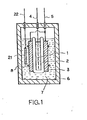
- Rechargeable cells with a structure as shown in Fig. 1 were produced using the above negative electrodes and positive electrodes, together with separators constituted by 0.3mm thick polypropylene nonwoven cloth and an 8mol/l KOH aqueous solution as the electrolyte.
- Fig. 1 is a negative electrode and 3 is a positive electrode.
- 4 and 5 are conductors of the negative electrode and positive electrode, respectively, which are electrically insulated from the cell container 6.
- 7 is the electrolyte.
- Separator 2 encloses the negative electrode in a U shape and positive electrodes 3 are positioned on opposite sides of it and held firmly contact by acrylic holders 8.
- the electrochemical capacity of the positive electrode was made somewhat larger than that of the negative electrode so that the cell performance was determined by the negative electrode characteristics, in order to permit accurate measurement of the performance of the negative electrode in this cell according to the invention.
- a reference electrode 21 made of Cd/Cd(OH) 2 was introduced into the container 6 and immersed in the electrolyte 7 in order to permit measurement of the negative electrode potential which could be obtained as the voltage of the conductor 4 vs. the conductor 22.
- Each of the cells constructed in the abovedescribed manner for the embodiment and comparison examples was subjected to charge-discharge cycles in which it was given a charge of 0.17Ah per lg of hydrogen absorbing alloy contained in the negative electrode per cycle.
- all the cells displayed a large capacity characteristic giving 100% of charge-discharge efficiency, that is 0.17Ahg -1 of discharged capacity, but the discharge capacity eventually fell with repetition of the charge-discharge cycles.
- the number of cycles at which the discharged capacity fell to 80% was taken to be the rechargeable cell's life.
- Embodiment-examples 1-7 and Comparison-example 1 in Table 1 are examples of cells manufactured using a negative electrode composed from a hydrogen absorbing alloy with the composition MNi 4.2 Mn 0.6 Al 0.2 .
- the contents of the rare earth elements in M are as noted in Table 1 and the correlation between the Ce content and cell life performance is plotted in Fig. 2.
- the cell life characteristic is improved if the Ce content in M is less than 40wt%. Further, it is improved markedly when the content is decreased to beyond 12wt% and still more when it is less than 8wt%.
- Embodiment-examples 8-10 and Comparison-example 3 in Table 1 are examples of the cells manufactured using hydrogen absorbing alloys representable by the formula MA B C in which Ni and Co are used for A, Mn is used for B, x y z Al is used for C, x is made 4.2, y is made 0.6 and z is made 0.2.
- the contents of the rare earth elements in M also are as noted in Table 1.
- the cell life characteristic is improved if the Ce content is less than 40wt% and, as seen in Fig. 3, it is improved markedly when the content is decreased to beyond 12wt% and still more when it is less than 8wt%.
- the materials used have the same compositions apart from the rare earth component M. With these alloys, the cell life is also long in all cases when Ce is less than 40wt%, and in Embodiment-example 12 in particular, with the alloy with the Ce content in M small at 4.6wt%, the cell has an excellent life characteristic of 1,000 cycles.
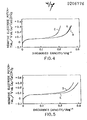
- the discharge characteristics on the 20th cycle of repeated charge-discharge at a current density of 0.17A per 1g of hydrogen absorbing alloy contained in the negative electrode are shown by curves A, B and C respectively in Fig. 4 for cells of Embodiment-examples 14, 15 and 12 in Table 1.
- the charged capacity was the same as the theoretical capacity of the hydrogen absorbing alloy contained in the electrode.
- the characteristic plot of Fig. 5 is a representation in which the abscissa is the discharged capacity per lg of alloy and the ordinate is the negative electrode potential relative to the reference electrode 21.
- Embodiment-examples 14 and 15 displayed long lives of 1,100 cycles and 1,210 cycles respectively. Comparing these results with Embodiment-example 12, whose negative electrode has an hydrogen absorbing alloy with the same composition as its main material, the electrochemical capacity is greater and the cycle life is longer with Embodiment-examples 14 and 15, which contain conductive powder with an average particle diameter of 0.03um. In other words, inclusion of conductive powder with an average particle diameter of 10 ⁇ m or less as in the invention effectively maintains electrical contact between hydrogen absorbing alloy particles in the electrode and greatly improves the electrochemical capacity of the electrode. This effect can be seen as differences in discharge characteristics that are shown in Fig. 4 as the differences between the curves A,_B and C.
- Embodiment-example 12 which does not contain conductive powder, than it is in Embodiment-examples 1 4 and 15, since current cannot flow inelectrically isolated hydrogen absorbing alloy particles.
- Embodiment-example 13 and Embodiment-example 16 are cells with negative electrodes whose main material is a hydrogen absorbing alloy in which the Ce content in M is only 2.2wt%.
- the negative electrode of Embodiment-example 16 also contains carbon powder as supplementary material.
- Curves D and E in Fig. 5 show the discharge characteristics of Embodiment-examples 13 and 16 respectively, that were measured in the same way as for the abovenoted Embodiment-examples 12, 14 and 15.
- Fig. 5 indicates that the cell of Embodiment-example 13 has a large discharged capacity of about 0.27Ahg -1 , while that of Embodiment-example 16 has an even larger capacity of about 0.30Ahg 1 .
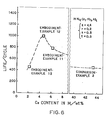
- the life characteristics shown in Table 1 the lives of Embodiment-examples 13 and 16 are shorter than those of Embodiment-example 11 or 12 though they are more than 400 cycles.
- the relation between these Embodiment-examples 11, 12 and 13 is shown in Fig. 6.
- the Ce content in M is too small, the cycle life of the cell becomes shorter, however, such a cell has the advantage of very large capacity, as seen from curves D and E in Fig. 5.
- a cell according to the invention it is possible to design a rechargeable cell with desired properties by deciding on the necessary capacity and life characteristics, taking aspects such as above into account, and going on the basis of these decisions to select the hydrogen absorbing alloy composition and conductive material that constitute the negative electrode.
- the content of Ce in M there is marked deterioration, first of the life characteristic and then of the capacity characteristic, if the amount is 40wt% or more. While if it is less than O.lwt%, the advantages of the invention fail to be achieved, since there is a marked deterioration of the life characteristic.
- Embodiment-example 17 and 18 were cells having the negative electrodes which contained the hydrogen absorbing alloy with the same composition as that used for Embodiment-examples 12 and 15 and were prepared in the same way as described above.
- the sheet of the negative electrodes of Embodiment-examples 17 and 18 had a weight of 7g.
- Embodiment-example 18 included the same conductive powder as used for Embodiment-example 15.
- sealed secondary cells with a spiral-shaped electrode structure as shown in Fig. 7 were made using positive electrodes, separators and electrolyte as in Embodiment-examples 1-16.
- a negative electrode 11, separator 12 and a positive electrode 13 were wound together in a spiral shape and put into a cell container 16 together with electrolyte 17, and sealing was effected with an insulating gasket and an O-ring 10.
- Positive electrode 13 was connected to an electrode terminal 15 by a lead wire and the negative electrode 11 was connected to cell container 16, which also served as an electrode terminal. These terminals made it possible to measure an e.m.f. of the cell.
- the capacity of the positive electrode was made equal to or less than that of the negative electrode.
- a pressure sensor was mounted on a portion of the top plate 20 of container 16 to measure the internal pressureof the cell.
- Embodiment-examples 17 and 18 were subjected to charge-discharge cycles with a charged capacity of 0.8Ah and, as seen in Fig. 8, measurements of the internal pressure of the cells showed that in both embodiments the maximum internal pressure at the end of charge was kept low for up to as many as 200 cycles. It is seen from Fig. 8 that Embodiment-example 18, which had a negative electrode containing a conductive powder as a subsidiary material, was superior, as its maximum internal pressure was less than 2kgcm -2 even when the number of charge-discharge cycles reached 200.
- an electrochemical rechargeable cell has a long cycle life if it has a negative electrode using as the main material a hydrogen absorbing alloy with a suitable composition containing a set amount of Ce. Further, both large capacity and long life characteristics are obtained if the cell includes a conductive powder with an average article diameter of 10 ⁇ m or less as subsidiary material. Moreover, cells thus constituted have the excellent advantages of the prevention of rise of internal pressure in the cell container, that of hydrogen leakage and a characteristic of slow self-discharge, that are required of sealed secondary cells.
Landscapes
- Chemical & Material Sciences (AREA)
- Chemical Kinetics & Catalysis (AREA)
- Electrochemistry (AREA)
- General Chemical & Material Sciences (AREA)
- Engineering & Computer Science (AREA)
- Materials Engineering (AREA)
- Organic Chemistry (AREA)
- Battery Electrode And Active Subsutance (AREA)
Applications Claiming Priority (6)
| Application Number | Priority Date | Filing Date | Title |
|---|---|---|---|
| JP133985/85 | 1985-06-21 | ||
| JP60133985A JP2713881B2 (ja) | 1985-06-21 | 1985-06-21 | 密閉型金属酸化物・水素電池 |
| JP61065877A JPH0754703B2 (ja) | 1986-03-26 | 1986-03-26 | 金属酸化物・水素電池 |
| JP65877/86 | 1986-03-26 | ||
| JP61107614A JPH0810596B2 (ja) | 1986-05-13 | 1986-05-13 | 金属酸化物・水素電池 |
| JP107614/86 | 1986-05-13 |
Publications (3)
| Publication Number | Publication Date |
|---|---|
| EP0206776A2 true EP0206776A2 (de) | 1986-12-30 |
| EP0206776A3 EP0206776A3 (en) | 1987-06-03 |
| EP0206776B1 EP0206776B1 (de) | 1991-03-06 |
Family
ID=27298959
Family Applications (1)
| Application Number | Title | Priority Date | Filing Date |
|---|---|---|---|
| EP86304743A Expired - Lifetime EP0206776B1 (de) | 1985-06-21 | 1986-06-20 | Wiederaufladbare elektrochemische Zelle mit einer negativen Elektrode aus einer wasserstoffabsorbierenden Legierung, die ein Element der seltenen Erden enthält |
Country Status (4)
| Country | Link |
|---|---|
| US (1) | US4696873A (de) |
| EP (1) | EP0206776B1 (de) |
| CA (1) | CA1279095C (de) |
| DE (1) | DE3677831D1 (de) |
Cited By (8)
| Publication number | Priority date | Publication date | Assignee | Title |
|---|---|---|---|---|
| EP0383991A3 (en) * | 1989-02-23 | 1990-09-12 | Matsushita Electric Industrial Co., Ltd. | Alkaline storage battery using hydrogen absorbing alloy |
| EP0432342A1 (de) * | 1989-12-13 | 1991-06-19 | Matsushita Electric Industrial Co., Ltd. | Prismatischer gasdichter alkalischer Akkumulator mit wasserstoffspeichernde Legierung enthaltender negativer Elektrode |
| EP0451575A1 (de) * | 1990-03-24 | 1991-10-16 | Japan Storage Battery Company Limited | Wasserstoffspeichernde Elektrode geeignet zur Verwendung in Nickel-Metallhydrid Sekundärbatterien |
| EP0641032A1 (de) * | 1993-08-25 | 1995-03-01 | Furukawa Denchi Kabushiki Kaisha | Elektrode aus Wasserstoffeinlagerungslegierung |
| EP0719870A1 (de) * | 1994-12-28 | 1996-07-03 | Samsung Display Devices Co., Ltd. | Elektrode aus Wasserstoffeinlagerungslegierung |
| US5738953A (en) * | 1995-04-06 | 1998-04-14 | Varta Batterie Aktiengesellschaft | Alkaline metal oxide/metal hydride battery |
| US5738958A (en) * | 1995-07-27 | 1998-04-14 | Varta Batterie Aktiengesellschaft | Alloys for use as active material for the negative electrode of an alkaline, rechargeable nickel-metal hydride battery, and process for its production |
| WO2019108120A1 (en) * | 2017-11-28 | 2019-06-06 | Nilar International Ab | Milling of recovered negative electrode material |
Families Citing this family (20)
| Publication number | Priority date | Publication date | Assignee | Title |
|---|---|---|---|---|
| NL8801233A (nl) * | 1988-05-11 | 1989-12-01 | Philips Nv | Gesloten elektrochemische cel. |
| US5536591A (en) | 1990-04-26 | 1996-07-16 | Ovonic Battery Company, Inc. | Electrochemical hydrogen storage alloys for nickel metal hydride batteries |
| JPH0685323B2 (ja) * | 1990-06-18 | 1994-10-26 | 古河電池株式会社 | 水素吸蔵電極 |
| US5110695A (en) * | 1990-06-19 | 1992-05-05 | The Royal Institution For The Advancement Of Lerning (Mcgill University) | Rechargeable electrolytic cell with amorphous alloy electrode |
| JP3238930B2 (ja) * | 1991-04-17 | 2001-12-17 | 三洋電機株式会社 | 金属−水素アルカリ蓄電池の製造方法 |
| US5290640A (en) * | 1993-03-10 | 1994-03-01 | Acme Electric Corporation | Sealed rechargeable battery |
| US5506074A (en) * | 1993-09-30 | 1996-04-09 | Sanyo Electric Co. Ltd. | Metal hydride electrode and nickel-hydrogen alkaline storage cell |
| US5656203A (en) * | 1994-07-29 | 1997-08-12 | E. I. Du Pont De Nemours And Company | Electrically conductive ceramics with oxides of Al, Cr, and Mg |
| US5569554A (en) * | 1994-09-15 | 1996-10-29 | Acme Electric Corporation | Sealed rechargeable battery with stabilizer |
| US5902700A (en) * | 1995-09-20 | 1999-05-11 | Sanyo Electric Co., Ltd. | Hydrogen storage alloy electrode and manufacturing method of the same |
| KR100398709B1 (ko) * | 1995-09-20 | 2003-12-24 | 산요덴키가부시키가이샤 | 수소흡장합금전극및수소흡장합금전극의제조방법 |
| CN1205679C (zh) * | 1995-09-28 | 2005-06-08 | 株式会社汤浅 | 储氢电极、镍电极和碱性蓄电池 |
| US6074783A (en) * | 1996-12-19 | 2000-06-13 | Duracell Inc. | Hydrogen storage alloys for use in rechargeable electrochemical cells, and methods of producing them |
| US6330925B1 (en) | 1997-01-31 | 2001-12-18 | Ovonic Battery Company, Inc. | Hybrid electric vehicle incorporating an integrated propulsion system |
| JP2000268819A (ja) * | 1999-03-15 | 2000-09-29 | Sanyo Electric Co Ltd | 水素吸蔵合金電極 |
| US20040074760A1 (en) * | 2002-10-17 | 2004-04-22 | Carnegie Mellon University | Production of biofuels |
| US7387712B2 (en) * | 2002-10-17 | 2008-06-17 | Carnegie Mellon University | Catalytic process for the treatment of organic compounds |
| US7157401B2 (en) * | 2002-10-17 | 2007-01-02 | Carnegie Mellon University | Catalyst for the treatment of organic compounds |
| US20050274065A1 (en) * | 2004-06-15 | 2005-12-15 | Carnegie Mellon University | Methods for producing biodiesel |
| US10050319B2 (en) | 2014-05-28 | 2018-08-14 | John M. Guerra | Photoelectrochemical secondary cell and battery |
Family Cites Families (11)
| Publication number | Priority date | Publication date | Assignee | Title |
|---|---|---|---|---|
| CH495060A (de) * | 1967-05-02 | 1970-08-15 | Battelle Memorial Inst Interna | Akkumulator-Elektrode mit Speichervermögen für Wasserstoff und Verfahren zu deren Herstellung |
| NL6906305A (de) * | 1969-01-24 | 1970-10-27 | ||
| US3850694A (en) * | 1972-11-27 | 1974-11-26 | Communications Satellite Corp | Low pressure nickel hydrogen cell |
| US3980501A (en) * | 1974-06-19 | 1976-09-14 | Bell Telephone Laboratories, Incorporated | Use of hydrogen-absorbing electrode in alkaline battery |
| US4024322A (en) * | 1975-03-24 | 1977-05-17 | Hooker Chemicals & Plastics Corporation | Battery with silicon metal anodes |
| FR2311858A1 (fr) * | 1975-05-23 | 1976-12-17 | Anvar | Alliages a base de lanthane et de nickel et leurs applications electrochimiques |
| NL7512833A (nl) * | 1975-11-03 | 1977-05-05 | Philips Nv | Hydriden van intermetallische verbindingen en de toepassing daarvan bij de opslag van water- stof. |
| US4292209A (en) * | 1979-05-02 | 1981-09-29 | The United States Of America As Represented By The United States Department Of Energy | Ceramic component for MHD electrode |
| US4409180A (en) * | 1982-05-26 | 1983-10-11 | Mpd Technology Corporation | Process for manufacturing rare earth intermetallic hydridable compounds |
| NL8303630A (nl) * | 1983-10-21 | 1985-05-17 | Philips Nv | Elektrochemische cel met stabiele hydridevormende materialen. |
| US4605603A (en) * | 1983-12-26 | 1986-08-12 | Kabushiki Kaisha Toshiba | Hermetically sealed metallic oxide-hydrogen battery using hydrogen storage alloy |
-
1986
- 1986-06-11 US US06/872,844 patent/US4696873A/en not_active Expired - Lifetime
- 1986-06-20 DE DE8686304743T patent/DE3677831D1/de not_active Expired - Lifetime
- 1986-06-20 CA CA000512075A patent/CA1279095C/en not_active Expired - Lifetime
- 1986-06-20 EP EP86304743A patent/EP0206776B1/de not_active Expired - Lifetime
Cited By (11)
| Publication number | Priority date | Publication date | Assignee | Title |
|---|---|---|---|---|
| EP0383991A3 (en) * | 1989-02-23 | 1990-09-12 | Matsushita Electric Industrial Co., Ltd. | Alkaline storage battery using hydrogen absorbing alloy |
| EP0432342A1 (de) * | 1989-12-13 | 1991-06-19 | Matsushita Electric Industrial Co., Ltd. | Prismatischer gasdichter alkalischer Akkumulator mit wasserstoffspeichernde Legierung enthaltender negativer Elektrode |
| EP0451575A1 (de) * | 1990-03-24 | 1991-10-16 | Japan Storage Battery Company Limited | Wasserstoffspeichernde Elektrode geeignet zur Verwendung in Nickel-Metallhydrid Sekundärbatterien |
| US5284619A (en) * | 1990-03-24 | 1994-02-08 | Japan Storage Battery Company, Limited | Hydrogen absorbing electrode for use in nickel-metal hydride secondary batteries |
| EP0641032A1 (de) * | 1993-08-25 | 1995-03-01 | Furukawa Denchi Kabushiki Kaisha | Elektrode aus Wasserstoffeinlagerungslegierung |
| US5496665A (en) * | 1993-08-25 | 1996-03-05 | Furukawa Denchi Kabushiki Kaisha | Hydrogen-occlusion-alloy electrode |
| CN1074172C (zh) * | 1994-12-26 | 2001-10-31 | 三星电管株式会社 | 储氢合金及其制造方法 |
| EP0719870A1 (de) * | 1994-12-28 | 1996-07-03 | Samsung Display Devices Co., Ltd. | Elektrode aus Wasserstoffeinlagerungslegierung |
| US5738953A (en) * | 1995-04-06 | 1998-04-14 | Varta Batterie Aktiengesellschaft | Alkaline metal oxide/metal hydride battery |
| US5738958A (en) * | 1995-07-27 | 1998-04-14 | Varta Batterie Aktiengesellschaft | Alloys for use as active material for the negative electrode of an alkaline, rechargeable nickel-metal hydride battery, and process for its production |
| WO2019108120A1 (en) * | 2017-11-28 | 2019-06-06 | Nilar International Ab | Milling of recovered negative electrode material |
Also Published As
| Publication number | Publication date |
|---|---|
| US4696873A (en) | 1987-09-29 |
| DE3677831D1 (de) | 1991-04-11 |
| EP0206776A3 (en) | 1987-06-03 |
| CA1279095C (en) | 1991-01-15 |
| EP0206776B1 (de) | 1991-03-06 |
Similar Documents
| Publication | Publication Date | Title |
|---|---|---|
| US4696873A (en) | Rechargeable electrochemical cell with a negative electrode comprising a hydrogen absorbing alloy including rare earth component | |
| US8101121B2 (en) | Hydrogen absorbing alloy for alkaline storage battery | |
| JPH0515774B2 (de) | ||
| US20090155688A1 (en) | Alkaline storage cell | |
| EP0251384A1 (de) | Elektrochemische Zelle | |
| US7582381B2 (en) | Alkaline storage cell and hydrogen storage alloy for negative electrode of alkaline storage cell | |
| US5776626A (en) | Hydrogen-occluding alloy and hydrogen-occluding alloy electrode | |
| US7198868B2 (en) | Alkaline storage battery | |
| JP3604156B2 (ja) | 電気化学的電池 | |
| JP5556142B2 (ja) | アルカリ蓄電池 | |
| JPH08190931A (ja) | 水素化物二次電池 | |
| JP2007087722A (ja) | アルカリ蓄電池 | |
| JP5171123B2 (ja) | アルカリ二次電池 | |
| JP4663275B2 (ja) | アルカリ蓄電池用水素吸蔵合金及びアルカリ蓄電池 | |
| JP4849852B2 (ja) | アルカリ蓄電池の製造方法 | |
| JPS62264557A (ja) | 金属酸化物・水素電池 | |
| JP4511298B2 (ja) | ニッケル水素蓄電池 | |
| WO1998054775A9 (en) | Hydrogen storage alloy | |
| JP2001313069A (ja) | ニツケル水素蓄電池 | |
| JPH08120364A (ja) | 電池用水素吸蔵合金,その製造方法およびニッケル水素二次電池 | |
| JPH0754703B2 (ja) | 金属酸化物・水素電池 | |
| JP2538610B2 (ja) | 金属酸化物・水素電池 | |
| JP3152845B2 (ja) | ニッケル・水素電池 | |
| JPH0690922B2 (ja) | 密閉型アルカリ蓄電池 | |
| JP3825582B2 (ja) | アルカリ蓄電池用水素吸蔵合金及びその製造方法並びにアルカリ蓄電池用水素吸蔵合金電極及びその製造方法 |
Legal Events
| Date | Code | Title | Description |
|---|---|---|---|
| PUAI | Public reference made under article 153(3) epc to a published international application that has entered the european phase |
Free format text: ORIGINAL CODE: 0009012 |
|
| 17P | Request for examination filed |
Effective date: 19860627 |
|
| AK | Designated contracting states |
Kind code of ref document: A2 Designated state(s): DE FR GB NL |
|
| PUAL | Search report despatched |
Free format text: ORIGINAL CODE: 0009013 |
|
| AK | Designated contracting states |
Kind code of ref document: A3 Designated state(s): DE FR GB NL |
|
| 17Q | First examination report despatched |
Effective date: 19890519 |
|
| GRAA | (expected) grant |
Free format text: ORIGINAL CODE: 0009210 |
|
| AK | Designated contracting states |
Kind code of ref document: B1 Designated state(s): DE FR GB NL |
|
| ET | Fr: translation filed | ||
| REF | Corresponds to: |
Ref document number: 3677831 Country of ref document: DE Date of ref document: 19910411 |
|
| PG25 | Lapsed in a contracting state [announced via postgrant information from national office to epo] |
Ref country code: NL Effective date: 19920101 |
|
| PLBE | No opposition filed within time limit |
Free format text: ORIGINAL CODE: 0009261 |
|
| STAA | Information on the status of an ep patent application or granted ep patent |
Free format text: STATUS: NO OPPOSITION FILED WITHIN TIME LIMIT |
|
| NLV4 | Nl: lapsed or anulled due to non-payment of the annual fee | ||
| 26N | No opposition filed | ||
| REG | Reference to a national code |
Ref country code: GB Ref legal event code: 746 Effective date: 19981010 |
|
| REG | Reference to a national code |
Ref country code: FR Ref legal event code: D6 |
|
| REG | Reference to a national code |
Ref country code: GB Ref legal event code: IF02 |
|
| PGFP | Annual fee paid to national office [announced via postgrant information from national office to epo] |
Ref country code: FR Payment date: 20050608 Year of fee payment: 20 |
|
| PGFP | Annual fee paid to national office [announced via postgrant information from national office to epo] |
Ref country code: GB Payment date: 20050615 Year of fee payment: 20 |
|
| PGFP | Annual fee paid to national office [announced via postgrant information from national office to epo] |
Ref country code: DE Payment date: 20050616 Year of fee payment: 20 |
|
| REG | Reference to a national code |
Ref country code: GB Ref legal event code: PE20 |
|
| PG25 | Lapsed in a contracting state [announced via postgrant information from national office to epo] |
Ref country code: GB Free format text: LAPSE BECAUSE OF EXPIRATION OF PROTECTION Effective date: 20060619 |