EP0206792A2 - Mobile Phase für die Hochleistungsflüssigkeitschromatographie - Google Patents
Mobile Phase für die Hochleistungsflüssigkeitschromatographie Download PDFInfo
- Publication number
- EP0206792A2 EP0206792A2 EP86304799A EP86304799A EP0206792A2 EP 0206792 A2 EP0206792 A2 EP 0206792A2 EP 86304799 A EP86304799 A EP 86304799A EP 86304799 A EP86304799 A EP 86304799A EP 0206792 A2 EP0206792 A2 EP 0206792A2
- Authority
- EP
- European Patent Office
- Prior art keywords
- mobile phase
- acid
- column
- group
- protein
- Prior art date
- Legal status (The legal status is an assumption and is not a legal conclusion. Google has not performed a legal analysis and makes no representation as to the accuracy of the status listed.)
- Granted
Links
Images







Classifications
-
- C—CHEMISTRY; METALLURGY
- C07—ORGANIC CHEMISTRY
- C07K—PEPTIDES
- C07K1/00—General methods for the preparation of peptides, i.e. processes for the organic chemical preparation of peptides or proteins of any length
- C07K1/14—Extraction; Separation; Purification
- C07K1/16—Extraction; Separation; Purification by chromatography
-
- B—PERFORMING OPERATIONS; TRANSPORTING
- B01—PHYSICAL OR CHEMICAL PROCESSES OR APPARATUS IN GENERAL
- B01D—SEPARATION
- B01D15/00—Separating processes involving the treatment of liquids with solid sorbents; Apparatus therefor
- B01D15/08—Selective adsorption, e.g. chromatography
- B01D15/42—Selective adsorption, e.g. chromatography characterised by the development mode, e.g. by displacement or by elution
- B01D15/424—Elution mode
- B01D15/426—Specific type of solvent
Definitions
- This invention relates to high performance liquid chromatography (HPLC). More particularly it relates to a mobile phase for use in reversed phase HPLC which is particularly suitable for the recovery of proteins.
- HPLC is established as an efficient tool in both analytical and preparative techniques for the recovery of biological products in high purity.
- Reversed phase HPLC with bonded supports (such as C 18 -silica) is optimal for highly polar solutes.
- Reversed phase HPLC generally involves the use of a polar eluent with a non-polar support. Highly polar solutes have a greater affinity for the eluent than does the support and solutes are eluted in reverse order of polarity.
- High molecular weight biological molecules such as proteins have a complex three dimensional structure which must be preserved to maintain the biological function of the sample.
- the optimal separation involves the interaction between the hydrocabonaceous groups of the support and hydrophobic surface features on the protein molecule.
- the resolution of a protein mixture on a hydrophobic column is therefore related to specific topological features of the individual protein species, with the components of lower or less accessible hydrophobic surface patches being eluted first.
- HPLC is a highly resolutive chromatographic method. Even slight compositional differences between proteins will lead to topological differences which can result in an effective separation. For example, porcine and human insulin are easily separated by HPLC, although the two molecules only have a minor difference in a single amino acid residue.
- Hydrophobic interactions between a target protein molecule and the reversed phase column must be carefully controlled. If the protein molecule is significantly destabilised in the chromatographic medium, unfolding of the three dimensional structure of the protein molecule can expose buried hydrophobic groups which can lead to additional hydrophobic interactions with the reversed phase column and prevent elution of the protein. Such increased interactions between the solute and stationary phase can lead to denaturation of the protein molecule and/or low recoveries due to irreversible multisite binding of the solute.
- Currently used mobile phases often destabilise the protein sample and thus do not allow for high yield preparative separations.
- solvents such as acetonitrile are widely used to elute polypeptide samples that are retained by reversed phase columns. Such solvents are highly toxic and cannot be used in preparative separations.
- the mobile phase for use in preparative HPLC should be mild to the protein so as not to denature it and be inert to the support. Damage to the support is not only inherently disadvantageous in relation to the support itself but can produce toxic by-products which are not acceptable with proteins which might be used for, for example, pharmaceutical applications.
- a physiological carboxylic acid of structure YCOOH where Y is a polar electron withdrawing group capable of hydrogen bonding - silanol groups in a siliconaceous support goes some way to achieving these desiderata.
- a preferred physiological carboxylic acid is a carboxylic acid which is present in vivo in a biochemical pathway such as the glycolytic pathway or the citric acid cycle. Not only are these acids of a natural origin and thus suitable in pharmaceutical applications, but unexpectedly these acids allow stabilisation of the native protein structure (so as to control the undesired interactions between the stationary phase and the solute) as well as allowing elution of the protein sample under milder chromatographic conditions. Because of the stabilisation of protein structure (and thereby limiting the number of hydrophobic contacts with the reversed phase) a lower concentration of organic solvent or a solvent of lower eluotrophic strength can be used to elute the protein molecule.
- this invention allows the use of ethanol in a mobile phase with subsequent advantages in pharmaceutical applications.
- Ethanol is not sufficiently non-polar to elute protein samples which have a high number of non-polar interactions with the stationary phase.
- This invention also allows the use of a moderate pH value (between 2.2 and 5) in the mobile phase instead of the values of pH ⁇ 2.2 or pH > 5 which are currently used in reversed phase chromatography of proteins.
- the use of moderate pH values results in greater stability of both the protein sample and the stationary phase. Therefore the purified protein is recovered with higher biological activity and is not contaminated with C 18 -silica or other degradation products caused by hydrolysis of the C 18 -silica with either the high or low pH values.
- physiological carboxylic acid of structure YCOOH associates via hydrogen bonding interactions with silanol groups of the reversed phase column. These interactions result in a dynamic layer of physiological acid being associated with the underlying silica and thereby prevent a direct interaction between the ammonium groups of protein molecules and the silanol groups present in the reversed phase packing material. These undesired interactions have been associated with loss of protein materials by irreversible binding and with peak broadening and tailing with consequent losses of separation efficiency.
- the invention may be said broadly to consist in a solution suitable for use as a mobile phase in preparative HPLC which comprises substantially pure water containing .005 to 1 molar of a physiologically acceptable carboxylic acid, the acid being of the general formula YCOOH wherein Y is a polar e-lectron withdrawing group capable of hydrogen bonding silanol groups in a siliconaceous support; said solution also containing up to 95% by volume of a physiologically acceptable organic solvent.
- Y is H, X(CR l R 2 ) n -, or a cyclic or heterocyclic ring compound substituted with hydroxy groups, wherein, X is -H, -OH, -COOH; R 1 and R 2 (which may be the same or different) are -H, -OH or -COOH, or -R 3 COOH wherein R 3 is lower alkyl; and n is 0 or an integer from 1 to 5.
- carboxylic acid is any one of the following:
- the solution contains a salt such as NaCl, KC1 or NH 4 Cl.
- carboxylic acid is citric acid or formic acid.
- said organic solvent is ethanol.
- organic solvent is methanol, propanol or isopropanol.
- the invention may be said broadly to consist in the recovery of proteins through the use of reversed phase HPLC using as a mobile phase a solution as defined herein above.
- the organic solvent of said solution is ethanol.
- Preferably said method includes the use of a support comprising silica with pendent hydrocarbon groups, such as octadecyl, alkylnitrile or alkylphenyl.
- a support comprising silica with pendent hydrocarbon groups, such as octadecyl, alkylnitrile or alkylphenyl.
- said mobile phase contains 1% NaCl.
- said support is an organic copolymer, such as TSK-PW, which has good stability to moderate pressures (up to 2000 psi) and is compatible with polypeptide samples and having pendent hydrocarbon groups such as octadecyl, alkylnitrile or alkylphenyl.
- said support is suitable for hydrophobic interaction chromatography (HIC).
- HIC hydrophobic interaction chromatography
- said support is a silica - based or organic copolymer with a coating of a polar, neutral phase, such as a diol and a light coating of hydrophobic groups, such as butyl.
- said support is C 18 -silica, with a relatively light loading of hydrocarbon groups, e.g. 9-14% for a silica of 300 m 2 /g.
- the protein sample is isolated after the chromatographic separation by ultrafiltration or dialysis.
- the combination of a physiological carboxylic acid and organic solvent in the mobile phase was chosen so that a membrane of suitable pore size would permit passage of low molecular weight molecules present in the mobile phase but not a high molecular weight protein sample.
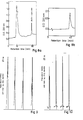
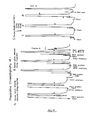
- Figure 2 COLUMN: Rad-Pak-C 18 Buffers: (as in Fig 1) Linear gradient from 0 to 100% in 1 hr at ml/min. Detection: 280 nm A 0.1 Chart: 200 mm/hr Albumin (bovine) ⁇ -lactoglobulin A) ⁇ -lactoglobulin B) not separated
- Figure 3a Instrument: Prep/LC-500 (Waters) Column: Prep-Pak-C 18 (1 cartridge) Buffers:
- Figure 3b Insulin after chromatography on the Prep/LC-500 (see 3a) Column: Rad-Pak-C 18 Buffers:
- Figure 4 Instrument: Prep/LC-500 Waters. 1.0 g bovine serum albumin (BSA) COLUMN: Prep-Pak-C 18 (1 cartridge) Buffers:
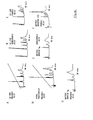
- Figure 7 Conditions as in Figure 6 100 ⁇ g of whey protein
- Figure 8a The separation of human growth hormone, Nordisk Insulin Laboratories. Conditions as in Figure 5.
- GRADIENT Linear 25 to 100% in 1.5 hr at 0.5 ml/min.
- Figure 8b The separation of human growth hormone, New Zealand National Hormone Laboratory. Conditions as in Figure 5.
- GRADIENT Linear 25 to 50% in 1 hr at 0.5 ml/min.
- Figure 9 Coating of the column with acid.
- Figure 10 Column: Waters; 8NVC18 5 ⁇ , P4136D01 Solvent: water/2-propanol 9:1 Injection of 1% citric acid (20 ⁇ l) Detection: R 401 sensitivity X 1
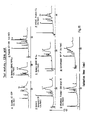
- Figure 11 Shows a test mixture of proteins on 8 different columns.
- Buffer citric acid/salt system
- Program Linear gradient usually from 15-100% B in 1 hour at 1 ml/min.
- bovine serum albumin 4 : a- lactalbumin 5(+8):myoglobin (equine skeletal muscle) 6 : ⁇ - lactoglobul in B 7.: ⁇ - lactoglobulin A
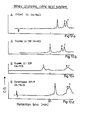
- Figure 12 Separation of whey proteins.
- SUPELCO LC-318
- C SUPELCO LC-3DP
- D SYNCHROM. INC. SYNCHROPAK RP-P Buffer : citric acid system
- Program linear gradient from 25-50% B in 1 hour at 1 ml/min
- Figure 13 Separation of insulins.
- Buffer citric acid system
- Program linear gradient from 13-20% B (column A) linear gradient from 15-25% B (others) in 1 hour at 1 ml/min
- Sample peak A) equine insulin
- B bovine insulin
- C porcine insulin
- a SUPELCO LC-3DP
- SUPELCO LC-318
- VYDAC PROTEIN-C 4
- Figure 14 Preparative chromatography of 1.0 g of bovine serum albumin.
- Instrument Prep - 500 Waters Column: 1 C18 - cartridge Buffers: A : 0.1% citric acid + 1% NaCl in H 2 O/95% EtOH 3:1 Buffer B :0.1% citric acid + 1% NaCl in H 2 0/95% EtOH 45:55 Gradient was concave and was made up from 1 buffer A and 5 1 buffer B.
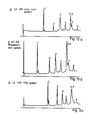
- Figure 15a A : 0.1% citric acid + 1% salt in H 2 0/IPA 9:1
- B 0.1% citric acid + 1% salt in H 2 0/IPA 1:4
- Figure 15b A : 0.1% v/v H 3 P0 4 + 1% salt in H 2 0/IPA 9:1
- B 0.1% v/v H 3 P0 4 + 1% salt in H 2 0/IPA 1:4
- Figure 15c A : 0.1% TFA + 1% salt in H 2 O/IPA 9:1
- B 0.1% TFA + 1% salt in H 2 O/IPA 1:4
- Linear gradients from 15-60% in 1 hour at 1 ml/min for A and B. From 5-60% B in 1 hour 1 ml/min for C.
- Figure 19 As in figure 18 except insulins were injected as exemplified in Example 12.
- Figure 20 As in figure 18 except whey proteins were injected as exemplified in Example 12.
- HPLC HPLC was carried out according to the techniques described in the following references:
- the gradient was delivered by two Waters HPLC pumps Model 600.0 A in combination with a Model 660 solvent programmer.
- Detection Waters Model 450 Variable Wavelength Detector at 220 mm and 2.0 Aufs.
- Buffer A 0.1% reagent in water/isopropanol 9:1
- Buffer B 0.1% reagent in water/isopropanol 1:9
- Solvents were freshly prepared and filtered through Millipore filters. (0.45 ⁇ m).
- bovine albumin (Sigma, No. A-4503) was injected in a linear gradient run from Buffer A to B in one hour at 1.0 ml/min.
- Buffer A 0.1% citric acid in water/95% ethanol 9:1 (2.2 1)
- Buffer B 0.1% citric acid in waterI95% ethanol 1:9 (3 1)
- the concave gradient was obtained by a simple mixing flask containing buffer A. This flask is closed with a rubber bung through which one "TEFLON" (a trade mark) tube leads to the chromatograph, the other to buffer B. Buffer B automatically flows into this mixing flask when the pump is running.
- TEFLON a trade mark
- the albumin sample (1.0 gram) is dissolved in 200 ml of water and pumped onto the column, the system is washed with 200 ml of buffer A after which the gradient is started.
- the albumin solution obtained above is diluted to about 20% alcohol and subjected to ultrafiltration.
- the buffer components are-removed.
- the albumin may be freeze dried to a colourless powder.
- the albumin solution can be adjusted to a desirable buffer composition for direct use.
- Insulin may be treated by the method set out in example 2 of United Kingdom Patent Specification No. 1,285,024 except that the ion exchanger to be used is "INDION-QAE" (trade mark). This is a strongly basic ion exchanger whose functional group is quaternary amine and whose counter ion is chloride.
- Figures. 1 and 2 show separation of porcine insulin from bovine albumin and albumin from ⁇ -lactoglobulin A and B respectively.
- Figure 3a shows a preparative chromatography run (Prep. 500) of porcine insulin (1 gram) with. citric acid - ethanol system (see example 1).
- Figure 3b is the analytical chromatogram of the preparative run in 3a.
- Figure shows a combination of Figures 1 and 2 and illustrates excellent separation of insulin, albumin and ⁇ -lactoglobulin A and B.
- Figure 6 illustrates that fine tuning leads to separation of the ⁇ -lactoglobulins.
- Figure 7 shows clear separation of whey protein components.
- FIG 8a shows how a commercial sample of human growth (HGH) can be clearly separated from several very minor contaminants.
- Figure 8b illustrates a sample of HGH from a source in New Zealand.
- BSA bovine serum Albumin
- the recoveries may vary considerably, unless the selection of the mobile phase and gradient condition is carefully made.
- the 250 mm columns like the Whatman Protesil - 300 OCTYL25 and Synchropak RP-P (CR 103-25) give rise to fairly high backpressures and are therefore not ideal with solvent systems of high viscosity.
- an ideal column for analytical protein separations in the systems described is short (50 or at the most 100mm long) and has a pore size of O approximately 30 nm (300 A).
- a concave gradient was now started using a 1 1 of buffer A and 5 1 of buffer B.
- a column was packed with Synchroprep a C18-silica, spherical, 30 with 300 A pores. Column dimensions 250 x 10 mm 0. A number of automatic purifications of proteins were carried out.
- the first peak is a mixture of citric acid added to the sample and N-acetyltryptophan, present in the sample as a stabiliser.
- the second peak is albumin. Arrows indicate where trapping was started and ended.
- BSA (40 mg) was injected repeatedly.
- the procedure was as in example 11A but the gradient used was from 50-60% B at 1.5 ml/min in 15 minutes. An abrupt change to initial conditions was possible after 30 minutes.
- Figure 17B shows a simulated automatic run where insul was injected every 36 minutes.
- Retention times of the proteins are influenced when relatively large quantities are injected.
- the proteins are dissolve in the same solvent in which the column is equilibrated. In the cas of insulin this is possible if enough solid citric acid is added to mixture.
- BSA 200mg, Sigma
- Insulin 200mg Nordisk was suspended in 10 ml of a mixture of buffer B and 55% buffer A. Solid citric acid was added until all insulin was dissolved.
- Reversed phase columns used for this work were the Supelco LC-3 and the Vydac Protein-C4 as examples of wide pore (300A) columns an the Waters Novapak C18 and 8NVC18 5 ⁇ as examples of narrow pore C18-silicas.
- the buffer systems were:
Landscapes
- Chemical & Material Sciences (AREA)
- Analytical Chemistry (AREA)
- Organic Chemistry (AREA)
- Life Sciences & Earth Sciences (AREA)
- Molecular Biology (AREA)
- Biochemistry (AREA)
- Biophysics (AREA)
- General Health & Medical Sciences (AREA)
- Genetics & Genomics (AREA)
- Medicinal Chemistry (AREA)
- Health & Medical Sciences (AREA)
- Proteomics, Peptides & Aminoacids (AREA)
- Chemical Kinetics & Catalysis (AREA)
- Peptides Or Proteins (AREA)
- Steroid Compounds (AREA)
- Medicines That Contain Protein Lipid Enzymes And Other Medicines (AREA)
- Treatment Of Liquids With Adsorbents In General (AREA)
Priority Applications (1)
| Application Number | Priority Date | Filing Date | Title |
|---|---|---|---|
| AT86304799T ATE69237T1 (de) | 1985-06-24 | 1986-06-23 | Mobile phase fuer die hochleistungsfluessigkeitschromatographie. |
Applications Claiming Priority (2)
| Application Number | Priority Date | Filing Date | Title |
|---|---|---|---|
| NZ212523A NZ212523A (en) | 1985-06-24 | 1985-06-24 | Mobile phase for purification of proteins by high performance liquid chromatography |
| NZ212523 | 1985-06-24 |
Publications (3)
| Publication Number | Publication Date |
|---|---|
| EP0206792A2 true EP0206792A2 (de) | 1986-12-30 |
| EP0206792A3 EP0206792A3 (en) | 1987-06-10 |
| EP0206792B1 EP0206792B1 (de) | 1991-11-06 |
Family
ID=19921253
Family Applications (1)
| Application Number | Title | Priority Date | Filing Date |
|---|---|---|---|
| EP86304799A Expired - Lifetime EP0206792B1 (de) | 1985-06-24 | 1986-06-23 | Mobile Phase für die Hochleistungsflüssigkeitschromatographie |
Country Status (9)
| Country | Link |
|---|---|
| US (1) | US4909941A (de) |
| EP (1) | EP0206792B1 (de) |
| JP (1) | JPS62188963A (de) |
| AT (1) | ATE69237T1 (de) |
| AU (1) | AU583388B2 (de) |
| CA (1) | CA1262121A (de) |
| DE (1) | DE3682333D1 (de) |
| NZ (1) | NZ212523A (de) |
| ZA (1) | ZA864660B (de) |
Cited By (3)
| Publication number | Priority date | Publication date | Assignee | Title |
|---|---|---|---|---|
| WO2010092303A1 (fr) | 2009-02-13 | 2010-08-19 | Max Bayer | Eluant complet pour chromatographie et utilisation |
| US8067554B2 (en) | 1999-03-15 | 2011-11-29 | Novo Nordisk A/S | Ion exchange chromatography of GLP-1, analogs and derivatives thereof |
| CN111405934A (zh) * | 2017-09-26 | 2020-07-10 | 沃特世科技公司 | 包含用于保留酸性分析物的可电离改性剂的高纯度色谱材料 |
Families Citing this family (10)
| Publication number | Priority date | Publication date | Assignee | Title |
|---|---|---|---|---|
| US6497820B1 (en) | 1998-02-03 | 2002-12-24 | Arqule, Inc. | Rapid method for separation of small molecules using reverse phase high performance liquid chromatography |
| US5968361A (en) * | 1998-02-24 | 1999-10-19 | Arqule, Inc. | Rapid method for separation of small molecules using reverse phase high performance liquid chromatography |
| US6451987B1 (en) * | 1999-03-15 | 2002-09-17 | Novo Nordisk A/S | Ion exchange chromatography of proteins and peptides |
| US6966992B2 (en) * | 2001-03-19 | 2005-11-22 | Akzo Nobel Nv | Method of purification of molecules using unbranched terminal alkyldiols |
| US7125492B2 (en) * | 2003-07-17 | 2006-10-24 | Agilent Technologies, Inc. | Additives for reversed-phase HPLC mobile phases |
| WO2006088793A1 (en) * | 2005-02-12 | 2006-08-24 | Shark Defense Llc | Elasmobranch-repelling compounds, methods of use and devices |
| WO2006135876A2 (en) | 2005-06-11 | 2006-12-21 | Shark Defense Llc | Elasmobranch-repelling compounds and methods of use |
| WO2008106043A2 (en) * | 2007-02-26 | 2008-09-04 | Alltech Associates Inc. | Ultra-fast chromatography |
| CN113994205B (zh) * | 2019-06-07 | 2025-05-27 | 沃特世科技公司 | 使用金属螯合剂作为流动相添加剂改善基于rplc的肽图分析色谱性能 |
| CN117007691A (zh) * | 2022-04-28 | 2023-11-07 | 上海市质量监督检验技术研究院 | 一种液体乳中热敏性活性蛋白含量的检测方法 |
Family Cites Families (22)
| Publication number | Priority date | Publication date | Assignee | Title |
|---|---|---|---|---|
| US3907676A (en) * | 1970-07-28 | 1975-09-23 | Novo Terapeutisk Labor As | Process for purifying insulin |
| US4073725A (en) * | 1975-05-09 | 1978-02-14 | Hitachi, Ltd. | Method and apparatus for liquid chromatography under elevated pressure |
| DE2616984C3 (de) * | 1976-04-17 | 1981-10-29 | Behringwerke Ag, 3550 Marburg | Verfahren zur Isolierung und Reinigung eines plazentenspezifischen Glycoproteins |
| US4122094A (en) * | 1976-06-09 | 1978-10-24 | Lever Brothers Company | Separation of the isomers of tocopherol by liquid/solid chromatography |
| JPS594664B2 (ja) * | 1976-11-10 | 1984-01-31 | 株式会社日立製作所 | イオン交換クロマトグラフイ− |
| US4377482A (en) * | 1978-04-28 | 1983-03-22 | Salk Institute For Biological Studies | Mobile phase for liquid chromatography |
| IN150740B (de) * | 1978-11-24 | 1982-12-04 | Hoffmann La Roche | |
| EP0021817B1 (de) * | 1979-06-22 | 1985-10-02 | Sekisui Kagaku Kogyo Kabushiki Kaisha | Füllmaterial für Flüssigkeits-Chromatographie, Verfahren zur Trennung wasserlöslicher Substanzen mit diesem Füllstoff und Verwendung dieses Füllstoffes bei der Trennung wasserlöslicher biochemischer Substanzen |
| US4549965A (en) * | 1980-09-02 | 1985-10-29 | The Dow Chemical Company | Liquid chromatographic method and apparatus with membrane for post-column derivatization |
| US4691055A (en) * | 1981-12-07 | 1987-09-01 | Cpc International Inc. | Concentration of organic chemicals from dilute aqueous solutions |
| JPS58140024A (ja) * | 1982-02-15 | 1983-08-19 | Eisai Co Ltd | セクレチンの精製方法 |
| CA1220700A (en) * | 1982-08-06 | 1987-04-21 | Kureha Kagaku Kogyo Kabushiki Kaisha | Aqueous solution as an eluant used in liquid chromatography |
| US4530963A (en) * | 1982-08-20 | 1985-07-23 | Devoe-Holbein International, N.V. | Insoluble chelating compositions |
| JPS5967456A (ja) * | 1982-10-12 | 1984-04-17 | Asahi Chem Ind Co Ltd | クロマトグラフイ−によるアルブミンの分離方法 |
| JPS5985957A (ja) * | 1982-11-09 | 1984-05-18 | Toyo Soda Mfg Co Ltd | 陰イオンの分離分析方法 |
| US4485017A (en) * | 1982-12-22 | 1984-11-27 | Cetus Corporation | Isolation of human interferon by immunosorbent and high performance liquid chromatography |
| JPS6075530A (ja) * | 1983-09-30 | 1985-04-27 | Asahi Chem Ind Co Ltd | 金属元素の新しい分離精製方法 |
| US4525465A (en) * | 1983-10-07 | 1985-06-25 | Nippon Kayaku Kabushiki Kaisha | Water-insoluble biospecific absorbent containing argininal derivative |
| US4499014A (en) * | 1984-02-07 | 1985-02-12 | Interferon Sciences, Inc. | Method for purifying gamma-interferon |
| US4539399A (en) * | 1984-07-27 | 1985-09-03 | Advanced Separation Technologies Inc. | Bonded phase material for chromatographic separations |
| FR2570615B1 (fr) * | 1984-09-26 | 1986-12-26 | Centre Nat Rech Scient | Nouveau complexe d'elution notamment pour chromatographie d'affinite |
| US4673733A (en) * | 1985-04-11 | 1987-06-16 | Sudhish Chandra | Treatment of biological and pharmaceutical products adsorbed on a solid phase with virus and pyrogen inactivating agents |
-
1985
- 1985-06-24 NZ NZ212523A patent/NZ212523A/xx unknown
-
1986
- 1986-06-23 CA CA000512160A patent/CA1262121A/en not_active Expired
- 1986-06-23 DE DE8686304799T patent/DE3682333D1/de not_active Expired - Lifetime
- 1986-06-23 ZA ZA864660A patent/ZA864660B/xx unknown
- 1986-06-23 AT AT86304799T patent/ATE69237T1/de not_active IP Right Cessation
- 1986-06-23 EP EP86304799A patent/EP0206792B1/de not_active Expired - Lifetime
- 1986-06-23 AU AU58948/86A patent/AU583388B2/en not_active Ceased
- 1986-06-24 JP JP61146284A patent/JPS62188963A/ja active Pending
-
1988
- 1988-12-08 US US07/281,548 patent/US4909941A/en not_active Expired - Lifetime
Cited By (4)
| Publication number | Priority date | Publication date | Assignee | Title |
|---|---|---|---|---|
| US8067554B2 (en) | 1999-03-15 | 2011-11-29 | Novo Nordisk A/S | Ion exchange chromatography of GLP-1, analogs and derivatives thereof |
| WO2010092303A1 (fr) | 2009-02-13 | 2010-08-19 | Max Bayer | Eluant complet pour chromatographie et utilisation |
| CN111405934A (zh) * | 2017-09-26 | 2020-07-10 | 沃特世科技公司 | 包含用于保留酸性分析物的可电离改性剂的高纯度色谱材料 |
| CN111405934B (zh) * | 2017-09-26 | 2022-04-26 | 沃特世科技公司 | 用于离析、分离、纯化或检测酸性极性分子的方法 |
Also Published As
| Publication number | Publication date |
|---|---|
| US4909941A (en) | 1990-03-20 |
| DE3682333D1 (de) | 1991-12-12 |
| ZA864660B (en) | 1987-06-24 |
| EP0206792A3 (en) | 1987-06-10 |
| EP0206792B1 (de) | 1991-11-06 |
| AU583388B2 (en) | 1989-04-27 |
| ATE69237T1 (de) | 1991-11-15 |
| JPS62188963A (ja) | 1987-08-18 |
| CA1262121A (en) | 1989-10-03 |
| NZ212523A (en) | 1989-01-06 |
| AU5894886A (en) | 1987-01-08 |
Similar Documents
| Publication | Publication Date | Title |
|---|---|---|
| Tarr et al. | Reverse-phase high-performance liquid chromatography of hydrophobic proteins and fragments thereof | |
| EP0206792B1 (de) | Mobile Phase für die Hochleistungsflüssigkeitschromatographie | |
| JPS646201B2 (de) | ||
| Westall | The amino acids and other ampholytes of urine. 3. Unidentified substances excreted in normal human urine | |
| US20100317827A1 (en) | Method of Purifying a Peptide | |
| US4377482A (en) | Mobile phase for liquid chromatography | |
| Heukeshoven et al. | Reversed-phase high-performance liquid chromatography of virus proteins and other large hydrophobic proteins in formic acid containing solvents | |
| Hancock et al. | High-pressure liquid chromatography of peptides and proteins XI. The use of cationic reagents for the analysis of peptides by high-pressure liquid chromatography | |
| Herraiz et al. | Evaluation of solid-phase extraction procedures in peptide analysis | |
| Grant et al. | Effects of sodium dodecyl sulfate and other dissociating reagents on the globulins of peas | |
| van der Rest et al. | A comprehensive approach to the study of collagen primary structure based on high‐performance liquid chromatography | |
| Herraez-Hernandez et al. | Determination of the total concentration of highly protein-bound drugs in plasma by on-line dialysis and column liquid chromatography: application to non-steroidal anti-inflammatory drugs | |
| Ma et al. | Recent advances in peptide separation by countercurrent chromatography | |
| Agas⊘ ster | Automated determination of oxytetracycline residues in muscle, liver, milk and egg by on‐line dialysis and post‐column reaction detection HPLC | |
| Rusconi et al. | Reversed-phase high-performance liquid chromatographic characterization of a novel proline-rich trytophyllin | |
| Pusztai et al. | Protein body membranes of Phaseolus vulgaris L. cotyledons: isolation and preliminary characterization of constituent proteins | |
| Schlüter et al. | Application of non-size-related separation effects to the purification of biologically active substances with a size-exclusion gel | |
| Porath et al. | Thiophilic adsorption: A new kind of molecular interaction revealed by chromatography | |
| Josić et al. | Crown ethers as ligands for high-performance liquid chromatography of proteins and nucleic acids | |
| Schooley et al. | Isolation techniques for insect neuropeptides | |
| Lin et al. | Evidence of the importance of pH and salt concentration on column chromatography with Sepharose gel filtration in separation of proteins | |
| US5567620A (en) | Non-denaturing potency assay for somatotropin | |
| Byrnes | Reversed-Phase High-Performance Liquid Chromatography: A Semipreparative Methodology | |
| AU6094794A (en) | Non-denaturing potency assay for bovine somatotropin | |
| Kamp | High performance liquid chromatography of proteins |
Legal Events
| Date | Code | Title | Description |
|---|---|---|---|
| PUAI | Public reference made under article 153(3) epc to a published international application that has entered the european phase |
Free format text: ORIGINAL CODE: 0009012 |
|
| AK | Designated contracting states |
Kind code of ref document: A2 Designated state(s): AT BE CH DE FR GB IT LI LU NL SE |
|
| PUAL | Search report despatched |
Free format text: ORIGINAL CODE: 0009013 |
|
| AK | Designated contracting states |
Kind code of ref document: A3 Designated state(s): AT BE CH DE FR GB IT LI LU NL SE |
|
| 17P | Request for examination filed |
Effective date: 19870918 |
|
| 17Q | First examination report despatched |
Effective date: 19890626 |
|
| GRAA | (expected) grant |
Free format text: ORIGINAL CODE: 0009210 |
|
| AK | Designated contracting states |
Kind code of ref document: B1 Designated state(s): AT BE CH DE FR GB IT LI LU NL SE |
|
| REF | Corresponds to: |
Ref document number: 69237 Country of ref document: AT Date of ref document: 19911115 Kind code of ref document: T |
|
| REF | Corresponds to: |
Ref document number: 3682333 Country of ref document: DE Date of ref document: 19911212 |
|
| ITF | It: translation for a ep patent filed | ||
| ET | Fr: translation filed | ||
| PLBE | No opposition filed within time limit |
Free format text: ORIGINAL CODE: 0009261 |
|
| STAA | Information on the status of an ep patent application or granted ep patent |
Free format text: STATUS: NO OPPOSITION FILED WITHIN TIME LIMIT |
|
| 26N | No opposition filed | ||
| EPTA | Lu: last paid annual fee | ||
| EAL | Se: european patent in force in sweden |
Ref document number: 86304799.9 |
|
| REG | Reference to a national code |
Ref country code: GB Ref legal event code: IF02 |
|
| REG | Reference to a national code |
Ref country code: CH Ref legal event code: NV Representative=s name: MICHELI & CIE INGENIEURS-CONSEILS |
|
| PGFP | Annual fee paid to national office [announced via postgrant information from national office to epo] |
Ref country code: LU Payment date: 20030618 Year of fee payment: 18 |
|
| PGFP | Annual fee paid to national office [announced via postgrant information from national office to epo] |
Ref country code: CH Payment date: 20030826 Year of fee payment: 18 |
|
| PGFP | Annual fee paid to national office [announced via postgrant information from national office to epo] |
Ref country code: SE Payment date: 20040519 Year of fee payment: 19 |
|
| PGFP | Annual fee paid to national office [announced via postgrant information from national office to epo] |
Ref country code: AT Payment date: 20040528 Year of fee payment: 19 |
|
| PGFP | Annual fee paid to national office [announced via postgrant information from national office to epo] |
Ref country code: GB Payment date: 20040611 Year of fee payment: 19 |
|
| PG25 | Lapsed in a contracting state [announced via postgrant information from national office to epo] |
Ref country code: LU Free format text: LAPSE BECAUSE OF NON-PAYMENT OF DUE FEES Effective date: 20040623 |
|
| PGFP | Annual fee paid to national office [announced via postgrant information from national office to epo] |
Ref country code: BE Payment date: 20040623 Year of fee payment: 19 |
|
| PGFP | Annual fee paid to national office [announced via postgrant information from national office to epo] |
Ref country code: NL Payment date: 20040624 Year of fee payment: 19 |
|
| PGFP | Annual fee paid to national office [announced via postgrant information from national office to epo] |
Ref country code: FR Payment date: 20040628 Year of fee payment: 19 |
|
| PG25 | Lapsed in a contracting state [announced via postgrant information from national office to epo] |
Ref country code: LI Free format text: LAPSE BECAUSE OF NON-PAYMENT OF DUE FEES Effective date: 20040630 Ref country code: CH Free format text: LAPSE BECAUSE OF NON-PAYMENT OF DUE FEES Effective date: 20040630 |
|
| PGFP | Annual fee paid to national office [announced via postgrant information from national office to epo] |
Ref country code: DE Payment date: 20040830 Year of fee payment: 19 |
|
| REG | Reference to a national code |
Ref country code: CH Ref legal event code: PL |
|
| PG25 | Lapsed in a contracting state [announced via postgrant information from national office to epo] |
Ref country code: IT Free format text: LAPSE BECAUSE OF NON-PAYMENT OF DUE FEES;WARNING: LAPSES OF ITALIAN PATENTS WITH EFFECTIVE DATE BEFORE 2007 MAY HAVE OCCURRED AT ANY TIME BEFORE 2007. THE CORRECT EFFECTIVE DATE MAY BE DIFFERENT FROM THE ONE RECORDED. Effective date: 20050623 Ref country code: GB Free format text: LAPSE BECAUSE OF NON-PAYMENT OF DUE FEES Effective date: 20050623 Ref country code: AT Free format text: LAPSE BECAUSE OF NON-PAYMENT OF DUE FEES Effective date: 20050623 |
|
| PG25 | Lapsed in a contracting state [announced via postgrant information from national office to epo] |
Ref country code: SE Free format text: LAPSE BECAUSE OF NON-PAYMENT OF DUE FEES Effective date: 20050624 |
|
| PG25 | Lapsed in a contracting state [announced via postgrant information from national office to epo] |
Ref country code: BE Free format text: LAPSE BECAUSE OF NON-PAYMENT OF DUE FEES Effective date: 20050630 |
|
| PG25 | Lapsed in a contracting state [announced via postgrant information from national office to epo] |
Ref country code: NL Free format text: LAPSE BECAUSE OF NON-PAYMENT OF DUE FEES Effective date: 20060101 |
|
| PG25 | Lapsed in a contracting state [announced via postgrant information from national office to epo] |
Ref country code: DE Free format text: LAPSE BECAUSE OF NON-PAYMENT OF DUE FEES Effective date: 20060103 |
|
| EUG | Se: european patent has lapsed | ||
| PG25 | Lapsed in a contracting state [announced via postgrant information from national office to epo] |
Ref country code: FR Free format text: LAPSE BECAUSE OF NON-PAYMENT OF DUE FEES Effective date: 20060228 |
|
| GBPC | Gb: european patent ceased through non-payment of renewal fee |
Effective date: 20050623 |
|
| NLV4 | Nl: lapsed or anulled due to non-payment of the annual fee |
Effective date: 20060101 |
|
| REG | Reference to a national code |
Ref country code: FR Ref legal event code: ST Effective date: 20060228 |
|
| BERE | Be: lapsed |
Owner name: *MASSEY UNIVERSITY Effective date: 20050630 |